Diagnostic Microbiology Lab. 
By 
Dr. Nabil El Aila 
Assistant Professor of Molecular Microbiology 
Medical Technology Department 
Al -Aqsa University
A 
B 
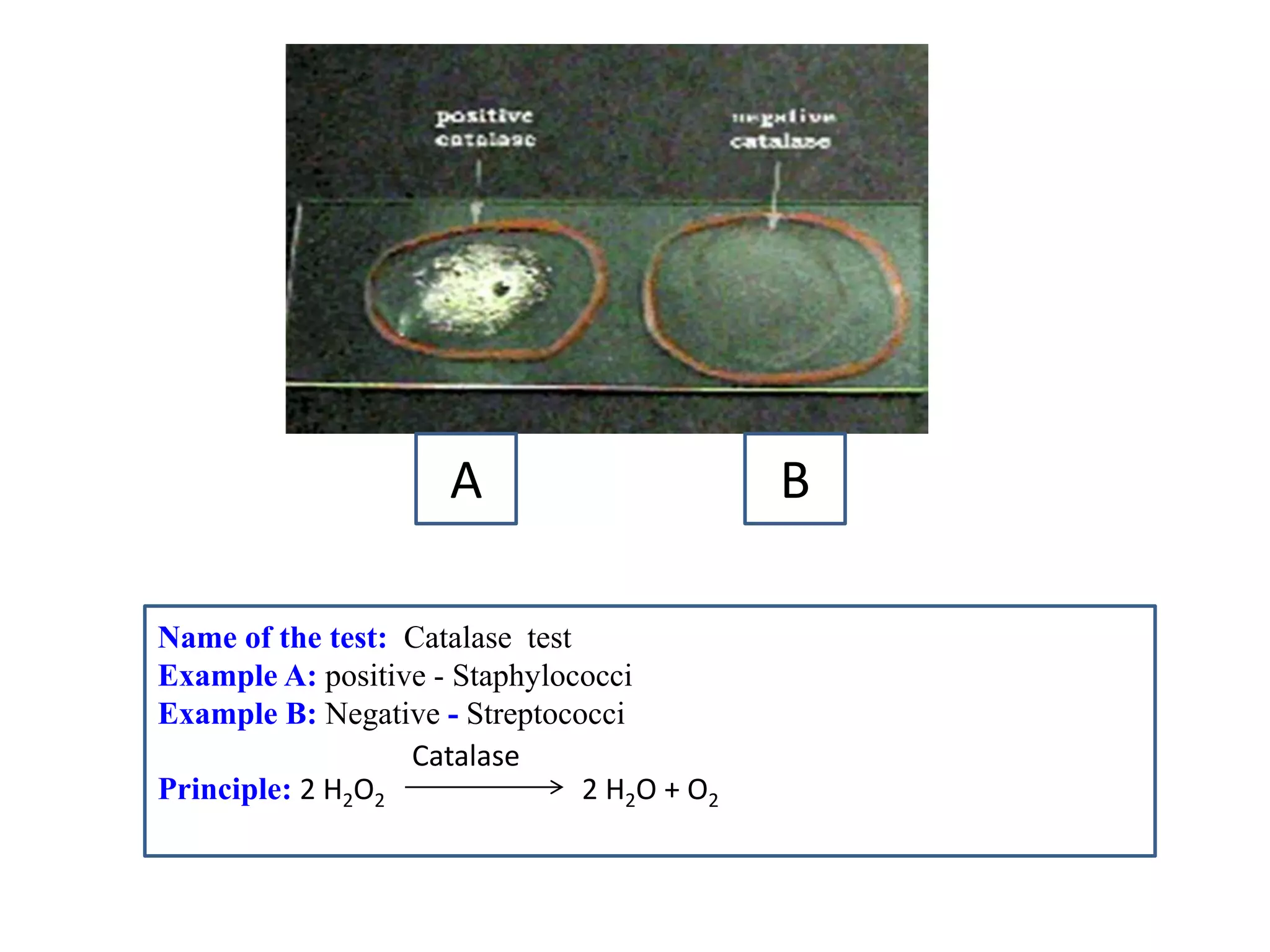
Name of the test: Catalase test 
Example A: positive - Staphylococci 
Example B: Negative - Streptococci 
Principle: 2 H2O2 2 H2O + O2 
Catalase
A 
B 
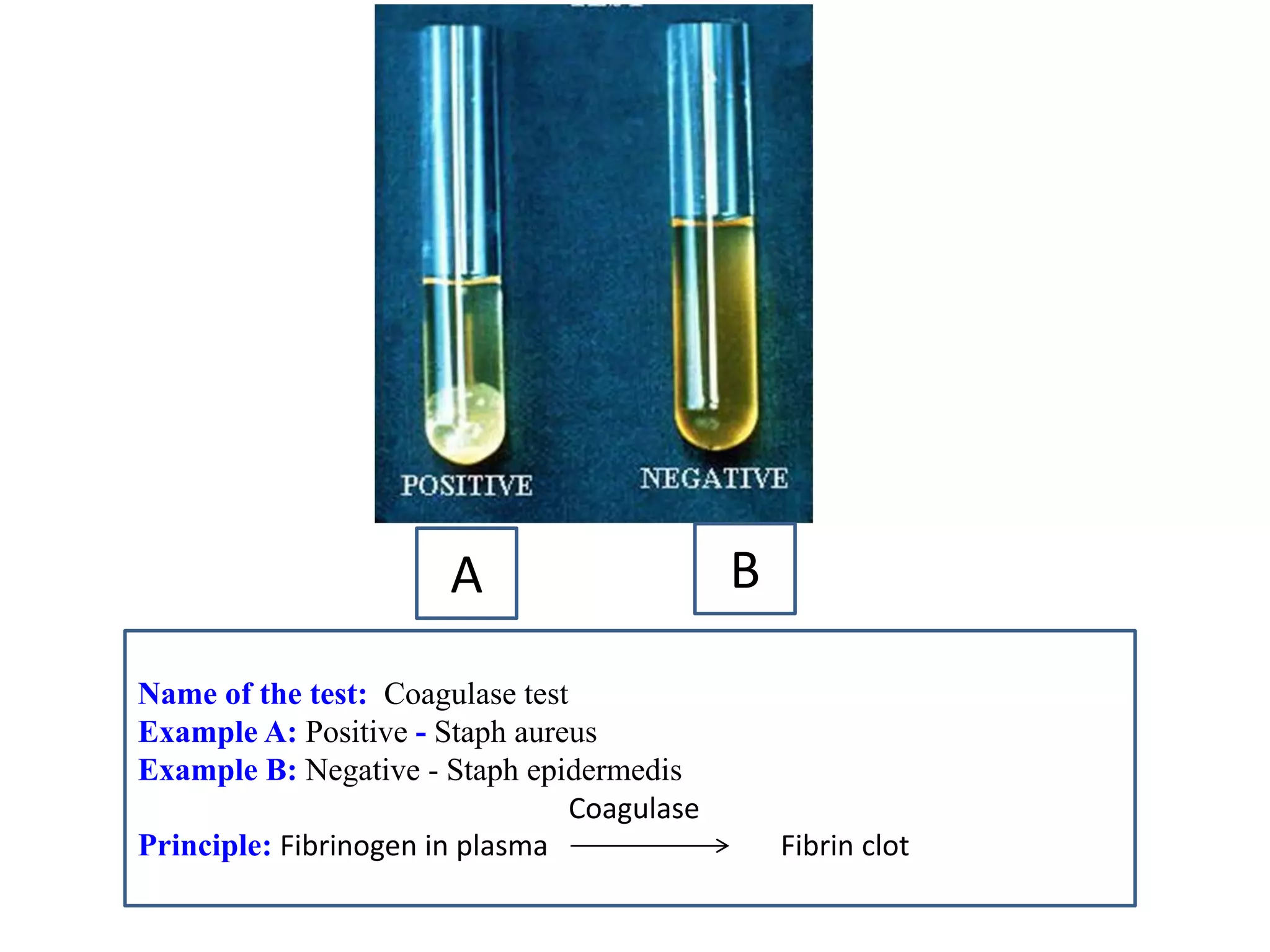
Name of the test: Coagulase test 
Example A: Positive - Staph aureus 
Example B: Negative - Staph epidermedis 
Principle: Fibrinogen in plasma Fibrin clot 
Coagulase
A 
B 
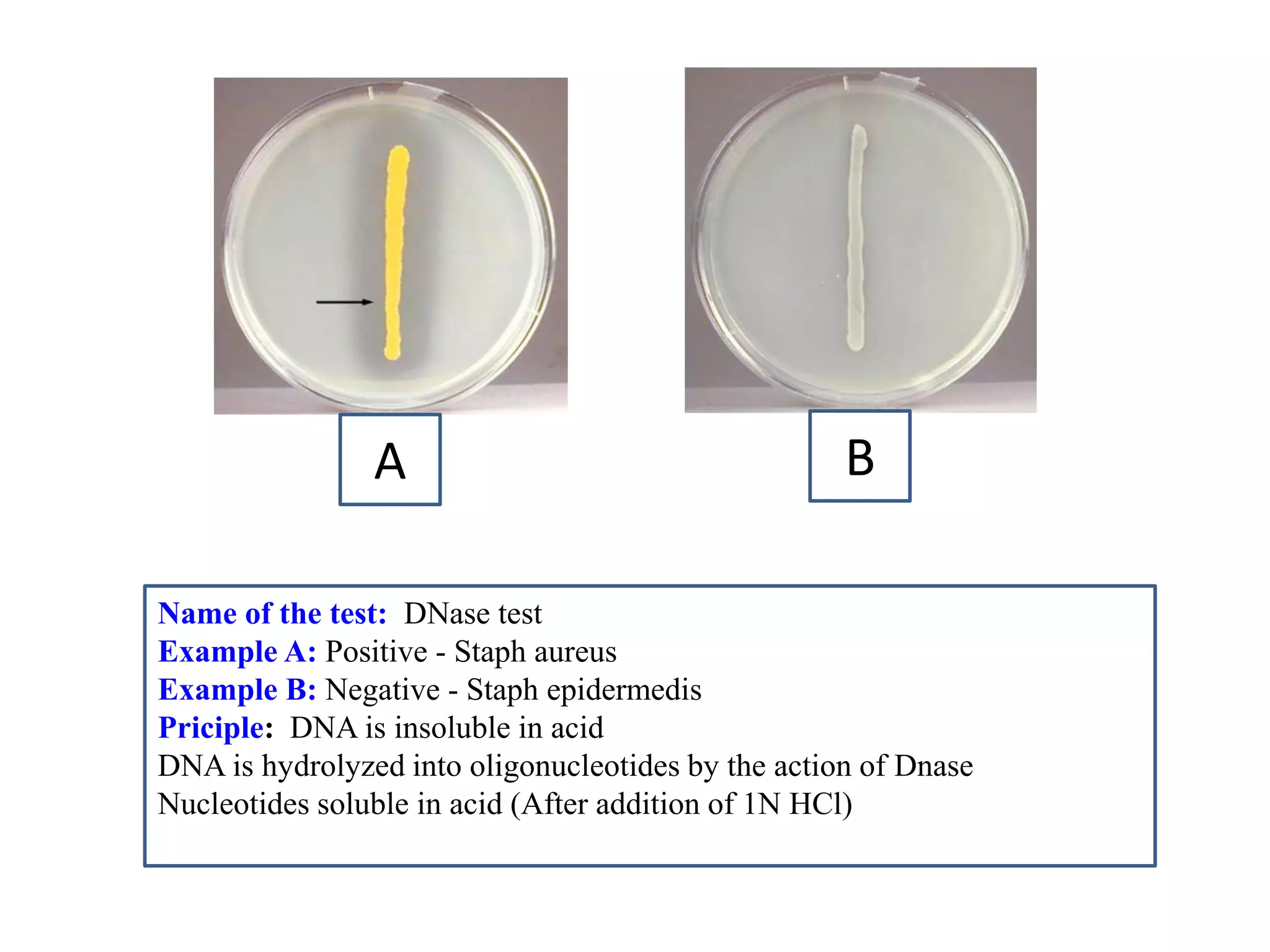
Name of the test: DNase test 
Example A: Positive - Staph aureus 
Example B: Negative - Staph epidermedis 
Priciple: DNA is insoluble in acid 
DNA is hydrolyzed into oligonucleotides by the action of Dnase 
Nucleotides soluble in acid (After addition of 1N HCl)
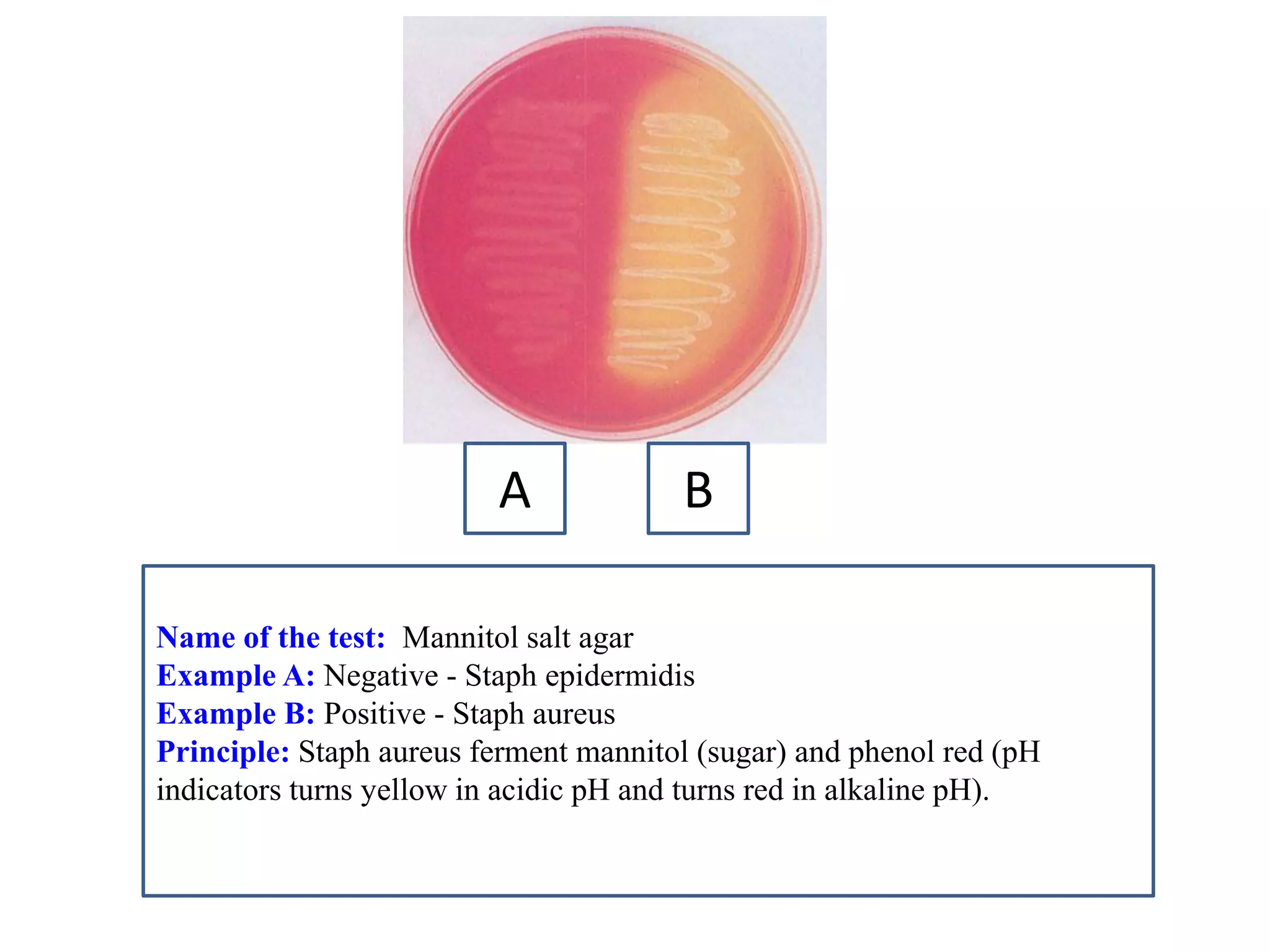
Name of the test: Mannitol salt agar 
Example A: Negative - Staph epidermidis 
Example B: Positive - Staph aureus 
Principle: Staph aureus ferment mannitol (sugar) and phenol red (pH indicators turns yellow in acidic pH and turns red in alkaline pH). 
A 
B
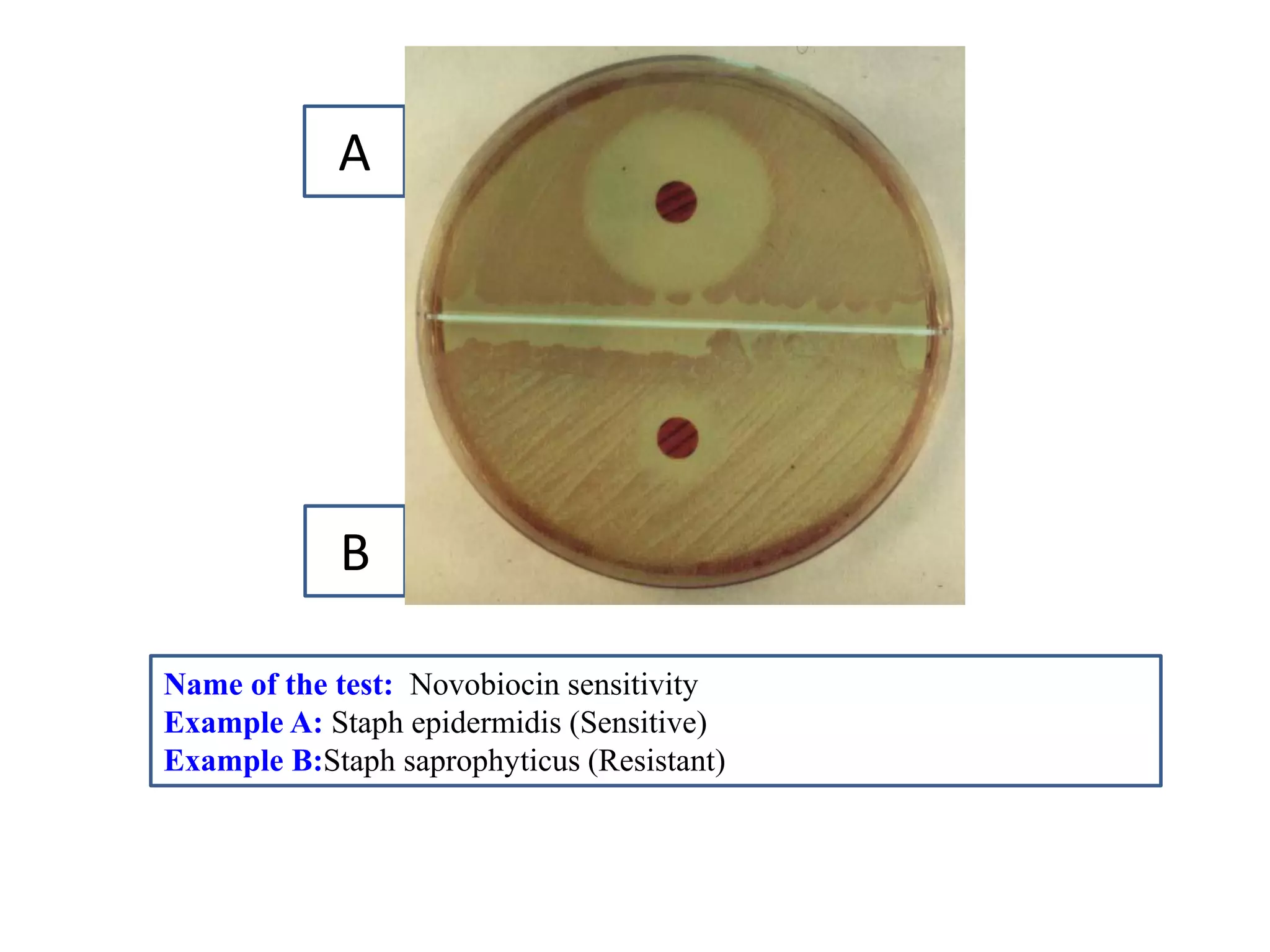
Name of the test: Novobiocin sensitivity 
Example A: Staph epidermidis (Sensitive) 
Example B:Staph saprophyticus (Resistant) 
A 
B
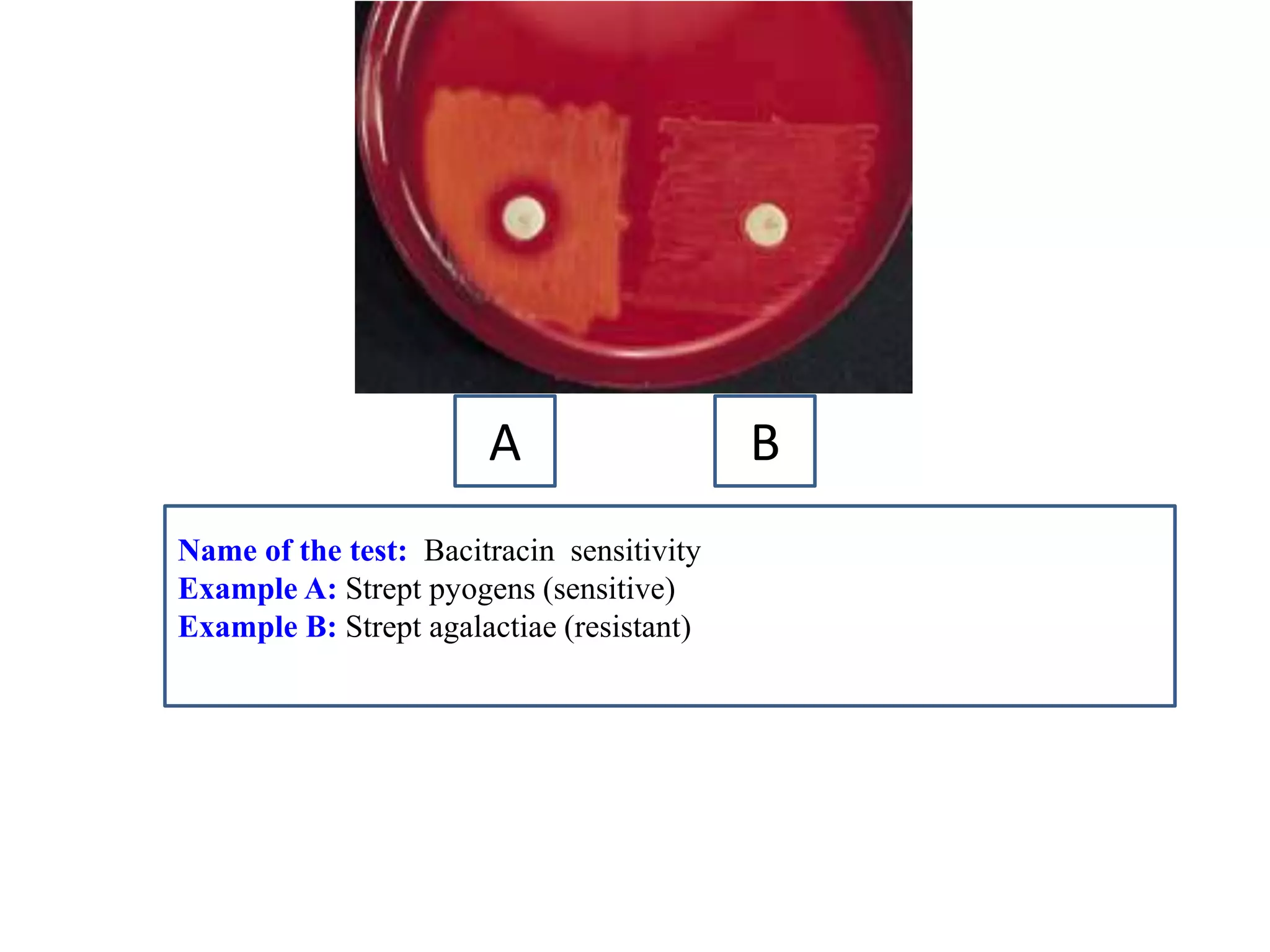
Name of the test: Bacitracin sensitivity 
Example A: Strept pyogens (sensitive) 
Example B: Strept agalactiae (resistant) 
A 
B
A 
B 
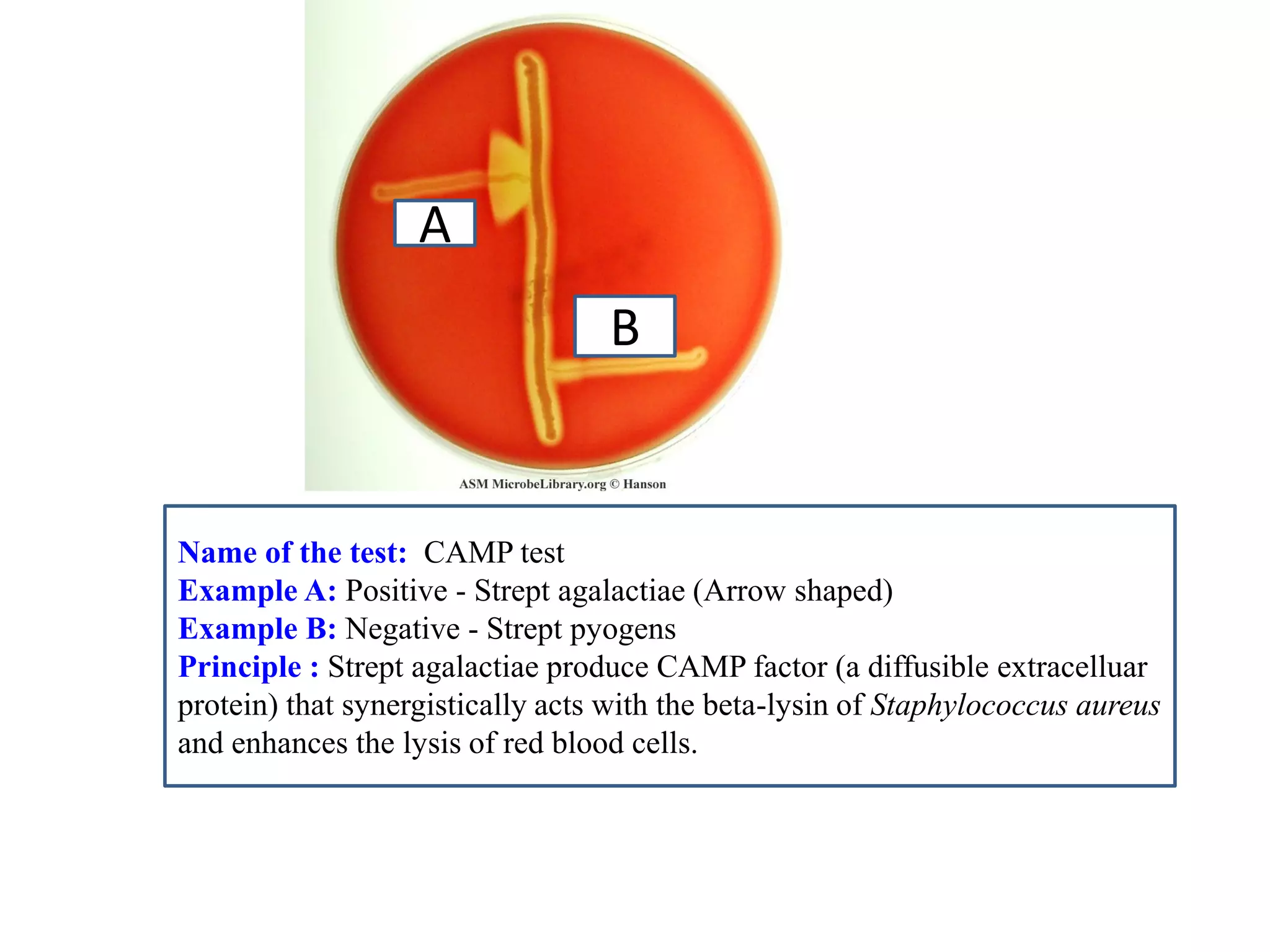
Name of the test: CAMP test 
Example A: Positive - Strept agalactiae (Arrow shaped) 
Example B: Negative - Strept pyogens 
Principle : Strept agalactiae produce CAMP factor (a diffusible extracelluar protein) that synergistically acts with the beta-lysin of Staphylococcus aureus and enhances the lysis of red blood cells.
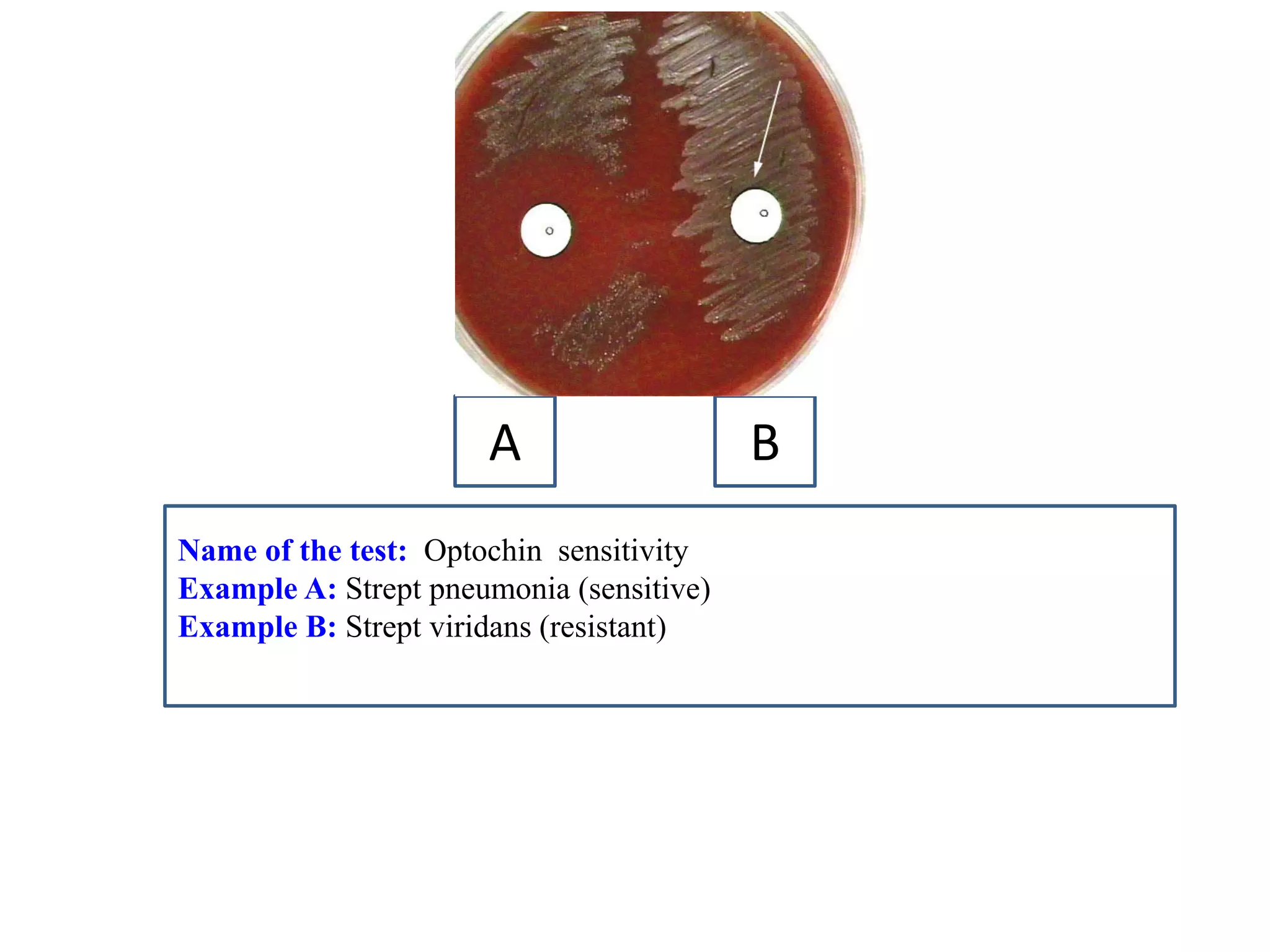
Name of the test: Optochin sensitivity 
Example A: Strept pneumonia (sensitive) 
Example B: Strept viridans (resistant) 
A 
B
A 
B 
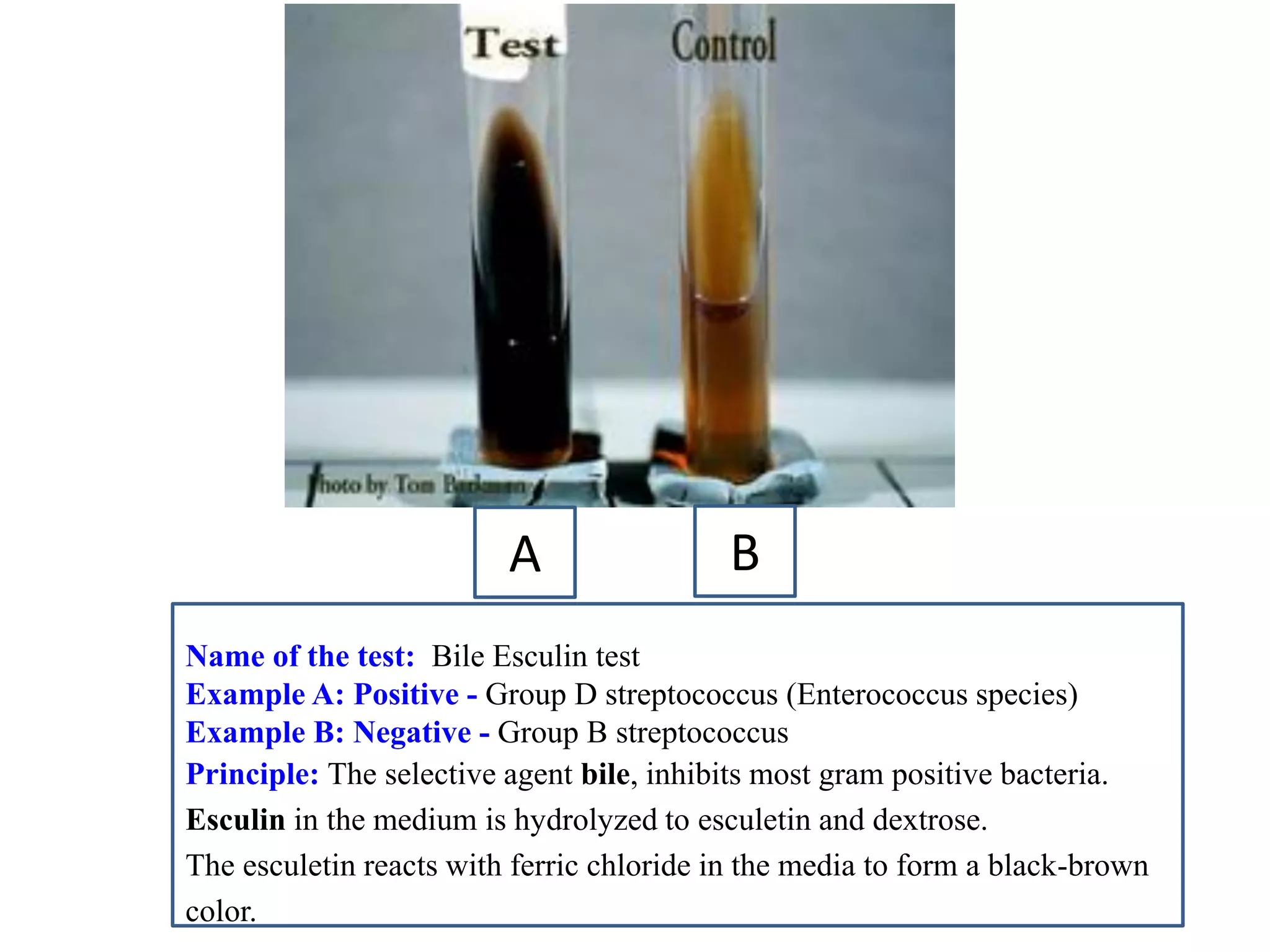
Name of the test: Bile Esculin test 
Example A: Positive - Group D streptococcus (Enterococcus species) 
Example B: Negative - Group B streptococcus 
Principle: The selective agent bile, inhibits most gram positive bacteria. 
Esculin in the medium is hydrolyzed to esculetin and dextrose. 
The esculetin reacts with ferric chloride in the media to form a black-brown color.
B 
A 
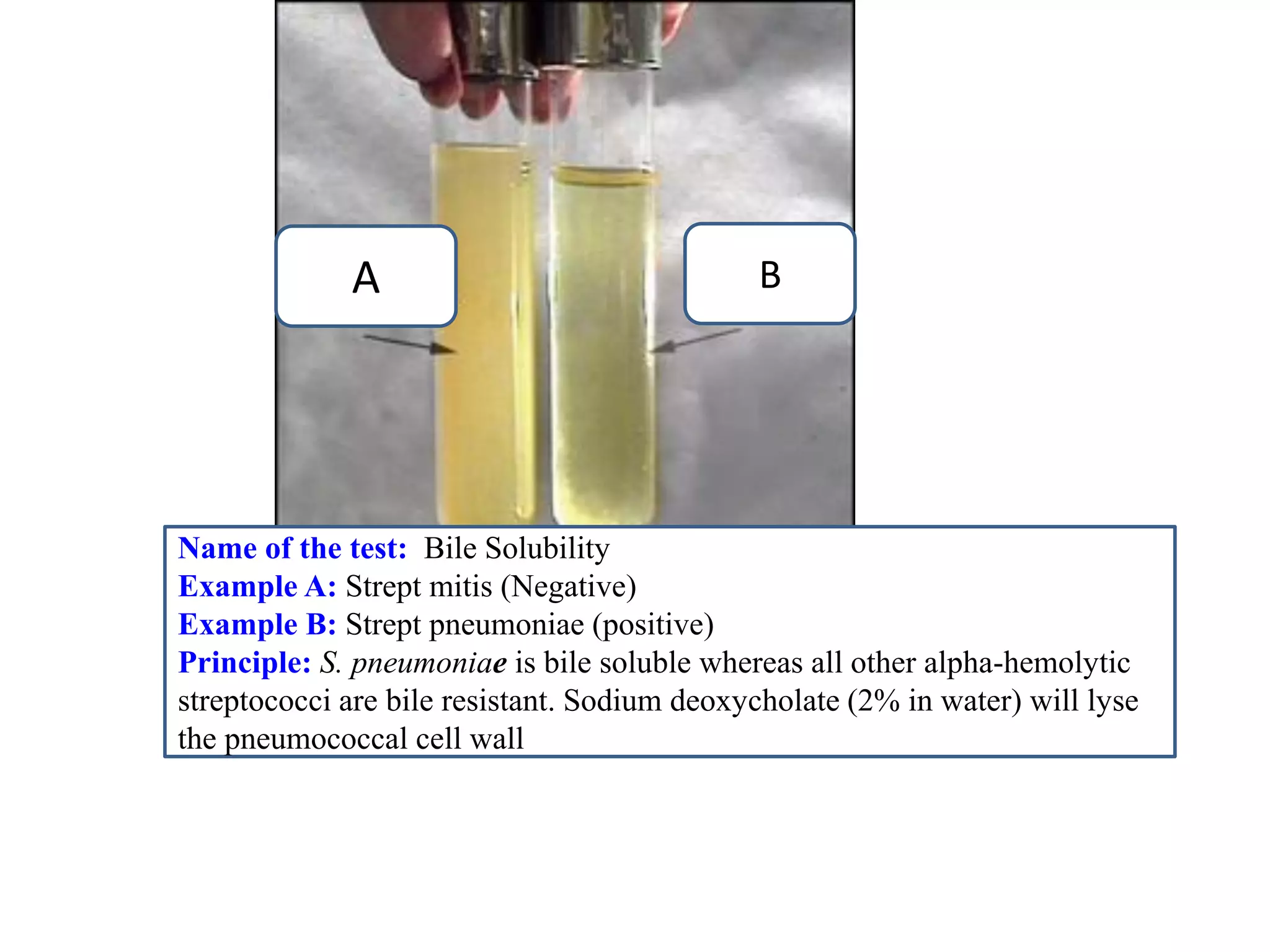
Name of the test: Bile Solubility 
Example A: Strept mitis (Negative) 
Example B: Strept pneumoniae (positive) 
Principle: S. pneumoniae is bile soluble whereas all other alpha-hemolytic streptococci are bile resistant. Sodium deoxycholate (2% in water) will lyse the pneumococcal cell wall
A 
B 
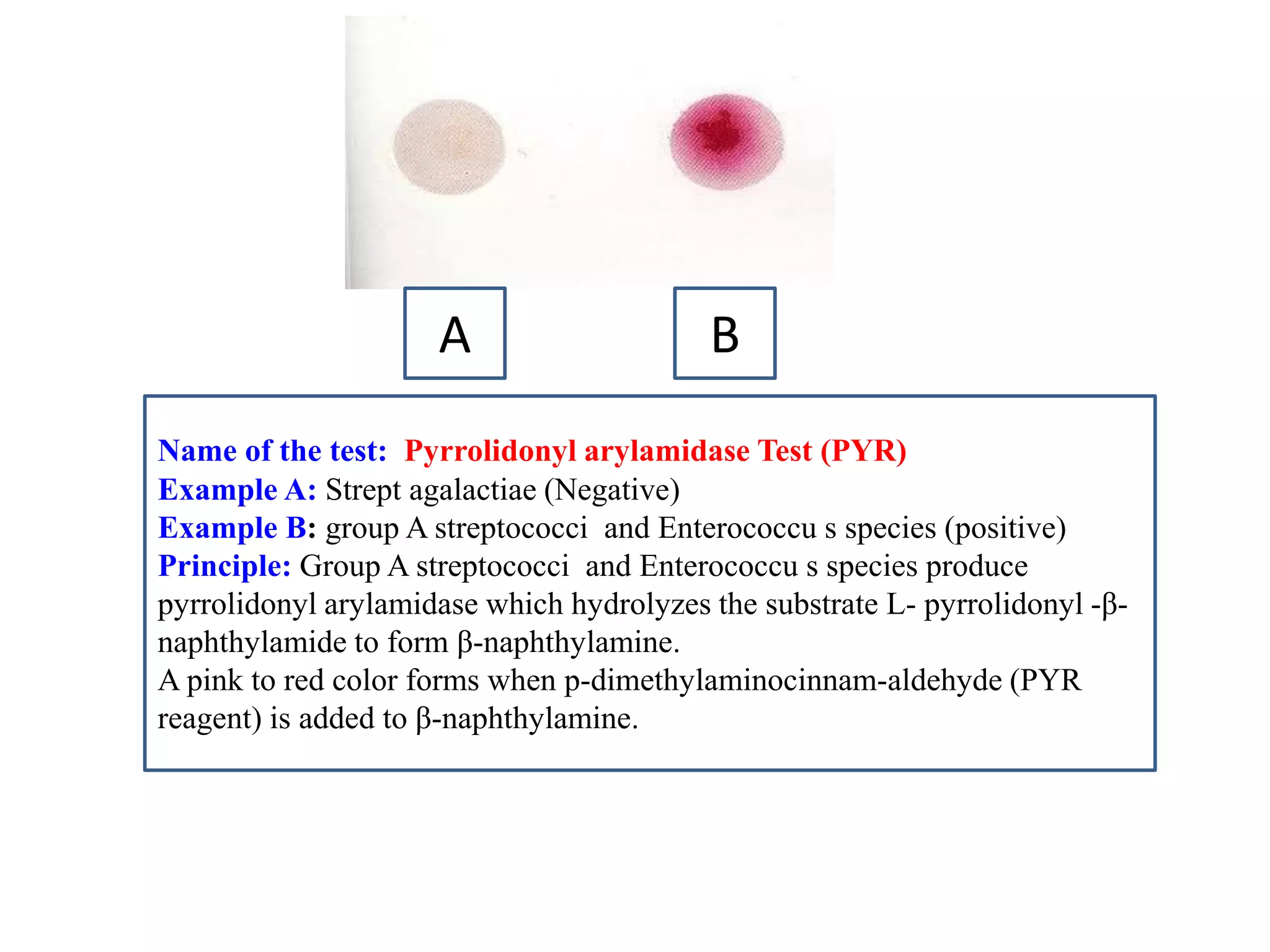
Name of the test: Pyrrolidonyl arylamidase Test (PYR) 
Example A: Strept agalactiae (Negative) 
Example B: group A streptococci and Enterococcu s species (positive) 
Principle: Group A streptococci and Enterococcu s species produce pyrrolidonyl arylamidase which hydrolyzes the substrate L- pyrrolidonyl -β- naphthylamide to form β-naphthylamine. 
A pink to red color forms when p-dimethylaminocinnam-aldehyde (PYR reagent) is added to β-naphthylamine.
A 
B 
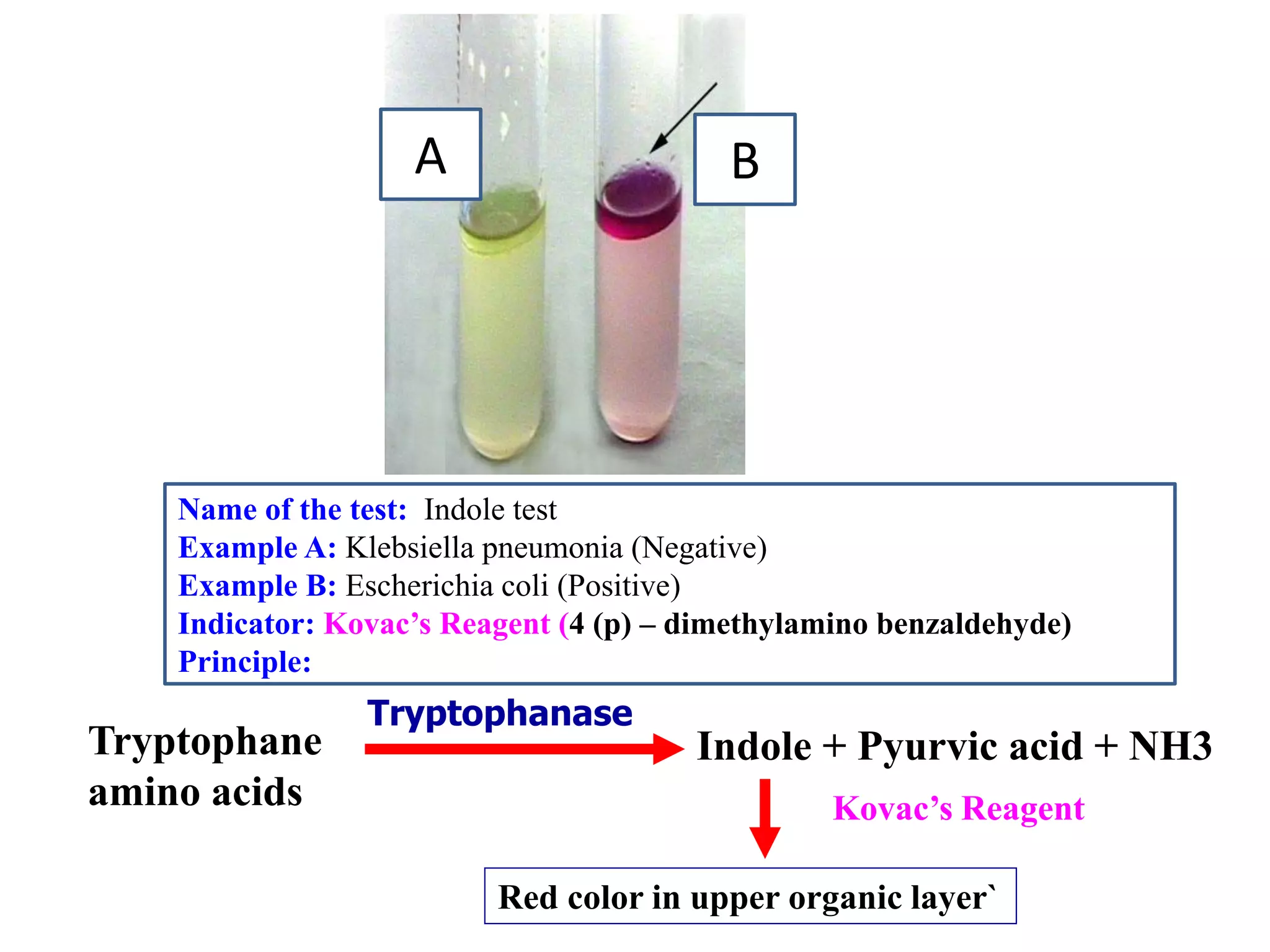
Tryptophane 
amino acids 
Tryptophanase 
Indole + Pyurvic acid + NH3 
Kovac’s Reagent 
Red color in upper organic layer` 
Name of the test: Indole test 
Example A: Klebsiella pneumonia (Negative) 
Example B: Escherichia coli (Positive) 
Indicator: Kovac’s Reagent (4 (p) – dimethylamino benzaldehyde) 
Principle:
A 
B 
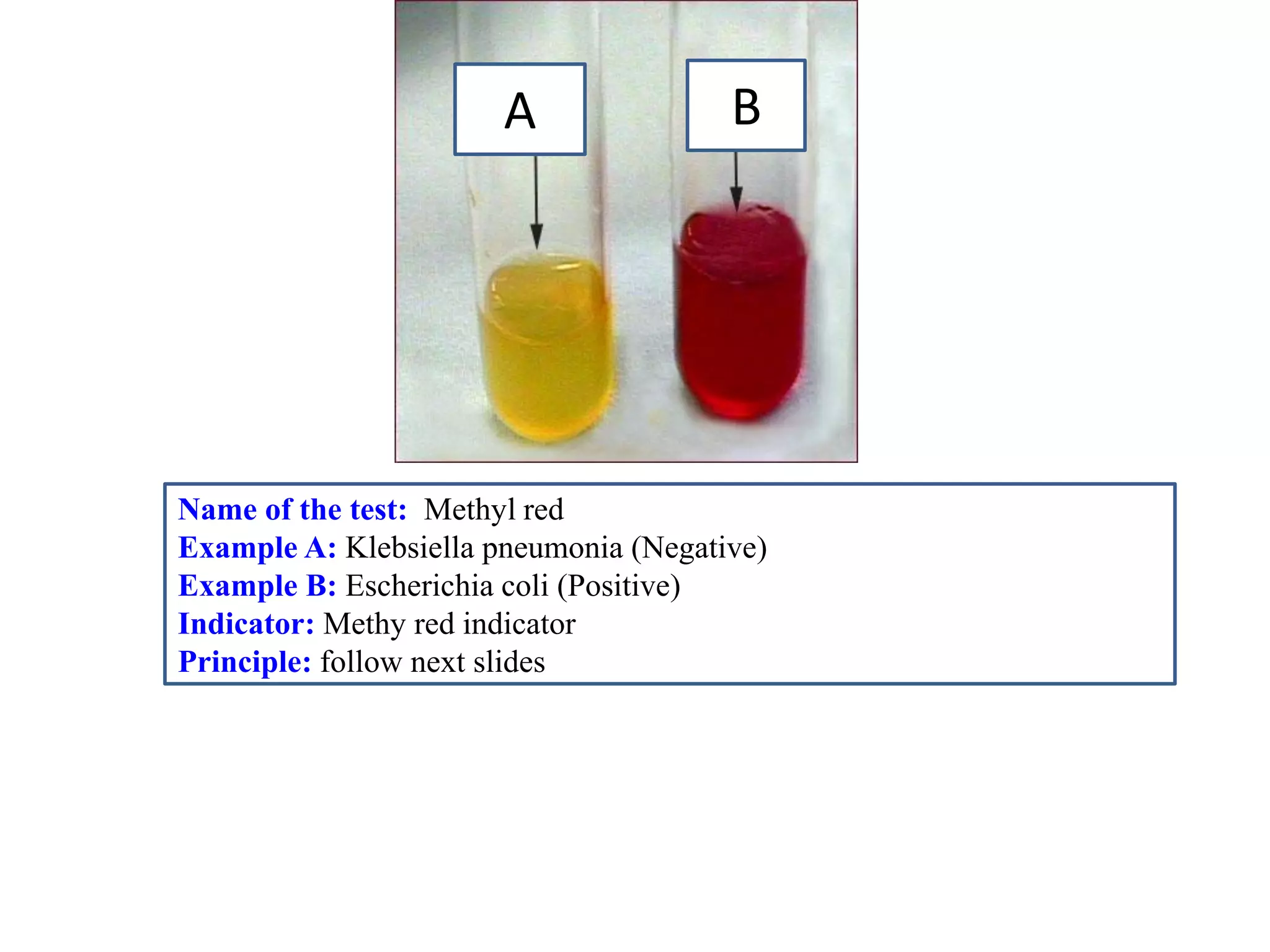
Name of the test: Methyl red 
Example A: Klebsiella pneumonia (Negative) 
Example B: Escherichia coli (Positive) 
Indicator: Methy red indicator 
Principle: follow next slides
A 
B 
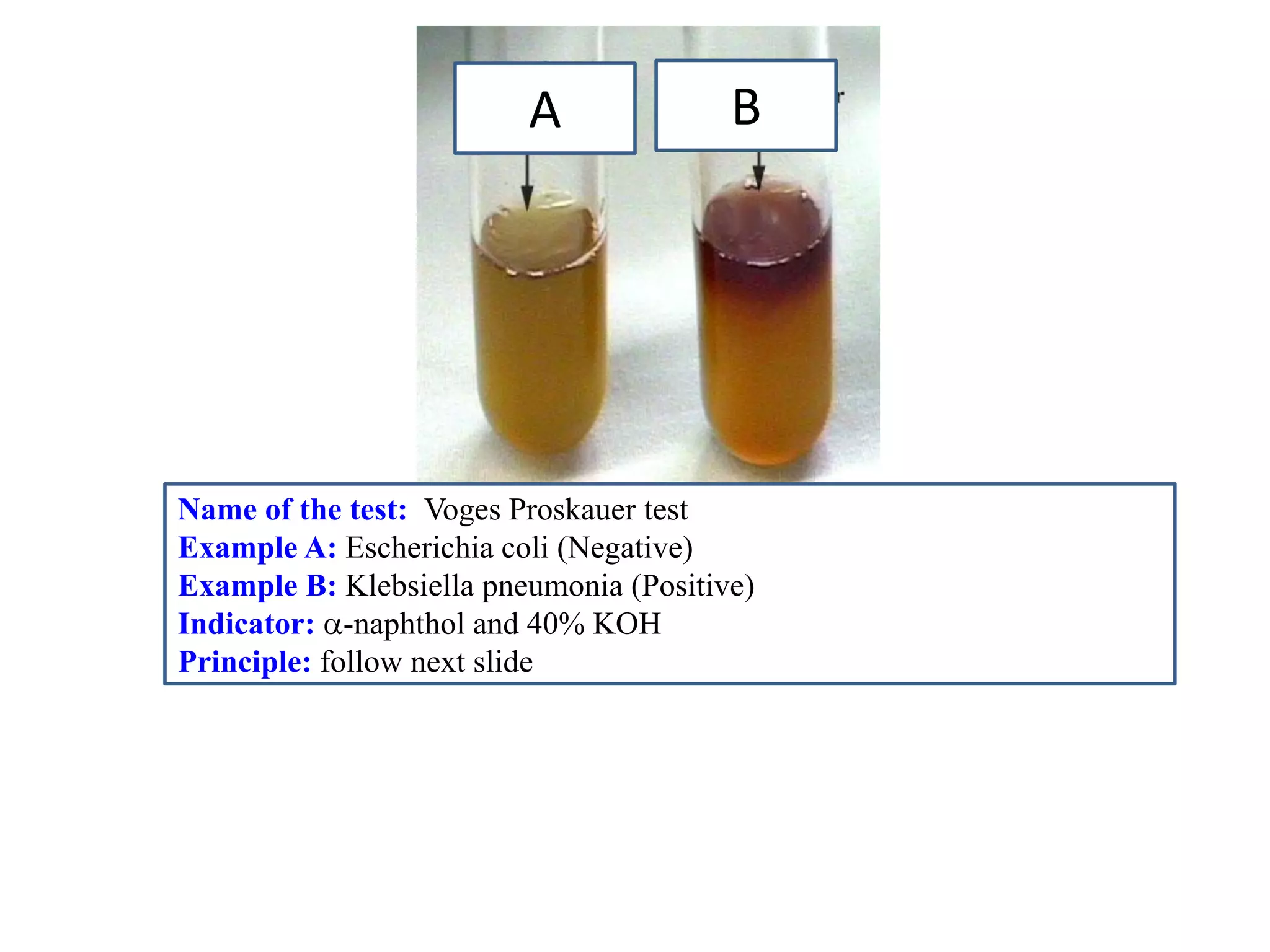
Name of the test: Voges Proskauer test 
Example A: Escherichia coli (Negative) 
Example B: Klebsiella pneumonia (Positive) 
Indicator: -naphthol and 40% KOH 
Principle: follow next slide
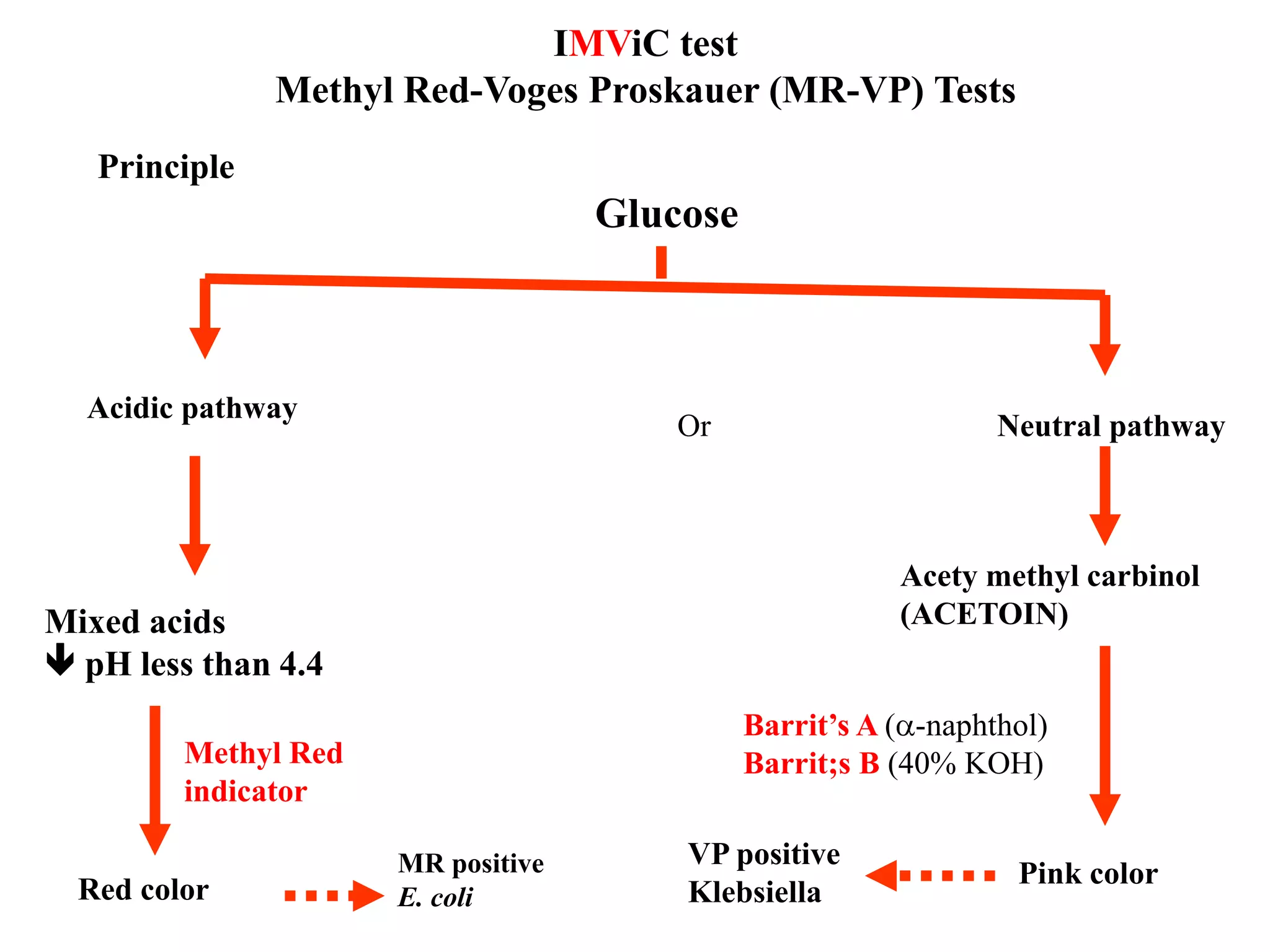
IMViC test Methyl Red-Voges Proskauer (MR-VP) Tests 
Glucose 
Acidic pathway 
Mixed acids 
 pH less than 4.4 
Methyl Red 
indicator 
Red color 
Principle 
MR positive 
E. coli 
Or 
Neutral pathway 
Acety methyl carbinol 
(ACETOIN) 
Barrit’s A (-naphthol) 
Barrit;s B (40% KOH) 
Pink color 
VP positive 
Klebsiella
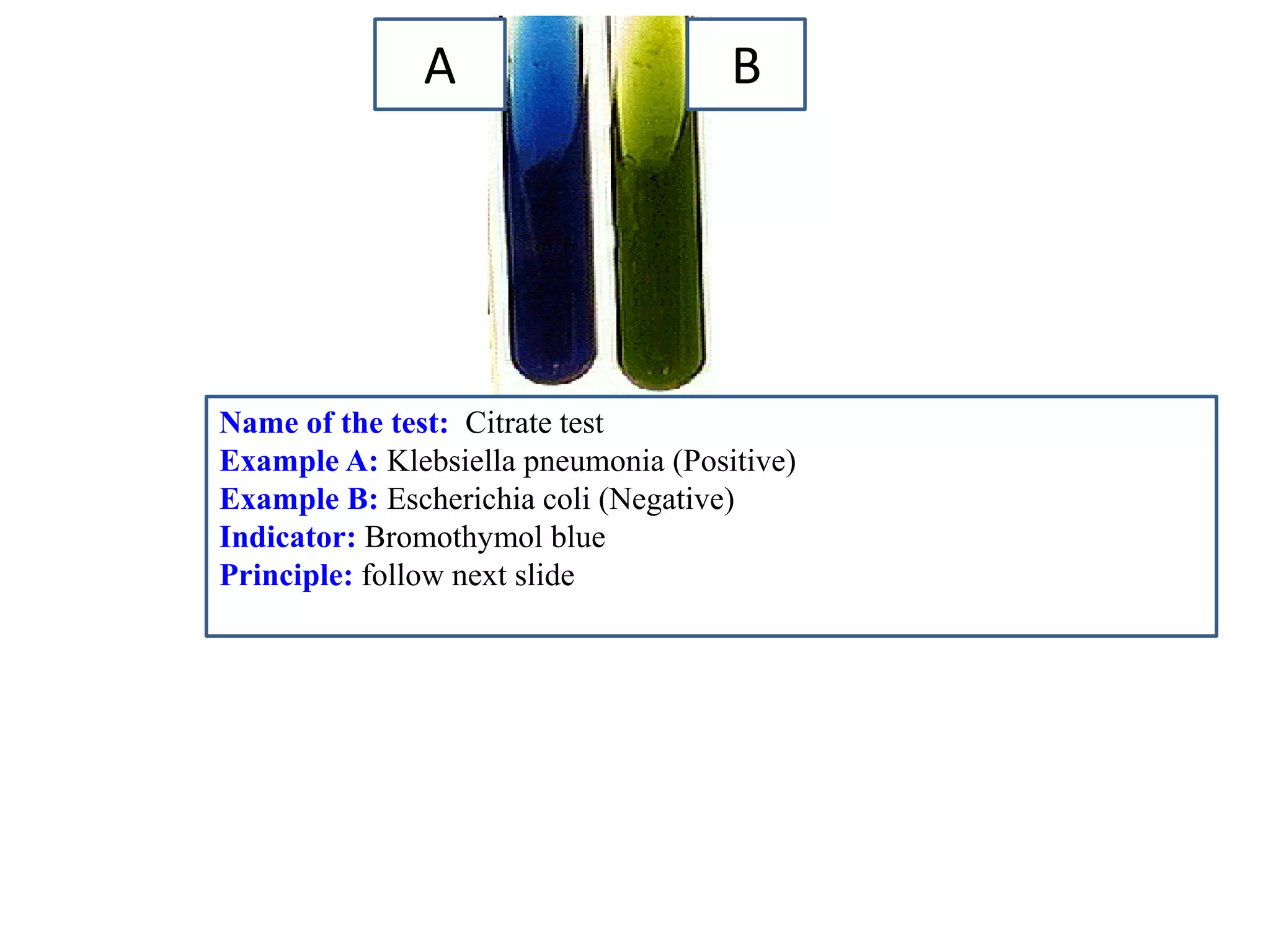
Name of the test: Citrate test 
Example A: Klebsiella pneumonia (Positive) 
Example B: Escherichia coli (Negative) 
Indicator: Bromothymol blue 
Principle: follow next slide 
A 
B
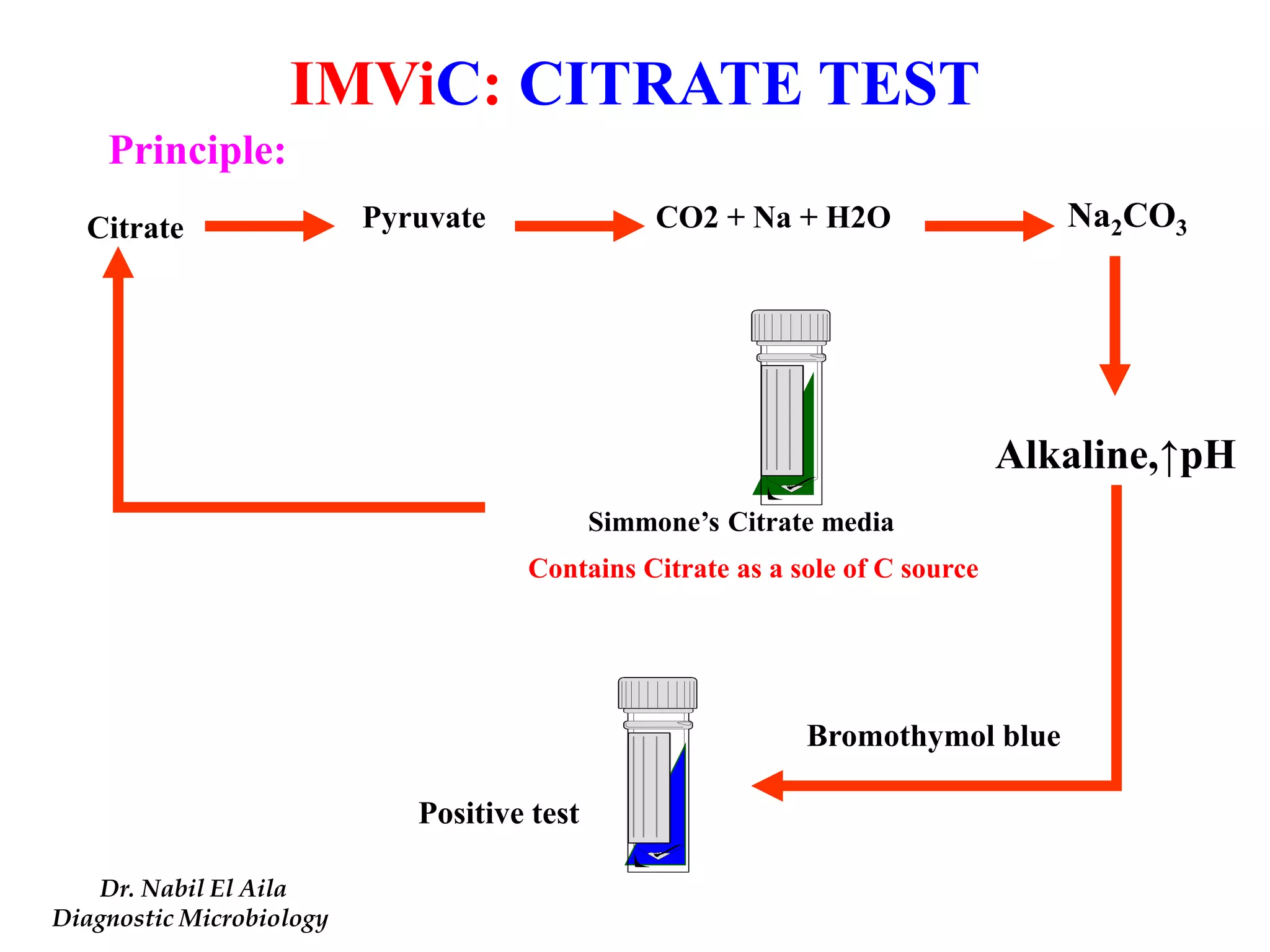
Principle: 
Citrate Na2CO3 
Alkaline,↑pH 
Bromothymol blue 
Simmone’s Citrate media 
Pyruvate CO2 + Na + H2O 
Positive test 
Contains Citrate as a sole of C source 
IMViC: CITRATE TEST 
Dr. Nabil El Aila 
Diagnostic Microbiology
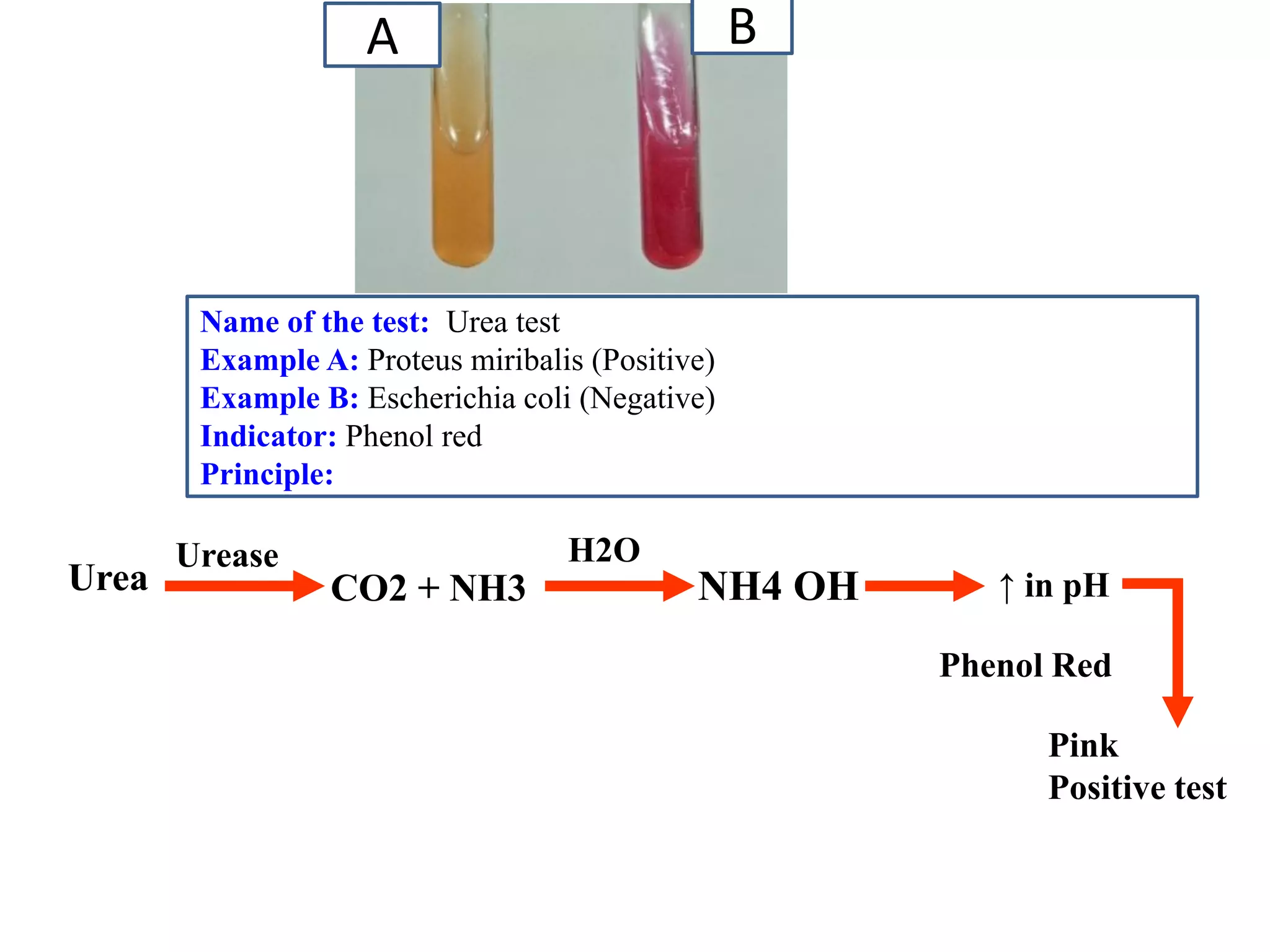
Name of the test: Urea test 
Example A: Proteus miribalis (Positive) 
Example B: Escherichia coli (Negative) 
Indicator: Phenol red 
Principle: 
A 
B 
Urea 
Urease 
CO2 + NH3 
H2O 
NH4 OH 
↑ in pH 
Phenol Red 
Pink 
Positive test
A 
B 
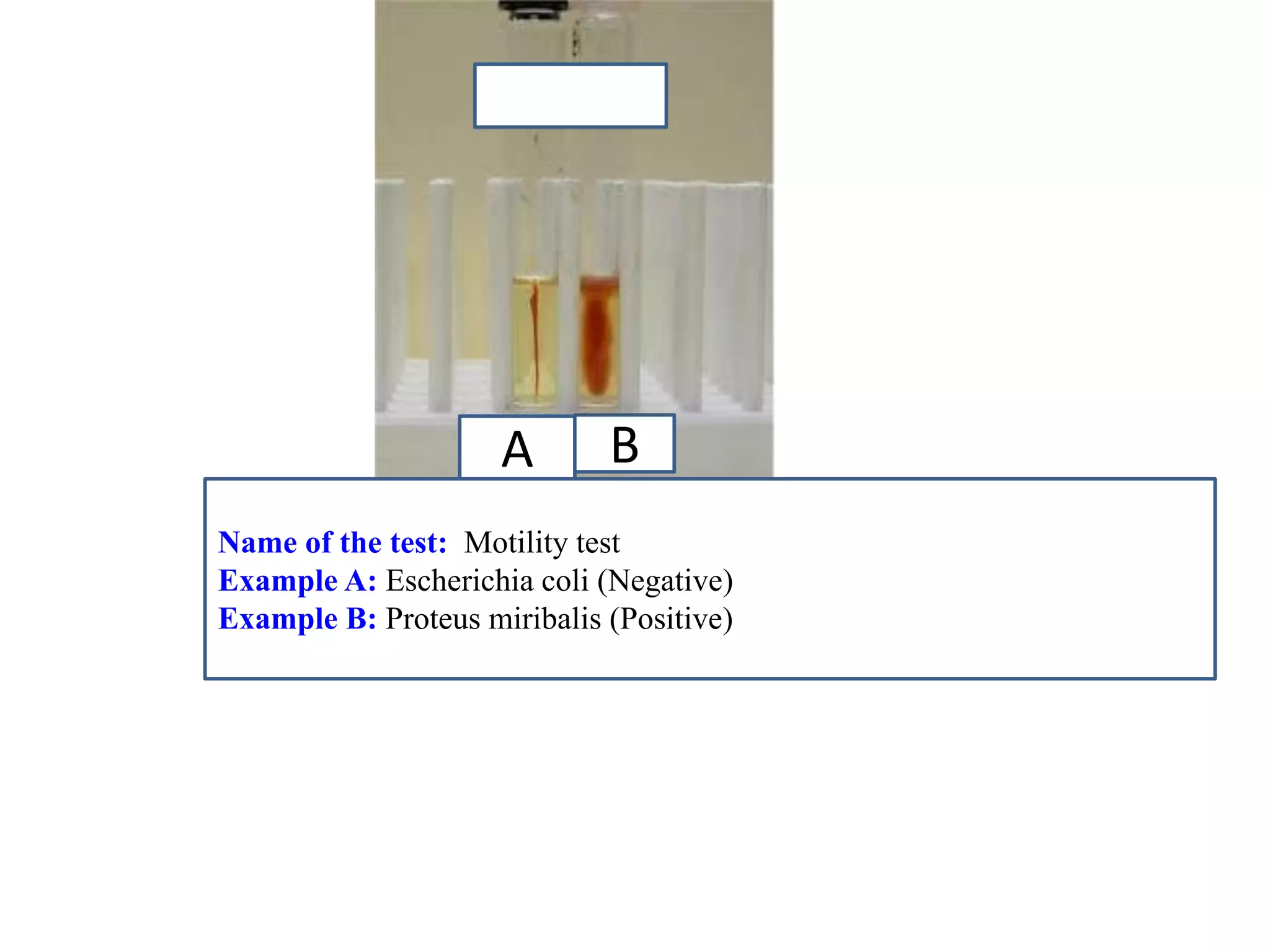
Name of the test: Motility test 
Example A: Escherichia coli (Negative) 
Example B: Proteus miribalis (Positive)
A 
B 
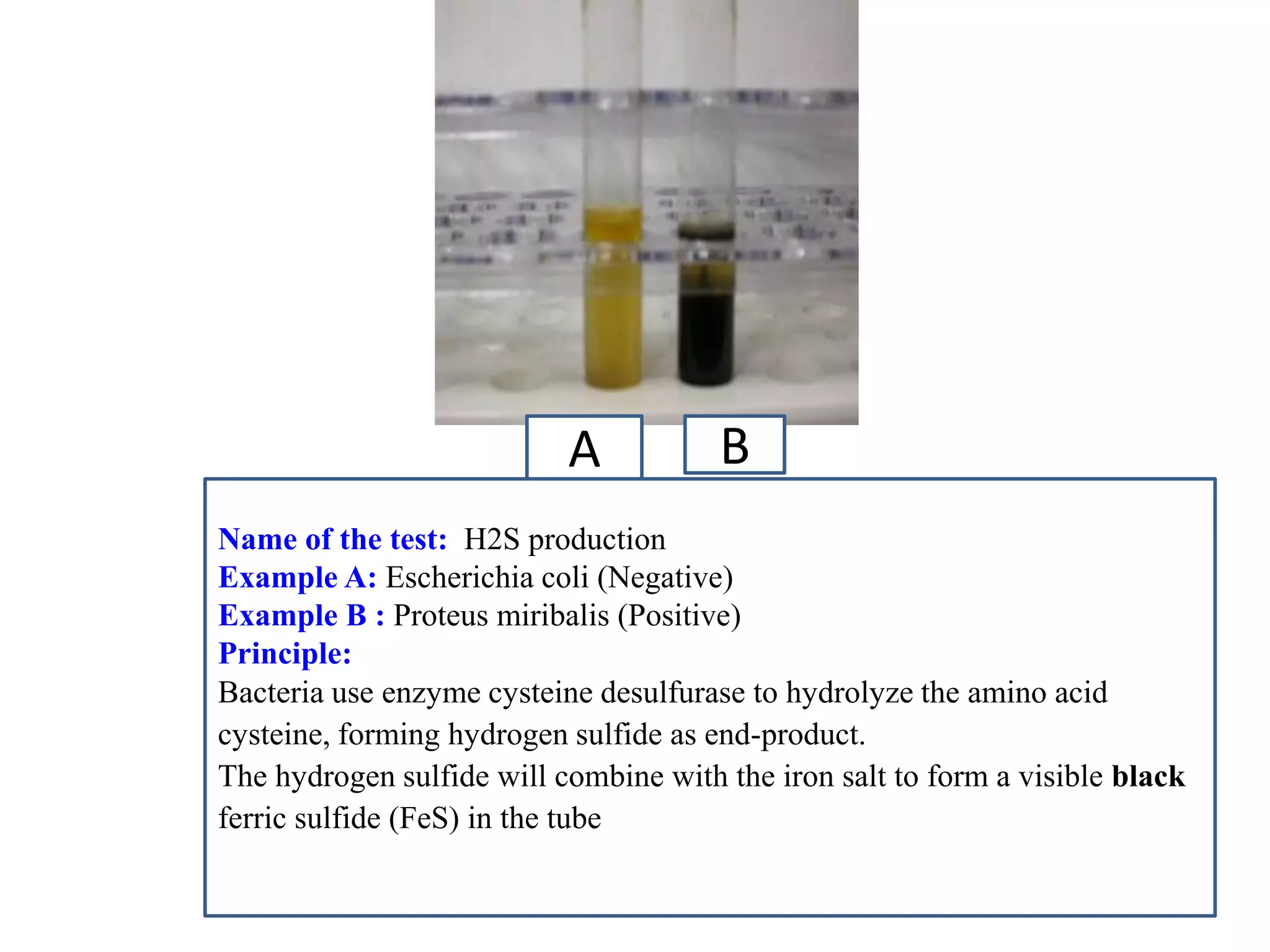
Name of the test: H2S production 
Example A: Escherichia coli (Negative) 
Example B : Proteus miribalis (Positive) 
Principle: 
Bacteria use enzyme cysteine desulfurase to hydrolyze the amino acid cysteine, forming hydrogen sulfide as end-product. 
The hydrogen sulfide will combine with the iron salt to form a visible black ferric sulfide (FeS) in the tube
A 
B 
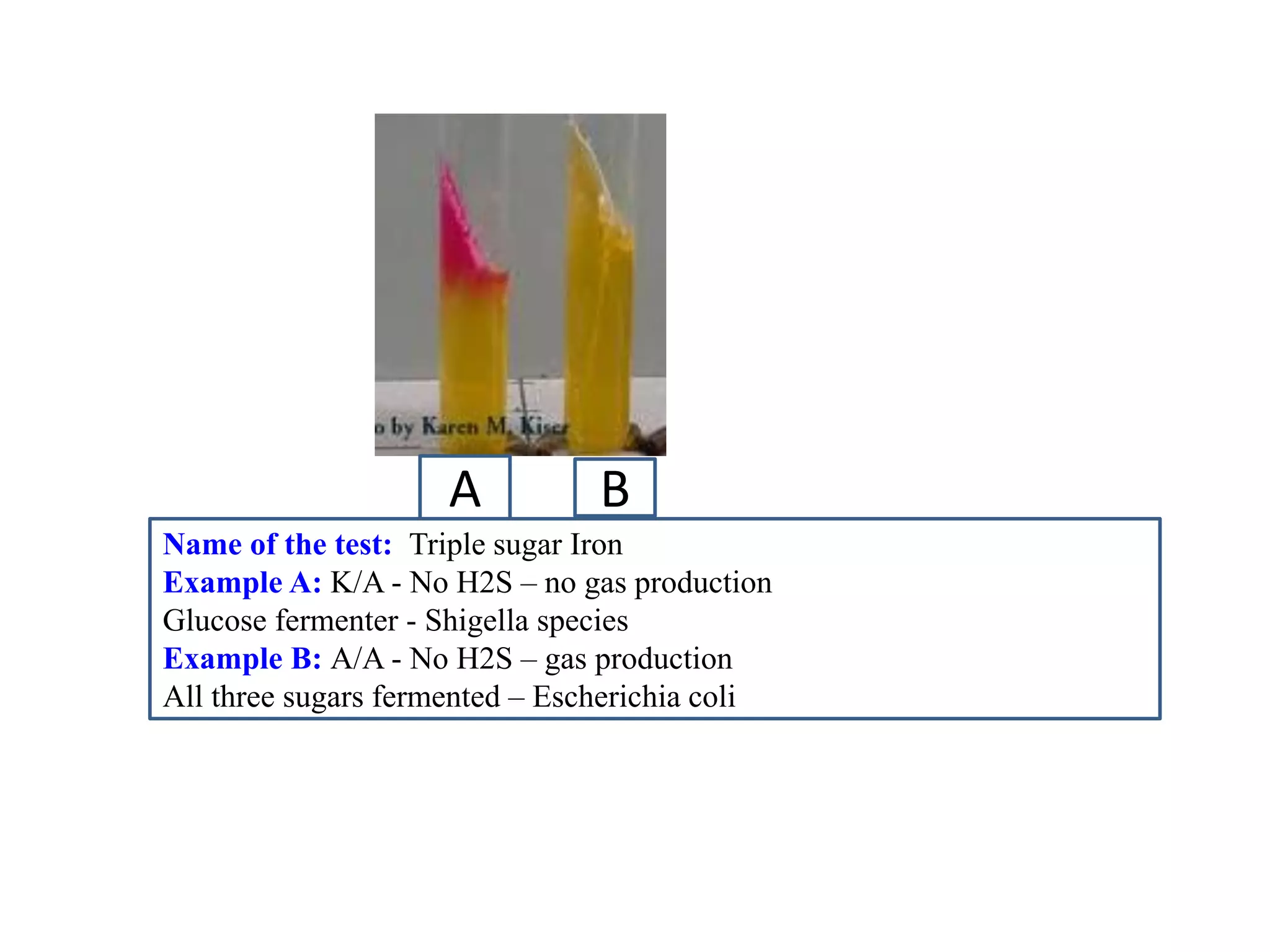
Name of the test: Triple sugar Iron 
Example A: K/A - No H2S – no gas production 
Glucose fermenter - Shigella species 
Example B: A/A - No H2S – gas production 
All three sugars fermented – Escherichia coli
A 
B 
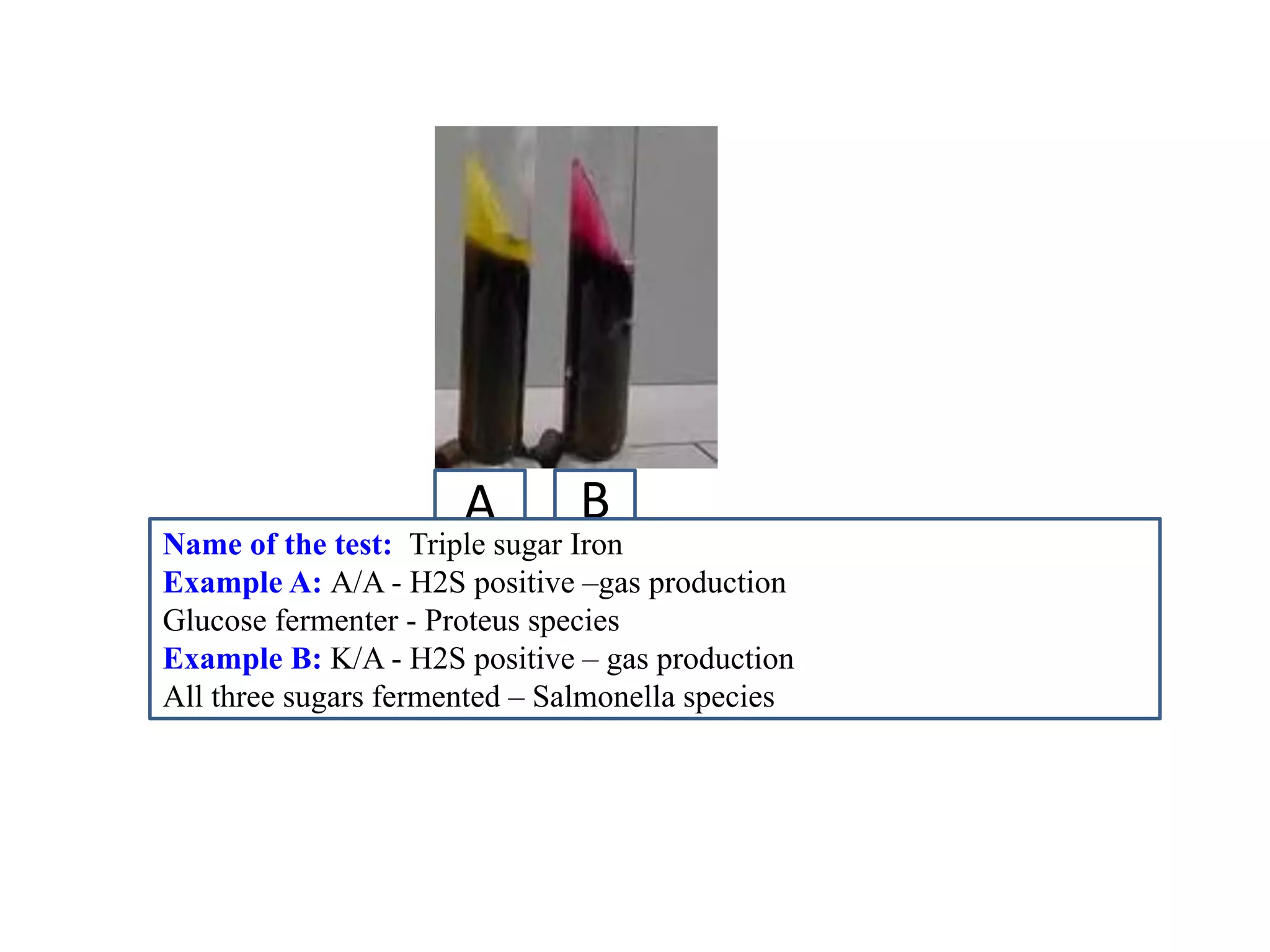
Name of the test: Triple sugar Iron 
Example A: A/A - H2S positive –gas production 
Glucose fermenter - Proteus species 
Example B: K/A - H2S positive – gas production 
All three sugars fermented – Salmonella species
A 
B 
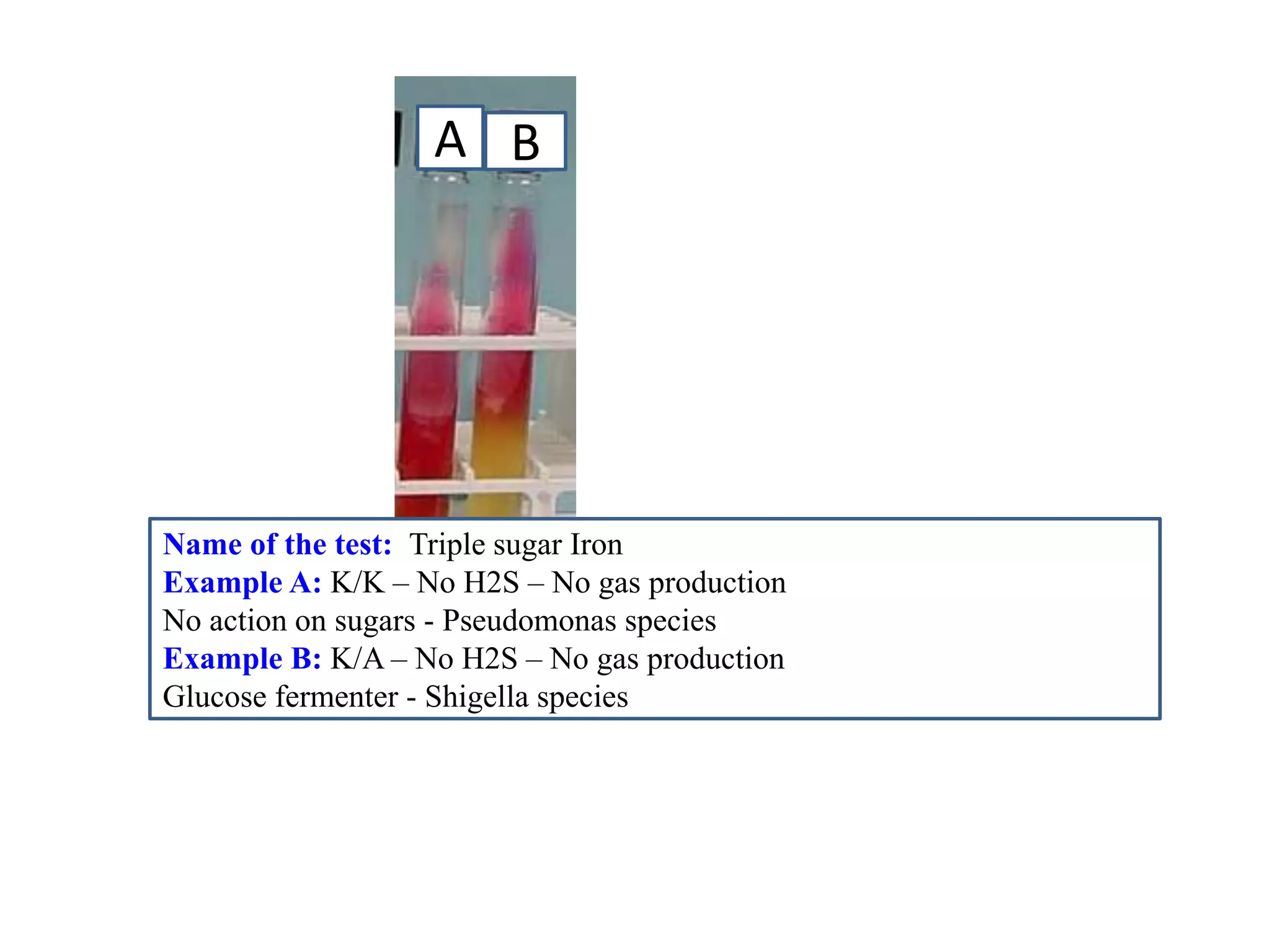
Name of the test: Triple sugar Iron 
Example A: K/K – No H2S – No gas production 
No action on sugars - Pseudomonas species 
Example B: K/A – No H2S – No gas production 
Glucose fermenter - Shigella species
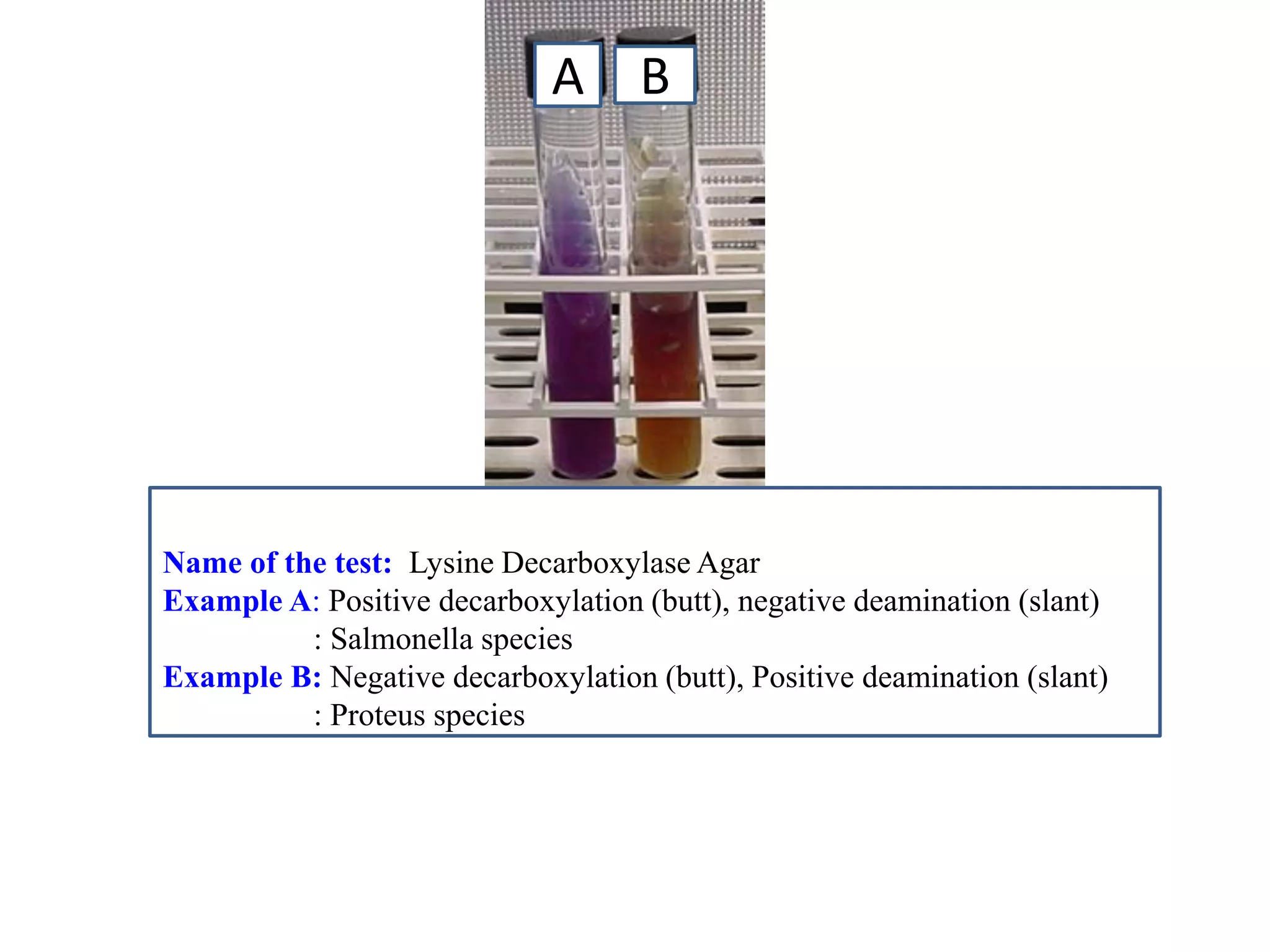
Name of the test: Lysine Decarboxylase Agar 
Example A: Positive decarboxylation (butt), negative deamination (slant) 
: Salmonella species 
Example B: Negative decarboxylation (butt), Positive deamination (slant) 
: Proteus species 
A 
B
A 
B 
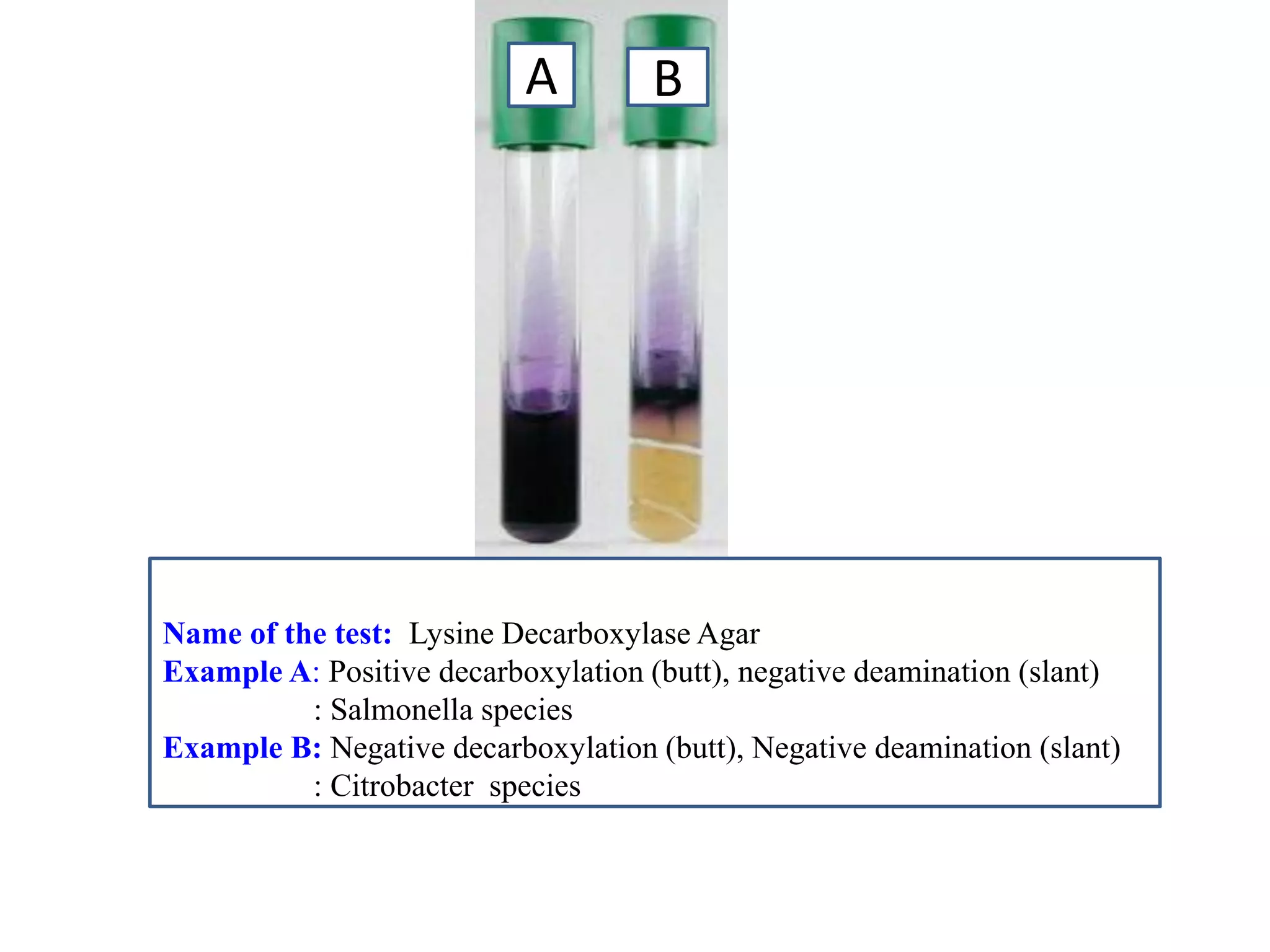
Name of the test: Lysine Decarboxylase Agar 
Example A: Positive decarboxylation (butt), negative deamination (slant) 
: Salmonella species 
Example B: Negative decarboxylation (butt), Negative deamination (slant) 
: Citrobacter species
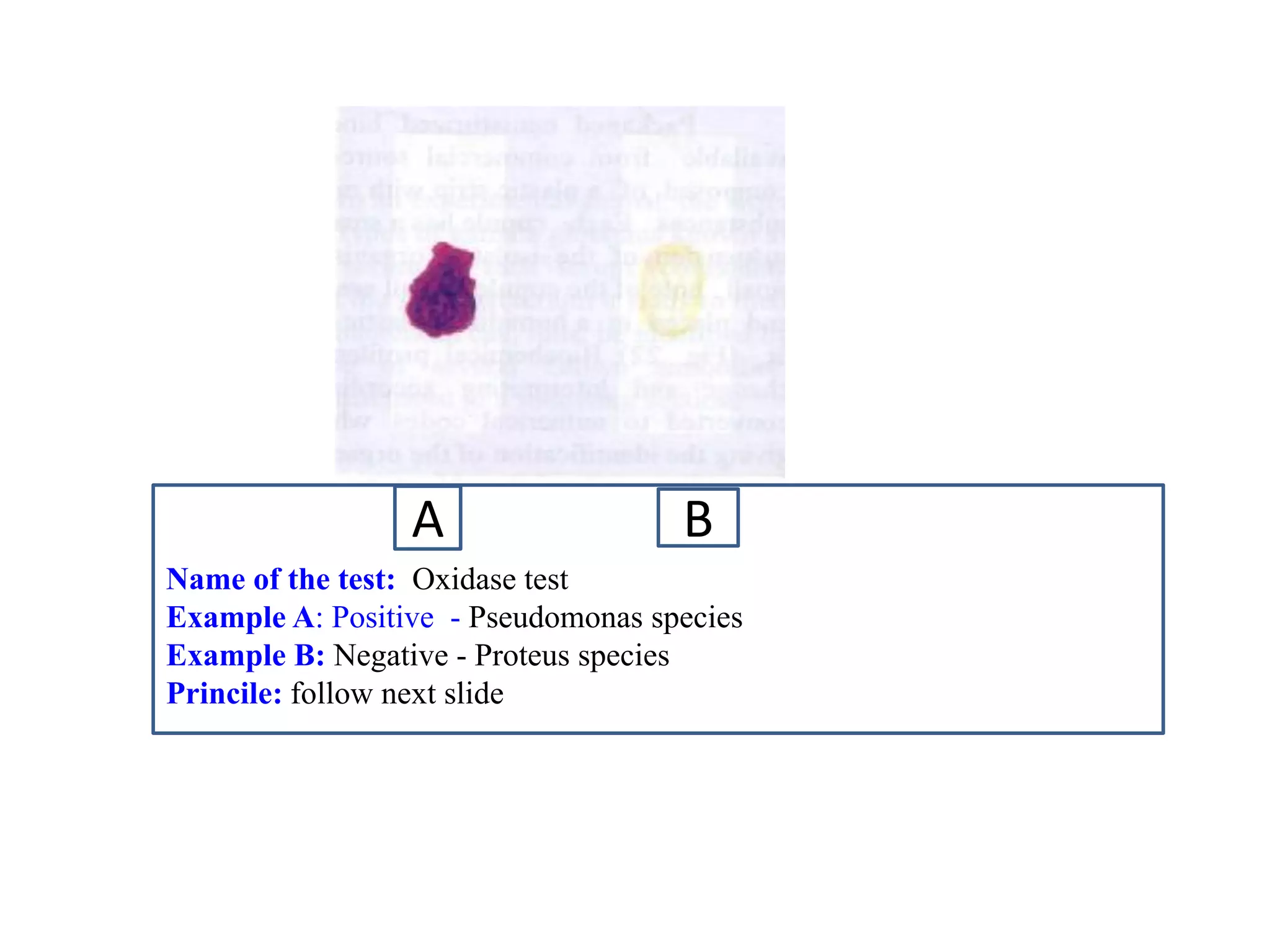
Name of the test: Oxidase test 
Example A: Positive - Pseudomonas species 
Example B: Negative - Proteus species 
Princile: follow next slide 
A 
B
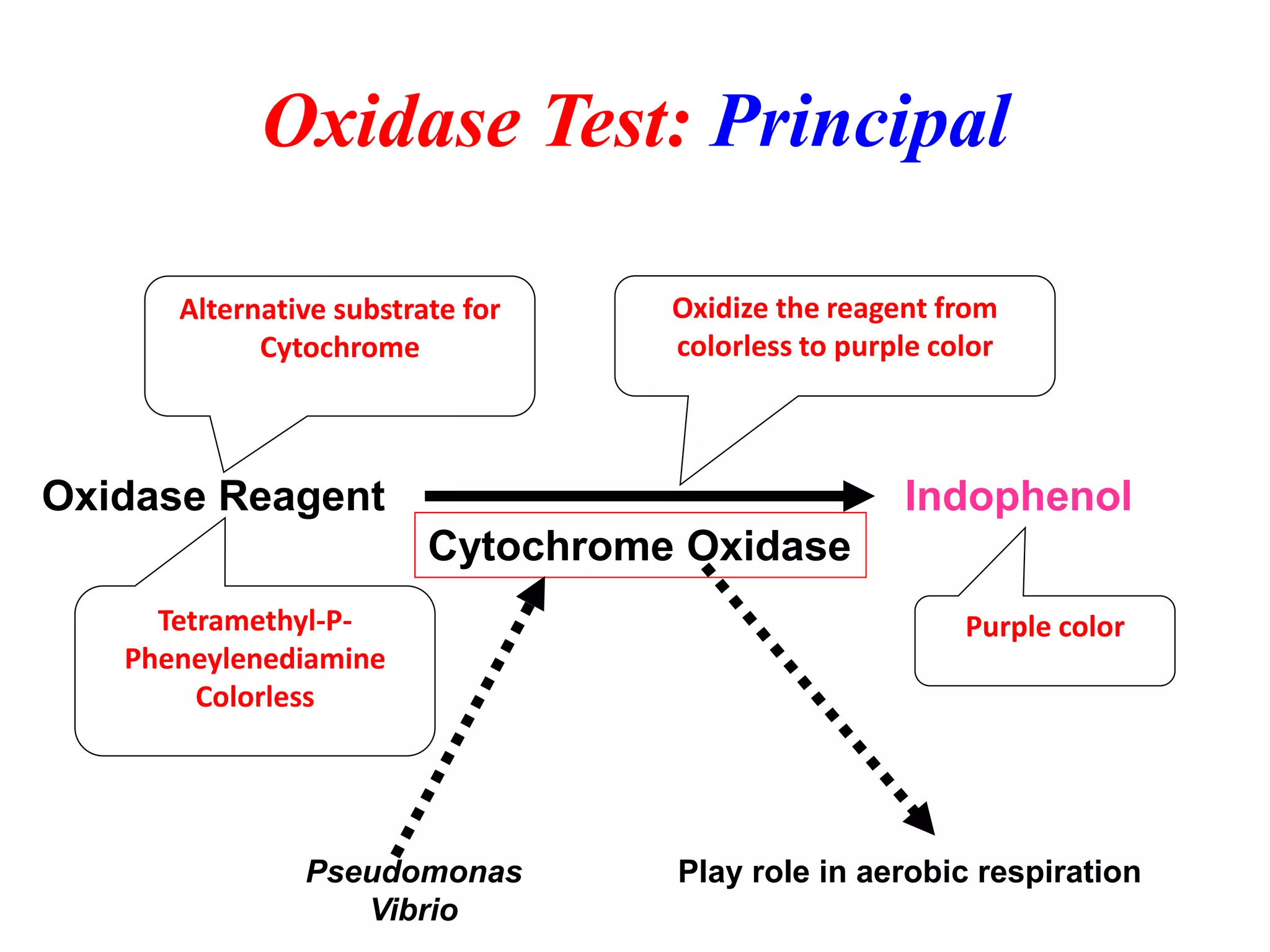
Oxidase Test: Principal 
Oxidase Reagent 
Cytochrome Oxidase 
Indophenol 
Play role in aerobic respiration 
Pseudomonas 
Vibrio 
Alternative substrate for Cytochrome 
Tetramethyl-P- Pheneylenediamine 
Colorless 
Purple color 
Oxidize the reagent from colorless to purple color
A 
B 
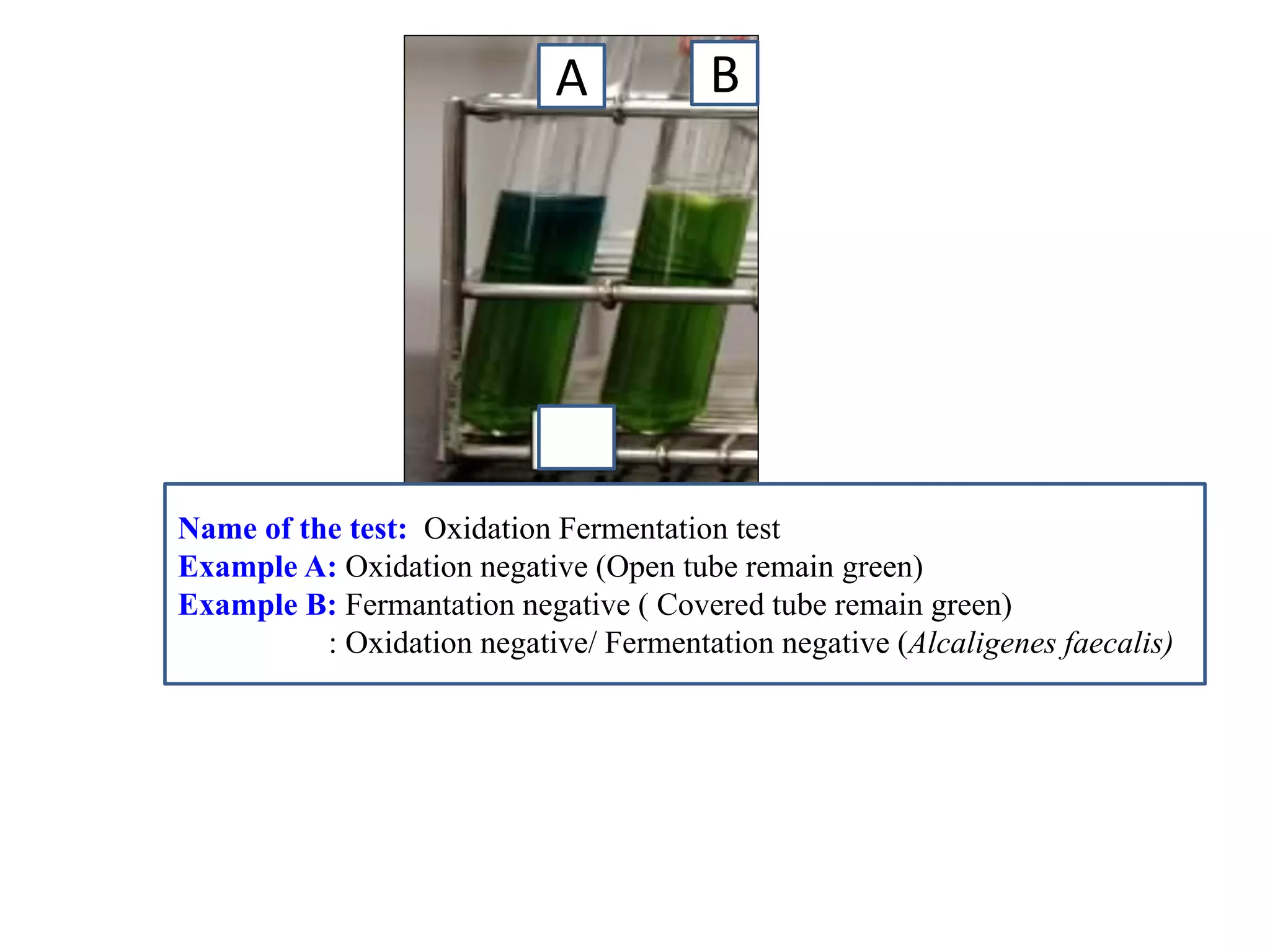
Name of the test: Oxidation Fermentation test 
Example A: Oxidation negative (Open tube remain green) 
Example B: Fermantation negative ( Covered tube remain green) 
: Oxidation negative/ Fermentation negative (Alcaligenes faecalis)
A 
B 
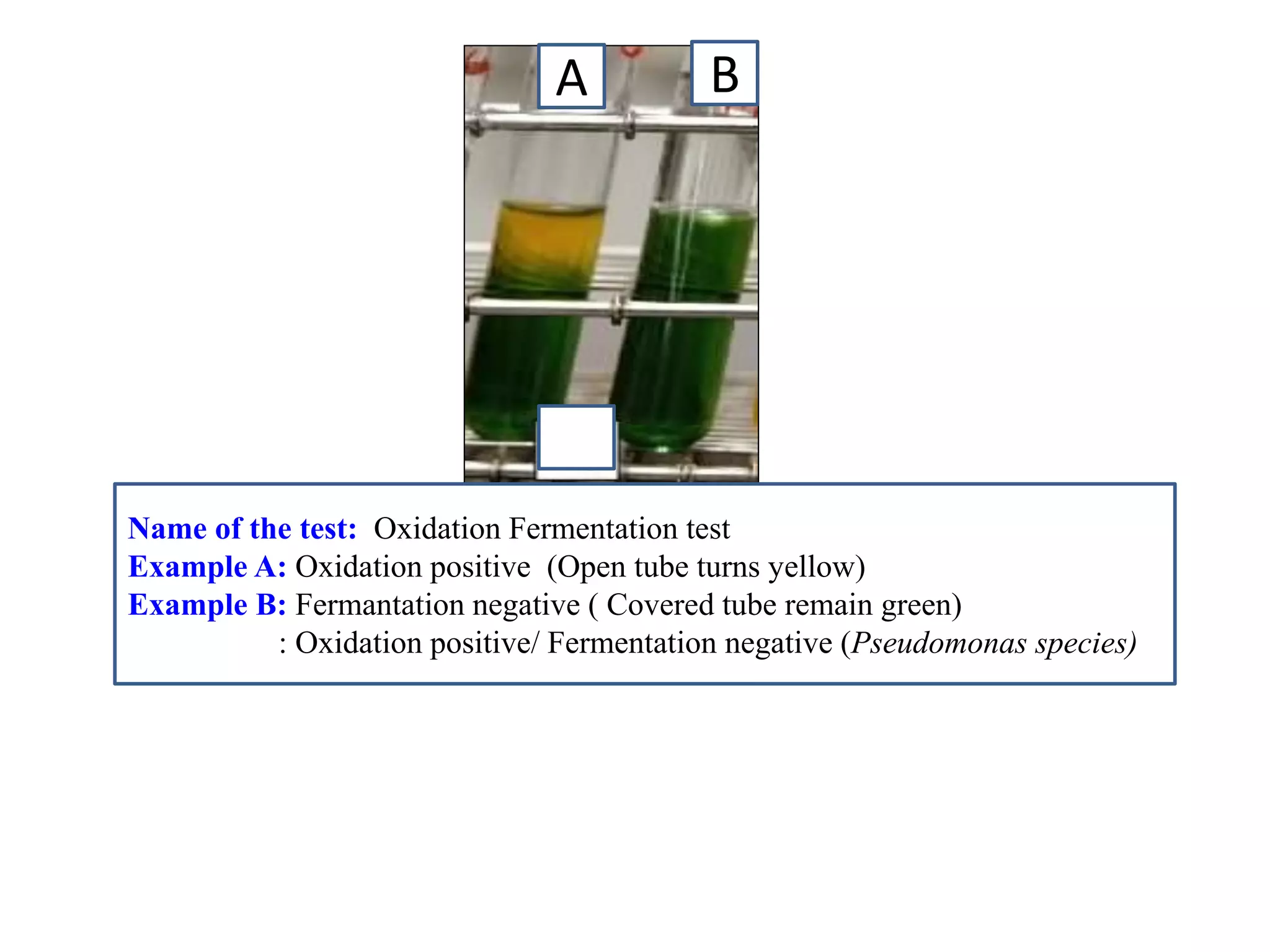
Name of the test: Oxidation Fermentation test 
Example A: Oxidation positive (Open tube turns yellow) 
Example B: Fermantation negative ( Covered tube remain green) 
: Oxidation positive/ Fermentation negative (Pseudomonas species)
A 
B 
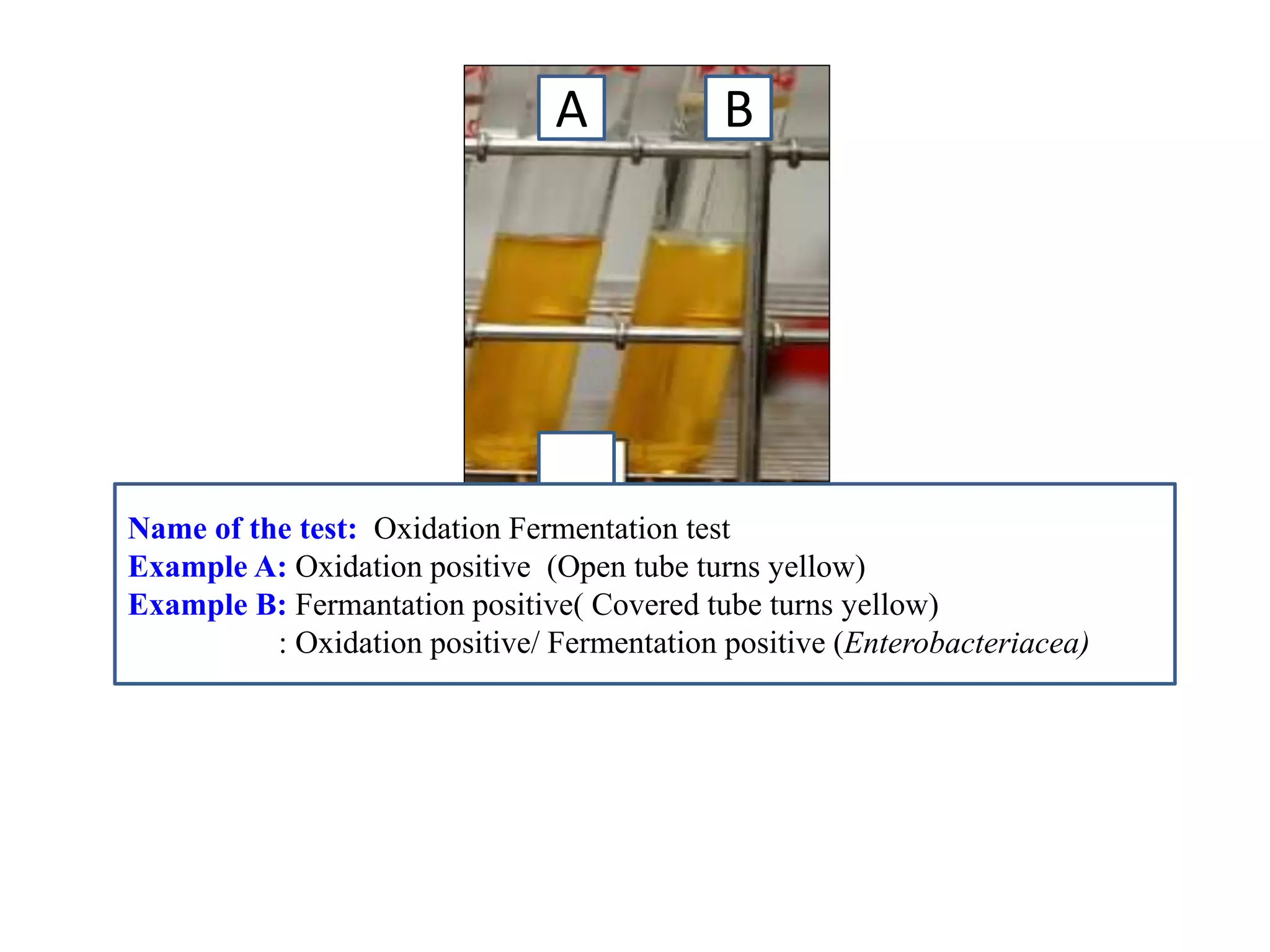
Name of the test: Oxidation Fermentation test 
Example A: Oxidation positive (Open tube turns yellow) 
Example B: Fermantation positive( Covered tube turns yellow) 
: Oxidation positive/ Fermentation positive (Enterobacteriacea)
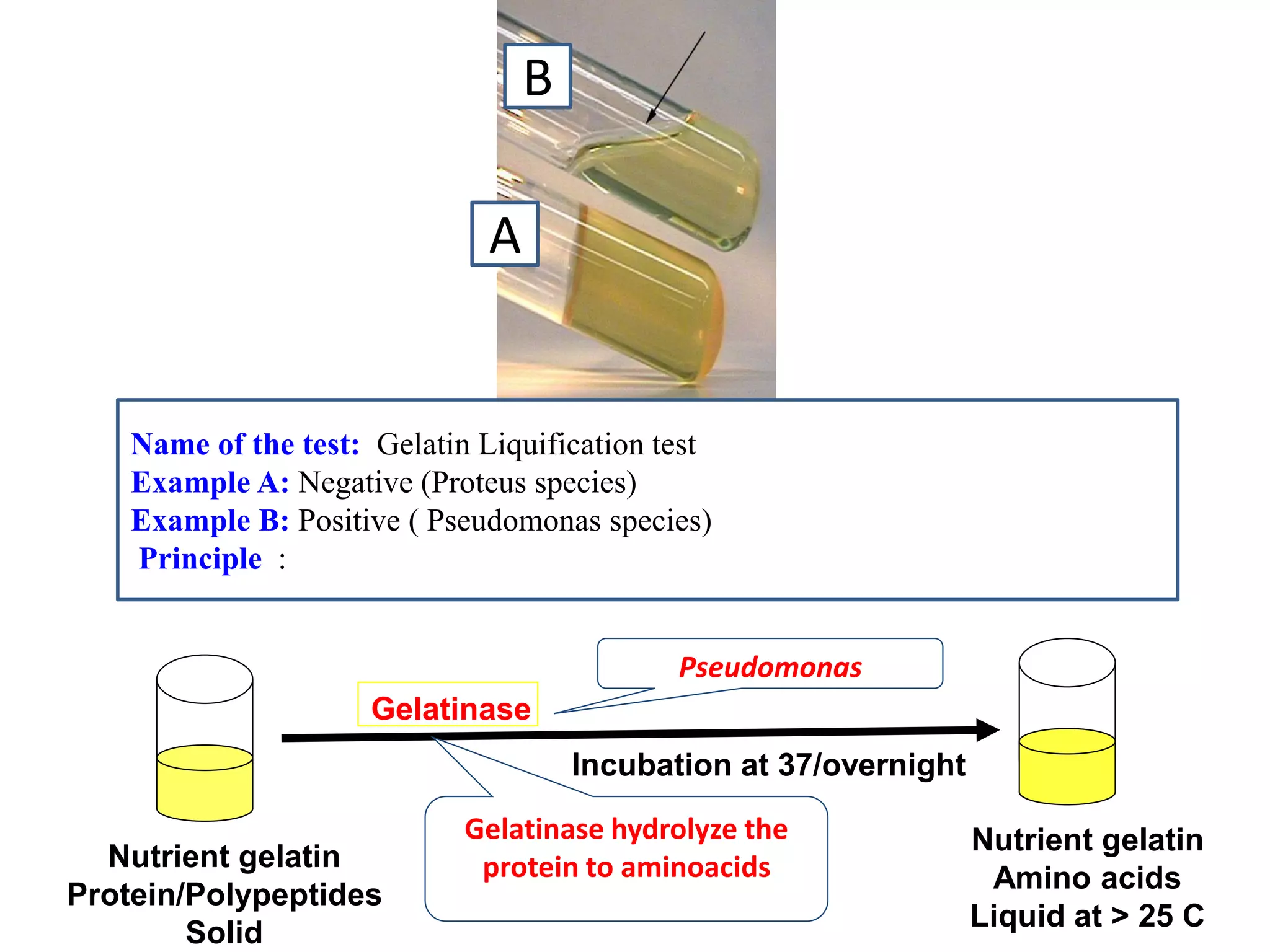
Name of the test: Gelatin Liquification test 
Example A: Negative (Proteus species) 
Example B: Positive ( Pseudomonas species) 
Principle : 
Nutrient gelatin 
Protein/Polypeptides 
Solid 
Gelatinase 
Incubation at 37/overnight 
Nutrient gelatin 
Amino acids 
Liquid at > 25 C 
Gelatinase hydrolyze the protein to aminoacids 
Pseudomonas 
A 
B
A 
B 
C 
D 
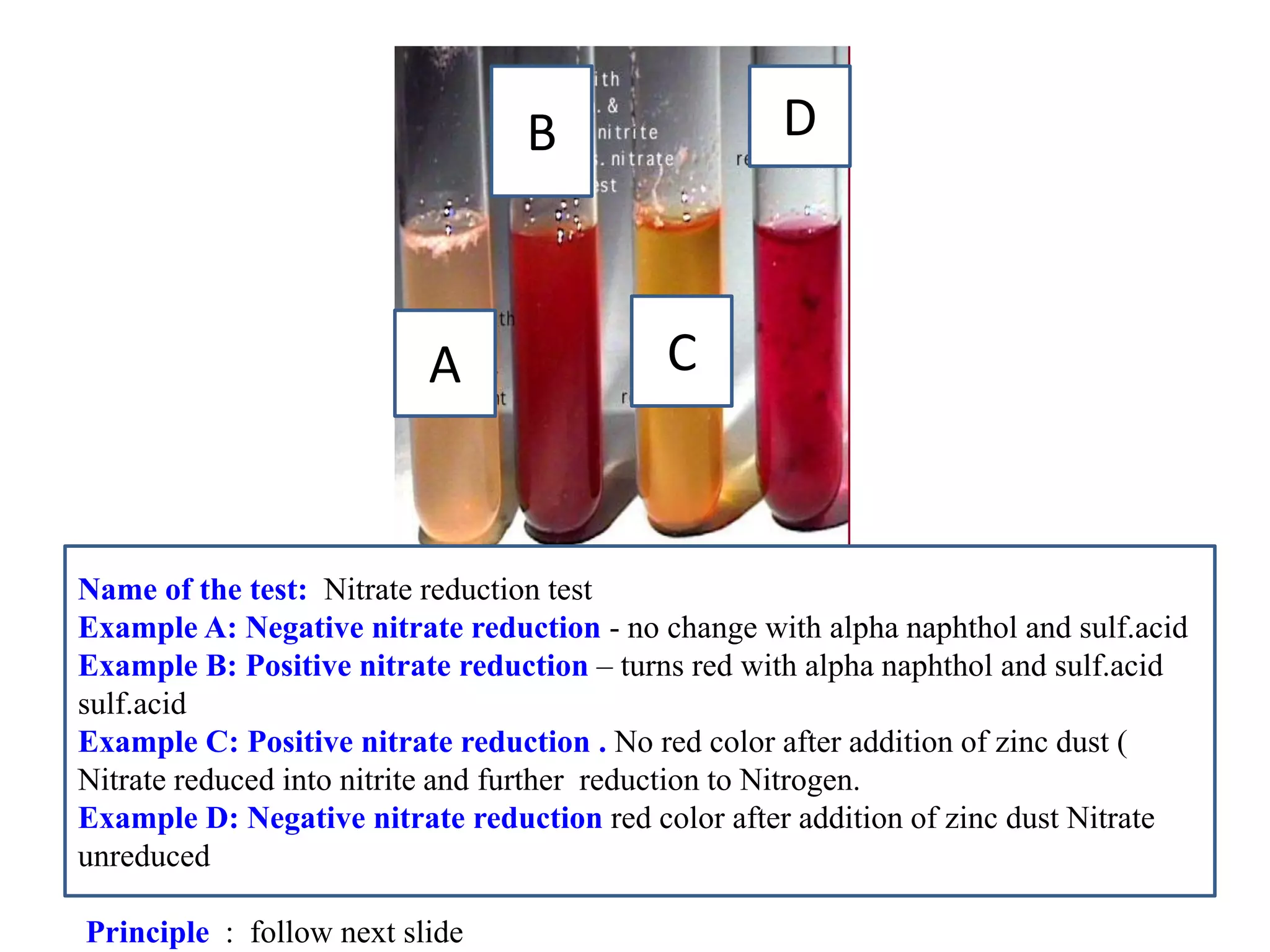
Name of the test: Nitrate reduction test 
Example A: Negative nitrate reduction - no change with alpha naphthol and sulf.acid 
Example B: Positive nitrate reduction – turns red with alpha naphthol and sulf.acid sulf.acid 
Example C: Positive nitrate reduction . No red color after addition of zinc dust ( Nitrate reduced into nitrite and further reduction to Nitrogen. 
Example D: Negative nitrate reduction red color after addition of zinc dust Nitrate unreduced 
Principle : follow next slide
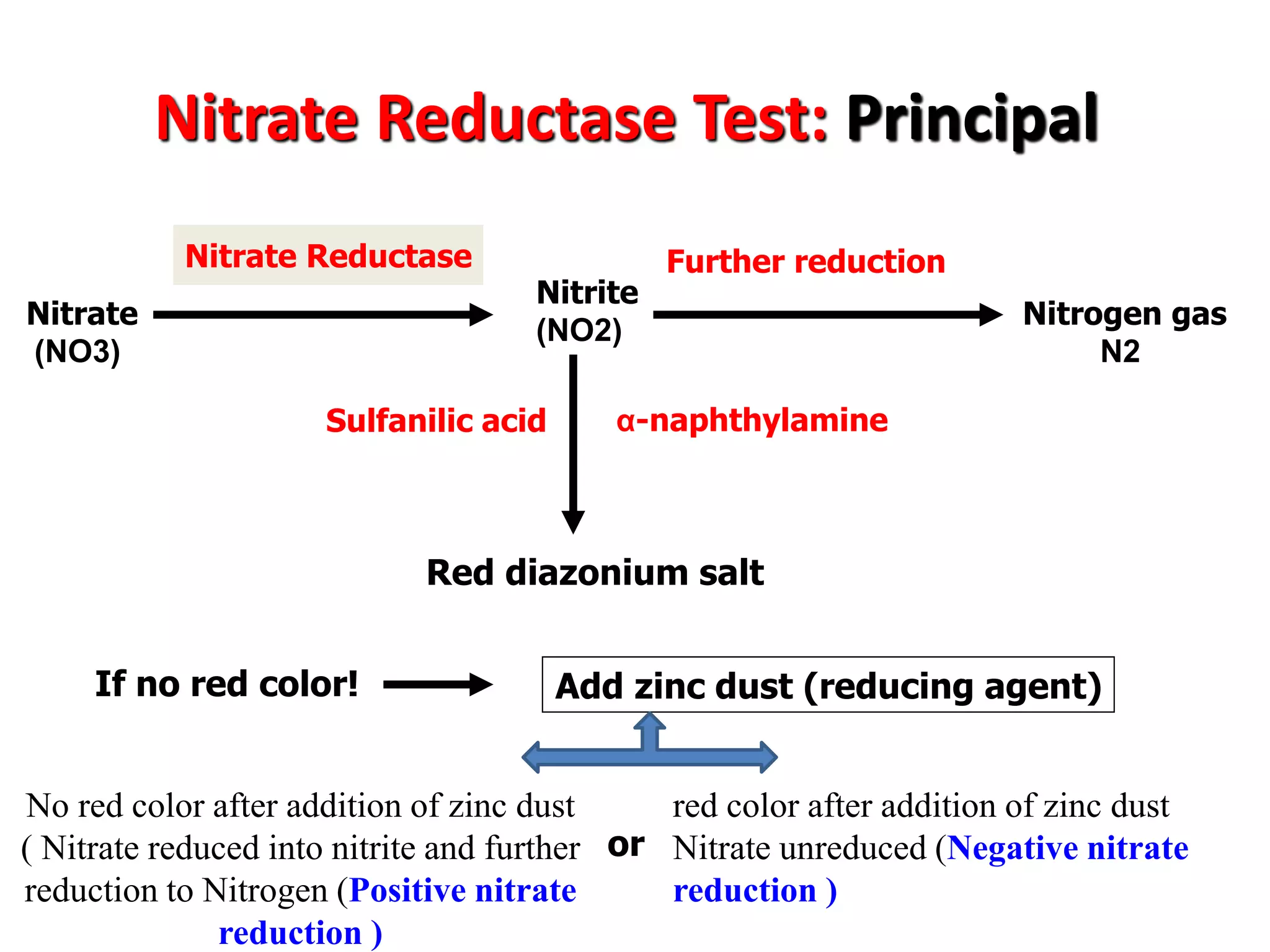
Nitrate Reductase Test: Principal 
Nitrate 
(NO3) 
Nitrate reductase 
Nitrite 
(NO2) 
α-naphthylamine 
Sulfanilic acid 
Red diazonium salt 
If no red color! 
Further reduction 
Nitrogen gas 
N2 
Add zinc dust (reducing agent) 
Nitrate Reductase 
No red color after addition of zinc dust 
( Nitrate reduced into nitrite and further reduction to Nitrogen (Positive nitrate reduction ) 
or 
red color after addition of zinc dust Nitrate unreduced (Negative nitrate reduction )
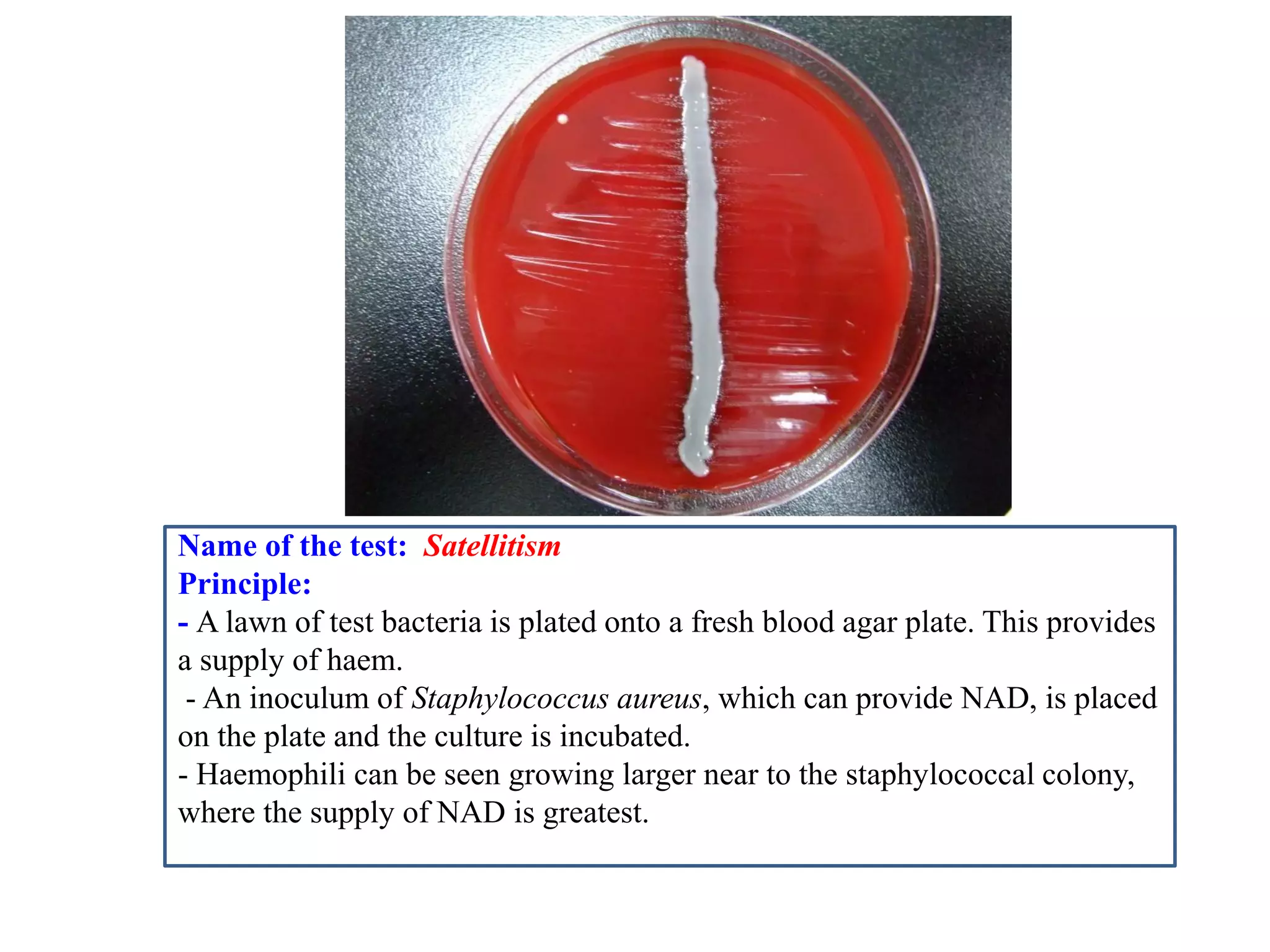
Name of the test: Satellitism 
Principle: 
- A lawn of test bacteria is plated onto a fresh blood agar plate. This provides a supply of haem. 
- An inoculum of Staphylococcus aureus, which can provide NAD, is placed on the plate and the culture is incubated. 
- Haemophili can be seen growing larger near to the staphylococcal colony, where the supply of NAD is greatest.
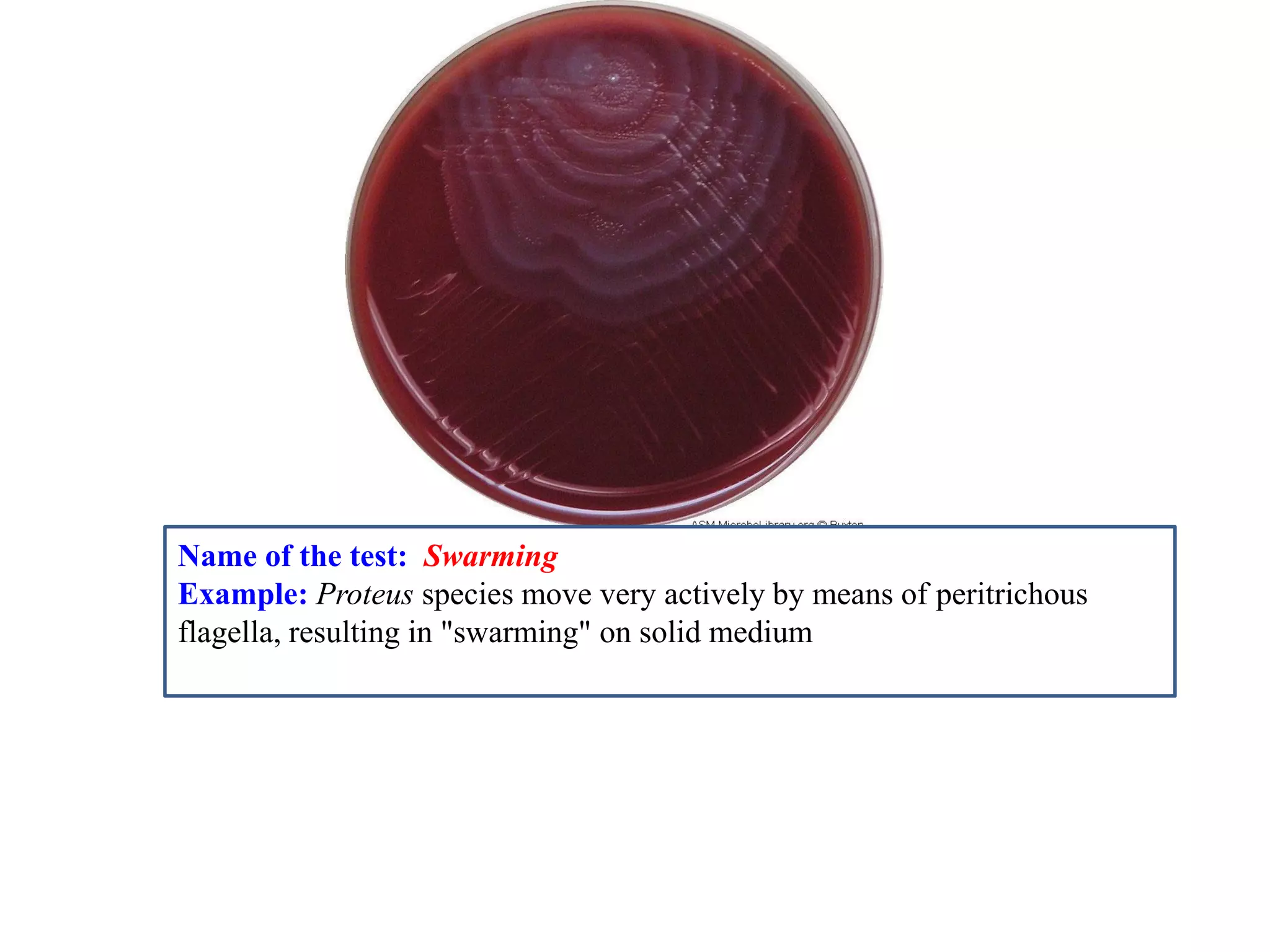
Name of the test: Swarming 
Example: Proteus species move very actively by means of peritrichous flagella, resulting in "swarming" on solid medium
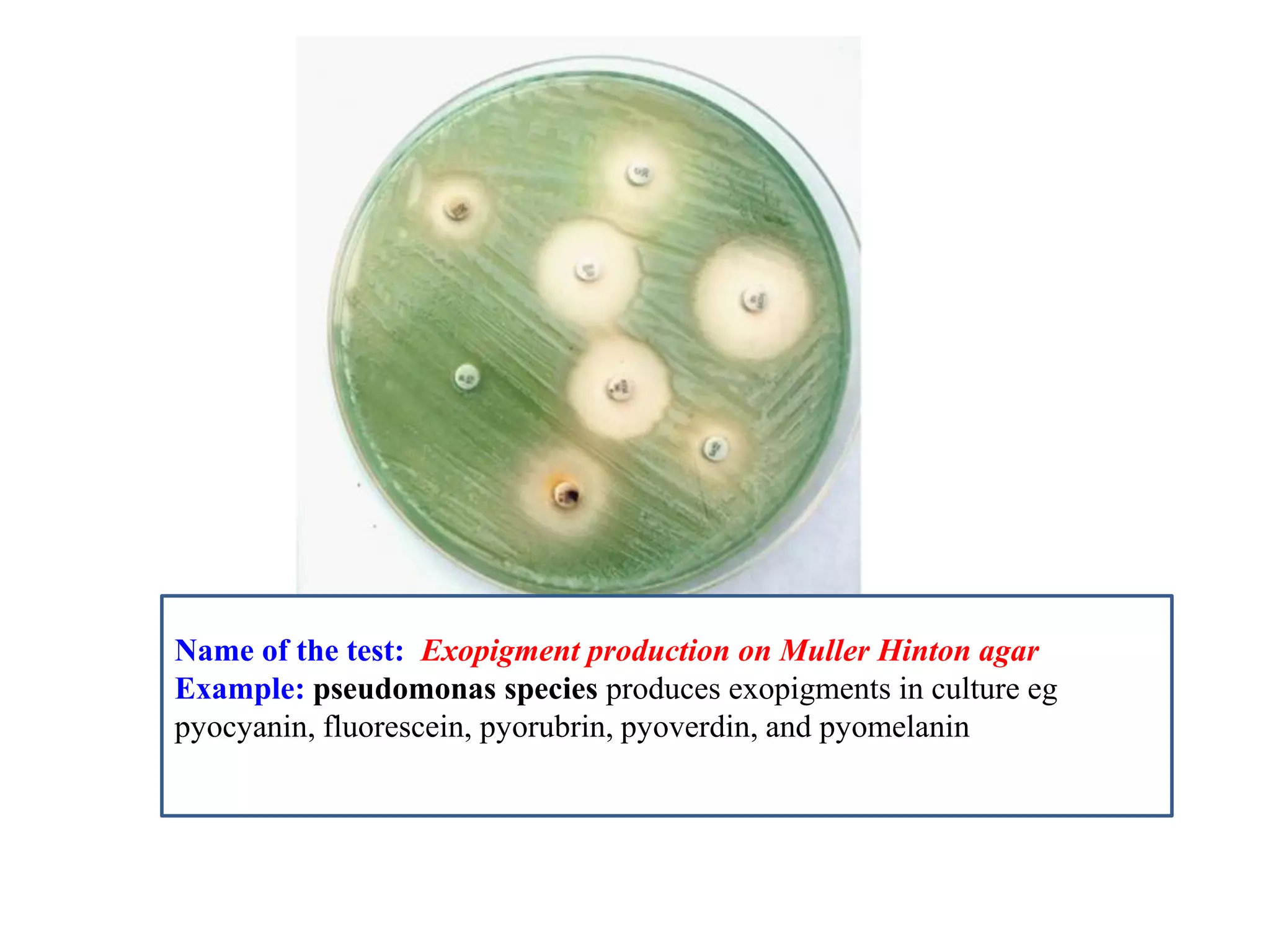
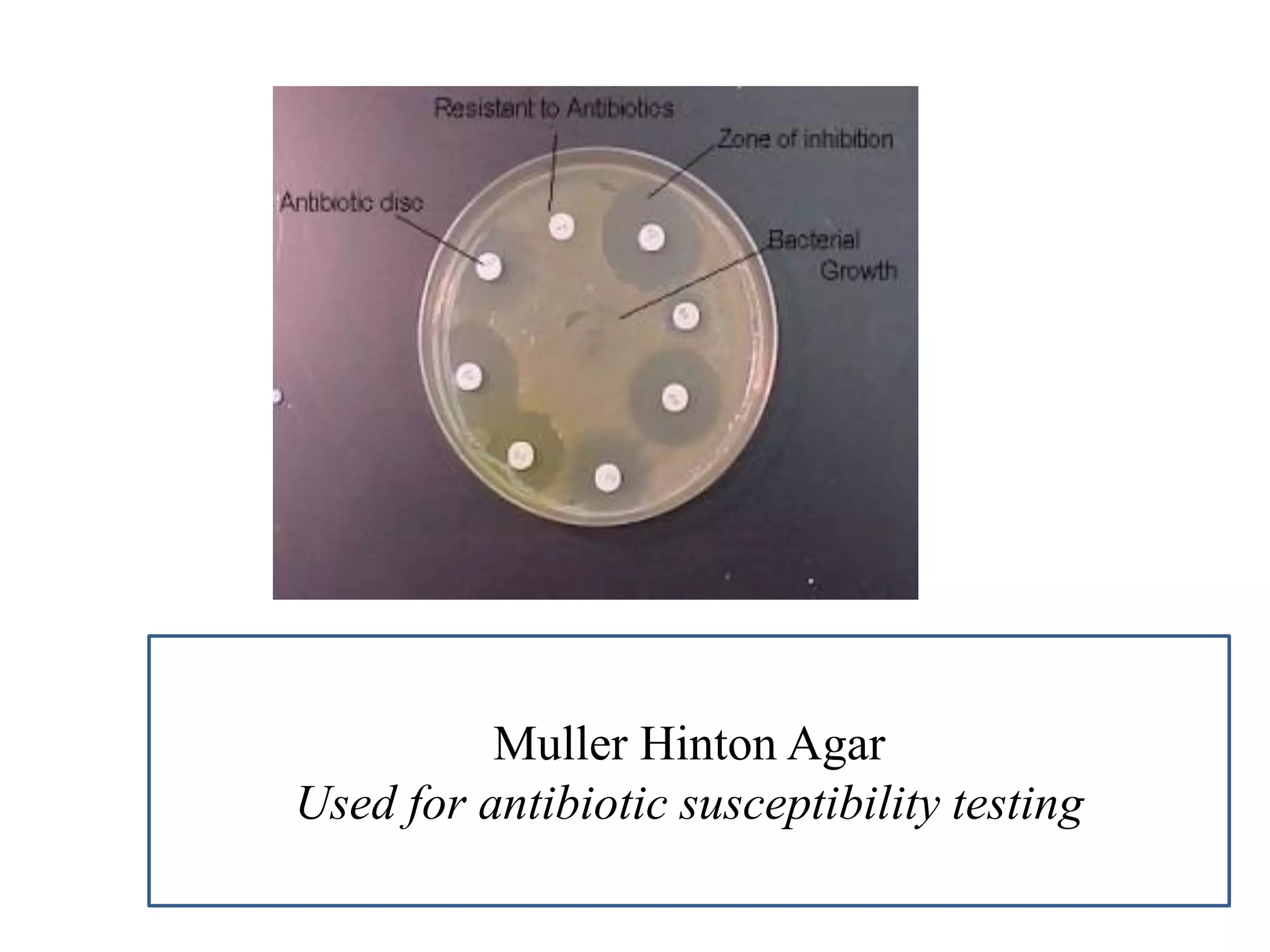
Name of the test: Exopigment production on Muller Hinton agar 
Example: pseudomonas species produces exopigments in culture eg pyocyanin, fluorescein, pyorubrin, pyoverdin, and pyomelanin
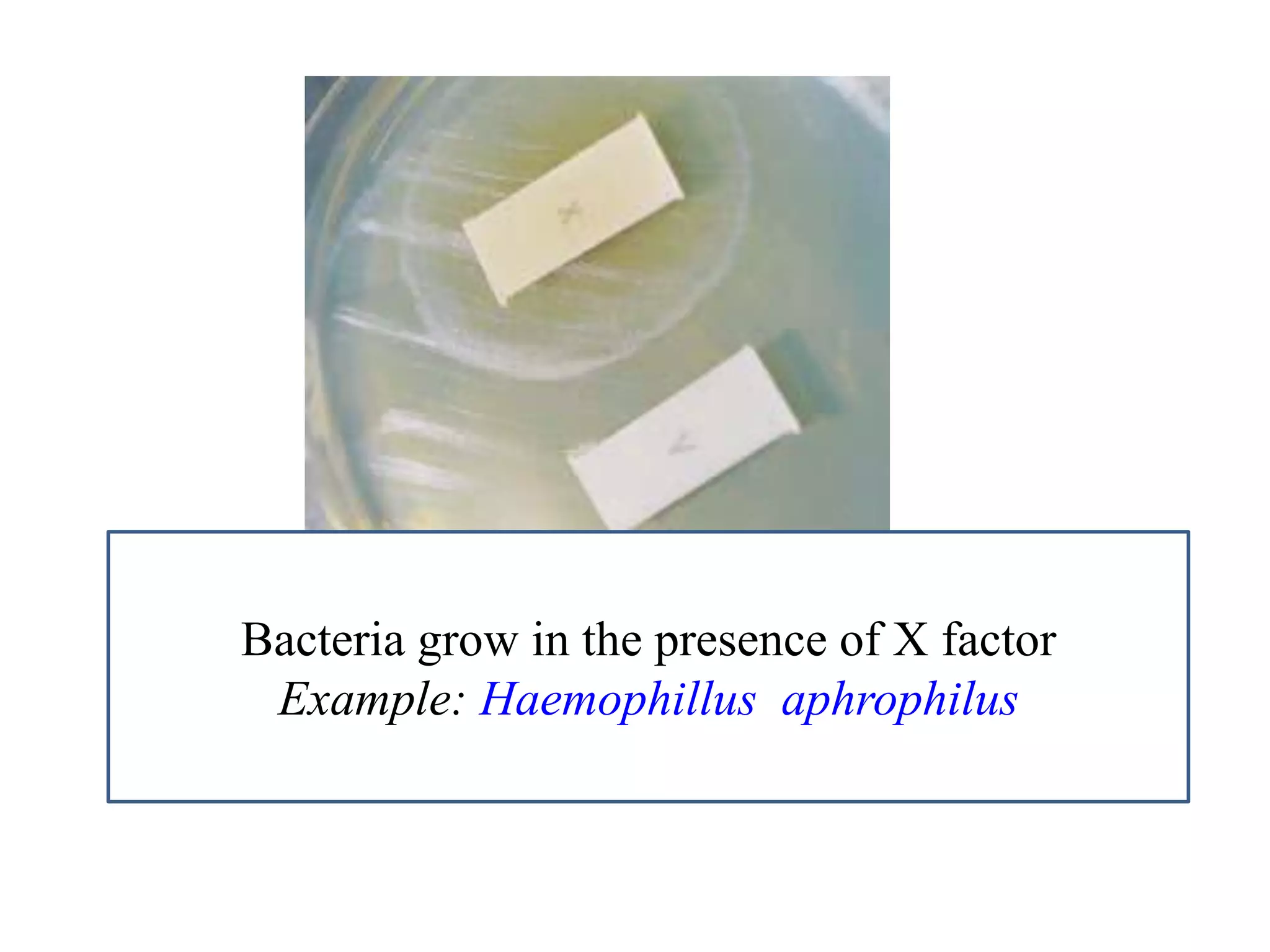
Bacteria grow in the presence of X factor 
Example: Haemophillus aphrophilus
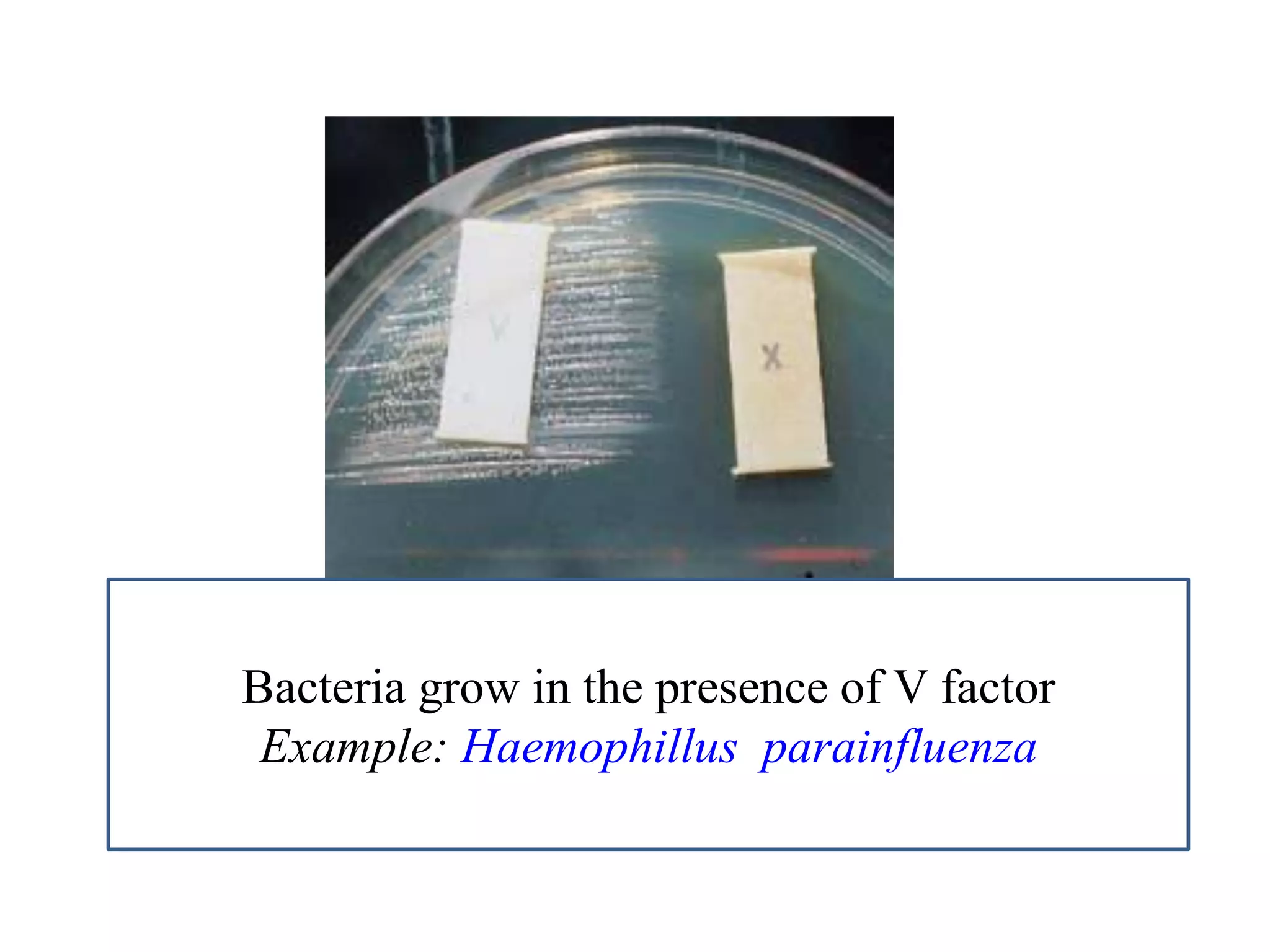
Bacteria grow in the presence of V factor 
Example: Haemophillus parainfluenza
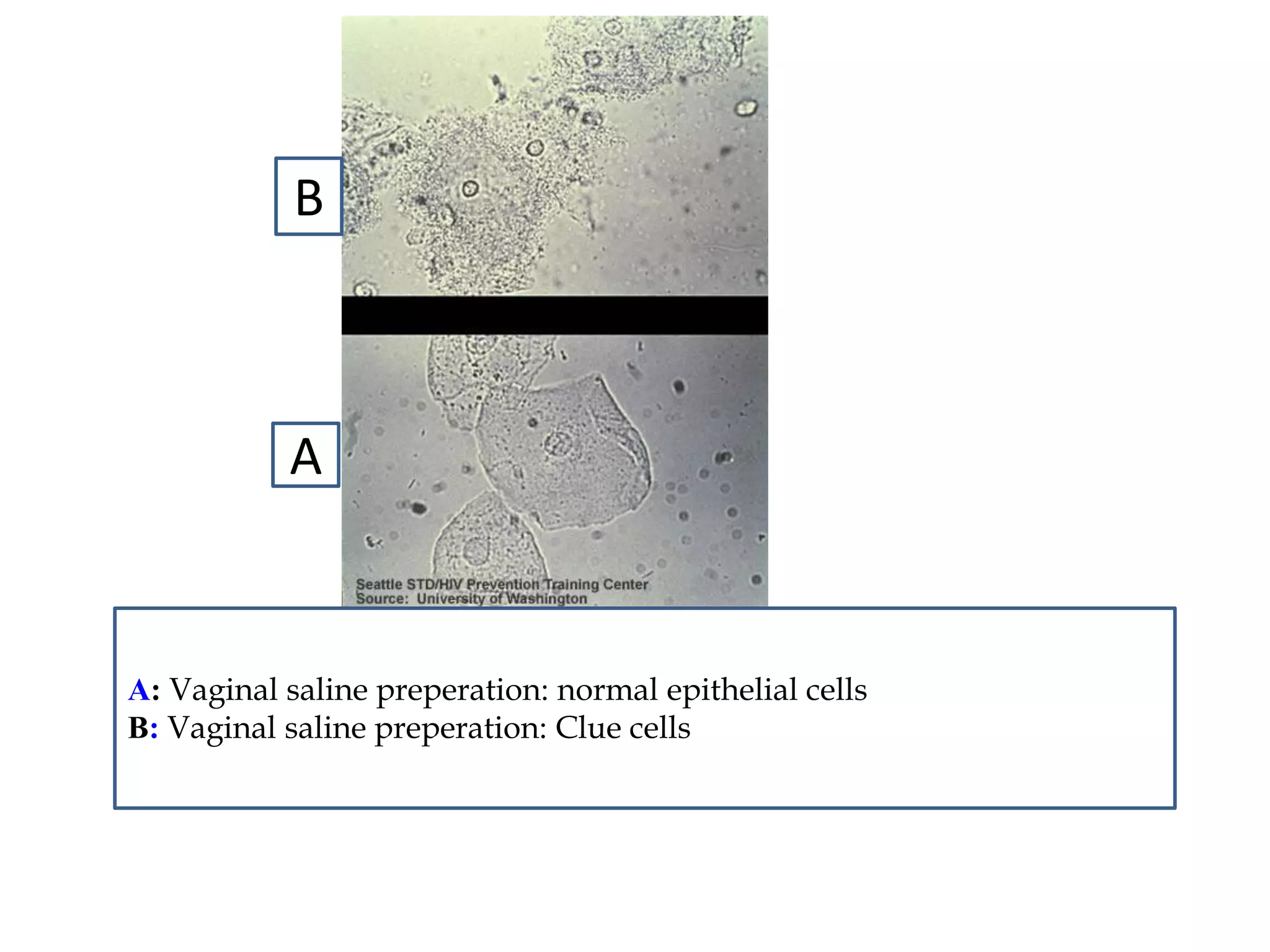
A 
B 
A: Vaginal saline preperation: normal epithelial cells 
B: Vaginal saline preperation: Clue cells
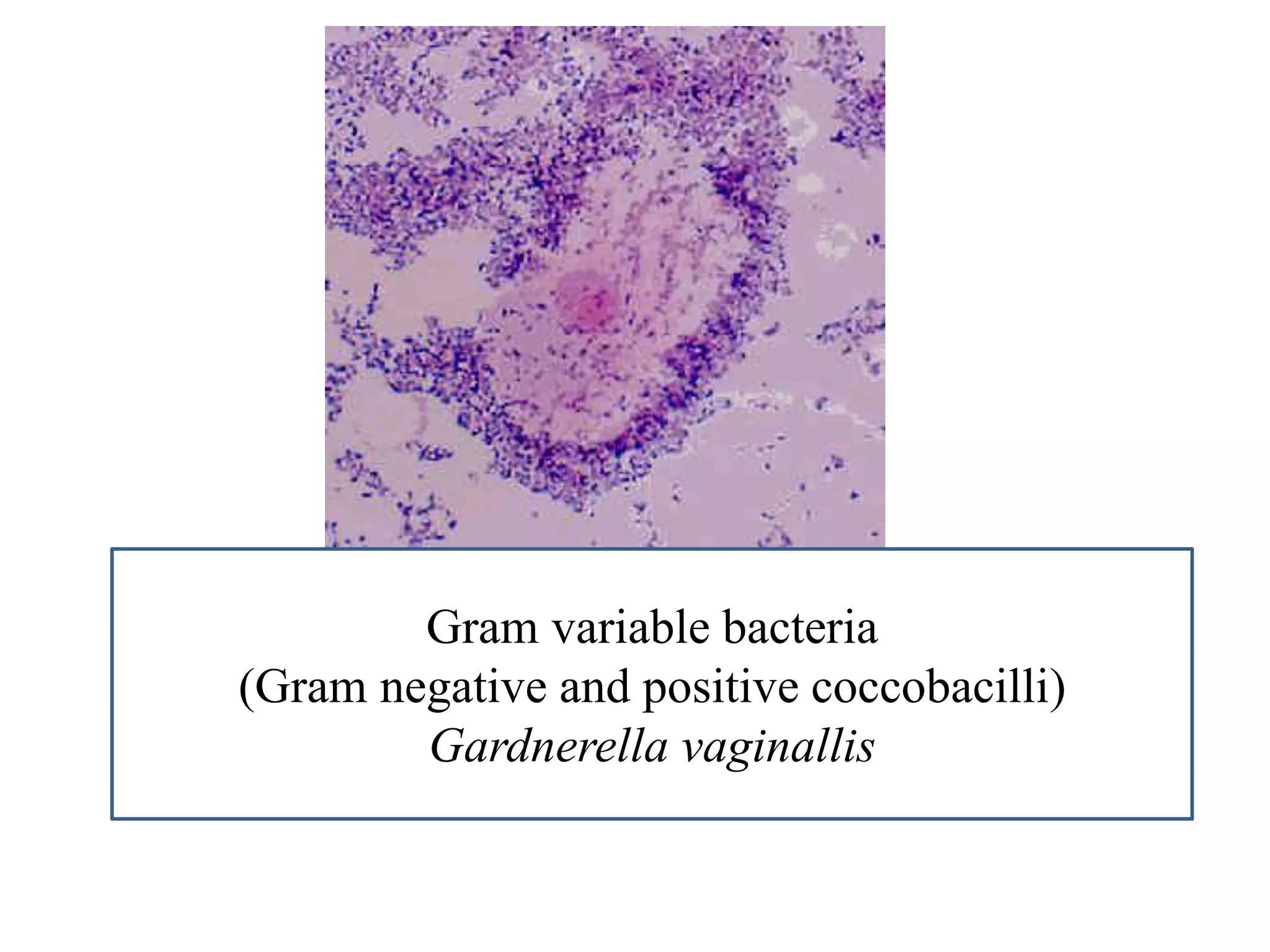
Gram variable bacteria 
(Gram negative and positive coccobacilli) 
Gardnerella vaginallis
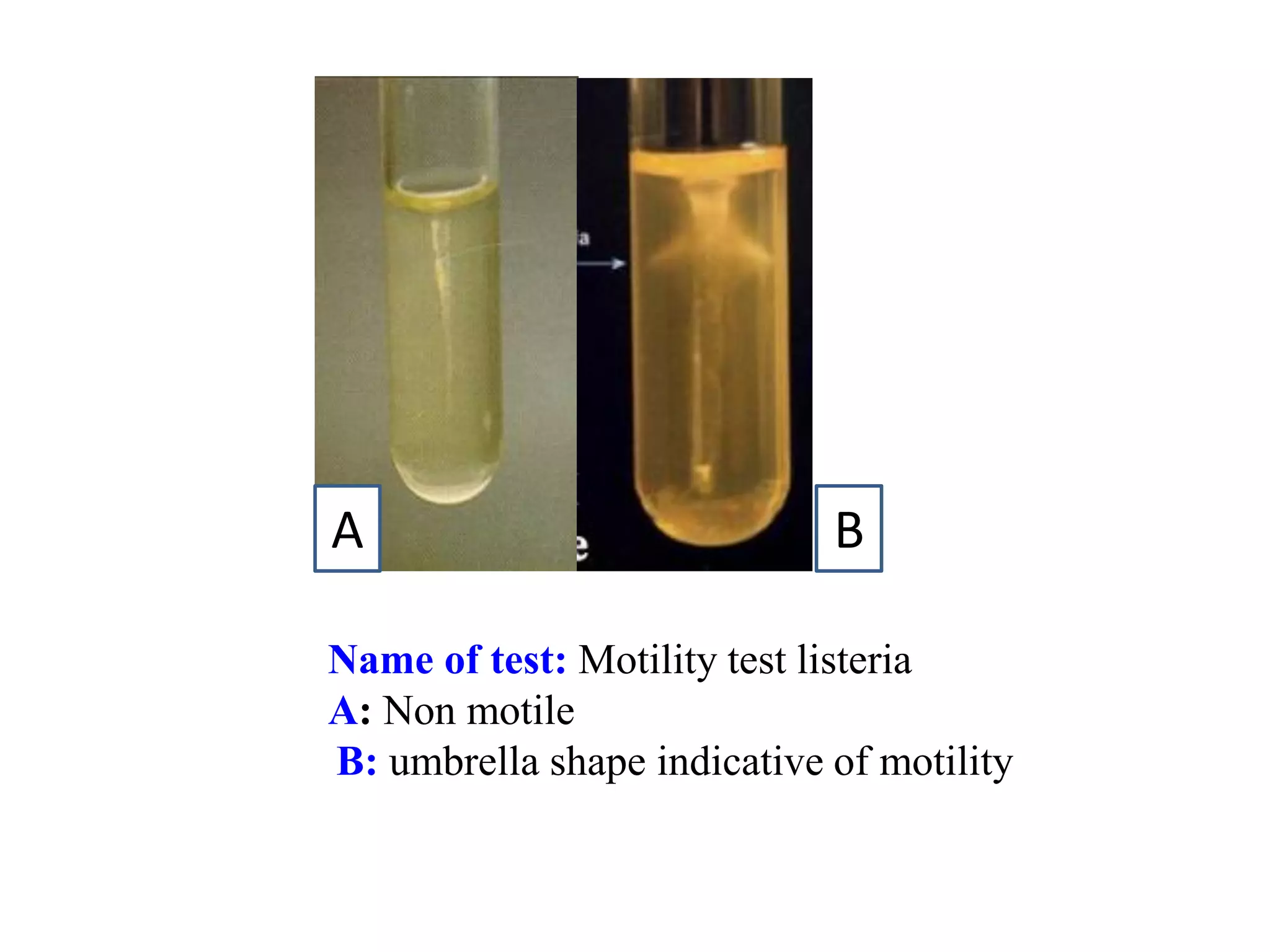
Name of test: Motility test listeria 
A: Non motile 
B: umbrella shape indicative of motility 
A 
B
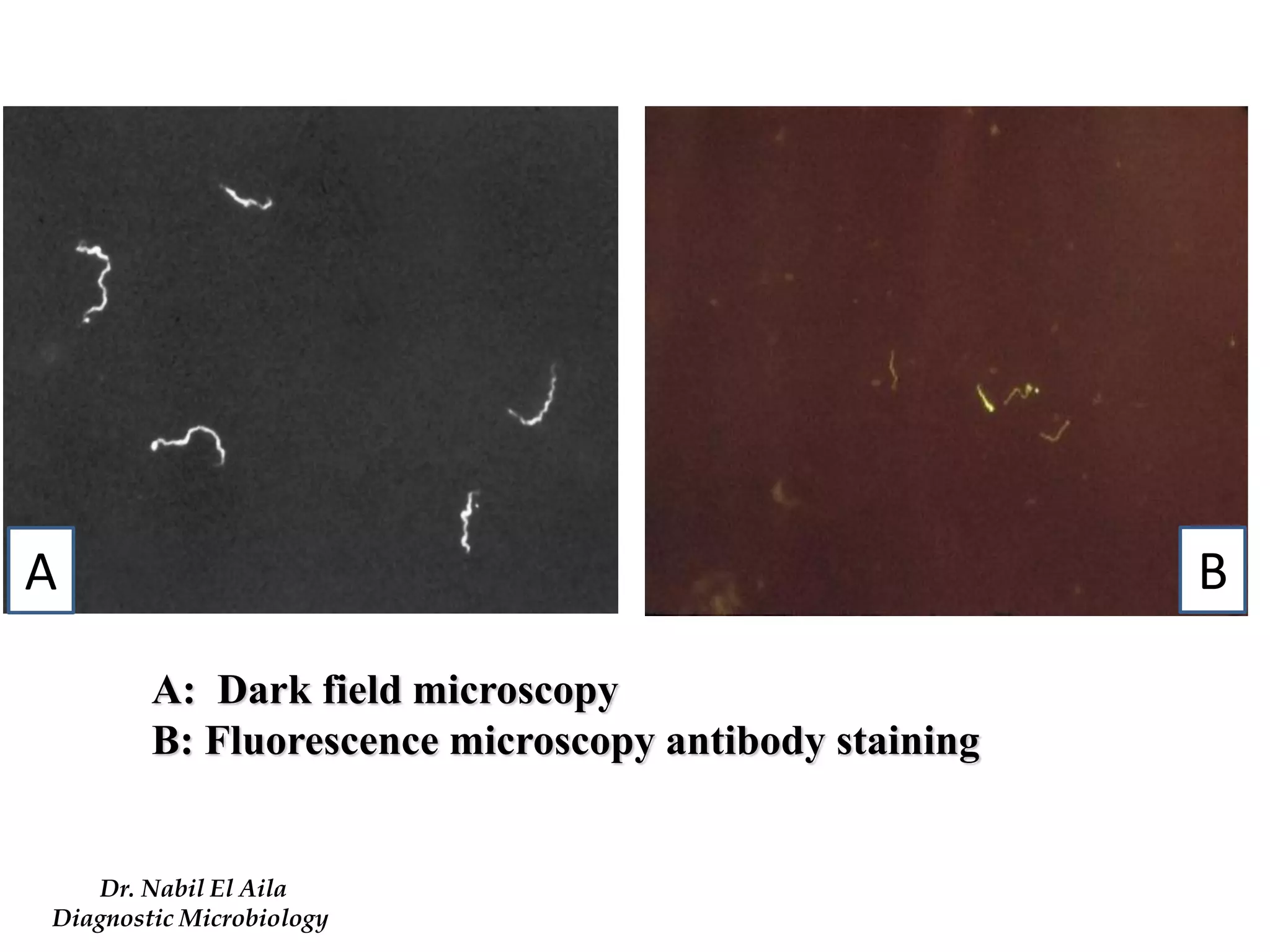
A: Dark field microscopy 
B: Fluorescence microscopy antibody staining 
Dr. Nabil El Aila 
Diagnostic Microbiology 
A 
B
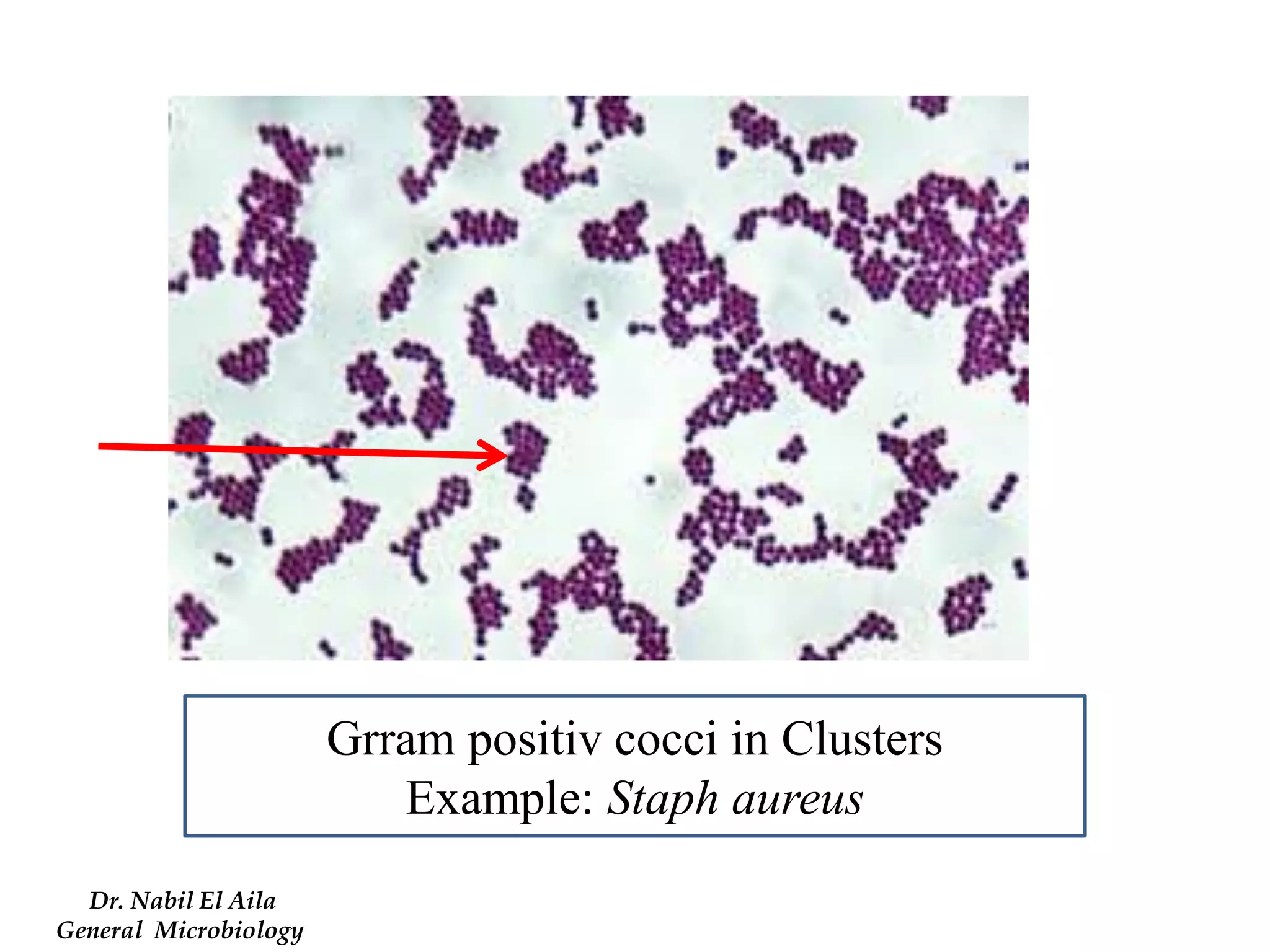
Grram positiv cocci in Clusters 
Example: Staph aureus 
Dr. Nabil El Aila 
General Microbiology
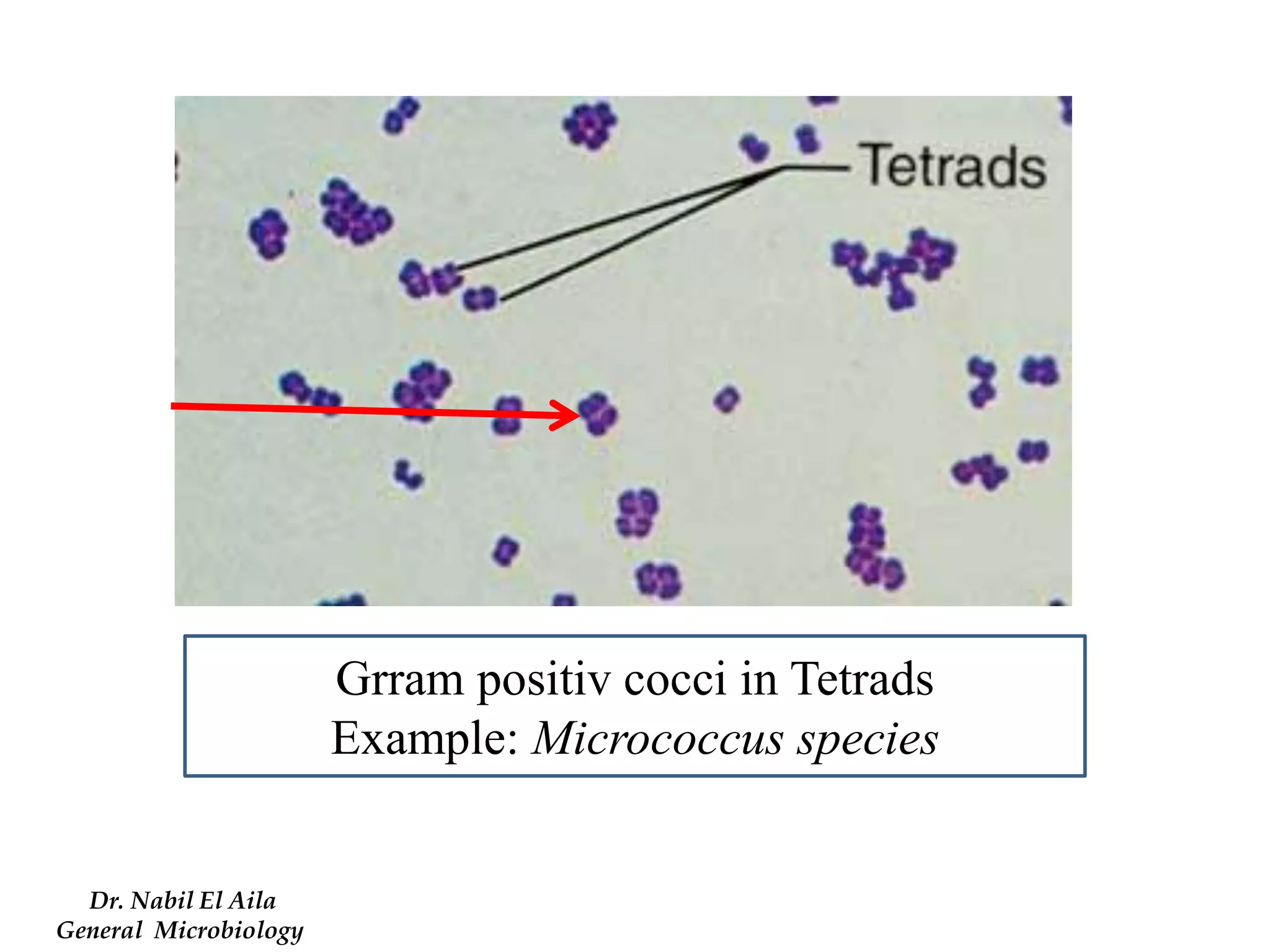
Grram positiv cocci in Tetrads 
Example: Micrococcus species 
Dr. Nabil El Aila 
General Microbiology
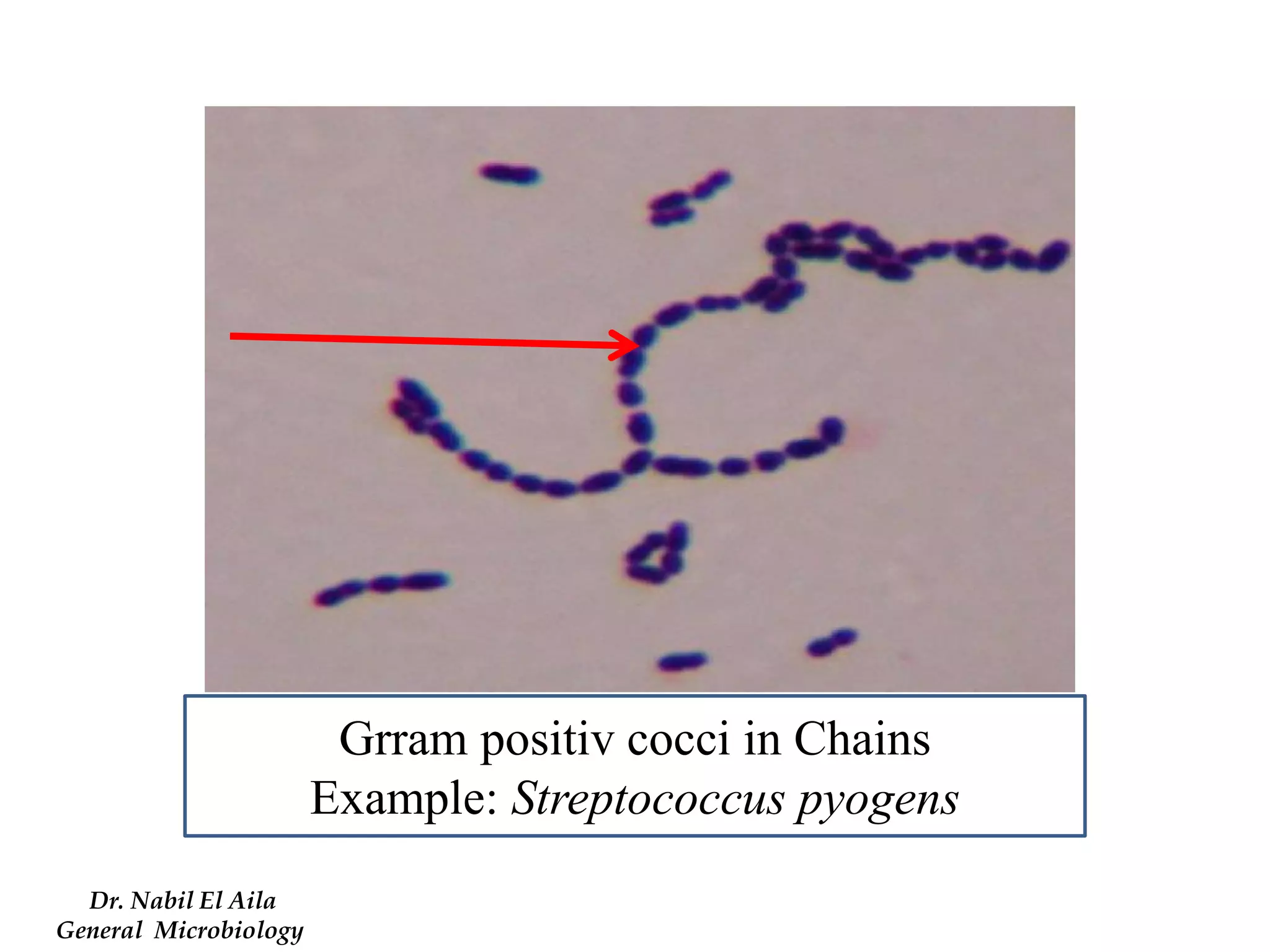
Grram positiv cocci in Chains 
Example: Streptococcus pyogens 
Dr. Nabil El Aila 
General Microbiology
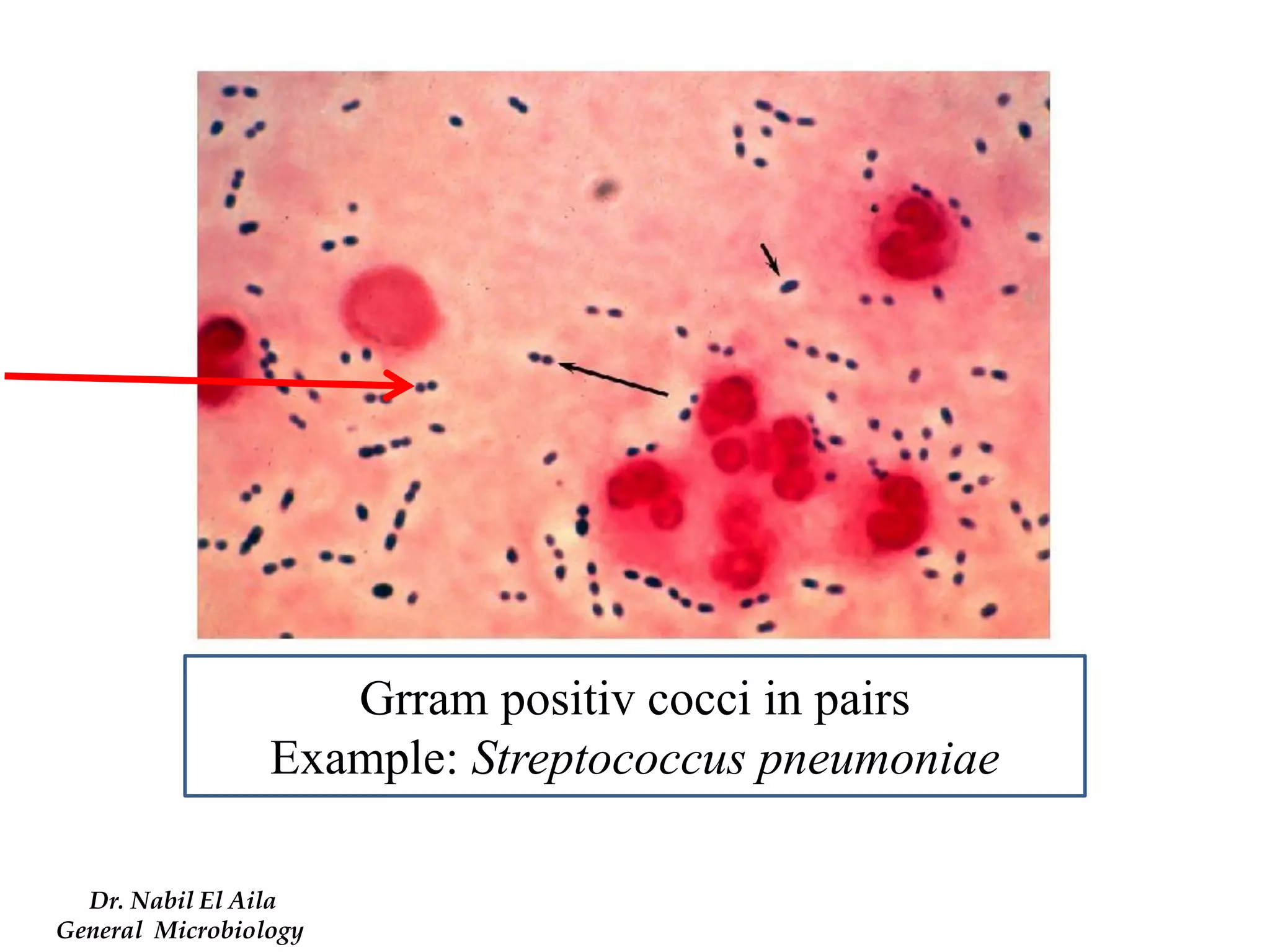
Grram positiv cocci in pairs 
Example: Streptococcus pneumoniae 
Dr. Nabil El Aila 
General Microbiology
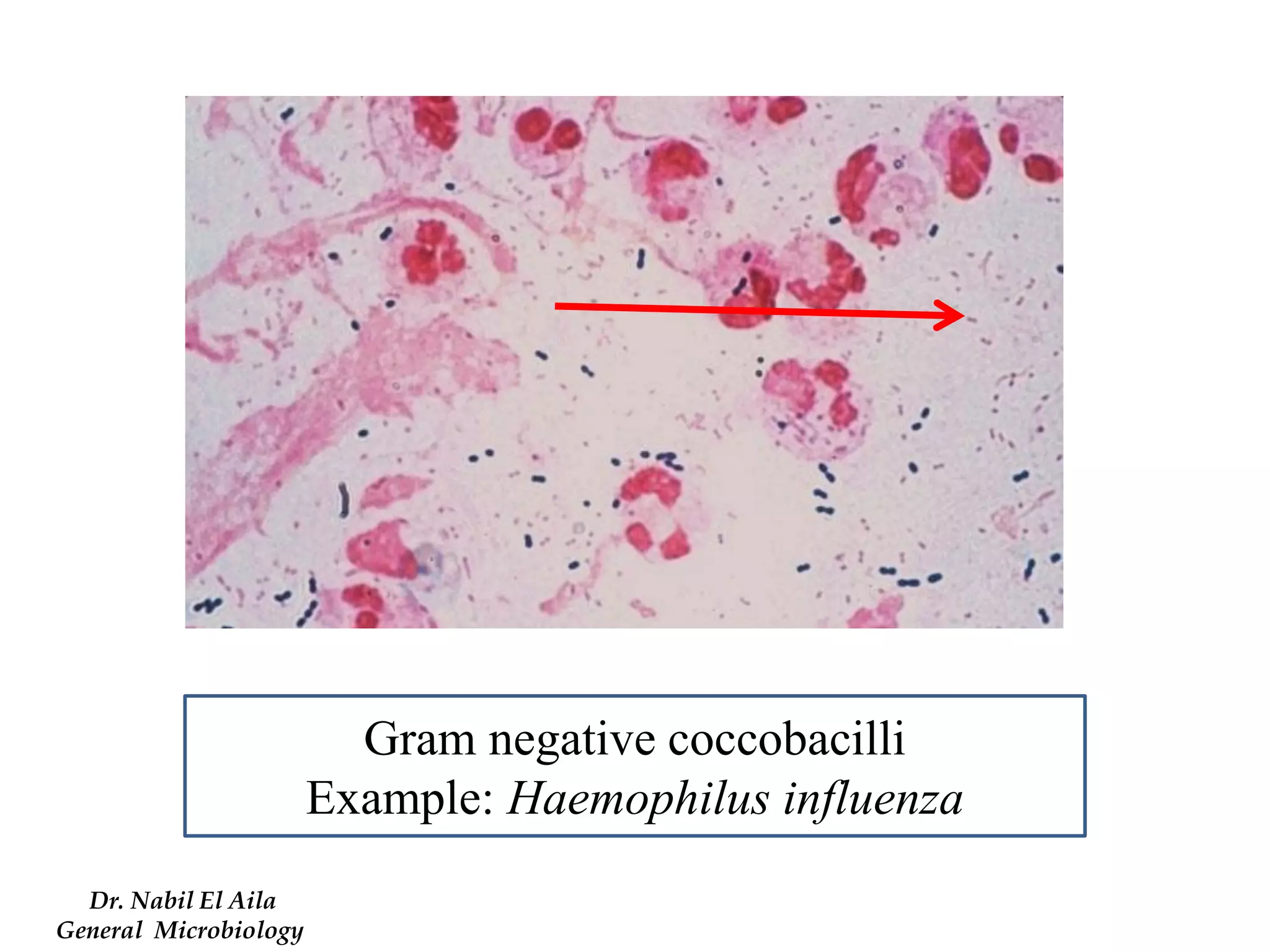
Gram negative coccobacilli 
Example: Haemophilus influenza 
Dr. Nabil El Aila 
General Microbiology
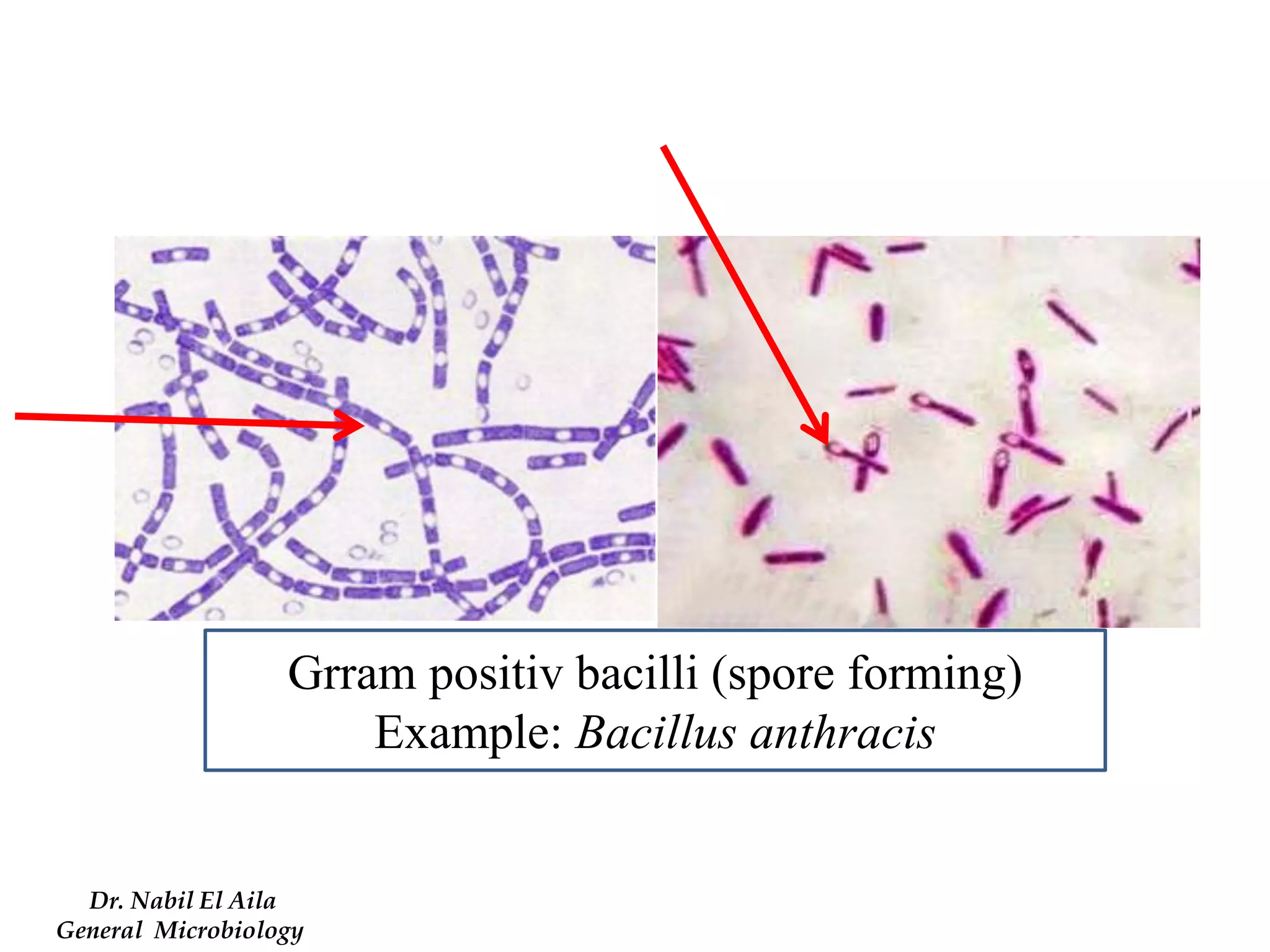
Grram positiv bacilli (spore forming) 
Example: Bacillus anthracis 
Dr. Nabil El Aila 
General Microbiology
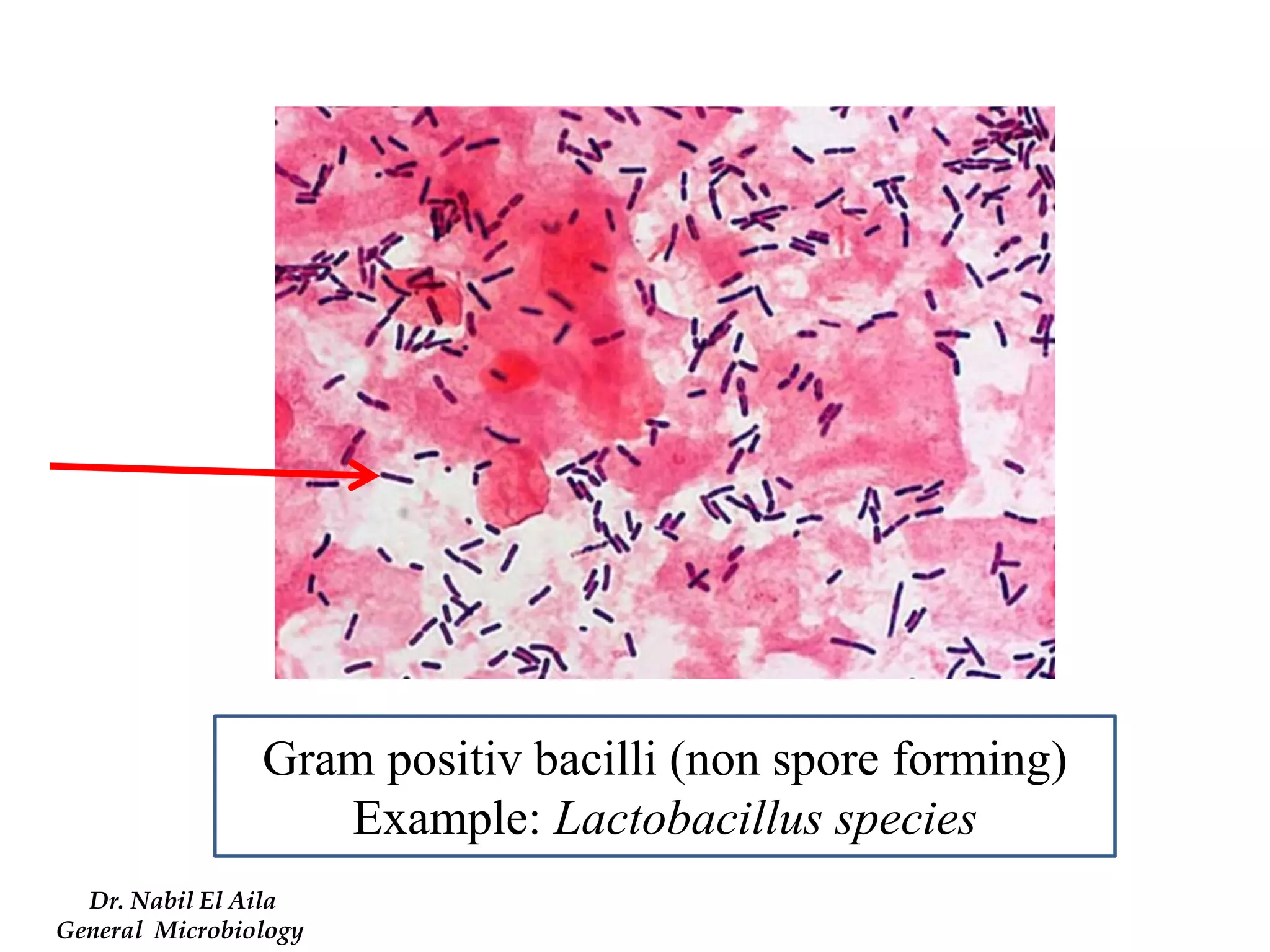
Gram positiv bacilli (non spore forming) 
Example: Lactobacillus species 
Dr. Nabil El Aila 
General Microbiology
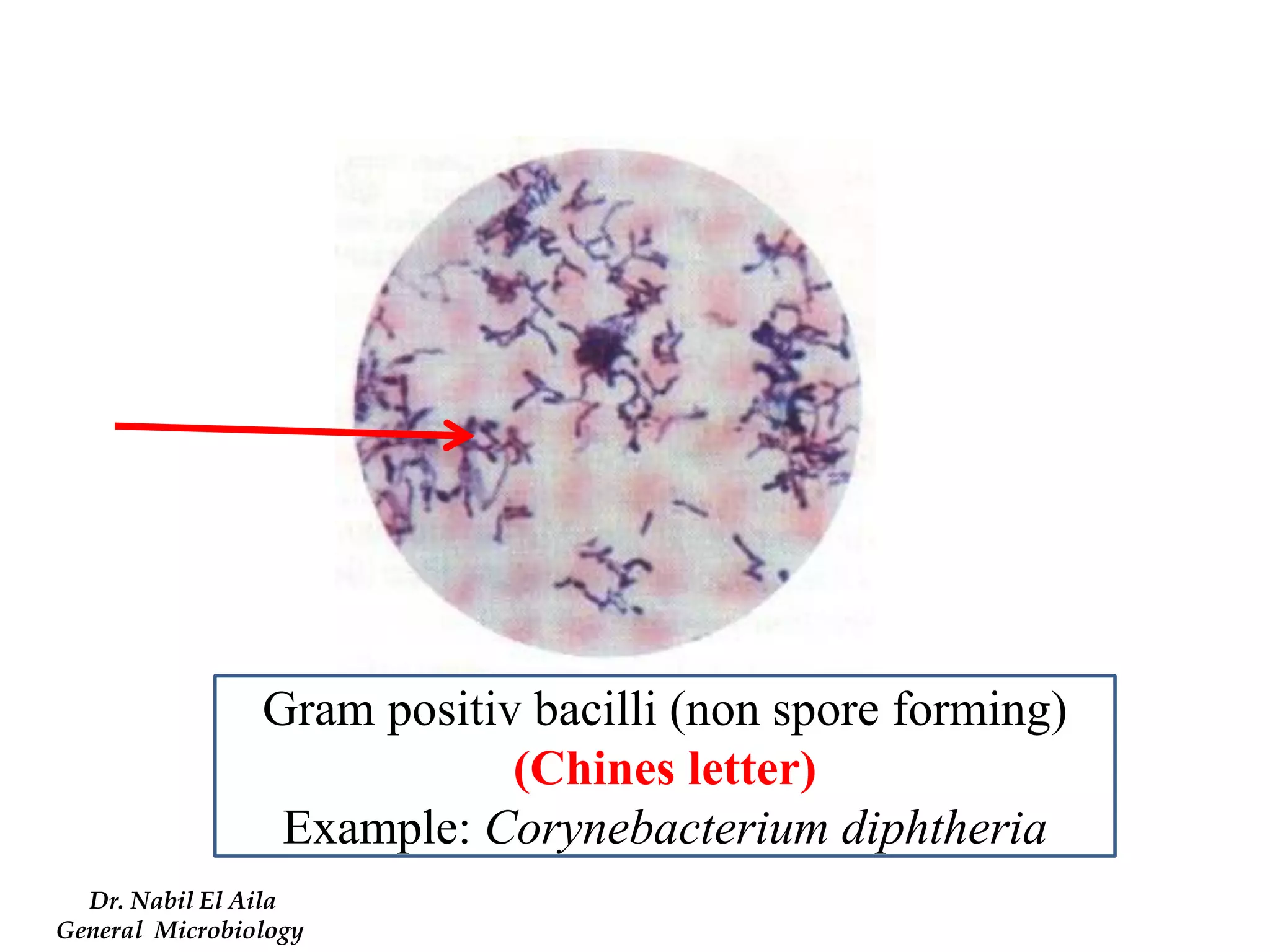
Gram positiv bacilli (non spore forming) (Chines letter) 
Example: Corynebacterium diphtheria 
Dr. Nabil El Aila 
General Microbiology
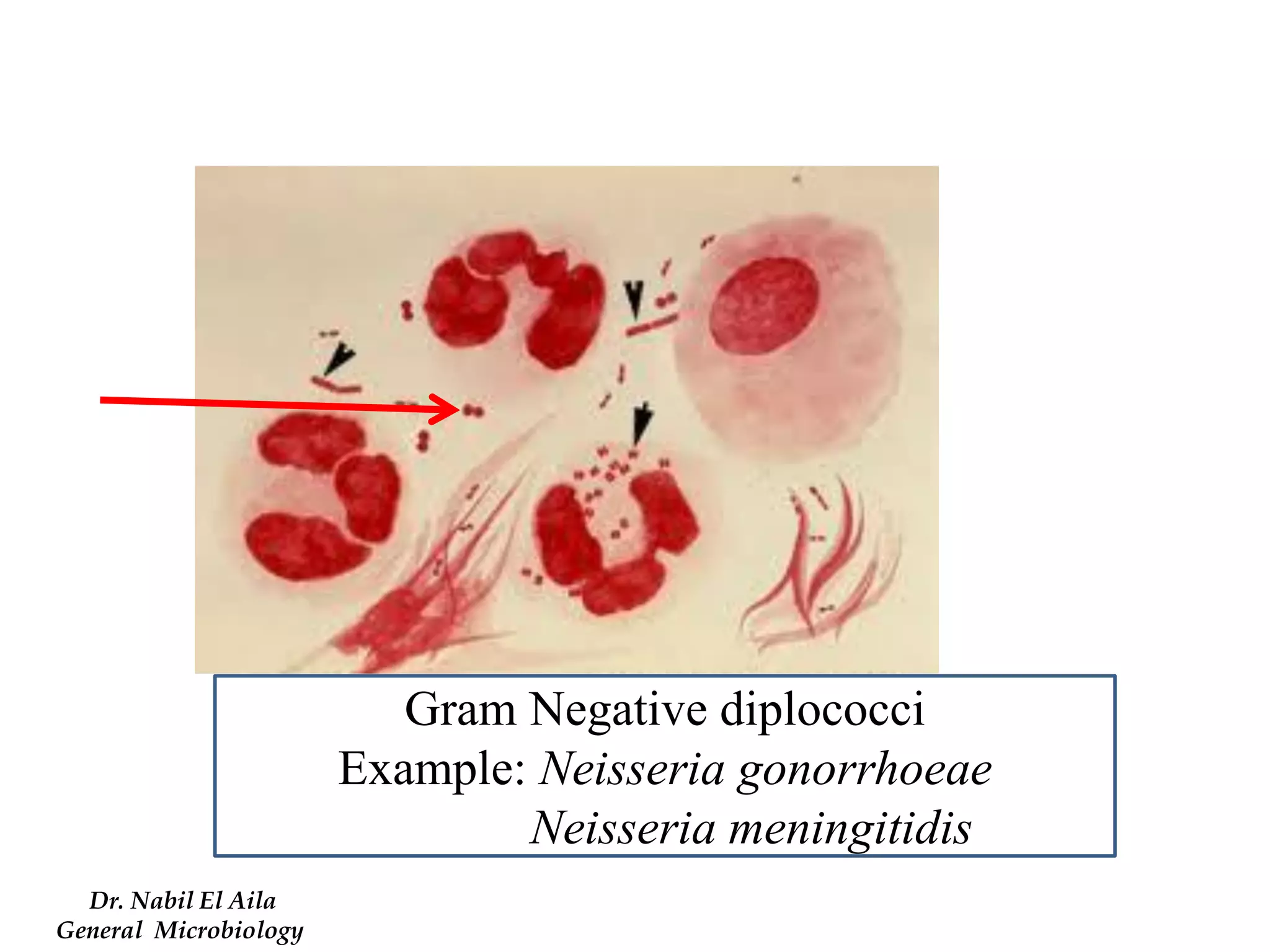
Gram Negative diplococci 
Example: Neisseria gonorrhoeae 
Neisseria meningitidis 
Dr. Nabil El Aila 
General Microbiology
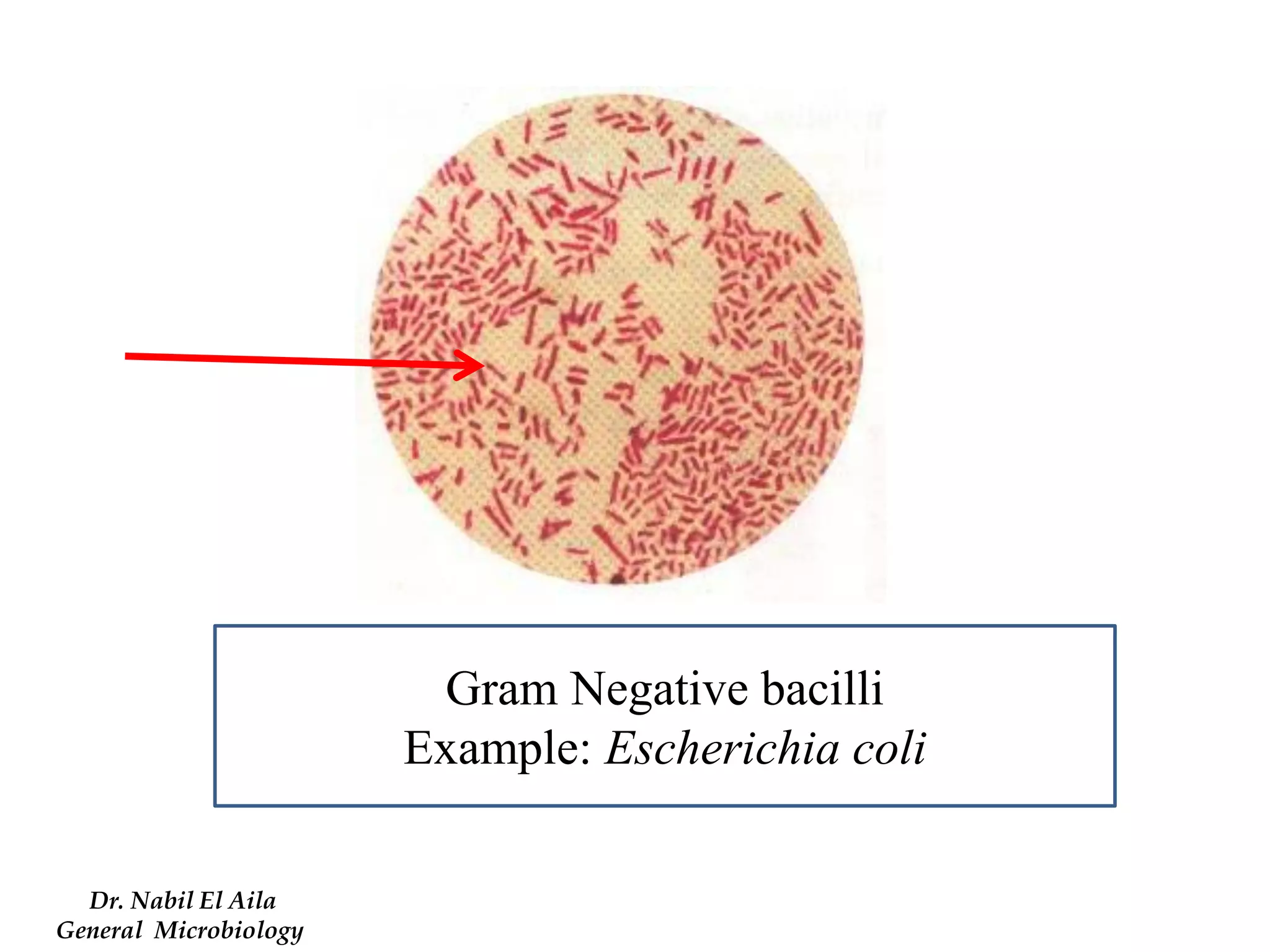
Gram Negative bacilli 
Example: Escherichia coli 
Dr. Nabil El Aila 
General Microbiology
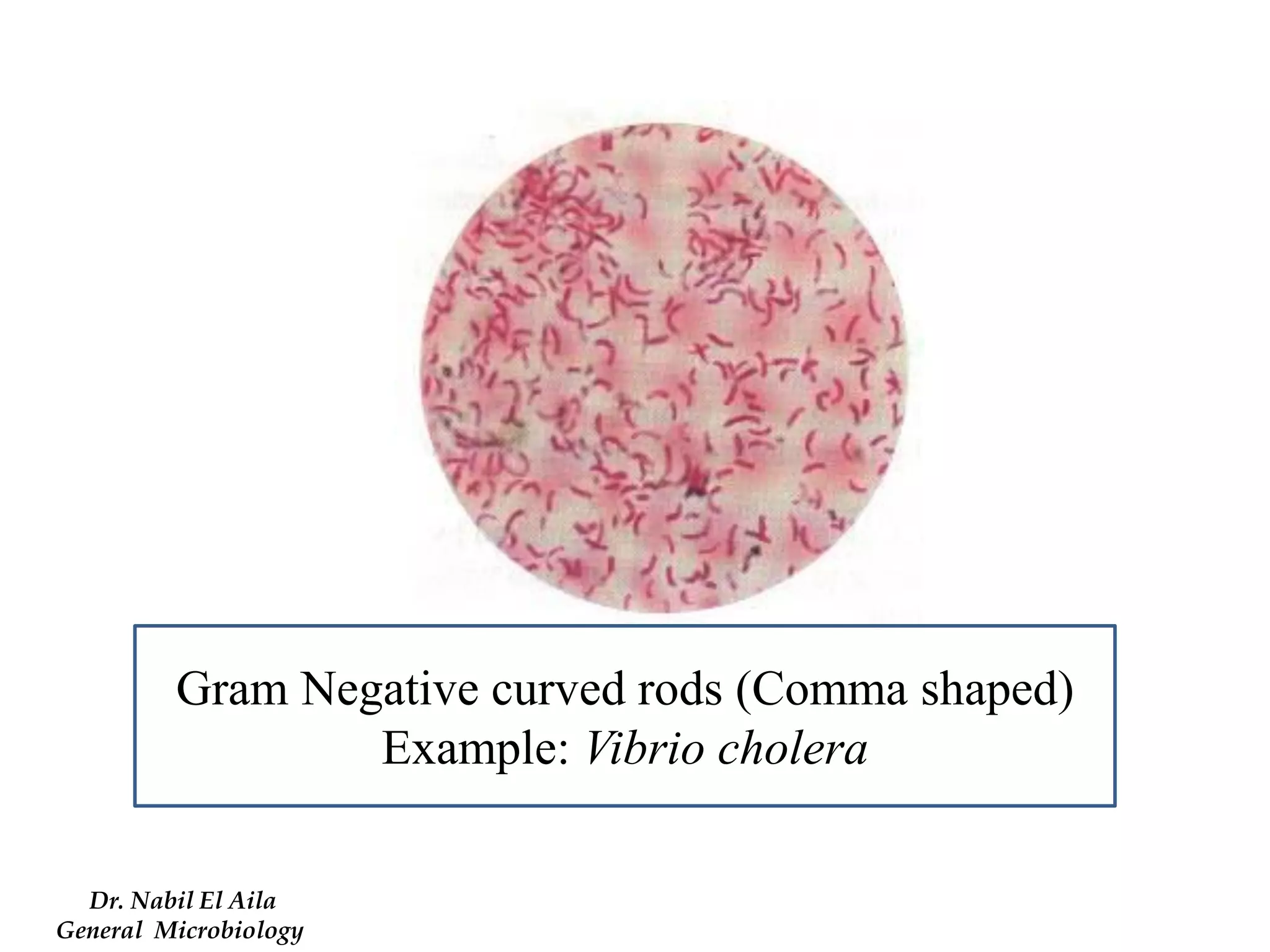
Gram Negative curved rods (Comma shaped) 
Example: Vibrio cholera 
Dr. Nabil El Aila 
General Microbiology
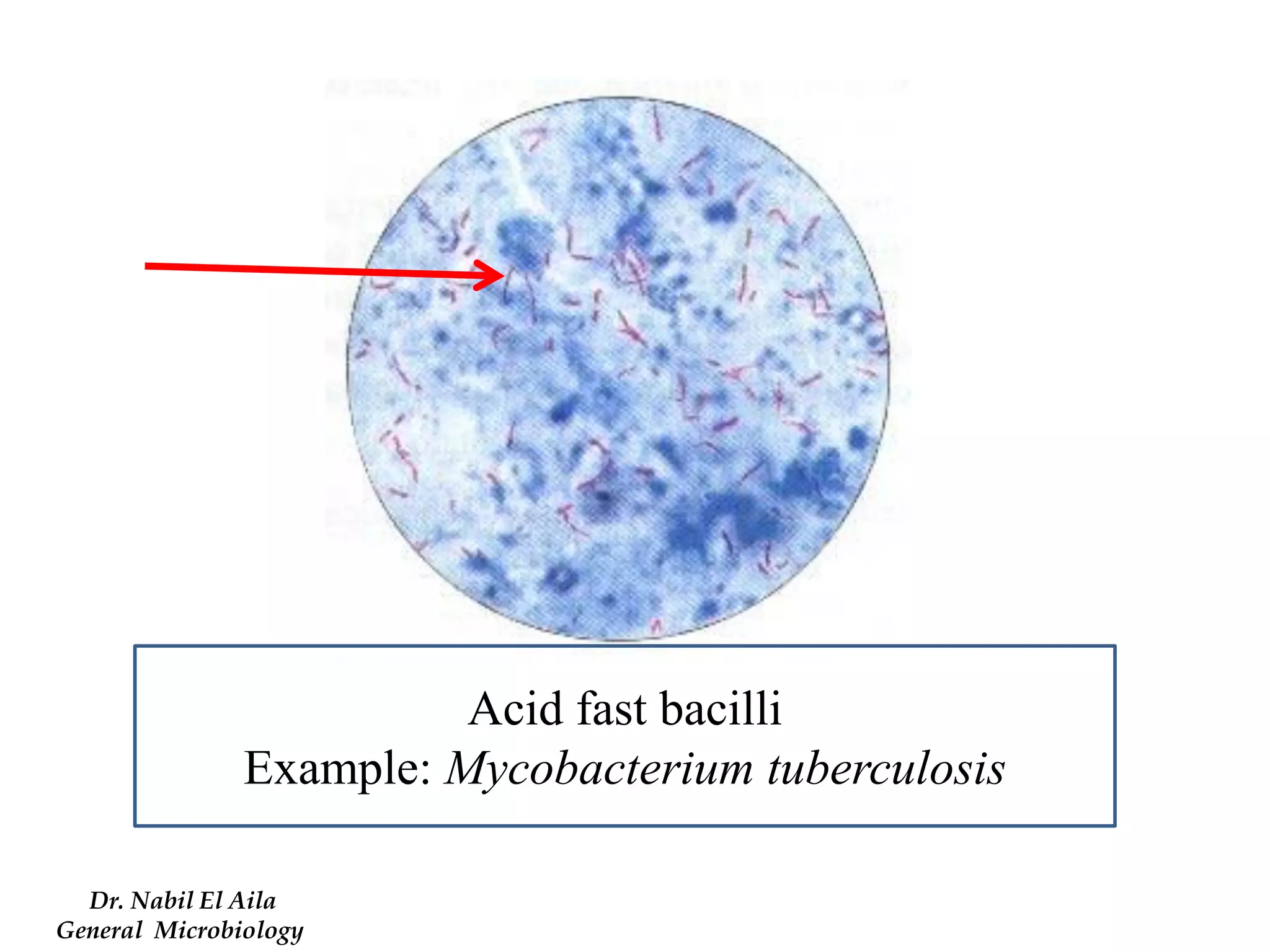
Acid fast bacilli 
Example: Mycobacterium tuberculosis 
Dr. Nabil El Aila 
General Microbiology
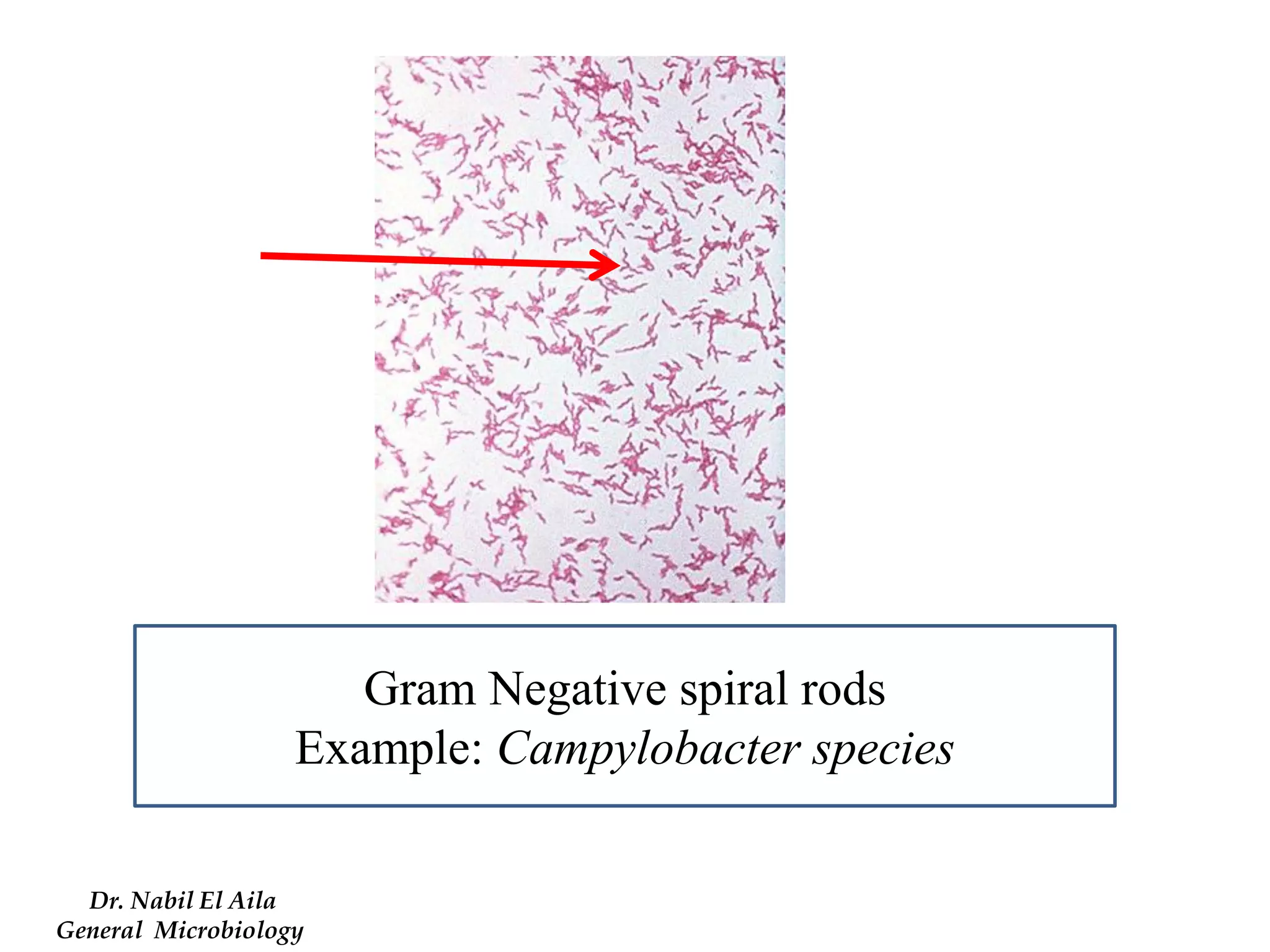
Gram Negative spiral rods 
Example: Campylobacter species 
Dr. Nabil El Aila 
General Microbiology
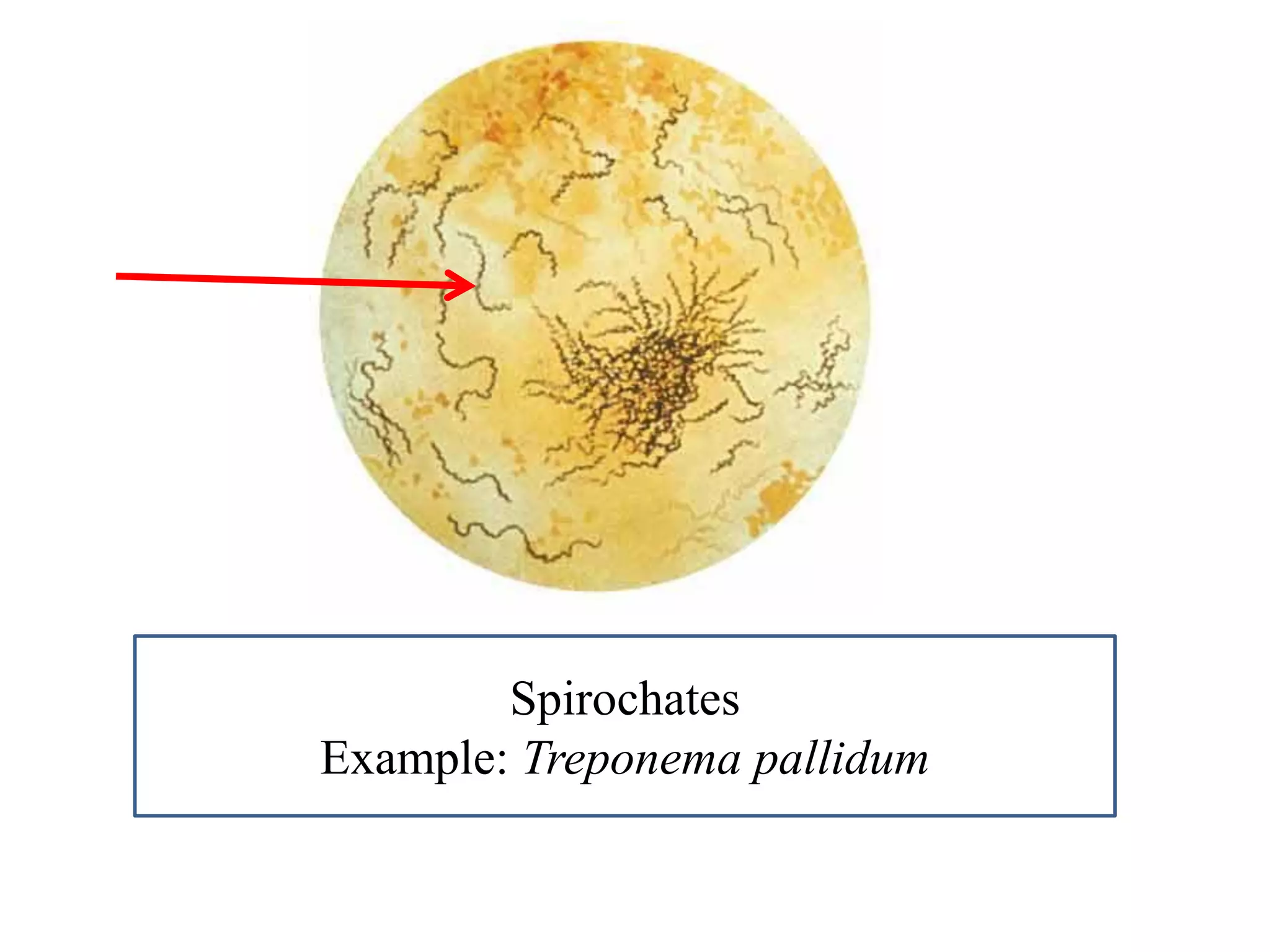
Spirochates 
Example: Treponema pallidum
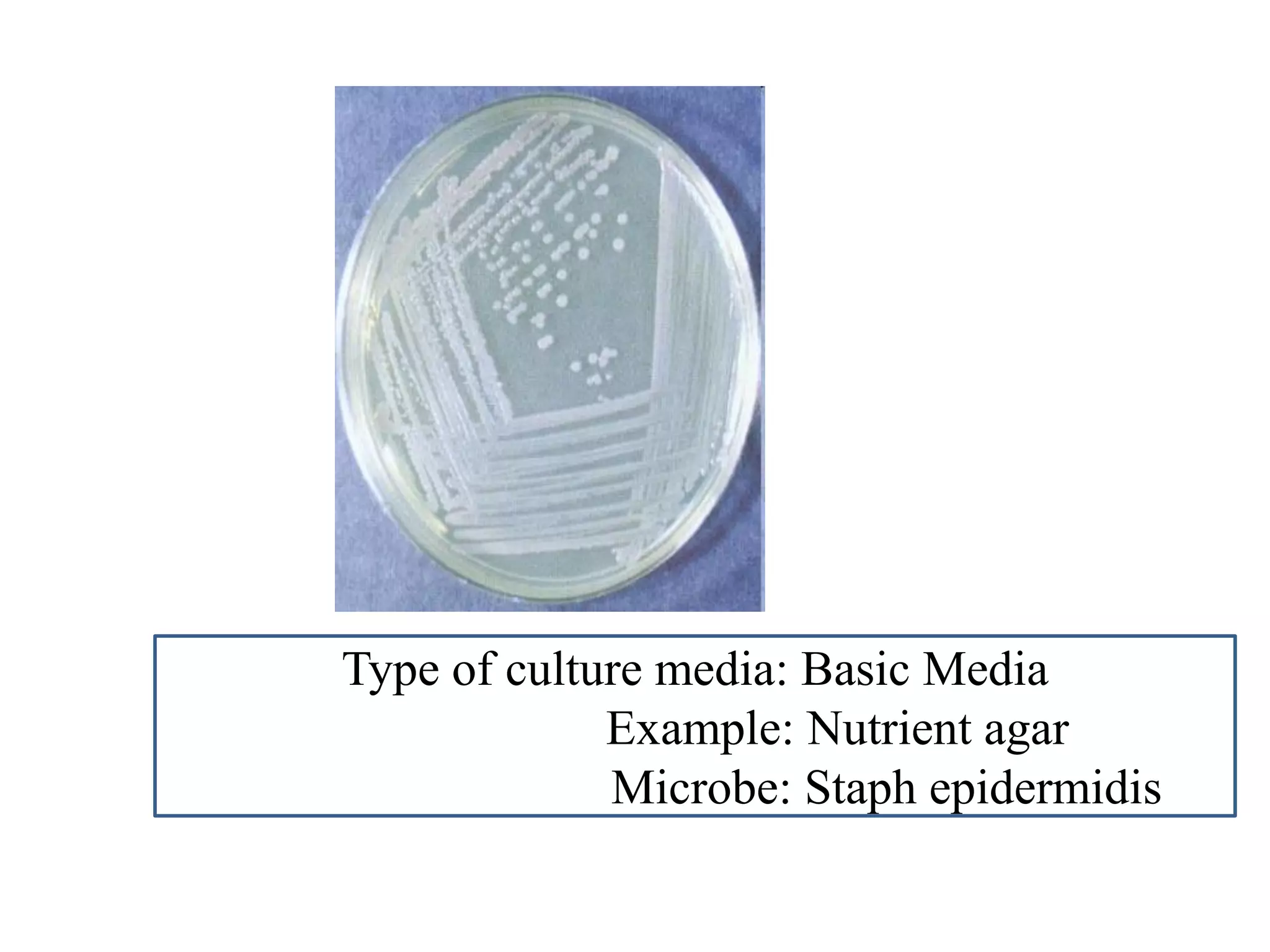
Type of culture media: Basic Media 
Example: Nutrient agar 
Microbe: Staph epidermidis
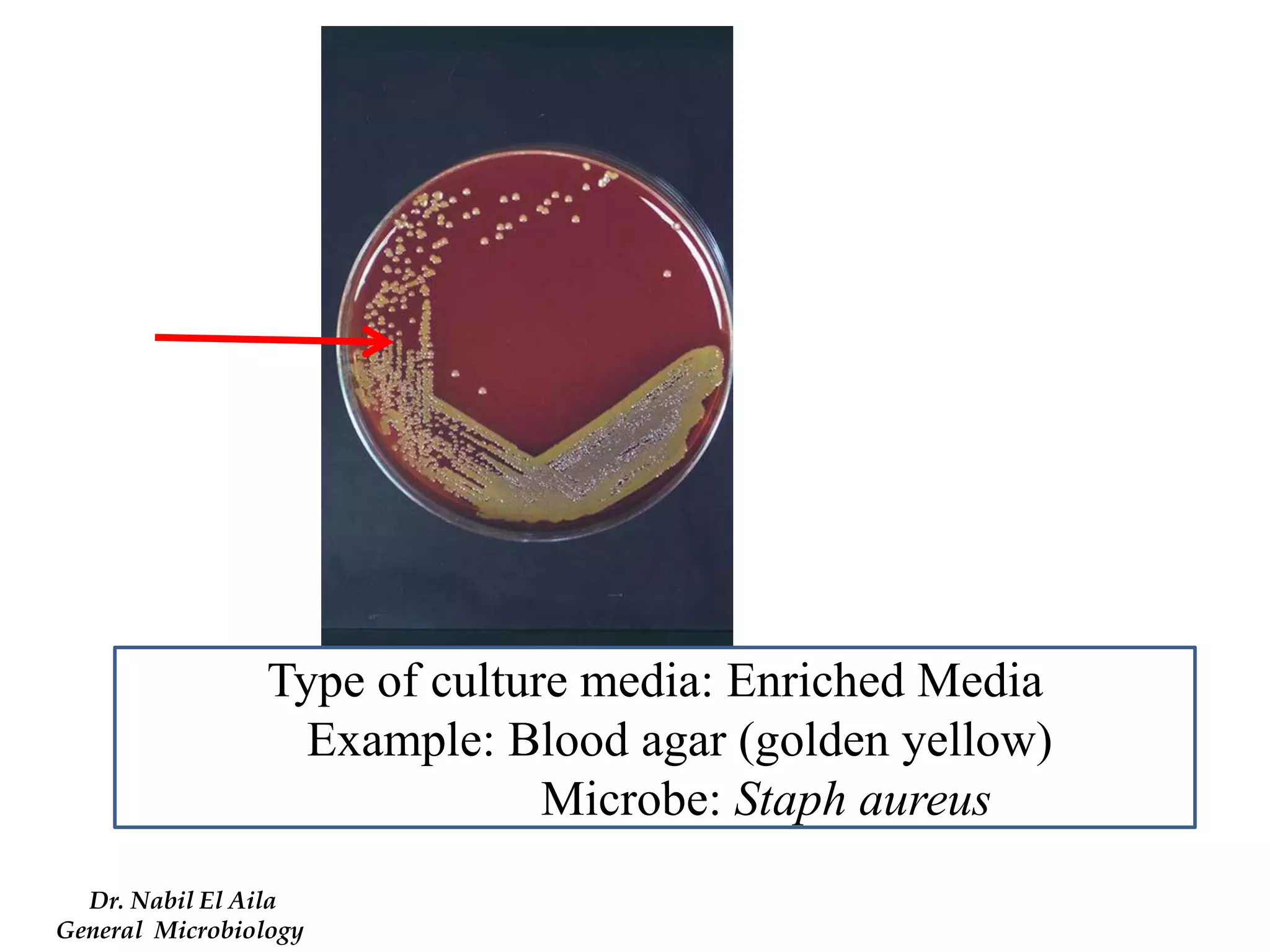
Type of culture media: Enriched Media 
Example: Blood agar (golden yellow) 
Microbe: Staph aureus 
Dr. Nabil El Aila 
General Microbiology
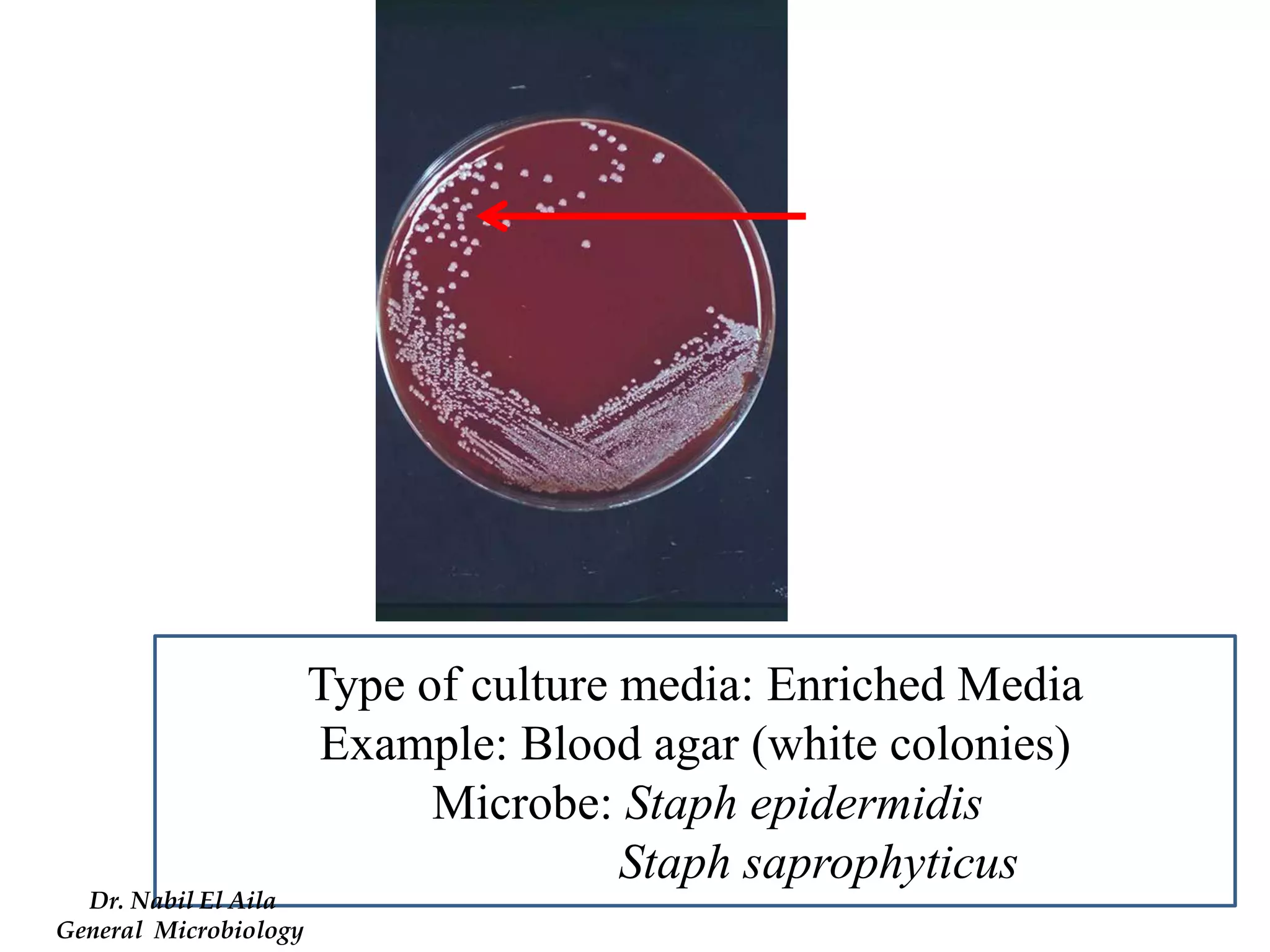
Type of culture media: Enriched Media 
Example: Blood agar (white colonies) 
Microbe: Staph epidermidis 
Staph saprophyticus 
Dr. Nabil El Aila 
General Microbiology
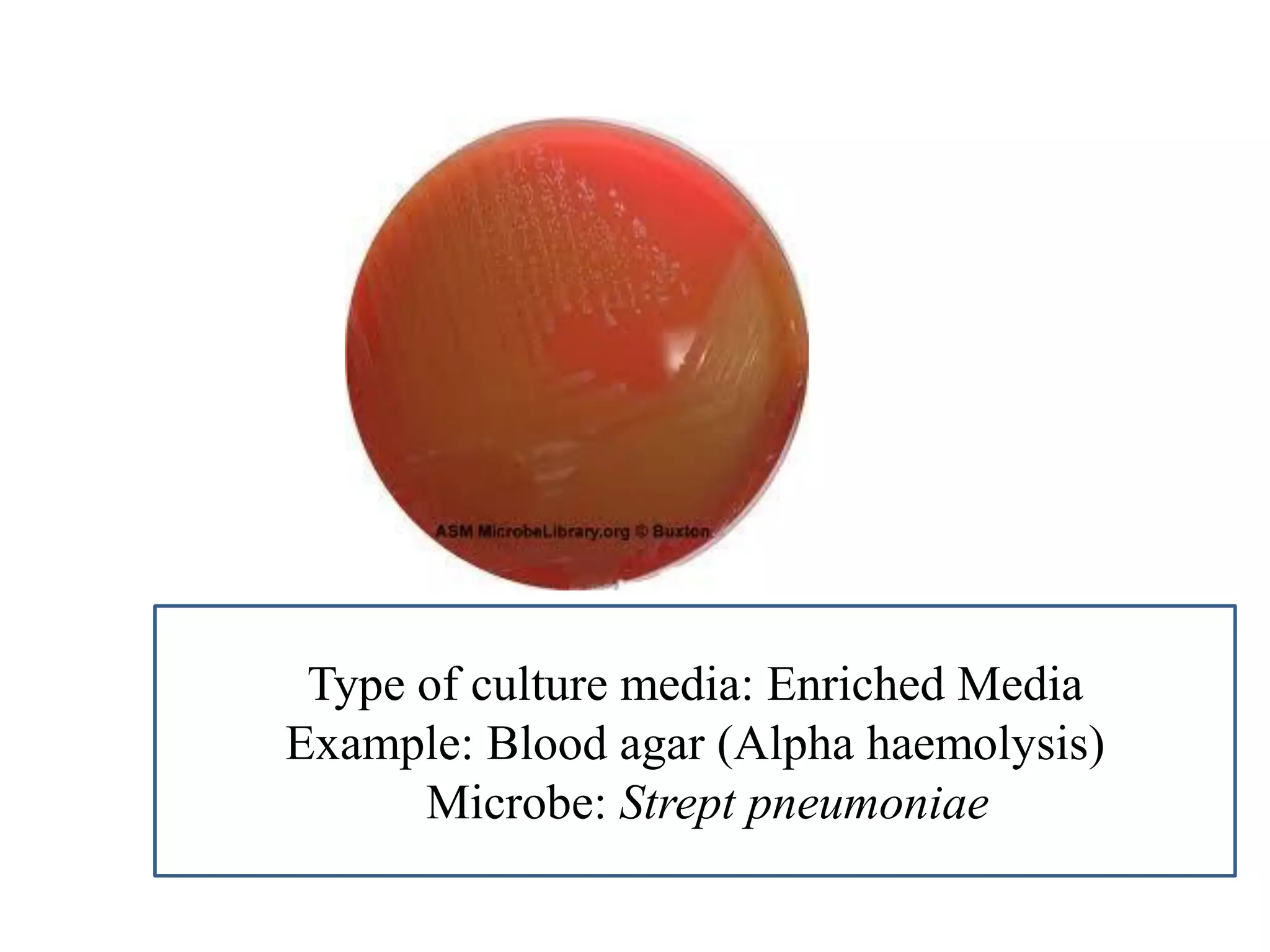
Type of culture media: Enriched Media 
Example: Blood agar (Alpha haemolysis) 
Microbe: Strept pneumoniae
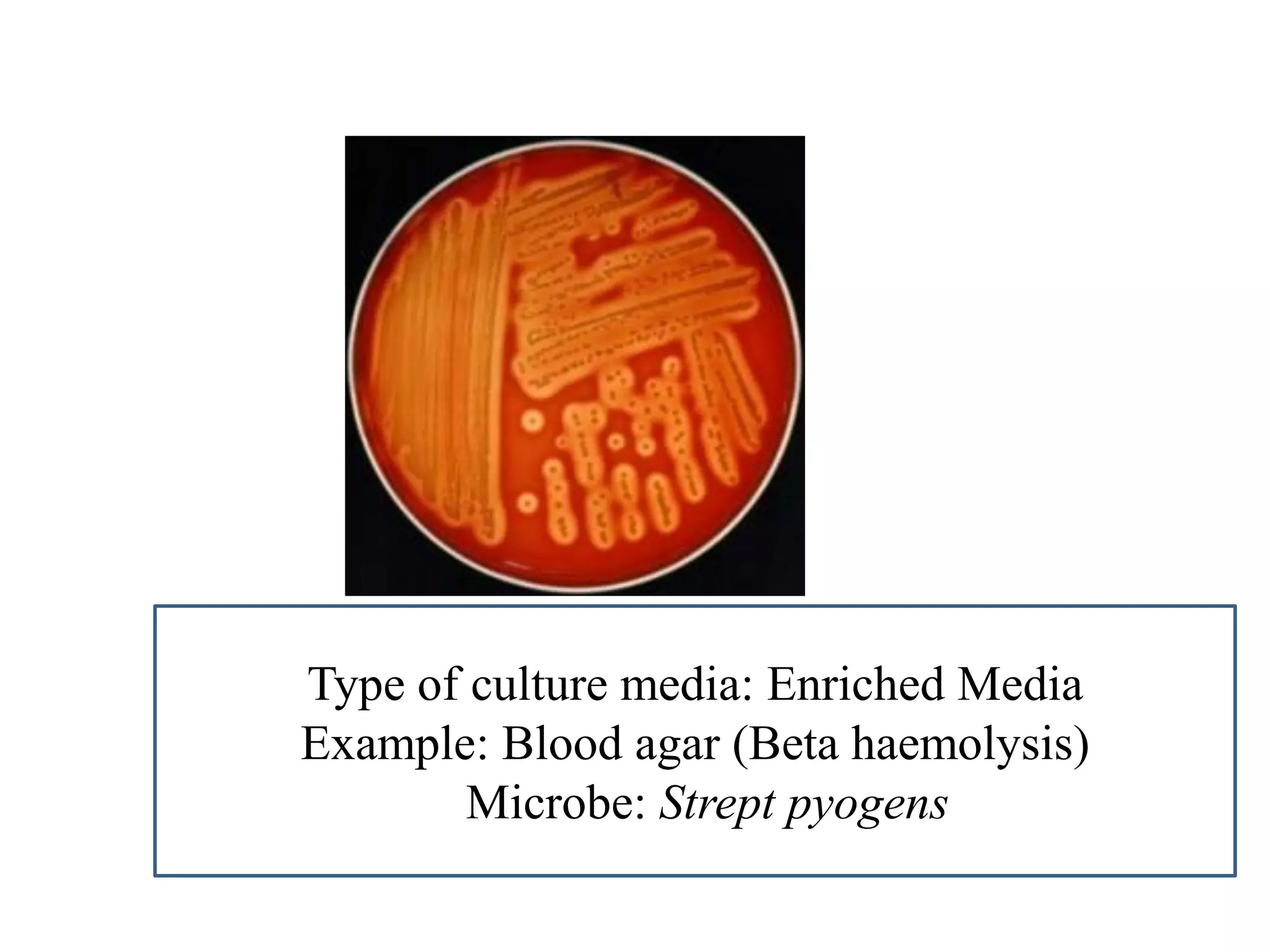
Type of culture media: Enriched Media 
Example: Blood agar (Beta haemolysis) 
Microbe: Strept pyogens
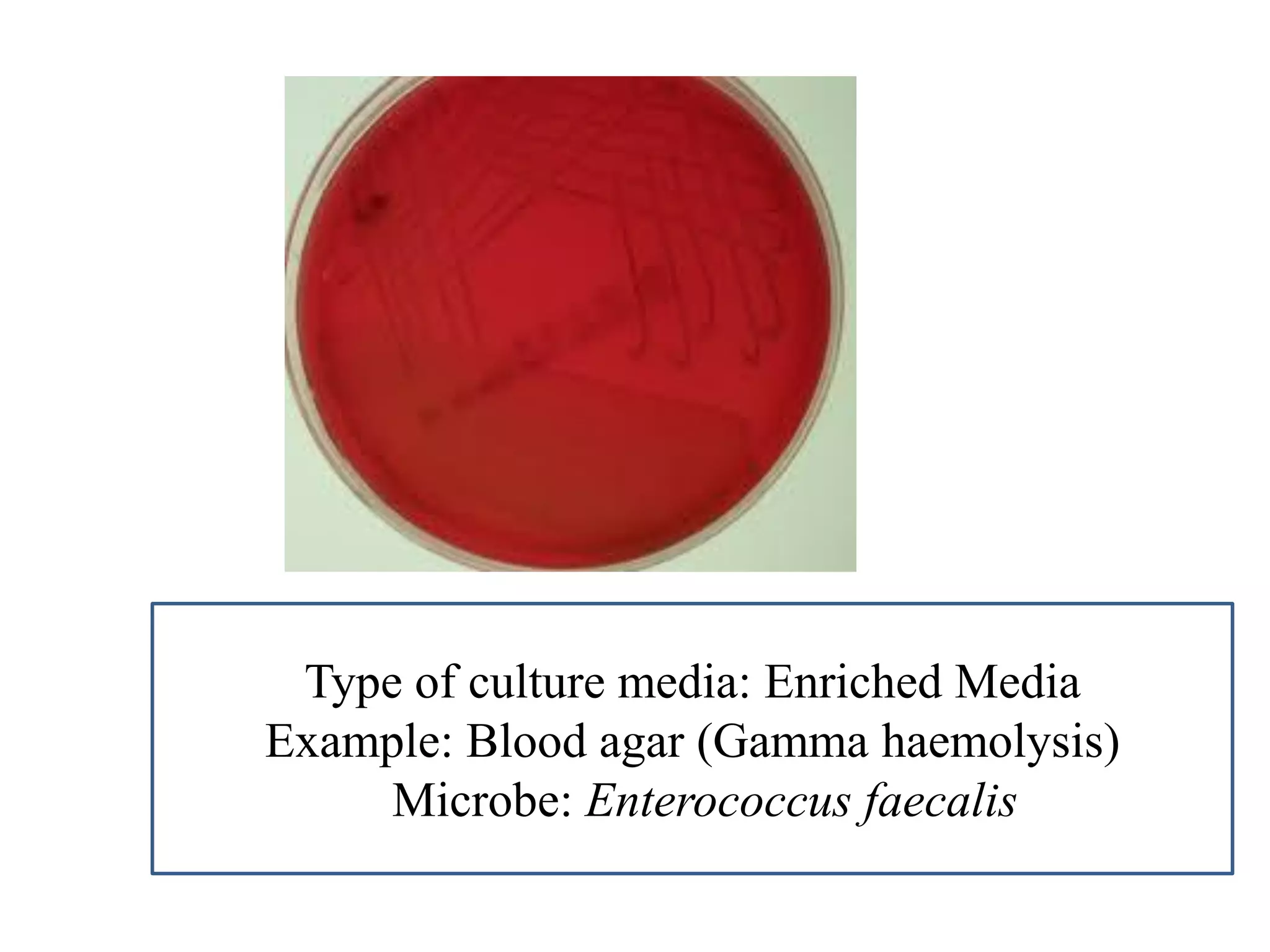
Type of culture media: Enriched Media 
Example: Blood agar (Gamma haemolysis) 
Microbe: Enterococcus faecalis
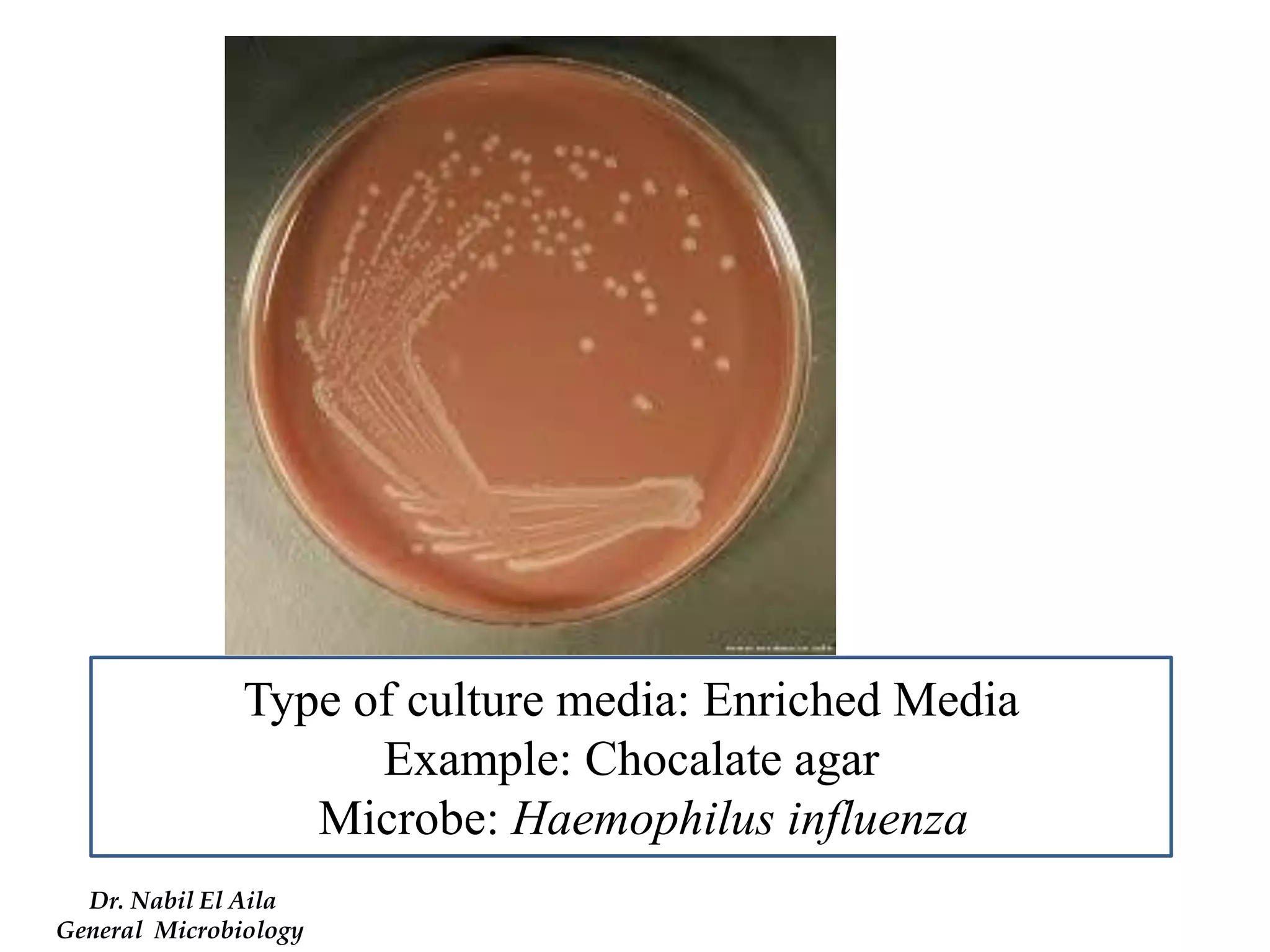
Type of culture media: Enriched Media 
Example: Chocalate agar 
Microbe: Haemophilus influenza 
Dr. Nabil El Aila 
General Microbiology
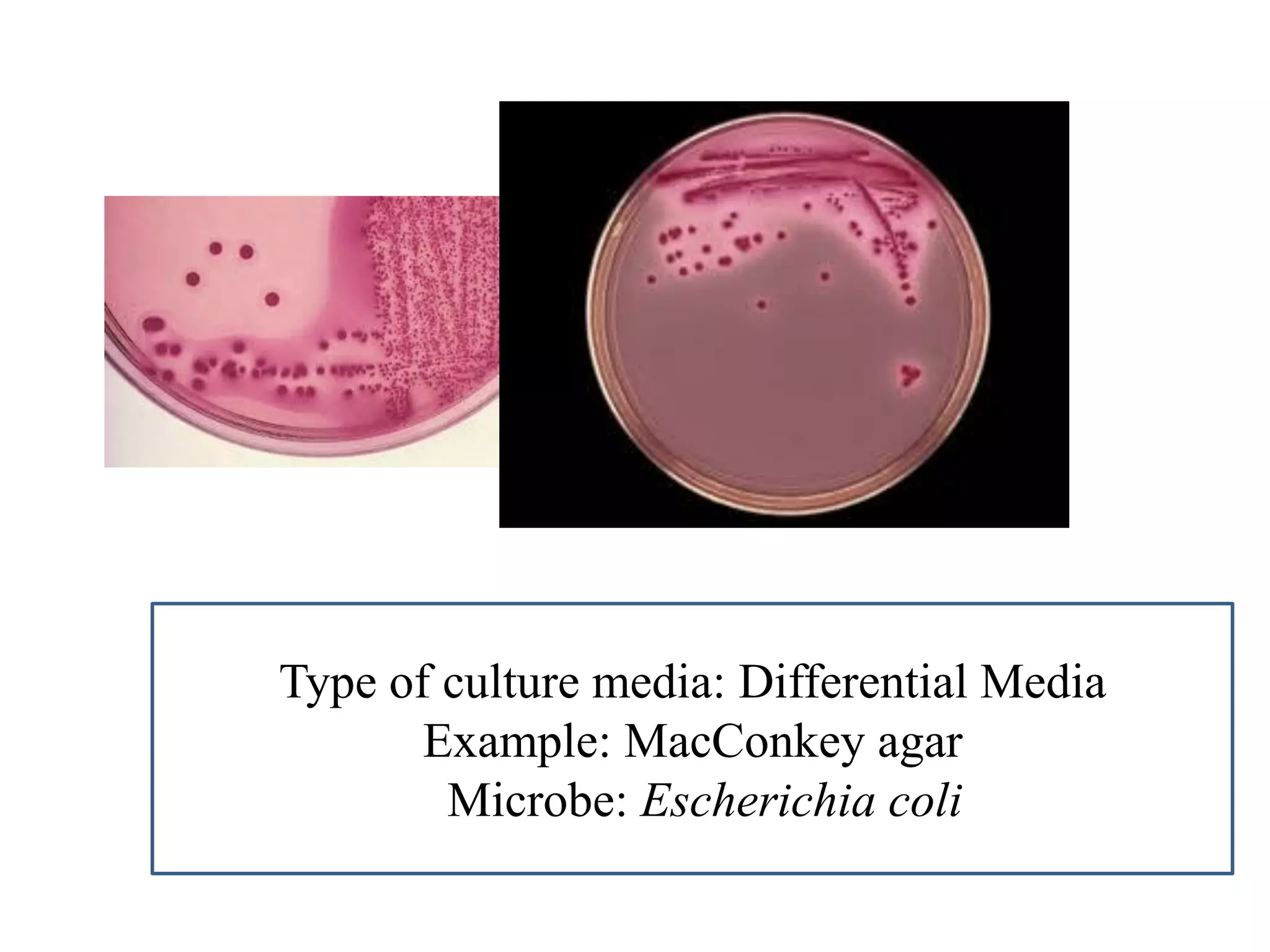
Type of culture media: Differential Media 
Example: MacConkey agar 
Microbe: Escherichia coli
Type of culture media: Differential Media 
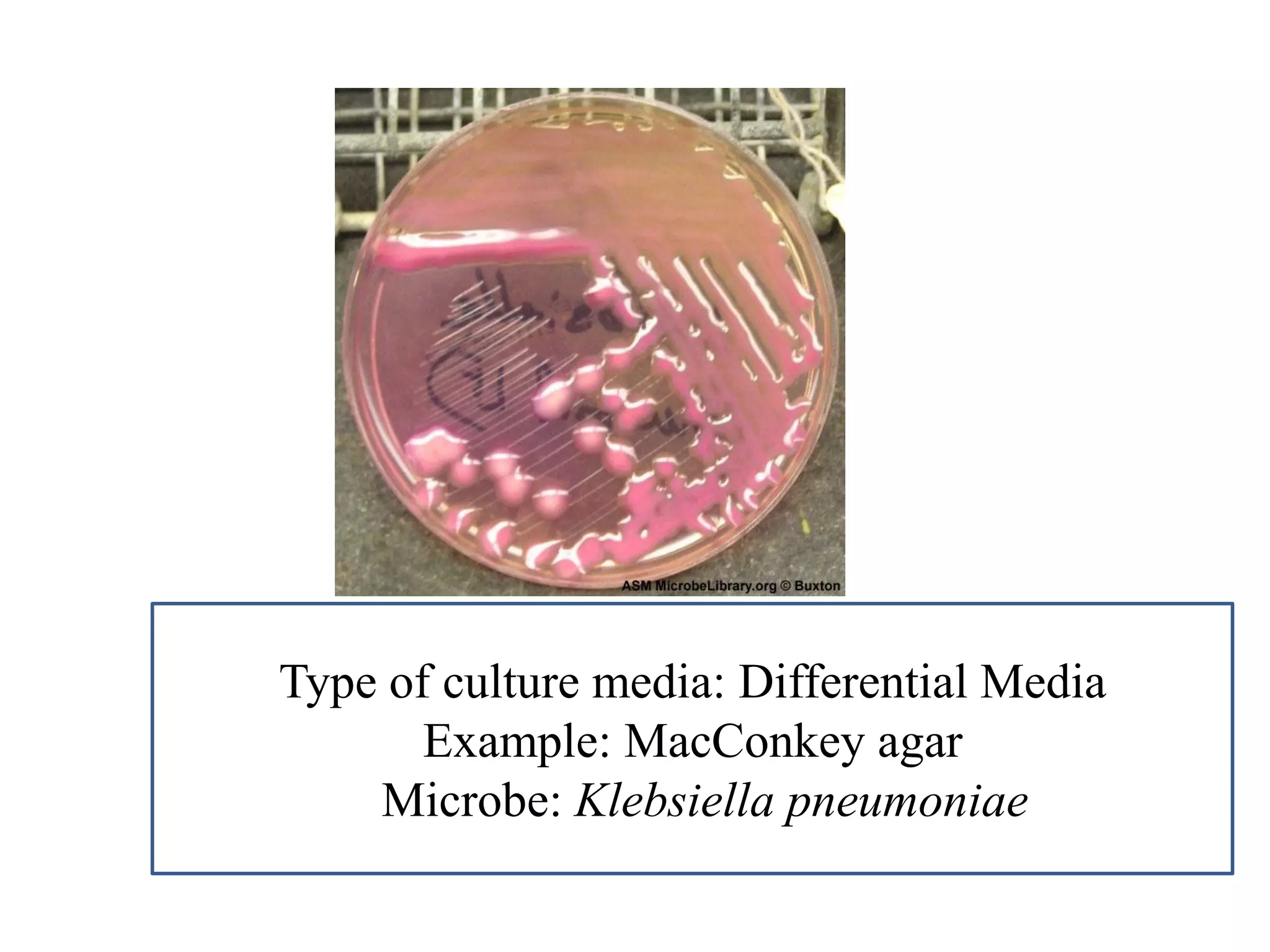
Example: MacConkey agar 
Microbe: Klebsiella pneumoniae
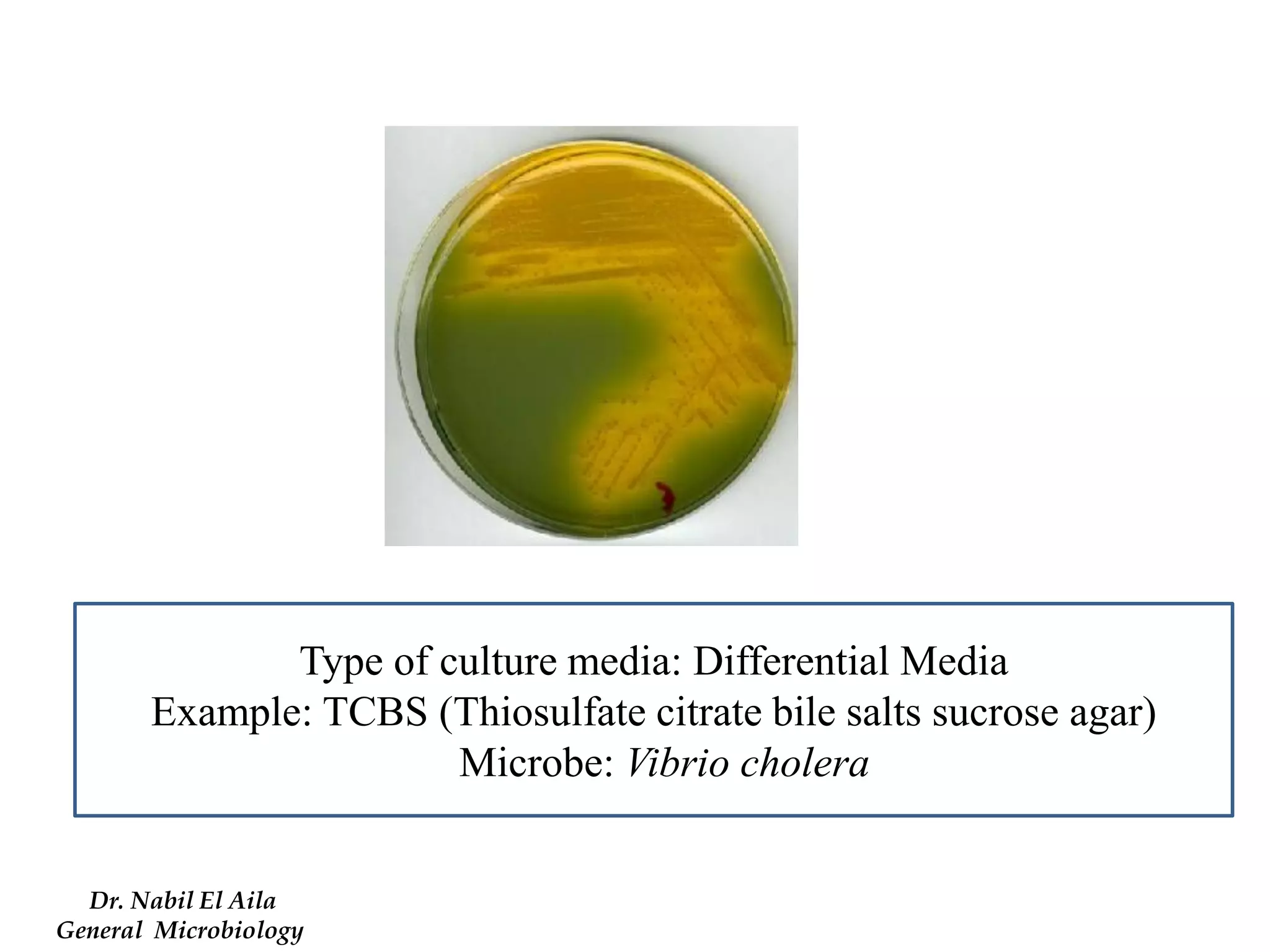
Type of culture media: Differential Media 
Example: TCBS (Thiosulfate citrate bile salts sucrose agar) 
Microbe: Vibrio cholera 
Dr. Nabil El Aila 
General Microbiology
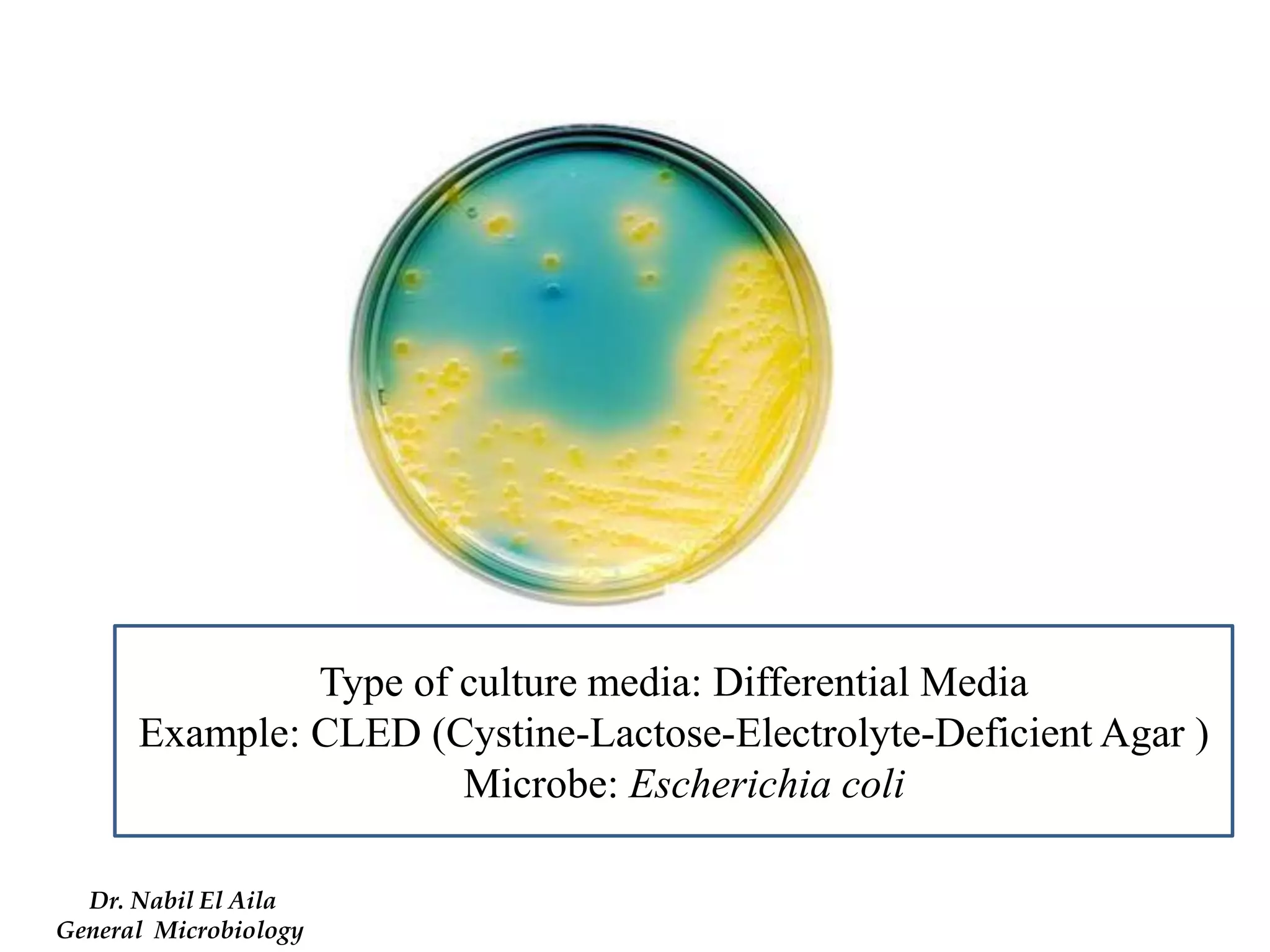
Type of culture media: Differential Media 
Example: CLED (Cystine-Lactose-Electrolyte-Deficient Agar ) 
Microbe: Escherichia coli 
Dr. Nabil El Aila 
General Microbiology
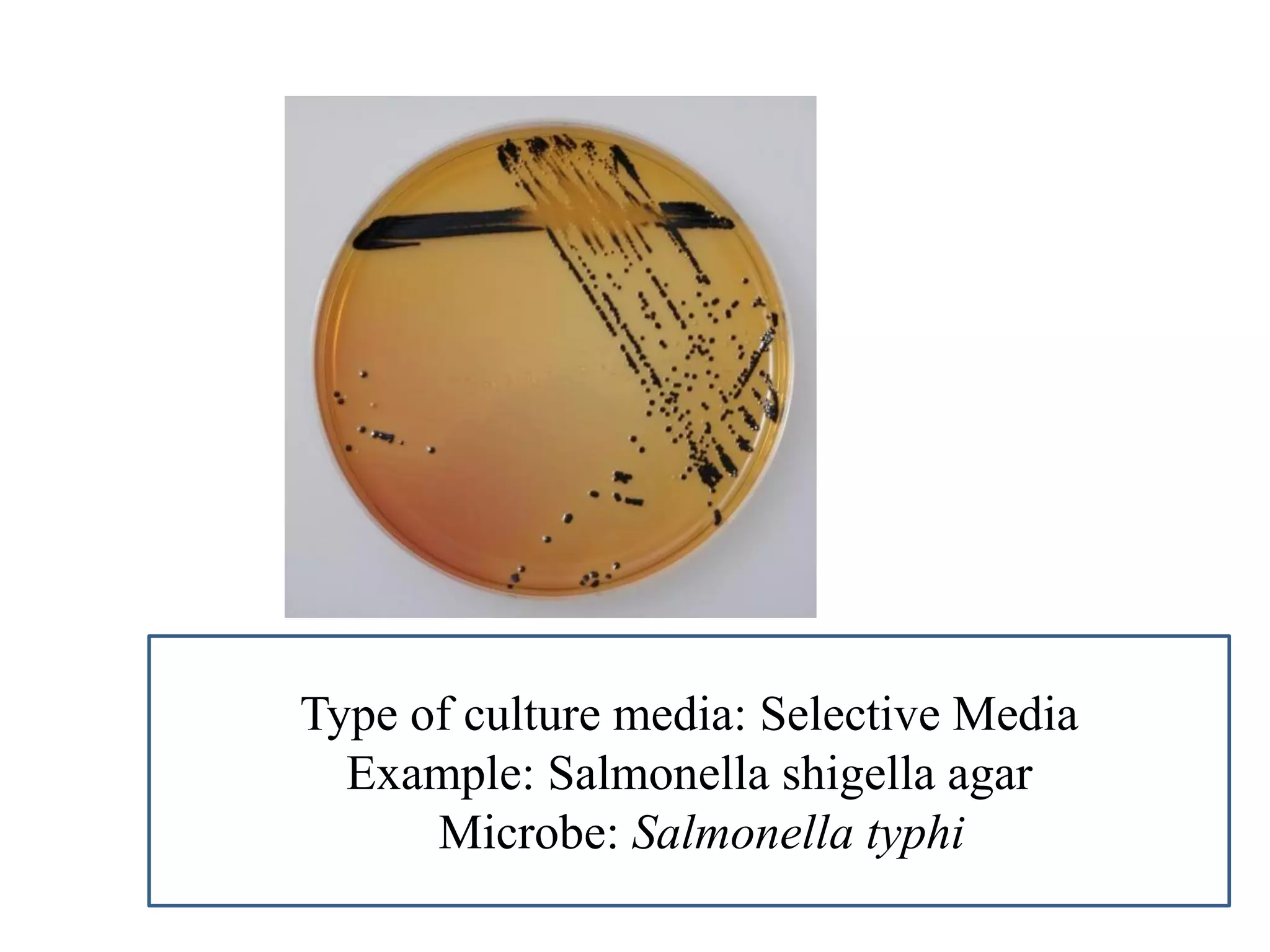
Type of culture media: Selective Media 
Example: Salmonella shigella agar 
Microbe: Salmonella typhi
Type of culture media: Selective Media 
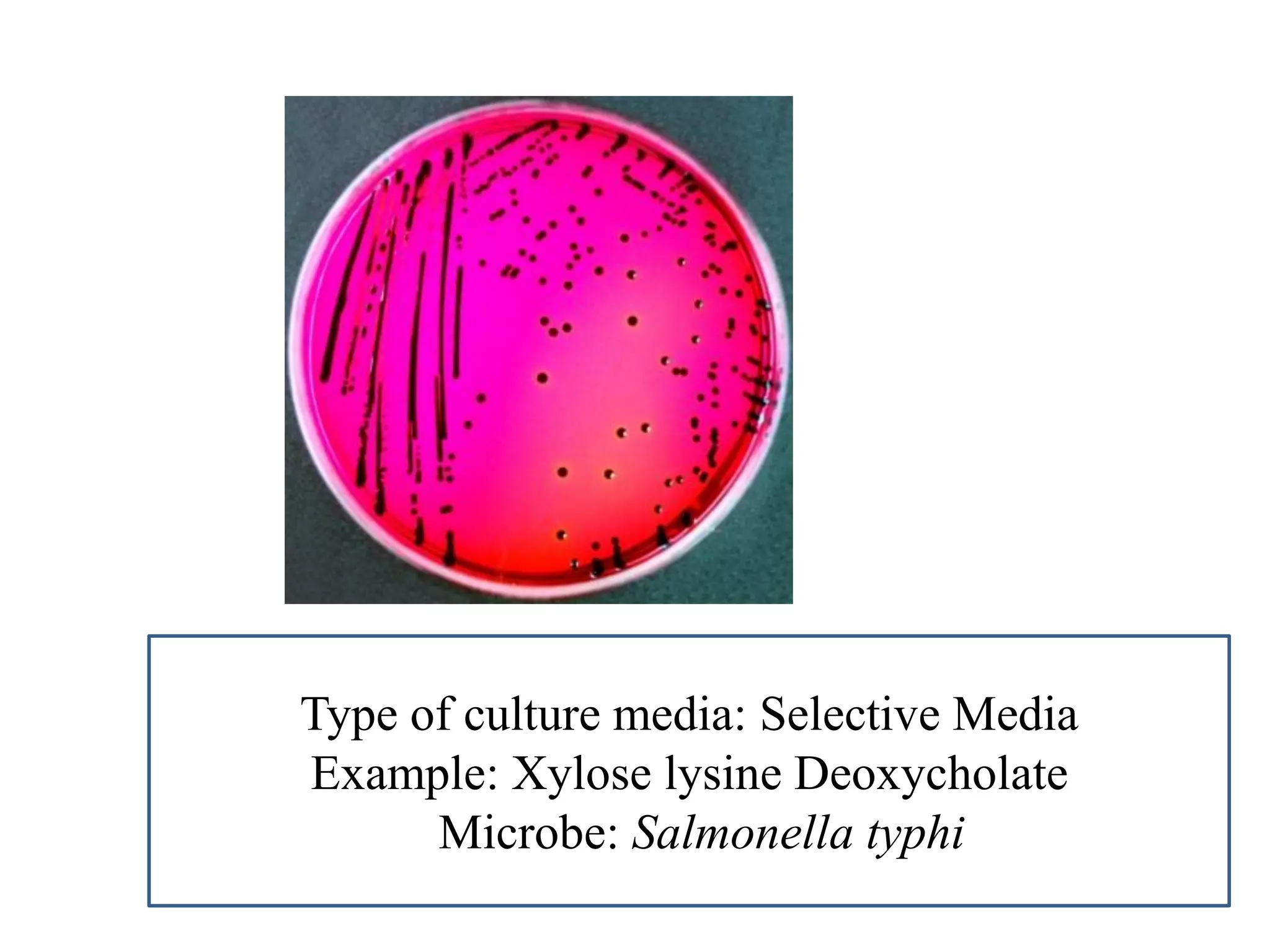
Example: Xylose lysine Deoxycholate 
Microbe: Salmonella typhi
Type of culture media: Selective Media 
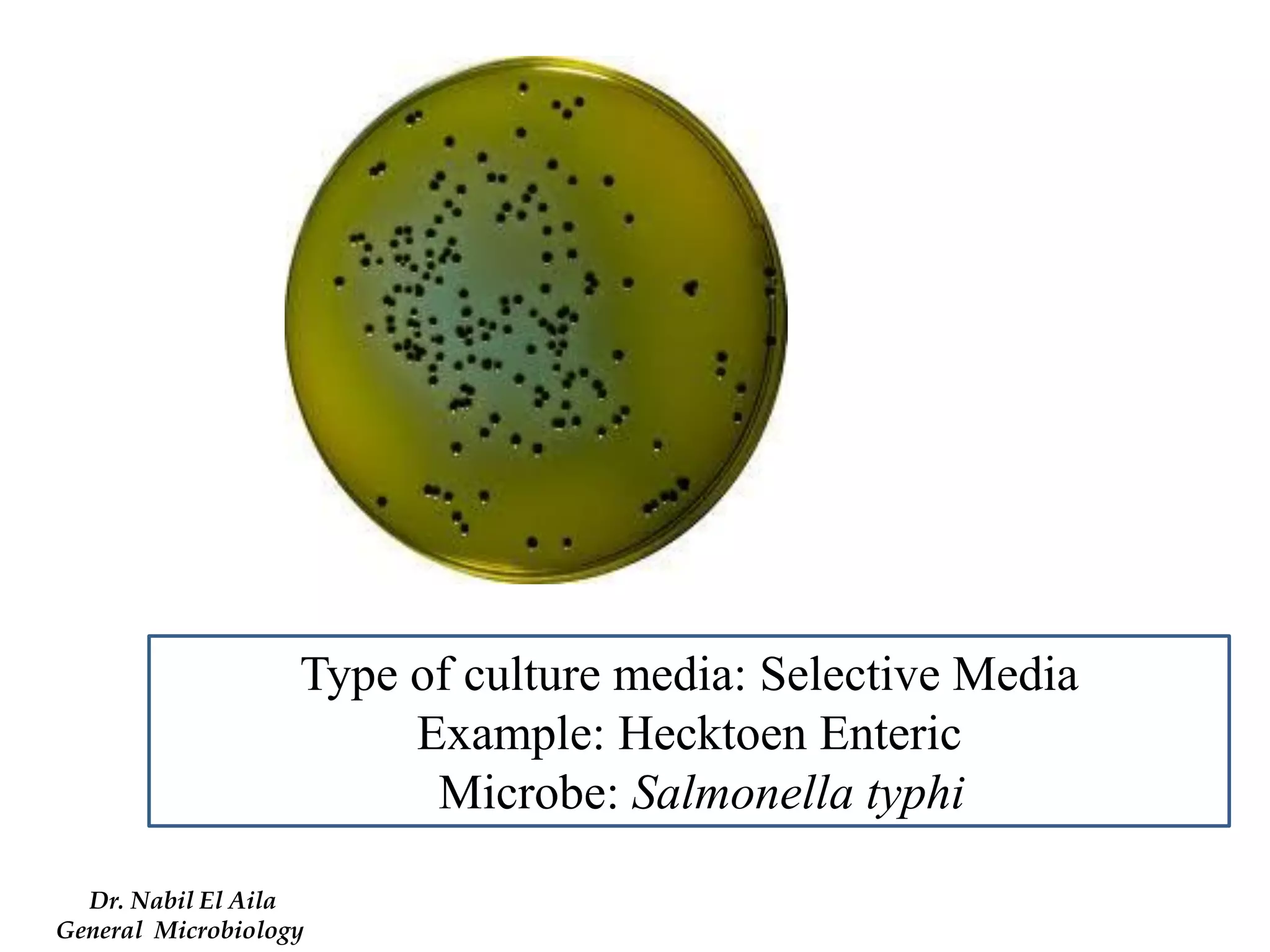
Example: Hecktoen Enteric 
Microbe: Salmonella typhi 
Dr. Nabil El Aila 
General Microbiology
Type of culture media: Selective Media 
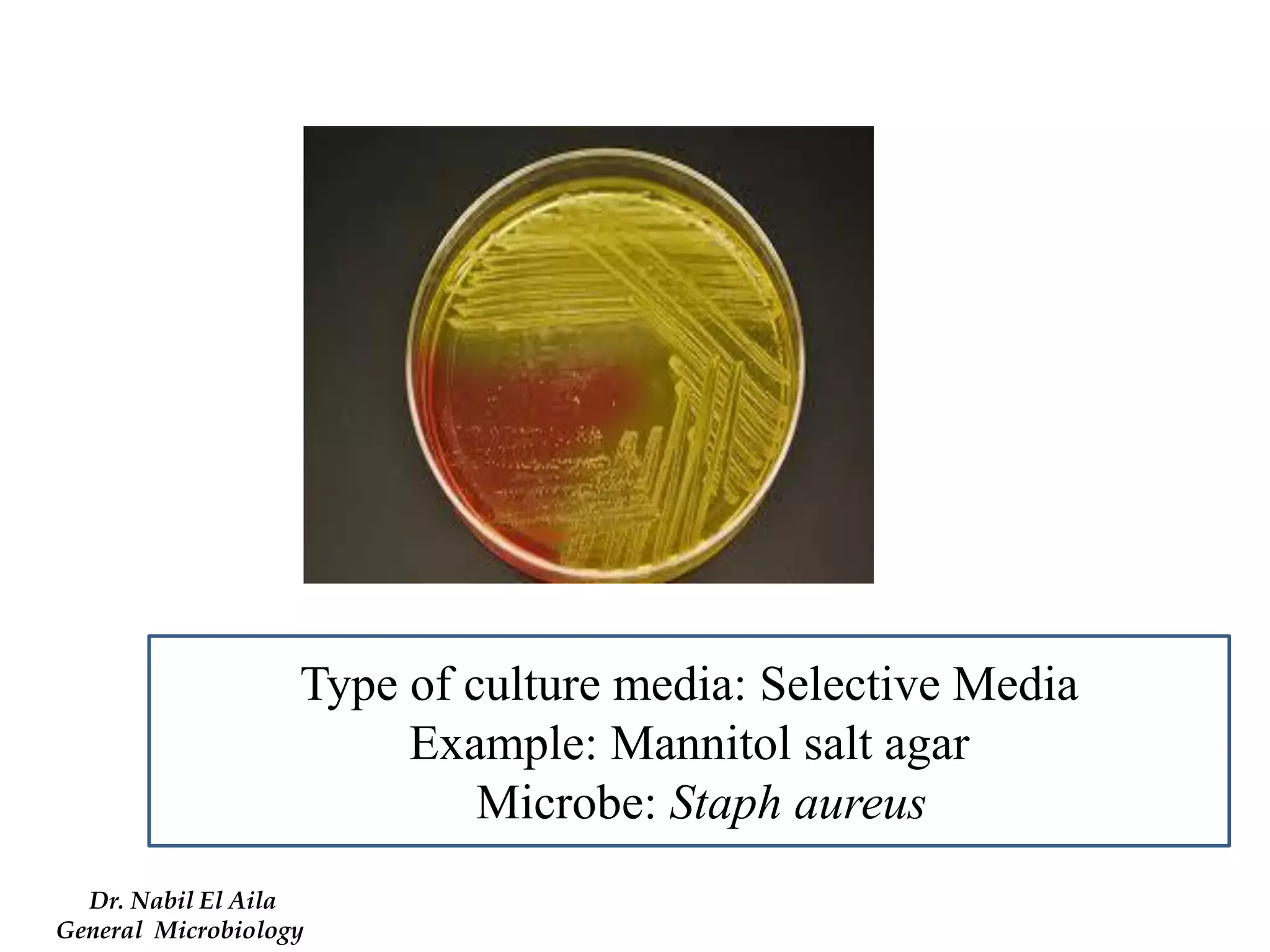
Example: Mannitol salt agar 
Microbe: Staph aureus 
Dr. Nabil El Aila 
General Microbiology
Type of culture media: Selective Media 
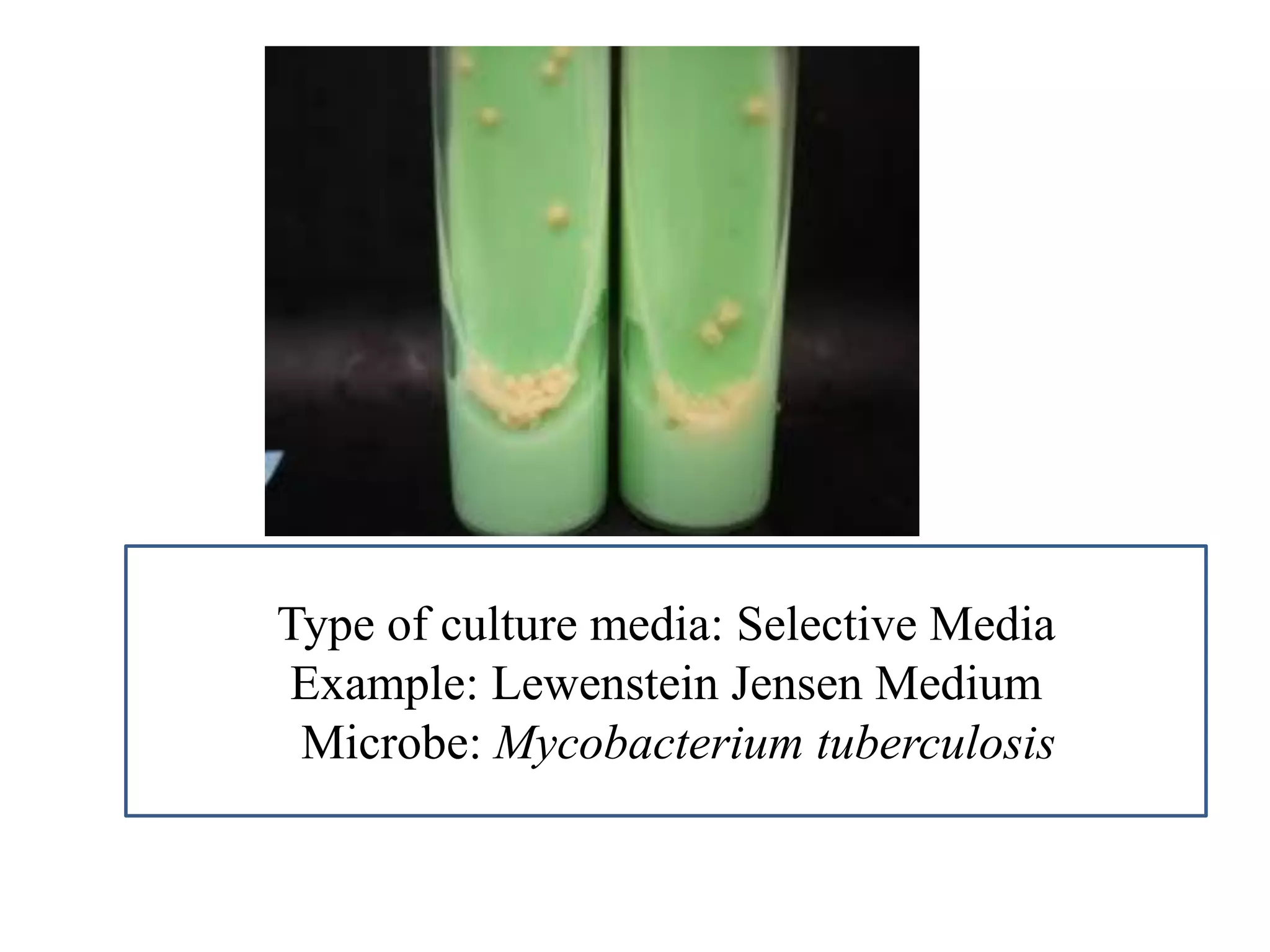
Example: Lewenstein Jensen Medium 
Microbe: Mycobacterium tuberculosis
Muller Hinton Agar 
Used for antibiotic susceptibility testing
Dr. Nabil El Aila 
General Microbiology 
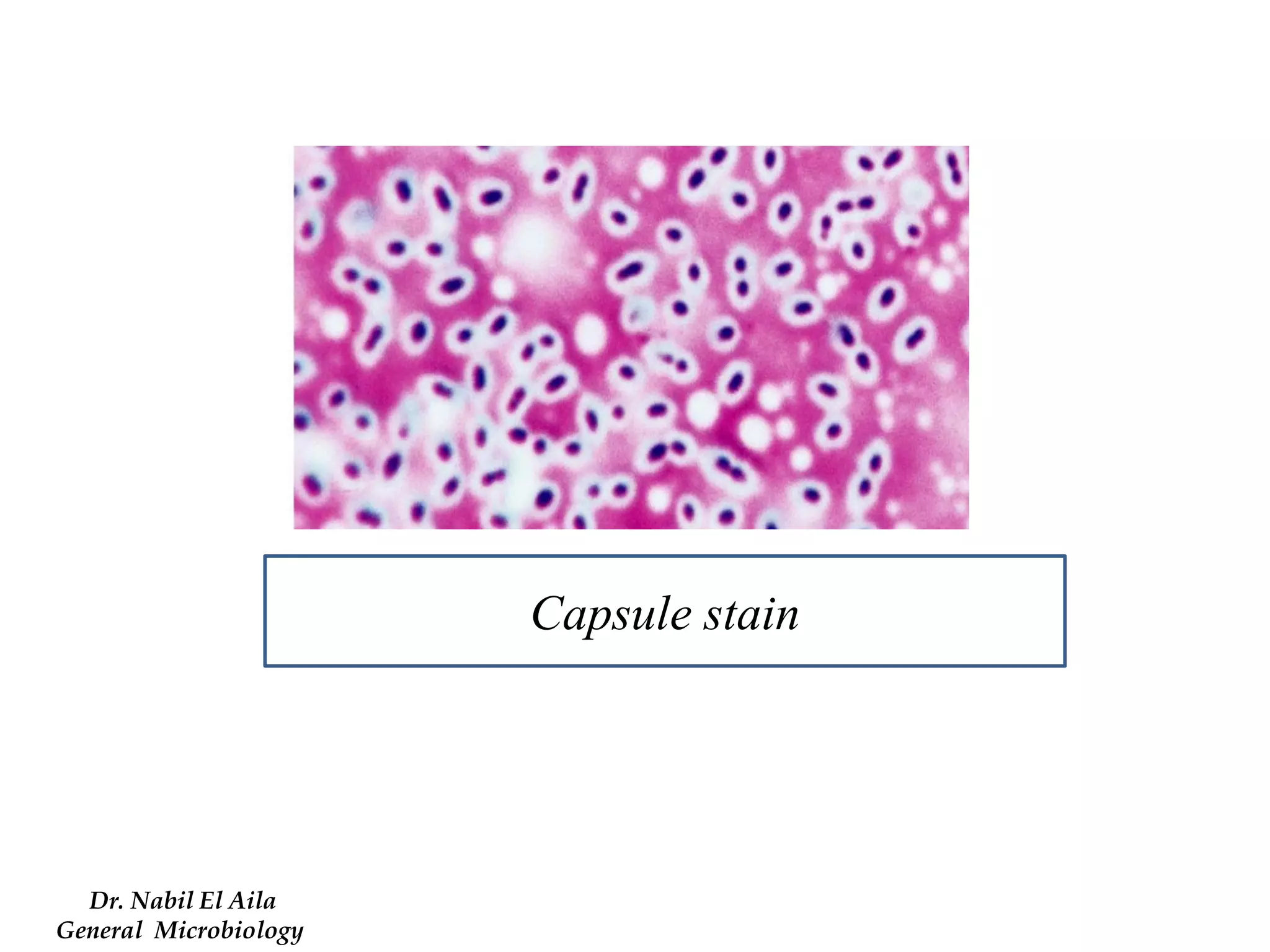
Capsule stain
Dr. Nabil El Aila 
General Microbiology 
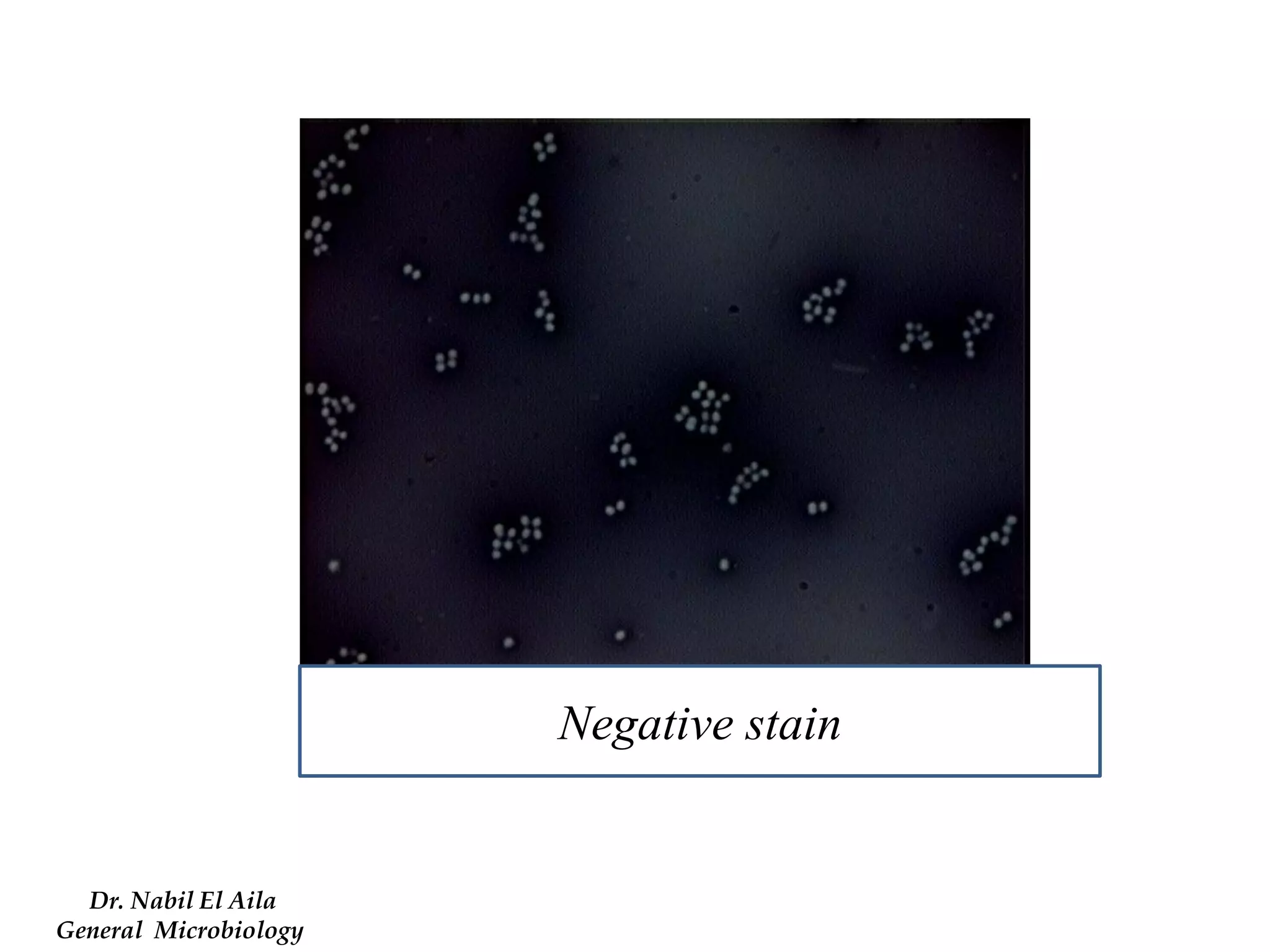
Negative stain
Dr. Nabil El Aila 
General Microbiology 
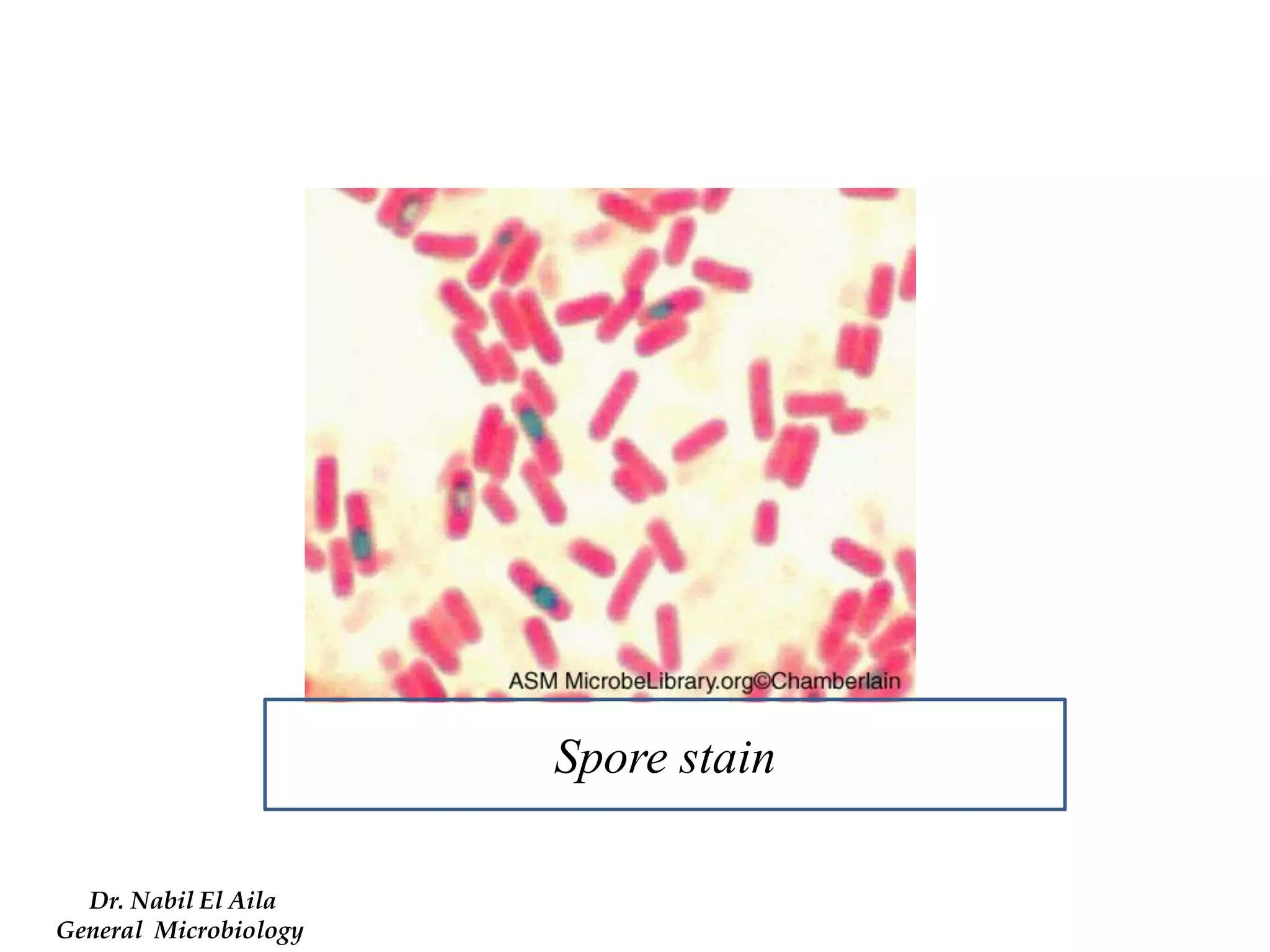
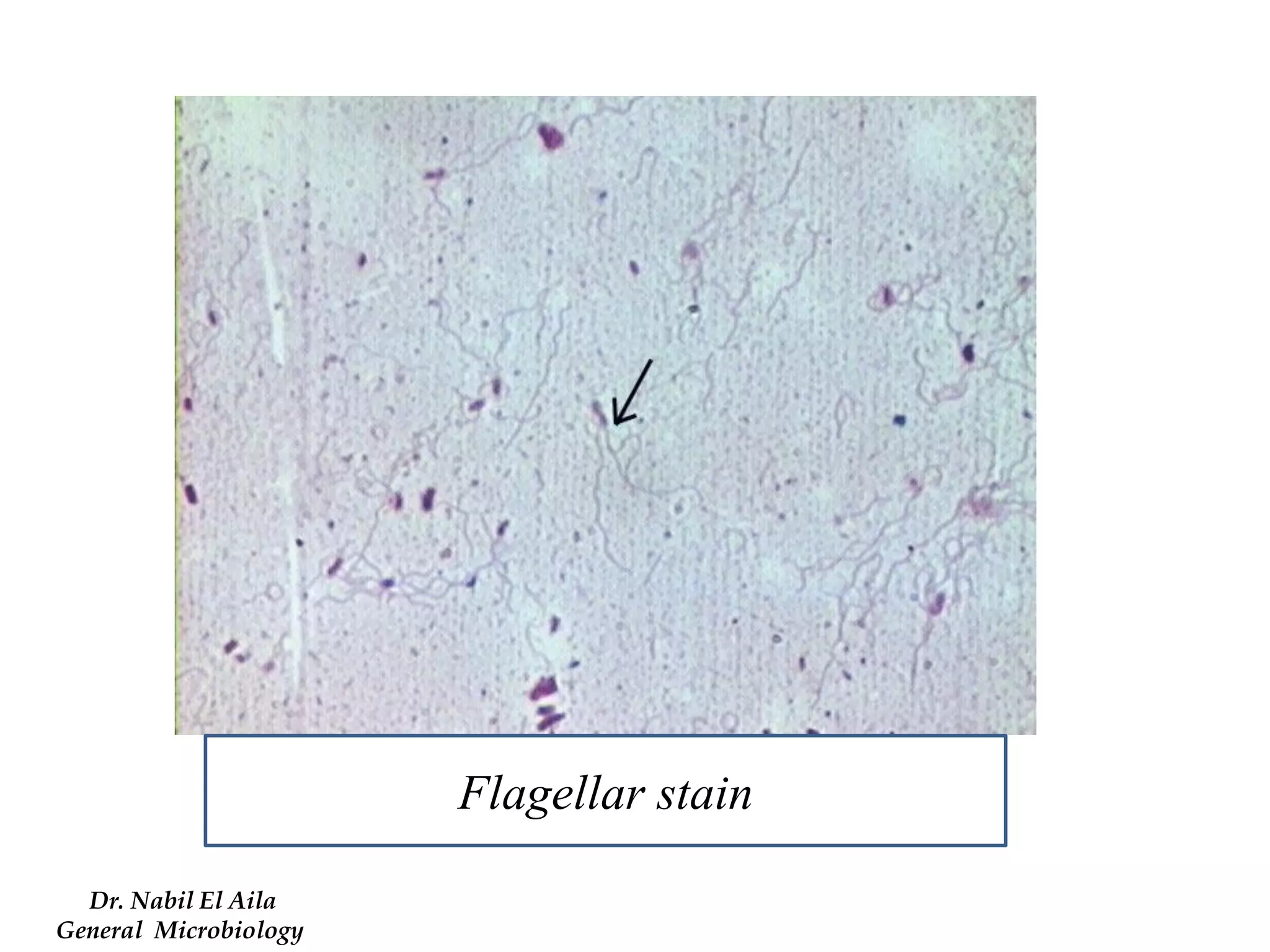
Spore stain
Dr. Nabil El Aila 
General Microbiology 
Flagellar stain

Slides examبكتريا عملي

  • 1.
    Diagnostic Microbiology Lab. By Dr. Nabil El Aila Assistant Professor of Molecular Microbiology Medical Technology Department Al -Aqsa University
  • 2.
    A B Nameof the test: Catalase test Example A: positive - Staphylococci Example B: Negative - Streptococci Principle: 2 H2O2 2 H2O + O2 Catalase
  • 3.
    A B Nameof the test: Coagulase test Example A: Positive - Staph aureus Example B: Negative - Staph epidermedis Principle: Fibrinogen in plasma Fibrin clot Coagulase
  • 4.
    A B Nameof the test: DNase test Example A: Positive - Staph aureus Example B: Negative - Staph epidermedis Priciple: DNA is insoluble in acid DNA is hydrolyzed into oligonucleotides by the action of Dnase Nucleotides soluble in acid (After addition of 1N HCl)
  • 5.
    Name of thetest: Mannitol salt agar Example A: Negative - Staph epidermidis Example B: Positive - Staph aureus Principle: Staph aureus ferment mannitol (sugar) and phenol red (pH indicators turns yellow in acidic pH and turns red in alkaline pH). A B
  • 6.
    Name of thetest: Novobiocin sensitivity Example A: Staph epidermidis (Sensitive) Example B:Staph saprophyticus (Resistant) A B
  • 7.
    Name of thetest: Bacitracin sensitivity Example A: Strept pyogens (sensitive) Example B: Strept agalactiae (resistant) A B
  • 8.
    A B Nameof the test: CAMP test Example A: Positive - Strept agalactiae (Arrow shaped) Example B: Negative - Strept pyogens Principle : Strept agalactiae produce CAMP factor (a diffusible extracelluar protein) that synergistically acts with the beta-lysin of Staphylococcus aureus and enhances the lysis of red blood cells.
  • 9.
    Name of thetest: Optochin sensitivity Example A: Strept pneumonia (sensitive) Example B: Strept viridans (resistant) A B
  • 10.
    A B Nameof the test: Bile Esculin test Example A: Positive - Group D streptococcus (Enterococcus species) Example B: Negative - Group B streptococcus Principle: The selective agent bile, inhibits most gram positive bacteria. Esculin in the medium is hydrolyzed to esculetin and dextrose. The esculetin reacts with ferric chloride in the media to form a black-brown color.
  • 11.
    B A Nameof the test: Bile Solubility Example A: Strept mitis (Negative) Example B: Strept pneumoniae (positive) Principle: S. pneumoniae is bile soluble whereas all other alpha-hemolytic streptococci are bile resistant. Sodium deoxycholate (2% in water) will lyse the pneumococcal cell wall
  • 12.
    A B Nameof the test: Pyrrolidonyl arylamidase Test (PYR) Example A: Strept agalactiae (Negative) Example B: group A streptococci and Enterococcu s species (positive) Principle: Group A streptococci and Enterococcu s species produce pyrrolidonyl arylamidase which hydrolyzes the substrate L- pyrrolidonyl -β- naphthylamide to form β-naphthylamine. A pink to red color forms when p-dimethylaminocinnam-aldehyde (PYR reagent) is added to β-naphthylamine.
  • 13.
    A B Tryptophane amino acids Tryptophanase Indole + Pyurvic acid + NH3 Kovac’s Reagent Red color in upper organic layer` Name of the test: Indole test Example A: Klebsiella pneumonia (Negative) Example B: Escherichia coli (Positive) Indicator: Kovac’s Reagent (4 (p) – dimethylamino benzaldehyde) Principle:
  • 14.
    A B Nameof the test: Methyl red Example A: Klebsiella pneumonia (Negative) Example B: Escherichia coli (Positive) Indicator: Methy red indicator Principle: follow next slides
  • 15.
    A B Nameof the test: Voges Proskauer test Example A: Escherichia coli (Negative) Example B: Klebsiella pneumonia (Positive) Indicator: -naphthol and 40% KOH Principle: follow next slide
  • 16.
    IMViC test MethylRed-Voges Proskauer (MR-VP) Tests Glucose Acidic pathway Mixed acids  pH less than 4.4 Methyl Red indicator Red color Principle MR positive E. coli Or Neutral pathway Acety methyl carbinol (ACETOIN) Barrit’s A (-naphthol) Barrit;s B (40% KOH) Pink color VP positive Klebsiella
  • 17.
    Name of thetest: Citrate test Example A: Klebsiella pneumonia (Positive) Example B: Escherichia coli (Negative) Indicator: Bromothymol blue Principle: follow next slide A B
  • 18.
    Principle: Citrate Na2CO3 Alkaline,↑pH Bromothymol blue Simmone’s Citrate media Pyruvate CO2 + Na + H2O Positive test Contains Citrate as a sole of C source IMViC: CITRATE TEST Dr. Nabil El Aila Diagnostic Microbiology
  • 19.
    Name of thetest: Urea test Example A: Proteus miribalis (Positive) Example B: Escherichia coli (Negative) Indicator: Phenol red Principle: A B Urea Urease CO2 + NH3 H2O NH4 OH ↑ in pH Phenol Red Pink Positive test
  • 20.
    A B Nameof the test: Motility test Example A: Escherichia coli (Negative) Example B: Proteus miribalis (Positive)
  • 21.
    A B Nameof the test: H2S production Example A: Escherichia coli (Negative) Example B : Proteus miribalis (Positive) Principle: Bacteria use enzyme cysteine desulfurase to hydrolyze the amino acid cysteine, forming hydrogen sulfide as end-product. The hydrogen sulfide will combine with the iron salt to form a visible black ferric sulfide (FeS) in the tube
  • 22.
    A B Nameof the test: Triple sugar Iron Example A: K/A - No H2S – no gas production Glucose fermenter - Shigella species Example B: A/A - No H2S – gas production All three sugars fermented – Escherichia coli
  • 23.
    A B Nameof the test: Triple sugar Iron Example A: A/A - H2S positive –gas production Glucose fermenter - Proteus species Example B: K/A - H2S positive – gas production All three sugars fermented – Salmonella species
  • 24.
    A B Nameof the test: Triple sugar Iron Example A: K/K – No H2S – No gas production No action on sugars - Pseudomonas species Example B: K/A – No H2S – No gas production Glucose fermenter - Shigella species
  • 25.
    Name of thetest: Lysine Decarboxylase Agar Example A: Positive decarboxylation (butt), negative deamination (slant) : Salmonella species Example B: Negative decarboxylation (butt), Positive deamination (slant) : Proteus species A B
  • 26.
    A B Nameof the test: Lysine Decarboxylase Agar Example A: Positive decarboxylation (butt), negative deamination (slant) : Salmonella species Example B: Negative decarboxylation (butt), Negative deamination (slant) : Citrobacter species
  • 27.
    Name of thetest: Oxidase test Example A: Positive - Pseudomonas species Example B: Negative - Proteus species Princile: follow next slide A B
  • 28.
    Oxidase Test: Principal Oxidase Reagent Cytochrome Oxidase Indophenol Play role in aerobic respiration Pseudomonas Vibrio Alternative substrate for Cytochrome Tetramethyl-P- Pheneylenediamine Colorless Purple color Oxidize the reagent from colorless to purple color
  • 29.
    A B Nameof the test: Oxidation Fermentation test Example A: Oxidation negative (Open tube remain green) Example B: Fermantation negative ( Covered tube remain green) : Oxidation negative/ Fermentation negative (Alcaligenes faecalis)
  • 30.
    A B Nameof the test: Oxidation Fermentation test Example A: Oxidation positive (Open tube turns yellow) Example B: Fermantation negative ( Covered tube remain green) : Oxidation positive/ Fermentation negative (Pseudomonas species)
  • 31.
    A B Nameof the test: Oxidation Fermentation test Example A: Oxidation positive (Open tube turns yellow) Example B: Fermantation positive( Covered tube turns yellow) : Oxidation positive/ Fermentation positive (Enterobacteriacea)
  • 32.
    Name of thetest: Gelatin Liquification test Example A: Negative (Proteus species) Example B: Positive ( Pseudomonas species) Principle : Nutrient gelatin Protein/Polypeptides Solid Gelatinase Incubation at 37/overnight Nutrient gelatin Amino acids Liquid at > 25 C Gelatinase hydrolyze the protein to aminoacids Pseudomonas A B
  • 33.
    A B C D Name of the test: Nitrate reduction test Example A: Negative nitrate reduction - no change with alpha naphthol and sulf.acid Example B: Positive nitrate reduction – turns red with alpha naphthol and sulf.acid sulf.acid Example C: Positive nitrate reduction . No red color after addition of zinc dust ( Nitrate reduced into nitrite and further reduction to Nitrogen. Example D: Negative nitrate reduction red color after addition of zinc dust Nitrate unreduced Principle : follow next slide
  • 34.
    Nitrate Reductase Test:Principal Nitrate (NO3) Nitrate reductase Nitrite (NO2) α-naphthylamine Sulfanilic acid Red diazonium salt If no red color! Further reduction Nitrogen gas N2 Add zinc dust (reducing agent) Nitrate Reductase No red color after addition of zinc dust ( Nitrate reduced into nitrite and further reduction to Nitrogen (Positive nitrate reduction ) or red color after addition of zinc dust Nitrate unreduced (Negative nitrate reduction )
  • 35.
    Name of thetest: Satellitism Principle: - A lawn of test bacteria is plated onto a fresh blood agar plate. This provides a supply of haem. - An inoculum of Staphylococcus aureus, which can provide NAD, is placed on the plate and the culture is incubated. - Haemophili can be seen growing larger near to the staphylococcal colony, where the supply of NAD is greatest.
  • 36.
    Name of thetest: Swarming Example: Proteus species move very actively by means of peritrichous flagella, resulting in "swarming" on solid medium
  • 37.
    Name of thetest: Exopigment production on Muller Hinton agar Example: pseudomonas species produces exopigments in culture eg pyocyanin, fluorescein, pyorubrin, pyoverdin, and pyomelanin
  • 38.
    Bacteria grow inthe presence of X factor Example: Haemophillus aphrophilus
  • 39.
    Bacteria grow inthe presence of V factor Example: Haemophillus parainfluenza
  • 40.
    A B A:Vaginal saline preperation: normal epithelial cells B: Vaginal saline preperation: Clue cells
  • 41.
    Gram variable bacteria (Gram negative and positive coccobacilli) Gardnerella vaginallis
  • 42.
    Name of test:Motility test listeria A: Non motile B: umbrella shape indicative of motility A B
  • 43.
    A: Dark fieldmicroscopy B: Fluorescence microscopy antibody staining Dr. Nabil El Aila Diagnostic Microbiology A B
  • 44.
    Grram positiv cocciin Clusters Example: Staph aureus Dr. Nabil El Aila General Microbiology
  • 45.
    Grram positiv cocciin Tetrads Example: Micrococcus species Dr. Nabil El Aila General Microbiology
  • 46.
    Grram positiv cocciin Chains Example: Streptococcus pyogens Dr. Nabil El Aila General Microbiology
  • 47.
    Grram positiv cocciin pairs Example: Streptococcus pneumoniae Dr. Nabil El Aila General Microbiology
  • 48.
    Gram negative coccobacilli Example: Haemophilus influenza Dr. Nabil El Aila General Microbiology
  • 49.
    Grram positiv bacilli(spore forming) Example: Bacillus anthracis Dr. Nabil El Aila General Microbiology
  • 50.
    Gram positiv bacilli(non spore forming) Example: Lactobacillus species Dr. Nabil El Aila General Microbiology
  • 51.
    Gram positiv bacilli(non spore forming) (Chines letter) Example: Corynebacterium diphtheria Dr. Nabil El Aila General Microbiology
  • 52.
    Gram Negative diplococci Example: Neisseria gonorrhoeae Neisseria meningitidis Dr. Nabil El Aila General Microbiology
  • 53.
    Gram Negative bacilli Example: Escherichia coli Dr. Nabil El Aila General Microbiology
  • 54.
    Gram Negative curvedrods (Comma shaped) Example: Vibrio cholera Dr. Nabil El Aila General Microbiology
  • 55.
    Acid fast bacilli Example: Mycobacterium tuberculosis Dr. Nabil El Aila General Microbiology
  • 56.
    Gram Negative spiralrods Example: Campylobacter species Dr. Nabil El Aila General Microbiology
  • 57.
  • 58.
    Type of culturemedia: Basic Media Example: Nutrient agar Microbe: Staph epidermidis
  • 59.
    Type of culturemedia: Enriched Media Example: Blood agar (golden yellow) Microbe: Staph aureus Dr. Nabil El Aila General Microbiology
  • 60.
    Type of culturemedia: Enriched Media Example: Blood agar (white colonies) Microbe: Staph epidermidis Staph saprophyticus Dr. Nabil El Aila General Microbiology
  • 61.
    Type of culturemedia: Enriched Media Example: Blood agar (Alpha haemolysis) Microbe: Strept pneumoniae
  • 62.
    Type of culturemedia: Enriched Media Example: Blood agar (Beta haemolysis) Microbe: Strept pyogens
  • 63.
    Type of culturemedia: Enriched Media Example: Blood agar (Gamma haemolysis) Microbe: Enterococcus faecalis
  • 64.
    Type of culturemedia: Enriched Media Example: Chocalate agar Microbe: Haemophilus influenza Dr. Nabil El Aila General Microbiology
  • 65.
    Type of culturemedia: Differential Media Example: MacConkey agar Microbe: Escherichia coli
  • 66.
    Type of culturemedia: Differential Media Example: MacConkey agar Microbe: Klebsiella pneumoniae
  • 67.
    Type of culturemedia: Differential Media Example: TCBS (Thiosulfate citrate bile salts sucrose agar) Microbe: Vibrio cholera Dr. Nabil El Aila General Microbiology
  • 68.
    Type of culturemedia: Differential Media Example: CLED (Cystine-Lactose-Electrolyte-Deficient Agar ) Microbe: Escherichia coli Dr. Nabil El Aila General Microbiology
  • 69.
    Type of culturemedia: Selective Media Example: Salmonella shigella agar Microbe: Salmonella typhi
  • 70.
    Type of culturemedia: Selective Media Example: Xylose lysine Deoxycholate Microbe: Salmonella typhi
  • 71.
    Type of culturemedia: Selective Media Example: Hecktoen Enteric Microbe: Salmonella typhi Dr. Nabil El Aila General Microbiology
  • 72.
    Type of culturemedia: Selective Media Example: Mannitol salt agar Microbe: Staph aureus Dr. Nabil El Aila General Microbiology
  • 73.
    Type of culturemedia: Selective Media Example: Lewenstein Jensen Medium Microbe: Mycobacterium tuberculosis
  • 74.
    Muller Hinton Agar Used for antibiotic susceptibility testing
  • 75.
    Dr. Nabil ElAila General Microbiology Capsule stain
  • 76.
    Dr. Nabil ElAila General Microbiology Negative stain
  • 77.
    Dr. Nabil ElAila General Microbiology Spore stain
  • 78.
    Dr. Nabil ElAila General Microbiology Flagellar stain