
Testing Wireless Medical Devices
Greg Kiemel
Outline
 Wireless Trends
 Latest News
 Medical Wireless Technologies
 Risks
 Regulatory
 Standards
 Beyond EMC
 Compliance Considerations
2
Wireless Trends
Increasing Rate of Change
 It took more than 90 years for landline
service to reach 100 million consumers
 More than 21 years for color televisions to
reach 100 million consumers
 But less than 17 years for wireless to reach
100 million consumers.
Source: CTIA – The Wireless Association, Wireless Quick Facts, 2011. 4
Regulatory Approval Trends
 Virtually all radios sold in the U.S. require FCC
certification.
 To keep up with the increasing number of
applications, the FCC created the
Telecommunications Certification Body (TCB)
program in June 2000.
 TCBs certify wireless products under the authority of
the FCC.
 FCC ET Docket 13-44 released 12/30/14 made TCBs
the only route to certification. The FCC will no longer
accept applications for certification. 5
TCB Application Trend
Source: https://apps.fcc.gov/oetcf/eas/reports/GenericSearch.cfm
0
10000
20000
30000
40000
1999 2000 2001 2002 2003 2004 2005 2006 2007 2008 2009 2010 2011 2012 2013 2014
Approvals
Year
FCC
TCB
6
Application Trends
Jan 1, 2014 – Dec 31, 2014
TCBs issued 42,669 Approvals, FCC 425
7
Wireless Data Standards
Usable Range WWAN
802.16e
(WiMax)
GSM, GPRS,
Edge, HSPA
4G LTE
WLAN
802.11a/b/g/n
WPAN
802.11ac
802.15.4
(Zigbee)
802.15.1
(Bluetooth)
Feet
Miles
802.15.3
(UWB)
WBAN
802.15.6
MBAN
8
MedRadio Inductive
Telemetry
802.11ad
Evolution of Applications / Platforms
Computer
TV, Video
Wireless
Telecommunications
Internet
Convergence of
Technologies
9
Medical
Multiple Radios in the Same Host
Device
Patient Monitor with Wi-Fi,
Bluetooth, and WWAN
Radios
4G Cellphone with
Wi-Fi, Bluetooth,
NFC, and GPS
Notebook PC or Tablet with
Cellular modem, Wi-Fi, and
Bluetooth
10
New Technologies
 Spectrum Efficiency is the driving force…more users
require more throughput while occupying the same
finite chunk of frequency spectrum
 Biggest Breakthroughs
– Smart Antenna Systems
• MIMO (Multiple Input and Multiple Output)
• Adaptive Beam forming
– OFDM (Orthogonal frequency-division multiplexing)
– Cognitive Radio
• Listen Before Talk (LBT)
• Dynamic Frequency Selection (DFS)
• Adaptive Frequency Hopping (e.g. Bluetooth devices)
11
The ‘New’ Wireless Medical World
12
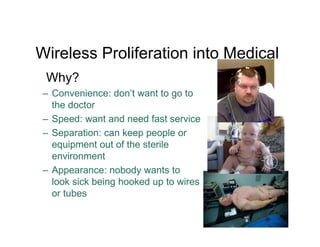
Wireless Proliferation into Medical
Why?
– Convenience: don’t want to go to
the doctor
– Speed: want and need fast service
– Separation: can keep people or
equipment out of the sterile
environment
– Appearance: nobody wants to
look sick being hooked up to wires
or tubes
13
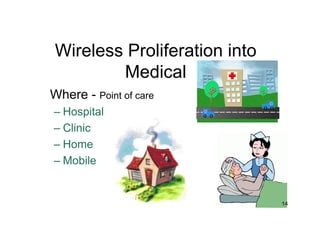
Wireless Proliferation into
Medical
Where - Point of care
– Hospital
– Clinic
– Home
– Mobile
14
Latest News
FCC Report and Order (FCC 14-208)
 FCC will no longer accept applications for certification. All grants will be
issued by TCBs.
 The Permit But Ask procedure will be codified.
 Clarification of TCB responsibilities for performing market surveillance.
 Specify steps for addressing instances of deficient TCB performance,
including sanctions and rescinding TCB authority.
 Modify the rules to reference new standards (ISO/IEC 17065) used to accredit
TCBs
 Require labs that test for certification or DoC to be accredited. [“Testing
laboratories located in non MRA countries are not FCC recognized as
accredited under the current procedures.“]
 Codify a procedure through which the Commission currently recognizes new
laboratory accreditation bodies;
 Update references to industry measurement procedures in the Commission’s
rules (e.g. ANSI C63.4-2014 and ANSI C63.10-2013); and
 Provide greater flexibility to enable the FCC’s OET to address minor technical
issues that may be raised when updating to the latest versions of industry
standards that are referenced in Parts 2, 5, 15, and 18 of the Commission’s
rules.
16
FCC Report and Order (FCC 14-30)
 New rules for U-NII devices (e.g. 802.11an) became effective on June 2,
2014. Transition period, see FCC KDB 926956:
– New devices can be approved until June 1, 2015 under either the old or new rules.
– Starting June 2, 2015, new approvals must be to the new rules.
– Starting June 2, 2016, permissive changes must be to the new rules. Also products previously
certified under the old rules can’t be marketed unless they meet the new rules (C2PC
application required).
 Indoor-only restriction removed from the 5.2 GHz band. Also increased the
output power in that band.
 Extended the upper frequency edge of the 5.8 GHz band to match FCC
15.247. They are now both 5725 – 5850 MHz
 Harmonized the rules between 15.247 and 15.407 for DTS device operating in
the 5.8 GHz band.
 U-NII device software must be secured to prevent its modification
 New DFS radar waveform and new test requirements.
17
Radio Equipment Directive (RED)
2014/53/EU
 Published in the OJEU on April 16, 2014 will be applicable June 13, 2016.
No one can claim compliance with this new directive until then.
 However, if equipment meets the requirements of the R&TTE Directive before
June 13, 2016, compliance with the RED is not mandatory until June 13,
2017. For new equipment placed on the EU market after June 12, 2016
must meet the requirements of the RED.
 Sound and TV broadcast receivers will be included in the RED
 Telecom Terminal Equipment will be excluded
 “Radio determination” will be included, e.g. RFID, movement detection.
 Radio equipment operating below 9 kHz will be included
 ISM equipment (generates RF to perform work, not telecommunications) will
be excluded.
 Role of a Notified Body is still to assess compliance at the request of the
manufacturer. This is optional if harmonized standards have been applied in
full. Notified Bodies will issue an “EU-Type Examination Certificate” that
documents their assessment of the manufacturer’s supplied “Technical
Documentation” (see Annex V of the RED)
18
Changes to EN 300 328 and EN 301 893
 EN 300 328 V1.8.1 and EN 301 893 V1.7.1 required starting Jan 1, 2015.
 Even products that have been selling for years under the previous version
must now meet the latest version if they are still being shipped into the EU.
 Products already in the EU prior to Jan 1, 2015 do NOT need to be recalled or
retested.
 The main differences between the old and new versions of the standards are
significant and can be summarized as follows:
– Adequate spectrum sharing. The efficiency of the various sharing mechanisms
must be tested per the procedures of the harmonized standards. Previous
versions permitted just an attestation from the manufacturer.
– An output power test methodology that would address a wide-range of
technologies. This new approach is completely different from what was included in
V1.7.1 of the standard.
– A power spectral density test methodology that would permit a higher output power.
Many devices are not limited by the 100mW EIRP limit, but instead by the
10mW/MHz power spectral density (PSD) limit. EN 300 328 V1.8.1 has very
different and much more complex method of measuring power spectral density.
– Harmonize test methods with other ETSI standards operating in the same bands.
 EN 300 328 V1.9.1 published in the OJ on April 17, 2015. Mandatory starting
Nov. 30, 2016. Contains minor fixes to previous version.
19
Medical Wireless Technology
 Wearable, wireless devices capable of
offering real time data
– 2012 – 14 million
– 2016 – 171 million (estimated)
• $6 billion market minimum
21
DIGI FIT LIFE, “Wearble, Wireless Technology to Generate Minimum $6 Billion by 2016”, August 2012, retrieved from
http://digifitlife.com/wearable-wireless-technology-to-generate-minimum-6-billion-by-2016/#.VL_xwkfF-So
Medical Wireless Technology
• Inductive
• Typically below 200 kHz
• Very short range, low level
• Inductive charging
• ISM/SRD (Industrial, Scientific & Medical / Short range
Devices)
• Frequencies – 13.56 MHz (ISM/SRD), 27.12 MHz (ISM), 40.68 MHz
(ISM), 433.92 MHz (ISM), 865.0 MHz (SRD), 915.0 MHz (ISM), 2450
MHz (ISM, SRD) , 5.8 GHz (ISM, SRD)
• Crowded
• Medical Device Radiocommunication Service (MedRadio) or
MICS (Medical Implant Communication Service)
• 401-406 MHz
• Special – implanted devices
• Short range - approximately 3-5meters
22
Medical Wireless Technology
• A Sub-set of MedRadio , the FCC also permits
operation of Medical Micropower Network (MMN)
devices
• In November 2011, the FCC adopted rules for the operation
of ultra-low power wideband networks in the 413-419 MHz,
426-432 MHz, 438-444 MHz, 451-457 MHz, and 2360-2400
MHz bands: http://www.fcc.gov/document/medical-micro-power-networks
• MMN’s are used to restore functions to paralyzed limbs.
• Implanted transmitters in the body take the place of
damaged nerves, restoring sensation and mobility.
• Multiple MMNs may be present within a patient. Implants
may only communicate with the programmer /controller for
their MMN, and not with each other.
23
Medical Wireless Technology
 MBAN (Medical Body Area Networks)
• 5/2012 - FCC Designates 2360-2400 MHz band
• ‘License-by-rule’ – users will not have to apply for/receive
individual station licenses
• Sharing 2360-2390 w/Aeronautical Mobile Telemetry (AMT)
licenses. Use in that band restricted to indoor health care
facilities & requires registration w/MBAN coordinator. FCC
still needs to select.
• Rest of band no registration, use anywhere (mobile, home,
health care facilities)
• Low power, short range
– http://www.fcc.gov/document/medical-body-area-networks-first-report-and-
order/ 24
Medical Wireless Technology
 MBAN (Medical Body Area Networks)
• Multiple body sensors for monitoring & control
• ‘Facebook for your organs’
• removes the tether
25
Medical Wireless Technology
 WMTS (Wireless Medical Telemetry
Service – instituted in 2000)
– Freqs: 608-614 MHz, 1395-1400 MHz,
1429-1432 MHz
– Long range
– Safe band, proprietary, very common use
for wireless patient monitoring
– Limited to use within health care facilities.
26
Wireless Technology
 Wi-Fi – connectivity of monitors
– 92% Wi-Fi penetration into large (500+
employees) healthcare facilities now &
100% by 2016
– 17% of the world’s population uses Wi-Fi
– Wi-Fi Alliance working on WLAN best
practices & Risk Mgmnt, plus personal
home healthcare architecture
27
Wireless Technology
 Bluetooth – low power, secure, interoperability
– 2 billion BT products ship in 2012
– Bluetooth 4.0 is capable of Basic Rate and Enhance Data Rate
operation (BR/ EDR) as well as Low Energy (LE), or LE only.
– Bluetooth BR and EDR modes operate on 79 hopping channels
that are tested at: 2402, 2441, and 2480 MHz
– Bluetooth LE Advertising mode utilizes only three
channels: 2402, 2426, and 2480 MHz
– Bluetooth LE Data mode has 37 hopping channels: 2404, 2442,
and 2478 MHz
28
Wireless Technology
 RFID – equipment or people tags
 Zigbee – some but mostly industrial
devices
 Cell bands – mobile communication/
apps
29
Risks
Are Wireless Medical Devices Safe and Effective?
 Interference could result in injury or death
 Failure to provide critical status or drug injection
information
 Problem Reports (FDA)
– Feb 2006 – cell phone interfered w/infusion pump causing higher
prescribed rate
– June 2006 – cell phone caused infusion pump to stop
– Sept 2008 – electrocautery device caused a loss of therapeutic effect
on an implant
– Other studies – ICD reactions to RFID
 Legal Perspective
http://www.fr.com/files/uploads/attachments/FinalRegulatoryWhitePaperWirelessMedicalTechnologies.pdf
31
RF Wireless Coexistence
 Due to the increasing number of wireless devices, the
risk of interference with wireless medical devices is
also increasing
 Critical data transmitted by medical devices could be
delayed or blocked by other nearby wireless devices.
 Current EMC standards are inadequate. In-band
interference is specifically excluded. Manufacturers
cannot claim the safe operation of their wireless
medical device based solely on EMC test results.
 Test methods are under development to assess the risk of
interference. (ANSI, Univ of Oklahoma)
32
Current Guidance on Coexistence
 Co-existence is discussed in the FDA Guidance for Wireless
Technology in Medical Devices. Draft issued Jan 2007, became
formal guidance August 2013.
http://www.fda.gov/MedicalDevices/DeviceRegulationandGuidance/GuidanceDocuments/ucm077210.htm
– Also contains guidance on risk management, design &
development, verification, validation, labeling, etc.
 Environmental Considerations – Radio Channel Characteristics,
Polarization, Co-channel & Adjacent Channel Interference,
Distance from the interfering source
– Testing should be done in both an anechoic chamber and in
situ, with each wireless medical device separately exposed to
one or more wireless networks.
http://www.medicalelectronicsdesign.com/article/wireless-medical-device-coexistence
33
Regulatory
Regulatory
 US
– FDA – Medical
• Regulates all medical devices & general public health and
safety
• http://www.fda.gov/MedicalDevices/DeviceRegulationandGuidance/Guidanc
eDocuments/ucm077210.htm
– FCC – Wireless and RF Exposure
• Spectrum management
• Standards
• TCB route for approvals – short turnaround
35
Regulatory
 EU
– Medical & Wireless - Directives
• Radio (RTTE) / EMC (EMCD)
– RTTE repealed and RED begins June 13, 2016
– Old EMCD repealed and New EMCD begins April 20,
2016
• Medical Devices (MDD, AIMDD)
• Safety (Electrical, Mechanical, RF)
• Self declaration
36
Typical Wireless Test Requirements
 Output Power
 Effective Radiated Power
 Frequency Stability
 Occupied Bandwidth
 Emissions Mask
 Power Spectral Density
 Spurious Emissions
 Immunity
37
Effective Radiated Power –
MedRadio 403 – 405 MHz
 Maximum EIRP: 25uW = 85.2 dBuV/m @ 3 meters
measured over reference ground plane.
 Implants must be configured to transmit in a human
torso simulator placed 1.5 m above the ground plane.
– Dimensions of the fixture, and the properties of the
tissue substitute material are defined in 95.639(f)(2).
– The properties of the tissue substitute material should
be verified on the day of test, and the temperature of
the material recorded at the start and conclusion of the
test.
38
Torso Simulator
 Cylindrical Plexiglas container with
a size of 30 cm by 76 cm with a
sidewall thickness of 0.635 cm.
 A mounting grid for the implant and
associated leads must be provided
inside the container that permits the
implant to be positioned vertically
and horizontally
 The implant must be mounted 6 cm
from the sidewall and centered
vertically within the container.
39
Radiated Emissions Test Setup
EUT
Horizontal
EUT
Vertical
40
Radiated Emissions Test Setup
41
Tissue Substitute Material
 Torso simulator must be completely filled with a tissue
substitute material whose dielectric and conductivity
properties match those of human muscle tissue at 403.5
MHz
 Simple saline solutions do not meet the above criteria. A
formula for a suitable tissue substitute material is defined
in the paper “Simulated Biological Materials for
Electromagnetic Radiation Absorption Studies” by G.
Hartsgrove, A. Kraszewski, and A. Surowiec as published
in “Bioelectromagnetics 8:29–36 (1987)”.
 All emissions measurements are made with the tissue
material at a nominal temperature of 20–25°C
42
Standards
Standards
 Inductive (communications)
– US
• FCC Part 15.209 / 207 (tested in air)
– EU
• ERC/REC 70-03
• ETSI EN 302 195-2 / -1 (tested in saline)
• ETSI EN 301 489-31 / -1
44
Standards
 Inductive (charging portion only)
– US
• FCC Part 18
• RF Exposure (KDB 680106)
– EU
• CISPR 11
• IEC 60601-1-2
45
Standards
 ISM/SRD
– US
• 15.209 / 15.109 / 15.107
• 15.247 – 2.4 - 2.4835 GHz Band
• 15.249 – 902-928 MHz
– EU
• ERC/REC 70-03
• EN ETSI 300 220-2/-1 / 300 440 /300 328
• EN ETS 301 489-3 / -1
46
Standards
 MedRadio/MICS
– US
• Part 95I / 2
• 15.109 / 107
– EU
• ERC/REC 70-03
• EN ETSI 301 839-2 / -1
• EN ETS 301 489-27 / -1
– Other
• Torso simulator 47
Standards
 MBAN
– US
• Part 95I
– EU
• ERC/REC 70-03
• Unknown – we are to assume Part of MICS but
could also be Wi-Fi stds or some combo
• EN ETSI 301 839-2 / -1
• EN ETS 301 489-27 / -1
48
Standards
 Wi-Fi/BT
– US
• Part 15.407 / 15.247
• 15.207
– EU
• ERC/REC 70-03
• EN ETSI 300 328
• EN ETS 301 489-17 / -1
49
Medical Device Standards
 FDA
– IEC 601-1-2 – EMC of medical electrical equipment &
systems
• IEC 60601-2-X – specific types of equipment
– FDA Guidance
• Higher immunity levels might be required & have been
requested
50
Medical Device Standards
 Other
– AAMI PC69 – EMC for Active Implantable Medical
Devices
– EN 45502-2 (Active Implantable Medical Devices)
– ISO 14708-2 (implantable cardiac pacemakers)
– EN & ETSI reqs
– ISO Standards (wheelchairs, pulse oximeters,
neurostimulators)
51
Beyond EMC
Special Requirements – RF Exposure / RF Safety
 RF Exposure is the effect of emissions from transmitters on the
quality of the human environment.
 On August 1, 1996, the Commission adopted the NCRP's
recommended Maximum Permissible Exposure limits for field
strength and power density for the transmitters operating at
frequencies of 300 kHz to 100 GHz.
 FCC and Industry Canada adopted the specific absorption rate
(SAR) limits for devices operating within close proximity to the
body as specified within the ANSI/IEEE C95.1-1992 guidelines.
 More info: http://transition.fcc.gov/oet/rfsafety/
53
Exposure Categories
Fixed Mobile Portable
54
Exposure Limits
 FCC RF exposure limits are based on ANSI/IEEE C95.1-1992 and NCRP
Report No. 86, but not identical to these standards
 Maximum Permissible Exposure (MPE) limits are applicable to fixed and
mobile transmitters. Used >= 20cm from the head or torso
– Frequency dependent free-space power density and/or field strength
limits
– Based on whole-body averaged plane wave equivalent exposure
conditions
 Specific Absorption Rate (SAR) are applicable to portable transmitters.
Used < 20cm from the head or torso
– One gram averaged energy absorption limits for the US and Canada,
10g limits for the rest of the world
– Based on partial-body or localized near-field exposure conditions
55
Specific Absorption Rate (SAR)
56
SAR Test System
57
SAR Test System
Radio Held Underneath Body Phantom
58
SAR Test System
Radio Held Next to Head Phantom
59
RF Exposure Requirement for MedRadio Implants
 95.1221 RF exposure: “… Applications for equipment
authorization of devices operating under this section
must demonstrate compliance with these requirements
using either finite difference time domain (FDTD)
computational modeling or laboratory measurement
techniques.”
 FCC KDB 447498 D01 v05v401, Section 4.2.4: “When
the aggregate of the maximum power available at the
antenna port and radiating structures of an implanted
transmitter, under all operating circumstances, is ≤ 1.0
mW, SAR test exclusion may be applied.” 60
Special Requirements – Listen Before Talk (LBT)
 Required for MedRadio operation in the 401 –
406 MHz band.
– EN 301 839-1 Clause 10 – best test procedure
 Except in the case of a Medical Implant Event,
communications sessions shall be initiated via
LBT (either by programmer or implant). Before a
communications session is initiated the
requirements as stated specifically in clauses
10.1-10.6 of EN 301 839-1 shall be met.
61
Compliance Considerations
Research Objectives for your Target Market
 Spectrum Allocation
– Frequency Bands
– Output power
– Data vs. Voice
– Modulation type
– Licensed vs. Unlicensed
 Specifications and Test Methods
– EMC and RF Safety
 Equipment Authorization process
– System or modular approval
– Self Declaration or submittal to spectrum authority
– Labeling and User Info 63
Write a Test Plan
IEC 60601-1-2, 4th edition "Prior to the start of formal testing,
a detailed test plan shall be provided to the test laboratory.“
 Compliance Objective – Certification, Class II permissive change, or
audit.
 Target markets – U.S., Canada, EU, etc.
 Brief product description
 List of standards including version and year.
 Any applicable interpretations or procedures from spectrum
authorities.
 Complete List of operating modes including modulation types, data
rates, power levels, and antennas.
 Detailed equipment configuration for each test
 Operating instructions 64
Make EMC a Design Consideration
 The focus of EMC design: grounding, filtering,
component selection, PCB layout, and shielding.
 Single solutions don’t exist; but rather a
combination of suppression techniques are
required.
 Don’t wait until the end of the design cycle to test.
 “One test result is worth one thousand expert
opinions” – Wernher Von Braun
65
Common Design Pitfalls
 Poor antenna matching
 Lack of shielding
 Design objectives or omissions that
conflict with regulatory requirements
– Output power versus operating band
– RF Exposure
– Listen Before Talk, Duty Cycle, or Dynamic
Frequency Selection (DFS) 66
Get Expert Testing & Approval Services
 Partner with a domestic EMC laboratory that is accredited for
foreign specifications
– Permits testing in-country to obtain global approvals. For
example Japan and Korea wireless can be tested locally.
– Easy access to someone who is familiar with the
requirements of your target market
 Confirm that your EMC laboratory has experience in medical
EMC
– How many MICS, MedRadio, WMTS, Wi-Fi, and
Bluetooth grants have they issued?
 Ask if your EMC laboratory is equipped for the latest medical
EMC test requirements
– Radiated Immunity to 6 GHz, 10V/m with uniform field
– Radiated Immunity in the 4th edition "IMMUNITY to proximity
fields from RF wireless communications"
– Radiated Emissions testing at 10 meters
67
Thank You!
68

Testing wireless medical devices

  • 1.
    Testing Wireless MedicalDevices Greg Kiemel
  • 2.
    Outline  Wireless Trends Latest News  Medical Wireless Technologies  Risks  Regulatory  Standards  Beyond EMC  Compliance Considerations 2
  • 3.
  • 4.
    Increasing Rate ofChange  It took more than 90 years for landline service to reach 100 million consumers  More than 21 years for color televisions to reach 100 million consumers  But less than 17 years for wireless to reach 100 million consumers. Source: CTIA – The Wireless Association, Wireless Quick Facts, 2011. 4
  • 5.
    Regulatory Approval Trends Virtually all radios sold in the U.S. require FCC certification.  To keep up with the increasing number of applications, the FCC created the Telecommunications Certification Body (TCB) program in June 2000.  TCBs certify wireless products under the authority of the FCC.  FCC ET Docket 13-44 released 12/30/14 made TCBs the only route to certification. The FCC will no longer accept applications for certification. 5
  • 6.
    TCB Application Trend Source:https://apps.fcc.gov/oetcf/eas/reports/GenericSearch.cfm 0 10000 20000 30000 40000 1999 2000 2001 2002 2003 2004 2005 2006 2007 2008 2009 2010 2011 2012 2013 2014 Approvals Year FCC TCB 6
  • 7.
    Application Trends Jan 1,2014 – Dec 31, 2014 TCBs issued 42,669 Approvals, FCC 425 7
  • 8.
    Wireless Data Standards UsableRange WWAN 802.16e (WiMax) GSM, GPRS, Edge, HSPA 4G LTE WLAN 802.11a/b/g/n WPAN 802.11ac 802.15.4 (Zigbee) 802.15.1 (Bluetooth) Feet Miles 802.15.3 (UWB) WBAN 802.15.6 MBAN 8 MedRadio Inductive Telemetry 802.11ad
  • 9.
    Evolution of Applications/ Platforms Computer TV, Video Wireless Telecommunications Internet Convergence of Technologies 9 Medical
  • 10.
    Multiple Radios inthe Same Host Device Patient Monitor with Wi-Fi, Bluetooth, and WWAN Radios 4G Cellphone with Wi-Fi, Bluetooth, NFC, and GPS Notebook PC or Tablet with Cellular modem, Wi-Fi, and Bluetooth 10
  • 11.
    New Technologies  SpectrumEfficiency is the driving force…more users require more throughput while occupying the same finite chunk of frequency spectrum  Biggest Breakthroughs – Smart Antenna Systems • MIMO (Multiple Input and Multiple Output) • Adaptive Beam forming – OFDM (Orthogonal frequency-division multiplexing) – Cognitive Radio • Listen Before Talk (LBT) • Dynamic Frequency Selection (DFS) • Adaptive Frequency Hopping (e.g. Bluetooth devices) 11
  • 12.
    The ‘New’ WirelessMedical World 12
  • 13.
    Wireless Proliferation intoMedical Why? – Convenience: don’t want to go to the doctor – Speed: want and need fast service – Separation: can keep people or equipment out of the sterile environment – Appearance: nobody wants to look sick being hooked up to wires or tubes 13
  • 14.
    Wireless Proliferation into Medical Where- Point of care – Hospital – Clinic – Home – Mobile 14
  • 15.
  • 16.
    FCC Report andOrder (FCC 14-208)  FCC will no longer accept applications for certification. All grants will be issued by TCBs.  The Permit But Ask procedure will be codified.  Clarification of TCB responsibilities for performing market surveillance.  Specify steps for addressing instances of deficient TCB performance, including sanctions and rescinding TCB authority.  Modify the rules to reference new standards (ISO/IEC 17065) used to accredit TCBs  Require labs that test for certification or DoC to be accredited. [“Testing laboratories located in non MRA countries are not FCC recognized as accredited under the current procedures.“]  Codify a procedure through which the Commission currently recognizes new laboratory accreditation bodies;  Update references to industry measurement procedures in the Commission’s rules (e.g. ANSI C63.4-2014 and ANSI C63.10-2013); and  Provide greater flexibility to enable the FCC’s OET to address minor technical issues that may be raised when updating to the latest versions of industry standards that are referenced in Parts 2, 5, 15, and 18 of the Commission’s rules. 16
  • 17.
    FCC Report andOrder (FCC 14-30)  New rules for U-NII devices (e.g. 802.11an) became effective on June 2, 2014. Transition period, see FCC KDB 926956: – New devices can be approved until June 1, 2015 under either the old or new rules. – Starting June 2, 2015, new approvals must be to the new rules. – Starting June 2, 2016, permissive changes must be to the new rules. Also products previously certified under the old rules can’t be marketed unless they meet the new rules (C2PC application required).  Indoor-only restriction removed from the 5.2 GHz band. Also increased the output power in that band.  Extended the upper frequency edge of the 5.8 GHz band to match FCC 15.247. They are now both 5725 – 5850 MHz  Harmonized the rules between 15.247 and 15.407 for DTS device operating in the 5.8 GHz band.  U-NII device software must be secured to prevent its modification  New DFS radar waveform and new test requirements. 17
  • 18.
    Radio Equipment Directive(RED) 2014/53/EU  Published in the OJEU on April 16, 2014 will be applicable June 13, 2016. No one can claim compliance with this new directive until then.  However, if equipment meets the requirements of the R&TTE Directive before June 13, 2016, compliance with the RED is not mandatory until June 13, 2017. For new equipment placed on the EU market after June 12, 2016 must meet the requirements of the RED.  Sound and TV broadcast receivers will be included in the RED  Telecom Terminal Equipment will be excluded  “Radio determination” will be included, e.g. RFID, movement detection.  Radio equipment operating below 9 kHz will be included  ISM equipment (generates RF to perform work, not telecommunications) will be excluded.  Role of a Notified Body is still to assess compliance at the request of the manufacturer. This is optional if harmonized standards have been applied in full. Notified Bodies will issue an “EU-Type Examination Certificate” that documents their assessment of the manufacturer’s supplied “Technical Documentation” (see Annex V of the RED) 18
  • 19.
    Changes to EN300 328 and EN 301 893  EN 300 328 V1.8.1 and EN 301 893 V1.7.1 required starting Jan 1, 2015.  Even products that have been selling for years under the previous version must now meet the latest version if they are still being shipped into the EU.  Products already in the EU prior to Jan 1, 2015 do NOT need to be recalled or retested.  The main differences between the old and new versions of the standards are significant and can be summarized as follows: – Adequate spectrum sharing. The efficiency of the various sharing mechanisms must be tested per the procedures of the harmonized standards. Previous versions permitted just an attestation from the manufacturer. – An output power test methodology that would address a wide-range of technologies. This new approach is completely different from what was included in V1.7.1 of the standard. – A power spectral density test methodology that would permit a higher output power. Many devices are not limited by the 100mW EIRP limit, but instead by the 10mW/MHz power spectral density (PSD) limit. EN 300 328 V1.8.1 has very different and much more complex method of measuring power spectral density. – Harmonize test methods with other ETSI standards operating in the same bands.  EN 300 328 V1.9.1 published in the OJ on April 17, 2015. Mandatory starting Nov. 30, 2016. Contains minor fixes to previous version. 19
  • 20.
  • 21.
    Medical Wireless Technology Wearable, wireless devices capable of offering real time data – 2012 – 14 million – 2016 – 171 million (estimated) • $6 billion market minimum 21 DIGI FIT LIFE, “Wearble, Wireless Technology to Generate Minimum $6 Billion by 2016”, August 2012, retrieved from http://digifitlife.com/wearable-wireless-technology-to-generate-minimum-6-billion-by-2016/#.VL_xwkfF-So
  • 22.
    Medical Wireless Technology •Inductive • Typically below 200 kHz • Very short range, low level • Inductive charging • ISM/SRD (Industrial, Scientific & Medical / Short range Devices) • Frequencies – 13.56 MHz (ISM/SRD), 27.12 MHz (ISM), 40.68 MHz (ISM), 433.92 MHz (ISM), 865.0 MHz (SRD), 915.0 MHz (ISM), 2450 MHz (ISM, SRD) , 5.8 GHz (ISM, SRD) • Crowded • Medical Device Radiocommunication Service (MedRadio) or MICS (Medical Implant Communication Service) • 401-406 MHz • Special – implanted devices • Short range - approximately 3-5meters 22
  • 23.
    Medical Wireless Technology •A Sub-set of MedRadio , the FCC also permits operation of Medical Micropower Network (MMN) devices • In November 2011, the FCC adopted rules for the operation of ultra-low power wideband networks in the 413-419 MHz, 426-432 MHz, 438-444 MHz, 451-457 MHz, and 2360-2400 MHz bands: http://www.fcc.gov/document/medical-micro-power-networks • MMN’s are used to restore functions to paralyzed limbs. • Implanted transmitters in the body take the place of damaged nerves, restoring sensation and mobility. • Multiple MMNs may be present within a patient. Implants may only communicate with the programmer /controller for their MMN, and not with each other. 23
  • 24.
    Medical Wireless Technology MBAN (Medical Body Area Networks) • 5/2012 - FCC Designates 2360-2400 MHz band • ‘License-by-rule’ – users will not have to apply for/receive individual station licenses • Sharing 2360-2390 w/Aeronautical Mobile Telemetry (AMT) licenses. Use in that band restricted to indoor health care facilities & requires registration w/MBAN coordinator. FCC still needs to select. • Rest of band no registration, use anywhere (mobile, home, health care facilities) • Low power, short range – http://www.fcc.gov/document/medical-body-area-networks-first-report-and- order/ 24
  • 25.
    Medical Wireless Technology MBAN (Medical Body Area Networks) • Multiple body sensors for monitoring & control • ‘Facebook for your organs’ • removes the tether 25
  • 26.
    Medical Wireless Technology WMTS (Wireless Medical Telemetry Service – instituted in 2000) – Freqs: 608-614 MHz, 1395-1400 MHz, 1429-1432 MHz – Long range – Safe band, proprietary, very common use for wireless patient monitoring – Limited to use within health care facilities. 26
  • 27.
    Wireless Technology  Wi-Fi– connectivity of monitors – 92% Wi-Fi penetration into large (500+ employees) healthcare facilities now & 100% by 2016 – 17% of the world’s population uses Wi-Fi – Wi-Fi Alliance working on WLAN best practices & Risk Mgmnt, plus personal home healthcare architecture 27
  • 28.
    Wireless Technology  Bluetooth– low power, secure, interoperability – 2 billion BT products ship in 2012 – Bluetooth 4.0 is capable of Basic Rate and Enhance Data Rate operation (BR/ EDR) as well as Low Energy (LE), or LE only. – Bluetooth BR and EDR modes operate on 79 hopping channels that are tested at: 2402, 2441, and 2480 MHz – Bluetooth LE Advertising mode utilizes only three channels: 2402, 2426, and 2480 MHz – Bluetooth LE Data mode has 37 hopping channels: 2404, 2442, and 2478 MHz 28
  • 29.
    Wireless Technology  RFID– equipment or people tags  Zigbee – some but mostly industrial devices  Cell bands – mobile communication/ apps 29
  • 30.
  • 31.
    Are Wireless MedicalDevices Safe and Effective?  Interference could result in injury or death  Failure to provide critical status or drug injection information  Problem Reports (FDA) – Feb 2006 – cell phone interfered w/infusion pump causing higher prescribed rate – June 2006 – cell phone caused infusion pump to stop – Sept 2008 – electrocautery device caused a loss of therapeutic effect on an implant – Other studies – ICD reactions to RFID  Legal Perspective http://www.fr.com/files/uploads/attachments/FinalRegulatoryWhitePaperWirelessMedicalTechnologies.pdf 31
  • 32.
    RF Wireless Coexistence Due to the increasing number of wireless devices, the risk of interference with wireless medical devices is also increasing  Critical data transmitted by medical devices could be delayed or blocked by other nearby wireless devices.  Current EMC standards are inadequate. In-band interference is specifically excluded. Manufacturers cannot claim the safe operation of their wireless medical device based solely on EMC test results.  Test methods are under development to assess the risk of interference. (ANSI, Univ of Oklahoma) 32
  • 33.
    Current Guidance onCoexistence  Co-existence is discussed in the FDA Guidance for Wireless Technology in Medical Devices. Draft issued Jan 2007, became formal guidance August 2013. http://www.fda.gov/MedicalDevices/DeviceRegulationandGuidance/GuidanceDocuments/ucm077210.htm – Also contains guidance on risk management, design & development, verification, validation, labeling, etc.  Environmental Considerations – Radio Channel Characteristics, Polarization, Co-channel & Adjacent Channel Interference, Distance from the interfering source – Testing should be done in both an anechoic chamber and in situ, with each wireless medical device separately exposed to one or more wireless networks. http://www.medicalelectronicsdesign.com/article/wireless-medical-device-coexistence 33
  • 34.
  • 35.
    Regulatory  US – FDA– Medical • Regulates all medical devices & general public health and safety • http://www.fda.gov/MedicalDevices/DeviceRegulationandGuidance/Guidanc eDocuments/ucm077210.htm – FCC – Wireless and RF Exposure • Spectrum management • Standards • TCB route for approvals – short turnaround 35
  • 36.
    Regulatory  EU – Medical& Wireless - Directives • Radio (RTTE) / EMC (EMCD) – RTTE repealed and RED begins June 13, 2016 – Old EMCD repealed and New EMCD begins April 20, 2016 • Medical Devices (MDD, AIMDD) • Safety (Electrical, Mechanical, RF) • Self declaration 36
  • 37.
    Typical Wireless TestRequirements  Output Power  Effective Radiated Power  Frequency Stability  Occupied Bandwidth  Emissions Mask  Power Spectral Density  Spurious Emissions  Immunity 37
  • 38.
    Effective Radiated Power– MedRadio 403 – 405 MHz  Maximum EIRP: 25uW = 85.2 dBuV/m @ 3 meters measured over reference ground plane.  Implants must be configured to transmit in a human torso simulator placed 1.5 m above the ground plane. – Dimensions of the fixture, and the properties of the tissue substitute material are defined in 95.639(f)(2). – The properties of the tissue substitute material should be verified on the day of test, and the temperature of the material recorded at the start and conclusion of the test. 38
  • 39.
    Torso Simulator  CylindricalPlexiglas container with a size of 30 cm by 76 cm with a sidewall thickness of 0.635 cm.  A mounting grid for the implant and associated leads must be provided inside the container that permits the implant to be positioned vertically and horizontally  The implant must be mounted 6 cm from the sidewall and centered vertically within the container. 39
  • 40.
    Radiated Emissions TestSetup EUT Horizontal EUT Vertical 40
  • 41.
  • 42.
    Tissue Substitute Material Torso simulator must be completely filled with a tissue substitute material whose dielectric and conductivity properties match those of human muscle tissue at 403.5 MHz  Simple saline solutions do not meet the above criteria. A formula for a suitable tissue substitute material is defined in the paper “Simulated Biological Materials for Electromagnetic Radiation Absorption Studies” by G. Hartsgrove, A. Kraszewski, and A. Surowiec as published in “Bioelectromagnetics 8:29–36 (1987)”.  All emissions measurements are made with the tissue material at a nominal temperature of 20–25°C 42
  • 43.
  • 44.
    Standards  Inductive (communications) –US • FCC Part 15.209 / 207 (tested in air) – EU • ERC/REC 70-03 • ETSI EN 302 195-2 / -1 (tested in saline) • ETSI EN 301 489-31 / -1 44
  • 45.
    Standards  Inductive (chargingportion only) – US • FCC Part 18 • RF Exposure (KDB 680106) – EU • CISPR 11 • IEC 60601-1-2 45
  • 46.
    Standards  ISM/SRD – US •15.209 / 15.109 / 15.107 • 15.247 – 2.4 - 2.4835 GHz Band • 15.249 – 902-928 MHz – EU • ERC/REC 70-03 • EN ETSI 300 220-2/-1 / 300 440 /300 328 • EN ETS 301 489-3 / -1 46
  • 47.
    Standards  MedRadio/MICS – US •Part 95I / 2 • 15.109 / 107 – EU • ERC/REC 70-03 • EN ETSI 301 839-2 / -1 • EN ETS 301 489-27 / -1 – Other • Torso simulator 47
  • 48.
    Standards  MBAN – US •Part 95I – EU • ERC/REC 70-03 • Unknown – we are to assume Part of MICS but could also be Wi-Fi stds or some combo • EN ETSI 301 839-2 / -1 • EN ETS 301 489-27 / -1 48
  • 49.
    Standards  Wi-Fi/BT – US •Part 15.407 / 15.247 • 15.207 – EU • ERC/REC 70-03 • EN ETSI 300 328 • EN ETS 301 489-17 / -1 49
  • 50.
    Medical Device Standards FDA – IEC 601-1-2 – EMC of medical electrical equipment & systems • IEC 60601-2-X – specific types of equipment – FDA Guidance • Higher immunity levels might be required & have been requested 50
  • 51.
    Medical Device Standards Other – AAMI PC69 – EMC for Active Implantable Medical Devices – EN 45502-2 (Active Implantable Medical Devices) – ISO 14708-2 (implantable cardiac pacemakers) – EN & ETSI reqs – ISO Standards (wheelchairs, pulse oximeters, neurostimulators) 51
  • 52.
  • 53.
    Special Requirements –RF Exposure / RF Safety  RF Exposure is the effect of emissions from transmitters on the quality of the human environment.  On August 1, 1996, the Commission adopted the NCRP's recommended Maximum Permissible Exposure limits for field strength and power density for the transmitters operating at frequencies of 300 kHz to 100 GHz.  FCC and Industry Canada adopted the specific absorption rate (SAR) limits for devices operating within close proximity to the body as specified within the ANSI/IEEE C95.1-1992 guidelines.  More info: http://transition.fcc.gov/oet/rfsafety/ 53
  • 54.
  • 55.
    Exposure Limits  FCCRF exposure limits are based on ANSI/IEEE C95.1-1992 and NCRP Report No. 86, but not identical to these standards  Maximum Permissible Exposure (MPE) limits are applicable to fixed and mobile transmitters. Used >= 20cm from the head or torso – Frequency dependent free-space power density and/or field strength limits – Based on whole-body averaged plane wave equivalent exposure conditions  Specific Absorption Rate (SAR) are applicable to portable transmitters. Used < 20cm from the head or torso – One gram averaged energy absorption limits for the US and Canada, 10g limits for the rest of the world – Based on partial-body or localized near-field exposure conditions 55
  • 56.
  • 57.
  • 58.
    SAR Test System RadioHeld Underneath Body Phantom 58
  • 59.
    SAR Test System RadioHeld Next to Head Phantom 59
  • 60.
    RF Exposure Requirementfor MedRadio Implants  95.1221 RF exposure: “… Applications for equipment authorization of devices operating under this section must demonstrate compliance with these requirements using either finite difference time domain (FDTD) computational modeling or laboratory measurement techniques.”  FCC KDB 447498 D01 v05v401, Section 4.2.4: “When the aggregate of the maximum power available at the antenna port and radiating structures of an implanted transmitter, under all operating circumstances, is ≤ 1.0 mW, SAR test exclusion may be applied.” 60
  • 61.
    Special Requirements –Listen Before Talk (LBT)  Required for MedRadio operation in the 401 – 406 MHz band. – EN 301 839-1 Clause 10 – best test procedure  Except in the case of a Medical Implant Event, communications sessions shall be initiated via LBT (either by programmer or implant). Before a communications session is initiated the requirements as stated specifically in clauses 10.1-10.6 of EN 301 839-1 shall be met. 61
  • 62.
  • 63.
    Research Objectives foryour Target Market  Spectrum Allocation – Frequency Bands – Output power – Data vs. Voice – Modulation type – Licensed vs. Unlicensed  Specifications and Test Methods – EMC and RF Safety  Equipment Authorization process – System or modular approval – Self Declaration or submittal to spectrum authority – Labeling and User Info 63
  • 64.
    Write a TestPlan IEC 60601-1-2, 4th edition "Prior to the start of formal testing, a detailed test plan shall be provided to the test laboratory.“  Compliance Objective – Certification, Class II permissive change, or audit.  Target markets – U.S., Canada, EU, etc.  Brief product description  List of standards including version and year.  Any applicable interpretations or procedures from spectrum authorities.  Complete List of operating modes including modulation types, data rates, power levels, and antennas.  Detailed equipment configuration for each test  Operating instructions 64
  • 65.
    Make EMC aDesign Consideration  The focus of EMC design: grounding, filtering, component selection, PCB layout, and shielding.  Single solutions don’t exist; but rather a combination of suppression techniques are required.  Don’t wait until the end of the design cycle to test.  “One test result is worth one thousand expert opinions” – Wernher Von Braun 65
  • 66.
    Common Design Pitfalls Poor antenna matching  Lack of shielding  Design objectives or omissions that conflict with regulatory requirements – Output power versus operating band – RF Exposure – Listen Before Talk, Duty Cycle, or Dynamic Frequency Selection (DFS) 66
  • 67.
    Get Expert Testing& Approval Services  Partner with a domestic EMC laboratory that is accredited for foreign specifications – Permits testing in-country to obtain global approvals. For example Japan and Korea wireless can be tested locally. – Easy access to someone who is familiar with the requirements of your target market  Confirm that your EMC laboratory has experience in medical EMC – How many MICS, MedRadio, WMTS, Wi-Fi, and Bluetooth grants have they issued?  Ask if your EMC laboratory is equipped for the latest medical EMC test requirements – Radiated Immunity to 6 GHz, 10V/m with uniform field – Radiated Immunity in the 4th edition "IMMUNITY to proximity fields from RF wireless communications" – Radiated Emissions testing at 10 meters 67
  • 68.