
Telecommunications,
The Internet,
and Wireless Technology
Syed Ali Roshaan Raza
Mubashir Hasan
(group 5)
NETWORKING AND COMMUNICATION TRENDS
 Convergence of telephones and computer networks (and internet):
 Examples are smartphones
 Cable companies now offering voice service and Internet access.
 Broadband:
 High-speed connections provided by telephone and cable TV companies
running at 1 to 15 million bits per second
 Broadband wireless:
 Voice and data communication as well as Internet access are increasingly taking
place over broadband wireless platforms
WHAT IS A COMPUTER NETWORK?
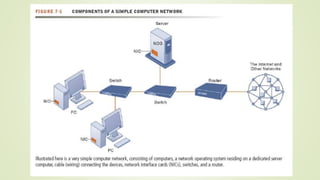
 Two or more computers connected together
 Major components in a simple network
Client computer
Server computer
Network interface Card (NIC)
Connection medium
Network operating system (NOS)
Hub or switch
 Routers
Device used to route packets of data through different
networks, ensuring that data sent gets to the correct
address
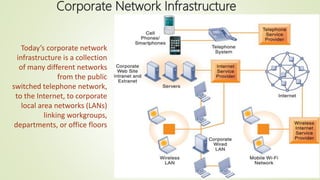
Corporate Network Infrastructure
Today’s corporate network
infrastructure is a collection
of many different networks
from the public
switched telephone network,
to the Internet, to corporate
local area networks (LANs)
linking workgroups,
departments, or office floors
KEY DIGITAL NETWORKING
TECHNOLOGIES
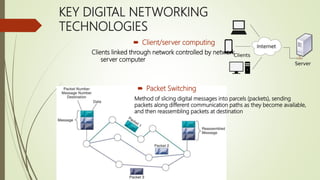
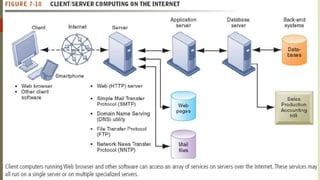
 Client/server computing
Clients linked through network controlled by network
server computer
Method of slicing digital messages into parcels (packets), sending
packets along different communication paths as they become available,
and then reassembling packets at destination
 Packet Switching
KEY DIGITAL NETWORKING
TECHNOLOGIES
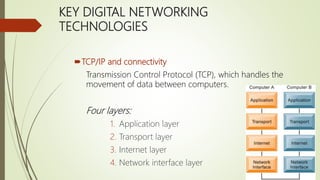
TCP/IP and connectivity
Transmission Control Protocol (TCP), which handles the
movement of data between computers.
Four layers:
1. Application layer
2. Transport layer
3. Internet layer
4. Network interface layer
SIGNALS: DIGITAL vs. ANALOG
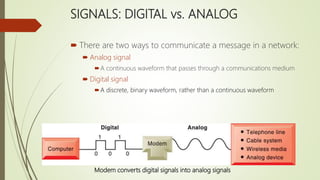
 There are two ways to communicate a message in a network:
 Analog signal
A continuous waveform that passes through a communications medium
 Digital signal
A discrete, binary waveform, rather than a continuous waveform
Modem converts digital signals into analog signals
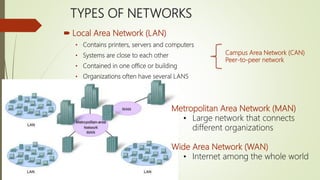
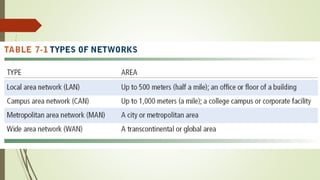
TYPES OF NETWORKS
Metropolitan Area Network (MAN)
• Large network that connects
different organizations
Wide Area Network (WAN)
• Internet among the whole world
 Local Area Network (LAN)
• Contains printers, servers and computers
• Systems are close to each other
• Contained in one office or building
• Organizations often have several LANS
Campus Area Network (CAN)
Peer-to-peer network
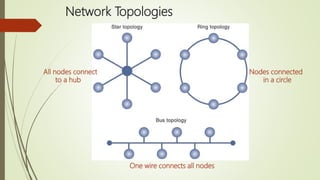
Network Topologies
One wire connects all nodes
All nodes connect
to a hub
Nodes connected
in a circle
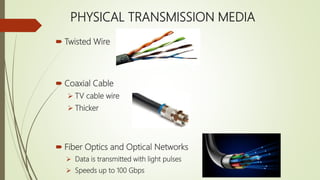
PHYSICAL TRANSMISSION MEDIA
 Twisted Wire
 Coaxial Cable
 TV cable wire
 Thicker
 Fiber Optics and Optical Networks
 Data is transmitted with light pulses
 Speeds up to 100 Gbps
PHYSICAL TRANSMISSION MEDIA
 Wireless transmission media and devices
 Microwave
 Satellites
 Cellular telephones
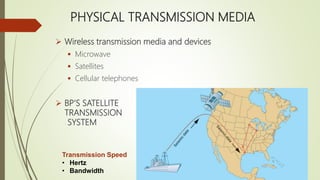
 BP’S SATELLITE
TRANSMISSION
SYSTEM
Transmission Speed
• Hertz
• Bandwidth
THE GLOBAL INTERNET
What is the Internet?
World’s most extensive, public communication system
Internet Addressing and Architecture
The Domain Name System
 Hierarchical structure
 Top-level domains
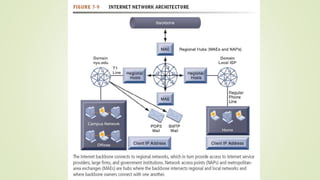
Internet Architecture and Governance
 Network Service Providers
The Future Internet: IPv6 and Internet2
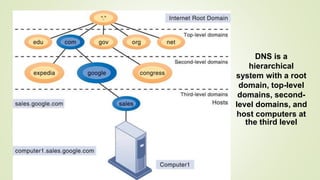
DNS is a
hierarchical
system with a root
domain, top-level
domains, second-
level domains, and
host computers at
the third level
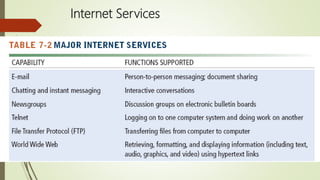
Internet Services
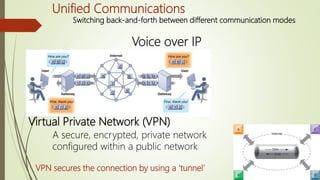
Voice over IP
Unified Communications
Switching back-and-forth between different communication modes
Virtual Private Network (VPN)
A secure, encrypted, private network
configured within a public network
VPN secures the connection by using a ‘tunnel’
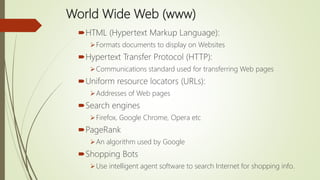
World Wide Web (www)
HTML (Hypertext Markup Language):
Formats documents to display on Websites
Hypertext Transfer Protocol (HTTP):
Communications standard used for transferring Web pages
Uniform resource locators (URLs):
Addresses of Web pages
Search engines
Firefox, Google Chrome, Opera etc
PageRank
An algorithm used by Google
Shopping Bots
Use intelligent agent software to search Internet for shopping info.
Web 2.0
Four defining features
1. Interactivity
2. Real-time user control
3. Social participation
4. User-generated content
Technologies and services behind these features
• Cloud computing
• Blogs & Vlogs
• Mashups & widgets
• Wikis
• Social networks
 Web 3.0, will be the future!
 Semantic web (giving meaning to the web)
The Wireless Revolution
 Cellular systems (mobile phones network)
 Wireless Computer Networks And Internet Access
Bluetooth
802.15 wireless networking standard
Creates small Personal Area Networks (PAN)
Useful for quickly sharing files across platforms
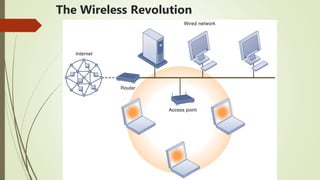
Wifi (802.11)
PCs, mobile phones, smart TVs etc can connect to the internet using
router for signals
Hotspot: access points providing wireless Internet access in a public place
The Wireless Revolution
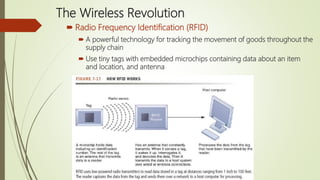
 Radio Frequency Identification (RFID)
 A powerful technology for tracking the movement of goods throughout the
supply chain
 Use tiny tags with embedded microchips containing data about an item
and location, and antenna
The Wireless Revolution
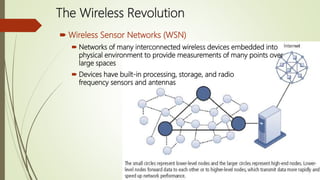
 Wireless Sensor Networks (WSN)
 Networks of many interconnected wireless devices embedded into
physical environment to provide measurements of many points over
large spaces
 Devices have built-in processing, storage, and radio
frequency sensors and antennas
The End
Thank You! 

Telecommunications, the Internet, and Wireless Technology

  • 1.
    Telecommunications, The Internet, and WirelessTechnology Syed Ali Roshaan Raza Mubashir Hasan (group 5)
  • 2.
    NETWORKING AND COMMUNICATIONTRENDS  Convergence of telephones and computer networks (and internet):  Examples are smartphones  Cable companies now offering voice service and Internet access.  Broadband:  High-speed connections provided by telephone and cable TV companies running at 1 to 15 million bits per second  Broadband wireless:  Voice and data communication as well as Internet access are increasingly taking place over broadband wireless platforms
  • 3.
    WHAT IS ACOMPUTER NETWORK?  Two or more computers connected together  Major components in a simple network Client computer Server computer Network interface Card (NIC) Connection medium Network operating system (NOS) Hub or switch  Routers Device used to route packets of data through different networks, ensuring that data sent gets to the correct address
  • 5.
    Corporate Network Infrastructure Today’scorporate network infrastructure is a collection of many different networks from the public switched telephone network, to the Internet, to corporate local area networks (LANs) linking workgroups, departments, or office floors
  • 6.
    KEY DIGITAL NETWORKING TECHNOLOGIES Client/server computing Clients linked through network controlled by network server computer Method of slicing digital messages into parcels (packets), sending packets along different communication paths as they become available, and then reassembling packets at destination  Packet Switching
  • 7.
    KEY DIGITAL NETWORKING TECHNOLOGIES TCP/IPand connectivity Transmission Control Protocol (TCP), which handles the movement of data between computers. Four layers: 1. Application layer 2. Transport layer 3. Internet layer 4. Network interface layer
  • 8.
    SIGNALS: DIGITAL vs.ANALOG  There are two ways to communicate a message in a network:  Analog signal A continuous waveform that passes through a communications medium  Digital signal A discrete, binary waveform, rather than a continuous waveform Modem converts digital signals into analog signals
  • 9.
    TYPES OF NETWORKS MetropolitanArea Network (MAN) • Large network that connects different organizations Wide Area Network (WAN) • Internet among the whole world  Local Area Network (LAN) • Contains printers, servers and computers • Systems are close to each other • Contained in one office or building • Organizations often have several LANS Campus Area Network (CAN) Peer-to-peer network
  • 11.
    Network Topologies One wireconnects all nodes All nodes connect to a hub Nodes connected in a circle
  • 12.
    PHYSICAL TRANSMISSION MEDIA Twisted Wire  Coaxial Cable  TV cable wire  Thicker  Fiber Optics and Optical Networks  Data is transmitted with light pulses  Speeds up to 100 Gbps
  • 13.
    PHYSICAL TRANSMISSION MEDIA Wireless transmission media and devices  Microwave  Satellites  Cellular telephones  BP’S SATELLITE TRANSMISSION SYSTEM Transmission Speed • Hertz • Bandwidth
  • 14.
    THE GLOBAL INTERNET Whatis the Internet? World’s most extensive, public communication system Internet Addressing and Architecture The Domain Name System  Hierarchical structure  Top-level domains Internet Architecture and Governance  Network Service Providers The Future Internet: IPv6 and Internet2
  • 15.
    DNS is a hierarchical systemwith a root domain, top-level domains, second- level domains, and host computers at the third level
  • 17.
  • 19.
    Voice over IP UnifiedCommunications Switching back-and-forth between different communication modes Virtual Private Network (VPN) A secure, encrypted, private network configured within a public network VPN secures the connection by using a ‘tunnel’
  • 20.
    World Wide Web(www) HTML (Hypertext Markup Language): Formats documents to display on Websites Hypertext Transfer Protocol (HTTP): Communications standard used for transferring Web pages Uniform resource locators (URLs): Addresses of Web pages Search engines Firefox, Google Chrome, Opera etc PageRank An algorithm used by Google Shopping Bots Use intelligent agent software to search Internet for shopping info.
  • 21.
    Web 2.0 Four definingfeatures 1. Interactivity 2. Real-time user control 3. Social participation 4. User-generated content Technologies and services behind these features • Cloud computing • Blogs & Vlogs • Mashups & widgets • Wikis • Social networks  Web 3.0, will be the future!  Semantic web (giving meaning to the web)
  • 22.
    The Wireless Revolution Cellular systems (mobile phones network)  Wireless Computer Networks And Internet Access Bluetooth 802.15 wireless networking standard Creates small Personal Area Networks (PAN) Useful for quickly sharing files across platforms Wifi (802.11) PCs, mobile phones, smart TVs etc can connect to the internet using router for signals Hotspot: access points providing wireless Internet access in a public place
  • 23.
  • 24.
     Radio FrequencyIdentification (RFID)  A powerful technology for tracking the movement of goods throughout the supply chain  Use tiny tags with embedded microchips containing data about an item and location, and antenna The Wireless Revolution
  • 25.
    The Wireless Revolution Wireless Sensor Networks (WSN)  Networks of many interconnected wireless devices embedded into physical environment to provide measurements of many points over large spaces  Devices have built-in processing, storage, and radio frequency sensors and antennas
  • 26.