VEMU INSTITUTE OF TECHNOLOGY
Chittoor- Trupathi Highway P.kothakota ,Chittoor dist.-517112
DEPARTMENT OF ELECTRONICS AND COMMUNICATION
ENGINEERING
TECHNICAL SEMINAR
ON
6G WIRELESS TECHONOLOGY
Presented by:
K.GANESH
194M1A0448
Contents:
 Introduction
 Working Principle
 Need For 6G Technology
 Block Diagram
 Technology Used
 6G Development Projects
 Requirements
 Advantages
 Features
 Result
INTRODUCTION
 6G is proposed to integrate 5G with satellite networks for global coverage.6G
Technology is considered to be cheap and Fast Internet Technology. It provides high
data rates and fast internet speed to access on air through wireless and mobile devices
with data ranges up-to 11Gbps when travelling far distance's.
 The main aim of 6G internet is to support 1 microsecond latency communication.
 The 6g is planning to provide 11 Giga bps data rate.
 The present 5g is 100+ Mbps average data rates faster than 4G.
 The 4G is delivering up to 20 Mbps data rates.
 This Technology will breaks the previous Technologies.
6G technology
 Complete wireless network with no limitations.
 Incredible transmission speed in Terabit range.
 Zero distances connectivity between peoples.
 It will be available in the market in coming years with more reliability than previous mobiles.
 The 5G is the beginning of 6G Technology.
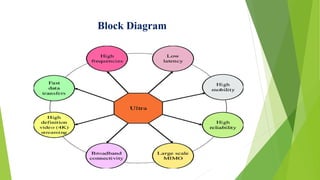
Block Diagram
Need for 6G Technology
 The 6G technology will surely make a great changes in mobile technologies.
 The 6g network will be able to use higher frequencies than 5g networks.
 In telecommunications, ^g is the sixth generation standard currently, under development for wireless
communication technologies supporting cellular development for wireless communication technologies
supporting cellular data networks.
 The successive of 5g will likely be significantly faster.
 It has the capability of handling massive volumes of data and very high data rate connectivity per device.
Technology Used
 Uses WCDMA Multiplexing (Wideband Code Division Multiple Access).
 UWB Radio Technology (Ultra Wide Band).
 LTE (Long Term Evolution).
 3GPP (3rd Generation Partnership Project).
 E-UMTS (Evolved Universal Mobile Telecommunication System).
 E-EDGE (Evolved Enhanced Data Rates For GSM Evolution).
Requirements
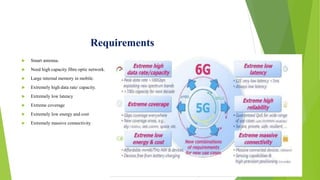
 Smart antenna.
 Need high capacity fibre optic network.
 Large internal memory in mobile.
 Extremely high data rate/ capacity.
 Extremely low latency
 Extreme coverage
 Extremely low energy and cost
 Extremely massive connectivity
ADVANTAGES
 Ultra fast to access internet without any buffering.
 Data rates up to 10 – 11 Giga bps.
 A real time online gaming experience.
 Massively red used lag while gaming.
 Smart homes, cities and villages.
 Protects the mobile and secure the data.
 Record calls and forward to email also forward calls to other numbers.
 Improve storage capability.
 Satellite to satellite communication for the development of mankind.
 Natural calamities will be controlled with 6G network.
 Sea to space communication.
Features
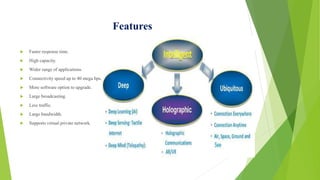
 Faster response time.
 High capacity.
 Wider range of applications.
 Connectivity speed up to 40 mega bps.
 More software option to upgrade.
 Large broadcasting.
 Less traffic.
 Large bandwidth.
 Supports virtual private network.
Conclusion
 In conclusion, 6G is the next step in the evolution of wireless technology and is set to revolutionize the current
5G networks.
 It is expected to be faster, more efficient and more secure than the 5g networks that are currently available.
 6g is expected to have speeds of up to 1 Tera bps, much lower latency and far better security than 5g.
 How ever, than are certain challenges associated with the rollout and implementation of 6g networks such as the
cost of the infrastructure and the limited amount of spectrum available.
 6g is still in its early stages of development and its not expected to be available until at least 2030.
Reference
 A. Anupkumar, business borderless workplace for the new normal, 10 2021,
[online] available: https://www.Tata.Com/newsroom/business/borderless-
workplace-tcs-sbws.
 A flagship for 6g vision and intelligent fabric of technology enablers
connecting human physical and digital worlds, 10 2021, [online] available:
https://hexa-x.Eu/.
 E. Mihret and G. Haile, "4G 5G 6G 7G and future mobile
technologies", American journal of computer science and technology, vol. 9,
pp. 75, 2021.
 M. A. Khan, "fog computing in 5G enabled smart cities: conceptual framework
overview and challenges", 2019 IEEE international smart cities conference
(ISC2), pp. 438-443, 2019.
6G wireless Technology.pptx

6G wireless Technology.pptx

  • 1.
    VEMU INSTITUTE OFTECHNOLOGY Chittoor- Trupathi Highway P.kothakota ,Chittoor dist.-517112 DEPARTMENT OF ELECTRONICS AND COMMUNICATION ENGINEERING TECHNICAL SEMINAR ON 6G WIRELESS TECHONOLOGY Presented by: K.GANESH 194M1A0448
  • 2.
    Contents:  Introduction  WorkingPrinciple  Need For 6G Technology  Block Diagram  Technology Used  6G Development Projects  Requirements  Advantages  Features  Result
  • 3.
    INTRODUCTION  6G isproposed to integrate 5G with satellite networks for global coverage.6G Technology is considered to be cheap and Fast Internet Technology. It provides high data rates and fast internet speed to access on air through wireless and mobile devices with data ranges up-to 11Gbps when travelling far distance's.  The main aim of 6G internet is to support 1 microsecond latency communication.  The 6g is planning to provide 11 Giga bps data rate.  The present 5g is 100+ Mbps average data rates faster than 4G.  The 4G is delivering up to 20 Mbps data rates.  This Technology will breaks the previous Technologies.
  • 4.
    6G technology  Completewireless network with no limitations.  Incredible transmission speed in Terabit range.  Zero distances connectivity between peoples.  It will be available in the market in coming years with more reliability than previous mobiles.  The 5G is the beginning of 6G Technology.
  • 5.
  • 6.
    Need for 6GTechnology  The 6G technology will surely make a great changes in mobile technologies.  The 6g network will be able to use higher frequencies than 5g networks.  In telecommunications, ^g is the sixth generation standard currently, under development for wireless communication technologies supporting cellular development for wireless communication technologies supporting cellular data networks.  The successive of 5g will likely be significantly faster.  It has the capability of handling massive volumes of data and very high data rate connectivity per device.
  • 7.
    Technology Used  UsesWCDMA Multiplexing (Wideband Code Division Multiple Access).  UWB Radio Technology (Ultra Wide Band).  LTE (Long Term Evolution).  3GPP (3rd Generation Partnership Project).  E-UMTS (Evolved Universal Mobile Telecommunication System).  E-EDGE (Evolved Enhanced Data Rates For GSM Evolution).
  • 8.
    Requirements  Smart antenna. Need high capacity fibre optic network.  Large internal memory in mobile.  Extremely high data rate/ capacity.  Extremely low latency  Extreme coverage  Extremely low energy and cost  Extremely massive connectivity
  • 9.
    ADVANTAGES  Ultra fastto access internet without any buffering.  Data rates up to 10 – 11 Giga bps.  A real time online gaming experience.  Massively red used lag while gaming.  Smart homes, cities and villages.  Protects the mobile and secure the data.  Record calls and forward to email also forward calls to other numbers.  Improve storage capability.  Satellite to satellite communication for the development of mankind.  Natural calamities will be controlled with 6G network.  Sea to space communication.
  • 10.
    Features  Faster responsetime.  High capacity.  Wider range of applications.  Connectivity speed up to 40 mega bps.  More software option to upgrade.  Large broadcasting.  Less traffic.  Large bandwidth.  Supports virtual private network.
  • 11.
    Conclusion  In conclusion,6G is the next step in the evolution of wireless technology and is set to revolutionize the current 5G networks.  It is expected to be faster, more efficient and more secure than the 5g networks that are currently available.  6g is expected to have speeds of up to 1 Tera bps, much lower latency and far better security than 5g.  How ever, than are certain challenges associated with the rollout and implementation of 6g networks such as the cost of the infrastructure and the limited amount of spectrum available.  6g is still in its early stages of development and its not expected to be available until at least 2030.
  • 12.
    Reference  A. Anupkumar,business borderless workplace for the new normal, 10 2021, [online] available: https://www.Tata.Com/newsroom/business/borderless- workplace-tcs-sbws.  A flagship for 6g vision and intelligent fabric of technology enablers connecting human physical and digital worlds, 10 2021, [online] available: https://hexa-x.Eu/.  E. Mihret and G. Haile, "4G 5G 6G 7G and future mobile technologies", American journal of computer science and technology, vol. 9, pp. 75, 2021.  M. A. Khan, "fog computing in 5G enabled smart cities: conceptual framework overview and challenges", 2019 IEEE international smart cities conference (ISC2), pp. 438-443, 2019.