Prof. Rosynella Cardozo R.
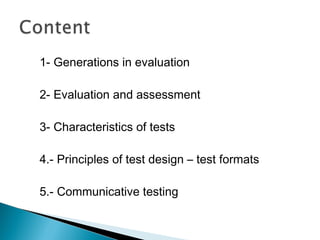
1- Generations in evaluation
2- Evaluation and assessment
3- Characteristics of tests
4.- Principles of test design – test formats
5.- Communicative testing
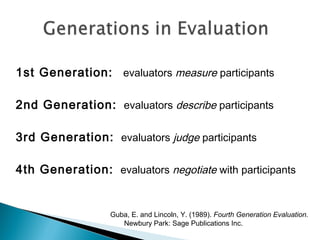
1st Generation: evaluators measure participants
2nd Generation: evaluators describe participants
3rd Generation: evaluators judge participants
4th Generation: evaluators negotiate with participants
Guba, E. and Lincoln, Y. (1989). Fourth Generation Evaluation.
Newbury Park: Sage Publications Inc.
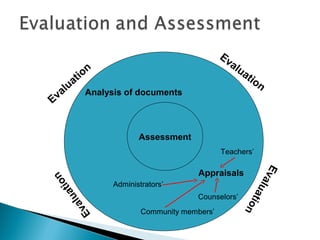
Assessment
Analysis of documents
Appraisals
Evaluation
EvaluationEvaluation
Evaluation
Administrators’
Counselors’
Teachers’
Community members’
Exercise 1: general evaluation
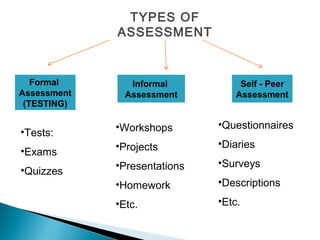
TYPES OF
ASSESSMENT
Formal
Assessment
(TESTING)
Informal
Assessment
Self - Peer
Assessment
•Tests:
•Exams
•Quizzes
•Workshops
•Projects
•Presentations
•Homework
•Etc.
•Questionnaires
•Diaries
•Surveys
•Descriptions
•Etc.
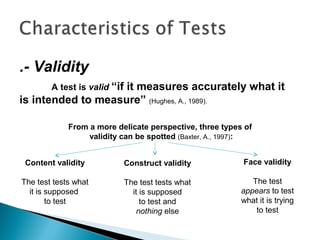
.- Validity
A test is valid “if it measures accurately what it
is intended to measure” (Hughes, A., 1989).
Content validity
The test tests what
it is supposed
to test
Construct validity
The test tests what
it is supposed
to test and
nothing else
Face validity
The test
appears to test
what it is trying
to test
From a more delicate perspective, three types of
validity can be spotted (Baxter, A., 1997):
.- Reliability
A test is reliable if it measures consistently.
Results must be stable.
a) Inter-rater reliability
b) Intra-rater reliability
.- Practicality
a) Economy
b) Resources
c) Administration and scoring
.- Washback
Influence of teaching and learning
1- Guidelines for item design
2- Sample items
3- Formats
4- Multiple choice items
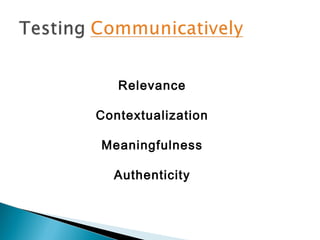
Relevance
Contextualization
Meaningfulness
Authenticity
Session 2 (Overview)

Session 2 (Overview)