Assessing pronunciation
By: Valentina Espinosa
Camila Martínez
Concepción-June-2017
Introduction
In this presentation, we will show you some
ways of how to assess pronunciation and
aspects that must be considered during this
process.
The first one, and most important is that
“pronunciation” is a subcategory of speaking.
Assessing speaking
❖ Personal impression.
❖ Expectations of hearer.
❖ Purpose of hearer.
Cycle of assessing speaking
Luoma, 2004 (p.5)
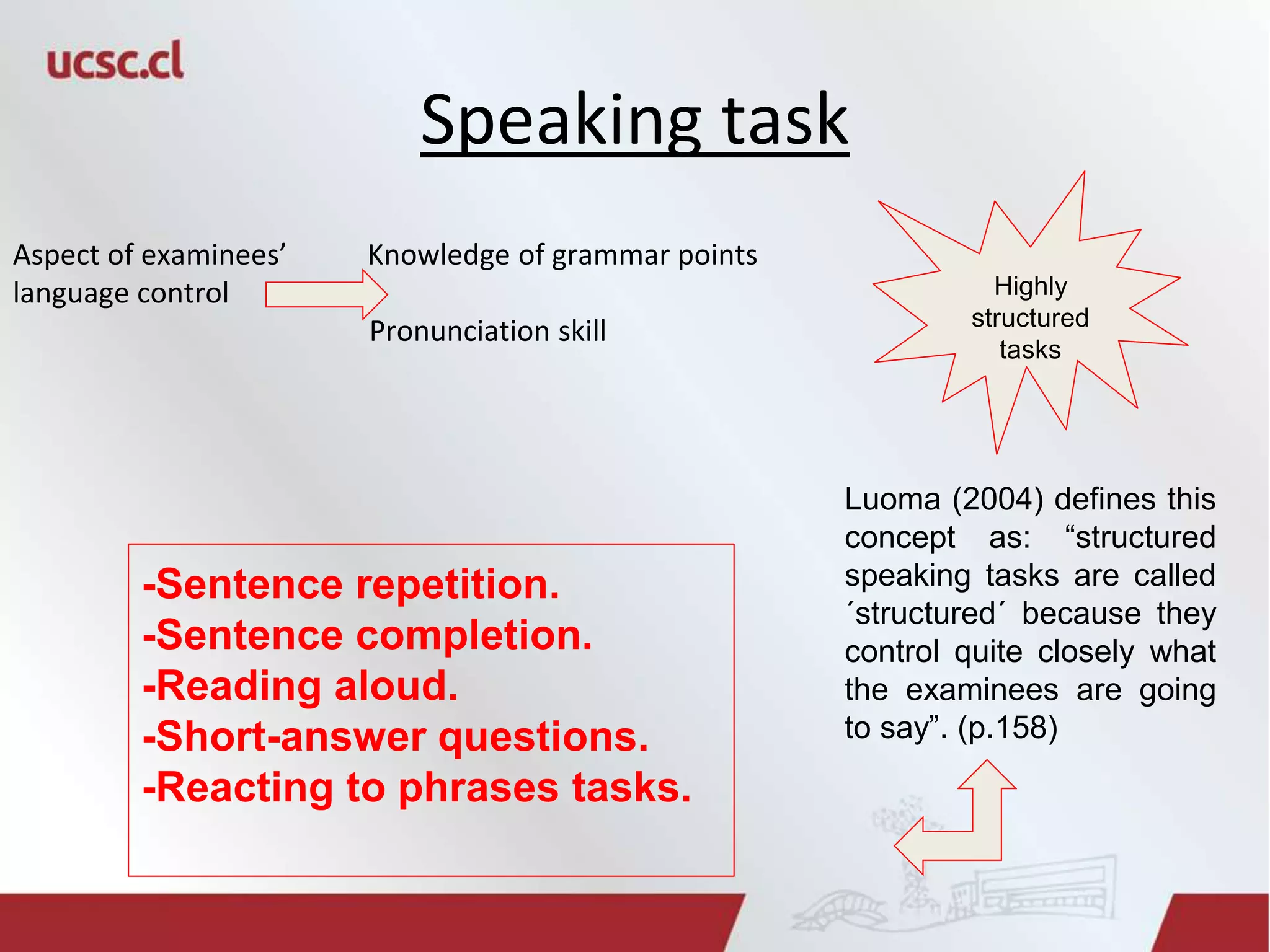
Speaking task
Highly
structured
tasks
Luoma (2004) defines this
concept as: “structured
speaking tasks are called
´structured´ because they
control quite closely what
the examinees are going
to say”. (p.158)
Aspect of examinees’ Knowledge of grammar points
language control
Pronunciation skill
-Sentence repetition.
-Sentence completion.
-Reading aloud.
-Short-answer questions.
-Reacting to phrases tasks.
Before assessing
pronunciation
Before assessing pronunciation we must
consider the following:
Pronunciation teaching
must focus on issues of
oral fluency and ss’
accuracy
Teaching should extend
beyond isolated word
level to discourse level
Teacher needs to
consider learners
styles
The practice and
feedback need to
involve ICT’s
Roach,P. 2009
Sources to consider in assessing
pronunciation
Age
Social
Class Style
-Differences
between young
and old
generations
-Young people
tend to present
more elisions
than older
people
-Input
-Expansion
of domains of
linguistic
competence.
-Speaker and
hearer
relationship
-Background
knowledge
-Foreign
learners-
careful and
formal
-Foreign with
native- rapid,
casual.
-Context
Exposure to
the target
language
Assessing
pronunciation
The main goal of pronunciation
activities is that “learner’s
pronunciation sufficiently to
permit effective communication
with native speakers.”
Roach,P. 2009 (p.6)
Ways of assessing
pronunciation
• Intonation
• stress: word stress / sentence stress
• Vowels: short /long
• Consonants: voiced / voiceless
• Rhythm
• Intelligibility
Techniques used to assess
pronunciation
Pronunciation testing
and evaluation
Consonant-vowel
discrimination
Example:
Underline the word you
hear.
a.Don’t (slip/sleep) on the
floor.
b. He’s gone to (back
up/pack up) the car.
Example:
Pronunciation testing
and evaluation
Recognition of English
words stress patterns.
Word stress
Direction: Circle the alternative that shows the syllable receiving the
main stress (capital=stress)
(on cassette) 1. Photography in one of my favorite activities.
a. PHOtography d.ACtivities
b.phoTOGraphy e.acTIVities
c.photoGRAPHY f.actiVITies
Pronunciation testing
and evaluation
Prominence Example:
Directions: listen to the following
utterances and choose the
alternative that best represent the
proper stress pattern (capital=stress)
1. Joe: Hi, I’m Joe Miller. What’s
your name?
a.HI, I’m JOE Miller. WHAT’S your
name?
b. HI, I’M Joe MILLER. What’s YOUR
name?
c. Hi, I’M Joe Miller. What’s your
NAME?
Ability to perceive
the most prominent
element used for
word stress.
Pronunciation testing
and evaluation
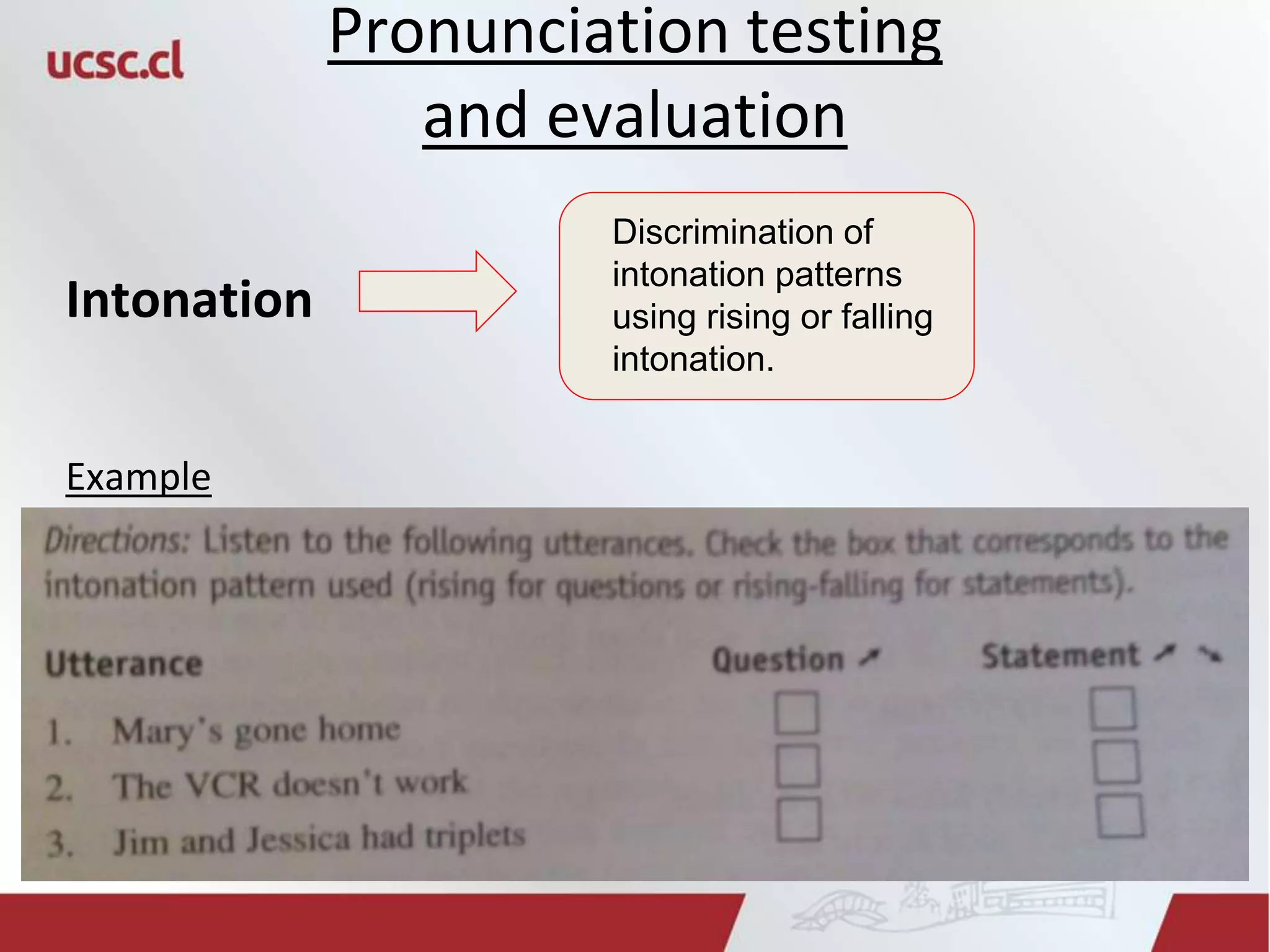
Intonation
Example
Discrimination of
intonation patterns
using rising or falling
intonation.
• This test principally focus on production
rather than perception.
• There are oral proficiency tests usually rated
globally in which pronunciation is evaluated:
Proficiency test
Basic English
Skills Test
(BEST)
Test of Spoken
English
(TSE)
Methodological variation
Communicative
approach
Fluency obligatory;
accuracy optional
Method- learner
engagement in
authentic listening
and speaking
tasks
Celce-Murcia, Brinton, Goodwin, 1996 (p.327)
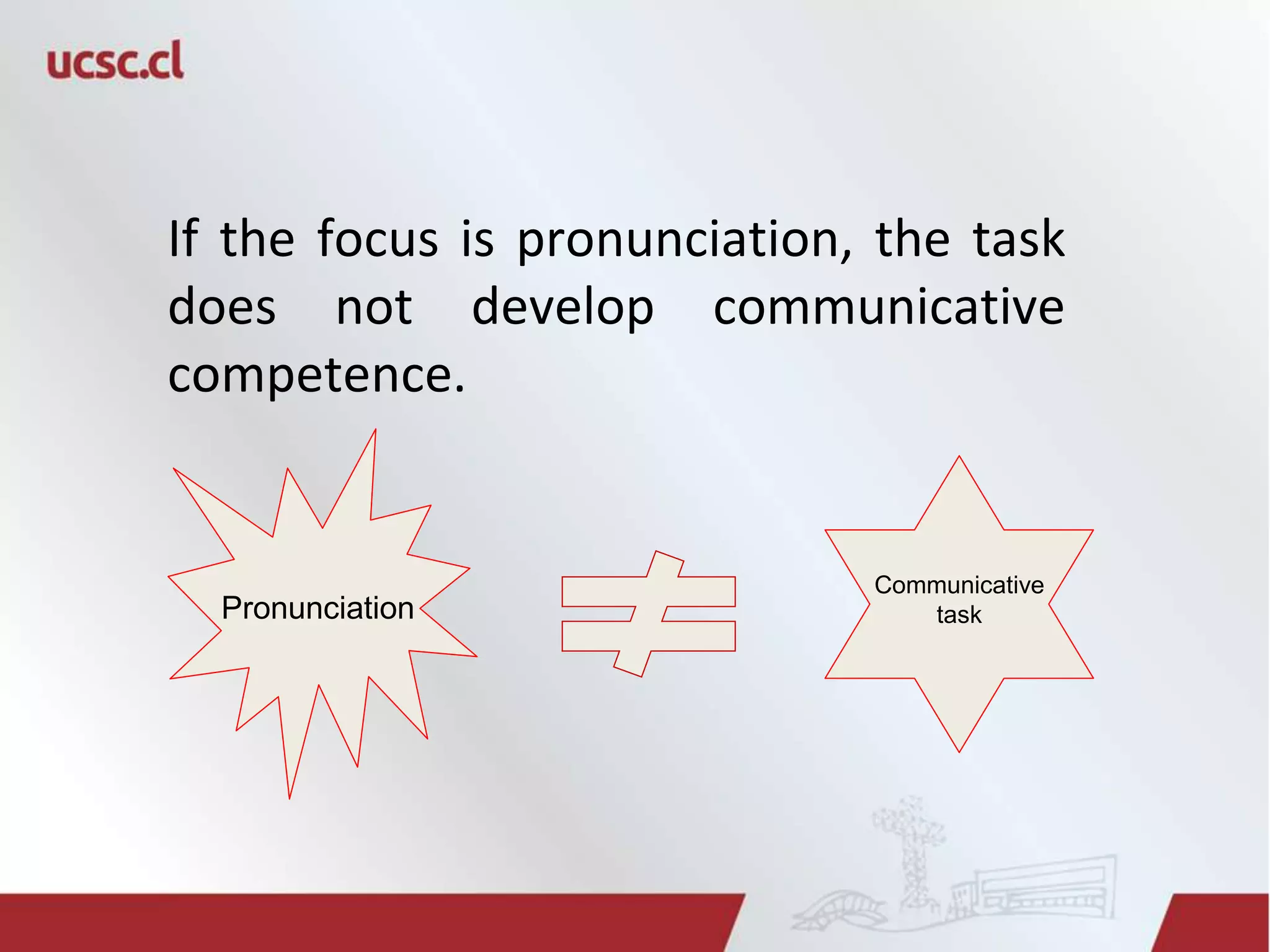
Pronunciation
Communicative
task
If the focus is pronunciation, the task
does not develop communicative
competence.
Conclusion
To sum up, it is important to say that to assess
pronunciation, we, as teachers, must teach it
during our classes; and prepare specific tasks
and rubrics that assess what we really want to
assess taking into consideration all the aspects
we mentioned in this presentation.
References
• Celce-Murcia, M; Brinton, D & Goodwin, J (1996) “Teaching pronunciation:
a reference for teachers of English to speakers of other languages”.
Cambridge University Press.
• Correa, R (2016) “Assessing Pronunciation”. Recuperado de la base de
datos Intranet Corporativo UCSC.
• Correa, R; Bórquez, P (2016) “Assessing Pronunciation”. Recuperada de
la base de datos Intranet Corporativo UCSC.
• Roach, P (2009) “English Phonetics and Phonology: A practical course".
Cambridge: Cambridge University Press.
• Luoma, S (2004) “Assessing Speaking”. Cambridge: Cambridge University
Press.

Assessing pronuntiation

  • 1.
    Assessing pronunciation By: ValentinaEspinosa Camila Martínez Concepción-June-2017
  • 2.
    Introduction In this presentation,we will show you some ways of how to assess pronunciation and aspects that must be considered during this process. The first one, and most important is that “pronunciation” is a subcategory of speaking.
  • 3.
    Assessing speaking ❖ Personalimpression. ❖ Expectations of hearer. ❖ Purpose of hearer.
  • 4.
    Cycle of assessingspeaking Luoma, 2004 (p.5)
  • 5.
    Speaking task Highly structured tasks Luoma (2004)defines this concept as: “structured speaking tasks are called ´structured´ because they control quite closely what the examinees are going to say”. (p.158) Aspect of examinees’ Knowledge of grammar points language control Pronunciation skill -Sentence repetition. -Sentence completion. -Reading aloud. -Short-answer questions. -Reacting to phrases tasks.
  • 6.
    Before assessing pronunciation Before assessingpronunciation we must consider the following: Pronunciation teaching must focus on issues of oral fluency and ss’ accuracy Teaching should extend beyond isolated word level to discourse level Teacher needs to consider learners styles The practice and feedback need to involve ICT’s Roach,P. 2009
  • 7.
    Sources to considerin assessing pronunciation Age Social Class Style -Differences between young and old generations -Young people tend to present more elisions than older people -Input -Expansion of domains of linguistic competence. -Speaker and hearer relationship -Background knowledge -Foreign learners- careful and formal -Foreign with native- rapid, casual. -Context Exposure to the target language
  • 8.
    Assessing pronunciation The main goalof pronunciation activities is that “learner’s pronunciation sufficiently to permit effective communication with native speakers.” Roach,P. 2009 (p.6)
  • 9.
    Ways of assessing pronunciation •Intonation • stress: word stress / sentence stress • Vowels: short /long • Consonants: voiced / voiceless • Rhythm • Intelligibility
  • 10.
    Techniques used toassess pronunciation
  • 11.
    Pronunciation testing and evaluation Consonant-vowel discrimination Example: Underlinethe word you hear. a.Don’t (slip/sleep) on the floor. b. He’s gone to (back up/pack up) the car.
  • 12.
    Example: Pronunciation testing and evaluation Recognitionof English words stress patterns. Word stress Direction: Circle the alternative that shows the syllable receiving the main stress (capital=stress) (on cassette) 1. Photography in one of my favorite activities. a. PHOtography d.ACtivities b.phoTOGraphy e.acTIVities c.photoGRAPHY f.actiVITies
  • 13.
    Pronunciation testing and evaluation ProminenceExample: Directions: listen to the following utterances and choose the alternative that best represent the proper stress pattern (capital=stress) 1. Joe: Hi, I’m Joe Miller. What’s your name? a.HI, I’m JOE Miller. WHAT’S your name? b. HI, I’M Joe MILLER. What’s YOUR name? c. Hi, I’M Joe Miller. What’s your NAME? Ability to perceive the most prominent element used for word stress.
  • 14.
    Pronunciation testing and evaluation Intonation Example Discriminationof intonation patterns using rising or falling intonation.
  • 15.
    • This testprincipally focus on production rather than perception. • There are oral proficiency tests usually rated globally in which pronunciation is evaluated: Proficiency test Basic English Skills Test (BEST) Test of Spoken English (TSE)
  • 16.
    Methodological variation Communicative approach Fluency obligatory; accuracyoptional Method- learner engagement in authentic listening and speaking tasks Celce-Murcia, Brinton, Goodwin, 1996 (p.327)
  • 17.
    Pronunciation Communicative task If the focusis pronunciation, the task does not develop communicative competence.
  • 18.
    Conclusion To sum up,it is important to say that to assess pronunciation, we, as teachers, must teach it during our classes; and prepare specific tasks and rubrics that assess what we really want to assess taking into consideration all the aspects we mentioned in this presentation.
  • 19.
    References • Celce-Murcia, M;Brinton, D & Goodwin, J (1996) “Teaching pronunciation: a reference for teachers of English to speakers of other languages”. Cambridge University Press. • Correa, R (2016) “Assessing Pronunciation”. Recuperado de la base de datos Intranet Corporativo UCSC. • Correa, R; Bórquez, P (2016) “Assessing Pronunciation”. Recuperada de la base de datos Intranet Corporativo UCSC. • Roach, P (2009) “English Phonetics and Phonology: A practical course". Cambridge: Cambridge University Press. • Luoma, S (2004) “Assessing Speaking”. Cambridge: Cambridge University Press.