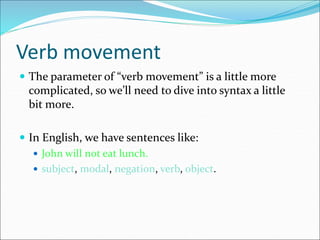
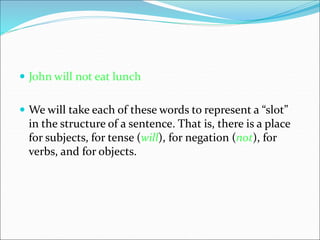
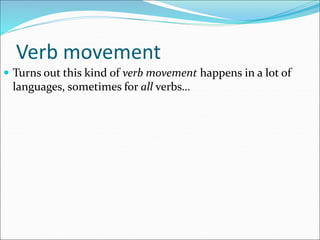
This document discusses verb movement in syntax. It explains that in English, auxiliary verbs like "have" and "be" can appear in the tense slot of a sentence, rather than within the verb phrase, when there is no other verb filling the tense slot. This occurs because the auxiliary verb is said to "move" to the tense position. The document provides examples showing that adverbs can appear before or after the verb phrase but not between the verb and its object, and suggests this is because the verb and object form a syntactic unit. It notes that verb movement also happens in other languages sometimes with all verbs.


![ The reason for this is that the verb and object form a
unit (VP) which the adverbs must be “attached to”:
Malcolm will not [VP clean his room ].
So, these kind of adverbs can, in a sense, serve as
“landmarks”. Similarly, not and tense and the subject are
assumed to be in the same structural position all the
time.](https://image.slidesharecdn.com/verbmovements-230315065234-3f431e06/85/verb-movements-ppt-5-320.jpg)
![Auxiliary verbs
But some verbs (in particular, have and be, the “auxiliary
verbs”) act different.
Malcolm will not
^ [VP have ^ [VP cleaned his room ]] ^.
So we know that have is a real verb here…
Malcolm has not ^ [VP cleaned his room ] ^.
But if there isn’t something “filling up” the tense slot, have
shows up in the tense slot (to the left of not and adverbs).](https://image.slidesharecdn.com/verbmovements-230315065234-3f431e06/85/verb-movements-ppt-6-320.jpg)
![Auxiliary verbs
Same goes for be:
The meat will not ^ [VP be ^ [VP eaten ]] ^.
The meat was not ^ [VP eaten ] ^.
What appears to be happening to have and be is
that they are placed in the tense slot (unless it’s
otherwise filled) instead of in the VP. Another way
to look at it is that the auxiliary verb has moved to
the tense slot.](https://image.slidesharecdn.com/verbmovements-230315065234-3f431e06/85/verb-movements-ppt-7-320.jpg)
![Auxiliary verbs
That is, we might start out with:
Malcolm [PAST] not [have [cleaned his room]]
In which case, we have this:
Malcolm have+[PAST] not [—[cleaned his room]]
That is…
Malcolm had not cleaned his room.
But if start with:
Malcolm will not [have [cleaned his room]]
We just get:
Malcolm will not have cleaned his room.](https://image.slidesharecdn.com/verbmovements-230315065234-3f431e06/85/verb-movements-ppt-8-320.jpg)
![Verb movement
And we in fact see this:
In English, you can never have an adverb between the
verb and its object.
*John [eats often chocolate].
John often [eats chocolate].](https://image.slidesharecdn.com/verbmovements-230315065234-3f431e06/85/verb-movements-ppt-10-320.jpg)


