How to Test Vocabulary


     Maria Kristina P
      1021150015
Why Test Vocabulary

•   Motivates learners
•   Provides a form of feedback
•   To know the effectiveness of teaching
•   Research purpose
•   Make an useful backwash effects
Why Test Vocabulary
Tests of Vocabulary
• Placement Test / Diagnostic Test.
 At the beginning of the course.
• Achievement Test.
At the end of the course.
What to Test
The factors in testing vocabulary
• Validity  Does the test assess what I want
  to asses?
*of practicality (easy to administer)
*of backwash (Will the test have a positive
  effect on learning?)

• Reliability  Does it have consistent result?
• Face validity Do the learners accept it as
  being a valid test?
Types of Test
1.Multiple choice
(+) easy to score
      easy to design

2. Gap-fill
    *Selective (or open)cloze
    type
    * C-Test
Measuring Word Knowledge
      Three aspects of vocabulary knowledge
  that are measurable quantitatively:
• Lexical density a measure of the
  proportion of content words in a text.
• Lexical variety a measure of the different
  words in the text.
• Lexical sophistication assessed by counting
  the number of relatively infrequent words in
  a text.
Doing Action Research

*ActionResearch is small scale
 research implemented by
 teachers and directed at
 improving learning outcomes.
Doing Action Research
*List of research ideas:
• To investigate different learning styles.
• To investigate the effectiveness of different mnemonic
  techniques.
• To investigate different ways of selecting words for
  presentation.
• To investigate the effect of extensive reading on
  vocabulary acquisition.
• To investigate vocabulary recording strategies.
• To investigate the effect of guessing-from-context.
• To investigate the effect of dictionary use.
How to Teach Grammar

Sample Lesson 3
Sample Lesson 3
   Integrating grammar into a skills -
      based lesson (Intermediate)
• Step 1  Teacher tells a story about his
  experience.
• Step 2 Teacher asks questions on details of
  the story.
• Step 3Teacher produces a copy of letter.
Sample Lesson 3
   Integrating grammar into a skills -
      based lesson (Intermediate)
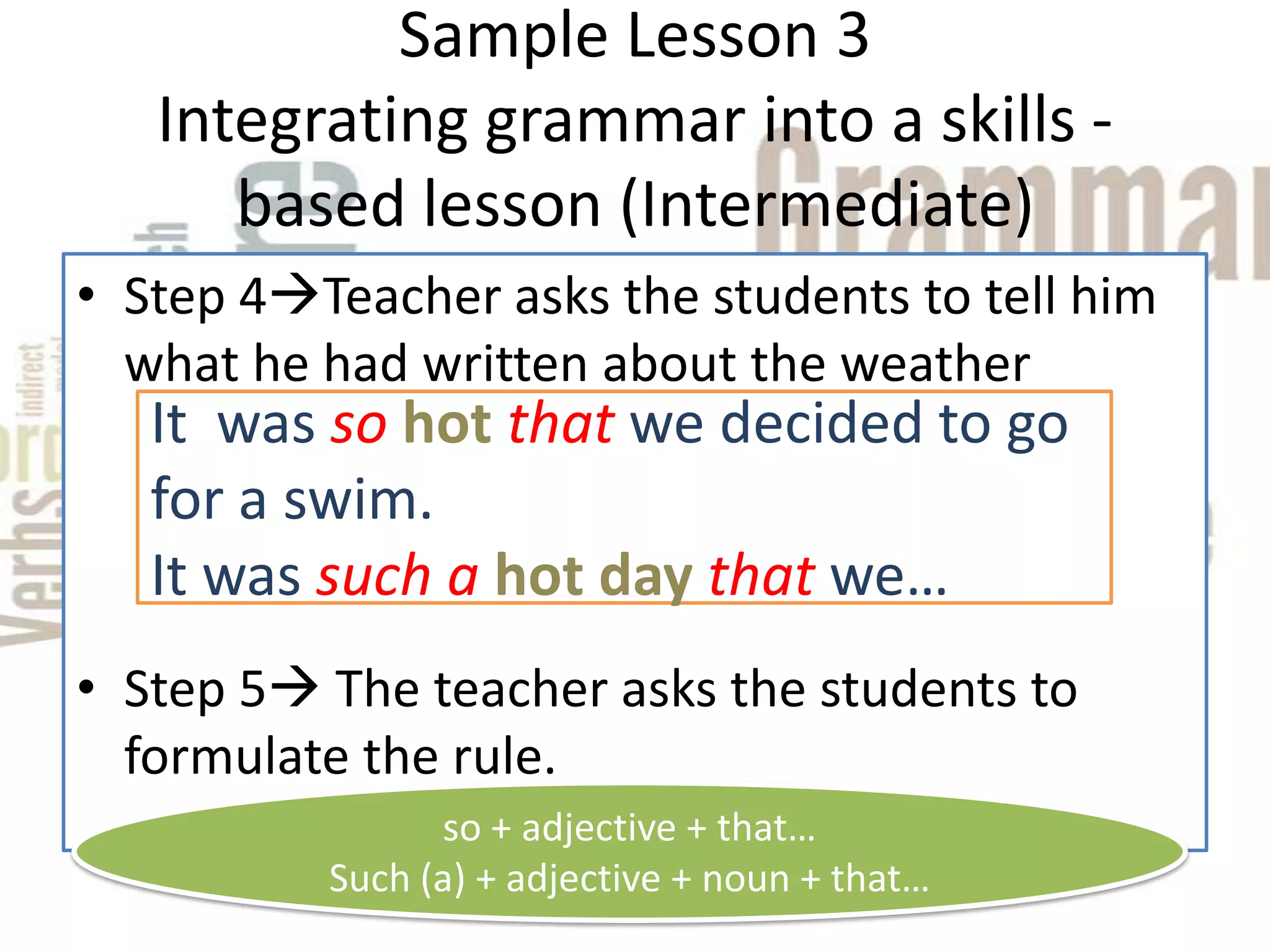
• Step 4Teacher asks the students to tell him
  what he had written about the weather
   It was so hot that we decided to go
   for a swim.
   It was such a hot day that we…
• Step 5 The teacher asks the students to
  formulate the rule.
                so + adjective + that…
          Such (a) + adjective + noun + that…
Sample Lesson 3
  Integrating grammar into a skills -
     based lesson (Intermediate)

• Step 6 Teacher asks the students to write a
  short summary about his story.

• Step 7Teacher invites students to recall
  similar incidents and incorporate the use of
  so or such when see an opportunity.
Sample Lesson 3
   Integrating grammar into a skills -
      based lesson (Intermediate)
Discussion
• PPP lesson
• Targeted language presented by means of a text (
  Step 1 and 3)
• Available text for later language – focused work
  (Step 2)
• Made ‘problematic’(Step 4)
• Short practice stage ( Step 6)
• Production Stage ( Step 7)
Sample Lesson 3
  Integrating grammar into a skills -
     based lesson (Intermediate)
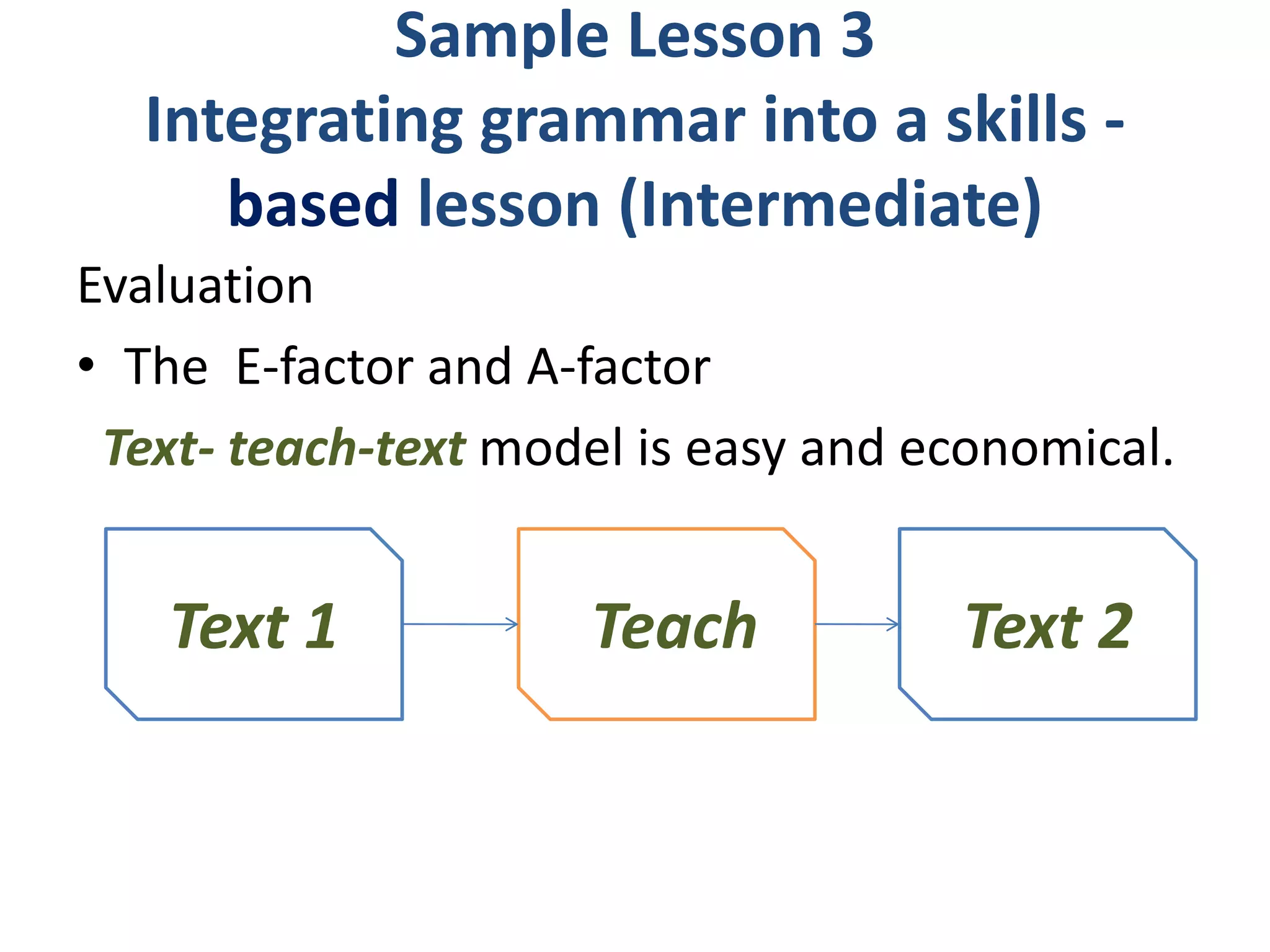
Evaluation
• The E-factor and A-factor
 Text- teach-text model is easy and economical.


   Text 1             Teach          Text 2
Thank you :D

How to test vocabulary

  • 1.
    How to TestVocabulary Maria Kristina P 1021150015
  • 2.
    Why Test Vocabulary • Motivates learners • Provides a form of feedback • To know the effectiveness of teaching • Research purpose • Make an useful backwash effects
  • 3.
    Why Test Vocabulary Testsof Vocabulary • Placement Test / Diagnostic Test. At the beginning of the course. • Achievement Test. At the end of the course.
  • 4.
    What to Test Thefactors in testing vocabulary • Validity  Does the test assess what I want to asses? *of practicality (easy to administer) *of backwash (Will the test have a positive effect on learning?) • Reliability  Does it have consistent result? • Face validity Do the learners accept it as being a valid test?
  • 5.
    Types of Test 1.Multiplechoice (+) easy to score easy to design 2. Gap-fill *Selective (or open)cloze type * C-Test
  • 6.
    Measuring Word Knowledge Three aspects of vocabulary knowledge that are measurable quantitatively: • Lexical density a measure of the proportion of content words in a text. • Lexical variety a measure of the different words in the text. • Lexical sophistication assessed by counting the number of relatively infrequent words in a text.
  • 7.
    Doing Action Research *ActionResearchis small scale research implemented by teachers and directed at improving learning outcomes.
  • 8.
    Doing Action Research *Listof research ideas: • To investigate different learning styles. • To investigate the effectiveness of different mnemonic techniques. • To investigate different ways of selecting words for presentation. • To investigate the effect of extensive reading on vocabulary acquisition. • To investigate vocabulary recording strategies. • To investigate the effect of guessing-from-context. • To investigate the effect of dictionary use.
  • 9.
    How to TeachGrammar Sample Lesson 3
  • 10.
    Sample Lesson 3 Integrating grammar into a skills - based lesson (Intermediate) • Step 1  Teacher tells a story about his experience. • Step 2 Teacher asks questions on details of the story. • Step 3Teacher produces a copy of letter.
  • 11.
    Sample Lesson 3 Integrating grammar into a skills - based lesson (Intermediate) • Step 4Teacher asks the students to tell him what he had written about the weather It was so hot that we decided to go for a swim. It was such a hot day that we… • Step 5 The teacher asks the students to formulate the rule. so + adjective + that… Such (a) + adjective + noun + that…
  • 12.
    Sample Lesson 3 Integrating grammar into a skills - based lesson (Intermediate) • Step 6 Teacher asks the students to write a short summary about his story. • Step 7Teacher invites students to recall similar incidents and incorporate the use of so or such when see an opportunity.
  • 13.
    Sample Lesson 3 Integrating grammar into a skills - based lesson (Intermediate) Discussion • PPP lesson • Targeted language presented by means of a text ( Step 1 and 3) • Available text for later language – focused work (Step 2) • Made ‘problematic’(Step 4) • Short practice stage ( Step 6) • Production Stage ( Step 7)
  • 14.
    Sample Lesson 3 Integrating grammar into a skills - based lesson (Intermediate) Evaluation • The E-factor and A-factor Text- teach-text model is easy and economical. Text 1 Teach Text 2
  • 15.