The document discusses different types of questions:
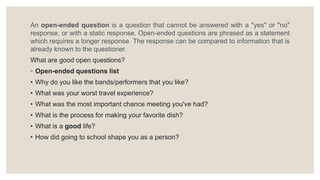
- Open-ended questions cannot be answered with "yes" or "no" and require longer responses. Good open questions ask about experiences, processes, and opinions.
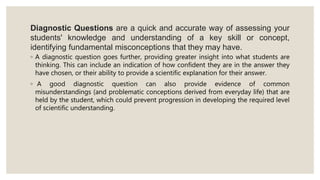
- Diagnostic questions assess a student's understanding and can reveal misconceptions.
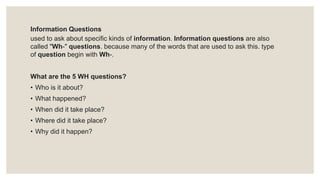
- Information questions, also called "Wh-" questions, seek specific facts about who, what, when, where, and why.
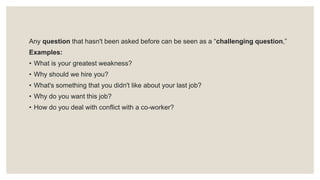
- Challenging questions have no pre-determined answers and assess skills like problem-solving.
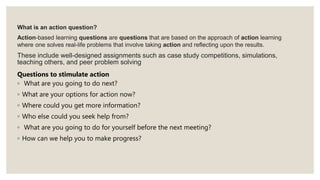
- Action questions stimulate problem-solving and next steps to address real-life issues.
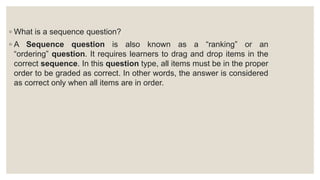
- Sequence questions require ordering or ranking multiple items in the correct sequence.
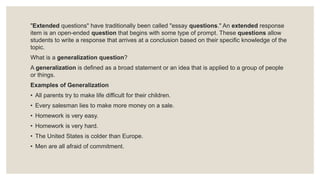
- Generalization questions