Sample RightLumen Report
                 tm
Implications and Recommendations

Market transformation technologies like solid state lighting can create a significant change
to your operations. We summarize measured results from your lighting demonstration and
address the implications to make prudent recommendations on the right system going
forward. Because LED lighting and adaptive control technologies are application specific,
our review includes an analysis all lighting technologies today to produce an unbiased
recommendation that includes the most ideal business solution for the application.


Competitive Technology Review (Induction versus LED)

We provide a complete analysis of lighting systems looking at over 35 critical performance
parameters. Solid state lighting is a more expensive technology upfront but offers great
promise for reducing energy use and operating expense. It is important to remember that
some aspects of the technology are still evolving, including new lighting standards, whereas
the need for businesses to cut energy and maintenance costs is more immediate.

Our competitive review provides the tools to evaluate and compare what manufacturer’s
product makes the best economic sense and within the context of
your business objectives.

Our tools include a comprehensive way to compare system performance for the
application so you can make critical decisions before products are installed for
evaluation.
LED Basics
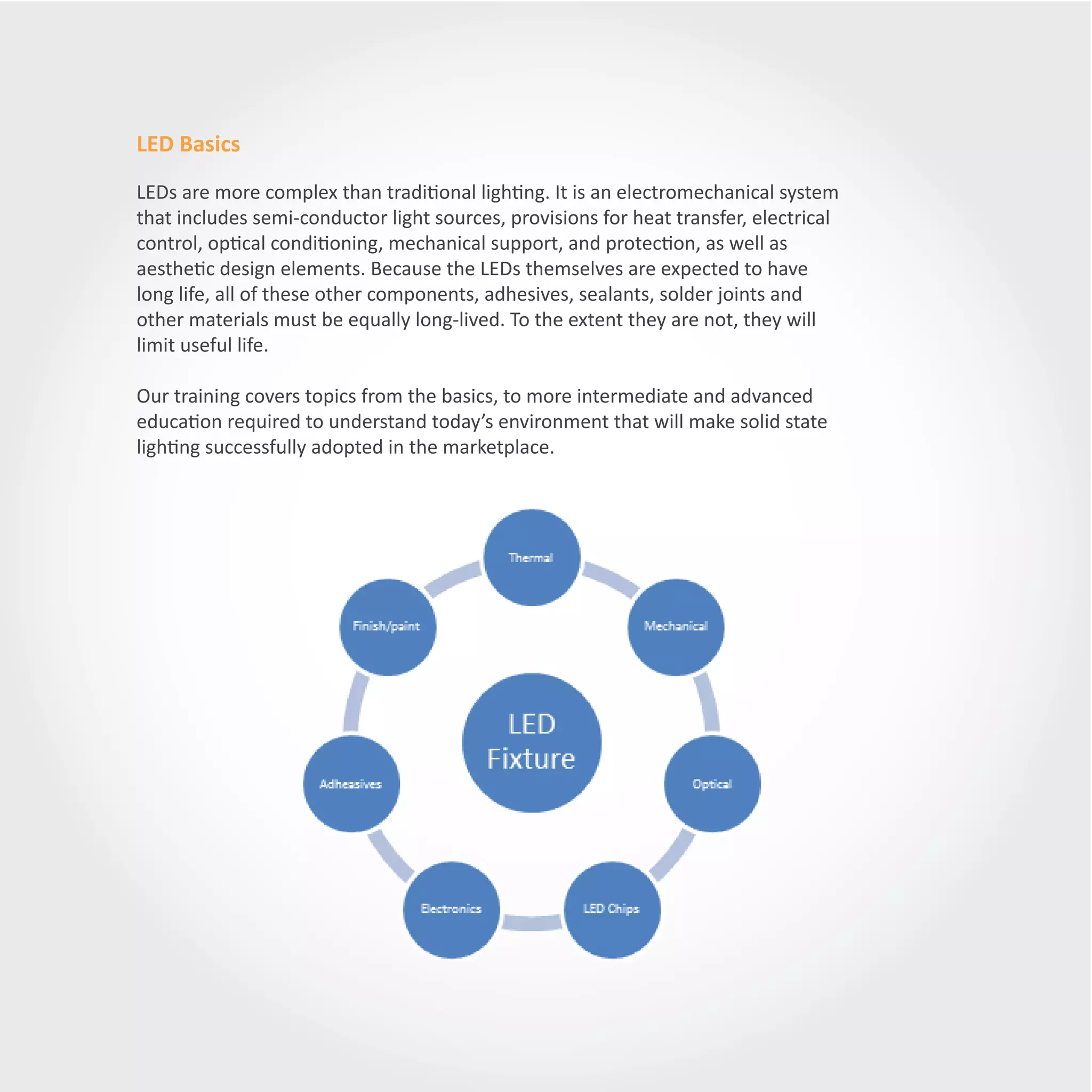
LEDs are more complex than traditional lighting. It is an electromechanical system
that includes semi-conductor light sources, provisions for heat transfer, electrical
control, optical conditioning, mechanical support, and protection, as well as
aesthetic design elements. Because the LEDs themselves are expected to have
long life, all of these other components, adhesives, sealants, solder joints and
other materials must be equally long-lived. To the extent they are not, they will
limit useful life.

Our training covers topics from the basics, to more intermediate and advanced
education required to understand today’s environment that will make solid state
lighting successfully adopted in the marketplace.
Measurement Data
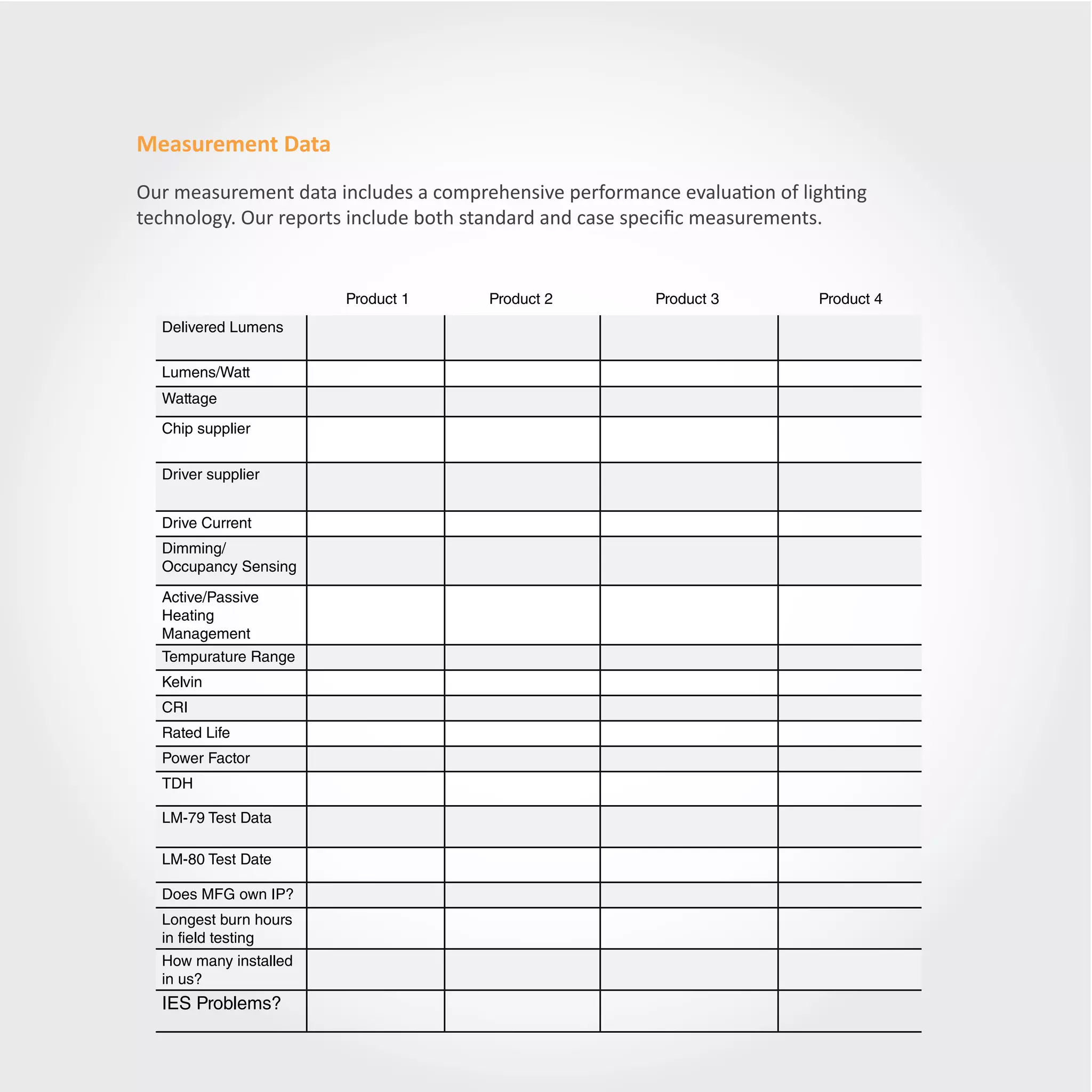
Our measurement data includes a comprehensive performance evaluation of lighting
technology. Our reports include both standard and case specific measurements.


                       Product 1      Product 2         Product 3         Product 4
  Delivered Lumens

  Lumens/Watt
  Wattage
  Chip supplier


  Driver supplier


  Drive Current
  Dimming/
  Occupancy Sensing

  Active/Passive
  Heating
  Management
  Tempurature Range
  Kelvin
  CRI
  Rated Life
  Power Factor
  TDH

  LM-79 Test Data

  LM-80 Test Date

  Does MFG own IP?
  Longest burn hours
  in field testing
  How many installed
  in us?
  IES Problems?
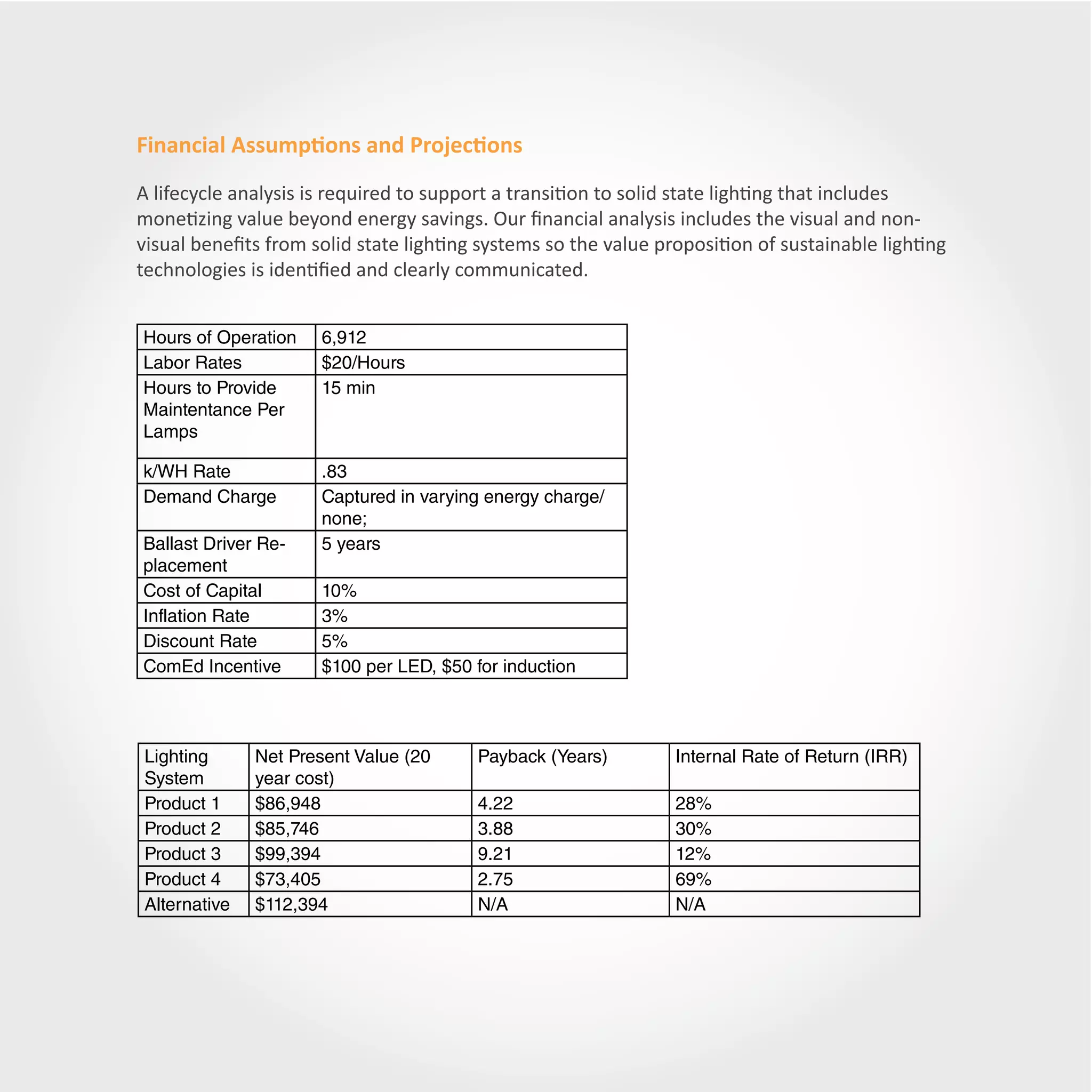
Financial Assumptions and Projections
A lifecycle analysis is required to support a transition to solid state lighting that includes
monetizing value beyond energy savings. Our financial analysis includes the visual and non-
visual benefits from solid state lighting systems so the value proposition of sustainable lighting
technologies is identified and clearly communicated.


Hours of Operation    6,912
Labor Rates           $20/Hours
Hours to Provide      15 min
Maintentance Per
Lamps

k/WH Rate             .83
Demand Charge         Captured in varying energy charge/
                      none;
Ballast Driver Re-    5 years
placement
Cost of Capital       10%
Inflation Rate        3%
Discount Rate         5%
ComEd Incentive       $100 per LED, $50 for induction


Lighting      Net Present Value (20      Payback (Years)         Internal Rate of Return (IRR)
System        year cost)
Product 1     $86,948                    4.22                    28%
Product 2     $85,746                    3.88                    30%
Product 3     $99,394                    9.21                    12%
Product 4     $73,405                    2.75                    69%
Alternative   $112,394                   N/A                     N/A

Sample RightLumen Guide

  • 1.
  • 2.
    Implications and Recommendations Markettransformation technologies like solid state lighting can create a significant change to your operations. We summarize measured results from your lighting demonstration and address the implications to make prudent recommendations on the right system going forward. Because LED lighting and adaptive control technologies are application specific, our review includes an analysis all lighting technologies today to produce an unbiased recommendation that includes the most ideal business solution for the application. Competitive Technology Review (Induction versus LED) We provide a complete analysis of lighting systems looking at over 35 critical performance parameters. Solid state lighting is a more expensive technology upfront but offers great promise for reducing energy use and operating expense. It is important to remember that some aspects of the technology are still evolving, including new lighting standards, whereas the need for businesses to cut energy and maintenance costs is more immediate. Our competitive review provides the tools to evaluate and compare what manufacturer’s product makes the best economic sense and within the context of your business objectives. Our tools include a comprehensive way to compare system performance for the application so you can make critical decisions before products are installed for evaluation.
  • 3.
    LED Basics LEDs aremore complex than traditional lighting. It is an electromechanical system that includes semi-conductor light sources, provisions for heat transfer, electrical control, optical conditioning, mechanical support, and protection, as well as aesthetic design elements. Because the LEDs themselves are expected to have long life, all of these other components, adhesives, sealants, solder joints and other materials must be equally long-lived. To the extent they are not, they will limit useful life. Our training covers topics from the basics, to more intermediate and advanced education required to understand today’s environment that will make solid state lighting successfully adopted in the marketplace.
  • 4.
    Measurement Data Our measurementdata includes a comprehensive performance evaluation of lighting technology. Our reports include both standard and case specific measurements. Product 1 Product 2 Product 3 Product 4 Delivered Lumens Lumens/Watt Wattage Chip supplier Driver supplier Drive Current Dimming/ Occupancy Sensing Active/Passive Heating Management Tempurature Range Kelvin CRI Rated Life Power Factor TDH LM-79 Test Data LM-80 Test Date Does MFG own IP? Longest burn hours in field testing How many installed in us? IES Problems?
  • 5.
    Financial Assumptions andProjections A lifecycle analysis is required to support a transition to solid state lighting that includes monetizing value beyond energy savings. Our financial analysis includes the visual and non- visual benefits from solid state lighting systems so the value proposition of sustainable lighting technologies is identified and clearly communicated. Hours of Operation 6,912 Labor Rates $20/Hours Hours to Provide 15 min Maintentance Per Lamps k/WH Rate .83 Demand Charge Captured in varying energy charge/ none; Ballast Driver Re- 5 years placement Cost of Capital 10% Inflation Rate 3% Discount Rate 5% ComEd Incentive $100 per LED, $50 for induction Lighting Net Present Value (20 Payback (Years) Internal Rate of Return (IRR) System year cost) Product 1 $86,948 4.22 28% Product 2 $85,746 3.88 30% Product 3 $99,394 9.21 12% Product 4 $73,405 2.75 69% Alternative $112,394 N/A N/A