TEST
Presented By
Nadia Nazir

1
TEST
A test is a means of measuring the knowledge, skills,
feelings, intelligence or aptitude of an individual or
group.

2
Test are divided into two categories:


Objective items
It is highly structured and requires the pupils to supply a word or two or to select the
correct answer from a number of alternatives.

 Essay

questions

It permits the pupils to select, organize and present the answer in essay form.

3
The objective test items classified
into:


Supply types
that require the pupil to supply the answer.



Selection types
that require the pupil to select the answer from the nunmber of
alternatives.

4
Essay questions classified into:


Extended response type
In which people are given complete freedom in making their
responses.



Restricted response type
In which the nature, length or organization of the response is
limited.

5
Comparative advantages of objectives
and essay tests:
Objective test

Essay Test

Learning outcomes
measured

Efficient for measuring
knowledge of facts

Inefficient for measuring
knowledge of facts

Preparation of
questions

Large number of
questions is needed

A few questions are
needed

Sampling of course
content

Provides an extensive
Sampling of course
sampling of course
content is usually limited
content
Complete structuring of
Freedom to respond
task limits pupil to type of
response called for.

Control of pupil’s
response

6
Objective Test
Scoring

Influence on learning

Reliability

Objective scoring is
quick, easy and
consistent
Encourages pupil to
develop a
comprehensive
knowledge of specific
facts
High reliability is
possible

Eassy Test
Subjective scoring is
slow, difficult and
inconsistent
Encourages pupils to
concentrate on larger
units of subject matter
with special emphasis
Reliability is typically
low

7
Selecting the most appropriate item
types


Supply the answer



Selection type

•

Multiple-choice item

•

True-false item

•

Matching items

8
Consideration in preparing
relevant test items
STEP 1:
The purpose of the step should be determined.

STEP 2:
A set of specifications should be developed.

STEP 3:
The most appropriate item types should be selected.

STEP 4:
The test item should be constructed in accordance
with the specification developed during the preceding
steps.
9
Selecting Proper Item Difficulty
Item Difficulty
Item difficulty is expressed as the percentage of pupils
answering the item correctly.
Criterion-Referenced:
The difficulty of the items to be included in a classroom test
depends largely on whether the test is being designed to
describe the specific learning tasks pupils can perform.
Norm-Referenced:
To rank the pupils in order of their achievements.

10
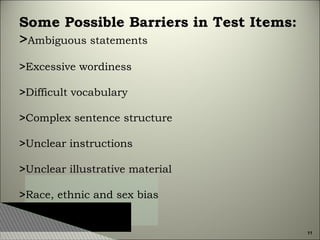
Some Possible Barriers in Test Items:
>Ambiguous statements
>Excessive wordiness
>Difficult vocabulary
>Complex sentence structure
>Unclear instructions
>Unclear illustrative material
>Race, ethnic and sex bias

11
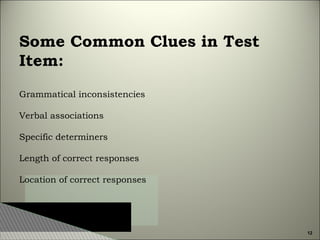
Some Common Clues in Test
Item:
Grammatical inconsistencies
Verbal associations
Specific determiners
Length of correct responses
Location of correct responses

12
General Suggestions for Writing Test
Items:
1.Use your test specifications as aguide to item writing.
2. Write more test items than needed.
3. Write the test items well in advance of the testing
date.
4. Write each test item so that it calls forth the
performance described in the intended learning
outcome.

13
5. Write each test item so that the task to be performed
is clearly defined.
6. Write each test item at an appropriate reading level.
7. Write each item so that it does not provode help in
answering other items in the test.
8. Write each test item so that the answer is one that
would be agreed upon by experts

14
9. Write each item so that it is at the proper level of
difficulty
10. Whenever a test item is revised, recheck its relevance

15
Focusing on improving learning and
instruction:
1.

Tests can have a desirable influence on pupil learning if attention
is paid to the breadth of content and learning outcomes
measured by the tests.

1.

Constructing tests that measure a variety of learning outcomes should
also lead to improved teaching procedures and thus indirectly to
improved pupil learning.

1.

Finally a test will contribute to improved teacher-pupil relations if pupils
view the test as a fair and useful measure of their achievement.

16

Test presentation

  • 1.
  • 2.
    TEST A test isa means of measuring the knowledge, skills, feelings, intelligence or aptitude of an individual or group. 2
  • 3.
    Test are dividedinto two categories:  Objective items It is highly structured and requires the pupils to supply a word or two or to select the correct answer from a number of alternatives.  Essay questions It permits the pupils to select, organize and present the answer in essay form. 3
  • 4.
    The objective testitems classified into:  Supply types that require the pupil to supply the answer.  Selection types that require the pupil to select the answer from the nunmber of alternatives. 4
  • 5.
    Essay questions classifiedinto:  Extended response type In which people are given complete freedom in making their responses.  Restricted response type In which the nature, length or organization of the response is limited. 5
  • 6.
    Comparative advantages ofobjectives and essay tests: Objective test Essay Test Learning outcomes measured Efficient for measuring knowledge of facts Inefficient for measuring knowledge of facts Preparation of questions Large number of questions is needed A few questions are needed Sampling of course content Provides an extensive Sampling of course sampling of course content is usually limited content Complete structuring of Freedom to respond task limits pupil to type of response called for. Control of pupil’s response 6
  • 7.
    Objective Test Scoring Influence onlearning Reliability Objective scoring is quick, easy and consistent Encourages pupil to develop a comprehensive knowledge of specific facts High reliability is possible Eassy Test Subjective scoring is slow, difficult and inconsistent Encourages pupils to concentrate on larger units of subject matter with special emphasis Reliability is typically low 7
  • 8.
    Selecting the mostappropriate item types  Supply the answer  Selection type • Multiple-choice item • True-false item • Matching items 8
  • 9.
    Consideration in preparing relevanttest items STEP 1: The purpose of the step should be determined. STEP 2: A set of specifications should be developed. STEP 3: The most appropriate item types should be selected. STEP 4: The test item should be constructed in accordance with the specification developed during the preceding steps. 9
  • 10.
    Selecting Proper ItemDifficulty Item Difficulty Item difficulty is expressed as the percentage of pupils answering the item correctly. Criterion-Referenced: The difficulty of the items to be included in a classroom test depends largely on whether the test is being designed to describe the specific learning tasks pupils can perform. Norm-Referenced: To rank the pupils in order of their achievements. 10
  • 11.
    Some Possible Barriersin Test Items: >Ambiguous statements >Excessive wordiness >Difficult vocabulary >Complex sentence structure >Unclear instructions >Unclear illustrative material >Race, ethnic and sex bias 11
  • 12.
    Some Common Cluesin Test Item: Grammatical inconsistencies Verbal associations Specific determiners Length of correct responses Location of correct responses 12
  • 13.
    General Suggestions forWriting Test Items: 1.Use your test specifications as aguide to item writing. 2. Write more test items than needed. 3. Write the test items well in advance of the testing date. 4. Write each test item so that it calls forth the performance described in the intended learning outcome. 13
  • 14.
    5. Write eachtest item so that the task to be performed is clearly defined. 6. Write each test item at an appropriate reading level. 7. Write each item so that it does not provode help in answering other items in the test. 8. Write each test item so that the answer is one that would be agreed upon by experts 14
  • 15.
    9. Write eachitem so that it is at the proper level of difficulty 10. Whenever a test item is revised, recheck its relevance 15
  • 16.
    Focusing on improvinglearning and instruction: 1. Tests can have a desirable influence on pupil learning if attention is paid to the breadth of content and learning outcomes measured by the tests. 1. Constructing tests that measure a variety of learning outcomes should also lead to improved teaching procedures and thus indirectly to improved pupil learning. 1. Finally a test will contribute to improved teacher-pupil relations if pupils view the test as a fair and useful measure of their achievement. 16