The Now Tech

By Cierra Warren
Welcome to 2021
• Welcome to the year 2021. We have yet to
  invent the flying car or a hovercraft, but as we
  expected technology has become an ever
  more important factor in daily lives. With all
  the changes I feel it is best to talk about the
  main three that are seen everyday by every
  person in the world, or at least those who are
  able to afford it.
Internet
• The internet is now something that is more factual then
  informational. Well this all depends on which internet you
  are using. WWW is not the only way to find information,
  you now type FIT(facts inputted technology) in front of your
  website and it takes you to a place where it is easy to
  research projects. The internet in the past was had flaws
  because anyone can put information up on it without it
  having to be factual on FIT internet all information must be
  factual and in order for information to be checked by a
  number of scholars on this subject. WWW is still up and
  running and is exactly as before but is not used as much by
  students. The umbrella, Rogers and Moore theories are
  why this is possible.
The Umbrella Perspective
• The use of an “umbrella” to illustrate these
  five factors is the results of the manner in
  which they were drawn on a chalkboard
  during lecture in 1988. The arrangement of
  the five attributes resembled an umbrella and
  the name stuck” (Grant &Meadows)
• The main focus is to describe the adaption of
  new technologies into society.
Rogers diffusion of Innovation
• The theory describes diffusion as the process
  by which an innovation is communicated
  through certain channels over time among the
  members of a social systems
Moore’s Innovation Adoption Rates
• The rate of adoption is defined as the relative
  speed with which members of a social system
  adopt an innovation. The rates are
  determined by an individual’s adopter
  category .
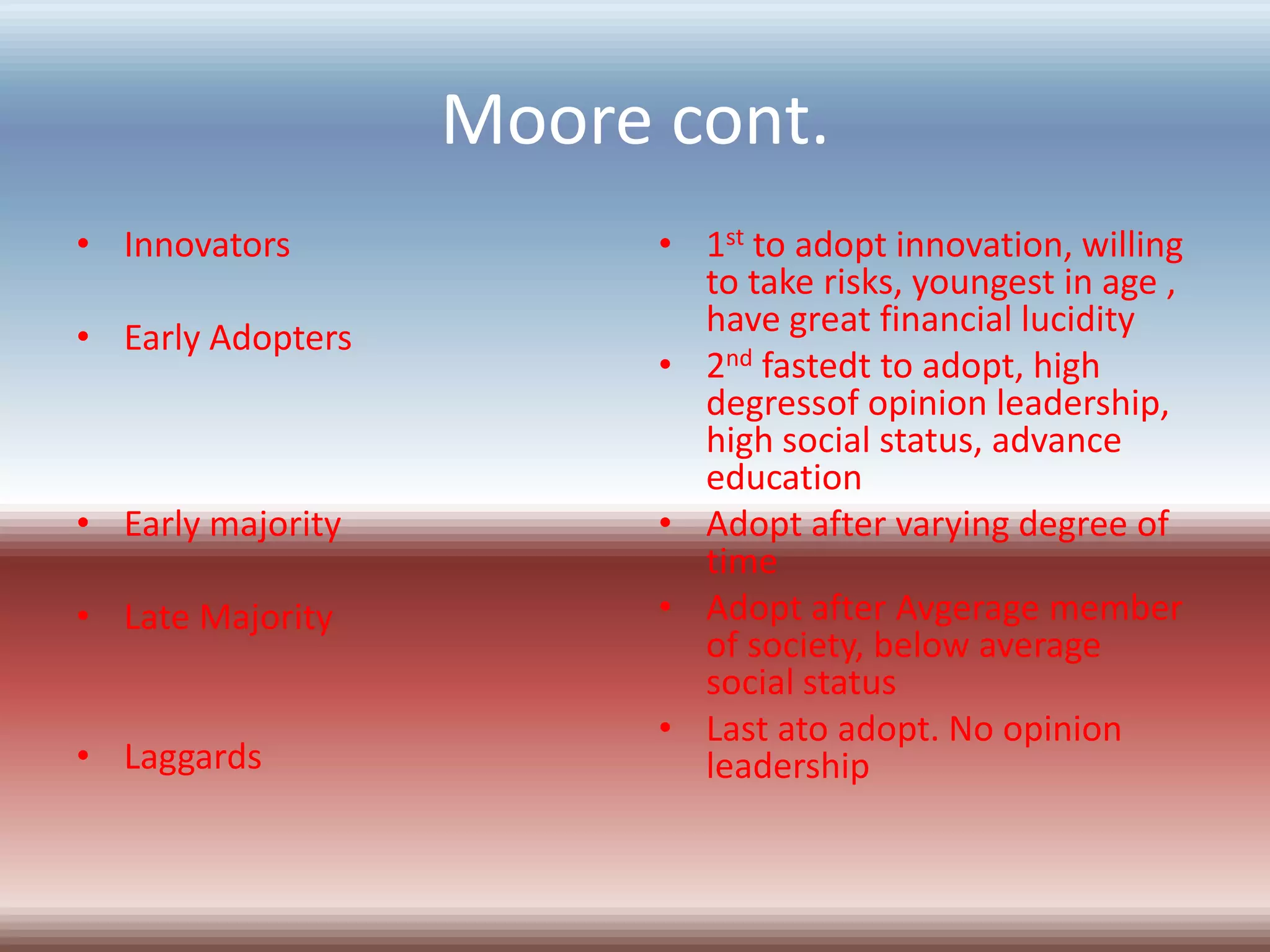
Moore cont.
• Innovators             • 1st to adopt innovation, willing
                           to take risks, youngest in age ,
• Early Adopters           have great financial lucidity
                         • 2nd fastedt to adopt, high
                           degressof opinion leadership,
                           high social status, advance
                           education
• Early majority         • Adopt after varying degree of
                           time
• Late Majority          • Adopt after Avgerage member
                           of society, below average
                           social status
                         • Last ato adopt. No opinion
• Laggards                 leadership
Social Networking
•
    Professors have noticed the time that students spend on the social
    networking cites. One professor actually lead a new wave of
    classrooms on students favorite cites. He started by updating his
    tweets on twitter with the homework assignments for the day or
    for that week. Students who check their twitters very often found
    this to be easier to know what they had to do, but this was just the
    beginning. Professors soon unloaded lectures on their status and
    then study guides and now there are apps on the social network to
    do your exams. So, now instead of hearing if you spent as much
    time on face book as you do your homework, parents do not have
    to worry about if their children are knowing what their work is that
    is needed to be done. Critical Mass Theory, Uses and Gratifications
    Theory, Media System Dependency Theory.
Critical Mass Theory

• Is the stage of diffusion process that an
  interactive medium has to reach in order for
  the adoption to take off. This is no longer a
  very time costing process.
Uses and Gratifications Theory

• This theory focus on what user want out of
  their technology. States what will seek
  technologies that satisfy their needs. This
  theory with why people choose certain media
  tech over others. Can also compare different
  media technology based on why people use
  them.
Media System Dependency Theory

• Tries to explain the role of media in our
  society. When it comes to social networking
  this shows how much people use these sites
  to work, Because professor now post
  information on these sites it shows how much
  people depend on the sites.
The Telephone
• No longer are their house phones, but almost everyone
  has a cell phone. Cell phones do the same as any smart
  phone did in the past, text, email, internet, etc. The
  thing that is different is that all phones are now smart
  phone. There is not one company that cells a phone
  that does not have the latest technology on it. Some of
  the more higher tech phones come with projectors,
  clearer cameras, and the ipod 12 has a screen that will
  not brake no matter how many times you drop it.
  Social Learning Theory/Social Cognitive Theory, The
  Theory of the Long Tail, The Principle of Relative
  Constancy.
Social Learning Theory/Social
            Cognitive Theory
• People learn by watching others and they
  imitated behavior. They reinforcement and
  punishment plays roles.
The Theory of the Long Tail

• Explains how our culture and culture shifts
  from mass markets to narrow interests.
The Principle of Relative Constancy

• Explains what happens to technology as
  newer ones become available.
Reference
• Green, R. (2011). Sage journalonline. Retrieved
  from
  http://crx.sagepub.com/content/23/5/612.abstra
  ct
• Honors: communication capstone. (2001).
  Retrieved from
  http://www.uky.edu/~drlane/capstone/mass/use
  s.htm
• (n.d.). Retrieved from
  http://people.bethel.edu/~socsco/ComTech/Com
  TechTheory.html

The Now Tech

  • 1.
    The Now Tech ByCierra Warren
  • 2.
    Welcome to 2021 •Welcome to the year 2021. We have yet to invent the flying car or a hovercraft, but as we expected technology has become an ever more important factor in daily lives. With all the changes I feel it is best to talk about the main three that are seen everyday by every person in the world, or at least those who are able to afford it.
  • 3.
    Internet • The internetis now something that is more factual then informational. Well this all depends on which internet you are using. WWW is not the only way to find information, you now type FIT(facts inputted technology) in front of your website and it takes you to a place where it is easy to research projects. The internet in the past was had flaws because anyone can put information up on it without it having to be factual on FIT internet all information must be factual and in order for information to be checked by a number of scholars on this subject. WWW is still up and running and is exactly as before but is not used as much by students. The umbrella, Rogers and Moore theories are why this is possible.
  • 4.
    The Umbrella Perspective •The use of an “umbrella” to illustrate these five factors is the results of the manner in which they were drawn on a chalkboard during lecture in 1988. The arrangement of the five attributes resembled an umbrella and the name stuck” (Grant &Meadows) • The main focus is to describe the adaption of new technologies into society.
  • 5.
    Rogers diffusion ofInnovation • The theory describes diffusion as the process by which an innovation is communicated through certain channels over time among the members of a social systems
  • 6.
    Moore’s Innovation AdoptionRates • The rate of adoption is defined as the relative speed with which members of a social system adopt an innovation. The rates are determined by an individual’s adopter category .
  • 7.
    Moore cont. • Innovators • 1st to adopt innovation, willing to take risks, youngest in age , • Early Adopters have great financial lucidity • 2nd fastedt to adopt, high degressof opinion leadership, high social status, advance education • Early majority • Adopt after varying degree of time • Late Majority • Adopt after Avgerage member of society, below average social status • Last ato adopt. No opinion • Laggards leadership
  • 8.
    Social Networking • Professors have noticed the time that students spend on the social networking cites. One professor actually lead a new wave of classrooms on students favorite cites. He started by updating his tweets on twitter with the homework assignments for the day or for that week. Students who check their twitters very often found this to be easier to know what they had to do, but this was just the beginning. Professors soon unloaded lectures on their status and then study guides and now there are apps on the social network to do your exams. So, now instead of hearing if you spent as much time on face book as you do your homework, parents do not have to worry about if their children are knowing what their work is that is needed to be done. Critical Mass Theory, Uses and Gratifications Theory, Media System Dependency Theory.
  • 9.
    Critical Mass Theory •Is the stage of diffusion process that an interactive medium has to reach in order for the adoption to take off. This is no longer a very time costing process.
  • 10.
    Uses and GratificationsTheory • This theory focus on what user want out of their technology. States what will seek technologies that satisfy their needs. This theory with why people choose certain media tech over others. Can also compare different media technology based on why people use them.
  • 11.
    Media System DependencyTheory • Tries to explain the role of media in our society. When it comes to social networking this shows how much people use these sites to work, Because professor now post information on these sites it shows how much people depend on the sites.
  • 12.
    The Telephone • Nolonger are their house phones, but almost everyone has a cell phone. Cell phones do the same as any smart phone did in the past, text, email, internet, etc. The thing that is different is that all phones are now smart phone. There is not one company that cells a phone that does not have the latest technology on it. Some of the more higher tech phones come with projectors, clearer cameras, and the ipod 12 has a screen that will not brake no matter how many times you drop it. Social Learning Theory/Social Cognitive Theory, The Theory of the Long Tail, The Principle of Relative Constancy.
  • 13.
    Social Learning Theory/Social Cognitive Theory • People learn by watching others and they imitated behavior. They reinforcement and punishment plays roles.
  • 14.
    The Theory ofthe Long Tail • Explains how our culture and culture shifts from mass markets to narrow interests.
  • 15.
    The Principle ofRelative Constancy • Explains what happens to technology as newer ones become available.
  • 16.
    Reference • Green, R.(2011). Sage journalonline. Retrieved from http://crx.sagepub.com/content/23/5/612.abstra ct • Honors: communication capstone. (2001). Retrieved from http://www.uky.edu/~drlane/capstone/mass/use s.htm • (n.d.). Retrieved from http://people.bethel.edu/~socsco/ComTech/Com TechTheory.html