The t-test
Inferences about Population Means
SUBMITTED TO:
Dr. Deepali Jat
Associate professor
Dr. H.S. Gour Central University,
Sagar -470003 (M.P.)
SUBMITTED BY: NAGENDRA
SAHU
Dr. H.S. Gour Central University
Sagar-470003 (M.P.)
TABLE OF CONTENTS
1. OBJECTIVE
2. BACKGROUND
3. Z-TEST
4. DISTRIBUTION OF t-TEST
5. DEGREE OF FREEDOM
6. SINGLE t-TEST
7. ASSUMPTIONS
8. REFERENCES
9. AKNOWELDGEMENT
Questions
• What is the main use of the t-test?
• How is the distribution of t related to the unit normal?
• When would we use a t-test instead of a z-test? Why might
we prefer one to the other?
• What are the chief varieties or forms of the t-test?
• What is the standard error of the difference between means?
What are the factors that influence its size?
Background
• The t-test is used to test hypotheses about means
when the population variance is unknown (the usual
case). Closely related to z, the unit normal.
• Developed by Gossett for the quality control of beer.
• Comes in 3 varieties:
• Single sample, independent samples, and dependent
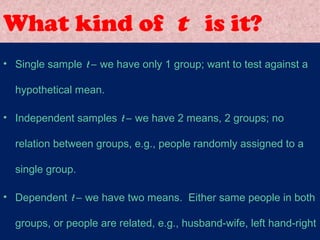
What kind of t is it?
• Single sample t – we have only 1 group; want to test against a
hypothetical mean.
• Independent samples t – we have 2 means, 2 groups; no
relation between groups, e.g., people randomly assigned to a
single group.
• Dependent t – we have two means. Either same people in both
groups, or people are related, e.g., husband-wife, left hand-right
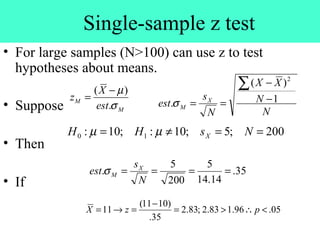
Single-sample z test
• For large samples (N>100) can use z to test
hypotheses about means.
• Suppose
• Then
• If
M
M
est
X
z
σ
µ
.
)( −
=
N
N
XX
N
s
est X
M
1
)(
.
2
−
−
==
∑
σ
200;5;10:;10: 10 ==≠= NsHH Xµµ
35.
14.14
5
200
5
. ====
N
s
est X
Mσ
05.96.183.2;83.2
35.
)1011(
11 <∴>=
−
=→= pzX
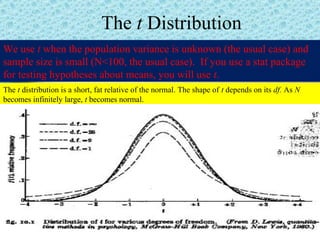
The t Distribution
We use t when the population variance is unknown (the usual case) and
sample size is small (N<100, the usual case). If you use a stat package
for testing hypotheses about means, you will use t.
The t distribution is a short, fat relative of the normal. The shape of t depends on its df. As N
becomes infinitely large, t becomes normal.
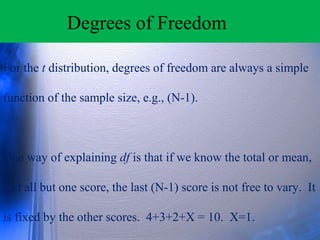
Degrees of Freedom
For the t distribution, degrees of freedom are always a simple
function of the sample size, e.g., (N-1).
One way of explaining df is that if we know the total or mean,
and all but one score, the last (N-1) score is not free to vary. It
is fixed by the other scores. 4+3+2+X = 10. X=1.
Single-sample t-test
With a small sample size, we compute the same numbers
as we did for z, but we compare them to the t distribution
instead of the z distribution.
25;5;10:;10: 10 ==≠= NsHH Xµµ
1
25
5
. ===
N
s
est X
Mσ 1
1
)1011(
11 =
−
=→= tX
064.2)24,05(. =t 1<2.064, n.s.
Interval =
]064.13,936.8[)1(064.211
ˆ
=±
± MtX σ
Interval is about 9 to 13 and contains 10, so n.s.
(c.f. z=1.96)
Assumptions
• The t-test is based on assumptions of normality and
homogeneity of variance.
• You can test for both these (make sure you learn the
SAS methods).
• As long as the samples in each group are large and
nearly equal, the t-test is robust, that is, still good,
the t test

the t test

  • 1.
    The t-test Inferences aboutPopulation Means SUBMITTED TO: Dr. Deepali Jat Associate professor Dr. H.S. Gour Central University, Sagar -470003 (M.P.) SUBMITTED BY: NAGENDRA SAHU Dr. H.S. Gour Central University Sagar-470003 (M.P.)
  • 2.
    TABLE OF CONTENTS 1.OBJECTIVE 2. BACKGROUND 3. Z-TEST 4. DISTRIBUTION OF t-TEST 5. DEGREE OF FREEDOM 6. SINGLE t-TEST 7. ASSUMPTIONS 8. REFERENCES 9. AKNOWELDGEMENT
  • 3.
    Questions • What isthe main use of the t-test? • How is the distribution of t related to the unit normal? • When would we use a t-test instead of a z-test? Why might we prefer one to the other? • What are the chief varieties or forms of the t-test? • What is the standard error of the difference between means? What are the factors that influence its size?
  • 4.
    Background • The t-testis used to test hypotheses about means when the population variance is unknown (the usual case). Closely related to z, the unit normal. • Developed by Gossett for the quality control of beer. • Comes in 3 varieties: • Single sample, independent samples, and dependent
  • 5.
    What kind oft is it? • Single sample t – we have only 1 group; want to test against a hypothetical mean. • Independent samples t – we have 2 means, 2 groups; no relation between groups, e.g., people randomly assigned to a single group. • Dependent t – we have two means. Either same people in both groups, or people are related, e.g., husband-wife, left hand-right
  • 6.
    Single-sample z test •For large samples (N>100) can use z to test hypotheses about means. • Suppose • Then • If M M est X z σ µ . )( − = N N XX N s est X M 1 )( . 2 − − == ∑ σ 200;5;10:;10: 10 ==≠= NsHH Xµµ 35. 14.14 5 200 5 . ==== N s est X Mσ 05.96.183.2;83.2 35. )1011( 11 <∴>= − =→= pzX
  • 7.
    The t Distribution Weuse t when the population variance is unknown (the usual case) and sample size is small (N<100, the usual case). If you use a stat package for testing hypotheses about means, you will use t. The t distribution is a short, fat relative of the normal. The shape of t depends on its df. As N becomes infinitely large, t becomes normal.
  • 8.
    Degrees of Freedom Forthe t distribution, degrees of freedom are always a simple function of the sample size, e.g., (N-1). One way of explaining df is that if we know the total or mean, and all but one score, the last (N-1) score is not free to vary. It is fixed by the other scores. 4+3+2+X = 10. X=1.
  • 9.
    Single-sample t-test With asmall sample size, we compute the same numbers as we did for z, but we compare them to the t distribution instead of the z distribution. 25;5;10:;10: 10 ==≠= NsHH Xµµ 1 25 5 . === N s est X Mσ 1 1 )1011( 11 = − =→= tX 064.2)24,05(. =t 1<2.064, n.s. Interval = ]064.13,936.8[)1(064.211 ˆ =± ± MtX σ Interval is about 9 to 13 and contains 10, so n.s. (c.f. z=1.96)
  • 10.
    Assumptions • The t-testis based on assumptions of normality and homogeneity of variance. • You can test for both these (make sure you learn the SAS methods). • As long as the samples in each group are large and nearly equal, the t-test is robust, that is, still good,