Prepared by: Ayoub Oubla
Supervised by: Mr.Ayad Chraa
Professional B.A: English Language Teaching and The Global Market
2020-2021
OUTLINE
❑What is integration skills?
❑ What is the Segregation-skill approach?
❑Why integrating skills?
❑Advantages of inegrated-skill approach
❑Types of integrated skill approach
❑How to integrate skills?
❑Disadvantages of integarted-skill approach
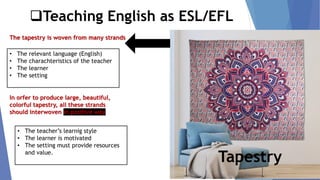
Tapestry
• The relevant language (English)
• The charachteristics of the teacher
• The learner
• The setting
The tapestry is woven from many strands
❑Teaching English as ESL/EFL
In orfer to produce large, beautiful,
colorful tapestry, all these strands
should interwoven in positive way
• The teacher’s learnig style
• The learner is motivated
• The setting must provide resources
and value.
❑ The Segregated-skill Approach?
Also know as the language-based approach, the language itself is the focus of
instruction (language for language's sake)
 Language learning is typically separate from content learning and this is contrary to
the integrated way that people use language skills in normal communication.
 Skill segregation is reflected in traditional ESL/EFL programs that offer classes
focusing on segregated language skills.
 The segregated-skill approach would not ensure adequate preparation for later
success in academic communication, career- related language use, or everyday
interaction in the language. E.g translation-method
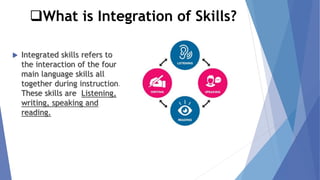
 Integrated skills refers to
the interaction of the four
main language skills all
together during instruction.
These skills are Listening,
writing, speaking and
reading.
❑What is Integration of Skills?
 “the importance of using this Approach lies on the fact that, when facing a
real communicative situation, “more than one skill is used to communicate
and integrated skill approach provides opportunities to develop these skills at
the same time.”
Jing (quoted in Hungyo and Kijai, 2009)
❑Advantages of Integrated Skills
Teachers can build the lesson plan around a theme or a topic based on the interest of
learners and also on topics that are relevant to them.
It exposes English language learners to authentic language and challenges them to interact
naturally in the language.
It brings variety into the classroom, which enables teachers to enrich classroom instruction by
integrating the skills cooperatively.
Language skills integration helps students develop their communicative competence
(grammatical/linguistic competence, strategic competence, sociolinguistic competence,
and discourse competence).
It assists students to develop their critical thinking so that they can analyze, synthesize
and evaluate information better.
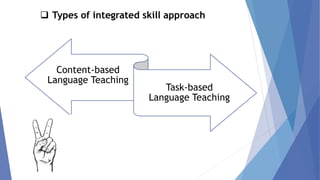
❑ Types of integrated skill approach
Content-based
Language Teaching
Task-based
Language Teaching
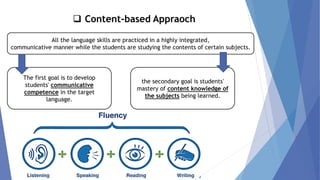
❑ Content-based Appraoch
All the language skills are practiced in a highly integrated,
communicative manner while the students are studying the contents of certain subjects.
The first goal is to develop
students' communicative
competence in the target
language.
the secondary goal is students'
mastery of content knowledge of
the subjects being learned.
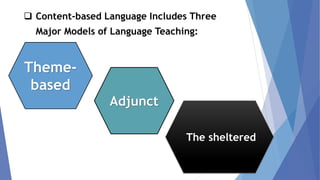
❑ Content-based Language Includes Three
Major Models of Language Teaching:
The sheltered
Adjunct
Theme-
based
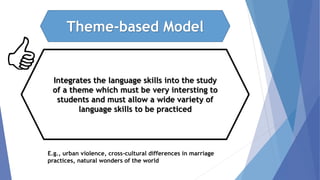
Theme-based Model
Integrates the language skills into the study
of a theme which must be very intersting to
students and must allow a wide variety of
language skills to be practiced
E.g., urban violence, cross-cultural differences in marriage
practices, natural wonders of the world
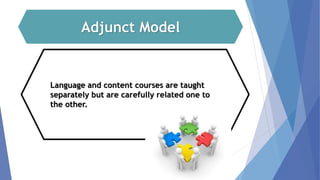
Adjunct Model
Language and content courses are taught
separately but are carefully related one to
the other.
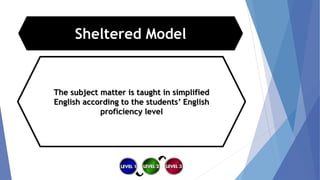
Sheltered Model
The subject matter is taught in simplified
English according to the students’ English
proficiency level
❑ Task-based Appraoch
In task-based language learning, students participate in
communicative tasks in the target language.
Communicative tasks are activities which can stand
alone as fundamental units and require
comprehending, producing, manipulating, or
interacting in authentic language while attention is
principally paid to meaning rather than form
❑ Examples of Communicative Tasks
 Students work in pair or group to solve a problem, complete a task or create
a product.
 students collaborate to criticize a poem, analyze a short story, enact scenes
from a play.
❑ The goal of these Communicative Tasks
➢ the tasks function to help unify two or more language skills together to
facilitate meaningful communication.
➢ these tasks also serve as a 'glue' to relate the language skills to learners'
background, goal, culture, and linguistic competence.
 Learn more about the various ways to integrate language skills in the classroom (e.g.,
content-based, task-based, or a combination).
 Reflect on their current approach and evaluate the extent to which the skills are
integrated.
 Choose instructional materials, textbooks, and technologies that promote the
integration of
listening, reading, speaking, and writing, as well as the associated skills of syntax,
vocabulary and so on.
 Even if a given course is labeled according to just one skill, remember that it is possible
to integrate the other language skills through appropriate tasks.
❑How to integrate Skills?
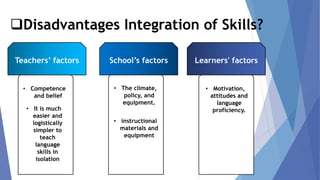
❑Disadvantages Integration of Skills?
Teachers’ factors School’s factors Learners' factors
• Competence
and belief
• It is much
easier and
logistically
simpler to
teach
language
skills in
isolation
• The climate,
policy, and
equipment.
• instructional
materials and
equipment
• Motivation,
attitudes and
language
proficiency.
REFERENCES
• Pardede, P. (2017). Integrated skills approach in EFL classrooms: A
literature review. Integrated Skills Approach in EFL Classrooms: A
Literature Review, 1–22.
https://www.researchgate.net/publication/332607443
• Peregoy, S.F., & Boyle, O.F. (2001). Reading, writing, and learning in ESL.
New York: Addison Wesley longman.
• Oxford, R. (1990). Language learning strategies. What every teacher
should know. Boston, MA: Heinle & Heinle.

Integration of Skills In English Language Teaching by Ayoub Oubla

  • 1.
    Prepared by: AyoubOubla Supervised by: Mr.Ayad Chraa Professional B.A: English Language Teaching and The Global Market 2020-2021
  • 2.
    OUTLINE ❑What is integrationskills? ❑ What is the Segregation-skill approach? ❑Why integrating skills? ❑Advantages of inegrated-skill approach ❑Types of integrated skill approach ❑How to integrate skills? ❑Disadvantages of integarted-skill approach
  • 3.
    Tapestry • The relevantlanguage (English) • The charachteristics of the teacher • The learner • The setting The tapestry is woven from many strands ❑Teaching English as ESL/EFL In orfer to produce large, beautiful, colorful tapestry, all these strands should interwoven in positive way • The teacher’s learnig style • The learner is motivated • The setting must provide resources and value.
  • 4.
    ❑ The Segregated-skillApproach? Also know as the language-based approach, the language itself is the focus of instruction (language for language's sake)  Language learning is typically separate from content learning and this is contrary to the integrated way that people use language skills in normal communication.  Skill segregation is reflected in traditional ESL/EFL programs that offer classes focusing on segregated language skills.  The segregated-skill approach would not ensure adequate preparation for later success in academic communication, career- related language use, or everyday interaction in the language. E.g translation-method
  • 5.
     Integrated skillsrefers to the interaction of the four main language skills all together during instruction. These skills are Listening, writing, speaking and reading. ❑What is Integration of Skills?
  • 6.
     “the importanceof using this Approach lies on the fact that, when facing a real communicative situation, “more than one skill is used to communicate and integrated skill approach provides opportunities to develop these skills at the same time.” Jing (quoted in Hungyo and Kijai, 2009)
  • 7.
    ❑Advantages of IntegratedSkills Teachers can build the lesson plan around a theme or a topic based on the interest of learners and also on topics that are relevant to them. It exposes English language learners to authentic language and challenges them to interact naturally in the language. It brings variety into the classroom, which enables teachers to enrich classroom instruction by integrating the skills cooperatively. Language skills integration helps students develop their communicative competence (grammatical/linguistic competence, strategic competence, sociolinguistic competence, and discourse competence). It assists students to develop their critical thinking so that they can analyze, synthesize and evaluate information better.
  • 8.
    ❑ Types ofintegrated skill approach Content-based Language Teaching Task-based Language Teaching
  • 9.
    ❑ Content-based Appraoch Allthe language skills are practiced in a highly integrated, communicative manner while the students are studying the contents of certain subjects. The first goal is to develop students' communicative competence in the target language. the secondary goal is students' mastery of content knowledge of the subjects being learned.
  • 10.
    ❑ Content-based LanguageIncludes Three Major Models of Language Teaching: The sheltered Adjunct Theme- based
  • 11.
    Theme-based Model Integrates thelanguage skills into the study of a theme which must be very intersting to students and must allow a wide variety of language skills to be practiced E.g., urban violence, cross-cultural differences in marriage practices, natural wonders of the world
  • 12.
    Adjunct Model Language andcontent courses are taught separately but are carefully related one to the other.
  • 13.
    Sheltered Model The subjectmatter is taught in simplified English according to the students’ English proficiency level
  • 14.
    ❑ Task-based Appraoch Intask-based language learning, students participate in communicative tasks in the target language. Communicative tasks are activities which can stand alone as fundamental units and require comprehending, producing, manipulating, or interacting in authentic language while attention is principally paid to meaning rather than form
  • 15.
    ❑ Examples ofCommunicative Tasks  Students work in pair or group to solve a problem, complete a task or create a product.  students collaborate to criticize a poem, analyze a short story, enact scenes from a play. ❑ The goal of these Communicative Tasks ➢ the tasks function to help unify two or more language skills together to facilitate meaningful communication. ➢ these tasks also serve as a 'glue' to relate the language skills to learners' background, goal, culture, and linguistic competence.
  • 16.
     Learn moreabout the various ways to integrate language skills in the classroom (e.g., content-based, task-based, or a combination).  Reflect on their current approach and evaluate the extent to which the skills are integrated.  Choose instructional materials, textbooks, and technologies that promote the integration of listening, reading, speaking, and writing, as well as the associated skills of syntax, vocabulary and so on.  Even if a given course is labeled according to just one skill, remember that it is possible to integrate the other language skills through appropriate tasks. ❑How to integrate Skills?
  • 17.
    ❑Disadvantages Integration ofSkills? Teachers’ factors School’s factors Learners' factors • Competence and belief • It is much easier and logistically simpler to teach language skills in isolation • The climate, policy, and equipment. • instructional materials and equipment • Motivation, attitudes and language proficiency.
  • 22.
    REFERENCES • Pardede, P.(2017). Integrated skills approach in EFL classrooms: A literature review. Integrated Skills Approach in EFL Classrooms: A Literature Review, 1–22. https://www.researchgate.net/publication/332607443 • Peregoy, S.F., & Boyle, O.F. (2001). Reading, writing, and learning in ESL. New York: Addison Wesley longman. • Oxford, R. (1990). Language learning strategies. What every teacher should know. Boston, MA: Heinle & Heinle.