Outline
Using MOOCs to provide pre-entry
skills support at the University of
Cumbria
lesley.english@cumbria.ac.uk
Outline
• Introduction to the University of Cumbria & the role
of the library and academic adviser
• The evolution of the MOOC: where it all began
• Creation of resources & finding the right platform
• Small scale research
• Benefits, challenges and moving forward
McVeigh 2012
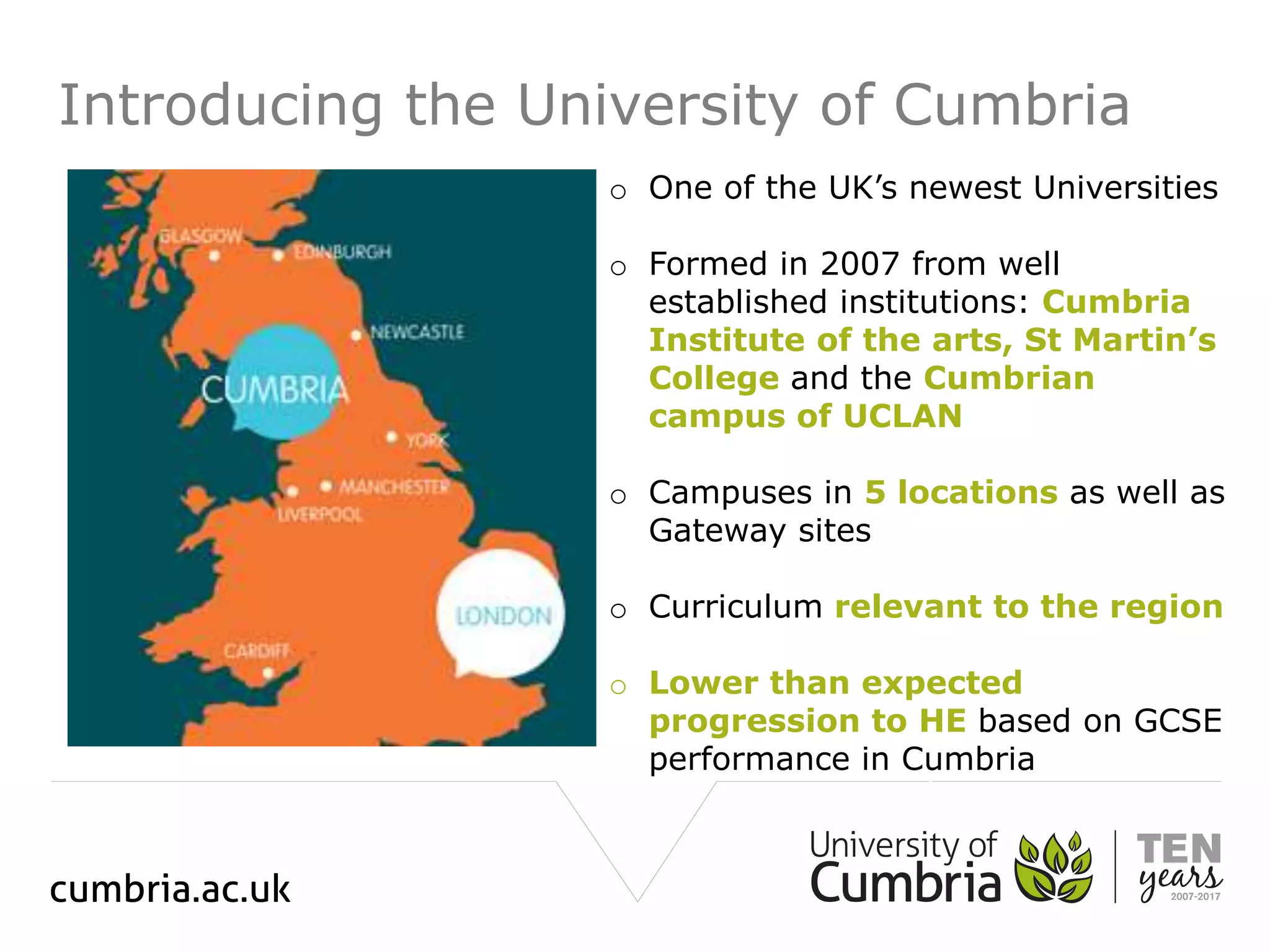
o One of the UK’s newest Universities
o Formed in 2007 from well
established institutions: Cumbria
Institute of the arts, St Martin’s
College and the Cumbrian
campus of UCLAN
o Campuses in 5 locations as well as
Gateway sites
o Curriculum relevant to the region
o Lower than expected
progression to HE based on GCSE
performance in Cumbria
Introducing the University of Cumbria
Demographics of our students
• 8790 students at the University, 80% are
undergraduate (including foundation degree).
Of the 1795 postgraduate students, 55%
were studying part-time (HESA, 2016)
• 62-65% of our FT UG students have at least
one Widening Participation (WP)
characteristic
• Post-1992 University – students arrive with
generally lower grades
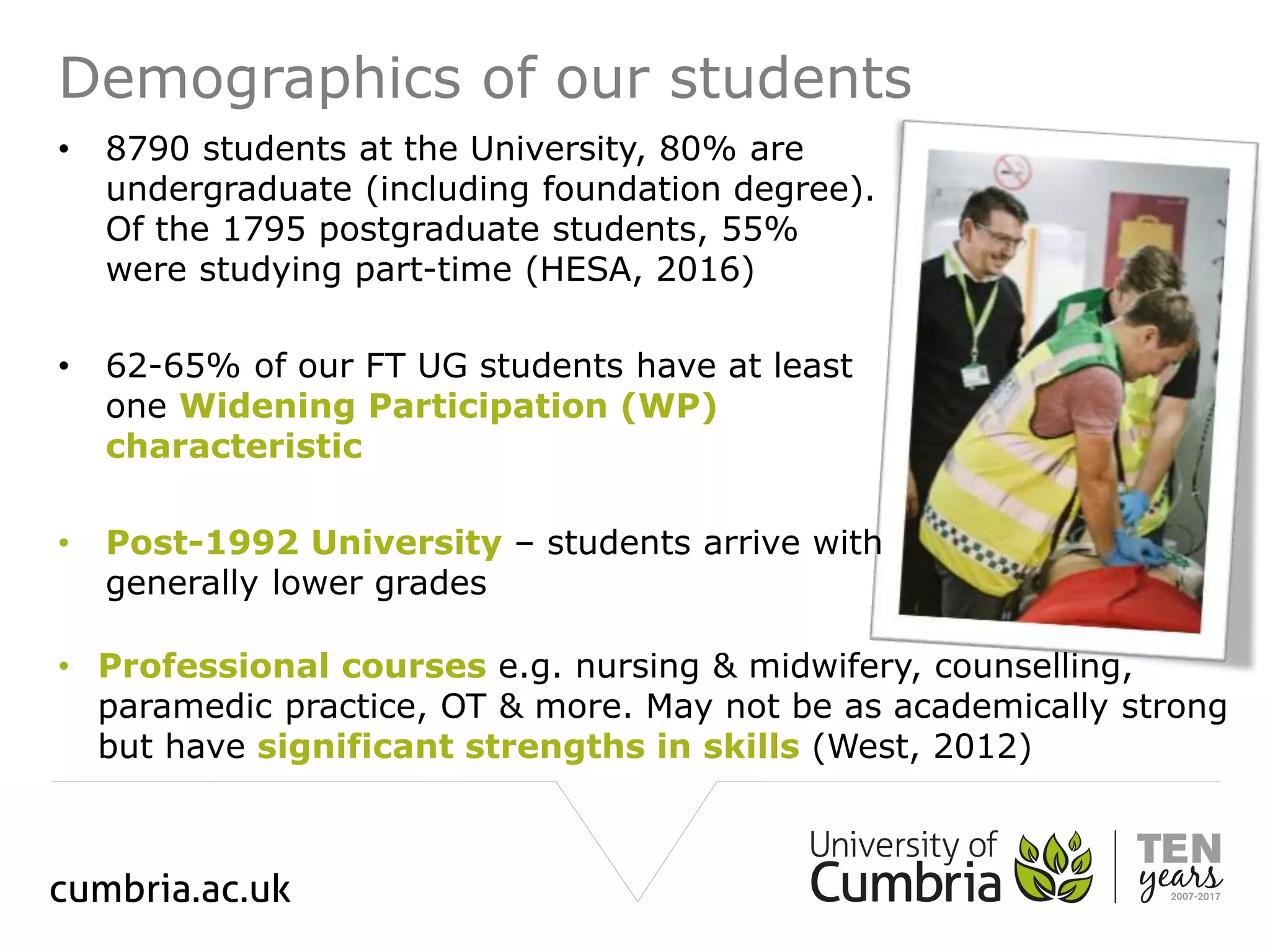
• Professional courses e.g. nursing & midwifery, counselling,
paramedic practice, OT & more. May not be as academically strong
but have significant strengths in skills (West, 2012)
Pre-entry support
• Lack of preparedness for HE is one of the main
factors why students don’t complete their course
(Murtagh, 2012)
• Most UK HEI’s prioritise the area of transition & the
‘first year experience’ as they are recognised in
improving student retention & success (Thomas,
2012)
• Interventions at this pre-entry stage need to engage
students, provide key information about both the
University and their course to ensure they arrive with
realistic expectations, and develop the students’
own confidence (HEFCE, 2012a)
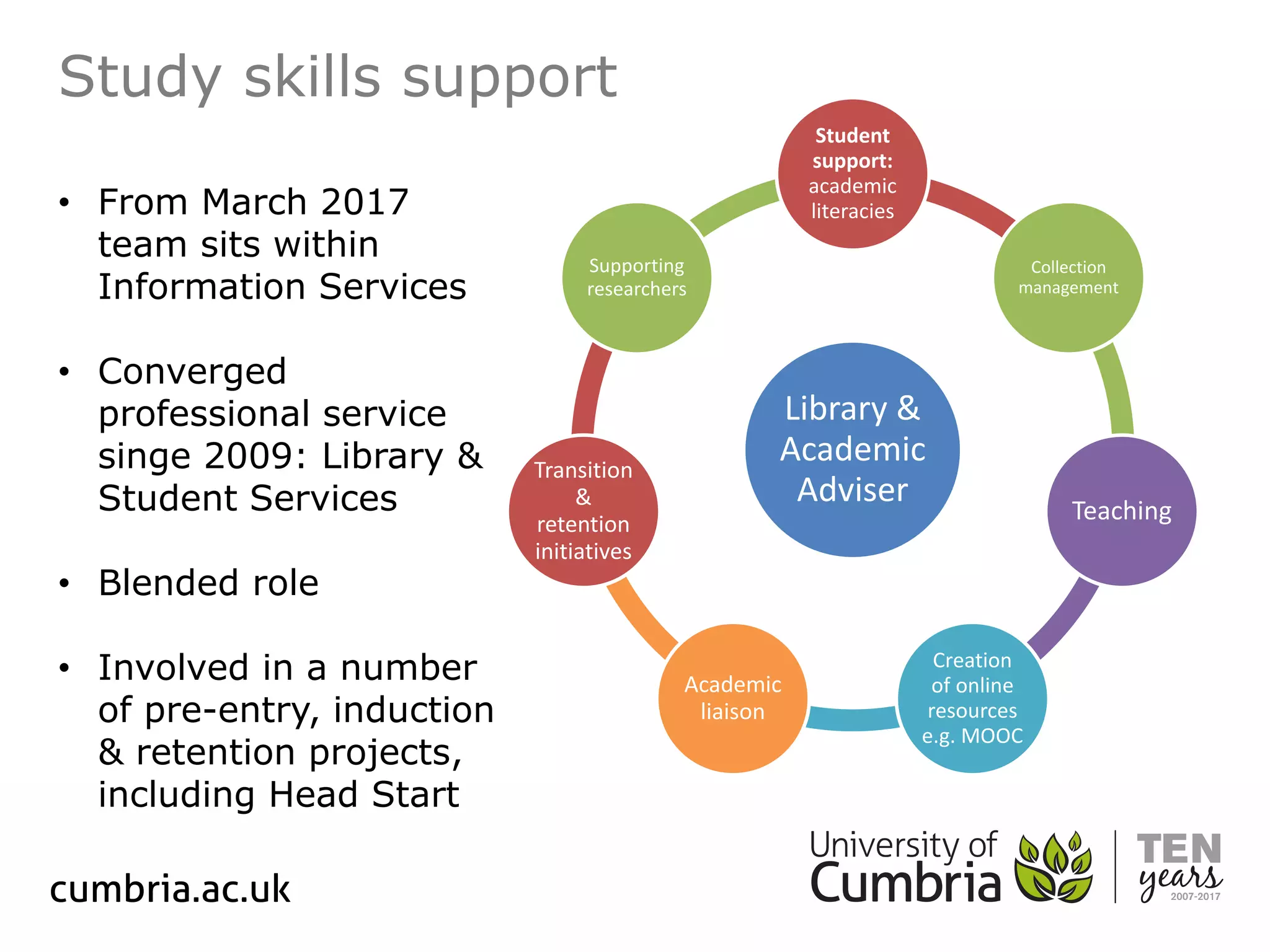
Library &
Academic
Adviser
Student
support:
academic
literacies
Collection
management
Teaching
Creation
of online
resources
e.g. MOOC
Academic
liaison
Transition
&
retention
initiatives
Supporting
researchers
Study skills support
• From March 2017
team sits within
Information Services
• Converged
professional service
singe 2009: Library &
Student Services
• Blended role
• Involved in a number
of pre-entry, induction
& retention projects,
including Head Start
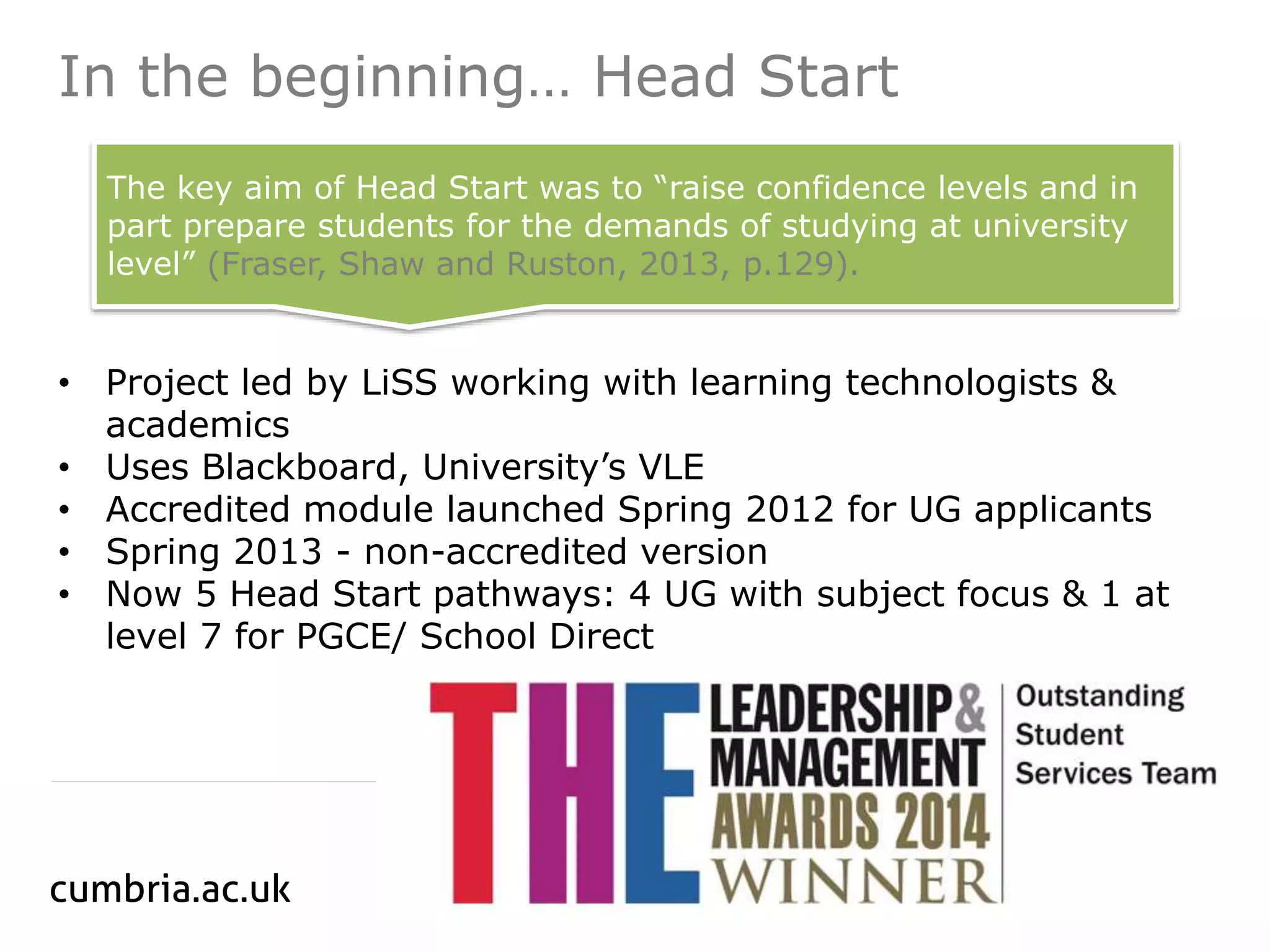
In the beginning… Head Start
• Project led by LiSS working with learning technologists &
academics
• Uses Blackboard, University’s VLE
• Accredited module launched Spring 2012 for UG applicants
• Spring 2013 - non-accredited version
• Now 5 Head Start pathways: 4 UG with subject focus & 1 at
level 7 for PGCE/ School Direct
The key aim of Head Start was to “raise confidence levels and in
part prepare students for the demands of studying at university
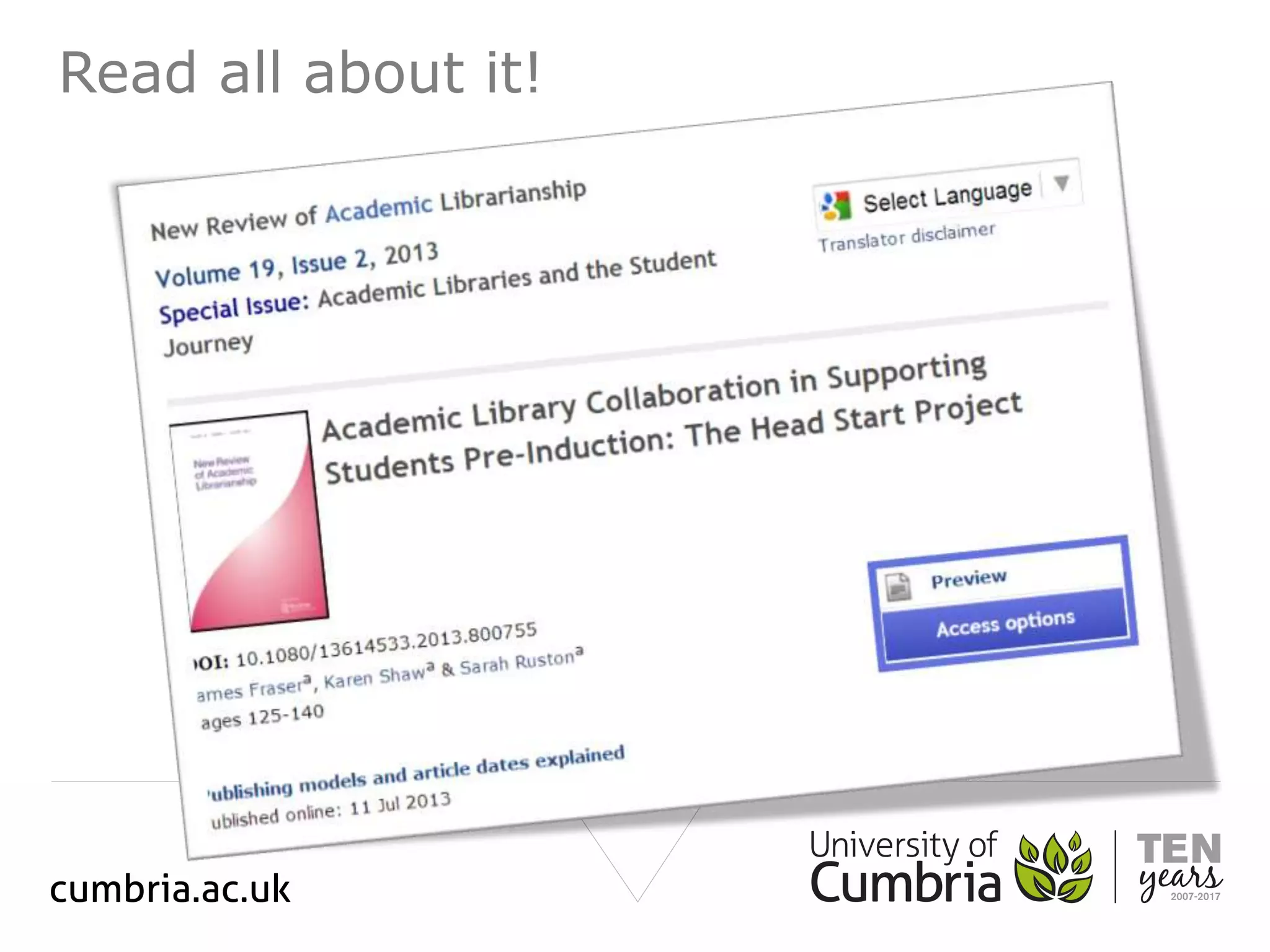
level” (Fraser, Shaw and Ruston, 2013, p.129).
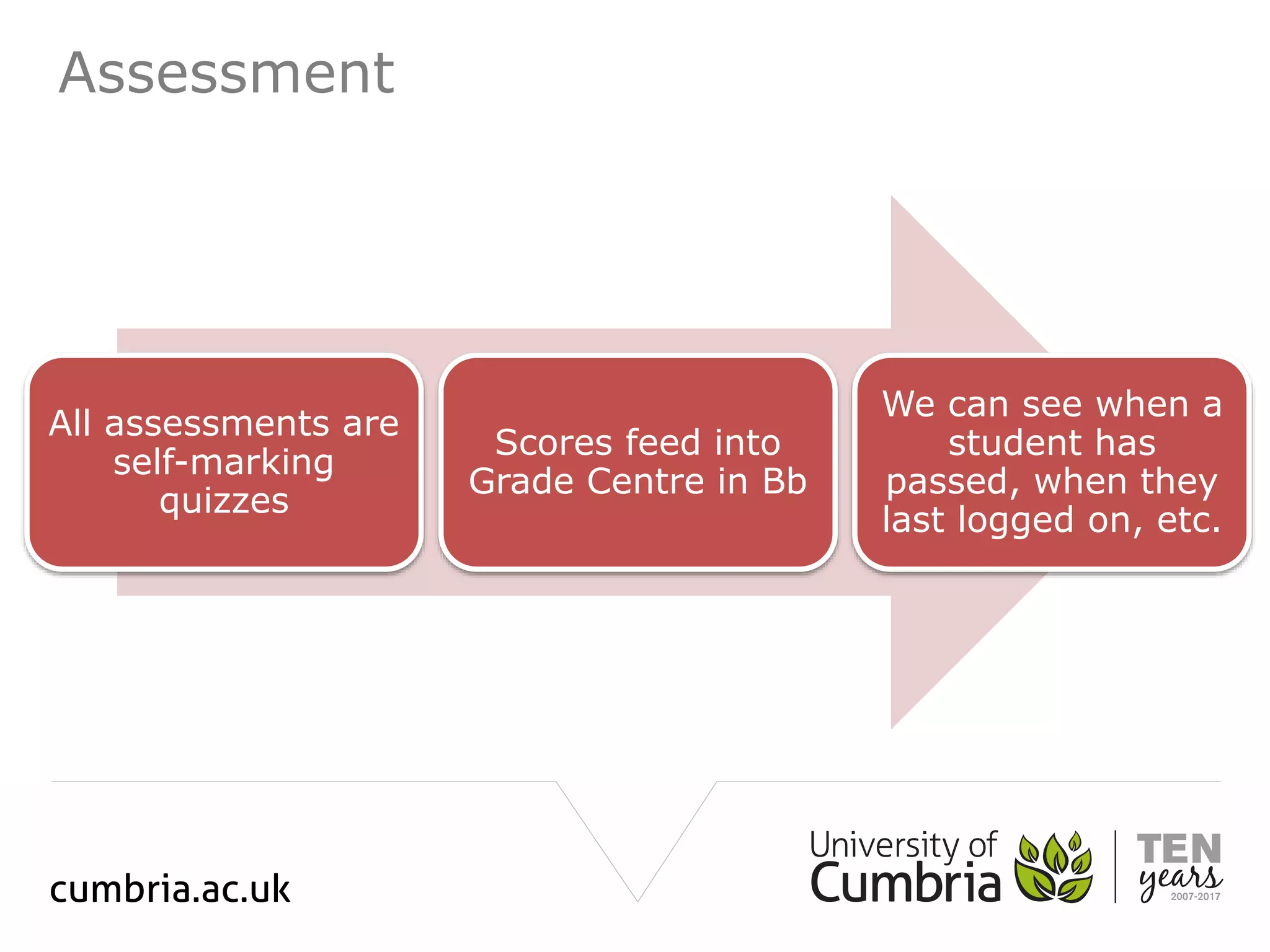
Assessment
All assessments are
self-marking
quizzes
Scores feed into
Grade Centre in Bb
We can see when a
student has
passed, when they
last logged on, etc.
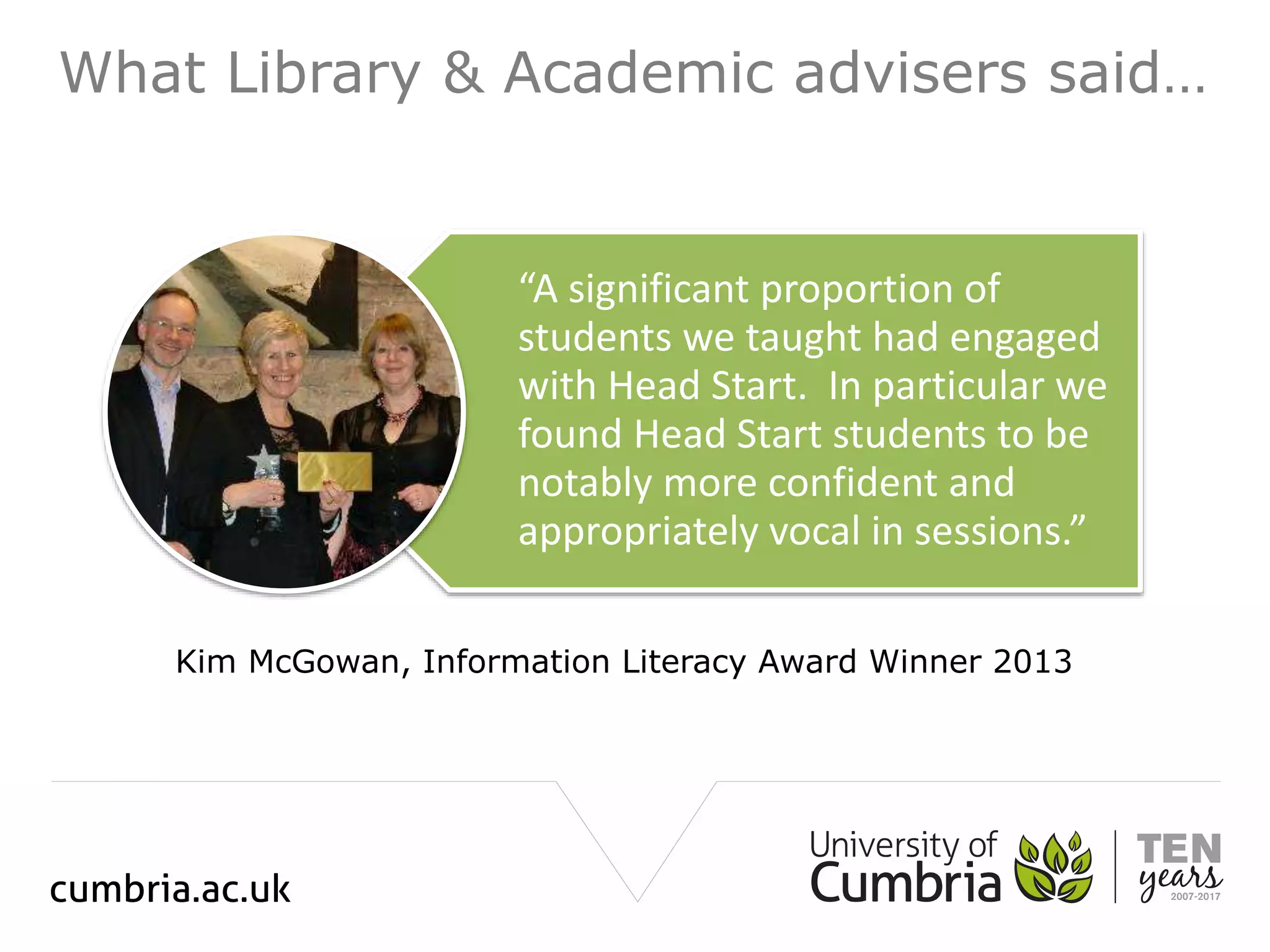
What Library & Academic advisers said…
“A significant proportion of
students we taught had engaged
with Head Start. In particular we
found Head Start students to be
notably more confident and
appropriately vocal in sessions.”
Kim McGowan, Information Literacy Award Winner 2013
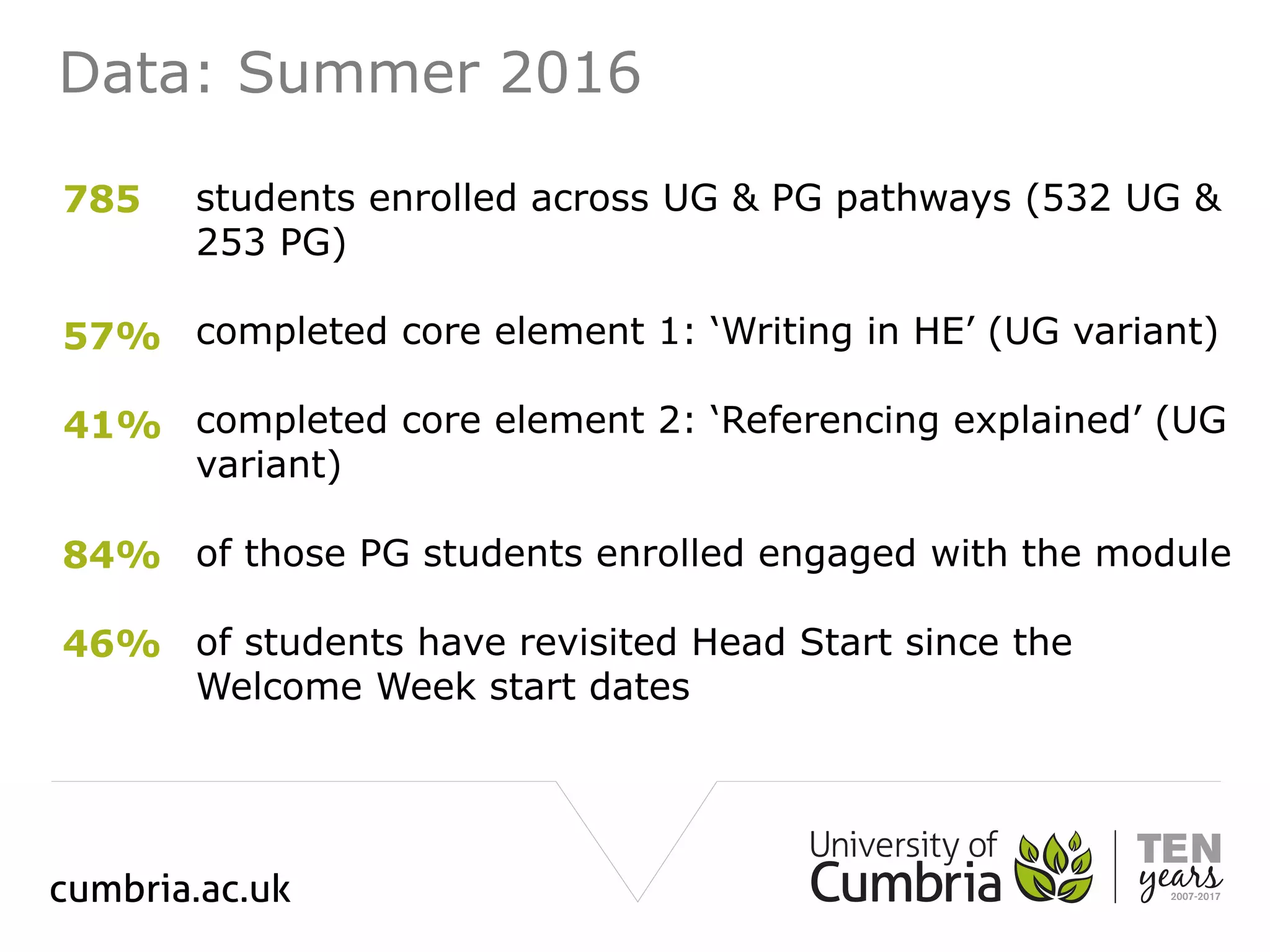
Data: Summer 2016
785 students enrolled across UG & PG pathways (532 UG &
253 PG)
completed core element 1: ‘Writing in HE’ (UG variant)
completed core element 2: ‘Referencing explained’ (UG
variant)
of those PG students enrolled engaged with the module
of students have revisited Head Start since the
Welcome Week start dates
46%
57%
41%
84%
Read all about it!
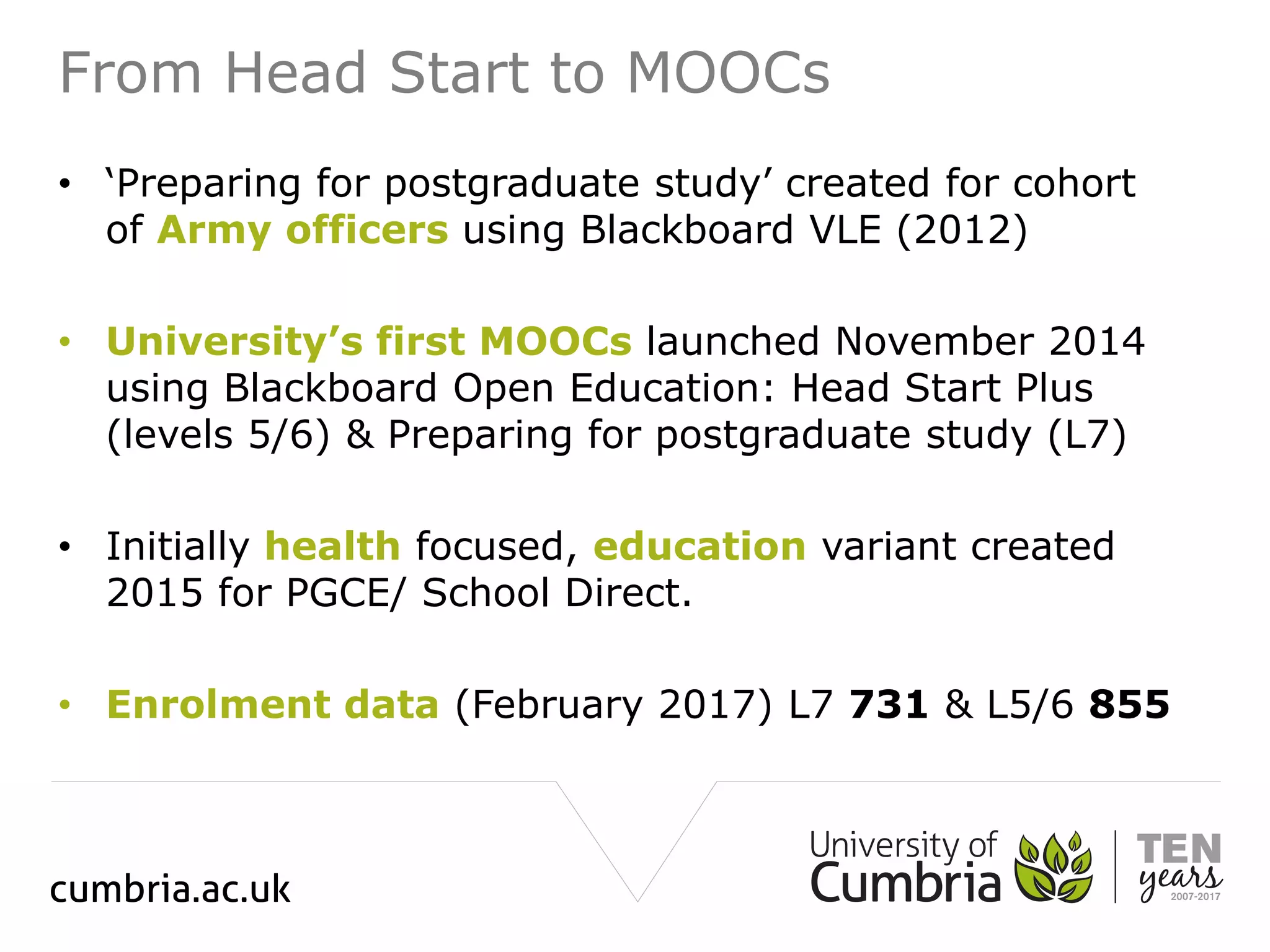
From Head Start to MOOCs
• ‘Preparing for postgraduate study’ created for cohort
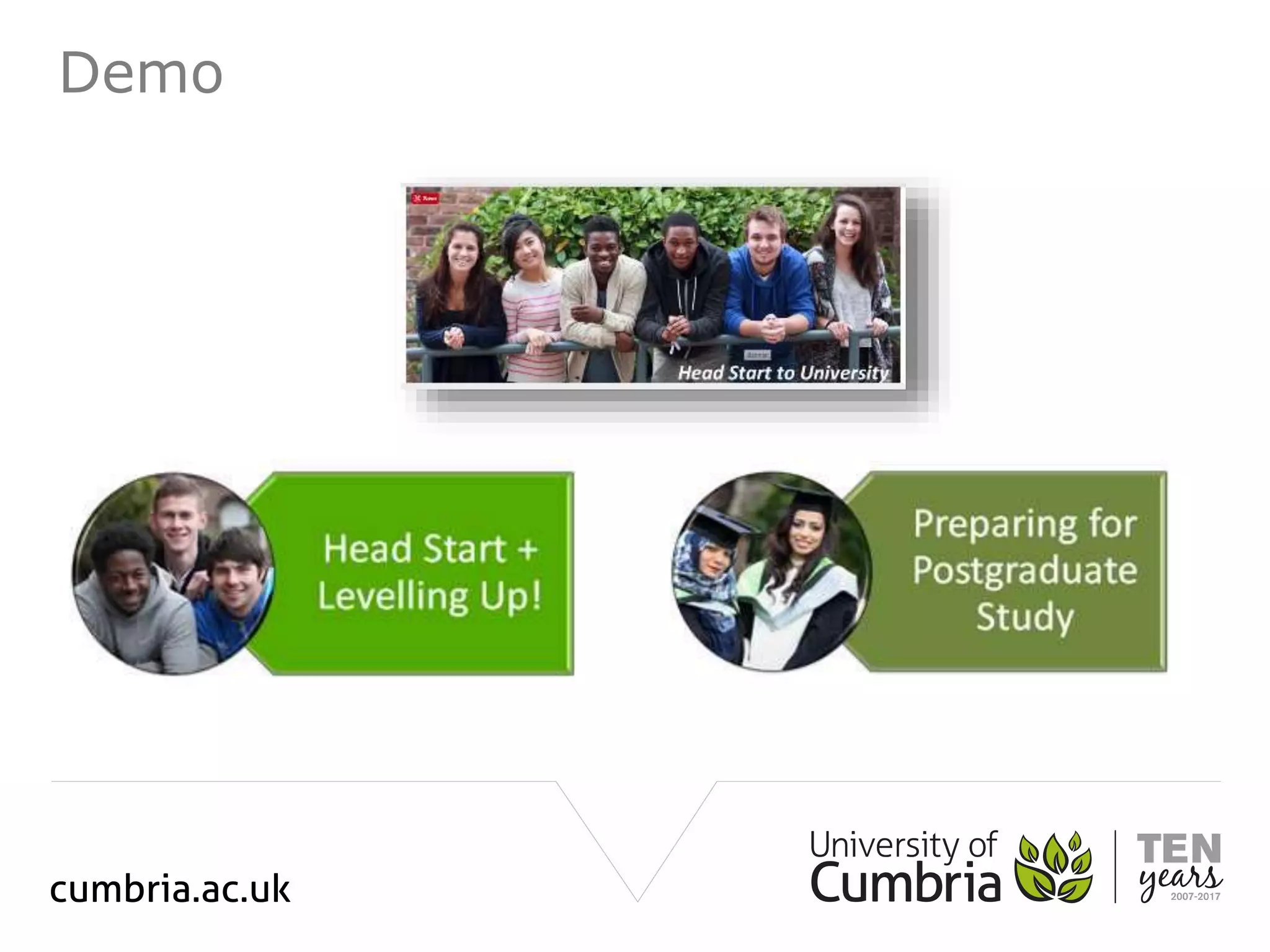
of Army officers using Blackboard VLE (2012)
• University’s first MOOCs launched November 2014
using Blackboard Open Education: Head Start Plus
(levels 5/6) & Preparing for postgraduate study (L7)
• Initially health focused, education variant created
2015 for PGCE/ School Direct.
• Enrolment data (February 2017) L7 731 & L5/6 855
Preparation for Masters level study
Previous research (West, 2012) highlights that
transition at Masters level is particularly important
for students studying on a more practical course (such
as counselling, nursing or CBT) and that we should not
make assumptions and expect postgraduate students to
arrive with the study skills necessary for M-level study
(Tobell, O’Donnell and Zammit, 2010; O’Donnell et al.,
2009; Watson, Johnson and Walker, 2005; Grotzer,
2005).
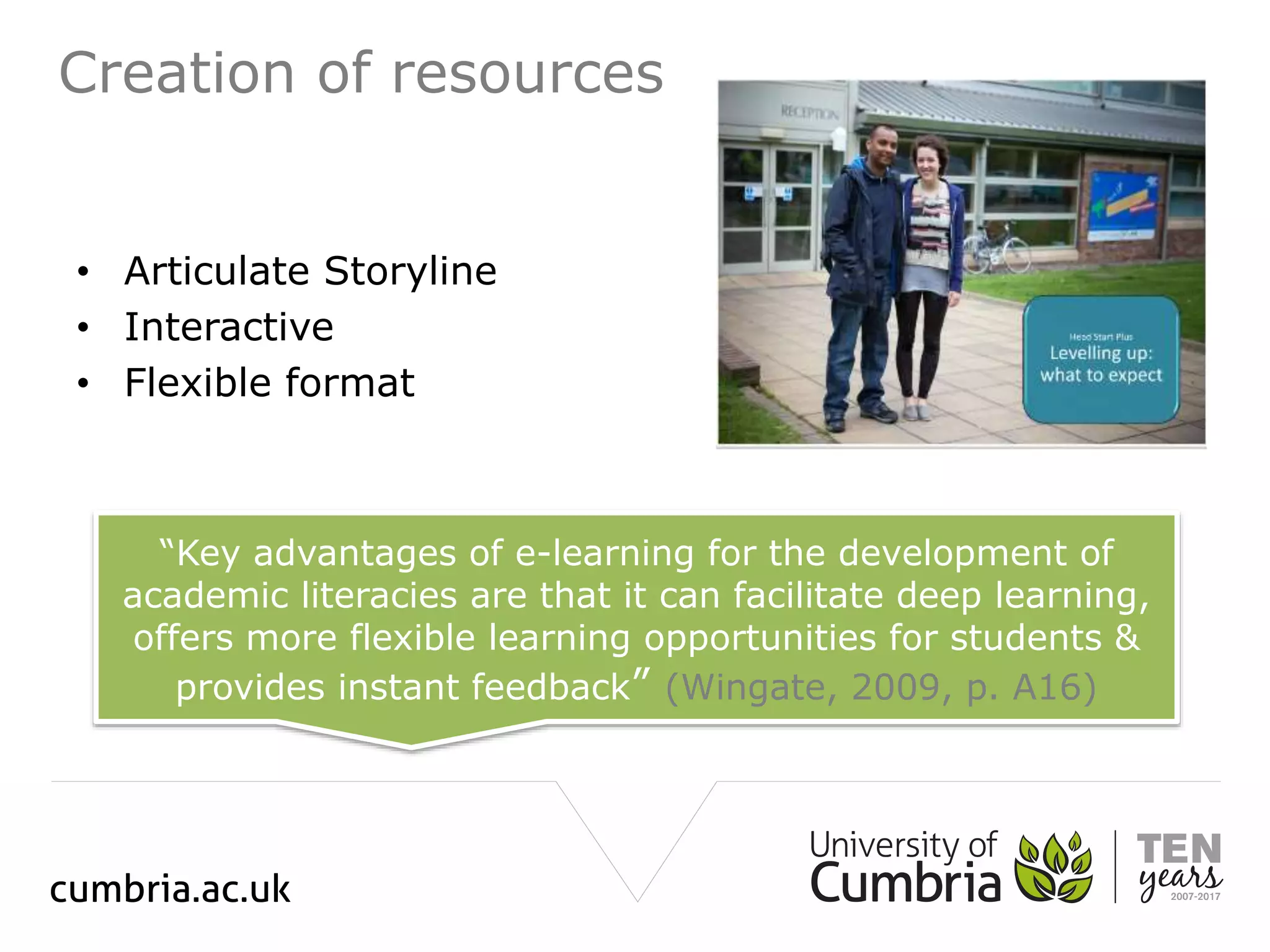
Creation of resources
• Articulate Storyline
• Interactive
• Flexible format
“Key advantages of e-learning for the development of
academic literacies are that it can facilitate deep learning,
offers more flexible learning opportunities for students &
provides instant feedback” (Wingate, 2009, p. A16)
Demo
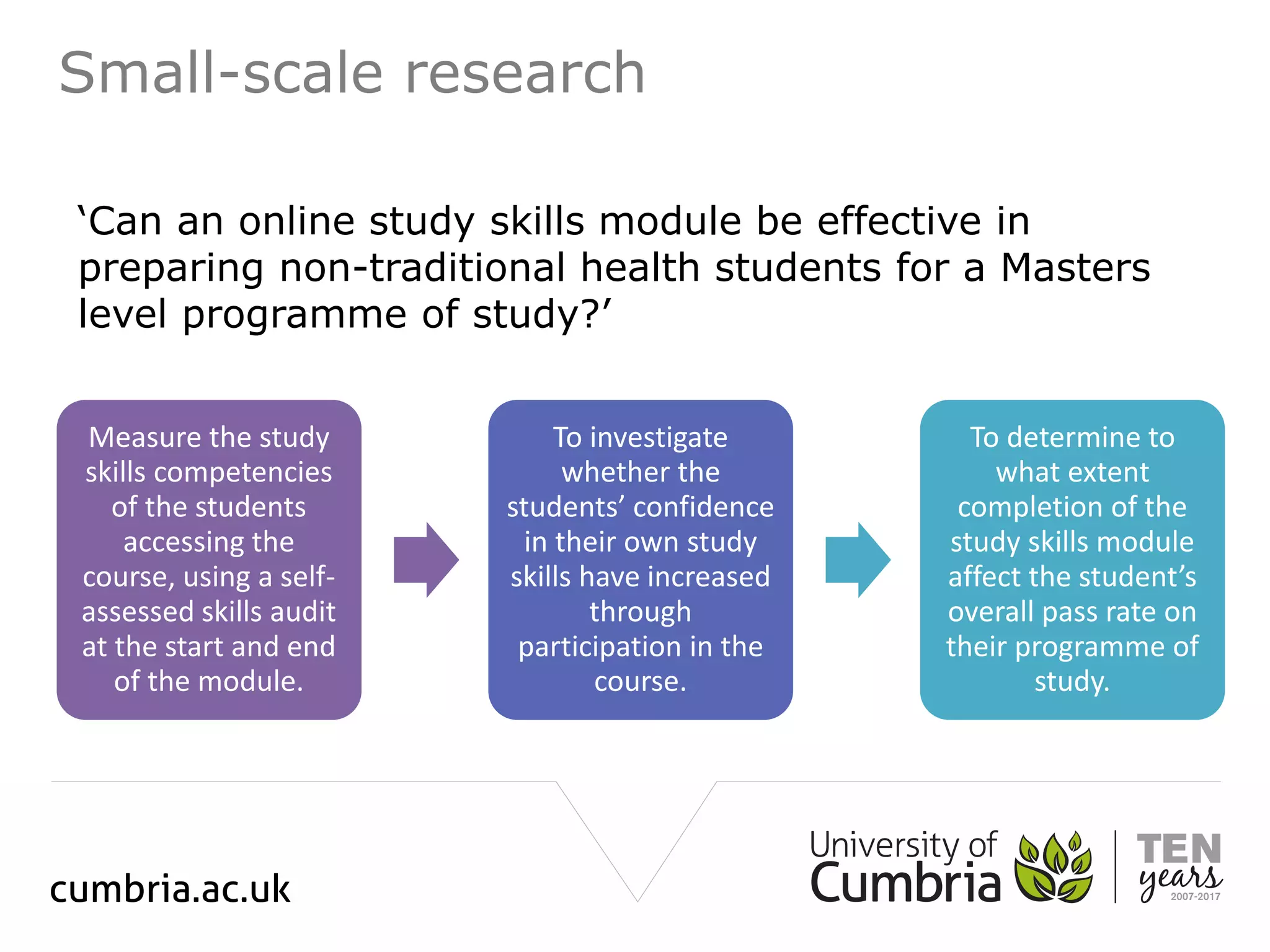
Small-scale research
‘Can an online study skills module be effective in
preparing non-traditional health students for a Masters
level programme of study?’
Measure the study
skills competencies
of the students
accessing the
course, using a self-
assessed skills audit
at the start and end
of the module.
To investigate
whether the
students’ confidence
in their own study
skills have increased
through
participation in the
course.
To determine to
what extent
completion of the
study skills module
affect the student’s
overall pass rate on
their programme of
study.
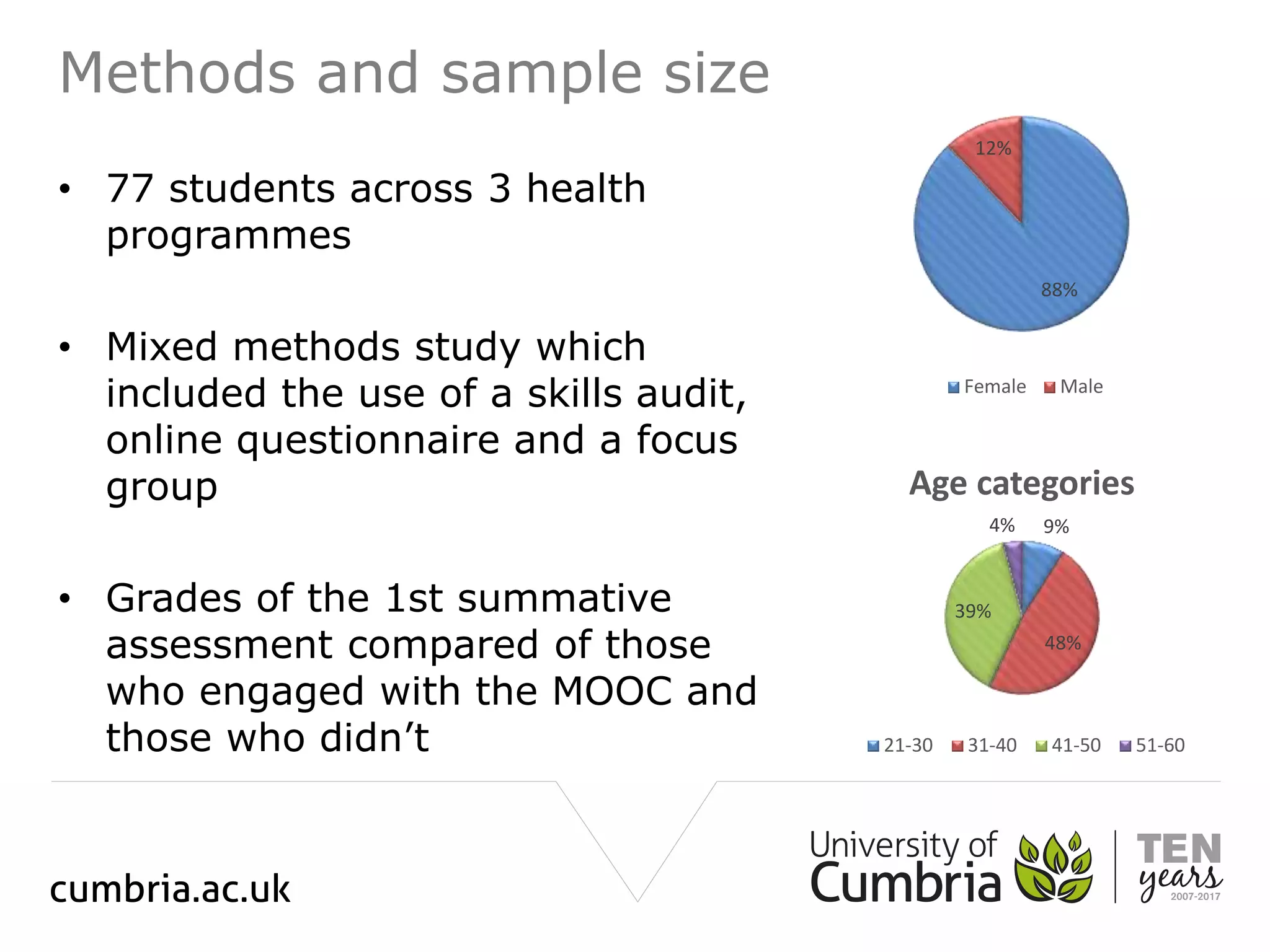
Methods and sample size
• 77 students across 3 health
programmes
• Mixed methods study which
included the use of a skills audit,
online questionnaire and a focus
group
• Grades of the 1st summative
assessment compared of those
who engaged with the MOOC and
those who didn’t
88%
12%
Female Male
9%
48%
39%
4%
Age categories
21-30 31-40 41-50 51-60
Key findings (1)
Do you feel that by accessing
the MOOC you felt more
confident about studying at
Masters-level?
Yes No Not sure
Do you think that by accessing the
MOOC you felt prepared for
studying at Masters-level at the
University of Cumbria?
Yes No Not sure
“I found [the MOOC] offered confidence in new skills and a
remembering of old skills. It allowed me to undertake September with
confidence and a deeper understanding of the skills I needed”
(Student 11)
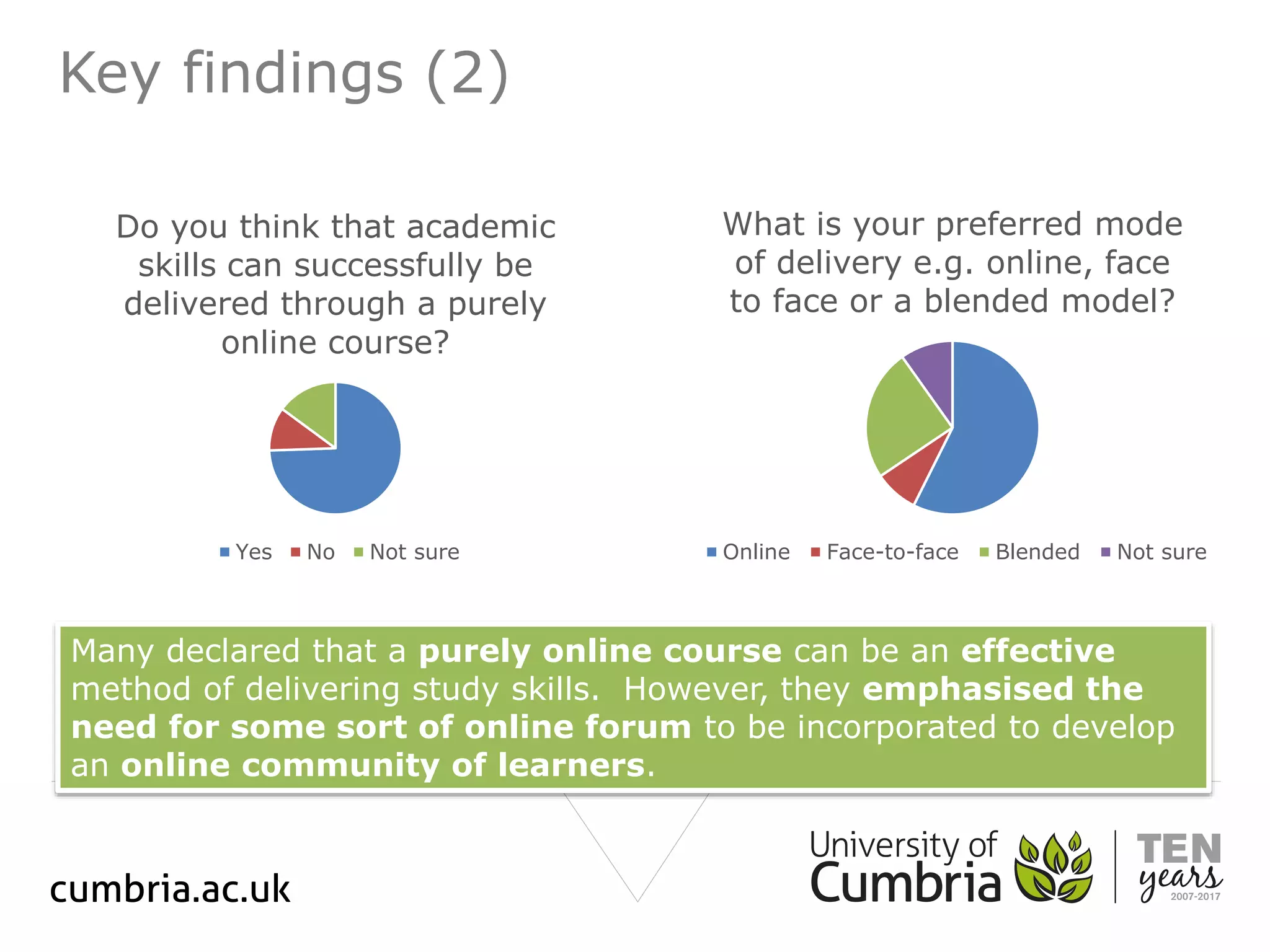
Key findings (2)
Many declared that a purely online course can be an effective
method of delivering study skills. However, they emphasised the
need for some sort of online forum to be incorporated to develop
an online community of learners.
Do you think that academic
skills can successfully be
delivered through a purely
online course?
Yes No Not sure
What is your preferred mode
of delivery e.g. online, face
to face or a blended model?
Online Face-to-face Blended Not sure
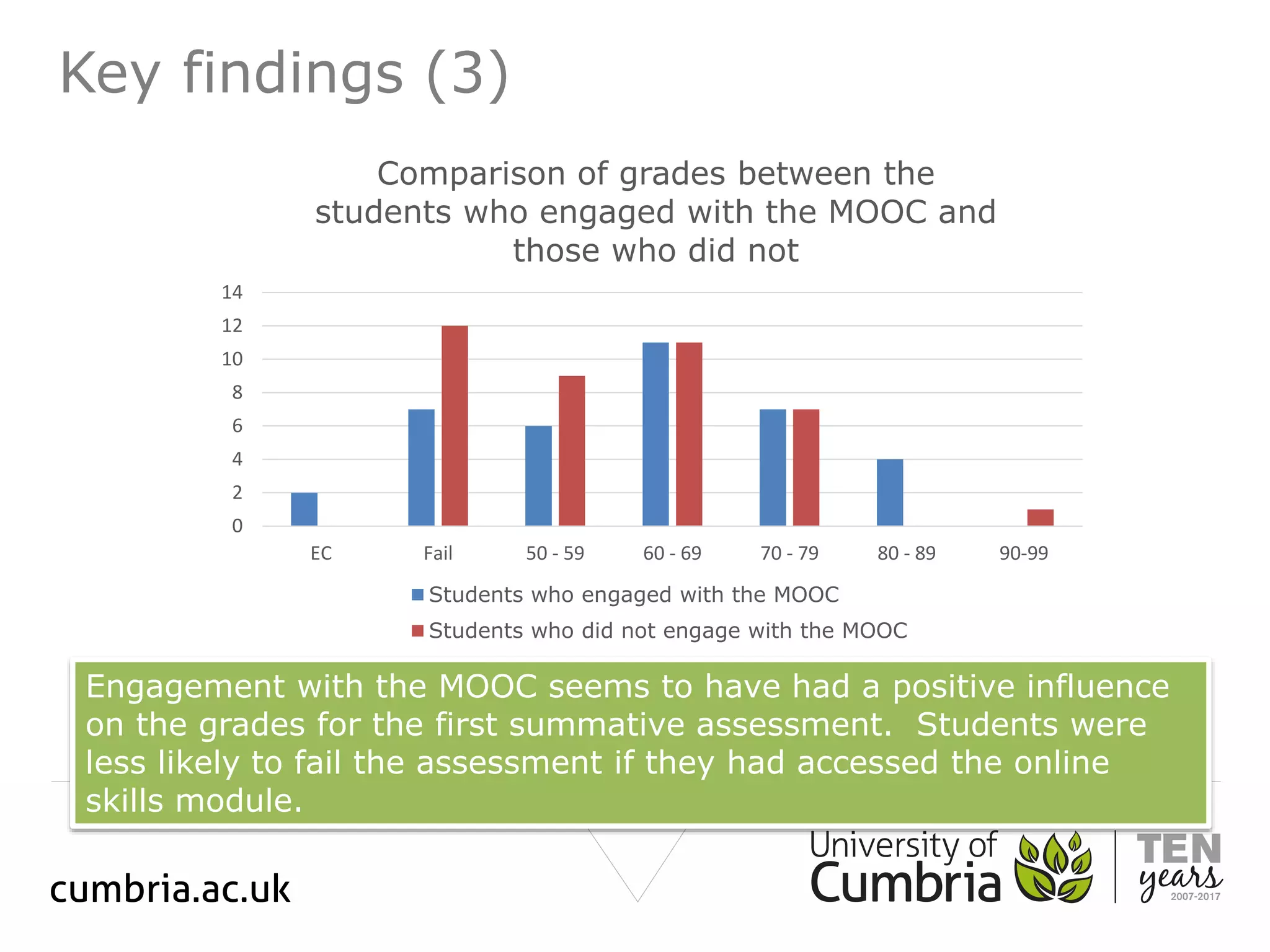
Key findings (3)
Engagement with the MOOC seems to have had a positive influence
on the grades for the first summative assessment. Students were
less likely to fail the assessment if they had accessed the online
skills module.
0
2
4
6
8
10
12
14
EC Fail 50 - 59 60 - 69 70 - 79 80 - 89 90-99
Comparison of grades between the
students who engaged with the MOOC and
those who did not
Students who engaged with the MOOC
Students who did not engage with the MOOC
Benefits and challenges
“The MOOCs have been useful in offering guidance to those new to
both Level 5/6 and Level 7 study.
Often students feel they are ready to study at a higher level and
have some understanding of academic writing however, when it
comes to submitting work, some have a tendency to write
descriptively. Some have a basic understanding of academic
writing but there are obvious mistakes in their referencing or by
not being critical or analytical enough. This is when I advise them
to look at the MOOCs”
Lisa Smith, Senior Lecturer in Emergency and Urgent Care (2017)
Benefits and challenges
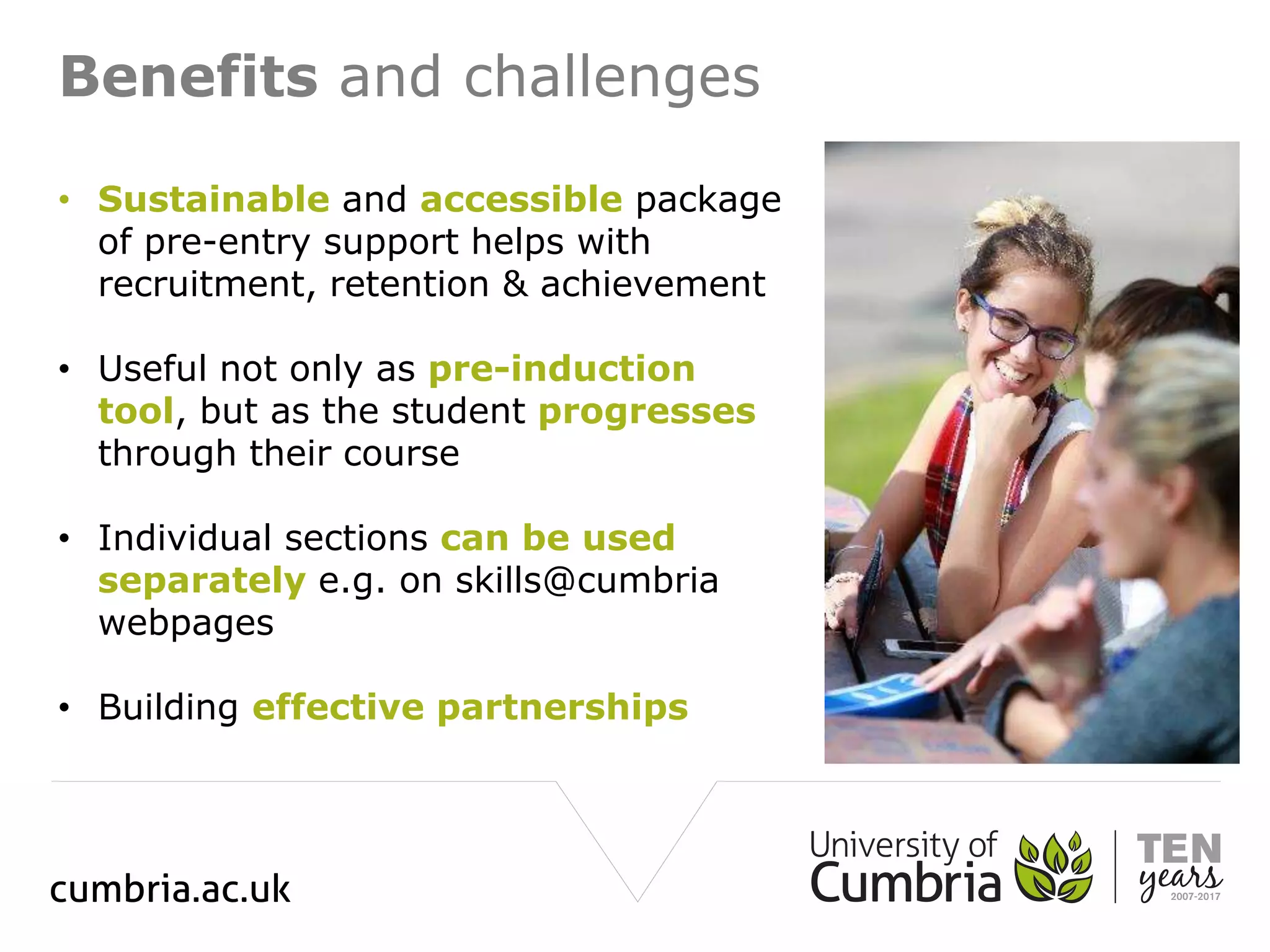
• Sustainable and accessible package
of pre-entry support helps with
recruitment, retention & achievement
• Useful not only as pre-induction
tool, but as the student progresses
through their course
• Individual sections can be used
separately e.g. on skills@cumbria
webpages
• Building effective partnerships
Benefits and challenges
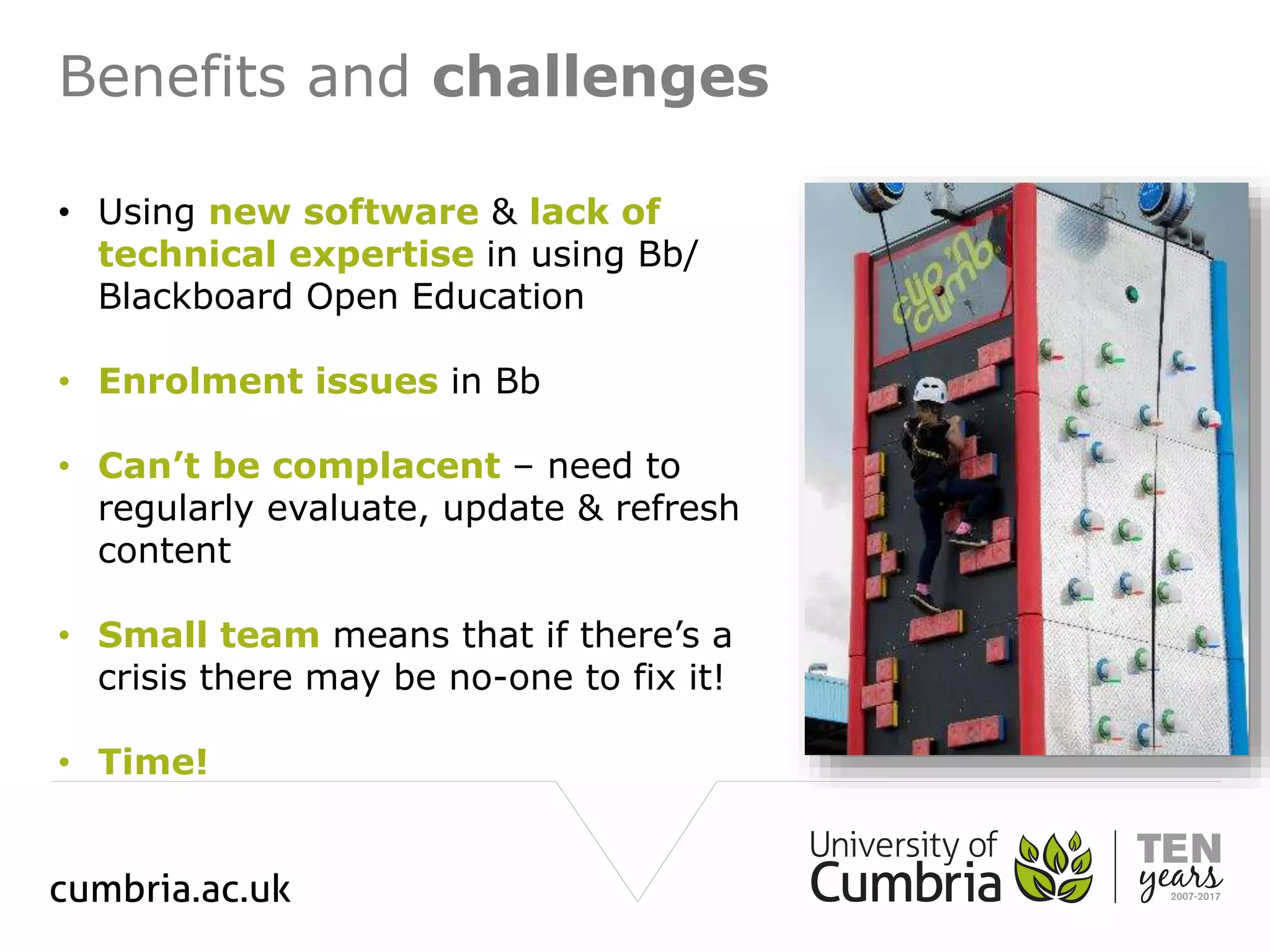
• Using new software & lack of
technical expertise in using Bb/
Blackboard Open Education
• Enrolment issues in Bb
• Can’t be complacent – need to
regularly evaluate, update & refresh
content
• Small team means that if there’s a
crisis there may be no-one to fix it!
• Time!
Moving forward
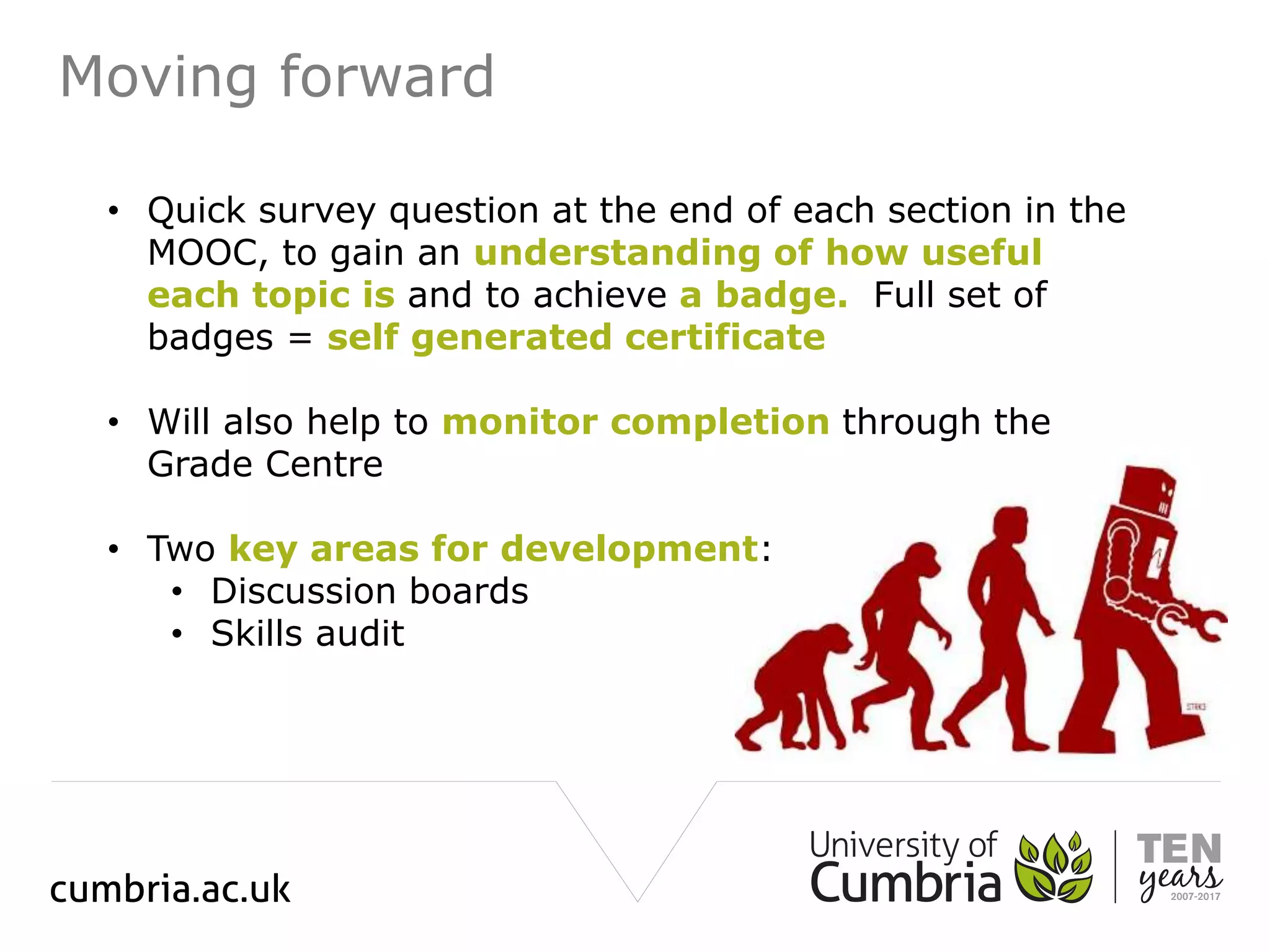
• Quick survey question at the end of each section in the
MOOC, to gain an understanding of how useful
each topic is and to achieve a badge. Full set of
badges = self generated certificate
• Will also help to monitor completion through the
Grade Centre
• Two key areas for development:
• Discussion boards
• Skills audit
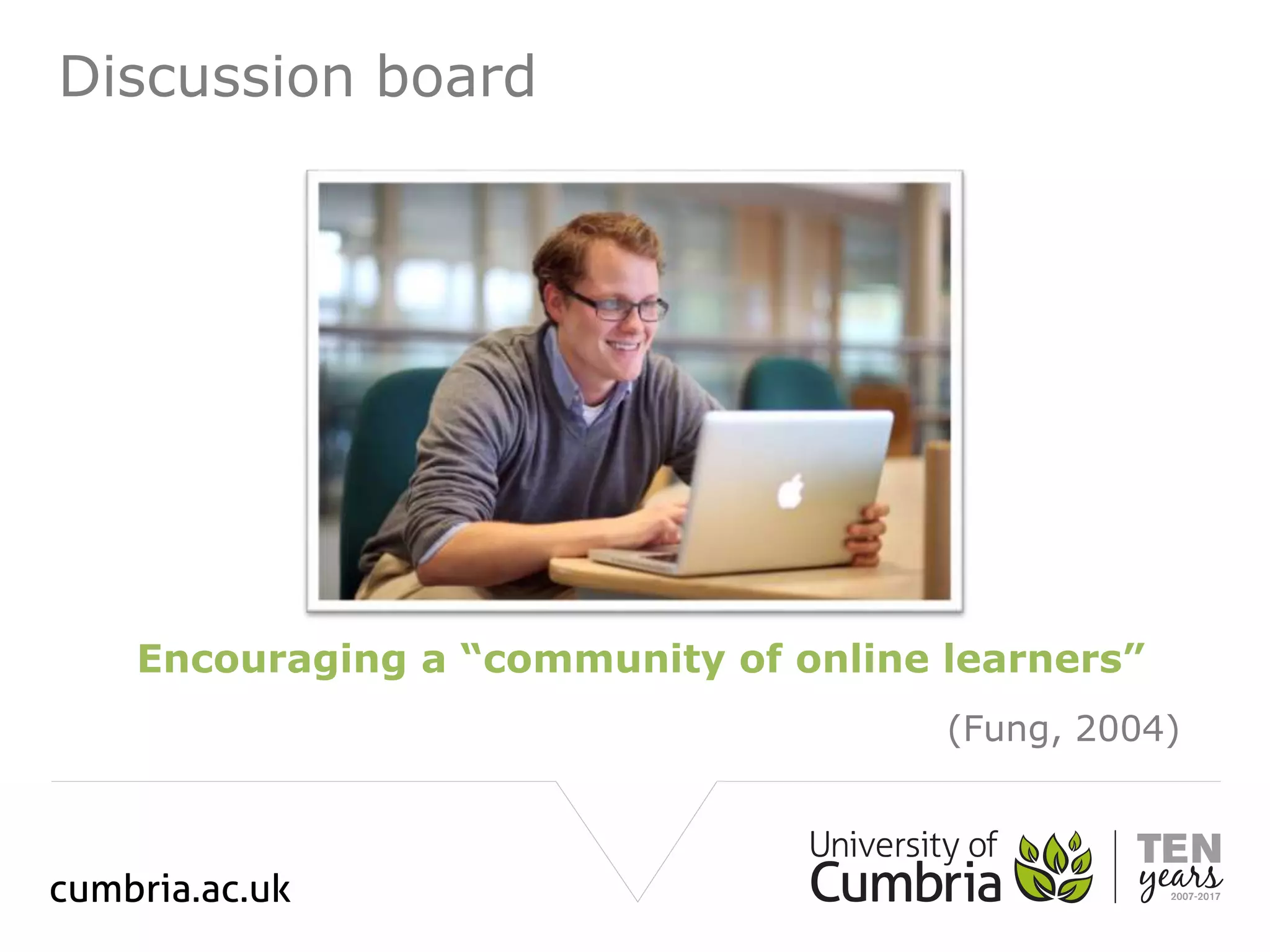
Discussion board
Encouraging a “community of online learners”
(Fung, 2004)
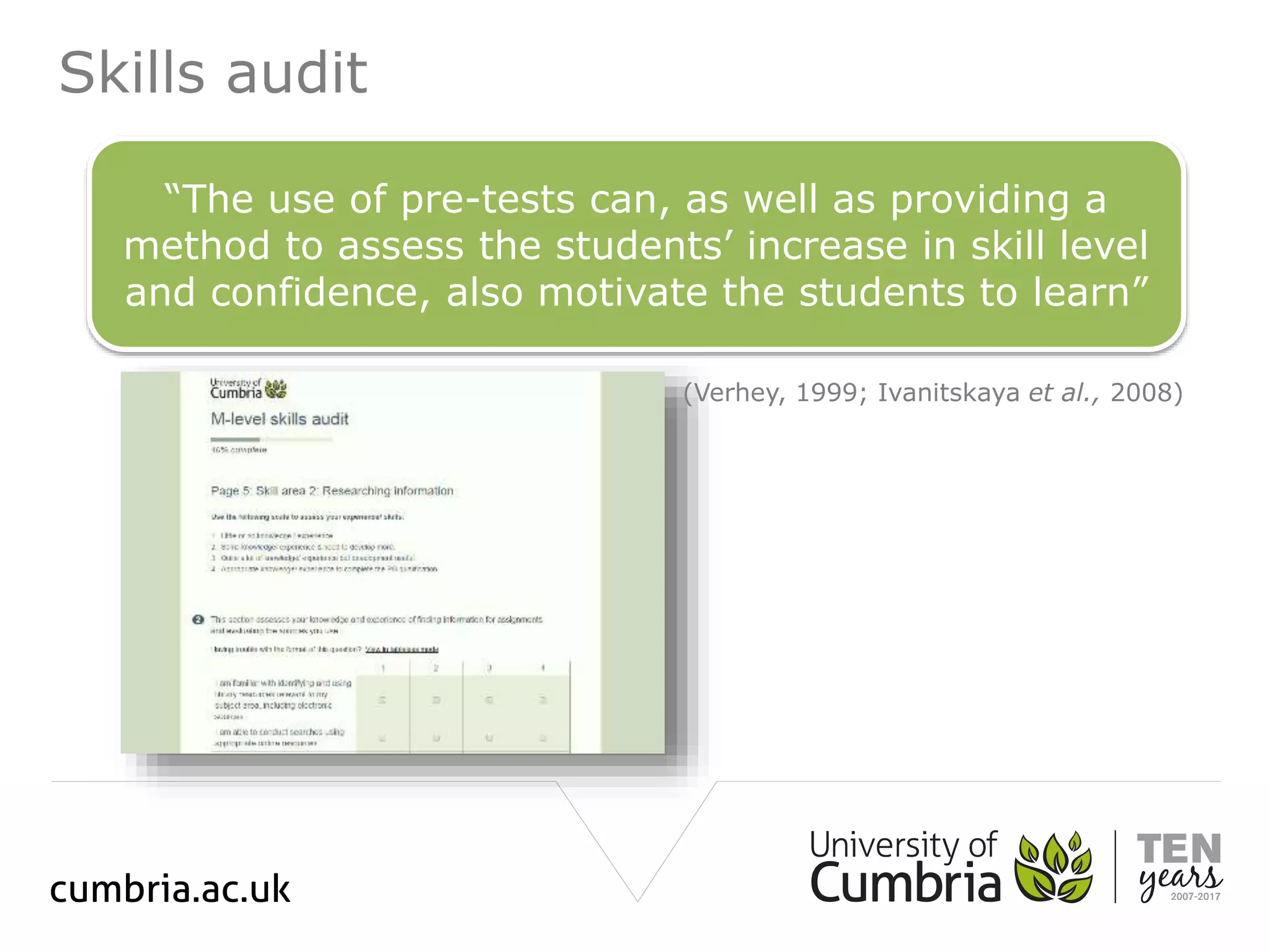
Skills audit
“The use of pre-tests can, as well as providing a
method to assess the students’ increase in skill level
and confidence, also motivate the students to learn”
(Verhey, 1999; Ivanitskaya et al., 2008)
Reference list of
To access the reference list via Google Drive click on the link below:
https://drive.google.com/file/d/0B02a4M-
IesMWdUVyczFxbG4tWDQ/view?usp=sharing

Mind the Gap: Using MOOCs to provide pre-entry skills support at the University of Cumbria - Lesley English

  • 1.
    Outline Using MOOCs toprovide pre-entry skills support at the University of Cumbria lesley.english@cumbria.ac.uk
  • 2.
    Outline • Introduction tothe University of Cumbria & the role of the library and academic adviser • The evolution of the MOOC: where it all began • Creation of resources & finding the right platform • Small scale research • Benefits, challenges and moving forward
  • 3.
    McVeigh 2012 o Oneof the UK’s newest Universities o Formed in 2007 from well established institutions: Cumbria Institute of the arts, St Martin’s College and the Cumbrian campus of UCLAN o Campuses in 5 locations as well as Gateway sites o Curriculum relevant to the region o Lower than expected progression to HE based on GCSE performance in Cumbria Introducing the University of Cumbria
  • 5.
    Demographics of ourstudents • 8790 students at the University, 80% are undergraduate (including foundation degree). Of the 1795 postgraduate students, 55% were studying part-time (HESA, 2016) • 62-65% of our FT UG students have at least one Widening Participation (WP) characteristic • Post-1992 University – students arrive with generally lower grades • Professional courses e.g. nursing & midwifery, counselling, paramedic practice, OT & more. May not be as academically strong but have significant strengths in skills (West, 2012)
  • 6.
    Pre-entry support • Lackof preparedness for HE is one of the main factors why students don’t complete their course (Murtagh, 2012) • Most UK HEI’s prioritise the area of transition & the ‘first year experience’ as they are recognised in improving student retention & success (Thomas, 2012) • Interventions at this pre-entry stage need to engage students, provide key information about both the University and their course to ensure they arrive with realistic expectations, and develop the students’ own confidence (HEFCE, 2012a)
  • 7.
    Library & Academic Adviser Student support: academic literacies Collection management Teaching Creation of online resources e.g.MOOC Academic liaison Transition & retention initiatives Supporting researchers Study skills support • From March 2017 team sits within Information Services • Converged professional service singe 2009: Library & Student Services • Blended role • Involved in a number of pre-entry, induction & retention projects, including Head Start
  • 8.
    In the beginning…Head Start • Project led by LiSS working with learning technologists & academics • Uses Blackboard, University’s VLE • Accredited module launched Spring 2012 for UG applicants • Spring 2013 - non-accredited version • Now 5 Head Start pathways: 4 UG with subject focus & 1 at level 7 for PGCE/ School Direct The key aim of Head Start was to “raise confidence levels and in part prepare students for the demands of studying at university level” (Fraser, Shaw and Ruston, 2013, p.129).
  • 9.
    Assessment All assessments are self-marking quizzes Scoresfeed into Grade Centre in Bb We can see when a student has passed, when they last logged on, etc.
  • 10.
    What Library &Academic advisers said… “A significant proportion of students we taught had engaged with Head Start. In particular we found Head Start students to be notably more confident and appropriately vocal in sessions.” Kim McGowan, Information Literacy Award Winner 2013
  • 11.
    Data: Summer 2016 785students enrolled across UG & PG pathways (532 UG & 253 PG) completed core element 1: ‘Writing in HE’ (UG variant) completed core element 2: ‘Referencing explained’ (UG variant) of those PG students enrolled engaged with the module of students have revisited Head Start since the Welcome Week start dates 46% 57% 41% 84%
  • 12.
  • 13.
    From Head Startto MOOCs • ‘Preparing for postgraduate study’ created for cohort of Army officers using Blackboard VLE (2012) • University’s first MOOCs launched November 2014 using Blackboard Open Education: Head Start Plus (levels 5/6) & Preparing for postgraduate study (L7) • Initially health focused, education variant created 2015 for PGCE/ School Direct. • Enrolment data (February 2017) L7 731 & L5/6 855
  • 14.
    Preparation for Masterslevel study Previous research (West, 2012) highlights that transition at Masters level is particularly important for students studying on a more practical course (such as counselling, nursing or CBT) and that we should not make assumptions and expect postgraduate students to arrive with the study skills necessary for M-level study (Tobell, O’Donnell and Zammit, 2010; O’Donnell et al., 2009; Watson, Johnson and Walker, 2005; Grotzer, 2005).
  • 15.
    Creation of resources •Articulate Storyline • Interactive • Flexible format “Key advantages of e-learning for the development of academic literacies are that it can facilitate deep learning, offers more flexible learning opportunities for students & provides instant feedback” (Wingate, 2009, p. A16)
  • 16.
  • 18.
    Small-scale research ‘Can anonline study skills module be effective in preparing non-traditional health students for a Masters level programme of study?’ Measure the study skills competencies of the students accessing the course, using a self- assessed skills audit at the start and end of the module. To investigate whether the students’ confidence in their own study skills have increased through participation in the course. To determine to what extent completion of the study skills module affect the student’s overall pass rate on their programme of study.
  • 19.
    Methods and samplesize • 77 students across 3 health programmes • Mixed methods study which included the use of a skills audit, online questionnaire and a focus group • Grades of the 1st summative assessment compared of those who engaged with the MOOC and those who didn’t 88% 12% Female Male 9% 48% 39% 4% Age categories 21-30 31-40 41-50 51-60
  • 20.
    Key findings (1) Doyou feel that by accessing the MOOC you felt more confident about studying at Masters-level? Yes No Not sure Do you think that by accessing the MOOC you felt prepared for studying at Masters-level at the University of Cumbria? Yes No Not sure “I found [the MOOC] offered confidence in new skills and a remembering of old skills. It allowed me to undertake September with confidence and a deeper understanding of the skills I needed” (Student 11)
  • 21.
    Key findings (2) Manydeclared that a purely online course can be an effective method of delivering study skills. However, they emphasised the need for some sort of online forum to be incorporated to develop an online community of learners. Do you think that academic skills can successfully be delivered through a purely online course? Yes No Not sure What is your preferred mode of delivery e.g. online, face to face or a blended model? Online Face-to-face Blended Not sure
  • 22.
    Key findings (3) Engagementwith the MOOC seems to have had a positive influence on the grades for the first summative assessment. Students were less likely to fail the assessment if they had accessed the online skills module. 0 2 4 6 8 10 12 14 EC Fail 50 - 59 60 - 69 70 - 79 80 - 89 90-99 Comparison of grades between the students who engaged with the MOOC and those who did not Students who engaged with the MOOC Students who did not engage with the MOOC
  • 23.
    Benefits and challenges “TheMOOCs have been useful in offering guidance to those new to both Level 5/6 and Level 7 study. Often students feel they are ready to study at a higher level and have some understanding of academic writing however, when it comes to submitting work, some have a tendency to write descriptively. Some have a basic understanding of academic writing but there are obvious mistakes in their referencing or by not being critical or analytical enough. This is when I advise them to look at the MOOCs” Lisa Smith, Senior Lecturer in Emergency and Urgent Care (2017)
  • 24.
    Benefits and challenges •Sustainable and accessible package of pre-entry support helps with recruitment, retention & achievement • Useful not only as pre-induction tool, but as the student progresses through their course • Individual sections can be used separately e.g. on skills@cumbria webpages • Building effective partnerships
  • 25.
    Benefits and challenges •Using new software & lack of technical expertise in using Bb/ Blackboard Open Education • Enrolment issues in Bb • Can’t be complacent – need to regularly evaluate, update & refresh content • Small team means that if there’s a crisis there may be no-one to fix it! • Time!
  • 26.
    Moving forward • Quicksurvey question at the end of each section in the MOOC, to gain an understanding of how useful each topic is and to achieve a badge. Full set of badges = self generated certificate • Will also help to monitor completion through the Grade Centre • Two key areas for development: • Discussion boards • Skills audit
  • 27.
    Discussion board Encouraging a“community of online learners” (Fung, 2004)
  • 28.
    Skills audit “The useof pre-tests can, as well as providing a method to assess the students’ increase in skill level and confidence, also motivate the students to learn” (Verhey, 1999; Ivanitskaya et al., 2008)
  • 29.
    Reference list of Toaccess the reference list via Google Drive click on the link below: https://drive.google.com/file/d/0B02a4M- IesMWdUVyczFxbG4tWDQ/view?usp=sharing