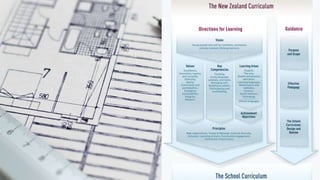
A framework for building an
information literate community
SLANZA
Conference
Auckland
July 2017
What is Information Literacy?
Information Literacy involves the processes,
strategies, skills, competencies,
expertise and ways of thinking which enable
individuals to engage with information to
learn across a range of platforms, transform the
known, and discover the unknown.
Definition
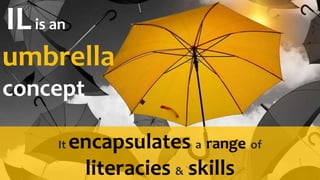
ILis an
umbrella
concept
It encapsulates a range of
literacies & skills
“To be information literate, a
person must be able to
recognise when information is
needed”
American Library Association
Information Literacy
is one of the beacons
of the information society,
illuminatingthe courses
to development, prosperity
& freedom
Alexandria Proclamation on Information Literacy and Lifelong Learning
“We are drowning in
information but starvedfor
knowledge.”
John Naisbitt
We need to stop thinking of
the library as a
grocery store – a place
to “get stuff”
and start thinking about it as a
kitchen– a place
to “make stuff.”
Joyce Valenza
The
Research
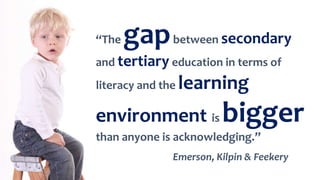
“The gapbetween secondary
and tertiary education in terms of
literacy and the learning
environment is bigger
than anyone is acknowledging.”
Emerson, Kilpin & Feekery
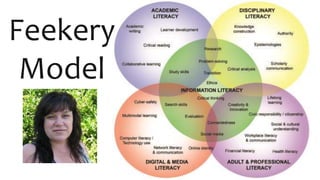
Feekery
Model
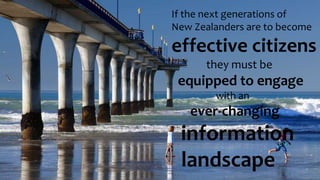
If the next generations of
New Zealanders are to become
effective citizens
they must be
equipped to engage
with an
ever-changing
information
landscape
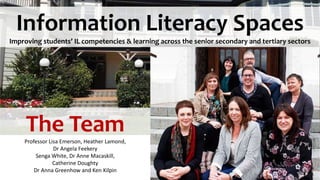
Information Literacy Spaces
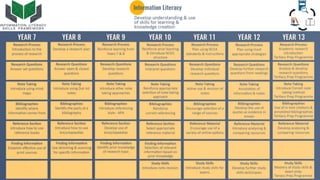
Improving students’ IL competencies & learning across the senior secondary and tertiary sectors
The TeamProfessor Lisa Emerson, Heather Lamond,
Dr Angela Feekery
Senga White, Dr Anne Macaskill,
Catherine Doughty
Dr Anna Greenhow and Ken Kilpin
We plan to:
Collaboratively develop a baseline IL study
Develop collaborative teacher/librarian
partnerships
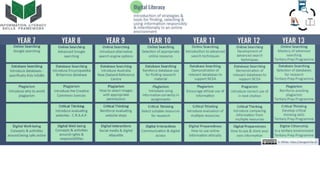
Develop IL progressions and resources
Through
Participatory Action Research
and mixed methods
to embed IL skills throughout secondary
and tertiary programmes
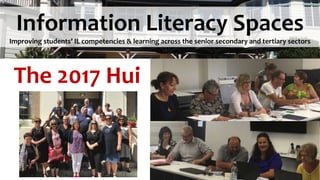
Information Literacy Spaces
Improving students’ IL competencies & learning across the senior secondary and tertiary sectors
The 2017 Hui
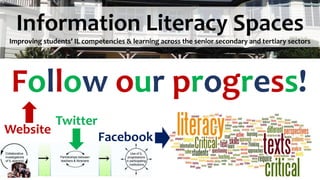
Information Literacy Spaces
Improving students’ IL competencies & learning across the senior secondary and tertiary sectors
Website
Twitter
Facebook
Follow our progress!
“The illiterateof the 21st century will not be
those who cannot read and write, but
those who cannot learn, unlearn, and
relearn.”
Alvin Toffler
Occupational Invisibility
“Others often do not see depth,
breadth and importance
of what school librarians
contributeto
learningin schools”
Gary Hartzell
Make the
invisible
Make the
visible
Make the
implicit
explicit
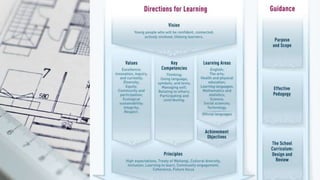
The School Library and Learning
in the Information Landscape
Guidelines for New Zealand Schools
Guiding
Principles
National Library Services to Schools &
New Zealand Ministry of Education - 2002
Information Landscape: Guidelines for New Zealand Schools
The school library is a
learning environment
central to the development of an
information-literate
school community
Develop
information literate
students who are
responsible and
ethical participants
in society
Develop competent,
self-directed learners
who are aware of
their information needs
and actively engage in
the world of ideas
Develop students
who know how
to locateand
select
relevant
information,
And can manage
technologytools to
accessinformation
& communicate
what they’ve learned
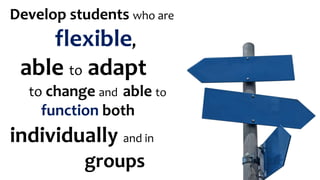
Develop students who are
flexible,
able to adapt
to change and able to
function both
individually and in
groups
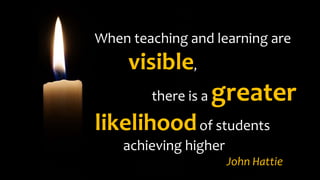
When teaching and learning are
visible,
there is a greater
likelihoodof students
achieving higher
John Hattie
ERO
Report
2005
Student Learning
in the Information Landscape
Working with teachers
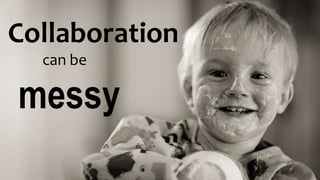
Collaboration
can be
messy
Keys to Success
Plan for it
Be organised
Be positive
Stay curious
Approaches
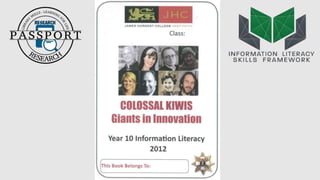
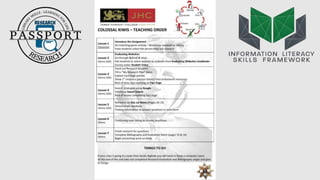
One-off lesson
One teacher
One unit
One Department
Whole School
Lessons
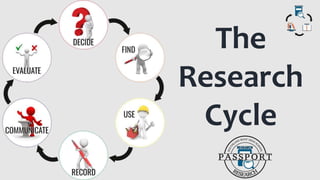
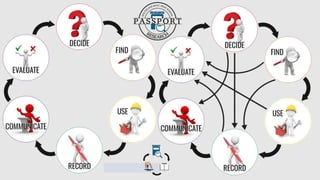
The
Research
Cycle
The Pizza Research Process
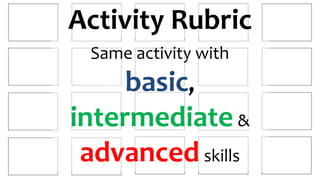
Activity Rubric
Same activity with
basic,
intermediate&
advanced skills
Google
Searching
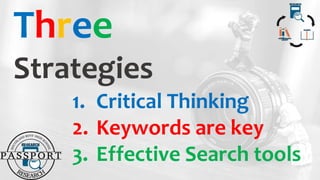
Three
Strategies
1. Critical Thinking
2. Keywords are key
3. Effective Search tools
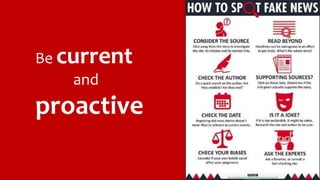
Be current
and
proactive
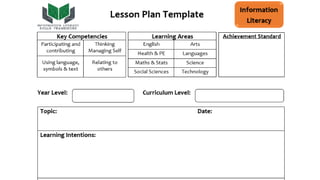
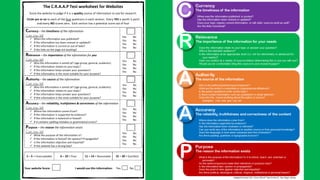
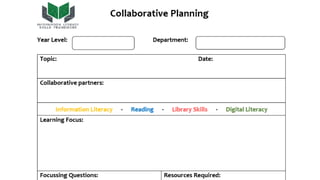
Templates
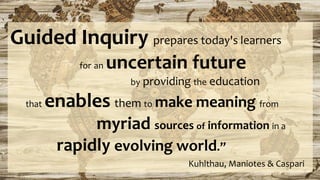
Guided Inquiry prepares today's learners
for an uncertain future
by providing the education
that enables them to make meaning from
myriad sources of information in a
rapidly evolving world.”
Kuhlthau, Maniotes & Caspari
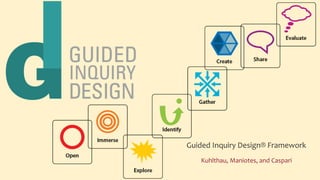
Kuhlthau, Maniotes, and Caspari
Guided Inquiry Design® Framework
Ultimately,
information literate
people
are those who have
learnedhow to
learnAmerican Library Association
Passionate
librarians
are
infectious!
Teachers &librarians
need to
become effective
evaluatorsof
their
own
practice
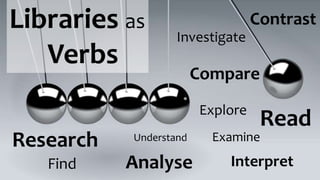
Find
Research
Analyse
Explore
Examine
Compare
Contrast
Understand
Interpret
Investigate
Read
Libraries as
Verbs
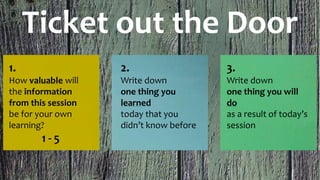
Ticket out the Door
1.
How valuable will
the information
from this session
be for your own
learning?
1 - 5
2.
Write down
one thing you
learned
today that you
didn’t know before
3.
Write down
one thing you will
do
as a result of today’s
session
“You can never
be
over-dressed
or
over-educated.”
Oscar Wilde
School Library Manifesto
and Guiding Principles
Creating an Information Literate Community

Creating an Information Literate Community

Editor's Notes

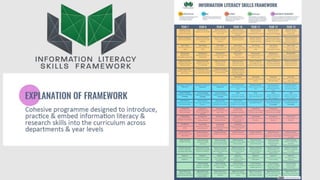
  • #64 Introduce, practice and embed IL across depts. & year levels