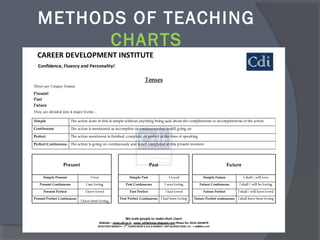
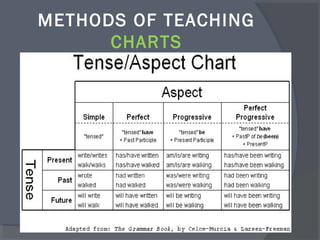
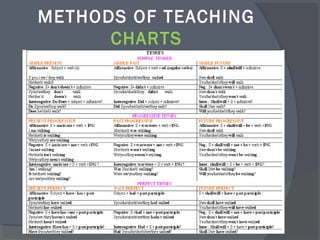
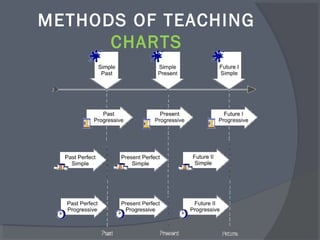

TYPES OF TENSES
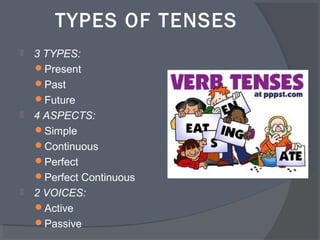
 3 TYPES:
Present
Past
Future
 4 ASPECTS:
Simple
Continuous
Perfect
Perfect Continuous
 2 VOICES:
Active
Passive
MAIN POINTS WHILE
TEACHING
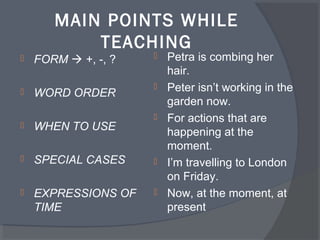
 FORM  +, -, ?
 WORD ORDER
 WHEN TO USE
 SPECIAL CASES
 EXPRESSIONS OF
TIME
 Petra is combing her
hair.
 Peter isn’t working in the
garden now.
 For actions that are
happening at the
moment.
 I’m travelling to London
on Friday.
 Now, at the moment, at
present
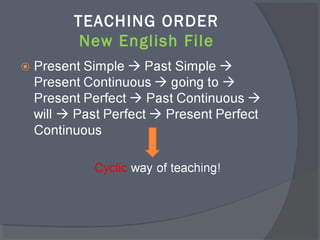
TEACHING ORDER
New English File
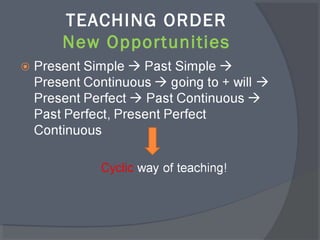
TEACHING ORDER
New Opportunities
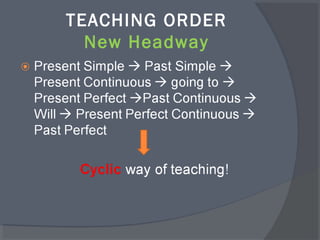
TEACHING ORDER
New Headway
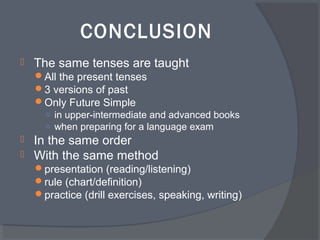
CONCLUSION
 The same tenses are taught
All the present tenses
3 versions of past
Only Future Simple
○ in upper-intermediate and advanced books
○ when preparing for a language exam
 In the same order
 With the same method
presentation (reading/listening)
rule (chart/definition)
practice (drill exercises, speaking, writing)
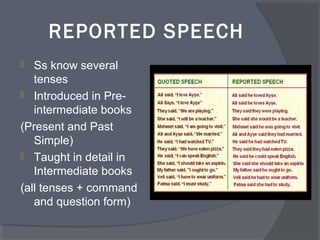
REPORTED SPEECH
 Ss know several
tenses
 Introduced in Pre-
intermediate books
(Present and Past
Simple)
 Taught in detail in
Intermediate books
(all tenses + command
and question form)
METHODS OF TEACHING
CHARTS
METHODS OF TEACHING
CHARTS
METHODS OF TEACHING
CHARTS
METHODS OF TEACHING
CHARTS
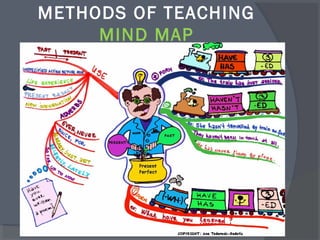
METHODS OF TEACHING
MIND MAP
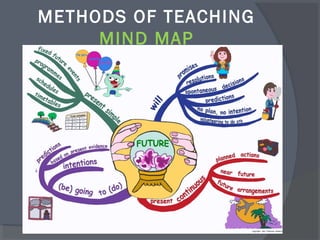
METHODS OF TEACHING
MIND MAP
OTHER SOURCES FOR
PRACTICE
 Hadfield: Elementary Grammar Games
 Hadfield: Elementary Communication
Games
 Hadfield: Intermediate Communication
Games
 Murphy: Grammar in Use
 Katalin Németh: English Grammar
THANK YOU FOR YOUR
KIND ATTENTION!

Tenses