Future Focused
Schools
Online Workshop - 5 May 2020
Derek Wenmoth
@dwenmoth #futurefocused
What we’d like to achieve…
By the end of the workshop you will…
identify principles of building future-focused schoolsIdentify
realise a future-focused school through the alignment of school-wide strategies,
policies and practicesRealise
courageously lead your school community to provide future focused, relevant
learning programmes.Lead
Group Session One
• What comes to your
mind when you hear
the term ‘future
focused’?
• How does it make you
feel?
Future Shock
“Future shock is the shattering
stress and disorientation that
we induce in individuals by
subjecting them to too much
change in too short a time.”
• Alvin Toffler (1970)
The new
normal?
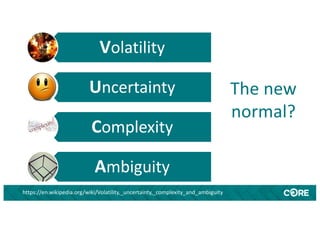
Volatility
Uncertainty
Complexity
Ambiguity
https://en.wikipedia.org/wiki/Volatility,_uncertainty,_complexity_and_ambiguity
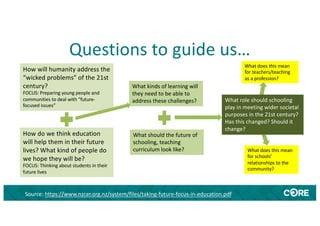
Questions to guide us…
Source: https://www.nzcer.org.nz/system/files/taking-future-focus-in-education.pdf
How will humanity address the
“wicked problems” of the 21st
century?
FOCUS: Preparing young people and
communities to deal with “future-
focused issues”
How do we think education
will help them in their future
lives? What kind of people do
we hope they will be?
FOCUS: Thinking about students in their
future lives
What kinds of learning will
they need to be able to
address these challenges?
What does this mean
for teachers/teaching
as a profession?
What does this mean
for schools’
relationships to the
community?
What should the future of
schooling, teaching
curriculum look like?
What role should schooling
play in meeting wider societal
purposes in the 21st century?
Has this changed? Should it
change?
Future Focus issues
• What are the big issues facing
our world currently?
• What are the things we see
becoming issues into the
future?
How will humanity address
the “wicked problems” of
the 21st century?
FOCUS: Preparing young people and
communities to deal with “future-
focused issues”
1
Global challenges…
• Food supply
• Water
• Environment
• War, terrorism and refugees
• Technology, AI, robots
• Equity
• Access to education
• Super-diversity
• Human rights
• Poverty
• Religious intolerance
• Child Poverty
• Threats to biodiversity
• Energy
1
Discuss
• Are any of these issues
addressed in the
curriculum in your
school?
• How?
https://www.needpix.com/photo/547083/group-chat-icon-website-internet-web-discussion-website-icons-computer
1
Future lives of students?
How do we think education
will help them in their future
lives? What kind of people
do we hope they will be?
FOCUS: Thinking about students in
their future lives
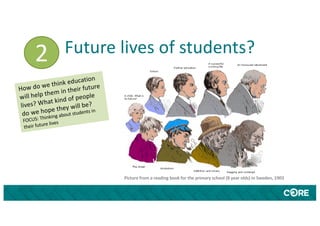
Picture from a reading book for the primary school (8 year olds) in Sweden, 1903
2
Future of work
BOYS GIRLS
1. Engineer
2. Business manager
3. Doctor
4. ICT professional
5. Sportsman
6. Teacher
7. Police officer
8. Mechanic
9. Lawyer
10. Architect
1. Doctor
2. Teacher
3. Business manager
4. Lawyer
5. Nurse/midwife
6. Psychologist
7. Designer
8. Veterinarian
9. Police officer
10. Architect
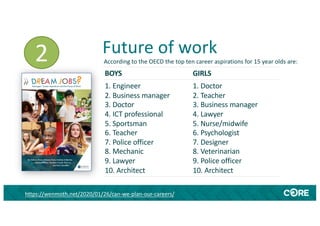
According to the OECD the top ten career aspirations for 15 year olds are:
https://wenmoth.net/2020/01/26/can-we-plan-our-careers/
2
What skills?
http://educatingforthefuture.economist.com/#
• Interdisciplinary skills
• Creative and analytical skills
• Entrepreneurial skills
• Leadership skills
• Digital and technical skills
• Global awareness and civic
education
2
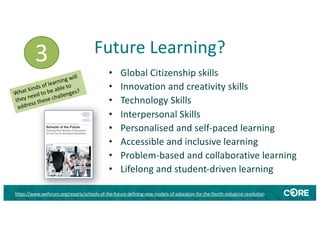
Future Learning?
• Global Citizenship skills
• Innovation and creativity skills
• Technology Skills
• Interpersonal Skills
• Personalised and self-paced learning
• Accessible and inclusive learning
• Problem-based and collaborative learning
• Lifelong and student-driven learning
What kinds of learning will
they need to be able to
address these challenges?
https://www.weforum.org/reports/schools-of-the-future-defining-new-models-of-education-for-the-fourth-industrial-revolution
3
Discuss
• Which of the skills on
this list do you believe
need to be cultivated as
a priority? Why?
https://www.needpix.com/photo/547083/group-chat-icon-website-internet-web-discussion-website-icons-computer
3
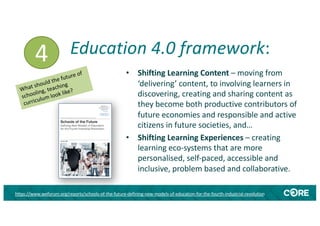
Education 4.0 framework:
• Shifting Learning Content – moving from
‘delivering’ content, to involving learners in
discovering, creating and sharing content as
they become both productive contributors of
future economies and responsible and active
citizens in future societies, and…
• Shifting Learning Experiences – creating
learning eco-systems that are more
personalised, self-paced, accessible and
inclusive, problem based and collaborative.
https://www.weforum.org/reports/schools-of-the-future-defining-new-models-of-education-for-the-fourth-industrial-revolution
4
What should the future of
schooling, teaching
curriculum look like?
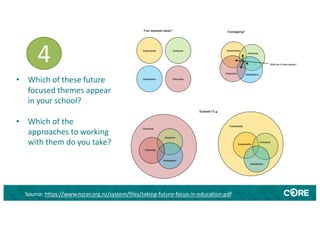
Source: https://www.nzcer.org.nz/system/files/taking-future-focus-in-education.pdf
4
• Which of these future
focused themes appear
in your school?
• Which of the
approaches to working
with them do you take?
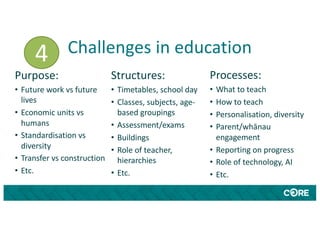
Challenges in education
Structures:
• Timetables, school day
• Classes, subjects, age-
based groupings
• Assessment/exams
• Buildings
• Role of teacher,
hierarchies
• Etc.
Processes:
• What to teach
• How to teach
• Personalisation, diversity
• Parent/whānau
engagement
• Reporting on progress
• Role of technology, AI
• Etc.
Purpose:
• Future work vs future
lives
• Economic units vs
humans
• Standardisation vs
diversity
• Transfer vs construction
• Etc.
4
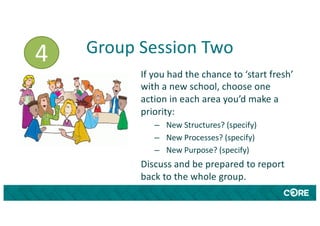
Group Session Two
If you had the chance to ‘start fresh’
with a new school, choose one
action in each area you’d make a
priority:
– New Structures? (specify)
– New Processes? (specify)
– New Purpose? (specify)
Discuss and be prepared to report
back to the whole group.
4
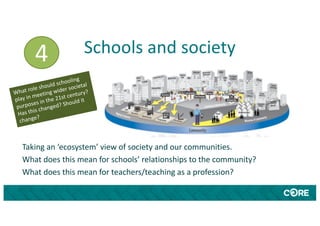
Schools and society
Taking an ‘ecosystem’ view of society and our communities.
What does this mean for schools’ relationships to the community?
What does this mean for teachers/teaching as a profession?
What role should schooling
play in meeting wider societal
purposes in the 21st century?
Has this changed? Should it
change?
4
In their future our learners will…
• need to know stuff we can hardly guess today
• always need to know if the facts they've dredged up are accurate
and truthful
• need to know how to regularly clean up their electronic trail
• need to know enough to make more complicated medical choices
• have to face the fact that technology favours some and eclipses
others
• be forced to take on moral questions no human has ever faced
4
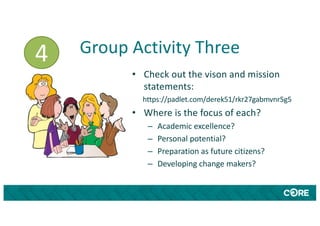
Group Activity Three
• Check out the vison and mission
statements:
https://padlet.com/derek51/rkr27gabmvnr5g5
• Where is the focus of each?
– Academic excellence?
– Personal potential?
– Preparation as future citizens?
– Developing change makers?
4
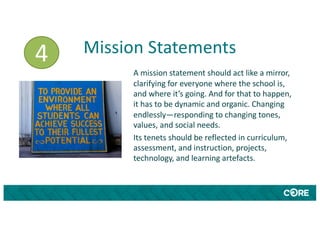
Mission Statements
A mission statement should act like a mirror,
clarifying for everyone where the school is,
and where it’s going. And for that to happen,
it has to be dynamic and organic. Changing
endlessly—responding to changing tones,
values, and social needs.
Its tenets should be reflected in curriculum,
assessment, and instruction, projects,
technology, and learning artefacts.
4
Challenge
On return to you school/class context, consider how the
following reflect a future focused view:
• Curriculum
• Assessment
• Pedagogical approach
• Use of technology
What might you need to change? How?
4
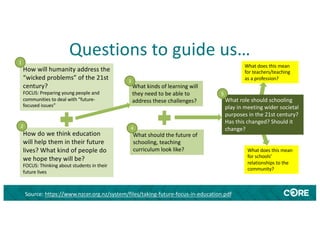
Questions to guide us…
Source: https://www.nzcer.org.nz/system/files/taking-future-focus-in-education.pdf
How will humanity address the
“wicked problems” of the 21st
century?
FOCUS: Preparing young people and
communities to deal with “future-
focused issues”
How do we think education
will help them in their future
lives? What kind of people do
we hope they will be?
FOCUS: Thinking about students in their
future lives
What kinds of learning will
they need to be able to
address these challenges?
What does this mean
for teachers/teaching
as a profession?
What does this mean
for schools’
relationships to the
community?
What should the future of
schooling, teaching
curriculum look like?
What role should schooling
play in meeting wider societal
purposes in the 21st century?
Has this changed? Should it
change?
1
2
3
4
5
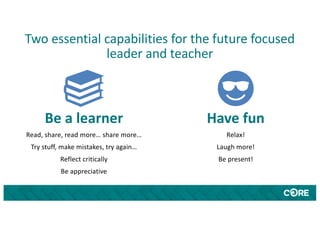
Two essential capabilities for the future focused
leader and teacher
Be a learner
Read, share, read more… share more…
Try stuff, make mistakes, try again…
Reflect critically
Be appreciative
Have fun
Relax!
Laugh more!
Be present!
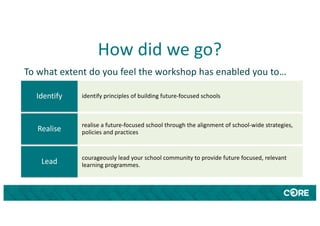
How did we go?
To what extent do you feel the workshop has enabled you to…
identify principles of building future-focused schoolsIdentify
realise a future-focused school through the alignment of school-wide strategies,
policies and practicesRealise
courageously lead your school community to provide future focused, relevant
learning programmes.Lead
Thank You
derek.wenmoth@core-ed.org
@dwenmoth
http://www.wenmoth.net

Future focused schools workshop

  • 1.
    Future Focused Schools Online Workshop- 5 May 2020 Derek Wenmoth @dwenmoth #futurefocused
  • 2.
    What we’d liketo achieve… By the end of the workshop you will… identify principles of building future-focused schoolsIdentify realise a future-focused school through the alignment of school-wide strategies, policies and practicesRealise courageously lead your school community to provide future focused, relevant learning programmes.Lead
  • 3.
    Group Session One •What comes to your mind when you hear the term ‘future focused’? • How does it make you feel?
  • 4.
    Future Shock “Future shockis the shattering stress and disorientation that we induce in individuals by subjecting them to too much change in too short a time.” • Alvin Toffler (1970)
  • 5.
  • 6.
    Questions to guideus… Source: https://www.nzcer.org.nz/system/files/taking-future-focus-in-education.pdf How will humanity address the “wicked problems” of the 21st century? FOCUS: Preparing young people and communities to deal with “future- focused issues” How do we think education will help them in their future lives? What kind of people do we hope they will be? FOCUS: Thinking about students in their future lives What kinds of learning will they need to be able to address these challenges? What does this mean for teachers/teaching as a profession? What does this mean for schools’ relationships to the community? What should the future of schooling, teaching curriculum look like? What role should schooling play in meeting wider societal purposes in the 21st century? Has this changed? Should it change?
  • 7.
    Future Focus issues •What are the big issues facing our world currently? • What are the things we see becoming issues into the future? How will humanity address the “wicked problems” of the 21st century? FOCUS: Preparing young people and communities to deal with “future- focused issues” 1
  • 8.
    Global challenges… • Foodsupply • Water • Environment • War, terrorism and refugees • Technology, AI, robots • Equity • Access to education • Super-diversity • Human rights • Poverty • Religious intolerance • Child Poverty • Threats to biodiversity • Energy 1
  • 9.
    Discuss • Are anyof these issues addressed in the curriculum in your school? • How? https://www.needpix.com/photo/547083/group-chat-icon-website-internet-web-discussion-website-icons-computer 1
  • 10.
    Future lives ofstudents? How do we think education will help them in their future lives? What kind of people do we hope they will be? FOCUS: Thinking about students in their future lives Picture from a reading book for the primary school (8 year olds) in Sweden, 1903 2
  • 11.
    Future of work BOYSGIRLS 1. Engineer 2. Business manager 3. Doctor 4. ICT professional 5. Sportsman 6. Teacher 7. Police officer 8. Mechanic 9. Lawyer 10. Architect 1. Doctor 2. Teacher 3. Business manager 4. Lawyer 5. Nurse/midwife 6. Psychologist 7. Designer 8. Veterinarian 9. Police officer 10. Architect According to the OECD the top ten career aspirations for 15 year olds are: https://wenmoth.net/2020/01/26/can-we-plan-our-careers/ 2
  • 12.
    What skills? http://educatingforthefuture.economist.com/# • Interdisciplinaryskills • Creative and analytical skills • Entrepreneurial skills • Leadership skills • Digital and technical skills • Global awareness and civic education 2
  • 13.
    Future Learning? • GlobalCitizenship skills • Innovation and creativity skills • Technology Skills • Interpersonal Skills • Personalised and self-paced learning • Accessible and inclusive learning • Problem-based and collaborative learning • Lifelong and student-driven learning What kinds of learning will they need to be able to address these challenges? https://www.weforum.org/reports/schools-of-the-future-defining-new-models-of-education-for-the-fourth-industrial-revolution 3
  • 14.
    Discuss • Which ofthe skills on this list do you believe need to be cultivated as a priority? Why? https://www.needpix.com/photo/547083/group-chat-icon-website-internet-web-discussion-website-icons-computer 3
  • 15.
    Education 4.0 framework: •Shifting Learning Content – moving from ‘delivering’ content, to involving learners in discovering, creating and sharing content as they become both productive contributors of future economies and responsible and active citizens in future societies, and… • Shifting Learning Experiences – creating learning eco-systems that are more personalised, self-paced, accessible and inclusive, problem based and collaborative. https://www.weforum.org/reports/schools-of-the-future-defining-new-models-of-education-for-the-fourth-industrial-revolution 4 What should the future of schooling, teaching curriculum look like?
  • 16.
    Source: https://www.nzcer.org.nz/system/files/taking-future-focus-in-education.pdf 4 • Whichof these future focused themes appear in your school? • Which of the approaches to working with them do you take?
  • 17.
    Challenges in education Structures: •Timetables, school day • Classes, subjects, age- based groupings • Assessment/exams • Buildings • Role of teacher, hierarchies • Etc. Processes: • What to teach • How to teach • Personalisation, diversity • Parent/whānau engagement • Reporting on progress • Role of technology, AI • Etc. Purpose: • Future work vs future lives • Economic units vs humans • Standardisation vs diversity • Transfer vs construction • Etc. 4
  • 18.
    Group Session Two Ifyou had the chance to ‘start fresh’ with a new school, choose one action in each area you’d make a priority: – New Structures? (specify) – New Processes? (specify) – New Purpose? (specify) Discuss and be prepared to report back to the whole group. 4
  • 19.
    Schools and society Takingan ‘ecosystem’ view of society and our communities. What does this mean for schools’ relationships to the community? What does this mean for teachers/teaching as a profession? What role should schooling play in meeting wider societal purposes in the 21st century? Has this changed? Should it change? 4
  • 20.
    In their futureour learners will… • need to know stuff we can hardly guess today • always need to know if the facts they've dredged up are accurate and truthful • need to know how to regularly clean up their electronic trail • need to know enough to make more complicated medical choices • have to face the fact that technology favours some and eclipses others • be forced to take on moral questions no human has ever faced 4
  • 21.
    Group Activity Three •Check out the vison and mission statements: https://padlet.com/derek51/rkr27gabmvnr5g5 • Where is the focus of each? – Academic excellence? – Personal potential? – Preparation as future citizens? – Developing change makers? 4
  • 22.
    Mission Statements A missionstatement should act like a mirror, clarifying for everyone where the school is, and where it’s going. And for that to happen, it has to be dynamic and organic. Changing endlessly—responding to changing tones, values, and social needs. Its tenets should be reflected in curriculum, assessment, and instruction, projects, technology, and learning artefacts. 4
  • 23.
    Challenge On return toyou school/class context, consider how the following reflect a future focused view: • Curriculum • Assessment • Pedagogical approach • Use of technology What might you need to change? How? 4
  • 24.
    Questions to guideus… Source: https://www.nzcer.org.nz/system/files/taking-future-focus-in-education.pdf How will humanity address the “wicked problems” of the 21st century? FOCUS: Preparing young people and communities to deal with “future- focused issues” How do we think education will help them in their future lives? What kind of people do we hope they will be? FOCUS: Thinking about students in their future lives What kinds of learning will they need to be able to address these challenges? What does this mean for teachers/teaching as a profession? What does this mean for schools’ relationships to the community? What should the future of schooling, teaching curriculum look like? What role should schooling play in meeting wider societal purposes in the 21st century? Has this changed? Should it change? 1 2 3 4 5
  • 25.
    Two essential capabilitiesfor the future focused leader and teacher Be a learner Read, share, read more… share more… Try stuff, make mistakes, try again… Reflect critically Be appreciative Have fun Relax! Laugh more! Be present!
  • 26.
    How did wego? To what extent do you feel the workshop has enabled you to… identify principles of building future-focused schoolsIdentify realise a future-focused school through the alignment of school-wide strategies, policies and practicesRealise courageously lead your school community to provide future focused, relevant learning programmes.Lead
  • 27.