Inspiring the next
generation of
leaders, thinkers
and problem-
solvers
derek@futuremakers.nz
@dwenmoth
www.futuremakers.nz
http://www.wenmoth.net
Knowledge Ecology:
Back to the past?
Have powerful COVID lockdown lessons in
leading and learning been lost?
Education Exposed
*https://wenmoth.net/2020/07/18/why-innovate-teaching-and-learning/
**https://www.un.org/development/desa/dspd/wp-content/uploads/sites/22/2020/08/sg_policy_brief_covid-19_and_education_august_2020.pdf
“The global COVID-19 pandemic has pulled back the curtain on what our kids are
doing at school and exposed weaknesses in many of the philosophical
understandings that guide our work (both explicitly and implicitly), and in the
structures and processes that define how we work with our students and the
expectations we have of them – and of our teachers.”
Wenmoth blog post*
“The COVID-19 pandemic has created the largest disruption of education systems
in history… The crisis is exacerbating pre-existing education disparities by reducing
the opportunities for many of the most vulnerable children, youth, and adults… On
the other hand, this crisis has stimulated innovation within the education sector”.
UN Policy Brief**
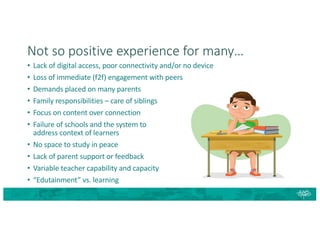
Not so positive experience for many…
• Lack of digital access, poor connectivity and/or no device
• Loss of immediate (f2f) engagement with peers
• Demands placed on many parents
• Family responsibilities – care of siblings
• Focus on content over connection
• Failure of schools and the system to
address context of learners
• No space to study in peace
• Lack of parent support or feedback
• Variable teacher capability and capacity
• “Edutainment” vs. learning
Yet very positive experience for others
Overwhelming response from many students who talked positively about:
• Flexibility of learning
• Freedom to manage themselves and their time
• Increased use of online learning platforms and digital
tools
• Timetables (lack of)
• More free time to read, think, engage in own activity
• No (or fewer) distractions
• Being able to learn what/when/where they wanted to
• More relaxed, comfortable settings and contexts
• More time to think and do the work
• More time with family
What we’ve learned…
• Equity gaps are growing – leading
to learning poverty
• Lack of systemness undermines
our efforts
• Solutions must be collectively
developed and owned
• Requires transformation in
thinking and action
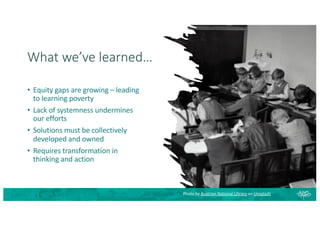
Photo by Austrian National Library on Unsplash
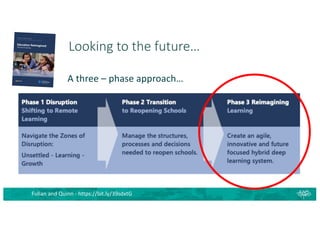
Looking to the future…
Fullan and Quinn - https://bit.ly/39sdxtG
A three – phase approach…
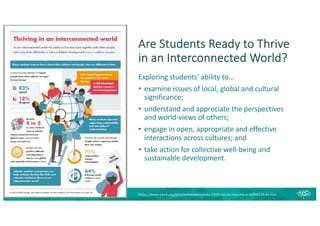
Are Students Ready to Thrive
in an Interconnected World?
Exploring students’ ability to…
• examine issues of local, global and cultural
significance;
• understand and appreciate the perspectives
and world-views of others;
• engage in open, appropriate and effective
interactions across cultures; and
• take action for collective well-being and
sustainable development.
https://www.oecd.org/pisa/publications/pisa-2018-results-volume-vi-d5f68679-en.htm
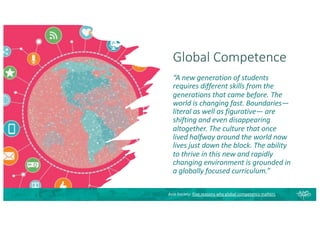
Global Competence
“A new generation of students
requires different skills from the
generations that came before. The
world is changing fast. Boundaries—
literal as well as figurative— are
shifting and even disappearing
altogether. The culture that once
lived halfway around the world now
lives just down the block. The ability
to thrive in this new and rapidly
changing environment is grounded in
a globally focused curriculum.”
Asia Society: Five reasons why global competency matters
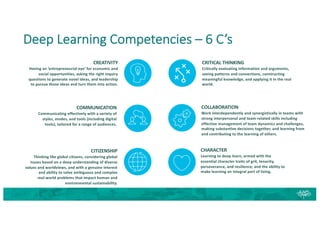
Deep Learning Competencies – 6 C’s
CHARACTER
Learning to deep learn, armed with the
essential character traits of grit, tenacity,
perseverance, and resilience; and the ability to
make learning an integral part of living.
CREATIVITY
Having an ‘entrepreneurial eye’ for economic and
social opportunities, asking the right inquiry
questions to generate novel ideas, and leadership
to pursue those ideas and turn them into action.
COMMUNICATION
Communicating effectively with a variety of
styles, modes, and tools (including digital
tools), tailored for a range of audiences.
CITIZENSHIP
Thinking like global citizens, considering global
issues based on a deep understanding of diverse
values and worldviews, and with a genuine interest
and ability to solve ambiguous and complex
real-world problems that impact human and
environmental sustainability.
COLLABORATION
Work interdependently and synergistically in teams with
strong interpersonal and team-related skills including
effective management of team dynamics and challenges,
making substantive decisions together, and learning from
and contributing to the learning of others.
CRITICAL THINKING
Critically evaluating information and arguments,
seeing patterns and connections, constructing
meaningful knowledge, and applying it in the real
world.
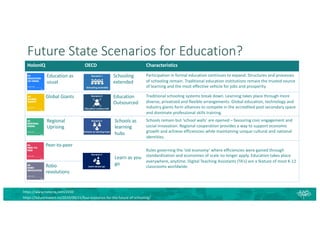
Future State Scenarios for Education?
HolonIQ OECD Characteristics
Education as
usual
Schooling
extended
Participation in formal education continues to expand. Structures and processes
of schooling remain. Traditional education institutions remain the trusted source
of learning and the most effective vehicle for jobs and prosperity.
Global Giants Education
Outsourced
Traditional schooling systems break down. Learning takes place through more
diverse, privatized and flexible arrangements. Global education, technology and
industry giants form alliances to compete in the accredited post secondary space
and dominate professional skills training.
Regional
Uprising
Schools as
learning
hubs
Schools remain but ‘school walls’ are opened – favouring civic engagement and
social innovation. Regional cooperation provides a way to support economic
growth and achieve efficiencies while maintaining unique cultural and national
identities.
Peer-to-peer
Learn as you
go
Rules governing the ‘old economy’ where efficiencies were gained through
standardization and economies of scale no longer apply. Education takes place
everywhere, anytime. Digital Teaching Assistants (TA’s) are a feature of most K-12
classrooms worldwide.
Robo
revolutions
https://www.holoniq.com/2030
https://futuremakers.nz/2020/09/21/four-scenarios-for-the-future-of-schooling/
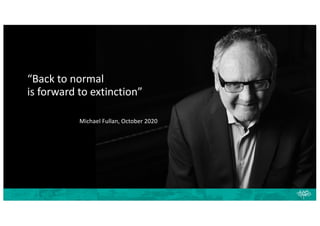
“Back to normal
is forward to extinction”
Michael Fullan, October 2020
Thank You
derek@futuremakers.nz
@dwenmoth
www.futuremakers.nz
http://www.wenmoth.net

Knowledge Ecology: Back to the past?

  • 1.
    Inspiring the next generationof leaders, thinkers and problem- solvers derek@futuremakers.nz @dwenmoth www.futuremakers.nz http://www.wenmoth.net Knowledge Ecology: Back to the past? Have powerful COVID lockdown lessons in leading and learning been lost?
  • 2.
    Education Exposed *https://wenmoth.net/2020/07/18/why-innovate-teaching-and-learning/ **https://www.un.org/development/desa/dspd/wp-content/uploads/sites/22/2020/08/sg_policy_brief_covid-19_and_education_august_2020.pdf “The globalCOVID-19 pandemic has pulled back the curtain on what our kids are doing at school and exposed weaknesses in many of the philosophical understandings that guide our work (both explicitly and implicitly), and in the structures and processes that define how we work with our students and the expectations we have of them – and of our teachers.” Wenmoth blog post* “The COVID-19 pandemic has created the largest disruption of education systems in history… The crisis is exacerbating pre-existing education disparities by reducing the opportunities for many of the most vulnerable children, youth, and adults… On the other hand, this crisis has stimulated innovation within the education sector”. UN Policy Brief**
  • 3.
    Not so positiveexperience for many… • Lack of digital access, poor connectivity and/or no device • Loss of immediate (f2f) engagement with peers • Demands placed on many parents • Family responsibilities – care of siblings • Focus on content over connection • Failure of schools and the system to address context of learners • No space to study in peace • Lack of parent support or feedback • Variable teacher capability and capacity • “Edutainment” vs. learning
  • 4.
    Yet very positiveexperience for others Overwhelming response from many students who talked positively about: • Flexibility of learning • Freedom to manage themselves and their time • Increased use of online learning platforms and digital tools • Timetables (lack of) • More free time to read, think, engage in own activity • No (or fewer) distractions • Being able to learn what/when/where they wanted to • More relaxed, comfortable settings and contexts • More time to think and do the work • More time with family
  • 5.
    What we’ve learned… •Equity gaps are growing – leading to learning poverty • Lack of systemness undermines our efforts • Solutions must be collectively developed and owned • Requires transformation in thinking and action Photo by Austrian National Library on Unsplash
  • 6.
    Looking to thefuture… Fullan and Quinn - https://bit.ly/39sdxtG A three – phase approach…
  • 7.
    Are Students Readyto Thrive in an Interconnected World? Exploring students’ ability to… • examine issues of local, global and cultural significance; • understand and appreciate the perspectives and world-views of others; • engage in open, appropriate and effective interactions across cultures; and • take action for collective well-being and sustainable development. https://www.oecd.org/pisa/publications/pisa-2018-results-volume-vi-d5f68679-en.htm
  • 8.
    Global Competence “A newgeneration of students requires different skills from the generations that came before. The world is changing fast. Boundaries— literal as well as figurative— are shifting and even disappearing altogether. The culture that once lived halfway around the world now lives just down the block. The ability to thrive in this new and rapidly changing environment is grounded in a globally focused curriculum.” Asia Society: Five reasons why global competency matters
  • 9.
    Deep Learning Competencies– 6 C’s CHARACTER Learning to deep learn, armed with the essential character traits of grit, tenacity, perseverance, and resilience; and the ability to make learning an integral part of living. CREATIVITY Having an ‘entrepreneurial eye’ for economic and social opportunities, asking the right inquiry questions to generate novel ideas, and leadership to pursue those ideas and turn them into action. COMMUNICATION Communicating effectively with a variety of styles, modes, and tools (including digital tools), tailored for a range of audiences. CITIZENSHIP Thinking like global citizens, considering global issues based on a deep understanding of diverse values and worldviews, and with a genuine interest and ability to solve ambiguous and complex real-world problems that impact human and environmental sustainability. COLLABORATION Work interdependently and synergistically in teams with strong interpersonal and team-related skills including effective management of team dynamics and challenges, making substantive decisions together, and learning from and contributing to the learning of others. CRITICAL THINKING Critically evaluating information and arguments, seeing patterns and connections, constructing meaningful knowledge, and applying it in the real world.
  • 10.
    Future State Scenariosfor Education? HolonIQ OECD Characteristics Education as usual Schooling extended Participation in formal education continues to expand. Structures and processes of schooling remain. Traditional education institutions remain the trusted source of learning and the most effective vehicle for jobs and prosperity. Global Giants Education Outsourced Traditional schooling systems break down. Learning takes place through more diverse, privatized and flexible arrangements. Global education, technology and industry giants form alliances to compete in the accredited post secondary space and dominate professional skills training. Regional Uprising Schools as learning hubs Schools remain but ‘school walls’ are opened – favouring civic engagement and social innovation. Regional cooperation provides a way to support economic growth and achieve efficiencies while maintaining unique cultural and national identities. Peer-to-peer Learn as you go Rules governing the ‘old economy’ where efficiencies were gained through standardization and economies of scale no longer apply. Education takes place everywhere, anytime. Digital Teaching Assistants (TA’s) are a feature of most K-12 classrooms worldwide. Robo revolutions https://www.holoniq.com/2030 https://futuremakers.nz/2020/09/21/four-scenarios-for-the-future-of-schooling/
  • 11.
    “Back to normal isforward to extinction” Michael Fullan, October 2020
  • 12.