Abdalla Mutwakil Gamal
Medical Officer
Mr Mohammed Babiker Unit
Department of Orthopedic Surgery
National Ribat Teaching Hospital
Khartoum, Sudan
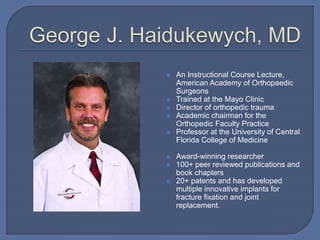
 An Instructional Course Lecture,
American Academy of Orthopaedic
Surgeons
 Trained at the Mayo Clinic
 Director of orthopedic trauma
 Academic chairman for the
Orthopedic Faculty Practice
 Professor at the University of Central
Florida College of Medicine
 Award-winning researcher
 100+ peer reviewed publications and
book chapters
 20+ patents and has developed
multiple innovative implants for
fracture fixation and joint
replacement.
 1948-present
 The journal is the official
publication of the:
• British Orthopaedic Association
• Canadian Orthopaedic
Association
• New Zealand Orthopaedic
Association
• Australian Orthopaedic
Association, and
• Sociedade Brasileira de
Orthopedia e raumatologia.
 Impact factor: 3.581 (2017)
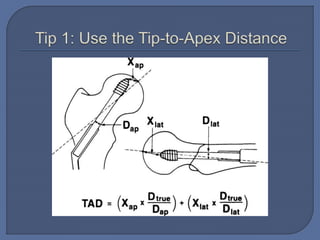
 Tip 1: Use the Tip-to-Apex Distance
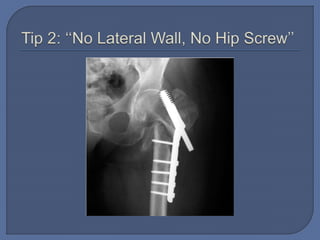
 Tip 2: ‘‘No Lateral Wall, No Hip Screw’’
 Tip 3: Know the Unstable Intertrochanteric
Fracture Patterns, and Nail Them
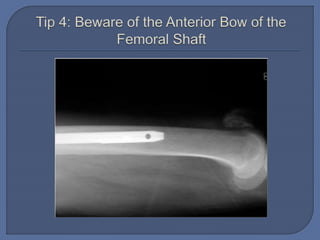
 Tip 4: Beware of the Anterior Bow of the
Femoral Shaft
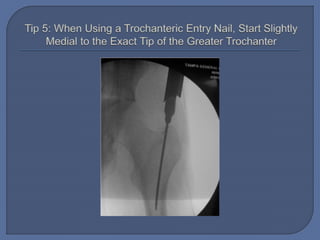
 Tip 5: When Using a Trochanteric Entry Nail,
Start Slightly Medial to the Exact Tip of the
Greater Trochanter
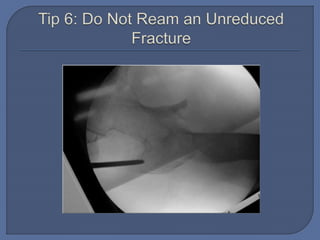
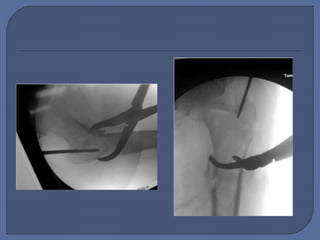
 Tip 6: Do Not Ream an Unreduced Fracture
 Tip 7: Be Cautious About the Nail Insertion
Trajectory, and Do Not Use a Hammer to
Seat the Nail
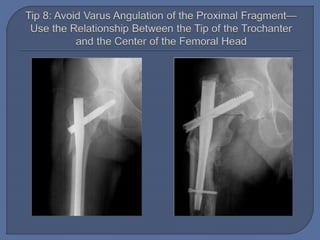
 Tip 8: Avoid Varus Angulation of the Proximal
Fragment—Use the Relationship Between the
Tip of the Trochanter and the Center of the
Femoral Head
 Tip 9: When Nailing, Lock the Nail Distally if
the Fracture Is Axially or Rotationally
Unstable
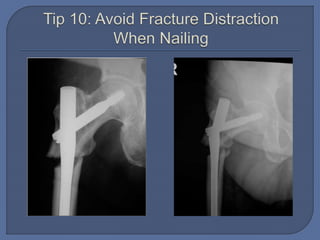
 Tip 10: Avoid Fracture Distraction
When Nailing
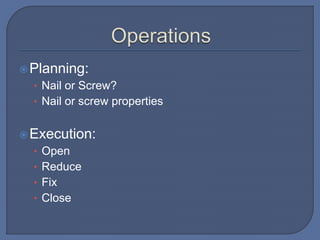
Planning:
• Nail or Screw?
• Nail or screw properties
Execution:
• Open
• Reduce
• Fix
• Close
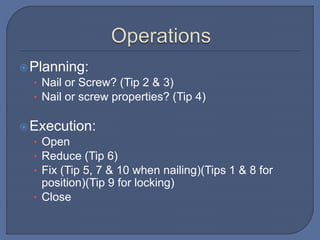
Planning:
• Nail or Screw? (Tip 2 & 3)
• Nail or screw properties? (Tip 4)
Execution:
• Open
• Reduce (Tip 6)
• Fix (Tip 5, 7 & 10 when nailing)(Tips 1 & 8 for
position)(Tip 9 for locking)
• Close
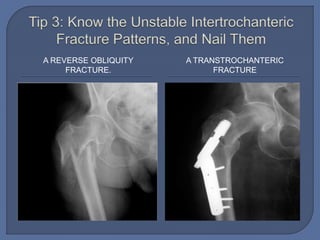
A REVERSE OBLIQUITY
FRACTURE.
A TRANSTROCHANTERIC
FRACTURE
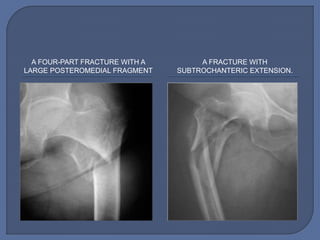
A FOUR-PART FRACTURE WITH A
LARGE POSTEROMEDIAL FRAGMENT
A FRACTURE WITH
SUBTROCHANTERIC EXTENSION.
Nothing.
 Nailing:
 Tip 5, 7 & 10
 Position:
 Tips 1 & 8
 Locking:
 Tip 9
 Planning:
• Nail or Screw?
• Nail or screw properties
 Execution:
• Open
• Reduce
• Fix
• Close
 Tip 2: ‘‘No Lateral Wall,
No Hip Screw’’
 Tip 3: Know the Unstable
Intertrochanteric Fracture
Patterns, and Nail Them
 Planning:
• Nail or Screw?
• Nail or screw properties
 Execution:
• Open
• Reduce
• Fix
• Close
 Tip 4: Beware of the
Anterior Bow of the
Femoral Shaft
 Planning:
• Nail or Screw?
• Nail or screw properties
 Execution:
• Open
• Reduce
• Fix
• Close
 Nothing
 Planning:
• Nail or Screw?
• Nail or screw properties
 Execution:
• Open
• Reduce
• Fix
• Close
 Tip 6: Do Not Ream an
Unreduced Fracture
 Planning:
• Nail or Screw?
• Nail or screw properties
 Execution:
• Open
• Reduce
• Fix - Nailing
• Close
 Tip 5: When Using a
Trochanteric Entry Nail,
Start Slightly Medial to
the Exact Tip of the
Greater Trochanter
 Tip 7: Be Cautious
About the Nail Insertion
Trajectory, and Do Not
Use a Hammer to Seat
the Nail
 Tip 10: Avoid Fracture
Distraction
When Nailing
 Planning:
• Nail or Screw?
• Nail or screw properties
 Execution:
• Open
• Reduce
• Fix - position
• Close
 Tip 1: Use the Tip-to-Apex
Distance
 Tip 8: Avoid Varus
Angulation of the Proximal
Fragment—Use the
Relationship Between the
Tip of the Trochanter and
the Center of the Femoral
Head
 Planning:
• Nail or Screw?
• Nail or screw properties
 Execution:
• Open
• Reduce
• Fix - Locking
• Close
 Tip 9: When Nailing, Lock
the Nail Distally if the
Fracture Is Axially or
Rotationally Unstable
Ten tips presentation

Ten tips presentation

  • 1.
    Abdalla Mutwakil Gamal MedicalOfficer Mr Mohammed Babiker Unit Department of Orthopedic Surgery National Ribat Teaching Hospital Khartoum, Sudan
  • 3.
     An InstructionalCourse Lecture, American Academy of Orthopaedic Surgeons  Trained at the Mayo Clinic  Director of orthopedic trauma  Academic chairman for the Orthopedic Faculty Practice  Professor at the University of Central Florida College of Medicine  Award-winning researcher  100+ peer reviewed publications and book chapters  20+ patents and has developed multiple innovative implants for fracture fixation and joint replacement.

  • 4.
     1948-present  Thejournal is the official publication of the: • British Orthopaedic Association • Canadian Orthopaedic Association • New Zealand Orthopaedic Association • Australian Orthopaedic Association, and • Sociedade Brasileira de Orthopedia e raumatologia.  Impact factor: 3.581 (2017)
  • 8.
     Tip 1:Use the Tip-to-Apex Distance  Tip 2: ‘‘No Lateral Wall, No Hip Screw’’  Tip 3: Know the Unstable Intertrochanteric Fracture Patterns, and Nail Them  Tip 4: Beware of the Anterior Bow of the Femoral Shaft  Tip 5: When Using a Trochanteric Entry Nail, Start Slightly Medial to the Exact Tip of the Greater Trochanter  Tip 6: Do Not Ream an Unreduced Fracture
  • 9.
     Tip 7:Be Cautious About the Nail Insertion Trajectory, and Do Not Use a Hammer to Seat the Nail  Tip 8: Avoid Varus Angulation of the Proximal Fragment—Use the Relationship Between the Tip of the Trochanter and the Center of the Femoral Head  Tip 9: When Nailing, Lock the Nail Distally if the Fracture Is Axially or Rotationally Unstable  Tip 10: Avoid Fracture Distraction When Nailing
  • 10.
    Planning: • Nail orScrew? • Nail or screw properties Execution: • Open • Reduce • Fix • Close
  • 11.
    Planning: • Nail orScrew? (Tip 2 & 3) • Nail or screw properties? (Tip 4) Execution: • Open • Reduce (Tip 6) • Fix (Tip 5, 7 & 10 when nailing)(Tips 1 & 8 for position)(Tip 9 for locking) • Close
  • 15.
    A REVERSE OBLIQUITY FRACTURE. ATRANSTROCHANTERIC FRACTURE
  • 16.
    A FOUR-PART FRACTUREWITH A LARGE POSTEROMEDIAL FRAGMENT A FRACTURE WITH SUBTROCHANTERIC EXTENSION.
  • 19.
  • 23.
     Nailing:  Tip5, 7 & 10  Position:  Tips 1 & 8  Locking:  Tip 9
  • 31.
     Planning: • Nailor Screw? • Nail or screw properties  Execution: • Open • Reduce • Fix • Close  Tip 2: ‘‘No Lateral Wall, No Hip Screw’’  Tip 3: Know the Unstable Intertrochanteric Fracture Patterns, and Nail Them
  • 32.
     Planning: • Nailor Screw? • Nail or screw properties  Execution: • Open • Reduce • Fix • Close  Tip 4: Beware of the Anterior Bow of the Femoral Shaft
  • 33.
     Planning: • Nailor Screw? • Nail or screw properties  Execution: • Open • Reduce • Fix • Close  Nothing
  • 34.
     Planning: • Nailor Screw? • Nail or screw properties  Execution: • Open • Reduce • Fix • Close  Tip 6: Do Not Ream an Unreduced Fracture
  • 35.
     Planning: • Nailor Screw? • Nail or screw properties  Execution: • Open • Reduce • Fix - Nailing • Close  Tip 5: When Using a Trochanteric Entry Nail, Start Slightly Medial to the Exact Tip of the Greater Trochanter  Tip 7: Be Cautious About the Nail Insertion Trajectory, and Do Not Use a Hammer to Seat the Nail  Tip 10: Avoid Fracture Distraction When Nailing
  • 36.
     Planning: • Nailor Screw? • Nail or screw properties  Execution: • Open • Reduce • Fix - position • Close  Tip 1: Use the Tip-to-Apex Distance  Tip 8: Avoid Varus Angulation of the Proximal Fragment—Use the Relationship Between the Tip of the Trochanter and the Center of the Femoral Head
  • 37.
     Planning: • Nailor Screw? • Nail or screw properties  Execution: • Open • Reduce • Fix - Locking • Close  Tip 9: When Nailing, Lock the Nail Distally if the Fracture Is Axially or Rotationally Unstable

Editor's Notes

  • #30 Varus angulation of the proximal fragment increases the lever arm on the fixation since it makes the femoral neck more horizontal and therefore functionally longer when body weight is applied. This also results in the femoral head fixation being placed more superiorly in the head than is ideal and increases the risk of the device cutting out of the femoral head. It can be difficult to determine the appropriate femoral neck-shaft angle in a patient with an intertrochanteric fracture. When using an intramedullary nail for fixation of an intertrochanteric fracture, most surgeons choose a nail with a 130 neck-shaft configuration (Figs. 13 and 14). It is important to know the neckshaft angle of the device that is being used. One way to assess varus or valgus position during surgery is to look at the relationship between the tip of the greater trochanter and the center of the femoral head. These two points should be coplanar. If the center of the femoral head is distal to the tip of the greater trochanter, the reduction is in varus. If the center of the head is proximal to the greater trochanter, the reduction is in valgus. Preoperative plain radiographs of the uninjured hip can be used to assess the patient’s normal neck-shaft angle as the two sides are normally symmetric. Varus and high lag-screw placement are associated with an increased frequency of failure of fixation with an intramedullary nail and sliding hip screw20,21. (Fig. 13 A well-aligned fracture. Note the central position of the lag screw in the femoral head. Fig. 14 Radiograph showing the relationship between the tip of the greater trochanter and the center of the femoral head. Normally, this relationship is coplanar. Here, the proximal fragment is in varus, the starting point is lateral, and the screw is high in the head.)
  • #32 The unstable patterns include reverse obliquity fractures, transtrochanteric fractures, fractures with a large posteromedial fragment implying loss of the calcar buttress, and fractures with subtrochanteric extension (Figs. 4 through 7)3-5,9,12-16.