Temporal Graph : Storage, 
Traversal, Path discovery 
Submitted by 
Vinay Sarda 
M.Tech(CSE) II Year 
13535054 
Under the guidance of 
Prof. A.K. Sarje
Outline 
 Introduction 
 Graph Database 
 What is a Temporal Graph 
 Traversal in Temporal Path 
 Types of Path in Temporal Graph 
 Algorithms to determine different temporal path 
 Conclusion
Introduction 
 Graph database are best tool for handling highly connected data 
 In Relational or Hierarchical database, some entities have precedence over other 
like key, parent etc. 
 In Graph No node or edge have a higher precedence over other 
 Graph DB are NOSQL, doesn’t have rigid schema 
 Graph uses structures like nodes, edges are used to store and represent data 
 No need to look-up for neighbours as it provides index-free adjacency 
 Graph DB can be used in to determine whether two concept are related or not, or 
is it possible to reach from source to destination within specified interval etc.
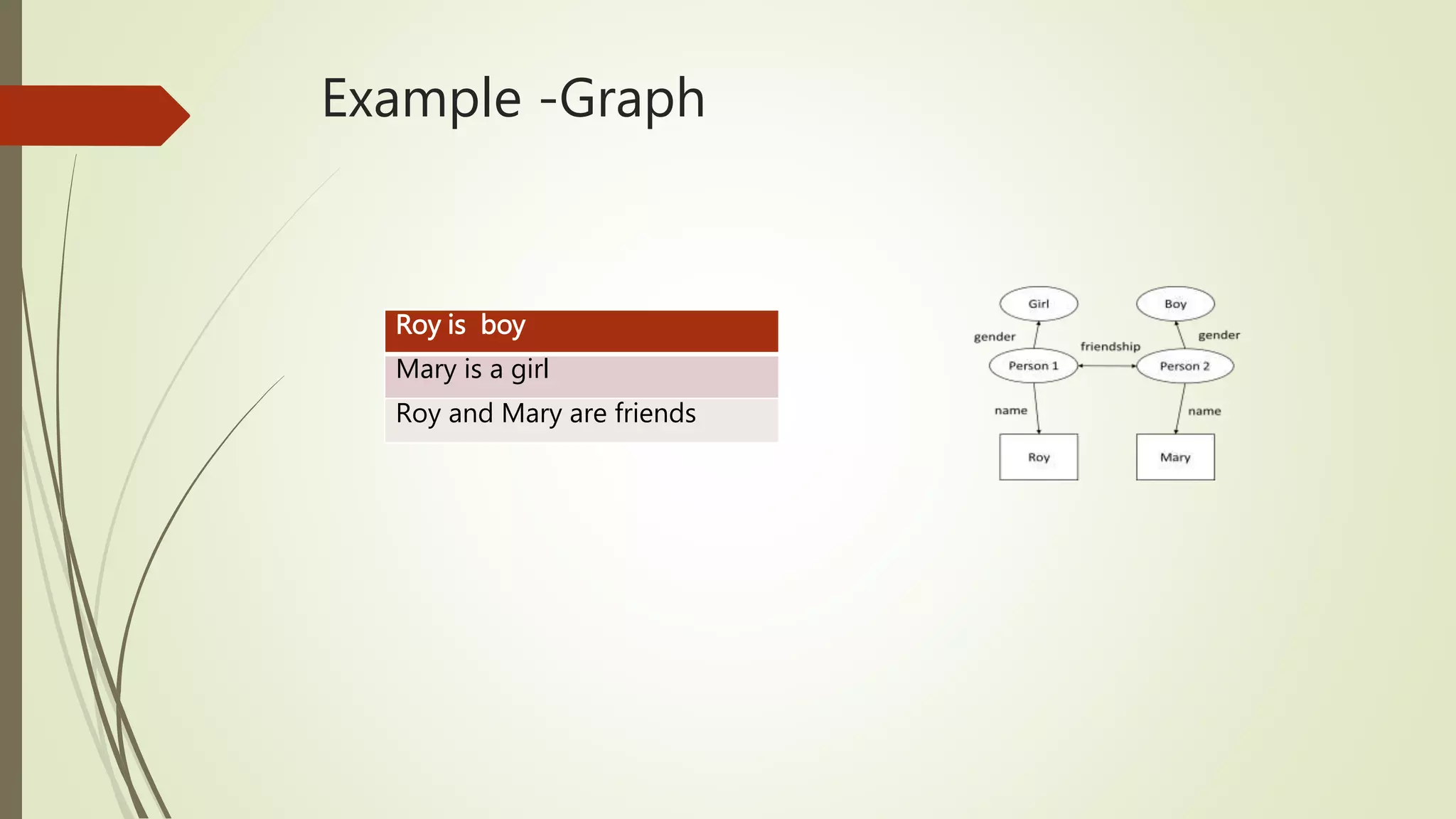
Example -Graph 
Roy is boy 
Mary is a girl 
Roy and Mary are friends
Accessing Graph DB 
 TinkerPop is an open source toolkit that provides 
interfaces to implement Blueprint 
 Blueprint is a generic graph API, serves as a base layer for 
graph DB architectures 
 Pipes is a dataflow network using process graphs 
 Gremlin is a graph traversal language for accessing and 
manipulating graphs 
 Frames allows developer to frame a graph element in 
terms of java interface 
 Furnace is a graph algorithm package 
 Rexster is a graph server that exploits blueprint via REST 
 Example Titan Graph DB 
TinkerPop Stack
Temporal Graph 
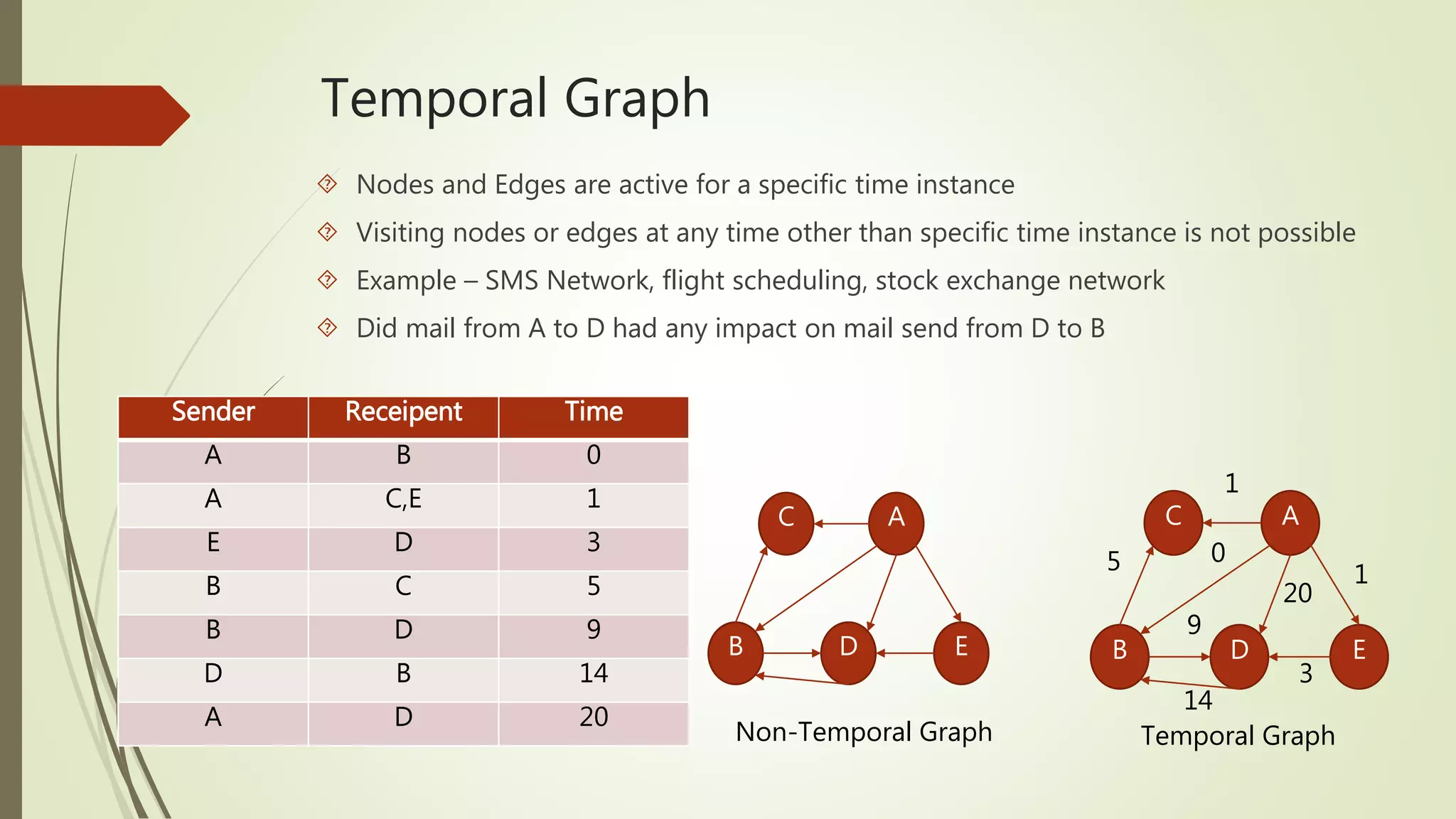
 Nodes and Edges are active for a specific time instance 
 Visiting nodes or edges at any time other than specific time instance is not possible 
 Example – SMS Network, flight scheduling, stock exchange network 
 Did mail from A to D had any impact on mail send from D to B 
Sender Receipent Time 
A B 0 
A C,E 1 
E D 3 
B C 5 
B D 9 
D B 14 
A D 20 
C A 
B D E 
1 
C A 
5 0 
20 
1 
9 
B D E 
14 
3 
Non-Temporal Graph Temporal Graph
Temporal Graph Traversal 
 Depth First Traversal 
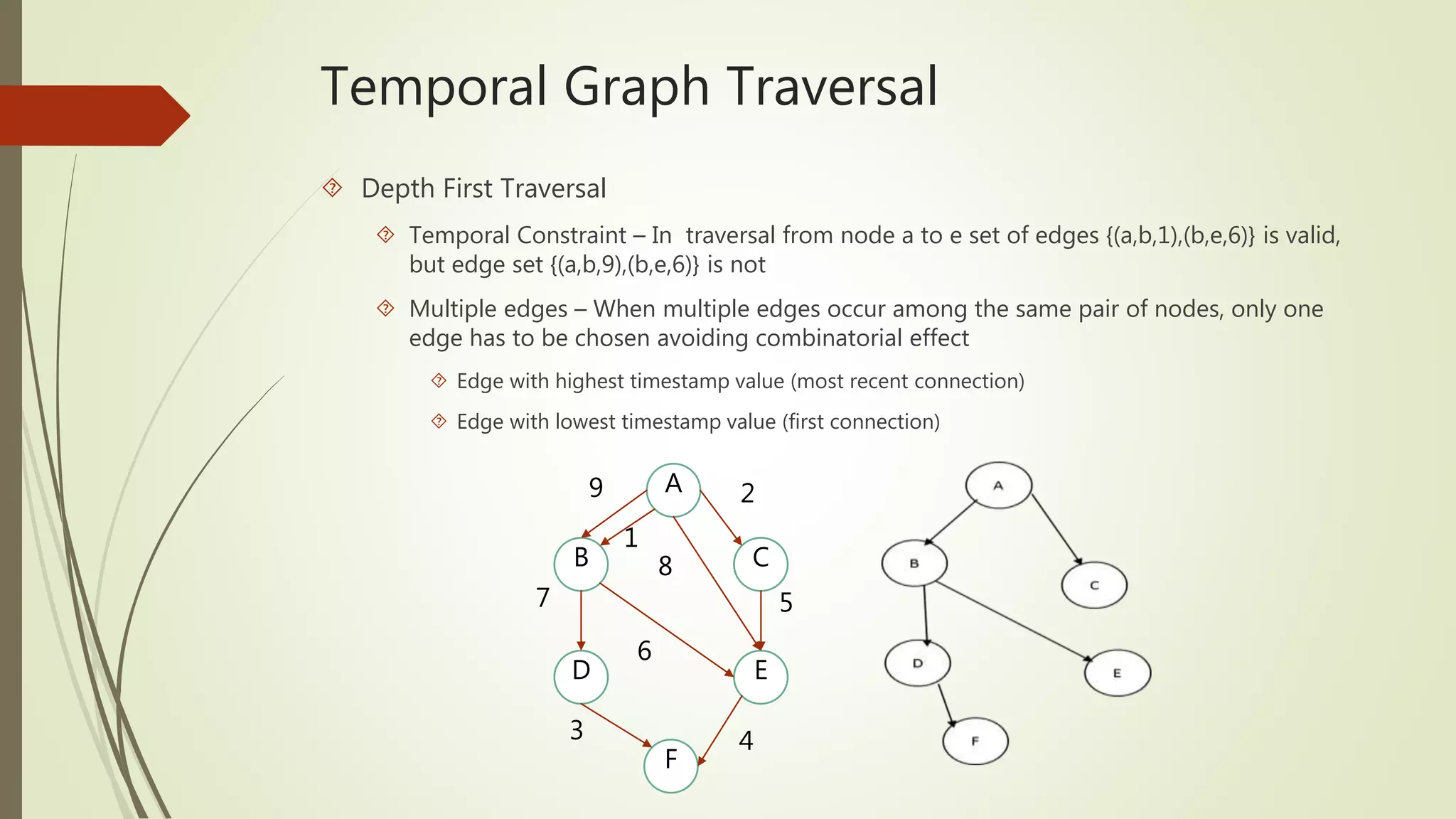
 Temporal Constraint – In traversal from node a to e set of edges {(a,b,1),(b,e,6)} is valid, 
but edge set {(a,b,9),(b,e,6)} is not 
 Multiple edges – When multiple edges occur among the same pair of nodes, only one 
edge has to be chosen avoiding combinatorial effect 
 Edge with highest timestamp value (most recent connection) 
 Edge with lowest timestamp value (first connection) 
A 
B C 
E 
D 
F 
3 
2 
8 
6 
7 
1 
4 
5 
9
Depth First Traversal 
 Create a DFS tree rooted at node ‘a’ with lowest timestamp value 
 Initially every node’s visiting time is infinite 
 At node ‘a’, Eset = {(a,b,9), (a,b,1), (a,e,8), (a,c,2)} 
 Take edge (a,b,1) and visit node ‘b’ and mark time 1 
 Now Eset = {(b,d,7), (b,e,6)} and take edge (b,e,6), mark time t[e] = 6, and then (b,d,7), mark 
time t[d] = 7, and so on 
a 
b c 
e 
d 
2 
7 
1 
5 
a 
c 
e 
b 
d 
3 f 
2 
8 
6 
7 
1 
4 
9 
5 
6
Breadth First Traversal 
 Challenges 
 Temporal Constraint 
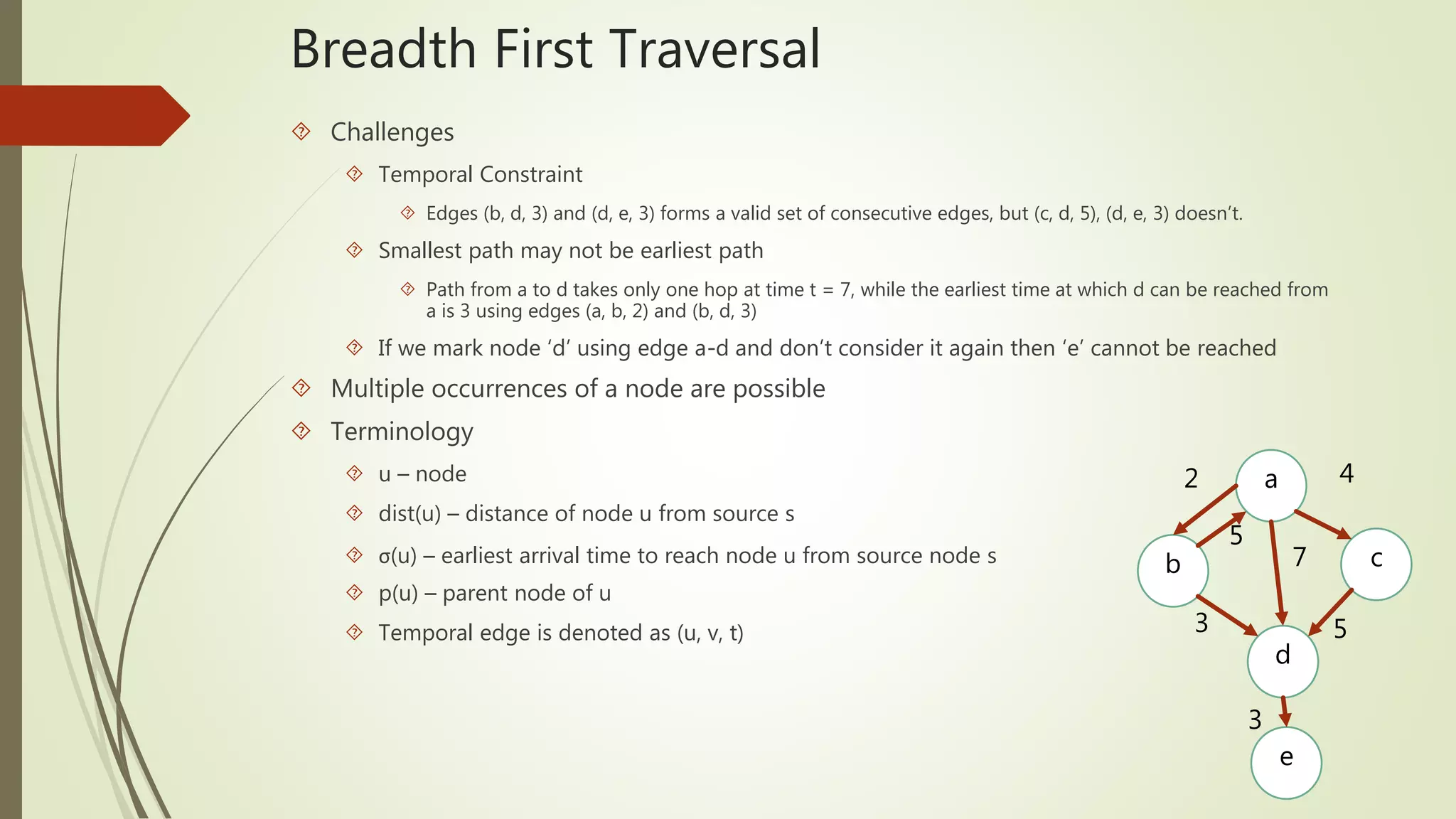
 Edges (b, d, 3) and (d, e, 3) forms a valid set of consecutive edges, but (c, d, 5), (d, e, 3) doesn’t. 
 Smallest path may not be earliest path 
 Path from a to d takes only one hop at time t = 7, while the earliest time at which d can be reached from 
a is 3 using edges (a, b, 2) and (b, d, 3) 
 If we mark node ‘d’ using edge a-d and don’t consider it again then ‘e’ cannot be reached 
 Multiple occurrences of a node are possible 
 Terminology 
 u – node 
 dist(u) – distance of node u from source s 
 σ(u) – earliest arrival time to reach node u from source node s 
 p(u) – parent node of u 
 Temporal edge is denoted as (u, v, t) 
a 
b c 
d 
e 
2 
5 
4 
7 
3 5 
3
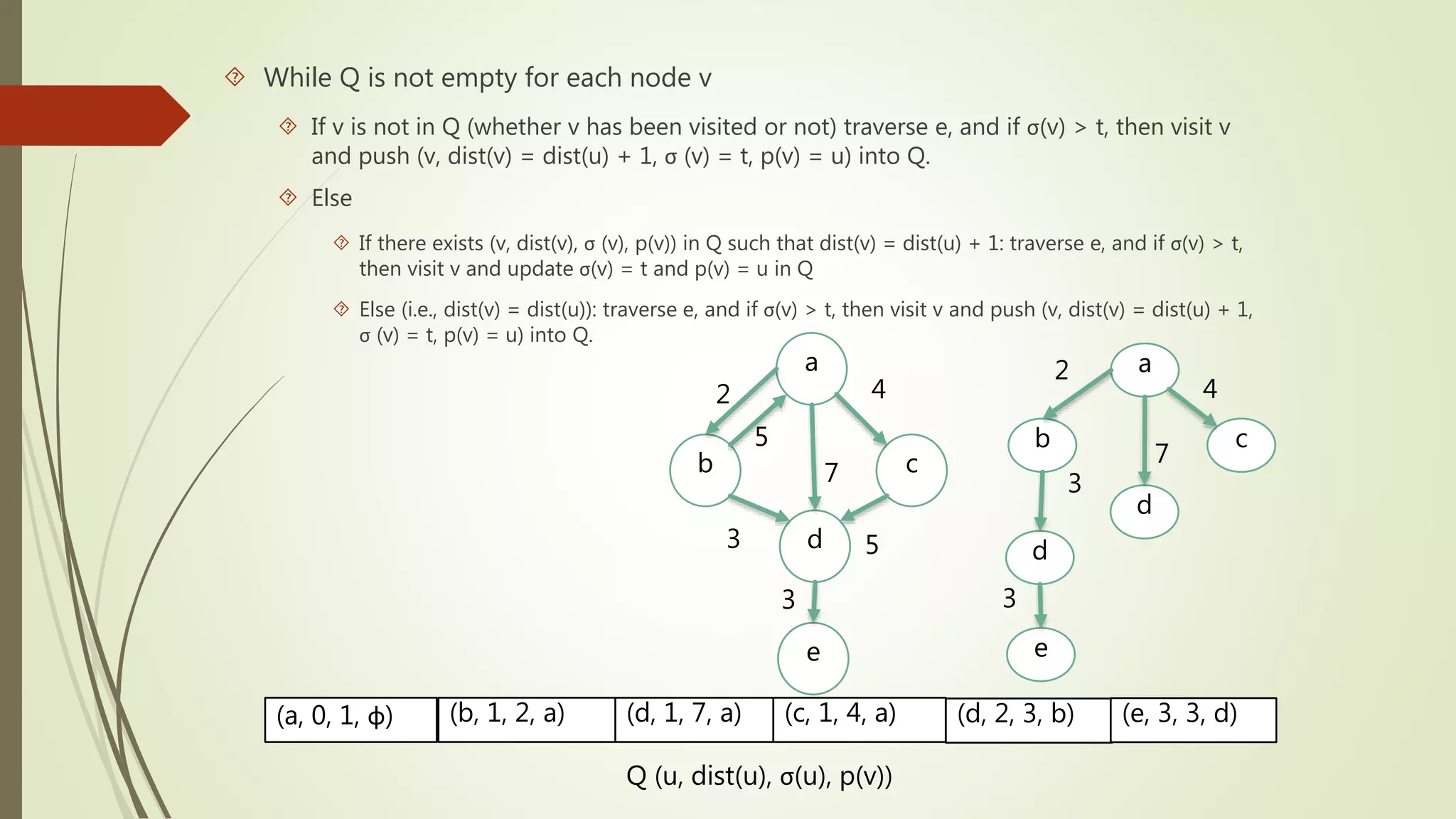
 While Q is not empty for each node v 
 If v is not in Q (whether v has been visited or not) traverse e, and if σ(v) > t, then visit v 
and push (v, dist(v) = dist(u) + 1, σ (v) = t, p(v) = u) into Q. 
 Else 
 If there exists (v, dist(v), σ (v), p(v)) in Q such that dist(v) = dist(u) + 1: traverse e, and if σ(v) > t, 
then visit v and update σ(v) = t and p(v) = u in Q 
 Else (i.e., dist(v) = dist(u)): traverse e, and if σ(v) > t, then visit v and push (v, dist(v) = dist(u) + 1, 
σ (v) = t, p(v) = u) into Q. 
a 
b c 
d 
e 
2 
5 
4 
7 
3 5 
3 
c 
a 
b 
d 
e 
2 
4 
3 
d 
7 
3 
(a, 0, 1, φ) (b, 1, 2, a) (d, 1, 7, a) (c, 1, 4, a) (d, 2, 3, b) (e, 3, 3, d) 
Q (u, dist(u), σ(u), p(v))
Paths in Temporal Graph 
 A path ρ = {(s, u1, t1), (u1, u2, t2), (u2, u3, t3),……..,(ui-1, ui, ti), ….. (un-1 ,d, tn)} from 
source s to destination d is a temporal path if ti ≤ ti+1 
 Terminology 
 Pset - set of all paths from source s to destination d 
 [ta, tb] – time interval 
 t[u] – time at which node u can be reached from source s 
 tstart(ρ) - timestamp of a path ρ at which it starts at source s 
 tend(ρ) - timestamp of a path ρ at which it ends at destination d 
 dist(ρ) - number of nodes in path ρ 
 duration(ρ) – time taken by path ρ to reach destination node from source node, tend(ρ) - 
tstart(ρ) 
 Transition time – time taken to reach from node to its neighbour node (λ), by default 
assumed to be 1
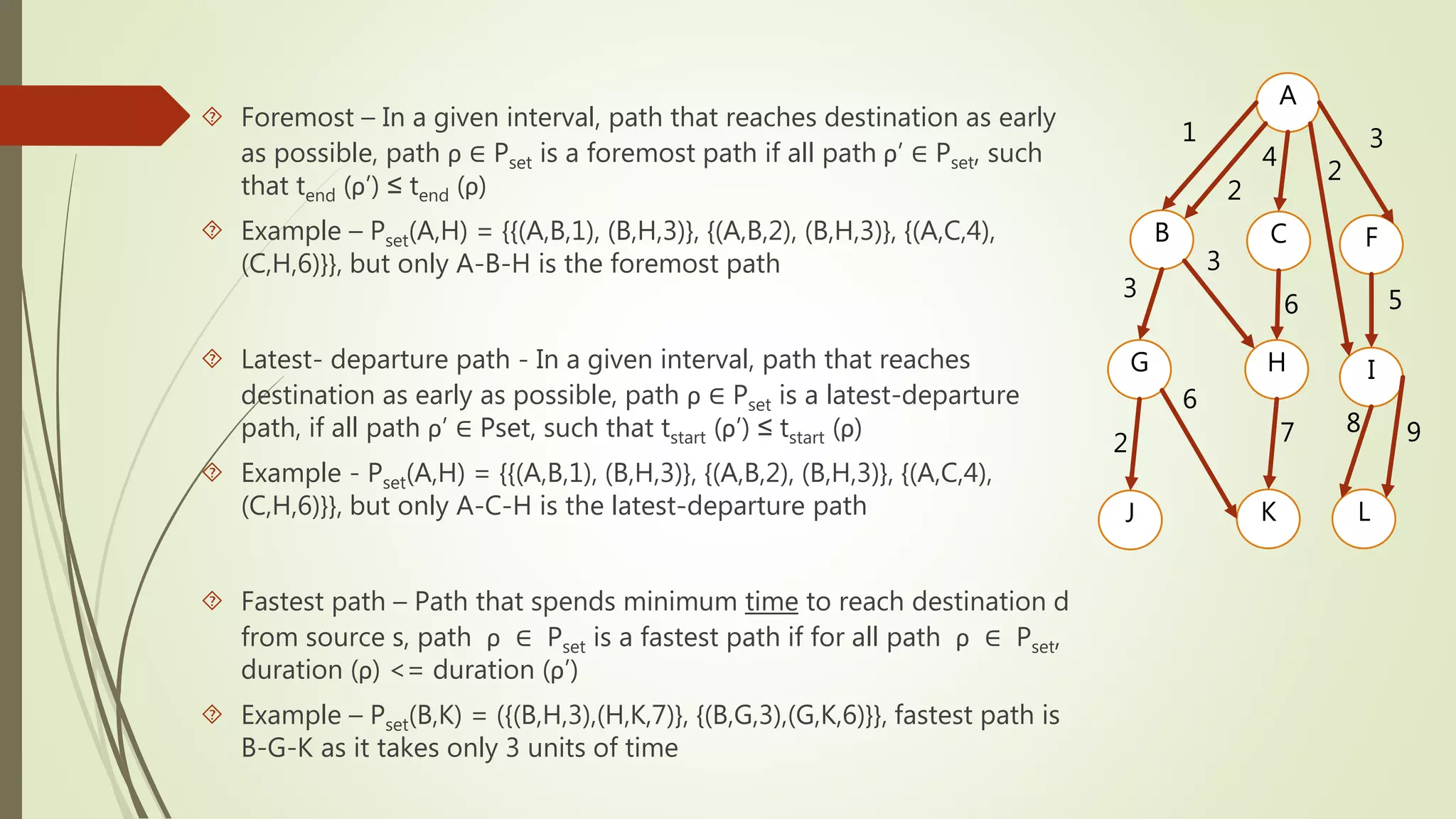
 Foremost – In a given interval, path that reaches destination as early 
as possible, path ρ ∈ Pset is a foremost path if all path ρ’ ∈ Pset, such 
that tend (ρ’) ≤ tend (ρ) 
 Example – Pset(A,H) = {{(A,B,1), (B,H,3)}, {(A,B,2), (B,H,3)}, {(A,C,4), 
(C,H,6)}}, but only A-B-H is the foremost path 
 Latest- departure path - In a given interval, path that reaches 
destination as early as possible, path ρ ∈ Pset is a latest-departure 
path, if all path ρ’ ∈ Pset, such that tstart (ρ’) ≤ tstart (ρ) 
 Example - Pset(A,H) = {{(A,B,1), (B,H,3)}, {(A,B,2), (B,H,3)}, {(A,C,4), 
(C,H,6)}}, but only A-C-H is the latest-departure path 
 Fastest path – Path that spends minimum time to reach destination d 
from source s, path ρ ∈ Pset is a fastest path if for all path ρ ∈ Pset, 
duration (ρ) <= duration (ρ’) 
 Example – Pset(B,K) = ({(B,H,3),(H,K,7)}, {(B,G,3),(G,K,6)}}, fastest path is 
B-G-K as it takes only 3 units of time 
A 
1 
2 
4 
2 
3 
B C F 
3 
3 
6 5 
G H I 
6 
2 7 8 9 
J K L
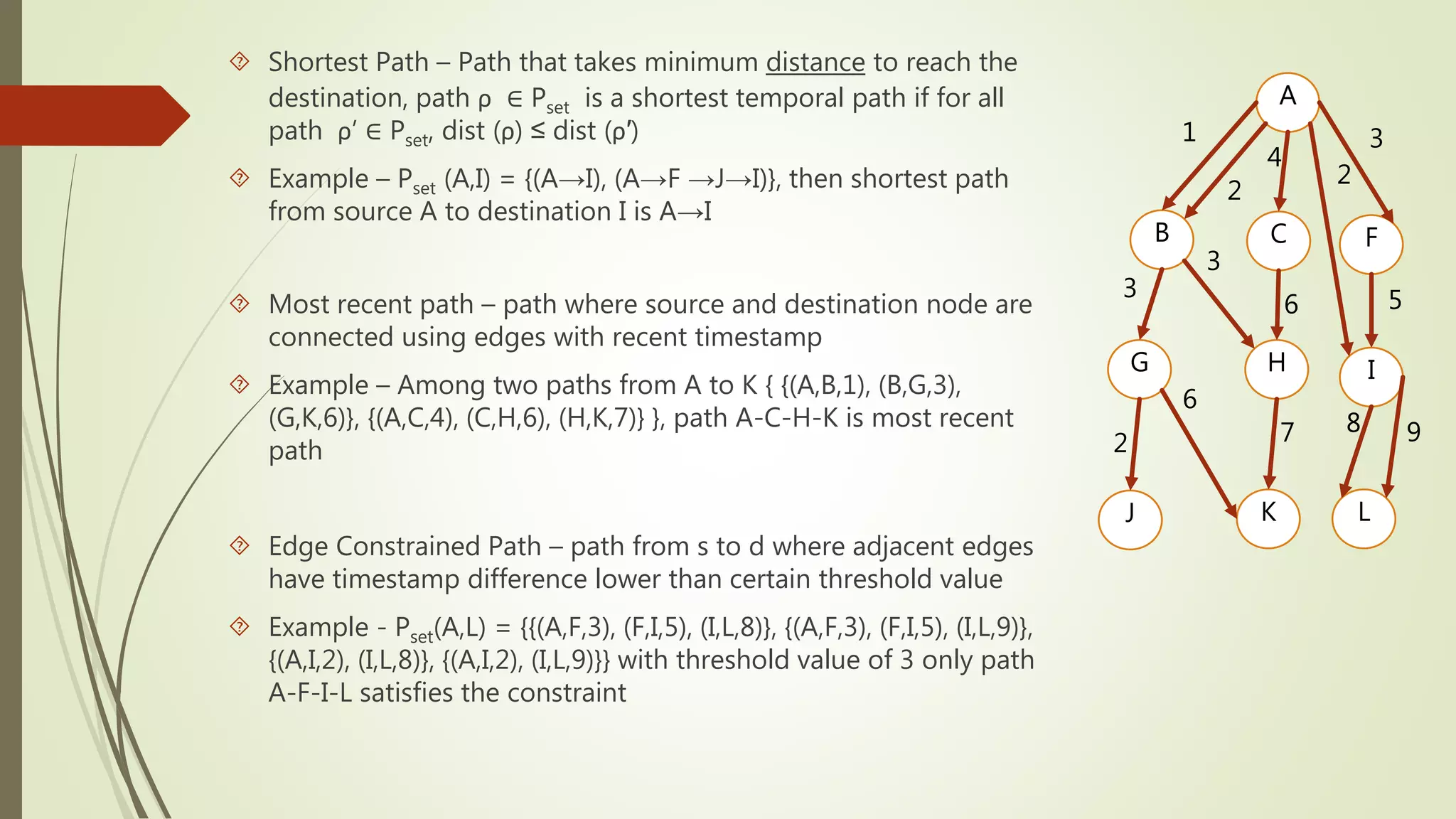
 Shortest Path – Path that takes minimum distance to reach the 
destination, path ρ ∈ Pset is a shortest temporal path if for all 
path ρ’ ∈ Pset, dist (ρ) ≤ dist (ρ′) 
 Example – Pset (A,I) = {(A→I), (A→F →J→I)}, then shortest path 
from source A to destination I is A→I 
 Most recent path – path where source and destination node are 
connected using edges with recent timestamp 
 Example – Among two paths from A to K { {(A,B,1), (B,G,3), 
(G,K,6)}, {(A,C,4), (C,H,6), (H,K,7)} }, path A-C-H-K is most recent 
path 
 Edge Constrained Path – path from s to d where adjacent edges 
have timestamp difference lower than certain threshold value 
 Example - Pset(A,L) = {{(A,F,3), (F,I,5), (I,L,8)}, {(A,F,3), (F,I,5), (I,L,9)}, 
{(A,I,2), (I,L,8)}, {(A,I,2), (I,L,9)}} with threshold value of 3 only path 
A-F-I-L satisfies the constraint 
A 
1 
2 
4 
2 
3 
B C F 
3 
3 
6 5 
G H I 
6 
2 7 8 9 
J K L
Observation 
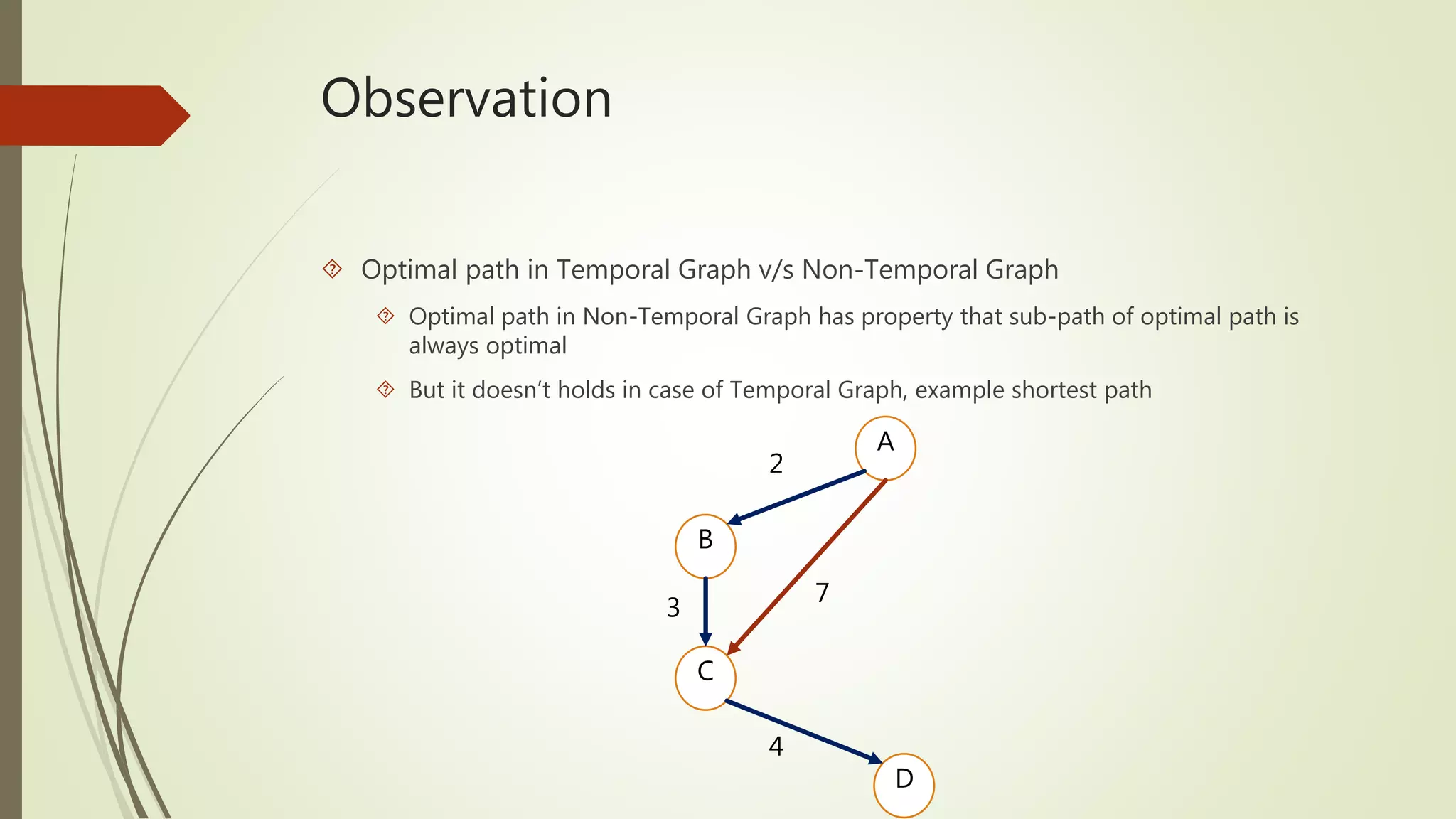
 Optimal path in Temporal Graph v/s Non-Temporal Graph 
 Optimal path in Non-Temporal Graph has property that sub-path of optimal path is 
always optimal 
 But it doesn’t holds in case of Temporal Graph, example shortest path 
A 
B 
C 
D 
2 
3 
7 
4
Temporal Path Discovery Techniques 
 Stream Representation of Temporal Graph 
 Transformation Graph
Stream Representation 
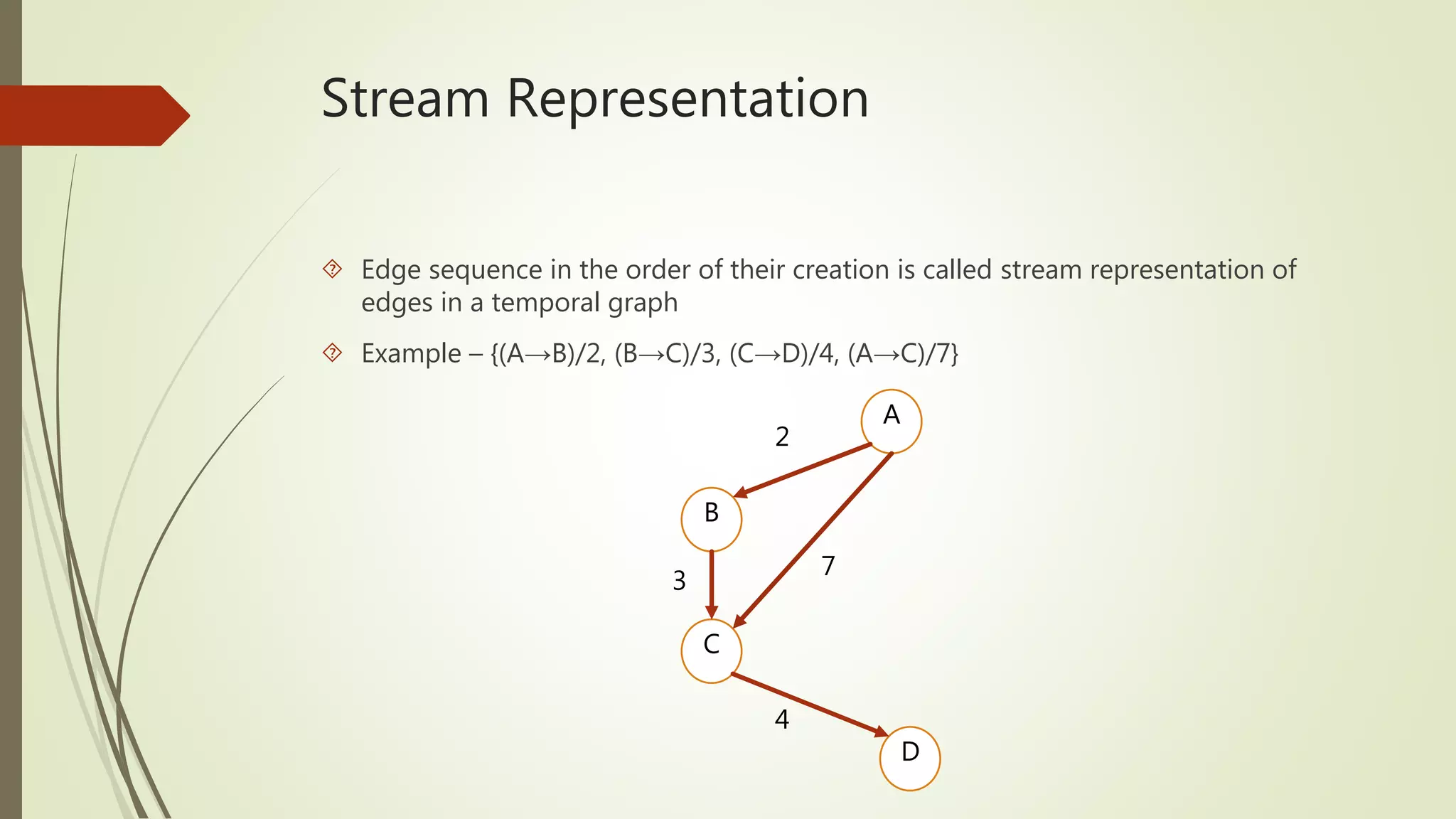
 Edge sequence in the order of their creation is called stream representation of 
edges in a temporal graph 
 Example – {(A→B)/2, (B→C)/3, (C→D)/4, (A→C)/7} 
A 
B 
C 
D 
2 
3 
7 
4
Foremost Path 
 Foremost Path for node ‘s’ in time interval [ta,tb] 
 For each node u in graph G t[u] = ∞ 
 Considering each edge in the sequence in the order 
 Check for two conditions if true then update t[v] = t+λ 
 t+λ ≤ tb and t ≥ t[u] 
 t+λ < t[v] 
 if t+ λ > tb then exit
Example 
 Edge representation is {(a, b, 1, λ), (a, c, 2, λ), (d, f, 3, λ), (b, d, 7, λ)} 
 Foremost path for node ‘a’ in [1,4] assuming λ = 1 
 For all node t[u] =∞ 
 Mark t[a] = 0 
 For edge (a, b, 1, 1), t + λ = 2, satisfies conditions, update t[b] = 2 
 For edge (a, c, 2, 1), t + λ = 3, satisfies conditions, update t[c] = 3 
 For edge (d, f, 3, 1), t + λ = 4, doesn’t satisfies condition t ≥ t[d] as t[d] = ∞ and t = 
3 
t+λ ≤ tb and t ≥ t[u] 
t+λ < t[v] 
a 
c 
b 
d f 
3 
2 
7 
1 
∞ 
∞ 
∞ 
∞ ∞ 
0 a 
3 
c 
b 
d f 
3 
2 
7 
1 
2 ∞ ∞
Fastest Path 
 Lv – sorted list of foremost time for each node v from source node ‘s is maintained, 
(s[v], a[v]), where s[v] represents start time from ‘s’ and a[v] arrival time at v 
 If s’[v] > s[v] and a’[v] ≤ a[v], or s’[v] = s[v] and a’[v] < a[v], then (s’[v], a’[v]) 
dominates (s[v], a[v]) 
A 
1 
2 
1,1 2,2 
B D 
3 
5 
C E 
4 
5 
F 
6 
1,3 
1,4 
2,5 
2,6 
S.No. s[v] a[v] 
a 1 4 
b 2 4 
c 4 6 
d 4 5
Transformation Graph 
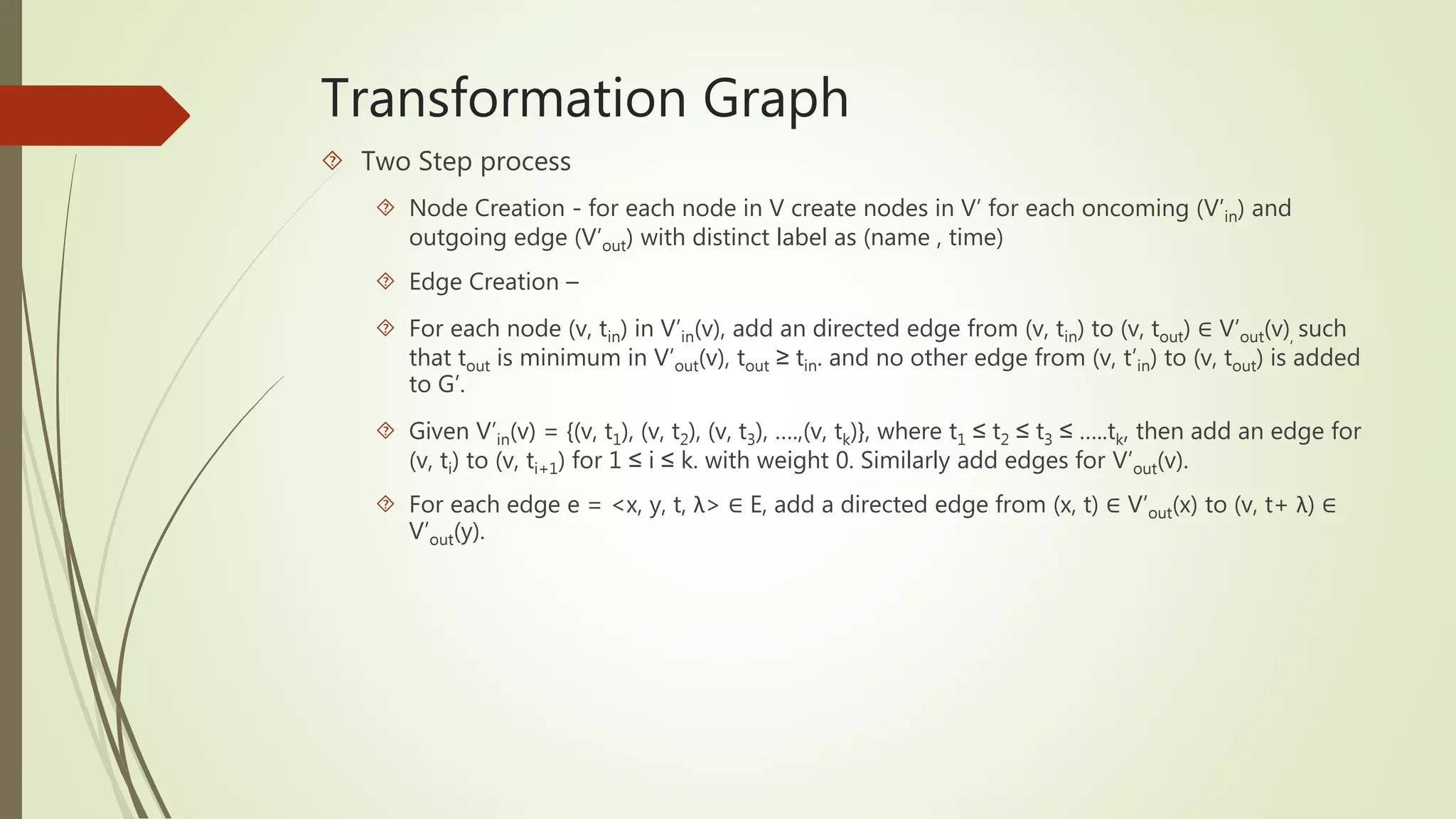
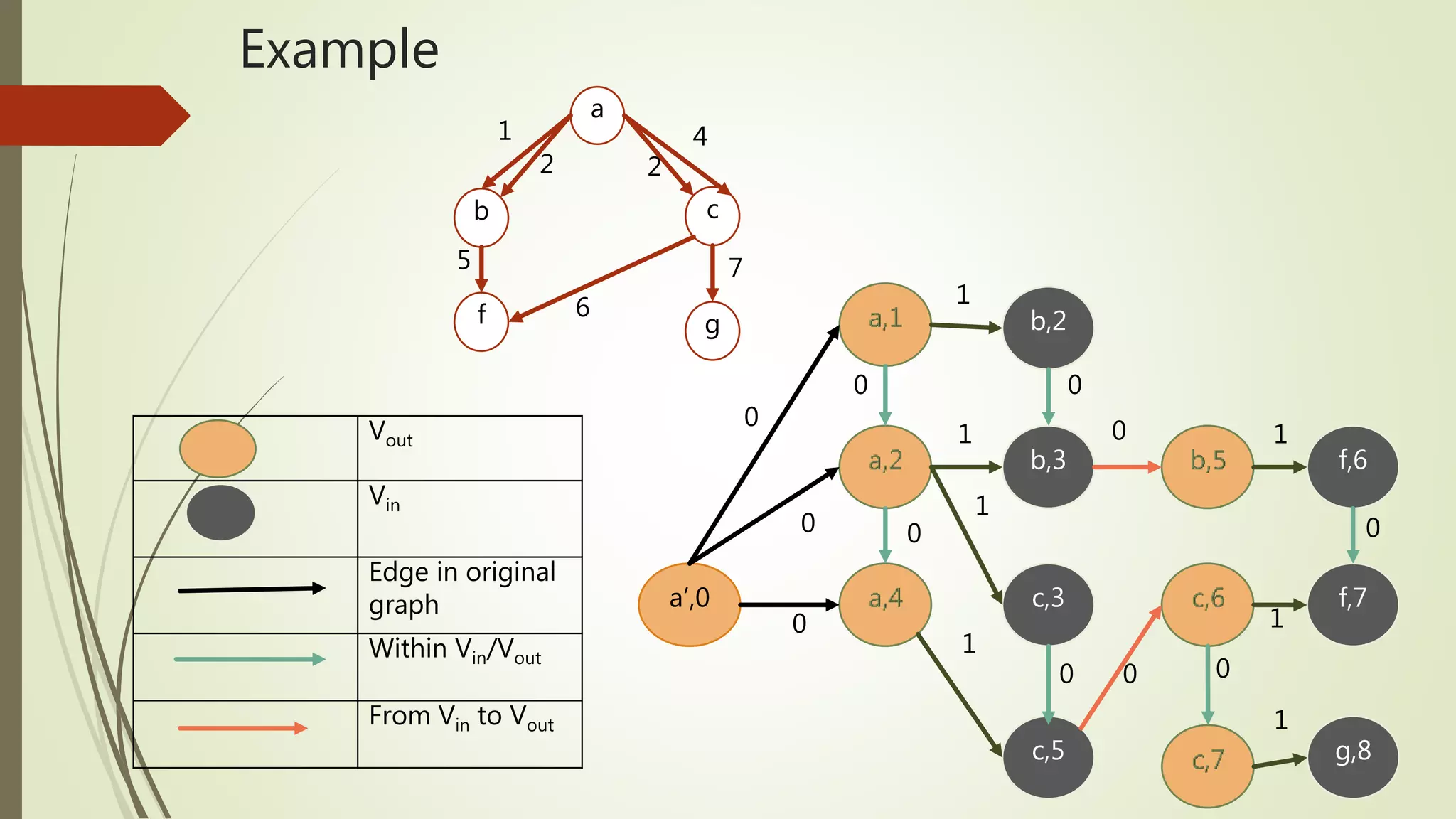
 Two Step process 
 Node Creation - for each node in V create nodes in V’ for each oncoming (V’in) and 
outgoing edge (V’out) with distinct label as (name , time) 
 Edge Creation – 
 For each node (v, tin) in V’in(v), add an directed edge from (v, tin) to (v, tout) ∈ V’out(v), such 
that tout is minimum in V’out(v), tout ≥ tin. and no other edge from (v, t’in) to (v, tout) is added 
to G’. 
 Given V’in(v) = {(v, t1), (v, t2), (v, t3), ….,(v, tk)}, where t1 ≤ t2 ≤ t3 ≤ …..tk, then add an edge for 
(v, ti) to (v, ti+1) for 1 ≤ i ≤ k. with weight 0. Similarly add edges for V’out(v). 
 For each edge e = <x, y, t, λ> ∈ E, add a directed edge from (x, t) ∈ V’out(x) to (v, t+ λ) ∈ 
V’out(y).
4 
a’,0 
b,2 
1 0 1 
b,3 
0 0 
c,3 
c,5 
f,6 
f,7 
g,8 
0 
0 
0 
1 
0 0 
1 
1 
0 0 0 
1 
1 
a 
1 
2 2 
b c 
f g 
5 
6 
7 
Example 
Vout 
Vin 
Edge in original 
graph 
Within Vin/Vout 
From Vin to Vout
Foremost Path 
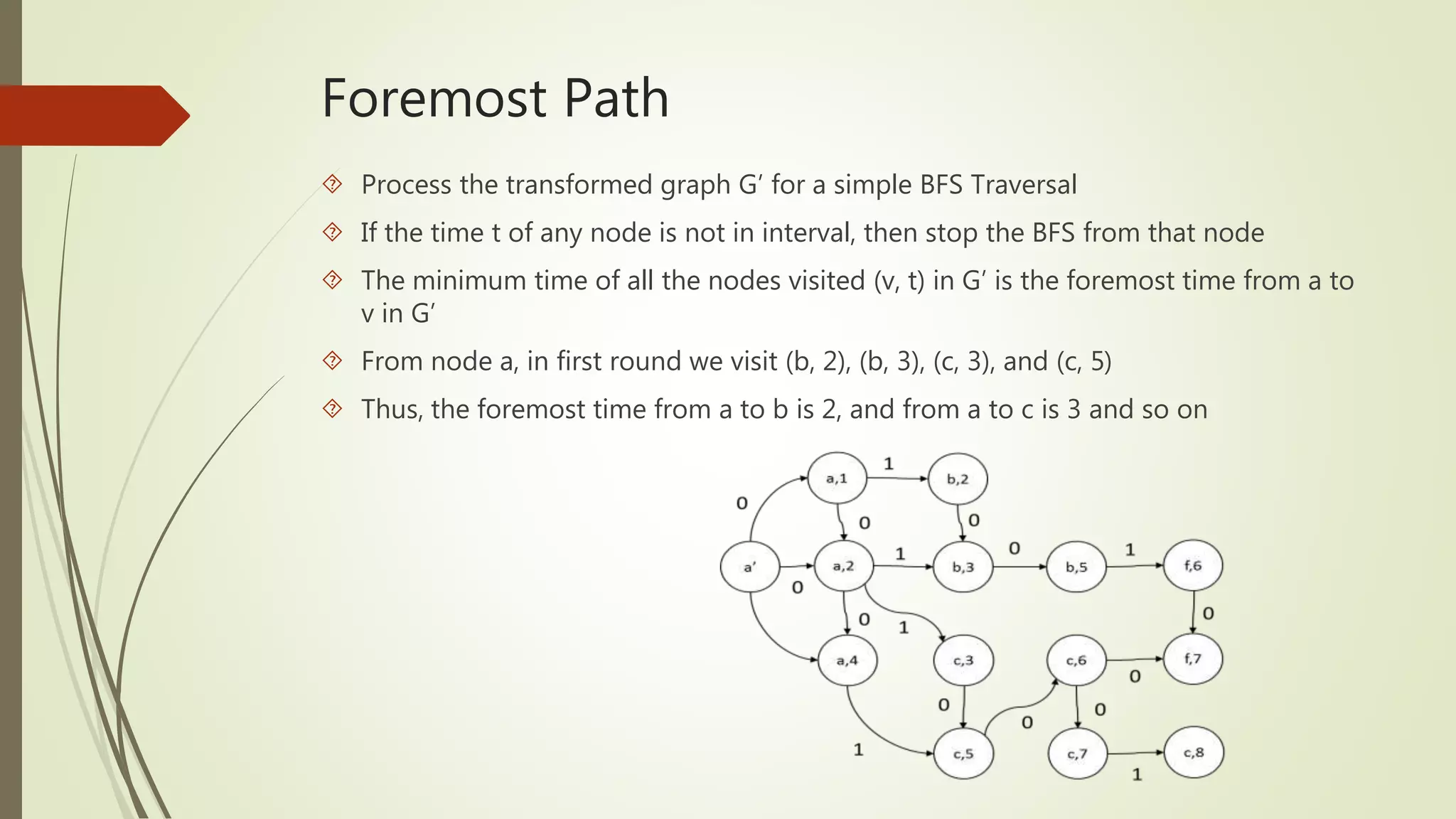
 Process the transformed graph G’ for a simple BFS Traversal 
 If the time t of any node is not in interval, then stop the BFS from that node 
 The minimum time of all the nodes visited (v, t) in G’ is the foremost time from a to 
v in G’ 
 From node a, in first round we visit (b, 2), (b, 3), (c, 3), and (c, 5) 
 Thus, the foremost time from a to b is 2, and from a to c is 3 and so on
Cost Optimal Path with time constraint 
 A graph in which cost of an edge changes with time is called time dependent 
graph 
 Two factors are considered in time dependent graph 
 Time 
 Cost of path 
 Constraints 
 Departure time from source and arrival time at destination must be within specified 
interval 
 Cost of the path must be minimum 
 Problem of finding cost-optimal path is 
 Optimal path from source to destination 
 Optimal waiting time at each node
 Earliest arrival time for each node is calculated so , λ1 = 0, λ2 = 
10, λ3 = 15 and λ4 = 25 and time domain of g1(t), g2(t), g3(t) and 
g4(t) are [0, 60], [10, 60], [15, 60] and [25, 60] respectively 
 Initially ti for all node is infinite except for source s 
 Priority Q is maintained containing all nodes with respect to 
their ti 
 In first iteration, v1 is dequeued as t1= 0 is minimum 
 g2(t) and g3(t) are computed and v1 is removed from Q 
 t2 = 20 and t3 = 5 are set 
 In second iteration, v3, is dequeued from Q 
 As T3 = 30, so S3 is updated as [30,60] 
 g4(t) is updated and t3 = 20 
 In third iteration, v2 is dequeued 
 g3(t) and g4(t) are computed and v2 is removed from Q 
 Similarly v3 is dequeued again in fourth iteration and v4 is 
dequeued in fifth iteration, and thus algorithm terminates
Conclusion 
 Graph DB used to store connected data and different technologies used to access 
them 
 Temporal Graph are used to withhold the temporal information about the data 
 Breadth first and depth traversal techniques on Temporal Graph 
 Different temporal paths and algorithms to determine those path
Thank You 
Q & A

Temporal graph

  • 1.
    Temporal Graph :Storage, Traversal, Path discovery Submitted by Vinay Sarda M.Tech(CSE) II Year 13535054 Under the guidance of Prof. A.K. Sarje
  • 2.
    Outline  Introduction  Graph Database  What is a Temporal Graph  Traversal in Temporal Path  Types of Path in Temporal Graph  Algorithms to determine different temporal path  Conclusion
  • 3.
    Introduction  Graphdatabase are best tool for handling highly connected data  In Relational or Hierarchical database, some entities have precedence over other like key, parent etc.  In Graph No node or edge have a higher precedence over other  Graph DB are NOSQL, doesn’t have rigid schema  Graph uses structures like nodes, edges are used to store and represent data  No need to look-up for neighbours as it provides index-free adjacency  Graph DB can be used in to determine whether two concept are related or not, or is it possible to reach from source to destination within specified interval etc.
  • 4.
    Example -Graph Royis boy Mary is a girl Roy and Mary are friends
  • 5.
    Accessing Graph DB  TinkerPop is an open source toolkit that provides interfaces to implement Blueprint  Blueprint is a generic graph API, serves as a base layer for graph DB architectures  Pipes is a dataflow network using process graphs  Gremlin is a graph traversal language for accessing and manipulating graphs  Frames allows developer to frame a graph element in terms of java interface  Furnace is a graph algorithm package  Rexster is a graph server that exploits blueprint via REST  Example Titan Graph DB TinkerPop Stack
  • 6.
    Temporal Graph Nodes and Edges are active for a specific time instance  Visiting nodes or edges at any time other than specific time instance is not possible  Example – SMS Network, flight scheduling, stock exchange network  Did mail from A to D had any impact on mail send from D to B Sender Receipent Time A B 0 A C,E 1 E D 3 B C 5 B D 9 D B 14 A D 20 C A B D E 1 C A 5 0 20 1 9 B D E 14 3 Non-Temporal Graph Temporal Graph
  • 7.
    Temporal Graph Traversal  Depth First Traversal  Temporal Constraint – In traversal from node a to e set of edges {(a,b,1),(b,e,6)} is valid, but edge set {(a,b,9),(b,e,6)} is not  Multiple edges – When multiple edges occur among the same pair of nodes, only one edge has to be chosen avoiding combinatorial effect  Edge with highest timestamp value (most recent connection)  Edge with lowest timestamp value (first connection) A B C E D F 3 2 8 6 7 1 4 5 9
  • 8.
    Depth First Traversal  Create a DFS tree rooted at node ‘a’ with lowest timestamp value  Initially every node’s visiting time is infinite  At node ‘a’, Eset = {(a,b,9), (a,b,1), (a,e,8), (a,c,2)}  Take edge (a,b,1) and visit node ‘b’ and mark time 1  Now Eset = {(b,d,7), (b,e,6)} and take edge (b,e,6), mark time t[e] = 6, and then (b,d,7), mark time t[d] = 7, and so on a b c e d 2 7 1 5 a c e b d 3 f 2 8 6 7 1 4 9 5 6
  • 9.
    Breadth First Traversal  Challenges  Temporal Constraint  Edges (b, d, 3) and (d, e, 3) forms a valid set of consecutive edges, but (c, d, 5), (d, e, 3) doesn’t.  Smallest path may not be earliest path  Path from a to d takes only one hop at time t = 7, while the earliest time at which d can be reached from a is 3 using edges (a, b, 2) and (b, d, 3)  If we mark node ‘d’ using edge a-d and don’t consider it again then ‘e’ cannot be reached  Multiple occurrences of a node are possible  Terminology  u – node  dist(u) – distance of node u from source s  σ(u) – earliest arrival time to reach node u from source node s  p(u) – parent node of u  Temporal edge is denoted as (u, v, t) a b c d e 2 5 4 7 3 5 3
  • 10.
     While Qis not empty for each node v  If v is not in Q (whether v has been visited or not) traverse e, and if σ(v) > t, then visit v and push (v, dist(v) = dist(u) + 1, σ (v) = t, p(v) = u) into Q.  Else  If there exists (v, dist(v), σ (v), p(v)) in Q such that dist(v) = dist(u) + 1: traverse e, and if σ(v) > t, then visit v and update σ(v) = t and p(v) = u in Q  Else (i.e., dist(v) = dist(u)): traverse e, and if σ(v) > t, then visit v and push (v, dist(v) = dist(u) + 1, σ (v) = t, p(v) = u) into Q. a b c d e 2 5 4 7 3 5 3 c a b d e 2 4 3 d 7 3 (a, 0, 1, φ) (b, 1, 2, a) (d, 1, 7, a) (c, 1, 4, a) (d, 2, 3, b) (e, 3, 3, d) Q (u, dist(u), σ(u), p(v))
  • 11.
    Paths in TemporalGraph  A path ρ = {(s, u1, t1), (u1, u2, t2), (u2, u3, t3),……..,(ui-1, ui, ti), ….. (un-1 ,d, tn)} from source s to destination d is a temporal path if ti ≤ ti+1  Terminology  Pset - set of all paths from source s to destination d  [ta, tb] – time interval  t[u] – time at which node u can be reached from source s  tstart(ρ) - timestamp of a path ρ at which it starts at source s  tend(ρ) - timestamp of a path ρ at which it ends at destination d  dist(ρ) - number of nodes in path ρ  duration(ρ) – time taken by path ρ to reach destination node from source node, tend(ρ) - tstart(ρ)  Transition time – time taken to reach from node to its neighbour node (λ), by default assumed to be 1
  • 12.
     Foremost –In a given interval, path that reaches destination as early as possible, path ρ ∈ Pset is a foremost path if all path ρ’ ∈ Pset, such that tend (ρ’) ≤ tend (ρ)  Example – Pset(A,H) = {{(A,B,1), (B,H,3)}, {(A,B,2), (B,H,3)}, {(A,C,4), (C,H,6)}}, but only A-B-H is the foremost path  Latest- departure path - In a given interval, path that reaches destination as early as possible, path ρ ∈ Pset is a latest-departure path, if all path ρ’ ∈ Pset, such that tstart (ρ’) ≤ tstart (ρ)  Example - Pset(A,H) = {{(A,B,1), (B,H,3)}, {(A,B,2), (B,H,3)}, {(A,C,4), (C,H,6)}}, but only A-C-H is the latest-departure path  Fastest path – Path that spends minimum time to reach destination d from source s, path ρ ∈ Pset is a fastest path if for all path ρ ∈ Pset, duration (ρ) <= duration (ρ’)  Example – Pset(B,K) = ({(B,H,3),(H,K,7)}, {(B,G,3),(G,K,6)}}, fastest path is B-G-K as it takes only 3 units of time A 1 2 4 2 3 B C F 3 3 6 5 G H I 6 2 7 8 9 J K L
  • 13.
     Shortest Path– Path that takes minimum distance to reach the destination, path ρ ∈ Pset is a shortest temporal path if for all path ρ’ ∈ Pset, dist (ρ) ≤ dist (ρ′)  Example – Pset (A,I) = {(A→I), (A→F →J→I)}, then shortest path from source A to destination I is A→I  Most recent path – path where source and destination node are connected using edges with recent timestamp  Example – Among two paths from A to K { {(A,B,1), (B,G,3), (G,K,6)}, {(A,C,4), (C,H,6), (H,K,7)} }, path A-C-H-K is most recent path  Edge Constrained Path – path from s to d where adjacent edges have timestamp difference lower than certain threshold value  Example - Pset(A,L) = {{(A,F,3), (F,I,5), (I,L,8)}, {(A,F,3), (F,I,5), (I,L,9)}, {(A,I,2), (I,L,8)}, {(A,I,2), (I,L,9)}} with threshold value of 3 only path A-F-I-L satisfies the constraint A 1 2 4 2 3 B C F 3 3 6 5 G H I 6 2 7 8 9 J K L
  • 14.
    Observation  Optimalpath in Temporal Graph v/s Non-Temporal Graph  Optimal path in Non-Temporal Graph has property that sub-path of optimal path is always optimal  But it doesn’t holds in case of Temporal Graph, example shortest path A B C D 2 3 7 4
  • 15.
    Temporal Path DiscoveryTechniques  Stream Representation of Temporal Graph  Transformation Graph
  • 16.
    Stream Representation Edge sequence in the order of their creation is called stream representation of edges in a temporal graph  Example – {(A→B)/2, (B→C)/3, (C→D)/4, (A→C)/7} A B C D 2 3 7 4
  • 17.
    Foremost Path Foremost Path for node ‘s’ in time interval [ta,tb]  For each node u in graph G t[u] = ∞  Considering each edge in the sequence in the order  Check for two conditions if true then update t[v] = t+λ  t+λ ≤ tb and t ≥ t[u]  t+λ < t[v]  if t+ λ > tb then exit
  • 18.
    Example  Edgerepresentation is {(a, b, 1, λ), (a, c, 2, λ), (d, f, 3, λ), (b, d, 7, λ)}  Foremost path for node ‘a’ in [1,4] assuming λ = 1  For all node t[u] =∞  Mark t[a] = 0  For edge (a, b, 1, 1), t + λ = 2, satisfies conditions, update t[b] = 2  For edge (a, c, 2, 1), t + λ = 3, satisfies conditions, update t[c] = 3  For edge (d, f, 3, 1), t + λ = 4, doesn’t satisfies condition t ≥ t[d] as t[d] = ∞ and t = 3 t+λ ≤ tb and t ≥ t[u] t+λ < t[v] a c b d f 3 2 7 1 ∞ ∞ ∞ ∞ ∞ 0 a 3 c b d f 3 2 7 1 2 ∞ ∞
  • 19.
    Fastest Path Lv – sorted list of foremost time for each node v from source node ‘s is maintained, (s[v], a[v]), where s[v] represents start time from ‘s’ and a[v] arrival time at v  If s’[v] > s[v] and a’[v] ≤ a[v], or s’[v] = s[v] and a’[v] < a[v], then (s’[v], a’[v]) dominates (s[v], a[v]) A 1 2 1,1 2,2 B D 3 5 C E 4 5 F 6 1,3 1,4 2,5 2,6 S.No. s[v] a[v] a 1 4 b 2 4 c 4 6 d 4 5
  • 20.
    Transformation Graph Two Step process  Node Creation - for each node in V create nodes in V’ for each oncoming (V’in) and outgoing edge (V’out) with distinct label as (name , time)  Edge Creation –  For each node (v, tin) in V’in(v), add an directed edge from (v, tin) to (v, tout) ∈ V’out(v), such that tout is minimum in V’out(v), tout ≥ tin. and no other edge from (v, t’in) to (v, tout) is added to G’.  Given V’in(v) = {(v, t1), (v, t2), (v, t3), ….,(v, tk)}, where t1 ≤ t2 ≤ t3 ≤ …..tk, then add an edge for (v, ti) to (v, ti+1) for 1 ≤ i ≤ k. with weight 0. Similarly add edges for V’out(v).  For each edge e = <x, y, t, λ> ∈ E, add a directed edge from (x, t) ∈ V’out(x) to (v, t+ λ) ∈ V’out(y).
  • 21.
    4 a’,0 b,2 1 0 1 b,3 0 0 c,3 c,5 f,6 f,7 g,8 0 0 0 1 0 0 1 1 0 0 0 1 1 a 1 2 2 b c f g 5 6 7 Example Vout Vin Edge in original graph Within Vin/Vout From Vin to Vout
  • 22.
    Foremost Path Process the transformed graph G’ for a simple BFS Traversal  If the time t of any node is not in interval, then stop the BFS from that node  The minimum time of all the nodes visited (v, t) in G’ is the foremost time from a to v in G’  From node a, in first round we visit (b, 2), (b, 3), (c, 3), and (c, 5)  Thus, the foremost time from a to b is 2, and from a to c is 3 and so on
  • 23.
    Cost Optimal Pathwith time constraint  A graph in which cost of an edge changes with time is called time dependent graph  Two factors are considered in time dependent graph  Time  Cost of path  Constraints  Departure time from source and arrival time at destination must be within specified interval  Cost of the path must be minimum  Problem of finding cost-optimal path is  Optimal path from source to destination  Optimal waiting time at each node
  • 24.
     Earliest arrivaltime for each node is calculated so , λ1 = 0, λ2 = 10, λ3 = 15 and λ4 = 25 and time domain of g1(t), g2(t), g3(t) and g4(t) are [0, 60], [10, 60], [15, 60] and [25, 60] respectively  Initially ti for all node is infinite except for source s  Priority Q is maintained containing all nodes with respect to their ti  In first iteration, v1 is dequeued as t1= 0 is minimum  g2(t) and g3(t) are computed and v1 is removed from Q  t2 = 20 and t3 = 5 are set  In second iteration, v3, is dequeued from Q  As T3 = 30, so S3 is updated as [30,60]  g4(t) is updated and t3 = 20  In third iteration, v2 is dequeued  g3(t) and g4(t) are computed and v2 is removed from Q  Similarly v3 is dequeued again in fourth iteration and v4 is dequeued in fifth iteration, and thus algorithm terminates
  • 25.
    Conclusion  GraphDB used to store connected data and different technologies used to access them  Temporal Graph are used to withhold the temporal information about the data  Breadth first and depth traversal techniques on Temporal Graph  Different temporal paths and algorithms to determine those path
  • 26.

Editor's Notes

  • #10 While Q is not empty, do: (a) Pop (u, dist(u), σ (u), p(u)) from Q; (b) Let Eu,v be the set of temporal edges going from u to v, where each edge (u, v, t) ∈ Eu,v has not been traversed before and σ(u) ≤ t. For each out-neighbor v of u, where Eu,v 6 = ∅, do: i. Let e = (u, v, t) be the edge in Eu,v where t = min{t ′ : (u, v, t ′ ) ∈ Eu,v}. ii. If v is not in Q (whether v has been visited or not): traverse e, and if σ(v) > t, then visit v and push (v, dist(v) = dist(u) + 1, σ (v) = t, p(v) = u) into Q. iii. Else: A. If there exists (v, dist(v), σ (v), p(v)) in Q such that dist(v) = dist(u) + 1: traverse e, and if σ(v) > t, then visit v and update σ(v) = t and p(v) = u in Q. B. Else (i.e., dist(v) = dist(u)): traverse e, and if σ(v) > t, then visit v and push (v, dist(v) = dist(u) + 1, σ (v) = t, p(v) = u) into Q. The BFS constructs a BFS tree, T , which is rooted at s, where the set of vertices in T is defined as ({s} ∪ {v : v is visited in the BFS and p(v) 6 = φ}, and the set of edges in T is defined as {(p(v), v ) : v in T and p(v) 6 = φ