Swipe
Neural Networks
What is neural network?
An Artificial Neural Network (ANN) is an
information processing paradigm that is inspired
by biological nervous systems.
It is composed of a large number of highly
interconnected processing elements called
neurons.
An ANN is configured for a specific application,
such as pattern recognition or data classification .
Ability to derive meaning from complicated or
imprecise data.
Extract patterns and detect trends that are too
complex to be noticed by either humans or other
computer techniques.
Adaptive learning.
Real Time Operation.
Neural networks enable us to find solution where
algorithmic methods are computationally
intensive or do not exist.
There is no need to program neural networks they
learn with examples.
Neural networks offer significant speed
advantage over conventional techniques.
Why use neural networks?
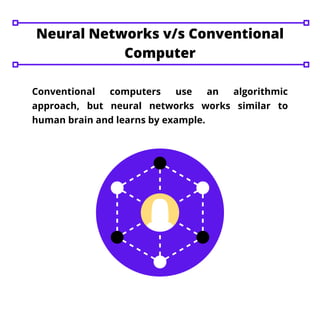
Conventional computers use an algorithmic
approach, but neural networks works similar to
human brain and learns by example.
Neural Networks v/s Conventional
Computer
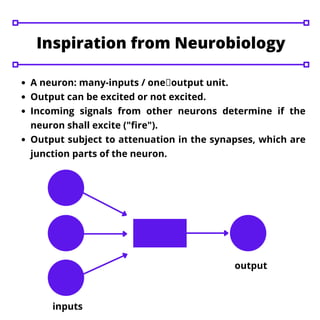
A neuron: many-inputs / one output unit.
Output can be excited or not excited.
Incoming signals from other neurons determine if the
neuron shall excite ("fire").
Output subject to attenuation in the synapses, which are
junction parts of the neuron.
Inspiration from Neurobiology
inputs
output
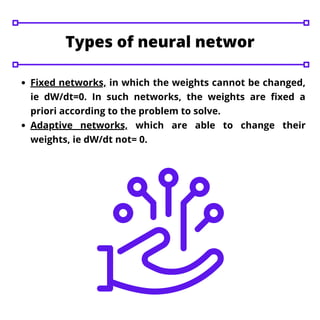
Fixed networks, in which the weights cannot be changed,
ie dW/dt=0. In such networks, the weights are fixed a
priori according to the problem to solve.
Adaptive networks, which are able to change their
weights, ie dW/dt not= 0.
Types of neural networ
Nearest-neighbour recall.
Interpolative recall
Associative mapping in which the network learns to
produce a particular pattern on the set of input units
whenever another particular pattern is applied on
the set of input units. The associative mapping can
generally be broken down into two mechanisms:
The Learning Process
Nearest-neighbour recall, where the output pattern
produced corresponds to the input pattern stored, which
is closest to the pattern presented.
Interpolative recall, where the output pattern is a
similarity dependent interpolation of the patterns stored
corresponding to the pattern presented. Yet another
paradigm, which is a variant associative mapping is
classification, ie when there is a fixed set of categories
into which the input patterns are to be classified.
Hetero-association recall mechanisms
Key Features
Neural network design, training, and simulation.
Pattern recognition, clustering, and data-fitting tools.
Unsupervised networks including self-organizing maps and
competitive layersSupervised networks including
feedforward, radial basis, LVQ, time delay, nonlinear
autoregressive (NARX), and layer-recurrents.
Preprocessing and postprocessing for improving the
efficiency of network training and assessing network
performance.
Modular network representation for managing and
visualizing networks of arbitrary size.
Routines for improving generalization to prevent
overfitting.
Simulinkblocks for building and evaluating neural
networks, and advanced blocks for control systems
applications.
Topics for next Post
Similarity learning
Stay Tuned with

Neural networks

  • 1.
  • 2.
    What is neuralnetwork? An Artificial Neural Network (ANN) is an information processing paradigm that is inspired by biological nervous systems. It is composed of a large number of highly interconnected processing elements called neurons. An ANN is configured for a specific application, such as pattern recognition or data classification .
  • 3.
    Ability to derivemeaning from complicated or imprecise data. Extract patterns and detect trends that are too complex to be noticed by either humans or other computer techniques. Adaptive learning. Real Time Operation. Neural networks enable us to find solution where algorithmic methods are computationally intensive or do not exist. There is no need to program neural networks they learn with examples. Neural networks offer significant speed advantage over conventional techniques. Why use neural networks?
  • 4.
    Conventional computers usean algorithmic approach, but neural networks works similar to human brain and learns by example. Neural Networks v/s Conventional Computer
  • 5.
    A neuron: many-inputs/ one output unit. Output can be excited or not excited. Incoming signals from other neurons determine if the neuron shall excite ("fire"). Output subject to attenuation in the synapses, which are junction parts of the neuron. Inspiration from Neurobiology inputs output
  • 6.
    Fixed networks, inwhich the weights cannot be changed, ie dW/dt=0. In such networks, the weights are fixed a priori according to the problem to solve. Adaptive networks, which are able to change their weights, ie dW/dt not= 0. Types of neural networ
  • 7.
    Nearest-neighbour recall. Interpolative recall Associativemapping in which the network learns to produce a particular pattern on the set of input units whenever another particular pattern is applied on the set of input units. The associative mapping can generally be broken down into two mechanisms: The Learning Process
  • 8.
    Nearest-neighbour recall, wherethe output pattern produced corresponds to the input pattern stored, which is closest to the pattern presented. Interpolative recall, where the output pattern is a similarity dependent interpolation of the patterns stored corresponding to the pattern presented. Yet another paradigm, which is a variant associative mapping is classification, ie when there is a fixed set of categories into which the input patterns are to be classified. Hetero-association recall mechanisms
  • 9.
    Key Features Neural networkdesign, training, and simulation. Pattern recognition, clustering, and data-fitting tools. Unsupervised networks including self-organizing maps and competitive layersSupervised networks including feedforward, radial basis, LVQ, time delay, nonlinear autoregressive (NARX), and layer-recurrents. Preprocessing and postprocessing for improving the efficiency of network training and assessing network performance. Modular network representation for managing and visualizing networks of arbitrary size. Routines for improving generalization to prevent overfitting. Simulinkblocks for building and evaluating neural networks, and advanced blocks for control systems applications.
  • 10.
    Topics for nextPost Similarity learning Stay Tuned with