Presentation
On
Training Neural Networks , Backpropagation, Forward
propagation
by
Ms.K.Ghuge
Training Neural Networks
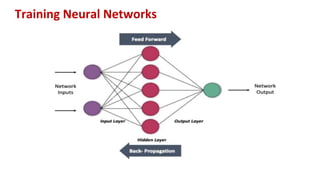
● Training a neural network involves the process of adjusting the weights
and biases of the network to minimize the difference between the
predicted outputs and the actual outputs for a given set of training data.
● This process is typically done through a combination of forward
propagation and backpropagation.
● This process is typically done through a combination of forward
propagation and backpropagation. Here's a step-by-step overview of
the training process:
Training Neural Networks
● Training a neural network involves the process of adjusting the weights
and biases of the network to minimize the difference between the
predicted outputs and the actual outputs for a given set of training data.
● This process is typically done through a combination of forward
propagation and backpropagation.
● This process is typically done through a combination of forward
propagation and backpropagation. Here's a step-by-step overview of
the training process:
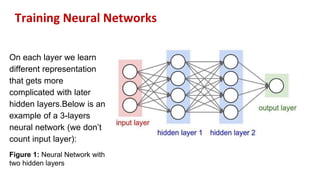
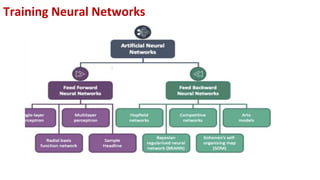
On each layer we learn
different representation
that gets more
complicated with later
hidden layers.Below is an
example of a 3-layers
neural network (we don’t
count input layer):
Figure 1: Neural Network with
two hidden layers
Training Neural Networks
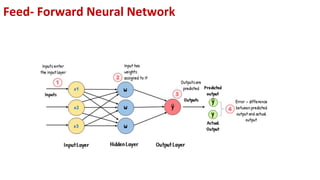
Feed- Forward Neural Network
Forward Propagation:
● Input a training sample into the neural network.
● Propagate the input forward through the network to compute the
predicted output.
● Apply activation functions at each neuron to introduce non-linearity.
Compute Loss:
● Compare the predicted output with the actual output using a loss
function.
● The loss function quantifies the error between the predicted and actual
outputs.
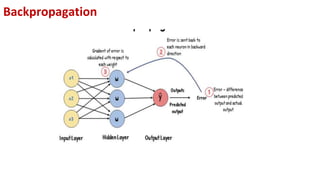
Backpropagation
Backpropagation
Backward Pass:
Compute the gradient of the loss with respect to the output of the neural network.
∂Loss / ∂Output
Backpropagate Errors:
● Propagate the gradient backward through the network to compute the gradients of the
loss with respect to the weights and biases.
● Use the chain rule to calculate the contribution of each weight and bias to the overall
loss.
Backpropagation
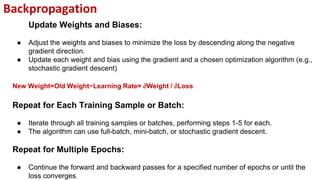
Update Weights and Biases:
● Adjust the weights and biases to minimize the loss by descending along the negative
gradient direction.
● Update each weight and bias using the gradient and a chosen optimization algorithm (e.g.,
stochastic gradient descent)
New Weight=Old Weight−Learning Rate× ∂Weight / ∂Loss
Repeat for Each Training Sample or Batch:
● Iterate through all training samples or batches, performing steps 1-5 for each.
● The algorithm can use full-batch, mini-batch, or stochastic gradient descent.
Repeat for Multiple Epochs:
● Continue the forward and backward passes for a specified number of epochs or until the
loss converges.
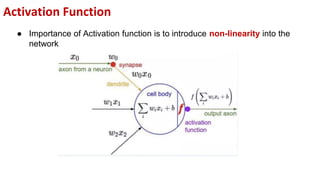
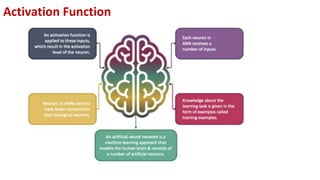
Activation Function
● Importance of Activation function is to introduce non-linearity into the
network
Activation Function
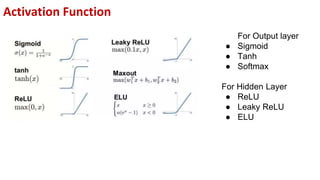
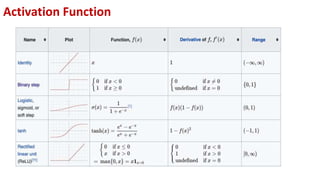
For Output layer
● Sigmoid
● Tanh
● Softmax
For Hidden Layer
● ReLU
● Leaky ReLU
● ELU
Activation Function
Activation Function
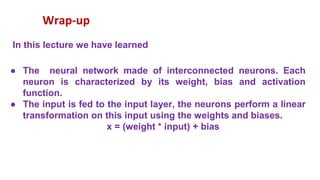
● The neural network made of interconnected neurons. Each
neuron is characterized by its weight, bias and activation
function.
● The input is fed to the input layer, the neurons perform a linear
transformation on this input using the weights and biases.
x = (weight * input) + bias
Wrap-up
In this lecture we have learned
Wrap-up
In this lecture we have learned
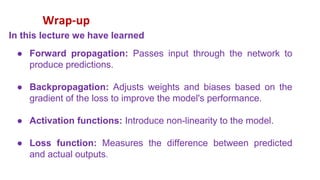
● Forward propagation: Passes input through the network to
produce predictions.
● Backpropagation: Adjusts weights and biases based on the
gradient of the loss to improve the model's performance.
● Activation functions: Introduce non-linearity to the model.
● Loss function: Measures the difference between predicted
and actual outputs.

Training Neural Networks.pptx

  • 1.
    Presentation On Training Neural Networks, Backpropagation, Forward propagation by Ms.K.Ghuge
  • 2.
    Training Neural Networks ●Training a neural network involves the process of adjusting the weights and biases of the network to minimize the difference between the predicted outputs and the actual outputs for a given set of training data. ● This process is typically done through a combination of forward propagation and backpropagation. ● This process is typically done through a combination of forward propagation and backpropagation. Here's a step-by-step overview of the training process:
  • 3.
    Training Neural Networks ●Training a neural network involves the process of adjusting the weights and biases of the network to minimize the difference between the predicted outputs and the actual outputs for a given set of training data. ● This process is typically done through a combination of forward propagation and backpropagation. ● This process is typically done through a combination of forward propagation and backpropagation. Here's a step-by-step overview of the training process:
  • 4.
    On each layerwe learn different representation that gets more complicated with later hidden layers.Below is an example of a 3-layers neural network (we don’t count input layer): Figure 1: Neural Network with two hidden layers Training Neural Networks
  • 5.
  • 6.
  • 7.
  • 8.
  • 9.
    Feed- Forward NeuralNetwork Forward Propagation: ● Input a training sample into the neural network. ● Propagate the input forward through the network to compute the predicted output. ● Apply activation functions at each neuron to introduce non-linearity. Compute Loss: ● Compare the predicted output with the actual output using a loss function. ● The loss function quantifies the error between the predicted and actual outputs.
  • 10.
  • 11.
    Backpropagation Backward Pass: Compute thegradient of the loss with respect to the output of the neural network. ∂Loss / ∂Output Backpropagate Errors: ● Propagate the gradient backward through the network to compute the gradients of the loss with respect to the weights and biases. ● Use the chain rule to calculate the contribution of each weight and bias to the overall loss.
  • 12.
    Backpropagation Update Weights andBiases: ● Adjust the weights and biases to minimize the loss by descending along the negative gradient direction. ● Update each weight and bias using the gradient and a chosen optimization algorithm (e.g., stochastic gradient descent) New Weight=Old Weight−Learning Rate× ∂Weight / ∂Loss Repeat for Each Training Sample or Batch: ● Iterate through all training samples or batches, performing steps 1-5 for each. ● The algorithm can use full-batch, mini-batch, or stochastic gradient descent. Repeat for Multiple Epochs: ● Continue the forward and backward passes for a specified number of epochs or until the loss converges.
  • 13.
    Activation Function ● Importanceof Activation function is to introduce non-linearity into the network
  • 14.
    Activation Function For Outputlayer ● Sigmoid ● Tanh ● Softmax For Hidden Layer ● ReLU ● Leaky ReLU ● ELU
  • 15.
  • 16.
  • 17.
    ● The neuralnetwork made of interconnected neurons. Each neuron is characterized by its weight, bias and activation function. ● The input is fed to the input layer, the neurons perform a linear transformation on this input using the weights and biases. x = (weight * input) + bias Wrap-up In this lecture we have learned
  • 18.
    Wrap-up In this lecturewe have learned ● Forward propagation: Passes input through the network to produce predictions. ● Backpropagation: Adjusts weights and biases based on the gradient of the loss to improve the model's performance. ● Activation functions: Introduce non-linearity to the model. ● Loss function: Measures the difference between predicted and actual outputs.