Ms. Poonam Sinai Kenkre

 Why  is web crawler required?
 How does web crawler work?
 Crawling strategies
        Breadth first search traversal
        depth first search traversal
 Architecture of web crawler
 Crawling policies
 Distributed crawling
   The process or program used by search engines to
    download pages from the web for later processing by a
    search engine that will index the downloaded pages to
    provide fast searches.

   A program or automated script which browses the World
    Wide Web in a methodical, automated manner

   also known as web spiders and web robots.

   less used names- ants, bots and worms.
 What   is a web crawler?

 How   does web crawler work?
 Crawling strategies
       Breadth first search traversal
        depth first search traversal
 Architecture of web crawler
 Crawling policies
 Distributed crawling
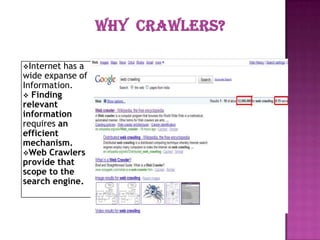
Internet has a
wide expanse of
Information.
 Finding
relevant
information
requires an
efficient
mechanism.
Web Crawlers
provide that
scope to the
search engine.
 What   is a web crawler?
 Why  is web crawler required?
 How does web crawler work?
 Crawling strategies
       Breadth first search traversal
        depth first search traversal
 Architecture of web crawler
 Crawling policies
 Distributed crawling
 It starts with a list of URLs to visit, called the
  seeds . As the crawler visits these URLs, it
  identifies all the hyperlinks in the page and adds
  them to the list of visited URLs, called the crawl
  frontier
 URLs from the frontier are recursively visited
  according to a set of policies.
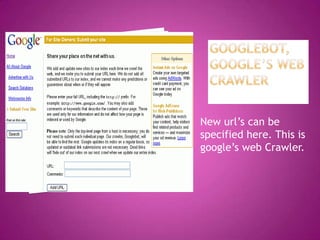
New url’s can be
specified here. This is
google’s web Crawler.
Initialize queue (Q) with initial set of known URL’s.
Until Q empty or page or time limit exhausted:
 Pop URL, L, from front of Q.
 If L is not an HTML page (.gif, .jpeg, .ps, .pdf, .ppt…)
       exit loop.
 If already visited L, continue loop(get next url).
 Download page, P, for L.
 If cannot download P (e.g. 404 error, robot excluded)
       exit loop, else.
 Index P (e.g. add to inverted index or store cached copy).
 Parse P to obtain list of new links N.
 Append N to the end of Q.
 What   is a web crawler?
 Why  is web crawler required?
 How does web crawler work?
 Crawling strategies
       Breadth first search traversal
        depth first search traversal
 Architecture of web crawler
 Crawling policies
 Distributed crawling
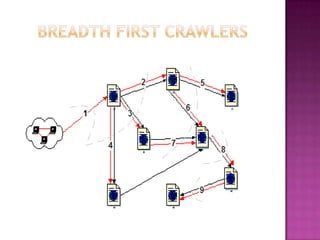
Alternate way of looking at the problem.

 Web is a huge directed graph, with
 documents as vertices and hyperlinks as
 edges.
 Need to explore the graph using a suitable
  graph traversal algorithm.
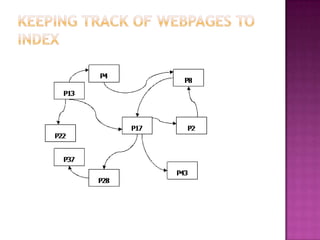
 W.r.t. previous ex: nodes are represented
 by rectangles and directed edges are
 drawn as arrows.
Given any graph and a set of seeds at which to start, the
  graph can be traversed using the algorithm

1. Put all the given seeds into the queue;
2. Prepare to keep a list of “visited” nodes (initially
   empty);
3. As long as the queue is not empty:
     a. Remove the first node from the queue;
     b. Append that node to the list of “visited” nodes
     c. For each edge starting at that node:
 i. If the node at the end of the edge already appears on
   the list of “visited” nodes or it is already in the queue,
   then do nothing more with that edge;
 ii. Otherwise, append the node at the end of the edge
   to the end of the queue.
 What   is a web crawler?
 Why  is web crawler required?
 How does web crawler work?
 Crawling strategies
        Breadth first search traversal
        Depth first search traversal
 Architecture of web crawler
 Crawling policies
 Parallel crawling
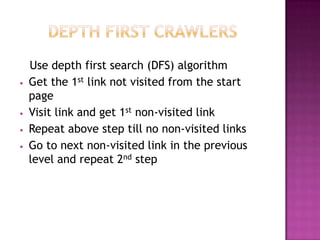
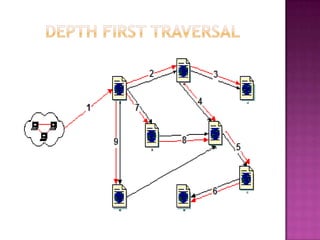
Use depth first search (DFS) algorithm
•   Get the 1st link not visited from the start
    page
•   Visit link and get 1st non-visited link
•   Repeat above step till no non-visited links
•   Go to next non-visited link in the previous
    level and repeat 2nd step
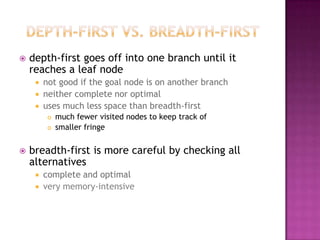
   depth-first goes off into one branch until it
    reaches a leaf node
        not good if the goal node is on another branch
        neither complete nor optimal
        uses much less space than breadth-first
            much fewer visited nodes to keep track of
            smaller fringe


   breadth-first is more careful by checking all
    alternatives
        complete and optimal
        very memory-intensive
 What   is a web crawler?
 Why  is web crawler required?
 How does web crawler work?
 Crawling strategies
        Breadth first search traversal
        Depth first search traversal
 Architecture of web crawler
 Crawling policies
 Distributed crawling
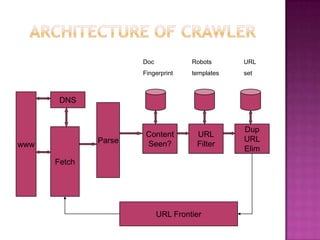
Doc            Robots      URL
                      Fingerprint    templates   set


       DNS


                                                 Dup
                       Content        URL
              Parse                              URL
www                    Seen?          Filter
                                                 Elim
      Fetch


                            URL Frontier
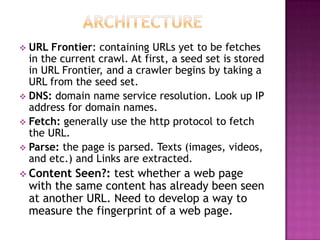
 URL Frontier: containing URLs yet to be fetches
  in the current crawl. At first, a seed set is stored
  in URL Frontier, and a crawler begins by taking a
  URL from the seed set.
 DNS: domain name service resolution. Look up IP
  address for domain names.
 Fetch: generally use the http protocol to fetch
  the URL.
 Parse: the page is parsed. Texts (images, videos,
  and etc.) and Links are extracted.
 Content    Seen?: test whether a web page
    with the same content has already been seen
    at another URL. Need to develop a way to
    measure the fingerprint of a web page.
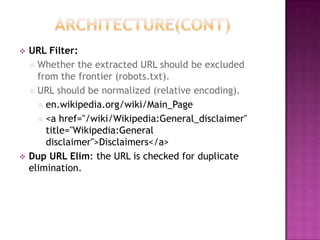
   URL Filter:
     Whether the extracted URL should be excluded
      from the frontier (robots.txt).
     URL should be normalized (relative encoding).
       en.wikipedia.org/wiki/Main_Page
       <a href="/wiki/Wikipedia:General_disclaimer"
        title="Wikipedia:General
        disclaimer">Disclaimers</a>
   Dup URL Elim: the URL is checked for duplicate
    elimination.
 What   is a web crawler?
 Why  is web crawler required?
 How does web crawler work?
 Crawling strategies
        Breadth first search traversal
        Depth first search traversal
 Architecture of web crawler
 Crawling policies
 Distributed crawling
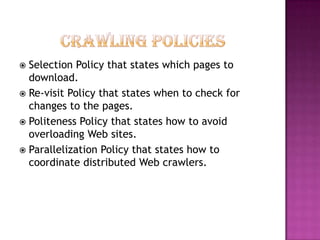
 Selection Policy that states which pages to
  download.
 Re-visit Policy that states when to check for
  changes to the pages.
 Politeness Policy that states how to avoid
  overloading Web sites.
 Parallelization Policy that states how to
  coordinate distributed Web crawlers.
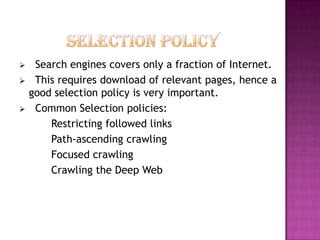
    Search engines covers only a fraction of Internet.
    This requires download of relevant pages, hence a
    good selection policy is very important.
    Common Selection policies:
        Restricting followed links
        Path-ascending crawling
        Focused crawling
        Crawling the Deep Web
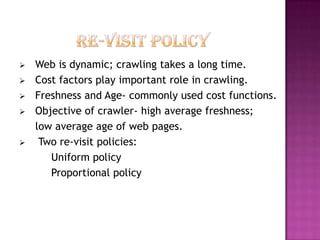
   Web is dynamic; crawling takes a long time.
   Cost factors play important role in crawling.
   Freshness and Age- commonly used cost functions.
   Objective of crawler- high average freshness;
    low average age of web pages.
    Two re-visit policies:
       Uniform policy
       Proportional policy
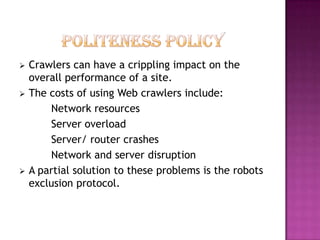
   Crawlers can have a crippling impact on the
    overall performance of a site.
   The costs of using Web crawlers include:
        Network resources
        Server overload
        Server/ router crashes
        Network and server disruption
   A partial solution to these problems is the robots
    exclusion protocol.
 How to control those robots!
 Web sites and pages can specify that robots
 should not crawl/index certain areas.
 Two components:
    Robots Exclusion Protocol (robots.txt): Site wide
     specification of excluded directories.
    Robots META Tag: Individual document tag to
     exclude indexing or following links.
 Site   administrator puts a “robots.txt” file at
    the root of the host’s web directory.
       http://www.ebay.com/robots.txt
       http://www.cnn.com/robots.txt
       http://clgiles.ist.psu.edu/robots.txt
 File  is a list of excluded directories for a
    given robot (user-agent).
    Exclude all robots from the entire site:
       User-agent: *
      Disallow: /
    New Allow:

   Find some interesting robots.txt
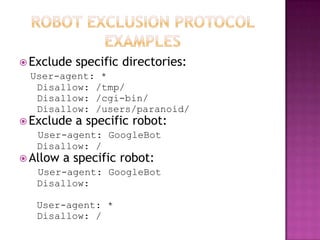
 Exclude   specific directories:
 User-agent: *
  Disallow: /tmp/
  Disallow: /cgi-bin/
  Disallow: /users/paranoid/
 Exclude   a specific robot:
   User-agent: GoogleBot
   Disallow: /
 Allow   a specific robot:
   User-agent: GoogleBot
   Disallow:

   User-agent: *
   Disallow: /
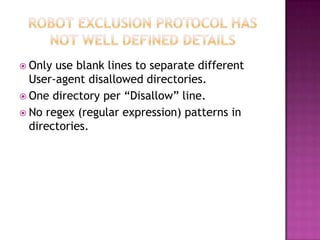
 Only use blank lines to separate different
  User-agent disallowed directories.
 One directory per “Disallow” line.
 No regex (regular expression) patterns in
  directories.
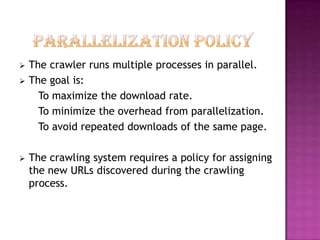
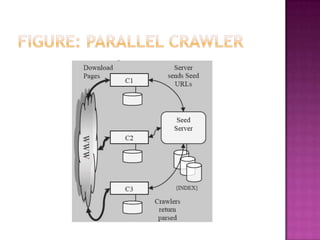
   The crawler runs multiple processes in parallel.
   The goal is:
      To maximize the download rate.
      To minimize the overhead from parallelization.
      To avoid repeated downloads of the same page.

   The crawling system requires a policy for assigning
    the new URLs discovered during the crawling
    process.
 What   is a web crawler?
 Why  is web crawler required?
 How does web crawler work?
 Mechanism used
       Breadth first search traversal
        Depth first search traversal
 Architecture of web crawler
 Crawling policies
 Distributed crawling
   A distributed computing technique whereby
    search engines employ many computers to index
    the Internet via web crawling.

   The idea is to spread out the required resources
    of computation and bandwidth to many
    computers and networks.

   Types of distributed web crawling:
     1. Dynamic Assignment
     2. Static Assignment
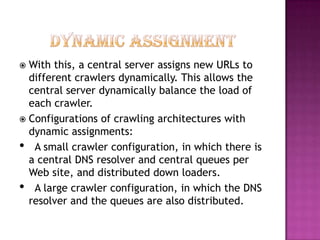
 With this, a central server assigns new URLs to
  different crawlers dynamically. This allows the
  central server dynamically balance the load of
  each crawler.
 Configurations of crawling architectures with
  dynamic assignments:
• A small crawler configuration, in which there is
  a central DNS resolver and central queues per
  Web site, and distributed down loaders.
• A large crawler configuration, in which the DNS
  resolver and the queues are also distributed.
• Here a fixed rule is stated from the beginning of
    the crawl that defines how to assign new URLs to
    the crawlers.
•   A hashing function can be used to transform URLs
    into a number that corresponds to the index of
    the corresponding crawling process.
•   To reduce the overhead due to the exchange of
    URLs between crawling processes, when links
    switch from one website to another, the
    exchange should be done in batch.
 Focused crawling was first introduced by
  Chakrabarti.
 A focused crawler ideally would like to download
  only web pages that are relevant to a particular
  topic and avoid downloading all others.
 It assumes that some labeled examples of
  relevant and not relevant pages are available.
   A focused crawler predict the probability that a
    link to a particular page is relevant before
    actually downloading the page. A possible
    predictor is the anchor text of links.

   In another approach, the relevance of a page is
    determined after downloading its content.
    Relevant pages are sent to content indexing and
    their contained URLs are added to the crawl
    frontier; pages that fall below a relevance
    threshold are discarded.
 Yahoo! Slurp: Yahoo Search crawler.
 Msnbot: Microsoft's Bing web crawler.
 Googlebot : Google’s web crawler.
 WebCrawler : Used to build the first publicly-
  available full-text index of a subset of the Web.
 World Wide Web Worm : Used to build a simple
  index of document titles and URLs.
 Web Fountain: Distributed, modular crawler
  written in C++.
 Slug: Semantic web crawler
1)Draw a neat labeled diagram to explain how does a
  web crawler work?
2)What is the function of crawler?
3)How does the crawler knows if it can crawl and index
  data from website? Explain.
4)Write a note on robot.txt.
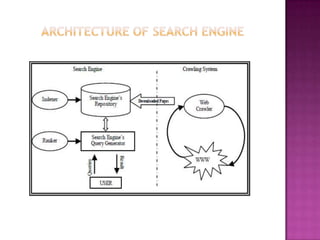
5)Discuss the architecture of a search engine.
7)Explain difference between crawler and focused
  crawler.
Web crawler

Web crawler

  • 1.
  • 2.
      Why is web crawler required?  How does web crawler work?  Crawling strategies Breadth first search traversal depth first search traversal  Architecture of web crawler  Crawling policies  Distributed crawling
  • 3.
    The process or program used by search engines to download pages from the web for later processing by a search engine that will index the downloaded pages to provide fast searches.  A program or automated script which browses the World Wide Web in a methodical, automated manner  also known as web spiders and web robots.  less used names- ants, bots and worms.
  • 4.
     What is a web crawler?  How does web crawler work?  Crawling strategies Breadth first search traversal depth first search traversal  Architecture of web crawler  Crawling policies  Distributed crawling
  • 5.
    Internet has a wideexpanse of Information.  Finding relevant information requires an efficient mechanism. Web Crawlers provide that scope to the search engine.
  • 6.
     What is a web crawler?  Why is web crawler required?  How does web crawler work?  Crawling strategies Breadth first search traversal depth first search traversal  Architecture of web crawler  Crawling policies  Distributed crawling
  • 7.
     It startswith a list of URLs to visit, called the seeds . As the crawler visits these URLs, it identifies all the hyperlinks in the page and adds them to the list of visited URLs, called the crawl frontier  URLs from the frontier are recursively visited according to a set of policies.
  • 8.
    New url’s canbe specified here. This is google’s web Crawler.
  • 9.
    Initialize queue (Q)with initial set of known URL’s. Until Q empty or page or time limit exhausted: Pop URL, L, from front of Q. If L is not an HTML page (.gif, .jpeg, .ps, .pdf, .ppt…) exit loop. If already visited L, continue loop(get next url). Download page, P, for L. If cannot download P (e.g. 404 error, robot excluded) exit loop, else. Index P (e.g. add to inverted index or store cached copy). Parse P to obtain list of new links N. Append N to the end of Q.
  • 11.
     What is a web crawler?  Why is web crawler required?  How does web crawler work?  Crawling strategies Breadth first search traversal depth first search traversal  Architecture of web crawler  Crawling policies  Distributed crawling
  • 12.
    Alternate way oflooking at the problem.  Web is a huge directed graph, with documents as vertices and hyperlinks as edges.  Need to explore the graph using a suitable graph traversal algorithm.  W.r.t. previous ex: nodes are represented by rectangles and directed edges are drawn as arrows.
  • 13.
    Given any graphand a set of seeds at which to start, the graph can be traversed using the algorithm 1. Put all the given seeds into the queue; 2. Prepare to keep a list of “visited” nodes (initially empty); 3. As long as the queue is not empty: a. Remove the first node from the queue; b. Append that node to the list of “visited” nodes c. For each edge starting at that node: i. If the node at the end of the edge already appears on the list of “visited” nodes or it is already in the queue, then do nothing more with that edge; ii. Otherwise, append the node at the end of the edge to the end of the queue.
  • 15.
     What is a web crawler?  Why is web crawler required?  How does web crawler work?  Crawling strategies Breadth first search traversal Depth first search traversal  Architecture of web crawler  Crawling policies  Parallel crawling
  • 16.
    Use depth firstsearch (DFS) algorithm • Get the 1st link not visited from the start page • Visit link and get 1st non-visited link • Repeat above step till no non-visited links • Go to next non-visited link in the previous level and repeat 2nd step
  • 18.
    depth-first goes off into one branch until it reaches a leaf node  not good if the goal node is on another branch  neither complete nor optimal  uses much less space than breadth-first  much fewer visited nodes to keep track of  smaller fringe  breadth-first is more careful by checking all alternatives  complete and optimal  very memory-intensive
  • 19.
     What is a web crawler?  Why is web crawler required?  How does web crawler work?  Crawling strategies Breadth first search traversal Depth first search traversal  Architecture of web crawler  Crawling policies  Distributed crawling
  • 21.
    Doc Robots URL Fingerprint templates set DNS Dup Content URL Parse URL www Seen? Filter Elim Fetch URL Frontier
  • 22.
     URL Frontier:containing URLs yet to be fetches in the current crawl. At first, a seed set is stored in URL Frontier, and a crawler begins by taking a URL from the seed set.  DNS: domain name service resolution. Look up IP address for domain names.  Fetch: generally use the http protocol to fetch the URL.  Parse: the page is parsed. Texts (images, videos, and etc.) and Links are extracted.  Content Seen?: test whether a web page with the same content has already been seen at another URL. Need to develop a way to measure the fingerprint of a web page.
  • 23.
    URL Filter:  Whether the extracted URL should be excluded from the frontier (robots.txt).  URL should be normalized (relative encoding).  en.wikipedia.org/wiki/Main_Page  <a href="/wiki/Wikipedia:General_disclaimer" title="Wikipedia:General disclaimer">Disclaimers</a>  Dup URL Elim: the URL is checked for duplicate elimination.
  • 24.
     What is a web crawler?  Why is web crawler required?  How does web crawler work?  Crawling strategies Breadth first search traversal Depth first search traversal  Architecture of web crawler  Crawling policies  Distributed crawling
  • 25.
     Selection Policythat states which pages to download.  Re-visit Policy that states when to check for changes to the pages.  Politeness Policy that states how to avoid overloading Web sites.  Parallelization Policy that states how to coordinate distributed Web crawlers.
  • 26.
    Search engines covers only a fraction of Internet.  This requires download of relevant pages, hence a good selection policy is very important.  Common Selection policies: Restricting followed links Path-ascending crawling Focused crawling Crawling the Deep Web
  • 27.
    Web is dynamic; crawling takes a long time.  Cost factors play important role in crawling.  Freshness and Age- commonly used cost functions.  Objective of crawler- high average freshness; low average age of web pages.  Two re-visit policies: Uniform policy Proportional policy
  • 28.
    Crawlers can have a crippling impact on the overall performance of a site.  The costs of using Web crawlers include: Network resources Server overload Server/ router crashes Network and server disruption  A partial solution to these problems is the robots exclusion protocol.
  • 29.
     How tocontrol those robots! Web sites and pages can specify that robots should not crawl/index certain areas. Two components:  Robots Exclusion Protocol (robots.txt): Site wide specification of excluded directories.  Robots META Tag: Individual document tag to exclude indexing or following links.
  • 30.
     Site administrator puts a “robots.txt” file at the root of the host’s web directory.  http://www.ebay.com/robots.txt  http://www.cnn.com/robots.txt  http://clgiles.ist.psu.edu/robots.txt  File is a list of excluded directories for a given robot (user-agent). Exclude all robots from the entire site: User-agent: * Disallow: / New Allow:  Find some interesting robots.txt
  • 31.
     Exclude specific directories: User-agent: * Disallow: /tmp/ Disallow: /cgi-bin/ Disallow: /users/paranoid/  Exclude a specific robot: User-agent: GoogleBot Disallow: /  Allow a specific robot: User-agent: GoogleBot Disallow: User-agent: * Disallow: /
  • 32.
     Only useblank lines to separate different User-agent disallowed directories.  One directory per “Disallow” line.  No regex (regular expression) patterns in directories.
  • 33.
    The crawler runs multiple processes in parallel.  The goal is: To maximize the download rate. To minimize the overhead from parallelization. To avoid repeated downloads of the same page.  The crawling system requires a policy for assigning the new URLs discovered during the crawling process.
  • 34.
     What is a web crawler?  Why is web crawler required?  How does web crawler work?  Mechanism used Breadth first search traversal Depth first search traversal  Architecture of web crawler  Crawling policies  Distributed crawling
  • 36.
    A distributed computing technique whereby search engines employ many computers to index the Internet via web crawling.  The idea is to spread out the required resources of computation and bandwidth to many computers and networks.  Types of distributed web crawling: 1. Dynamic Assignment 2. Static Assignment
  • 37.
     With this,a central server assigns new URLs to different crawlers dynamically. This allows the central server dynamically balance the load of each crawler.  Configurations of crawling architectures with dynamic assignments: • A small crawler configuration, in which there is a central DNS resolver and central queues per Web site, and distributed down loaders. • A large crawler configuration, in which the DNS resolver and the queues are also distributed.
  • 38.
    • Here afixed rule is stated from the beginning of the crawl that defines how to assign new URLs to the crawlers. • A hashing function can be used to transform URLs into a number that corresponds to the index of the corresponding crawling process. • To reduce the overhead due to the exchange of URLs between crawling processes, when links switch from one website to another, the exchange should be done in batch.
  • 39.
     Focused crawlingwas first introduced by Chakrabarti.  A focused crawler ideally would like to download only web pages that are relevant to a particular topic and avoid downloading all others.  It assumes that some labeled examples of relevant and not relevant pages are available.
  • 40.
    A focused crawler predict the probability that a link to a particular page is relevant before actually downloading the page. A possible predictor is the anchor text of links.  In another approach, the relevance of a page is determined after downloading its content. Relevant pages are sent to content indexing and their contained URLs are added to the crawl frontier; pages that fall below a relevance threshold are discarded.
  • 41.
     Yahoo! Slurp:Yahoo Search crawler.  Msnbot: Microsoft's Bing web crawler.  Googlebot : Google’s web crawler.  WebCrawler : Used to build the first publicly- available full-text index of a subset of the Web.  World Wide Web Worm : Used to build a simple index of document titles and URLs.  Web Fountain: Distributed, modular crawler written in C++.  Slug: Semantic web crawler
  • 42.
    1)Draw a neatlabeled diagram to explain how does a web crawler work? 2)What is the function of crawler? 3)How does the crawler knows if it can crawl and index data from website? Explain. 4)Write a note on robot.txt. 5)Discuss the architecture of a search engine. 7)Explain difference between crawler and focused crawler.