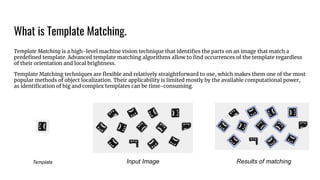
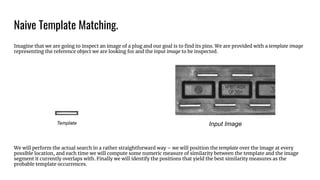
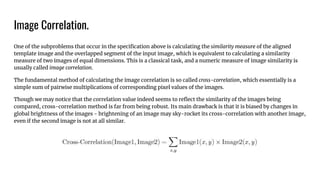
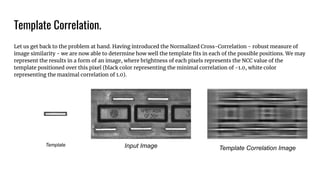
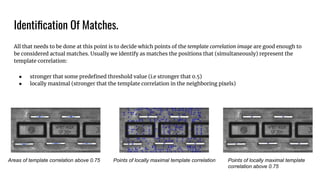
This document discusses template matching techniques in computer vision. Template matching allows identifying parts of an image that match a predefined template. Naive template matching works by comparing template images to overlapping regions of input images. More advanced methods use normalized cross-correlation to measure similarity in a way that is robust to brightness changes. Key points identified through template matching must exceed a threshold and be locally maximal correlations. Edge-based and multi-angle matching techniques improve template matching for rotated objects. Template matching has applications in fields like face recognition and medical imaging.