Erbil PolytechnicUniversity
Koya Technical Institute
Dep. Of Oil Technology
Control and Operation
Name of Experiment:
Temperature Measurements and Calibration
Supervised by: Mr. Haymen F. Fattah
Name: Muhammed Fuad Rashid
Group: A
Date of Exp.:8/11/2017
Name of laboratory: Heat and Mass Transfer
Title Page number
Aim 2
Theory 2
Sketch 6
Discussion 7
Calculation 8
Aim:
Measuring the temperature by different methods and draw the
calibration curve with thermometer readings.
Theory and procedure:
1.Temperaturemeasurement using liquidthermometers:
In a glass thermometer, the relative expansion of a liquid to the
content of the bulb is measured. The majority of the liquid is in a
spherical or cylindrical-shaped bulb that forms the thermometers
actual sensing element (1), the bulb opens into the long thin glass
capillary tube (2). Practically all liquids can be used in thermometers
here a differentiation is made between wetting (Organic) and non-
wetting liquids (mercury) wetting liquids cause additional errors as
the temperature drop, an organic liquid must be colored so that it is
visible in the capillary tube and the reading of the temperature made
easier. Liquid containers for mercury are larger than for other liquids
due to the smaller coefficient of expansion.
2. Temperature measurement using Bimetallic thermometers:
Bimetallic thermometers exploit the differential expansion of two
different materials to indicate the temperature, two or more layers of
different materials are rolled to gather, during the process different
shapes can be manufactured depending on the application, one end
of the sensor is firmly anchored the other is coupled to a
transmission gear or directly to a display device, contrary to rod type
thermometers bimetallic sensors have only a low capacity to
perform work, they are thus practically limited to a usage for
indicating equipment and are less suitable for remote indication.
Over wide measuring ranges the non-linear relationship of the
specific deflection to temperature becomes detrimentally apparent
due to the relatively large surface areas. Bimetallic thermometers
that are exposed to the surrounding medium without heavy
protective housings react comparatively quickly.
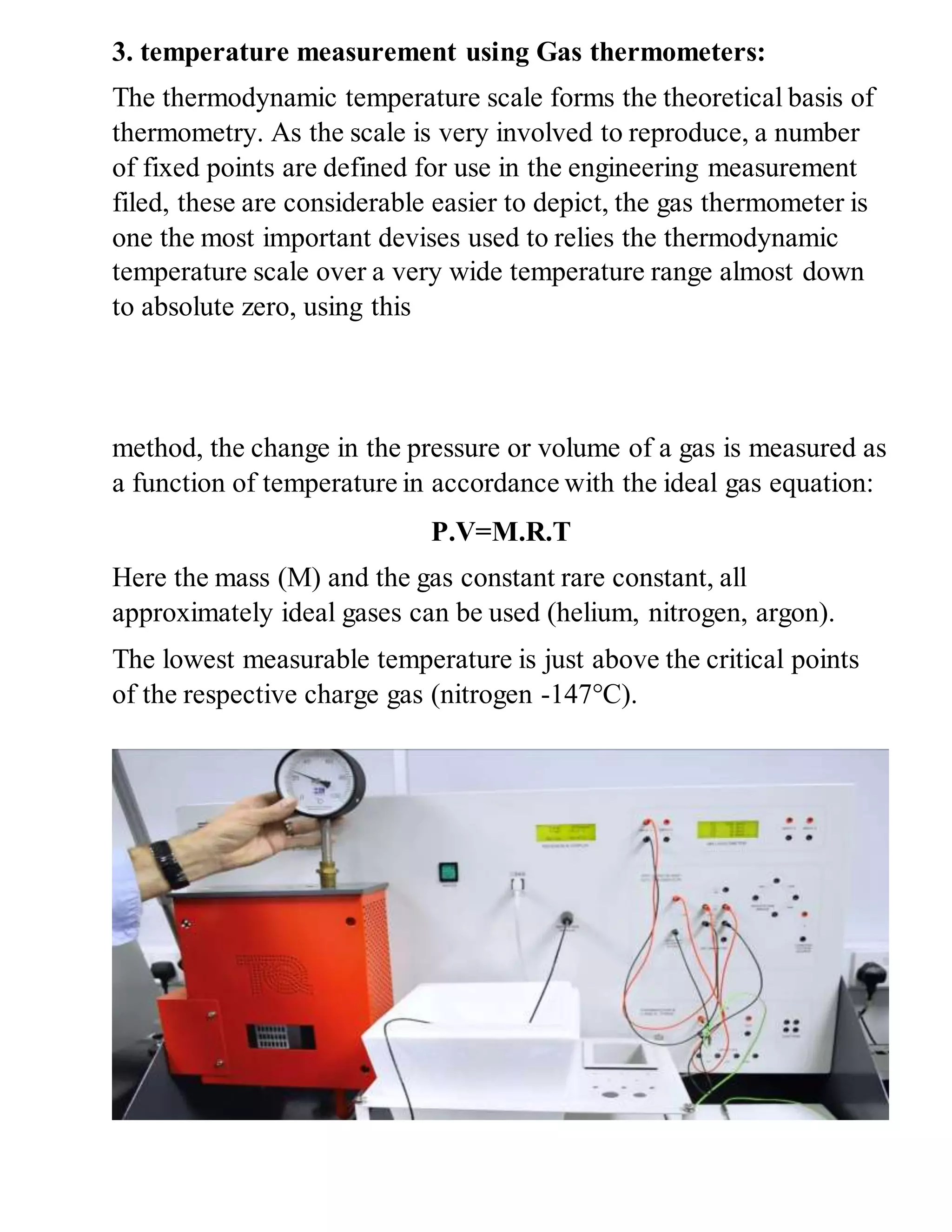
3. temperature measurement using Gas thermometers:
The thermodynamic temperature scale forms the theoretical basis of
thermometry. As the scale is very involved to reproduce, a number
of fixed points are defined for use in the engineering measurement
filed, these are considerable easier to depict, the gas thermometer is
one the most important devises used to relies the thermodynamic
temperature scale over a very wide temperature range almost down
to absolute zero, using this
method, the change in the pressure or volume of a gas is measured as
a function of temperature in accordance with the ideal gas equation:
P.V=M.R.T
Here the mass (M) and the gas constant rare constant, all
approximately ideal gases can be used (helium, nitrogen, argon).
The lowest measurable temperature is just above the critical points
of the respective charge gas (nitrogen -147°C).
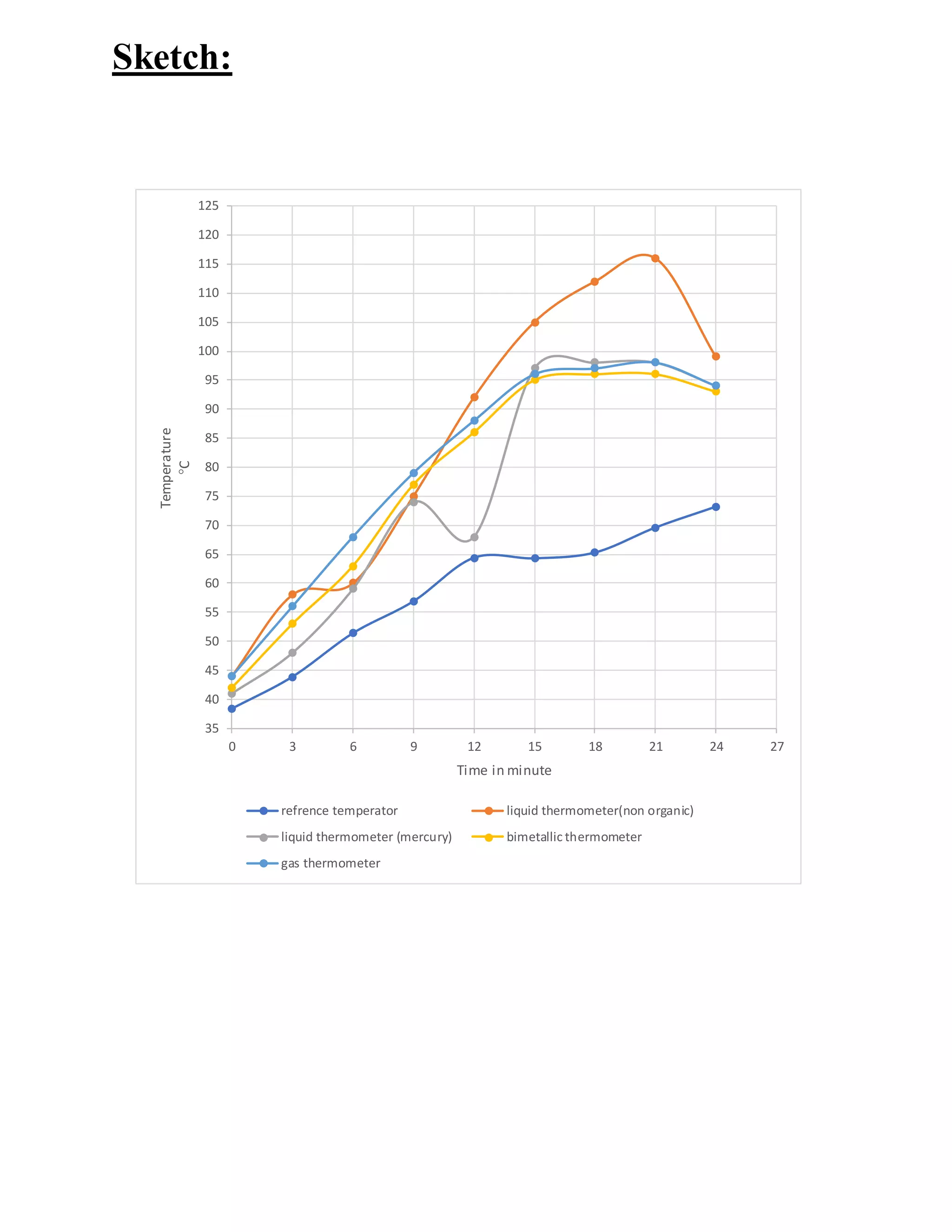
Sketch:
35
40
45
50
55
60
65
70
75
80
85
90
95
100
105
110
115
120
125
0 3 6 9 12 15 18 21 24 27
Temperature
°C
Time in minute
refrence temperator liquid thermometer(non organic)
liquid thermometer (mercury) bimetallic thermometer
gas thermometer
Discussion:
1.Why we get different reading between all the
thermometers types?
A/every types has a different range and used for different
purposeand each of them contain a special fluid that has its
propertiesand react for changing the temperature.
2.Whichthermometer is the best and has minimum
reading error?
A/gas thermometer
3.Why we have errors?
A/there’s so many possibilities to make our reading wrong
such as we didn’t read the thermometer properly that’swhy
our diagram is seems gone to the wrong side or we grab the
thermometer with our hand and our temperatureis affected on
our reading.
4.Discussionthe diagram that you draw it?
A/ By increasing the time, the temperaturewill increase.
5.Whatyou suggest to gate a bitter reading?
A/ I’d prefer to connect my machine to a computer system
that makes our work easier. I recommend to doing an
experiment in a very suitableplace with atmospheric pressure
and temperature and being accuracy in reading degrees
because any rude action could take our process into wrong
side.

Temperature measurements and Calibration by heating

  • 1.
    Erbil PolytechnicUniversity Koya TechnicalInstitute Dep. Of Oil Technology Control and Operation Name of Experiment: Temperature Measurements and Calibration Supervised by: Mr. Haymen F. Fattah Name: Muhammed Fuad Rashid Group: A Date of Exp.:8/11/2017 Name of laboratory: Heat and Mass Transfer
  • 2.
    Title Page number Aim2 Theory 2 Sketch 6 Discussion 7 Calculation 8
  • 3.
    Aim: Measuring the temperatureby different methods and draw the calibration curve with thermometer readings. Theory and procedure: 1.Temperaturemeasurement using liquidthermometers: In a glass thermometer, the relative expansion of a liquid to the content of the bulb is measured. The majority of the liquid is in a spherical or cylindrical-shaped bulb that forms the thermometers actual sensing element (1), the bulb opens into the long thin glass capillary tube (2). Practically all liquids can be used in thermometers here a differentiation is made between wetting (Organic) and non- wetting liquids (mercury) wetting liquids cause additional errors as the temperature drop, an organic liquid must be colored so that it is visible in the capillary tube and the reading of the temperature made easier. Liquid containers for mercury are larger than for other liquids due to the smaller coefficient of expansion.
  • 4.
    2. Temperature measurementusing Bimetallic thermometers: Bimetallic thermometers exploit the differential expansion of two different materials to indicate the temperature, two or more layers of different materials are rolled to gather, during the process different shapes can be manufactured depending on the application, one end of the sensor is firmly anchored the other is coupled to a transmission gear or directly to a display device, contrary to rod type thermometers bimetallic sensors have only a low capacity to perform work, they are thus practically limited to a usage for indicating equipment and are less suitable for remote indication. Over wide measuring ranges the non-linear relationship of the specific deflection to temperature becomes detrimentally apparent due to the relatively large surface areas. Bimetallic thermometers that are exposed to the surrounding medium without heavy protective housings react comparatively quickly.
  • 5.
    3. temperature measurementusing Gas thermometers: The thermodynamic temperature scale forms the theoretical basis of thermometry. As the scale is very involved to reproduce, a number of fixed points are defined for use in the engineering measurement filed, these are considerable easier to depict, the gas thermometer is one the most important devises used to relies the thermodynamic temperature scale over a very wide temperature range almost down to absolute zero, using this method, the change in the pressure or volume of a gas is measured as a function of temperature in accordance with the ideal gas equation: P.V=M.R.T Here the mass (M) and the gas constant rare constant, all approximately ideal gases can be used (helium, nitrogen, argon). The lowest measurable temperature is just above the critical points of the respective charge gas (nitrogen -147°C).
  • 6.
    Sketch: 35 40 45 50 55 60 65 70 75 80 85 90 95 100 105 110 115 120 125 0 3 69 12 15 18 21 24 27 Temperature °C Time in minute refrence temperator liquid thermometer(non organic) liquid thermometer (mercury) bimetallic thermometer gas thermometer
  • 7.
    Discussion: 1.Why we getdifferent reading between all the thermometers types? A/every types has a different range and used for different purposeand each of them contain a special fluid that has its propertiesand react for changing the temperature. 2.Whichthermometer is the best and has minimum reading error? A/gas thermometer 3.Why we have errors? A/there’s so many possibilities to make our reading wrong such as we didn’t read the thermometer properly that’swhy our diagram is seems gone to the wrong side or we grab the thermometer with our hand and our temperatureis affected on our reading. 4.Discussionthe diagram that you draw it? A/ By increasing the time, the temperaturewill increase. 5.Whatyou suggest to gate a bitter reading? A/ I’d prefer to connect my machine to a computer system that makes our work easier. I recommend to doing an experiment in a very suitableplace with atmospheric pressure and temperature and being accuracy in reading degrees because any rude action could take our process into wrong side.