








UNIVERISDAD AUTÓNOMA DE NUEVO LEÓNFACULTAD DE FILOSOFÍA Y LETRASLINGÜISTICA APLICADA CON ENFASIS EN DIDÁCTICA MASS MEDIA11 de Diciembre 2007San Nicolás de los Garza, Nuevo León
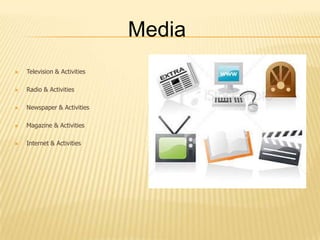
MediaTelevision & Activities Radio & ActivitiesNewspaper & ActivitiesMagazine & ActivitiesInternet & Activities
MediaIt involves television, radio, and film, newspapers and magazines. It is not just journalistic communication. The mass media is a focal point of social control and the source of popular culture. The main purpose was to get people informed.Entertainment is a big bussiness.Effect how we dress, what we buy, and how our society functions, moral, culture …
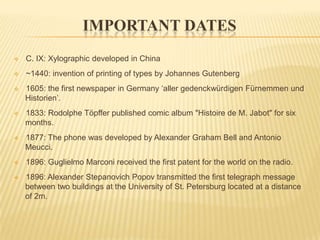
IMPORTANT DATESC. IX: Xylographic developed in China
~1440: invention of printing of types by Johannes Gutenberg
1605: the first newspaper in Germany ‘allergedenckwürdigenFürnemmen und Historien’.
1833: RodolpheTöpffer published comic album "Histoire de M. Jabot" for six months.
1877: The phone was developed by Alexander Graham Bell and Antonio Meucci.
1896: Guglielmo Marconi received the first patent for the world on the radio.
1896: Alexander Stepanovich Popov transmitted the first telegraph message between two buildings at the University of St. Petersburg located at a distance of 2m.US communications media1690.- First American newspaper in Massachusetts.Then magazines appearing in several major American cities.Commercial radio at the beginning of the 20th century.Television, entered the scene shortly after World War II.The Media is one of the most important factor in the economic role because is one of America's largest business groups that provide jobs for hundreds of thousands of technicians, writers, artists, performers and intellectuals and shaping attitudes and beliefs.
According to a recent survey by Mediamark Research98% of Americans have a television;82% of those watch "prime time“71% cable programming. 84% listen to radio regularly. 79% are newspaper readers. 45% has access to the Internet.
There are at least four basic types of television in the United States: broadcast, or "over-the-air" television; cable television; satellite television; and IPTV (TV over Internet). Over the air TV is usually (but not always) freely available to anyone with a receiver while cable, satellite and Internet TV generally require subscriptions.
The United States has a decentralized, market-oriented television system. Unlike many other countries, the United States has no national broadcast programming service. Instead, local media markets have their own television stations, which may be affiliated or owned and operated by a TV network.
Until the 1970s and '80s, local stations supplemented network programming with a good deal of their own produced shows. Today, however, many stations produce only local news shows. They fill the rest of their schedule with syndicated shows, or material produced independently and sold to individual stations in each local market
The major networksthe National Broadcasting Company (NBC), Columbia Broadcasting System (CBS)- both began in the 1920s as radio networksthe American Broadcasting Company (ABC), which began its life as a radio network spun off from NBC in 1943.Fox, MyNetwork TV, ION, PBS (educational), Univision, Daystar(religious).
CBS Broadcasting Inc. (CBS)Type Broadcast radio network andtelevision networkCountry United StatesAvailability    United States; also available in  Canada,  Mexico, and the CaribbeanSlogan We Are CBSOwner CBS CorporationKey people Leslie Moonves, Chairman of CBSLaunch date September 18, 1927(radio); 1939 (television)Past names United Independent Broadcasters (1927)Columbia Phonographic Broadcasting System (1927–1928)Columbia Broadcasting System (1928–1974 in official usage)Programs CSI, NCIS, Bing bang theory, Amazing Race, Criminal minds
NBSNational Broadcasting Company Incorporated1926 Created by the Radio corporation of America1928.- 1st. Permanent coast to coast radio network in the US.Law and Order: SVU, Friends, Heroes, The Office
ABCAmerican BroadcastingCompanyCreated in 1943 from NBCBlue radio networkOwned by The Walt Disney Company2004. New president Stephen McPherson2004, Desperate Housewives, and Lost. 2005, Grey's Anatomy2006, Ugly Betty (soup opera)
FOX20th Century Fox (Twentieth Century Fox Film Corporation) 19351950 Century Fox produced syndicated TV programsLaunched on October 9, 19862007–08 season, Fox was the most popular networkBones, Glee, American Idol
MorningProgrAMSTypically, they begin weekdays with an early-morning locally news showFollowed by a network morning show, such as NBC's Today, which mixes news, weather, interviews and music. Syndicated programming, especially talk shows, fill the late morning.Local news at middle day (Eastern Time).
Network run Soap operas dominate the early afternoon, Syndicated talk shows such as The Oprah Winfrey Show appear in the late afternoon.Family-orientedcomedy programs in the early prime time, replaced by reality television like Dancing with the Stars.Later in the evening, dramas like CSI: Crime Scene Investigation, House, M.D., and Grey's Anatomy air.
At 10 or 11 p.m., another local news program comes on, usually followed by late-night interview shows, such as Late Show with David Letterman or The Tonight Show. Rather than sign off for the early hours of the morning (as was standard practice until the early 1970s in larger markets and until the mid 1980's in smaller ones),
WEEKENDSProgramming aimed at children (including animated cartoons)Sunday mornings include public-affairs programs.This helps fulfill stations' legal obligations to provide public-service programming.Sports and infomercials can be found on weekend afternoonsFollowed again by the same type of prime-time shows aired during the week
TELEVISION IN THE UNITED KINGDOM
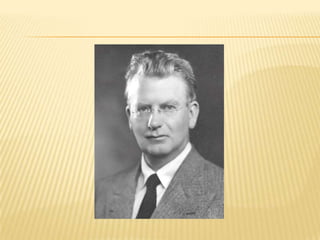
John LogieBaird (1888 - 1946)One of thepioneers of televisionTheelectromechanicalsystemforexploration of theimage (or electro-TV) basedontheNipkow disk.In 1926, on 26 January in London madethefirstpublicdemonstration of hissystembefore a group of scientists:A doll, Theoldpuppet Bill, becamethefirsttoappearon a televisionscreen.Theimagehad a resolution of only 25 lines and wastiny, butthefacewasperfectlyrecognizable.
Achieved in 1927 through a telephone cable, transmited a television signal between Glasgow and LondonHe founded at1927, the Baird Television Development Company, Ltd, In 1929, the mechanical scanning system of 240 lines was adopted experimentally by the British Broadcasting Corporation (BBC). He system was substituted with the picture tube, sold by Marconi
The British Broadcasting Corporation (BBC)Type Broadcast radio, television and onlineCountry United KingdomAvailability   NationalInternationalFounder John ReithSlogan "This is what we do"(has been used in various current promotional idents)Motto "Nation Shall Speak Peace Unto Nation“Key people Sir Michael Lyons, Chairman, BBC Trust Mark Thompson, Director-General (Chairman of the Executive Board).Launch date 1922 (radio)1927 (incorporation) 1932 (television)Past names British Broadcasting Company Ltd. (1922-1927)Website www.bbc.co.uk
BBC TelevisionOn September 30, 1929 began, from his studio in Long Acre (London), its first experimental television transmissions.The simultaneous transmission of sound and image began March 30, 1930 through a new transmitter, and gradually began to develop emission testing continued.August 22, 1932, established a new study and new infrastructure such as the electronic transmission system. The BBC began regular broadcasts officially October 1, 1936.
The BBC wasforcedtoabruptlyhaltthe TV serviceon 1 September 1939, shortlyaftertheoutbreak of WorldWar II. Thelastprogramairedwasananimated film of Mickey Mouse.OnJune 7, 1946, theappearance of one of thepresenters of thechainduringthe '30s, JasmineBligh.TheCorporationincreasingcoverageto Birmingham in 1949 withtheopening of a transmitter.Regular newsservicesrestarted, July 5, 1954, with BBC News.Transmission of livebroadcastssuch as thecoronation of      Elizabeth II of Britain, one of thehighestcoverage in thehistory of the canal.
Appearance of private channels and competition
BBC Television remained the monopoly until 1955.A new law impulsed the developing Audiovisual TV service through competition.This forced the BBC to change its strategy, identity and priorities, forcing them to compete to avoid hearing loss. Thus began implementing popular programming series, game shows and productions.
ProgrammingStresses in the production of news programs (2,500 hours per year), documentaries and entertainment. In its news programs including BBC Breakfast BBC News, the news at 13:00, 18:00 and 22:00 (the most watched news in the UK), as well as relaying meteorological and political programs or special events last minute.
ProgrammingDIY programs - DIY means do it yourself. These programmes are very popular as many people love improving their homes and decorating. Drama and sitcomsDrama and situational comedies are very popular and are the favorite kind of programs in England.Soaps  	A series of television or radio programmes about the lives and problems of a particular group of characters. They run over a long period and are broadcast several times every week.Reality programs 	Involve filming  normal people in their every-day jobs or putting several people in a specially built house where they can be filmed 24 hours-a-day and giving them challenges to do. 
DocumentariesThe most-watched series of the canal is the novel EastEnders, on the air since 1985.It has also sold internationally as other series Life on Mars, Monty Python's Flying Circus, Little Britain and Doctor Who among others.Also highlights sports broadcasts of BBC Sport and the CBBC children's programming
BBC NEWS 24It is considered the entity that collects more of information among the world's media. BBC News provides news on entertainment, sports, business, science, technology and health of both England and the world.
Regional ProgrammingTo reflect the different nations within the UK, BBC One has regional windows for Scotland, Wales and Northern Ireland.Until the advent in 2002 of the digital terrestrial television, which allows reception of regional programming at various points, the BBC aired a report generated named UK Today that included the news about all the different regional centers.
Radio in EnglandPeople in Britain listen to an average 15 hours and 50 minutes of radio each week.The BBC has five national radio networks:  music, news, current affairs, drama, education, sport, ….There are also 39 BBC local radio stations, andnational radio services in Scotland, Wales and Northern Ireland.
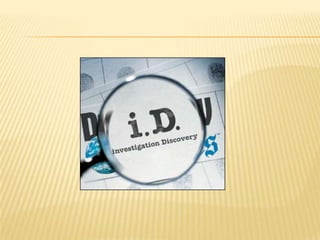
Investigation Discovery, IDIt is a channel in the United Kingdom and the Republic of Ireland. The channel is characterized by transmitting programs on crime, including programs on "missing persons and murder investigations, and historical unresolved cases, as well as documentaries on the forensic investigation.
ITNITN (IndependentTelevision News), istheleadingnewsprovider in the UK. They are responsibleforthenewsto ITV News, ITV London, Channel 4 News, More4 News, amongothers, in additiontodistributingnewsaroundtheworld.Produces a total of ten broadcastslivedailytelevisionnews.
UK magazines UK magazines are mainly based in London, though some groups, such as Future in Bath and DC Thomson in Dundee, are based in other cities.
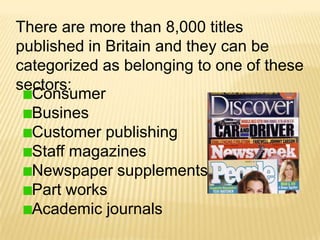
There are more than 8,000 titles published in Britain and they can be categorized as belonging to one of these sectors: ConsumerBusinesCustomerpublishingStaff magazinesNewspapersupplementsPartworksAcademicjournals
Consumer maganizesConsumer magazines make up the bulk of the titles for sale in newsagents. They may be general titles that aim to entertain and inform (such as Loaded, Elle, Radio Times) or consumer specialist titles aimed at a specific interest or hobby (Car, Total Film).
THE BIGGEST CONSUMER MAGAZINE PUBLISHERS Bauer (which took over the 2nd largest           	group, Emap, in 2008): 26%IPC (Time Warner): 20%BBC Magazines (BBC): 8%National Magazines (Hearst): 7%
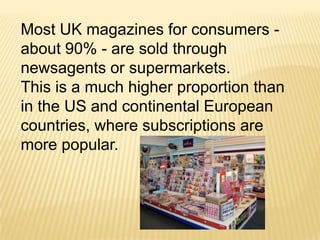
Most UK magazines for consumers - about 90% - are sold through newsagents or supermarkets. This is a much higher proportion than in the US and continental European countries, where subscriptions are more popular.
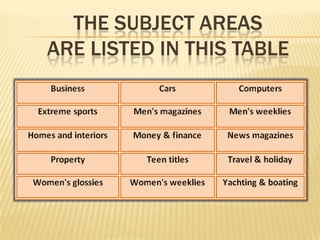
Thesubjectareasare listed in thistable
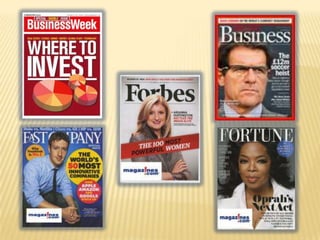
businessBusiness magazines, which may also be called trade or B2B (business to business) magazines are for people at work. There are about 5,100 of such titles in the UK.
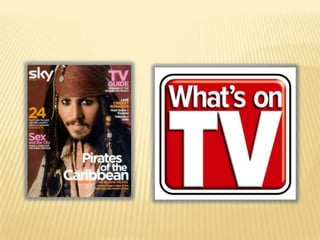
Customer magazinesCustomer magazines, which may also be called contract or custom magazines, are produced by publishing agencies for companies to give to their customers as a form of marketing. This sector has expanded greatly since the mid-1980s.
Staff magazinesProduced by a company's internal communications team or a publishing agency to inform staff about their company
NewspapersupplementsNewspaper supplements come free as part of a daily or Sunday paper. Most national newspaper in the UK actually publish more than one magazine each week
partworksPartworks, unlike mainstream magazines that aim to be published for as long as economically possible, have a set number of issues. They often build up into an 'encyclopedia' on a specific topic in, say, 25 parts.
AcademicjournalsAcademic journals aim to encourage university-level discussion of all sorts of arcane topics. Their identifying feature is that their subject matter is controlled by an academic board. Authors are not paid; rather, they gain academic credibility.
Probably the most famous academic journal is Nature. The earliest periodicals were, in fact, journals such as these.
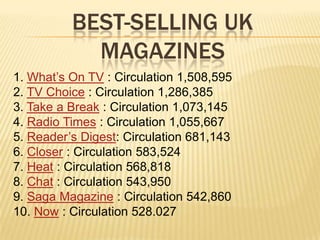
Best-sellinguk magazines1. What’s On TV : Circulation 1,508,5952. TV Choice : Circulation 1,286,3853. Take a Break : Circulation 1,073,1454. Radio Times : Circulation 1,055,6675. Reader’s Digest: Circulation 681,1436. Closer : Circulation 583,5247. Heat : Circulation 568,8188. Chat : Circulation 543,9509. Saga Magazine : Circulation 542,86010. Now : Circulation 528.027
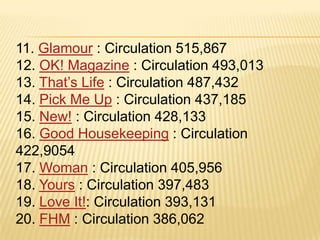
11. Glamour : Circulation 515,86712. OK! Magazine : Circulation 493,01313. That’s Life : Circulation 487,43214. Pick Me Up : Circulation 437,18515. New! : Circulation 428,13316. Good Housekeeping : Circulation 422,905417. Woman : Circulation 405,95618. Yours : Circulation 397,48319. Love It!: Circulation 393,13120. FHM : Circulation 386,062
Best-readuk magazinesMost magazines are read by more than one person. They may be read just within a household or company, or passed on to friends, or end up in a doctor's waiting room or hairdresser's.
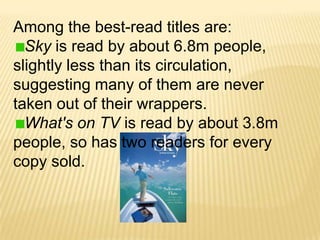
Among the best-read titles are:Sky is read by about 6.8m people, slightly less than its circulation, suggesting many of them are never taken out of their wrappers.What's on TV is read by about 3.8m people, so has two readers for every copy sold.
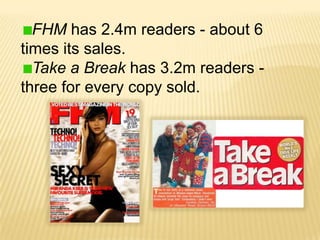
FHM has 2.4m readers - about 6 times its sales.Take a Break has 3.2m readers - three for every copy sold.
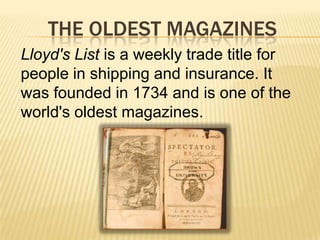
Theoldest magazinesLloyd's List is a weekly trade title for people in shipping and insurance. It was founded in 1734 and is one of the world's oldest magazines.
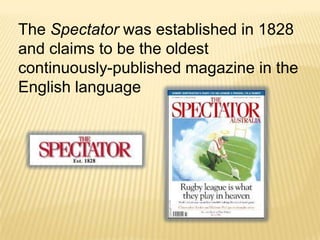
The Spectator was established in 1828 and claims to be the oldest continuously-published magazine in the English language
US magazinesA magazine—like the smart, charming gazette you hold in your hands, even in this age of electronic things, everything everywhere, is a marvelous invention. In America, Ben Franklin is credited with conceiving of the first such publication, in 1741. (It was called The General Magazine, and it began a trend that exists to this day).
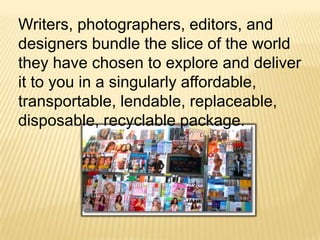
Writers, photographers, editors, and designers bundle the slice of the world they have chosen to explore and deliver it to you in a singularly affordable, transportable, lendable, replaceable, disposable, recyclable package.
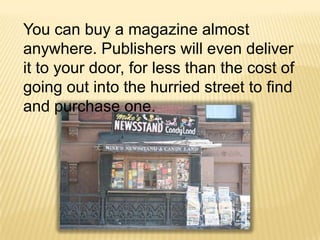
You can buy a magazine almost anywhere. Publishers will even deliver it to your door, for less than the cost of going out into the hurried street to find and purchase one.
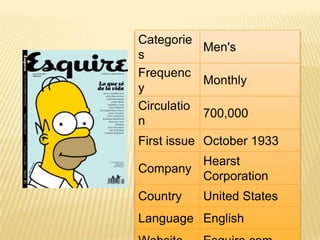
esquireEsquire is a men's magazine, published in the U.S. by the Hearst Corporation. Founded in 1932, it flourished during the Great Depression under the guidance of founder and editor Arnold Gingrich.
The New YorkerThe New Yorkeris an American magazine of reportage, commentary, criticism, essays, fiction, satire, cartoons, and poetry published by Condé Nast Publications. Starting as a weekly in the mid-1920s, the magazine is now published forty-seven times per year, with five of these issues covering two-week spans.
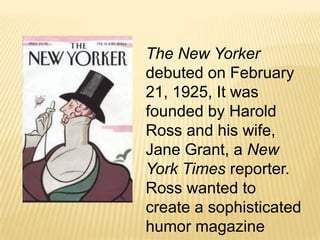
The New Yorker debuted on February 21, 1925, It was founded by Harold Ross and his wife, Jane Grant, a New York Times reporter. Ross wanted to create a sophisticated humor magazine
PlayboyIs an American men's magazine, founded in Chicago in 1953 by Hugh Hefner and his associates, and funded in part by a $1,000 loan from Hefner's mother. The magazine has grown into Playboy Enterprises, Inc., with a presence in nearly every medium.
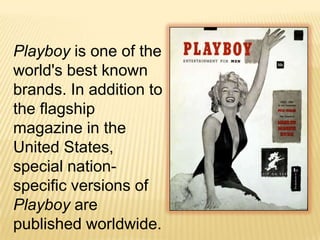
Playboy is one of the world's best known brands. In addition to the flagship magazine in the United States, special nation-specific versions of Playboy are published worldwide.
The New York Times MagazineIsa supplement to the Sunday The New York Times newspaper. It is host to feature articles longer than those typically included in the newspaper, and attracts many notable contributors. The magazine is also noted for its photography, especially relating to fashion and style.
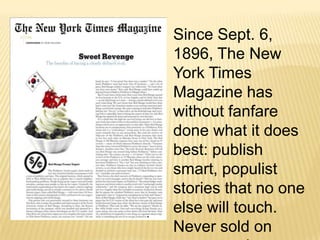
Since Sept. 6, 1896, The New York Times Magazine has without fanfare done what it does best: publish smart, populist stories that no one else will touch. Never sold on newsstands
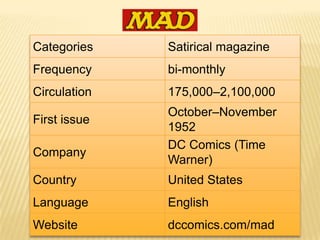
MADIs an American humor magazine founded by the editor Harvey Kurtzman in 1952.The magazine offers satire on all aspects of life and popular culture, politics, entertainment, and public figures. Its format is divided into a number of recurring segments such as TV and movie parodies, as well as freeform articles.
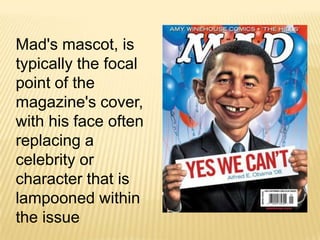
Mad's mascot, is typically the focal point of the magazine's cover, with his face often replacing a celebrity or character that is lampooned within the issue
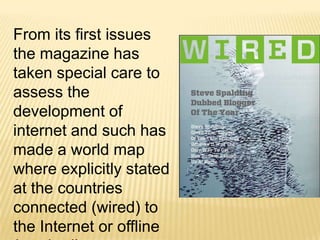
WIREDWired is a full-color monthly American magazine and on-line periodical, published since March 1993, that reports on how technology affects culture, the economy, and politics. Owned by Condé Nast Publications, it is published in San Francisco, California.
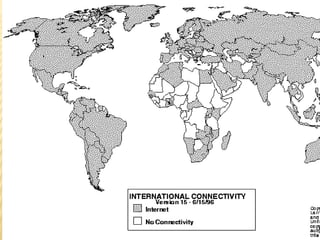
From its first issues the magazine has taken special care to assess the development of internet and such has made a world map where explicitly stated at the countries connected (wired) to the Internet or offline (unwired).
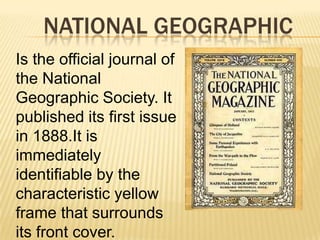
National GeographicIs the official journal of the National Geographic Society. It published its first issue in 1888.It is immediately identifiable by the characteristic yellow frame that surrounds its front cover.
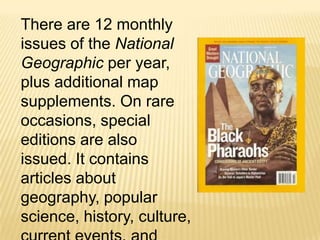
There are 12 monthly issues of the National Geographic per year, plus additional map supplements. On rare occasions, special editions are also issued. It contains articles about geography, popular science, history, culture, current events, and photography
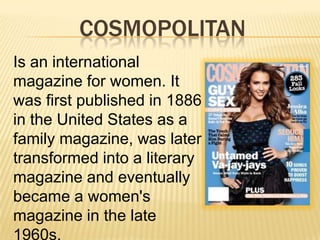
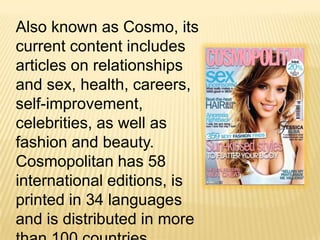
CosmopolitanIs an international magazine for women. It was first published in 1886 in the United States as a family magazine, was later transformed into a literary magazine and eventually became a women's magazine in the late 1960s.
Also known as Cosmo, its current content includes articles on relationships and sex, health, careers, self-improvement, celebrities, as well as fashion and beauty. Cosmopolitan has 58 international editions, is printed in 34 languages and is distributed in more than 100 countries.
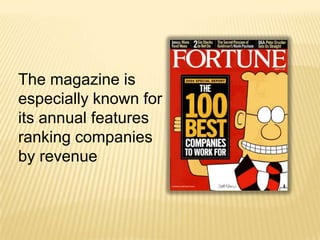
FORTUNEFortune is a global business magazine published by Time Inc. Founded by Henry Luce in 1930, Fortune's primary competitors in the national business magazine category are Forbes, which is also published bi-weekly, and BusinessWeek.
The magazine is especially known for its annual features ranking companies by revenue
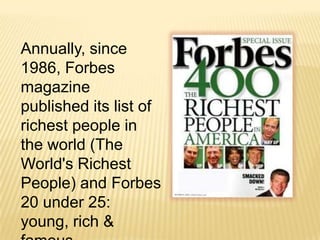
Forbes Forbes magazine is published in the United States and specializes in business and finance. Founded in 1917 by B. C. Forbes. Each year it publishes lists of great interest to the business through.Its headquarters is on Fifth Avenue in New York.
Annually, since 1986, Forbes magazine published its list of richest people in the world (The World's Richest People) and Forbes 20 under 25: young, rich & famous
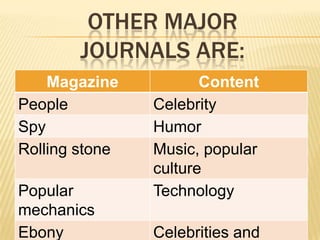
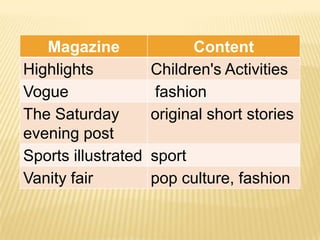
other major journals are:
internet learningE-learning
introductionSuch as pens, paper and pencil, and the PC, the Internet is becoming a fixture in classrooms around the world.
World Wide Web,E-learning comprises all forms of electronically supported learning and teaching
TITULOTexto
TITULOTexto
MEXICO  U.K.   USA

The media

  • 2.
    UNIVERISDAD AUTÓNOMA DENUEVO LEÓNFACULTAD DE FILOSOFÍA Y LETRASLINGÜISTICA APLICADA CON ENFASIS EN DIDÁCTICA MASS MEDIA11 de Diciembre 2007San Nicolás de los Garza, Nuevo León
  • 3.
    MediaTelevision & ActivitiesRadio & ActivitiesNewspaper & ActivitiesMagazine & ActivitiesInternet & Activities
  • 4.
    MediaIt involves television,radio, and film, newspapers and magazines. It is not just journalistic communication. The mass media is a focal point of social control and the source of popular culture. The main purpose was to get people informed.Entertainment is a big bussiness.Effect how we dress, what we buy, and how our society functions, moral, culture …
  • 5.
    IMPORTANT DATESC. IX:Xylographic developed in China
  • 6.
    ~1440: invention ofprinting of types by Johannes Gutenberg
  • 7.
    1605: the firstnewspaper in Germany ‘allergedenckwürdigenFürnemmen und Historien’.
  • 8.
    1833: RodolpheTöpffer publishedcomic album "Histoire de M. Jabot" for six months.
  • 9.
    1877: The phonewas developed by Alexander Graham Bell and Antonio Meucci.
  • 10.
    1896: Guglielmo Marconireceived the first patent for the world on the radio.
  • 11.
    1896: Alexander StepanovichPopov transmitted the first telegraph message between two buildings at the University of St. Petersburg located at a distance of 2m.US communications media1690.- First American newspaper in Massachusetts.Then magazines appearing in several major American cities.Commercial radio at the beginning of the 20th century.Television, entered the scene shortly after World War II.The Media is one of the most important factor in the economic role because is one of America's largest business groups that provide jobs for hundreds of thousands of technicians, writers, artists, performers and intellectuals and shaping attitudes and beliefs.
  • 12.
    According to arecent survey by Mediamark Research98% of Americans have a television;82% of those watch "prime time“71% cable programming. 84% listen to radio regularly. 79% are newspaper readers. 45% has access to the Internet.
  • 14.
    There are atleast four basic types of television in the United States: broadcast, or "over-the-air" television; cable television; satellite television; and IPTV (TV over Internet). Over the air TV is usually (but not always) freely available to anyone with a receiver while cable, satellite and Internet TV generally require subscriptions.
  • 15.
    The United Stateshas a decentralized, market-oriented television system. Unlike many other countries, the United States has no national broadcast programming service. Instead, local media markets have their own television stations, which may be affiliated or owned and operated by a TV network.
  • 16.
    Until the 1970sand '80s, local stations supplemented network programming with a good deal of their own produced shows. Today, however, many stations produce only local news shows. They fill the rest of their schedule with syndicated shows, or material produced independently and sold to individual stations in each local market
  • 18.
    The major networkstheNational Broadcasting Company (NBC), Columbia Broadcasting System (CBS)- both began in the 1920s as radio networksthe American Broadcasting Company (ABC), which began its life as a radio network spun off from NBC in 1943.Fox, MyNetwork TV, ION, PBS (educational), Univision, Daystar(religious).
  • 19.
    CBS Broadcasting Inc.(CBS)Type Broadcast radio network andtelevision networkCountry United StatesAvailability    United States; also available in  Canada,  Mexico, and the CaribbeanSlogan We Are CBSOwner CBS CorporationKey people Leslie Moonves, Chairman of CBSLaunch date September 18, 1927(radio); 1939 (television)Past names United Independent Broadcasters (1927)Columbia Phonographic Broadcasting System (1927–1928)Columbia Broadcasting System (1928–1974 in official usage)Programs CSI, NCIS, Bing bang theory, Amazing Race, Criminal minds
  • 20.
    NBSNational Broadcasting CompanyIncorporated1926 Created by the Radio corporation of America1928.- 1st. Permanent coast to coast radio network in the US.Law and Order: SVU, Friends, Heroes, The Office
  • 21.
    ABCAmerican BroadcastingCompanyCreated in1943 from NBCBlue radio networkOwned by The Walt Disney Company2004. New president Stephen McPherson2004, Desperate Housewives, and Lost. 2005, Grey's Anatomy2006, Ugly Betty (soup opera)
  • 22.
    FOX20th Century Fox(Twentieth Century Fox Film Corporation) 19351950 Century Fox produced syndicated TV programsLaunched on October 9, 19862007–08 season, Fox was the most popular networkBones, Glee, American Idol
  • 23.
    MorningProgrAMSTypically, they beginweekdays with an early-morning locally news showFollowed by a network morning show, such as NBC's Today, which mixes news, weather, interviews and music. Syndicated programming, especially talk shows, fill the late morning.Local news at middle day (Eastern Time).
  • 25.
    Network run Soapoperas dominate the early afternoon, Syndicated talk shows such as The Oprah Winfrey Show appear in the late afternoon.Family-orientedcomedy programs in the early prime time, replaced by reality television like Dancing with the Stars.Later in the evening, dramas like CSI: Crime Scene Investigation, House, M.D., and Grey's Anatomy air.
  • 27.
    At 10 or11 p.m., another local news program comes on, usually followed by late-night interview shows, such as Late Show with David Letterman or The Tonight Show. Rather than sign off for the early hours of the morning (as was standard practice until the early 1970s in larger markets and until the mid 1980's in smaller ones),
  • 29.
    WEEKENDSProgramming aimed atchildren (including animated cartoons)Sunday mornings include public-affairs programs.This helps fulfill stations' legal obligations to provide public-service programming.Sports and infomercials can be found on weekend afternoonsFollowed again by the same type of prime-time shows aired during the week
  • 30.
    TELEVISION IN THEUNITED KINGDOM
  • 32.
    John LogieBaird (1888- 1946)One of thepioneers of televisionTheelectromechanicalsystemforexploration of theimage (or electro-TV) basedontheNipkow disk.In 1926, on 26 January in London madethefirstpublicdemonstration of hissystembefore a group of scientists:A doll, Theoldpuppet Bill, becamethefirsttoappearon a televisionscreen.Theimagehad a resolution of only 25 lines and wastiny, butthefacewasperfectlyrecognizable.
  • 33.
    Achieved in 1927through a telephone cable, transmited a television signal between Glasgow and LondonHe founded at1927, the Baird Television Development Company, Ltd, In 1929, the mechanical scanning system of 240 lines was adopted experimentally by the British Broadcasting Corporation (BBC). He system was substituted with the picture tube, sold by Marconi
  • 34.
    The British BroadcastingCorporation (BBC)Type Broadcast radio, television and onlineCountry United KingdomAvailability   NationalInternationalFounder John ReithSlogan "This is what we do"(has been used in various current promotional idents)Motto "Nation Shall Speak Peace Unto Nation“Key people Sir Michael Lyons, Chairman, BBC Trust Mark Thompson, Director-General (Chairman of the Executive Board).Launch date 1922 (radio)1927 (incorporation) 1932 (television)Past names British Broadcasting Company Ltd. (1922-1927)Website www.bbc.co.uk
  • 35.
    BBC TelevisionOn September30, 1929 began, from his studio in Long Acre (London), its first experimental television transmissions.The simultaneous transmission of sound and image began March 30, 1930 through a new transmitter, and gradually began to develop emission testing continued.August 22, 1932, established a new study and new infrastructure such as the electronic transmission system. The BBC began regular broadcasts officially October 1, 1936.
  • 36.
    The BBC wasforcedtoabruptlyhalttheTV serviceon 1 September 1939, shortlyaftertheoutbreak of WorldWar II. Thelastprogramairedwasananimated film of Mickey Mouse.OnJune 7, 1946, theappearance of one of thepresenters of thechainduringthe '30s, JasmineBligh.TheCorporationincreasingcoverageto Birmingham in 1949 withtheopening of a transmitter.Regular newsservicesrestarted, July 5, 1954, with BBC News.Transmission of livebroadcastssuch as thecoronation of Elizabeth II of Britain, one of thehighestcoverage in thehistory of the canal.
  • 37.
    Appearance of privatechannels and competition
  • 38.
    BBC Television remainedthe monopoly until 1955.A new law impulsed the developing Audiovisual TV service through competition.This forced the BBC to change its strategy, identity and priorities, forcing them to compete to avoid hearing loss. Thus began implementing popular programming series, game shows and productions.
  • 39.
    ProgrammingStresses in theproduction of news programs (2,500 hours per year), documentaries and entertainment. In its news programs including BBC Breakfast BBC News, the news at 13:00, 18:00 and 22:00 (the most watched news in the UK), as well as relaying meteorological and political programs or special events last minute.
  • 40.
    ProgrammingDIY programs -DIY means do it yourself. These programmes are very popular as many people love improving their homes and decorating. Drama and sitcomsDrama and situational comedies are very popular and are the favorite kind of programs in England.Soaps A series of television or radio programmes about the lives and problems of a particular group of characters. They run over a long period and are broadcast several times every week.Reality programs Involve filming  normal people in their every-day jobs or putting several people in a specially built house where they can be filmed 24 hours-a-day and giving them challenges to do. 
  • 41.
    DocumentariesThe most-watched seriesof the canal is the novel EastEnders, on the air since 1985.It has also sold internationally as other series Life on Mars, Monty Python's Flying Circus, Little Britain and Doctor Who among others.Also highlights sports broadcasts of BBC Sport and the CBBC children's programming
  • 43.
    BBC NEWS 24Itis considered the entity that collects more of information among the world's media. BBC News provides news on entertainment, sports, business, science, technology and health of both England and the world.
  • 44.
    Regional ProgrammingTo reflectthe different nations within the UK, BBC One has regional windows for Scotland, Wales and Northern Ireland.Until the advent in 2002 of the digital terrestrial television, which allows reception of regional programming at various points, the BBC aired a report generated named UK Today that included the news about all the different regional centers.
  • 45.
    Radio in EnglandPeoplein Britain listen to an average 15 hours and 50 minutes of radio each week.The BBC has five national radio networks: music, news, current affairs, drama, education, sport, ….There are also 39 BBC local radio stations, andnational radio services in Scotland, Wales and Northern Ireland.
  • 46.
    Investigation Discovery, IDItis a channel in the United Kingdom and the Republic of Ireland. The channel is characterized by transmitting programs on crime, including programs on "missing persons and murder investigations, and historical unresolved cases, as well as documentaries on the forensic investigation.
  • 47.
    ITNITN (IndependentTelevision News),istheleadingnewsprovider in the UK. They are responsibleforthenewsto ITV News, ITV London, Channel 4 News, More4 News, amongothers, in additiontodistributingnewsaroundtheworld.Produces a total of ten broadcastslivedailytelevisionnews.
  • 49.
    UK magazines UKmagazines are mainly based in London, though some groups, such as Future in Bath and DC Thomson in Dundee, are based in other cities.
  • 50.
    There are morethan 8,000 titles published in Britain and they can be categorized as belonging to one of these sectors: ConsumerBusinesCustomerpublishingStaff magazinesNewspapersupplementsPartworksAcademicjournals
  • 51.
    Consumer maganizesConsumer magazinesmake up the bulk of the titles for sale in newsagents. They may be general titles that aim to entertain and inform (such as Loaded, Elle, Radio Times) or consumer specialist titles aimed at a specific interest or hobby (Car, Total Film).
  • 52.
    THE BIGGEST CONSUMERMAGAZINE PUBLISHERS Bauer (which took over the 2nd largest group, Emap, in 2008): 26%IPC (Time Warner): 20%BBC Magazines (BBC): 8%National Magazines (Hearst): 7%
  • 53.
    Most UK magazinesfor consumers - about 90% - are sold through newsagents or supermarkets. This is a much higher proportion than in the US and continental European countries, where subscriptions are more popular.
  • 54.
  • 55.
    businessBusiness magazines, whichmay also be called trade or B2B (business to business) magazines are for people at work. There are about 5,100 of such titles in the UK.
  • 57.
    Customer magazinesCustomer magazines,which may also be called contract or custom magazines, are produced by publishing agencies for companies to give to their customers as a form of marketing. This sector has expanded greatly since the mid-1980s.
  • 59.
    Staff magazinesProduced bya company's internal communications team or a publishing agency to inform staff about their company
  • 60.
    NewspapersupplementsNewspaper supplements comefree as part of a daily or Sunday paper. Most national newspaper in the UK actually publish more than one magazine each week
  • 61.
    partworksPartworks, unlike mainstreammagazines that aim to be published for as long as economically possible, have a set number of issues. They often build up into an 'encyclopedia' on a specific topic in, say, 25 parts.
  • 62.
    AcademicjournalsAcademic journals aimto encourage university-level discussion of all sorts of arcane topics. Their identifying feature is that their subject matter is controlled by an academic board. Authors are not paid; rather, they gain academic credibility.
  • 63.
    Probably the mostfamous academic journal is Nature. The earliest periodicals were, in fact, journals such as these.
  • 64.
    Best-sellinguk magazines1. What’sOn TV : Circulation 1,508,5952. TV Choice : Circulation 1,286,3853. Take a Break : Circulation 1,073,1454. Radio Times : Circulation 1,055,6675. Reader’s Digest: Circulation 681,1436. Closer : Circulation 583,5247. Heat : Circulation 568,8188. Chat : Circulation 543,9509. Saga Magazine : Circulation 542,86010. Now : Circulation 528.027
  • 65.
    11. Glamour :Circulation 515,86712. OK! Magazine : Circulation 493,01313. That’s Life : Circulation 487,43214. Pick Me Up : Circulation 437,18515. New! : Circulation 428,13316. Good Housekeeping : Circulation 422,905417. Woman : Circulation 405,95618. Yours : Circulation 397,48319. Love It!: Circulation 393,13120. FHM : Circulation 386,062
  • 66.
    Best-readuk magazinesMost magazinesare read by more than one person. They may be read just within a household or company, or passed on to friends, or end up in a doctor's waiting room or hairdresser's.
  • 67.
    Among the best-readtitles are:Sky is read by about 6.8m people, slightly less than its circulation, suggesting many of them are never taken out of their wrappers.What's on TV is read by about 3.8m people, so has two readers for every copy sold.
  • 68.
    FHM has 2.4mreaders - about 6 times its sales.Take a Break has 3.2m readers - three for every copy sold.
  • 69.
    Theoldest magazinesLloyd's Listis a weekly trade title for people in shipping and insurance. It was founded in 1734 and is one of the world's oldest magazines.
  • 70.
    The Spectator wasestablished in 1828 and claims to be the oldest continuously-published magazine in the English language
  • 71.
    US magazinesA magazine—likethe smart, charming gazette you hold in your hands, even in this age of electronic things, everything everywhere, is a marvelous invention. In America, Ben Franklin is credited with conceiving of the first such publication, in 1741. (It was called The General Magazine, and it began a trend that exists to this day).
  • 72.
    Writers, photographers, editors,and designers bundle the slice of the world they have chosen to explore and deliver it to you in a singularly affordable, transportable, lendable, replaceable, disposable, recyclable package.
  • 73.
    You can buya magazine almost anywhere. Publishers will even deliver it to your door, for less than the cost of going out into the hurried street to find and purchase one.
  • 74.
    esquireEsquire is amen's magazine, published in the U.S. by the Hearst Corporation. Founded in 1932, it flourished during the Great Depression under the guidance of founder and editor Arnold Gingrich.
  • 76.
    The New YorkerTheNew Yorkeris an American magazine of reportage, commentary, criticism, essays, fiction, satire, cartoons, and poetry published by Condé Nast Publications. Starting as a weekly in the mid-1920s, the magazine is now published forty-seven times per year, with five of these issues covering two-week spans.
  • 77.
    The New Yorkerdebuted on February 21, 1925, It was founded by Harold Ross and his wife, Jane Grant, a New York Times reporter. Ross wanted to create a sophisticated humor magazine
  • 78.
    PlayboyIs an Americanmen's magazine, founded in Chicago in 1953 by Hugh Hefner and his associates, and funded in part by a $1,000 loan from Hefner's mother. The magazine has grown into Playboy Enterprises, Inc., with a presence in nearly every medium.
  • 79.
    Playboy is oneof the world's best known brands. In addition to the flagship magazine in the United States, special nation-specific versions of Playboy are published worldwide.
  • 80.
    The New YorkTimes MagazineIsa supplement to the Sunday The New York Times newspaper. It is host to feature articles longer than those typically included in the newspaper, and attracts many notable contributors. The magazine is also noted for its photography, especially relating to fashion and style.
  • 81.
    Since Sept. 6,1896, The New York Times Magazine has without fanfare done what it does best: publish smart, populist stories that no one else will touch. Never sold on newsstands
  • 82.
    MADIs an Americanhumor magazine founded by the editor Harvey Kurtzman in 1952.The magazine offers satire on all aspects of life and popular culture, politics, entertainment, and public figures. Its format is divided into a number of recurring segments such as TV and movie parodies, as well as freeform articles.
  • 83.
    Mad's mascot, istypically the focal point of the magazine's cover, with his face often replacing a celebrity or character that is lampooned within the issue
  • 85.
    WIREDWired is afull-color monthly American magazine and on-line periodical, published since March 1993, that reports on how technology affects culture, the economy, and politics. Owned by Condé Nast Publications, it is published in San Francisco, California.
  • 86.
    From its firstissues the magazine has taken special care to assess the development of internet and such has made a world map where explicitly stated at the countries connected (wired) to the Internet or offline (unwired).
  • 87.
    National GeographicIs theofficial journal of the National Geographic Society. It published its first issue in 1888.It is immediately identifiable by the characteristic yellow frame that surrounds its front cover.
  • 88.
    There are 12monthly issues of the National Geographic per year, plus additional map supplements. On rare occasions, special editions are also issued. It contains articles about geography, popular science, history, culture, current events, and photography
  • 89.
    CosmopolitanIs an internationalmagazine for women. It was first published in 1886 in the United States as a family magazine, was later transformed into a literary magazine and eventually became a women's magazine in the late 1960s.
  • 90.
    Also known asCosmo, its current content includes articles on relationships and sex, health, careers, self-improvement, celebrities, as well as fashion and beauty. Cosmopolitan has 58 international editions, is printed in 34 languages and is distributed in more than 100 countries.
  • 91.
    FORTUNEFortune is aglobal business magazine published by Time Inc. Founded by Henry Luce in 1930, Fortune's primary competitors in the national business magazine category are Forbes, which is also published bi-weekly, and BusinessWeek.
  • 92.
    The magazine isespecially known for its annual features ranking companies by revenue
  • 93.
    Forbes Forbes magazineis published in the United States and specializes in business and finance. Founded in 1917 by B. C. Forbes. Each year it publishes lists of great interest to the business through.Its headquarters is on Fifth Avenue in New York.
  • 94.
    Annually, since 1986,Forbes magazine published its list of richest people in the world (The World's Richest People) and Forbes 20 under 25: young, rich & famous
  • 95.
  • 97.
  • 98.
    introductionSuch as pens,paper and pencil, and the PC, the Internet is becoming a fixture in classrooms around the world.
  • 99.
    World Wide Web,E-learningcomprises all forms of electronically supported learning and teaching
  • 100.
  • 101.
  • 102.