






THE U.S. TELEVISION INDUSTRY Professor Miriam A. Smith San Francisco State University
The U.S. Television Industry Overview and  Current Issues
U.S. Television Audience Population - about 300 million Percentage of Households with TV 98%  (Nielsen Media Research 1998) TV Households 112.8 million  (Jan 2008)
TV Ownership More than one TV 82% of total households in U.S. 1 TV 18% of total households 3 or more TV’s 52% of total households 99% have color television 85% have a VCR
Dual TV Broadcast System Large Commercial (Private) Sector Advertiser supported Much Smaller Public Sector
Television Delivery Options Broadcast Free-over-the air Cable Satellite Internet Mobile
Cable & Satellite Cable 64% of total U.S. households -- basic cable 96.6% of TV households passed by cable Satellite 22% of total U.S. households -- DBS
Other Options Remote Control 93% of total U.S. households VCR 85% of total U.S. households DVR VOD
Commercial Broadcast Television National 5 networks Local 1,752 local broadcast stations (1,566 digital)
National Networks ABC, CBS, NBC Fox CW (WB, UPN merger)  Combined have a 58% market share
Public Broadcasting 1 national network -- PBS 381 television stations 254 UHF educational stations 127 VHF educational stations
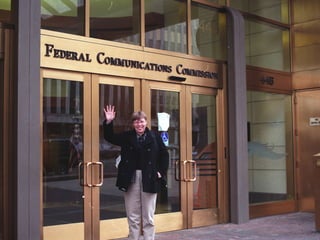
Broadcast Regulation Federal Communications Commission
 
 
Basic Powers of Regulators Licensing Supervisory Rule-making
FCC Objectives Healthy industries Competition More choices and lower prices for consumers Diversity of voices Localism Local control Local programming
Rulemaking Notice of Proposed Rulemaking Comments Promulgate Rule Requests for Reconsideration
Licensing in U.S. 8 year license period licensee must serve public interest, convenience and necessity availability of frequency no opposition
Basic Qualifications Technology comply with FCC technical standards--transmission facilities, interference avoidance and signal quality Financial adequate capital -- sufficient funds to operate station for three months without ad revenue
Character lack of serious legal violations (don’t lie to commission, engage in fraudulent programming or commit felonies) Citizenship/Ownership U.S. citizens ownership restrictions Equal Employment opportunities Don’t discriminate
Media Concentration Ownership Quotas
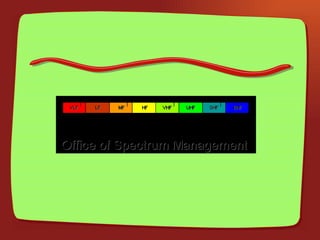
Spectrum Management spectrum allocation band allotment channel assignment (licensing) Berlin International Radio Convention of 1906
 
Media Ownership Rules Always a debate
Other Things that Are Good to Know
Other Powers of the FCC Warnings Fines (forfeitures) Revoke Licenses Refuse to Renew Licenses Position Papers Informal Negotiations
Specific Rules Ownership Concentration Foreign ownership Political Advertising Children’s Television Cable Satellite
More Rules Advanced television (digital; HDTV) Close-captioning Indecency
Some Background For almost 40 years there were only 3 national networks in the United States. Today there are 6 national networks. Is the U.S. twice as big today?
Dominance of Big Three In 1983 big 3 had 80% of the prime time viewing audience In 1980, networks and their stations and affiliates accounted for about 90% of revenues and profits in broadcast television industry
Economic Technical Regulatory
Economic Reasons First networks grew out of existing radio networks CBS NBC Red NBC Blue
Could use radio profits to finance television Had an established program pool to exploit Could shift program, sponsor and audience to television Many new tv licensees were long-time radio affiliates
Technical Reasons co-channel interference -- need 200 miles between same channel stations adjacent channel interference -- need 60 miles between adjacent channels
even in largest city, interference would limit number of channels to 7 2, 4, 5, 7, 9, 11, 13 economically, even in large markets only a handful of stations will be successful
Regulatory reasons FCC decided to assign only limited portions of spectrum. FCC wanted to assign, wherever possible, at least one television station to each U.S. community (localism).
because most communities close in proximity, in order to avoid interference, had to limit the area television stations serve to allow for transmitters in small communities, FCC had to limit number of stations assigned to larger cities
Effect was to limit number of available outlets that the networks might use to reach large numbers of viewers Localism model criticism:  overconfidence in local area’s ability to produce viable programming
Alternate:  National Model Put all stations in big cities 2, 4, 5, 7, 9, 11, 13 Practical reach of signal is 50 miles Use repeaters to expand reach
How Did We Get 4 Networks?
struggle between major movie studios and networks for ownership of television programming FCC imposed rules in early 1970’s financial interest and syndication rules, networks could not own any prime time programming it distributed
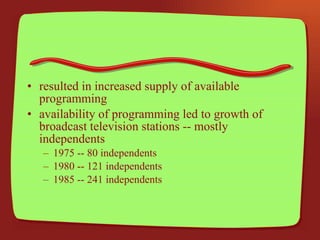
resulted in increased supply of available programming availability of programming led to growth of broadcast television stations -- mostly independents 1975 -- 80 independents 1980 -- 121 independents 1985 -- 241 independents
Fall 1986 -- Fox begins 1 program 1987 single night of programming 1993 five nights of programming
FCC suspended full-regulation of Fox so it could grow.
Why More than 4?
UPN and WB availability of stations availability of supply of programming repeal of fin/syn rule studios want to distribute their programs and then syndicate same weblets are owned, at least in part, by studios/producers
2006 end of UPN and WB birth of CW
Four Advantages of Networks Reduced transaction costs one network schedule takes care of 200 affiliates Increased efficiency advertisers need only deal with one network (who might guarantee the audience) Distribution costs reduced cost of transmitting signals to affiliates reduced if same program scheduled simultaneously Success breeds success in network scheduling of programs
Ownership of Local Stations Network owned-and-operated (O&O) Station Groups Cox Communications Hearst Business or individual
Local Station Administration Sales Programming Promotion Engineering Traffic News
Trends Mergers & consolidation leading to vertical integration Globalization Shrinking audience Increased options for audience Going digital
Vertical integration firm controls different aspects of production, distribution and exhibition of its products
Vertical Integration In 1993, vertically-integrated companies (production, distribution, station ownership) had 27% audience share. 1n 2003, have 69% audience share.
Current Issues
Current Issues Ownership Restrictions Everything is Getting More Expensive
Everything is Getting More Expensive
Programming In the final season, NBC paid Paramount $5.2 million per episode for  Frasier Even reality shows can cost $1 to $2 million per episode
 

Television

  • 1.
    THE U.S. TELEVISIONINDUSTRY Professor Miriam A. Smith San Francisco State University
  • 2.
    The U.S. TelevisionIndustry Overview and Current Issues
  • 3.
    U.S. Television AudiencePopulation - about 300 million Percentage of Households with TV 98% (Nielsen Media Research 1998) TV Households 112.8 million (Jan 2008)
  • 4.
    TV Ownership Morethan one TV 82% of total households in U.S. 1 TV 18% of total households 3 or more TV’s 52% of total households 99% have color television 85% have a VCR
  • 5.
    Dual TV BroadcastSystem Large Commercial (Private) Sector Advertiser supported Much Smaller Public Sector
  • 6.
    Television Delivery OptionsBroadcast Free-over-the air Cable Satellite Internet Mobile
  • 7.
    Cable & SatelliteCable 64% of total U.S. households -- basic cable 96.6% of TV households passed by cable Satellite 22% of total U.S. households -- DBS
  • 8.
    Other Options RemoteControl 93% of total U.S. households VCR 85% of total U.S. households DVR VOD
  • 9.
    Commercial Broadcast TelevisionNational 5 networks Local 1,752 local broadcast stations (1,566 digital)
  • 10.
    National Networks ABC,CBS, NBC Fox CW (WB, UPN merger) Combined have a 58% market share
  • 11.
    Public Broadcasting 1national network -- PBS 381 television stations 254 UHF educational stations 127 VHF educational stations
  • 12.
    Broadcast Regulation FederalCommunications Commission
  • 13.
  • 14.
  • 15.
    Basic Powers ofRegulators Licensing Supervisory Rule-making
  • 16.
    FCC Objectives Healthyindustries Competition More choices and lower prices for consumers Diversity of voices Localism Local control Local programming
  • 17.
    Rulemaking Notice ofProposed Rulemaking Comments Promulgate Rule Requests for Reconsideration
  • 18.
    Licensing in U.S.8 year license period licensee must serve public interest, convenience and necessity availability of frequency no opposition
  • 19.
    Basic Qualifications Technologycomply with FCC technical standards--transmission facilities, interference avoidance and signal quality Financial adequate capital -- sufficient funds to operate station for three months without ad revenue
  • 20.
    Character lack ofserious legal violations (don’t lie to commission, engage in fraudulent programming or commit felonies) Citizenship/Ownership U.S. citizens ownership restrictions Equal Employment opportunities Don’t discriminate
  • 21.
  • 22.
    Spectrum Management spectrumallocation band allotment channel assignment (licensing) Berlin International Radio Convention of 1906
  • 23.
  • 24.
    Media Ownership RulesAlways a debate
  • 25.
    Other Things thatAre Good to Know
  • 26.
    Other Powers ofthe FCC Warnings Fines (forfeitures) Revoke Licenses Refuse to Renew Licenses Position Papers Informal Negotiations
  • 27.
    Specific Rules OwnershipConcentration Foreign ownership Political Advertising Children’s Television Cable Satellite
  • 28.
    More Rules Advancedtelevision (digital; HDTV) Close-captioning Indecency
  • 29.
    Some Background Foralmost 40 years there were only 3 national networks in the United States. Today there are 6 national networks. Is the U.S. twice as big today?
  • 30.
    Dominance of BigThree In 1983 big 3 had 80% of the prime time viewing audience In 1980, networks and their stations and affiliates accounted for about 90% of revenues and profits in broadcast television industry
  • 31.
  • 32.
    Economic Reasons Firstnetworks grew out of existing radio networks CBS NBC Red NBC Blue
  • 33.
    Could use radioprofits to finance television Had an established program pool to exploit Could shift program, sponsor and audience to television Many new tv licensees were long-time radio affiliates
  • 34.
    Technical Reasons co-channelinterference -- need 200 miles between same channel stations adjacent channel interference -- need 60 miles between adjacent channels
  • 35.
    even in largestcity, interference would limit number of channels to 7 2, 4, 5, 7, 9, 11, 13 economically, even in large markets only a handful of stations will be successful
  • 36.
    Regulatory reasons FCCdecided to assign only limited portions of spectrum. FCC wanted to assign, wherever possible, at least one television station to each U.S. community (localism).
  • 37.
    because most communitiesclose in proximity, in order to avoid interference, had to limit the area television stations serve to allow for transmitters in small communities, FCC had to limit number of stations assigned to larger cities
  • 38.
    Effect was tolimit number of available outlets that the networks might use to reach large numbers of viewers Localism model criticism: overconfidence in local area’s ability to produce viable programming
  • 39.
    Alternate: NationalModel Put all stations in big cities 2, 4, 5, 7, 9, 11, 13 Practical reach of signal is 50 miles Use repeaters to expand reach
  • 40.
    How Did WeGet 4 Networks?
  • 41.
    struggle between majormovie studios and networks for ownership of television programming FCC imposed rules in early 1970’s financial interest and syndication rules, networks could not own any prime time programming it distributed
  • 42.
    resulted in increasedsupply of available programming availability of programming led to growth of broadcast television stations -- mostly independents 1975 -- 80 independents 1980 -- 121 independents 1985 -- 241 independents
  • 43.
    Fall 1986 --Fox begins 1 program 1987 single night of programming 1993 five nights of programming
  • 44.
    FCC suspended full-regulationof Fox so it could grow.
  • 45.
  • 46.
    UPN and WBavailability of stations availability of supply of programming repeal of fin/syn rule studios want to distribute their programs and then syndicate same weblets are owned, at least in part, by studios/producers
  • 47.
    2006 end ofUPN and WB birth of CW
  • 48.
    Four Advantages ofNetworks Reduced transaction costs one network schedule takes care of 200 affiliates Increased efficiency advertisers need only deal with one network (who might guarantee the audience) Distribution costs reduced cost of transmitting signals to affiliates reduced if same program scheduled simultaneously Success breeds success in network scheduling of programs
  • 49.
    Ownership of LocalStations Network owned-and-operated (O&O) Station Groups Cox Communications Hearst Business or individual
  • 50.
    Local Station AdministrationSales Programming Promotion Engineering Traffic News
  • 51.
    Trends Mergers &consolidation leading to vertical integration Globalization Shrinking audience Increased options for audience Going digital
  • 52.
    Vertical integration firmcontrols different aspects of production, distribution and exhibition of its products
  • 53.
    Vertical Integration In1993, vertically-integrated companies (production, distribution, station ownership) had 27% audience share. 1n 2003, have 69% audience share.
  • 54.
  • 55.
    Current Issues OwnershipRestrictions Everything is Getting More Expensive
  • 56.
    Everything is GettingMore Expensive
  • 57.
    Programming In thefinal season, NBC paid Paramount $5.2 million per episode for Frasier Even reality shows can cost $1 to $2 million per episode
  • 58.

Editor's Notes

  • #8 Nielsen
  • #10 FCC as of June 30, 2004
  • #12 FCC as of June 30, 2004