Who Pays for Journalism?
Principles of News
Professor Neil Foote
Chapter 4, Principles of American Journalism
What is the “business of
journalism”?
• Uphold our democracy?
• Protect the First Amendment?
• News?
• Advertising?
• Distribution?
• Technology?
• Access?

2
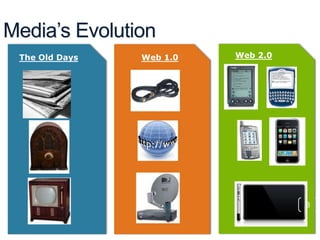
Media’s Evolution
The Old Days

Web 1.0

Web 2.0

3
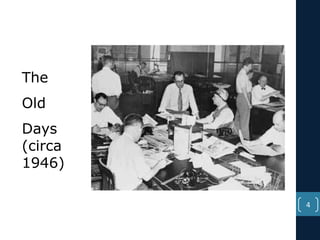
The
Old
Days
(circa
1946)
4
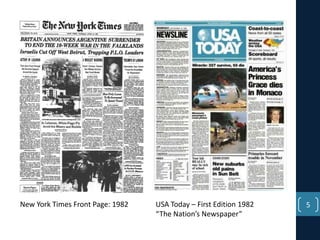
New York Times Front Page: 1982

USA Today – First Edition 1982
“The Nation’s Newspaper”

5
USA Today: The Reaction
“In 1981, when we announced it, most critics
said we were crazy. They wrote our obit before
we were born.
“In 1982, after we published Vo. 1, No. 1 on
September 15, 1982, many said we had
aborted on the launchpad.
“The whole idea was simply too big and too
bold for the newspaper establishment club and
the journalism critics to accept.”
-- Al Neuharth, the late founder, USA
Today & Gannett Corporation Chair.(p.
106, Confessions of a SOB)

6
USA Today: The Reaction cont.
• “A national newspaper so informative and
entertaining and enjoyable that it would
grab millions of readers, including many of
the television generation who were then
nonreaders.”
-- Al Neuharth, the late founder, USA
Today & Gannett Corporation Chair (p.
107, Confessions of a SOB.)
7
USA Today: The Reaction cont.
• “A newspaper so differ, so advance in
design and appearance and content that it
would pull the rest of the industry into the
twenty-first century, albeit kicking and
screaming.
•“We’ll reinvent the newspaper.”
-- Al Neuharth, the late founder, USA
Today & Gannett Corporation Chair (p.
107, Confessions of a SOB.)

8
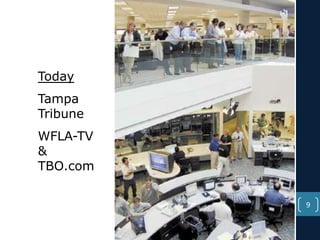
Today
Tampa
Tribune
WFLA-TV
&
TBO.com
9
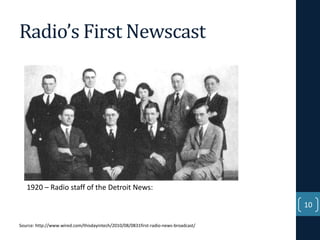
Radio’s First Newscast

1920 – Radio staff of the Detroit News:
10
Source: http://www.wired.com/thisdayintech/2010/08/0831first-radio-news-broadcast/
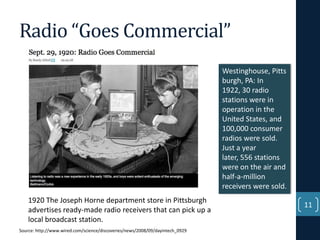
Radio “Goes Commercial”
Westinghouse, Pitts
burgh, PA: In
1922, 30 radio
stations were in
operation in the
United States, and
100,000 consumer
radios were sold.
Just a year
later, 556 stations
were on the air and
half-a-million
receivers were sold.
1920 The Joseph Horne department store in Pittsburgh
advertises ready-made radio receivers that can pick up a
local broadcast station.
Source: http://www.wired.com/science/discoveries/news/2008/09/dayintech_0929

11
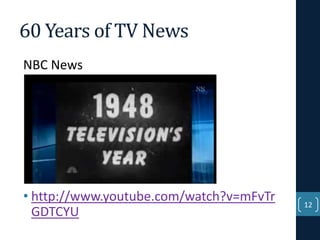
60 Years of TV News
NBC News

• http://www.youtube.com/watch?v=mFvTr
GDTCYU

12
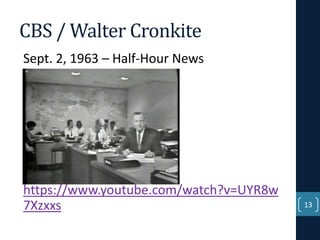
CBS / Walter Cronkite
Sept. 2, 1963 – Half-Hour News

https://www.youtube.com/watch?v=UYR8w
7Xzxxs

13
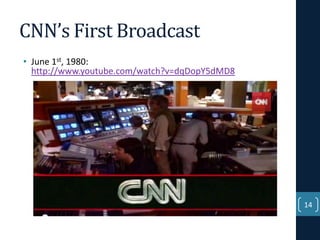
CNN’s First Broadcast
• June 1st, 1980:
http://www.youtube.com/watch?v=dqDopY5dMD8

14
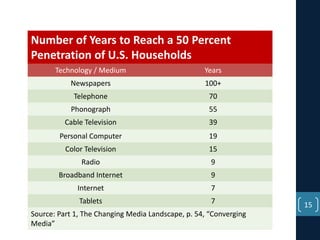
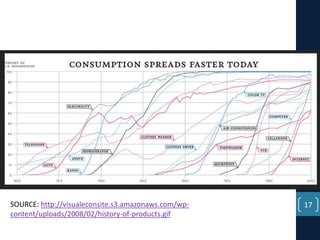
Number of Years to Reach a 50 Percent
Penetration of U.S. Households
Technology / Medium

Years

Newspapers

100+

Telephone

70

Phonograph

55

Cable Television

39

Personal Computer

19

Color Television

15

Radio

9

Broadband Internet

9

Internet

7

Tablets

7

Source: Part 1, The Changing Media Landscape, p. 54, “Converging
Media”

15
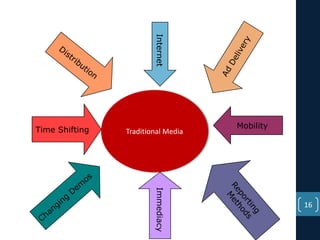
Internet

Time Shifting

Traditional Media

Mobility

Immediacy

16
SOURCE: http://visualeconsite.s3.amazonaws.com/wpcontent/uploads/2008/02/history-of-products.gif

17
What’s Going On?
Insatiable desire for
information

• Anytime, anywhere on any device

Changes in Lifestyles

• Time-shifting

Exponential growth in
technology

• Methods of distribution
• Devices – Smartphones, tablets

Content Creation
Everywhere/Everybody

• Blogs, Facebook, Twitter

18
What is ‘media’?
•Mass Media:
• Sending and receiving messages on a
massive scale

• NEWS Media
• Sending and receiving NEWS
19
Theoretical Framework
• Characteristics of media economy
• Ownership: Who Owns What
• Structure

20
Ownership Patterns
• Publicly traded companies:
• Disney, Viacom, Comcast, Gannet, New York
Times, Belo Corporation

• Privately held
• Journal Register, New York Daily
News, Boston Globe,

• Public-Private
• NPR, BBC

• Government Owned
• Voice of America

21
Key issues
• Contrast of market and public sphere models
• Assumptions
• Advantages of market model
• Economies of scale
• Horizontal and vertical integration

• Critique of market model by public sphere model
• Concentration of ownership
• Dual-product model
22
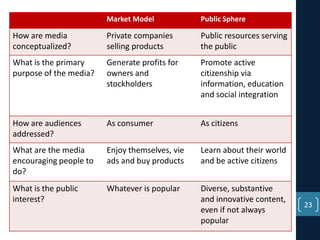
Market Model

Public Sphere

How are media
conceptualized?

Private companies
selling products

Public resources serving
the public

What is the primary
purpose of the media?

Generate profits for
owners and
stockholders

Promote active
citizenship via
information, education
and social integration

How are audiences
addressed?

As consumer

As citizens

What are the media
encouraging people to
do?

Enjoy themselves, vie
ads and buy products

Learn about their world
and be active citizens

What is the public
interest?

Whatever is popular

Diverse, substantive
and innovative content,
even if not always
popular

23
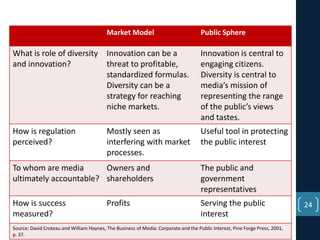
Market Model

Public Sphere

What is role of diversity Innovation can be a
and innovation?
threat to profitable,
standardized formulas.
Diversity can be a
strategy for reaching
niche markets.
Innovation is central to
engaging citizens.
Diversity is central to
media’s mission of
representing the range
of the public’s views
and tastes.

How is regulation
perceived?

Useful tool in protecting
the public interest

Mostly seen as
interfering with market
processes.

To whom are media
Owners and
ultimately accountable? shareholders

The public and
government
representatives

How is success
measured?

Serving the public
interest

Profits

Source: David Croteau and William Hoynes, The Business of Media: Corporate and the Public Interest, Pine Forge Press, 2001,
p. 37.

24
Structure of Media Markets
• Daniel C. Hallin and Paolo Mancini:
“Comparing Media Systems: Three Models
of media and Politics”
• Development of the “mass press”
• The rate of newspaper circulation. How
much is the circulation the newspaper.
• Newspaper-readership relationship. It
defines what the ratio of mass or elite
audience is.

25
Structure of Media Markets
• Relative importance of newspapers and
television as sources of news
• Ratio of local, regional, and national
newspapers
• Regional or linguistic segmentation of
media markets
26
Contrasts to consider
• Ownership
• Commercial versus Noncommercial
• Orientation
• Market versus Public
• Primary Goal
• Profit versus Service

27
Commercial ownership
Not owned by government
• Operate as for-profit business
• Owners can be individuals, families
or stockholders
• Media monopolies evolve to media
oligopoly
•

28
Media Oligopoly
• A marketplace in which media
ownership and diversity are severely
limited and the actions of any single
media group substantially affect its
competitors, including determining
the content and price of media
products for both consumers and
advertisers.
Source: Chapter 2, Media Literacy in the Digital Age, p. 51, Converging Media

29
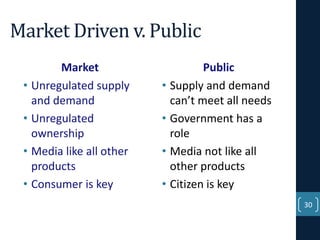
Market Driven v. Public
Market
• Unregulated supply
and demand
• Unregulated
ownership
• Media like all other
products
• Consumer is key

Public
• Supply and demand
can’t meet all needs
• Government has a
role
• Media not like all
other products
• Citizen is key
30
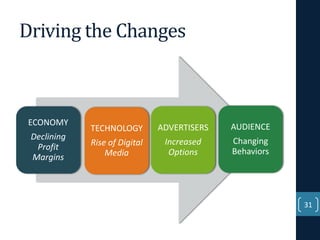
Driving the Changes

ECONOMY
Declining
Profit
Margins

TECHNOLOGY

ADVERTISERS

AUDIENCE

Rise of Digital
Media

Increased
Options

Changing
Behaviors

31
Primary Goal
Profit

Public
Service

32
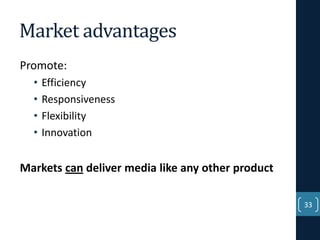
Market advantages
Promote:
•
•
•
•

Efficiency
Responsiveness
Flexibility
Innovation

Markets can deliver media like any other product
33
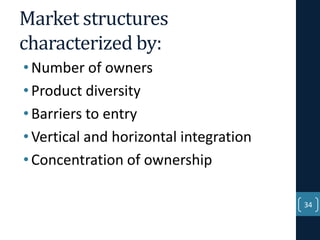
Market structures
characterized by:
• Number of owners
• Product diversity
• Barriers to entry
• Vertical and horizontal integration
• Concentration of ownership
34
How does it offer those
advantages?
• Economies of scale
• Horizontal integration
• Vertical integration

35
Horizontal Integration
• When a single large media
corporation owns a number of
different kinds of media products
or outlets.
• E.g. The Hearst Corporation
36
Vertical Integration
• When a media corporation owns
companies involved in different
phases of the media production
process – creating media
products, distributing
them, showing them.
• E.g Comcast

37
Examples: Economies of Scale
• Hearst Corporation
• Horizontal Integration
• 15 newspapers, 20 magazines (300 int’l
editions, including Cosmo, ELLE,
Seventeen, Car and Driver), 29 television
stations
http://www.cjr.org/resources/?c=hearst
38
Examples: Economies of Scale
• Comcast
• Vertical integration:
TV, Cable, Internet, Programming
• 22.0 million video customers, 19.4 million
high-speed Internet customers, and 10.0
million voice customers
• NBC Universal, Telemundo
• Weather Channel, Bravo, SyFy, USA, Golf
Channel, NBC Sports, E! Online
• http://www.cjr.org/resources/?c=comcast

39
Examples: Economies of Scale
• Disney Corporation
• Horizontal and vertical integration
• ABC, ESPN, Disney
World, Disneyland, Disney Cruise Buena
Vista Pictures, Lucas Film, Radio
Disney, Local radio stations
• http://www.cjr.org/resources/?c=disney
40
Examples: Economies of Scale
• Gannett Corporation
• Concentration of ownership
• 82 daily newspapers, including USA Today
• 200 weekly publications
• 23 Television stations
• Numerous websites
• http://www.cjr.org/resources/?c=gannett
41
Examples: Economies of Scale
• Clear Channel
• Concentration of ownership
• Reaches 243 million monthly listeners via
radio
• 150 cities through 850 owned radio
stations in the U.S., as well as more than
140 stations in New Zealand and Australia
• http://www.cjr.org/resources/?c=clearcha
nnel

42
Competition
• Without it, no incentive to…
• improve product
• keep prices attractive
• Innovate
• Consolidation has thwarted
innovation, fueled complacency
• Allowed more noble, agile smaller
players into the marketplace

43
Media consolidation
• What’s its impact?
• Let’s listen to Sen. Maria Cantrell ask
questions of Thomas Wheeler, nominee
for chair, Federal Communications
Commission
• https://www.youtube.com/watch?v=p8Af
KrGgcLs
44
Government regulation
• Government intervention (regulation) can
serve the market where competition is
lacking.
• Fueled growth, standardization;
• All digital signals in 2009, fueling HD TV

• FCC: Federal Communications Commission
• FTC: Federal Trade Commission
45
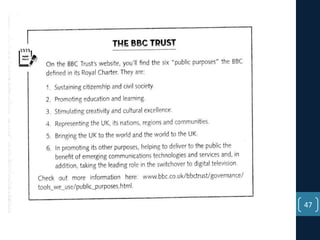
Public sphere model
• News media a social space for public
dialogue, which needs:
• Free-flowing, public interest information
• Citizen participation
• Diversity of ideas and voices
Markets are limited in their ability to provide
those things.
46
47
Why is the market limited?
• Markets can be undemocratic
• $1 = 1 vote

• Unequal access to marketplace
• Amoral
• Bad content often cheap as well as popular
• Markets don’t necessarily meet social needs
• Market success may or may not = political or
cultural success
48
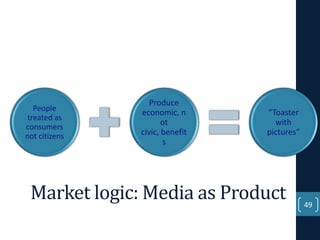
People
treated as
consumers
not citizens

Produce
economic, n
ot
civic, benefit
s

“Toaster
with
pictures”

Market logic: Media as Product

49
From the public perspective:
• Market OK for media consumers, not so
much for media citizens
• Media are resources for citizenship, not
just entertainment
• Media have unique role in
democracy, recognized in US legal
protections
50
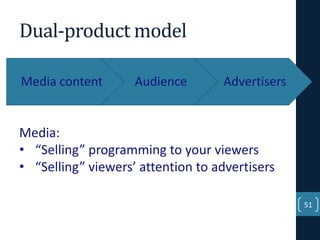
Dual-product model
Media content

Audience

Advertisers

Media:
• “Selling” programming to your viewers
• “Selling” viewers’ attention to advertisers
51
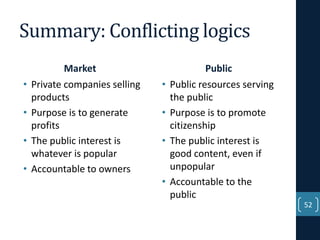
Summary: Conflicting logics
•

•
•

•

Market
Private companies selling
products
Purpose is to generate
profits
The public interest is
whatever is popular
Accountable to owners

•

•
•

•

Public
Public resources serving
the public
Purpose is to promote
citizenship
The public interest is
good content, even if
unpopular
Accountable to the
public
52
Media Ownership: The Trilogy
• Competition
• Localism
• Diversity (of voices, ownership)

53
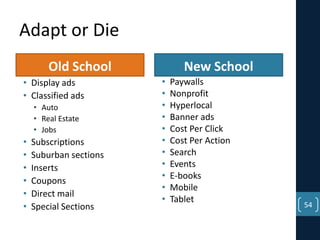
Adapt or Die
Old School
• Display ads
• Classified ads
• Auto
• Real Estate
• Jobs

•
•
•
•
•
•

Subscriptions
Suburban sections
Inserts
Coupons
Direct mail
Special Sections

New School
•
•
•
•
•
•
•
•
•
•
•

Paywalls
Nonprofit
Hyperlocal
Banner ads
Cost Per Click
Cost Per Action
Search
Events
E-books
Mobile
Tablet

54
YOUR QUESTION OF THE DAY:
• Some say profits and good journalism are
constantly in conflict. Given the economic
problems of traditional media today,
consolidation has become a solution for
survival.
• Is consolidation of media good or bad for
media?
• What impact does advertising you see in
today’s news coverage? Programming?

55
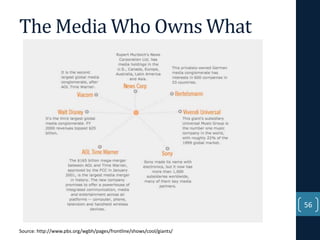
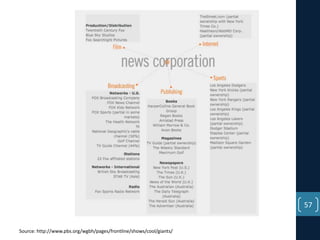
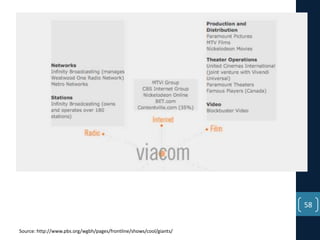
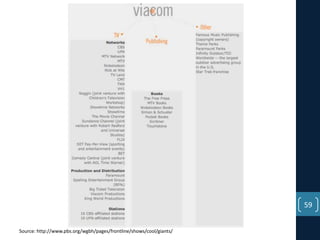
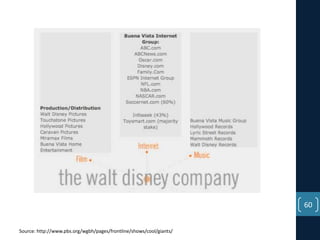
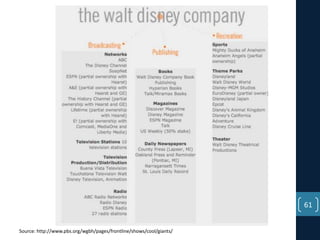
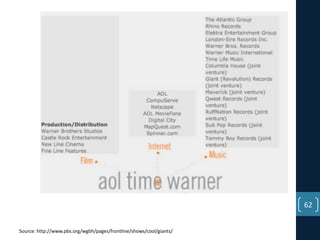
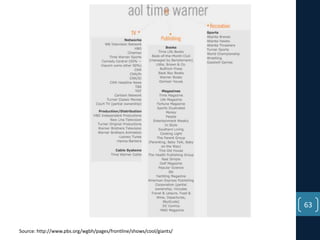
The Media Who Owns What

56
Source: http://www.pbs.org/wgbh/pages/frontline/shows/cool/giants/
57
Source: http://www.pbs.org/wgbh/pages/frontline/shows/cool/giants/
58
Source: http://www.pbs.org/wgbh/pages/frontline/shows/cool/giants/
59
Source: http://www.pbs.org/wgbh/pages/frontline/shows/cool/giants/
60
Source: http://www.pbs.org/wgbh/pages/frontline/shows/cool/giants/
61
Source: http://www.pbs.org/wgbh/pages/frontline/shows/cool/giants/
62
Source: http://www.pbs.org/wgbh/pages/frontline/shows/cool/giants/
63
Source: http://www.pbs.org/wgbh/pages/frontline/shows/cool/giants/

Who paysforjournalism chapter4(5)

  • 1.
    Who Pays forJournalism? Principles of News Professor Neil Foote Chapter 4, Principles of American Journalism
  • 2.
    What is the“business of journalism”? • Uphold our democracy? • Protect the First Amendment? • News? • Advertising? • Distribution? • Technology? • Access? 2
  • 3.
    Media’s Evolution The OldDays Web 1.0 Web 2.0 3
  • 4.
  • 5.
    New York TimesFront Page: 1982 USA Today – First Edition 1982 “The Nation’s Newspaper” 5
  • 6.
    USA Today: TheReaction “In 1981, when we announced it, most critics said we were crazy. They wrote our obit before we were born. “In 1982, after we published Vo. 1, No. 1 on September 15, 1982, many said we had aborted on the launchpad. “The whole idea was simply too big and too bold for the newspaper establishment club and the journalism critics to accept.” -- Al Neuharth, the late founder, USA Today & Gannett Corporation Chair.(p. 106, Confessions of a SOB) 6
  • 7.
    USA Today: TheReaction cont. • “A national newspaper so informative and entertaining and enjoyable that it would grab millions of readers, including many of the television generation who were then nonreaders.” -- Al Neuharth, the late founder, USA Today & Gannett Corporation Chair (p. 107, Confessions of a SOB.) 7
  • 8.
    USA Today: TheReaction cont. • “A newspaper so differ, so advance in design and appearance and content that it would pull the rest of the industry into the twenty-first century, albeit kicking and screaming. •“We’ll reinvent the newspaper.” -- Al Neuharth, the late founder, USA Today & Gannett Corporation Chair (p. 107, Confessions of a SOB.) 8
  • 9.
  • 10.
    Radio’s First Newscast 1920– Radio staff of the Detroit News: 10 Source: http://www.wired.com/thisdayintech/2010/08/0831first-radio-news-broadcast/
  • 11.
    Radio “Goes Commercial” Westinghouse,Pitts burgh, PA: In 1922, 30 radio stations were in operation in the United States, and 100,000 consumer radios were sold. Just a year later, 556 stations were on the air and half-a-million receivers were sold. 1920 The Joseph Horne department store in Pittsburgh advertises ready-made radio receivers that can pick up a local broadcast station. Source: http://www.wired.com/science/discoveries/news/2008/09/dayintech_0929 11
  • 12.
    60 Years ofTV News NBC News • http://www.youtube.com/watch?v=mFvTr GDTCYU 12
  • 13.
    CBS / WalterCronkite Sept. 2, 1963 – Half-Hour News https://www.youtube.com/watch?v=UYR8w 7Xzxxs 13
  • 14.
    CNN’s First Broadcast •June 1st, 1980: http://www.youtube.com/watch?v=dqDopY5dMD8 14
  • 15.
    Number of Yearsto Reach a 50 Percent Penetration of U.S. Households Technology / Medium Years Newspapers 100+ Telephone 70 Phonograph 55 Cable Television 39 Personal Computer 19 Color Television 15 Radio 9 Broadband Internet 9 Internet 7 Tablets 7 Source: Part 1, The Changing Media Landscape, p. 54, “Converging Media” 15
  • 16.
  • 17.
  • 18.
    What’s Going On? Insatiabledesire for information • Anytime, anywhere on any device Changes in Lifestyles • Time-shifting Exponential growth in technology • Methods of distribution • Devices – Smartphones, tablets Content Creation Everywhere/Everybody • Blogs, Facebook, Twitter 18
  • 19.
    What is ‘media’? •MassMedia: • Sending and receiving messages on a massive scale • NEWS Media • Sending and receiving NEWS 19
  • 20.
    Theoretical Framework • Characteristicsof media economy • Ownership: Who Owns What • Structure 20
  • 21.
    Ownership Patterns • Publiclytraded companies: • Disney, Viacom, Comcast, Gannet, New York Times, Belo Corporation • Privately held • Journal Register, New York Daily News, Boston Globe, • Public-Private • NPR, BBC • Government Owned • Voice of America 21
  • 22.
    Key issues • Contrastof market and public sphere models • Assumptions • Advantages of market model • Economies of scale • Horizontal and vertical integration • Critique of market model by public sphere model • Concentration of ownership • Dual-product model 22
  • 23.
    Market Model Public Sphere Howare media conceptualized? Private companies selling products Public resources serving the public What is the primary purpose of the media? Generate profits for owners and stockholders Promote active citizenship via information, education and social integration How are audiences addressed? As consumer As citizens What are the media encouraging people to do? Enjoy themselves, vie ads and buy products Learn about their world and be active citizens What is the public interest? Whatever is popular Diverse, substantive and innovative content, even if not always popular 23
  • 24.
    Market Model Public Sphere Whatis role of diversity Innovation can be a and innovation? threat to profitable, standardized formulas. Diversity can be a strategy for reaching niche markets. Innovation is central to engaging citizens. Diversity is central to media’s mission of representing the range of the public’s views and tastes. How is regulation perceived? Useful tool in protecting the public interest Mostly seen as interfering with market processes. To whom are media Owners and ultimately accountable? shareholders The public and government representatives How is success measured? Serving the public interest Profits Source: David Croteau and William Hoynes, The Business of Media: Corporate and the Public Interest, Pine Forge Press, 2001, p. 37. 24
  • 25.
    Structure of MediaMarkets • Daniel C. Hallin and Paolo Mancini: “Comparing Media Systems: Three Models of media and Politics” • Development of the “mass press” • The rate of newspaper circulation. How much is the circulation the newspaper. • Newspaper-readership relationship. It defines what the ratio of mass or elite audience is. 25
  • 26.
    Structure of MediaMarkets • Relative importance of newspapers and television as sources of news • Ratio of local, regional, and national newspapers • Regional or linguistic segmentation of media markets 26
  • 27.
    Contrasts to consider •Ownership • Commercial versus Noncommercial • Orientation • Market versus Public • Primary Goal • Profit versus Service 27
  • 28.
    Commercial ownership Not ownedby government • Operate as for-profit business • Owners can be individuals, families or stockholders • Media monopolies evolve to media oligopoly • 28
  • 29.
    Media Oligopoly • Amarketplace in which media ownership and diversity are severely limited and the actions of any single media group substantially affect its competitors, including determining the content and price of media products for both consumers and advertisers. Source: Chapter 2, Media Literacy in the Digital Age, p. 51, Converging Media 29
  • 30.
    Market Driven v.Public Market • Unregulated supply and demand • Unregulated ownership • Media like all other products • Consumer is key Public • Supply and demand can’t meet all needs • Government has a role • Media not like all other products • Citizen is key 30
  • 31.
  • 32.
  • 33.
  • 34.
    Market structures characterized by: •Number of owners • Product diversity • Barriers to entry • Vertical and horizontal integration • Concentration of ownership 34
  • 35.
    How does itoffer those advantages? • Economies of scale • Horizontal integration • Vertical integration 35
  • 36.
    Horizontal Integration • Whena single large media corporation owns a number of different kinds of media products or outlets. • E.g. The Hearst Corporation 36
  • 37.
    Vertical Integration • Whena media corporation owns companies involved in different phases of the media production process – creating media products, distributing them, showing them. • E.g Comcast 37
  • 38.
    Examples: Economies ofScale • Hearst Corporation • Horizontal Integration • 15 newspapers, 20 magazines (300 int’l editions, including Cosmo, ELLE, Seventeen, Car and Driver), 29 television stations http://www.cjr.org/resources/?c=hearst 38
  • 39.
    Examples: Economies ofScale • Comcast • Vertical integration: TV, Cable, Internet, Programming • 22.0 million video customers, 19.4 million high-speed Internet customers, and 10.0 million voice customers • NBC Universal, Telemundo • Weather Channel, Bravo, SyFy, USA, Golf Channel, NBC Sports, E! Online • http://www.cjr.org/resources/?c=comcast 39
  • 40.
    Examples: Economies ofScale • Disney Corporation • Horizontal and vertical integration • ABC, ESPN, Disney World, Disneyland, Disney Cruise Buena Vista Pictures, Lucas Film, Radio Disney, Local radio stations • http://www.cjr.org/resources/?c=disney 40
  • 41.
    Examples: Economies ofScale • Gannett Corporation • Concentration of ownership • 82 daily newspapers, including USA Today • 200 weekly publications • 23 Television stations • Numerous websites • http://www.cjr.org/resources/?c=gannett 41
  • 42.
    Examples: Economies ofScale • Clear Channel • Concentration of ownership • Reaches 243 million monthly listeners via radio • 150 cities through 850 owned radio stations in the U.S., as well as more than 140 stations in New Zealand and Australia • http://www.cjr.org/resources/?c=clearcha nnel 42
  • 43.
    Competition • Without it,no incentive to… • improve product • keep prices attractive • Innovate • Consolidation has thwarted innovation, fueled complacency • Allowed more noble, agile smaller players into the marketplace 43
  • 44.
    Media consolidation • What’sits impact? • Let’s listen to Sen. Maria Cantrell ask questions of Thomas Wheeler, nominee for chair, Federal Communications Commission • https://www.youtube.com/watch?v=p8Af KrGgcLs 44
  • 45.
    Government regulation • Governmentintervention (regulation) can serve the market where competition is lacking. • Fueled growth, standardization; • All digital signals in 2009, fueling HD TV • FCC: Federal Communications Commission • FTC: Federal Trade Commission 45
  • 46.
    Public sphere model •News media a social space for public dialogue, which needs: • Free-flowing, public interest information • Citizen participation • Diversity of ideas and voices Markets are limited in their ability to provide those things. 46
  • 47.
  • 48.
    Why is themarket limited? • Markets can be undemocratic • $1 = 1 vote • Unequal access to marketplace • Amoral • Bad content often cheap as well as popular • Markets don’t necessarily meet social needs • Market success may or may not = political or cultural success 48
  • 49.
    People treated as consumers not citizens Produce economic,n ot civic, benefit s “Toaster with pictures” Market logic: Media as Product 49
  • 50.
    From the publicperspective: • Market OK for media consumers, not so much for media citizens • Media are resources for citizenship, not just entertainment • Media have unique role in democracy, recognized in US legal protections 50
  • 51.
    Dual-product model Media content Audience Advertisers Media: •“Selling” programming to your viewers • “Selling” viewers’ attention to advertisers 51
  • 52.
    Summary: Conflicting logics • • • • Market Privatecompanies selling products Purpose is to generate profits The public interest is whatever is popular Accountable to owners • • • • Public Public resources serving the public Purpose is to promote citizenship The public interest is good content, even if unpopular Accountable to the public 52
  • 53.
    Media Ownership: TheTrilogy • Competition • Localism • Diversity (of voices, ownership) 53
  • 54.
    Adapt or Die OldSchool • Display ads • Classified ads • Auto • Real Estate • Jobs • • • • • • Subscriptions Suburban sections Inserts Coupons Direct mail Special Sections New School • • • • • • • • • • • Paywalls Nonprofit Hyperlocal Banner ads Cost Per Click Cost Per Action Search Events E-books Mobile Tablet 54
  • 55.
    YOUR QUESTION OFTHE DAY: • Some say profits and good journalism are constantly in conflict. Given the economic problems of traditional media today, consolidation has become a solution for survival. • Is consolidation of media good or bad for media? • What impact does advertising you see in today’s news coverage? Programming? 55
  • 56.
    The Media WhoOwns What 56 Source: http://www.pbs.org/wgbh/pages/frontline/shows/cool/giants/
  • 57.
  • 58.
  • 59.
  • 60.
  • 61.
  • 62.
  • 63.

Editor's Notes

  • #36 Going to the websites of media conglomerates helps illustrate this. You could use screenshots of Gannett Corp and Clear Channel (economies of scale and concentration of ownership), Comcast (vertical integration), Hearst (horizontal integration), Disney (both horizontal and vertical) etc. A complete listing of “who owns what” can be found on the Columbia Journalism Review website, cjr.org.
  • #50 The “toaster with pictures” is a reference to a famous quote by former FCC Chairman Mark Fowler who was arguing that, because television is no more than an appliance, a “toaster with pictures,” it didn’t need to be regulated. The idea is that media are like any other product. This is in direct contrast to the public sphere approach.