Economics
Scan the Macroenvironment Political Economic Social Technological Environmental Legal Educational Demographic
economic institutions engaged in production and dissemination of content targeted towards consumers behavior governed by economics consumers indicate preference for media content through exchange of time and money
fundamental transactions sell audiences to advertisers broadcasters cable/satellite produce & sell media content Studios & production companies (networks, stations, consumers)
Economics assumes scarcity of goods and services.
What Drives the U.S. Economy? self-interest supply demand
Let’s Define a Few Terms
Market A “market” is an organized process by which buyers and sellers exchange goods and services. Every market has two sides -- a demand side (buyers) and a supply side (sellers) “ Market” and “industry” often used synonymously.
Supply the amount of product producers will offer at a certain price producers determine quantity make production decisions based on the anticipated needs of consumers of product a higher price motivates producers to supply more (prices go up, supply goes up)
Demand the quantity of a particular product or service that consumers will purchase at a given price the lower the price, the stronger the demand  demand falls as price rises demand rises as price falls
Normal Good A good that is bought in greater quantities as income increases.
Inferior Good A good you buy less of as your income rises.
Luxury Good Demand for the good rises even faster than income .
Complements Two goods used together so that if the price of one increases, the demand for the other will fall Example – dvds and dvd players
Substitutes Two goods that are interchangeable so that if the price of one increases, the demand for the other will increase. Example, broadcast and cable.
Material v. immaterial marginal cost inventory distribution shipping/handling final sale
Public Good very low or zero marginal cost nonexclusive in consumption nondepletive in consumption may be simultaneously consumed by more than one individual use by one individual does not reduce quantity available for consumption by others
Consumption = rival when one’s person’s use (consumption) diminishes another person’s use -- it is a rival good
Available to one and all . . .  nonexcludable
Cost of Producing One More “Good” marginal cost
Revenue from Selling One More “Good” marginal revenue
Economies of Scale Long term average cost of production decreases as plant size and rate of output increase.
Economies of scale Existing firms may have already built efficient plants. Added output of entrant’s efficient plant may be so large that exceeds demand so product price will fall below entrant’s cost per unit. Just no room in the market for someone else.
First Copy Cost In media, the cost of producing the first copy is high. The cost of producing subsequent copies is marginal. Hence, the more units sold, the better.
Absolute unit cost differences Established firms can produce and market wares more efficiently than newcomer. Why? Entrant may have to pay more for scarce raw material. May have to ship goods farther. Production technologies might be inferior. Maybe pay higher interest rates on start-up debt.
Product differentiation Highly differentiated product. May have to master marketing problems as well as production problems. Marketing differentiated product entails substantial cost -- advertising, packaging, style, etc.
Economies of Scope Common in media industries Shared overheads make it more cost-effective for two or more related products to be produced and sold jointly, rather than separately Re-using and reformatting
Economies of Scope Achieved Through Multi-Product Production
Cost structures costs for production in a particular market fixed and variable
Fixed Cost costs needed to produce one unit of a product also called “first copy”costs
Variable costs costs that vary depending on quantity produced
Vertical integration firm controls different aspects of production, distribution and exhibition of its products
Marginal Revenue The revenue generated when one additional unit is sold.
Marginal Cost The cost of producing one more unit of output.
Price discrimination The practice of charging different prices to different consumers for a nearly identical good.
Transaction costs The costs involved in making a market transaction.
Utility satisfaction offered by the product subjective measure individuals assign value based on utility
Barriers to Entry Anything that prevents a new firm from entering a market.
Competition Should bring increased choices and lower prices to consumers.
Brand names lower transaction costs. Brand names convey important information to consumers, which lowers the transaction cost.
Our Media Economics Model Basic conditions:  What type of product is being sold? Market structure:  Perfect competition, monopolistic competition, oligopoly or monopoly? Conduct:  How do competitors compete--price, promotion, product diversity . . . : Performance:  Is there money to be made?
Market Structure Number of buyers and sellers Product Differentiation Barriers to entry Cost structures Vertical integration
Types of Markets Perfect competition Monopolistic competition Oligopoly Monopoly
Many buyers and sellers in market. No firm has price-setting power (all take the market price). All products homogeneous. All buyers and sellers have perfect. knowledge about prices and quantities. Free entry into and exit from market. Perfect Competition Market
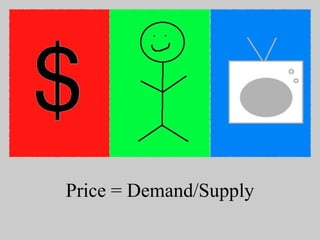
Price = Demand/Supply
People Want Less of the Product Demand  Decreases Supply  Increases Suppliers will Make More of the Product
People Want More of the Product Demand  Increases Supply  Decreases Suppliers will Make Less of the Product What a deal!
Market Demand The total quantity of a good or service demanded by potential buyers.
the price that will make both the buyers and sellers happy buyers are willing to buy at that price sellers are willing to sell at that price
Equilibrium Price Intersection of demand and supply curve.
Firms are Price takers. A price taker is one whose buying or selling decisions do not affect the market price of the good.
Shifts in the Demand Curve A change in income. A change in the price of a substitute. A change in the price of a complement. New information. A change in preference.
Demand Curve Shifts
Examples of Perfect Competition eBay iPods
Competitive Market Many buyers and sellers -- all small. Product of each seller is slightly different from product of every other seller. Firms may enter and leave market with ease. All have perfect knowledge of prices of products, their qualities and quantities available.
Product Differentiation Differentiate product itself. Differentiate image of the product. Differentiate characteristics of the sellers of a product.
Examples of Competitive Markets Book industry Magazine industry
Oligopoly Several firms control a market.
Examples of Oligopoly Television networks Motion Picture Studios Recording Industry
Monopoly Only one producer of a good or service.
Types of Monopoly Natural monopolies -- are inherent like delivery of water. Created monopolies -- created by law, like the U.S. Postal Service. Created by scarcity -- only one firm has access to the resources necessary to produce a good or service -- Colonel’s secret recipe or Lisa Fernandez.
 
 
Natural Monopolies The telephone system was once a monopoly. Cable television is usually a local monopoly.
Natural Monopolies Are Not Forever Technology may allow competition with what was formerly a Monopoly. Satellite television (DBS) now competes with cable television.
Cost curve for a monopoly Natural monopolies have extremely high fixed costs but very low marginal costs. In cable, cost of wiring a city is very high, but cost of adding one additional customer is low.
Decision How much to produce. What price to charge.
Examples of Monopolies Cable Television Newspaper (in most markets)
Cartel A group of firms seek to act like a monopolist.
Market Structure Number of buyers and sellers Product Differentiation Barriers to entry Cost structures Vertical integration
Market Structure Barriers to entry
Two conditions for entry Motivation The prospects of eventually earning a substantial profit. Ability The potential entrant must be legally and financially capable of entering the market.  Helpful if also possesses sufficient “know-how.”
Types of barriers to entry Physical barriers -- can’t get resources need. Technical (financial) barriers. Capital cost requirements Economies of scale Absolute unit cost differences Product differentiation Legal barriers -- government grants exclusive right to one entity.
Capital cost requirements Amount of “up-front” money needed to start new business.
Economies of scale Bigger is better
Demand for differentiated product counteracts push for economies of scale.
Factors favorable to entry Rapid growth in industry New technology Change in government regulation
Market Structure Number of buyers and sellers Product Differentiation Barriers to entry Cost structures Vertical integration
Market Structure Cost structures
First Copy Cost In media, the cost of producing the first copy is high. The cost of producing subsequent copies is marginal. Hence, the more units sold, the better.
Market Structure Number of buyers and sellers Product Differentiation Barriers to entry Cost structures Vertical integration
Market Structure Vertical integration
Our Media Economics Model What will you sell? = Basic conditions. What is the industry like? = Market structure. How will you compete? = Conduct. Will you make money? = Performance.
A “market” is all the buyers and sellers combined. For us, a “market” is the same as an “industry” for example, we might talk about the market for television programs sold market by market, which is also called the syndication industry
What happens when the price changes?
Is there price elasticity of demand? Or How sensitive are consumers to changes in price?
Price Elasticity of Demand The percentage change in the quantity of a good demanded in response to a one percent change in its price. % change in quantity sold divided by % change in price. Small rise in price causes substantial reduction in demand -- demand for product is elastic.
% change in quantity sold % change in price If greater than 1 -- demand is elastic If less than 1 -- demand is inelastic If 1 -- unitary elastic
Price Elasticities of Demand and Revenue -- Prices Go Down
Price Elasticities of Demand and Revenue -- Prices Go Up
Determinants of Elasticity of Demand The availability of good substitutes. The share of total budget expended on the product. Time and adjustment to price change. The luxuriousness of the good.
Cross-price Elasticity % change in quantity demanded of a good in response to a change in the price of another good.
Cross price elasticity of demand % change in quantity of good 1 % change in price of good 2
Cross-price elasticity and substitutes and complements If goods are substitutes--cross-price elasticity of demand will be positive. As price of one good goes up, demand for the other good increases. If goods are complements--cross-price elasticity of demand will be negative. If price of one good goes up, demand for the other good will fall.
In the rule making proceeding concerning the local and national TV ownership rules and the TV-radio cross ownership rules, a fundamental economic issue is the determination of the proper product or service market. Or putting it another way, to what extent do TV stations, radio stations, cable TV systems, wireless cable, DBS, open video systems, video cassette rentals, newspapers, magazines, etc. compete in the same market and appear to be substitutes to advertisers, viewers, consumers, program suppliers? In addition, what is the proper way to analyze the degree of competition or the degree of substitutability between services that are primarily advertiser supported, and services that are primarily subscription supported? How does one measure cross price elasticity of demand or supply between advertiser supported and subscription supported services?
Our Media Economics Model Basic conditions:  What type of product is being sold? Market structure:  Perfect competition, monopolistic competition, oligopoly or monopoly? Conduct:  How do competitors compete--price, promotion, product diversity . . . : Performance:  Is there money to be made?
WHAT WILL YOU SELL?  MUSIC TV PROGRAMS MOVIES VIDEO GAMES ADVERTISING DVD SERVICES
WHAT TYPE OF PRODUCT IS IT? [BASIC CONDITIONS] Public good or a private good? Normal good or luxury good or inferior good? Substitute for another product? Complement to another product?
Is it material or immaterial? Does consumption destroy the product? Is the product available to one and all? Is it novel or standard?
What is the cost of producing one more good? How quickly can the good be reproduced? Is product innovation required? Is the demand for the product of long or short duration (i.e., what is the product’s shelf life)?
Why does it matter? production of public goods often politically determined
Why does it matter? state of the economy may affect demand
Why does it matter? competition
Why does it matter? must be certain marginal revenue exceeds marginal cost or selling more won’t bring in more profits
Key Concepts Price = supply/demand Price elasticity of demand Consumer sensitivity to price changes Cross-price elasticity of demand Economic characteristics of the product
Our Media Economics Model Basic conditions:  What type of product is being sold? Market structure:  Perfect competition, monopolistic competition, oligopoly or monopoly? Conduct:  How do competitors compete--price, promotion, product diversity . . . : Performance:  Is there money to be made?
Conduct -- How do the firms compete? Price competition. Product strategies. Promotion. Advertising. Production.
Performance -- Is there money to be made? Is this an efficient firm? Is this a profitable firm?
GREAT NEWS! You are now a key executive of a new media company!
Everyone has some questions for you . . .  What will you sell? How much will it cost? How many will you produce?
What is the industry like? What is the market? What is the market structure? Who are your competitors? Is the market concentrated? What are the barriers to entry for new competitors?
How will you compete? PRICE? INNOVATION? ADVERTISING? IMAGE?
Will you make money? What is the future for this market? What types of government regulation (if any) are found in the market? What are the technological forces impacting the market?
MORE GREAT NEWS! YOU KNOW THE ANSWERS BECAUSE YOU HAVE STUDIED THE ECONOMIC ASPECTS OF THE ELECTRONIC MEDIA!

Economics

  • 1.
  • 2.
    Scan the MacroenvironmentPolitical Economic Social Technological Environmental Legal Educational Demographic
  • 3.
    economic institutions engagedin production and dissemination of content targeted towards consumers behavior governed by economics consumers indicate preference for media content through exchange of time and money
  • 4.
    fundamental transactions sellaudiences to advertisers broadcasters cable/satellite produce & sell media content Studios & production companies (networks, stations, consumers)
  • 5.
    Economics assumes scarcityof goods and services.
  • 6.
    What Drives theU.S. Economy? self-interest supply demand
  • 7.
  • 8.
    Market A “market”is an organized process by which buyers and sellers exchange goods and services. Every market has two sides -- a demand side (buyers) and a supply side (sellers) “ Market” and “industry” often used synonymously.
  • 9.
    Supply the amountof product producers will offer at a certain price producers determine quantity make production decisions based on the anticipated needs of consumers of product a higher price motivates producers to supply more (prices go up, supply goes up)
  • 10.
    Demand the quantityof a particular product or service that consumers will purchase at a given price the lower the price, the stronger the demand demand falls as price rises demand rises as price falls
  • 11.
    Normal Good Agood that is bought in greater quantities as income increases.
  • 12.
    Inferior Good Agood you buy less of as your income rises.
  • 13.
    Luxury Good Demandfor the good rises even faster than income .
  • 14.
    Complements Two goodsused together so that if the price of one increases, the demand for the other will fall Example – dvds and dvd players
  • 15.
    Substitutes Two goodsthat are interchangeable so that if the price of one increases, the demand for the other will increase. Example, broadcast and cable.
  • 16.
    Material v. immaterialmarginal cost inventory distribution shipping/handling final sale
  • 17.
    Public Good verylow or zero marginal cost nonexclusive in consumption nondepletive in consumption may be simultaneously consumed by more than one individual use by one individual does not reduce quantity available for consumption by others
  • 18.
    Consumption = rivalwhen one’s person’s use (consumption) diminishes another person’s use -- it is a rival good
  • 19.
    Available to oneand all . . . nonexcludable
  • 20.
    Cost of ProducingOne More “Good” marginal cost
  • 21.
    Revenue from SellingOne More “Good” marginal revenue
  • 22.
    Economies of ScaleLong term average cost of production decreases as plant size and rate of output increase.
  • 23.
    Economies of scaleExisting firms may have already built efficient plants. Added output of entrant’s efficient plant may be so large that exceeds demand so product price will fall below entrant’s cost per unit. Just no room in the market for someone else.
  • 24.
    First Copy CostIn media, the cost of producing the first copy is high. The cost of producing subsequent copies is marginal. Hence, the more units sold, the better.
  • 25.
    Absolute unit costdifferences Established firms can produce and market wares more efficiently than newcomer. Why? Entrant may have to pay more for scarce raw material. May have to ship goods farther. Production technologies might be inferior. Maybe pay higher interest rates on start-up debt.
  • 26.
    Product differentiation Highlydifferentiated product. May have to master marketing problems as well as production problems. Marketing differentiated product entails substantial cost -- advertising, packaging, style, etc.
  • 27.
    Economies of ScopeCommon in media industries Shared overheads make it more cost-effective for two or more related products to be produced and sold jointly, rather than separately Re-using and reformatting
  • 28.
    Economies of ScopeAchieved Through Multi-Product Production
  • 29.
    Cost structures costsfor production in a particular market fixed and variable
  • 30.
    Fixed Cost costsneeded to produce one unit of a product also called “first copy”costs
  • 31.
    Variable costs coststhat vary depending on quantity produced
  • 32.
    Vertical integration firmcontrols different aspects of production, distribution and exhibition of its products
  • 33.
    Marginal Revenue Therevenue generated when one additional unit is sold.
  • 34.
    Marginal Cost Thecost of producing one more unit of output.
  • 35.
    Price discrimination Thepractice of charging different prices to different consumers for a nearly identical good.
  • 36.
    Transaction costs Thecosts involved in making a market transaction.
  • 37.
    Utility satisfaction offeredby the product subjective measure individuals assign value based on utility
  • 38.
    Barriers to EntryAnything that prevents a new firm from entering a market.
  • 39.
    Competition Should bringincreased choices and lower prices to consumers.
  • 40.
    Brand names lowertransaction costs. Brand names convey important information to consumers, which lowers the transaction cost.
  • 41.
    Our Media EconomicsModel Basic conditions: What type of product is being sold? Market structure: Perfect competition, monopolistic competition, oligopoly or monopoly? Conduct: How do competitors compete--price, promotion, product diversity . . . : Performance: Is there money to be made?
  • 42.
    Market Structure Numberof buyers and sellers Product Differentiation Barriers to entry Cost structures Vertical integration
  • 43.
    Types of MarketsPerfect competition Monopolistic competition Oligopoly Monopoly
  • 44.
    Many buyers andsellers in market. No firm has price-setting power (all take the market price). All products homogeneous. All buyers and sellers have perfect. knowledge about prices and quantities. Free entry into and exit from market. Perfect Competition Market
  • 45.
  • 46.
    People Want Lessof the Product Demand Decreases Supply Increases Suppliers will Make More of the Product
  • 47.
    People Want Moreof the Product Demand Increases Supply Decreases Suppliers will Make Less of the Product What a deal!
  • 48.
    Market Demand Thetotal quantity of a good or service demanded by potential buyers.
  • 49.
    the price thatwill make both the buyers and sellers happy buyers are willing to buy at that price sellers are willing to sell at that price
  • 50.
    Equilibrium Price Intersectionof demand and supply curve.
  • 51.
    Firms are Pricetakers. A price taker is one whose buying or selling decisions do not affect the market price of the good.
  • 52.
    Shifts in theDemand Curve A change in income. A change in the price of a substitute. A change in the price of a complement. New information. A change in preference.
  • 53.
  • 54.
    Examples of PerfectCompetition eBay iPods
  • 55.
    Competitive Market Manybuyers and sellers -- all small. Product of each seller is slightly different from product of every other seller. Firms may enter and leave market with ease. All have perfect knowledge of prices of products, their qualities and quantities available.
  • 56.
    Product Differentiation Differentiateproduct itself. Differentiate image of the product. Differentiate characteristics of the sellers of a product.
  • 57.
    Examples of CompetitiveMarkets Book industry Magazine industry
  • 58.
    Oligopoly Several firmscontrol a market.
  • 59.
    Examples of OligopolyTelevision networks Motion Picture Studios Recording Industry
  • 60.
    Monopoly Only oneproducer of a good or service.
  • 61.
    Types of MonopolyNatural monopolies -- are inherent like delivery of water. Created monopolies -- created by law, like the U.S. Postal Service. Created by scarcity -- only one firm has access to the resources necessary to produce a good or service -- Colonel’s secret recipe or Lisa Fernandez.
  • 62.
  • 63.
  • 64.
    Natural Monopolies Thetelephone system was once a monopoly. Cable television is usually a local monopoly.
  • 65.
    Natural Monopolies AreNot Forever Technology may allow competition with what was formerly a Monopoly. Satellite television (DBS) now competes with cable television.
  • 66.
    Cost curve fora monopoly Natural monopolies have extremely high fixed costs but very low marginal costs. In cable, cost of wiring a city is very high, but cost of adding one additional customer is low.
  • 67.
    Decision How muchto produce. What price to charge.
  • 68.
    Examples of MonopoliesCable Television Newspaper (in most markets)
  • 69.
    Cartel A groupof firms seek to act like a monopolist.
  • 70.
    Market Structure Numberof buyers and sellers Product Differentiation Barriers to entry Cost structures Vertical integration
  • 71.
  • 72.
    Two conditions forentry Motivation The prospects of eventually earning a substantial profit. Ability The potential entrant must be legally and financially capable of entering the market. Helpful if also possesses sufficient “know-how.”
  • 73.
    Types of barriersto entry Physical barriers -- can’t get resources need. Technical (financial) barriers. Capital cost requirements Economies of scale Absolute unit cost differences Product differentiation Legal barriers -- government grants exclusive right to one entity.
  • 74.
    Capital cost requirementsAmount of “up-front” money needed to start new business.
  • 75.
    Economies of scaleBigger is better
  • 76.
    Demand for differentiatedproduct counteracts push for economies of scale.
  • 77.
    Factors favorable toentry Rapid growth in industry New technology Change in government regulation
  • 78.
    Market Structure Numberof buyers and sellers Product Differentiation Barriers to entry Cost structures Vertical integration
  • 79.
  • 80.
    First Copy CostIn media, the cost of producing the first copy is high. The cost of producing subsequent copies is marginal. Hence, the more units sold, the better.
  • 81.
    Market Structure Numberof buyers and sellers Product Differentiation Barriers to entry Cost structures Vertical integration
  • 82.
  • 83.
    Our Media EconomicsModel What will you sell? = Basic conditions. What is the industry like? = Market structure. How will you compete? = Conduct. Will you make money? = Performance.
  • 84.
    A “market” isall the buyers and sellers combined. For us, a “market” is the same as an “industry” for example, we might talk about the market for television programs sold market by market, which is also called the syndication industry
  • 85.
    What happens whenthe price changes?
  • 86.
    Is there priceelasticity of demand? Or How sensitive are consumers to changes in price?
  • 87.
    Price Elasticity ofDemand The percentage change in the quantity of a good demanded in response to a one percent change in its price. % change in quantity sold divided by % change in price. Small rise in price causes substantial reduction in demand -- demand for product is elastic.
  • 88.
    % change inquantity sold % change in price If greater than 1 -- demand is elastic If less than 1 -- demand is inelastic If 1 -- unitary elastic
  • 89.
    Price Elasticities ofDemand and Revenue -- Prices Go Down
  • 90.
    Price Elasticities ofDemand and Revenue -- Prices Go Up
  • 91.
    Determinants of Elasticityof Demand The availability of good substitutes. The share of total budget expended on the product. Time and adjustment to price change. The luxuriousness of the good.
  • 92.
    Cross-price Elasticity %change in quantity demanded of a good in response to a change in the price of another good.
  • 93.
    Cross price elasticityof demand % change in quantity of good 1 % change in price of good 2
  • 94.
    Cross-price elasticity andsubstitutes and complements If goods are substitutes--cross-price elasticity of demand will be positive. As price of one good goes up, demand for the other good increases. If goods are complements--cross-price elasticity of demand will be negative. If price of one good goes up, demand for the other good will fall.
  • 95.
    In the rulemaking proceeding concerning the local and national TV ownership rules and the TV-radio cross ownership rules, a fundamental economic issue is the determination of the proper product or service market. Or putting it another way, to what extent do TV stations, radio stations, cable TV systems, wireless cable, DBS, open video systems, video cassette rentals, newspapers, magazines, etc. compete in the same market and appear to be substitutes to advertisers, viewers, consumers, program suppliers? In addition, what is the proper way to analyze the degree of competition or the degree of substitutability between services that are primarily advertiser supported, and services that are primarily subscription supported? How does one measure cross price elasticity of demand or supply between advertiser supported and subscription supported services?
  • 96.
    Our Media EconomicsModel Basic conditions: What type of product is being sold? Market structure: Perfect competition, monopolistic competition, oligopoly or monopoly? Conduct: How do competitors compete--price, promotion, product diversity . . . : Performance: Is there money to be made?
  • 97.
    WHAT WILL YOUSELL? MUSIC TV PROGRAMS MOVIES VIDEO GAMES ADVERTISING DVD SERVICES
  • 98.
    WHAT TYPE OFPRODUCT IS IT? [BASIC CONDITIONS] Public good or a private good? Normal good or luxury good or inferior good? Substitute for another product? Complement to another product?
  • 99.
    Is it materialor immaterial? Does consumption destroy the product? Is the product available to one and all? Is it novel or standard?
  • 100.
    What is thecost of producing one more good? How quickly can the good be reproduced? Is product innovation required? Is the demand for the product of long or short duration (i.e., what is the product’s shelf life)?
  • 101.
    Why does itmatter? production of public goods often politically determined
  • 102.
    Why does itmatter? state of the economy may affect demand
  • 103.
    Why does itmatter? competition
  • 104.
    Why does itmatter? must be certain marginal revenue exceeds marginal cost or selling more won’t bring in more profits
  • 105.
    Key Concepts Price= supply/demand Price elasticity of demand Consumer sensitivity to price changes Cross-price elasticity of demand Economic characteristics of the product
  • 106.
    Our Media EconomicsModel Basic conditions: What type of product is being sold? Market structure: Perfect competition, monopolistic competition, oligopoly or monopoly? Conduct: How do competitors compete--price, promotion, product diversity . . . : Performance: Is there money to be made?
  • 107.
    Conduct -- Howdo the firms compete? Price competition. Product strategies. Promotion. Advertising. Production.
  • 108.
    Performance -- Isthere money to be made? Is this an efficient firm? Is this a profitable firm?
  • 109.
    GREAT NEWS! Youare now a key executive of a new media company!
  • 110.
    Everyone has somequestions for you . . . What will you sell? How much will it cost? How many will you produce?
  • 111.
    What is theindustry like? What is the market? What is the market structure? Who are your competitors? Is the market concentrated? What are the barriers to entry for new competitors?
  • 112.
    How will youcompete? PRICE? INNOVATION? ADVERTISING? IMAGE?
  • 113.
    Will you makemoney? What is the future for this market? What types of government regulation (if any) are found in the market? What are the technological forces impacting the market?
  • 114.
    MORE GREAT NEWS!YOU KNOW THE ANSWERS BECAUSE YOU HAVE STUDIED THE ECONOMIC ASPECTS OF THE ELECTRONIC MEDIA!

Editor's Notes

  • #63 http://interwaryears.8m.net/Babe%20Ruth.jpg
  • #100 public good is one whose cost of production is independent of the number of consumers