


Commercial Speech
Commercial Speech Speech intended to generate marketplace transactions. (Advertising)
Leading Cases Valentine v. Chrestensen Bigelow v. Virginia Virginia State Board of Pharmacy v. Virginia Citizens Consumer Council, Inc. Central Hudson Gas & Electric Corp. v. Public Service Commission
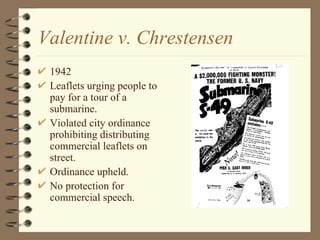
Valentine v. Chrestensen 1942 Leaflets urging people to pay for a tour of a submarine. Violated city ordinance prohibiting distributing commercial leaflets on street. Ordinance upheld. No protection for commercial speech.
Bigelow v. Virginia 1975 Newspaper editor convicted for running ads for legal abortions in New York. Virginia law prohibited abortion promotions. Conviction reversed. Ad included factual material of public interest.
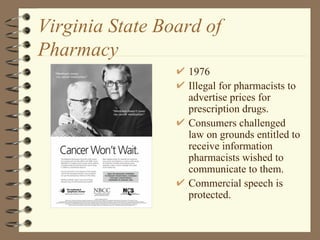
Virginia State Board of Pharmacy 1976 Illegal for pharmacists to advertise prices for prescription drugs. Consumers challenged law on grounds entitled to receive information pharmacists wished to communicate to them. Commercial speech is protected.
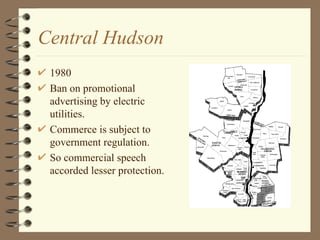
Central Hudson 1980 Ban on promotional advertising by electric utilities. Commerce is subject to government regulation. So commercial speech accorded lesser protection.
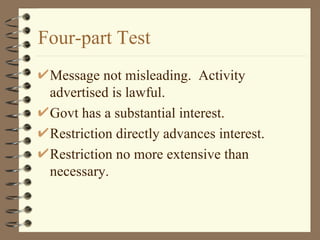
Four-part Test Message not misleading.  Activity advertised is lawful. Govt has a substantial interest. Restriction directly advances interest. Restriction no more extensive than necessary.
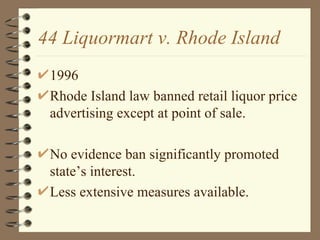
44 Liquormart v. Rhode Island 1996 Rhode Island law banned retail liquor price advertising except at point of sale. No evidence ban significantly promoted state’s interest. Less extensive measures available.
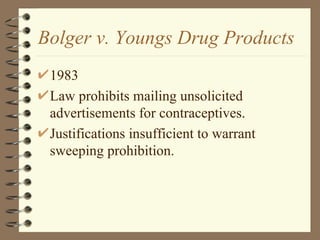
Bolger v. Youngs Drug Products 1983 Law prohibits mailing unsolicited advertisements for contraceptives. Justifications insufficient to warrant sweeping prohibition.
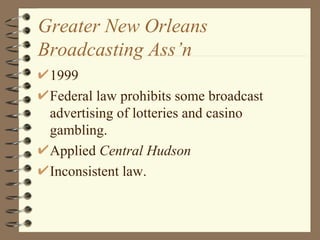
Greater New Orleans Broadcasting Ass’n 1999 Federal law prohibits some broadcast advertising of lotteries and casino gambling. Applied  Central Hudson Inconsistent law.
ADVERTISING  REGULATION
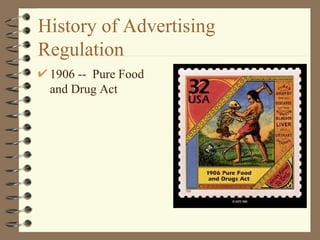
History of Advertising Regulation 1906 --  Pure Food and Drug Act
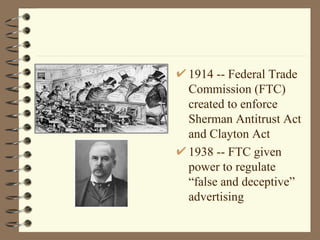
1914 -- Federal Trade Commission (FTC) created to enforce Sherman Antitrust Act and Clayton Act 1938 -- FTC given power to regulate “false and deceptive” advertising
Powers of the FTC Investigation begins -- public or nonpublic (usually nonpublic) Letter of compliance Consent order Administrative complaint Cease and desist order Court -- injunction, civil penalties, consumer redress
FTC May Require . . . forced disclosure affirmative acts corrective ads
False and Deceptive Ads What are they?
False Ad misleading in a material respect
Deceptive Acts or Practices Representation, omission or practice that is likely to mislead the consumer, and Reasonable consumer if ad directed to particular group, consider reasonableness from perspective of that group Must be “material” representation, omission or practice Affect consumers’ behavior or decisions about the product or service
Unfair Acts or Practices Injury causes, or likely to cause is substantial not outweighed by other benefits not reasonably avoided
Misleading and Deceptive Practices . . .  false oral or written representations misleading price claims sales of hazardous or systematically defective products or services without adequate disclosures failure to disclose information regarding pyramid sales bait and switch
failure to perform promised services failure to meet warranty obligations
Claims Must be Substantiated If you say “tests show . . . “ must have tests that show that Bayer, Bayer Children’s Aspirin, Cope, Vanquish, Midol ads promised more than they could deliver in the way of headache and tension relief
Disclaimers and disclosures must be clear and conspicuous consumer must be able to notice, read or hear, and understand the information disclaimers and disclosures alone usually not enough to remedy a false or deceptive ad
Demonstrations must show how the product will perform under normal use
Refunds must be made to dissatisfied customers, if you promised to make them
Advertising to children must be very careful children have greater difficulty evaluating advertising claims and understanding nature of information you provide
Credit and Financial Issues Truth in Lending Act Fair Credit Billing Act Fair Credit Reporting Act Equal Credit Opportunity Act Electronic Fund Transfer Act The Consumer Leasing Act
Environmental Claims Deceptive to represent product offers a general environmental benefit Either qualify broad environmental claims or Avoid them Don’t imply significant environmental benefits if benefit isn’t significant
Free Products if its buy one, get one free one item must be free and the other no more than regular price all terms and conditions of  free offer must be described clearly and prominently
Mail and Telephone Orders must have reason for stating shipping time if delayed, must notify with right to cancel if longer than 30 days delay, or if second delay, must get consumer’s consent if no shipping time promised, must ship within 30 days
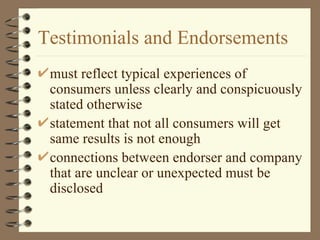
Testimonials and Endorsements must reflect typical experiences of consumers unless clearly and conspicuously stated otherwise statement that not all consumers will get same results is not enough connections between endorser and company that are unclear or unexpected must be disclosed
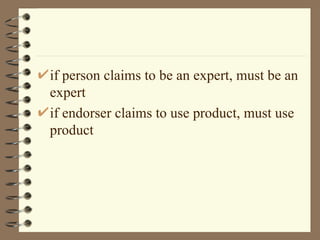
if person claims to be an expert, must be an expert if endorser claims to use product, must use product


Commercial Speech/Advertising Regulation

  • 1.
  • 2.
    Commercial Speech Speechintended to generate marketplace transactions. (Advertising)
  • 3.
    Leading Cases Valentinev. Chrestensen Bigelow v. Virginia Virginia State Board of Pharmacy v. Virginia Citizens Consumer Council, Inc. Central Hudson Gas & Electric Corp. v. Public Service Commission
  • 4.
    Valentine v. Chrestensen1942 Leaflets urging people to pay for a tour of a submarine. Violated city ordinance prohibiting distributing commercial leaflets on street. Ordinance upheld. No protection for commercial speech.
  • 5.
    Bigelow v. Virginia1975 Newspaper editor convicted for running ads for legal abortions in New York. Virginia law prohibited abortion promotions. Conviction reversed. Ad included factual material of public interest.
  • 6.
    Virginia State Boardof Pharmacy 1976 Illegal for pharmacists to advertise prices for prescription drugs. Consumers challenged law on grounds entitled to receive information pharmacists wished to communicate to them. Commercial speech is protected.
  • 7.
    Central Hudson 1980Ban on promotional advertising by electric utilities. Commerce is subject to government regulation. So commercial speech accorded lesser protection.
  • 8.
    Four-part Test Messagenot misleading. Activity advertised is lawful. Govt has a substantial interest. Restriction directly advances interest. Restriction no more extensive than necessary.
  • 9.
    44 Liquormart v.Rhode Island 1996 Rhode Island law banned retail liquor price advertising except at point of sale. No evidence ban significantly promoted state’s interest. Less extensive measures available.
  • 10.
    Bolger v. YoungsDrug Products 1983 Law prohibits mailing unsolicited advertisements for contraceptives. Justifications insufficient to warrant sweeping prohibition.
  • 11.
    Greater New OrleansBroadcasting Ass’n 1999 Federal law prohibits some broadcast advertising of lotteries and casino gambling. Applied Central Hudson Inconsistent law.
  • 12.
  • 13.
    History of AdvertisingRegulation 1906 -- Pure Food and Drug Act
  • 14.
    1914 -- FederalTrade Commission (FTC) created to enforce Sherman Antitrust Act and Clayton Act 1938 -- FTC given power to regulate “false and deceptive” advertising
  • 15.
    Powers of theFTC Investigation begins -- public or nonpublic (usually nonpublic) Letter of compliance Consent order Administrative complaint Cease and desist order Court -- injunction, civil penalties, consumer redress
  • 16.
    FTC May Require. . . forced disclosure affirmative acts corrective ads
  • 17.
    False and DeceptiveAds What are they?
  • 18.
    False Ad misleadingin a material respect
  • 19.
    Deceptive Acts orPractices Representation, omission or practice that is likely to mislead the consumer, and Reasonable consumer if ad directed to particular group, consider reasonableness from perspective of that group Must be “material” representation, omission or practice Affect consumers’ behavior or decisions about the product or service
  • 20.
    Unfair Acts orPractices Injury causes, or likely to cause is substantial not outweighed by other benefits not reasonably avoided
  • 21.
    Misleading and DeceptivePractices . . . false oral or written representations misleading price claims sales of hazardous or systematically defective products or services without adequate disclosures failure to disclose information regarding pyramid sales bait and switch
  • 22.
    failure to performpromised services failure to meet warranty obligations
  • 23.
    Claims Must beSubstantiated If you say “tests show . . . “ must have tests that show that Bayer, Bayer Children’s Aspirin, Cope, Vanquish, Midol ads promised more than they could deliver in the way of headache and tension relief
  • 24.
    Disclaimers and disclosuresmust be clear and conspicuous consumer must be able to notice, read or hear, and understand the information disclaimers and disclosures alone usually not enough to remedy a false or deceptive ad
  • 25.
    Demonstrations must showhow the product will perform under normal use
  • 26.
    Refunds must bemade to dissatisfied customers, if you promised to make them
  • 27.
    Advertising to childrenmust be very careful children have greater difficulty evaluating advertising claims and understanding nature of information you provide
  • 28.
    Credit and FinancialIssues Truth in Lending Act Fair Credit Billing Act Fair Credit Reporting Act Equal Credit Opportunity Act Electronic Fund Transfer Act The Consumer Leasing Act
  • 29.
    Environmental Claims Deceptiveto represent product offers a general environmental benefit Either qualify broad environmental claims or Avoid them Don’t imply significant environmental benefits if benefit isn’t significant
  • 30.
    Free Products ifits buy one, get one free one item must be free and the other no more than regular price all terms and conditions of free offer must be described clearly and prominently
  • 31.
    Mail and TelephoneOrders must have reason for stating shipping time if delayed, must notify with right to cancel if longer than 30 days delay, or if second delay, must get consumer’s consent if no shipping time promised, must ship within 30 days
  • 32.
    Testimonials and Endorsementsmust reflect typical experiences of consumers unless clearly and conspicuously stated otherwise statement that not all consumers will get same results is not enough connections between endorser and company that are unclear or unexpected must be disclosed
  • 33.
    if person claimsto be an expert, must be an expert if endorser claims to use product, must use product
  • 34.
  • 35.
  • 36.

Editor's Notes

  • #5 http://www.firstamendmentcenter.org/faclibrary/case.aspx?id=1912
  • #7 http://www.canceradvocacy.org/news/pdf/photo_medicaread_10.15.03.jpg
  • #8 http://inet.cenhud.com/ic_esco/images/svcmap2.gif
  • #14 http://vm.cfsan.fda.gov/~lrd/stamp.jpg
  • #15 supreme court history Sherman: http://business.enotes.com/images/business-finance/ebf_02_img0163.jpg