Contact:
sales@taurusglocal.net
Website:
www.taurusglocal.com
CONFIDENTIAL AND PROPRIETARY TO THE PARTIES IN DISCUSSION.
1
Background Notes
Indo-French Dialogue on Telemedicine in Healthcare
New Delhi, 22 January, 2015
WHAT IS TELEMEDICINE
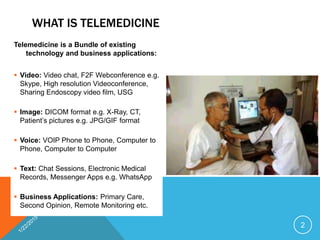
Telemedicine is a Bundle of existing
technology and business applications:
 Video: Video chat, F2F Webconference e.g.
Skype, High resolution Videoconference,
Sharing Endoscopy video film, USG
 Image: DICOM format e.g. X-Ray, CT,
Patient’s pictures e.g. JPG/GIF format
 Voice: VOIP Phone to Phone, Computer to
Phone, Computer to Computer
 Text: Chat Sessions, Electronic Medical
Records, Messenger Apps e.g. WhatsApp
 Business Applications: Primary Care,
Second Opinion, Remote Monitoring etc.
2
WHY TELEMEDICINE
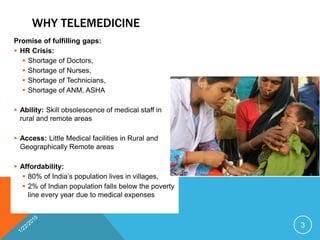
Promise of fulfilling gaps:
 HR Crisis:
 Shortage of Doctors,
 Shortage of Nurses,
 Shortage of Technicians,
 Shortage of ANM, ASHA
 Ability: Skill obsolescence of medical staff in
rural and remote areas
 Access: Little Medical facilities in Rural and
Geographically Remote areas
 Affordability:
 80% of India’s population lives in villages,
 2% of Indian population falls below the poverty
line every year due to medical expenses
3
TELEMEDICINE CHALLENGES
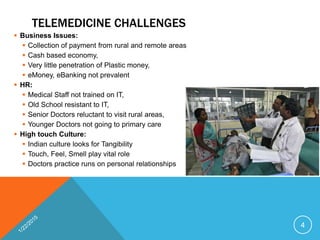
 Business Issues:
 Collection of payment from rural and remote areas
 Cash based economy,
 Very little penetration of Plastic money,
 eMoney, eBanking not prevalent
 HR:
 Medical Staff not trained on IT,
 Old School resistant to IT,
 Senior Doctors reluctant to visit rural areas,
 Younger Doctors not going to primary care
 High touch Culture:
 Indian culture looks for Tangibility
 Touch, Feel, Smell play vital role
 Doctors practice runs on personal relationships
4
PROMISE OF TELEMEDICINE
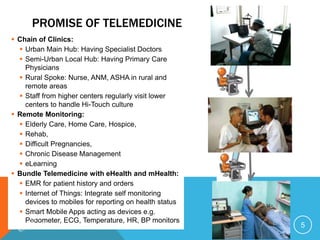
 Chain of Clinics:
 Urban Main Hub: Having Specialist Doctors
 Semi-Urban Local Hub: Having Primary Care
Physicians
 Rural Spoke: Nurse, ANM, ASHA in rural and
remote areas
 Staff from higher centers regularly visit lower
centers to handle Hi-Touch culture
 Remote Monitoring:
 Elderly Care, Home Care, Hospice,
 Rehab,
 Difficult Pregnancies,
 Chronic Disease Management
 eLearning
 Bundle Telemedicine with eHealth and mHealth:
 EMR for patient history and orders
 Internet of Things: Integrate self monitoring
devices to mobiles for reporting on health status
 Smart Mobile Apps acting as devices e.g.
Pedometer, ECG, Temperature, HR, BP monitors
5
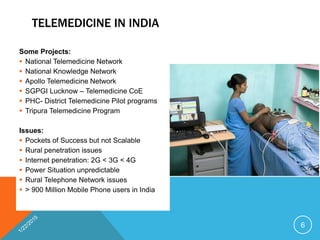
TELEMEDICINE IN INDIA
Some Projects:
 National Telemedicine Network
 National Knowledge Network
 Apollo Telemedicine Network
 SGPGI Lucknow – Telemedicine CoE
 PHC- District Telemedicine Pilot programs
 Tripura Telemedicine Program
Issues:
 Pockets of Success but not Scalable
 Rural penetration issues
 Internet penetration: 2G < 3G < 4G
 Power Situation unpredictable
 Rural Telephone Network issues
 > 900 Million Mobile Phone users in India
6
Contact:
sales@taurusglocal.net
Website:
www.taurusglocal.com
CONFIDENTIAL AND PROPRIETARY TO THE PARTIES IN DISCUSSION.
7
GOVERNMENT OF INDIA POLICY ON
TELEMEDICINE
 EHR Standards notified. Available on
MoHFW website.
 MDDS Standards draft approved.
Available on MoHFW website
 Telemedicine Guidelines published.
 Digital India > eKranti > eHealth
Services > Telemedicine
 DEITY > NeGP > MMP > Health
 National eHealth Authority [NeHA] in the
works.
8
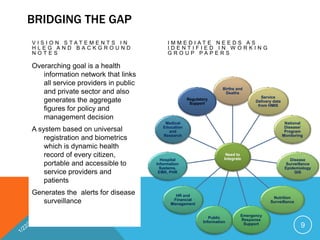
V I S I O N S T A T E M E N T S I N
H L E G A N D B A C K G R O U N D
N O T E S
Overarching goal is a health
information network that links
all service providers in public
and private sector and also
generates the aggregate
figures for policy and
management decision
A system based on universal
registration and biometrics
which is dynamic health
record of every citizen,
portable and accessible to
service providers and
patients
Generates the alerts for disease
surveillance
I M M E D I A T E N E E D S A S
I D E N T I F I E D I N W O R K I N G
G R O U P P A P E R S
BRIDGING THE GAP
Need to
Integrate
Births and
Deaths
Service
Delivery data
from HMIS
National
Disease/
Program
Monitoring
Disease
Surveillance
Epidemiology
GIS
Nutrition
Surveillance
Emergency
Response
Support
Public
Information
HR and
Financial
Management
Hospital
Information
Systems,
EMR, PHR
Medical
Education
and
Research
Regulatory
Support
9
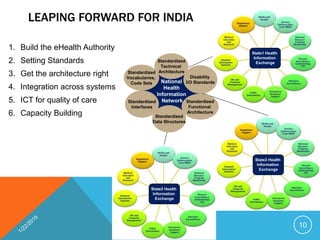
LEAPING FORWARD FOR INDIA
State2 Health
Information
Exchange
State1 Health
Information
Exchange
State3 Health
Information
Exchange
1. Build the eHealth Authority
2. Setting Standards
3. Get the architecture right
4. Integration across systems
5. ICT for quality of care
6. Capacity Building
National
Health
Information
Network
Standardized
Technical
Architecture
Standardized
Interfaces
Standardized
Data Structures
Standardized
Vocabularies,
Code Sets
Standardized
Functional
Architecture
Disability
I/O Standards
10
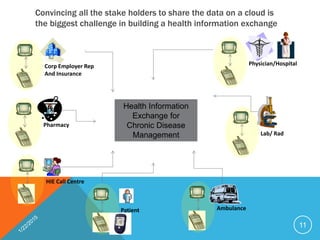
Physician/Hospital
Pharmacy
HIE Call Centre
Patient Ambulance
Lab/ Rad
Corp Employer Rep
And Insurance
Health Information
Exchange for
Chronic Disease
Management
Convincing all the stake holders to share the data on a cloud is
the biggest challenge in building a health information exchange
11
Contact:
sales@taurusglocal.net
Website:
www.taurusglocal.com
CONFIDENTIAL AND PROPRIETARY TO THE PARTIES IN DISCUSSION.
12
DEFINITION OF TELEMEDICINE
Telemedicine is defined by the Telemedicine Information Exchange (1997) as the
"use of electronic signals to transfer medical data (photographs, x-ray
images, audio, patient records, videoconferences, etc.) from one site to
another via the Internet, Intranets, PCs, satellites, or videoconferencing
telephone equipment in order to improve access to health care."
Reid (1996) defines telemedicine as "the use of advanced telecommunications
technologies to exchange health information and provide health care services
across geographic, time, social, and cultural barriers."
13
HISTORY OF TELEMEDICINE
The practice of medicine through telecommunications, or telemedicine, began in the early
1960s when the National Aeronautics and Space Administration (NASA) first put men in
space. Physiological measurements of the astronauts were telemetered from both the
spacecraft and the space suits during NASA space flights. These early efforts were
enhanced by the development of satellite technology which fo stered the development
of telemedicine.
NASA funded telemedicine research projects in the late 1960s and early 1970s.
In 1974, NASA conducted a study with SCI Systems of Houston to determine the minimal
television system requirements for accurate telediagnosis. A high-quality videotape was
made of an actual medical exam conducted by a nurse but supervised by a physician
watching on closed-circuit television. These videotapes were systematically
electronically degraded to less than broadcast quality. The original and degraded videos
were then shown to randomly selected groups of physicians who attempted to reach a
correct diagnosis (Telemedicine Research Center, 1997).
In 1989, NASA conducted the first international telemedicine project, Space Bridge to
Armenia/Ufa, after a powerful earthquake struck the Soviet Republic of Armenia in
December 1988. An offer of medical consultation was extended to the Soviet Union by
several medical centers in the United States. Telemedicine consultations were
conducted under the guidance of the US/USSR Joint Working Group on Space Biology
using video, audio, and facsimile between a medical center in Yerevan, Armenia and
four medical centers in the United States. 14

French telemed 22 jan15 v2

  • 1.
    Contact: sales@taurusglocal.net Website: www.taurusglocal.com CONFIDENTIAL AND PROPRIETARYTO THE PARTIES IN DISCUSSION. 1 Background Notes Indo-French Dialogue on Telemedicine in Healthcare New Delhi, 22 January, 2015
  • 2.
    WHAT IS TELEMEDICINE Telemedicineis a Bundle of existing technology and business applications:  Video: Video chat, F2F Webconference e.g. Skype, High resolution Videoconference, Sharing Endoscopy video film, USG  Image: DICOM format e.g. X-Ray, CT, Patient’s pictures e.g. JPG/GIF format  Voice: VOIP Phone to Phone, Computer to Phone, Computer to Computer  Text: Chat Sessions, Electronic Medical Records, Messenger Apps e.g. WhatsApp  Business Applications: Primary Care, Second Opinion, Remote Monitoring etc. 2
  • 3.
    WHY TELEMEDICINE Promise offulfilling gaps:  HR Crisis:  Shortage of Doctors,  Shortage of Nurses,  Shortage of Technicians,  Shortage of ANM, ASHA  Ability: Skill obsolescence of medical staff in rural and remote areas  Access: Little Medical facilities in Rural and Geographically Remote areas  Affordability:  80% of India’s population lives in villages,  2% of Indian population falls below the poverty line every year due to medical expenses 3
  • 4.
    TELEMEDICINE CHALLENGES  BusinessIssues:  Collection of payment from rural and remote areas  Cash based economy,  Very little penetration of Plastic money,  eMoney, eBanking not prevalent  HR:  Medical Staff not trained on IT,  Old School resistant to IT,  Senior Doctors reluctant to visit rural areas,  Younger Doctors not going to primary care  High touch Culture:  Indian culture looks for Tangibility  Touch, Feel, Smell play vital role  Doctors practice runs on personal relationships 4
  • 5.
    PROMISE OF TELEMEDICINE Chain of Clinics:  Urban Main Hub: Having Specialist Doctors  Semi-Urban Local Hub: Having Primary Care Physicians  Rural Spoke: Nurse, ANM, ASHA in rural and remote areas  Staff from higher centers regularly visit lower centers to handle Hi-Touch culture  Remote Monitoring:  Elderly Care, Home Care, Hospice,  Rehab,  Difficult Pregnancies,  Chronic Disease Management  eLearning  Bundle Telemedicine with eHealth and mHealth:  EMR for patient history and orders  Internet of Things: Integrate self monitoring devices to mobiles for reporting on health status  Smart Mobile Apps acting as devices e.g. Pedometer, ECG, Temperature, HR, BP monitors 5
  • 6.
    TELEMEDICINE IN INDIA SomeProjects:  National Telemedicine Network  National Knowledge Network  Apollo Telemedicine Network  SGPGI Lucknow – Telemedicine CoE  PHC- District Telemedicine Pilot programs  Tripura Telemedicine Program Issues:  Pockets of Success but not Scalable  Rural penetration issues  Internet penetration: 2G < 3G < 4G  Power Situation unpredictable  Rural Telephone Network issues  > 900 Million Mobile Phone users in India 6
  • 7.
  • 8.
    GOVERNMENT OF INDIAPOLICY ON TELEMEDICINE  EHR Standards notified. Available on MoHFW website.  MDDS Standards draft approved. Available on MoHFW website  Telemedicine Guidelines published.  Digital India > eKranti > eHealth Services > Telemedicine  DEITY > NeGP > MMP > Health  National eHealth Authority [NeHA] in the works. 8
  • 9.
    V I SI O N S T A T E M E N T S I N H L E G A N D B A C K G R O U N D N O T E S Overarching goal is a health information network that links all service providers in public and private sector and also generates the aggregate figures for policy and management decision A system based on universal registration and biometrics which is dynamic health record of every citizen, portable and accessible to service providers and patients Generates the alerts for disease surveillance I M M E D I A T E N E E D S A S I D E N T I F I E D I N W O R K I N G G R O U P P A P E R S BRIDGING THE GAP Need to Integrate Births and Deaths Service Delivery data from HMIS National Disease/ Program Monitoring Disease Surveillance Epidemiology GIS Nutrition Surveillance Emergency Response Support Public Information HR and Financial Management Hospital Information Systems, EMR, PHR Medical Education and Research Regulatory Support 9
  • 10.
    LEAPING FORWARD FORINDIA State2 Health Information Exchange State1 Health Information Exchange State3 Health Information Exchange 1. Build the eHealth Authority 2. Setting Standards 3. Get the architecture right 4. Integration across systems 5. ICT for quality of care 6. Capacity Building National Health Information Network Standardized Technical Architecture Standardized Interfaces Standardized Data Structures Standardized Vocabularies, Code Sets Standardized Functional Architecture Disability I/O Standards 10
  • 11.
    Physician/Hospital Pharmacy HIE Call Centre PatientAmbulance Lab/ Rad Corp Employer Rep And Insurance Health Information Exchange for Chronic Disease Management Convincing all the stake holders to share the data on a cloud is the biggest challenge in building a health information exchange 11
  • 12.
  • 13.
    DEFINITION OF TELEMEDICINE Telemedicineis defined by the Telemedicine Information Exchange (1997) as the "use of electronic signals to transfer medical data (photographs, x-ray images, audio, patient records, videoconferences, etc.) from one site to another via the Internet, Intranets, PCs, satellites, or videoconferencing telephone equipment in order to improve access to health care." Reid (1996) defines telemedicine as "the use of advanced telecommunications technologies to exchange health information and provide health care services across geographic, time, social, and cultural barriers." 13
  • 14.
    HISTORY OF TELEMEDICINE Thepractice of medicine through telecommunications, or telemedicine, began in the early 1960s when the National Aeronautics and Space Administration (NASA) first put men in space. Physiological measurements of the astronauts were telemetered from both the spacecraft and the space suits during NASA space flights. These early efforts were enhanced by the development of satellite technology which fo stered the development of telemedicine. NASA funded telemedicine research projects in the late 1960s and early 1970s. In 1974, NASA conducted a study with SCI Systems of Houston to determine the minimal television system requirements for accurate telediagnosis. A high-quality videotape was made of an actual medical exam conducted by a nurse but supervised by a physician watching on closed-circuit television. These videotapes were systematically electronically degraded to less than broadcast quality. The original and degraded videos were then shown to randomly selected groups of physicians who attempted to reach a correct diagnosis (Telemedicine Research Center, 1997). In 1989, NASA conducted the first international telemedicine project, Space Bridge to Armenia/Ufa, after a powerful earthquake struck the Soviet Republic of Armenia in December 1988. An offer of medical consultation was extended to the Soviet Union by several medical centers in the United States. Telemedicine consultations were conducted under the guidance of the US/USSR Joint Working Group on Space Biology using video, audio, and facsimile between a medical center in Yerevan, Armenia and four medical centers in the United States. 14