Last year Doctors used the latest technology in medical education which shocked the country By using ICT tools Pen Scanners, Email, GPRS, MMS, SMS, Bluetooth. In leaking Question papers in All India PG entrance Where are we?
 
Present scenario-INDIA
 
Relation between Health and ICT ? Why  both to be related  & Why now? Deals with computers or patients ? Public or Private? Which part of Health is useful? Where is the challenge? How for its useful? Costlier ? Future – telemedicine?


eHealth eHealth is the use, in the health sector, of digital data transmitted, stored and retrieved electronically in support of health care both at the local site and at a distance.   A global consultation meeting on eHealth for countries was held on 12-13 February 2004, at WHO headquarters in Geneva The  recommendations  are….
RECOMMENDATIONS 1. Information for health promotion and awareness, medical education, health and biomedical research, evidence-based medicine and e-learning. 2. Information for HIS(disease surveillance, health statistics, MIS, financial, logistical, and GIS), monitoring and evaluation. 3. Information for HCD: diagnostics, treatment, consultation (telemedicine applications) and EPR.
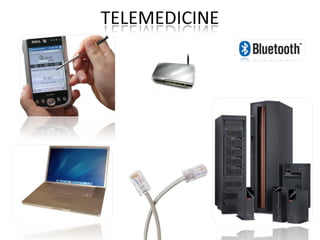
TELEMEDICINE
 
 
Key challenges 1. Lack of financial support and sustainability 2. Poor quality of technology and infrastructure 3. Lack of technically competent staff at all levels 4. Lack of awareness, access and attitudinal problems among users 5. Legal and policy issues
Initiatives taken in India   Public Sector  Disease surveillance systems under IDSP in Andhra Pradesh and Tamil Nadu. ICDS surveillance system in Orissa  Jiva's  teledoc initiative, the use of PDAs by ANMs in Nalgonda (sponsored by World Bank),  The Electronic Resource Centre for capacity building in HIV/AIDS set up by SAATHI
CDAC, an autonomous  government IT organization, was a pioneer in developing First HIS in India. First total HIS software in collaboration with Sanjay Gandhi Post Graduate Institute of Medical Sciences, Lucknow in 1997. This has been implemented at SGPGI and GTB  hospital, New Delhi
NGOs eHealth-Care foundation was conceptualized in 2001 as e-Swasthya (eHealth in Hindi) with a goal to implement it across 21 health centres in the Madhubani district of Bihar. eHealth-Care Foundation, (eHCF) a New Delhi based Not for Profit Organization- Digital Partners, a USA and India based Non-Profit Organization
M/s. eHealth-Care - Authorize Channel Partner of France Telecom’s RBGAN Terminal (Mobile Satellite Communication) National Thermal Power Corp. Ltd (NTPC) , New Delhi & Noida (Medical Card & Referral Slip Software) NTPC-SAIL Power Corp. Ltd (NSPCL),  New Delhi (Medical Card & Referral Slip Software) NTPC-NCR,  Noida (Medical Card & Referral Slip Software) General Hospital,  Sirsa, Haryana (Medical Cards & Online Prescription writing Software) Sirsa District Administration,  Haryana (Birth & Death Registration Software)


Initiatives telemedicine- Govt Indian Space Research Organisation (ISRO)- GRAMSAT (rural satellite)  programme. Presently ISRO’s Telemedicine Network  consists of 75 Hospitals   61  Remote/Rural/District Hospital/Health  Centre connected  14 Super Specialty Hospital located in the major cities. More than 12,500 patients have been provided with Teleconsultation & treatment under ISRO DIT  For  telemedicine software systems - C-DAC Started its pilot projects in HP,AP,TN,TRIPURA,WB,PUNJAB,KERALA National Resource Centre for Telemedicine and Biomedical Informatics at SGPGI, Lucknow. DIT grant-in-aid Rs. 515 Lakhs for the presentation.
Private sector Apollo set up over 45 Telemedicine Centres across different locations in the country Asia Heart Foundation  more than 2000 tele- cardiology consultation through an enterprise based network Escort Heart Institute & Research Center involved in telecardiology service Shankar Nethralaya ,  Chennai and Meenakshi Eye mission , Madurai Mobile Tele-Ophthalmology service Online Telemedicine Research Institute,Ahmedabad  R&D activities in telemedicine
 
Objectives of Telemedicine Enable the medical experts to  take control  of a remote medical emergency when required The telemedicine system and sub-system especially at the remote location should be designed for  use by non-medical  but  trained personnel The remote telemedicine system should be designed for easy  portability The telemedicine solution should be  cost effective  requiring  minimal  training,  installation  and maintenance The telemedicine equipment used should use a  optimum bandwidth  for data communication Benefits Patient  - Improved access to quality care Doctor - improved Disease management Hospital - Substantial cost reduction in short term and long term  health care
A model of eHealth- Canada COST $142 Billion business 10.4% of GDP 60% of costs for hospitals, physicians and  drugs FINANCING 70% public and 30% private funded SHARED GOVERNANCE Federal Govt coordinates healthcare via  the Canada Health Act Provinces & territories have primary responsibility for healthcare 100+ health regions deliver care
Courtesy: eHealth India 2007
Challenges in future Human factors Individuals Address concerns about training, liability, patient security and increased workload among providers Organizations Demonstrate the value of  eHealth to the health payer,  provider and advocacy organizations Align telemedicine with the increasing emphasis on self-care and  multidisciplinary care models Continue clinical trials at academic institutions to demonstrate that eHealth is effective and efficient Governance Promote acceptance of a patient-centred and technology-enabled  method of health-care delivery Create practice environments that reduce defensive medicine practices, which in turn limit the adoption of new clinical interventions such as telemedicine (e.g. malpractice reform) Create a compelling case for lifting licensure restrictions that inhibit telemedicine activities across borders
Economics Pilot new third-party reimbursement mechanisms to attract greater patient and provider participation, particularly in health systems that are not supported publicly Explore global markets for eHealth that allow the export of  medical expertise Seek sustainable economic models that support telemedicine in the developing world to address the growing burden of chronic  disease Technology Improve usability for patients with limited function, but who aim  to benefit from eHealth. Implement methods that verify and authorize access to health information such as fingerprint and voice recognition Create communications devices that are smaller, less expensive and more powerful, which will be available at the point of care Create sensors that are more sensitive, less expensive, passive and  less obtrusive Introduce methods of bridging the ‘digital divide’ faced by  developing countries
FUTURE- A VISION A patient in mondola will be diagnosed as Peptic ulcer and not MI by the GTB cardiologist by telecardiology. Ectopic pregnancy will be diagnosed in dhallupura by teleradiology. From the health card ,it will be known that a person  is diabetic under 10years of listed treatment  hypertensive under 5 years of treatment  Sulpha drug allergy TT Immunization 2 years back Lipid profile done 1 week back with details
Professor of Harvard public health school will elaborate his views to  the Health care professionals in rural part of india.


Ehealth

  • 1.
  • 2.
    Last year Doctorsused the latest technology in medical education which shocked the country By using ICT tools Pen Scanners, Email, GPRS, MMS, SMS, Bluetooth. In leaking Question papers in All India PG entrance Where are we?
  • 3.
  • 4.
  • 5.
  • 6.
    Relation between Healthand ICT ? Why both to be related & Why now? Deals with computers or patients ? Public or Private? Which part of Health is useful? Where is the challenge? How for its useful? Costlier ? Future – telemedicine?
  • 7.
  • 8.
  • 9.
  • 10.
  • 11.
  • 12.
  • 13.
  • 14.
  • 15.
    eHealth eHealth isthe use, in the health sector, of digital data transmitted, stored and retrieved electronically in support of health care both at the local site and at a distance. A global consultation meeting on eHealth for countries was held on 12-13 February 2004, at WHO headquarters in Geneva The recommendations are….
  • 16.
    RECOMMENDATIONS 1. Informationfor health promotion and awareness, medical education, health and biomedical research, evidence-based medicine and e-learning. 2. Information for HIS(disease surveillance, health statistics, MIS, financial, logistical, and GIS), monitoring and evaluation. 3. Information for HCD: diagnostics, treatment, consultation (telemedicine applications) and EPR.
  • 17.
  • 18.
  • 19.
  • 20.
    Key challenges 1. Lackof financial support and sustainability 2. Poor quality of technology and infrastructure 3. Lack of technically competent staff at all levels 4. Lack of awareness, access and attitudinal problems among users 5. Legal and policy issues
  • 21.
    Initiatives taken inIndia Public Sector Disease surveillance systems under IDSP in Andhra Pradesh and Tamil Nadu. ICDS surveillance system in Orissa Jiva's teledoc initiative, the use of PDAs by ANMs in Nalgonda (sponsored by World Bank), The Electronic Resource Centre for capacity building in HIV/AIDS set up by SAATHI
  • 22.
    CDAC, an autonomous government IT organization, was a pioneer in developing First HIS in India. First total HIS software in collaboration with Sanjay Gandhi Post Graduate Institute of Medical Sciences, Lucknow in 1997. This has been implemented at SGPGI and GTB hospital, New Delhi
  • 23.
    NGOs eHealth-Care foundationwas conceptualized in 2001 as e-Swasthya (eHealth in Hindi) with a goal to implement it across 21 health centres in the Madhubani district of Bihar. eHealth-Care Foundation, (eHCF) a New Delhi based Not for Profit Organization- Digital Partners, a USA and India based Non-Profit Organization
  • 24.
    M/s. eHealth-Care -Authorize Channel Partner of France Telecom’s RBGAN Terminal (Mobile Satellite Communication) National Thermal Power Corp. Ltd (NTPC) , New Delhi & Noida (Medical Card & Referral Slip Software) NTPC-SAIL Power Corp. Ltd (NSPCL), New Delhi (Medical Card & Referral Slip Software) NTPC-NCR, Noida (Medical Card & Referral Slip Software) General Hospital, Sirsa, Haryana (Medical Cards & Online Prescription writing Software) Sirsa District Administration, Haryana (Birth & Death Registration Software)
  • 25.
  • 26.
  • 27.
  • 28.
  • 29.
    Initiatives telemedicine- GovtIndian Space Research Organisation (ISRO)- GRAMSAT (rural satellite) programme. Presently ISRO’s Telemedicine Network consists of 75 Hospitals 61 Remote/Rural/District Hospital/Health Centre connected 14 Super Specialty Hospital located in the major cities. More than 12,500 patients have been provided with Teleconsultation & treatment under ISRO DIT For telemedicine software systems - C-DAC Started its pilot projects in HP,AP,TN,TRIPURA,WB,PUNJAB,KERALA National Resource Centre for Telemedicine and Biomedical Informatics at SGPGI, Lucknow. DIT grant-in-aid Rs. 515 Lakhs for the presentation.
  • 30.
    Private sector Apolloset up over 45 Telemedicine Centres across different locations in the country Asia Heart Foundation more than 2000 tele- cardiology consultation through an enterprise based network Escort Heart Institute & Research Center involved in telecardiology service Shankar Nethralaya , Chennai and Meenakshi Eye mission , Madurai Mobile Tele-Ophthalmology service Online Telemedicine Research Institute,Ahmedabad R&D activities in telemedicine
  • 31.
  • 32.
    Objectives of TelemedicineEnable the medical experts to take control of a remote medical emergency when required The telemedicine system and sub-system especially at the remote location should be designed for use by non-medical but trained personnel The remote telemedicine system should be designed for easy portability The telemedicine solution should be cost effective requiring minimal training, installation and maintenance The telemedicine equipment used should use a optimum bandwidth for data communication Benefits Patient - Improved access to quality care Doctor - improved Disease management Hospital - Substantial cost reduction in short term and long term health care
  • 33.
    A model ofeHealth- Canada COST $142 Billion business 10.4% of GDP 60% of costs for hospitals, physicians and drugs FINANCING 70% public and 30% private funded SHARED GOVERNANCE Federal Govt coordinates healthcare via the Canada Health Act Provinces & territories have primary responsibility for healthcare 100+ health regions deliver care
  • 34.
  • 35.
  • 36.
    Challenges in futureHuman factors Individuals Address concerns about training, liability, patient security and increased workload among providers Organizations Demonstrate the value of eHealth to the health payer, provider and advocacy organizations Align telemedicine with the increasing emphasis on self-care and multidisciplinary care models Continue clinical trials at academic institutions to demonstrate that eHealth is effective and efficient Governance Promote acceptance of a patient-centred and technology-enabled method of health-care delivery Create practice environments that reduce defensive medicine practices, which in turn limit the adoption of new clinical interventions such as telemedicine (e.g. malpractice reform) Create a compelling case for lifting licensure restrictions that inhibit telemedicine activities across borders
  • 37.
    Economics Pilot newthird-party reimbursement mechanisms to attract greater patient and provider participation, particularly in health systems that are not supported publicly Explore global markets for eHealth that allow the export of medical expertise Seek sustainable economic models that support telemedicine in the developing world to address the growing burden of chronic disease Technology Improve usability for patients with limited function, but who aim to benefit from eHealth. Implement methods that verify and authorize access to health information such as fingerprint and voice recognition Create communications devices that are smaller, less expensive and more powerful, which will be available at the point of care Create sensors that are more sensitive, less expensive, passive and less obtrusive Introduce methods of bridging the ‘digital divide’ faced by developing countries
  • 38.
    FUTURE- A VISIONA patient in mondola will be diagnosed as Peptic ulcer and not MI by the GTB cardiologist by telecardiology. Ectopic pregnancy will be diagnosed in dhallupura by teleradiology. From the health card ,it will be known that a person is diabetic under 10years of listed treatment hypertensive under 5 years of treatment Sulpha drug allergy TT Immunization 2 years back Lipid profile done 1 week back with details
  • 39.
    Professor of Harvardpublic health school will elaborate his views to the Health care professionals in rural part of india.
  • 40.
  • 41.