Interference Cancellation in UWB
Systems
By
Dr.M.Jayasheela, Professor/ECE
KIT-Kalaignarkarunanidhi Institute of
Technology
Outline
• Zero Correlation Zone codes
• Ultra Wide Band Technology
• UWB Channels
• Multiuser detection
• Interference cancellation in UWB using m-zcz
sequences.
M (Maximal Length)Sequences
• An m-sequence contains, one more one, than
zero. The number of ones is (N+1)/2.
• A run is defined as a sequence of a single type
of binary digits within the m-sequence. The
length of this subsequence is the length of the
run.
• The periodic autocorrelation function θb(k) of
an m-sequence is two valued .
• Let b(D) represent a m-sequence. Let this
sequence be shifted by j chips represented by
b(D+j). Then the modulo-2 sum of the two
sequences results in a sequence b(D+k) which
is the same m-sequence shifted by k chips.
Zero Correlation Zone Codes
• ZCZ codes are interference free in any wireless
system as long as the one-side ZCZ length
longer than the maximum single delay spread,
which is caused by multipath propagation .
• The ZCZ length of conventional binary ZCZ
code is restricted to 2k, where k is an
integer.But, in practical applications the ZCZ
length has to be chosen much larger than
required.
m-ZCZ Squences
• A binary ZCZ code based on m-sequences,
called m-ZCZ code.
• Its length can be flexibly selected to match
the maximum time delay with the great
degree-of-freedom, such that constructed
interference resistant UWB system can
support more no of users than that using
conventional binary ZCZ codes.
ZCZ Generation
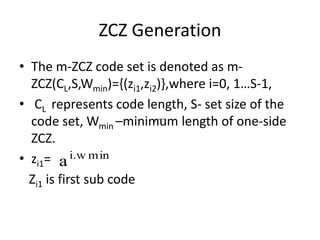
• The m-ZCZ code set is denoted as m-
ZCZ(CL,S,Wmin)={(zi1,zi2)},where i=0, 1…S-1,
• CL represents code length, S- set size of the
code set, Wmin –minimum length of one-side
ZCZ.
• zi1=
Zi1 is first sub code
minw.i
a
minw.i
a
where a0 is an m-sequence with its period N,
and a iWmin stands for the sequence generated
by cyclically leftward shifted a0 with i. Wmin
chips. This can be represented as
Naa o
win
wi
n modmin).(
min.

• The second sub-code zi2={+1} contains only
one “+1” chip. The congregated code length is
CL = N +1.
• The set size of the code is S = [N / Wmin].
Auto correlation & Cross correlation
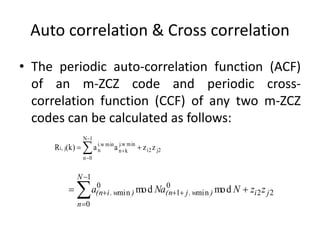
• The periodic auto-correlation function (ACF)
of an m-ZCZ code and periodic cross-
correlation function (CCF) of any two m-ZCZ
codes can be calculated as follows:
2j2i
minw.j
kn
1N
0n
minw.i
nj,i zzaa)k(R  



22
0
min1
1
0
0
min modmod ji)j.w(n
N
n
)i.w(n zzNNaa  



where integer k denotes the relative time shift.
Correlation Property
• Using above equation ACF of any m-ZCZ code
is zero when 0<|k|<Wmin and the CCF between
any two codes is zero |k|<Wmin. Thus, there
exists a ZCZ with minimum one-side length
being wmin.
• The wmin can be flexibly controlled by
adjusting the number of cyclic shifted chips.
• Example: Given L=16, wmin=4 we can get a set
of m-ZCZ codes denoted by (16,3,4) containing
J=[15/4]=3 codes as
(a01, a02)=(+1 +1 +1 -1 -1 -1 -1 +1 -1
+1 -1 -1 +1 +1 -1, +1)
(a11, a12)=( -1 -1 -1 +1 -1 +1 -1 -1 +1
+1 -1 +1 +1 +1 -1, +1)
(a21, a22)=( -1 +1 -1 -1 +1 +1 -1 +1 +1 +1 -
1 -1 -1 -1 +1,+1)
where sub-codes are separated by commas.
Parameters
• When 1<wmin<N, the set size S satisfies 1<S=
[N/wmin] <N. Therefore, length of m-ZCZ can
be increased by reducing the set size.
• Spreading code is formed at the transmitter
side by two sub-codes of an m-ZCZ code with
a cyclic prefix and a cyclic postfix inserted at
both sides of each sub-code. The lengths of
the cyclic prefixes and cyclic postfixes should
be at least equal to the maximum multipath
time delay, so that the two sub codes will not
overlap with each other after being
transmitted via multipath channels.
• Despreading code is formed at the receiver side by the
two sub-codes of an m-ZCZ code, with zeroes inserted
in the guard intervals of identical length which should
be equal to that of the cyclic prefixes and postfixes in
the spreading code.
• To make decisions, aperiodic correlation is performed
between the received signal and the local despreading
code. Due to the effects of cyclic prefix and postfix the
aperiodic correlation automatically becomes periodic
correlation.The m-ZCZ code could be more suitable for
wireless systems with a relatively short delay spread.
Spreading Codes
DeSpreading Codes
0…0 Sub-code 1 0…0 0…0 1 0……0
In order to reduce multipath interference the one-side ZCZ length
wmin must be larger than the maximum delay spread ζmax
Comparison of Correlation b/w m &
m-ZCZ Sequences
Sequence Length Correlation of m-
Sequences
Correlation of m-ZCZ
Sequences
3 0.333 0.01
7 0.1428 0.009
15 0.0667 0.0003
31 0.0322 0.0001
63 0.015873 0
BER Performance m- Sequences/m-
ZCZ Sequences in CDMA System
Comparison of BER performance of m- Sequences and
m-ZCZ Sequences for Eb/No=20 dB in Rayleigh
BER Performance m- Sequences/m-
ZCZ Sequences in CDMA System
Comparison of BER performance of m-Sequences and m-
ZCZ Sequences for 1000users in Rayleigh Channel
UWB Technology
• It transmits very short pulses on the order of a
fraction of a nanosecond thereby spreads the
energy from near D.C to a few gigahertz.
• Blue tooth ,cordless phone and numerous
other devices are related to the unlicensed
frequency bands .Each occupy narrowband of
frequences relative to what is allowed by UWB
UWB spectrum allocation
• Based on Shannon’s Capacity limit equation –
the maximum channel capacity grows linearly
with the channel bandwidth while grows
logarithmically with signal to noise ratio, a
greatly improved channel capacity can be
achieved by UWB due to its ultra wide
bandwidth.
Advantages &Applications
UWB PROPERTIES ADVANTAGES APPLICATIONS
Very wide fractional and
absoulte RF Bandwidth
•High rate communications
•Lowfrequencies penetrate
walls and grounds
•High rate WPAN
•Lowpower
•Multiple Access
Very short pulses •Direct resolvability of
discrete mutipath
components
•Diversity gain
Low power combined
communications and
Localizations
Persistence of multipath
reflections
•Low fade margin
•Low power
NLOS Communications
indoors
Carrier less transmission •Hardware Simplicity Smart Sensor Networks
UWB Signal Model
• Time Hopping Spread Spectrum impulse
Radio(TH-UWB)
 In TH-UWB a pseudorandom sequence defines
the time when the pulses are transmitted
• Direct Sequence Spread Spectrum impulse
Radio(DS-UWB)
In DS-UWB the pulses are transmitted
continuously using a pseudorandom sequence for
the spreading of information bits.
Modulation
• Pulse Position Modulation
• Pulse Amplitude Modulation
• On-Off Keying
UWB Channel Modeling
4 types of Channel models
• CM1 0-4 meters’ range with LOS
• CM2 0-4 meters’ range with NLOS
• CM3 4-10 meters’ range with LOS
• CM4 greater than 10 meters’ range with NLOS
The IEEE Channel Characteristics for Four different
Scenarios
Typical Channel response of CM1
Typical Channel response of CM2
Typical Channel response of CM3
Typical Channel response of CM4
System Model for Multiuser THPPM Based Ultra
Wide Band Systems with m-ZCZ Sequences
Performance Comparison of m and m-ZCZ sequences using CM1
Performance Comparison of m and m-ZCZ sequences using CM4
Comparison of m/m-ZCZ Sequence in UWB using
AWGN
5 10 15 20 25 30 35 40 45 50
10
-5
10
-4
10
-3
10
-2
10
-1
users
BitErrorRate
comp of ML AND M-ZCZ Sequence -in UWB SYSTEM in AWGN CHANNEL
ebno12-ML
ebno12-MZCZ
Multi-user Detection
• Multiple Access Interference (MAI) due to the
simultaneous transmission of signals by
different users is a serious problem in the
wireless systems. One of the methods of
suppressing this interference is multiuser
detection.
• Multi user detection is signal processing
intensive and they promise to give a large-
scale increase in capacity of present 3G and
future generation wireless communication
systems.
CONVENTIONAL MATCHED FILTER
Multiuser Detection Schemes in
UWB
• Decorrelating Detector (DD)
The decorrelating detector suppresses the
interference by a linear transformation of
cross correlation matrix inversion on the soft
output of the matched filter bank. The inverse
of the correlation matrix R is applied to the
MF output.
Decorrelating Detector
Minimum Mean Square Error (MMSE) detector
• The MMSE detector is a linear detector which
considers both the thermal noise and MAI. It
performs a transformation LMMSE which
minimizes , the mean square error
between the actual data and the soft output
of the MAI.
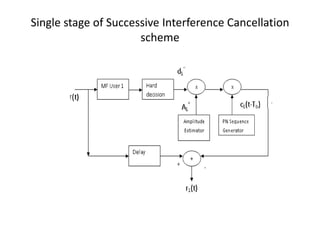
Successive Interference Cancellation (SIC)
• SIC is a nonlinear type of MUD scheme in
which users are decoded successively. The
approach successively cancels strongest users
by re-encoding the decoded bits and after
making an estimate of the channel, the
interfering signal is recreated at the receiver
and subtracted from the received waveform.
Single stage of Successive Interference Cancellation
scheme
Parallel Interference Cancellation (PIC)
• The data estimates obtained from the matched
filter denoted by d1
^(0),…….,dK
^(0) corresponding
to all K users are multiplied by the amplitude
estimates, spreaded using corresponding
spreading codes. Thus the received signal is
regenerated. All the regenerated signals except
the desired user are partially summed. This
output is the MAI and is subtracted from the
received signal. Thus the MAI cancelled output is
passed on to a second bank of MF to produce
second set of data estimates. This process is
repeated for multiple stages till the desired bit
error rate performance is achieved.
Parallel Interference Cancellation Multiuser Detector
MUD Based TH PPM UWB Simulation Model
. Performance of MUD Schemes in TH PPMUWB using
m-ZCZ sequences for CM1 fading condition
Performance of MUD Schemes in TH PPMUWB using
m-ZCZ sequences for CM3 fading condition
Application:Telemedicine(Transmission
of bio medical images)
Input Image Detected Image using CMF with m-ZCZ
Sequences for LOS(0-4mt) with PSNR=22.79
Detected Image using SIC with m-ZCZ
Sequences for LOS(0-4mt) with PSNR=24.5
Detected Image using PIC with m-ZCZ Sequences
for LOS(0-4mt) with PSNR=24.82
Detected Image using MMSE with m-ZCZ
Sequences for LOS(0-4mt) with PSNR=26.5
Detected Image using DD with m-ZCZ
Sequences for LOS(0-4mt) with PSNR=28.9
Conclusion
 BER performance of m-ZCZ is better than that
of existing m Sequences
 This Sequences implemented in UWB Systems
for indoor applications and used for
suppressing multiuser interference.
 It is used in Telemedicine applications .
THANK YOU

Interference cancellation in uwb systems

  • 1.
    Interference Cancellation inUWB Systems By Dr.M.Jayasheela, Professor/ECE KIT-Kalaignarkarunanidhi Institute of Technology
  • 2.
    Outline • Zero CorrelationZone codes • Ultra Wide Band Technology • UWB Channels • Multiuser detection • Interference cancellation in UWB using m-zcz sequences.
  • 3.
    M (Maximal Length)Sequences •An m-sequence contains, one more one, than zero. The number of ones is (N+1)/2. • A run is defined as a sequence of a single type of binary digits within the m-sequence. The length of this subsequence is the length of the run. • The periodic autocorrelation function θb(k) of an m-sequence is two valued .
  • 4.
    • Let b(D)represent a m-sequence. Let this sequence be shifted by j chips represented by b(D+j). Then the modulo-2 sum of the two sequences results in a sequence b(D+k) which is the same m-sequence shifted by k chips.
  • 5.
    Zero Correlation ZoneCodes • ZCZ codes are interference free in any wireless system as long as the one-side ZCZ length longer than the maximum single delay spread, which is caused by multipath propagation . • The ZCZ length of conventional binary ZCZ code is restricted to 2k, where k is an integer.But, in practical applications the ZCZ length has to be chosen much larger than required.
  • 6.
    m-ZCZ Squences • Abinary ZCZ code based on m-sequences, called m-ZCZ code. • Its length can be flexibly selected to match the maximum time delay with the great degree-of-freedom, such that constructed interference resistant UWB system can support more no of users than that using conventional binary ZCZ codes.
  • 7.
    ZCZ Generation • Them-ZCZ code set is denoted as m- ZCZ(CL,S,Wmin)={(zi1,zi2)},where i=0, 1…S-1, • CL represents code length, S- set size of the code set, Wmin –minimum length of one-side ZCZ. • zi1= Zi1 is first sub code minw.i a minw.i a
  • 8.
    where a0 isan m-sequence with its period N, and a iWmin stands for the sequence generated by cyclically leftward shifted a0 with i. Wmin chips. This can be represented as Naa o win wi n modmin).( min. 
  • 9.
    • The secondsub-code zi2={+1} contains only one “+1” chip. The congregated code length is CL = N +1. • The set size of the code is S = [N / Wmin].
  • 10.
    Auto correlation &Cross correlation • The periodic auto-correlation function (ACF) of an m-ZCZ code and periodic cross- correlation function (CCF) of any two m-ZCZ codes can be calculated as follows: 2j2i minw.j kn 1N 0n minw.i nj,i zzaa)k(R      22 0 min1 1 0 0 min modmod ji)j.w(n N n )i.w(n zzNNaa     
  • 11.
    where integer kdenotes the relative time shift.
  • 12.
    Correlation Property • Usingabove equation ACF of any m-ZCZ code is zero when 0<|k|<Wmin and the CCF between any two codes is zero |k|<Wmin. Thus, there exists a ZCZ with minimum one-side length being wmin. • The wmin can be flexibly controlled by adjusting the number of cyclic shifted chips.
  • 13.
    • Example: GivenL=16, wmin=4 we can get a set of m-ZCZ codes denoted by (16,3,4) containing J=[15/4]=3 codes as (a01, a02)=(+1 +1 +1 -1 -1 -1 -1 +1 -1 +1 -1 -1 +1 +1 -1, +1) (a11, a12)=( -1 -1 -1 +1 -1 +1 -1 -1 +1 +1 -1 +1 +1 +1 -1, +1) (a21, a22)=( -1 +1 -1 -1 +1 +1 -1 +1 +1 +1 - 1 -1 -1 -1 +1,+1) where sub-codes are separated by commas.
  • 14.
    Parameters • When 1<wmin<N,the set size S satisfies 1<S= [N/wmin] <N. Therefore, length of m-ZCZ can be increased by reducing the set size.
  • 15.
    • Spreading codeis formed at the transmitter side by two sub-codes of an m-ZCZ code with a cyclic prefix and a cyclic postfix inserted at both sides of each sub-code. The lengths of the cyclic prefixes and cyclic postfixes should be at least equal to the maximum multipath time delay, so that the two sub codes will not overlap with each other after being transmitted via multipath channels.
  • 16.
    • Despreading codeis formed at the receiver side by the two sub-codes of an m-ZCZ code, with zeroes inserted in the guard intervals of identical length which should be equal to that of the cyclic prefixes and postfixes in the spreading code. • To make decisions, aperiodic correlation is performed between the received signal and the local despreading code. Due to the effects of cyclic prefix and postfix the aperiodic correlation automatically becomes periodic correlation.The m-ZCZ code could be more suitable for wireless systems with a relatively short delay spread.
  • 17.
    Spreading Codes DeSpreading Codes 0…0Sub-code 1 0…0 0…0 1 0……0 In order to reduce multipath interference the one-side ZCZ length wmin must be larger than the maximum delay spread ζmax
  • 18.
    Comparison of Correlationb/w m & m-ZCZ Sequences Sequence Length Correlation of m- Sequences Correlation of m-ZCZ Sequences 3 0.333 0.01 7 0.1428 0.009 15 0.0667 0.0003 31 0.0322 0.0001 63 0.015873 0
  • 19.
    BER Performance m-Sequences/m- ZCZ Sequences in CDMA System Comparison of BER performance of m- Sequences and m-ZCZ Sequences for Eb/No=20 dB in Rayleigh
  • 20.
    BER Performance m-Sequences/m- ZCZ Sequences in CDMA System Comparison of BER performance of m-Sequences and m- ZCZ Sequences for 1000users in Rayleigh Channel
  • 21.
    UWB Technology • Ittransmits very short pulses on the order of a fraction of a nanosecond thereby spreads the energy from near D.C to a few gigahertz. • Blue tooth ,cordless phone and numerous other devices are related to the unlicensed frequency bands .Each occupy narrowband of frequences relative to what is allowed by UWB
  • 22.
  • 23.
    • Based onShannon’s Capacity limit equation – the maximum channel capacity grows linearly with the channel bandwidth while grows logarithmically with signal to noise ratio, a greatly improved channel capacity can be achieved by UWB due to its ultra wide bandwidth.
  • 24.
    Advantages &Applications UWB PROPERTIESADVANTAGES APPLICATIONS Very wide fractional and absoulte RF Bandwidth •High rate communications •Lowfrequencies penetrate walls and grounds •High rate WPAN •Lowpower •Multiple Access Very short pulses •Direct resolvability of discrete mutipath components •Diversity gain Low power combined communications and Localizations Persistence of multipath reflections •Low fade margin •Low power NLOS Communications indoors Carrier less transmission •Hardware Simplicity Smart Sensor Networks
  • 25.
    UWB Signal Model •Time Hopping Spread Spectrum impulse Radio(TH-UWB)  In TH-UWB a pseudorandom sequence defines the time when the pulses are transmitted • Direct Sequence Spread Spectrum impulse Radio(DS-UWB) In DS-UWB the pulses are transmitted continuously using a pseudorandom sequence for the spreading of information bits.
  • 26.
    Modulation • Pulse PositionModulation • Pulse Amplitude Modulation • On-Off Keying
  • 27.
    UWB Channel Modeling 4types of Channel models • CM1 0-4 meters’ range with LOS • CM2 0-4 meters’ range with NLOS • CM3 4-10 meters’ range with LOS • CM4 greater than 10 meters’ range with NLOS
  • 28.
    The IEEE ChannelCharacteristics for Four different Scenarios
  • 29.
  • 30.
  • 31.
  • 32.
  • 33.
    System Model forMultiuser THPPM Based Ultra Wide Band Systems with m-ZCZ Sequences
  • 35.
    Performance Comparison ofm and m-ZCZ sequences using CM1
  • 36.
    Performance Comparison ofm and m-ZCZ sequences using CM4
  • 37.
    Comparison of m/m-ZCZSequence in UWB using AWGN 5 10 15 20 25 30 35 40 45 50 10 -5 10 -4 10 -3 10 -2 10 -1 users BitErrorRate comp of ML AND M-ZCZ Sequence -in UWB SYSTEM in AWGN CHANNEL ebno12-ML ebno12-MZCZ
  • 38.
    Multi-user Detection • MultipleAccess Interference (MAI) due to the simultaneous transmission of signals by different users is a serious problem in the wireless systems. One of the methods of suppressing this interference is multiuser detection. • Multi user detection is signal processing intensive and they promise to give a large- scale increase in capacity of present 3G and future generation wireless communication systems.
  • 39.
  • 40.
    Multiuser Detection Schemesin UWB • Decorrelating Detector (DD) The decorrelating detector suppresses the interference by a linear transformation of cross correlation matrix inversion on the soft output of the matched filter bank. The inverse of the correlation matrix R is applied to the MF output.
  • 41.
  • 42.
    Minimum Mean SquareError (MMSE) detector • The MMSE detector is a linear detector which considers both the thermal noise and MAI. It performs a transformation LMMSE which minimizes , the mean square error between the actual data and the soft output of the MAI.
  • 43.
    Successive Interference Cancellation(SIC) • SIC is a nonlinear type of MUD scheme in which users are decoded successively. The approach successively cancels strongest users by re-encoding the decoded bits and after making an estimate of the channel, the interfering signal is recreated at the receiver and subtracted from the received waveform.
  • 44.
    Single stage ofSuccessive Interference Cancellation scheme
  • 45.
    Parallel Interference Cancellation(PIC) • The data estimates obtained from the matched filter denoted by d1 ^(0),…….,dK ^(0) corresponding to all K users are multiplied by the amplitude estimates, spreaded using corresponding spreading codes. Thus the received signal is regenerated. All the regenerated signals except the desired user are partially summed. This output is the MAI and is subtracted from the received signal. Thus the MAI cancelled output is passed on to a second bank of MF to produce second set of data estimates. This process is repeated for multiple stages till the desired bit error rate performance is achieved.
  • 46.
  • 47.
    MUD Based THPPM UWB Simulation Model
  • 48.
    . Performance ofMUD Schemes in TH PPMUWB using m-ZCZ sequences for CM1 fading condition
  • 49.
    Performance of MUDSchemes in TH PPMUWB using m-ZCZ sequences for CM3 fading condition
  • 50.
    Application:Telemedicine(Transmission of bio medicalimages) Input Image Detected Image using CMF with m-ZCZ Sequences for LOS(0-4mt) with PSNR=22.79
  • 51.
    Detected Image usingSIC with m-ZCZ Sequences for LOS(0-4mt) with PSNR=24.5 Detected Image using PIC with m-ZCZ Sequences for LOS(0-4mt) with PSNR=24.82
  • 52.
    Detected Image usingMMSE with m-ZCZ Sequences for LOS(0-4mt) with PSNR=26.5 Detected Image using DD with m-ZCZ Sequences for LOS(0-4mt) with PSNR=28.9
  • 53.
    Conclusion  BER performanceof m-ZCZ is better than that of existing m Sequences  This Sequences implemented in UWB Systems for indoor applications and used for suppressing multiuser interference.  It is used in Telemedicine applications .
  • 54.