A DVB-H Tutorial

      Video over IP
     goes Wireless

                       Marie Josée (MJ) Drouin,
SMPTE Toronto Chapter BootCamp, June 8th, 2010
                                     © D. Tech 2010
Who am I?
   Director with 15 years of Media experience, I lead technical teams of up to
    30 people and 3 managers to deliver most aspects of the business -
    Operations, Customer Services, Information Technologies, Project
    Management, Engineering, and Procurement. I developed expertise in


                                                                                                MJ Drouin© - May 19th, 2010
    managing cable, wireless, satellite, transmission, engineering and software
    development. I worked at Bell, Teleglobe, Intelsat, CBC and as a expert
    consultant.
   Professional Engineer, Masters in Technological Management, ITIL
    foundation, PMP


                                                                                                          - VSF
   I have extensive experience in speaking since the 90's (ouf!), subjects were
    always a mix of technologies, commerce and management.
        Past engagements included: My video is a file, now what? (2010), Service Oriented
         Architecture: Tutorial for the Broadcasters (2010), Pitfalls of SW development: What every
         executive should know (2009), 8 weeks on Twitter: I love it! (2009), The Future of Broadcast
         Archive Systems (2008), DVB-H: Video over IP goes Wireless (2006), HDTV distribution
         (2005), Video over IP (2004) and, Several broadcast technical training (1994-1998): Video
         101, Digital Video and Compression 201, Video testing techniques 301.
   http://www.linkedin.com/in/mjdrouin
   http://twitter.com/mjdrouin
                                                 2                                        © D. Tech 2010
© D. Tech 2010
Agenda


1. Video over Mobiles

2. DVB-H Technical Review

3. System Technical Review


                             © D. Tech 2010
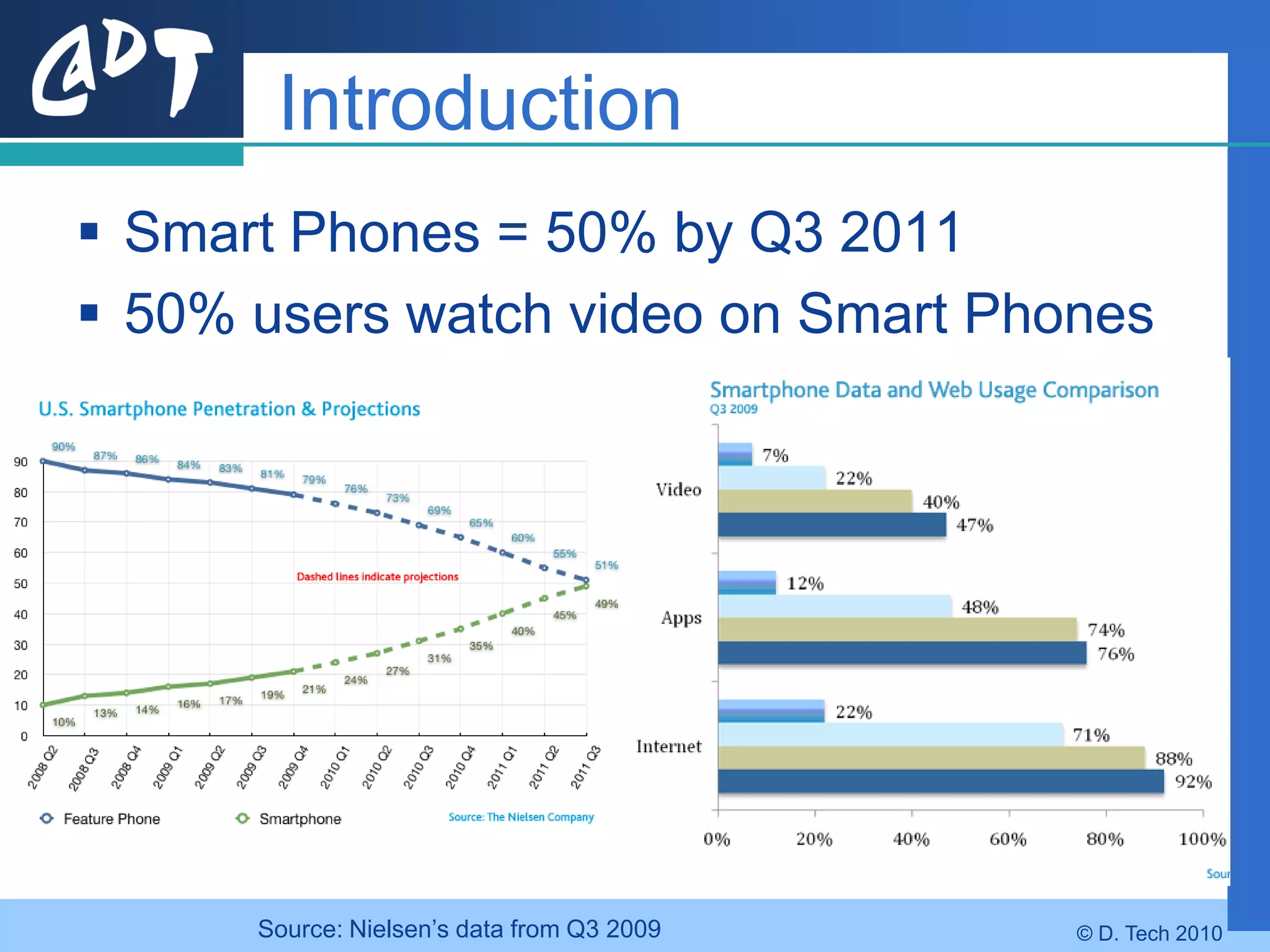
Introduction
 Smart Phones = 50% by Q3 2011
 50% users watch video on Smart Phones


      Source: Nielsen’s data from Q3 2009   © D. Tech 2010
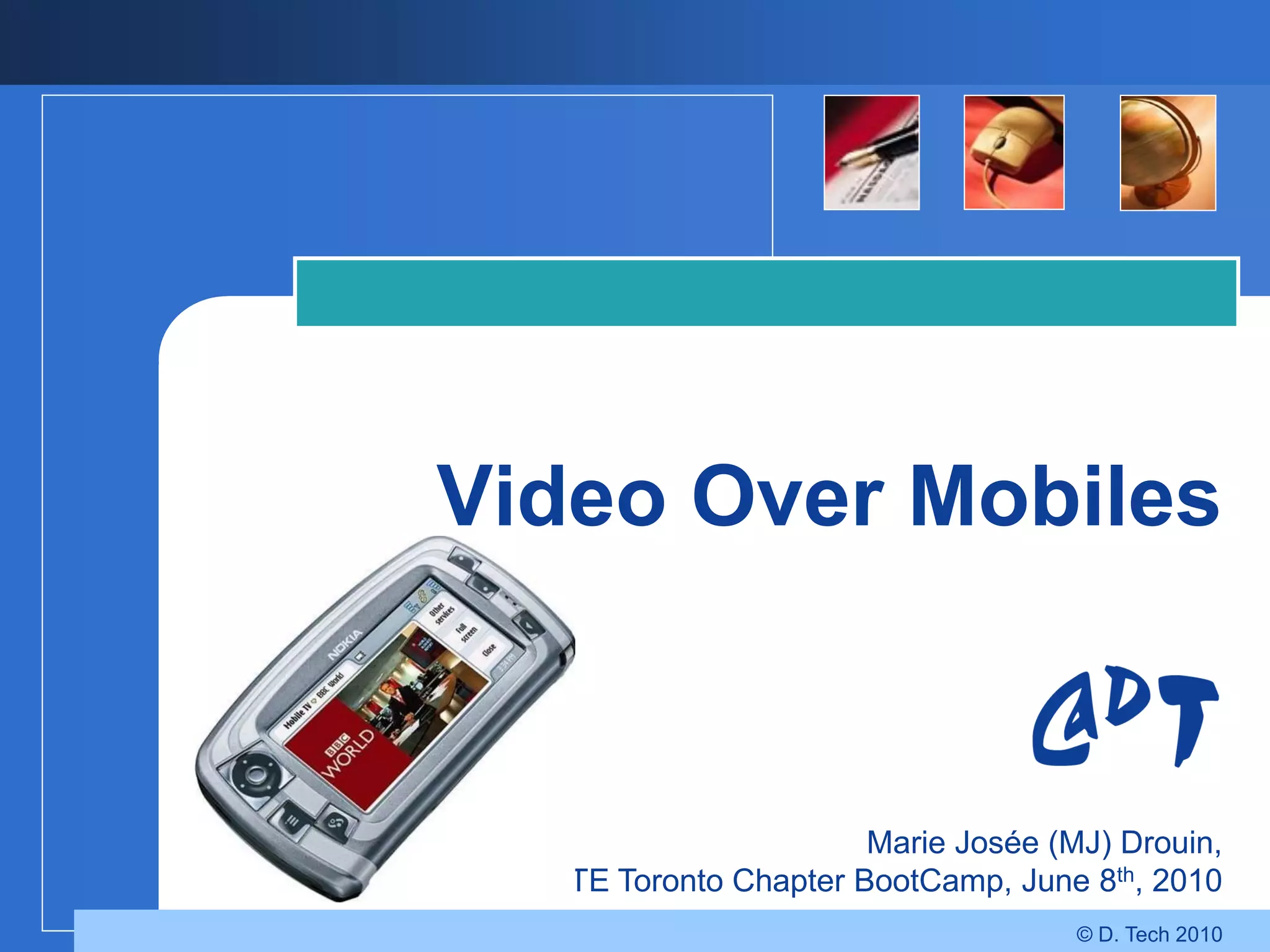
Video Over Mobiles


                        Marie Josée (MJ) Drouin,
 SMPTE Toronto Chapter BootCamp, June 8th, 2010
                                      © D. Tech 2010
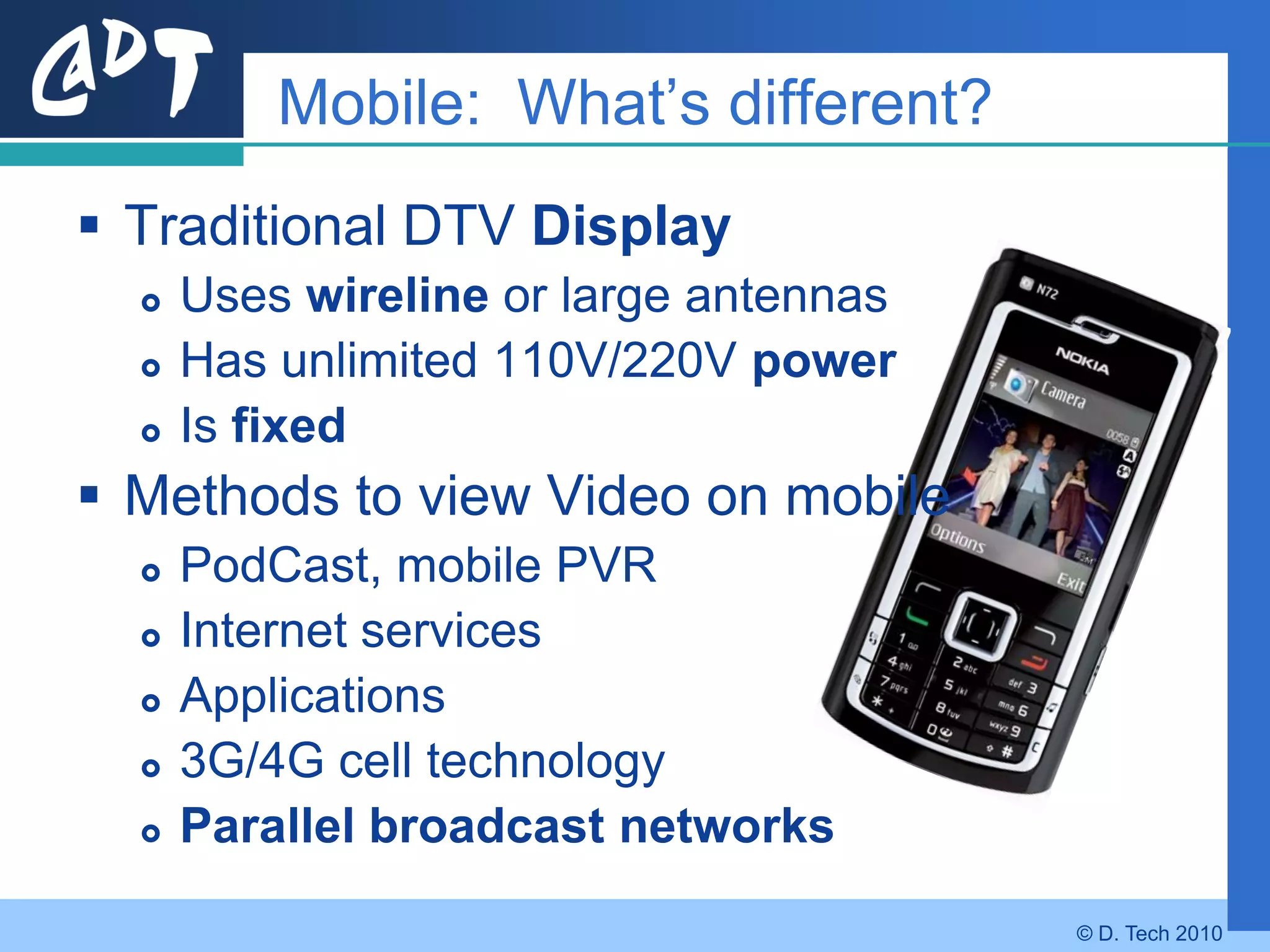
Mobile: What’s different?
 Traditional DTV Display
     Uses wireline or large antennas
     Has unlimited 110V/220V power
     Is fixed
 Methods to view Video on mobile
     PodCast, mobile PVR
     Internet services
     Applications
     3G/4G cell technology
     Parallel broadcast networks
                                        © D. Tech 2010
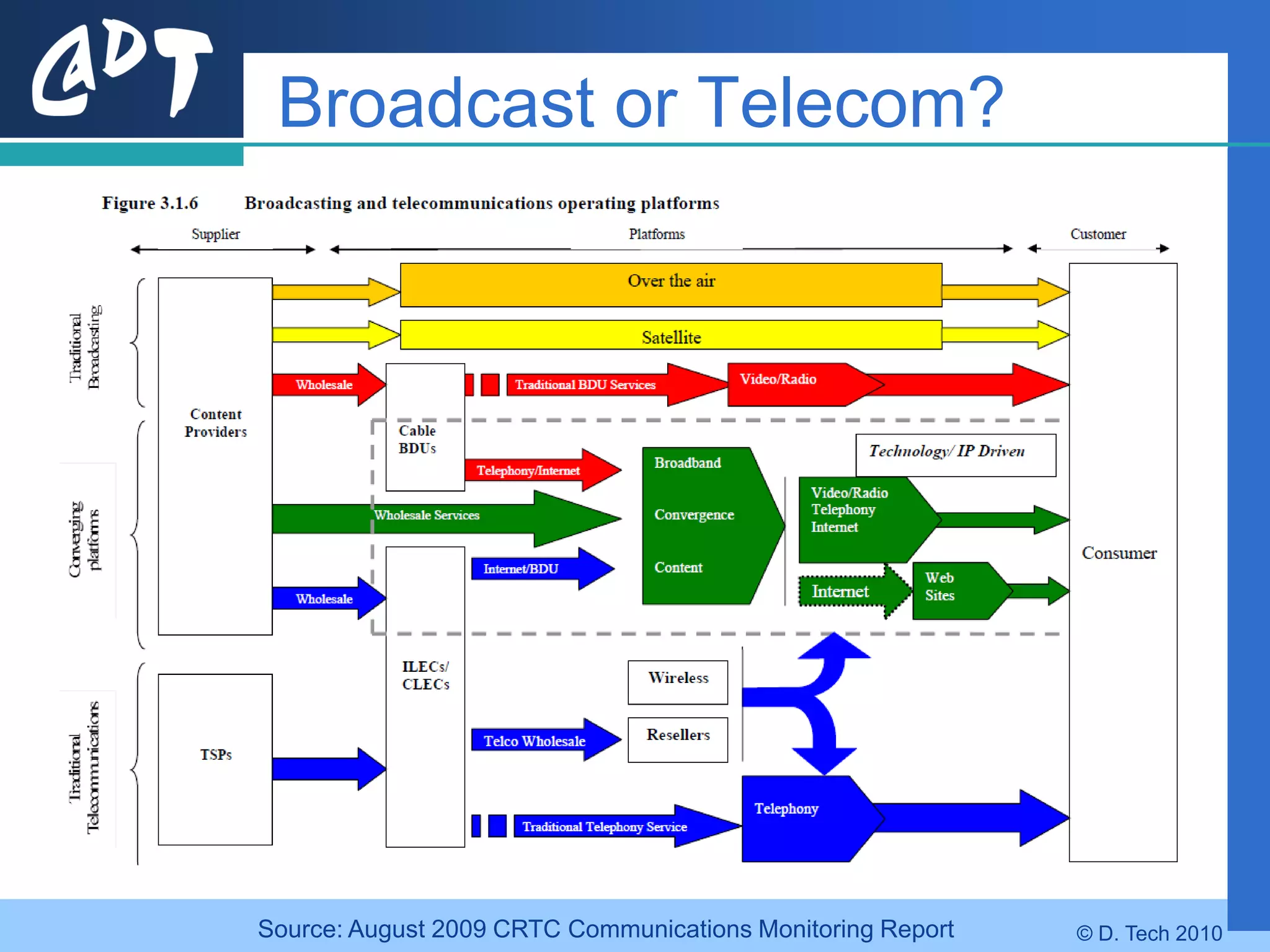
Broadcast or Telecom?


Source: August 2009 CRTC Communications Monitoring Report   © D. Tech 2010
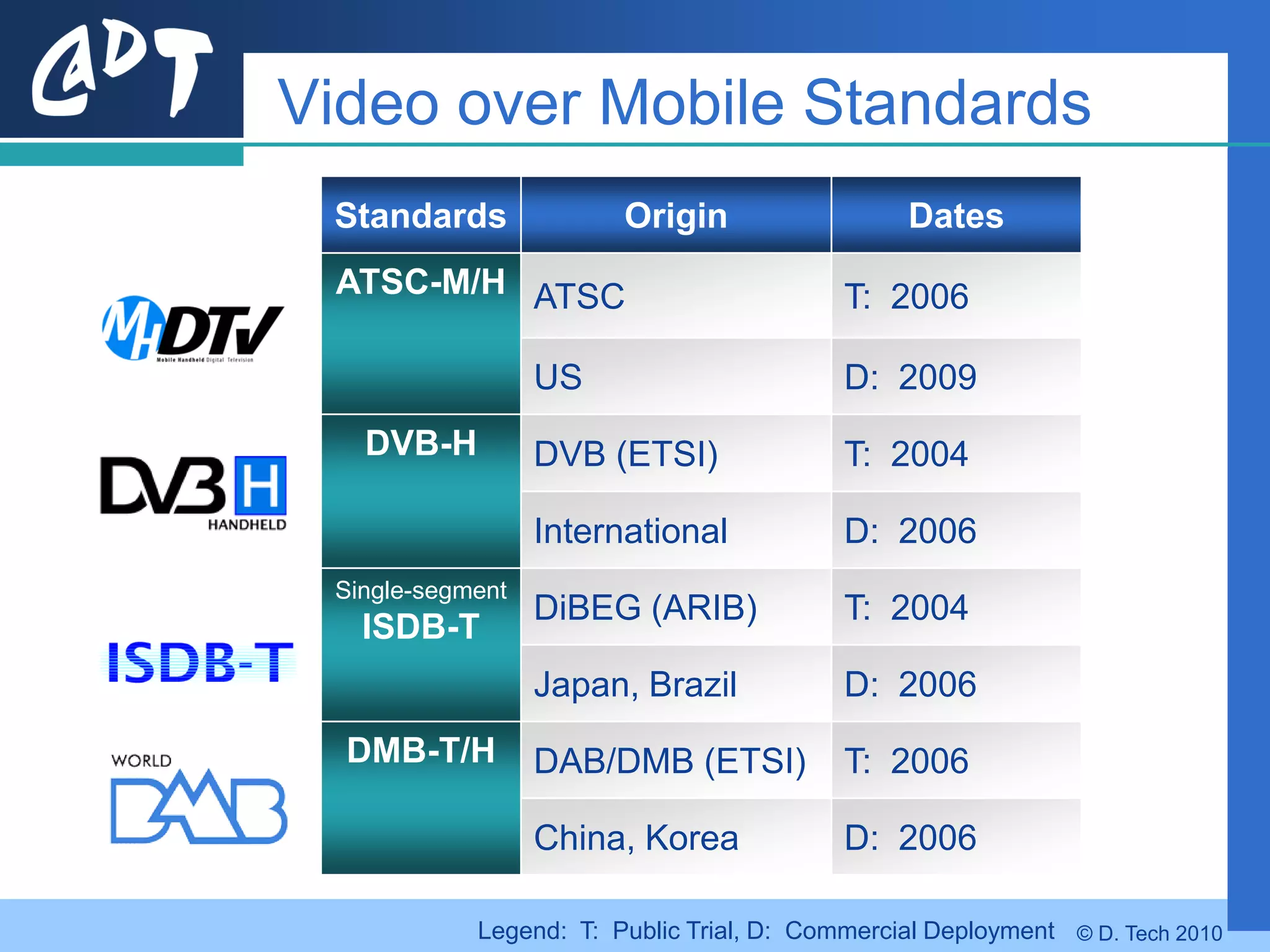
Video over Mobile Standards
 Standards              Origin                  Dates
 ATSC-M/H ATSC                             T: 2006

                  US                       D: 2009
   DVB-H          DVB (ETSI)               T: 2004

                  International            D: 2006
 Single-segment
                  DiBEG (ARIB)             T: 2004
   ISDB-T
                  Japan, Brazil            D: 2006
  DMB-T/H         DAB/DMB (ETSI)           T: 2006

                  China, Korea             D: 2006

            Legend: T: Public Trial, D: Commercial Deployment © D. Tech 2010
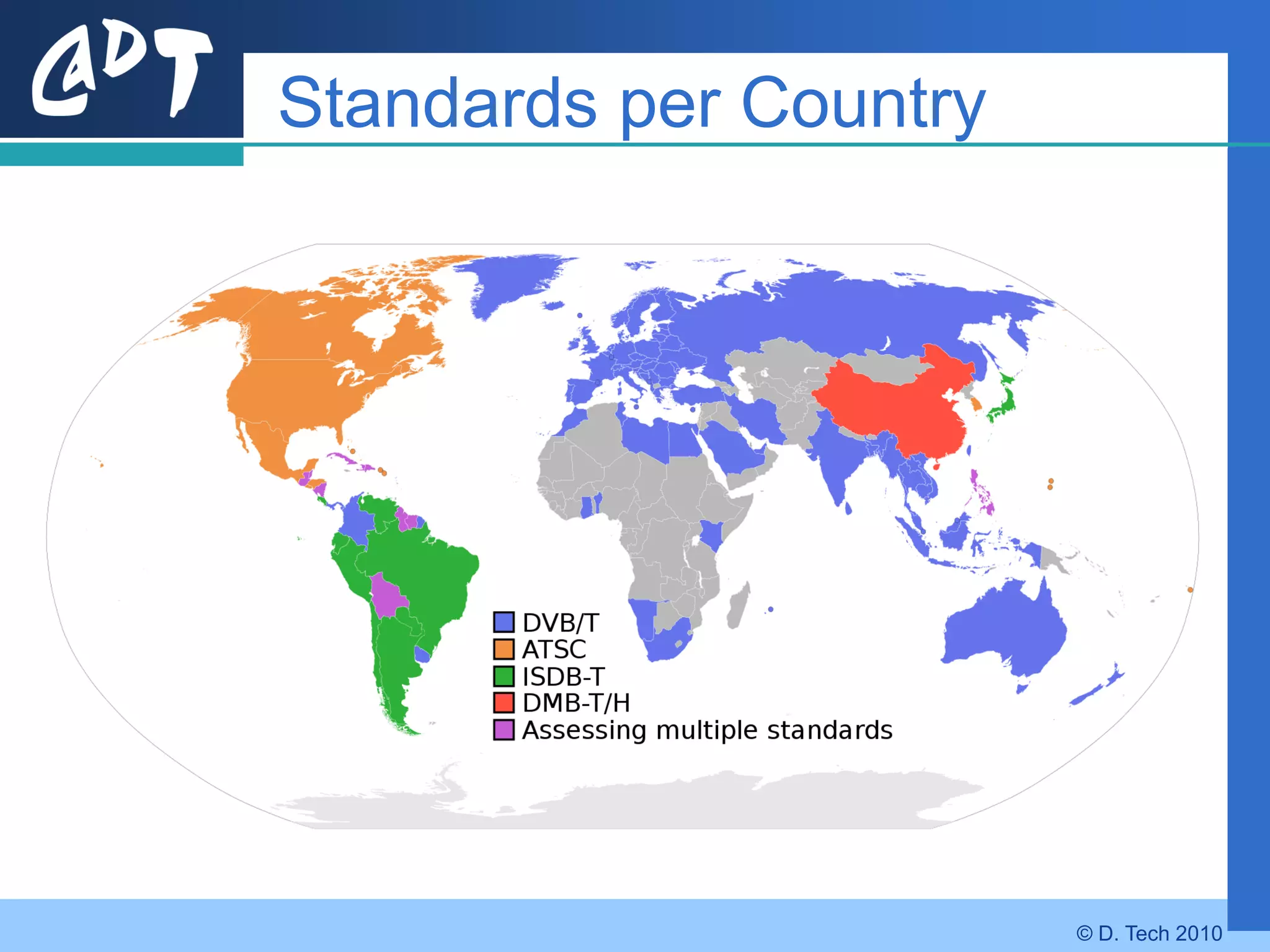
Standards per Country


                        © D. Tech 2010
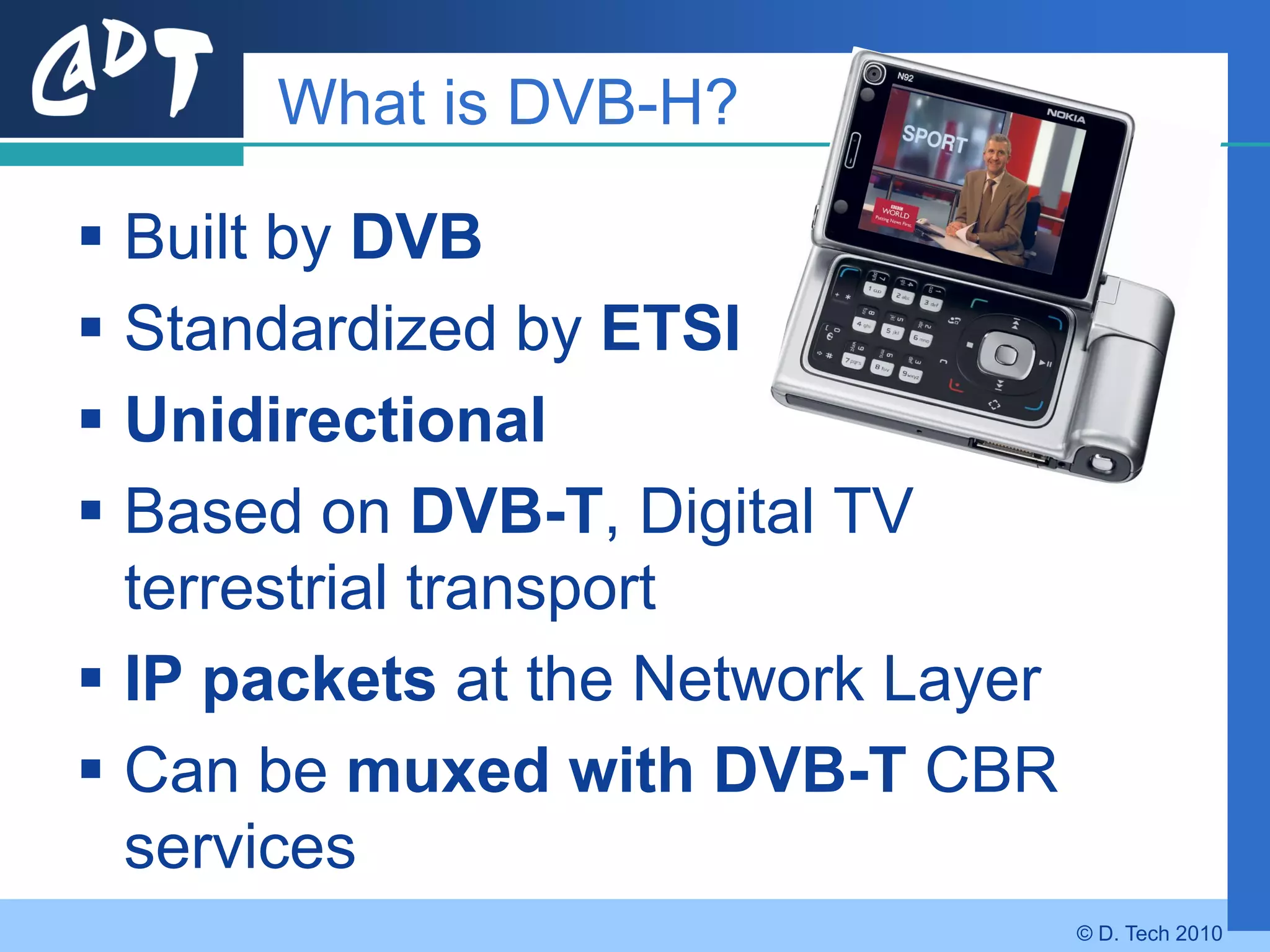
What is DVB-H?

 Built by DVB
 Standardized by ETSI
 Unidirectional
 Based on DVB-T, Digital TV
  terrestrial transport
 IP packets at the Network Layer
 Can be muxed with DVB-T CBR
  services
                                    © D. Tech 2010
DVB-H Technical Review


                             Marie Josée (MJ) Drouin,
      SMPTE Toronto Chapter BootCamp, June 8th, 2010
                                           © D. Tech 2010
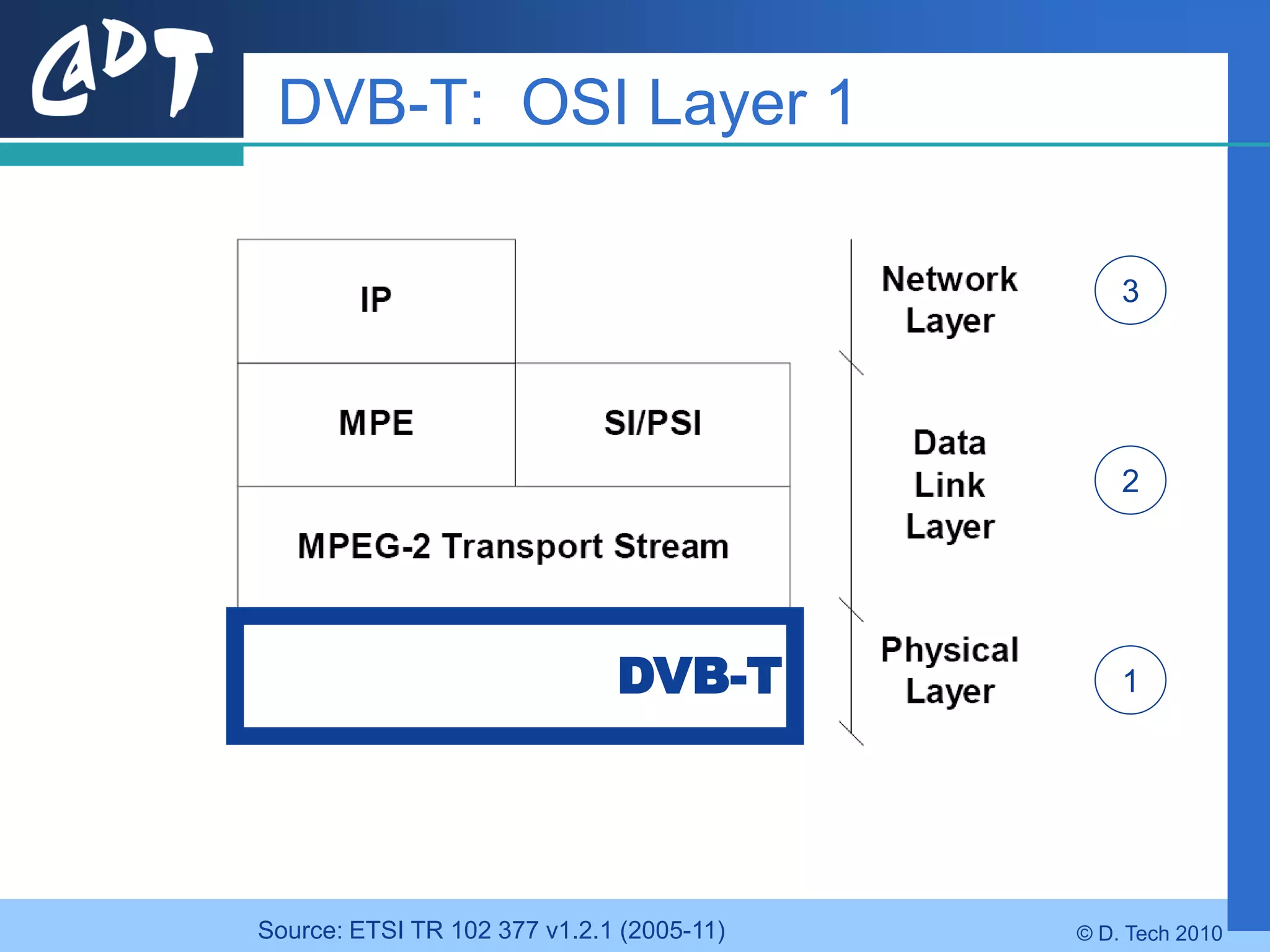
DVB-T: OSI Layer 1

                                               3


                                               2


                              DVB-T            1


Source: ETSI TR 102 377 v1.2.1 (2005-11)   © D. Tech 2010
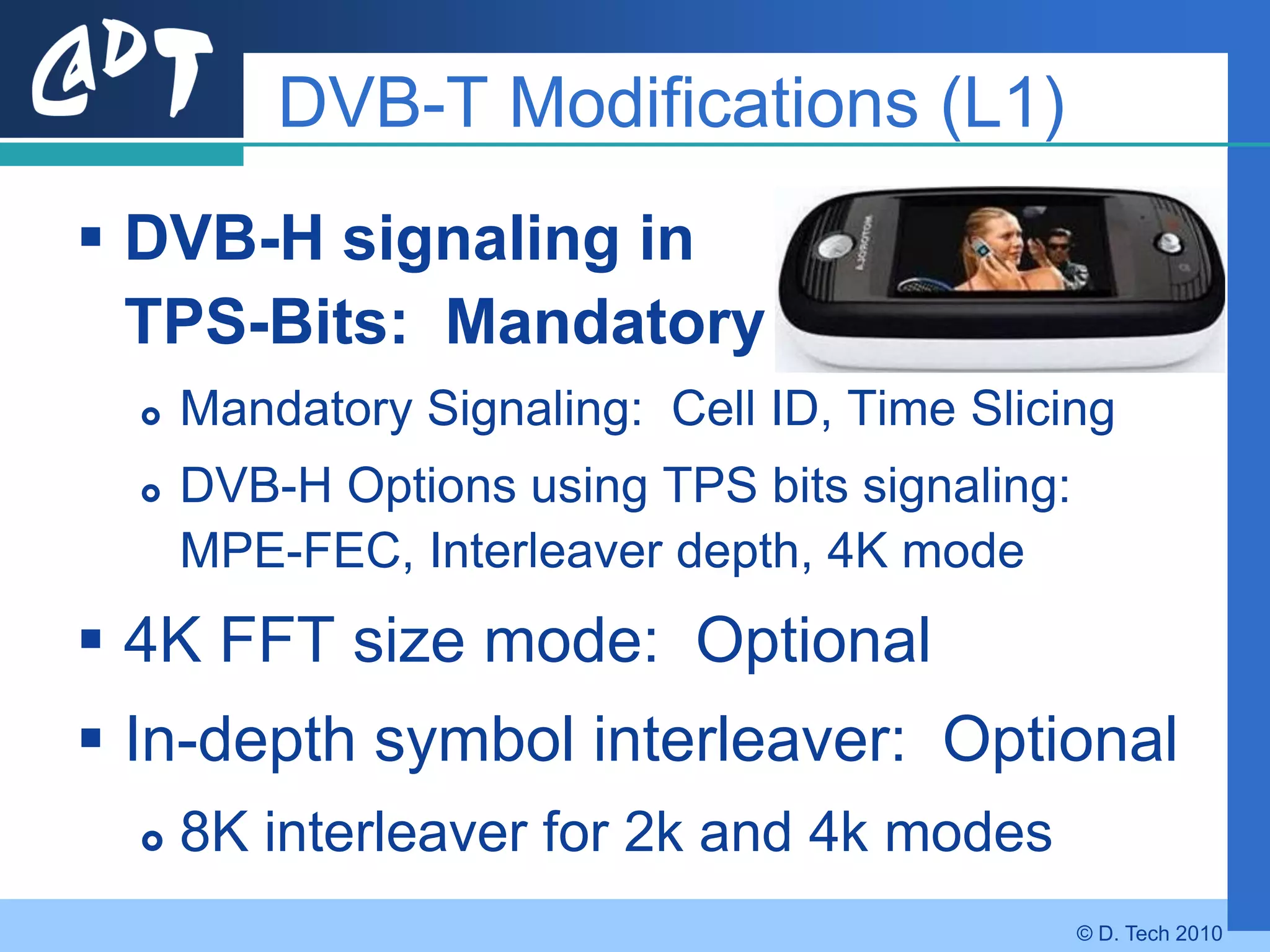
DVB-T Modifications (L1)
 DVB-H signaling in
  TPS-Bits: Mandatory
     Mandatory Signaling: Cell ID, Time Slicing
     DVB-H Options using TPS bits signaling:
      MPE-FEC, Interleaver depth, 4K mode
 4K FFT size mode: Optional
 In-depth symbol interleaver: Optional
     8K interleaver for 2k and 4k modes
                                                © D. Tech 2010
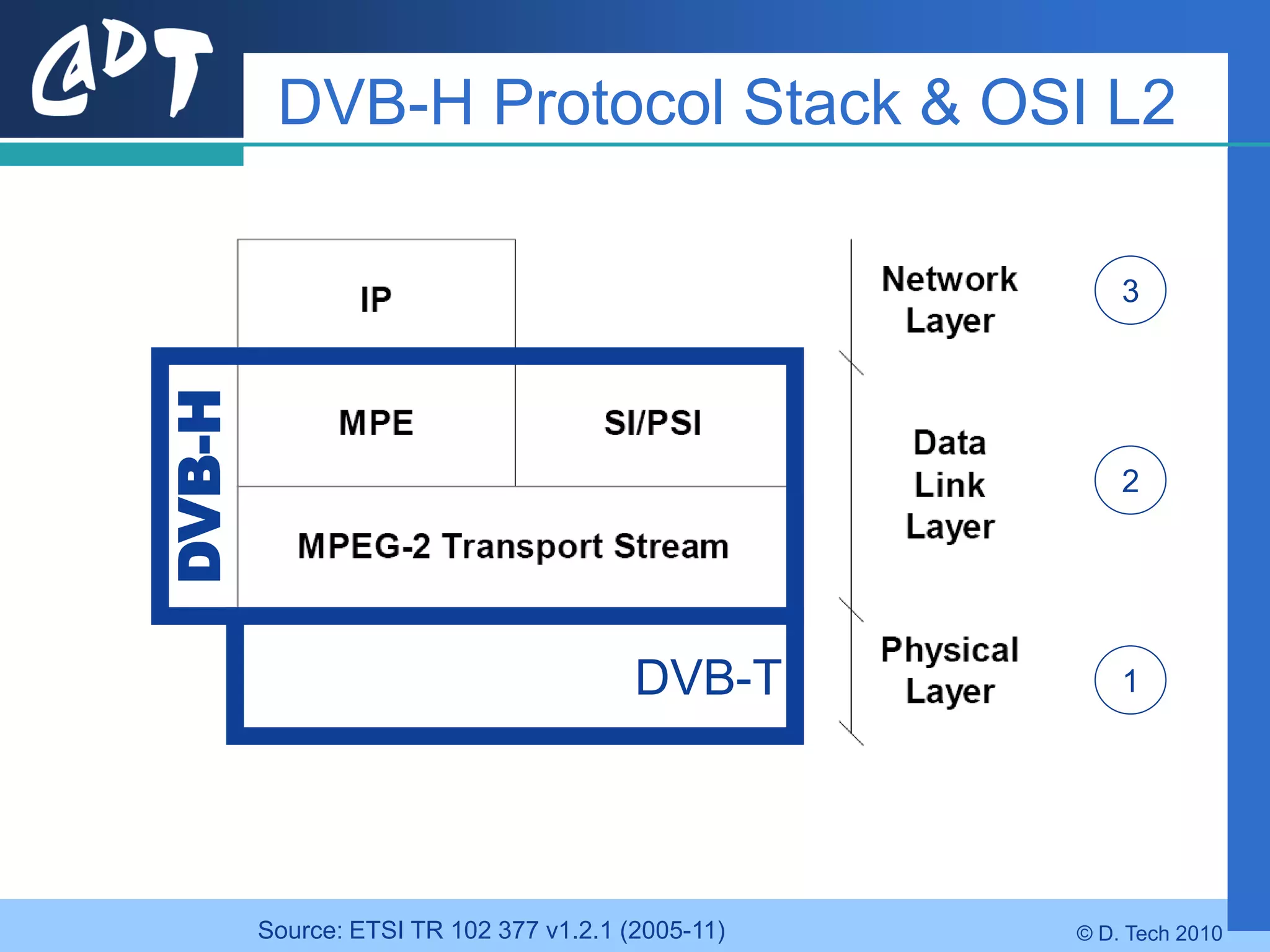
DVB-H Protocol Stack & OSI L2

                                                       3
DVB-H


                                                       2


                                        DVB-T          1


        Source: ETSI TR 102 377 v1.2.1 (2005-11)   © D. Tech 2010
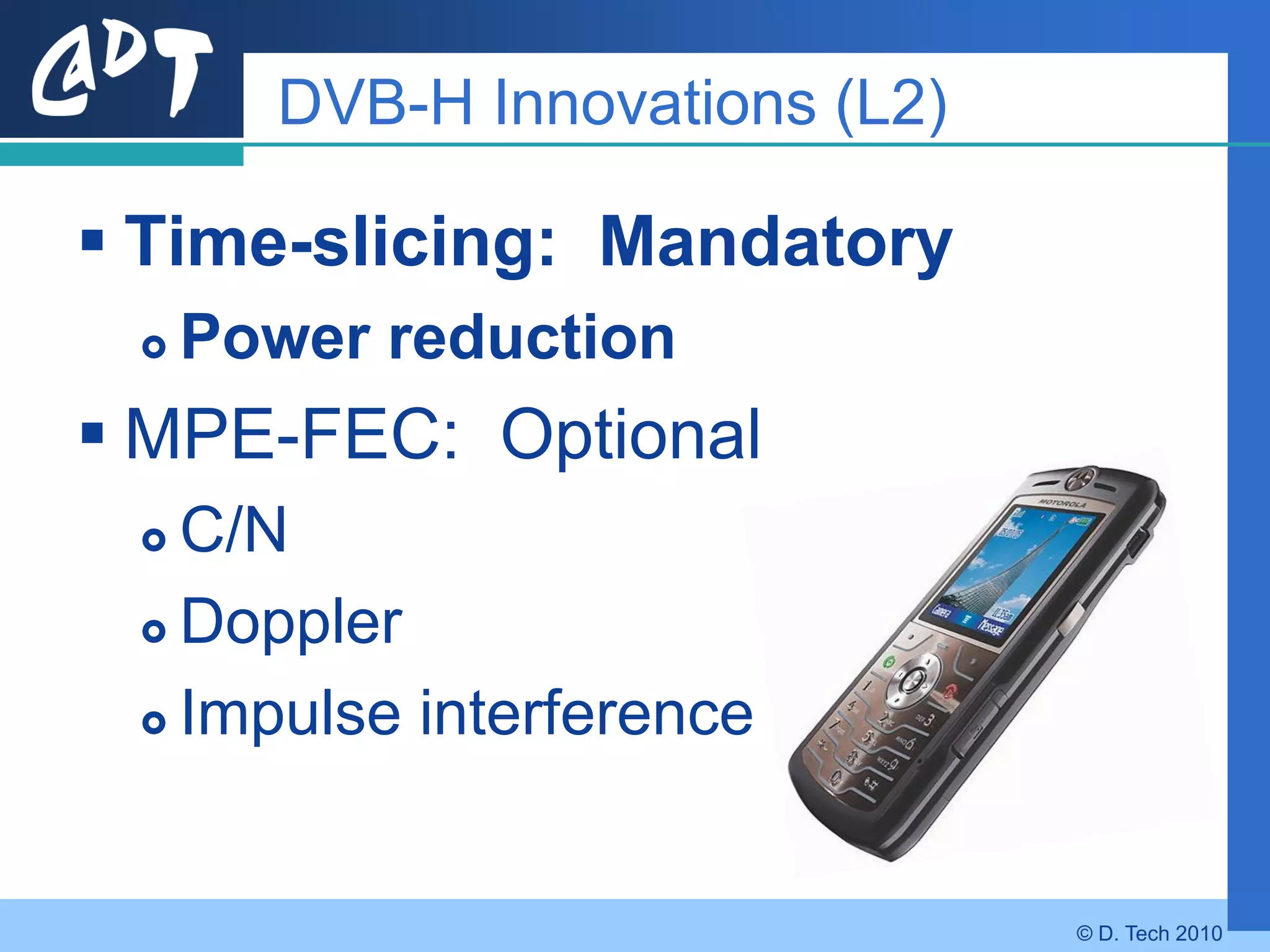
DVB-H Innovations (L2)

 Time-slicing: Mandatory
    Power reduction
 MPE-FEC: Optional
  C/N
  Doppler

  Impulse interference


                                © D. Tech 2010
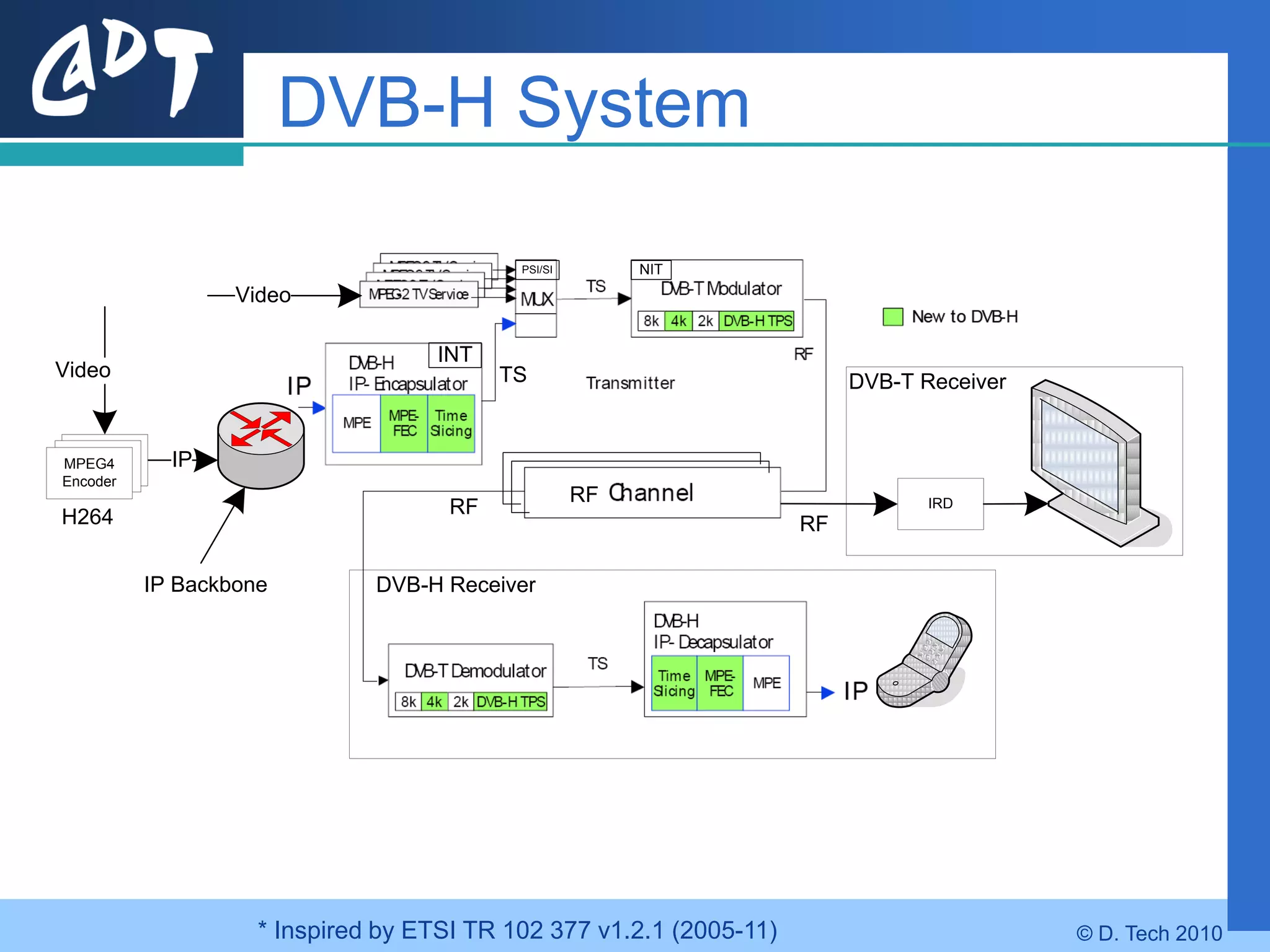
DVB-H System

                                             PSI/SI        NIT
                    Video

                                     INT
Video                                      TS                               DVB-T Receiver


  MPEG4
 MPEG4
MPEG4
  Encoder     IP
 Encoder
Encoder
                                                      RF                           IRD
H264                                  RF
                                                                       RF

            IP Backbone         DVB-H Receiver


                      * Inspired by ETSI TR 102 377 v1.2.1 (2005-11)                         © D. Tech 2010
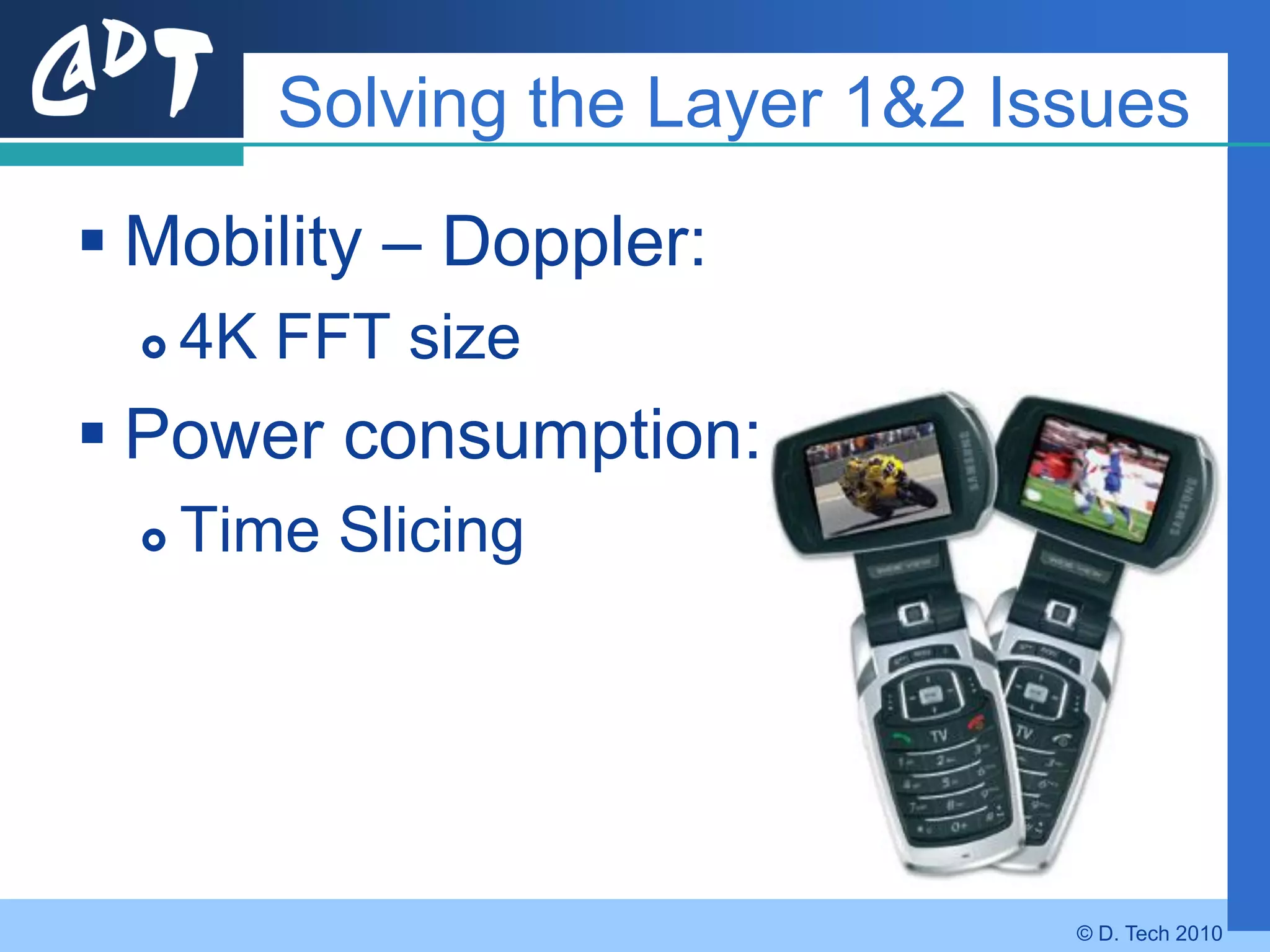
Solving the Layer 1&2 Issues
 Mobility – Doppler:
     4K FFT size
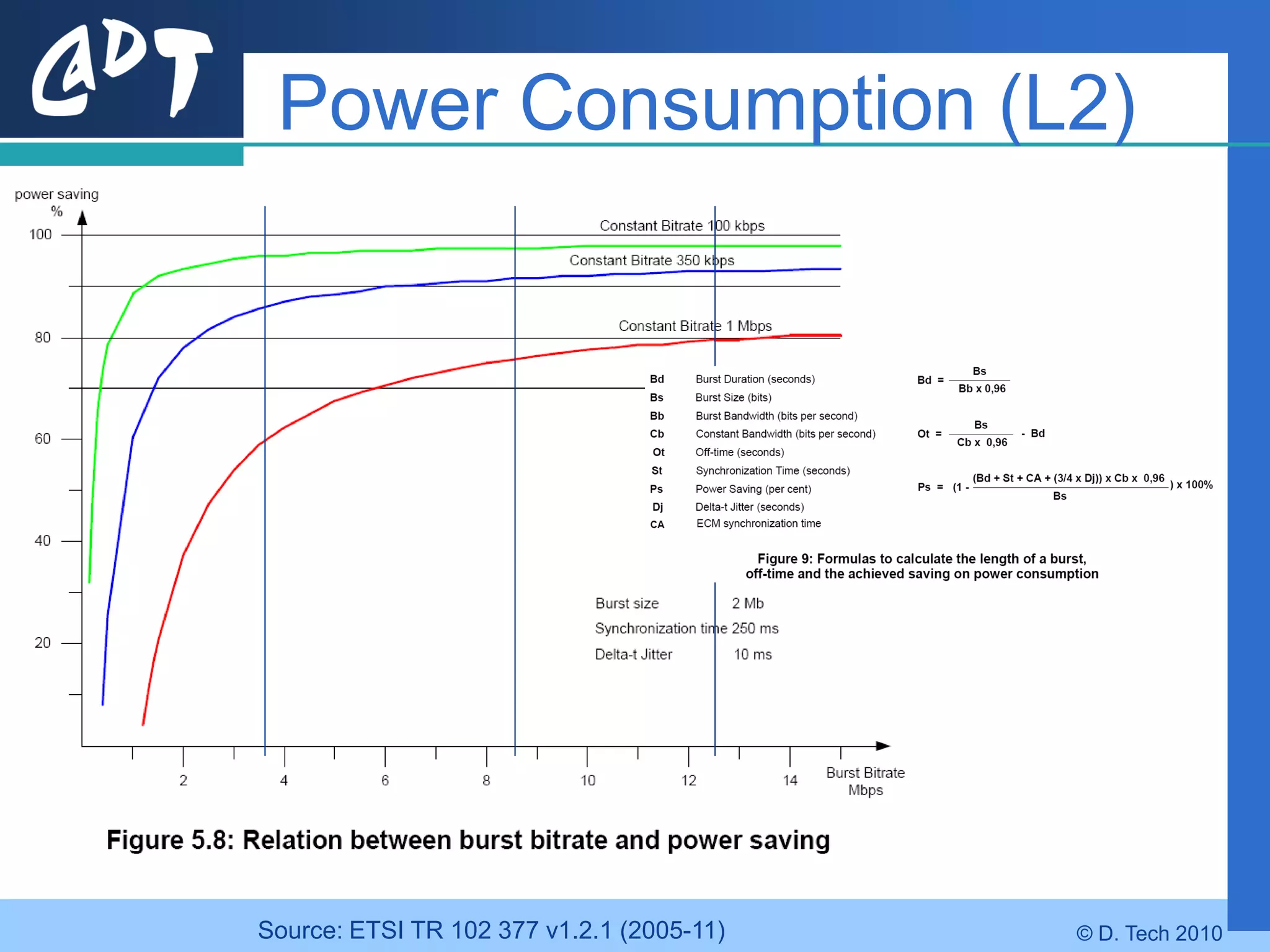
 Power consumption:
     Time Slicing


                                 © D. Tech 2010
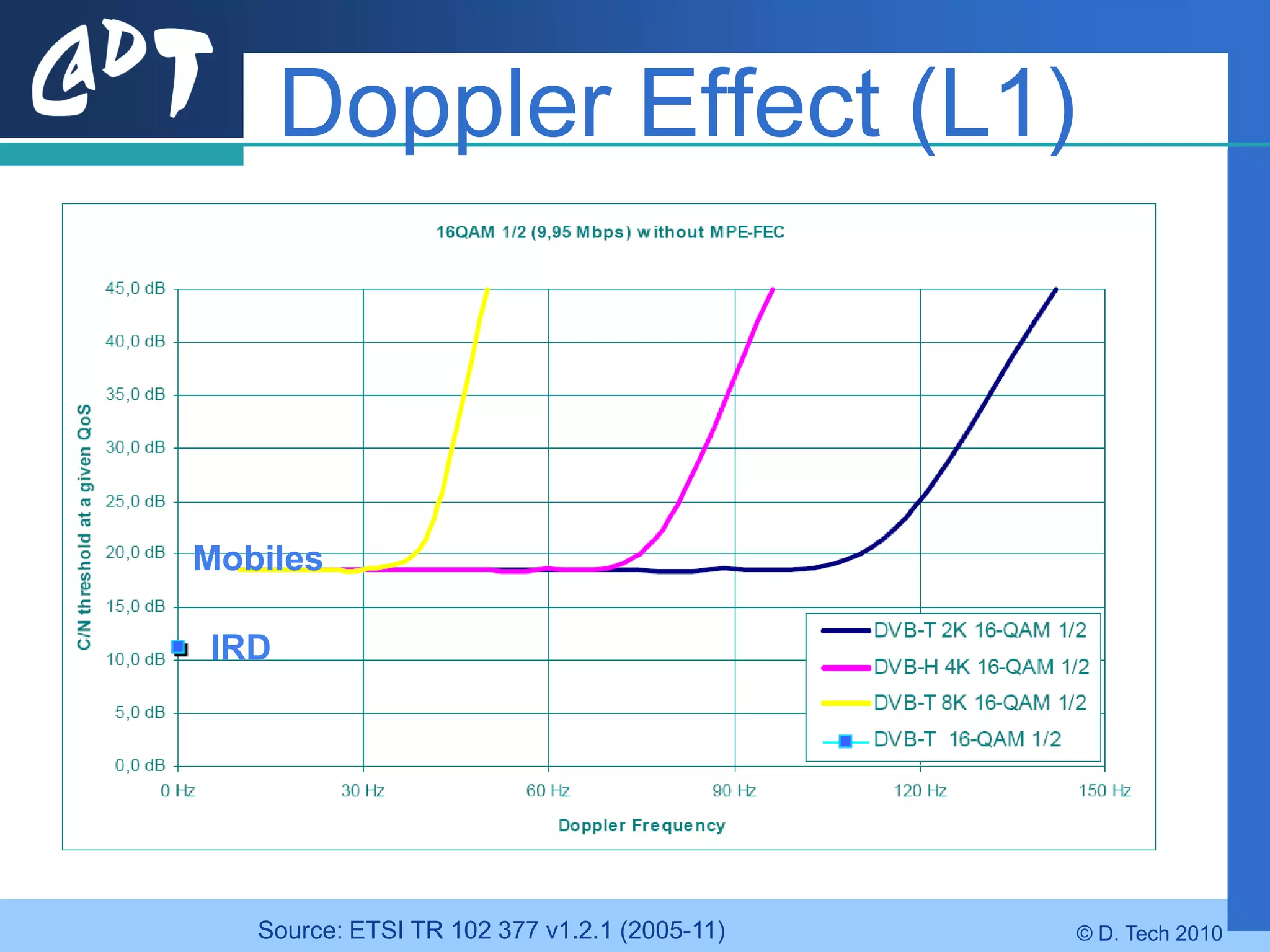
Doppler Effect (L1)


Mobiles

IRD


   Source: ETSI TR 102 377 v1.2.1 (2005-11)   © D. Tech 2010
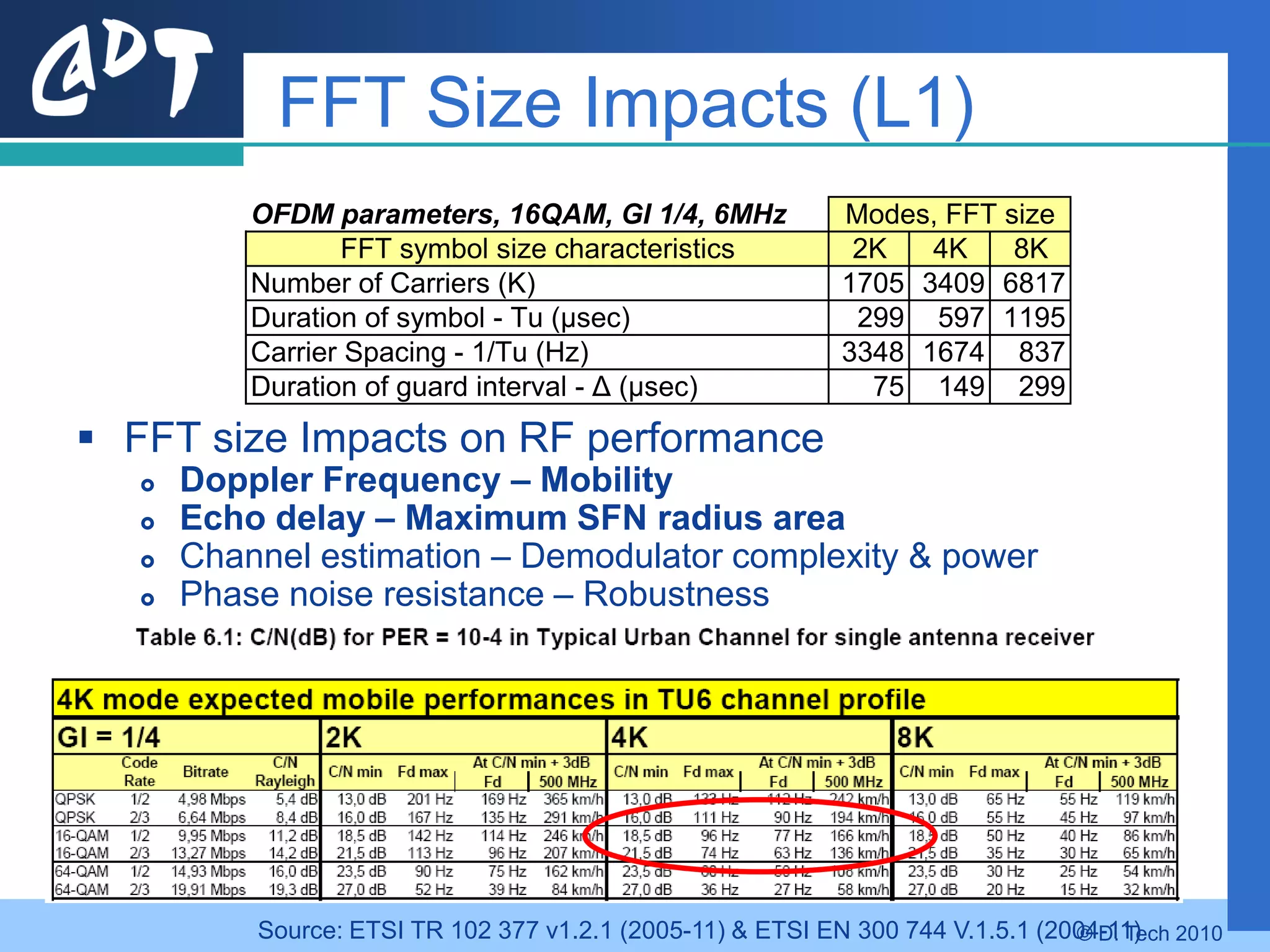
FFT Size Impacts (L1)
           OFDM parameters, 16QAM, GI 1/4, 6MHz             Modes, FFT size
                  FFT symbol size characteristics            2K   4K    8K
           Number of Carriers (K)                           1705 3409 6817
           Duration of symbol - Tu (µsec)                    299 597 1195
           Carrier Spacing - 1/Tu (Hz)                      3348 1674 837
           Duration of guard interval - Δ (µsec)              75 149 299
 FFT size Impacts on RF performance
      Doppler Frequency – Mobility
      Echo delay – Maximum SFN radius area
      Channel estimation – Demodulator complexity & power
      Phase noise resistance – Robustness


           Source: ETSI TR 102 377 v1.2.1 (2005-11) & ETSI EN 300 744 V.1.5.1 (2004-11) 2010
                                                                                 © D. Tech
Power Consumption (L2)


Source: ETSI TR 102 377 v1.2.1 (2005-11)   © D. Tech 2010
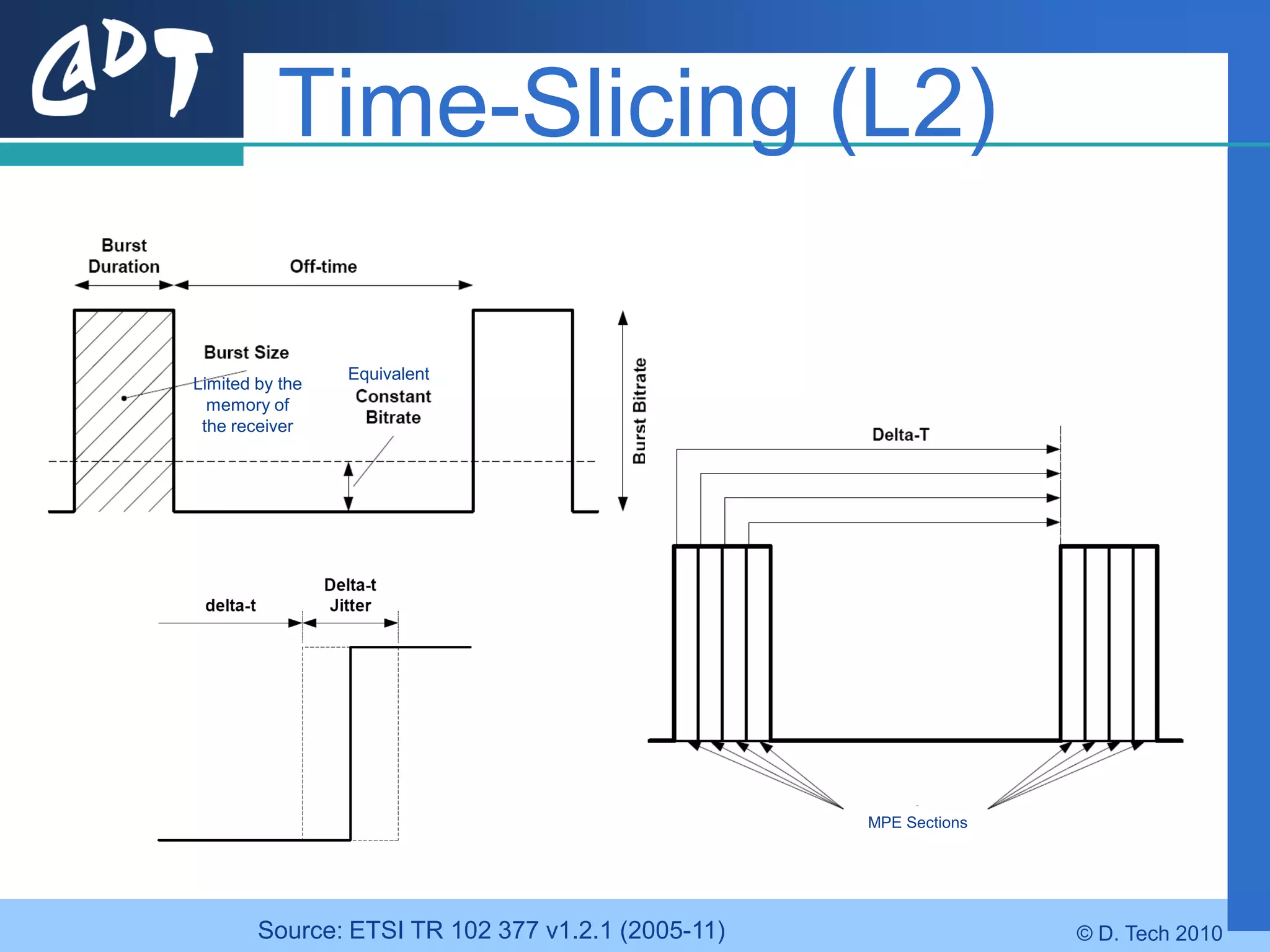
Time-Slicing (L2)

                 Equivalent
Limited by the
  memory of
 the receiver


                                                   MPE Sections


        Source: ETSI TR 102 377 v1.2.1 (2005-11)                  © D. Tech 2010
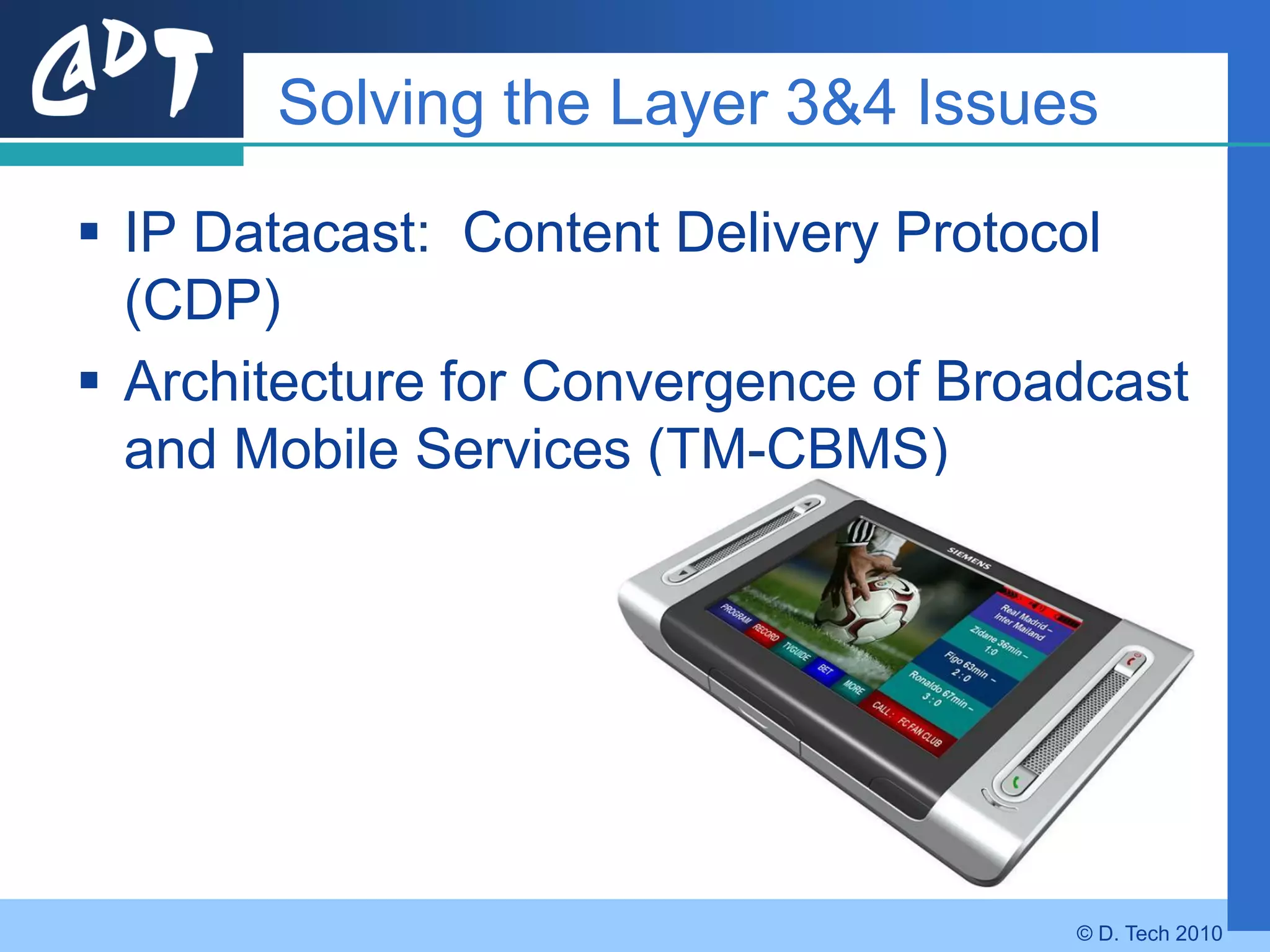
Solving the Layer 3&4 Issues

 IP Datacast: Content Delivery Protocol
  (CDP)
 Architecture for Convergence of Broadcast
  and Mobile Services (TM-CBMS)


                                      © D. Tech 2010
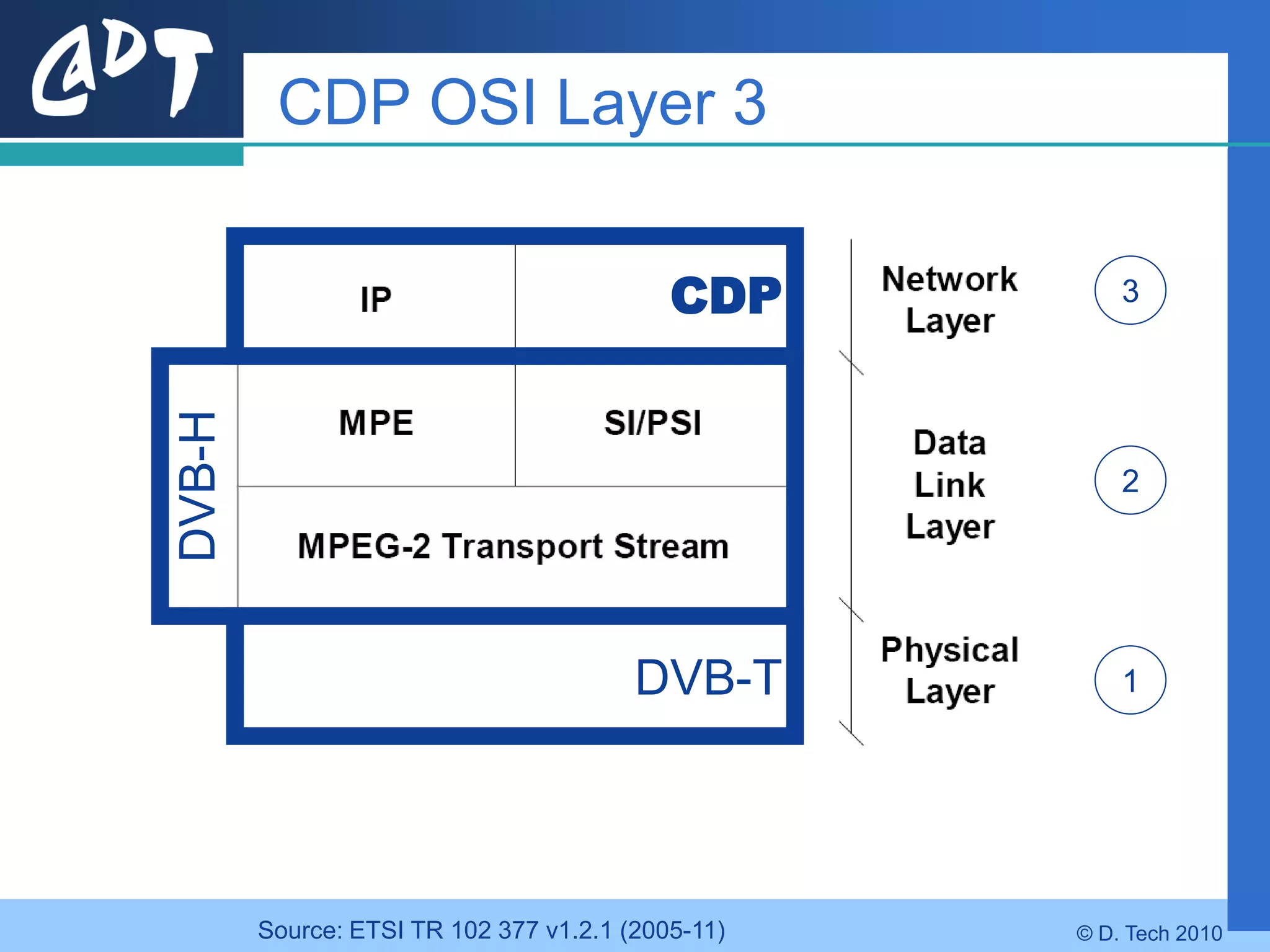
CDP OSI Layer 3

                                           CDP         3
DVB-H


                                                       2


                                        DVB-T          1


        Source: ETSI TR 102 377 v1.2.1 (2005-11)   © D. Tech 2010
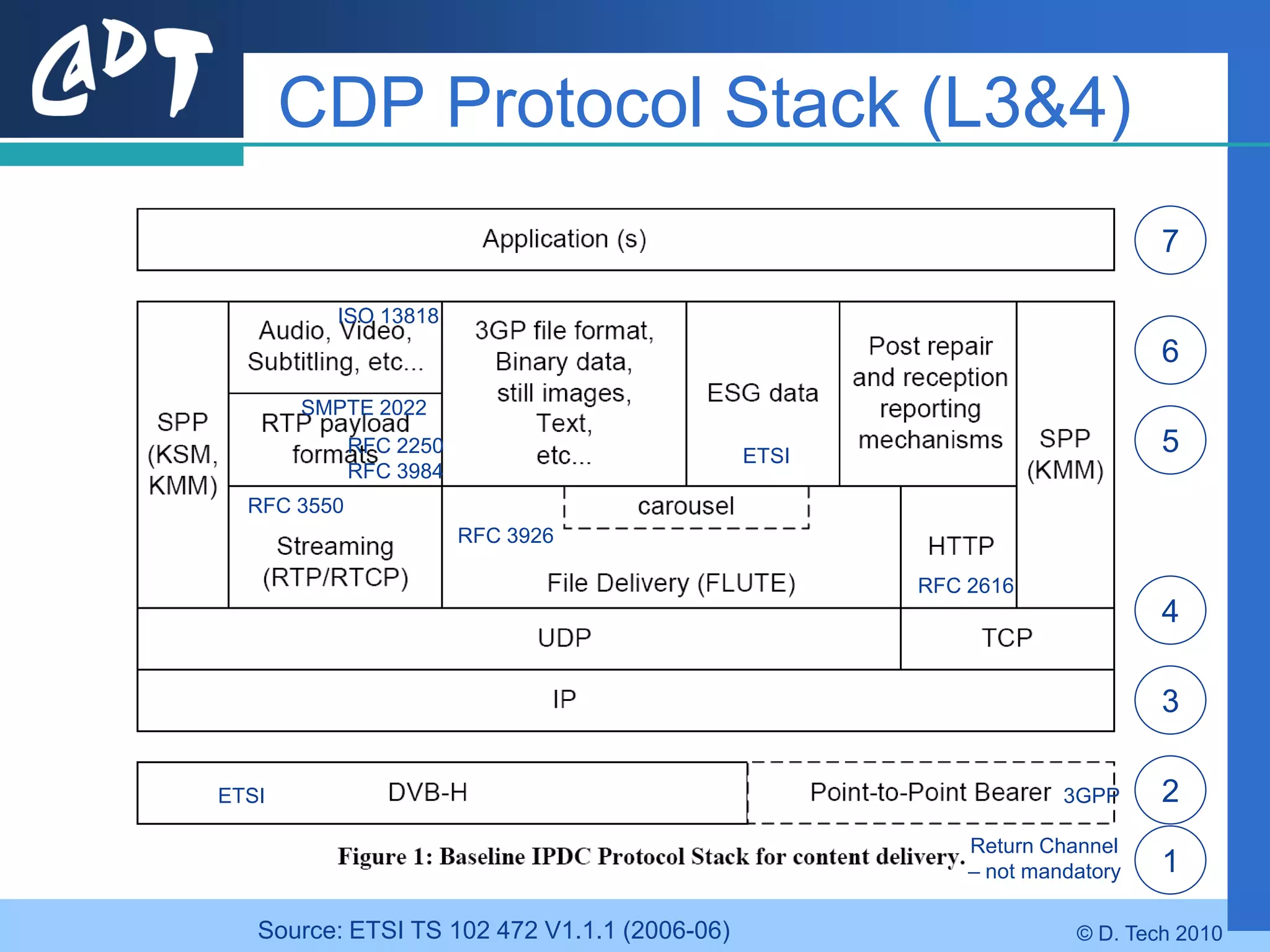
CDP Protocol Stack (L3&4)
                                                                           7

         ISO 13818
                                                                           6
       SMPTE 2022
             RFC 2250                         ETSI
                                                                           5
             RFC 3984
  RFC 3550
                        RFC 3926

                                                     RFC 2616
                                                                           4

                                                                           3

ETSI                                                              3GPP     2
                                                         Return Channel
                                                         – not mandatory   1

   Source: ETSI TS 102 472 V1.1.1 (2006-06)                        © D. Tech 2010
System Technical Review


                             Marie Josée (MJ) Drouin,
      SMPTE Toronto Chapter BootCamp, June 8th, 2010
                                           © D. Tech 2010
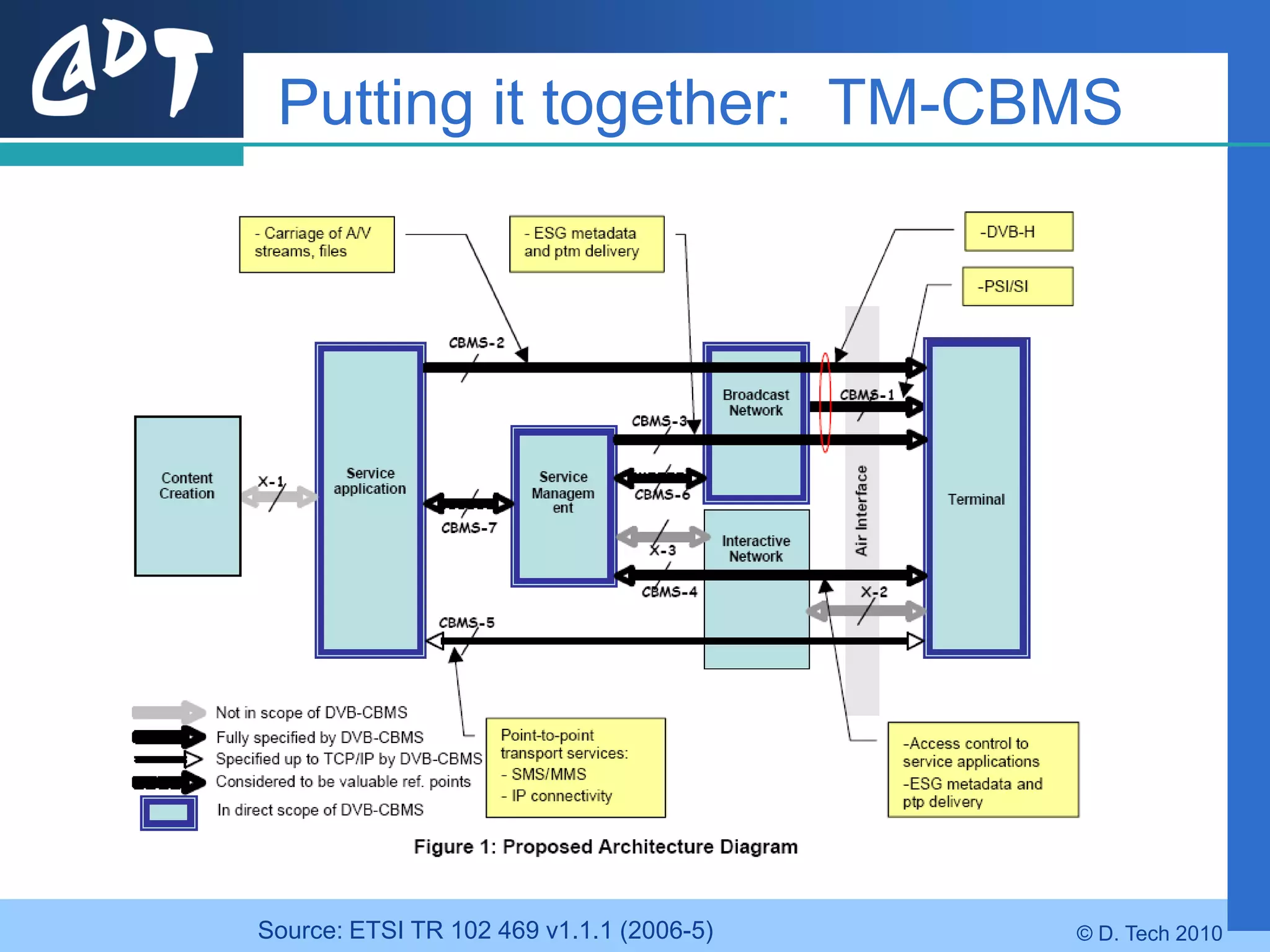
Putting it together: TM-CBMS


Source: ETSI TR 102 469 v1.1.1 (2006-5)   © D. Tech 2010
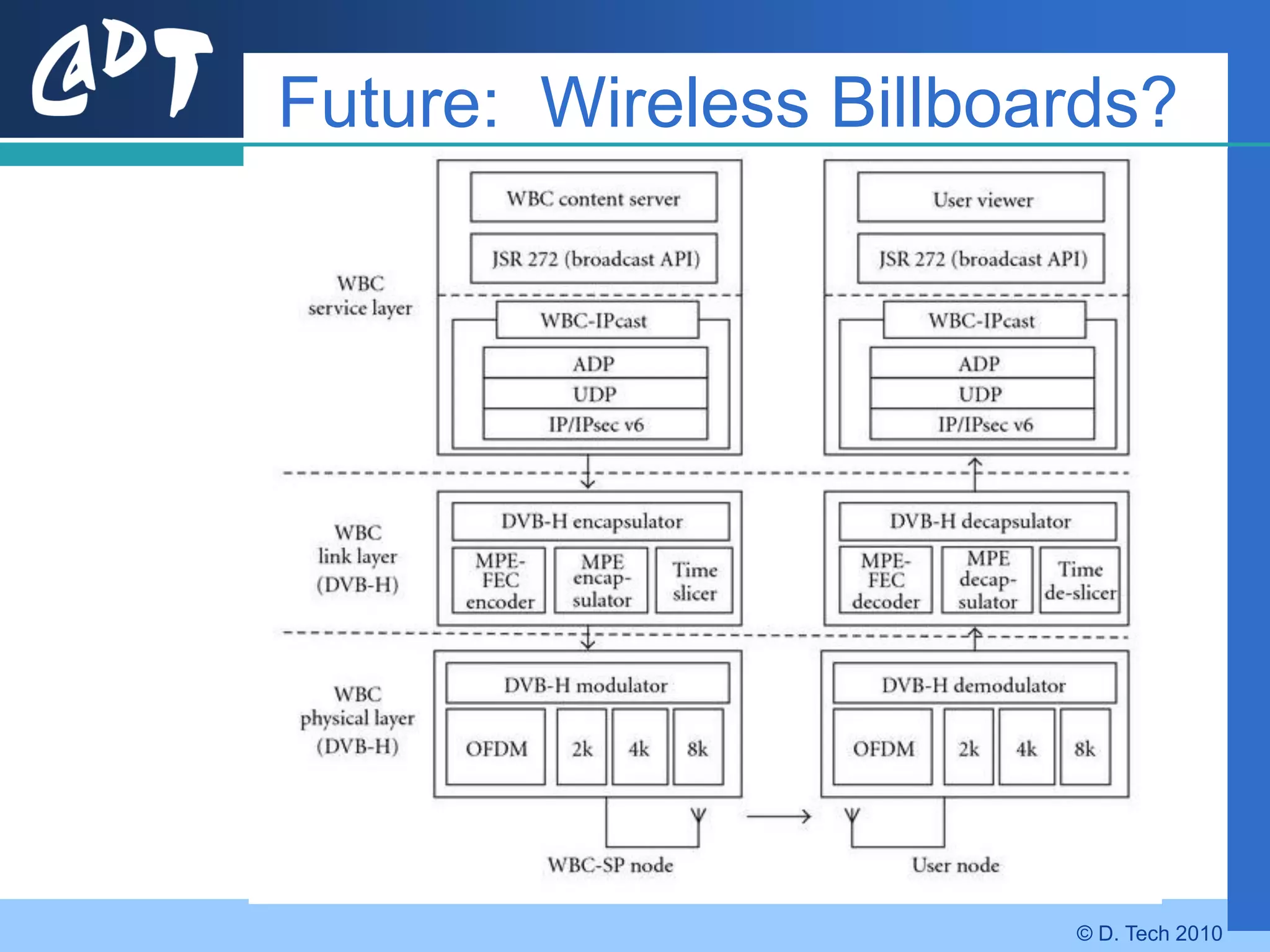
Future: Wireless Billboards?


                        © D. Tech 2010
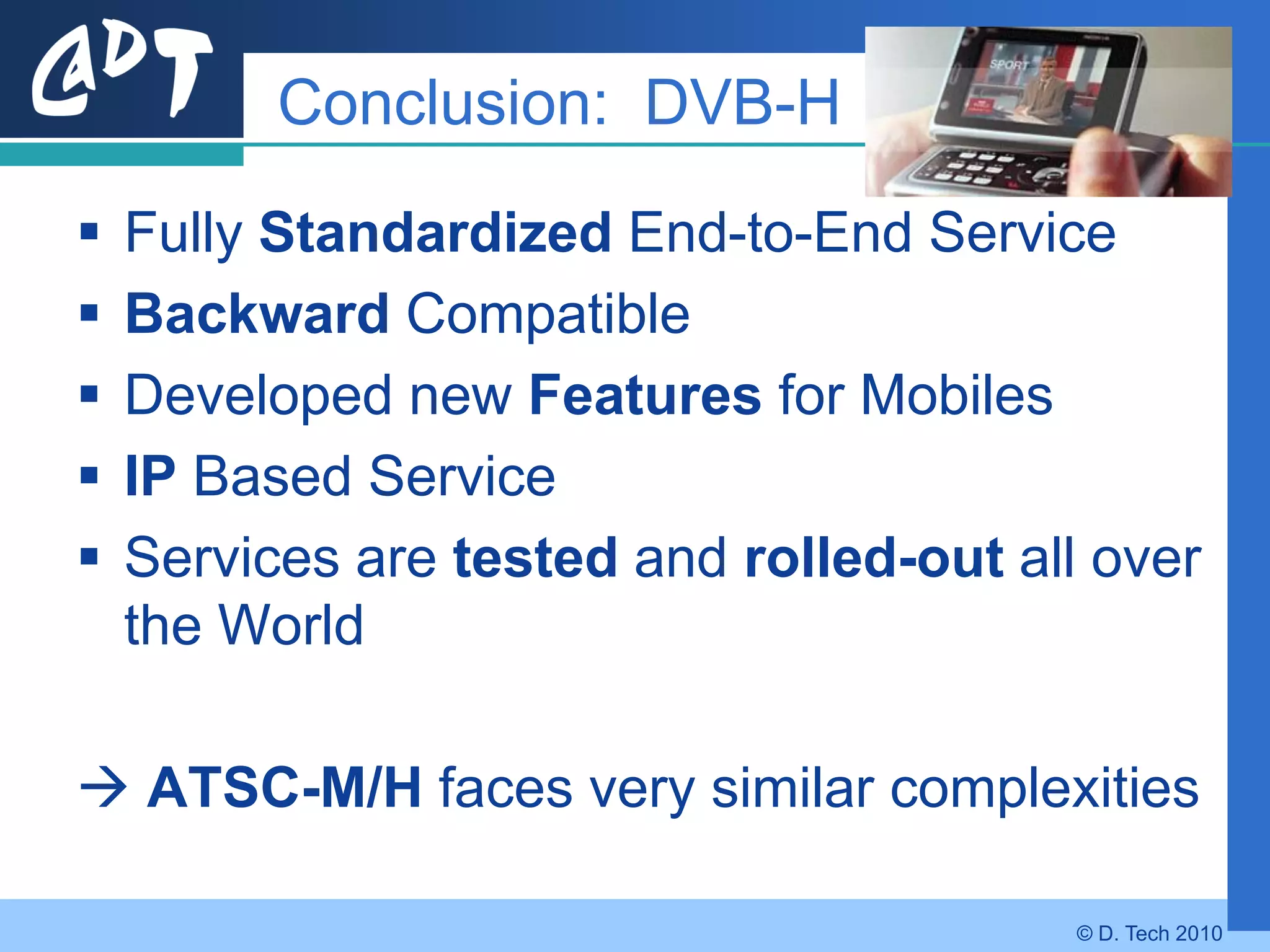
Conclusion: DVB-H

   Fully Standardized End-to-End Service
   Backward Compatible
   Developed new Features for Mobiles
   IP Based Service
   Services are tested and rolled-out all over
    the World

 ATSC-M/H faces very similar complexities

                                          © D. Tech 2010
mjdrouin@gmail.com


                  Thank You


                       Marie Josée (MJ) Drouin,
SMPTE Toronto Chapter BootCamp, June 8th, 2010
                                     © D. Tech 2010

Video over IP goes wireless: A DVB-H Tutorial

  • 1.
    A DVB-H Tutorial Video over IP goes Wireless Marie Josée (MJ) Drouin, SMPTE Toronto Chapter BootCamp, June 8th, 2010 © D. Tech 2010
  • 2.
    Who am I?  Director with 15 years of Media experience, I lead technical teams of up to 30 people and 3 managers to deliver most aspects of the business - Operations, Customer Services, Information Technologies, Project Management, Engineering, and Procurement. I developed expertise in MJ Drouin© - May 19th, 2010 managing cable, wireless, satellite, transmission, engineering and software development. I worked at Bell, Teleglobe, Intelsat, CBC and as a expert consultant.  Professional Engineer, Masters in Technological Management, ITIL foundation, PMP - VSF  I have extensive experience in speaking since the 90's (ouf!), subjects were always a mix of technologies, commerce and management.  Past engagements included: My video is a file, now what? (2010), Service Oriented Architecture: Tutorial for the Broadcasters (2010), Pitfalls of SW development: What every executive should know (2009), 8 weeks on Twitter: I love it! (2009), The Future of Broadcast Archive Systems (2008), DVB-H: Video over IP goes Wireless (2006), HDTV distribution (2005), Video over IP (2004) and, Several broadcast technical training (1994-1998): Video 101, Digital Video and Compression 201, Video testing techniques 301.  http://www.linkedin.com/in/mjdrouin  http://twitter.com/mjdrouin 2 © D. Tech 2010
  • 3.
  • 4.
    Agenda 1. Video overMobiles 2. DVB-H Technical Review 3. System Technical Review © D. Tech 2010
  • 5.
    Introduction  Smart Phones= 50% by Q3 2011  50% users watch video on Smart Phones Source: Nielsen’s data from Q3 2009 © D. Tech 2010
  • 6.
    Video Over Mobiles Marie Josée (MJ) Drouin, SMPTE Toronto Chapter BootCamp, June 8th, 2010 © D. Tech 2010
  • 7.
    Mobile: What’s different? Traditional DTV Display  Uses wireline or large antennas  Has unlimited 110V/220V power  Is fixed  Methods to view Video on mobile  PodCast, mobile PVR  Internet services  Applications  3G/4G cell technology  Parallel broadcast networks © D. Tech 2010
  • 8.
    Broadcast or Telecom? Source:August 2009 CRTC Communications Monitoring Report © D. Tech 2010
  • 9.
    Video over MobileStandards Standards Origin Dates ATSC-M/H ATSC T: 2006 US D: 2009 DVB-H DVB (ETSI) T: 2004 International D: 2006 Single-segment DiBEG (ARIB) T: 2004 ISDB-T Japan, Brazil D: 2006 DMB-T/H DAB/DMB (ETSI) T: 2006 China, Korea D: 2006 Legend: T: Public Trial, D: Commercial Deployment © D. Tech 2010
  • 10.
    Standards per Country © D. Tech 2010
  • 11.
    What is DVB-H? Built by DVB  Standardized by ETSI  Unidirectional  Based on DVB-T, Digital TV terrestrial transport  IP packets at the Network Layer  Can be muxed with DVB-T CBR services © D. Tech 2010
  • 12.
    DVB-H Technical Review Marie Josée (MJ) Drouin, SMPTE Toronto Chapter BootCamp, June 8th, 2010 © D. Tech 2010
  • 13.
    DVB-T: OSI Layer1 3 2 DVB-T 1 Source: ETSI TR 102 377 v1.2.1 (2005-11) © D. Tech 2010
  • 14.
    DVB-T Modifications (L1) DVB-H signaling in TPS-Bits: Mandatory  Mandatory Signaling: Cell ID, Time Slicing  DVB-H Options using TPS bits signaling: MPE-FEC, Interleaver depth, 4K mode  4K FFT size mode: Optional  In-depth symbol interleaver: Optional  8K interleaver for 2k and 4k modes © D. Tech 2010
  • 15.
    DVB-H Protocol Stack& OSI L2 3 DVB-H 2 DVB-T 1 Source: ETSI TR 102 377 v1.2.1 (2005-11) © D. Tech 2010
  • 16.
    DVB-H Innovations (L2) Time-slicing: Mandatory  Power reduction  MPE-FEC: Optional  C/N  Doppler  Impulse interference © D. Tech 2010
  • 17.
    DVB-H System PSI/SI NIT Video INT Video TS DVB-T Receiver MPEG4 MPEG4 MPEG4 Encoder IP Encoder Encoder RF IRD H264 RF RF IP Backbone DVB-H Receiver * Inspired by ETSI TR 102 377 v1.2.1 (2005-11) © D. Tech 2010
  • 18.
    Solving the Layer1&2 Issues  Mobility – Doppler:  4K FFT size  Power consumption:  Time Slicing © D. Tech 2010
  • 19.
    Doppler Effect (L1) Mobiles IRD Source: ETSI TR 102 377 v1.2.1 (2005-11) © D. Tech 2010
  • 20.
    FFT Size Impacts(L1) OFDM parameters, 16QAM, GI 1/4, 6MHz Modes, FFT size FFT symbol size characteristics 2K 4K 8K Number of Carriers (K) 1705 3409 6817 Duration of symbol - Tu (µsec) 299 597 1195 Carrier Spacing - 1/Tu (Hz) 3348 1674 837 Duration of guard interval - Δ (µsec) 75 149 299  FFT size Impacts on RF performance  Doppler Frequency – Mobility  Echo delay – Maximum SFN radius area  Channel estimation – Demodulator complexity & power  Phase noise resistance – Robustness Source: ETSI TR 102 377 v1.2.1 (2005-11) & ETSI EN 300 744 V.1.5.1 (2004-11) 2010 © D. Tech
  • 21.
    Power Consumption (L2) Source:ETSI TR 102 377 v1.2.1 (2005-11) © D. Tech 2010
  • 22.
    Time-Slicing (L2) Equivalent Limited by the memory of the receiver MPE Sections Source: ETSI TR 102 377 v1.2.1 (2005-11) © D. Tech 2010
  • 23.
    Solving the Layer3&4 Issues  IP Datacast: Content Delivery Protocol (CDP)  Architecture for Convergence of Broadcast and Mobile Services (TM-CBMS) © D. Tech 2010
  • 24.
    CDP OSI Layer3 CDP 3 DVB-H 2 DVB-T 1 Source: ETSI TR 102 377 v1.2.1 (2005-11) © D. Tech 2010
  • 25.
    CDP Protocol Stack(L3&4) 7 ISO 13818 6 SMPTE 2022 RFC 2250 ETSI 5 RFC 3984 RFC 3550 RFC 3926 RFC 2616 4 3 ETSI 3GPP 2 Return Channel – not mandatory 1 Source: ETSI TS 102 472 V1.1.1 (2006-06) © D. Tech 2010
  • 26.
    System Technical Review Marie Josée (MJ) Drouin, SMPTE Toronto Chapter BootCamp, June 8th, 2010 © D. Tech 2010
  • 27.
    Putting it together:TM-CBMS Source: ETSI TR 102 469 v1.1.1 (2006-5) © D. Tech 2010
  • 28.
  • 29.
    Conclusion: DVB-H  Fully Standardized End-to-End Service  Backward Compatible  Developed new Features for Mobiles  IP Based Service  Services are tested and rolled-out all over the World  ATSC-M/H faces very similar complexities © D. Tech 2010
  • 30.
    mjdrouin@gmail.com Thank You Marie Josée (MJ) Drouin, SMPTE Toronto Chapter BootCamp, June 8th, 2010 © D. Tech 2010