An FFT Prec for FSM on GPGPU’s por M.Storti et.al.
An FFT Preconditioning Technique for the
Solution of Incompressible Flow with
Fractional Step Methods on GPGPU’s
por M.Storti, R.Paz, L.Dalcin, S.Costarelli
Centro Internacional de M´etodos Computacionales
en Ingenier´ıa - CIMEC
INTEC, (CONICET-UNL), Santa Fe, Argentina
mario.storti@gmail.com
http://www.cimec.org.ar/mstorti
CIMEC-INTEC-CONICET-UNL 1
((version texstuff-1.0.35-8-g7f2f93d Tue Nov 16 13:02:45 2010 -0300) (date Thu Nov 18 07:27:53 2010 -0300))
An FFT Prec for FSM on GPGPU’s por M.Storti et.al.
Solution of incompressible Navier-Stokes flows on GPU
• GPU’s are less efficient for algorithms that require access to the card’s
(device) global memory. Shared memory is much faster but usually scarce
(16K per thread block in the Tesla C1060) .
• The best algorithms are those that make computations for one cell
requiring only information on that cell and their neighbors. These
algorithms are classified as cellular automata (CA).
• Lattice-Boltzmann and explicit F M (FDM/FVM/FEM) fall in this category.
• Structured meshes require less data to exchange between cells (e.g.
neighbor indices are computed, no stored), and so, they require less
shared memory. Also, very fast solvers like FFT-based (Fast Fourier
Transform) or Geometric Multigrid are available .
CIMEC-INTEC-CONICET-UNL 2
((version texstuff-1.0.35-8-g7f2f93d Tue Nov 16 13:02:45 2010 -0300) (date Thu Nov 18 07:27:53 2010 -0300))
An FFT Prec for FSM on GPGPU’s por M.Storti et.al.
Fractional Step Method on structured grids with QUICK
Proposed by Molemaker et.al. SCA’08: 2008 ACM SIGGRAPH, Low viscosity
flow simulations for animation.
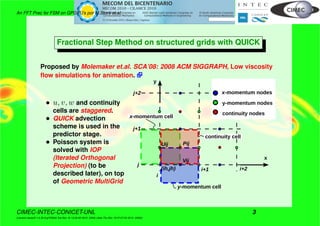
• u, v, w and continuity
cells are staggered.
• QUICK advection
scheme is used in the
predictor stage.
• Poisson system is
solved with IOP
(Iterated Orthogonal
Projection) (to be
described later), on top
of Geometric MultiGrid
j
j+1
j+2
i+1 i+2(ih,jh)
Vij
PijUij
x
y
i
y-momentum cell
x-momentum nodes
y-momentum nodes
continuity nodes
x-momentum cell
continuity cell
CIMEC-INTEC-CONICET-UNL 3
((version texstuff-1.0.35-8-g7f2f93d Tue Nov 16 13:02:45 2010 -0300) (date Thu Nov 18 07:27:53 2010 -0300))
An FFT Prec for FSM on GPGPU’s por M.Storti et.al.
Quick advection scheme
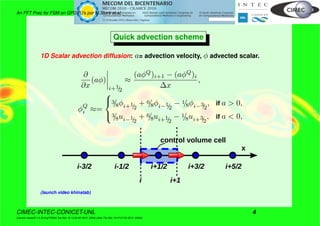
1D Scalar advection diffusion: a= advection velocity, φ advected scalar.
∂
∂x
(aφ)
i+1/2
≈
(aφQ
)i+1 − (aφQ
)i
∆x
,
φQ
i ≈=



3/8φi+1/2
+ 6/8φi−1/2
− 1/8φi−3/2
, if a > 0,
3/8ui−1/2
+ 6/8ui+1/2
− 1/8ui+3/2
, if a < 0,
x
i+1/2 i+3/2 i+5/2i-1/2i-3/2
control volume cell
i+1i
(launch video khinstab)
CIMEC-INTEC-CONICET-UNL 4
((version texstuff-1.0.35-8-g7f2f93d Tue Nov 16 13:02:45 2010 -0300) (date Thu Nov 18 07:27:53 2010 -0300))
An FFT Prec for FSM on GPGPU’s por M.Storti et.al.
Solution of the Poisson equation on embedded geometries
• Solution of the Poisson equation is, for large meshes, the more CPU
consuming time stage in Fractional-Step like Navier-Stokes solvers.
• One approach for the solution is the IOP (Iterated Orthogonal Projection)
algorithm.
• It is based on solving iteratively the Poisson eq. on the whole domain
(fluid+solid). Solving in the whole domain is fast, because algorithms like
Geometric Multigrid or FFT can be used. Also, they are very efficient
running on GPU’s .
• However, if we solve in the whole domain, then we can’t enforce the
boundary condition (∂p/∂n) = 0 at the solid boundary which, then
means the violation of the condition of impenetrability at the solid
boundary .
CIMEC-INTEC-CONICET-UNL 5
((version texstuff-1.0.35-8-g7f2f93d Tue Nov 16 13:02:45 2010 -0300) (date Thu Nov 18 07:27:53 2010 -0300))
An FFT Prec for FSM on GPGPU’s por M.Storti et.al.
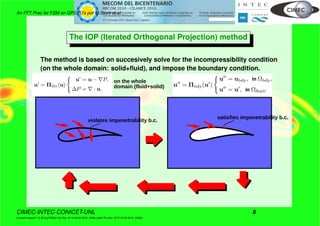
The IOP (Iterated Orthogonal Projection) method
The method is based on succesively solve for the incompressibility condition
(on the whole domain: solid+fluid), and impose the boundary condition.
on the whole
domain (fluid+solid)
violates impenetrability b.c.
satisfies impenetrability b.c.
CIMEC-INTEC-CONICET-UNL 6
((version texstuff-1.0.35-8-g7f2f93d Tue Nov 16 13:02:45 2010 -0300) (date Thu Nov 18 07:27:53 2010 -0300))
An FFT Prec for FSM on GPGPU’s por M.Storti et.al.
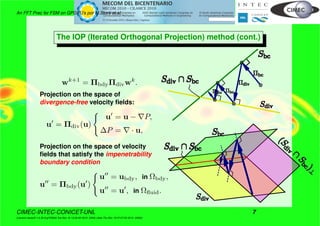
The IOP (Iterated Orthogonal Projection) method (cont.)
wk+1
= ΠbdyΠdivwk
.
Projection on the space of
divergence-free velocity fields:
u = Πdiv(u)
u = u − P,
∆P = · u,
Projection on the space of velocity
fields that satisfy the impenetrability
boundary condition
u = Πbdy(u )
u = ubdy, in Ωbdy,
u = u , in Ωfluid.
CIMEC-INTEC-CONICET-UNL 7
((version texstuff-1.0.35-8-g7f2f93d Tue Nov 16 13:02:45 2010 -0300) (date Thu Nov 18 07:27:53 2010 -0300))
An FFT Prec for FSM on GPGPU’s por M.Storti et.al.
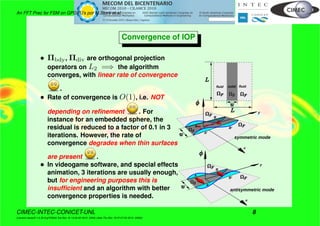
Convergence of IOP
• Πbdy, Πdiv are orthogonal projection
operators on L2 =⇒ the algorithm
converges, with linear rate of convergence
.
• Rate of convergence is O(1), i.e. NOT
depending on refinement . For
instance for an embedded sphere, the
residual is reduced to a factor of 0.1 in 3
iterations. However, the rate of
convergence degrades when thin surfaces
are present .
• In videogame software, and special effects
animation, 3 iterations are usually enough,
but for engineering purposes this is
insufficient and an algorithm with better
convergence properties is needed.
x
y
A
A'
B
B'
x
y
A'
B
B'
symmetric mode
antisymmetric mode
A
fluid fluidsolid
CIMEC-INTEC-CONICET-UNL 8
((version texstuff-1.0.35-8-g7f2f93d Tue Nov 16 13:02:45 2010 -0300) (date Thu Nov 18 07:27:53 2010 -0300))
An FFT Prec for FSM on GPGPU’s por M.Storti et.al.
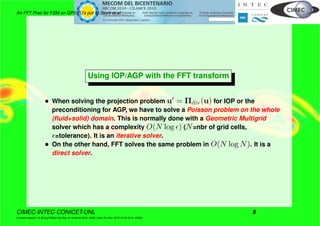
Using IOP/AGP with the FFT transform
• When solving the projection problem u = Πdiv(u) for IOP or the
preconditioning for AGP, we have to solve a Poisson problem on the whole
(fluid+solid) domain. This is normally done with a Geometric Multigrid
solver which has a complexity O(N log ) (N=nbr of grid cells,
=tolerance). It is an iterative solver.
• On the other hand, FFT solves the same problem in O(N log N). It is a
direct solver.
CIMEC-INTEC-CONICET-UNL 9
((version texstuff-1.0.35-8-g7f2f93d Tue Nov 16 13:02:45 2010 -0300) (date Thu Nov 18 07:27:53 2010 -0300))
An FFT Prec for FSM on GPGPU’s por M.Storti et.al.
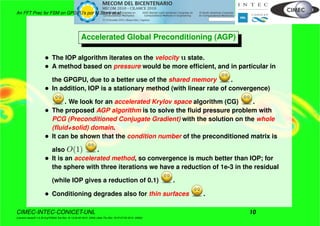
Accelerated Global Preconditioning (AGP)
• The IOP algorithm iterates on the velocity u state.
• A method based on pressure would be more efficient, and in particular in
the GPGPU, due to a better use of the shared memory .
• In addition, IOP is a stationary method (with linear rate of convergence)
. We look for an accelerated Krylov space algorithm (CG) .
• The proposed AGP algorithm is to solve the fluid pressure problem with
PCG (Preconditioned Conjugate Gradient) with the solution on the whole
(fluid+solid) domain.
• It can be shown that the condition number of the preconditioned matrix is
also O(1) .
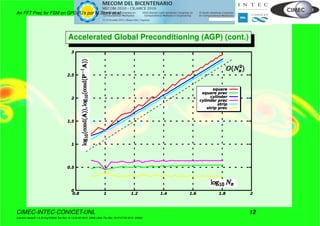
• It is an accelerated method, so convergence is much better than IOP; for
the sphere with three iterations we have a reduction of 1e-3 in the residual
(while IOP gives a reduction of 0.1) .
• Conditioning degrades also for thin surfaces .
CIMEC-INTEC-CONICET-UNL 10
((version texstuff-1.0.35-8-g7f2f93d Tue Nov 16 13:02:45 2010 -0300) (date Thu Nov 18 07:27:53 2010 -0300))
An FFT Prec for FSM on GPGPU’s por M.Storti et.al.
Accelerated Global Preconditioning (AGP) (cont.)
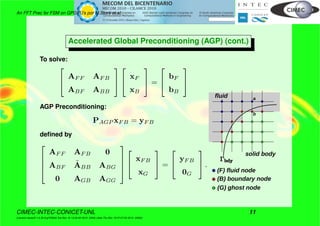
To solve:


AF F AF B
ABF ABB




xF
xB

 =


bF
bB


AGP Preconditioning:
PAGP xF B = yF B
defined by




AF F AF B 0
ABF
˜ABB ABG
0 AGB AGG






xF B
xG

 =


yF B
0G

 .
solid body
fluid a
b
(F) fluid node
(B) boundary node
(G) ghost node
CIMEC-INTEC-CONICET-UNL 11
((version texstuff-1.0.35-8-g7f2f93d Tue Nov 16 13:02:45 2010 -0300) (date Thu Nov 18 07:27:53 2010 -0300))
An FFT Prec for FSM on GPGPU’s por M.Storti et.al.
Accelerated Global Preconditioning (AGP) (cont.)
0
0.5
1
1.5
2
2.5
3
0.8 1 1.2 1.4 1.6 1.8 2
square
square prec
cylinder
cylinder prec
strip
strip prec
CIMEC-INTEC-CONICET-UNL 12
((version texstuff-1.0.35-8-g7f2f93d Tue Nov 16 13:02:45 2010 -0300) (date Thu Nov 18 07:27:53 2010 -0300))
An FFT Prec for FSM on GPGPU’s por M.Storti et.al.
Spectral decomposition of Stekhlov operators
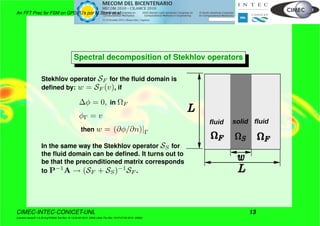
Stekhlov operator SF for the fluid domain is
defined by: w = SF (v), if
∆φ = 0, in ΩF
φΓ = v
then w = (∂φ/∂n)|Γ
In the same way the Stekhlov operator SS for
the fluid domain can be defined. It turns out to
be that the preconditioned matrix corresponds
to P−1
A → (SF + SS)−1
SF .
fluid fluidsolid
CIMEC-INTEC-CONICET-UNL 13
((version texstuff-1.0.35-8-g7f2f93d Tue Nov 16 13:02:45 2010 -0300) (date Thu Nov 18 07:27:53 2010 -0300))
An FFT Prec for FSM on GPGPU’s por M.Storti et.al.
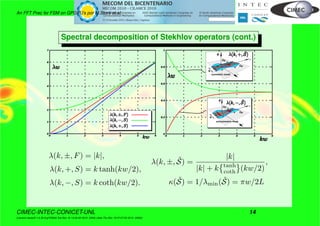
Spectral decomposition of Stekhlov operators (cont.)
0
1
2
3
4
5
6
7
0 1 2 3 4 5 6
0
0.2
0.4
0.6
0.8
1
0 1 2 3 4 5 6
x
y
A
A'
B
B'
symmetric mode
x
y
A'
B
B'
antisymmetric mode
A
λ(k, ±, F) = |k|,
λ(k, +, S) = k tanh(kw/2),
λ(k, −, S) = k coth(kw/2).
λ(k, ±, ˜S) =
|k|
|k| + k tanh
coth (kw/2)
,
κ( ˜S) = 1/λmin( ˜S) = πw/2L
CIMEC-INTEC-CONICET-UNL 14
((version texstuff-1.0.35-8-g7f2f93d Tue Nov 16 13:02:45 2010 -0300) (date Thu Nov 18 07:27:53 2010 -0300))
An FFT Prec for FSM on GPGPU’s por M.Storti et.al.
Implementation details on the GPU
• We use the CUFFT library.
• Per iteration: 2 FFT’s and
Poisson residual
evaluation. The FFT on the
GPU Tesla C1060 performs
at 27 Gflops, where the
operations are counted as
5N log2(N). The new
Tesla C2050 (Fermi) GPU
has a performance of
80 Gflops for the FFT.
• For a grid of 128x128x64
8ms/iter (2x4ms, for each
FFT), so the cost per time
step (Poisson only,
assuming 3 iterations) is of
24ms.
0
5
10
15
20
25
30
10^{3} 10^{4} 10^{5} 10^{6} 10^{7} 10^{8}
FFTcomputingrate[Gflops]
Number of cells
CIMEC-INTEC-CONICET-UNL 15
((version texstuff-1.0.35-8-g7f2f93d Tue Nov 16 13:02:45 2010 -0300) (date Thu Nov 18 07:27:53 2010 -0300))
An FFT Prec for FSM on GPGPU’s por M.Storti et.al.
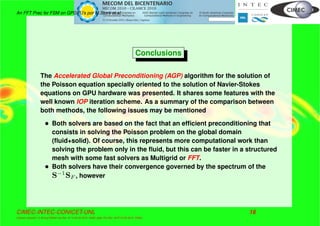
Conclusions
The Accelerated Global Preconditioning (AGP) algorithm for the solution of
the Poisson equation specially oriented to the solution of Navier-Stokes
equations on GPU hardware was presented. It shares some features with the
well known IOP iteration scheme. As a summary of the comparison between
both methods, the following issues may be mentioned
• Both solvers are based on the fact that an efficient preconditioning that
consists in solving the Poisson problem on the global domain
(fluid+solid). Of course, this represents more computational work than
solving the problem only in the fluid, but this can be faster in a structured
mesh with some fast solvers as Multigrid or FFT.
• Both solvers have their convergence governed by the spectrum of the
S−1
SF , however
CIMEC-INTEC-CONICET-UNL 16
((version texstuff-1.0.35-8-g7f2f93d Tue Nov 16 13:02:45 2010 -0300) (date Thu Nov 18 07:27:53 2010 -0300))
An FFT Prec for FSM on GPGPU’s por M.Storti et.al.
IOP is a stationary method and its limit rate of convergence is given by
rn+1
≤ γIOP rn
γIOP = 1 − λmin,
λmin = min(eig(S−1
SF )).
(1)
AGP is a preconditioned Krylov space method and its convergence is
governed by the condition number of S−1
SF , i.e.
κ(A−1
AF ) =
1
min(eig(S−1SF ))
=
1
λmin
, (2)
• It has been shown that λmin = O(1), i.e. it does not degrade with
refinement, so that IOP has a linear convergence with limit rate O(1).
• By the same reason, the condition number for AGP does not degrade with
refinement.
• IOP iterates over both the velocity and pressure fields, whereas AGP
iterates only on the pressure vector (which is better for implementation on
GPU’s).
CIMEC-INTEC-CONICET-UNL 17
((version texstuff-1.0.35-8-g7f2f93d Tue Nov 16 13:02:45 2010 -0300) (date Thu Nov 18 07:27:53 2010 -0300))
An FFT Prec for FSM on GPGPU’s por M.Storti et.al.
Acknowledgments
This work has received financial support from
• Consejo Nacional de Investigaciones Cient´ıficas y T´ecnicas (CONICET,
Argentina, PIP 5271/05),
• Universidad Nacional del Litoral (UNL, Argentina, grant CAI+D
2009-65/334),
• Agencia Nacional de Promoci´on Cient´ıfica y Tecnol´ogica (ANPCyT,
Argentina, grants PICT-1506/2006, PICT-1141/2007, PICT-0270/2008), and
• European Research Council (ERC) Advanced Grant, Real Time
Computational Mechanics Techniques for Multi-Fluid Problems
(REALTIME, Reference: ERC-2009-AdG, Dir: Dr. Sergio Idelsohn).
The authors made extensive use of Free Software as GNU/Linux OS, GCC/G++
compilers, Octave, and Open Source software as VTK among many others. In
addition, many ideas from these packages have been inspiring to them.
CIMEC-INTEC-CONICET-UNL 18
((version texstuff-1.0.35-8-g7f2f93d Tue Nov 16 13:02:45 2010 -0300) (date Thu Nov 18 07:27:53 2010 -0300))

Gpuslides

  • 1.
    An FFT Precfor FSM on GPGPU’s por M.Storti et.al. An FFT Preconditioning Technique for the Solution of Incompressible Flow with Fractional Step Methods on GPGPU’s por M.Storti, R.Paz, L.Dalcin, S.Costarelli Centro Internacional de M´etodos Computacionales en Ingenier´ıa - CIMEC INTEC, (CONICET-UNL), Santa Fe, Argentina mario.storti@gmail.com http://www.cimec.org.ar/mstorti CIMEC-INTEC-CONICET-UNL 1 ((version texstuff-1.0.35-8-g7f2f93d Tue Nov 16 13:02:45 2010 -0300) (date Thu Nov 18 07:27:53 2010 -0300))
  • 2.
    An FFT Precfor FSM on GPGPU’s por M.Storti et.al. Solution of incompressible Navier-Stokes flows on GPU • GPU’s are less efficient for algorithms that require access to the card’s (device) global memory. Shared memory is much faster but usually scarce (16K per thread block in the Tesla C1060) . • The best algorithms are those that make computations for one cell requiring only information on that cell and their neighbors. These algorithms are classified as cellular automata (CA). • Lattice-Boltzmann and explicit F M (FDM/FVM/FEM) fall in this category. • Structured meshes require less data to exchange between cells (e.g. neighbor indices are computed, no stored), and so, they require less shared memory. Also, very fast solvers like FFT-based (Fast Fourier Transform) or Geometric Multigrid are available . CIMEC-INTEC-CONICET-UNL 2 ((version texstuff-1.0.35-8-g7f2f93d Tue Nov 16 13:02:45 2010 -0300) (date Thu Nov 18 07:27:53 2010 -0300))
  • 3.
    An FFT Precfor FSM on GPGPU’s por M.Storti et.al. Fractional Step Method on structured grids with QUICK Proposed by Molemaker et.al. SCA’08: 2008 ACM SIGGRAPH, Low viscosity flow simulations for animation. • u, v, w and continuity cells are staggered. • QUICK advection scheme is used in the predictor stage. • Poisson system is solved with IOP (Iterated Orthogonal Projection) (to be described later), on top of Geometric MultiGrid j j+1 j+2 i+1 i+2(ih,jh) Vij PijUij x y i y-momentum cell x-momentum nodes y-momentum nodes continuity nodes x-momentum cell continuity cell CIMEC-INTEC-CONICET-UNL 3 ((version texstuff-1.0.35-8-g7f2f93d Tue Nov 16 13:02:45 2010 -0300) (date Thu Nov 18 07:27:53 2010 -0300))
  • 4.
    An FFT Precfor FSM on GPGPU’s por M.Storti et.al. Quick advection scheme 1D Scalar advection diffusion: a= advection velocity, φ advected scalar. ∂ ∂x (aφ) i+1/2 ≈ (aφQ )i+1 − (aφQ )i ∆x , φQ i ≈=    3/8φi+1/2 + 6/8φi−1/2 − 1/8φi−3/2 , if a > 0, 3/8ui−1/2 + 6/8ui+1/2 − 1/8ui+3/2 , if a < 0, x i+1/2 i+3/2 i+5/2i-1/2i-3/2 control volume cell i+1i (launch video khinstab) CIMEC-INTEC-CONICET-UNL 4 ((version texstuff-1.0.35-8-g7f2f93d Tue Nov 16 13:02:45 2010 -0300) (date Thu Nov 18 07:27:53 2010 -0300))
  • 5.
    An FFT Precfor FSM on GPGPU’s por M.Storti et.al. Solution of the Poisson equation on embedded geometries • Solution of the Poisson equation is, for large meshes, the more CPU consuming time stage in Fractional-Step like Navier-Stokes solvers. • One approach for the solution is the IOP (Iterated Orthogonal Projection) algorithm. • It is based on solving iteratively the Poisson eq. on the whole domain (fluid+solid). Solving in the whole domain is fast, because algorithms like Geometric Multigrid or FFT can be used. Also, they are very efficient running on GPU’s . • However, if we solve in the whole domain, then we can’t enforce the boundary condition (∂p/∂n) = 0 at the solid boundary which, then means the violation of the condition of impenetrability at the solid boundary . CIMEC-INTEC-CONICET-UNL 5 ((version texstuff-1.0.35-8-g7f2f93d Tue Nov 16 13:02:45 2010 -0300) (date Thu Nov 18 07:27:53 2010 -0300))
  • 6.
    An FFT Precfor FSM on GPGPU’s por M.Storti et.al. The IOP (Iterated Orthogonal Projection) method The method is based on succesively solve for the incompressibility condition (on the whole domain: solid+fluid), and impose the boundary condition. on the whole domain (fluid+solid) violates impenetrability b.c. satisfies impenetrability b.c. CIMEC-INTEC-CONICET-UNL 6 ((version texstuff-1.0.35-8-g7f2f93d Tue Nov 16 13:02:45 2010 -0300) (date Thu Nov 18 07:27:53 2010 -0300))
  • 7.
    An FFT Precfor FSM on GPGPU’s por M.Storti et.al. The IOP (Iterated Orthogonal Projection) method (cont.) wk+1 = ΠbdyΠdivwk . Projection on the space of divergence-free velocity fields: u = Πdiv(u) u = u − P, ∆P = · u, Projection on the space of velocity fields that satisfy the impenetrability boundary condition u = Πbdy(u ) u = ubdy, in Ωbdy, u = u , in Ωfluid. CIMEC-INTEC-CONICET-UNL 7 ((version texstuff-1.0.35-8-g7f2f93d Tue Nov 16 13:02:45 2010 -0300) (date Thu Nov 18 07:27:53 2010 -0300))
  • 8.
    An FFT Precfor FSM on GPGPU’s por M.Storti et.al. Convergence of IOP • Πbdy, Πdiv are orthogonal projection operators on L2 =⇒ the algorithm converges, with linear rate of convergence . • Rate of convergence is O(1), i.e. NOT depending on refinement . For instance for an embedded sphere, the residual is reduced to a factor of 0.1 in 3 iterations. However, the rate of convergence degrades when thin surfaces are present . • In videogame software, and special effects animation, 3 iterations are usually enough, but for engineering purposes this is insufficient and an algorithm with better convergence properties is needed. x y A A' B B' x y A' B B' symmetric mode antisymmetric mode A fluid fluidsolid CIMEC-INTEC-CONICET-UNL 8 ((version texstuff-1.0.35-8-g7f2f93d Tue Nov 16 13:02:45 2010 -0300) (date Thu Nov 18 07:27:53 2010 -0300))
  • 9.
    An FFT Precfor FSM on GPGPU’s por M.Storti et.al. Using IOP/AGP with the FFT transform • When solving the projection problem u = Πdiv(u) for IOP or the preconditioning for AGP, we have to solve a Poisson problem on the whole (fluid+solid) domain. This is normally done with a Geometric Multigrid solver which has a complexity O(N log ) (N=nbr of grid cells, =tolerance). It is an iterative solver. • On the other hand, FFT solves the same problem in O(N log N). It is a direct solver. CIMEC-INTEC-CONICET-UNL 9 ((version texstuff-1.0.35-8-g7f2f93d Tue Nov 16 13:02:45 2010 -0300) (date Thu Nov 18 07:27:53 2010 -0300))
  • 10.
    An FFT Precfor FSM on GPGPU’s por M.Storti et.al. Accelerated Global Preconditioning (AGP) • The IOP algorithm iterates on the velocity u state. • A method based on pressure would be more efficient, and in particular in the GPGPU, due to a better use of the shared memory . • In addition, IOP is a stationary method (with linear rate of convergence) . We look for an accelerated Krylov space algorithm (CG) . • The proposed AGP algorithm is to solve the fluid pressure problem with PCG (Preconditioned Conjugate Gradient) with the solution on the whole (fluid+solid) domain. • It can be shown that the condition number of the preconditioned matrix is also O(1) . • It is an accelerated method, so convergence is much better than IOP; for the sphere with three iterations we have a reduction of 1e-3 in the residual (while IOP gives a reduction of 0.1) . • Conditioning degrades also for thin surfaces . CIMEC-INTEC-CONICET-UNL 10 ((version texstuff-1.0.35-8-g7f2f93d Tue Nov 16 13:02:45 2010 -0300) (date Thu Nov 18 07:27:53 2010 -0300))
  • 11.
    An FFT Precfor FSM on GPGPU’s por M.Storti et.al. Accelerated Global Preconditioning (AGP) (cont.) To solve:   AF F AF B ABF ABB     xF xB   =   bF bB   AGP Preconditioning: PAGP xF B = yF B defined by     AF F AF B 0 ABF ˜ABB ABG 0 AGB AGG       xF B xG   =   yF B 0G   . solid body fluid a b (F) fluid node (B) boundary node (G) ghost node CIMEC-INTEC-CONICET-UNL 11 ((version texstuff-1.0.35-8-g7f2f93d Tue Nov 16 13:02:45 2010 -0300) (date Thu Nov 18 07:27:53 2010 -0300))
  • 12.
    An FFT Precfor FSM on GPGPU’s por M.Storti et.al. Accelerated Global Preconditioning (AGP) (cont.) 0 0.5 1 1.5 2 2.5 3 0.8 1 1.2 1.4 1.6 1.8 2 square square prec cylinder cylinder prec strip strip prec CIMEC-INTEC-CONICET-UNL 12 ((version texstuff-1.0.35-8-g7f2f93d Tue Nov 16 13:02:45 2010 -0300) (date Thu Nov 18 07:27:53 2010 -0300))
  • 13.
    An FFT Precfor FSM on GPGPU’s por M.Storti et.al. Spectral decomposition of Stekhlov operators Stekhlov operator SF for the fluid domain is defined by: w = SF (v), if ∆φ = 0, in ΩF φΓ = v then w = (∂φ/∂n)|Γ In the same way the Stekhlov operator SS for the fluid domain can be defined. It turns out to be that the preconditioned matrix corresponds to P−1 A → (SF + SS)−1 SF . fluid fluidsolid CIMEC-INTEC-CONICET-UNL 13 ((version texstuff-1.0.35-8-g7f2f93d Tue Nov 16 13:02:45 2010 -0300) (date Thu Nov 18 07:27:53 2010 -0300))
  • 14.
    An FFT Precfor FSM on GPGPU’s por M.Storti et.al. Spectral decomposition of Stekhlov operators (cont.) 0 1 2 3 4 5 6 7 0 1 2 3 4 5 6 0 0.2 0.4 0.6 0.8 1 0 1 2 3 4 5 6 x y A A' B B' symmetric mode x y A' B B' antisymmetric mode A λ(k, ±, F) = |k|, λ(k, +, S) = k tanh(kw/2), λ(k, −, S) = k coth(kw/2). λ(k, ±, ˜S) = |k| |k| + k tanh coth (kw/2) , κ( ˜S) = 1/λmin( ˜S) = πw/2L CIMEC-INTEC-CONICET-UNL 14 ((version texstuff-1.0.35-8-g7f2f93d Tue Nov 16 13:02:45 2010 -0300) (date Thu Nov 18 07:27:53 2010 -0300))
  • 15.
    An FFT Precfor FSM on GPGPU’s por M.Storti et.al. Implementation details on the GPU • We use the CUFFT library. • Per iteration: 2 FFT’s and Poisson residual evaluation. The FFT on the GPU Tesla C1060 performs at 27 Gflops, where the operations are counted as 5N log2(N). The new Tesla C2050 (Fermi) GPU has a performance of 80 Gflops for the FFT. • For a grid of 128x128x64 8ms/iter (2x4ms, for each FFT), so the cost per time step (Poisson only, assuming 3 iterations) is of 24ms. 0 5 10 15 20 25 30 10^{3} 10^{4} 10^{5} 10^{6} 10^{7} 10^{8} FFTcomputingrate[Gflops] Number of cells CIMEC-INTEC-CONICET-UNL 15 ((version texstuff-1.0.35-8-g7f2f93d Tue Nov 16 13:02:45 2010 -0300) (date Thu Nov 18 07:27:53 2010 -0300))
  • 16.
    An FFT Precfor FSM on GPGPU’s por M.Storti et.al. Conclusions The Accelerated Global Preconditioning (AGP) algorithm for the solution of the Poisson equation specially oriented to the solution of Navier-Stokes equations on GPU hardware was presented. It shares some features with the well known IOP iteration scheme. As a summary of the comparison between both methods, the following issues may be mentioned • Both solvers are based on the fact that an efficient preconditioning that consists in solving the Poisson problem on the global domain (fluid+solid). Of course, this represents more computational work than solving the problem only in the fluid, but this can be faster in a structured mesh with some fast solvers as Multigrid or FFT. • Both solvers have their convergence governed by the spectrum of the S−1 SF , however CIMEC-INTEC-CONICET-UNL 16 ((version texstuff-1.0.35-8-g7f2f93d Tue Nov 16 13:02:45 2010 -0300) (date Thu Nov 18 07:27:53 2010 -0300))
  • 17.
    An FFT Precfor FSM on GPGPU’s por M.Storti et.al. IOP is a stationary method and its limit rate of convergence is given by rn+1 ≤ γIOP rn γIOP = 1 − λmin, λmin = min(eig(S−1 SF )). (1) AGP is a preconditioned Krylov space method and its convergence is governed by the condition number of S−1 SF , i.e. κ(A−1 AF ) = 1 min(eig(S−1SF )) = 1 λmin , (2) • It has been shown that λmin = O(1), i.e. it does not degrade with refinement, so that IOP has a linear convergence with limit rate O(1). • By the same reason, the condition number for AGP does not degrade with refinement. • IOP iterates over both the velocity and pressure fields, whereas AGP iterates only on the pressure vector (which is better for implementation on GPU’s). CIMEC-INTEC-CONICET-UNL 17 ((version texstuff-1.0.35-8-g7f2f93d Tue Nov 16 13:02:45 2010 -0300) (date Thu Nov 18 07:27:53 2010 -0300))
  • 18.
    An FFT Precfor FSM on GPGPU’s por M.Storti et.al. Acknowledgments This work has received financial support from • Consejo Nacional de Investigaciones Cient´ıficas y T´ecnicas (CONICET, Argentina, PIP 5271/05), • Universidad Nacional del Litoral (UNL, Argentina, grant CAI+D 2009-65/334), • Agencia Nacional de Promoci´on Cient´ıfica y Tecnol´ogica (ANPCyT, Argentina, grants PICT-1506/2006, PICT-1141/2007, PICT-0270/2008), and • European Research Council (ERC) Advanced Grant, Real Time Computational Mechanics Techniques for Multi-Fluid Problems (REALTIME, Reference: ERC-2009-AdG, Dir: Dr. Sergio Idelsohn). The authors made extensive use of Free Software as GNU/Linux OS, GCC/G++ compilers, Octave, and Open Source software as VTK among many others. In addition, many ideas from these packages have been inspiring to them. CIMEC-INTEC-CONICET-UNL 18 ((version texstuff-1.0.35-8-g7f2f93d Tue Nov 16 13:02:45 2010 -0300) (date Thu Nov 18 07:27:53 2010 -0300))