Technology and the Global
   Classroom

A Curriculum 21 Study Guide
Chapter 5 – Five Socio-Technology Trends
Chapter 6 – A Classroom as Wide as the World
Five Socio-Technology Trends
                                              Stephen Wilmarth

   Social Production of Knowledge
       “Our students are no longer primary consumers of content.
        They participate as content creator at rates never before
        seen. And the trend is accelerating.” (pg 82)


   Social Networks
       “The new power of social media and networking
        technologies to teach is perhaps the least leveraged
        technology in formal education systems today.” (pg 85)
Five Socio-Technology Trends
                                          Stephen Wilmarth

   A Semantic Web
       “A semantic web will dramatically transform our
        relationship to new knowledge for the purposes
        of creativity, and our definition of what it means
        to be educated.” (pg 88)
   Media Grids
       “ Virtual worlds hold the potential to transform
        social interactions online. … there’s almost no
        assumption of a human heartbeat behind a web
        page, virtual worlds are inherently social
        settings” (pg 92)
Five Socio-Technology Trends
                                    Stephen Wilmarth


   Non-Linear Learning
       “Should we still be looking at disciplines
        as separate, distinct, and unassailable by
        anyone outside the walled gardens of the
        academy.” (pg 95)
Five Socio-Technology Trends
                                                         Stephen Wilmarth
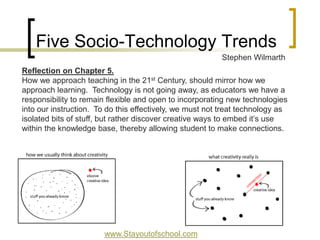
Reflection on Chapter 5.
How we approach teaching in the 21st Century, should mirror how we
approach learning. Technology is not going away, as educators we have a
responsibility to remain flexible and open to incorporating new technologies
into our instruction. To do this effectively, we must not treat technology as
isolated bits of stuff, but rather discover creative ways to embed it’s use
within the knowledge base, thereby allowing student to make connections.


                       www.Stayoutofschool.com
A Classroom as Wide as the World
                                         Vivien Stewart
   Global Trends
     “International knowledge and skills are no longer
       just a luxury for a few would-be specialists but
       are a new basic for all students” (pg 101)
   Global Learning
     Knowledge of other world
       regions, cultures, economies, and global issues
     Skills to communicate in languages other than
       English
     Values of respect for other cultures and the
       disposition to engage responsibly as an actor in
       the global context. (pg 102)
A Classroom as Wide as the World
                                           Vivien Stewart

   Global Connections
     “Thanks to technology and to the Internet, all
       children now are children of the globe, not just
       children of the neighborhood where they live.”
       (pg 107)
   Going to Scale
     “…hundreds of innovative efforts are under way
       in schools (local) … to add global content and
       connections. But as encouraging as these
       efforts are, they are islands of excellence.” (pg
       110)
A Classroom as Wide as the World
                                                           Vivien Stewart

Reflection on Chapter 6
As our world continues to be more connected economically, politically, and
socially, the need to educate our youth in a global context will continue to
grow. In a 24/7 media cycle world events unfold in real-time on our computers,
TV’s, and mobile devices, the impact of which is not necessarily instantly
known. This is why it is critical that we begin to develop a sense of global
literacy in all of our students, so they have experience to draw from, when
witnessing and learning about global issues.


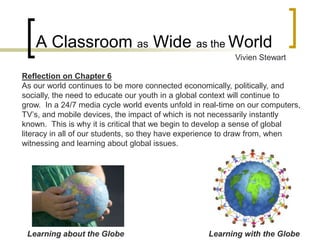
 Learning about the Globe                           Learning with the Globe
Performance Objectives
   Writes specific curriculum outcomes which require the
    effective use of technology to acquire the intended
    learning content.
       Identifies the learning content (subject specific)
       Connects the use of technology to the learning content
       Writes measurable specific curriculum outcomes
   Writes specific curriculum outcomes which require the
    application of the learning content in a global context.
       Identifies the learning content (subject specific)
       Connects the learning content to global issues
       Writes measurable specific curriculum outcomes
Driving Questions
       1.   How can we write clear, measurable, and concise
            specific curriculum outcomes(SCOs) which require
            students to effectively use technology in our PEI
            Curriculum Documents?
       2.   How can we write clear, measurable, and concise
            specific curriculum outcomes(SCOs) which require
            students to engage in global issues in our PEI
            Curriculum Documents?
Group Challenge
With the members of your group, choose to answer one (1) of the Driving
Questions stated above , make use of your personal knowledge and experience,
the WIKI site, and any other tools or resources the impact your work.
You will have 5mins to share your results with the group at the end of the meeting.
Please keep a record of your work for the WIKI.
Good Luck.

Technology and the global classroom

  • 1.
    Technology and theGlobal Classroom A Curriculum 21 Study Guide Chapter 5 – Five Socio-Technology Trends Chapter 6 – A Classroom as Wide as the World
  • 2.
    Five Socio-Technology Trends Stephen Wilmarth  Social Production of Knowledge  “Our students are no longer primary consumers of content. They participate as content creator at rates never before seen. And the trend is accelerating.” (pg 82)  Social Networks  “The new power of social media and networking technologies to teach is perhaps the least leveraged technology in formal education systems today.” (pg 85)
  • 3.
    Five Socio-Technology Trends Stephen Wilmarth  A Semantic Web  “A semantic web will dramatically transform our relationship to new knowledge for the purposes of creativity, and our definition of what it means to be educated.” (pg 88)  Media Grids  “ Virtual worlds hold the potential to transform social interactions online. … there’s almost no assumption of a human heartbeat behind a web page, virtual worlds are inherently social settings” (pg 92)
  • 4.
    Five Socio-Technology Trends Stephen Wilmarth  Non-Linear Learning  “Should we still be looking at disciplines as separate, distinct, and unassailable by anyone outside the walled gardens of the academy.” (pg 95)
  • 5.
    Five Socio-Technology Trends Stephen Wilmarth Reflection on Chapter 5. How we approach teaching in the 21st Century, should mirror how we approach learning. Technology is not going away, as educators we have a responsibility to remain flexible and open to incorporating new technologies into our instruction. To do this effectively, we must not treat technology as isolated bits of stuff, but rather discover creative ways to embed it’s use within the knowledge base, thereby allowing student to make connections. www.Stayoutofschool.com
  • 6.
    A Classroom asWide as the World Vivien Stewart  Global Trends  “International knowledge and skills are no longer just a luxury for a few would-be specialists but are a new basic for all students” (pg 101)  Global Learning  Knowledge of other world regions, cultures, economies, and global issues  Skills to communicate in languages other than English  Values of respect for other cultures and the disposition to engage responsibly as an actor in the global context. (pg 102)
  • 7.
    A Classroom asWide as the World Vivien Stewart  Global Connections  “Thanks to technology and to the Internet, all children now are children of the globe, not just children of the neighborhood where they live.” (pg 107)  Going to Scale  “…hundreds of innovative efforts are under way in schools (local) … to add global content and connections. But as encouraging as these efforts are, they are islands of excellence.” (pg 110)
  • 8.
    A Classroom asWide as the World Vivien Stewart Reflection on Chapter 6 As our world continues to be more connected economically, politically, and socially, the need to educate our youth in a global context will continue to grow. In a 24/7 media cycle world events unfold in real-time on our computers, TV’s, and mobile devices, the impact of which is not necessarily instantly known. This is why it is critical that we begin to develop a sense of global literacy in all of our students, so they have experience to draw from, when witnessing and learning about global issues. Learning about the Globe Learning with the Globe
  • 9.
    Performance Objectives  Writes specific curriculum outcomes which require the effective use of technology to acquire the intended learning content.  Identifies the learning content (subject specific)  Connects the use of technology to the learning content  Writes measurable specific curriculum outcomes  Writes specific curriculum outcomes which require the application of the learning content in a global context.  Identifies the learning content (subject specific)  Connects the learning content to global issues  Writes measurable specific curriculum outcomes
  • 10.
    Driving Questions 1. How can we write clear, measurable, and concise specific curriculum outcomes(SCOs) which require students to effectively use technology in our PEI Curriculum Documents? 2. How can we write clear, measurable, and concise specific curriculum outcomes(SCOs) which require students to engage in global issues in our PEI Curriculum Documents? Group Challenge With the members of your group, choose to answer one (1) of the Driving Questions stated above , make use of your personal knowledge and experience, the WIKI site, and any other tools or resources the impact your work. You will have 5mins to share your results with the group at the end of the meeting. Please keep a record of your work for the WIKI. Good Luck.