Multicultural Diversity:
A Challenge to Global
Teachers
Energizer!!
Dam Dam Dah Dah
Energizer!!
“All men are pretty
much alike. It is
only by culture that
they are set apart.” Confuciu
s
What is Culture?
“the values, traditions,
social and worldview
shared by a group of
people bound together by
a combination of factors.”
(Derman and Sparks)
Maraming
Salamat
Dialect / Language
Bacolod – Hiligaynon
Palawan – Cuyonon
Cebu – Sugbuanon
Bicol - Bikol
Trivia:
Maraming
Salamat
Culture
Comes from the Latin
word “CULTUS”
http://journal.media-culture.org.au/0005/meaning.php
Diversit
y
Comes from the Latin
word “DIVERTAS”
http://lawandliberty.org/cult_div.htm
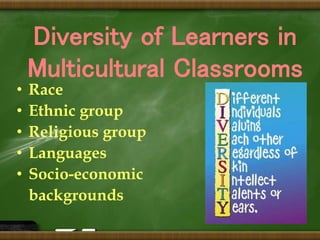
Diversity of Learners in
Multicultural Classrooms
• Race
• Ethnic group
• Religious group
• Languages
• Socio-economic
backgrounds
James Bank
“The major goal of multicultural
education is to transform the school so
that the male and female students,
exceptional learners, as well as
students coming from diverse cultural,
social-class, racial and ethnic groups
will receive an equal opportunity to
learn in school.”
MULTICULTURAL
EDUCATION
enables teachers and educators to give
value to the differences in prior
knowledge, experiences of learners from
diverse background and familiarity with
students’ histories of diverse cultures.
(Haertel, 1998)
Fraser-Abner (2001)
Suggestions:
1. Be sensitive and aware.
2. Never make assumptions.
3. Avoid stereotyping.
4. Get to know each student.
Fraser-Abner (2001)
Suggestions:
5. Look into your own conscious.
6. Plan your activities.
7. Infuse multicultural
instructional materials.
8. Collaboration and cooperation.
Guiding Principles:
1. Pre-Service teacher education programs
2. Equitable opportunities
3. Social skills
4. School Curriculum
5. Eliminate stereotyping
6. Values
Some of basic assumptions
that enhance Teacher
Development:1. No two learners are exactly the same.
2. Children in all classrooms are heterogeneous.
3. Strategies that work with one learner may not work
with another
4. Student’s background and experiences should be
considered
5. Community members can assist teachers in facing
issues
Play Video
Miss International 2016
Multicultural Diversity

Multicultural Diversity

Editor's Notes

  • #5 Confucius said - All men are pretty much alike. It is only by culture that they are set apart. Confucius is known as a Chinese teacher editor, politician, and philosopher of the Spring and Autumn period of Chinese history. The philosophy of Confucius emphasized personal and governmental morality, correctness of social relationships, justice and sincerity. Meaning of this statement - Every man is the same but the way that we raised and the way that we lives our lives will make us different and set us apart from other men. Syempre iba iba tayo ng pinagkalakihan – sa bahay, sa paaralan, sa komunidad. At iba iba yung pamantayan natin sa buhay.
  • #6 Ang kultura o kalinangan sa pangkalahatan ay tumutukoy sa aktibidad ng sangkatauhan. Ito ang "kaparaanan ng mga tao sa buhay", ibig sabihin ang paraan kung paano gawin ang mga bagay-bagay. Iba't iba ang kahulugan ng kultura na sumasalamin sa iba't ibang mga teoriya sa kaunawaan, o sukatan sa pagpapahalaga. Sa iba, ito ang kuro o opinyon ng buong lipunan, na maaaring makita sa kanilang mga salita, aklat at mga sinulat, relihiyon,musika, pananamit, pagluluto, at iba pa.
  • #7 Bacolod – Madamo gid na salamat Palawan – Matamang Salamat Cebu – Daghang Salamat Bicol – Dios Mabalos Encantadia – Avisala Eshma
  • #8 Bacolod – Madamo gid na salamat Palawan – Matamang Salamat Cebu – Daghang Salamat Bicol – Dios Mabalos Encantadia – Avisala Eshma
  • #9 Bacolod – Madamo gid na salamat Palawan – Matamang Salamat Cebu – Daghang Salamat Bicol – Dios Mabalos Encantadia – Avisala Eshma
  • #10 The word 'culture' comes from the Latin cultus, which means 'care’. It denotes improvement or enlargement. Historically used in an agricultural context (to "cultivate" one's crops) it is used now to describe the material traits of a group or sub-group.
  • #11 DIVERSITY: From the Latin divertas, the term denotes difference (unlikeness). The concept of diversity encompasses acceptance and respect.  It means understanding that each individual is unique,  and recognizing our individual differences.  the state or fact of being diverse;  difference; unlikeness:
  • #12 Cultural diversity is a form of appreciating the differences in individuals. The differences can be based on gender, age, sex, ethnicity, sexual orientation, and social status. 
  • #13 Diversity or differences among our students have placed greater demands to teachers in today’s school. Students may differ in race which is commonly indicated by the color of the skin. They may belong to different ethnic group. Religious group Speak Different Languages Socio Economic backgrounds - is typically broken into three categories(high SES, middle SES, and low SES) to describe the three areas a family or an individual may fall into. When placing a family or individual into one of these categories, any or all of the three variables (income, education, and occupation) can be assessed.
  • #14 According to James Bank enables teachers and educators to give values to the differences in knowledge and experiences of the learners. In the midst of this diversity, students are supposed to receive equal opportunities to education. In order to do this, we need: Curricular and instructional modifications (Different) Teaching styles Re-examination of teachers’ attitudes, beliefs and perception
  • #15 Multicultural education is a set of strategies and materials in education that were developed to assist teachers when responding to the many issues created by the rapidly changing demographics of their students. Multicultural education cannot be taught in a textbook. It must be developed by each educator based on a particular student group.
  • #16 To assist us in understanding our multicultural learners, Fraser-Abner offers the following suggestions. Learn as much about and become as sensitive to and aware of racial, ethnic, cultural and gender groups other than your own. Never make assumptions about an individual based on your perception of that individual’s race, ethnicity, culture or gender.- TONDO - Basagulero Avoid stereotyping – Na ang pink is for girls only. Na ang football is for boys only. Na ang mga muslim are terrorist. 4. Get to know each students as a unique individual: Walk in the footsteps of all your students.
  • #17 5. Look into your own conscious and sub conscious biases about the people who are different from yourselves in race, ethnicity, culture, gender, or socioeconomic status. 6. Plan your activities within a multicultural framework while making your classroom a safe and secure haven for all the students. 7. Invest multicultural instructional materials and strategies in your teaching. 8. Foster collaboration and cooperation among your learners, parents and teachers.
  • #18 In view of this purpose some guiding principles which were adapted from an interdisciplinary group of psychologists, political scientists, sociologists and multicultural specialists, are hereby presented, to with: 1. Pre-service teacher education programs should help prospective teachers understand the complex characteristics of ethnic groups in way race, ethnicity, language and social class interact to influence students’ behavior. – Trainings and Seminars – Diversity Trainings sa America 2. Teachers should ensure that all students have equitable opportunities to learn and to perform a standard. - Every Students have right for equal education. 3. Teachers should help students acquire social skills needed to interact effectively with students from other racial, ethnic, cultural, language of social group. 4. The school curriculum helps students understand that knowledge is socially constructed and are reflective of the social, political and economic context in which they live and work. 5. Teachers and students should learn to reduce or eliminate stereotyping and other related biases that have negative effects on racial and ethnic relations. 6. Teachers should teach and students should learn about the values shared virtually by all cultural groups like justice, equality, freedom, peace, compassion and charity among others.
  • #19 1. Because of our culture every one is unique. – may fast and slow learners 2. Children are different.
  • #20 pls look kung ano yung mali.
  • #21 As a teacher we should be careful, sensitive and aware on what we are saying to our students. Being a second parents on our learners we should be conduits of love and acceptance to them in our class. To give them a engaging and nurturing learning experience. Diversity Training…