Case Study of the Dominican Republic and their
                   development and use of OER


                 Presentation of Prelim Abstract
                 Some Background Information on OER
                 Alfonso Sintjago – April 15
CIES – ICT4D SIG
 THE FUTURE OF COMPARATIVE AND INTERNATIONAL
  EDUCATION IN A GLOBALISED WORLD - DAVID N. WILSON

 “In my 1994 CIES presidential address I posed another
  “perplexing question” about “when comparative and
  international education will achieve recognition as something
  more than an ‘amorphous’ field” (Wilson 1994: 485).I believe
  that the answer is that globalisation has given comparative and
  international education increased recognition, and that ICTs
  have provided the communications tools to reach wider
  audiences. I urge all comparative and international educators to
  use this recognition wisely by doing their utmost to
  communicate effectively the results of the academic and field-
  based research and insights to policy-makers, educational
  reformers and practitioners”
Broader Academia
 “My view is that in the open-access movement, we are
 seeing the early emergence of a meta-university—a
 transcendent, accessible, empowering, dynamic,
 communally constructed framework of open materials
 and platforms on which much of higher education
 worldwide can be constructed or enhanced.” – Charles
 Vest 2006
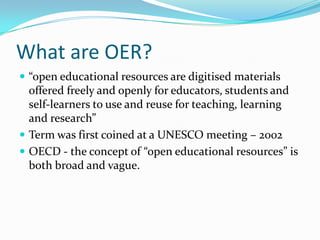
What are OER?
 “open educational resources are digitised materials
  offered freely and openly for educators, students and
  self-learners to use and reuse for teaching, learning
  and research”
 Term was first coined at a UNESCO meeting – 2002
 OECD - the concept of “open educational resources” is
  both broad and vague.
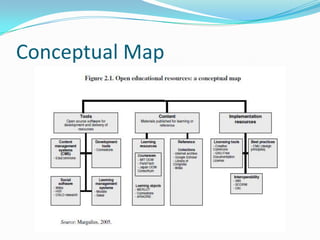
Conceptual Map
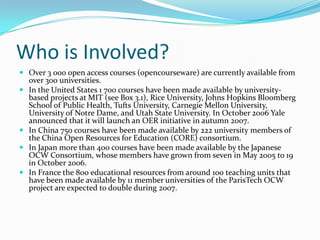
Who is Involved?
 Over 3 000 open access courses (opencourseware) are currently available from
    over 300 universities.
   In the United States 1 700 courses have been made available by university-
    based projects at MIT (see Box 3.1), Rice University, Johns Hopkins Bloomberg
    School of Public Health, Tufts University, Carnegie Mellon University,
    University of Notre Dame, and Utah State University. In October 2006 Yale
    announced that it will launch an OER initiative in autumn 2007.
   In China 750 courses have been made available by 222 university members of
    the China Open Resources for Education (CORE) consortium.
   In Japan more than 400 courses have been made available by the Japanese
    OCW Consortium, whose members have grown from seven in May 2005 to 19
    in October 2006.
   In France the 800 educational resources from around 100 teaching units that
    have been made available by 11 member universities of the ParisTech OCW
    project are expected to double during 2007.
Major OER Initiatives
 Wikieducators.org
 Free Textbook Movement
 Connexions Consortium
 OpenCourseWare Consortium
 Community Colleges Consortium for Open Education
  Resources
 UNESCO Support for the OERU Initiative
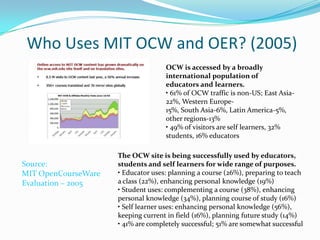
Who Uses MIT OCW and OER? (2005)
                                    OCW is accessed by a broadly
                                    international population of
                                    educators and learners.
                                    • 61% of OCW traffic is non-US; East Asia-
                                    22%, Western Europe-
                                    15%, South Asia-6%, Latin America-5%,
                                    other regions-13%
                                    • 49% of visitors are self learners, 32%
                                    students, 16% educators

                     The OCW site is being successfully used by educators,
Source:              students and self learners for wide range of purposes.
MIT OpenCourseWare   • Educator uses: planning a course (26%), preparing to teach
Evaluation – 2005    a class (22%), enhancing personal knowledge (19%)
                     • Student uses: complementing a course (38%), enhancing
                     personal knowledge (34%), planning course of study (16%)
                     • Self learner uses: enhancing personal knowledge (56%),
                     keeping current in field (16%), planning future study (14%)
                     • 41% are completely successful; 51% are somewhat successful
Creative Commons Licenses
 As of June 2006, the use of the different license options
  had the following distribution:
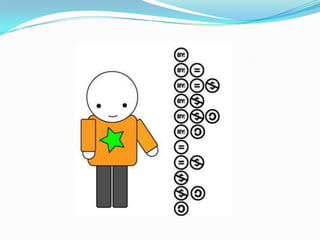
   Attribution (BY) is used by 96.6% of all licensors.
   Non-commercial option (NC) 67.5%.
   Share Alike (SA) 45.4%.
   No derivatives (ND) 24.3%.
2011 - OER Movement and its Implications for Local Knowledges

2011 - OER Movement and its Implications for Local Knowledges

  • 1.
    Case Study ofthe Dominican Republic and their development and use of OER Presentation of Prelim Abstract Some Background Information on OER Alfonso Sintjago – April 15
  • 2.
    CIES – ICT4DSIG  THE FUTURE OF COMPARATIVE AND INTERNATIONAL EDUCATION IN A GLOBALISED WORLD - DAVID N. WILSON  “In my 1994 CIES presidential address I posed another “perplexing question” about “when comparative and international education will achieve recognition as something more than an ‘amorphous’ field” (Wilson 1994: 485).I believe that the answer is that globalisation has given comparative and international education increased recognition, and that ICTs have provided the communications tools to reach wider audiences. I urge all comparative and international educators to use this recognition wisely by doing their utmost to communicate effectively the results of the academic and field- based research and insights to policy-makers, educational reformers and practitioners”
  • 4.
    Broader Academia  “Myview is that in the open-access movement, we are seeing the early emergence of a meta-university—a transcendent, accessible, empowering, dynamic, communally constructed framework of open materials and platforms on which much of higher education worldwide can be constructed or enhanced.” – Charles Vest 2006
  • 5.
    What are OER? “open educational resources are digitised materials offered freely and openly for educators, students and self-learners to use and reuse for teaching, learning and research”  Term was first coined at a UNESCO meeting – 2002  OECD - the concept of “open educational resources” is both broad and vague.
  • 6.
  • 8.
    Who is Involved? Over 3 000 open access courses (opencourseware) are currently available from over 300 universities.  In the United States 1 700 courses have been made available by university- based projects at MIT (see Box 3.1), Rice University, Johns Hopkins Bloomberg School of Public Health, Tufts University, Carnegie Mellon University, University of Notre Dame, and Utah State University. In October 2006 Yale announced that it will launch an OER initiative in autumn 2007.  In China 750 courses have been made available by 222 university members of the China Open Resources for Education (CORE) consortium.  In Japan more than 400 courses have been made available by the Japanese OCW Consortium, whose members have grown from seven in May 2005 to 19 in October 2006.  In France the 800 educational resources from around 100 teaching units that have been made available by 11 member universities of the ParisTech OCW project are expected to double during 2007.
  • 9.
    Major OER Initiatives Wikieducators.org  Free Textbook Movement  Connexions Consortium  OpenCourseWare Consortium  Community Colleges Consortium for Open Education Resources  UNESCO Support for the OERU Initiative
  • 10.
    Who Uses MITOCW and OER? (2005) OCW is accessed by a broadly international population of educators and learners. • 61% of OCW traffic is non-US; East Asia- 22%, Western Europe- 15%, South Asia-6%, Latin America-5%, other regions-13% • 49% of visitors are self learners, 32% students, 16% educators The OCW site is being successfully used by educators, Source: students and self learners for wide range of purposes. MIT OpenCourseWare • Educator uses: planning a course (26%), preparing to teach Evaluation – 2005 a class (22%), enhancing personal knowledge (19%) • Student uses: complementing a course (38%), enhancing personal knowledge (34%), planning course of study (16%) • Self learner uses: enhancing personal knowledge (56%), keeping current in field (16%), planning future study (14%) • 41% are completely successful; 51% are somewhat successful
  • 12.
    Creative Commons Licenses As of June 2006, the use of the different license options had the following distribution:  Attribution (BY) is used by 96.6% of all licensors.  Non-commercial option (NC) 67.5%.  Share Alike (SA) 45.4%.  No derivatives (ND) 24.3%.

Editor's Notes

  • #3 former President of the Comparative and InternationalEducation Society of Canada (CIESC), of the Comparative and InternationalEducation Society of the US (CIES), as well as of the World Council ofComparative Education Societies (WCCES)