This project has received funding from the European Union’s Horizon 2020 research and innovation
programme under grant agreement No 689687
FERTINNOWA – Technologies to improve
fertigation. Management spatial variability
Carlos Campillo Torres (carlos.campillo@juntaex.es)
IRRIGATION AND FERTILIZATION GROUP. CICYTEX
This project has received funding from the European Union’s Horizon 2020 research and innovation
programme under grant agreement No 689687
Gaps in irrigation management are:
 Irrigation management tools and
technologies require high level of
knowledge
 Lack of automation and friendly
systems to aid decision in irrigation
time.
 Growers find irrigation management
tools and technologies too
expensive and not reliable.
 The heterogeneity of the soil and
plant grown
 Technology designed by persons of
the other sectors different of the
agriculture.
Gaps in fertigation management are:
 DSS are not available for all crops,
varieties and local conditions.
 Difficulties to select representative
points to take samples.
 Crop monitoring techniques require
reference values. A lot of time to
know analysis results and too late to
make the correction on the farm.
 The farmer does not take into
account the different sources of
nitrogen on the farm.
 Deficiencies in the fertigation system
 The grower prefers over-fertilizer to
avoid possible deficiencies and with
that lost production
Task 4.1 Identification of Gaps
This project has received funding from the European Union’s Horizon 2020 research and innovation
programme under grant agreement No 689687Centro de Investigaciones Científicas y
Tecnológicas de Extremadura
Perales Farm (200hectares)
Trial plot (60 hectares) 2017
H1311 (Heinz Co) Variety
Transplant 15th april harvest 20th august
Subsurface drip irrigation
This project has received funding from the European Union’s Horizon 2020 research and innovation
programme under grant agreement No 689687Centro de Investigaciones Científicas y
Tecnológicas de Extremadura
SOIL HETEROGENITY EMI Sensor
Apparent electrical conductivity (ECa)
This project has received funding from the European Union’s Horizon 2020 research and innovation
programme under grant agreement No 689687
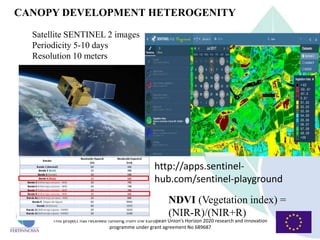
CANOPY DEVELOPMENT HETEROGENITY
Satellite SENTINEL 2 images
Periodicity 5-10 days
Resolution 10 meters
NDVI (Vegetation index) =
(NIR-R)/(NIR+R)
http://apps.sentinel-
hub.com/sentinel-playground
This project has received funding from the European Union’s Horizon 2020 research and innovation
programme under grant agreement No 689687
Nmin
CROP
SOIL
TO KNOW DIFERENT MANAGEMENT ZONES TO SELECTION THE
LOCATION OF SAMPLES
NDVI vs Crop Development
Eca vs soil texture
This project has received funding from the European Union’s Horizon 2020 research and innovation
programme under grant agreement No 689687Centro de Investigaciones Científicas y
Tecnológicas de Extremadura
Zone a: a1, a2 and a3 most crop development zone
Zone b: b1, b2, b3 and b4 medium crop development zone
Zone c: c1, c2 and c3 low crop development zone
Zone Depth Texture % OM
a 0-30 cm Clay-Loam 0,74
a 30-60 cm Clay-Loam 0,54
b 0-30 cm Sandy-Loam 0,63
b 30-60 cm Sandy-Loam 0,16
c 0-30 cm Sandy-Loam 0,61
c 30-60 cm Sandy-Loam 0,23
This project has received funding from the European Union’s Horizon 2020 research and innovation
programme under grant agreement No 689687
SENSOR (LOCATED) TO CORRECTION DURING THE CROP
• Soil Samples Soil texture and NPK concentration
• Leaf Analysis NPK in plant
• Canopy Ground Cover Effects on crop development
• Spectral Analysis Early detection nitrogen and water deficit
Cropcircle
470 spectral
sensor
Canopeo
App
Sentinel 2
Satellite
image
SPAD
sensor
DUALEX
sensor
RQFlex 10
sensor
Pump-up
sensor
This project has received funding from the European Union’s Horizon 2020 research and innovation
programme under grant agreement No 689687
Zone a Zone b Zone c
“zone a” showed a bigger development regard to
others zones. the NDVI values are smaller at the
beginning in the “zone a”, same that % ground
cover, due to the days of difference in
transplantation, but it reaches a greater
development in the phase of rapid growth
(flowering and fruit set).
NVDI in the area a and c, of the same that was
observed in the other two methodologies of
measurement, it can be indicated the periods where
the difference of development took place between
both zones, it is also observed what is the moment and
the dynamics in the phase of plant senescenceStart late fase
Start midle fase
This project has received funding from the European Union’s Horizon 2020 research and innovation
programme under grant agreement No 689687Centro de Investigaciones Científicas y
Tecnológicas de Extremadura
This project has received funding from the European Union’s Horizon 2020 research and innovation
programme under grant agreement No 689687
0
0.2
0.4
0.6
0.8
1
abril-17 mayo-17 junio-17 julio-17 agosto-17 septiembre-17
NVDI
Zonaa Zonac
15%
Kcini
Kcdev
Kcmid
Kclate
This project has received funding from the European Union’s Horizon 2020 research and innovation
programme under grant agreement No 689687
TOTAL YIELD
The total production
obtained were greater
in the "a" zone, as has
been demonstrated in
the different data
obtained in the
development of the
crop and as it was
identified with the
measures of
variability made
before the
transplanting.
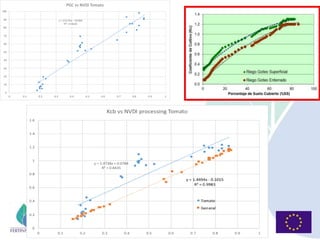
The total yield data from control points were
correlated with NVDI images from sentinel 2
satellite, near of harvest (R2 = 0.81) and one
moth before (R2 = 0.74). This information to
permit elaborate a map with total yield to all
field test
*
*
*
This project has received funding from the European Union’s Horizon 2020 research and innovation
programme under grant agreement No 689687
CONCLUSIONS
 Results showed that spatial variability had an important
influence on the sampling and measurements of nutritional
status in a processing tomato farms.
 Satellite images allowed to identify zones of different crop
development and production, this can be good tools to select a
sample points in the farm.
 With Satellite technology, farmers can identify the zones with
different crop development to select zones of control of water
and nutritional status during the crop cycle, allowing to make
adjustments of the irrigation and fertilizer doses in each zone of
the plot.
 The satellite image to permit identify a more and less
productive zone in the farm thirty days before harvest.
This project has received funding from the European Union’s Horizon 2020 research and innovation
programme under grant agreement No 689687
14
ACKNOWLEDGEMENTS
FERTINNOWA Project funding from the
European union's horizon 2020 research and
innovation programme under grant
agreement no 689687
CONESA group

Technologies to improve fertigation. Management spatial variability

  • 1.
    This project hasreceived funding from the European Union’s Horizon 2020 research and innovation programme under grant agreement No 689687 FERTINNOWA – Technologies to improve fertigation. Management spatial variability Carlos Campillo Torres (carlos.campillo@juntaex.es) IRRIGATION AND FERTILIZATION GROUP. CICYTEX
  • 2.
    This project hasreceived funding from the European Union’s Horizon 2020 research and innovation programme under grant agreement No 689687 Gaps in irrigation management are:  Irrigation management tools and technologies require high level of knowledge  Lack of automation and friendly systems to aid decision in irrigation time.  Growers find irrigation management tools and technologies too expensive and not reliable.  The heterogeneity of the soil and plant grown  Technology designed by persons of the other sectors different of the agriculture. Gaps in fertigation management are:  DSS are not available for all crops, varieties and local conditions.  Difficulties to select representative points to take samples.  Crop monitoring techniques require reference values. A lot of time to know analysis results and too late to make the correction on the farm.  The farmer does not take into account the different sources of nitrogen on the farm.  Deficiencies in the fertigation system  The grower prefers over-fertilizer to avoid possible deficiencies and with that lost production Task 4.1 Identification of Gaps
  • 3.
    This project hasreceived funding from the European Union’s Horizon 2020 research and innovation programme under grant agreement No 689687Centro de Investigaciones Científicas y Tecnológicas de Extremadura Perales Farm (200hectares) Trial plot (60 hectares) 2017 H1311 (Heinz Co) Variety Transplant 15th april harvest 20th august Subsurface drip irrigation
  • 4.
    This project hasreceived funding from the European Union’s Horizon 2020 research and innovation programme under grant agreement No 689687Centro de Investigaciones Científicas y Tecnológicas de Extremadura SOIL HETEROGENITY EMI Sensor Apparent electrical conductivity (ECa)
  • 5.
    This project hasreceived funding from the European Union’s Horizon 2020 research and innovation programme under grant agreement No 689687 CANOPY DEVELOPMENT HETEROGENITY Satellite SENTINEL 2 images Periodicity 5-10 days Resolution 10 meters NDVI (Vegetation index) = (NIR-R)/(NIR+R) http://apps.sentinel- hub.com/sentinel-playground
  • 6.
    This project hasreceived funding from the European Union’s Horizon 2020 research and innovation programme under grant agreement No 689687 Nmin CROP SOIL TO KNOW DIFERENT MANAGEMENT ZONES TO SELECTION THE LOCATION OF SAMPLES NDVI vs Crop Development Eca vs soil texture
  • 7.
    This project hasreceived funding from the European Union’s Horizon 2020 research and innovation programme under grant agreement No 689687Centro de Investigaciones Científicas y Tecnológicas de Extremadura Zone a: a1, a2 and a3 most crop development zone Zone b: b1, b2, b3 and b4 medium crop development zone Zone c: c1, c2 and c3 low crop development zone Zone Depth Texture % OM a 0-30 cm Clay-Loam 0,74 a 30-60 cm Clay-Loam 0,54 b 0-30 cm Sandy-Loam 0,63 b 30-60 cm Sandy-Loam 0,16 c 0-30 cm Sandy-Loam 0,61 c 30-60 cm Sandy-Loam 0,23
  • 8.
    This project hasreceived funding from the European Union’s Horizon 2020 research and innovation programme under grant agreement No 689687 SENSOR (LOCATED) TO CORRECTION DURING THE CROP • Soil Samples Soil texture and NPK concentration • Leaf Analysis NPK in plant • Canopy Ground Cover Effects on crop development • Spectral Analysis Early detection nitrogen and water deficit Cropcircle 470 spectral sensor Canopeo App Sentinel 2 Satellite image SPAD sensor DUALEX sensor RQFlex 10 sensor Pump-up sensor
  • 9.
    This project hasreceived funding from the European Union’s Horizon 2020 research and innovation programme under grant agreement No 689687 Zone a Zone b Zone c Zone a Zone b Zone c “zone a” showed a bigger development regard to others zones. the NDVI values are smaller at the beginning in the “zone a”, same that % ground cover, due to the days of difference in transplantation, but it reaches a greater development in the phase of rapid growth (flowering and fruit set). NVDI in the area a and c, of the same that was observed in the other two methodologies of measurement, it can be indicated the periods where the difference of development took place between both zones, it is also observed what is the moment and the dynamics in the phase of plant senescenceStart late fase Start midle fase
  • 10.
    This project hasreceived funding from the European Union’s Horizon 2020 research and innovation programme under grant agreement No 689687Centro de Investigaciones Científicas y Tecnológicas de Extremadura
  • 11.
    This project hasreceived funding from the European Union’s Horizon 2020 research and innovation programme under grant agreement No 689687 0 0.2 0.4 0.6 0.8 1 abril-17 mayo-17 junio-17 julio-17 agosto-17 septiembre-17 NVDI Zonaa Zonac 15% Kcini Kcdev Kcmid Kclate
  • 12.
    This project hasreceived funding from the European Union’s Horizon 2020 research and innovation programme under grant agreement No 689687 TOTAL YIELD The total production obtained were greater in the "a" zone, as has been demonstrated in the different data obtained in the development of the crop and as it was identified with the measures of variability made before the transplanting. The total yield data from control points were correlated with NVDI images from sentinel 2 satellite, near of harvest (R2 = 0.81) and one moth before (R2 = 0.74). This information to permit elaborate a map with total yield to all field test * * *
  • 13.
    This project hasreceived funding from the European Union’s Horizon 2020 research and innovation programme under grant agreement No 689687 CONCLUSIONS  Results showed that spatial variability had an important influence on the sampling and measurements of nutritional status in a processing tomato farms.  Satellite images allowed to identify zones of different crop development and production, this can be good tools to select a sample points in the farm.  With Satellite technology, farmers can identify the zones with different crop development to select zones of control of water and nutritional status during the crop cycle, allowing to make adjustments of the irrigation and fertilizer doses in each zone of the plot.  The satellite image to permit identify a more and less productive zone in the farm thirty days before harvest.
  • 14.
    This project hasreceived funding from the European Union’s Horizon 2020 research and innovation programme under grant agreement No 689687 14 ACKNOWLEDGEMENTS FERTINNOWA Project funding from the European union's horizon 2020 research and innovation programme under grant agreement no 689687 CONESA group