Precision Agriculture at a Glance
Definition: An information and technology based farm management
system to identify, analyze and manage variability within fields by
doing all practices of crop production in right place at right time and
in right way for optimum profitability, sustainability and protection of
the land resource. Precision agriculture is a systems approach to
farming for maximizing the effectiveness of crop inputs.
Need of precision agriculture:
1. For assessing and managing field variability: We know that our
fields have variable yields across the landscape because of
variations to management practices, soil properties and/or
environmental characteristics. One’s mental information database
about how to treat different areas in a field requires years of
observation and implementation through trial-and error. Today,
that level of knowledge of field conditions is difficult to maintain
because of the variable farm sizes and changes in areas farmed due
to annual shifts in leasing arrangements. Precision agriculture
offers the potential to automate and simplify the collection and
analysis of information.
2. For doing the right thing in the right place at the right time:
After assessing the variability precision agriculture allows
management decisions to be made and implemented in right time
in right places on small areas within larger fields.
3. For higher productivity: Since precision farming, proposes to
prescribe tailor made management practices, it will definitely
increase the yield per unit of land, provided nature’s other
uncontrollable factors are in favor.
4. For increasing the effectiveness of inputs: Increased
productivity per unit of input used indicates increased efficiency of
the inputs.
5. For maximum use of minimum land unit: After knowing the
land status, a farmer tries to improve each and every part of land
and uses it for the production purpose.
Components of precision agriculture
I. Information or data base
 Soil: Soil Texture, Structure, Physical Condition, Soil Moisture;
Soil Nutrients, etc.
 Crop: Plant Population; Crop Tissue Nutrient Status, Crop Stress,
Weed patches (weed type and intensity); Insect or fungal
infestation (species and intensity), Crop Yield; Harvest Swath
Width etc.
 Climate: Temperature, humidity, rainfall, solar radiation, wind
velocity, etc.
In-fields variability, spatially or temporally, in soil-related
properties, crop characteristics, weed and insect-pest population
and harvest data are important databases that need to be
developed to realize the potential of precision farming.
II. Technology
Technologies include a vast array of tools of hardware, software and
equipments.
1. Global Positioning System (GPS) receivers: GPS provides
continuous position information in real time, while in motion.
Having precise location information at any time allows soil and
crop measurements to be mapped. GPS receivers, either carried to
the field or mounted on implements allow users to return to
specific locations to sample or treat those areas.
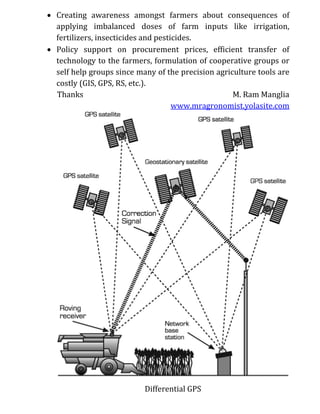
2. Differential Global Positioning System (DGPS): A technique to
improve GPS accuracy that uses pseudo range errors measured at a
known location to improve the measurements made by other GPS
receivers within the same general geographic area (figure at
bottom).
3. Geographic information systems (GIS): Geographic information
systems (GIS) are computer hardware and software that use
feature attributes and location data to produce maps. An important
function of an agricultural GIS is to store layers of information,
such as yields, soil survey maps, remotely sensed data, crop
scouting reports and soil nutrient levels.
4. Remote sensing: It is the collection of data from a distance. Data
sensors can simply be hand-held devices, mounted on aircraft or
satellite-based. Remotely-sensed data provide a tool for evaluating
crop health. Plant stress related to moisture, nutrients, compaction,
crop diseases and other plant health concerns are often easily
detected in overhead images. Remote sensing can reveal in-season
variability that affects crop yield, and can be timely enough to
make management decisions that improve profitability for the
current crop.
5. Variable Rate Applicator:
The variable rate applicator has three components:
a. Control computer
b. Locator and
c. Actuator
The application map is loaded into a computer mounted on a
variable-rate applicator. The computer uses the application map
and a GPS receiver to direct a product-delivery controller that
changes the amount and/or kind of product, according to the
application map.
6. Combine harvesters with yield monitors: Yield monitors
continuously measure and record the flow of grain in the clean-
grain elevator of a combine. When linked with a GPS receiver, yield
monitors can provide data necessary for yield maps.
III. Management
1. Information management: The adoption of precision agriculture
requires the joint development of management skills and pertinent
information databases. A farmer must have clear idea of objectives
of precision farming and crucial information necessary to make
decisions effectively. Effective information management requires
many more than just keeping analysis tools. It requires an
entrepreneurial attitude toward education and experimentation.
2. Decision support system (DSS): Combination of information and
technology into a comprehensive and operational system gives
farmers a decision to treat the field. For this purpose, DSS can be
developed, utilizing GIS, agronomic, economic and environmental
software, to help farmers manage their fields.
3. Identifying a precision agriculture service provider: It is also
advisable for farmers to consider the availability of custom
services when making decisions about adopting precise/site
specific crop management. Purchasing the equipments and
learning the necessary skills for precision farming is a significant
up-front cost that can not be affordable for many farmers.
Therefore, farmers are advised to take services of agricultural
service providers or properly trained extension workers for
precision agriculture. The most common custom services that
precision agriculture service providers offer are intensive soil
sampling, mapping and variable rate applications of fertilizer and
lime. Equipments required for these operations include a vehicle
equipped with a GPS receiver and a field computer for soil
sampling, a computer with mapping software and a variable rate
applicator for fertilizers and lime. By distributing capital costs for
specialized equipment over more land and by using the skills of
precision agriculture specialists, custom services can decrease the
cost and increase the efficiency of precision agriculture activities.
Steps in precision farming
I. Identification and assessment of variability
1. Grid soil sampling: Grid soil sampling uses the same principles of
soil sampling but increases the intensity of sampling compared to
the traditional sampling. Soil samples collected in a systematic grid
also have location information that allows the data to be mapped.
The goal of grid soil sampling is to generate a map of
nutrient/water requirement, called an application map.
2. Crop scouting: In-season observations of crop conditions like
weed patches (weed type and intensity); insect or fungal
infestation (species and intensity); crop tissue nutrient status; also
can be helpful later when explaining variations in yield maps.
3. Use of precision technologies for assessing variability: Faster
and in real time assessment of variability is possible only through
advanced tools of precision agriculture.
II. Management of variability
1. Variable rate application: Grid soil samples are analyzed in the
laboratory, and an interpretation of crop input (nutrient/water)
needs is made for each soil sample. Then the input application map
is plotted using the entire set of soil samples. The input application
map is loaded into a computer mounted on a variable-rate input
applicator. The computer uses the input application map and a GPS
receiver to direct a product-delivery controller that changes the
amount and/or kind of input (fertilizer/water), according to the
application map.
2. Yield monitoring and mapping: Yield measurements are
essential for making sound management decisions. However, soil,
landscape and other environmental factors should also be weighed
when interpreting a yield map. Used properly, yield information
provides important feedback in determining the effects of
managed inputs such as fertilizer amendments, seed, pesticides
and cultural practices including tillage and irrigation. Since yield
measurements from a single year may be heavily influenced by
weather, it is always advisable to examine yield data of several
years including data from extreme weather years that helps in
pinpointing whether the observed yields are due to management
or climate-induced.
3. Quantifying on farm variability: Every farm presents a unique
management puzzle. Not all the tools described above will help
determine the causes of variability in a field, and it would be cost-
prohibitive to implement all of them immediately. An incremental
approach is a wiser strategy, using one or two of the tools at a time
and carefully evaluating the results and then proceeding further.
III. Evaluation of precision farming
1. Economic analysis: Whether it is cost effective?
2. Environmental assessment: Does it improve the quality of
environment or at least not harm?
3. Rate of ToT (Transfer of Technology): Do farmers adopt it
rapidly?
Scope of precision farming in India
The concept of precision farming is not new for India. Farmers try
their best to do the things for getting maximum possible yield with
information and technologies available to them but unless & until total
information about his field and advanced technologies are available,
they cannot do precision farming in perfect sense. In India, major
problem is the small field size. More than 58 percent of operational
holdings in the country have size less than 1ha. Only in the states of
Punjab, Rajasthan, Haryana and Gujarat more than 20 per cent of
agricultural lands have operational holding size of more than four
hectare. When contiguous fields with the same crop are considered, it
is possible to obtain fields of over 15 ha extent in which similar crop
management are followed. Such fields can be considered for the
purpose of initiating the implementation of precision farming. Similar
implementation can also be carried out on the state farms. There is a
scope of implementing precision agriculture for crops like, rice and
wheat especially in the states of Punjab and Haryana. Commercial as
well as horticultural crops also show a wider scope for precision
agriculture in the cooperative farms. Nearly two-third arable land in
India is rain-fed. The crop yields are very low (≈1t ha-1) and very good
potential exists for increasing productivity of rain-fed Cropping
systems.
Benefits of precision farming
 The concept of “doing the right thing in the right place at the
right time” has a strong intuitive appeal which gives farmers the
ability to use all operations and crop inputs more effectively.
 More effective use of inputs results in greater crop yield and/or
quality, without polluting the environment.
 Precision agriculture can address both economic and
environmental issues that surround production agriculture
today.
Drawbacks of precision farming
 High cost: It has proven difficult to determine the cost benefits
of precision agriculture management. At present, many of the
technologies used are in their infancy, and pricing of equipment
and services is hard to pin down.
 Lack of technical expertise knowledge and technology: The
success of precision agriculture depends largely on how well and
how quickly the knowledge needed to guide the new
technologies can be found (India spends only 0.3% of its
agricultural Gross Domestic Product in Research and
Development)
 Not applicable or difficult/costly for small land holdings
 Heterogeneity of cropping systems and market
imperfections
The policy approach to promote precision farming at farm level:
 Identify the niche areas for the promotion of crop specific
precision farming.
 Creation of multidisciplinary teams involving agricultural
scientists in various fields, engineers, manufacturers and
economists to study the overall scope of precision agriculture.
 Promote the progressive farmers for precision farming
technology who have sufficient risk bearing capacity.
 Encourage the farmers to study of spatial and temporal
variability of the input parameters using primary data at field
level.
 Provide complete technical backup support to the farmers to
develop pilots or models, which can be replicated on a large
scale.
 Pilot study should be conducted on farmer’s field to show the
results of precision agriculture implementation.
 Encourage the farmers to adopt water accounting protocols at
farm level and to use of micro level irrigation systems and water
saving techniques.
 Government legislation restraining farmers using indiscriminate
farm inputs and thereby causing ecological/environmental
imbalance would induce the farmer to go for alternative
approach.
 Creating awareness amongst farmers about consequences of
applying imbalanced doses of farm inputs like irrigation,
fertilizers, insecticides and pesticides.
 Policy support on procurement prices, efficient transfer of
technology to the farmers, formulation of cooperative groups or
self help groups since many of the precision agriculture tools are
costly (GIS, GPS, RS, etc.).
Thanks M. Ram Manglia
www.mragronomist.yolasite.com
Differential GPS

Precision farming at Glance.pdf

  • 1.
    Precision Agriculture ata Glance Definition: An information and technology based farm management system to identify, analyze and manage variability within fields by doing all practices of crop production in right place at right time and in right way for optimum profitability, sustainability and protection of the land resource. Precision agriculture is a systems approach to farming for maximizing the effectiveness of crop inputs. Need of precision agriculture: 1. For assessing and managing field variability: We know that our fields have variable yields across the landscape because of variations to management practices, soil properties and/or environmental characteristics. One’s mental information database about how to treat different areas in a field requires years of observation and implementation through trial-and error. Today, that level of knowledge of field conditions is difficult to maintain because of the variable farm sizes and changes in areas farmed due to annual shifts in leasing arrangements. Precision agriculture offers the potential to automate and simplify the collection and analysis of information. 2. For doing the right thing in the right place at the right time: After assessing the variability precision agriculture allows management decisions to be made and implemented in right time in right places on small areas within larger fields. 3. For higher productivity: Since precision farming, proposes to prescribe tailor made management practices, it will definitely increase the yield per unit of land, provided nature’s other uncontrollable factors are in favor. 4. For increasing the effectiveness of inputs: Increased productivity per unit of input used indicates increased efficiency of the inputs.
  • 2.
    5. For maximumuse of minimum land unit: After knowing the land status, a farmer tries to improve each and every part of land and uses it for the production purpose. Components of precision agriculture I. Information or data base  Soil: Soil Texture, Structure, Physical Condition, Soil Moisture; Soil Nutrients, etc.  Crop: Plant Population; Crop Tissue Nutrient Status, Crop Stress, Weed patches (weed type and intensity); Insect or fungal infestation (species and intensity), Crop Yield; Harvest Swath Width etc.  Climate: Temperature, humidity, rainfall, solar radiation, wind velocity, etc. In-fields variability, spatially or temporally, in soil-related properties, crop characteristics, weed and insect-pest population and harvest data are important databases that need to be developed to realize the potential of precision farming. II. Technology Technologies include a vast array of tools of hardware, software and equipments. 1. Global Positioning System (GPS) receivers: GPS provides continuous position information in real time, while in motion. Having precise location information at any time allows soil and crop measurements to be mapped. GPS receivers, either carried to the field or mounted on implements allow users to return to specific locations to sample or treat those areas. 2. Differential Global Positioning System (DGPS): A technique to improve GPS accuracy that uses pseudo range errors measured at a known location to improve the measurements made by other GPS receivers within the same general geographic area (figure at bottom).
  • 3.
    3. Geographic informationsystems (GIS): Geographic information systems (GIS) are computer hardware and software that use feature attributes and location data to produce maps. An important function of an agricultural GIS is to store layers of information, such as yields, soil survey maps, remotely sensed data, crop scouting reports and soil nutrient levels. 4. Remote sensing: It is the collection of data from a distance. Data sensors can simply be hand-held devices, mounted on aircraft or satellite-based. Remotely-sensed data provide a tool for evaluating crop health. Plant stress related to moisture, nutrients, compaction, crop diseases and other plant health concerns are often easily detected in overhead images. Remote sensing can reveal in-season variability that affects crop yield, and can be timely enough to make management decisions that improve profitability for the current crop. 5. Variable Rate Applicator: The variable rate applicator has three components: a. Control computer b. Locator and c. Actuator The application map is loaded into a computer mounted on a variable-rate applicator. The computer uses the application map and a GPS receiver to direct a product-delivery controller that changes the amount and/or kind of product, according to the application map. 6. Combine harvesters with yield monitors: Yield monitors continuously measure and record the flow of grain in the clean- grain elevator of a combine. When linked with a GPS receiver, yield monitors can provide data necessary for yield maps.
  • 4.
    III. Management 1. Informationmanagement: The adoption of precision agriculture requires the joint development of management skills and pertinent information databases. A farmer must have clear idea of objectives of precision farming and crucial information necessary to make decisions effectively. Effective information management requires many more than just keeping analysis tools. It requires an entrepreneurial attitude toward education and experimentation. 2. Decision support system (DSS): Combination of information and technology into a comprehensive and operational system gives farmers a decision to treat the field. For this purpose, DSS can be developed, utilizing GIS, agronomic, economic and environmental software, to help farmers manage their fields. 3. Identifying a precision agriculture service provider: It is also advisable for farmers to consider the availability of custom services when making decisions about adopting precise/site specific crop management. Purchasing the equipments and learning the necessary skills for precision farming is a significant up-front cost that can not be affordable for many farmers. Therefore, farmers are advised to take services of agricultural service providers or properly trained extension workers for precision agriculture. The most common custom services that precision agriculture service providers offer are intensive soil sampling, mapping and variable rate applications of fertilizer and lime. Equipments required for these operations include a vehicle equipped with a GPS receiver and a field computer for soil sampling, a computer with mapping software and a variable rate applicator for fertilizers and lime. By distributing capital costs for specialized equipment over more land and by using the skills of precision agriculture specialists, custom services can decrease the cost and increase the efficiency of precision agriculture activities.
  • 5.
    Steps in precisionfarming I. Identification and assessment of variability 1. Grid soil sampling: Grid soil sampling uses the same principles of soil sampling but increases the intensity of sampling compared to the traditional sampling. Soil samples collected in a systematic grid also have location information that allows the data to be mapped. The goal of grid soil sampling is to generate a map of nutrient/water requirement, called an application map. 2. Crop scouting: In-season observations of crop conditions like weed patches (weed type and intensity); insect or fungal infestation (species and intensity); crop tissue nutrient status; also can be helpful later when explaining variations in yield maps. 3. Use of precision technologies for assessing variability: Faster and in real time assessment of variability is possible only through advanced tools of precision agriculture. II. Management of variability 1. Variable rate application: Grid soil samples are analyzed in the laboratory, and an interpretation of crop input (nutrient/water) needs is made for each soil sample. Then the input application map is plotted using the entire set of soil samples. The input application map is loaded into a computer mounted on a variable-rate input applicator. The computer uses the input application map and a GPS receiver to direct a product-delivery controller that changes the amount and/or kind of input (fertilizer/water), according to the application map.
  • 6.
    2. Yield monitoringand mapping: Yield measurements are essential for making sound management decisions. However, soil, landscape and other environmental factors should also be weighed when interpreting a yield map. Used properly, yield information provides important feedback in determining the effects of managed inputs such as fertilizer amendments, seed, pesticides and cultural practices including tillage and irrigation. Since yield measurements from a single year may be heavily influenced by weather, it is always advisable to examine yield data of several years including data from extreme weather years that helps in pinpointing whether the observed yields are due to management or climate-induced. 3. Quantifying on farm variability: Every farm presents a unique management puzzle. Not all the tools described above will help determine the causes of variability in a field, and it would be cost- prohibitive to implement all of them immediately. An incremental approach is a wiser strategy, using one or two of the tools at a time and carefully evaluating the results and then proceeding further. III. Evaluation of precision farming 1. Economic analysis: Whether it is cost effective? 2. Environmental assessment: Does it improve the quality of environment or at least not harm? 3. Rate of ToT (Transfer of Technology): Do farmers adopt it rapidly? Scope of precision farming in India The concept of precision farming is not new for India. Farmers try their best to do the things for getting maximum possible yield with information and technologies available to them but unless & until total information about his field and advanced technologies are available, they cannot do precision farming in perfect sense. In India, major
  • 7.
    problem is thesmall field size. More than 58 percent of operational holdings in the country have size less than 1ha. Only in the states of Punjab, Rajasthan, Haryana and Gujarat more than 20 per cent of agricultural lands have operational holding size of more than four hectare. When contiguous fields with the same crop are considered, it is possible to obtain fields of over 15 ha extent in which similar crop management are followed. Such fields can be considered for the purpose of initiating the implementation of precision farming. Similar implementation can also be carried out on the state farms. There is a scope of implementing precision agriculture for crops like, rice and wheat especially in the states of Punjab and Haryana. Commercial as well as horticultural crops also show a wider scope for precision agriculture in the cooperative farms. Nearly two-third arable land in India is rain-fed. The crop yields are very low (≈1t ha-1) and very good potential exists for increasing productivity of rain-fed Cropping systems. Benefits of precision farming  The concept of “doing the right thing in the right place at the right time” has a strong intuitive appeal which gives farmers the ability to use all operations and crop inputs more effectively.  More effective use of inputs results in greater crop yield and/or quality, without polluting the environment.  Precision agriculture can address both economic and environmental issues that surround production agriculture today. Drawbacks of precision farming  High cost: It has proven difficult to determine the cost benefits of precision agriculture management. At present, many of the technologies used are in their infancy, and pricing of equipment and services is hard to pin down.
  • 8.
     Lack oftechnical expertise knowledge and technology: The success of precision agriculture depends largely on how well and how quickly the knowledge needed to guide the new technologies can be found (India spends only 0.3% of its agricultural Gross Domestic Product in Research and Development)  Not applicable or difficult/costly for small land holdings  Heterogeneity of cropping systems and market imperfections The policy approach to promote precision farming at farm level:  Identify the niche areas for the promotion of crop specific precision farming.  Creation of multidisciplinary teams involving agricultural scientists in various fields, engineers, manufacturers and economists to study the overall scope of precision agriculture.  Promote the progressive farmers for precision farming technology who have sufficient risk bearing capacity.  Encourage the farmers to study of spatial and temporal variability of the input parameters using primary data at field level.  Provide complete technical backup support to the farmers to develop pilots or models, which can be replicated on a large scale.  Pilot study should be conducted on farmer’s field to show the results of precision agriculture implementation.  Encourage the farmers to adopt water accounting protocols at farm level and to use of micro level irrigation systems and water saving techniques.  Government legislation restraining farmers using indiscriminate farm inputs and thereby causing ecological/environmental imbalance would induce the farmer to go for alternative approach.
  • 9.
     Creating awarenessamongst farmers about consequences of applying imbalanced doses of farm inputs like irrigation, fertilizers, insecticides and pesticides.  Policy support on procurement prices, efficient transfer of technology to the farmers, formulation of cooperative groups or self help groups since many of the precision agriculture tools are costly (GIS, GPS, RS, etc.). Thanks M. Ram Manglia www.mragronomist.yolasite.com Differential GPS