
Downloaded 18 times
![International Journal of Technical Research and Applications e-ISSN: 2320-8163,
www.ijtra.com Volume 3, Issue 1 (Jan-Feb 2015), PP. 14-17
14 | P a g e
FERTIGATION THROUGH DRIP IRRIGATION
USING EMBEDDED SYSTEM
Ms. S. R. Kanawade, Prof. S. G. Galande
Dept. of the Electronics and Telecommunication, PREC Loni, MS, India.
sharmilakanawade2004@gmail.com
Abstract:--In the field of Agriculture most important things
are fertility of soil, nutrition’s available in soil, water availability
in that area, atmospheric conditions .All these parameters are
playing the measure roll regarding the productivity of crop .In
this paper we are trying to go through the techniques which will
show us how to improve productivity with the minimum use of
natural resources like water, and avoid leaching of soil by using
fertilizers through drip. This can be used in greenhouse or open
environments to efficiently monitor soil moisture and
temperature, ambient temperature, and humidity. Wired
communications, sensor networks, and other complementary
technologies provide the necessary tools to compile and processes
physical variables, including temperature, humidity, and soil
moisture, pH of soil, fertilizer concentrations. Greenhouse and
precision agricultural, in general, demand real-time precise
measurement of these parameters in order to avoid unnecessary
exposure to unhealthy ambient conditions, assure maximum
productivity and provide value-added quality. This paper aims to
implement the basic application of automizing the irrigation field
by programming the components and building the necessary
hardware with ARM7 Processor. This is used to find the exact
field condition and maintaining their levels in the soil.
Index Terms--ARM 7, Fertigation, Temperature, Humidity,
Soil Moisture
I. INTRODUCTION
In India 60-70 % economy depends on the agriculture. With
the different landforms, different atmospheric conditions, and
unplanned use of waters natural resources which causes the
shortage of water forces us to think in different way. Best
solution to this problem is Drip irrigation system and Sprinkler
irrigation. Sprinkler is beneficial for those crops which needs
water spray over the ground [1].
With the help of drip irrigation system we can also provide
the fertilizers to crop. This process is called as fertigation.
Fertigation allows us to apply the nutrients in right amount and
uniformly at wetted root where the active roots of plants are
present. Fertigation has the potential to ensure that the right
combination of water and nutrients is available at the root zone,
satisfying the plants total requirement of water and nutrient[2].
An interactive computer program was developed for
estimation of irrigation water requirement, required amount of
fertilizers, and capacity of fertilizer tank, capacity of drip
system, injection duration and injection rates at different levels
of Fertigation[3]. Fertigation resulted in saving of 40%
fertilizers as compared to the broadcasting method of fertilizer
application without affecting the crop yield (23.35 t/ha and
23.56 t/ha, respectively).
Fig:1 A Generalize Block diagram for Fertigation
Fertilizer application at the level of 100% of recommended
dose through fertigation recorded an increase in yield of
25.21% from 23.0 t/ha to 28.8 t/ha, in the year 2000 and
16.5% from 23.56 t/ha to 27.47 t/ha, in the year 2001 as
compared to broad-casting method of fertilizer application. [2]
The right combination of water and nutrients is the key for
high yield and the quality of product. Fertigation saves
fertilizer as it permits applying fertilizer in small quantities at
a time matching with the plants nutrient need. It is considered
eco-friendly as it avoids leaching of fertilizers. Liquid
fertilizers are best suited for fertigation. This article suggests a
detailed method for using granular fertilizers for fertigation.
The methodology also estimates the concentration of nutrients
in irrigation water.
A. Methodology For Estimating the parameters
The method used for estimation of different parameters,
including amount of fertilizers, frequency of fertigation, water
requirement, capacity of drip system, injection rate and
injection duration, has been discussed here.
B. Amount of Fertilizer
In order to estimate the fertilizer amount we have to
consider following factors
-Depth of the crop rooting system.
-% of soil occupied by the root system under different
irrigation systems
-Soil bulk density (Bd)
These parameters calculate weight of soil of a certain area
to a depth where the active rooting zone is developed. The
amount of nutrient in soil is estimated by considering soil type,
depth of roots penetration in soil, rooting habits of the crop
The mass of the soil occupied by the root is
Soil Mass(tons)=(AxDxVxBd)/100 (1)
Where A is area of plantation/irrigated area (m^2), D is root
depth(m), V is soil volume occupied by roots(%),Bd is soil
bulk density(tons/m^3).From this soil mass value is estimated
and from chemical analysis of soil we can get the amount of
nutrients available in soil. Therefor amount of fertilizers
requirement is calculated as follows
NS(kg/ha)=(NR-SAN+SM)/Ue (2)
Where NS is amount of fertilizer supplied, NR is nutrient
required by crop (kg/ha), SAN is soil available nutrient
(ka/ha),Ue is nutrient uptake efficiency (fraction).[4]
II. FREQUENCY OF FERTIGATION:
Frequency of Fertilizers injection is depends on optimum
growth of plant under fertigation. Implicating the fertigation
program the actual water and nutrient requirement with
uniform distribution are very important parameters Crop water
requirements are the most critical link between irrigation and
sound fertigation. Therefor the amount of irrigation water
needed over the growing season must be determined by](https://image.slidesharecdn.com/ijtra141190-151028134923-lva1-app6892/85/FERTIGATION-THROUGH-DRIP-IRRIGATION-USING-EMBEDDED-SYSTEM-1-320.jpg)
![International Journal of Technical Research and Applications e-ISSN: 2320-8163,
www.ijtra.com Volume 3, Issue 1 (Jan-Feb 2015), PP. 14-17
14 | P a g e
FERTIGATION THROUGH DRIP IRRIGATION
USING EMBEDDED SYSTEM
Ms. S. R. Kanawade, Prof. S. G. Galande
Dept. of the Electronics and Telecommunication, PREC Loni, MS, India.
sharmilakanawade2004@gmail.com
Abstract:--In the field of Agriculture most important things
are fertility of soil, nutrition’s available in soil, water availability
in that area, atmospheric conditions .All these parameters are
playing the measure roll regarding the productivity of crop .In
this paper we are trying to go through the techniques which will
show us how to improve productivity with the minimum use of
natural resources like water, and avoid leaching of soil by using
fertilizers through drip. This can be used in greenhouse or open
environments to efficiently monitor soil moisture and
temperature, ambient temperature, and humidity. Wired
communications, sensor networks, and other complementary
technologies provide the necessary tools to compile and processes
physical variables, including temperature, humidity, and soil
moisture, pH of soil, fertilizer concentrations. Greenhouse and
precision agricultural, in general, demand real-time precise
measurement of these parameters in order to avoid unnecessary
exposure to unhealthy ambient conditions, assure maximum
productivity and provide value-added quality. This paper aims to
implement the basic application of automizing the irrigation field
by programming the components and building the necessary
hardware with ARM7 Processor. This is used to find the exact
field condition and maintaining their levels in the soil.
Index Terms--ARM 7, Fertigation, Temperature, Humidity,
Soil Moisture
I. INTRODUCTION
In India 60-70 % economy depends on the agriculture. With
the different landforms, different atmospheric conditions, and
unplanned use of waters natural resources which causes the
shortage of water forces us to think in different way. Best
solution to this problem is Drip irrigation system and Sprinkler
irrigation. Sprinkler is beneficial for those crops which needs
water spray over the ground [1].
With the help of drip irrigation system we can also provide
the fertilizers to crop. This process is called as fertigation.
Fertigation allows us to apply the nutrients in right amount and
uniformly at wetted root where the active roots of plants are
present. Fertigation has the potential to ensure that the right
combination of water and nutrients is available at the root zone,
satisfying the plants total requirement of water and nutrient[2].
An interactive computer program was developed for
estimation of irrigation water requirement, required amount of
fertilizers, and capacity of fertilizer tank, capacity of drip
system, injection duration and injection rates at different levels
of Fertigation[3]. Fertigation resulted in saving of 40%
fertilizers as compared to the broadcasting method of fertilizer
application without affecting the crop yield (23.35 t/ha and
23.56 t/ha, respectively).
Fig:1 A Generalize Block diagram for Fertigation
Fertilizer application at the level of 100% of recommended
dose through fertigation recorded an increase in yield of
25.21% from 23.0 t/ha to 28.8 t/ha, in the year 2000 and
16.5% from 23.56 t/ha to 27.47 t/ha, in the year 2001 as
compared to broad-casting method of fertilizer application. [2]
The right combination of water and nutrients is the key for
high yield and the quality of product. Fertigation saves
fertilizer as it permits applying fertilizer in small quantities at
a time matching with the plants nutrient need. It is considered
eco-friendly as it avoids leaching of fertilizers. Liquid
fertilizers are best suited for fertigation. This article suggests a
detailed method for using granular fertilizers for fertigation.
The methodology also estimates the concentration of nutrients
in irrigation water.
A. Methodology For Estimating the parameters
The method used for estimation of different parameters,
including amount of fertilizers, frequency of fertigation, water
requirement, capacity of drip system, injection rate and
injection duration, has been discussed here.
B. Amount of Fertilizer
In order to estimate the fertilizer amount we have to
consider following factors
-Depth of the crop rooting system.
-% of soil occupied by the root system under different
irrigation systems
-Soil bulk density (Bd)
These parameters calculate weight of soil of a certain area
to a depth where the active rooting zone is developed. The
amount of nutrient in soil is estimated by considering soil type,
depth of roots penetration in soil, rooting habits of the crop
The mass of the soil occupied by the root is
Soil Mass(tons)=(AxDxVxBd)/100 (1)
Where A is area of plantation/irrigated area (m^2), D is root
depth(m), V is soil volume occupied by roots(%),Bd is soil
bulk density(tons/m^3).From this soil mass value is estimated
and from chemical analysis of soil we can get the amount of
nutrients available in soil. Therefor amount of fertilizers
requirement is calculated as follows
NS(kg/ha)=(NR-SAN+SM)/Ue (2)
Where NS is amount of fertilizer supplied, NR is nutrient
required by crop (kg/ha), SAN is soil available nutrient
(ka/ha),Ue is nutrient uptake efficiency (fraction).[4]
II. FREQUENCY OF FERTIGATION:
Frequency of Fertilizers injection is depends on optimum
growth of plant under fertigation. Implicating the fertigation
program the actual water and nutrient requirement with
uniform distribution are very important parameters Crop water
requirements are the most critical link between irrigation and
sound fertigation. Therefor the amount of irrigation water
needed over the growing season must be determined by](https://image.slidesharecdn.com/ijtra141190-151028134923-lva1-app6892/75/FERTIGATION-THROUGH-DRIP-IRRIGATION-USING-EMBEDDED-SYSTEM-1-2048.jpg)
![International Journal of Technical Research and Applications e-ISSN: 2320-8163,
www.ijtra.com Volume 3, Issue 1 (Jan-Feb 2015), PP. 14-17
15 | P a g e
considering the climatic conditions of the region under
consideration. The empirical application of the fertilizer
depends on the response of crop to low recovery of fertilizer
therefor application frequency is depended on the farmer’s
experience and on broad recommendation.[4] The frequency
depends on irrigation scheduling, soil type, nutrients
requirement of crop and the farmer’s preference. In any case, it
is extremely important that the nutrients applied in any
irrigation are not subject to leaching either during that irrigation
or during subsequent irrigations.
III. CAPACITY OF FERTILIZER TANK
The stock solution is prepared by dissolving the granular
fertilizer in water. The amount of water needed to dissolve the
required amount of granular fertilizer depends on its solubility.
Depending upon the compatibility of the granular fertilizers,
either one stock solution of N-P-K fertilizers or different stock
solutions of N, P and K fertilizers were prepared separately.
Stock solutions could be prepared for each fertigation or for
injection during fertigation over a period of time [5]. The
capacity of fertilizer tank was calculated on the basis of
frequency of fertigation, area irrigated in one application,
application rate and concentration of stock solutions prepared
for fertigation.
Vt = (RF x A) / (C x nf) (3)
where Vt is the capacity of fertilizer tank, l; C,
concentration of the fertilizers in the stock solution, kg/l; nf ,
number of fertigations during the crop season and A is the
irrigated area, ha.
IV. IRRIGATION WATER REQUIREMENT
Irrigation water requirement was estimated on the basis of
evapotranspiration data and crop coefficient as follows.
V = Ep x K p x Kc x Cc x A x 10-4 (4)
where V is the total irrigation water requirement, l; Vd =
(V/N), average daily water requirement, l/day; Kc , crop
coefficient; Cc , canopy factor, (Cc = wetted area per plant area
= 1.0 for field crops); Kp , pan coefficient (generally it is 0.8);
Ep , total pan evaporation during the crop period, mm; and N is
the crop duration, days.
Injection Duration and Rate of Fertilizer Solution:
The fertilizer injection duration depends on the type of soil,
nutrient and water requirements of the crop. Maximum
injection duration of 45 min to 60 min is generally
recommended with enough time for flushing of fertilizer
residues from the drip lines before shutting the pump off.
Injection rate refers to the volume of fertilizer solution injected
during a specific period of time. To inject the fertilizer solution
at pre-determined injection rate, the selected fertilizer
applicator should be calibrated before starting the fertigation.
After calibration, the duration of injection for different
fertilizers may change as it depends on the concentration of the
fertilizers in the stock solution and the desired quantity of
nutrients to be applied during any fertigation. The discharge
through the applicator depends on the duration of Type
equation here.irrigation as well as on fertigation. The following
equation was used to determine the injection rate of fertilizer
injector.
QI = (RF X A)/(NF XC X T F ) (5)
where Qi is the injection rate of fertilizer solution, l/h; tf ,
duration of each fertigation, h. Concentration of Nutrients in
Irrigation Water The actual concentration of nutrients needed in
irrigation water depends on the fertilizing material and the crop
requirement
Flow Chart: 1, Fertilizer Concentration in soil
B) Working Principle
Atomized Fertigation is an interesting application for Real
time atomization of agricultural environment. Here in this
paper, we are basically concentrating on following applications
such as
1. To continuously monitor the soil moisture.
2. To continuously monitor the water level of well and
fertilizer tank.
3. To check the temperature, humidity determines the
weather condition.
4. To monitor & control the whole system through GSM
module.
5. It provides the detail information about the field
condition to the user through SMS.
6. Maintain faithful irrigation of the farm field via constant
monitoring of pH value or N-P-K concentration of soil
and other field parameters.
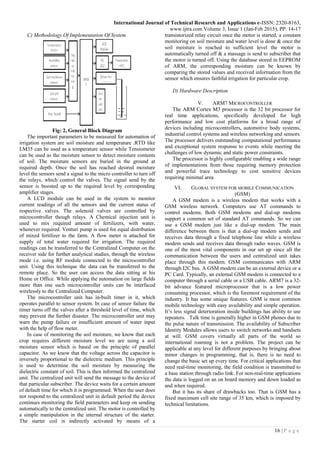
The system consists of a centralized unit, much like a
mobile base station This forms the link between the user and
the device. The whole system functions in the form network
being connected to the centralized unit as a Node. The
centralized unit is connected to many such nodes from/to which
it receives or sends the data. The user communicates with the
centralized unit through SMS. The centralized unit
communicates with the system through SMS which will be
received by the GSM with the help of the SMS. The GSM
sends this data to ARM7. ARM7 also continuously receives the
data from sensors in some form of codes. After processing, this
data is displayed on the LCD. The communication between
various devices takes place through RS232. Thus in short
whenever the system receives the activation command from the
subscriber it checks all the field conditions and gives a detailed
feedback to the user and waits for another activation command
to start the action. This system also monitors the physical
parameters like temperature humidity and maintain in
application with Green House very well.](https://image.slidesharecdn.com/ijtra141190-151028134923-lva1-app6892/85/FERTIGATION-THROUGH-DRIP-IRRIGATION-USING-EMBEDDED-SYSTEM-2-320.jpg)
![International Journal of Technical Research and Applications e-ISSN: 2320-8163,
www.ijtra.com Volume 3, Issue 1 (Jan-Feb 2015), PP. 14-17
17 | P a g e
FIG: 3 CONNECTING GSM MODULE TO THE SYSTEM
VII. MAINTAINING PH
The right combination of water and nutrients is the key for
high yield and the quality of produce. Fertigation has the
potential to ensure that the right combination of water and
nutrients is available at the root zone, satisfying the plants total
and temporal requirement of these two inputs. Fertigation saves
fertilizer as it permits applying fertilizer in small quantities at a
time matching with the plants nutrient need. Besides, it is
considered eco-friendly as it avoids leaching of fertilizers.
Liquid fertilizers are best suited for fertigation.
VIII. RESULTS
The prototype was developed for Fertigation control to
show proof of the concept. The scenario for context aware
agriculture is as follows:
*Sensors placed over piece of irrigated land will keep on
providing weather and soil moisture attributes of each similar
zones nearer to each other. The rate of sampling is defined as
per soil condition and crop under consideration.
* All conversions from raw samples, aggregation and data
storage facilities will be provided by desktop grid nodes.
* Context-aware sensor grid application will be using these
converted and aggregated samples for context modelling and
interpretation to know about the current situation for irrigation
requirements.
* Based on condition, decision will be taken for actuation
of respective emitters of drip for misting or for irrigation.
*Based on the pH sensors the action will be taken and it
will be maintained by providing Fertilizer with water.
*Temperature and Humidity can be maintained in Green
house as per requirement.
FIG: 4 GRAPH SHOWING SYSTEM BEHAVIOR ON SENSED VALUES
OF COOL AND HAZY DAY FOR SOIL MOISTURES.
IX. CONCLUSION
The Microcontroller based atomized drip irrigation system
technique proves to be a real time feedback control system
which monitors and controls all the activities of drip irrigation
system efficiently. Using this system, farmer can save
manpower, water to improve production and ultimately profit.
The developed irrigation automation system can be proposed to
be used in several commercial agricultural productions since it
was obtained in low cost and in reliable operation. This
application of sensor-based irrigation has showed that each
drop of water gives good crop yield, proper and required
amount of nutrient for crop which also avoid leaching. Based
on the rules and context situations different treatments were
performed to properly irrigate the area under consideration.
Threshold levels for irrigation and misting were defined based
on the plant under consideration Figure 4 presents the graphical
representation of climate and soil moisture data of a cool day
having hazy sun conditions and system response where drip is
actuated at a point when average soil moisture drops down the
minimum threshold level to cope up with water stress
condition. By providing the proper value of pH and fertilizers
and maintaining it in the soil productivity and quality of crop
will improve to very high level.
REFERENCE
[1] Control of Irrigation Automatically By Using Wireless Sensor
Network by Rashid Hussain, JL Sahgal, Anshulgangwar,
Md.Riyaj International Journal of Soft Computing and
Engineering (IJSCE) ISSN: 2231-2307, Volume-3, Issue-1,
March 2013.
[2] Fertigation in Vegetable Crops for Higher Productivity and
Resource Use Efficiency by RAM A. JAT1, SUHAS P.
WANI,KANWAR L. SAHRAWAT1 PIARA SINGH and
B.L. DHAKA, Published in Indian Journal of Fertilizer
(2011), Volume 7, No 3, Page 22-37Archived in the Open
Access institutional repository of the ICRISAT.
[3] N Patel and T B S Rajput. .Effect of Fertigation on Growth
and Yield of Onion.. Micro Irrigation, CBIP Publication, no
282, 2001, p 451. ”Fertigation recipe for selected crops in the
Mediterranean region”by Papadopouls,C. Metochis,N
Seraphides.
[4] M M Khan, K Shivashankar, A A Farooqui, Krishna
Manohar, R Kariyanna and R Sreerama. .Research Highlights
of Studies on Fertigation in Horticultural Crops. PDC,
GKVK, UAS Bangalore, 2001, p 28.
[5] C J Phene and R C Phene. .Drip Irrigation Systems and
Management. Extension Bulletin, no 244, Food and Fertilizer
Technology Centre, 1987, p 24.
[6] H K Veeranna, Abdul Khalak, A A Farooqui and G M Sujith.
.Effect ofFertigation with Normal and Water-soluble
Fertilizers Compared to Drip andFurrow Methods on Yield
Fertilizer and Irrigation Water Use Efficiency inChilli.. Micro
Irrigation, CBIP Publication, no 282, 2001, p 461.
[7] S J Locascio and A G Smajstrla. .Drip Irrigated Tomatoes as
Affected by Water Quantity and N and K Application Timing
for Trickle-irrigated Tomatoes.. Proceedings of Fla State
Horticulture Society, no 102, 1989, p 307.
[8] C J Phene and R C Phene. .Drip Irrigation Systems and
Management. Extension Bulletin, no 244, Food and Fertilizer
Technology Centre, 1987, p 24.
[9] An Integrated Framework to Develop Context-Aware Sensor
Grid for Agriculture “Aqeel-ur-Rehman, Zubair A. Shaikh,
Noor A. Shaikh and Noman Islam” Australian Journal of
Basic and Applied Sciences, 4(5): 922-931, 2010
[10] Or, D., 2005. Soil water sensors placement and interpretation
for drip irrigation management in heterogeneous soils. In:
Proceeding of 5th International Microirrigation Congress, pp:
214-222.](https://image.slidesharecdn.com/ijtra141190-151028134923-lva1-app6892/85/FERTIGATION-THROUGH-DRIP-IRRIGATION-USING-EMBEDDED-SYSTEM-4-320.jpg)
The paper discusses an automated fertigation system utilizing drip irrigation to enhance agricultural productivity while minimizing natural resource usage. It outlines the use of an ARM7 microcontroller to monitor soil conditions and manage water and fertilizer application, thereby ensuring optimal nutrient delivery and reducing fertilizer waste. The proposed system aims to provide real-time monitoring and control over irrigation parameters, contributing to increased crop yield and quality in an eco-friendly manner.


