Dr Sanjoy Sanyal
Professor, Surgeon, Informatician
 What is a Robot? (Slides 3 – 5)
 Classification of Robots (Slides 6 – 7)
 Table - ½ Century of Evolution of Robotics (Slide 8)
 UNIMATE (Slides 9 – 16)
 IRB 6 (Slides 17 – 23)
 CONSIGHT-1 (Slides 24 – 25)
 Humanoid Robot Evolution (Slides 26 – 28)
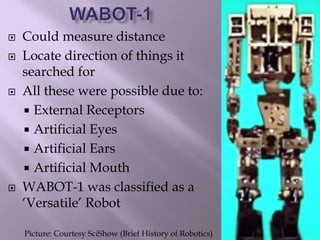
 WABOT-1 (Slides 29 – 32)
 WABOT-2 (Slides 33 – 36)
 ASIMO Development (Slides 37 – 50)
 BEAR (Slides 51 – 60)
 BAXTER (Slides 61 – 72)
 References / Acknowledgments (Slide 73)
 Contrary to what Sci-Fi thrillers would have
us believe, Robots are not self-aware machines
 They will not enslave us into bonded labors in
their version of ‘Silicon Mines’!
 They will not wage war against Humans, like
‘Skynet’!
 They will not send one of their own from the
Future to the Present to kill a boy, who they
have determined is destined to lead future
Humans against the Robots!!
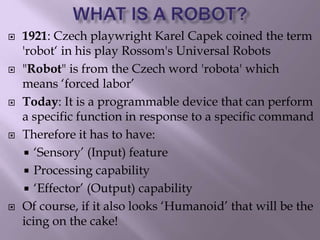
 1921: Czech playwright Karel Capek coined the term
'robot‘ in his play Rossom's Universal Robots
 "Robot" is from the Czech word 'robota' which
means ‘forced labor’
 Today: It is a programmable device that can perform
a specific function in response to a specific command
 Therefore it has to have:
 ‘Sensory’ (Input) feature
 Processing capability
 ‘Effector’ (Output) capability
 Of course, if it also looks ‘Humanoid’ that will be the
icing on the cake!
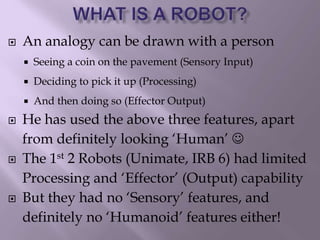
 An analogy can be drawn with a person
 Seeing a coin on the pavement (Sensory Input)
 Deciding to pick it up (Processing)
 And then doing so (Effector Output)
 He has used the above three features, apart
from definitely looking ‘Human’ 
 The 1st 2 Robots (Unimate, IRB 6) had limited
Processing and ‘Effector’ (Output) capability
 But they had no ‘Sensory’ features, and
definitely no ‘Humanoid’ features either!
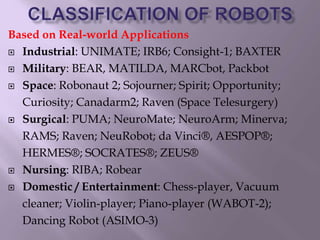
Based on Real-world Applications
 Industrial: UNIMATE; IRB6; Consight-1; BAXTER
 Military: BEAR, MATILDA, MARCbot, Packbot
 Space: Robonaut 2; Sojourner; Spirit; Opportunity;
Curiosity; Canadarm2; Raven (Space Telesurgery)
 Surgical: PUMA; NeuroMate; NeuroArm; Minerva;
RAMS; Raven; NeuRobot; da Vinci®, AESPOP®;
HERMES®; SOCRATES®; ZEUS®
 Nursing: RIBA; Robear
 Domestic / Entertainment: Chess-player, Vacuum
cleaner; Violin-player; Piano-player (WABOT-2);
Dancing Robot (ASIMO-3)
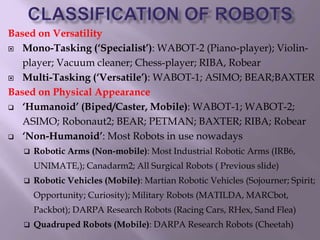
Based on Versatility
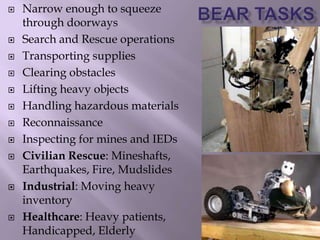
 Mono-Tasking (‘Specialist’): WABOT-2 (Piano-player); Violin-
player; Vacuum cleaner; Chess-player; RIBA, Robear
 Multi-Tasking (‘Versatile’): WABOT-1; ASIMO; BEAR;BAXTER
Based on Physical Appearance
 ‘Humanoid’ (Biped/Caster, Mobile): WABOT-1; WABOT-2;
ASIMO; Robonaut2; BEAR; PETMAN; BAXTER; RIBA; Robear
 ‘Non-Humanoid’: Most Robots in use nowadays
 Robotic Arms (Non-mobile): Most Industrial Robotic Arms (IRB6,
UNIMATE,); Canadarm2; All Surgical Robots ( Previous slide)
 Robotic Vehicles (Mobile): Martian Robotic Vehicles (Sojourner; Spirit;
Opportunity; Curiosity); Military Robots (MATILDA, MARCbot,
Packbot); DARPA Research Robots (Racing Cars, RHex, Sand Flea)
 Quadruped Robots (Mobile): DARPA Research Robots (Cheetah)
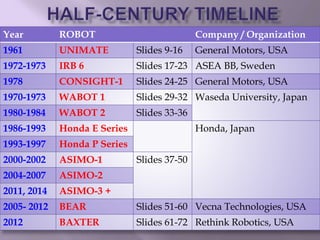
Year ROBOT Company / Organization
1961 UNIMATE Slides 9-16 General Motors, USA
1972-1973 IRB 6 Slides 17-23 ASEA BB, Sweden
1978 CONSIGHT-1 Slides 24-25 General Motors, USA
1970-1973 WABOT 1 Slides 29-32 Waseda University, Japan
1980-1984 WABOT 2 Slides 33-36
1986-1993 Honda E Series Honda, Japan
1993-1997 Honda P Series
2000-2002 ASIMO-1 Slides 37-50
2004-2007 ASIMO-2
2011, 2014 ASIMO-3 +
2005- 2012 BEAR Slides 51-60 Vecna Technologies, USA
2012 BAXTER Slides 61-72 Rethink Robotics, USA
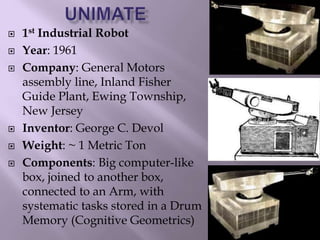
 1st Industrial Robot
 Year: 1961
 Company: General Motors
assembly line, Inland Fisher
Guide Plant, Ewing Township,
New Jersey
 Inventor: George C. Devol
 Weight: ~ 1 Metric Ton
 Components: Big computer-like
box, joined to another box,
connected to an Arm, with
systematic tasks stored in a Drum
Memory (Cognitive Geometrics)
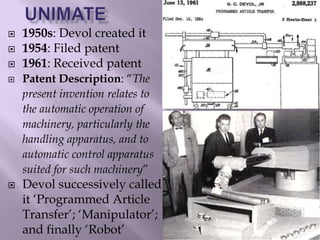
 1950s: Devol created it
 1954: Filed patent
 1961: Received patent
 Patent Description: “The
present invention relates to
the automatic operation of
machinery, particularly the
handling apparatus, and to
automatic control apparatus
suited for such machinery”
 Devol successively called
it ‘Programmed Article
Transfer’; ‘Manipulator’;
and finally ‘Robot’
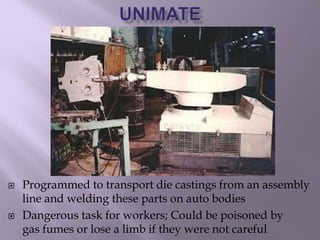
 Programmed to transport die castings from an assembly
line and welding these parts on auto bodies
 Dangerous task for workers; Could be poisoned by
gas fumes or lose a limb if they were not careful
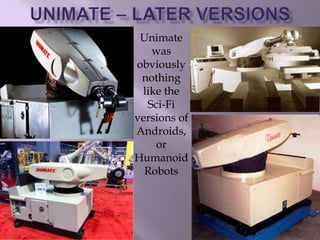
Unimate
was
obviously
nothing
like the
Sci-Fi
versions of
Androids,
or
Humanoid
Robots
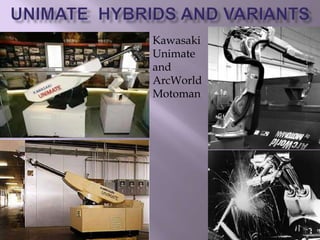
Kawasaki
Unimate
and
ArcWorld
Motoman
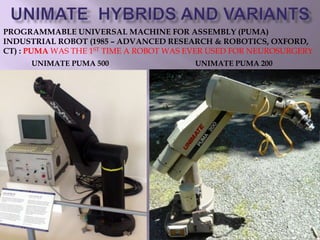
PROGRAMMABLE UNIVERSAL MACHINE FOR ASSEMBLY (PUMA)
INDUSTRIAL ROBOT (1985 – ADVANCED RESEARCH & ROBOTICS, OXFORD,
CT) : PUMA WAS THE 1ST TIME A ROBOT WAS EVER USED FOR NEUROSURGERY
UNIMATE PUMA 500 UNIMATE PUMA 200
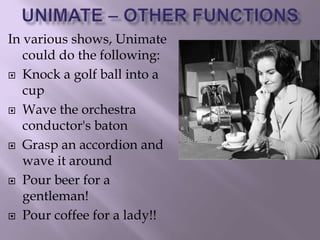
In various shows, Unimate
could do the following:
 Knock a golf ball into a
cup
 Wave the orchestra
conductor's baton
 Grasp an accordion and
wave it around
 Pour beer for a
gentleman!
 Pour coffee for a lady!!
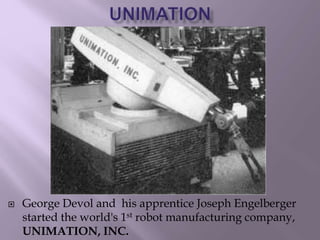
 George Devol and his apprentice Joseph Engelberger
started the world's 1st robot manufacturing company,
UNIMATION, INC.
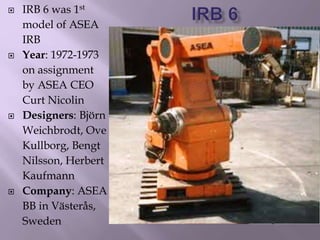
 IRB 6 was 1st
model of ASEA
IRB
 Year: 1972-1973
on assignment
by ASEA CEO
Curt Nicolin
 Designers: Björn
Weichbrodt, Ove
Kullborg, Bengt
Nilsson, Herbert
Kaufmann
 Company: ASEA
BB in Västerås,
Sweden
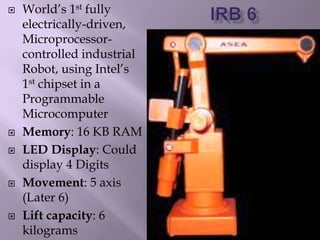
 World’s 1st fully
electrically-driven,
Microprocessor-
controlled industrial
Robot, using Intel’s
1st chipset in a
Programmable
Microcomputer
 Memory: 16 KB RAM
 LED Display: Could
display 4 Digits
 Movement: 5 axis
(Later 6)
 Lift capacity: 6
kilograms
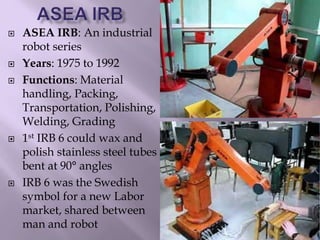
 ASEA IRB: An industrial
robot series
 Years: 1975 to 1992
 Functions: Material
handling, Packing,
Transportation, Polishing,
Welding, Grading
 1st IRB 6 could wax and
polish stainless steel tubes
bent at 90° angles
 IRB 6 was the Swedish
symbol for a new Labor
market, shared between
man and robot
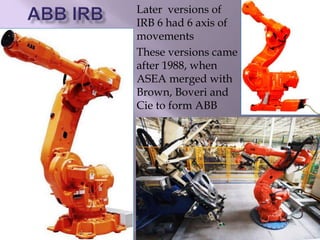
Later versions of
IRB 6 had 6 axis of
movements
These versions came
after 1988, when
ASEA merged with
Brown, Boveri and
Cie to form ABB
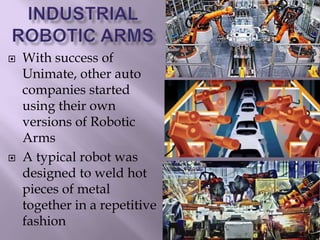
 With success of
Unimate, other auto
companies started
using their own
versions of Robotic
Arms
 A typical robot was
designed to weld hot
pieces of metal
together in a repetitive
fashion
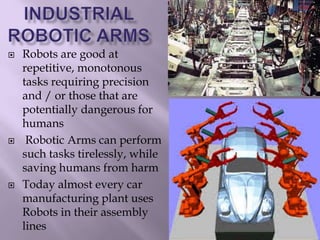
 Robots are good at
repetitive, monotonous
tasks requiring precision
and / or those that are
potentially dangerous for
humans
 Robotic Arms can perform
such tasks tirelessly, while
saving humans from harm
 Today almost every car
manufacturing plant uses
Robots in their assembly
lines
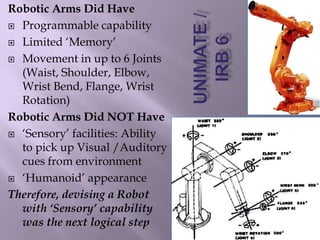
Robotic Arms Did Have
 Programmable capability
 Limited ‘Memory’
 Movement in up to 6 Joints
(Waist, Shoulder, Elbow,
Wrist Bend, Flange, Wrist
Rotation)
Robotic Arms Did NOT Have
 ‘Sensory’ facilities: Ability
to pick up Visual /Auditory
cues from environment
 ‘Humanoid’ appearance
Therefore, devising a Robot
with ‘Sensory’ capability
was the next logical step
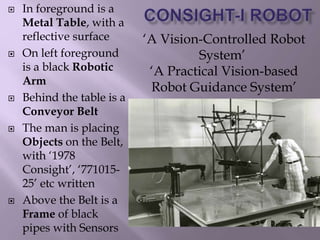
 In foreground is a
Metal Table, with a
reflective surface
 On left foreground
is a black Robotic
Arm
 Behind the table is a
Conveyor Belt
 The man is placing
Objects on the Belt,
with ‘1978
Consight’, ‘771015-
25’ etc written
 Above the Belt is a
Frame of black
pipes with Sensors
‘A Vision-Controlled Robot
System’
‘A Practical Vision-based
Robot Guidance System’
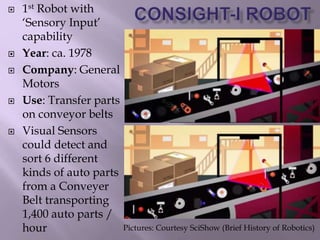
 1st Robot with
‘Sensory Input’
capability
 Year: ca. 1978
 Company: General
Motors
 Use: Transfer parts
on conveyor belts
 Visual Sensors
could detect and
sort 6 different
kinds of auto parts
from a Conveyer
Belt transporting
1,400 auto parts /
hour Pictures: Courtesy SciShow (Brief History of Robotics)
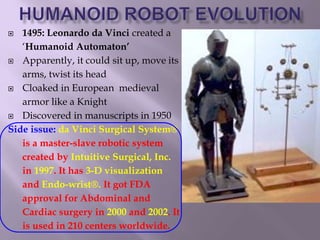
 1495: Leonardo da Vinci created a
‘Humanoid Automaton’
 Apparently, it could sit up, move its
arms, twist its head
 Cloaked in European medieval
armor like a Knight
 Discovered in manuscripts in 1950
Side issue: da Vinci Surgical System®
is a master-slave robotic system
created by Intuitive Surgical, Inc.
in 1997. It has 3-D visualization
and Endo-wrist®. It got FDA
approval for Abdominal and
Cardiac surgery in 2000 and 2002. It
is used in 210 centers worldwide.
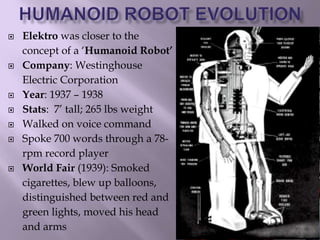
 Elektro was closer to the
concept of a ‘Humanoid Robot’
 Company: Westinghouse
Electric Corporation
 Year: 1937 – 1938
 Stats: 7’ tall; 265 lbs weight
 Walked on voice command
 Spoke 700 words through a 78-
rpm record player
 World Fair (1939): Smoked
cigarettes, blew up balloons,
distinguished between red and
green lights, moved his head
and arms
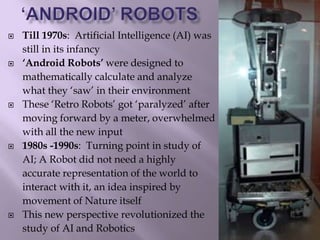
 Till 1970s: Artificial Intelligence (AI) was
still in its infancy
 ‘Android Robots’ were designed to
mathematically calculate and analyze
what they ‘saw’ in their environment
 These ‘Retro Robots’ got ‘paralyzed’ after
moving forward by a meter, overwhelmed
with all the new input
 1980s -1990s: Turning point in study of
AI; A Robot did not need a highly
accurate representation of the world to
interact with it, an idea inspired by
movement of Nature itself
 This new perspective revolutionized the
study of AI and Robotics
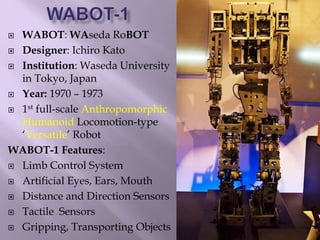
 WABOT: WAseda RoBOT
 Designer: Ichiro Kato
 Institution: Waseda University
in Tokyo, Japan
 Year: 1970 – 1973
 1st full-scale Anthropomorphic
Humanoid Locomotion-type
‘Versatile’ Robot
WABOT-1 Features:
 Limb Control System
 Artificial Eyes, Ears, Mouth
 Distance and Direction Sensors
 Tactile Sensors
 Gripping, Transporting Objects
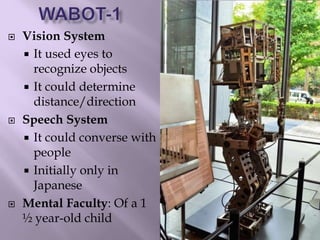
 Vision System
 It used eyes to
recognize objects
 It could determine
distance/direction
 Speech System
 It could converse with
people
 Initially only in
Japanese
 Mental Faculty: Of a 1
½ year-old child
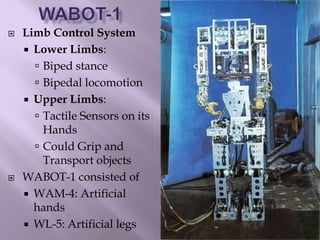
 Limb Control System
 Lower Limbs:
 Biped stance
 Bipedal locomotion
 Upper Limbs:
 Tactile Sensors on its
Hands
 Could Grip and
Transport objects
 WABOT-1 consisted of
 WAM-4: Artificial
hands
 WL-5: Artificial legs
 Could measure distance
 Locate direction of things it
searched for
 All these were possible due to:
 External Receptors
 Artificial Eyes
 Artificial Ears
 Artificial Mouth
 WABOT-1 was classified as a
‘Versatile’ Robot
Picture: Courtesy SciShow (Brief History of Robotics)
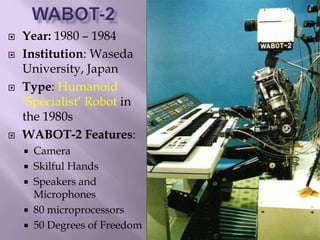
 Year: 1980 – 1984
 Institution: Waseda
University, Japan
 Type: Humanoid
‘Specialist’ Robot in
the 1980s
 WABOT-2 Features:
 Camera
 Skilful Hands
 Speakers and
Microphones
 80 microprocessors
 50 Degrees of Freedom
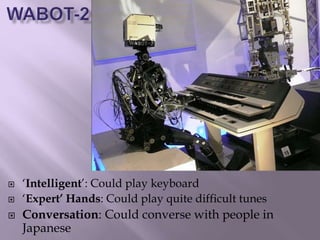
 ‘Intelligent’: Could play keyboard
 ‘Expert’ Hands: Could play quite difficult tunes
 Conversation: Could converse with people in
Japanese
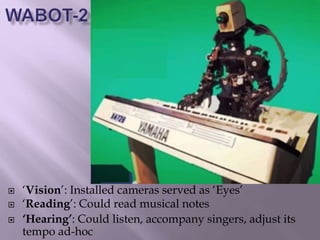
 ‘Vision’: Installed cameras served as ‘Eyes’
 ‘Reading’: Could read musical notes
 ‘Hearing’: Could listen, accompany singers, adjust its
tempo ad-hoc
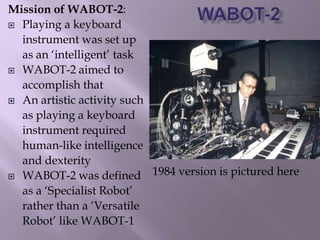
Mission of WABOT-2:
 Playing a keyboard
instrument was set up
as an ‘intelligent’ task
 WABOT-2 aimed to
accomplish that
 An artistic activity such
as playing a keyboard
instrument required
human-like intelligence
and dexterity
 WABOT-2 was defined
as a ‘Specialist Robot’
rather than a ‘Versatile
Robot’ like WABOT-1
1984 version is pictured here
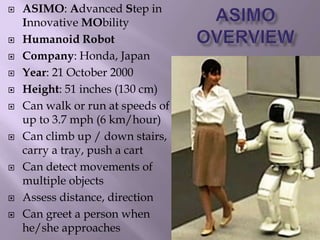
 ASIMO: Advanced Step in
Innovative MObility
 Humanoid Robot
 Company: Honda, Japan
 Year: 21 October 2000
 Height: 51 inches (130 cm)
 Can walk or run at speeds of
up to 3.7 mph (6 km/hour)
 Can climb up / down stairs,
carry a tray, push a cart
 Can detect movements of
multiple objects
 Assess distance, direction
 Can greet a person when
he/she approaches
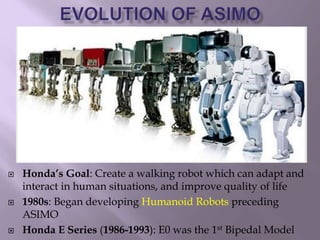
 Honda’s Goal: Create a walking robot which can adapt and
interact in human situations, and improve quality of life
 1980s: Began developing Humanoid Robots preceding
ASIMO
 Honda E Series (1986-1993): E0 was the 1st Bipedal Model
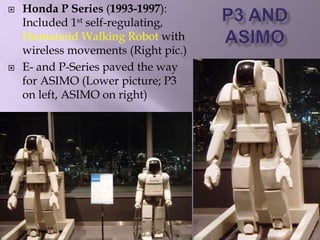
 Honda P Series (1993-1997):
Included 1st self-regulating,
Humanoid Walking Robot with
wireless movements (Right pic.)
 E- and P-Series paved the way
for ASIMO (Lower picture; P3
on left, ASIMO on right)
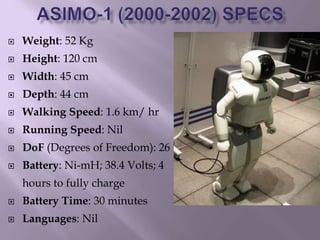
 Weight: 52 Kg
 Height: 120 cm
 Width: 45 cm
 Depth: 44 cm
 Walking Speed: 1.6 km/ hr
 Running Speed: Nil
 DoF (Degrees of Freedom): 26
 Battery: Ni-mH; 38.4 Volts; 4
hours to fully charge
 Battery Time: 30 minutes
 Languages: Nil
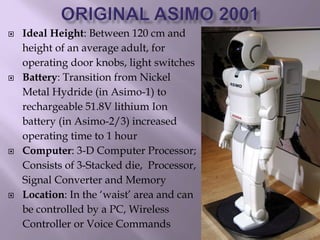
 Ideal Height: Between 120 cm and
height of an average adult, for
operating door knobs, light switches
 Battery: Transition from Nickel
Metal Hydride (in Asimo-1) to
rechargeable 51.8V lithium Ion
battery (in Asimo-2/3) increased
operating time to 1 hour
 Computer: 3-D Computer Processor;
Consists of 3-Stacked die, Processor,
Signal Converter and Memory
 Location: In the ‘waist’ area and can
be controlled by a PC, Wireless
Controller or Voice Commands
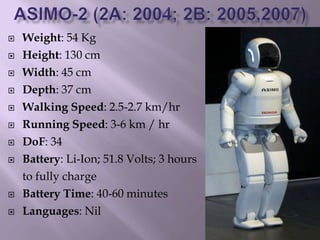
 Weight: 54 Kg
 Height: 130 cm
 Width: 45 cm
 Depth: 37 cm
 Walking Speed: 2.5-2.7 km/hr
 Running Speed: 3-6 km / hr
 DoF: 34
 Battery: Li-Ion; 51.8 Volts; 3 hours
to fully charge
 Battery Time: 40-60 minutes
 Languages: Nil
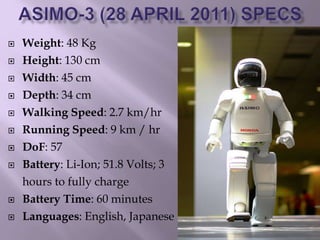
 Weight: 48 Kg
 Height: 130 cm
 Width: 45 cm
 Depth: 34 cm
 Walking Speed: 2.7 km/hr
 Running Speed: 9 km / hr
 DoF: 57
 Battery: Li-Ion; 51.8 Volts; 3
hours to fully charge
 Battery Time: 60 minutes
 Languages: English, Japanese
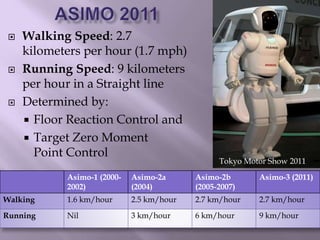
 Walking Speed: 2.7
kilometers per hour (1.7 mph)
 Running Speed: 9 kilometers
per hour in a Straight line
 Determined by:
 Floor Reaction Control and
 Target Zero Moment
Point Control
Tokyo Motor Show 2011
Asimo-1 (2000-
2002)
Asimo-2a
(2004)
Asimo-2b
(2005-2007)
Asimo-3 (2011)
Walking 1.6 km/hour 2.5 km/hour 2.7 km/hour 2.7 km/hour
Running Nil 3 km/hour 6 km/hour 9 km/hour
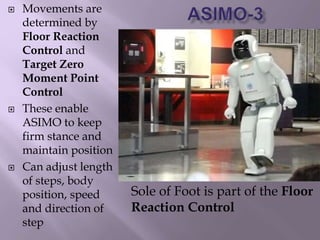
 Movements are
determined by
Floor Reaction
Control and
Target Zero
Moment Point
Control
 These enable
ASIMO to keep
firm stance and
maintain position
 Can adjust length
of steps, body
position, speed
and direction of
step
Sole of Foot is part of the Floor
Reaction Control
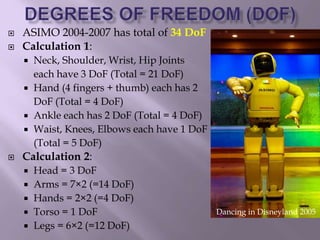
 ASIMO 2004-2007 has total of 34 DoF
 Calculation 1:
 Neck, Shoulder, Wrist, Hip Joints
each have 3 DoF (Total = 21 DoF)
 Hand (4 fingers + thumb) each has 2
DoF (Total = 4 DoF)
 Ankle each has 2 DoF (Total = 4 DoF)
 Waist, Knees, Elbows each have 1 DoF
(Total = 5 DoF)
 Calculation 2:
 Head = 3 DoF
 Arms = 7×2 (=14 DoF)
 Hands = 2×2 (=4 DoF)
 Torso = 1 DoF
 Legs = 6×2 (=12 DoF)
Dancing in Disneyland 2005
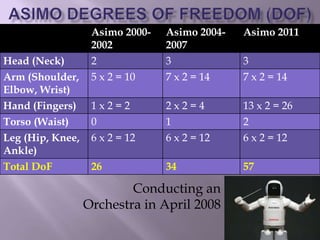
Asimo 2000-
2002
Asimo 2004-
2007
Asimo 2011
Head (Neck) 2 3 3
Arm (Shoulder,
Elbow, Wrist)
5 x 2 = 10 7 x 2 = 14 7 x 2 = 14
Hand (Fingers) 1 x 2 = 2 2 x 2 = 4 13 x 2 = 26
Torso (Waist) 0 1 2
Leg (Hip, Knee,
Ankle)
6 x 2 = 12 6 x 2 = 12 6 x 2 = 12
Total DoF 26 34 57
Conducting an
Orchestra in April 2008
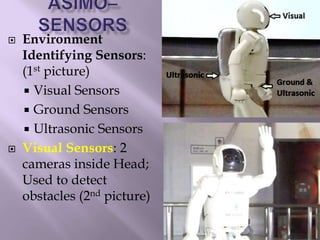
 Environment
Identifying Sensors:
(1st picture)
 Visual Sensors
 Ground Sensors
 Ultrasonic Sensors
 Visual Sensors: 2
cameras inside Head;
Used to detect
obstacles (2nd picture)
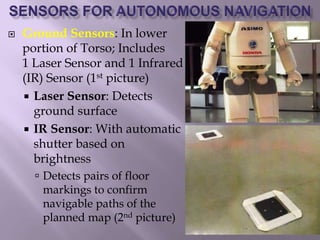
 Ground Sensors: In lower
portion of Torso; Includes
1 Laser Sensor and 1 Infrared
(IR) Sensor (1st picture)
 Laser Sensor: Detects
ground surface
 IR Sensor: With automatic
shutter based on
brightness
 Detects pairs of floor
markings to confirm
navigable paths of the
planned map (2nd picture)
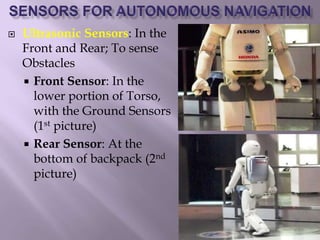
 Ultrasonic Sensors: In the
Front and Rear; To sense
Obstacles
 Front Sensor: In the
lower portion of Torso,
with the Ground Sensors
(1st picture)
 Rear Sensor: At the
bottom of backpack (2nd
picture)
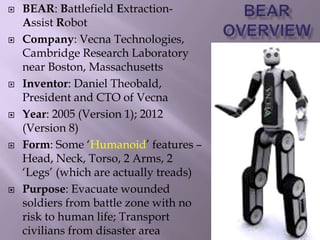
 BEAR: Battlefield Extraction-
Assist Robot
 Company: Vecna Technologies,
Cambridge Research Laboratory
near Boston, Massachusetts
 Inventor: Daniel Theobald,
President and CTO of Vecna
 Year: 2005 (Version 1); 2012
(Version 8)
 Form: Some ‘Humanoid’ features –
Head, Neck, Torso, 2 Arms, 2
‘Legs’ (which are actually treads)
 Purpose: Evacuate wounded
soldiers from battle zone with no
risk to human life; Transport
civilians from disaster area
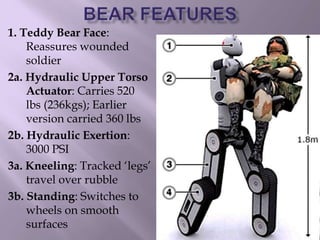
1. Teddy Bear Face:
Reassures wounded
soldier
2a. Hydraulic Upper Torso
Actuator: Carries 520
lbs (236kgs); Earlier
version carried 360 lbs
2b. Hydraulic Exertion:
3000 PSI
3a. Kneeling: Tracked ‘legs’
travel over rubble
3b. Standing: Switches to
wheels on smooth
surfaces
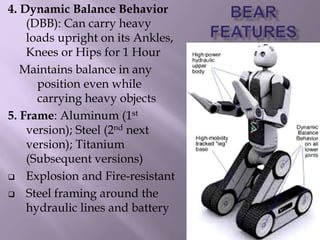
4. Dynamic Balance Behavior
(DBB): Can carry heavy
loads upright on its Ankles,
Knees or Hips for 1 Hour
Maintains balance in any
position even while
carrying heavy objects
5. Frame: Aluminum (1st
version); Steel (2nd next
version); Titanium
(Subsequent versions)
 Explosion and Fire-resistant
 Steel framing around the
hydraulic lines and battery
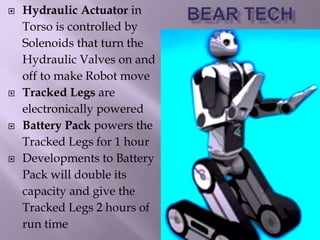
 Hydraulic Actuator in
Torso is controlled by
Solenoids that turn the
Hydraulic Valves on and
off to make Robot move
 Tracked Legs are
electronically powered
 Battery Pack powers the
Tracked Legs for 1 hour
 Developments to Battery
Pack will double its
capacity and give the
Tracked Legs 2 hours of
run time
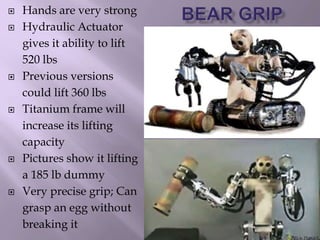
 Hands are very strong
 Hydraulic Actuator
gives it ability to lift
520 lbs
 Previous versions
could lift 360 lbs
 Titanium frame will
increase its lifting
capacity
 Pictures show it lifting
a 185 lb dummy
 Very precise grip; Can
grasp an egg without
breaking it
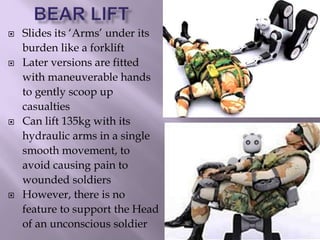
 Slides its ‘Arms’ under its
burden like a forklift
 Later versions are fitted
with maneuverable hands
to gently scoop up
casualties
 Can lift 135kg with its
hydraulic arms in a single
smooth movement, to
avoid causing pain to
wounded soldiers
 However, there is no
feature to support the Head
of an unconscious soldier
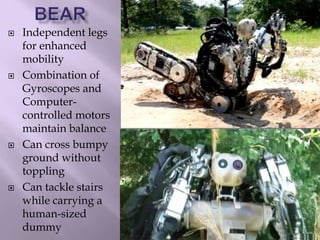
 Independent legs
for enhanced
mobility
 Combination of
Gyroscopes and
Computer-
controlled motors
maintain balance
 Can cross bumpy
ground without
toppling
 Can tackle stairs
while carrying a
human-sized
dummy
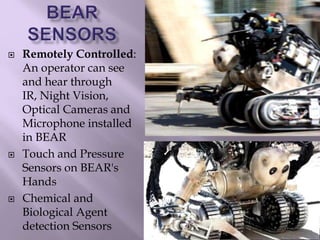
 Remotely Controlled:
An operator can see
and hear through
IR, Night Vision,
Optical Cameras and
Microphone installed
in BEAR
 Touch and Pressure
Sensors on BEAR's
Hands
 Chemical and
Biological Agent
detection Sensors
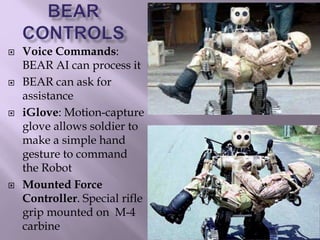
 Voice Commands:
BEAR AI can process it
 BEAR can ask for
assistance
 iGlove: Motion-capture
glove allows soldier to
make a simple hand
gesture to command
the Robot
 Mounted Force
Controller. Special rifle
grip mounted on M-4
carbine
 Narrow enough to squeeze
through doorways
 Search and Rescue operations
 Transporting supplies
 Clearing obstacles
 Lifting heavy objects
 Handling hazardous materials
 Reconnaissance
 Inspecting for mines and IEDs
 Civilian Rescue: Mineshafts,
Earthquakes, Fire, Mudslides
 Industrial: Moving heavy
inventory
 Healthcare: Heavy patients,
Handicapped, Elderly
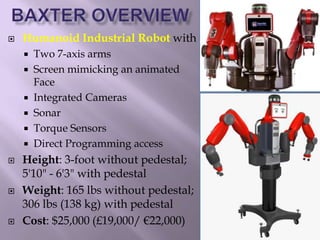
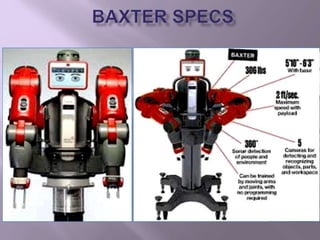
 Humanoid Industrial Robot with
 Two 7-axis arms
 Screen mimicking an animated
Face
 Integrated Cameras
 Sonar
 Torque Sensors
 Direct Programming access
 Height: 3-foot without pedestal;
5'10" - 6'3" with pedestal
 Weight: 165 lbs without pedestal;
306 lbs (138 kg) with pedestal
 Cost: $25,000 (£19,000/ €22,000)
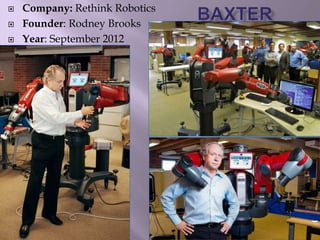
 Company: Rethink Robotics
 Founder: Rodney Brooks
 Year: September 2012
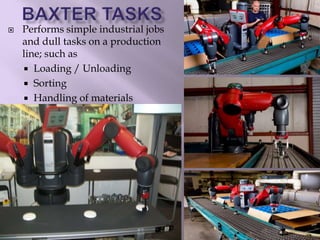
 Performs simple industrial jobs
and dull tasks on a production
line; such as
 Loading / Unloading
 Sorting
 Handling of materials
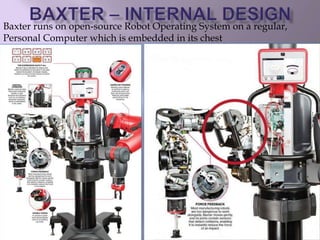
Baxter runs on open-source Robot Operating System on a regular,
Personal Computer which is embedded in its chest
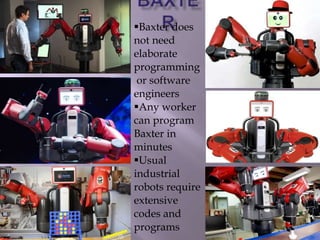
Baxter does
not need
elaborate
programming
or software
engineers
Any worker
can program
Baxter in
minutes
Usual
industrial
robots require
extensive
codes and
programs
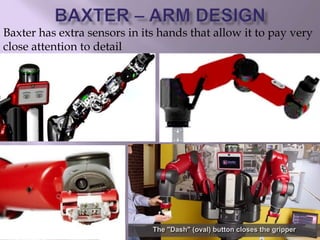
Baxter has extra sensors in its hands that allow it to pay very
close attention to detail
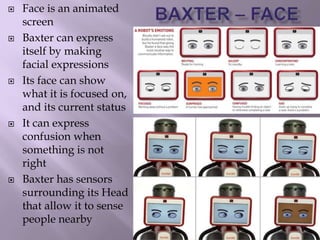
 Face is an animated
screen
 Baxter can express
itself by making
facial expressions
 Its face can show
what it is focused on,
and its current status
 It can express
confusion when
something is not
right
 Baxter has sensors
surrounding its Head
that allow it to sense
people nearby
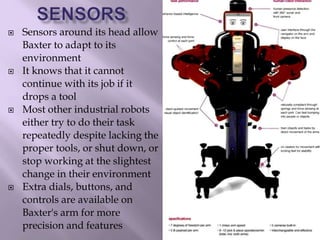
 Sensors around its head allow
Baxter to adapt to its
environment
 It knows that it cannot
continue with its job if it
drops a tool
 Most other industrial robots
either try to do their task
repeatedly despite lacking the
proper tools, or shut down, or
stop working at the slightest
change in their environment
 Extra dials, buttons, and
controls are available on
Baxter's arm for more
precision and features
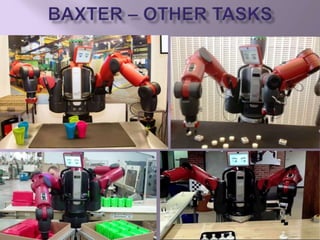
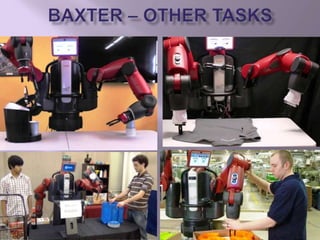
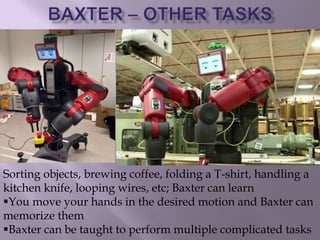
Sorting objects, brewing coffee, folding a T-shirt, handling a
kitchen knife, looping wires, etc; Baxter can learn
You move your hands in the desired motion and Baxter can
memorize them
Baxter can be taught to perform multiple complicated tasks
 Hank Green. SciShow Presenter; A Brief History of
Robotics. (The inspiration behind this PPTX) URL:
https://www.youtube.com/watch?v=uoC2ZGRI8a8
 History of Robots: URL: http://www.robots-and-
androids.com/history-of-robots.html
 Consight: URL:
http://www.computerhistory.org/collections/catal
og/102640482
 Waseda University Humanoid: URL:
http://www.humanoid.waseda.ac.jp/booklet/kato_
2.html
Thank you for watching

Technological Evolution of Robotics - Dr Sanjoy Sanyal

  • 1.
    Dr Sanjoy Sanyal Professor,Surgeon, Informatician
  • 2.
     What isa Robot? (Slides 3 – 5)  Classification of Robots (Slides 6 – 7)  Table - ½ Century of Evolution of Robotics (Slide 8)  UNIMATE (Slides 9 – 16)  IRB 6 (Slides 17 – 23)  CONSIGHT-1 (Slides 24 – 25)  Humanoid Robot Evolution (Slides 26 – 28)  WABOT-1 (Slides 29 – 32)  WABOT-2 (Slides 33 – 36)  ASIMO Development (Slides 37 – 50)  BEAR (Slides 51 – 60)  BAXTER (Slides 61 – 72)  References / Acknowledgments (Slide 73)
  • 3.
     Contrary towhat Sci-Fi thrillers would have us believe, Robots are not self-aware machines  They will not enslave us into bonded labors in their version of ‘Silicon Mines’!  They will not wage war against Humans, like ‘Skynet’!  They will not send one of their own from the Future to the Present to kill a boy, who they have determined is destined to lead future Humans against the Robots!!
  • 4.
     1921: Czechplaywright Karel Capek coined the term 'robot‘ in his play Rossom's Universal Robots  "Robot" is from the Czech word 'robota' which means ‘forced labor’  Today: It is a programmable device that can perform a specific function in response to a specific command  Therefore it has to have:  ‘Sensory’ (Input) feature  Processing capability  ‘Effector’ (Output) capability  Of course, if it also looks ‘Humanoid’ that will be the icing on the cake!
  • 5.
     An analogycan be drawn with a person  Seeing a coin on the pavement (Sensory Input)  Deciding to pick it up (Processing)  And then doing so (Effector Output)  He has used the above three features, apart from definitely looking ‘Human’   The 1st 2 Robots (Unimate, IRB 6) had limited Processing and ‘Effector’ (Output) capability  But they had no ‘Sensory’ features, and definitely no ‘Humanoid’ features either!
  • 6.
    Based on Real-worldApplications  Industrial: UNIMATE; IRB6; Consight-1; BAXTER  Military: BEAR, MATILDA, MARCbot, Packbot  Space: Robonaut 2; Sojourner; Spirit; Opportunity; Curiosity; Canadarm2; Raven (Space Telesurgery)  Surgical: PUMA; NeuroMate; NeuroArm; Minerva; RAMS; Raven; NeuRobot; da Vinci®, AESPOP®; HERMES®; SOCRATES®; ZEUS®  Nursing: RIBA; Robear  Domestic / Entertainment: Chess-player, Vacuum cleaner; Violin-player; Piano-player (WABOT-2); Dancing Robot (ASIMO-3)
  • 7.
    Based on Versatility Mono-Tasking (‘Specialist’): WABOT-2 (Piano-player); Violin- player; Vacuum cleaner; Chess-player; RIBA, Robear  Multi-Tasking (‘Versatile’): WABOT-1; ASIMO; BEAR;BAXTER Based on Physical Appearance  ‘Humanoid’ (Biped/Caster, Mobile): WABOT-1; WABOT-2; ASIMO; Robonaut2; BEAR; PETMAN; BAXTER; RIBA; Robear  ‘Non-Humanoid’: Most Robots in use nowadays  Robotic Arms (Non-mobile): Most Industrial Robotic Arms (IRB6, UNIMATE,); Canadarm2; All Surgical Robots ( Previous slide)  Robotic Vehicles (Mobile): Martian Robotic Vehicles (Sojourner; Spirit; Opportunity; Curiosity); Military Robots (MATILDA, MARCbot, Packbot); DARPA Research Robots (Racing Cars, RHex, Sand Flea)  Quadruped Robots (Mobile): DARPA Research Robots (Cheetah)
  • 8.
    Year ROBOT Company/ Organization 1961 UNIMATE Slides 9-16 General Motors, USA 1972-1973 IRB 6 Slides 17-23 ASEA BB, Sweden 1978 CONSIGHT-1 Slides 24-25 General Motors, USA 1970-1973 WABOT 1 Slides 29-32 Waseda University, Japan 1980-1984 WABOT 2 Slides 33-36 1986-1993 Honda E Series Honda, Japan 1993-1997 Honda P Series 2000-2002 ASIMO-1 Slides 37-50 2004-2007 ASIMO-2 2011, 2014 ASIMO-3 + 2005- 2012 BEAR Slides 51-60 Vecna Technologies, USA 2012 BAXTER Slides 61-72 Rethink Robotics, USA
  • 9.
     1st IndustrialRobot  Year: 1961  Company: General Motors assembly line, Inland Fisher Guide Plant, Ewing Township, New Jersey  Inventor: George C. Devol  Weight: ~ 1 Metric Ton  Components: Big computer-like box, joined to another box, connected to an Arm, with systematic tasks stored in a Drum Memory (Cognitive Geometrics)
  • 10.
     1950s: Devolcreated it  1954: Filed patent  1961: Received patent  Patent Description: “The present invention relates to the automatic operation of machinery, particularly the handling apparatus, and to automatic control apparatus suited for such machinery”  Devol successively called it ‘Programmed Article Transfer’; ‘Manipulator’; and finally ‘Robot’
  • 11.
     Programmed totransport die castings from an assembly line and welding these parts on auto bodies  Dangerous task for workers; Could be poisoned by gas fumes or lose a limb if they were not careful
  • 12.
  • 13.
  • 14.
    PROGRAMMABLE UNIVERSAL MACHINEFOR ASSEMBLY (PUMA) INDUSTRIAL ROBOT (1985 – ADVANCED RESEARCH & ROBOTICS, OXFORD, CT) : PUMA WAS THE 1ST TIME A ROBOT WAS EVER USED FOR NEUROSURGERY UNIMATE PUMA 500 UNIMATE PUMA 200
  • 15.
    In various shows,Unimate could do the following:  Knock a golf ball into a cup  Wave the orchestra conductor's baton  Grasp an accordion and wave it around  Pour beer for a gentleman!  Pour coffee for a lady!!
  • 16.
     George Devoland his apprentice Joseph Engelberger started the world's 1st robot manufacturing company, UNIMATION, INC.
  • 17.
     IRB 6was 1st model of ASEA IRB  Year: 1972-1973 on assignment by ASEA CEO Curt Nicolin  Designers: Björn Weichbrodt, Ove Kullborg, Bengt Nilsson, Herbert Kaufmann  Company: ASEA BB in Västerås, Sweden
  • 18.
     World’s 1stfully electrically-driven, Microprocessor- controlled industrial Robot, using Intel’s 1st chipset in a Programmable Microcomputer  Memory: 16 KB RAM  LED Display: Could display 4 Digits  Movement: 5 axis (Later 6)  Lift capacity: 6 kilograms
  • 19.
     ASEA IRB:An industrial robot series  Years: 1975 to 1992  Functions: Material handling, Packing, Transportation, Polishing, Welding, Grading  1st IRB 6 could wax and polish stainless steel tubes bent at 90° angles  IRB 6 was the Swedish symbol for a new Labor market, shared between man and robot
  • 20.
    Later versions of IRB6 had 6 axis of movements These versions came after 1988, when ASEA merged with Brown, Boveri and Cie to form ABB
  • 21.
     With successof Unimate, other auto companies started using their own versions of Robotic Arms  A typical robot was designed to weld hot pieces of metal together in a repetitive fashion
  • 22.
     Robots aregood at repetitive, monotonous tasks requiring precision and / or those that are potentially dangerous for humans  Robotic Arms can perform such tasks tirelessly, while saving humans from harm  Today almost every car manufacturing plant uses Robots in their assembly lines
  • 23.
    Robotic Arms DidHave  Programmable capability  Limited ‘Memory’  Movement in up to 6 Joints (Waist, Shoulder, Elbow, Wrist Bend, Flange, Wrist Rotation) Robotic Arms Did NOT Have  ‘Sensory’ facilities: Ability to pick up Visual /Auditory cues from environment  ‘Humanoid’ appearance Therefore, devising a Robot with ‘Sensory’ capability was the next logical step
  • 24.
     In foregroundis a Metal Table, with a reflective surface  On left foreground is a black Robotic Arm  Behind the table is a Conveyor Belt  The man is placing Objects on the Belt, with ‘1978 Consight’, ‘771015- 25’ etc written  Above the Belt is a Frame of black pipes with Sensors ‘A Vision-Controlled Robot System’ ‘A Practical Vision-based Robot Guidance System’
  • 25.
     1st Robotwith ‘Sensory Input’ capability  Year: ca. 1978  Company: General Motors  Use: Transfer parts on conveyor belts  Visual Sensors could detect and sort 6 different kinds of auto parts from a Conveyer Belt transporting 1,400 auto parts / hour Pictures: Courtesy SciShow (Brief History of Robotics)
  • 26.
     1495: Leonardoda Vinci created a ‘Humanoid Automaton’  Apparently, it could sit up, move its arms, twist its head  Cloaked in European medieval armor like a Knight  Discovered in manuscripts in 1950 Side issue: da Vinci Surgical System® is a master-slave robotic system created by Intuitive Surgical, Inc. in 1997. It has 3-D visualization and Endo-wrist®. It got FDA approval for Abdominal and Cardiac surgery in 2000 and 2002. It is used in 210 centers worldwide.
  • 27.
     Elektro wascloser to the concept of a ‘Humanoid Robot’  Company: Westinghouse Electric Corporation  Year: 1937 – 1938  Stats: 7’ tall; 265 lbs weight  Walked on voice command  Spoke 700 words through a 78- rpm record player  World Fair (1939): Smoked cigarettes, blew up balloons, distinguished between red and green lights, moved his head and arms
  • 28.
     Till 1970s:Artificial Intelligence (AI) was still in its infancy  ‘Android Robots’ were designed to mathematically calculate and analyze what they ‘saw’ in their environment  These ‘Retro Robots’ got ‘paralyzed’ after moving forward by a meter, overwhelmed with all the new input  1980s -1990s: Turning point in study of AI; A Robot did not need a highly accurate representation of the world to interact with it, an idea inspired by movement of Nature itself  This new perspective revolutionized the study of AI and Robotics
  • 29.
     WABOT: WAsedaRoBOT  Designer: Ichiro Kato  Institution: Waseda University in Tokyo, Japan  Year: 1970 – 1973  1st full-scale Anthropomorphic Humanoid Locomotion-type ‘Versatile’ Robot WABOT-1 Features:  Limb Control System  Artificial Eyes, Ears, Mouth  Distance and Direction Sensors  Tactile Sensors  Gripping, Transporting Objects
  • 30.
     Vision System It used eyes to recognize objects  It could determine distance/direction  Speech System  It could converse with people  Initially only in Japanese  Mental Faculty: Of a 1 ½ year-old child
  • 31.
     Limb ControlSystem  Lower Limbs:  Biped stance  Bipedal locomotion  Upper Limbs:  Tactile Sensors on its Hands  Could Grip and Transport objects  WABOT-1 consisted of  WAM-4: Artificial hands  WL-5: Artificial legs
  • 32.
     Could measuredistance  Locate direction of things it searched for  All these were possible due to:  External Receptors  Artificial Eyes  Artificial Ears  Artificial Mouth  WABOT-1 was classified as a ‘Versatile’ Robot Picture: Courtesy SciShow (Brief History of Robotics)
  • 33.
     Year: 1980– 1984  Institution: Waseda University, Japan  Type: Humanoid ‘Specialist’ Robot in the 1980s  WABOT-2 Features:  Camera  Skilful Hands  Speakers and Microphones  80 microprocessors  50 Degrees of Freedom
  • 34.
     ‘Intelligent’: Couldplay keyboard  ‘Expert’ Hands: Could play quite difficult tunes  Conversation: Could converse with people in Japanese
  • 35.
     ‘Vision’: Installedcameras served as ‘Eyes’  ‘Reading’: Could read musical notes  ‘Hearing’: Could listen, accompany singers, adjust its tempo ad-hoc
  • 36.
    Mission of WABOT-2: Playing a keyboard instrument was set up as an ‘intelligent’ task  WABOT-2 aimed to accomplish that  An artistic activity such as playing a keyboard instrument required human-like intelligence and dexterity  WABOT-2 was defined as a ‘Specialist Robot’ rather than a ‘Versatile Robot’ like WABOT-1 1984 version is pictured here
  • 37.
     ASIMO: AdvancedStep in Innovative MObility  Humanoid Robot  Company: Honda, Japan  Year: 21 October 2000  Height: 51 inches (130 cm)  Can walk or run at speeds of up to 3.7 mph (6 km/hour)  Can climb up / down stairs, carry a tray, push a cart  Can detect movements of multiple objects  Assess distance, direction  Can greet a person when he/she approaches
  • 38.
     Honda’s Goal:Create a walking robot which can adapt and interact in human situations, and improve quality of life  1980s: Began developing Humanoid Robots preceding ASIMO  Honda E Series (1986-1993): E0 was the 1st Bipedal Model
  • 39.
     Honda PSeries (1993-1997): Included 1st self-regulating, Humanoid Walking Robot with wireless movements (Right pic.)  E- and P-Series paved the way for ASIMO (Lower picture; P3 on left, ASIMO on right)
  • 40.
     Weight: 52Kg  Height: 120 cm  Width: 45 cm  Depth: 44 cm  Walking Speed: 1.6 km/ hr  Running Speed: Nil  DoF (Degrees of Freedom): 26  Battery: Ni-mH; 38.4 Volts; 4 hours to fully charge  Battery Time: 30 minutes  Languages: Nil
  • 41.
     Ideal Height:Between 120 cm and height of an average adult, for operating door knobs, light switches  Battery: Transition from Nickel Metal Hydride (in Asimo-1) to rechargeable 51.8V lithium Ion battery (in Asimo-2/3) increased operating time to 1 hour  Computer: 3-D Computer Processor; Consists of 3-Stacked die, Processor, Signal Converter and Memory  Location: In the ‘waist’ area and can be controlled by a PC, Wireless Controller or Voice Commands
  • 42.
     Weight: 54Kg  Height: 130 cm  Width: 45 cm  Depth: 37 cm  Walking Speed: 2.5-2.7 km/hr  Running Speed: 3-6 km / hr  DoF: 34  Battery: Li-Ion; 51.8 Volts; 3 hours to fully charge  Battery Time: 40-60 minutes  Languages: Nil
  • 43.
     Weight: 48Kg  Height: 130 cm  Width: 45 cm  Depth: 34 cm  Walking Speed: 2.7 km/hr  Running Speed: 9 km / hr  DoF: 57  Battery: Li-Ion; 51.8 Volts; 3 hours to fully charge  Battery Time: 60 minutes  Languages: English, Japanese
  • 44.
     Walking Speed:2.7 kilometers per hour (1.7 mph)  Running Speed: 9 kilometers per hour in a Straight line  Determined by:  Floor Reaction Control and  Target Zero Moment Point Control Tokyo Motor Show 2011 Asimo-1 (2000- 2002) Asimo-2a (2004) Asimo-2b (2005-2007) Asimo-3 (2011) Walking 1.6 km/hour 2.5 km/hour 2.7 km/hour 2.7 km/hour Running Nil 3 km/hour 6 km/hour 9 km/hour
  • 45.
     Movements are determinedby Floor Reaction Control and Target Zero Moment Point Control  These enable ASIMO to keep firm stance and maintain position  Can adjust length of steps, body position, speed and direction of step Sole of Foot is part of the Floor Reaction Control
  • 46.
     ASIMO 2004-2007has total of 34 DoF  Calculation 1:  Neck, Shoulder, Wrist, Hip Joints each have 3 DoF (Total = 21 DoF)  Hand (4 fingers + thumb) each has 2 DoF (Total = 4 DoF)  Ankle each has 2 DoF (Total = 4 DoF)  Waist, Knees, Elbows each have 1 DoF (Total = 5 DoF)  Calculation 2:  Head = 3 DoF  Arms = 7×2 (=14 DoF)  Hands = 2×2 (=4 DoF)  Torso = 1 DoF  Legs = 6×2 (=12 DoF) Dancing in Disneyland 2005
  • 47.
    Asimo 2000- 2002 Asimo 2004- 2007 Asimo2011 Head (Neck) 2 3 3 Arm (Shoulder, Elbow, Wrist) 5 x 2 = 10 7 x 2 = 14 7 x 2 = 14 Hand (Fingers) 1 x 2 = 2 2 x 2 = 4 13 x 2 = 26 Torso (Waist) 0 1 2 Leg (Hip, Knee, Ankle) 6 x 2 = 12 6 x 2 = 12 6 x 2 = 12 Total DoF 26 34 57 Conducting an Orchestra in April 2008
  • 48.
     Environment Identifying Sensors: (1stpicture)  Visual Sensors  Ground Sensors  Ultrasonic Sensors  Visual Sensors: 2 cameras inside Head; Used to detect obstacles (2nd picture)
  • 49.
     Ground Sensors:In lower portion of Torso; Includes 1 Laser Sensor and 1 Infrared (IR) Sensor (1st picture)  Laser Sensor: Detects ground surface  IR Sensor: With automatic shutter based on brightness  Detects pairs of floor markings to confirm navigable paths of the planned map (2nd picture)
  • 50.
     Ultrasonic Sensors:In the Front and Rear; To sense Obstacles  Front Sensor: In the lower portion of Torso, with the Ground Sensors (1st picture)  Rear Sensor: At the bottom of backpack (2nd picture)
  • 51.
     BEAR: BattlefieldExtraction- Assist Robot  Company: Vecna Technologies, Cambridge Research Laboratory near Boston, Massachusetts  Inventor: Daniel Theobald, President and CTO of Vecna  Year: 2005 (Version 1); 2012 (Version 8)  Form: Some ‘Humanoid’ features – Head, Neck, Torso, 2 Arms, 2 ‘Legs’ (which are actually treads)  Purpose: Evacuate wounded soldiers from battle zone with no risk to human life; Transport civilians from disaster area
  • 52.
    1. Teddy BearFace: Reassures wounded soldier 2a. Hydraulic Upper Torso Actuator: Carries 520 lbs (236kgs); Earlier version carried 360 lbs 2b. Hydraulic Exertion: 3000 PSI 3a. Kneeling: Tracked ‘legs’ travel over rubble 3b. Standing: Switches to wheels on smooth surfaces
  • 53.
    4. Dynamic BalanceBehavior (DBB): Can carry heavy loads upright on its Ankles, Knees or Hips for 1 Hour Maintains balance in any position even while carrying heavy objects 5. Frame: Aluminum (1st version); Steel (2nd next version); Titanium (Subsequent versions)  Explosion and Fire-resistant  Steel framing around the hydraulic lines and battery
  • 54.
     Hydraulic Actuatorin Torso is controlled by Solenoids that turn the Hydraulic Valves on and off to make Robot move  Tracked Legs are electronically powered  Battery Pack powers the Tracked Legs for 1 hour  Developments to Battery Pack will double its capacity and give the Tracked Legs 2 hours of run time
  • 55.
     Hands arevery strong  Hydraulic Actuator gives it ability to lift 520 lbs  Previous versions could lift 360 lbs  Titanium frame will increase its lifting capacity  Pictures show it lifting a 185 lb dummy  Very precise grip; Can grasp an egg without breaking it
  • 56.
     Slides its‘Arms’ under its burden like a forklift  Later versions are fitted with maneuverable hands to gently scoop up casualties  Can lift 135kg with its hydraulic arms in a single smooth movement, to avoid causing pain to wounded soldiers  However, there is no feature to support the Head of an unconscious soldier
  • 57.
     Independent legs forenhanced mobility  Combination of Gyroscopes and Computer- controlled motors maintain balance  Can cross bumpy ground without toppling  Can tackle stairs while carrying a human-sized dummy
  • 58.
     Remotely Controlled: Anoperator can see and hear through IR, Night Vision, Optical Cameras and Microphone installed in BEAR  Touch and Pressure Sensors on BEAR's Hands  Chemical and Biological Agent detection Sensors
  • 59.
     Voice Commands: BEARAI can process it  BEAR can ask for assistance  iGlove: Motion-capture glove allows soldier to make a simple hand gesture to command the Robot  Mounted Force Controller. Special rifle grip mounted on M-4 carbine
  • 60.
     Narrow enoughto squeeze through doorways  Search and Rescue operations  Transporting supplies  Clearing obstacles  Lifting heavy objects  Handling hazardous materials  Reconnaissance  Inspecting for mines and IEDs  Civilian Rescue: Mineshafts, Earthquakes, Fire, Mudslides  Industrial: Moving heavy inventory  Healthcare: Heavy patients, Handicapped, Elderly
  • 61.
     Humanoid IndustrialRobot with  Two 7-axis arms  Screen mimicking an animated Face  Integrated Cameras  Sonar  Torque Sensors  Direct Programming access  Height: 3-foot without pedestal; 5'10" - 6'3" with pedestal  Weight: 165 lbs without pedestal; 306 lbs (138 kg) with pedestal  Cost: $25,000 (£19,000/ €22,000)
  • 62.
     Company: RethinkRobotics  Founder: Rodney Brooks  Year: September 2012
  • 63.
     Performs simpleindustrial jobs and dull tasks on a production line; such as  Loading / Unloading  Sorting  Handling of materials
  • 65.
    Baxter runs onopen-source Robot Operating System on a regular, Personal Computer which is embedded in its chest
  • 66.
    Baxter does not need elaborate programming orsoftware engineers Any worker can program Baxter in minutes Usual industrial robots require extensive codes and programs
  • 67.
    Baxter has extrasensors in its hands that allow it to pay very close attention to detail
  • 68.
     Face isan animated screen  Baxter can express itself by making facial expressions  Its face can show what it is focused on, and its current status  It can express confusion when something is not right  Baxter has sensors surrounding its Head that allow it to sense people nearby
  • 69.
     Sensors aroundits head allow Baxter to adapt to its environment  It knows that it cannot continue with its job if it drops a tool  Most other industrial robots either try to do their task repeatedly despite lacking the proper tools, or shut down, or stop working at the slightest change in their environment  Extra dials, buttons, and controls are available on Baxter's arm for more precision and features
  • 72.
    Sorting objects, brewingcoffee, folding a T-shirt, handling a kitchen knife, looping wires, etc; Baxter can learn You move your hands in the desired motion and Baxter can memorize them Baxter can be taught to perform multiple complicated tasks
  • 73.
     Hank Green.SciShow Presenter; A Brief History of Robotics. (The inspiration behind this PPTX) URL: https://www.youtube.com/watch?v=uoC2ZGRI8a8  History of Robots: URL: http://www.robots-and- androids.com/history-of-robots.html  Consight: URL: http://www.computerhistory.org/collections/catal og/102640482  Waseda University Humanoid: URL: http://www.humanoid.waseda.ac.jp/booklet/kato_ 2.html Thank you for watching