SOLAR CARSSOLAR CARS
SeminarSeminar
Represented by:
Name : Arpit Verma
Roll no. : 50 (1116/YCET/13)
Branch : Mechanical
CONTENTS
History
What is solar energy??
Solar car
Electrical system
Drive train
Solar array
Limitation
Material used
Advantages
HISTORY
The first solar car invented was a tiny 15-inch vehicle created by
William G. Cobb of General Motors & is called the Sun mobile.
Cobb showcased the first solar car at the Chicago on august
31,1955.
The solar car was made up of 12 selenium photovoltaic cells & a
small pulley electric motor turning a pulley which in turn rotated
in the rear shaft wheel.
What is solar energy ??
Solar energy is radiant energy that is produced by sun.
The sun radiates more energy in one second then people have
used since the beginning of time.
The sun is the big ball of gasses-mostly hydrogen & helium
atoms. During nuclear fusion, the sun’s extremely high pressure
& temperature causes hydrogen atoms to come apart & their
nuclei to fuse to become one helium atom. The solar energy
travels to the earth at a speed of 186,000 miles per second.
SOLAR CAR
A solar car is a solar vehicle used for land transport .
Solar car combine the technology used in aerospace, bicycle,
alternative energy & automotive industries.
Solar cars can depend upon PV cells to convert sunlight into electricity.
When the sunlight strike PV cells, they excite electrons & allow them
to flow, creating an electric current. PV cells are made of semi-
conductor materials such as silicon, gallium & nitrogen. Its efficiency
rate is 15-20%.
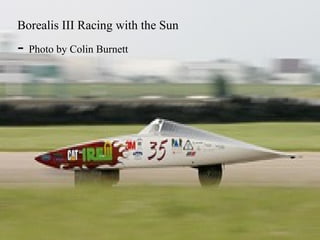
Borealis III Racing with the Sun
- Photo by Colin Burnett
ELECTRICAL SYSTEM
 Made up of batteries and power electronics.
Batteries
• Lead-Acid
• Nickel-Metal Hydride (NiMH)
• Nickel-Cadmium (NiCad)
• Lithium Ion
• Tesseract uses 512 li-ion batteries
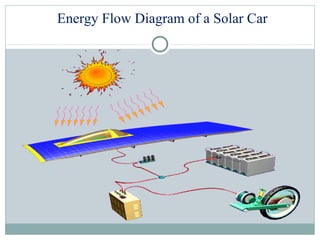
Energy Flow Diagram of a Solar Car
 Peak Power Trackers
• maximize the power
• protect the batteries from being damaged by overcharging
• efficiencies above 95%
Motor Controllers
• decides how much current actually reaches the motor
• up to 90% efficient
DRIVE TRAIN
 Consist of the electric motor and the means to by which the motor's
power is transmitted the wheel
 power generated is less than 5 hp
 only one wheel in the rear of the car is driven by the electric motor
motor types
• brushed DC
• dual winding DC brushless
• induction
Dual-winding DC brushless
• used as an electronic transmission
 Types of transmissions
• variable ratio belt drive
• hub motor
SOLAR ARRAY
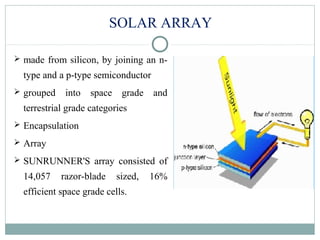
 made from silicon, by joining an n-
type and a p-type semiconductor
 grouped into space grade and
terrestrial grade categories
 Encapsulation
 Array
 SUNRUNNER'S array consisted of
14,057 razor-blade sized, 16%
efficient space grade cells.
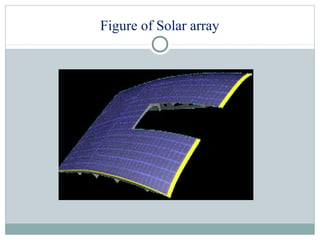
Figure of Solar array
LIMITATIONS
• Only 1000 W/m2 of energy reaches the earth’s surface in an hour of
“peak sun”
• average solar array configuration spans 8m²
• total amount of energy hitting the solar car during peak sun is
8KWh/m²
• average solar cells are only able to convert 12% to 18% to electricity
• the total amount of converted energy available to a car consists of 700-
1500 Watts
• three primary areas of energy loss consist of
• aerodynamic drag, braking, and rolling resistance
MATERIALS USED
 composite material
 combination of a filler material sandwiched between layers of a
structural material
 structural materials
• Carbon fibre, Kevlar and fibre glass
 filler materials
• Honeycomb and foam
 bonded together using epoxy resins
ADVANTAGES
Solar energy is renewable.
Solar energy is environment friendly.
It can be installed anywhere.
It doesn't produces harmful gasses.
It doesn’t damage to the earth or its atmosphere.
It doesn’t cause any pollution.
It reduces dependence on fossil fuel.
DIADVANTAGES
It takes a lot of space.
It only works when the sun is shining.
It doesn’t produce much electricity for one single panel.
Its installation cost is high.
Solar cells are not efficient yet.
Current devices which are utilized are expensive.
The efficiency of the system also relies on the location of the sun.
THANK YOU

Solar cars

  • 1.
    SOLAR CARSSOLAR CARS SeminarSeminar Representedby: Name : Arpit Verma Roll no. : 50 (1116/YCET/13) Branch : Mechanical
  • 2.
    CONTENTS History What is solarenergy?? Solar car Electrical system Drive train Solar array Limitation Material used Advantages
  • 3.
    HISTORY The first solarcar invented was a tiny 15-inch vehicle created by William G. Cobb of General Motors & is called the Sun mobile. Cobb showcased the first solar car at the Chicago on august 31,1955. The solar car was made up of 12 selenium photovoltaic cells & a small pulley electric motor turning a pulley which in turn rotated in the rear shaft wheel.
  • 4.
    What is solarenergy ?? Solar energy is radiant energy that is produced by sun. The sun radiates more energy in one second then people have used since the beginning of time. The sun is the big ball of gasses-mostly hydrogen & helium atoms. During nuclear fusion, the sun’s extremely high pressure & temperature causes hydrogen atoms to come apart & their nuclei to fuse to become one helium atom. The solar energy travels to the earth at a speed of 186,000 miles per second.
  • 5.
    SOLAR CAR A solarcar is a solar vehicle used for land transport . Solar car combine the technology used in aerospace, bicycle, alternative energy & automotive industries. Solar cars can depend upon PV cells to convert sunlight into electricity. When the sunlight strike PV cells, they excite electrons & allow them to flow, creating an electric current. PV cells are made of semi- conductor materials such as silicon, gallium & nitrogen. Its efficiency rate is 15-20%.
  • 6.
    Borealis III Racingwith the Sun - Photo by Colin Burnett
  • 7.
    ELECTRICAL SYSTEM  Madeup of batteries and power electronics. Batteries • Lead-Acid • Nickel-Metal Hydride (NiMH) • Nickel-Cadmium (NiCad) • Lithium Ion • Tesseract uses 512 li-ion batteries
  • 8.
    Energy Flow Diagramof a Solar Car
  • 9.
     Peak PowerTrackers • maximize the power • protect the batteries from being damaged by overcharging • efficiencies above 95% Motor Controllers • decides how much current actually reaches the motor • up to 90% efficient
  • 10.
    DRIVE TRAIN  Consistof the electric motor and the means to by which the motor's power is transmitted the wheel  power generated is less than 5 hp  only one wheel in the rear of the car is driven by the electric motor motor types • brushed DC • dual winding DC brushless • induction
  • 11.
    Dual-winding DC brushless •used as an electronic transmission  Types of transmissions • variable ratio belt drive • hub motor
  • 12.
    SOLAR ARRAY  madefrom silicon, by joining an n- type and a p-type semiconductor  grouped into space grade and terrestrial grade categories  Encapsulation  Array  SUNRUNNER'S array consisted of 14,057 razor-blade sized, 16% efficient space grade cells.
  • 13.
  • 14.
    LIMITATIONS • Only 1000W/m2 of energy reaches the earth’s surface in an hour of “peak sun” • average solar array configuration spans 8m² • total amount of energy hitting the solar car during peak sun is 8KWh/m² • average solar cells are only able to convert 12% to 18% to electricity • the total amount of converted energy available to a car consists of 700- 1500 Watts • three primary areas of energy loss consist of • aerodynamic drag, braking, and rolling resistance
  • 15.
    MATERIALS USED  compositematerial  combination of a filler material sandwiched between layers of a structural material  structural materials • Carbon fibre, Kevlar and fibre glass  filler materials • Honeycomb and foam  bonded together using epoxy resins
  • 16.
    ADVANTAGES Solar energy isrenewable. Solar energy is environment friendly. It can be installed anywhere. It doesn't produces harmful gasses. It doesn’t damage to the earth or its atmosphere. It doesn’t cause any pollution. It reduces dependence on fossil fuel.
  • 17.
    DIADVANTAGES It takes alot of space. It only works when the sun is shining. It doesn’t produce much electricity for one single panel. Its installation cost is high. Solar cells are not efficient yet. Current devices which are utilized are expensive. The efficiency of the system also relies on the location of the sun.
  • 18.