TECHNIQUES IN
SUMMARIZING
ACADEMIC
TEXTS
OBJECTIVES
1. discuss the features of summarizing;
2. identify techniques in summarizing
academic texts; and
3. use various techniques in summarizing
academic texts.
HOW WOULD YOU
SUMMARIZE TO
YOUR FRIEND THE
MOVIE THAT YOU
HAVE JUST
WATCHED?
3
DEFINITION AND
FEATURES OF
SUMMARIZING
Summarizing, according to Buckley (2004), is reducing
a text to one-third or one-quarter its original size,
clearly articulating the author’s meaning, and retaining
original ideas. Thus, the purpose is to briefly present
the key points of a theory or work in order to provide
context for your argument/thesis.”
WHAT IS SUMMARIZING? 5
- often used to determine the essential ideas in a book, article,
book chapter an article or part of the article.
- these essential ideas include the gist or the main idea, useful
information, or key words and phrases that would help you
meet your reading purpose.
- generally done after reading but it can be done as well while
reading a text.
6
WHY IS SUMMARIZING AN IMPORTANT SKILL?
* deepen your understanding of the text;
* learn to identify relevant information or key ideas;
* combine details or examples that support the main
idea/s;
* concentrate on the gist or main idea and key words
presented in the text; and,
* capture key ideas in the text and put them together
clearly and concisely.
* write down everything;
* write down ideas from the text word-for-
word;
*write down incoherent and irrelevant ideas;
* write down ideas that are not stated in the
text; or
*write down a summary that has the same
length or is no longer than the original text
YOU ARE NOT SUMMARIZING
WHEN YOU…..
7
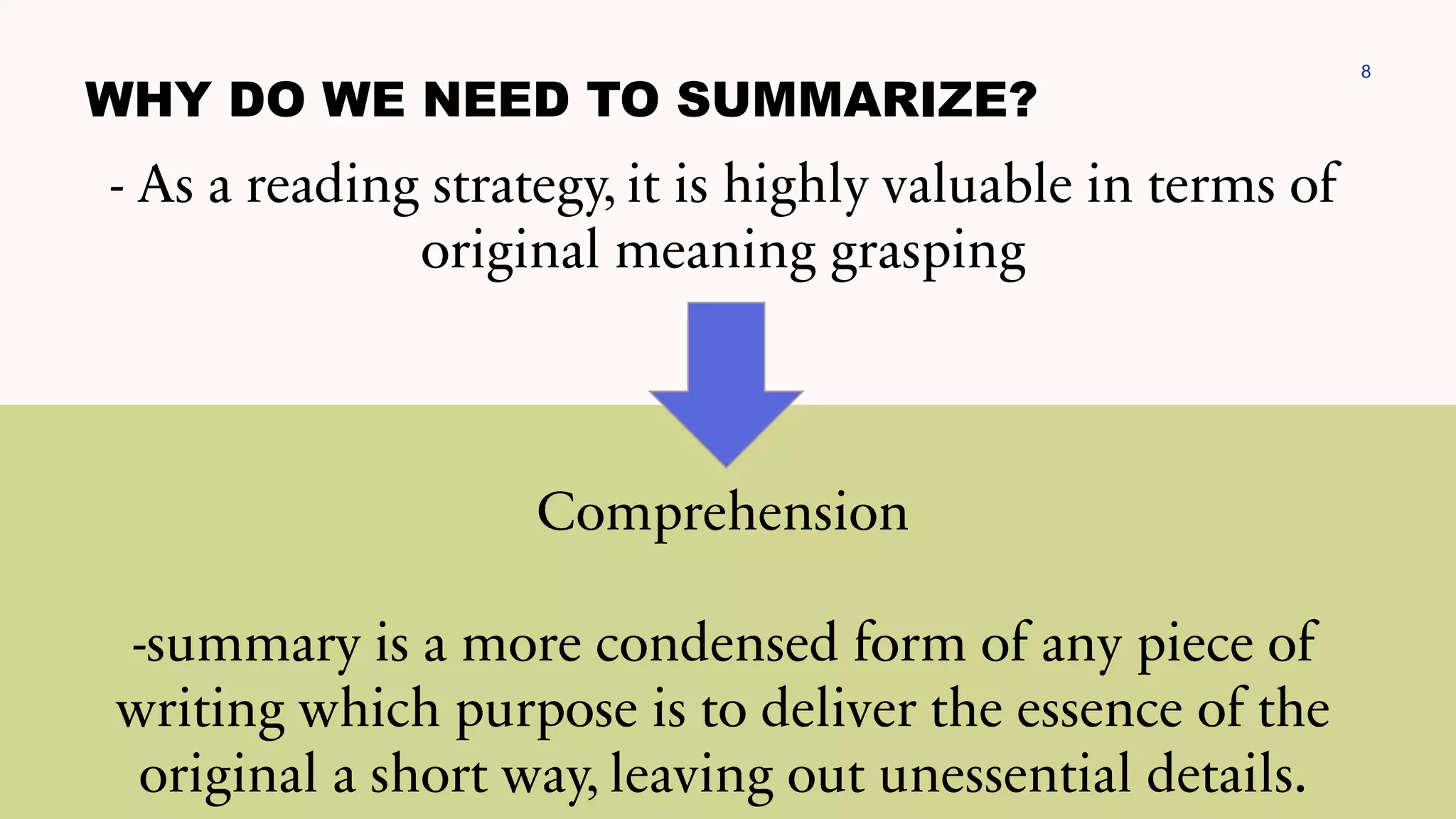
- As a reading strategy, it is highly valuable in terms of
original meaning grasping
Comprehension
-summary is a more condensed form of any piece of
writing which purpose is to deliver the essence of the
original a short way, leaving out unessential details.
WHY DO WE NEED TO SUMMARIZE?
8
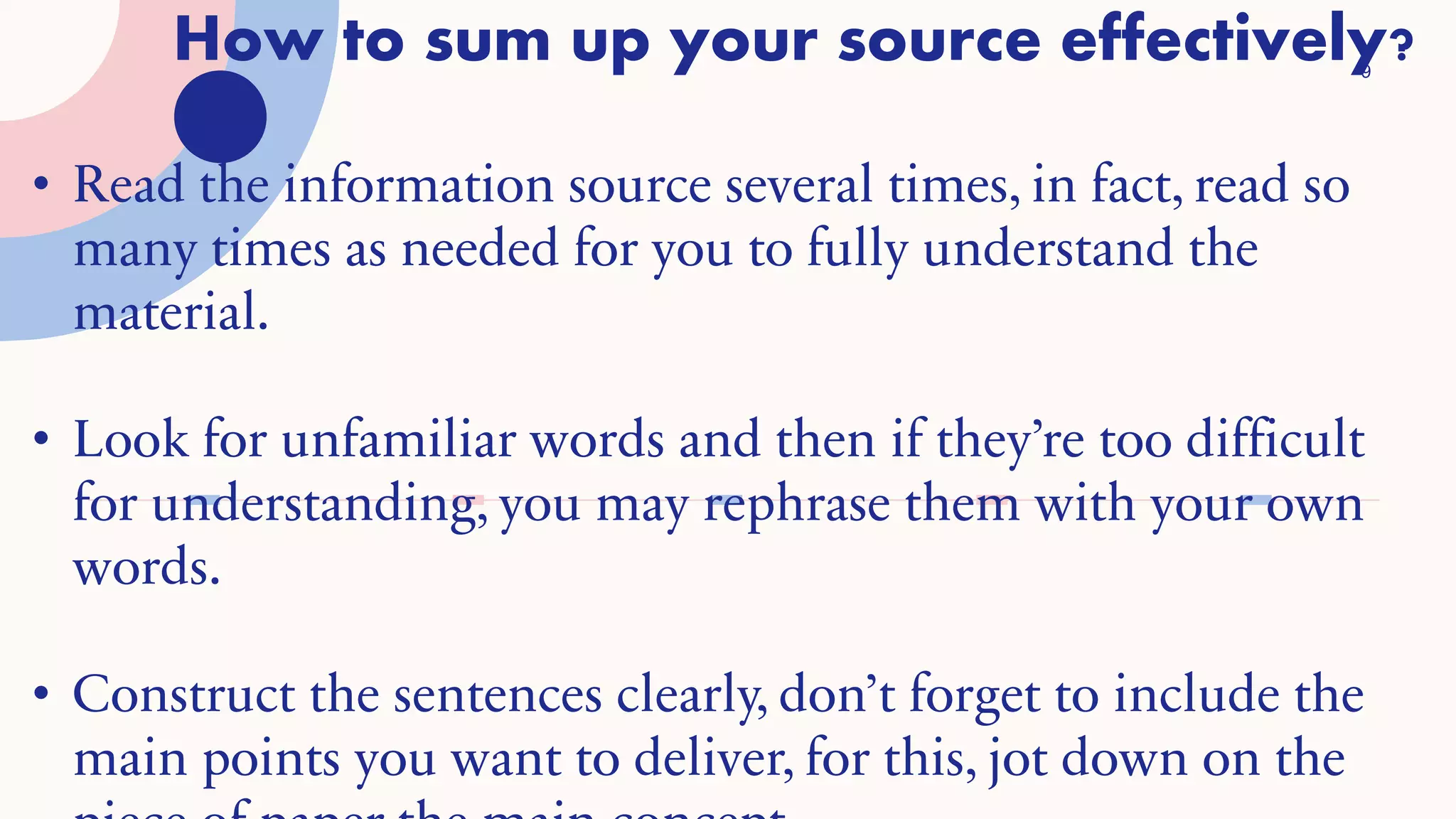
How to sum up your source effectively?
9
• Read the information source several times, in fact, read so
many times as needed for you to fully understand the
material.
• Look for unfamiliar words and then if they’re too difficult
for understanding, you may rephrase them with your own
words.
• Construct the sentences clearly, don’t forget to include the
main points you want to deliver, for this, jot down on the
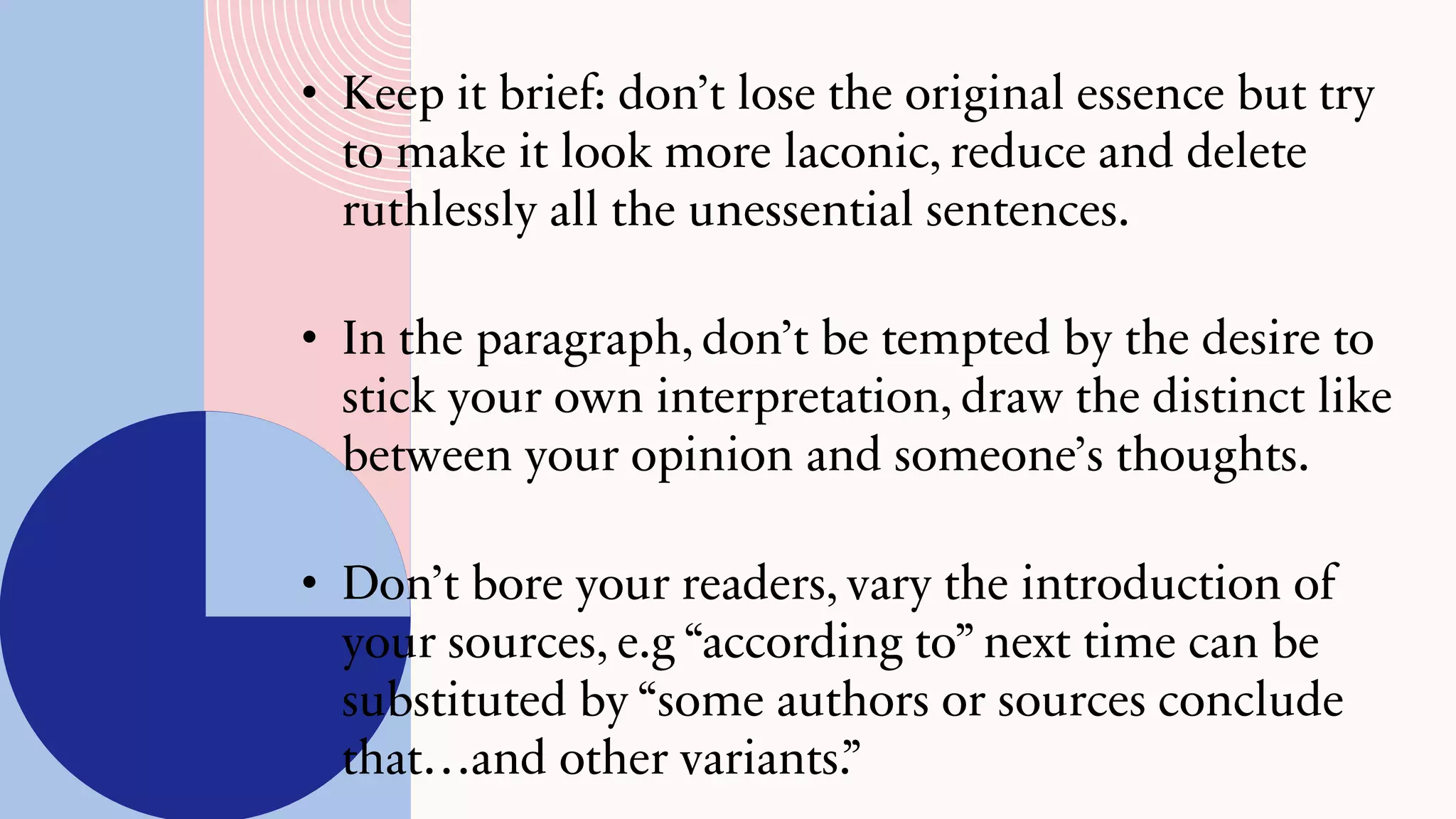
• Keep it brief: don’t lose the original essence but try
to make it look more laconic, reduce and delete
ruthlessly all the unessential sentences.
• In the paragraph, don’t be tempted by the desire to
stick your own interpretation, draw the distinct like
between your opinion and someone’s thoughts.
• Don’t bore your readers, vary the introduction of
your sources, e.g “according to” next time can be
substituted by “some authors or sources conclude
that…and other variants.”
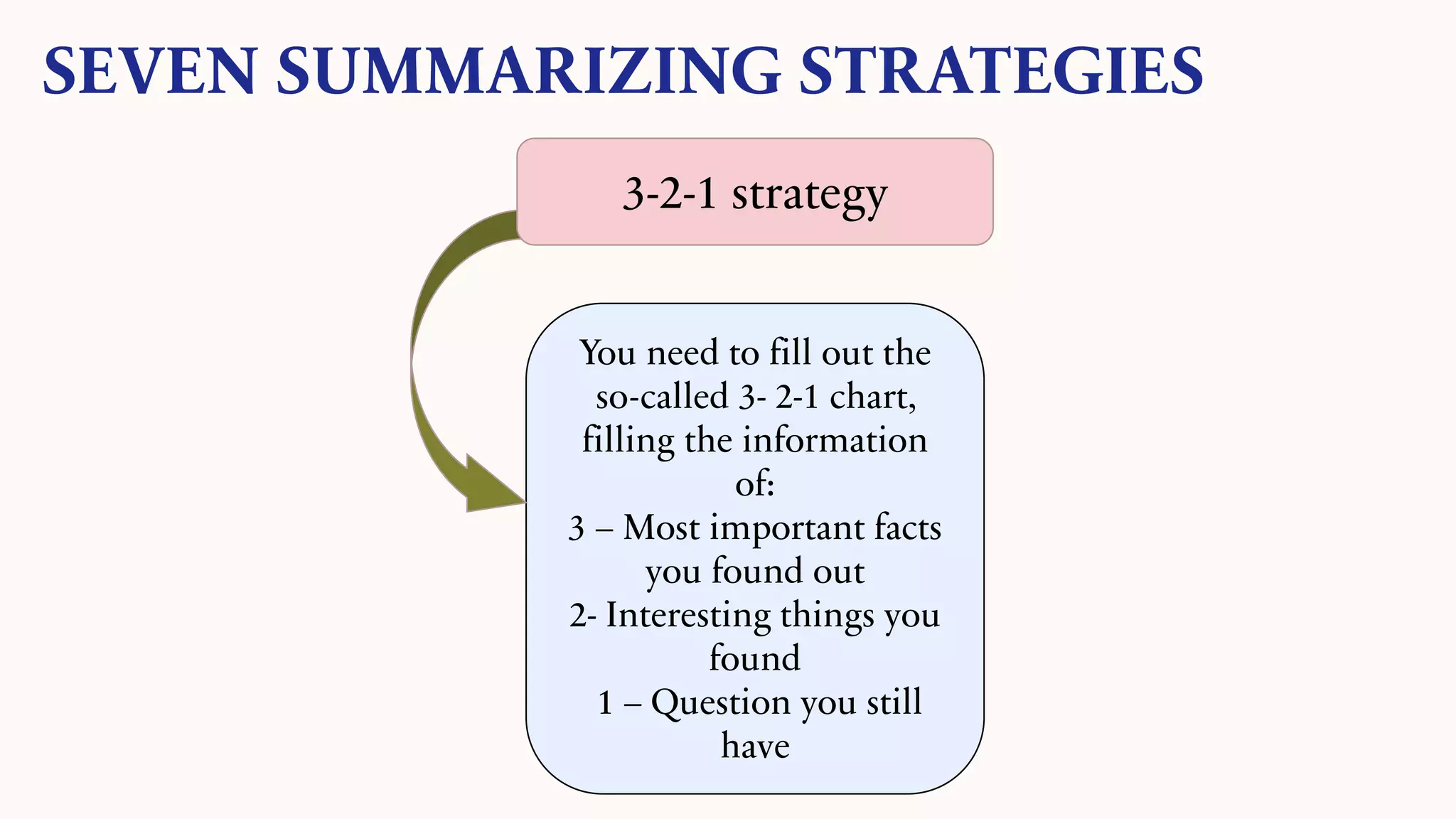
You need to fill out the
so-called 3- 2-1 chart,
filling the information
of:
3 – Most important facts
you found out
2- Interesting things you
found
1 – Question you still
have
SEVEN SUMMARIZING STRATEGIES
3-2-1 strategy
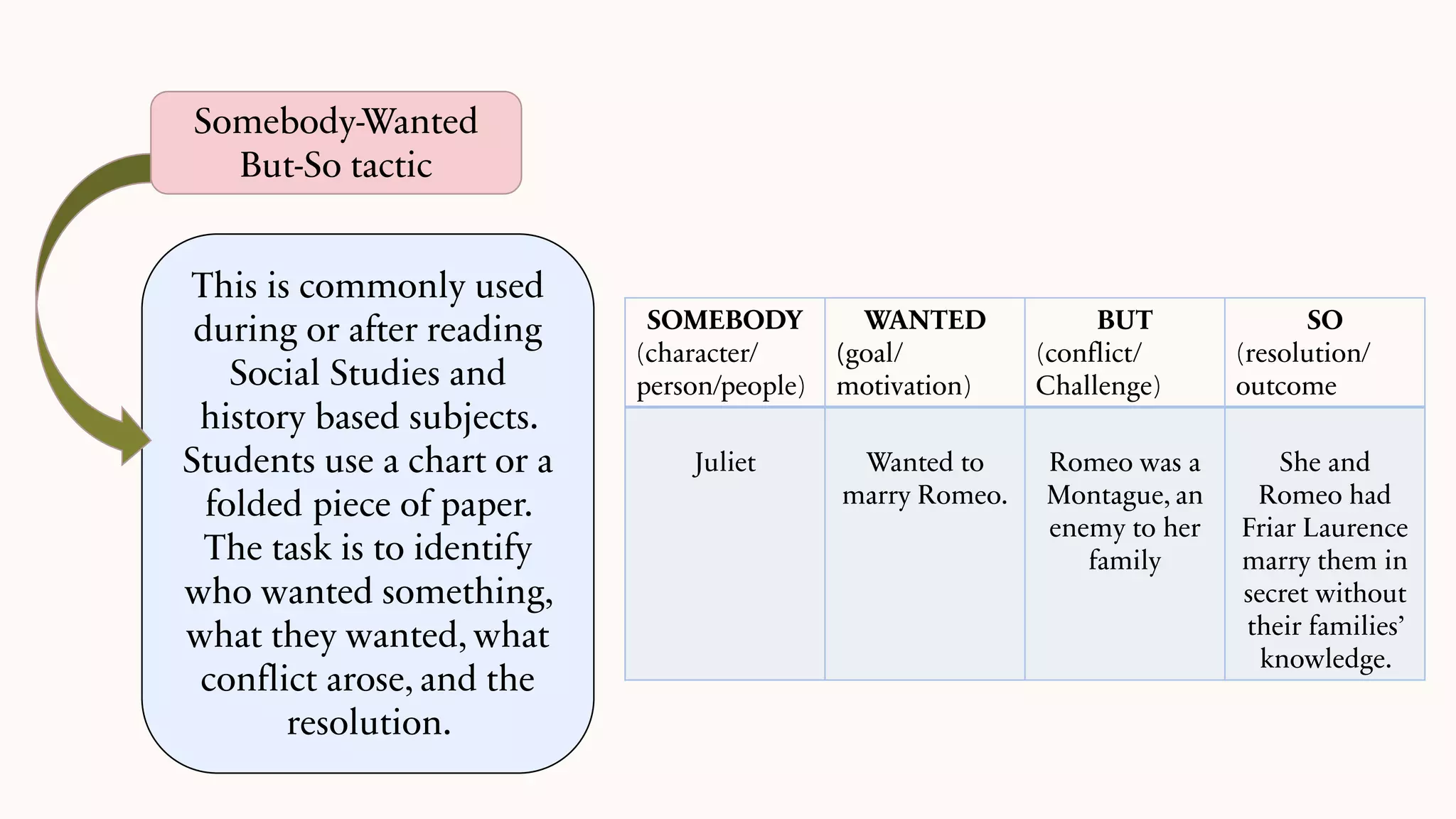
This is commonly used
during or after reading
Social Studies and
history based subjects.
Students use a chart or a
folded piece of paper.
The task is to identify
who wanted something,
what they wanted, what
conflict arose, and the
resolution.
Somebody-Wanted
But-So tactic
SOMEBODY
(character/
person/people)
WANTED
(goal/
motivation)
BUT
(conflict/
Challenge)
SO
(resolution/
outcome
Juliet Wanted to
marry Romeo.
Romeo was a
Montague, an
enemy to her
family
She and
Romeo had
Friar Laurence
marry them in
secret without
their families’
knowledge.
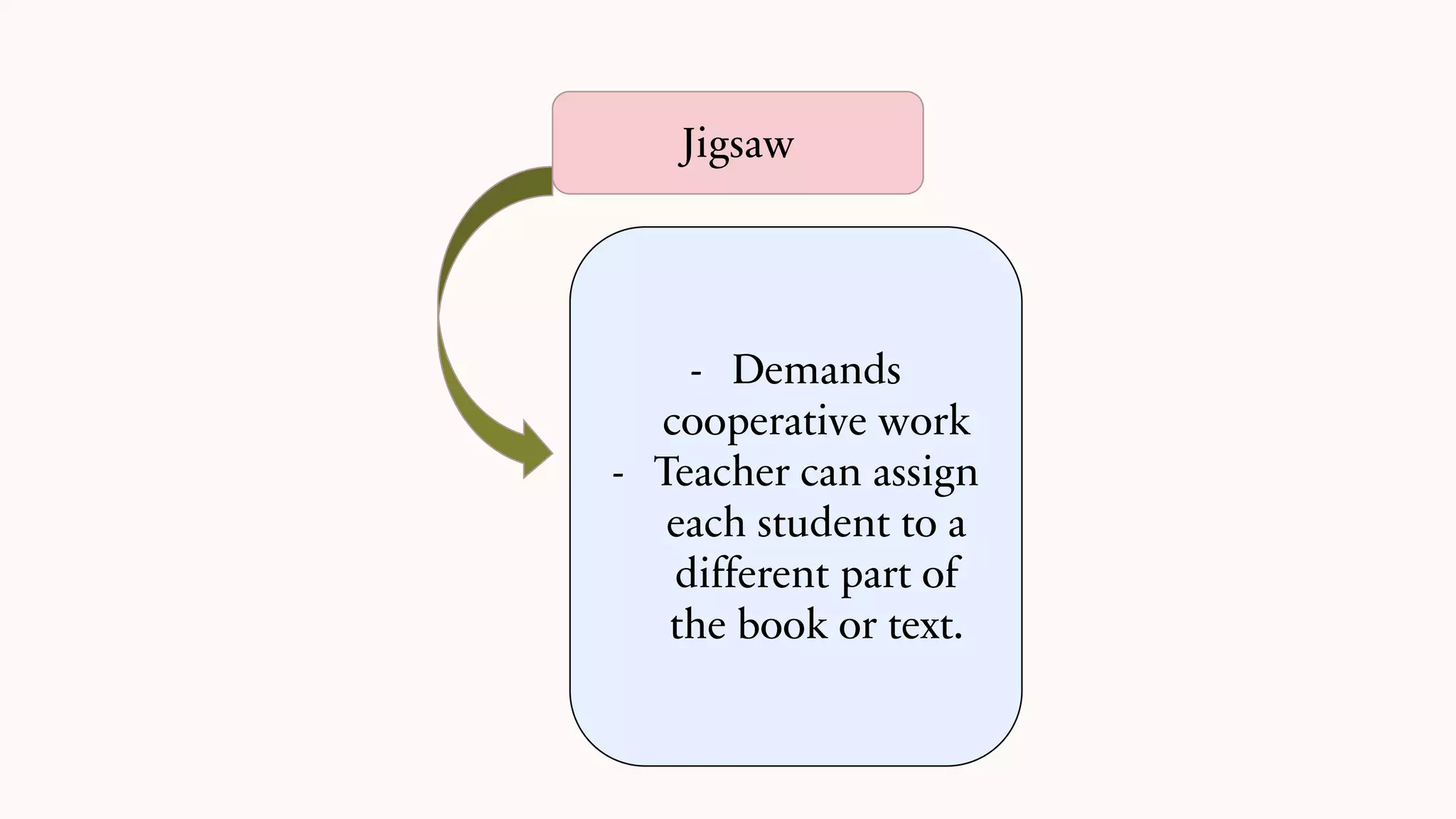
- Demands
cooperative work
- Teacher can assign
each student to a
different part of
the book or text.
Jigsaw
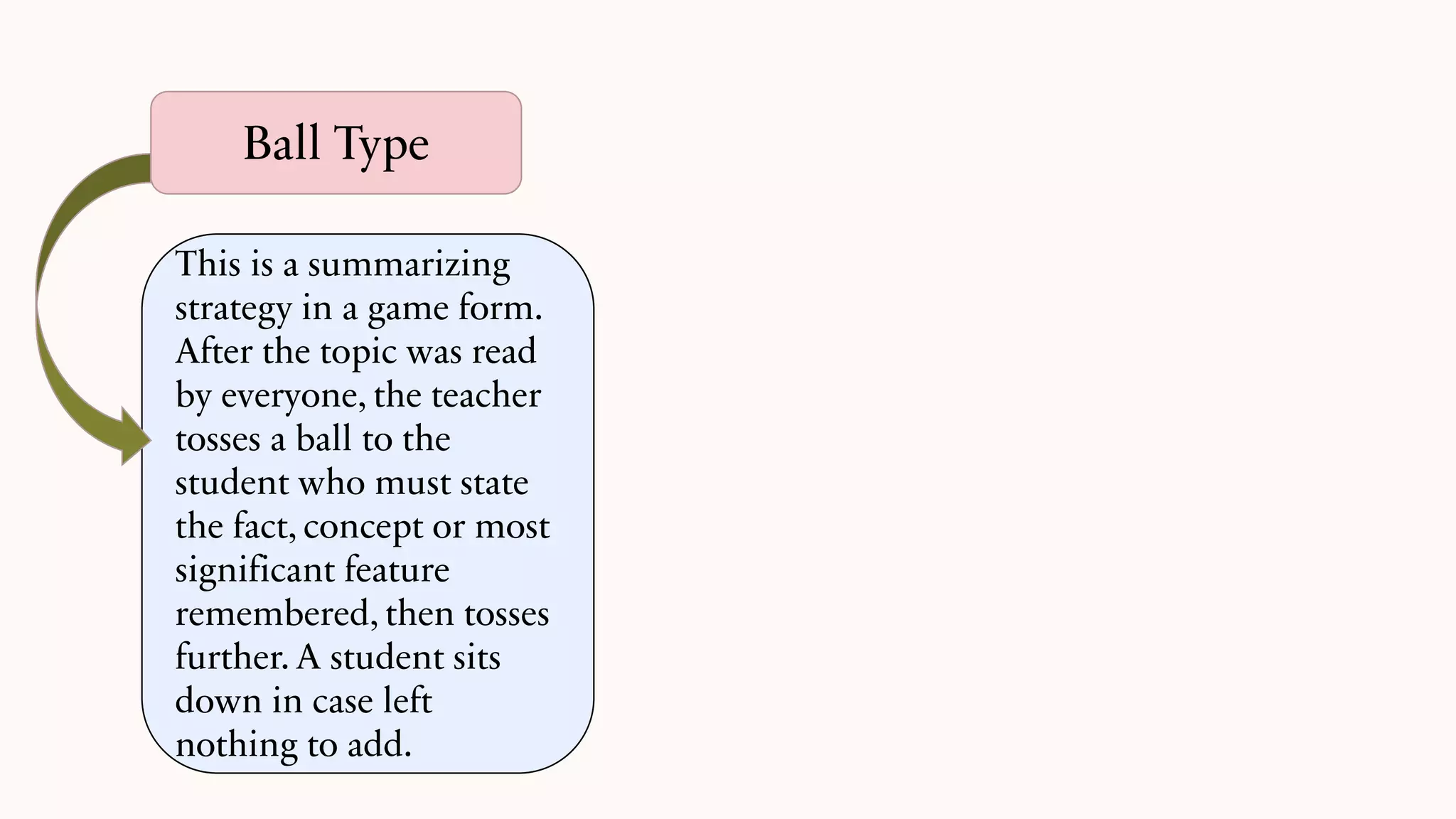
This is a summarizing
strategy in a game form.
After the topic was read
by everyone, the teacher
tosses a ball to the
student who must state
the fact, concept or most
significant feature
remembered, then tosses
further. A student sits
down in case left
nothing to add.
Ball Type
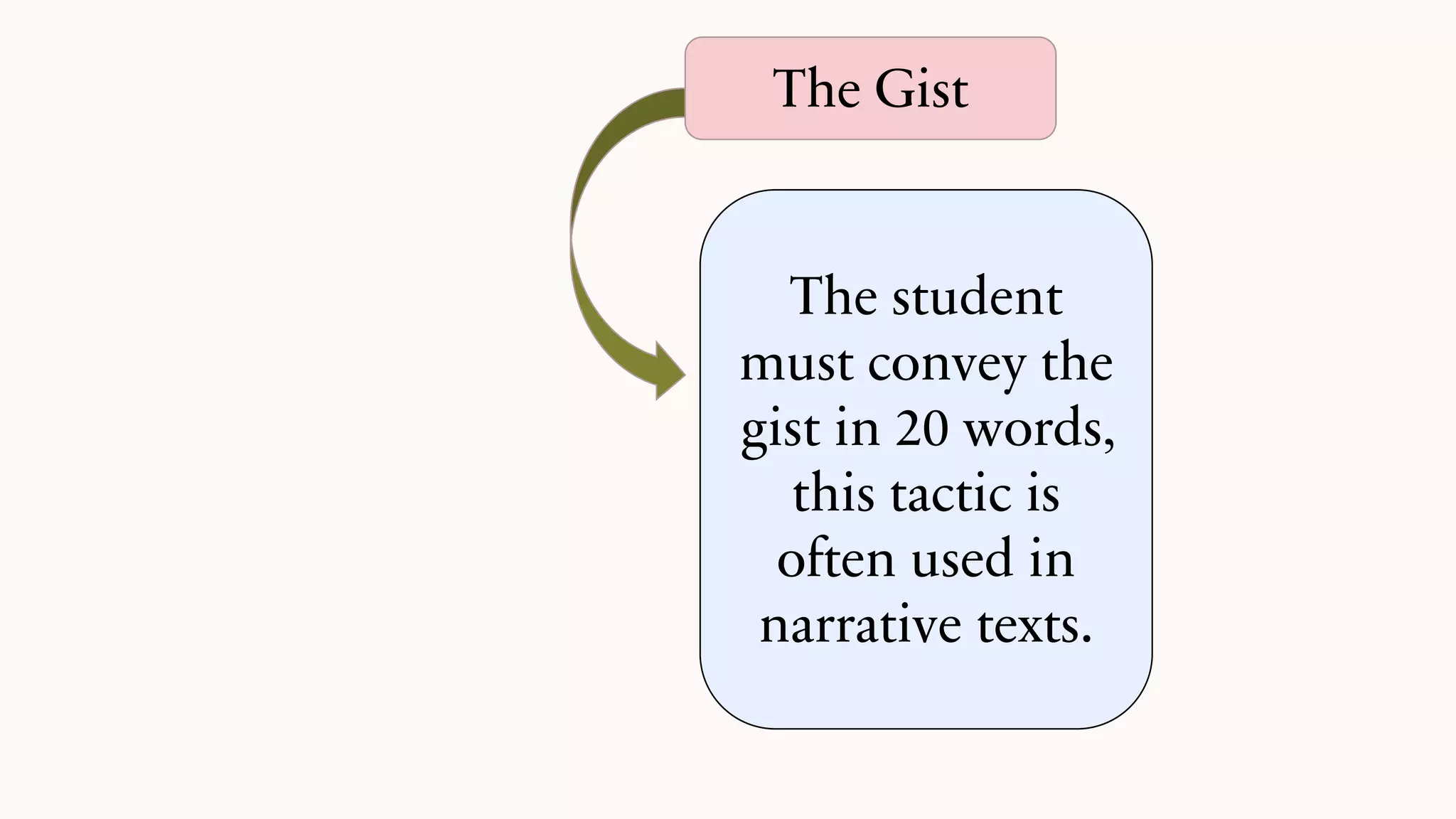
The student
must convey the
gist in 20 words,
this tactic is
often used in
narrative texts.
The Gist
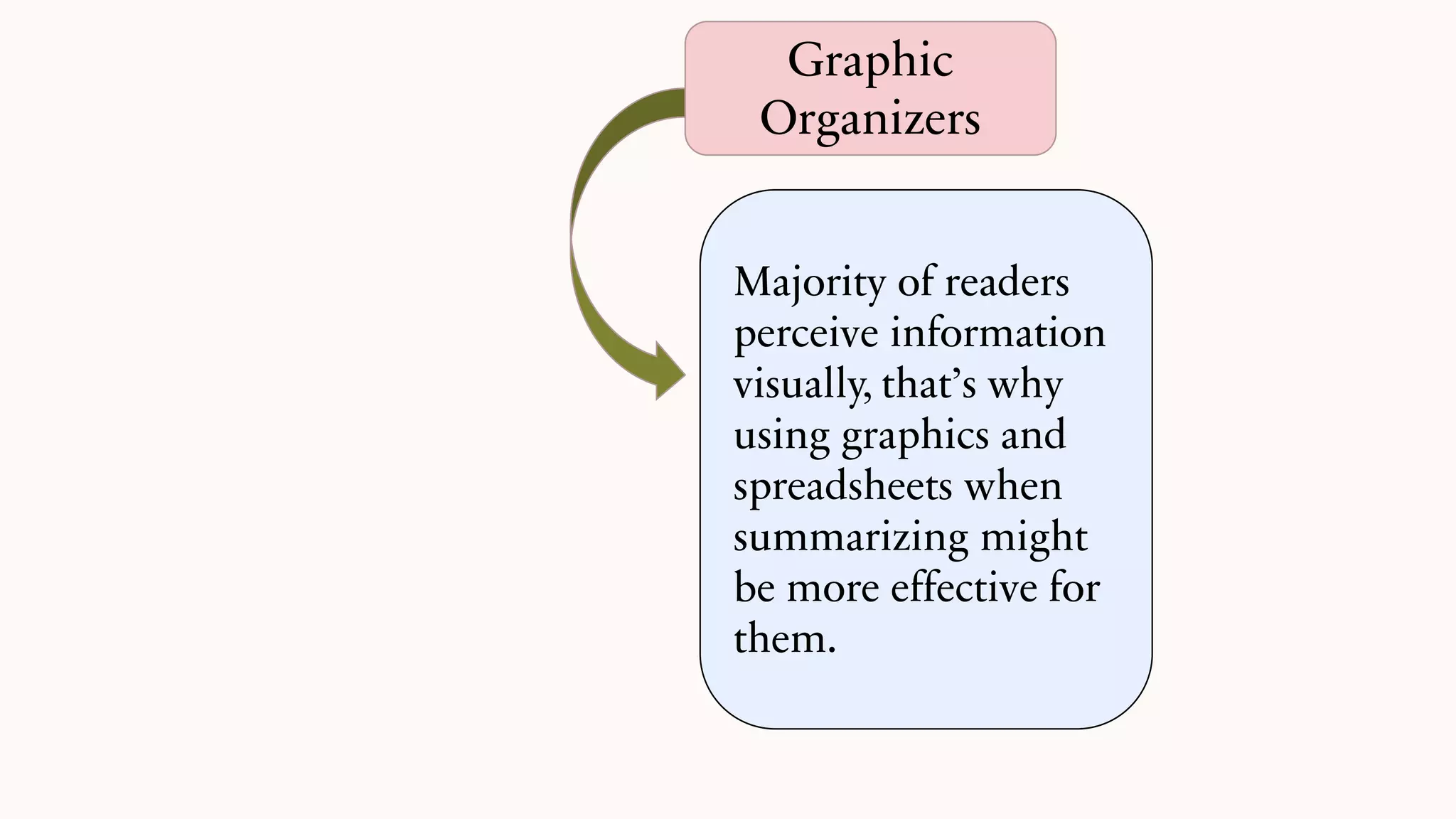
Majority of readers
perceive information
visually, that’s why
using graphics and
spreadsheets when
summarizing might
be more effective for
them.
Graphic
Organizers
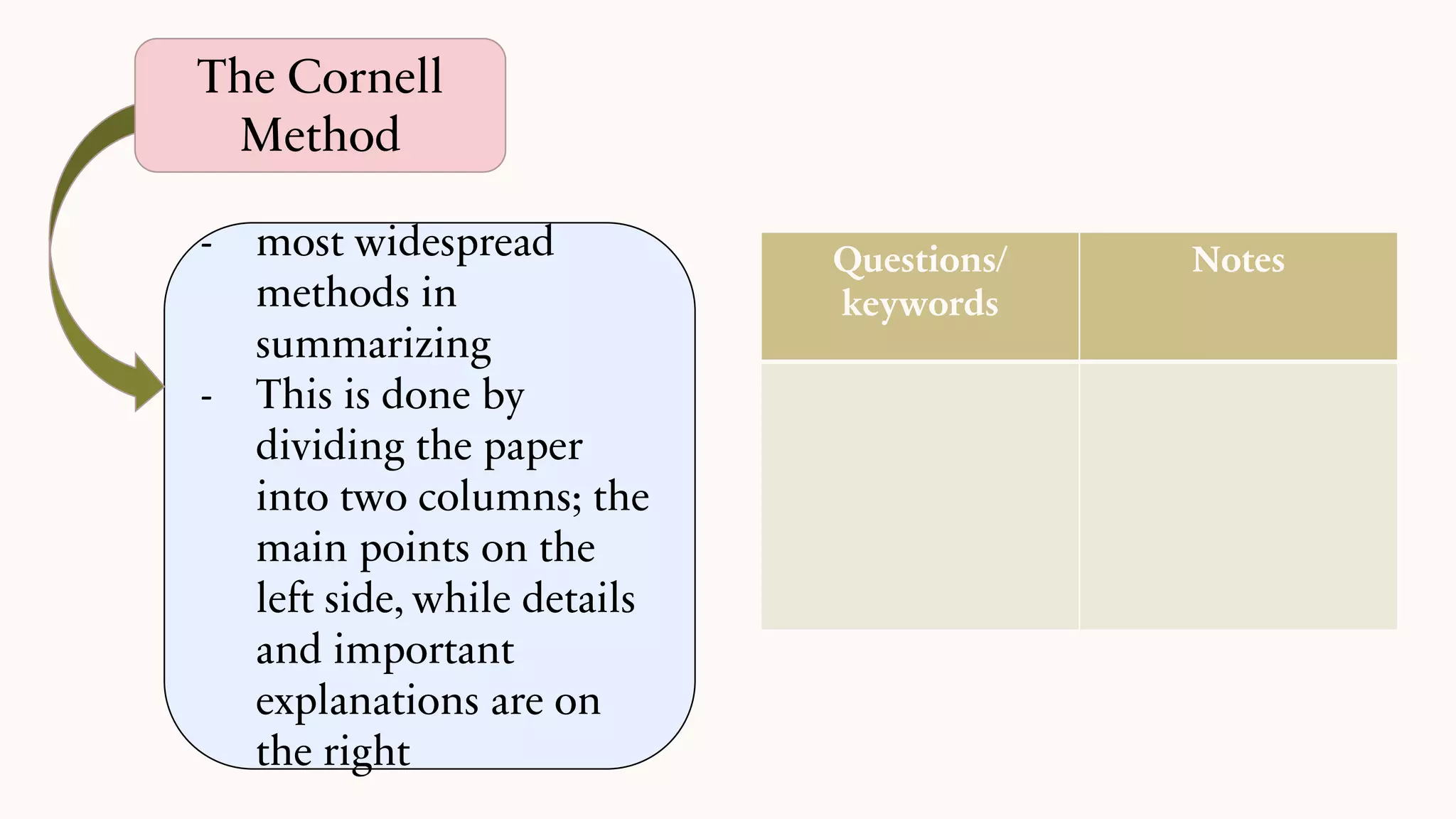
- most widespread
methods in
summarizing
- This is done by
dividing the paper
into two columns; the
main points on the
left side, while details
and important
explanations are on
the right
The Cornell
Method
Questions/
keywords
Notes
Techniques-in-Summarizing-Academic-Texts-App1-1.pdf

Techniques-in-Summarizing-Academic-Texts-App1-1.pdf

  • 1.
  • 2.
    OBJECTIVES 1. discuss thefeatures of summarizing; 2. identify techniques in summarizing academic texts; and 3. use various techniques in summarizing academic texts.
  • 3.
    HOW WOULD YOU SUMMARIZETO YOUR FRIEND THE MOVIE THAT YOU HAVE JUST WATCHED? 3
  • 4.
    DEFINITION AND FEATURES OF SUMMARIZING Summarizing,according to Buckley (2004), is reducing a text to one-third or one-quarter its original size, clearly articulating the author’s meaning, and retaining original ideas. Thus, the purpose is to briefly present the key points of a theory or work in order to provide context for your argument/thesis.”
  • 5.
    WHAT IS SUMMARIZING?5 - often used to determine the essential ideas in a book, article, book chapter an article or part of the article. - these essential ideas include the gist or the main idea, useful information, or key words and phrases that would help you meet your reading purpose. - generally done after reading but it can be done as well while reading a text.
  • 6.
    6 WHY IS SUMMARIZINGAN IMPORTANT SKILL? * deepen your understanding of the text; * learn to identify relevant information or key ideas; * combine details or examples that support the main idea/s; * concentrate on the gist or main idea and key words presented in the text; and, * capture key ideas in the text and put them together clearly and concisely.
  • 7.
    * write downeverything; * write down ideas from the text word-for- word; *write down incoherent and irrelevant ideas; * write down ideas that are not stated in the text; or *write down a summary that has the same length or is no longer than the original text YOU ARE NOT SUMMARIZING WHEN YOU….. 7
  • 8.
    - As areading strategy, it is highly valuable in terms of original meaning grasping Comprehension -summary is a more condensed form of any piece of writing which purpose is to deliver the essence of the original a short way, leaving out unessential details. WHY DO WE NEED TO SUMMARIZE? 8
  • 9.
    How to sumup your source effectively? 9 • Read the information source several times, in fact, read so many times as needed for you to fully understand the material. • Look for unfamiliar words and then if they’re too difficult for understanding, you may rephrase them with your own words. • Construct the sentences clearly, don’t forget to include the main points you want to deliver, for this, jot down on the
  • 10.
    • Keep itbrief: don’t lose the original essence but try to make it look more laconic, reduce and delete ruthlessly all the unessential sentences. • In the paragraph, don’t be tempted by the desire to stick your own interpretation, draw the distinct like between your opinion and someone’s thoughts. • Don’t bore your readers, vary the introduction of your sources, e.g “according to” next time can be substituted by “some authors or sources conclude that…and other variants.”
  • 11.
    You need tofill out the so-called 3- 2-1 chart, filling the information of: 3 – Most important facts you found out 2- Interesting things you found 1 – Question you still have SEVEN SUMMARIZING STRATEGIES 3-2-1 strategy
  • 12.
    This is commonlyused during or after reading Social Studies and history based subjects. Students use a chart or a folded piece of paper. The task is to identify who wanted something, what they wanted, what conflict arose, and the resolution. Somebody-Wanted But-So tactic SOMEBODY (character/ person/people) WANTED (goal/ motivation) BUT (conflict/ Challenge) SO (resolution/ outcome Juliet Wanted to marry Romeo. Romeo was a Montague, an enemy to her family She and Romeo had Friar Laurence marry them in secret without their families’ knowledge.
  • 13.
    - Demands cooperative work -Teacher can assign each student to a different part of the book or text. Jigsaw
  • 14.
    This is asummarizing strategy in a game form. After the topic was read by everyone, the teacher tosses a ball to the student who must state the fact, concept or most significant feature remembered, then tosses further. A student sits down in case left nothing to add. Ball Type
  • 15.
    The student must conveythe gist in 20 words, this tactic is often used in narrative texts. The Gist
  • 16.
    Majority of readers perceiveinformation visually, that’s why using graphics and spreadsheets when summarizing might be more effective for them. Graphic Organizers
  • 17.
    - most widespread methodsin summarizing - This is done by dividing the paper into two columns; the main points on the left side, while details and important explanations are on the right The Cornell Method Questions/ keywords Notes