Inspire Workshop Letters and Sounds taught through
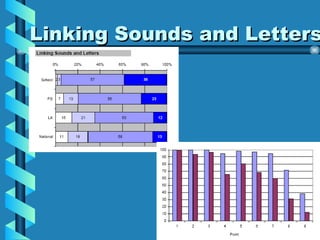
Linking Sounds and Letters
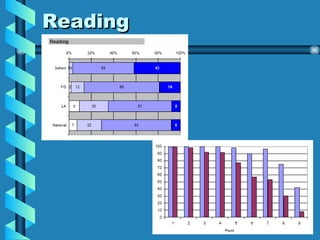
Reading
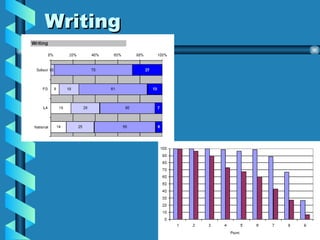
Writing Dubai
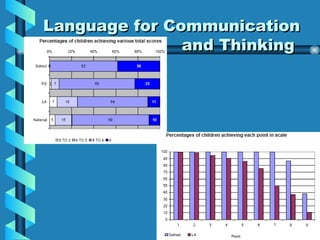
Language for Communication   and Thinking
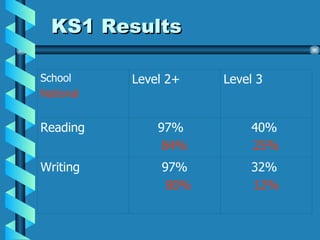
KS1 Results 32%  12% 97%  80% Writing  40%  25% 97%  84% Reading Level 3 Level 2+ School  National
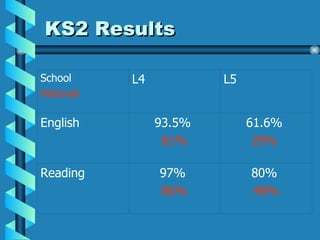
KS2 Results 80%  48% 97%  86% Reading 61.6%  29%   93.5%  81% English L5 L4 School  National
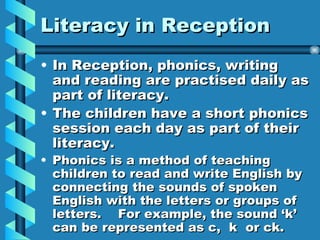
Literacy in Reception In Reception, phonics, writing and reading are practised daily as part of literacy. The children have a short phonics session each day as part of their literacy. Phonics is a method of teaching children to read and write English by connecting the sounds of spoken English with the letters or groups of letters.  For example, the sound ‘k’ can be represented as c,  k  or ck.
Why Jolly Phonics? Enjoyable and motivating for the children. It’s a thorough foundation for reading and writing. A systematic way of teaching phonics in the school. It uses the  synthetic phonics   method of teaching the letter sounds in a way that is fun and multi-sensory.  Children learn how to use the letter sounds to read and write words.
What are the key skills taught in Jolly Phonics?   The five basic skills for reading and writing are: 1. Learning the letter sounds and names 2. Learning letter formation 3. Blending 4. Identifying sounds in words 5. Spelling the tricky words These skills are taught alongside one another.
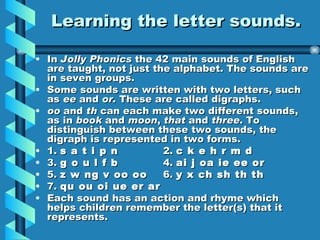
Learning the letter sounds. In  Jolly Phonics  the 42 main sounds of English are taught, not just the alphabet. The sounds are in seven groups.  Some sounds are written with two letters, such as  ee  and  or.  These are called digraphs.  oo  and  th  can each make two different sounds, as in  book  and  moon ,  that  and  three . To distinguish between these two sounds, the digraph is represented in two forms. 1.  s a t i p n 2.  c k e h r m d 3.  g o u l f b 4.  ai j oa ie ee or 5.  z w ng v oo oo 6.  y x ch sh th th 7.  qu ou oi ue er ar Each sound has an action and rhyme which helps children remember the letter(s) that it represents.
The letter sounds The letters are not introduced in alphabetical order. The first group  (s, a, t, i, p, n)  has been chosen because they make more simple three-letter words than any other six letters. The letters  b  and  d  are introduced in different groups to avoid confusion. Sounds that have more than one way of being written are initially taught in one form only. For example, the sound  ai  (r ai n) is taught first, and then  a-e  (g a t e)  and  ay  (d ay)  follow later.  We teach the letter sound and name simultaneously as the letter can make its sound or name in a word.  However, it is the sound that is used initially in blending three letters sounds to form words.  E.g. c-a-t.
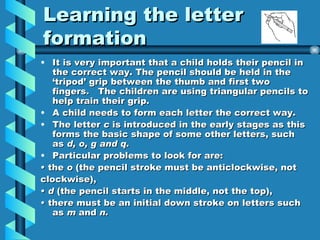
Learning the letter formation It is very important that a child holds their pencil in the correct way. The pencil should be held in the ‘tripod’ grip between the thumb and first two fingers.  The children are using triangular pencils to help train their grip. A child needs to form each letter the correct way. The letter  c  is introduced in the early stages as this forms the basic shape of some other letters, such as  d, o, g and q. Particular problems to look for are: •  the  o  (the pencil stroke must be anticlockwise, not clockwise), •  d  (the pencil starts in the middle, not the top), •  there must be an initial down stroke on letters such as  m  and  n.
Blending Blending is the process of saying the individual sounds in a word and then running them together to make the word. For example, sounding out  d-o-g  and making  dog . Some sounds (digraphs) are represented by two letters, such as  sh.  Children should sound out the digraph  (sh) , not the individual letters  (s-h) . E.g. r-ai-n not r-a-i-n When sounding out a blend, we encourage children to say the two sounds as one unit, so  fl-a-g.  This will lead to greater fluency when reading.
Identifying sounds in words The easiest way to know how to spell a word is to listen for the sounds in that word. Even with the tricky words an understanding of letter sounds can help. We start with asking children to listen for the first sound in a word, then the other sounds in order. We ask them to listen for how many sounds. Tapping each sound can help, e.g. c-a-t (3 taps) or f-i-sh (3 taps).
Spelling the tricky words There are several ways that we use to encourage the children to learn tricky spellings towards the end of the reception year: Look, Cover, Say and Check.  2) Say it as it sounds. For example, the word  was  is said as  ‘ wass ’,  to rhyme with  mass,  the word  Monday  is said as ‘M-on-day ’. 3) Mnemonics. The initial letter of each word in a saying gives the correct spelling of a word. For example,  laugh  – Laugh At Ugly Goat’s Hair. This is normally introduced in year one onwards to help with the more complicated tricky words.
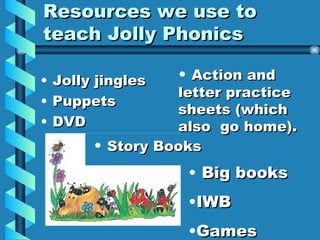
Resources we use to teach Jolly Phonics Jolly jingles Puppets DVD Story Books Big books  IWB Games  Action and letter practice sheets (which also  go home).
How can you help at home? Encouraging children to sound out the phonetic words in home readers. Blending letters together to read and spell simple words. Talk robotically (very slowly and deliberately) with children to split words into single sounds & digraphs – build into normal routines. Learn letters and spellings – writing in the air, writing in chalk, magnetic letters, bath paints. Fun practical ways without always using pencil paper. Encouraging the children to use the sound and action when reading and spelling words. Practising letter recognition and formation using the laminated sheet. And the most important thing is to make it … FUN! Little and often is the best policy.

Reception Inspire Workshop

  • 1.
    Inspire Workshop Lettersand Sounds taught through
  • 2.
  • 3.
  • 4.
  • 5.
  • 6.
    KS1 Results 32% 12% 97% 80% Writing 40% 25% 97% 84% Reading Level 3 Level 2+ School National
  • 7.
    KS2 Results 80% 48% 97% 86% Reading 61.6% 29% 93.5% 81% English L5 L4 School National
  • 8.
    Literacy in ReceptionIn Reception, phonics, writing and reading are practised daily as part of literacy. The children have a short phonics session each day as part of their literacy. Phonics is a method of teaching children to read and write English by connecting the sounds of spoken English with the letters or groups of letters. For example, the sound ‘k’ can be represented as c, k or ck.
  • 9.
    Why Jolly Phonics?Enjoyable and motivating for the children. It’s a thorough foundation for reading and writing. A systematic way of teaching phonics in the school. It uses the synthetic phonics method of teaching the letter sounds in a way that is fun and multi-sensory. Children learn how to use the letter sounds to read and write words.
  • 10.
    What are thekey skills taught in Jolly Phonics? The five basic skills for reading and writing are: 1. Learning the letter sounds and names 2. Learning letter formation 3. Blending 4. Identifying sounds in words 5. Spelling the tricky words These skills are taught alongside one another.
  • 11.
    Learning the lettersounds. In Jolly Phonics the 42 main sounds of English are taught, not just the alphabet. The sounds are in seven groups. Some sounds are written with two letters, such as ee and or. These are called digraphs. oo and th can each make two different sounds, as in book and moon , that and three . To distinguish between these two sounds, the digraph is represented in two forms. 1. s a t i p n 2. c k e h r m d 3. g o u l f b 4. ai j oa ie ee or 5. z w ng v oo oo 6. y x ch sh th th 7. qu ou oi ue er ar Each sound has an action and rhyme which helps children remember the letter(s) that it represents.
  • 12.
    The letter soundsThe letters are not introduced in alphabetical order. The first group (s, a, t, i, p, n) has been chosen because they make more simple three-letter words than any other six letters. The letters b and d are introduced in different groups to avoid confusion. Sounds that have more than one way of being written are initially taught in one form only. For example, the sound ai (r ai n) is taught first, and then a-e (g a t e) and ay (d ay) follow later. We teach the letter sound and name simultaneously as the letter can make its sound or name in a word. However, it is the sound that is used initially in blending three letters sounds to form words. E.g. c-a-t.
  • 13.
    Learning the letterformation It is very important that a child holds their pencil in the correct way. The pencil should be held in the ‘tripod’ grip between the thumb and first two fingers. The children are using triangular pencils to help train their grip. A child needs to form each letter the correct way. The letter c is introduced in the early stages as this forms the basic shape of some other letters, such as d, o, g and q. Particular problems to look for are: • the o (the pencil stroke must be anticlockwise, not clockwise), • d (the pencil starts in the middle, not the top), • there must be an initial down stroke on letters such as m and n.
  • 14.
    Blending Blending isthe process of saying the individual sounds in a word and then running them together to make the word. For example, sounding out d-o-g and making dog . Some sounds (digraphs) are represented by two letters, such as sh. Children should sound out the digraph (sh) , not the individual letters (s-h) . E.g. r-ai-n not r-a-i-n When sounding out a blend, we encourage children to say the two sounds as one unit, so fl-a-g. This will lead to greater fluency when reading.
  • 15.
    Identifying sounds inwords The easiest way to know how to spell a word is to listen for the sounds in that word. Even with the tricky words an understanding of letter sounds can help. We start with asking children to listen for the first sound in a word, then the other sounds in order. We ask them to listen for how many sounds. Tapping each sound can help, e.g. c-a-t (3 taps) or f-i-sh (3 taps).
  • 16.
    Spelling the trickywords There are several ways that we use to encourage the children to learn tricky spellings towards the end of the reception year: Look, Cover, Say and Check. 2) Say it as it sounds. For example, the word was is said as ‘ wass ’, to rhyme with mass, the word Monday is said as ‘M-on-day ’. 3) Mnemonics. The initial letter of each word in a saying gives the correct spelling of a word. For example, laugh – Laugh At Ugly Goat’s Hair. This is normally introduced in year one onwards to help with the more complicated tricky words.
  • 17.
    Resources we useto teach Jolly Phonics Jolly jingles Puppets DVD Story Books Big books IWB Games Action and letter practice sheets (which also go home).
  • 18.
    How can youhelp at home? Encouraging children to sound out the phonetic words in home readers. Blending letters together to read and spell simple words. Talk robotically (very slowly and deliberately) with children to split words into single sounds & digraphs – build into normal routines. Learn letters and spellings – writing in the air, writing in chalk, magnetic letters, bath paints. Fun practical ways without always using pencil paper. Encouraging the children to use the sound and action when reading and spelling words. Practising letter recognition and formation using the laminated sheet. And the most important thing is to make it … FUN! Little and often is the best policy.