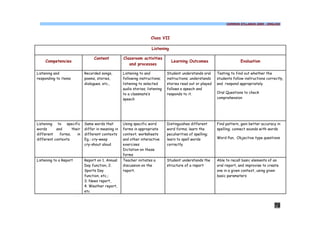
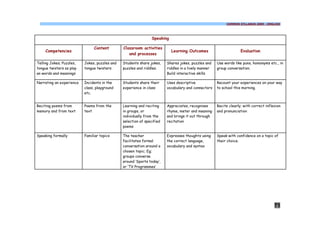
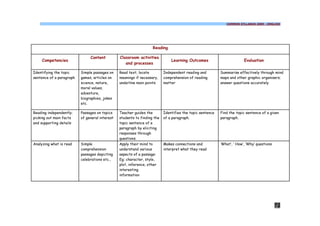
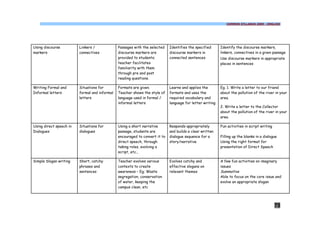
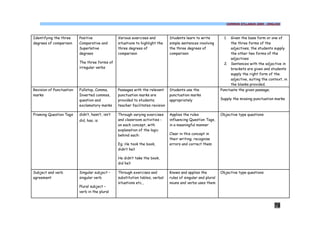
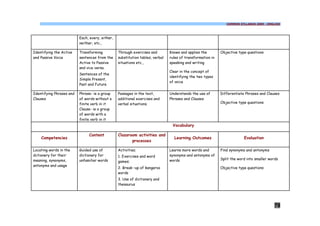
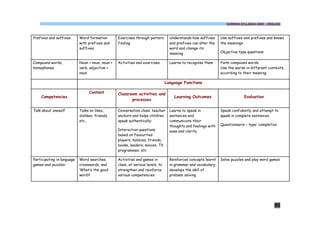
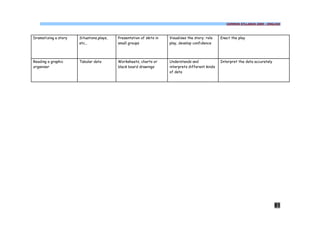
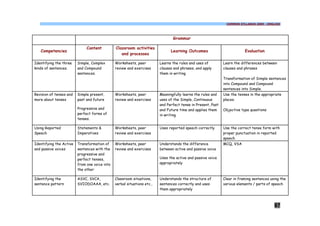
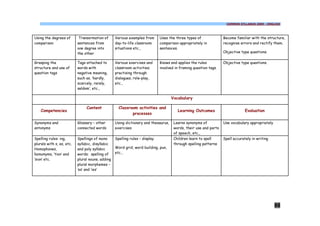
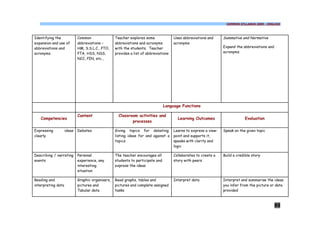
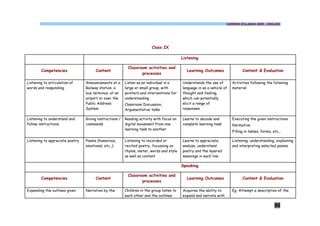
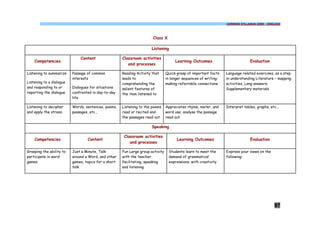
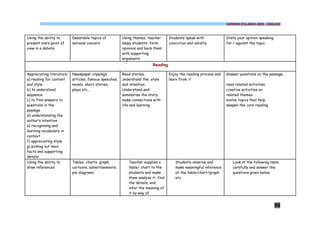
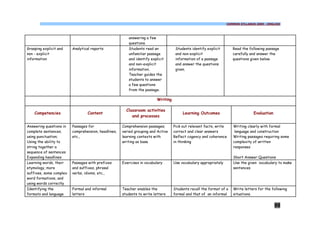
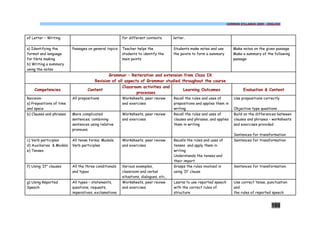
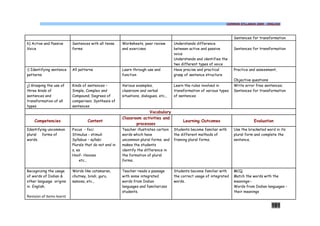
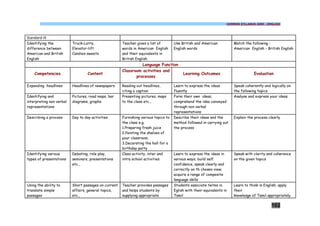
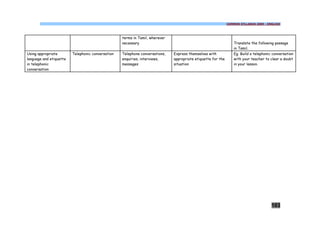
COMMON SYLLABUS 2009 - ENGLISH


                          COMMON SYLLABUS – 2009
                                      ENGLISH
                                  CLASSES I to X

A short preamble…

      In this adventure of envisioning a school syllabus anew, it may be kept in
mind that, along with all the diverse social and historical imperatives in the learning
of English, and the complex issues involved in teaching it in a multilingual frame of
reference, the acquisition of a new language is also enriching for its own sake ….the
discovery of sound and its combinations in an entirely new formatting, the rich
experience of finding new names for old things, the thrill of tune and rhythm in a
different configuration of words, the sheer wonder of finding people expressing
thoughts and ideas and feelings that are the same as one’s own, yet different, and
the percolated flavour of another culture, or cultures – another’s way to living
expression. The learning of English needs to be permeated with this enthusiasm to
learn about oneself through another language. The challenge is to build into one’s
own multicultural heritage and see language as a facilitating tool.

Vision for the syllabus

      English in India serves as a link language across diverse linguistic
communities. Globally it has become the repository of technical knowledge in many
emerging fields.

                                                            Position paper, NCF 2005


                                                                                        1
COMMON SYLLABUS 2009 - ENGLISH


Broad Objectives:

The learning of English to facilitate


         ·   Effective transaction in day-to-day situations
         ·   Communicative competence
         ·   Participatory learning frame
         ·   Language as a confidence-building strategy


Note on the Gradient

      In evolving the syllabus, care has been given to establishing clear gradients

in content and learning activities. With this in mind, Class V has been included in

the reckoning, both in the envisioning of the syllabus for Primary classes, and also

in visualizing the flow for Upper primary and secondary classes. It is felt that this

would help build a constructive transition into abstract learning.


                                        *****


                                                                                       2
COMMON SYLLABUS 2009 - ENGLISH


                                                         Class I

1. Listening


      Competency                    Content                Mode of Transaction                     Evaluation


  ·   Listening to jingles   ·   Jingles / Nursery        ·   Teacher sings or plays   ·   Listen to the tune and sing the
      / Nursery rhymes           rhymes                       the recorded cassettes       rhyme.

  ·   Understanding key                                                                ·   Respond with the next word or
      words in the rhymes                                                                  sentence when the teacher pauses
                                                                                           while singing the rhyme.

                                                                                       ·   Perform actions related to the
                                                                                           rhyme.


  ·   Listening to short,    ·   Simple short familiar    ·   Teacher narrates         ·   Do actions related to the story /
      familiar stories or        stories                      stories, or folktales.       folktale
      folktales                                               Children listen and
                                                              respond                  ·   Reproduce any environmental
  ·   Understanding the                                                                    sounds (Eg. wind blowing, crow
      main point of short                                                                  cawing) occurring in the story.
      stories told in
      English

                                                                                       ·   Listen and respond to simple
                                                                                           questions related to the story or
                                                                                           folktale.


                                                                                                                             3
COMMON SYLLABUS 2009 - ENGLISH


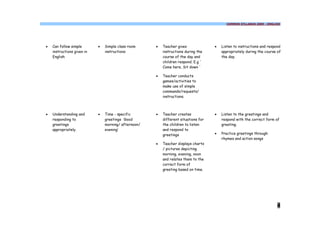
·   Can follow simple       ·   Simple class room     ·   Teacher gives              ·   Listen to instructions and respond
    instructions given in       instructions              instructions during the        appropriately during the course of
    English                                               course of the day and          the day.
                                                          children respond. E.g '
                                                          Come here, Sit down '

                                                      ·   Teacher conducts
                                                          games/activities to
                                                          make use of simple
                                                          commands/requests/
                                                          instructions.


·   Understanding and       ·   Time - specific       ·   Teacher creates            ·   Listen to the greetings and
    responding to               greetings ‘Good           different situations for       respond with the correct form of
    greetings                   morning/ afternoon/       the children to listen         greeting.
    appropriately.              evening’                  and respond to
                                                          greetings                  ·   Practice greetings through
                                                                                         rhymes and action songs
                                                      ·   Teacher displays charts
                                                          / pictures depicting
                                                          morning, evening, noon
                                                          and relates them to the
                                                          correct form of
                                                          greeting based on time.


                                                                                                                         4
COMMON SYLLABUS 2009 - ENGLISH


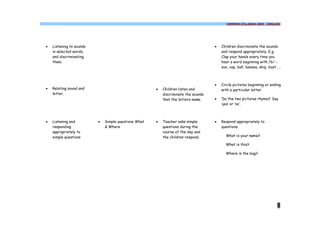
·   Listening to sounds                                                             ·   Children discriminate the sounds
    in selected words,                                                                  and respond appropriately. E.g.
    and discriminating                                                                  Clap your hands every time you
    them.                                                                               hear a word beginning with /b/ -
                                                                                        sun, cap, ball, banana, ship, boat……


                                                                                    ·   Circle pictures beginning or ending
·   Relating sound and                                ·   Children listen and           with a particular letter.
    letter.                                               discriminate the sounds
                                                          that the letters make.    ·   ‘Do the two pictures rhyme?’ Say
                                                                                        ‘yes’ or ‘no’.


·   Listening and         ·   Simple questions What   ·   Teacher asks simple       ·   Respond appropriately to
    responding                & Where                     questions during the          questions.
    appropriately to                                      course of the day and
    simple questions                                      the children respond.           What is your name?

                                                                                          What is this?

                                                                                          Where is the bag?


                                                                                                                         5
COMMON SYLLABUS 2009 - ENGLISH


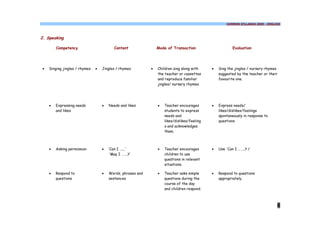
2. Speaking

        Competency                       Content                Mode of Transaction                      Evaluation


·   Singing jingles / rhymes   ·   Jingles / rhymes         ·   Children sing along with     ·   Sing the jingles / nursery rhymes
                                                                the teacher or cassettes         suggested by the teacher or their
                                                                and reproduce familiar           favourite one.
                                                                jingles/ nursery rhymes


    ·   Expressing needs           ·   Needs and likes          ·   Teacher encourages       ·   Express needs/
        and likes                                                   students to express          likes/dislikes/feelings
                                                                    needs and                    spontaneously in response to
                                                                    likes/dislikes/feeling       questions
                                                                    s and acknowledges
                                                                    them.


    ·   Asking permission          ·   ‘Can I …...'             ·   Teacher encourages       ·   Use 'Can I ……..? /
                                       'May I …….?'                 children to use
                                                                    questions in relevant
                                                                    situations.

    ·   Respond to                 ·   Words, phrases and       ·   Teacher asks simple      ·   Respond to questions
        questions                      sentences                    questions during the         appropriately.
                                                                    course of the day
                                                                    and children respond.


                                                                                                                                 6
COMMON SYLLABUS 2009 - ENGLISH


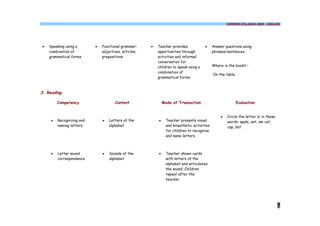
·   Speaking using a       ·   Functional grammar:     ·   Teacher provides            ·     Answer questions using
    combination of             adjectives, articles,       opportunities through             phrases/sentences.
    grammatical forms          prepositions                activities and informal
                                                           conversation for
                                                           children to speak using a         Where is the book? –
                                                           combination of
                                                                                             On the table.
                                                           grammatical forms.


3. Reading

         Competency                   Content                  Mode of Transaction                           Evaluation


                                                                                                 ·   Circle the letter ‘e’ in these
     ·   Recognizing and       ·   Letters of the          ·    Teacher presents visual              words: apple, ant, am cat,
         naming letters            alphabet                     and kinesthetic activities           cap, bat
                                                                for children to recognize
                                                                and name letters.


     ·   Letter sound          ·   Sounds of the           ·    Teacher shows cards
         correspondence            alphabet                     with letters of the
                                                                alphabet and articulates
                                                                the sound. Children
                                                                repeat after the
                                                                teacher.


                                                                                                                                      7
COMMON SYLLABUS 2009 - ENGLISH


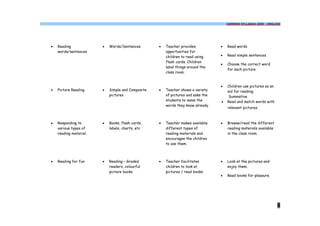
·   Reading             ·   Words/Sentences        ·   Teacher provides           ·   Read words
    words/sentences                                    opportunities for
                                                       children to read using     ·   Read simple sentences
                                                       flash cards. Children
                                                                                  ·   Choose the correct word
                                                       label things around the
                                                                                      for each picture.
                                                       class room.


                                                                                  ·   Children use pictures as an
·   Picture Reading     ·   Simple and Composite   ·   Teacher shows a variety        aid for reading.
                            pictures                   of pictures and asks the        Summative
                                                       students to name the       ·   Read and match words with
                                                       words they know already.
                                                                                      relevant pictures.


·   Responding to       ·   Books, flash cards,    ·   Teacher makes available    ·   Browse/read the different
    various types of        labels, charts, etc        different types of             reading materials available
    reading material.                                  reading materials and          in the class room.
                                                       encourages the children
                                                       to use them.


·   Reading for fun     ·   Reading – Graded       ·   Teacher facilitates        ·   Look at the pictures and
                            readers, colourful         children to look at            enjoy them.
                            picture books              pictures / read books.
                                                                                  ·   Read books for pleasure.


                                                                                                                    8
COMMON SYLLABUS 2009 - ENGLISH


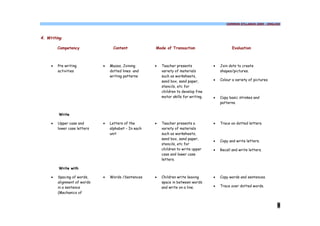
4. Writing

         Competency                Content             Mode of Transaction                        Evaluation


     ·   Pre writing          ·   Mazes, Joining       ·   Teacher presents            ·   Join dots to create
         activities               dotted lines and         variety of materials            shapes/pictures.
                                  writing patterns         such as worksheets,
                                                           sand box, sand paper,       ·   Colour a variety of pictures.
                                                           stencils, etc for
                                                           children to develop fine
                                                           motor skills for writing.   ·   Copy basic strokes and
                                                                                           patterns.


         Write

     ·   Upper case and       ·   Letters of the       ·   Teacher presents a          ·   Trace on dotted letters.
         lower case letters       alphabet – In each       variety of materials
                                  unit                     such as worksheets,
                                                           sand box, sand paper,
                                                                                       ·   Copy and write letters.
                                                           stencils, etc for
                                                           children to write upper     ·   Recall and write letters.
                                                           case and lower case
                                                           letters.

         Write with

     ·   Spacing of words,    ·   Words /Sentences     ·   Children write leaving      ·   Copy words and sentences.
         alignment of words                                space in between words
         in a sentence                                     and write on a line.        ·   Trace over dotted words.
         (Mechanics of


                                                                                                                           9
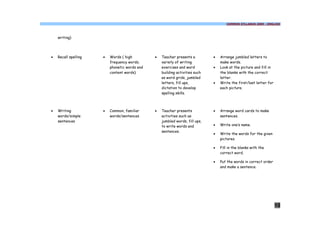
COMMON SYLLABUS 2009 - ENGLISH


    writing)


·   Recall spelling   ·   Words ( high         ·   Teacher presents a         ·   Arrange jumbled letters to
                          frequency words,         variety of writing             make words.
                          phonetic words and       exercises and word         ·   Look at the picture and fill in
                          content words)           building activities such       the blanks with the correct
                                                   as word grids, jumbled         letter.
                                                   letters, fill ups,         ·   Write the first/last letter for
                                                   dictation to develop           each picture.
                                                   spelling skills.


·   Writing           ·   Common, familiar     ·   Teacher presents           ·   Arrange word cards to make
    words/simple          words/sentences          activities such as             sentences.
    sentences                                      jumbled words, fill ups,
                                                   to write words and         ·   Write one’s name.
                                                   sentences.
                                                                              ·   Write the words for the given
                                                                                  pictures.

                                                                              ·   Fill in the blanks with the
                                                                                  correct word.

                                                                              ·   Put the words in correct order
                                                                                  and make a sentence.


                                                                                                                    10
COMMON SYLLABUS 2009 - ENGLISH


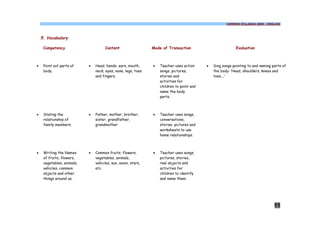
    5. Vocabulary

     Competency                      Content                   Mode of Transaction                          Evaluation


·    Point out parts of     ·   Head, hands, ears, mouth,      ·   Teacher uses action     ·   Sing songs pointing to and naming parts of
     body.                      neck, eyes, nose, legs, toes       songs, pictures,            the body: ‘Head, shoulders, knees and
                                and fingers.                       stories and                 toes….’
                                                                   activities for
                                                                   children to point and
                                                                   name the body
                                                                   parts.


·    Stating the            ·   Father, mother, brother,       ·   Teacher uses songs,
     relationship of            sister, grandfather,               conversations,
     family members.            grandmother                        stories, pictures and
                                                                   worksheets to use
                                                                   home relationships.


·    Writing the Names      ·   Common fruits, flowers,        ·   Teacher uses songs,
     of fruits, flowers,        vegetables, animals,               pictures, stories,
     vegetables, animals,       vehicles, sun, moon, stars,        real objects and
     vehicles, common           etc.                               activities for
     objects and other                                             children to identify
     things around us.                                             and name them.


                                                                                                                                  11
COMMON SYLLABUS 2009 - ENGLISH


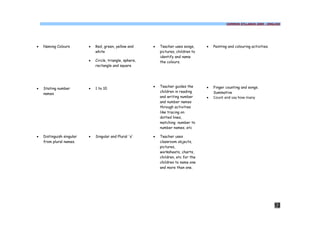
·   Naming Colours         ·   Red, green, yellow and      ·   Teacher uses songs,     ·   Painting and colouring activities.
                               white                           pictures, children to
                                                               identify and name
                           ·   Circle, triangle, sphere,       the colours.
                               rectangle and square


                                                           ·   Teacher guides the      ·   Finger counting and songs.
·   Stating number         ·   1 to 10
                                                               children in reading         Summative
    names
                                                               and writing number      ·   Count and say how many
                                                               and number names
                                                               through activities
                                                               like tracing on
                                                               dotted lines,
                                                               matching number to
                                                               number names, etc

·   Distinguish singular   ·   Singular and Plural 's'     ·   Teacher uses
    from plural names.                                         classroom objects,
                                                               pictures,
                                                               worksheets, charts,
                                                               children, etc for the
                                                               children to name one
                                                               and more than one.


                                                                                                                                12
COMMON SYLLABUS 2009 - ENGLISH


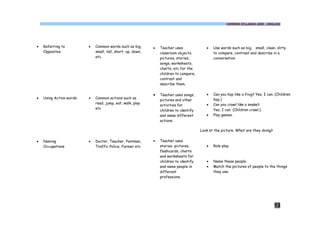
·   Referring to         ·   Common words such as big,       ·   Teacher uses              ·   Use words such as big, small, clean, dirty
    Opposites                small, tall, short, up, down,       classroom objects,            to compare, contrast and describe in a
                             etc.                                pictures, stories,            conversation
                                                                 songs, worksheets,
                                                                 charts, etc for the
                                                                 children to compare,
                                                                 contrast and
                                                                 describe them.

                                                             ·   Teacher uses songs,       ·   Can you hop like a frog? Yes, I can. (Children
·   Using Action words   ·   Common actions such as                                            hop.)
                                                                 pictures and other
                             read, jump, eat, walk, play                                   ·   Can you crawl like a snake?
                                                                 activities for
                             etc                                                               Yes, I can. (Children crawl.)
                                                                 children to identify
                                                                 and name different        ·   Play games.
                                                                 actions.

                                                                                        Look at the picture. What are they doing?

·   Naming               ·   Doctor, Teacher, Postman,       ·   Teacher uses
    Occupations              Traffic Police, Farmer etc          stories, pictures,        ·   Role play.
                                                                 flashcards, charts
                                                                 and worksheets for
                                                                 children to identify      ·   Name these people
                                                                 and name people in        ·   Match the pictures of people to the things
                                                                 different                     they use.
                                                                 professions.


                                                                                                                                    13
COMMON SYLLABUS 2009 - ENGLISH


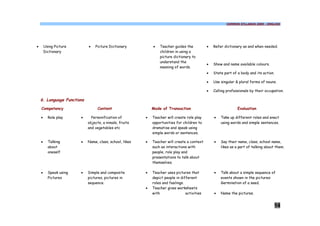
·       Using Picture       ·   Picture Dictionary           ·   Teacher guides the           ·   Refer dictionary as and when needed.
        Dictionary                                               children in using a
                                                                 picture dictionary to
                                                                 understand the
                                                                                              ·   Show and name available colours.
                                                                 meaning of words.
                                                                                              ·   State part of a body and its action.

                                                                                              ·   Use singular & plural forms of nouns.

                                                                                              ·   Calling professionals by their occupation.

    6. Language Functions

    Competency                   Content                     Mode of Transaction                                Evaluation

    ·     Role play     ·     Personification of         ·   Teacher will create role play        ·   Take up different roles and enact
                            objects, a nimals, fruits        opportunities for children to            using words and simple sentences.
                            and vegetables etc               dramatise and speak using
                                                             simple words or sentences.

    ·     Talking       ·   Name, class, school, likes   ·   Teacher will create a context        ·   Say their name, class, school name,
          about                                              such as interactions with                likes as a part of talking about them.
          oneself                                            people, role play and
                                                             presentations to talk about
                                                             themselves.

    ·     Speak using   ·   Simple and composite         ·   Teacher uses pictures that           ·   Talk about a simple sequence of
          Pictures          pictures, pictures in            depict people in different               events shown in the pictures:
                            sequence.                        roles and feelings.                      Germination of a seed.
                                                         ·   Teacher gives worksheets
                                                             with                activities       ·   Name the pictures.


                                                                                                                                         14
COMMON SYLLABUS 2009 - ENGLISH


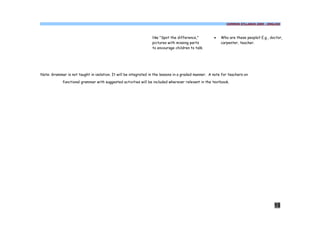
                                                                 like "Spot the difference,"         ·   Who are these people? E.g., doctor,
                                                                 pictures with missing parts             carpenter, teacher.
                                                                 to encourage children to talk.


Note: Grammar is not taught in isolation. It will be integrated in the lessons in a graded manner. A note for teachers on

            functional grammar with suggested activities will be included wherever relevant in the textbook.


                                                                                                                                       15
COMMON SYLLABUS 2009 - ENGLISH


                                                                Class II
1. Listening

               Competencies                  Content                       Mode of Transaction                       Evaluation

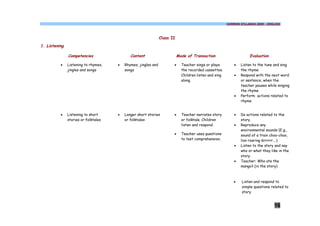
          ·    Listening to rhymes,   ·   Rhymes, jingles and          ·     Teacher sings or plays         ·   Listen to the tune and sing
               jingles and songs          songs                              the recorded cassettes.            the rhyme
                                                                             Children listen and sing       ·   Respond with the next word
                                                                             along.                             or sentence, when the
                                                                                                                teacher pauses while singing
                                                                                                                the rhyme
                                                                                                            ·   Perform actions related to
                                                                                                                rhyme


          ·    Listening to short     ·   Longer short stories         ·     Teacher narrates story         ·   Do actions related to the
               stories or folktales       or folktales                       or folktale. Children              story.
                                                                             listen and respond.            ·   Reproduce any
                                                                                                                environmental sounds (E.g.,
                                                                       ·     Teacher uses questions             sound of a train choo-choo,
                                                                             to test comprehension.             lion roaring Grrrrr….)
                                                                                                            ·   Listen to the story and say
                                                                                                                who or what they like in the
                                                                                                                story.
                                                                                                            ·   Teacher: Who ate the
                                                                                                                mango? (in the story)


                                                                                                            ·   Listen and respond to
                                                                                                                simple questions related to
                                                                                                                story


                                                                                                                                   16
COMMON SYLLABUS 2009 - ENGLISH


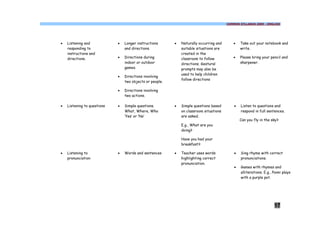
·   Listening and            ·   Longer instructions      ·   Naturally occurring and      ·    Take out your notebook and
    responding to                and directions.              suitable situations are           write.
    instructions and                                          created in the
    directions.              ·   Directions during            classroom to follow          ·    Please bring your pencil and
                                 indoor or outdoor            directions. Gestural              sharpener.
                                 games.                       prompts may also be
                                                              used to help children
                             ·   Directions involving
                                                              follow directions
                                 two objects or people.

                             ·   Directions involving
                                 two actions.

·   Listening to questions   ·   Simple questions.        ·   Simple questions based        ·   Listen to questions and
                                 What, Where, Who             on classroom situations           respond in full sentences.
                                 ‘Yes’ or ‘No’                are asked.
                                                                                                Can you fly in the sky?
                                                              E.g., What are you
                                                              doing?

                                                              Have you had your
                                                              breakfast?

·   Listening to             ·   Words and sentences      ·   Teacher uses words            ·   Sing rhyme with correct
    pronunciation                                             highlighting correct              pronunciations.
                                                              pronunciation.
                                                                                            ·   Games with rhymes and
                                                                                                alliterations. E.g., Ponni plays
                                                                                                with a purple pot.


                                                                                                                     17
COMMON SYLLABUS 2009 - ENGLISH


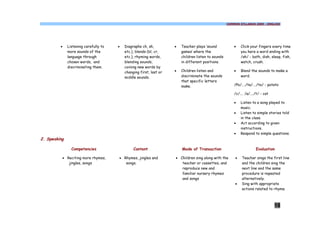
         ·    Listening carefully to   ·   Diagraphs ch, sh,         ·   Teacher plays ‘sound            ·   Click your fingers every time
              more sounds of the           etc.), blends (bl, cr,        games’ where the                    you here a word ending with
              language through             etc.), rhyming words,         children listen to sounds           /sh/ - bath, dish, sleep, fish,
              chosen words, and            blending sounds,              in different positions.             watch, crush.
              discriminating them.         coining new words by
                                           changing first, last or   ·   Children listen and             ·   Blend the sounds to make a
                                           middle sounds.                discriminate the sounds             word.
                                                                         that specific letters
                                                                         make.                           /Po/.…/ta/…./to/ - potato

                                                                                                         /c/…. /a/…./t/ - cat

                                                                                                         ·   Listen to a song played to
                                                                                                             music.
                                                                                                         ·   Listen to simple stories told
                                                                                                             in the class.
                                                                                                         ·   Act according to given
                                                                                                             instructions.
                                                                                                         ·   Respond to simple questions.
2. Speaking

                Competencies                    Content                  Mode of Transaction                          Evaluation

          · Reciting more rhymes,      · Rhymes, jingles and         · Children sing along with the      ·   Teacher sings the first line
             jingles, songs               songs.                        teacher or cassettes, and            and the children sing the
                                                                        reproduce new and                    next line and the same
                                                                        familiar nursery rhymes              procedure is repeated
                                                                        and songs                            alternatively.
                                                                                                         ·   Sing with appropriate
                                                                                                             actions related to rhyme.


                                                                                                                                 18
COMMON SYLLABUS 2009 - ENGLISH


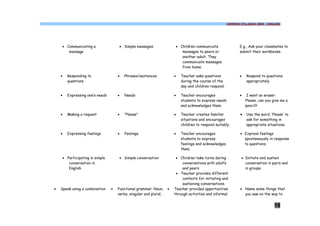
    · Communicating a                · Simple messages.                · Children communicate                 E.g., Ask your classmates to
       message                                                            messages to peers or                submit their workbooks.
                                                                          another adult. They
                                                                          communicate messages
                                                                          from home.

    ·   Responding to                ·   Phrases/sentences             ·   Teacher asks questions             ·   Respond to questions
        questions                                                          during the course of the               appropriately
                                                                           day and children respond.

    ·   Expressing one’s needs       ·   Needs                         ·   Teacher encourages                 ·    I want an eraser.
                                                                           students to express needs              Please, can you give me a
                                                                           and acknowledges them.                 pencil?

    ·   Making a request             ·   “Please”                      ·   Teacher creates familiar           ·   Use the word, ‘Please’ to
                                                                           situations and encourages              ask for something in
                                                                           children to respond suitably           appropriate situations.

    ·   Expressing feelings          ·   Feelings                      ·   Teacher encourages                 · Express feelings
                                                                           students to express                  spontaneously in response
                                                                           feelings and acknowledges            to questions
                                                                           them.

    · Participating in simple        · Simple conversation              · Children take turns during           · Initiate and sustain
       conversation in                                                     conversations with adults             conversation in pairs and
       English                                                             and peers                             in groups.
                                                                        · Teacher provides different
                                                                           contexts for initiating and
                                                                           sustaining conversations.
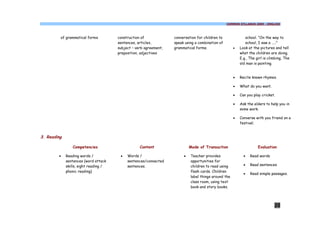
·   Speak using a combination    ·   Functional grammar: Noun,     ·   Teacher provides opportunities         · Name some things that
                                     verbs, singular and plural,       through activities and informal          you saw on the way to


                                                                                                                                   19
COMMON SYLLABUS 2009 - ENGLISH


         of grammatical forms          construction of             conversation for children to              school. “On the way to
                                       sentences, articles,        speak using a combination of              school, I saw a …..”
                                       subject – verb agreement,   grammatical forms.                 ·   Look at the pictures and tell
                                       preposition, adjectives                                            what the children are doing.
                                                                                                          E.g., The girl is climbing, The
                                                                                                          old man is painting.


                                                                                                      ·   Recite known rhymes.

                                                                                                      ·   What do you want.

                                                                                                      ·   Can you play cricket.

                                                                                                      ·   Ask the elders to help you in
                                                                                                          some work.

                                                                                                      ·   Converse with you friend on a
                                                                                                          festivel.


3. Reading

                 Competencies                      Content                  Mode of Transaction                      Evaluation

        ·    Reading words /            ·   Words /                     ·   Teacher provides                ·   Read words
             sentences (word attack         sentences/connected             opportunities for
             skills, sight reading /        sentences.                      children to read using          ·   Read sentences
             phonic reading)                                                flash cards. Children
                                                                                                            ·   Read simple passages.
                                                                            label things around the
                                                                            class room, using text
                                                                            book and story books.


                                                                                                                               20
COMMON SYLLABUS 2009 - ENGLISH


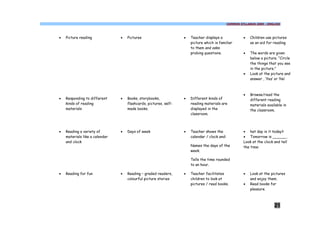
·   Picture reading             ·   Pictures                      ·   Teacher displays a               ·   Children use pictures
                                                                      picture which is familiar            as an aid for reading
                                                                      to them and asks
                                                                      probing questions.               ·   The words are given
                                                                                                           below a picture. “Circle
                                                                                                           the things that you see
                                                                                                           in the picture.”
                                                                                                       ·   Look at the picture and
                                                                                                           answer , ‘Yes’ or ‘No’


                                                                                                       ·   Browse/read the
·   Responding to different     ·   Books, storybooks,            ·   Different kinds of                   different reading
    kinds of reading                flashcards, pictures, self-       reading materials are                materials available in
    materials                       made books.                       displayed in the                     the classroom.
                                                                      classroom.


·   Reading a variety of        ·   Days of week                  ·   Teacher shows the                · hat day is it today?
    materials like a calendar                                         calendar / clock and:            · Tomorrow is ______.
    and clock                                                                                          Look at the clock and tell
                                                                      Names the days of the            the time:
                                                                      week.

                                                                      Tells the time rounded
                                                                      to an hour.

·   Reading for fun             ·   Reading – graded readers,     ·   Teacher facilitates              ·   Look at the pictures
                                    colourful picture stories         children to look at                  and enjoy them.
                                                                      pictures / read books.           ·   Read books for
                                                                                                           pleasure.


                                                                                                                         21
COMMON SYLLABUS 2009 - ENGLISH


4. Writing

             Competencies                   Content                  Mode of Transaction                    Evaluation

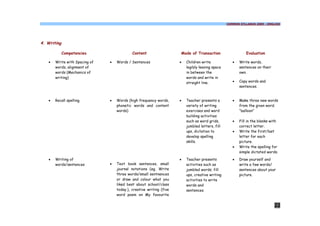
   ·   Write with Spacing of   ·   Words / Sentences                 ·   Children write             ·   Write words,
       words, alignment of                                               legibly leaving space          sentences on their
       words (Mechanics of                                               in between the                 own.
       writing)                                                          words and write in
                                                                         straight line.             ·   Copy words and
                                                                                                        sentences.


   ·   Recall spelling.        ·   Words (high frequency words,      ·   Teacher presents a         ·   Make three new words
                                   phonetic words and content            variety of writing             from the given word.
                                   words)                                exercises and word             “balloon”
                                                                         building activities
                                                                         such as word grids,        ·   Fill in the blanks with
                                                                         jumbled letters, fill          correct letter.
                                                                         ups, dictation to          ·   Write the first/last
                                                                         develop spelling               letter for each
                                                                         skills.                        picture.
                                                                                                    ·   Write the spelling for
                                                                                                        simple dictated words.

   ·   Writing of                                                    ·   Teacher presents           ·   Draw yourself and
       words/sentences         ·   Text book sentences, small            activities such as             write a few words/
                                   journal notations (eg. Write          jumbled words; fill            sentences about your
                                   three words/small sentnences          ups, creative writing          picture.
                                   or draw and colour what you           activities to write
                                   liked best about school/class         words and
                                   today.), creative writing (five       sentences.
                                   word poem on My favourite

                                                                                                                             22
COMMON SYLLABUS 2009 - ENGLISH


                                        colour, Mother, Tree etc.

   ·       Write using a            ·   Functional grammar: Noun,          ·   Teacher provides             ·   Match the words in column
           combination of               verbs, singular and plural,            opportunities through            A and column B and make
           grammatical forms            construction of sentences,             written activities for           sentences.
                                        articles, subject – verb               children to write using a    · Fill in the blanks with ‘a’,
                                        agreement, preposition,                combination of                   ‘an’ ____ apple.
                                        adjectives                             grammatical forms.               ____ red apple.
                                                                                                            · Look at the picture and
                                                                                                                fill in the blanks.
                                                                                                            E.g., The boy _____ water
                                                                                                            (drink/drinks).

5. Vocabulary

            Competencies                Content                       Mode of Transaction                         Evaluation

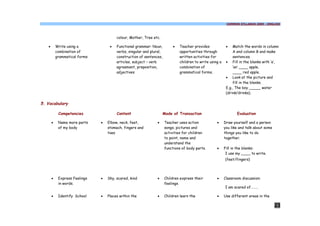
       ·    Name more parts    ·   Elbow, neck, feet,           ·     Teacher uses action            ·     Draw yourself and a person
            of my body             stomach, fingers and               songs, pictures and                  you like and talk about some
                                   toes                               activities for children              things you like to do
                                                                      to point, name and                   together.
                                                                      understand the
                                                                      functions of body parts.       ·     Fill in the blanks:
                                                                                                            I use my ____ to write.
                                                                                                           (feet/fingers)


       ·    Express Feelings   ·   Shy, scared, kind            ·     Children express their         ·     Classroom discussion:
            in words.                                                 feelings.
                                                                                                           I am scared of………

       ·    Identify School    ·   Places within the            ·     Children learn the             ·     Use different areas in the

                                                                                                                                          23
COMMON SYLLABUS 2009 - ENGLISH


    spaces                    school.                        names of different                 school and perform errands.
                                                             places in the school and
                                                             their purpose by
                                                             actively using them.

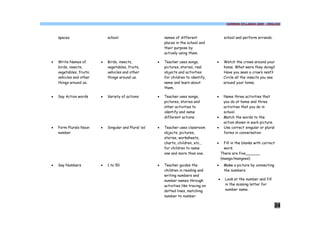
·   Write Names of        ·   Birds, insects,            ·   Teacher uses songs,          ·    Watch the crows around your
    birds, insects,           vegetables, fruits,            pictures, stories, real           home. What were they doing?
    vegetables, fruits,       vehicles and other             objects and activities            Have you seen a crow’s nest?
    vehicles and other        things around us.              for children to identify,         Circle all the insects you see
    things around us.                                        name and learn about              around your home.
                                                             them.

·   Say Action words      ·   Variety of actions         ·   Teacher uses songs,          ·    Name three activities that
                                                             pictures, stories and             you do at home and three
                                                             other activities to               activities that you do in
                                                             identify and name                 school.
                                                             different actions.           ·    Match the words to the
                                                                                               action shown in each picture.
·   Form Plurals Noun     ·   Singular and Plural ‘es’   ·   Teacher uses classroom       ·    Use correct singular or plural
    number                                                   objects, pictures,                forms in conversation
                                                             stories, worksheets,
                                                             charts, children, etc.,      ·     Fill in the blanks with correct
                                                             for children to name               word.
                                                             one and more than one.           There are five______.
                                                                                              (mango/mangoes)
·   Say Numbers           ·   1 to 50                    ·   Teacher guides the           ·     Make a picture by connecting
                                                             children in reading and            the numbers.
                                                             writing numbers and
                                                             number names through         ·     Look at the number and fill
                                                             activities like tracing on         in the missing letter for
                                                             dotted lines, matching             number name.
                                                             number to number

                                                                                                                               24
COMMON SYLLABUS 2009 - ENGLISH


                                                                    names, etc.

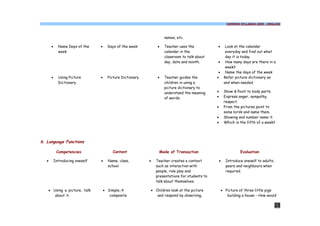
       ·     Name Days of the    ·     Days of the week         ·   Teacher uses the            ·        Look at the calendar
             week                                                   calendar in the                      everyday and find out what
                                                                    classroom to talk about              day it is today.
                                                                    day, date and month.        ·        How many days are there in a
                                                                                                         week?
                                                                                                 ·       Name the days of the week
       ·     Using Picture       ·     Picture Dictionary       ·   Teacher guides the          ·       Refer picture dictionary as
             Dictionary                                             children in using a                 and when needed.
                                                                    picture dictionary to
                                                                    understand the meaning      ·       Show & Point to body parts.
                                                                    of words.                   ·       Express anger, sympathy,
                                                                                                        respect.
                                                                                                ·       From the pictures point to
                                                                                                        some birds and name them.
                                                                                                ·       Showing and number name it.
                                                                                                ·       Which is the fifth of a week?


6. Language Functions

            Competencies                 Content                 Mode of Transaction                             Evaluation

   ·       Introducing oneself   ·     Name, class,         ·   Teacher creates a context           ·    Introduce oneself to adults,
                                       school                   such as interaction with                 peers and neighbours when
                                                                people, role play and                    required.
                                                                presentations for students to
                                                                talk about themselves.

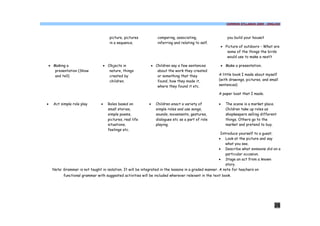
   · Using a picture, talk           · Simple,à             · Children look at the picture           · Picture of three little pigs
      about it.                         composite              and respond by observing,                building a house – How would

                                                                                                                                        25
COMMON SYLLABUS 2009 - ENGLISH


                                     picture, pictures          comparing, associating,                 you build your house?
                                     in a sequence.             inferring and relating to self.
                                                                                                     · Picture of outdoors – What are
                                                                                                        some of the things the birds
                                                                                                        would use to make a nest?

· Making a                       · Objects in               · Children say a few sentences           · Make a presentation.
   presentation (Show               nature, things             about the work they created
   and tell)                        created by                 or something that they               A little book I made about myself
                                    children.                  found, how they made it,             (with drawings, pictures, and small
                                                               where they found it etc.             sentences)

                                                                                                    A paper boat that I made.

·   Act simple role play        ·   Roles based on         ·   Children enact a variety of          ·   The scene is a market place.
                                    small stories,             simple roles and use songs,              Children take up roles as
                                    simple poems,              sounds, movements, gestures,             shopkeepers selling different
                                    pictures, real life        dialogues etc as a part of role          things. Others go to the
                                    situations,                playing.                                 market and pretend to buy.
                                    feelings etc.
                                                                                                        Introduce yourself to a guest.
                                                                                                       · Look at the picture and say
                                                                                                           what you see.
                                                                                                       · Describe what someone did on a
                                                                                                           particular occasion.
                                                                                                       · Stage an act from a known
                                                                                                           story.
    Note: Grammar is not taught in isolation. It will be integrated in the lessons in a graded manner. A note for teachers on
          functional grammar with suggested activities will be included wherever relevant in the text book.


                                                                                                                                    26
COMMON SYLLABUS 2009 - ENGLISH


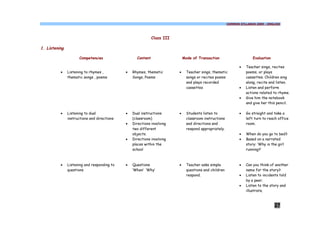
                                                             Class III

1. Listening

                      Competencies                 Content                   Mode of Transaction                      Evaluation

                                                                                                               ·   Teacher sings, recites
          ·    Listening to rhymes ,         ·   Rhymes, thematic        ·     Teacher sings, thematic             poems, or plays
               thematic songs , poems            Songs, Poems                  songs or recites poems              cassettes. Children sing
                                                                               and plays recorded                  along, recite and listen.
                                                                               cassettes                       ·   Listen and perform
                                                                                                                   actions related to rhyme.
                                                                                                               ·   Give him the notebook
                                                                                                                   and give her this pencil.

          ·    Listening to dual             ·   Dual instructions       ·     Students listen to              ·   Go straight and take a
               instructions and directions       (classroom)                   classroom instructions              left turn to reach office
                                             ·   Directions involving          and directions and                  room.
                                                 two different                 respond appropriately.
                                                 objects.                                                      ·   When do you go to bed?
                                             ·   Directions involving                                          ·   Based on a narrated
                                                 places within the                                                 story: ‘Why is the girl
                                                 school                                                            running?’


          ·    Listening and responding to   ·   Questions               ·     Teacher asks simple             ·   Can you think of another
               questions                         ‘When’ ‘Why’                  questions and children              name for the story?
                                                                               respond.                        ·   Listen to incidents told
                                                                                                                   by a peer.
                                                                                                               ·   Listen to the story and
                                                                                                                   illustrate.


                                                                                                                                   27
COMMON SYLLABUS 2009 - ENGLISH


                                                                                                 ·   Listen and respond to
                                                                                                     simple questions related
                                                                                                     to the story

                                 ·   Stories, incidents    ·   Teacher narrates                  ·    Listen to words with
·   Listening to stories,                                      stories. Children listen               slight differences in
    incidents                                                  and respond.                           vowel and consonant
                                                                                                      sounds.
                                                           ·   Teacher uses questions                (ship-sheep, plank-
                                                               to test comprehension.                 blank)
                                                                                                 ·    Change the first, middle
                                                                                                      or the last letter(s) and
                                                                                                      make a new word.
                                                                                                     (Play-clay, cot-cut,
                                                                                                      bit-bite)


·   Listening to pronunciation   ·   Words,sentences       ·   Teacher models
    of different words                                         pronunciation and
                                                               children listen and
                                                               repeat.                           ·   What is your favourite
                                                                                                     game? Why?
                                     Simple common ideas   ·   Teacher gives a topic to
·   Listening and responding,    ·
                                                               the children to discuss.
    in peer group discussion


                                                                                                                      28
COMMON SYLLABUS 2009 - ENGLISH


2. Speaking

              Competencies                  Content            Mode of Transaction                     Evaluation

     ·   Singing rhymes, poems,    ·   Rhymes, poems,      ·   Children sing or recite     ·   Listen to the tune and sing, or
         songs                         songs                   along with the teacher          listen to and recite the rhyme
                                                               or cassette and                 or poem.
                                                               reproduce the rhymes,       ·   Respond with the next word
                                                               poems or songs                  or sentence when the teacher
                                                                                               pauses while singing or
                                                                                               reciting the rhyme.
                                                                                           ·   Perform actions related to
                                                                                               the rhyme where initiated.


                                                                                           ·   Stand in line to go to the
         Communicate a message     ·   Simple messages     ·   Children communicate            playground.
                                                               messages to peers or        ·   My teacher wants a box of
                                                               another adult.                  chalks


     ·   Expressing regret         ·   “Sorry”             ·   Children express regret     The child says ‘Sorry’ when
                                                               in naturally occurring      she/he accidentally bumps into
                                                               situations.                 someone.

     ·   Responding to questions   ·   Phrases/sentences   ·   Teacher asks questions      ·   Respond to questions
                                                               during the course of            appropriately.
                                                               the day and children
                                                               respond.

     ·   Narrating                 ·   Short               ·   Children narrate any        ·  I went to the zoo with my
                                       stories/incidents       incident they have             brother and …………….
                                                               experienced, parts of       Narrate the story of – The

                                                                                                                      29
COMMON SYLLABUS 2009 - ENGLISH


                                                                                stories or an entire             thirsty crow.
                                                                                simple story.

     ·   Participating in discussion       ·   Simple common ideas.         ·   Teacher gives a topic to         ·   Have you been to a beach?
                                                                                the children to discuss.             What do you see? What are
                                                                                                                     some fun things we can do in
                                                                            ·   Children discuss topics              beach?
                                                                                of common interest on
                                                                                their own.

     ·   Speak using a combination         Functional grammar:          ·   Teacher provides                     ·   Is this Mala’s pencil? Yes, it is
         of grammatical forms              Articles, Nouns, Verbs,          opportunities through                    Mala’s pencil.
                                           Singular and Plural,             spoken activities for
                                           Adjectives, Comparison of        children to speak using a            ·   Look at your bag and your
                                           adjectives, Subject – verb       combination of grammatical               friend’s bag. Talk about what
                                           agreement Personal               forms.                                   looks the same and what is
                                           pronouns, Possessives,                                                    different.
                                           Verb forms

     ·   Asking questions                  ·   ‘Wh’ questions           ·   Children ask a variety of            ·   Where is the black dog?
                                                                            questions during the course
                                                                            of the day.                          ·    Who is your friend?


3. Reading

                   Competencies                          Content                    Mode of Transaction                      Evaluation


          ·   Reading sentences / longer         ·   Any passage from           ·   Teacher provides                 ·    Underline the
              text                                   text or other books            opportunities for                     unfamiliar words.
                                                                                    children to read                 ·    ‘Round Robin’
                                                                                    individually, in pairs and            reading – reading

                                                                                                                                            30
COMMON SYLLABUS 2009 - ENGLISH


                                                         in small groups.                     one sentence each
                                                                                              from a given
                                                     ·   Children read and                    passage.
                                                         answer simple questions.         ·   Read the sentence
                                                                                              and illustrate.

                                                     ·   Children pause at the            ·   Read the given
                                                         end of sentences.                    passage.
                                                                                          · Read the passage
                                                     ·   Children use word                    and choose the
                                                         attack skills to read.               correct answer.
                                                                                          The rat ran into a
                                                                                          _____.
                                                                                          pipe hole house


                                                                                          · Read aloud.
                         ·   Simple rules of         ·   Children identify magic          Bake
                             spelling. E.g., Magic       ‘e’ words and pronounce          Cake
                             ‘e’                         them accordingly.                Like
                                                         E.g., kite, late, cute           Write
                                                                                          Whole
·   Use Spelling rules                                                                    Hole


                                                                                          ·   List out the road
                         ·   Road Signs / maps       ·   Road signs and simple                signs you see while
                                                         maps are introduced to               coming to school.
                                                         children.
                                                                                          ·   Create your own

                                                                                                                31
COMMON SYLLABUS 2009 - ENGLISH


                                                                                                                road sign and talk
                                                                                                                about it.

                                                                                                            ·   Draw a map from
                                                                                                                your home to school.

                                                                                                            ·   Look at the pictures
         ·   Reading different genres       ·   Reading – Graded          ·   Teacher facilitates               and enjoy them
                                                readers, colourful            children to look at           ·   Read books for
                                                picture books                 pictures/read books.              pleasure
                                                                                                            ·   Convey a message to
                                                                                                                a friend.
                                                                                                            ·   Express regret for
                                                                                                                a mistaken act.
                                                                                                            ·   Narrate an incident.
                                                                                                            ·   Ask your friend
                                                                                                                question.
                                                                                                            ·   Read a few
         ·   Reading for fun                                                                                    sentences.

4. Writing

               Competencies                     Content                  Mode of Transaction                    Evaluation


         ·   Transcription of print     ·   Words / sentences        ·    Children copy                ·   Copy down the passage
             text                                                         sentences/passages
                                                                          from the text                ·   Finds hidden words in
                                                                          book/black board, etc.,          word grids
                                                                                                       ·   Write two other rhyming
                                                                                                           words for each word.


                                                                                                                                32
COMMON SYLLABUS 2009 - ENGLISH


·   Recall spelling      ·   Words (high           ·   Teacher presents a          ·   Fill in the blanks with
                             frequency words,          variety of writing              correct word:
                             phonetic words and        exercises such as           Monkeys climb______.
                             content words)            jumbled letters,            (stere/ reest/ trees)
                                                       sentences, fill ups and
                                                       dictation to develop
                                                       spelling skills.

·   Creative writing     ·   Writing rhyming       ·   Teacher presents a          ·   Write two sentences
                             sentences, Writing        simple rhyme with               that rhyme using the
                             on a topic, Drawing       missing sentences.              given words.
                             and writing, Making                                            ball, wall
                             a list                ·   Children draw, colour       · Make a list of things that
                                                       and write.                      you would like to do this
                                                                                       Sunday.
                                                                                   · Read and Answer the
                                                                                       following questions
                                                                                   · Make a question for the
                                                                                       following sentences. The
                                                                                       question words are given.
                                                                                   What __________
                                                                                   This is a train.

·   Writing sentences/   ·   Text, creative        ·   Teacher writes on the
    longer passages          writing                   blackboard and the
                                                       children copy it.
                                                   ·   Children read a passage
                                                       and answer questions.
                                                   ·   Children write a few
                                                       sentences using their
                                                       own ideas.                  ·   Punctuate:
·   Using punctuations   ·   Text comma,                                               - she is in delhi

                                                                                                             33
COMMON SYLLABUS 2009 - ENGLISH


                              apostrophe and              ·   Teacher helps the                - where is my
                              question mark                   children to mark the                sister
                                                              punctuations correctly           - ravi gita and
                                                              in a passage                       anwar are
                                                                                                playing football


·   Write using a         ·   Functional grammar:     ·   Teacher provides             ·   Fill in the blanks with correct
    combination of            Nouns, Verbs,               opportunities through            word.
    grammatical forms         prepositions,               written activities for           This is my shirt. ____
·   [Consolidation of         Articles, Adjectives,       children to write using a        (It/His) is red in colour.
    functional learning       Comparison of               combination of grammatical   ·   Make the sentences bigger
    through usage]            adjectives, Subject         forms.                           choosing from the words
                              – verb agreement                                             given.            (tall, blue,
                              Personal pronouns,                                           two)
                              Possessives, Verb                                            I have bottles.
                              forms, Singular and                                          A boy is running.
                              plural                                                       My bag is lost.
                          ·   [Learnt and
                              interpreted only as                                      ·   Copy a news item in your note
                              usage]                                                       book.
                                                                                       ·   form two or three rhyming
                                                                                           sentences.
                                                                                       ·   Use punctuations as directed
                                                                                           by the teacher.


                                                                                                                     34
COMMON SYLLABUS 2009 - ENGLISH


5. Vocabulary

                 Competencies                      Content              Mode of Transaction                      Evaluation

         ·   Forming Singular and Plural   ·   Irregular nouns      ·    Teacher guides children           · Match the following:
             Names.                            ‘ies’, ‘ves’              with vocabulary games             Knife – Loaves
                                                                         and activities                    Story – knives
                                                                                                           Loaf – stories

         ·   Using Picture Dictionary      ·   Picture Dictionary   ·    Teacher guides the                ·   Know how to refer
                                                                         children in grasping the              to picture dictionary
                                                                         meaning from the                      as and when needed.
                                                                         picture dictionary

         ·   Months of the year            ·   Months of the year   ·    Teacher uses the                  ·   Sing a rhyme-
                                                                         calendar for children to              ‘January,February,…’
                                                                         learn the months of the           ·   What is the first
                                                                         year and to know what                 month of the year?
                                                                         month they are in.                ·   What is the last
                                                                         E.g., Today is Friday,                month of the year?
                                                                         September 26 th, 2009.
6. Language Functions

                 Competencies                      Content              Mode of Transaction                      Evaluation

         ·   Make a Role play (pair        ·   Themes from text,    ·    Teacher initiates                 ·   Take up roles as
             work)                             story books, real         discussion and guides                 butterfly, bee, tree,
                                               life situations           children to play                      peacock and speak
                                                                         different roles                       one or two lines
                                                                                                               about yourself


                                                                                                                               35
COMMON SYLLABUS 2009 - ENGLISH


                                                 ·   Content from the           ·   Teacher facilitates in          ·   Take up roles to
           ·   Act in a drama                        text / stories                 dramatizing the story               enact a short story.
               (Dramatization)                                                                                          Akbar and Birbal


           ·   Making lists                      ·   Shopping list, list of     ·   Teacher presents topics         ·   Make a list of things
                                                     items in the                   for lists or uses                   you bring to school.
                                                     classroom, list of             naturally occurring
                                                     children                       opportunities to make
                                                                                    lists.

           ·   Making a presentation             ·   Things found or            ·   Children say a few              ·   Make a presentation
               (Show and tell)                       created by children.           sentences about the
                                                                                    work they created or            A scrap book- flowers
                                                                                    something that they
                                                                                    found, how they made it,        A fish made with shells.
                                                                                    where they found it
                                                                                    etc.,
           ·   Talking about a theme             ·   Simple / Common/           ·   Teacher enables                 ·   Talk about:
                                                     familiar themes                children to talk about a            My school.
                                                                                    familiar theme.                     My pet cat.
                                                                                                                    ·   Act like a docter.
                                                                                                                    ·   Prepare a list of
                                                                                                                        thing you want from
                                                                                                                        your father.
                                                                                                                    ·   Describe what you
                                                                                                                        made of waste paper
                                                                                                                        / rags / clay /
                                                                                                                        plastic items.

Note: Grammar is not taught in isolation. It will be integrated in the lessons in a graded manner. A note for teachers on
      functional grammar with suggested activities will be included wherever relevant in the textbook.

                                                                                                                                        36
COMMON SYLLABUS 2009 - ENGLISH


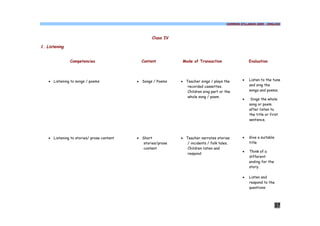
                                                   Class IV

1. Listening


                Competencies                  Content           Mode of Transaction                  Evaluation


    · Listening to songs / poems            · Songs / Poems    · Teacher sings / plays the       ·   Listen to the tune
                                                                  recorded cassettes.                and sing the
                                                                  Children sing part or the          songs and poems.
                                                                  whole song / poem.
                                                                                                 ·    Sings the whole
                                                                                                     song or poem
                                                                                                     after listen to
                                                                                                     the title or first
                                                                                                     sentence.


    · Listening to stories/ prose content   · Short            · Teacher narrates stories        ·   Give a suitable
                                               stories/prose      / incidents / folk tales.          title
                                               content            Children listen and
                                                                                                 ·   Think of a
                                                                  respond
                                                                                                     different
                                                                                                     ending for the
                                                                                                     story.

                                                                                                 ·   Listen and
                                                                                                     respond to the
                                                                                                     questions


                                                                                                                       37
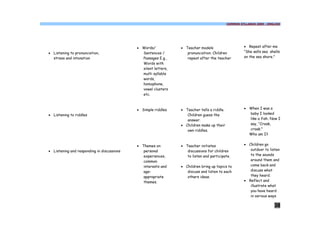
COMMON SYLLABUS 2009 - ENGLISH


                                            · Words/            · Teacher models                     · Repeat after me
· Listening to pronunciation,                 Sentences /          pronunciation. Children           “She sells sea shells
  stress and intonation                       Passages E.g.,       repeat after the teacher          on the sea shore.”
                                              Words with
                                              silent letters,
                                              multi syllable
                                              words,
                                              homophone,
                                              vowel clusters
                                              etc.


                                            · Simple riddles    · Teacher tells a riddle.            · When I was a
· Listening to riddles                                             Children guess the                  baby I looked
                                                                   answer.                             like a fish. Now I
                                                                · Children make up their               say, “Croak,
                                                                   own riddles.                        croak.”
                                                                                                       Who am I?


                                            · Themes on         · Teacher initiates                  · Children go
· Listening and responding in discussions      personal            discussions for children             outdoor to listen
                                               experiences,        to listen and participate.           to the sounds
                                               common                                                   around them and
                                               interests and    · Children bring up topics to           come back and
                                               age-                discuss and listen to each           discuss what
                                               appropriate         others ideas.                        they heard.
                                               themes.                                               · Reflect and
                                                                                                        illustrate what
                                                                                                        you have heard
                                                                                                        in various ways

                                                                                                                      38
COMMON SYLLABUS 2009 - ENGLISH


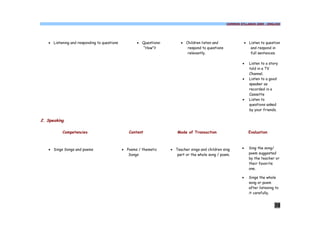
   · Listening and responding to questions          · Questions:        · Children listen and                 · Listen to question
                                                      “How”?               respond to questions                  and respond in
                                                                           relevantly.                           full sentences.

                                                                                                          ·     Listen to a story
                                                                                                                told in a TV
                                                                                                                Channel.
                                                                                                          ·     Listen to a good
                                                                                                                speaker as
                                                                                                                recorded in a
                                                                                                                Cassette
                                                                                                          ·     Listen to
                                                                                                                questions asked
                                                                                                                by your friends.

2. Speaking

          Competencies                          Content               Mode of Transaction                       Evaluation


   · Sings Songs and poems                   · Poems / thematic    · Teacher sings and children sing      ·     Sing the song/
                                                Songs                 part or the whole song / poem.            poem suggested
                                                                                                                by the teacher or
                                                                                                                their favorite
                                                                                                                one.

                                                                                                          ·     Sings the whole
                                                                                                                song or poem
                                                                                                                after listening to
                                                                                                                it carefully.


                                                                                                                               39
COMMON SYLLABUS 2009 - ENGLISH


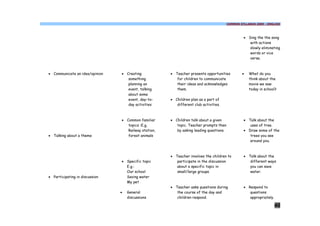
                                                                                                 · Sing the the song
                                                                                                    with actions
                                                                                                    slowly eliminating
                                                                                                    words or vice
                                                                                                    versa.


· Communicate an idea/opinion   · Creating            · Teacher presents opportunities          ·   What do you
                                   something             for children to communicate                think about the
                                   planning an           their ideas and acknowledges               movie we saw
                                   event, talking        them.                                      today in school?
                                   about some
                                   event, day-to-     · Children plan as a part of
                                   day activities        different club activities.


                                · Common familiar     · Children talk about a given              · Talk about the
                                   topics :E.g,          topic. Teacher prompts then                uses of tree.
                                   Railway station,      by asking leading questions.            · Draw some of the
· Talking about a theme            forest animals                                                   trees you see
                                                                                                    around you.


                                                      · Teacher involves the children to         · Talk about the
                                · Specific topic         participate in the discussion              different ways
                                  E.g.:                  about a specific topic in                  you can save
                                  Our school             small/large groups.                        water.
· Participating in discussion     Saving water
                                  My pet
                                                      · Teacher asks questions during            · Respond to
                                ·   General              the course of the day and                  questions
                                    discussions          children respond.                          appropriately.

                                                                                                                     40
COMMON SYLLABUS 2009 - ENGLISH


                                    ·   Sentences           · Children ask how something is        · How did the
                                        (Questions and         done or how something                  mouse save the
                                        answers)               happened.                              lion?

· Responding to questions           ·   “How?” questions    · Teacher provides opportunities       · Throw the ball on
                                                               through spoken activities for          the black board
                                                               children to use a combination          and make a
                                    ·   Functional             of grammatical forms.                  sentence with
                                        grammar: Noun,                                                the word you hit
· Asking questions                      verb, article,                                                with the ball.
                                        adjective, verb                                            · Look at the six
                                        forms, degrees of                                             pictures and tell
                                        adjectives,                                                   the story of the
· Speaking using a combination of
                                        personal pronoun,                                             ‘Ant and the
   grammatical forms.
                                        possessive                                                    Dove’.
                                        pronoun,                                                  · Sing your
[Consolidation of functional
                                        affirmative,                                                 favorite English
learning through usage]
                                        interrogative and                                            song
                                        negative                                                  · Discribe the
                                        sentences,                                                   magic show you
                                        adverbs,                                                     saw.
                                        conjunctions                                              · Say a few
                                        [Learnt and                                                  sentences about
                                        interpreted only                                             your village /
                                        as usage]                                                    town
                                                                                                  · Ask a sportsman
                                                                                                     how he own the
                                                                                                     prize.
                                                                                                  · Speak for two
                                                                                                     minite on a topic
                                                                                                     of your liking.

                                                                                                                    41
COMMON SYLLABUS 2009 - ENGLISH


3. Reading

        Competencies                       Content               Mode of Transaction                       Evaluation
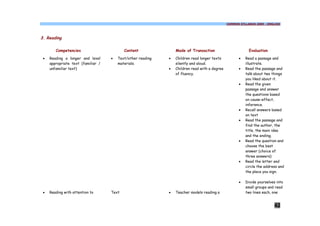
 ·   Reading a longer and level     ·   Text/other reading   ·   Children read longer texts          ·   Read a passage and
     appropriate text (familiar /       materials.               silently and aloud.                     illustrate.
     unfamiliar text)                                        ·   Children read with a degree         ·   Read the passage and
                                                                 of fluency.                             talk about two things
                                                                                                         you liked about it.
                                                                                                     ·   Read the given
                                                                                                         passage and answer
                                                                                                         the questions based
                                                                                                         on cause-effect,
                                                                                                         inference.
                                                                                                     ·   Recall answers based
                                                                                                         on text
                                                                                                     ·   Read the passage and
                                                                                                         find the author, the
                                                                                                         title, the main idea
                                                                                                         and the ending.
                                                                                                     ·   Read the question and
                                                                                                         choose the best
                                                                                                         answer (choice of
                                                                                                         three answers)
                                                                                                     ·   Read the letter and
                                                                                                         circle the address and
                                                                                                         the place you sign.

                                                                                                     ·   Divide yourselves into
                                                                                                         small groups and read
 ·   Reading with attention to      Text                     ·   Teacher models reading a                two lines each, one


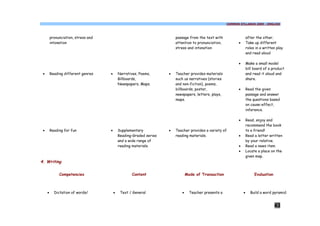
                                                                                                                         42
COMMON SYLLABUS 2009 - ENGLISH


         pronunciation, stress and                                       passage from the text with                  after the other.
         intonation                                                      attention to pronunciation,         ·       Take up different
                                                                         stress and intonation                       roles in a written play
                                                                                                                     and read aloud

                                                                                                             ·       Make a small model
                                                                                                                     bill board of a product
 ·       Reading different genres    ·       Narratives, Poems,      ·   Teacher provides materials                  and read it aloud and
                                             Billboards,                 such us narratives (stories                 share.
                                             Newspapers, Maps.           and non-fiction), poems,
                                                                         billboards, poster,                 ·       Read the given
                                                                         newspapers, letters, plays,                 passage and answer
                                                                         maps.                                       the questions based
                                                                                                                     on cause-effect,
                                                                                                                     inference.

                                                                                                             ·       Read, enjoy and
                                                                                                                     recommend the book
 ·       Reading for fun             ·       Supplementary           ·   Teacher provides a variety of               to a friend!
                                             Reading-Graded series       reading materials.                  ·       Read a letter written
                                             and a wide range of                                                     by your relative.
                                             reading materials.                                              ·       Read a news item.
                                                                                                             ·       Locate a place on the
                                                                                                                     given map.
4. Writing

              Competencies                          Content                     Mode of Transaction                       Evaluation


     ·     Dictation of words/           ·    Text / General                ·     Teacher presents a             ·     Build a word pyramid.


                                                                                                                                       43
COMMON SYLLABUS 2009 - ENGLISH


       sentences                                                                 variety of writing                   a, an, ant, pant
                                                                                 exercises and word              ·     Write words and
                                                                                 building activities.                  sentences with correct
                                                                                                                       spelling.

   ·   Writing                          ·   Question/answers, journal        ·   Teacher presents a              ·     Word pyramids
       sentences/passages                   notations, creative writing,         variety of writing              ·     Draw the things you
                                            letter writing (informal).           activities for children to            saw during a bus
                                                                                 do.                                   journey and write 2/3
                                                                                                                       lines about it.
                                                                                                                 ·     Look at the picture and
                                                                                                                       write about it.

                                                                                                                  ·    Choose a sentence
                                                                                                                        from Column A and a
                                                                                                                        sentence from Column
                                                                                                                        B and join them to
                                                                                                                        write a sentence using
                                                                                                                        ‘and’ or ‘but’.
                                                                             ·   Teacher provides
                                                                                 opportunities through
                                                                                 written activities for
   ·   Writing using a combination      ·   Functional grammar: Noun,            children to use a                    · Order jumbled
       of grammatical forms.                verb, article, adjective, verb       combination of                           sentences to make a
                                            forms, degrees of adjectives,        grammatical forms.                       story.
                                            personal pronoun, possessive                                              · Answer the given
[Consolidation of functional                pronoun, affirmative,                                                         questions.
learning through usage]                     interrogative and negative                                                · Read and answer
                                            sentences, adverbs,                                                           questions.
                                            conjunctions.                                                             · Complete the passage
                                     [Learnt and interpreted only as                                                      in your own words.
                                     usage]                                                                           · Write a letter to a

                                                                                                                                     44
COMMON SYLLABUS 2009 - ENGLISH


                                                                                                             friend inviting her
                                                                                                             for Pongal/any other
                                                                                                             festival (using the
                                                                                                             clues given)
                                                                                                       ·   Fill in the blanks
                                                                                                            choosing the correct
                                                                                                            word. The child is
                                                                                                            crying ______
                                                                                                            (loudly/fast)

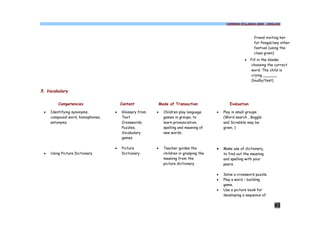
5. Vocabulary


         Competencies                 Content             Mode of Transaction                 Evaluation

 ·   Identifying synonyms,        ·   Glossary from   ·     Children play language     ·   Play in small groups.
     compound word, homophones,       Text                  games in groups, to            (Word search , Boggle
     antonyms                         Crosswords,           learn pronunciation,           and Scrabble may be
                                      Puzzles,              spelling and meaning of        given. )
                                      Vocabulary            new words.
                                      games

                                  ·   Picture         ·     Teacher guides the         ·   Make use of dictionary,
 ·   Using Picture Dictionary         Dictionary            children in grasping the       to find out the meaning
                                                            meaning from the               and spelling with your
                                                            picture dictionary             peers.

                                                                                       ·   Solve a crossword puzzle.
                                                                                       ·   Play a word – building
                                                                                           game.
                                                                                       ·   Use a picture book for
                                                                                           developing a sequence of

                                                                                                                        45
COMMON SYLLABUS 2009 - ENGLISH


                                                                                                                events.

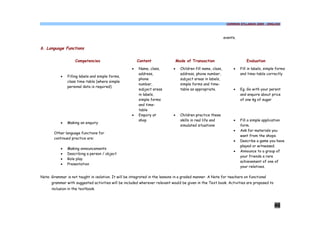
6. Language Functions

                    Competencies                         Content                 Mode of Transaction                          Evaluation
                                                     ·   Name, class,        ·     Children fill name, class,        ·    Fill in labels, simple forms
                                                         address,                  address, phone number,                 and time-table correctly
           ·   Filling labels and simple forms,
                                                         phone                     subject areas in labels,
               class time-table (where simple
                                                         number,                   simple forms and time-
               personal data is required)
                                                         subject areas             table as appropriate.             ·    Eg. Go with your parent
                                                         in labels,                                                       and enquire about price
                                                         simple forms                                                     of one kg of sugar
                                                         and time-
                                                         table
                                                     ·   Enquiry at          ·     Children practice these
                                                         shop                      skills in real life and           ·    Fill a simple application
           ·   Making an enquiry
                                                                                   simulated situations                   form.
                                                                                                                     ·    Ask for materials you
       Other language functions for
                                                                                                                          want from the shops.
       continued practice are:
                                                                                                                     ·    Describe a game you have
                                                                                                                          played or witnessed.
           ·   Making announcements
                                                                                                                     ·    Announce to a group of
           ·   Describing a person / object
                                                                                                                          your friends a rare
           ·   Role play
                                                                                                                          achievement of one of
           ·   Presentation
                                                                                                                          your relatives.

Note: Grammar is not taught in isolation. It will be integrated in the lessons in a graded manner. A Note for teachers on functional
      grammar with suggested activities will be included wherever relevant would be given in the Text book. Activities are proposed to
      inclusion in the textbook.


                                                                                                                                               46
COMMON SYLLABUS 2009 - ENGLISH


                                                      Class V

1. Listening

           Competencies                     Content                 Mode of transaction                       Evaluation

     ·   Listening to songs          ·   Songs                  ·   Children listen and respond to      ·   Listen to the song
     ·   Enjoying the tune and                                      songs                               ·   Sing the song with
         responding with actions                                                                            actions
         where appropriate or                                                                           ·   Give the theme of the
         required.                                                                                          song


     ·   Listening to poems          ·   Poems                  ·   Children listen to the poem         ·   What do you feel
     ·   Appreciating rhythm and                                ·   Understand the meanings of              after reading this
         rhyme                                                      difficult words [may use                poem?
     ·   Making meaning of the                                      dictionary]                         ·   Does is poem tell you
         words heard                                            ·   May be facilitated in their             of something sad or
     ·   Following sequence                                         understanding through                   happy?
     ·   Locating the Main and the                                  appropriate actions                 ·   Fill up the speech
         Supporting ideas                                       ·   Facilitated to discuss the              bubbles to indicate
     ·   Appreciating various                                       feelings and values expressed           understanding of main
         simple level appropriate                                   by the poet and evolve the              and supporting ideas.
         images                                                     sequence
                                                                ·   Grasp the central theme of          ·   Answer the following
                                                                    the poem                                questions using the
                                                                                                            clues given.


                                                                                                                       47
COMMON SYLLABUS 2009 - ENGLISH


·   Listening to stories / folk   ·   Stories & folktales       ·   Children listen to the story          ·   What is the meaning
    tales                                                       ·   Understand the meanings of                of _______?
·   Making meaning of the                                           difficult words [may use              ·   Arrange the sentences
    words heard                                                     dictionary]                               in order of sequence.
·   Following sequence                                          ·   Facilitated to discuss the            ·   Answer comprehension
·   Locating the Main and the                                       narrative and evolve the                  questions using the
    Supporting ideas                                                sequence                                  clues given.
                                                                ·   Grasp the central theme of
                                                                    the story/folk tale


·   Listening to correct          ·   Passage from the text,    ·   Through various facilitative          ·   Listen to the passage
    pronunciation, stress and         or audio cassettes            activities, children listen and           and repeat suggested
    intonation                                                      repeat words with correct                 words
                                                                    pronunciation, stress and
                                                                    intonation – Small or Large
                                                                    group.


                                  ·   Simple topics Eg; Toys,   ·   Children may be facilitated to        ·   Form group and
                                      Cartoon characters,           listen carefully to their peers,          discuss following the
·   Participating in discussion       Comic strips                  and discuss in small groups               topic.
                                                                                                          ·   What do you thing
                                                                                                              about helping others.
                                                                                                              Give a opinion about
                                                                                                              wearing school
                                                                                                              uniforms.

                                                                                                                         48
COMMON SYLLABUS 2009 - ENGLISH


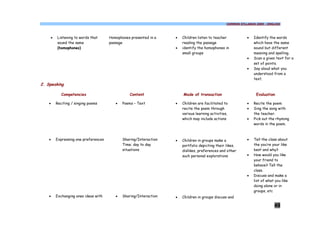
    ·   Listening to words that      Homophones presented in a    ·   Children listen to teacher            ·   Identify the words
        sound the same               passage                          reading the passage                       which have the same
        (homophones)                                              ·   identify the homophones in                sound but different
                                                                      small groups                              meaning and spelling.
                                                                                                            ·   Scan a given text for a
                                                                                                                set of points.
                                                                                                            ·   Say aloud what you
                                                                                                                understood from a
                                                                                                                text.
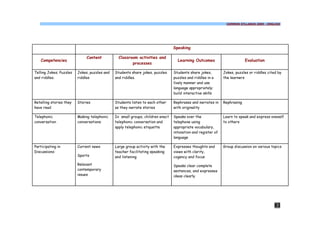
2. Speaking

           Competencies                         Content               Mode of transaction                        Evaluation

    ·   Reciting / singing poems        ·   Poems – Text          ·   Children are facilitated to           ·   Recite the poem
                                                                      recite the poem through               ·   Sing the song with
                                                                      various learning activities,              the teacher.
                                                                      which may include actions             ·   Pick out the rhyming
                                                                                                                words in the poem.


    ·   Expressing one preferences          Sharing/Interaction   ·   Children in groups make a             ·   Tell the class about
                                            Time; day to day          portfolio depicting their likes,          the you’re your like
                                            situations                dislikes, preferences and other           best and why?
                                                                      such personal explorations            ·   How would you like
                                                                                                                your friend to
                                                                                                                behave? Tell the
                                                                                                                class.
                                                                                                            ·   Discuss and make a
                                                                                                                list of what you like
                                                                                                                doing alone or in
                                                                                                                groups, etc
    ·   Exchanging ones ideas with      ·   Sharing/Interaction   ·   Children in groups discuss and

                                                                                                                            49
COMMON SYLLABUS 2009 - ENGLISH


          peers on a particular object           Time; day to day                 exchange ideas around any
          / place / person /event /              situations                       particular object / place /
          situation                          Eg; Encounter with a person          person /event /situation
                                             one doesn’t know well.


     ·    Speaking on common                 ·   Sharing/Interaction           Children in groups discuss and           ·     Practise rhymes and
          experiences                            Time; day to day              exchange ideas around any                      rhythms in a few
                                                 situations                    particular experience which they               songs given.
                                             Eg; Lost in a crowd               discover to have been common             ·     Say what you like and
                                                                                                                              you don’t in eating,
                                                                                                                              drinking, reading.

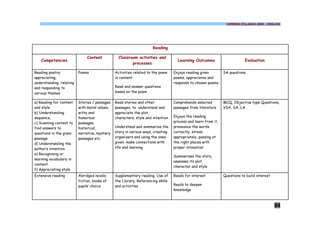
3. Reading

           Competencies                             Content                     Mode of transaction                         Evaluation

 ·   Reading text                        ·       Text/ Supplementary       ·    Children read the text both         ·   Read and list out the
       i) Understanding sequence                 materials                      silently and aloud                      unfamiliar words.
                                                                           ·    The teacher facilitates the         ·   Raise questions
                                                                                following activities and skills     ·   Engage in
                                                                                for each student:                       comprehension
         ii) Understanding content
                                                                           ·    Underlines main facts                   activities
         iii) Finding answers to                                           ·    Uses dictionary or vocabulary       ·   Choose the correct
              questions on the given                                            list (put up on board) to find          answers.
              passage                                                           meaning of unfamiliar words,        ·   [Objective
                                                                                and understands in context              Questions]
                                                                                through individual and small
                                                                                group activities
                                                                           ·    Uses the reading material to
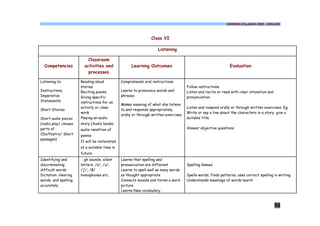
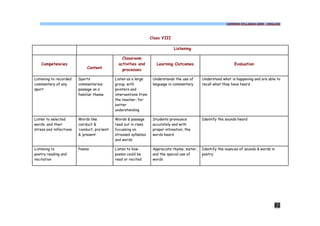
                                                                                answer questions
                                                                           ·    Teacher facilitates the

                                                                                                                                         50
COMMON SYLLABUS 2009 - ENGLISH


                                                                            understanding of selected
 ·   Using simple spelling                                                  spelling rules through a range
     conventions correctly                                                  of exercises and play
                                                                            activities

 ·   Reading with attention to        ·     Spelling rules              ·   Children are facilitated to           ·   Play a spelling game.
     pronunciation, stress and              emphasized through a            read words with correct               ·   Read a letter, an
     intonation                             relevant passage                pronunciation, stress and                 eseay and a poem.
                                                                            intonation – Small or Large           ·   Read a story with
                                      ·     Text / Additional               group.                                    suitable difference
                                            material                                                                  from a picture
                                                                                                                      sequence.
 ·   Reading for fun             Reading Time                           Children read in large groups,
                                    · Supplementary Reading             small groups and individually –
                                        – Graded series V               aloud or silently
                                    · Colourful picture
                                        stories


4. Writing
          Competencies                      Content                    Mode of transaction                        Evaluation

      ·   Simple projects         ·       Provided with            ·   Teacher helps children to             ·   Prepare a project on
                                          materials and ideas          evolve their own work plans,              the given topic.
                                                                       and facilitates their                 ·   Display your project
                                                                       execution                                 and explain how you
                                                                   ·   Children also discuss their               worked on it.
                                                                       plans in the small group

      ·   Filling in forms        ·       Forms of bank
                                          challans, reservation    ·   Teacher guides children to            ·   Fill up a bank challan


                                                                                                                                          51
COMMON SYLLABUS 2009 - ENGLISH


                               forms, M.O. forms,           learn to fill up forms.                for a Childrens
                               School application                                                  saving account.
                               form

                           ·   Story – clues, Story –
                               pictures are given       ·   Teacher explains steps in          ·   Objective
·   Developing a story                                      developing a story                     Questions, VSA, SA
                                                        ·   Children frame stories                 [2 to 4 lines]
                                                        ·   Discuss them in small groups
                           ·   Text
                                                        ·   Teacher provides
                                                            opportunities for children to     ·    Look at the given
·   Reading between the                                     read and analyze text                  diagram and answer
    lines                                                   through simple graphic                 the questions that
                                                            organizers                             follow.
                                                        ·   Error analysis in reading,
                                                            inference and conclusion
                                                        ·   Children are facilitated to
                                                            link thoughts and ideas to
                                                            facts
                                                        ·   They discuss their questions
                                                            in small groups

                           ·   Simple topics or free
                               choice                   ·   Teacher encourages children
                                                            to write simple poems.            ·    Use    the    given
·   Writing simple poems                                                                           rhyming words and
                                                                                                   form a poem of your
                           ·   Text and back of                                                    own.
                               chapter questions        ·   Teacher facilitates children
·   Completing simple                                       to complete the passage with      ·    Complete the story
    passages                                                suitable sentences, after

                                                                                                                         52
COMMON SYLLABUS 2009 - ENGLISH


                                      ·   Themes, Model                 discussion in small groups.
                                          letters
                                                                    ·   Teacher encourages children
                                                                        to write informal letters            ·   Write a letter to
     ·   Writing letters                                                                                         your Uncle / Dad /
         (Informal)                                                                                              Friend
                                      ·   Passage with                                                       ·   Describe a project
                                                                    ·   After initial large group
  Reference Skills                        questions                                                              done by you.
                                                                        reading, children are
                                      ·   Encyclopaedia/ any                                                 ·   Write simple pomes.
                                                                        facilitated collectively to
     ·   Referring to Junior              other relevant                                                     ·   Complete the story
                                                                        search for answers to the
         Encyclopaedia/ any               information source/                                                    half of which was
                                                                        questions
         other relevant                   reference material                                                     only given.
         information source/                                                                                 ·   Write a casual
         reference material                                                                                      letter to your
     ·   Making small notes                                                                                      parents.
                                                                                                             ·   Use an encyclopedia
                                                                                                                 to find out some
                                                                                                                 rare events.
5. Grammar

      Competencies                        Content                         Mode of transaction                          Evaluation

        Nouns and Verbs –             Text / Additional                  After explanation, children are
Exploring the types through    material such as magazines,      facilitated to identify the naming and
spotting use                   newspapers                       doing words in small groups with different
        Common Noun,                                            materials
Proper Noun
        Verbs – Present
tense – Simple, Continuous
        Simple past,
        Simple Future


                                                                                                                                       53
COMMON SYLLABUS 2009 - ENGLISH


         Parts of speech
   [Introduction to formal              Text / Additional                   Teacher guides the children
   naming of the different       material such as magazines,        through usage to identify various parts of
  parts of speech – already      newspapers                         speech. Exercises and activities are
    explored as use, in the                                         utilized for this.
       earlier classes]

 [Naming seen as a tool to                                                                                        ·   Correct the given wrong
 build formality and                                                                                                  sentences.
 awareness in learning at this                                                                                    ·   Reorder the words in the
 level]                                                                                                               given sentence to make it
         Types of Sentence       Exercises, Worksheets                     Children are facilitated to use            a question.
         [Affirmative,                                              these sentence types in contexts of their     ·   Use correct tense forms
        Interrogative]                                              own                                               in describing a series of
                                                                                                                      activities.
6. Vocabulary

         Competencies                         Content                          Mode of transaction                          Evaluation
     ·   Using Antonyms/              ·   Text / poetry                  ·   Exercises, activities and games
         Synonyms                                                                                                      ·   Games, children do
                                                                                                                           various exercises
                                                                                                                       ·   Games, children do
                                                                                                                           various exercises
     ·   Forming Compound             ·   Text, Puzzles,                 ·   Exercises, activities and games           ·   Use correct
         words.                           Supplementary material,                                                          alternative to the
     ·   Identify Prefix /                back of chapter                                                                  identified word in a
         Suffix                           questions                                                                        sentence.
     ·   Say the homophones                                                                                            ·   Identify the prefixes
     ·   State kinship terms                                                                                               and suffixes of any


                                                                                                                                         54
COMMON SYLLABUS 2009 - ENGLISH


·   write similes /               five words.
    metaphors                 ·   State the English
                                  equivalents for local
                                  relationship words.
                              ·   Compare any two
                                  objects using simile /
                                  metaphor.


                                                 55
COMMON SYLLABUS 2009 - ENGLISH


                                                               Class VI

                                                                   Listening

                          Classroom
  Competencies          activities and              Learning Outcomes                                        Evaluation
                          processes

Listening to:         Reading aloud           Comprehends oral instructions
                      stories                                                       Follow instructions
Instructions,         Reciting poems          Learns to pronounce words and         Listen and recite or read with clear intonation and
Imperative            Giving specific         phrases                               pronunciation
Statements            instructions for an
                                              Makes meaning of what she listens
                      activity or class                                             Listen and respond orally or through written exercises: Eg;
Short Stories                                 to and responds appropriately,
                      work                                                          Write or say a line about the characters in a story; give a
                                              orally or through written exercises
Short audio pieces    Playing an audio                                              suitable title
(radio play/ chosen   story (Audio books,
parts of              audio rendition of                                            Answer objective questions
CDs/Poetry/ Short     poems
passages)
                      It will be reiterated
                      at a suitable time in
                      future.
Identifying and        : gh sounds, silent    Learns that spelling and
discriminating        letters, /s/, /z/,      pronunciation are different           Spelling Games
difficult words       /∫/, /3/                Learns to spell well as many words
Dictation: Hearing    homophones etc.         as thought appropriate                Spells words; finds patterns; uses correct spelling in writing
words, and spelling                           Connects sounds and forms a word      Understands meanings of words learnt.
accurately                                    picture.
                                              Learns New vocabulary


                                                                                                                                          56
COMMON SYLLABUS 2009 - ENGLISH


                                                                     Speaking

                             Classroom
   Competencies            activities and            Learning Outcomes                                       Evaluation
                             processes

Reading aloud from a     Reading aloud from     Reads clearly with pauses;        Read the given passage fluently without erase and with correct
text                     their reader           pronounces words accurately       pauses.

Reciting: reading from   Learning and           Read in unison, with sense of
text                     reciting in groups,    meter and rhyme                   Expresse appreciation for the poem read;
                         or individually from                                     Recite with expression; without faltering
Reciting from memory     the selection of       Reads alone without stumbling,
                         specified poems        with expression                   Memorise the poem

Using appropriate        Activity: role play,   Learns to use oral instructions
greetings for various    games; other oral
occasions                activities:             Speaks and enacts using learnt   Follow the instructions correctly
                                                phrases
Making requests          Ask – Answer                                             How will you respond to the given situations?
                         activities around      Builds familiarity with
Enacting                 familiar situations    appropriate phrasing of
                         in day-to-day life     greetings and requests

                         Giving directions to
Instructing another
                         a place on campus
classmate
                         etc.

Asking and answering     This learning          Learns to frame appropriate       Objective questions
‘Wh’ / Yes/No /          activity may be        questions and answers
Seeking Information      undertaken around      correctly in the ‘Wh’/ Yes/No     Questions for different situations: Eg;
Questions                a story or passage:    model; also knows how to ask,


                                                                                                                                      57
COMMON SYLLABUS 2009 - ENGLISH


                          Teacher guided       to elicit relevant information   Ask questions to

                                                                                - find a place,

                                                                                - find the time of a train’s arrival or departure

Participation:            Large group          Builds participation skills
                          discussions,
In discussions in class                        Cogency in speech                Converse on a topic of your choice with a group of your
                          Classroom                                             classmates.
In a dialogue             discussion on        Confidence
                          lessons
                                               Resourcefulness
                          Converses around a
                                               Holds a train of thought
                          suggested or
                          initiated topic

Speaking formally on a    Each student takes   Learns to speak in front of a
topic for 2 minutes       turns to prepare     group, clearly and correctly
                          and speak on a                                        Address the class on why we need to grow more trees.
                          topic of choice

Telling Jokes; Puzzles    Students share       Students share jokes, puzzles
and Riddles.              jokes, puzzles and   and riddles in a lively manner
                          riddles.                                              Anyone can share a joke, puzzle or riddle which they enjoyed?
                                               Build interactive skills


                                                                                                                                      58
COMMON SYLLABUS 2009 - ENGLISH


                                                                  Reading

                            Classroom
   Competencies           activities and          Learning Outcomes                                           Evaluation
                            processes

Skimming                Using various short   The student learns skimming as
                        passages, the         a skill, and understands its
                        teacher facilitates   value in reading and             Read the given passage and answer the questions.
                        skimming content as   understanding
                        a reading skill

Scanning                Using various short   The student learns scanning as
                        passages, the         a skill, and understands its
                        teacher facilitates   value in reading and             Read the given information and find the data asked.
                        scanning content as   understanding
                        a reading skill

Reading                 Reading passages;     Reads and comprehends
independently, short    from text;
passages in prose and                         Understands and enjoys           Follow instructions clearly;
comprehending its       Reading selected      stories and essays
content                 unseen
                        comprehension         Learns to read independently
Reading and following   passages of
level appropriate       selected level
instructions
                        Teacher writes
                        instructions on
                        board and asks
                        children to follow
                        them: a play way

                                                                                                                                     59
COMMON SYLLABUS 2009 - ENGLISH


                         learning activity
                         (‘Simon says’ games)

Understanding            The teacher            Understands vocabulary; builds     Uses the dictionary effectively;
sequence                 facilitates the        vocabulary and uses words in
                         following activities   context; answers questions         Independently works at understanding a passage or poem
Understanding            and skills:            correctly
content                                                                            Follows sequence correctly;
                         Underline main         Begins to build cognitive skills
Finding answers to                                                                 Answers questions appropriately
                         facts                  in reading and understanding
questions on the given
                                                                                   VSA, SA
passage                  Use dictionary or      Takes the first steps in looking
                         vocabulary list (put   at the literary qualities and
Understanding the        up on board) to find   merits of a piece of writing
author’s intention       meaning, and
                         understand in the
Recognizing and
                         context
learning vocabulary in
context                  Use reading
                         material to answer
Appreciating style:
                         questions
first steps
                         Enjoy reading
Picking out main facts
and supporting detail

Relating stories to      Answer open ended      Responds to literature;
one’s own life and       questions: What do     understands life through
responding               you think?             reading

Reads poetry:            [Teacher               Appreciates poetry
appreciates it,          facilitates] Read
understands, relates     and respond to         Understands meaningfully           Illustrations and responses show understanding;


                                                                                                                                       60
COMMON SYLLABUS 2009 - ENGLISH


and responds              poetry; answer          Free association and ‘imagine’
                          questions; illustrate   activities                       Answer questions accurately

Reading Extension         Supplementary           Reads for interest
Activities                reading, use of the
                          Library,                Reads to deepen knowledge        Small assignments and projects
                          Referencing skills
                                                  Reads to link and connect
                          and activities
                                                  additional data

                                                                        Writing

                               Classroom
    Competencies             activities and            Learning Outcomes                                      Evaluation
                               processes

Answers questions in      Comprehension           Write in sentences; writes       Answer questions appropriately in complete sentences
complete sentences,       passages                complete answers; uses
using punctuation                                 punctuation


Uses relevant and level Exercises in              Uses vocabulary to make          Use vocabulary correctly; writes original sentences
appropriate vocabulary vocabulary                 sentences
to make sentences

Writes on a given         Specific paragraph      Paragraph unity, relevance,      Write cogently, organise content; relevant to topic; spell and
topic: (to an             topics; teaching        appropriate vocabulary and       use grammar correctly.
established word limit)   writing a paragraph     grammar conventions
                                                                                   Short Answers [5 lines]
[5 lines]


                                                                                                                                         61
COMMON SYLLABUS 2009 - ENGLISH


Identifying and using   Analysing sentences      Students learn to write
selected cohesive       and passages for         sentences and small passages
devices                 cohesive devices         using cohesive devices             Fill in the blanks with the correct connectors and other devices
                                                                                    in writing
                        [Facilitated by the
                        teacher]

                        May be a text                                               Objective Questions
                        passage

Writing letters in a    Learns about the         Learns to write a formal letter
given format            format of a leave        in the appropriate format
                        letter through                                              Writ a letter to a bookshop ordering books for your home
                        relevant examples                                           library
                        provided by the
                        teacher

Journal writing         Short journal            Self-expression                    Not assessed
                        prompts

Free writing            Five minutes of class    Just write without hesitation      Not assessed; a freeing exercise
                        time to write


Forming stories         Story writing tasks;     Write cogently; Use                Write a original story of a own on any theme of your choice.
                        from outlines or         imagination; Apply grammar         Write clearly and imaginatively.
                        story starters           conventions

Developing Hints        Hints are given, and     Expanding on given hints           Write cogently.
                        students facilitated
                        to use them skillfully   Building a story from an outline   Use all the hints

                                                 Learning skills that help to use   Imaginative


                                                                                                                                         62
COMMON SYLLABUS 2009 - ENGLISH


                                               imagination /facts productively   Innovative

                                                                                 Original

Writing simple         Students use life       Learns to use language            Look at the objects placed before you and describe them in the
messages and           situations to write     contextually                      few sentences
descriptions           relevant messages
                                               Learns to use language to
                       Students use            articulate a visual image
                       everyday objects and
                       scenarios to describe
                       what they see

Mind/Concept mapping   Use summary and         Picking out and organisation of   Frame sentences in sequence from the mind map given to you
                       graphic organisers in   information and facts in an
Summarize content in   all classroom           imaginative manner
any framework, using   transactions
graphic organisers                             Learning the value of Mind
                                               mapping as a tool to understand
                                               and associate

                                               Growing familiar with a range
                                               of graphic organizers

Spelling words         Spelling activities     Students know the spellings of    Objective questions and fun games for spelling
correctly              around familiar and     selected words
                       unfamiliar words

                       Dictation


                                                                                                                                    63
COMMON SYLLABUS 2009 - ENGLISH


                                                                  Grammar

                             Classroom                                                                      Evaluation
    Competencies           activities and         Learning Outcomes
                             processes

Have an overview of       Introduction to     Understands the different        Classify the given words in the respective coloumn – noun, adjective,
parts of speech: words    parts of speech     words and what part of speech    verb & adverb
have different roles in   through             they are
sentences                 explanation and                                      Objective questions
                          exercises
Functional use of words
in full exprestions.


Concept of a sentence:    Through varying     Learns the structure of          Separate sentences into subject and predicate.
subject predicate;        exercises on each   sentences; recognise
types of sentences;       concept, with       differences between              Use appropriate capital and end marks.
capital letters and       explanation of      sentences and fragments;
                                                                               Write sentences with appropriate structure
punctuation; Difference   logic behind each   understands and corrects run
between sentences and                         on errors                        Objective questions
fragments; correcting
run-ons                                       Learns four simple sentence
                                              types
[Assertive,
Interrogative,
Imperative, Simple
Negative]

Nouns and types of        Through exercises   Recognises all types of proper   Identify the nouns in the following sentences and state what kind
nouns: all proper and     and explanations                                     of noun has been used

                                                                                                                                       64
COMMON SYLLABUS 2009 - ENGLISH


abstract nouns              of nouns, their role   and abstract nouns               Objective questions
                            and use; rules;

Verbs: being and doing      Learns all doing       Recognise verbs and their role   Pick out verbs, simple predicates, use verbs in sentences
words: adds to              and being verbs in     as predicates                    correctly
understanding               the required
predicates                  contexts, through      Students use different tense     Objective questions
                            sheets,                forms in different situations
Simple Present              explanations and
[Habitual Action,                                  Students understand simple
                            activities
universal truth], Simple                           sentence structures – SVC,
Past [Completed                                    SVO and SVOO
actions], Simple Future
[Intended actions]

[SVC;SVO; SVIO DO]

Learning the different      Learns through         Recognise adjectives and         Uses and understands different describing and modifying words
kinds of Describing         exercises and          adverbs and their role in a      and the rules of usage
words and Modifying         explanations of        sentence
words in a sentence         describing words,                                       Objective questions
                            their role and use;    Students use different
[Adjectives and             Learns about           adjectives and adverbs in
Adverbs]                    modifying words        different situations
                            and their required
                            contexts, through
                            sheets,
                            explanations and
                            activities

Rules of capital use:       Worksheets,            Learn all the uses of capital    Applies rules in all written work
basic rules: beginning of   explanations           letters in sentences
sentences; types of         learning the rules

                                                                                                                                          65
COMMON SYLLABUS 2009 - ENGLISH


proper nouns; pronoun    of capitalising                                       Objective questions
I.

End marks (connected     Worksheets and       Recognises the types of          Uses end marks correctly
to types of sentences)   rules                sentences and uses end marks
                                              correctly                        Objective questions


Revise already learnt    Revision exercises
concepts through
exercises.

                                                                  Vocabulary

                             Classroom
    Competencies           activities and         Learning Outcomes                                        Evaluation
                             processes

Grasping the meaning     Uses dictionary;     Understands meanings of          Uses the words in sentences; understands context and meaning
of unfamiliar words      checks with peers,   words in context
from reading materials   teacher helps with                                    Objective questions
                         meaning

Vocabulary exercises     Activities,          Students learn some              Completes the related exercises correctly
in: homonyms,            crosswords, word     homonyms, synonyms and
synonyms, antonyms       search               antonyms

                                              Builds familiarity, identifies
                                              words correctly


                                                                                                                                    66
COMMON SYLLABUS 2009 - ENGLISH


                                                                Language Functions
                             Classroom
    Competencies           activities and            Learning Outcomes                                         Evaluation
                             processes

Reading and interpreting   Activities, tasks,   Enrichment and application:        Uses pictures and other visual media to complete the set task
pictorial information:     and language         Students develop the skill of
comic strip, pictures      games                describing pictures and cartoons
etc.
Reads a graphic            Worksheets; or       Understands and interprets         Interprets the data accurately
organiser                  charts or black      different kinds of data
Tabular data               board drawings

Narrating stories          Activities, tasks,   Enrichment and application         Original, imaginative, clear sentences
                           and language
                           games

Role play                  Activities, tasks,   Enrichment and application         Simulates effectively
                           and language
                           games

Writing poetry             Activities, tasks,   Enrichment and application         Write originally, authentically
                           and language
                           games


                                                                                                                                        67
COMMON SYLLABUS 2009 - ENGLISH


For the teacher
Template of the Active Learning Framework - Classroom Transactions for Prose & Poetry

Sl.
       Learning Activities for the student                                        By the student[s]
No.

      Introduction Activities
                                              ·   Priming/Reading Preparation Activity    Large Group
 1.   The teacher uses the activities given
                                              ·   Do you know? [related to content]
      in   the   Chapter/Lesson   Plan   to
                                              ·   A short related/reinforcing word game/anecdote/discussion
      introduce the topic

                                              Teacher Reading and Explanation, Reading related Activities with paragraphs [Word Web,
 2.   Learning Engagement Activities
                                              Mapping Activity] – Individual/Pair

 3.   Understanding Activities                Discussion and activity using graphic organisers provided in the textbook Small Groups

                                              Students answer Questions and attempt the activities that consolidate their learning of
 4.   Consolidation Activities
                                              the content in the textbook – Mixed as appropriate

                                              Students engage with the application related activities presented at the back of the
 5.   Functional Enrichment Activities
                                              chapter. Separate materials are provided there using the chapter as base

 6.   Language Structure Activities           The grammar to be taught is presented in the form of exercises.

                                              Simple Formative Assessment and Criterion – referenced evaluation based on the Lesson
 7.   Evaluation/Assessment Activities
                                              may be facilitated by the teacher

                                              Simple activities involving writing and observation/interaction related to the day-to-day
 8.   Suggested Extension Activities
                                              context of the child

 9.   Reinforcement Activities                Worksheets that address the need for revision and reiteration in an imaginative manner


                                                                                                                                   68
COMMON SYLLABUS 2009 - ENGLISH


It is suggested that this format is taken forward across VI to VIII. Another template will be suggested for IX and X, incorporating the
blueprint of assessment and evaluation, when it is ready.

List of possible classroom activities and transactions:

·   Role play
·   Dramatisation
·   Reading aloud
·   Recitation of rhymes, poems and making observations on a given topic/theme
·   Telling and retelling stories, anecdotes, and jokes
·   Discussion, debate
·   Simple projects
·   Interpreting pictures, sketches, cartoons
·   Activities, tasks, and language games
·   Pair work, group work, and short assignments both individual and group


                                                                                                                                   69
COMMON SYLLABUS 2009 - ENGLISH


                                                                    Class VII

                                                                    Listening

                                 Content           Classroom activities
     Competencies                                                               Learning Outcomes                       Evaluation
                                                      and processes

Listening and               Recorded songs,        Listening to and           Student understands oral     Testing to find out whether the
responding to items         poems, stories,        following instructions;    instructions; understands    students follow instructions correctly,
                            dialogues, etc.,       listening to selected      stories read out or played   and respond appropriately
                                                   audio stories; listening   follows a speech and
                                                   to a classmate’s           responds to it.              Oral Questions to check
                                                   speech                                                  comprehension


Listening to specific       Same words that        Using specific word        Distinguishes different      Find pattern, gain better accuracy in
words      and      their   differ in meaning in   forms in appropriate       word forms; learn the        spelling; connect sounds with words
different    forms,    in   different contexts     context; worksheets        peculiarities of spelling;
different contexts          Eg.: cry-weep          and other interactive      learn to spell words         Word Pun, Objective type questions
                            cry-shout aloud        exercises                  correctly
                                                   Dictation on these
                                                   forms
Listening to a Report       Report on 1. Annual    Teacher initiates a        Student understands the      Able to recall basic elements of an
                            Day function, 2.       discussion on the          structure of a report        oral report, and improvise to create
                            Sports Day             report.                                                 one in a given context, using given
                            function, etc.;                                                                basic parameters
                            3. News report,
                            4. Weather report,
                            etc


                                                                                                                                            70
COMMON SYLLABUS 2009 - ENGLISH


                                                                Speaking

                               Content         Classroom activities
     Competencies                                                          Learning Outcomes                       Evaluation
                                                  and processes

Telling Jokes; Puzzles,   Jokes, puzzles and   Students share jokes,    Shares jokes, puzzles and    Use words like puns, homonyms etc., in
tongue twisters as play   tongue twisters      puzzles and riddles.     riddles in a lively manner   group conversation.
an words and meanings                                                   Build interactive skills

Narrating an experience   Incidents in the     Students share their     Uses descriptive             Recount your experiences on your way
                          class, playground    experience in class      vocabulary and connectors    to school this morning.
                          etc.


Reciting poems from       Poems from the       Learning and reciting    Appreciates, recognises      Recite clearly; with correct inflexion
memory and from text      text                 in groups, or            rhyme, meter and meaning     and pronunciation
                                               individually from the    and brings it out through
                                               selection of specified   recitation
                                               poems

Speaking formally         Familiar topics      The teacher              Expresses thoughts using     Speak with confidence on a topic of
                                               facilitates formal       the correct language,        their choice.
                                               conversation around a    vocabulary and syntax
                                               chosen topic; Eg;
                                               groups converse
                                               around ‘Sports today’,
                                               or ‘TV Programmes’


                                                                                                                                       71
COMMON SYLLABUS 2009 - ENGLISH


                                                                   Reading

                               Content          Classroom activities
    Competencies                                                              Learning Outcomes                         Evaluation
                                                   and processes

Identifying the topic     Simple passages on    Read text, locate         Independent reading and         Summarise effectively through mind
sentence of a paragraph   games, articles on    meanings if necessary,    comprehension of reading        maps and other graphic organisers;
                          science, nature,      underline main points     matter                          answer questions accurately
                          moral values,
                          adventure,
                          biographies, jokes
                          etc.

Reading independently;    Passages on topics    Teacher guides the        Identifies the topic sentence   Find the topic sentence of a given
picking out main facts    of general interest   students to finding the   of a paragraph.                 paragraph.
and supporting details                          topic sentence of a
                                                paragraph by eliciting
                                                responses through
                                                questions.
Analyzing what is read    Simple                Apply their mind to       Makes connections and           ‘What’, ‘ How’, ‘Why’ questions
                          comprehension         understand various        interpret what they read
                          passages depicting    aspects of a passage:
                          celebrations etc.,    Eg; character, style,
                                                plot, inference, other
                                                interesting
                                                information


                                                                                                                                            72
COMMON SYLLABUS 2009 - ENGLISH


Understanding and           Pre reading and       Reading written           Follows written instructions   Read the instructions and respond
following written           post reading          instructions and                                         accordingly
instructions after or       questions on simple   following them

before a given passage;     passages

Following a trail of        Re-arranging          Exercises given after     Follows a sequence and build   MCQs, Objective type questions, VSA
written instructions to     jumbled sentences     the lesson, aiding        on what is known               and SA
arrive at a learning        into a logical        understanding,analysis,
outcome                     sequence              evolve connections

Relating stories to one’s   Stories inculcating   Answer open ended         Responds to literature;        Eg. If you were the boy in this story,
own life and responding     values like           questions: What do        understand life through        how would you have…
                            friendship, good      you think?                reading,
                            conduct, etc.,
                                                                            Reads with pause, stressing
                                                                            words appropriately and with
                                                                            proper intonation

Reading poetry:             Poems on simple       [Teacher facilitates]     Appreciates poetry
appreciating it,            themes                Read and respond to       Responds to the imagery and    Answer questions eliciting imagination
understanding, relating                           poetry; answer            emotions in a poem.            and emotions.
and responding                                    questions; illustrate
                                                                            Reads with pause, stressing
                                                                            words appropriately and with
                                                                            proper intonation
Reading with rhythm and     Newspapers,           Supplementary             Reads for interest             Building interest
emotion-extensive           Children’s            reading, Use of the       Reads to deepen knowledge
reading                     magazines, etc.,      Library, Referencing      Reads to link and connect      Small assignments and projects
                                                  skills and activities     additional data


                                                                                                                                           73
COMMON SYLLABUS 2009 - ENGLISH


                                                                     Writing

                               Content         Classroom activities and
     Competencies                                                                 Learning Outcomes                         Evaluation
                                                      processes

Writing answers to        Mind maps and        Comprehension passages          Explains clearly in writing,   Answer accurately in an organised,
Knowledge based           graphic organizers   with activities; or text        use appropriate                complete and clear manner
questions                                      based written exercises         expressions; answer in own     Normative
                                                                               wordas
                                                                                                              MCQs, Objective type questions, VSA
                                                                                                              and SA

Diffentiates between      Poems                Read, comprehend and            Interprets and                 Questions - VSA and SA
the language used in                           respond clearly                 understands the poems
prose and poetry.
                                               Identifies sentence
                                               patterns

Paraphrasing poetic       Poems                Read, comprehend and            Interprets and                 Rewrite the given line / lines of the
lines.                                         respond clearly                 understands the poems,         poem in prose form.
                                                                               expresses views with
                                               Use mind maps and graphic       originality and writes in
                                               organizers to aid               prose form
                                               understanding
Writing descriptive and   Topics of general    Introduction to essay           Writes up to 10 cogent         Write grammatically correct
narrative essays of       interest             writing; writing on given       lines on a given topic         sentences in an organised manner on a
specified length                               topic with guidelines                                          given topic
                                               provided
[8 – 10 lines]                                                                                                Long Answers [8 – 10 lines]


                                                                                                                                              74
COMMON SYLLABUS 2009 - ENGLISH


Using discourse          Linkers /             Passages with the selected    Identifies the specified      Identify the discourse markers,
markers                  connectives           discourse markers are         discourse markers in          linkers, connectives in a given passage
                                               provided to students;         connected sentences           Use discourse markers in appropriate
                                               teacher facilitates                                         places in sentences
                                               familiarity with them
                                               through pre and post
                                               reading questions.

Writing Formal and       Situations for        Formats are given.            Learns and applies the        Eg. 1. Write a letter to our friend
Informal letters         formal and informal   Teacher shows the style of    formats and uses the          about the pollution of the river in your
                         letters               language used in formal /     required vocabulary and       area.
                                               informal letters              language for letter writing
                                                                                                           2. Write a letter to the Collector
                                                                                                           about the pollution of the river in your
                                                                                                           area.

Using direct speech in   Situations for        Using a short narrative       Responds appropriately        Fun activities in script writing
Dialogues                dialogues             passage, students are         and builds a clear written
                                               encouraged to convert it to   dialogue sequence for a       Filling up the blanks in a dialogue
                                               direct speech, through        story/narrative               Using the right format for
                                               taking roles, evolving a                                    presentation of Direct Speech
                                               script, etc.,

Simple Slogan writing    Short, catchy         Teacher evolves various       Evolves catchy and            A few fun activities on imaginary
                         phrases and           contexts to create            effective slogans on          issues
                         sentences             awareness – Eg; Waste         relevant themes               Summative
                                               segregation, conservation                                   Able to focus on the core issue and
                                               of water, keeping the                                       evolve an appropriate slogan
                                               campus clean, etc


                                                                                                                                              75
COMMON SYLLABUS 2009 - ENGLISH


Journal writing        Current affairs,     Short journal prompts         Self-expression             Prepare articles for journals
                       general topics

Free writing           Current affairs,     Five minutes of class time    Writing spontaneously       Express your views on the chosen
                       general topics       to write on topics of the     without hesitation          topic
                                            pupils’ choice

                                                               Grammar

                            Content         Classroom activities and
    Competencies                                                            Learning Outcomes                      Evaluation
                                                   processes

Revision of Parts of   Nouns, verbs,        A passage in the text that    Recall and reinforcement    Demonstrates clarity of understanding
speech                 adjectives,          highlights the required       of learnt concepts in the
                       adverbs, pronouns,   grammatical functions.        parts of speech
                       preparations,
                                            Reinforcement of              [Sentence structure]        Cloze tests may be used
                       conjunctions,
                       interjections.       knowledge of parts of
                                            speech through usage
                       Articles             related interactive
                                            activities

Grasping the form,     Past, Present,       Learn about the continuous    Students use different      Students have a clear, meaningful and
structure and use of   Future continuous    tenses and their required     Continuous tense forms in   focussed understanding of the usage
the Continuous tense                        contexts, through sheets,     different situations        of the Continuous tense - Eg; Imagine
                                            explanations and activities   appropriately               a match is going on, and give a
                                                                                                      commentary using the Present
                                                                                                      Continuous tense. Narrate a past
                                                                                                      event using the Past Continuous Tense

                                                                                                      Objective type questions


                                                                                                                                      76
COMMON SYLLABUS 2009 - ENGLISH


Using Modal Verbs for     would, may, can, will   A passage in the text that    Students use different        Objective type Questions that test
                                                  highlights the required       Modal forms in different      use of Modals for suggestion,
Suggestion, Obligation,                           grammatical functions.        situations appropriately      obligation, politeness, willingness,
Politeness, Willingness                                                                                       ability.
                                                  Learn through exercises,
                                                  activities and explanation,
                                                  of modal verbs, their role
                                                  and use in the specified
                                                  contexts

Being and Doing Verbs:    ‘Be’ and ‘Do’ as main   Learn about verbs that        Students deepen their         Objective type questions
                          and auxiliary verbs     take objects and those        understanding of simple
Differentiating                                   that take complements,        sentence structures –
Transitive and            Verbs that take         and their required            [SVC, SVO and SVOO]
Intransitive Verbs        objects and those       contexts, through sheets,     Has a clear, meaningful
                          that do not             explanations and activities   and focussed
                                                                                understanding of the
                          SVO, SVC, SVOO,
Sentence pattern                                                                usage of selected
                          etc.,
                                                                                Transitive and Intransitive
                                                                                verbs in the specified
                                                                                sentence structures
Grasping the use and      Dividing the            A passage in the text that    Students understand the       Objective type questions
meaning of noun groups    sentence into noun      highlights the required       use of Noun Groups, with
and selected phrasal      and verb groups         grammatical functions.        head words and modifiers,
verbs                     (i.e. subject &                                       and some common phrasal
                          predicate)              Learn through exercises,      verbs, through usage
                                                  activities and explanation,
                          Phrasal Verbs using     of noun groups and phrasal
                                                  verbs, their role and use
                          bring, come, take


                                                                                                                                             77
COMMON SYLLABUS 2009 - ENGLISH


Identifying the three     Positive                Various exercises and          Students learn to write          1.  Given the base form or one of
degrees of comparison     Comparative and         situations to highlight the    simple sentences involving           the three forms of the
                          Superlative             three degrees of               the three degrees of                 adjectives, the students supply
                          degrees                 comparison                     comparison                           the other two forms of the
                                                                                                                      adjectives
                          The three forms of                                                                      2. Sentences with the adjective in
                          irregular verbs                                                                             brackets are given and students
                                                                                                                      supply the right form of the
                                                                                                                      adjective, suiting the context, in
                                                                                                                      the blanks provided.
Revision of Punctuation   Fullstop, Comma,        Passages with the relevant     Students use the               Punctuate the given passage;
marks                     Inverted commas,        punctuation marks are          punctuation marks
                          question and            provided to students;          appropriately                  Supply the missing punctuation marks
                          exclamatory marks       teacher facilitates revision

Framing Question Tags     didn’t, hasn’t, isn’t   Through varying exercises      Applies the rules              Objective type questions
                          did, has, is            and classroom activities -     influencing Question Tags,
                                                  on each concept, with          in a meaningful manner
                                                  explanation of the logic
                                                  behind each:                   Clear in this concept in
                                                                                 their writing; recognise
                                                  Eg; He took the book,          errors and correct them
                                                  didn’t he?

                                                  He didn’t take the book,
                                                  did he?

Subject and verb          Singular subject –      Through exercises and          Knows and applies the          Objective type questions
agreement                 singular verb           substitution tables, verbal    rules of singular and plural
                                                  situations etc.,               nouns and verbs uses them
                          Plural subject –
                          verb in the plural


                                                                                                                                                78
COMMON SYLLABUS 2009 - ENGLISH


                          Each, every, either,
                          neither, etc.,

Identifying the Active    Transforming           Through exercises and         Knows and applies the        Objective type questions
and Passive Voice         sentences from the     substitution tables, verbal   rules of transformation in
                          Active to Passive      situations etc.,              speaking and writing
                          and vice versa.
                                                                               Clear in the concept of
                          Sentences of the
                                                                               identifying the two types
                          Simple Present,
                                                                               of voice
                          Past and Future

Identifying Phrases and   Phrase- ie a group     Passages in the text,         Understands the use of       Differentiate Phrases and Clauses
Clauses                   of words without a     additional exercises and      Phrases and Clauses
                          finite verb in it      verbal situations.                                         Objective type questions
                          Clause- ie a group
                          of words with a
                          finite verb in it
                                                                                Vocabulary

                               Content           Classroom activities and
    Competencies                                                                 Learning Outcomes                       Evaluation
                                                        processes

Locating words in the     Guided use of          Activities;                   Learns more words and        Find synonyms and antonyms
dctionery for their       dictionary for         1. Exercises and word         synonyms and antonyms of
meaning, synonyms,        unfamiliar words                                     words                        Split the word into smaller words
                                                 games;
antonyms and usage
                                                 2. Break –up of kangaroo                                   Objective type questions
                                                 words
                                                 3. Use of dictionary and
                                                 thesaurus


                                                                                                                                           79
COMMON SYLLABUS 2009 - ENGLISH


Prefixes and suffixes       Word formation        Exercises through pattern        Understands how suffixes     Use suffixes and prefixes and knows
                            with prefixes and     finding                          and prefixes can alter the   the meanings
                            suffixes                                               word and change its
                                                                                   meaning                      Objective type questions

Compound words,             Noun + noun, noun +   Activities and exercises         Learns to recognise them     Form compound words.
homophones                  verb, adjective +                                                                   Use the words in different contexts,
                            noun                                                                                according to their meaning

                                                                                 Language Functions

                                  Content         Classroom activities and
    Competencies                                                                     Learning Outcomes                       Evaluation
                                                         processes

Talk about oneself          Talks on likes,       Conversation class; teacher      Learns to speak in           Speak confidently and attempt to
                            dislikes, friends,    anchors and helps children       sentences and                speak in complete sentences
                            etc.,                 speak authentically:             communicate their
                                                                                   thoughts and feelings with   Questionnaire – type: completion
                                                  Interaction questions            ease and clarity
                                                  based on Favourites:
                                                  players, hobbies, friends,
                                                  books, leaders, movies, TV
                                                  programmes, etc

Participating in language   Word searches,        Activities and games in          Reinforces concepts learnt   Solve puzzles and play word games
games and puzzles:          crosswords, and       class, at various levels, to     in grammar and vocabulary;
                            ‘What’s the good      strengthen and reinforce         develops the skill of
                            word?’                various competencies             problem solving


                                                                                                                                              80
COMMON SYLLABUS 2009 - ENGLISH


Dramatizing a story   Situations,plays,   Presentation of skits in   Visualises the story; role   Enact the play
                      etc.,               small groups               play, develop confidence


Reading a graphic     Tabular data        Worksheets, charts or      Understands and              Interpret the data accurately
organiser                                 black board drawings       interprets different kinds
                                                                     of data


                                                                                                                                  81
COMMON SYLLABUS 2009 - ENGLISH


                                                                   Class VIII

                                                                                Listening

                                                  Classroom
    Competencies                                activities and        Learning Outcomes                          Evaluation
                              Content             processes

Listening to recorded    Sports               Listen as a large     Understands the use of     Understand what is happening and are able to
commentary of any        commentaries;        group, with           language in commentary     recall what they have heard
sport                    passage on a         pointers and
                         familiar theme       interventions from
                                              the teacher, for
                                              better
                                              understanding

Listen to selected       Words like           Words & passage       Students pronounce         Identify the sounds heard
words, and their         con’duct &           read out in class     accurately and with
stress and inflections   ‘conduct; pre’sent   focussing on          proper intonation, the
                         & ‘present           stressed syllables    words heard
                                              and words

Listening to             Poems                Listen to how         Appreciate rhyme, meter,   Identify the nuances of sounds & words in
poetry reading and                            poems could be        and the special use of     poetry
recitation                                    read or recited       words


                                                                                                                                       82
COMMON SYLLABUS 2009 - ENGLISH


                                                                                Speaking

                              Content           Classroom activities and
   Competencies                                                                   Learning Outcomes                       Evaluation
                                                       processes

Telling Jokes; Puzzles   Jokes, puzzles and   Students share jokes, puzzles     Students share jokes,        Jokes, puzzles or riddles cited by
and riddles.             riddles              and riddles.                      puzzles and riddles in a     the learners
                                                                                lively manner and use
                                                                                language appropriately;
                                                                                build interactive skills

Retelling stories they   Stories              Students listen to each other     Rephrases and narrates in    Rephrasing
have read                                     as they narrate stories           with originality

Telephonic               Making telephonic    In small groups, children enact   Speaks over the              Learn to speak and express oneself
conversation             conversations        telephonic conversation and       telephone using              to others
                                              apply telephonic etiquette        appropriate vocabulary,
                                                                                intonation and register of
                                                                                language

Participating in         Current news         Large group activity with the     Expresses thoughts and       Group discussion on various topics
Discussions:                                  teacher facilitating speaking     views with clarity,
                         Sports               and listening                     cogency and focus

                         Relevant                                               Speaks clear complete
                         contemporary                                           sentences, and expresses
                         issues                                                 ideas clearly


                                                                                                                                          83
COMMON SYLLABUS 2009 - ENGLISH


                                                                     Reading

                               Content           Classroom activities and
   Competencies                                                                    Learning Outcomes                      Evaluation
                                                        processes

Reading poetry:           Poems                Activities related to the poem    Enjoys reading given         SA questions
appreciating,                                  in content.                       poems, appreciates and
understanding, relating                                                          responds to chosen poems
and responding to                              Read and answer questions
various themes                                 based on the poem

a) Reading for content    Stories / passages   Read stories and other            Comprehends selected         MCQ, Objective type Questions,
and style                 with moral values,   passages, to understand and       passages from literature     VSA, SA, LA
b) Understanding          witty and            appreciate the plot,
sequence,                 humorous             characters, style and intention   Enjoys the reading
c) Scanning content to    passages,                                              process and learn from it,
find answers to           historical,          Understand and summarise the      pronounce the words
questions in the given    narrative, mystery   story in various ways, creating   correctly, stress
passage                   passages etc.        organizers and using the ones     appropriately, passing at
d) Understanding the                           given; make connections with      the right places with
author’s intention                             life and learning                 proper intonation
e) Recognising or
                                                                                 Summarises the story,
learning vocabulary in
                                                                                 assesses its plot,
context
                                                                                 character and style
f) Appreciating style
Extensive reading         Abridged novels,     Supplementary reading, Use of     Reads for interest           Questions to build interest
                          fiction, books of    the Library, Referencing skills
                          pupils’ choice       and activities                    Reads to deepen
                                                                                 knowledge


                                                                                                                                            84
COMMON SYLLABUS 2009 - ENGLISH


                                                                               Reads to link and connect   Summative
                                                                               additional data             Answers addressed questions
                                                                                                           appropriately with supporting
                                                                                                           statements

                                                                               Writing

                                                 Classroom activities and
   `Competencies             Content                                             Learning Outcomes                     Evaluation
                                                        processes

Comprehension           Answer questions       Comprehension passage given     Picks out relevant facts,   VSA and SA questions, Make notes
                        in complete            for written work                writes correct and clear    and write the summary in a
Using mind – mapping    sentences, using                                       answers, to meet the        paragraph
techniques              proper punctuation     Exercises and activities that   requirement of the
                                               elucidate the required          questions specified
                                               concepts are facilitated
                                               through mind-mapping

Using both active and   Words, phrases,        Simple exercises prepared by    Uses vocabulary             Learn and use words correctly
passive vocabulary to   phrasal verbs,         the teacher                     appropriately
make sentences          etc.,                                                                              Objective type questions


Writing Paragraphs:     Simple topics,         Worksheets to understand and    Learn to use paragraphs     a) Expand the given outline into a
Topic sentence; unity   proverbs, etc.,        practise writing paragraphs     and to write on different   paragraph.
and structure                                                                  topics
                        Eg. 1.Cleanliness is                                                               b) Write a paragraph on the given
[Linking small          next to Godliness                                                                  topic.
paragraphs]
                        2. The importance
                        of good manners.


                                                                                                                                           85
COMMON SYLLABUS 2009 - ENGLISH


Writing on a given      Simple topics,       Specific essay topics; teaching   Write at length on a given   Complete essay with title,
topic: (150 – 200       proverbs, personal   how to write an essay             topic with organisation      introduction, content and conclusion
words)                  experiences, etc.,                                     and clarity
Revision: Writing       Topics for letter    Revision of the format of         Uses the correct format      a) Write a letter to the forest
letters in a given      writing              formal and informal letter and    and appropriate content      authorities about the cutting of
format                                       the register of language                                       trees in that area.

                                                                                                            b) Wrtie a letter to your friend
                                                                                                            expressing your disapproval on
                                                                                                            cutting down the trees in his
                                                                                                            compound.

Writing a summary       Passages for         Teacher explains the steps        Writes a summary             Write a summary of the given
                        summarising          involved in writing a summary.                                 passage in about one third of its
                                             Teacher provides a passage.                                    length.
                                             The students make use of the
                                             steps and make a summary of
                                             the given passage.

Creative Writing;       Captions for         Teacher facilitates               Writes creatively, evoking   Free articulation, imagination,
                        pictures, topics;    understanding of fantasy          powers of the imagination:   expression of ideas
Exercising one’s                             through reading a story, and      Writes and illustrates
imagination in a        Writing essays on    having pre and post reading       with cogency and fluency
creative manner         given topics         discussion

Collecting, recording   General topics       Teacher invites students to       Collects, records and        Summative
and collating                                collect and present information   collates information on
information                                  on various topics or happenings   suggested topics             Effectively collect, record and
                                             around them – My school, My                                    collate information on a suggested
                                             neighbours, the Library,                                       topic
                                             Hospital, Movies, Music /
                                             Dance performances etc.

                                                                                                                                          86
COMMON SYLLABUS 2009 - ENGLISH


                                                                                Grammar

                              Content          Classroom activities
   Competencies                                                                Learning Outcomes                          Evaluation
                                                  and processes

Identifying the three    Simple, Complex       Worksheets, peer          Learns the rules and uses of         Learn the differences between
kinds of sentences.      and Compound          review and exercises      clauses and phrases, and apply       clauses and phrases
                         sentences.                                      them in writing
                                                                                                              Transformation of Simple sentences
                                                                                                              into Compound and Compound
                                                                                                              sentences into Simple.
Revision of tenses and   Simple present,       Worksheets, peer          Meaningfully learns the rules and    Use the tenses in the appropriate
more about tenses        past and future       review and exercises      uses of the Simple, Continuous       places.
                                                                         and Perfect tense in Present, Past
                         Progressive and                                 and Future time and applies them     Objective type questions
                         perfect forms of                                in writing
                         tenses.

Using Reported           Statements &          Worksheets, peer          Uses reported speech correctly       Use the correct tense form with
Speech                   Imperatives           review and exercises                                           proper punctuation in reported
                                                                                                              speech
Identifying the Active   Transformation of     Worksheets, peer          Understands the difference           MCQ, VSA
and passive voices       sentences with the    review and exercises      between active and passive voice
                         progressive and
                         perfect tenses,                                 Uses the active and passive voice
                         from one voice into                             appropriately
                         the other

Identifying the          ASVC, SVCA,           Classroom situations,     Understands the structure of         Clear in framing sentences using the
sentence pattern         SVIODOAAA, etc.       verbal situations etc.,   sentences correctly and uses         various elements / parts of speech
                                                                         them appropriately


                                                                                                                                           87
COMMON SYLLABUS 2009 - ENGLISH


Using the degrees of        Transormation of      Various examples from      Uses the three types of              Become familiar with the structure,
comparison                 sentences from         day-to-life classroom      comparison appropriately in          recognise errors and rectify them.
                           one degree into        situations etc.,           sentences.
                           the other                                                                              Objective type questions.

Grasping the               Tags attached to       Various exercises and      Knows and applies the rules          Objective type questions.
structure and use of       words with             classroom activities;      involved in framing question tags.
question tags              negative meaning,      practising through
                           such as, ‘hardly,      dialogues, role-play,
                           scarcely, rarely,      etc.,
                           seldom’, etc.,

                                                                                    Vocabulary

                                Content             Classroom activities and
    Competencies                                                                       Learning Outcomes                       Evaluation
                                                           processes

Synonyms and               Glossary – other       Using dictionary and thesaurus,    Learns synonyms of           Use vocabulary appropriately
antonyms                   connected words        exercises                          words, their use and parts
                                                                                     of speech, etc.,
Spelling rules: ing,       Spellings of mono      Spelling rules – display           Children learn to spell      Spell accurately in writing
plurals with s, es, etc.   syllabic, disyllabic                                      through spelling patterns
Homophones,                and poly syllabic      Word grid, word building, pun,
homonyms, ‘tion’ and       words; spelling of     etc.,
‘sion’ etc.                plural nouns, adding
                           plural morphemes –
                           ‘es’ and ‘ies’


                                                                                                                                                 88
COMMON SYLLABUS 2009 - ENGLISH


Identifying the             Common                Teacher explores some              Uses abbreviations and      Summative and Normative
expansion and use of        abbreviations –       abbreviations and acronyms         acronyms
abbreviations and           HM, S.S.L.C., PTO,    with the students. Teacher                                     Expand the abbreviations and
acronyms.                   PTA, HSS, NSS,        provides a list of abbreviations                               acronyms.
                            NCC, PIN, etc.,


                                                                                Language Functions

                            Content                 Classroom activities and
   Competencies                                                                        Learning Outcomes                     Evaluation
                                                           processes

Expressing          ideas   Debates               Giving topics for debating;        Learns to express a view-   Speak on the given topic
clearly                                           listing ideas for and against a    point and supports it,
                                                  topics                             speaks with clarity and
                                                                                     logic

Describing / narrating      Personal              The teacher encourages all         Collaborates to create a    Build a credible story
events                      experience, any       students to participate and        story with peers
                            interesting           express the ideas
                            situation

Reading and                 Graphic organisers,   Read graphs, tables and            Interpret data              Interpret and summarise the ideas
interpreting data           pictures and          pictures and complete assigned                                 you infer from the picture or data
                            Tabular data          tasks                                                          provided


                                                                                                                                                89
COMMON SYLLABUS 2009 - ENGLISH


                                                                         Class IX

                                                                                           Listening

                                                          Classroom activities and
        Competencies                   Content                                                Learning Outcomes                Content & Evaluation
                                                                 processes

Listening to articulation of     Announcements at a      Listen as an individual in a      Understands the use of        Activities following the listening
words and responding.            Railway station, a      large or small group, with        language in as a vehicle of   material
                                 bus terminus, at an     pointers and interventions for    thought and feeling,
                                 airport or over the     understanding                     which can potentially
                                 Public Address          Classroom Discussion,             elicit a range of
                                 System                  Argumentative talks               responses

Listening to understand and      Giving instructions /   Reading activity with focus on    Learns to decode and          Executing the given instructions
follow instructions              commands                digital movement from one         complete learning task        Normative
                                                         learning task to another
                                                                                                                         Filling in tables, forms, etc.,

Listening to appreciate poetry   Poems (humorous,        Listening to recorded or          Learns to appreciate,         Listening, understanding, explaining
                                 emotional, etc.,)       recited poetry, focussing on      analyse, understand           and interpreting selected poems.
                                                         rhyme, meter, words and style     poetry and the layered
                                                         as well as content                meanings in each line

                                                                                           Speaking

                                                          Classroom activities and
        Competencies                   Content                                                Learning Outcomes                Content & Evaluation
                                                                 processes

Expanding the outlines given     Narration by the        Children in the group listen to   Acquires the ability to       Eg. Attempt a description of the
                                                         each other and the outlines       expand and narrate with

                                                                                                                                                    90
COMMON SYLLABUS 2009 - ENGLISH


                                  students               are shared                        originality [In English]        man mentioned in the given outline.

Presenting an oral report.        Report an:             Students use reporting            How to report an event,         Role play as a newsreporter on TV /
                                  Incident at            language to narrate incidents     an eye-witness account          Radio and report the following.
                                  home/at school/                                          objectively; using passive
                                  visit of a special                                       sentences and third
                                  person to school/ a                                      person narratives
                                  day trip/an event in
                                  school: Sports Day;
                                  Parents Day;
                                  Science exhibition
Role playing, & Role reversal –   Speaking on both       In pairs students enact           Uses the appropriate            1. Enact the role of…
                                  sides of an issue,     opposed or varying roles, and     vocabulary to
                                  looking at different   exchange ideas                    communicate fluently,           2. Speak on the pros and cons of
                                  perspectives                                             encouraging diverse             the given topic.
                                  through opposed                                          points of view
                                  characters: evolving
                                  their own small
                                  plays

                                                                      Reading

                                                          Classroom activities and
        Competencies                   Content                                               Learning Outcomes                   Evaluation & Content
                                                                 processes

Summarizing; picking out main     Passages on current    Filling up the KWL table          Using the KWL (What I           Comprehend the passage, learn to
points; using previous            topics, informative                                      know, What I want to            make short notes and write the
knowledge                         items, etc.,                                             know, What I have learnt)       summary; pick out main points
                                                                                                                           efficiently
Appreciating literature:          Interesting            Read stories, understanding       Enjoys the reading              Answer questions on the passage,
(a) reading for content and       excerpts from          the plot, characters, style and   process and learn from it
                                                                                                                           Comprehend a wide range of


                                                                                                                                                   91
COMMON SYLLABUS 2009 - ENGLISH


style                             biographies, auto      intention                         Identifies the theme and       materials and reading related
(b) to understand sequence,       biographies,                                             the message of the poem        activities
                                                         Understand and summarise the      / passage
                                  travelogues and
Grasps the author’s intention                            story; Apply what is learnt, to
                                  adventure stories      real life                         Improves vocabulary,
c) Recognising and learning                                                                develops the reading           Creative activities with related
vocabulary with contextual                               Excerpts from newspapers,         habit and fluency. Learns      themes
understanding                                            journals, magazines and           to approach matters
                                  Passages of            articles of general interest                                     Topics that help deepen the core
                                                                                           critically
                                  interest to the                                                                         reading
d) Picking out main facts and
supporting details, associating   learners
                                                                                                                          Topics that connect life
content with life experiences                                                                                             experiences to context.

Reading and interpreting          Graphs, pictures,      Read graphs, tables and           Interprets data; learn to      Interpret and summarise the ideas
graphic organisers, pictures      photographs etc.,      pictures and complete assigned    apply it                       from the picture or data provided
and                                                      tasks
tabular data                                             Associative & Summarizing         Uses it in other unrelated
[Deeper level, more complexity]                          activities                        areas


                                                                                           Writing

                                                             Classroom
        Competencies                   Content             activities and               Learning Outcomes                             Evaluation
                                                             processes
Answering questions in complete Suitable passages        Comprehension          Picks out relevant facts, writes          Write clearly with formal language
sentences, using punctuation;                            passages; varied       correct and clear answers                 and construction
                                Passages require         grouping and active                                              Answer questions on the following
Being able to string together a some complexity of       learning contexts      Reflects cogency and coherence in         passage:
sequence of sentences           written response         with writing as base   thinking

Writing articles; proof reading   Simple passages for    Exercises to write     Researches, plans, organizes and          Write articles on select issues,
                                  editing and drafting   with greater depth,    writes information                        themes or topics

                                                                                                                                                     92
COMMON SYLLABUS 2009 - ENGLISH


                                                        exploring topics                                               Rectify the errors and edit the
                                                                                                                       passages
Revision of letter writing -      Situations for        The teacher guides     Students write letters for the given    Write a letter to the Municipal
Formal and informal letters       writing letters –     the students to        situations using the appropriate        Commissioner to regulate road
                                  formal and informal   write letters,         style of language.                      traffic during school hours.
                                                        formal and informal                                            Write a letter to your friend
                                                                                                                       describing the book exhibition you
                                                                                                                       had been to.
Ability to translate from Tamil   Notices in public     Teacher provides       Students learn to think and apply       Translate the given dialogue /
to English and vice versa.        places (Airport,      situations and helps   the aquired language to the home        notice into your home language.
                                  Station etc.), bill   students to express    language meaningfully and express
                                  board, newspaper      the meaning in Tamil   themselves bi-lingually.
                                  reports, short        / English
                                  dialogues in shops,
                                  bus-stops etc.,
                                                         Grammar – Reiteration and extension from Class VIII upwards

                                                            Classroom
        Competencies                   Content            activities and              Learning Outcomes                      Evaluation & Content
                                                            processes

Revising Prepositions of time     during, between, in   Worksheets, peer       Learns the use of prepositions and      Use the given prepositions
and space                         front of, beside,     review and             apply them in writing                   appropriately
                                  etc.                  exercises                                                      Cloze testing, Fill in the blanks
                                                                                                                       etc.,
Revising Tenses:                  All tense forms       Worksheets, peer       Applies the tense forms                 MCQ, passages to insert verbs,
                                                        review and             appropriately                           editing etc.,
                                                        exercises
Revising Modals                   All modals and        Worksheets, peer       Applies the modals appropriately        Objective type questions.
                                  semi- modals          review and
                                                        exercises


                                                                                                                                                93
COMMON SYLLABUS 2009 - ENGLISH


Using Finite and Non Finite      Infinitives,           Required contexts,   Students meaningfully deepen their         MCQs, VSA
Verbs and identifying the        Participles, Gerunds   through a given      understanding of the verb, through
difference between them          - to be built          passage,             understanding the function of the
                                 through functional     worksheets,          infinitive, gerund and participle
                                 understanding and      explanation and
                                 reinforced             activities           Students have a clear, meaningful
                                 structurally and                            and focussed understanding of the
                                 creatively. Learn                           usage of Finite and Infinite verbs in
                                 the use of finite                           the specified sentence structures
                                 verbs or ‘Main’
                                 verbs, and those
                                 functions that link
                                 in various ways to
                                 the verb –

Using Clauses and phrases in     Transformation-        Worksheets, peer     Uses clauses and phrases, and
sentences of their own           Simple to Complex,     review and           applies them in writing                    Objective type questions
                                 Complex to Simple,     exercises
                                 Compound to                                 Builds on the differences between
                                 Complex, Complex                            clauses and phrases – worksheets
                                 to Compound                                 and exercises provided

Using Reported Speech            Interrogatives and     Worksheets, peer     Learns to write reported speech            Use correct tense, punctuation and
                                 Exclamatory            review and           with correct rules                         apply the rules involved in
                                                        exercises                                                       transformation.

                                                                                                                        Sentences for transformation

Using Active and Passive Voice   Interrogatives and     Worksheets, peer     Understands the difference                 Understand and identify the two
                                 Imperatives            review and           between active and passive voice and       types of voice.
                                                        exercises            uses them in their appropriate places
                                                                             (orders, requests)                         Sentences for transformation


                                                                                                                                               94
COMMON SYLLABUS 2009 - ENGLISH


Identifying the different         Revision of all        Learn through use      Has precise and practical grasp of      Practice and assessment,
sentence patterns and using       patterns including     and function           sentence structure
them in their own expressions     SVOC                                                                                  Objective type questions


                                                                                        Vocabulary

                                                             Classroom
        Competencies                   Content             activities and               Learning Outcomes                           Evaluation
                                                             processes
Identifying synonyms and          Glossary and           Using dictionary and   Learns synonyms of words, use and       Pick up vocabulary and usage
antonyms                          vocabulary items       thesaurus              meaning

Locating unfamiliar phrases and
idioms in the prescribed
lessons, poems

Identifying the difference        Words that have no     Spelling rules,        Children learn to spell through         Spell more accurately in writing
between spelling and              one-to-one             crossword puzzles,     finding patterns
pronunciation, onomatoepic        correspondence         pun, etc.,
words.                            with their spellings
                                  and pronunciation,
Revision of items learnt in       words with silent
Std.- VIII.                       letters

Using Vocabulary to make          Jumbled words to       Exercises in           Uses vocabulary appropriately           Vocabulary exercises
sentences                         be re-arranged into    vocabulary
                                  a coherent                                    Learns more words and uses them
                                  sentence                                      correctly

Using a few prepositional         Passages with          Exercises and          Communicates more effectively using     VSA and SA (paragraphs)
phrases, non-finites, range of    prepositional          activities in the      the language; understands literature
connectors, idioms etc.           phrases, non-          classroom using the    better


                                                                                                                                                 95
COMMON SYLLABUS 2009 - ENGLISH


                                 finites, range of      textbook,
                                 connectors, idioms     worksheets, etc.
                                 etc.

                                                                                    Language Functions

                                                            Classroom
        Competencies                  Content             activities and               Learning Outcomes                           Evaluation
                                                            processes
Revising all items of Std VIII   Debating, Role Play,   Class activity, Inter   Learns to express oneself with self-    Speak on the topic given
                                 Projects               and Intra school        confidence
                                 Various types of       activities
                                 presentation                                   Acquires a range of composite exam
                                 including                                      skills
                                 powerpoint
                                 presentation


                                                                                                                                                   96
COMMON SYLLABUS 2009 - ENGLISH


                                                                       Class X

                                                                       Listening

                              Content                 Classroom activities
    Competencies                                                                      Learning Outcomes                          Evaluation
                                                         and processes

Listening to summarize    Passage of common           Reading Activity that      Quick grasp of important facts    Language related exercises, as a step
                          interests                   leads to                   in longer sequences of writing:   in understanding Literature – mapping
Listening to a dialogue                               comprehending the          making referrable connections     activities, Long answers;
and responding to or      Dialogues for situations    salient features of                                          Supplementary materials
reporting the dialogue    confronted in day-to-day    the item listened to
                          life

Listening to decipher     Words, sentences, poems,    Listening to the poems     Appreciates rhyme, meter, and     Interpret tables, graphs, etc.,
and apply the stress.     passages, etc.,             read or recited and        word use; analyse the passage
                                                      the passages read out      read out

                                                                       Speaking

                                                       Classroom activities
    Competencies                  Content                                              Learning Outcomes                         Evaluation
                                                          and processes

Grasping the ability to   Just a Minute, Talk         Fun Large group activity    Students learn to meet the       Express your views on the
participate in word       around a Word, and other    with the teacher            demand of grammatical            following:
games                     games, topics for a short   facilitating, speaking      expressions, with creativity
                          talk                        and listening


                                                                                                                                               97
COMMON SYLLABUS 2009 - ENGLISH


Using the ability to       Debatable topics of          Using themes, teacher      Students speak with             State your opinion speaking
present one’s point of     national concern             helps students form        conviction and validity         for / against the topic:
view in a debate                                        opinions and back them
                                                        with supporting
                                                        arguments
                                                                         Reading

Appreciating literature:   Newspaper clippings,         Read stories,              Enjoy the reading process and   Answer questions on the passage,
a) reading for content     articles, famous speeches,   understand the style       learn from it
and style                  novels, short stories,       and intention                                              read related activities
b) to understand           plays etc.,                  Understand and                                             creative activities on
sequence                                                summarise the story;                                       related themes
c) to find answers to                                   make connections with                                      evolve topics that help
questions in the                                        life and learning                                          deepen the core reading
passage
d) understanding the
author’s intention
e) recognising and
learning vocabulary in
context
f) appreciating style
g) picking out main
facts and supporting
details
Using the ability to       Tables, charts, graph,          Teacher supplies a          Students observe and           Look at the following table
draw inferences            cartoons, advertisements,       table/ chart to the         make meaningful inference      carefully and answer the
                           pie diagrams                    students and make           of the table/chart/graph       questions given below.
                                                           them analyze it, find       etc.
                                                           the details, and
                                                           infer the meaning of
                                                           it by way of


                                                                                                                                                 98
COMMON SYLLABUS 2009 - ENGLISH


                                                        answering a few
                                                        questions.
Grasping explicit and    Analytical reports             Students read an            Students identify explicit       Read the following passage
non - explicit                                          unfamiliar passage          and non-explicit                 carefully and answer the
information                                             and identify explicit       information of a passage         questions given below.
                                                        and non-explicit            and answer the questions
                                                        information.                given.
                                                        Teacher guides the
                                                        students to answer
                                                        a few questions
                                                        from the passage.

                                                                         Writing

                                                       Classroom activities
    Competencies                 Content                                                Learning Outcomes                        Evaluation
                                                          and processes

Answering questions in   Passages for                Comprehension passages;       Pick out relevant facts, write    Writing clearly with formal
complete sentences,      comprehension, headlines,   varied grouping and Active    correct and clear answers          language and construction
using punctuation;       etc.,                       learning contexts with        Reflect cogency and coherence     Writing passages requiring some
Using the ability to                                 writing as base               in thinking                       complexity of written
string together a                                                                                                    responses
sequence of sentences
Expanding headlines                                                                                                  Short Answer Questions
Learning words, their    Passages with prefixes      Exercises in vocabulary       Use vocabulary appropriately      Use the given vocabulary to make
etymology, more          and suffixes, phrasal                                                                       sentences
suffixes, some complex   verbs, idioms, etc.,
word formations, and
using words correctly
Identifying the          Formal and informal         Teacher enables the           Students recall the format of a   Write letters for the following
formats and language     letters                     students to write letters     formal and that of an informal    situations.


                                                                                                                                              99
COMMON SYLLABUS 2009 - ENGLISH


of Letter – Writing                                    for different contexts.        letter.

a) Identifying the        Passages on general topics   Teacher helps the              Students make notes and use        Make notes on the given passage
format and language                                    students to identify the       the points to form a summary       Make a summary of the following
for Note making                                        main points                                                       passage
b) Writing a summary
using the notes
                                             Grammar – Reiteration and extension from Class IX
                                      Revision of all aspects of Grammar studied throughout the course
                                                     Classroom activities and
    Competencies                   Content                                        Learning Outcomes                            Evaluation & Content
                                                            processes
Revision-                 All prepositions             Worksheets, peer review        Recall the rules and uses of        Use prepositions correctly
a) Prepositions of time                                and exercises                  prepositions and applies them in
and space                                                                             writing                             Objective type questions
b) Clauses and phrases    More complicated             Worksheets, peer review        Recall the rules and uses of        Build on the differences between
                          sentences; combining         and exercises                  clauses and phrases, and applies    clauses and phrases – worksheets
                          sentences using relative                                    them in writing                     and exercises provided
                          pronouns.
                                                                                                                          Sentences for transformation
c) Verb participles       All tense forms; Modals;     Worksheets, peer review        Recalls the rules and uses of       Sentences for transformation
d) Auxiliaries & Modals   Verb participles             and exercises                  tenses and apply them in
e) Tenses                                                                             writing
                                                                                      Understands the tenses and
                                                                                      their import
f) Using ‘If” clauses     All the three conditionals   Various examples,              Grasps the rules involved in        Sentences for transformation.
                          and types                    classroom and verbal           using ‘If’ clause
                                                       situations, dialogues, etc.,
g) Using Reported         All types – statements,      Worksheets, peer review        Learns to use reported speech       Use correct tense, punctuation
Speech                    questions, requests,         and exercises                  with the correct rules of           and
                          imperatives, exclamations                                   structure                           the rules of reported speech


                                                                                                                                               100
COMMON SYLLABUS 2009 - ENGLISH


                                                                                                                         Sentences for transformation
h) Active and Passive      Sentences with all tense     Worksheets, peer review        Understands difference
Voice                      forms                        and exercises                  between active and passive        Sentences for transformation
                                                                                       voice
                                                                                       Understands and identifies the
                                                                                       two different types of voice
i) Identifying sentence    All patterns                 Learn through use and          Have precise and practical        Practice and assessment,
patterns                                                function                       grasp of sentence structure
                                                                                                                         Objective questions
j) Grasping the use of     Kinds of sentences –         Various examples,              Learn the rules involved in       Write error free sentences;
three kinds of             Simple, Complex and          classroom and verbal           transformation of various types   Sentences for transformation
sentences and              Compound; Degrees of         situations, dialogues, etc.,   of sentences
transformation of all      comparison; Synthesis of
types                      sentences
                                                                     Vocabulary
                                                        Classroom activities and
    Competencies                    Content                                                 Learning Outcomes                       Evaluation
                                                               processes
Identifying uncommon       Focus - foci                 Teacher illustrates certain    Students become familiar with     Use the bracketed word in its
plural  forms of           Stimulus - stimuli           words which have               the different methods of          plural form and complete the
words.                     Syllabus – syllabi           uncommon plural forms. and     framing plural forms.             sentence.
                           Plurals that do not end in   makes the students
                           s, es                        identify the difference in
                           Hoof- Hooves                 the formation of plural
                               etc.,                    forms.

Recognizing the usage      Words like catamaran,        Teacher reads a passage        Students become familiar with     MCQ
of words of Indian &       chutney, bindi, guru,        with some integrated           the correct usage of integrated   Match the words with the
other language origins     samosa, etc.,                words from Indian              words.                            meanings:-
in English.                                             languages and familiarizes                                       Words from Indian languages –
                                                        students.                                                        their meanings
Revision of items learnt

                                                                                                                                               101
COMMON SYLLABUS 2009 - ENGLISH


Standard-IX
Identifying the           Truck-Lorry,                Teacher gives a list of        Use British and American            Match the following :
difference between        Elevator-lift               words in American English      English words                       American English – British English
American and British      Candies-sweets              and their equivalents in
English                                               British English
                                                                Language Function
                                                      Classroom activities and
    Competencies                   Content                                                Learning Outcomes                         Evaluation
                                                             processes

Expanding headlines       Headlines of newspapers     Reading out headlines,         Learn to express the ideas          Speak coherently and logically on
                                                      citing a caption               fluently                            the following topics
Identifying and           Pictures, road maps, bar    Presenting pictures, maps      Form their own ideas,               Analyse and express your ideas
interpreting non verbal   diagrams, graphs            to the class etc.,             comprehend the idea conveyed
representations                                                                      through non verbal
                                                                                     representations
Describing a process      Day to day activities       Furnishing various topics to   Describe their ideas and the        Explain the process clearly
                                                      the class e.g.                 method followed in carrying out
                                                      1.Preparing fresh juice        the process
                                                      2.Painting the shelves of
                                                      your classroom.
                                                      3.Decarating the hall for a
                                                      birthday party
Identifying various       Debating, role play,        Class activity, inter and      Learn to express the ideas in       Speak with clarity and coherence
types of presentations    seminars, presentations     intra school activities        various ways; build self            on the given topics
                          etc.,                                                      confidence, speak clearly and
                                                                                     correctly on th chosen view;
                                                                                     acquire a range of composite
                                                                                     language skills
Using the ability to      Short passages on current   Teacher provides passages      Students associate terms in         Learn to think in English; apply
translate simple          affairs, general topics,    and helps students by          Eglish with their equivalents in    their
passages                  etc.,                       supplying appropriate          Tamil                               knowlesge of Tamil appropriately.

                                                                                                                                               102
COMMON SYLLABUS 2009 - ENGLISH


                                                   terms in Tamil, wherever
                                                   necessary                                                      Translate the following passage
                                                                                                                  in Tamil.
Using appropriate        Telephonic conversation   Telephone conversations,   Express themselves with             Eg. Build a telephonic conversation
language and etiquette                             enquiries, interviews,     appropriate etiquette for the       with your teacher to clear a doubt
in telephonic                                      messages                   situation                           in your lesson.
conversation


                                                                                                                                        103

3 bdc8d01

  • 1.
    COMMON SYLLABUS 2009- ENGLISH COMMON SYLLABUS – 2009 ENGLISH CLASSES I to X A short preamble… In this adventure of envisioning a school syllabus anew, it may be kept in mind that, along with all the diverse social and historical imperatives in the learning of English, and the complex issues involved in teaching it in a multilingual frame of reference, the acquisition of a new language is also enriching for its own sake ….the discovery of sound and its combinations in an entirely new formatting, the rich experience of finding new names for old things, the thrill of tune and rhythm in a different configuration of words, the sheer wonder of finding people expressing thoughts and ideas and feelings that are the same as one’s own, yet different, and the percolated flavour of another culture, or cultures – another’s way to living expression. The learning of English needs to be permeated with this enthusiasm to learn about oneself through another language. The challenge is to build into one’s own multicultural heritage and see language as a facilitating tool. Vision for the syllabus English in India serves as a link language across diverse linguistic communities. Globally it has become the repository of technical knowledge in many emerging fields. Position paper, NCF 2005 1
  • 2.
    COMMON SYLLABUS 2009- ENGLISH Broad Objectives: The learning of English to facilitate · Effective transaction in day-to-day situations · Communicative competence · Participatory learning frame · Language as a confidence-building strategy Note on the Gradient In evolving the syllabus, care has been given to establishing clear gradients in content and learning activities. With this in mind, Class V has been included in the reckoning, both in the envisioning of the syllabus for Primary classes, and also in visualizing the flow for Upper primary and secondary classes. It is felt that this would help build a constructive transition into abstract learning. ***** 2
  • 3.
    COMMON SYLLABUS 2009- ENGLISH Class I 1. Listening Competency Content Mode of Transaction Evaluation · Listening to jingles · Jingles / Nursery · Teacher sings or plays · Listen to the tune and sing the / Nursery rhymes rhymes the recorded cassettes rhyme. · Understanding key · Respond with the next word or words in the rhymes sentence when the teacher pauses while singing the rhyme. · Perform actions related to the rhyme. · Listening to short, · Simple short familiar · Teacher narrates · Do actions related to the story / familiar stories or stories stories, or folktales. folktale folktales Children listen and respond · Reproduce any environmental · Understanding the sounds (Eg. wind blowing, crow main point of short cawing) occurring in the story. stories told in English · Listen and respond to simple questions related to the story or folktale. 3
  • 4.
    COMMON SYLLABUS 2009- ENGLISH · Can follow simple · Simple class room · Teacher gives · Listen to instructions and respond instructions given in instructions instructions during the appropriately during the course of English course of the day and the day. children respond. E.g ' Come here, Sit down ' · Teacher conducts games/activities to make use of simple commands/requests/ instructions. · Understanding and · Time - specific · Teacher creates · Listen to the greetings and responding to greetings ‘Good different situations for respond with the correct form of greetings morning/ afternoon/ the children to listen greeting. appropriately. evening’ and respond to greetings · Practice greetings through rhymes and action songs · Teacher displays charts / pictures depicting morning, evening, noon and relates them to the correct form of greeting based on time. 4
  • 5.
    COMMON SYLLABUS 2009- ENGLISH · Listening to sounds · Children discriminate the sounds in selected words, and respond appropriately. E.g. and discriminating Clap your hands every time you them. hear a word beginning with /b/ - sun, cap, ball, banana, ship, boat…… · Circle pictures beginning or ending · Relating sound and · Children listen and with a particular letter. letter. discriminate the sounds that the letters make. · ‘Do the two pictures rhyme?’ Say ‘yes’ or ‘no’. · Listening and · Simple questions What · Teacher asks simple · Respond appropriately to responding & Where questions during the questions. appropriately to course of the day and simple questions the children respond. What is your name? What is this? Where is the bag? 5
  • 6.
    COMMON SYLLABUS 2009- ENGLISH 2. Speaking Competency Content Mode of Transaction Evaluation · Singing jingles / rhymes · Jingles / rhymes · Children sing along with · Sing the jingles / nursery rhymes the teacher or cassettes suggested by the teacher or their and reproduce familiar favourite one. jingles/ nursery rhymes · Expressing needs · Needs and likes · Teacher encourages · Express needs/ and likes students to express likes/dislikes/feelings needs and spontaneously in response to likes/dislikes/feeling questions s and acknowledges them. · Asking permission · ‘Can I …...' · Teacher encourages · Use 'Can I ……..? / 'May I …….?' children to use questions in relevant situations. · Respond to · Words, phrases and · Teacher asks simple · Respond to questions questions sentences questions during the appropriately. course of the day and children respond. 6
  • 7.
    COMMON SYLLABUS 2009- ENGLISH · Speaking using a · Functional grammar: · Teacher provides · Answer questions using combination of adjectives, articles, opportunities through phrases/sentences. grammatical forms prepositions activities and informal conversation for children to speak using a Where is the book? – combination of On the table. grammatical forms. 3. Reading Competency Content Mode of Transaction Evaluation · Circle the letter ‘e’ in these · Recognizing and · Letters of the · Teacher presents visual words: apple, ant, am cat, naming letters alphabet and kinesthetic activities cap, bat for children to recognize and name letters. · Letter sound · Sounds of the · Teacher shows cards correspondence alphabet with letters of the alphabet and articulates the sound. Children repeat after the teacher. 7
  • 8.
    COMMON SYLLABUS 2009- ENGLISH · Reading · Words/Sentences · Teacher provides · Read words words/sentences opportunities for children to read using · Read simple sentences flash cards. Children · Choose the correct word label things around the for each picture. class room. · Children use pictures as an · Picture Reading · Simple and Composite · Teacher shows a variety aid for reading. pictures of pictures and asks the Summative students to name the · Read and match words with words they know already. relevant pictures. · Responding to · Books, flash cards, · Teacher makes available · Browse/read the different various types of labels, charts, etc different types of reading materials available reading material. reading materials and in the class room. encourages the children to use them. · Reading for fun · Reading – Graded · Teacher facilitates · Look at the pictures and readers, colourful children to look at enjoy them. picture books pictures / read books. · Read books for pleasure. 8
  • 9.
    COMMON SYLLABUS 2009- ENGLISH 4. Writing Competency Content Mode of Transaction Evaluation · Pre writing · Mazes, Joining · Teacher presents · Join dots to create activities dotted lines and variety of materials shapes/pictures. writing patterns such as worksheets, sand box, sand paper, · Colour a variety of pictures. stencils, etc for children to develop fine motor skills for writing. · Copy basic strokes and patterns. Write · Upper case and · Letters of the · Teacher presents a · Trace on dotted letters. lower case letters alphabet – In each variety of materials unit such as worksheets, sand box, sand paper, · Copy and write letters. stencils, etc for children to write upper · Recall and write letters. case and lower case letters. Write with · Spacing of words, · Words /Sentences · Children write leaving · Copy words and sentences. alignment of words space in between words in a sentence and write on a line. · Trace over dotted words. (Mechanics of 9
  • 10.
    COMMON SYLLABUS 2009- ENGLISH writing) · Recall spelling · Words ( high · Teacher presents a · Arrange jumbled letters to frequency words, variety of writing make words. phonetic words and exercises and word · Look at the picture and fill in content words) building activities such the blanks with the correct as word grids, jumbled letter. letters, fill ups, · Write the first/last letter for dictation to develop each picture. spelling skills. · Writing · Common, familiar · Teacher presents · Arrange word cards to make words/simple words/sentences activities such as sentences. sentences jumbled words, fill ups, to write words and · Write one’s name. sentences. · Write the words for the given pictures. · Fill in the blanks with the correct word. · Put the words in correct order and make a sentence. 10
  • 11.
    COMMON SYLLABUS 2009- ENGLISH 5. Vocabulary Competency Content Mode of Transaction Evaluation · Point out parts of · Head, hands, ears, mouth, · Teacher uses action · Sing songs pointing to and naming parts of body. neck, eyes, nose, legs, toes songs, pictures, the body: ‘Head, shoulders, knees and and fingers. stories and toes….’ activities for children to point and name the body parts. · Stating the · Father, mother, brother, · Teacher uses songs, relationship of sister, grandfather, conversations, family members. grandmother stories, pictures and worksheets to use home relationships. · Writing the Names · Common fruits, flowers, · Teacher uses songs, of fruits, flowers, vegetables, animals, pictures, stories, vegetables, animals, vehicles, sun, moon, stars, real objects and vehicles, common etc. activities for objects and other children to identify things around us. and name them. 11
  • 12.
    COMMON SYLLABUS 2009- ENGLISH · Naming Colours · Red, green, yellow and · Teacher uses songs, · Painting and colouring activities. white pictures, children to identify and name · Circle, triangle, sphere, the colours. rectangle and square · Teacher guides the · Finger counting and songs. · Stating number · 1 to 10 children in reading Summative names and writing number · Count and say how many and number names through activities like tracing on dotted lines, matching number to number names, etc · Distinguish singular · Singular and Plural 's' · Teacher uses from plural names. classroom objects, pictures, worksheets, charts, children, etc for the children to name one and more than one. 12
  • 13.
    COMMON SYLLABUS 2009- ENGLISH · Referring to · Common words such as big, · Teacher uses · Use words such as big, small, clean, dirty Opposites small, tall, short, up, down, classroom objects, to compare, contrast and describe in a etc. pictures, stories, conversation songs, worksheets, charts, etc for the children to compare, contrast and describe them. · Teacher uses songs, · Can you hop like a frog? Yes, I can. (Children · Using Action words · Common actions such as hop.) pictures and other read, jump, eat, walk, play · Can you crawl like a snake? activities for etc Yes, I can. (Children crawl.) children to identify and name different · Play games. actions. Look at the picture. What are they doing? · Naming · Doctor, Teacher, Postman, · Teacher uses Occupations Traffic Police, Farmer etc stories, pictures, · Role play. flashcards, charts and worksheets for children to identify · Name these people and name people in · Match the pictures of people to the things different they use. professions. 13
  • 14.
    COMMON SYLLABUS 2009- ENGLISH · Using Picture · Picture Dictionary · Teacher guides the · Refer dictionary as and when needed. Dictionary children in using a picture dictionary to understand the · Show and name available colours. meaning of words. · State part of a body and its action. · Use singular & plural forms of nouns. · Calling professionals by their occupation. 6. Language Functions Competency Content Mode of Transaction Evaluation · Role play · Personification of · Teacher will create role play · Take up different roles and enact objects, a nimals, fruits opportunities for children to using words and simple sentences. and vegetables etc dramatise and speak using simple words or sentences. · Talking · Name, class, school, likes · Teacher will create a context · Say their name, class, school name, about such as interactions with likes as a part of talking about them. oneself people, role play and presentations to talk about themselves. · Speak using · Simple and composite · Teacher uses pictures that · Talk about a simple sequence of Pictures pictures, pictures in depict people in different events shown in the pictures: sequence. roles and feelings. Germination of a seed. · Teacher gives worksheets with activities · Name the pictures. 14
  • 15.
    COMMON SYLLABUS 2009- ENGLISH like "Spot the difference," · Who are these people? E.g., doctor, pictures with missing parts carpenter, teacher. to encourage children to talk. Note: Grammar is not taught in isolation. It will be integrated in the lessons in a graded manner. A note for teachers on functional grammar with suggested activities will be included wherever relevant in the textbook. 15
  • 16.
    COMMON SYLLABUS 2009- ENGLISH Class II 1. Listening Competencies Content Mode of Transaction Evaluation · Listening to rhymes, · Rhymes, jingles and · Teacher sings or plays · Listen to the tune and sing jingles and songs songs the recorded cassettes. the rhyme Children listen and sing · Respond with the next word along. or sentence, when the teacher pauses while singing the rhyme · Perform actions related to rhyme · Listening to short · Longer short stories · Teacher narrates story · Do actions related to the stories or folktales or folktales or folktale. Children story. listen and respond. · Reproduce any environmental sounds (E.g., · Teacher uses questions sound of a train choo-choo, to test comprehension. lion roaring Grrrrr….) · Listen to the story and say who or what they like in the story. · Teacher: Who ate the mango? (in the story) · Listen and respond to simple questions related to story 16
  • 17.
    COMMON SYLLABUS 2009- ENGLISH · Listening and · Longer instructions · Naturally occurring and · Take out your notebook and responding to and directions. suitable situations are write. instructions and created in the directions. · Directions during classroom to follow · Please bring your pencil and indoor or outdoor directions. Gestural sharpener. games. prompts may also be used to help children · Directions involving follow directions two objects or people. · Directions involving two actions. · Listening to questions · Simple questions. · Simple questions based · Listen to questions and What, Where, Who on classroom situations respond in full sentences. ‘Yes’ or ‘No’ are asked. Can you fly in the sky? E.g., What are you doing? Have you had your breakfast? · Listening to · Words and sentences · Teacher uses words · Sing rhyme with correct pronunciation highlighting correct pronunciations. pronunciation. · Games with rhymes and alliterations. E.g., Ponni plays with a purple pot. 17
  • 18.
    COMMON SYLLABUS 2009- ENGLISH · Listening carefully to · Diagraphs ch, sh, · Teacher plays ‘sound · Click your fingers every time more sounds of the etc.), blends (bl, cr, games’ where the you here a word ending with language through etc.), rhyming words, children listen to sounds /sh/ - bath, dish, sleep, fish, chosen words, and blending sounds, in different positions. watch, crush. discriminating them. coining new words by changing first, last or · Children listen and · Blend the sounds to make a middle sounds. discriminate the sounds word. that specific letters make. /Po/.…/ta/…./to/ - potato /c/…. /a/…./t/ - cat · Listen to a song played to music. · Listen to simple stories told in the class. · Act according to given instructions. · Respond to simple questions. 2. Speaking Competencies Content Mode of Transaction Evaluation · Reciting more rhymes, · Rhymes, jingles and · Children sing along with the · Teacher sings the first line jingles, songs songs. teacher or cassettes, and and the children sing the reproduce new and next line and the same familiar nursery rhymes procedure is repeated and songs alternatively. · Sing with appropriate actions related to rhyme. 18
  • 19.
    COMMON SYLLABUS 2009- ENGLISH · Communicating a · Simple messages. · Children communicate E.g., Ask your classmates to message messages to peers or submit their workbooks. another adult. They communicate messages from home. · Responding to · Phrases/sentences · Teacher asks questions · Respond to questions questions during the course of the appropriately day and children respond. · Expressing one’s needs · Needs · Teacher encourages · I want an eraser. students to express needs Please, can you give me a and acknowledges them. pencil? · Making a request · “Please” · Teacher creates familiar · Use the word, ‘Please’ to situations and encourages ask for something in children to respond suitably appropriate situations. · Expressing feelings · Feelings · Teacher encourages · Express feelings students to express spontaneously in response feelings and acknowledges to questions them. · Participating in simple · Simple conversation · Children take turns during · Initiate and sustain conversation in conversations with adults conversation in pairs and English and peers in groups. · Teacher provides different contexts for initiating and sustaining conversations. · Speak using a combination · Functional grammar: Noun, · Teacher provides opportunities · Name some things that verbs, singular and plural, through activities and informal you saw on the way to 19
  • 20.
    COMMON SYLLABUS 2009- ENGLISH of grammatical forms construction of conversation for children to school. “On the way to sentences, articles, speak using a combination of school, I saw a …..” subject – verb agreement, grammatical forms. · Look at the pictures and tell preposition, adjectives what the children are doing. E.g., The girl is climbing, The old man is painting. · Recite known rhymes. · What do you want. · Can you play cricket. · Ask the elders to help you in some work. · Converse with you friend on a festivel. 3. Reading Competencies Content Mode of Transaction Evaluation · Reading words / · Words / · Teacher provides · Read words sentences (word attack sentences/connected opportunities for skills, sight reading / sentences. children to read using · Read sentences phonic reading) flash cards. Children · Read simple passages. label things around the class room, using text book and story books. 20
  • 21.
    COMMON SYLLABUS 2009- ENGLISH · Picture reading · Pictures · Teacher displays a · Children use pictures picture which is familiar as an aid for reading to them and asks probing questions. · The words are given below a picture. “Circle the things that you see in the picture.” · Look at the picture and answer , ‘Yes’ or ‘No’ · Browse/read the · Responding to different · Books, storybooks, · Different kinds of different reading kinds of reading flashcards, pictures, self- reading materials are materials available in materials made books. displayed in the the classroom. classroom. · Reading a variety of · Days of week · Teacher shows the · hat day is it today? materials like a calendar calendar / clock and: · Tomorrow is ______. and clock Look at the clock and tell Names the days of the the time: week. Tells the time rounded to an hour. · Reading for fun · Reading – graded readers, · Teacher facilitates · Look at the pictures colourful picture stories children to look at and enjoy them. pictures / read books. · Read books for pleasure. 21
  • 22.
    COMMON SYLLABUS 2009- ENGLISH 4. Writing Competencies Content Mode of Transaction Evaluation · Write with Spacing of · Words / Sentences · Children write · Write words, words, alignment of legibly leaving space sentences on their words (Mechanics of in between the own. writing) words and write in straight line. · Copy words and sentences. · Recall spelling. · Words (high frequency words, · Teacher presents a · Make three new words phonetic words and content variety of writing from the given word. words) exercises and word “balloon” building activities such as word grids, · Fill in the blanks with jumbled letters, fill correct letter. ups, dictation to · Write the first/last develop spelling letter for each skills. picture. · Write the spelling for simple dictated words. · Writing of · Teacher presents · Draw yourself and words/sentences · Text book sentences, small activities such as write a few words/ journal notations (eg. Write jumbled words; fill sentences about your three words/small sentnences ups, creative writing picture. or draw and colour what you activities to write liked best about school/class words and today.), creative writing (five sentences. word poem on My favourite 22
  • 23.
    COMMON SYLLABUS 2009- ENGLISH colour, Mother, Tree etc. · Write using a · Functional grammar: Noun, · Teacher provides · Match the words in column combination of verbs, singular and plural, opportunities through A and column B and make grammatical forms construction of sentences, written activities for sentences. articles, subject – verb children to write using a · Fill in the blanks with ‘a’, agreement, preposition, combination of ‘an’ ____ apple. adjectives grammatical forms. ____ red apple. · Look at the picture and fill in the blanks. E.g., The boy _____ water (drink/drinks). 5. Vocabulary Competencies Content Mode of Transaction Evaluation · Name more parts · Elbow, neck, feet, · Teacher uses action · Draw yourself and a person of my body stomach, fingers and songs, pictures and you like and talk about some toes activities for children things you like to do to point, name and together. understand the functions of body parts. · Fill in the blanks: I use my ____ to write. (feet/fingers) · Express Feelings · Shy, scared, kind · Children express their · Classroom discussion: in words. feelings. I am scared of……… · Identify School · Places within the · Children learn the · Use different areas in the 23
  • 24.
    COMMON SYLLABUS 2009- ENGLISH spaces school. names of different school and perform errands. places in the school and their purpose by actively using them. · Write Names of · Birds, insects, · Teacher uses songs, · Watch the crows around your birds, insects, vegetables, fruits, pictures, stories, real home. What were they doing? vegetables, fruits, vehicles and other objects and activities Have you seen a crow’s nest? vehicles and other things around us. for children to identify, Circle all the insects you see things around us. name and learn about around your home. them. · Say Action words · Variety of actions · Teacher uses songs, · Name three activities that pictures, stories and you do at home and three other activities to activities that you do in identify and name school. different actions. · Match the words to the action shown in each picture. · Form Plurals Noun · Singular and Plural ‘es’ · Teacher uses classroom · Use correct singular or plural number objects, pictures, forms in conversation stories, worksheets, charts, children, etc., · Fill in the blanks with correct for children to name word. one and more than one. There are five______. (mango/mangoes) · Say Numbers · 1 to 50 · Teacher guides the · Make a picture by connecting children in reading and the numbers. writing numbers and number names through · Look at the number and fill activities like tracing on in the missing letter for dotted lines, matching number name. number to number 24
  • 25.
    COMMON SYLLABUS 2009- ENGLISH names, etc. · Name Days of the · Days of the week · Teacher uses the · Look at the calendar week calendar in the everyday and find out what classroom to talk about day it is today. day, date and month. · How many days are there in a week? · Name the days of the week · Using Picture · Picture Dictionary · Teacher guides the · Refer picture dictionary as Dictionary children in using a and when needed. picture dictionary to understand the meaning · Show & Point to body parts. of words. · Express anger, sympathy, respect. · From the pictures point to some birds and name them. · Showing and number name it. · Which is the fifth of a week? 6. Language Functions Competencies Content Mode of Transaction Evaluation · Introducing oneself · Name, class, · Teacher creates a context · Introduce oneself to adults, school such as interaction with peers and neighbours when people, role play and required. presentations for students to talk about themselves. · Using a picture, talk · Simple,à · Children look at the picture · Picture of three little pigs about it. composite and respond by observing, building a house – How would 25
  • 26.
    COMMON SYLLABUS 2009- ENGLISH picture, pictures comparing, associating, you build your house? in a sequence. inferring and relating to self. · Picture of outdoors – What are some of the things the birds would use to make a nest? · Making a · Objects in · Children say a few sentences · Make a presentation. presentation (Show nature, things about the work they created and tell) created by or something that they A little book I made about myself children. found, how they made it, (with drawings, pictures, and small where they found it etc. sentences) A paper boat that I made. · Act simple role play · Roles based on · Children enact a variety of · The scene is a market place. small stories, simple roles and use songs, Children take up roles as simple poems, sounds, movements, gestures, shopkeepers selling different pictures, real life dialogues etc as a part of role things. Others go to the situations, playing. market and pretend to buy. feelings etc. Introduce yourself to a guest. · Look at the picture and say what you see. · Describe what someone did on a particular occasion. · Stage an act from a known story. Note: Grammar is not taught in isolation. It will be integrated in the lessons in a graded manner. A note for teachers on functional grammar with suggested activities will be included wherever relevant in the text book. 26
  • 27.
    COMMON SYLLABUS 2009- ENGLISH Class III 1. Listening Competencies Content Mode of Transaction Evaluation · Teacher sings, recites · Listening to rhymes , · Rhymes, thematic · Teacher sings, thematic poems, or plays thematic songs , poems Songs, Poems songs or recites poems cassettes. Children sing and plays recorded along, recite and listen. cassettes · Listen and perform actions related to rhyme. · Give him the notebook and give her this pencil. · Listening to dual · Dual instructions · Students listen to · Go straight and take a instructions and directions (classroom) classroom instructions left turn to reach office · Directions involving and directions and room. two different respond appropriately. objects. · When do you go to bed? · Directions involving · Based on a narrated places within the story: ‘Why is the girl school running?’ · Listening and responding to · Questions · Teacher asks simple · Can you think of another questions ‘When’ ‘Why’ questions and children name for the story? respond. · Listen to incidents told by a peer. · Listen to the story and illustrate. 27
  • 28.
    COMMON SYLLABUS 2009- ENGLISH · Listen and respond to simple questions related to the story · Stories, incidents · Teacher narrates · Listen to words with · Listening to stories, stories. Children listen slight differences in incidents and respond. vowel and consonant sounds. · Teacher uses questions (ship-sheep, plank- to test comprehension. blank) · Change the first, middle or the last letter(s) and make a new word. (Play-clay, cot-cut, bit-bite) · Listening to pronunciation · Words,sentences · Teacher models of different words pronunciation and children listen and repeat. · What is your favourite game? Why? Simple common ideas · Teacher gives a topic to · Listening and responding, · the children to discuss. in peer group discussion 28
  • 29.
    COMMON SYLLABUS 2009- ENGLISH 2. Speaking Competencies Content Mode of Transaction Evaluation · Singing rhymes, poems, · Rhymes, poems, · Children sing or recite · Listen to the tune and sing, or songs songs along with the teacher listen to and recite the rhyme or cassette and or poem. reproduce the rhymes, · Respond with the next word poems or songs or sentence when the teacher pauses while singing or reciting the rhyme. · Perform actions related to the rhyme where initiated. · Stand in line to go to the Communicate a message · Simple messages · Children communicate playground. messages to peers or · My teacher wants a box of another adult. chalks · Expressing regret · “Sorry” · Children express regret The child says ‘Sorry’ when in naturally occurring she/he accidentally bumps into situations. someone. · Responding to questions · Phrases/sentences · Teacher asks questions · Respond to questions during the course of appropriately. the day and children respond. · Narrating · Short · Children narrate any · I went to the zoo with my stories/incidents incident they have brother and ……………. experienced, parts of Narrate the story of – The 29
  • 30.
    COMMON SYLLABUS 2009- ENGLISH stories or an entire thirsty crow. simple story. · Participating in discussion · Simple common ideas. · Teacher gives a topic to · Have you been to a beach? the children to discuss. What do you see? What are some fun things we can do in · Children discuss topics beach? of common interest on their own. · Speak using a combination Functional grammar: · Teacher provides · Is this Mala’s pencil? Yes, it is of grammatical forms Articles, Nouns, Verbs, opportunities through Mala’s pencil. Singular and Plural, spoken activities for Adjectives, Comparison of children to speak using a · Look at your bag and your adjectives, Subject – verb combination of grammatical friend’s bag. Talk about what agreement Personal forms. looks the same and what is pronouns, Possessives, different. Verb forms · Asking questions · ‘Wh’ questions · Children ask a variety of · Where is the black dog? questions during the course of the day. · Who is your friend? 3. Reading Competencies Content Mode of Transaction Evaluation · Reading sentences / longer · Any passage from · Teacher provides · Underline the text text or other books opportunities for unfamiliar words. children to read · ‘Round Robin’ individually, in pairs and reading – reading 30
  • 31.
    COMMON SYLLABUS 2009- ENGLISH in small groups. one sentence each from a given · Children read and passage. answer simple questions. · Read the sentence and illustrate. · Children pause at the · Read the given end of sentences. passage. · Read the passage · Children use word and choose the attack skills to read. correct answer. The rat ran into a _____. pipe hole house · Read aloud. · Simple rules of · Children identify magic Bake spelling. E.g., Magic ‘e’ words and pronounce Cake ‘e’ them accordingly. Like E.g., kite, late, cute Write Whole · Use Spelling rules Hole · List out the road · Road Signs / maps · Road signs and simple signs you see while maps are introduced to coming to school. children. · Create your own 31
  • 32.
    COMMON SYLLABUS 2009- ENGLISH road sign and talk about it. · Draw a map from your home to school. · Look at the pictures · Reading different genres · Reading – Graded · Teacher facilitates and enjoy them readers, colourful children to look at · Read books for picture books pictures/read books. pleasure · Convey a message to a friend. · Express regret for a mistaken act. · Narrate an incident. · Ask your friend question. · Read a few · Reading for fun sentences. 4. Writing Competencies Content Mode of Transaction Evaluation · Transcription of print · Words / sentences · Children copy · Copy down the passage text sentences/passages from the text · Finds hidden words in book/black board, etc., word grids · Write two other rhyming words for each word. 32
  • 33.
    COMMON SYLLABUS 2009- ENGLISH · Recall spelling · Words (high · Teacher presents a · Fill in the blanks with frequency words, variety of writing correct word: phonetic words and exercises such as Monkeys climb______. content words) jumbled letters, (stere/ reest/ trees) sentences, fill ups and dictation to develop spelling skills. · Creative writing · Writing rhyming · Teacher presents a · Write two sentences sentences, Writing simple rhyme with that rhyme using the on a topic, Drawing missing sentences. given words. and writing, Making ball, wall a list · Children draw, colour · Make a list of things that and write. you would like to do this Sunday. · Read and Answer the following questions · Make a question for the following sentences. The question words are given. What __________ This is a train. · Writing sentences/ · Text, creative · Teacher writes on the longer passages writing blackboard and the children copy it. · Children read a passage and answer questions. · Children write a few sentences using their own ideas. · Punctuate: · Using punctuations · Text comma, - she is in delhi 33
  • 34.
    COMMON SYLLABUS 2009- ENGLISH apostrophe and · Teacher helps the - where is my question mark children to mark the sister punctuations correctly - ravi gita and in a passage anwar are playing football · Write using a · Functional grammar: · Teacher provides · Fill in the blanks with correct combination of Nouns, Verbs, opportunities through word. grammatical forms prepositions, written activities for This is my shirt. ____ · [Consolidation of Articles, Adjectives, children to write using a (It/His) is red in colour. functional learning Comparison of combination of grammatical · Make the sentences bigger through usage] adjectives, Subject forms. choosing from the words – verb agreement given. (tall, blue, Personal pronouns, two) Possessives, Verb I have bottles. forms, Singular and A boy is running. plural My bag is lost. · [Learnt and interpreted only as · Copy a news item in your note usage] book. · form two or three rhyming sentences. · Use punctuations as directed by the teacher. 34
  • 35.
    COMMON SYLLABUS 2009- ENGLISH 5. Vocabulary Competencies Content Mode of Transaction Evaluation · Forming Singular and Plural · Irregular nouns · Teacher guides children · Match the following: Names. ‘ies’, ‘ves’ with vocabulary games Knife – Loaves and activities Story – knives Loaf – stories · Using Picture Dictionary · Picture Dictionary · Teacher guides the · Know how to refer children in grasping the to picture dictionary meaning from the as and when needed. picture dictionary · Months of the year · Months of the year · Teacher uses the · Sing a rhyme- calendar for children to ‘January,February,…’ learn the months of the · What is the first year and to know what month of the year? month they are in. · What is the last E.g., Today is Friday, month of the year? September 26 th, 2009. 6. Language Functions Competencies Content Mode of Transaction Evaluation · Make a Role play (pair · Themes from text, · Teacher initiates · Take up roles as work) story books, real discussion and guides butterfly, bee, tree, life situations children to play peacock and speak different roles one or two lines about yourself 35
  • 36.
    COMMON SYLLABUS 2009- ENGLISH · Content from the · Teacher facilitates in · Take up roles to · Act in a drama text / stories dramatizing the story enact a short story. (Dramatization) Akbar and Birbal · Making lists · Shopping list, list of · Teacher presents topics · Make a list of things items in the for lists or uses you bring to school. classroom, list of naturally occurring children opportunities to make lists. · Making a presentation · Things found or · Children say a few · Make a presentation (Show and tell) created by children. sentences about the work they created or A scrap book- flowers something that they found, how they made it, A fish made with shells. where they found it etc., · Talking about a theme · Simple / Common/ · Teacher enables · Talk about: familiar themes children to talk about a My school. familiar theme. My pet cat. · Act like a docter. · Prepare a list of thing you want from your father. · Describe what you made of waste paper / rags / clay / plastic items. Note: Grammar is not taught in isolation. It will be integrated in the lessons in a graded manner. A note for teachers on functional grammar with suggested activities will be included wherever relevant in the textbook. 36
  • 37.
    COMMON SYLLABUS 2009- ENGLISH Class IV 1. Listening Competencies Content Mode of Transaction Evaluation · Listening to songs / poems · Songs / Poems · Teacher sings / plays the · Listen to the tune recorded cassettes. and sing the Children sing part or the songs and poems. whole song / poem. · Sings the whole song or poem after listen to the title or first sentence. · Listening to stories/ prose content · Short · Teacher narrates stories · Give a suitable stories/prose / incidents / folk tales. title content Children listen and · Think of a respond different ending for the story. · Listen and respond to the questions 37
  • 38.
    COMMON SYLLABUS 2009- ENGLISH · Words/ · Teacher models · Repeat after me · Listening to pronunciation, Sentences / pronunciation. Children “She sells sea shells stress and intonation Passages E.g., repeat after the teacher on the sea shore.” Words with silent letters, multi syllable words, homophone, vowel clusters etc. · Simple riddles · Teacher tells a riddle. · When I was a · Listening to riddles Children guess the baby I looked answer. like a fish. Now I · Children make up their say, “Croak, own riddles. croak.” Who am I? · Themes on · Teacher initiates · Children go · Listening and responding in discussions personal discussions for children outdoor to listen experiences, to listen and participate. to the sounds common around them and interests and · Children bring up topics to come back and age- discuss and listen to each discuss what appropriate others ideas. they heard. themes. · Reflect and illustrate what you have heard in various ways 38
  • 39.
    COMMON SYLLABUS 2009- ENGLISH · Listening and responding to questions · Questions: · Children listen and · Listen to question “How”? respond to questions and respond in relevantly. full sentences. · Listen to a story told in a TV Channel. · Listen to a good speaker as recorded in a Cassette · Listen to questions asked by your friends. 2. Speaking Competencies Content Mode of Transaction Evaluation · Sings Songs and poems · Poems / thematic · Teacher sings and children sing · Sing the song/ Songs part or the whole song / poem. poem suggested by the teacher or their favorite one. · Sings the whole song or poem after listening to it carefully. 39
  • 40.
    COMMON SYLLABUS 2009- ENGLISH · Sing the the song with actions slowly eliminating words or vice versa. · Communicate an idea/opinion · Creating · Teacher presents opportunities · What do you something for children to communicate think about the planning an their ideas and acknowledges movie we saw event, talking them. today in school? about some event, day-to- · Children plan as a part of day activities different club activities. · Common familiar · Children talk about a given · Talk about the topics :E.g, topic. Teacher prompts then uses of tree. Railway station, by asking leading questions. · Draw some of the · Talking about a theme forest animals trees you see around you. · Teacher involves the children to · Talk about the · Specific topic participate in the discussion different ways E.g.: about a specific topic in you can save Our school small/large groups. water. · Participating in discussion Saving water My pet · Teacher asks questions during · Respond to · General the course of the day and questions discussions children respond. appropriately. 40
  • 41.
    COMMON SYLLABUS 2009- ENGLISH · Sentences · Children ask how something is · How did the (Questions and done or how something mouse save the answers) happened. lion? · Responding to questions · “How?” questions · Teacher provides opportunities · Throw the ball on through spoken activities for the black board children to use a combination and make a · Functional of grammatical forms. sentence with grammar: Noun, the word you hit · Asking questions verb, article, with the ball. adjective, verb · Look at the six forms, degrees of pictures and tell adjectives, the story of the · Speaking using a combination of personal pronoun, ‘Ant and the grammatical forms. possessive Dove’. pronoun, · Sing your [Consolidation of functional affirmative, favorite English learning through usage] interrogative and song negative · Discribe the sentences, magic show you adverbs, saw. conjunctions · Say a few [Learnt and sentences about interpreted only your village / as usage] town · Ask a sportsman how he own the prize. · Speak for two minite on a topic of your liking. 41
  • 42.
    COMMON SYLLABUS 2009- ENGLISH 3. Reading Competencies Content Mode of Transaction Evaluation · Reading a longer and level · Text/other reading · Children read longer texts · Read a passage and appropriate text (familiar / materials. silently and aloud. illustrate. unfamiliar text) · Children read with a degree · Read the passage and of fluency. talk about two things you liked about it. · Read the given passage and answer the questions based on cause-effect, inference. · Recall answers based on text · Read the passage and find the author, the title, the main idea and the ending. · Read the question and choose the best answer (choice of three answers) · Read the letter and circle the address and the place you sign. · Divide yourselves into small groups and read · Reading with attention to Text · Teacher models reading a two lines each, one 42
  • 43.
    COMMON SYLLABUS 2009- ENGLISH pronunciation, stress and passage from the text with after the other. intonation attention to pronunciation, · Take up different stress and intonation roles in a written play and read aloud · Make a small model bill board of a product · Reading different genres · Narratives, Poems, · Teacher provides materials and read it aloud and Billboards, such us narratives (stories share. Newspapers, Maps. and non-fiction), poems, billboards, poster, · Read the given newspapers, letters, plays, passage and answer maps. the questions based on cause-effect, inference. · Read, enjoy and recommend the book · Reading for fun · Supplementary · Teacher provides a variety of to a friend! Reading-Graded series reading materials. · Read a letter written and a wide range of by your relative. reading materials. · Read a news item. · Locate a place on the given map. 4. Writing Competencies Content Mode of Transaction Evaluation · Dictation of words/ · Text / General · Teacher presents a · Build a word pyramid. 43
  • 44.
    COMMON SYLLABUS 2009- ENGLISH sentences variety of writing a, an, ant, pant exercises and word · Write words and building activities. sentences with correct spelling. · Writing · Question/answers, journal · Teacher presents a · Word pyramids sentences/passages notations, creative writing, variety of writing · Draw the things you letter writing (informal). activities for children to saw during a bus do. journey and write 2/3 lines about it. · Look at the picture and write about it. · Choose a sentence from Column A and a sentence from Column B and join them to write a sentence using ‘and’ or ‘but’. · Teacher provides opportunities through written activities for · Writing using a combination · Functional grammar: Noun, children to use a · Order jumbled of grammatical forms. verb, article, adjective, verb combination of sentences to make a forms, degrees of adjectives, grammatical forms. story. personal pronoun, possessive · Answer the given [Consolidation of functional pronoun, affirmative, questions. learning through usage] interrogative and negative · Read and answer sentences, adverbs, questions. conjunctions. · Complete the passage [Learnt and interpreted only as in your own words. usage] · Write a letter to a 44
  • 45.
    COMMON SYLLABUS 2009- ENGLISH friend inviting her for Pongal/any other festival (using the clues given) · Fill in the blanks choosing the correct word. The child is crying ______ (loudly/fast) 5. Vocabulary Competencies Content Mode of Transaction Evaluation · Identifying synonyms, · Glossary from · Children play language · Play in small groups. compound word, homophones, Text games in groups, to (Word search , Boggle antonyms Crosswords, learn pronunciation, and Scrabble may be Puzzles, spelling and meaning of given. ) Vocabulary new words. games · Picture · Teacher guides the · Make use of dictionary, · Using Picture Dictionary Dictionary children in grasping the to find out the meaning meaning from the and spelling with your picture dictionary peers. · Solve a crossword puzzle. · Play a word – building game. · Use a picture book for developing a sequence of 45
  • 46.
    COMMON SYLLABUS 2009- ENGLISH events. 6. Language Functions Competencies Content Mode of Transaction Evaluation · Name, class, · Children fill name, class, · Fill in labels, simple forms address, address, phone number, and time-table correctly · Filling labels and simple forms, phone subject areas in labels, class time-table (where simple number, simple forms and time- personal data is required) subject areas table as appropriate. · Eg. Go with your parent in labels, and enquire about price simple forms of one kg of sugar and time- table · Enquiry at · Children practice these shop skills in real life and · Fill a simple application · Making an enquiry simulated situations form. · Ask for materials you Other language functions for want from the shops. continued practice are: · Describe a game you have played or witnessed. · Making announcements · Announce to a group of · Describing a person / object your friends a rare · Role play achievement of one of · Presentation your relatives. Note: Grammar is not taught in isolation. It will be integrated in the lessons in a graded manner. A Note for teachers on functional grammar with suggested activities will be included wherever relevant would be given in the Text book. Activities are proposed to inclusion in the textbook. 46
  • 47.
    COMMON SYLLABUS 2009- ENGLISH Class V 1. Listening Competencies Content Mode of transaction Evaluation · Listening to songs · Songs · Children listen and respond to · Listen to the song · Enjoying the tune and songs · Sing the song with responding with actions actions where appropriate or · Give the theme of the required. song · Listening to poems · Poems · Children listen to the poem · What do you feel · Appreciating rhythm and · Understand the meanings of after reading this rhyme difficult words [may use poem? · Making meaning of the dictionary] · Does is poem tell you words heard · May be facilitated in their of something sad or · Following sequence understanding through happy? · Locating the Main and the appropriate actions · Fill up the speech Supporting ideas · Facilitated to discuss the bubbles to indicate · Appreciating various feelings and values expressed understanding of main simple level appropriate by the poet and evolve the and supporting ideas. images sequence · Grasp the central theme of · Answer the following the poem questions using the clues given. 47
  • 48.
    COMMON SYLLABUS 2009- ENGLISH · Listening to stories / folk · Stories & folktales · Children listen to the story · What is the meaning tales · Understand the meanings of of _______? · Making meaning of the difficult words [may use · Arrange the sentences words heard dictionary] in order of sequence. · Following sequence · Facilitated to discuss the · Answer comprehension · Locating the Main and the narrative and evolve the questions using the Supporting ideas sequence clues given. · Grasp the central theme of the story/folk tale · Listening to correct · Passage from the text, · Through various facilitative · Listen to the passage pronunciation, stress and or audio cassettes activities, children listen and and repeat suggested intonation repeat words with correct words pronunciation, stress and intonation – Small or Large group. · Simple topics Eg; Toys, · Children may be facilitated to · Form group and Cartoon characters, listen carefully to their peers, discuss following the · Participating in discussion Comic strips and discuss in small groups topic. · What do you thing about helping others. Give a opinion about wearing school uniforms. 48
  • 49.
    COMMON SYLLABUS 2009- ENGLISH · Listening to words that Homophones presented in a · Children listen to teacher · Identify the words sound the same passage reading the passage which have the same (homophones) · identify the homophones in sound but different small groups meaning and spelling. · Scan a given text for a set of points. · Say aloud what you understood from a text. 2. Speaking Competencies Content Mode of transaction Evaluation · Reciting / singing poems · Poems – Text · Children are facilitated to · Recite the poem recite the poem through · Sing the song with various learning activities, the teacher. which may include actions · Pick out the rhyming words in the poem. · Expressing one preferences Sharing/Interaction · Children in groups make a · Tell the class about Time; day to day portfolio depicting their likes, the you’re your like situations dislikes, preferences and other best and why? such personal explorations · How would you like your friend to behave? Tell the class. · Discuss and make a list of what you like doing alone or in groups, etc · Exchanging ones ideas with · Sharing/Interaction · Children in groups discuss and 49
  • 50.
    COMMON SYLLABUS 2009- ENGLISH peers on a particular object Time; day to day exchange ideas around any / place / person /event / situations particular object / place / situation Eg; Encounter with a person person /event /situation one doesn’t know well. · Speaking on common · Sharing/Interaction Children in groups discuss and · Practise rhymes and experiences Time; day to day exchange ideas around any rhythms in a few situations particular experience which they songs given. Eg; Lost in a crowd discover to have been common · Say what you like and you don’t in eating, drinking, reading. 3. Reading Competencies Content Mode of transaction Evaluation · Reading text · Text/ Supplementary · Children read the text both · Read and list out the i) Understanding sequence materials silently and aloud unfamiliar words. · The teacher facilitates the · Raise questions following activities and skills · Engage in for each student: comprehension ii) Understanding content · Underlines main facts activities iii) Finding answers to · Uses dictionary or vocabulary · Choose the correct questions on the given list (put up on board) to find answers. passage meaning of unfamiliar words, · [Objective and understands in context Questions] through individual and small group activities · Uses the reading material to answer questions · Teacher facilitates the 50
  • 51.
    COMMON SYLLABUS 2009- ENGLISH understanding of selected · Using simple spelling spelling rules through a range conventions correctly of exercises and play activities · Reading with attention to · Spelling rules · Children are facilitated to · Play a spelling game. pronunciation, stress and emphasized through a read words with correct · Read a letter, an intonation relevant passage pronunciation, stress and eseay and a poem. intonation – Small or Large · Read a story with · Text / Additional group. suitable difference material from a picture sequence. · Reading for fun Reading Time Children read in large groups, · Supplementary Reading small groups and individually – – Graded series V aloud or silently · Colourful picture stories 4. Writing Competencies Content Mode of transaction Evaluation · Simple projects · Provided with · Teacher helps children to · Prepare a project on materials and ideas evolve their own work plans, the given topic. and facilitates their · Display your project execution and explain how you · Children also discuss their worked on it. plans in the small group · Filling in forms · Forms of bank challans, reservation · Teacher guides children to · Fill up a bank challan 51
  • 52.
    COMMON SYLLABUS 2009- ENGLISH forms, M.O. forms, learn to fill up forms. for a Childrens School application saving account. form · Story – clues, Story – pictures are given · Teacher explains steps in · Objective · Developing a story developing a story Questions, VSA, SA · Children frame stories [2 to 4 lines] · Discuss them in small groups · Text · Teacher provides opportunities for children to · Look at the given · Reading between the read and analyze text diagram and answer lines through simple graphic the questions that organizers follow. · Error analysis in reading, inference and conclusion · Children are facilitated to link thoughts and ideas to facts · They discuss their questions in small groups · Simple topics or free choice · Teacher encourages children to write simple poems. · Use the given · Writing simple poems rhyming words and form a poem of your · Text and back of own. chapter questions · Teacher facilitates children · Completing simple to complete the passage with · Complete the story passages suitable sentences, after 52
  • 53.
    COMMON SYLLABUS 2009- ENGLISH · Themes, Model discussion in small groups. letters · Teacher encourages children to write informal letters · Write a letter to · Writing letters your Uncle / Dad / (Informal) Friend · Passage with · Describe a project · After initial large group Reference Skills questions done by you. reading, children are · Encyclopaedia/ any · Write simple pomes. facilitated collectively to · Referring to Junior other relevant · Complete the story search for answers to the Encyclopaedia/ any information source/ half of which was questions other relevant reference material only given. information source/ · Write a casual reference material letter to your · Making small notes parents. · Use an encyclopedia to find out some rare events. 5. Grammar Competencies Content Mode of transaction Evaluation Nouns and Verbs – Text / Additional After explanation, children are Exploring the types through material such as magazines, facilitated to identify the naming and spotting use newspapers doing words in small groups with different Common Noun, materials Proper Noun Verbs – Present tense – Simple, Continuous Simple past, Simple Future 53
  • 54.
    COMMON SYLLABUS 2009- ENGLISH Parts of speech [Introduction to formal Text / Additional Teacher guides the children naming of the different material such as magazines, through usage to identify various parts of parts of speech – already newspapers speech. Exercises and activities are explored as use, in the utilized for this. earlier classes] [Naming seen as a tool to · Correct the given wrong build formality and sentences. awareness in learning at this · Reorder the words in the level] given sentence to make it Types of Sentence Exercises, Worksheets Children are facilitated to use a question. [Affirmative, these sentence types in contexts of their · Use correct tense forms Interrogative] own in describing a series of activities. 6. Vocabulary Competencies Content Mode of transaction Evaluation · Using Antonyms/ · Text / poetry · Exercises, activities and games Synonyms · Games, children do various exercises · Games, children do various exercises · Forming Compound · Text, Puzzles, · Exercises, activities and games · Use correct words. Supplementary material, alternative to the · Identify Prefix / back of chapter identified word in a Suffix questions sentence. · Say the homophones · Identify the prefixes · State kinship terms and suffixes of any 54
  • 55.
    COMMON SYLLABUS 2009- ENGLISH · write similes / five words. metaphors · State the English equivalents for local relationship words. · Compare any two objects using simile / metaphor. 55
  • 56.
    COMMON SYLLABUS 2009- ENGLISH Class VI Listening Classroom Competencies activities and Learning Outcomes Evaluation processes Listening to: Reading aloud Comprehends oral instructions stories Follow instructions Instructions, Reciting poems Learns to pronounce words and Listen and recite or read with clear intonation and Imperative Giving specific phrases pronunciation Statements instructions for an Makes meaning of what she listens activity or class Listen and respond orally or through written exercises: Eg; Short Stories to and responds appropriately, work Write or say a line about the characters in a story; give a orally or through written exercises Short audio pieces Playing an audio suitable title (radio play/ chosen story (Audio books, parts of audio rendition of Answer objective questions CDs/Poetry/ Short poems passages) It will be reiterated at a suitable time in future. Identifying and : gh sounds, silent Learns that spelling and discriminating letters, /s/, /z/, pronunciation are different Spelling Games difficult words /∫/, /3/ Learns to spell well as many words Dictation: Hearing homophones etc. as thought appropriate Spells words; finds patterns; uses correct spelling in writing words, and spelling Connects sounds and forms a word Understands meanings of words learnt. accurately picture. Learns New vocabulary 56
  • 57.
    COMMON SYLLABUS 2009- ENGLISH Speaking Classroom Competencies activities and Learning Outcomes Evaluation processes Reading aloud from a Reading aloud from Reads clearly with pauses; Read the given passage fluently without erase and with correct text their reader pronounces words accurately pauses. Reciting: reading from Learning and Read in unison, with sense of text reciting in groups, meter and rhyme Expresse appreciation for the poem read; or individually from Recite with expression; without faltering Reciting from memory the selection of Reads alone without stumbling, specified poems with expression Memorise the poem Using appropriate Activity: role play, Learns to use oral instructions greetings for various games; other oral occasions activities: Speaks and enacts using learnt Follow the instructions correctly phrases Making requests Ask – Answer How will you respond to the given situations? activities around Builds familiarity with Enacting familiar situations appropriate phrasing of in day-to-day life greetings and requests Giving directions to Instructing another a place on campus classmate etc. Asking and answering This learning Learns to frame appropriate Objective questions ‘Wh’ / Yes/No / activity may be questions and answers Seeking Information undertaken around correctly in the ‘Wh’/ Yes/No Questions for different situations: Eg; Questions a story or passage: model; also knows how to ask, 57
  • 58.
    COMMON SYLLABUS 2009- ENGLISH Teacher guided to elicit relevant information Ask questions to - find a place, - find the time of a train’s arrival or departure Participation: Large group Builds participation skills discussions, In discussions in class Cogency in speech Converse on a topic of your choice with a group of your Classroom classmates. In a dialogue discussion on Confidence lessons Resourcefulness Converses around a Holds a train of thought suggested or initiated topic Speaking formally on a Each student takes Learns to speak in front of a topic for 2 minutes turns to prepare group, clearly and correctly and speak on a Address the class on why we need to grow more trees. topic of choice Telling Jokes; Puzzles Students share Students share jokes, puzzles and Riddles. jokes, puzzles and and riddles in a lively manner riddles. Anyone can share a joke, puzzle or riddle which they enjoyed? Build interactive skills 58
  • 59.
    COMMON SYLLABUS 2009- ENGLISH Reading Classroom Competencies activities and Learning Outcomes Evaluation processes Skimming Using various short The student learns skimming as passages, the a skill, and understands its teacher facilitates value in reading and Read the given passage and answer the questions. skimming content as understanding a reading skill Scanning Using various short The student learns scanning as passages, the a skill, and understands its teacher facilitates value in reading and Read the given information and find the data asked. scanning content as understanding a reading skill Reading Reading passages; Reads and comprehends independently, short from text; passages in prose and Understands and enjoys Follow instructions clearly; comprehending its Reading selected stories and essays content unseen comprehension Learns to read independently Reading and following passages of level appropriate selected level instructions Teacher writes instructions on board and asks children to follow them: a play way 59
  • 60.
    COMMON SYLLABUS 2009- ENGLISH learning activity (‘Simon says’ games) Understanding The teacher Understands vocabulary; builds Uses the dictionary effectively; sequence facilitates the vocabulary and uses words in following activities context; answers questions Independently works at understanding a passage or poem Understanding and skills: correctly content Follows sequence correctly; Underline main Begins to build cognitive skills Finding answers to Answers questions appropriately facts in reading and understanding questions on the given VSA, SA passage Use dictionary or Takes the first steps in looking vocabulary list (put at the literary qualities and Understanding the up on board) to find merits of a piece of writing author’s intention meaning, and understand in the Recognizing and context learning vocabulary in context Use reading material to answer Appreciating style: questions first steps Enjoy reading Picking out main facts and supporting detail Relating stories to Answer open ended Responds to literature; one’s own life and questions: What do understands life through responding you think? reading Reads poetry: [Teacher Appreciates poetry appreciates it, facilitates] Read understands, relates and respond to Understands meaningfully Illustrations and responses show understanding; 60
  • 61.
    COMMON SYLLABUS 2009- ENGLISH and responds poetry; answer Free association and ‘imagine’ questions; illustrate activities Answer questions accurately Reading Extension Supplementary Reads for interest Activities reading, use of the Library, Reads to deepen knowledge Small assignments and projects Referencing skills Reads to link and connect and activities additional data Writing Classroom Competencies activities and Learning Outcomes Evaluation processes Answers questions in Comprehension Write in sentences; writes Answer questions appropriately in complete sentences complete sentences, passages complete answers; uses using punctuation punctuation Uses relevant and level Exercises in Uses vocabulary to make Use vocabulary correctly; writes original sentences appropriate vocabulary vocabulary sentences to make sentences Writes on a given Specific paragraph Paragraph unity, relevance, Write cogently, organise content; relevant to topic; spell and topic: (to an topics; teaching appropriate vocabulary and use grammar correctly. established word limit) writing a paragraph grammar conventions Short Answers [5 lines] [5 lines] 61
  • 62.
    COMMON SYLLABUS 2009- ENGLISH Identifying and using Analysing sentences Students learn to write selected cohesive and passages for sentences and small passages devices cohesive devices using cohesive devices Fill in the blanks with the correct connectors and other devices in writing [Facilitated by the teacher] May be a text Objective Questions passage Writing letters in a Learns about the Learns to write a formal letter given format format of a leave in the appropriate format letter through Writ a letter to a bookshop ordering books for your home relevant examples library provided by the teacher Journal writing Short journal Self-expression Not assessed prompts Free writing Five minutes of class Just write without hesitation Not assessed; a freeing exercise time to write Forming stories Story writing tasks; Write cogently; Use Write a original story of a own on any theme of your choice. from outlines or imagination; Apply grammar Write clearly and imaginatively. story starters conventions Developing Hints Hints are given, and Expanding on given hints Write cogently. students facilitated to use them skillfully Building a story from an outline Use all the hints Learning skills that help to use Imaginative 62
  • 63.
    COMMON SYLLABUS 2009- ENGLISH imagination /facts productively Innovative Original Writing simple Students use life Learns to use language Look at the objects placed before you and describe them in the messages and situations to write contextually few sentences descriptions relevant messages Learns to use language to Students use articulate a visual image everyday objects and scenarios to describe what they see Mind/Concept mapping Use summary and Picking out and organisation of Frame sentences in sequence from the mind map given to you graphic organisers in information and facts in an Summarize content in all classroom imaginative manner any framework, using transactions graphic organisers Learning the value of Mind mapping as a tool to understand and associate Growing familiar with a range of graphic organizers Spelling words Spelling activities Students know the spellings of Objective questions and fun games for spelling correctly around familiar and selected words unfamiliar words Dictation 63
  • 64.
    COMMON SYLLABUS 2009- ENGLISH Grammar Classroom Evaluation Competencies activities and Learning Outcomes processes Have an overview of Introduction to Understands the different Classify the given words in the respective coloumn – noun, adjective, parts of speech: words parts of speech words and what part of speech verb & adverb have different roles in through they are sentences explanation and Objective questions exercises Functional use of words in full exprestions. Concept of a sentence: Through varying Learns the structure of Separate sentences into subject and predicate. subject predicate; exercises on each sentences; recognise types of sentences; concept, with differences between Use appropriate capital and end marks. capital letters and explanation of sentences and fragments; Write sentences with appropriate structure punctuation; Difference logic behind each understands and corrects run between sentences and on errors Objective questions fragments; correcting run-ons Learns four simple sentence types [Assertive, Interrogative, Imperative, Simple Negative] Nouns and types of Through exercises Recognises all types of proper Identify the nouns in the following sentences and state what kind nouns: all proper and and explanations of noun has been used 64
  • 65.
    COMMON SYLLABUS 2009- ENGLISH abstract nouns of nouns, their role and abstract nouns Objective questions and use; rules; Verbs: being and doing Learns all doing Recognise verbs and their role Pick out verbs, simple predicates, use verbs in sentences words: adds to and being verbs in as predicates correctly understanding the required predicates contexts, through Students use different tense Objective questions sheets, forms in different situations Simple Present explanations and [Habitual Action, Students understand simple activities universal truth], Simple sentence structures – SVC, Past [Completed SVO and SVOO actions], Simple Future [Intended actions] [SVC;SVO; SVIO DO] Learning the different Learns through Recognise adjectives and Uses and understands different describing and modifying words kinds of Describing exercises and adverbs and their role in a and the rules of usage words and Modifying explanations of sentence words in a sentence describing words, Objective questions their role and use; Students use different [Adjectives and Learns about adjectives and adverbs in Adverbs] modifying words different situations and their required contexts, through sheets, explanations and activities Rules of capital use: Worksheets, Learn all the uses of capital Applies rules in all written work basic rules: beginning of explanations letters in sentences sentences; types of learning the rules 65
  • 66.
    COMMON SYLLABUS 2009- ENGLISH proper nouns; pronoun of capitalising Objective questions I. End marks (connected Worksheets and Recognises the types of Uses end marks correctly to types of sentences) rules sentences and uses end marks correctly Objective questions Revise already learnt Revision exercises concepts through exercises. Vocabulary Classroom Competencies activities and Learning Outcomes Evaluation processes Grasping the meaning Uses dictionary; Understands meanings of Uses the words in sentences; understands context and meaning of unfamiliar words checks with peers, words in context from reading materials teacher helps with Objective questions meaning Vocabulary exercises Activities, Students learn some Completes the related exercises correctly in: homonyms, crosswords, word homonyms, synonyms and synonyms, antonyms search antonyms Builds familiarity, identifies words correctly 66
  • 67.
    COMMON SYLLABUS 2009- ENGLISH Language Functions Classroom Competencies activities and Learning Outcomes Evaluation processes Reading and interpreting Activities, tasks, Enrichment and application: Uses pictures and other visual media to complete the set task pictorial information: and language Students develop the skill of comic strip, pictures games describing pictures and cartoons etc. Reads a graphic Worksheets; or Understands and interprets Interprets the data accurately organiser charts or black different kinds of data Tabular data board drawings Narrating stories Activities, tasks, Enrichment and application Original, imaginative, clear sentences and language games Role play Activities, tasks, Enrichment and application Simulates effectively and language games Writing poetry Activities, tasks, Enrichment and application Write originally, authentically and language games 67
  • 68.
    COMMON SYLLABUS 2009- ENGLISH For the teacher Template of the Active Learning Framework - Classroom Transactions for Prose & Poetry Sl. Learning Activities for the student By the student[s] No. Introduction Activities · Priming/Reading Preparation Activity Large Group 1. The teacher uses the activities given · Do you know? [related to content] in the Chapter/Lesson Plan to · A short related/reinforcing word game/anecdote/discussion introduce the topic Teacher Reading and Explanation, Reading related Activities with paragraphs [Word Web, 2. Learning Engagement Activities Mapping Activity] – Individual/Pair 3. Understanding Activities Discussion and activity using graphic organisers provided in the textbook Small Groups Students answer Questions and attempt the activities that consolidate their learning of 4. Consolidation Activities the content in the textbook – Mixed as appropriate Students engage with the application related activities presented at the back of the 5. Functional Enrichment Activities chapter. Separate materials are provided there using the chapter as base 6. Language Structure Activities The grammar to be taught is presented in the form of exercises. Simple Formative Assessment and Criterion – referenced evaluation based on the Lesson 7. Evaluation/Assessment Activities may be facilitated by the teacher Simple activities involving writing and observation/interaction related to the day-to-day 8. Suggested Extension Activities context of the child 9. Reinforcement Activities Worksheets that address the need for revision and reiteration in an imaginative manner 68
  • 69.
    COMMON SYLLABUS 2009- ENGLISH It is suggested that this format is taken forward across VI to VIII. Another template will be suggested for IX and X, incorporating the blueprint of assessment and evaluation, when it is ready. List of possible classroom activities and transactions: · Role play · Dramatisation · Reading aloud · Recitation of rhymes, poems and making observations on a given topic/theme · Telling and retelling stories, anecdotes, and jokes · Discussion, debate · Simple projects · Interpreting pictures, sketches, cartoons · Activities, tasks, and language games · Pair work, group work, and short assignments both individual and group 69
  • 70.
    COMMON SYLLABUS 2009- ENGLISH Class VII Listening Content Classroom activities Competencies Learning Outcomes Evaluation and processes Listening and Recorded songs, Listening to and Student understands oral Testing to find out whether the responding to items poems, stories, following instructions; instructions; understands students follow instructions correctly, dialogues, etc., listening to selected stories read out or played and respond appropriately audio stories; listening follows a speech and to a classmate’s responds to it. Oral Questions to check speech comprehension Listening to specific Same words that Using specific word Distinguishes different Find pattern, gain better accuracy in words and their differ in meaning in forms in appropriate word forms; learn the spelling; connect sounds with words different forms, in different contexts context; worksheets peculiarities of spelling; different contexts Eg.: cry-weep and other interactive learn to spell words Word Pun, Objective type questions cry-shout aloud exercises correctly Dictation on these forms Listening to a Report Report on 1. Annual Teacher initiates a Student understands the Able to recall basic elements of an Day function, 2. discussion on the structure of a report oral report, and improvise to create Sports Day report. one in a given context, using given function, etc.; basic parameters 3. News report, 4. Weather report, etc 70
  • 71.
    COMMON SYLLABUS 2009- ENGLISH Speaking Content Classroom activities Competencies Learning Outcomes Evaluation and processes Telling Jokes; Puzzles, Jokes, puzzles and Students share jokes, Shares jokes, puzzles and Use words like puns, homonyms etc., in tongue twisters as play tongue twisters puzzles and riddles. riddles in a lively manner group conversation. an words and meanings Build interactive skills Narrating an experience Incidents in the Students share their Uses descriptive Recount your experiences on your way class, playground experience in class vocabulary and connectors to school this morning. etc. Reciting poems from Poems from the Learning and reciting Appreciates, recognises Recite clearly; with correct inflexion memory and from text text in groups, or rhyme, meter and meaning and pronunciation individually from the and brings it out through selection of specified recitation poems Speaking formally Familiar topics The teacher Expresses thoughts using Speak with confidence on a topic of facilitates formal the correct language, their choice. conversation around a vocabulary and syntax chosen topic; Eg; groups converse around ‘Sports today’, or ‘TV Programmes’ 71
  • 72.
    COMMON SYLLABUS 2009- ENGLISH Reading Content Classroom activities Competencies Learning Outcomes Evaluation and processes Identifying the topic Simple passages on Read text, locate Independent reading and Summarise effectively through mind sentence of a paragraph games, articles on meanings if necessary, comprehension of reading maps and other graphic organisers; science, nature, underline main points matter answer questions accurately moral values, adventure, biographies, jokes etc. Reading independently; Passages on topics Teacher guides the Identifies the topic sentence Find the topic sentence of a given picking out main facts of general interest students to finding the of a paragraph. paragraph. and supporting details topic sentence of a paragraph by eliciting responses through questions. Analyzing what is read Simple Apply their mind to Makes connections and ‘What’, ‘ How’, ‘Why’ questions comprehension understand various interpret what they read passages depicting aspects of a passage: celebrations etc., Eg; character, style, plot, inference, other interesting information 72
  • 73.
    COMMON SYLLABUS 2009- ENGLISH Understanding and Pre reading and Reading written Follows written instructions Read the instructions and respond following written post reading instructions and accordingly instructions after or questions on simple following them before a given passage; passages Following a trail of Re-arranging Exercises given after Follows a sequence and build MCQs, Objective type questions, VSA written instructions to jumbled sentences the lesson, aiding on what is known and SA arrive at a learning into a logical understanding,analysis, outcome sequence evolve connections Relating stories to one’s Stories inculcating Answer open ended Responds to literature; Eg. If you were the boy in this story, own life and responding values like questions: What do understand life through how would you have… friendship, good you think? reading, conduct, etc., Reads with pause, stressing words appropriately and with proper intonation Reading poetry: Poems on simple [Teacher facilitates] Appreciates poetry appreciating it, themes Read and respond to Responds to the imagery and Answer questions eliciting imagination understanding, relating poetry; answer emotions in a poem. and emotions. and responding questions; illustrate Reads with pause, stressing words appropriately and with proper intonation Reading with rhythm and Newspapers, Supplementary Reads for interest Building interest emotion-extensive Children’s reading, Use of the Reads to deepen knowledge reading magazines, etc., Library, Referencing Reads to link and connect Small assignments and projects skills and activities additional data 73
  • 74.
    COMMON SYLLABUS 2009- ENGLISH Writing Content Classroom activities and Competencies Learning Outcomes Evaluation processes Writing answers to Mind maps and Comprehension passages Explains clearly in writing, Answer accurately in an organised, Knowledge based graphic organizers with activities; or text use appropriate complete and clear manner questions based written exercises expressions; answer in own Normative wordas MCQs, Objective type questions, VSA and SA Diffentiates between Poems Read, comprehend and Interprets and Questions - VSA and SA the language used in respond clearly understands the poems prose and poetry. Identifies sentence patterns Paraphrasing poetic Poems Read, comprehend and Interprets and Rewrite the given line / lines of the lines. respond clearly understands the poems, poem in prose form. expresses views with Use mind maps and graphic originality and writes in organizers to aid prose form understanding Writing descriptive and Topics of general Introduction to essay Writes up to 10 cogent Write grammatically correct narrative essays of interest writing; writing on given lines on a given topic sentences in an organised manner on a specified length topic with guidelines given topic provided [8 – 10 lines] Long Answers [8 – 10 lines] 74
  • 75.
    COMMON SYLLABUS 2009- ENGLISH Using discourse Linkers / Passages with the selected Identifies the specified Identify the discourse markers, markers connectives discourse markers are discourse markers in linkers, connectives in a given passage provided to students; connected sentences Use discourse markers in appropriate teacher facilitates places in sentences familiarity with them through pre and post reading questions. Writing Formal and Situations for Formats are given. Learns and applies the Eg. 1. Write a letter to our friend Informal letters formal and informal Teacher shows the style of formats and uses the about the pollution of the river in your letters language used in formal / required vocabulary and area. informal letters language for letter writing 2. Write a letter to the Collector about the pollution of the river in your area. Using direct speech in Situations for Using a short narrative Responds appropriately Fun activities in script writing Dialogues dialogues passage, students are and builds a clear written encouraged to convert it to dialogue sequence for a Filling up the blanks in a dialogue direct speech, through story/narrative Using the right format for taking roles, evolving a presentation of Direct Speech script, etc., Simple Slogan writing Short, catchy Teacher evolves various Evolves catchy and A few fun activities on imaginary phrases and contexts to create effective slogans on issues sentences awareness – Eg; Waste relevant themes Summative segregation, conservation Able to focus on the core issue and of water, keeping the evolve an appropriate slogan campus clean, etc 75
  • 76.
    COMMON SYLLABUS 2009- ENGLISH Journal writing Current affairs, Short journal prompts Self-expression Prepare articles for journals general topics Free writing Current affairs, Five minutes of class time Writing spontaneously Express your views on the chosen general topics to write on topics of the without hesitation topic pupils’ choice Grammar Content Classroom activities and Competencies Learning Outcomes Evaluation processes Revision of Parts of Nouns, verbs, A passage in the text that Recall and reinforcement Demonstrates clarity of understanding speech adjectives, highlights the required of learnt concepts in the adverbs, pronouns, grammatical functions. parts of speech preparations, Reinforcement of [Sentence structure] Cloze tests may be used conjunctions, interjections. knowledge of parts of speech through usage Articles related interactive activities Grasping the form, Past, Present, Learn about the continuous Students use different Students have a clear, meaningful and structure and use of Future continuous tenses and their required Continuous tense forms in focussed understanding of the usage the Continuous tense contexts, through sheets, different situations of the Continuous tense - Eg; Imagine explanations and activities appropriately a match is going on, and give a commentary using the Present Continuous tense. Narrate a past event using the Past Continuous Tense Objective type questions 76
  • 77.
    COMMON SYLLABUS 2009- ENGLISH Using Modal Verbs for would, may, can, will A passage in the text that Students use different Objective type Questions that test highlights the required Modal forms in different use of Modals for suggestion, Suggestion, Obligation, grammatical functions. situations appropriately obligation, politeness, willingness, Politeness, Willingness ability. Learn through exercises, activities and explanation, of modal verbs, their role and use in the specified contexts Being and Doing Verbs: ‘Be’ and ‘Do’ as main Learn about verbs that Students deepen their Objective type questions and auxiliary verbs take objects and those understanding of simple Differentiating that take complements, sentence structures – Transitive and Verbs that take and their required [SVC, SVO and SVOO] Intransitive Verbs objects and those contexts, through sheets, Has a clear, meaningful that do not explanations and activities and focussed understanding of the SVO, SVC, SVOO, Sentence pattern usage of selected etc., Transitive and Intransitive verbs in the specified sentence structures Grasping the use and Dividing the A passage in the text that Students understand the Objective type questions meaning of noun groups sentence into noun highlights the required use of Noun Groups, with and selected phrasal and verb groups grammatical functions. head words and modifiers, verbs (i.e. subject & and some common phrasal predicate) Learn through exercises, verbs, through usage activities and explanation, Phrasal Verbs using of noun groups and phrasal verbs, their role and use bring, come, take 77
  • 78.
    COMMON SYLLABUS 2009- ENGLISH Identifying the three Positive Various exercises and Students learn to write 1. Given the base form or one of degrees of comparison Comparative and situations to highlight the simple sentences involving the three forms of the Superlative three degrees of the three degrees of adjectives, the students supply degrees comparison comparison the other two forms of the adjectives The three forms of 2. Sentences with the adjective in irregular verbs brackets are given and students supply the right form of the adjective, suiting the context, in the blanks provided. Revision of Punctuation Fullstop, Comma, Passages with the relevant Students use the Punctuate the given passage; marks Inverted commas, punctuation marks are punctuation marks question and provided to students; appropriately Supply the missing punctuation marks exclamatory marks teacher facilitates revision Framing Question Tags didn’t, hasn’t, isn’t Through varying exercises Applies the rules Objective type questions did, has, is and classroom activities - influencing Question Tags, on each concept, with in a meaningful manner explanation of the logic behind each: Clear in this concept in their writing; recognise Eg; He took the book, errors and correct them didn’t he? He didn’t take the book, did he? Subject and verb Singular subject – Through exercises and Knows and applies the Objective type questions agreement singular verb substitution tables, verbal rules of singular and plural situations etc., nouns and verbs uses them Plural subject – verb in the plural 78
  • 79.
    COMMON SYLLABUS 2009- ENGLISH Each, every, either, neither, etc., Identifying the Active Transforming Through exercises and Knows and applies the Objective type questions and Passive Voice sentences from the substitution tables, verbal rules of transformation in Active to Passive situations etc., speaking and writing and vice versa. Clear in the concept of Sentences of the identifying the two types Simple Present, of voice Past and Future Identifying Phrases and Phrase- ie a group Passages in the text, Understands the use of Differentiate Phrases and Clauses Clauses of words without a additional exercises and Phrases and Clauses finite verb in it verbal situations. Objective type questions Clause- ie a group of words with a finite verb in it Vocabulary Content Classroom activities and Competencies Learning Outcomes Evaluation processes Locating words in the Guided use of Activities; Learns more words and Find synonyms and antonyms dctionery for their dictionary for 1. Exercises and word synonyms and antonyms of meaning, synonyms, unfamiliar words words Split the word into smaller words games; antonyms and usage 2. Break –up of kangaroo Objective type questions words 3. Use of dictionary and thesaurus 79
  • 80.
    COMMON SYLLABUS 2009- ENGLISH Prefixes and suffixes Word formation Exercises through pattern Understands how suffixes Use suffixes and prefixes and knows with prefixes and finding and prefixes can alter the the meanings suffixes word and change its meaning Objective type questions Compound words, Noun + noun, noun + Activities and exercises Learns to recognise them Form compound words. homophones verb, adjective + Use the words in different contexts, noun according to their meaning Language Functions Content Classroom activities and Competencies Learning Outcomes Evaluation processes Talk about oneself Talks on likes, Conversation class; teacher Learns to speak in Speak confidently and attempt to dislikes, friends, anchors and helps children sentences and speak in complete sentences etc., speak authentically: communicate their thoughts and feelings with Questionnaire – type: completion Interaction questions ease and clarity based on Favourites: players, hobbies, friends, books, leaders, movies, TV programmes, etc Participating in language Word searches, Activities and games in Reinforces concepts learnt Solve puzzles and play word games games and puzzles: crosswords, and class, at various levels, to in grammar and vocabulary; ‘What’s the good strengthen and reinforce develops the skill of word?’ various competencies problem solving 80
  • 81.
    COMMON SYLLABUS 2009- ENGLISH Dramatizing a story Situations,plays, Presentation of skits in Visualises the story; role Enact the play etc., small groups play, develop confidence Reading a graphic Tabular data Worksheets, charts or Understands and Interpret the data accurately organiser black board drawings interprets different kinds of data 81
  • 82.
    COMMON SYLLABUS 2009- ENGLISH Class VIII Listening Classroom Competencies activities and Learning Outcomes Evaluation Content processes Listening to recorded Sports Listen as a large Understands the use of Understand what is happening and are able to commentary of any commentaries; group, with language in commentary recall what they have heard sport passage on a pointers and familiar theme interventions from the teacher, for better understanding Listen to selected Words like Words & passage Students pronounce Identify the sounds heard words, and their con’duct & read out in class accurately and with stress and inflections ‘conduct; pre’sent focussing on proper intonation, the & ‘present stressed syllables words heard and words Listening to Poems Listen to how Appreciate rhyme, meter, Identify the nuances of sounds & words in poetry reading and poems could be and the special use of poetry recitation read or recited words 82
  • 83.
    COMMON SYLLABUS 2009- ENGLISH Speaking Content Classroom activities and Competencies Learning Outcomes Evaluation processes Telling Jokes; Puzzles Jokes, puzzles and Students share jokes, puzzles Students share jokes, Jokes, puzzles or riddles cited by and riddles. riddles and riddles. puzzles and riddles in a the learners lively manner and use language appropriately; build interactive skills Retelling stories they Stories Students listen to each other Rephrases and narrates in Rephrasing have read as they narrate stories with originality Telephonic Making telephonic In small groups, children enact Speaks over the Learn to speak and express oneself conversation conversations telephonic conversation and telephone using to others apply telephonic etiquette appropriate vocabulary, intonation and register of language Participating in Current news Large group activity with the Expresses thoughts and Group discussion on various topics Discussions: teacher facilitating speaking views with clarity, Sports and listening cogency and focus Relevant Speaks clear complete contemporary sentences, and expresses issues ideas clearly 83
  • 84.
    COMMON SYLLABUS 2009- ENGLISH Reading Content Classroom activities and Competencies Learning Outcomes Evaluation processes Reading poetry: Poems Activities related to the poem Enjoys reading given SA questions appreciating, in content. poems, appreciates and understanding, relating responds to chosen poems and responding to Read and answer questions various themes based on the poem a) Reading for content Stories / passages Read stories and other Comprehends selected MCQ, Objective type Questions, and style with moral values, passages, to understand and passages from literature VSA, SA, LA b) Understanding witty and appreciate the plot, sequence, humorous characters, style and intention Enjoys the reading c) Scanning content to passages, process and learn from it, find answers to historical, Understand and summarise the pronounce the words questions in the given narrative, mystery story in various ways, creating correctly, stress passage passages etc. organizers and using the ones appropriately, passing at d) Understanding the given; make connections with the right places with author’s intention life and learning proper intonation e) Recognising or Summarises the story, learning vocabulary in assesses its plot, context character and style f) Appreciating style Extensive reading Abridged novels, Supplementary reading, Use of Reads for interest Questions to build interest fiction, books of the Library, Referencing skills pupils’ choice and activities Reads to deepen knowledge 84
  • 85.
    COMMON SYLLABUS 2009- ENGLISH Reads to link and connect Summative additional data Answers addressed questions appropriately with supporting statements Writing Classroom activities and `Competencies Content Learning Outcomes Evaluation processes Comprehension Answer questions Comprehension passage given Picks out relevant facts, VSA and SA questions, Make notes in complete for written work writes correct and clear and write the summary in a Using mind – mapping sentences, using answers, to meet the paragraph techniques proper punctuation Exercises and activities that requirement of the elucidate the required questions specified concepts are facilitated through mind-mapping Using both active and Words, phrases, Simple exercises prepared by Uses vocabulary Learn and use words correctly passive vocabulary to phrasal verbs, the teacher appropriately make sentences etc., Objective type questions Writing Paragraphs: Simple topics, Worksheets to understand and Learn to use paragraphs a) Expand the given outline into a Topic sentence; unity proverbs, etc., practise writing paragraphs and to write on different paragraph. and structure topics Eg. 1.Cleanliness is b) Write a paragraph on the given [Linking small next to Godliness topic. paragraphs] 2. The importance of good manners. 85
  • 86.
    COMMON SYLLABUS 2009- ENGLISH Writing on a given Simple topics, Specific essay topics; teaching Write at length on a given Complete essay with title, topic: (150 – 200 proverbs, personal how to write an essay topic with organisation introduction, content and conclusion words) experiences, etc., and clarity Revision: Writing Topics for letter Revision of the format of Uses the correct format a) Write a letter to the forest letters in a given writing formal and informal letter and and appropriate content authorities about the cutting of format the register of language trees in that area. b) Wrtie a letter to your friend expressing your disapproval on cutting down the trees in his compound. Writing a summary Passages for Teacher explains the steps Writes a summary Write a summary of the given summarising involved in writing a summary. passage in about one third of its Teacher provides a passage. length. The students make use of the steps and make a summary of the given passage. Creative Writing; Captions for Teacher facilitates Writes creatively, evoking Free articulation, imagination, pictures, topics; understanding of fantasy powers of the imagination: expression of ideas Exercising one’s through reading a story, and Writes and illustrates imagination in a Writing essays on having pre and post reading with cogency and fluency creative manner given topics discussion Collecting, recording General topics Teacher invites students to Collects, records and Summative and collating collect and present information collates information on information on various topics or happenings suggested topics Effectively collect, record and around them – My school, My collate information on a suggested neighbours, the Library, topic Hospital, Movies, Music / Dance performances etc. 86
  • 87.
    COMMON SYLLABUS 2009- ENGLISH Grammar Content Classroom activities Competencies Learning Outcomes Evaluation and processes Identifying the three Simple, Complex Worksheets, peer Learns the rules and uses of Learn the differences between kinds of sentences. and Compound review and exercises clauses and phrases, and apply clauses and phrases sentences. them in writing Transformation of Simple sentences into Compound and Compound sentences into Simple. Revision of tenses and Simple present, Worksheets, peer Meaningfully learns the rules and Use the tenses in the appropriate more about tenses past and future review and exercises uses of the Simple, Continuous places. and Perfect tense in Present, Past Progressive and and Future time and applies them Objective type questions perfect forms of in writing tenses. Using Reported Statements & Worksheets, peer Uses reported speech correctly Use the correct tense form with Speech Imperatives review and exercises proper punctuation in reported speech Identifying the Active Transformation of Worksheets, peer Understands the difference MCQ, VSA and passive voices sentences with the review and exercises between active and passive voice progressive and perfect tenses, Uses the active and passive voice from one voice into appropriately the other Identifying the ASVC, SVCA, Classroom situations, Understands the structure of Clear in framing sentences using the sentence pattern SVIODOAAA, etc. verbal situations etc., sentences correctly and uses various elements / parts of speech them appropriately 87
  • 88.
    COMMON SYLLABUS 2009- ENGLISH Using the degrees of Transormation of Various examples from Uses the three types of Become familiar with the structure, comparison sentences from day-to-life classroom comparison appropriately in recognise errors and rectify them. one degree into situations etc., sentences. the other Objective type questions. Grasping the Tags attached to Various exercises and Knows and applies the rules Objective type questions. structure and use of words with classroom activities; involved in framing question tags. question tags negative meaning, practising through such as, ‘hardly, dialogues, role-play, scarcely, rarely, etc., seldom’, etc., Vocabulary Content Classroom activities and Competencies Learning Outcomes Evaluation processes Synonyms and Glossary – other Using dictionary and thesaurus, Learns synonyms of Use vocabulary appropriately antonyms connected words exercises words, their use and parts of speech, etc., Spelling rules: ing, Spellings of mono Spelling rules – display Children learn to spell Spell accurately in writing plurals with s, es, etc. syllabic, disyllabic through spelling patterns Homophones, and poly syllabic Word grid, word building, pun, homonyms, ‘tion’ and words; spelling of etc., ‘sion’ etc. plural nouns, adding plural morphemes – ‘es’ and ‘ies’ 88
  • 89.
    COMMON SYLLABUS 2009- ENGLISH Identifying the Common Teacher explores some Uses abbreviations and Summative and Normative expansion and use of abbreviations – abbreviations and acronyms acronyms abbreviations and HM, S.S.L.C., PTO, with the students. Teacher Expand the abbreviations and acronyms. PTA, HSS, NSS, provides a list of abbreviations acronyms. NCC, PIN, etc., Language Functions Content Classroom activities and Competencies Learning Outcomes Evaluation processes Expressing ideas Debates Giving topics for debating; Learns to express a view- Speak on the given topic clearly listing ideas for and against a point and supports it, topics speaks with clarity and logic Describing / narrating Personal The teacher encourages all Collaborates to create a Build a credible story events experience, any students to participate and story with peers interesting express the ideas situation Reading and Graphic organisers, Read graphs, tables and Interpret data Interpret and summarise the ideas interpreting data pictures and pictures and complete assigned you infer from the picture or data Tabular data tasks provided 89
  • 90.
    COMMON SYLLABUS 2009- ENGLISH Class IX Listening Classroom activities and Competencies Content Learning Outcomes Content & Evaluation processes Listening to articulation of Announcements at a Listen as an individual in a Understands the use of Activities following the listening words and responding. Railway station, a large or small group, with language in as a vehicle of material bus terminus, at an pointers and interventions for thought and feeling, airport or over the understanding which can potentially Public Address Classroom Discussion, elicit a range of System Argumentative talks responses Listening to understand and Giving instructions / Reading activity with focus on Learns to decode and Executing the given instructions follow instructions commands digital movement from one complete learning task Normative learning task to another Filling in tables, forms, etc., Listening to appreciate poetry Poems (humorous, Listening to recorded or Learns to appreciate, Listening, understanding, explaining emotional, etc.,) recited poetry, focussing on analyse, understand and interpreting selected poems. rhyme, meter, words and style poetry and the layered as well as content meanings in each line Speaking Classroom activities and Competencies Content Learning Outcomes Content & Evaluation processes Expanding the outlines given Narration by the Children in the group listen to Acquires the ability to Eg. Attempt a description of the each other and the outlines expand and narrate with 90
  • 91.
    COMMON SYLLABUS 2009- ENGLISH students are shared originality [In English] man mentioned in the given outline. Presenting an oral report. Report an: Students use reporting How to report an event, Role play as a newsreporter on TV / Incident at language to narrate incidents an eye-witness account Radio and report the following. home/at school/ objectively; using passive visit of a special sentences and third person to school/ a person narratives day trip/an event in school: Sports Day; Parents Day; Science exhibition Role playing, & Role reversal – Speaking on both In pairs students enact Uses the appropriate 1. Enact the role of… sides of an issue, opposed or varying roles, and vocabulary to looking at different exchange ideas communicate fluently, 2. Speak on the pros and cons of perspectives encouraging diverse the given topic. through opposed points of view characters: evolving their own small plays Reading Classroom activities and Competencies Content Learning Outcomes Evaluation & Content processes Summarizing; picking out main Passages on current Filling up the KWL table Using the KWL (What I Comprehend the passage, learn to points; using previous topics, informative know, What I want to make short notes and write the knowledge items, etc., know, What I have learnt) summary; pick out main points efficiently Appreciating literature: Interesting Read stories, understanding Enjoys the reading Answer questions on the passage, (a) reading for content and excerpts from the plot, characters, style and process and learn from it Comprehend a wide range of 91
  • 92.
    COMMON SYLLABUS 2009- ENGLISH style biographies, auto intention Identifies the theme and materials and reading related (b) to understand sequence, biographies, the message of the poem activities Understand and summarise the / passage travelogues and Grasps the author’s intention story; Apply what is learnt, to adventure stories real life Improves vocabulary, c) Recognising and learning develops the reading Creative activities with related vocabulary with contextual Excerpts from newspapers, habit and fluency. Learns themes understanding journals, magazines and to approach matters Passages of articles of general interest Topics that help deepen the core critically interest to the reading d) Picking out main facts and supporting details, associating learners Topics that connect life content with life experiences experiences to context. Reading and interpreting Graphs, pictures, Read graphs, tables and Interprets data; learn to Interpret and summarise the ideas graphic organisers, pictures photographs etc., pictures and complete assigned apply it from the picture or data provided and tasks tabular data Associative & Summarizing Uses it in other unrelated [Deeper level, more complexity] activities areas Writing Classroom Competencies Content activities and Learning Outcomes Evaluation processes Answering questions in complete Suitable passages Comprehension Picks out relevant facts, writes Write clearly with formal language sentences, using punctuation; passages; varied correct and clear answers and construction Passages require grouping and active Answer questions on the following Being able to string together a some complexity of learning contexts Reflects cogency and coherence in passage: sequence of sentences written response with writing as base thinking Writing articles; proof reading Simple passages for Exercises to write Researches, plans, organizes and Write articles on select issues, editing and drafting with greater depth, writes information themes or topics 92
  • 93.
    COMMON SYLLABUS 2009- ENGLISH exploring topics Rectify the errors and edit the passages Revision of letter writing - Situations for The teacher guides Students write letters for the given Write a letter to the Municipal Formal and informal letters writing letters – the students to situations using the appropriate Commissioner to regulate road formal and informal write letters, style of language. traffic during school hours. formal and informal Write a letter to your friend describing the book exhibition you had been to. Ability to translate from Tamil Notices in public Teacher provides Students learn to think and apply Translate the given dialogue / to English and vice versa. places (Airport, situations and helps the aquired language to the home notice into your home language. Station etc.), bill students to express language meaningfully and express board, newspaper the meaning in Tamil themselves bi-lingually. reports, short / English dialogues in shops, bus-stops etc., Grammar – Reiteration and extension from Class VIII upwards Classroom Competencies Content activities and Learning Outcomes Evaluation & Content processes Revising Prepositions of time during, between, in Worksheets, peer Learns the use of prepositions and Use the given prepositions and space front of, beside, review and apply them in writing appropriately etc. exercises Cloze testing, Fill in the blanks etc., Revising Tenses: All tense forms Worksheets, peer Applies the tense forms MCQ, passages to insert verbs, review and appropriately editing etc., exercises Revising Modals All modals and Worksheets, peer Applies the modals appropriately Objective type questions. semi- modals review and exercises 93
  • 94.
    COMMON SYLLABUS 2009- ENGLISH Using Finite and Non Finite Infinitives, Required contexts, Students meaningfully deepen their MCQs, VSA Verbs and identifying the Participles, Gerunds through a given understanding of the verb, through difference between them - to be built passage, understanding the function of the through functional worksheets, infinitive, gerund and participle understanding and explanation and reinforced activities Students have a clear, meaningful structurally and and focussed understanding of the creatively. Learn usage of Finite and Infinite verbs in the use of finite the specified sentence structures verbs or ‘Main’ verbs, and those functions that link in various ways to the verb – Using Clauses and phrases in Transformation- Worksheets, peer Uses clauses and phrases, and sentences of their own Simple to Complex, review and applies them in writing Objective type questions Complex to Simple, exercises Compound to Builds on the differences between Complex, Complex clauses and phrases – worksheets to Compound and exercises provided Using Reported Speech Interrogatives and Worksheets, peer Learns to write reported speech Use correct tense, punctuation and Exclamatory review and with correct rules apply the rules involved in exercises transformation. Sentences for transformation Using Active and Passive Voice Interrogatives and Worksheets, peer Understands the difference Understand and identify the two Imperatives review and between active and passive voice and types of voice. exercises uses them in their appropriate places (orders, requests) Sentences for transformation 94
  • 95.
    COMMON SYLLABUS 2009- ENGLISH Identifying the different Revision of all Learn through use Has precise and practical grasp of Practice and assessment, sentence patterns and using patterns including and function sentence structure them in their own expressions SVOC Objective type questions Vocabulary Classroom Competencies Content activities and Learning Outcomes Evaluation processes Identifying synonyms and Glossary and Using dictionary and Learns synonyms of words, use and Pick up vocabulary and usage antonyms vocabulary items thesaurus meaning Locating unfamiliar phrases and idioms in the prescribed lessons, poems Identifying the difference Words that have no Spelling rules, Children learn to spell through Spell more accurately in writing between spelling and one-to-one crossword puzzles, finding patterns pronunciation, onomatoepic correspondence pun, etc., words. with their spellings and pronunciation, Revision of items learnt in words with silent Std.- VIII. letters Using Vocabulary to make Jumbled words to Exercises in Uses vocabulary appropriately Vocabulary exercises sentences be re-arranged into vocabulary a coherent Learns more words and uses them sentence correctly Using a few prepositional Passages with Exercises and Communicates more effectively using VSA and SA (paragraphs) phrases, non-finites, range of prepositional activities in the the language; understands literature connectors, idioms etc. phrases, non- classroom using the better 95
  • 96.
    COMMON SYLLABUS 2009- ENGLISH finites, range of textbook, connectors, idioms worksheets, etc. etc. Language Functions Classroom Competencies Content activities and Learning Outcomes Evaluation processes Revising all items of Std VIII Debating, Role Play, Class activity, Inter Learns to express oneself with self- Speak on the topic given Projects and Intra school confidence Various types of activities presentation Acquires a range of composite exam including skills powerpoint presentation 96
  • 97.
    COMMON SYLLABUS 2009- ENGLISH Class X Listening Content Classroom activities Competencies Learning Outcomes Evaluation and processes Listening to summarize Passage of common Reading Activity that Quick grasp of important facts Language related exercises, as a step interests leads to in longer sequences of writing: in understanding Literature – mapping Listening to a dialogue comprehending the making referrable connections activities, Long answers; and responding to or Dialogues for situations salient features of Supplementary materials reporting the dialogue confronted in day-to-day the item listened to life Listening to decipher Words, sentences, poems, Listening to the poems Appreciates rhyme, meter, and Interpret tables, graphs, etc., and apply the stress. passages, etc., read or recited and word use; analyse the passage the passages read out read out Speaking Classroom activities Competencies Content Learning Outcomes Evaluation and processes Grasping the ability to Just a Minute, Talk Fun Large group activity Students learn to meet the Express your views on the participate in word around a Word, and other with the teacher demand of grammatical following: games games, topics for a short facilitating, speaking expressions, with creativity talk and listening 97
  • 98.
    COMMON SYLLABUS 2009- ENGLISH Using the ability to Debatable topics of Using themes, teacher Students speak with State your opinion speaking present one’s point of national concern helps students form conviction and validity for / against the topic: view in a debate opinions and back them with supporting arguments Reading Appreciating literature: Newspaper clippings, Read stories, Enjoy the reading process and Answer questions on the passage, a) reading for content articles, famous speeches, understand the style learn from it and style novels, short stories, and intention read related activities b) to understand plays etc., Understand and creative activities on sequence summarise the story; related themes c) to find answers to make connections with evolve topics that help questions in the life and learning deepen the core reading passage d) understanding the author’s intention e) recognising and learning vocabulary in context f) appreciating style g) picking out main facts and supporting details Using the ability to Tables, charts, graph, Teacher supplies a Students observe and Look at the following table draw inferences cartoons, advertisements, table/ chart to the make meaningful inference carefully and answer the pie diagrams students and make of the table/chart/graph questions given below. them analyze it, find etc. the details, and infer the meaning of it by way of 98
  • 99.
    COMMON SYLLABUS 2009- ENGLISH answering a few questions. Grasping explicit and Analytical reports Students read an Students identify explicit Read the following passage non - explicit unfamiliar passage and non-explicit carefully and answer the information and identify explicit information of a passage questions given below. and non-explicit and answer the questions information. given. Teacher guides the students to answer a few questions from the passage. Writing Classroom activities Competencies Content Learning Outcomes Evaluation and processes Answering questions in Passages for Comprehension passages; Pick out relevant facts, write Writing clearly with formal complete sentences, comprehension, headlines, varied grouping and Active correct and clear answers language and construction using punctuation; etc., learning contexts with Reflect cogency and coherence Writing passages requiring some Using the ability to writing as base in thinking complexity of written string together a responses sequence of sentences Expanding headlines Short Answer Questions Learning words, their Passages with prefixes Exercises in vocabulary Use vocabulary appropriately Use the given vocabulary to make etymology, more and suffixes, phrasal sentences suffixes, some complex verbs, idioms, etc., word formations, and using words correctly Identifying the Formal and informal Teacher enables the Students recall the format of a Write letters for the following formats and language letters students to write letters formal and that of an informal situations. 99
  • 100.
    COMMON SYLLABUS 2009- ENGLISH of Letter – Writing for different contexts. letter. a) Identifying the Passages on general topics Teacher helps the Students make notes and use Make notes on the given passage format and language students to identify the the points to form a summary Make a summary of the following for Note making main points passage b) Writing a summary using the notes Grammar – Reiteration and extension from Class IX Revision of all aspects of Grammar studied throughout the course Classroom activities and Competencies Content Learning Outcomes Evaluation & Content processes Revision- All prepositions Worksheets, peer review Recall the rules and uses of Use prepositions correctly a) Prepositions of time and exercises prepositions and applies them in and space writing Objective type questions b) Clauses and phrases More complicated Worksheets, peer review Recall the rules and uses of Build on the differences between sentences; combining and exercises clauses and phrases, and applies clauses and phrases – worksheets sentences using relative them in writing and exercises provided pronouns. Sentences for transformation c) Verb participles All tense forms; Modals; Worksheets, peer review Recalls the rules and uses of Sentences for transformation d) Auxiliaries & Modals Verb participles and exercises tenses and apply them in e) Tenses writing Understands the tenses and their import f) Using ‘If” clauses All the three conditionals Various examples, Grasps the rules involved in Sentences for transformation. and types classroom and verbal using ‘If’ clause situations, dialogues, etc., g) Using Reported All types – statements, Worksheets, peer review Learns to use reported speech Use correct tense, punctuation Speech questions, requests, and exercises with the correct rules of and imperatives, exclamations structure the rules of reported speech 100
  • 101.
    COMMON SYLLABUS 2009- ENGLISH Sentences for transformation h) Active and Passive Sentences with all tense Worksheets, peer review Understands difference Voice forms and exercises between active and passive Sentences for transformation voice Understands and identifies the two different types of voice i) Identifying sentence All patterns Learn through use and Have precise and practical Practice and assessment, patterns function grasp of sentence structure Objective questions j) Grasping the use of Kinds of sentences – Various examples, Learn the rules involved in Write error free sentences; three kinds of Simple, Complex and classroom and verbal transformation of various types Sentences for transformation sentences and Compound; Degrees of situations, dialogues, etc., of sentences transformation of all comparison; Synthesis of types sentences Vocabulary Classroom activities and Competencies Content Learning Outcomes Evaluation processes Identifying uncommon Focus - foci Teacher illustrates certain Students become familiar with Use the bracketed word in its plural forms of Stimulus - stimuli words which have the different methods of plural form and complete the words. Syllabus – syllabi uncommon plural forms. and framing plural forms. sentence. Plurals that do not end in makes the students s, es identify the difference in Hoof- Hooves the formation of plural etc., forms. Recognizing the usage Words like catamaran, Teacher reads a passage Students become familiar with MCQ of words of Indian & chutney, bindi, guru, with some integrated the correct usage of integrated Match the words with the other language origins samosa, etc., words from Indian words. meanings:- in English. languages and familiarizes Words from Indian languages – students. their meanings Revision of items learnt 101
  • 102.
    COMMON SYLLABUS 2009- ENGLISH Standard-IX Identifying the Truck-Lorry, Teacher gives a list of Use British and American Match the following : difference between Elevator-lift words in American English English words American English – British English American and British Candies-sweets and their equivalents in English British English Language Function Classroom activities and Competencies Content Learning Outcomes Evaluation processes Expanding headlines Headlines of newspapers Reading out headlines, Learn to express the ideas Speak coherently and logically on citing a caption fluently the following topics Identifying and Pictures, road maps, bar Presenting pictures, maps Form their own ideas, Analyse and express your ideas interpreting non verbal diagrams, graphs to the class etc., comprehend the idea conveyed representations through non verbal representations Describing a process Day to day activities Furnishing various topics to Describe their ideas and the Explain the process clearly the class e.g. method followed in carrying out 1.Preparing fresh juice the process 2.Painting the shelves of your classroom. 3.Decarating the hall for a birthday party Identifying various Debating, role play, Class activity, inter and Learn to express the ideas in Speak with clarity and coherence types of presentations seminars, presentations intra school activities various ways; build self on the given topics etc., confidence, speak clearly and correctly on th chosen view; acquire a range of composite language skills Using the ability to Short passages on current Teacher provides passages Students associate terms in Learn to think in English; apply translate simple affairs, general topics, and helps students by Eglish with their equivalents in their passages etc., supplying appropriate Tamil knowlesge of Tamil appropriately. 102
  • 103.
    COMMON SYLLABUS 2009- ENGLISH terms in Tamil, wherever necessary Translate the following passage in Tamil. Using appropriate Telephonic conversation Telephone conversations, Express themselves with Eg. Build a telephonic conversation language and etiquette enquiries, interviews, appropriate etiquette for the with your teacher to clear a doubt in telephonic messages situation in your lesson. conversation 103