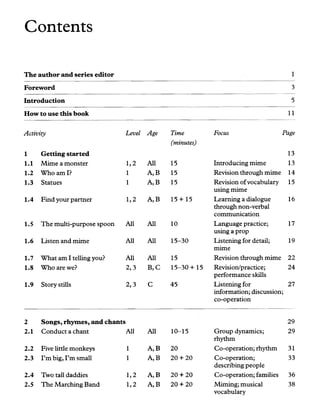
Contents
The author and series editor 1
Foreword 3
Introduction 5
How to use this book 11
Activity Level Age Time Focus Page
(minutes)
1 Getting started 13
1.1 Mime a monster 1,2 All 15 Introducing mime 13
1.2 Who am I? 1 A, B 15 Revision through mime 14
1.3 Statues 1 A, B 15 Revision ofvocabulary
using mime
15
1.4 Find your partner 1,2 A, B 15 + 15 Learning a dialogue
through non-verbal
communication
16
1.5 The multi-purpose spoon All All 10 Language practice;
using a prop
17
1.6 Listen and mime All All 15-30 Listening for detail;
mime
19
1.7 What am I telling you? All All 15 Revision through mime 22
1.8 Who are we? 2,3 B, C 15-30+15 Revision/practice;
performance skills
24
1.9 Story stills 2,3 C 45 Listening for
information; discussion
co-operation
27
5
2 Songs, rhymes, and chants 29
2.1 Conduct a chant All All 10-15 Group dynamics;
rhythm
29
2.2 Five little monkeys 1 A, B 20 Co-operation; rhythm 31
2.3 I’m big, I’m small 1 A, B 20 + 20 Co-operation;
describing people
33
2.4 Two tall daddies 1,2 A, B 20 + 20 Co-operation; families 36
2.5 The Marching Band 1,2 A, B 20 + 20 Miming; musical
vocabulary
38
2.6 Who stole the cookie
from the cookie jar?
1,2 A,B 25 + 25 Group co-ordination;
rhythm
40
2.7 The dragon hunt 2,3 B, C 25 + 25 Miming; group
co-ordination
43
2.8 A story chant 2,3 All 20-30 Listening for
information;
co-operation
47
3 M aking puppets and props 51
3.1 Face on a finger 1,2 A,B 5-10 Craft skills; instructions 52
3.2 Face on a fist 1,2 A,B 5-10 Craft skills; instructions 53
3.3 Finger tube puppet 2,3 A, B 15 Craft skills; instructions 53
3.4 Sponge puppet All A,B 20 Craft skills; instructions 55
3.5 Origami puppet All B, C 15 + 15 Craft skills; instructions 56
3.6 Sock puppet All B, C 40 Craft skills; instructions 57
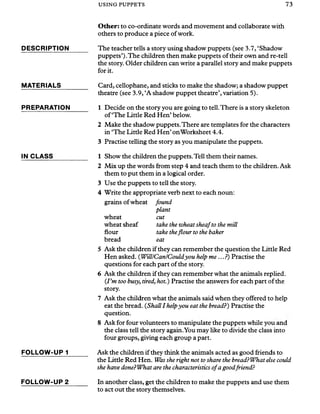
3.7 Shadow puppet All All 10+ Craft skills; instructions 58
3.8 Stick puppet All All 20+ Craft skills; instructions 60
3.9 Simple puppet theatres All All 5-15 Craft skills; instructions 60
3.10 Hat base All B}C 15 + 15 Craft skills; instructions 62
3.11 Headband All All 15+ Craft skills; instructions 63
3.12 A half mask All All 20-25 Craft skills; instructions 64
3.13 Mask on a stick All All 20-25 Craft skills; instructions 65
4 U sing puppets 67
4.1 Yes and no puppets All A,B 20 Getting used to
puppets; questions
67
4.2 Guessing games All B, C 10-15 Solving problems;
questions
69
4.3 Telling a story with stick
puppets: ‘Big Blue Fish and
Small Red Fish’
1,2 A,B 20 + 20 Co-operation;
listening to and telling
stories
70
4.4 Telling a story with
shadow puppets:
‘The Little Red Hen’
All All 40 Group co-operation;
listening to and telling
stories
72
4.5 Animating the textbook All All 30 Improvisation; memory;
dialogues
74
4.6 From situation to dialogue 2,3 C 45 Improvisation; activate
language resource
76
4.7 At the doctor’s 2,3 B, C 35-50 Improvisation; fluency 77
4.8 Puppet conversations 2,3 All 20 + 20 Exchanging personal 79
information
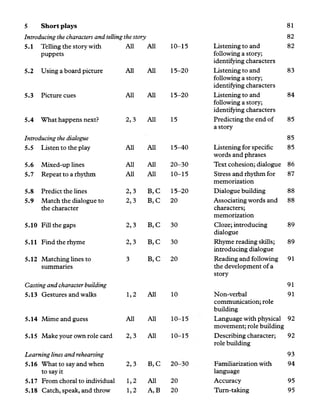
5 S hort plays
Introducing the characters and telling the story
5.1 Telling the story with
puppets
All All 10-15
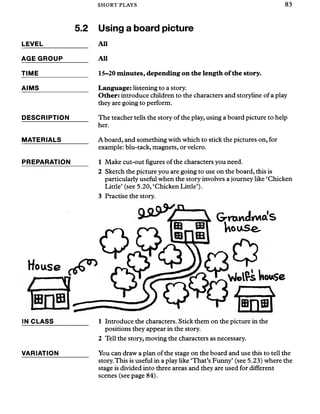
5.2 Using a board picture All All 15-20
5.3 Picture cues All All 15-20
5.4 What happens next?
Introducing the dialogue
2,3 All 15
5.5 Listen to the play All All 15-40
5.6 Mixed-up lines All All 20-30
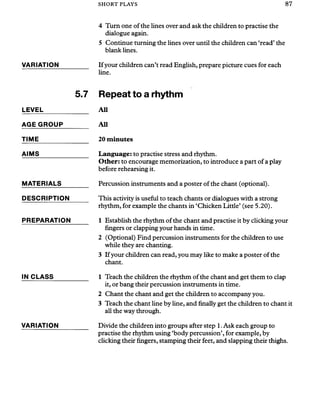
5.7 Repeat to a rhythm All All 10-15
5.8 Predict the lines 2,3 B, C 15-20
5.9 Match the dialogue to 2,3 B, C 20
the character
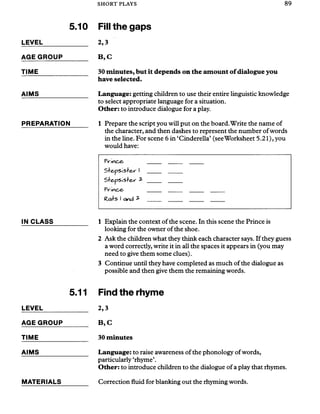
5.10 Fill the gaps 2,3 B, C 30
5.11 Find the rhyme 2,3 B, C 30
5.12 Matching lines to
summaries
3 B, C 20
Casting and character building
5.13 Gestures and walks 1,2 All 10
5.14 Mime and guess All All 10-
5.15 Make your own role card 2,3 All 10-
Learning lines and rehearsing
5.16 What to say and when
to say it
2,3 B, C 20-
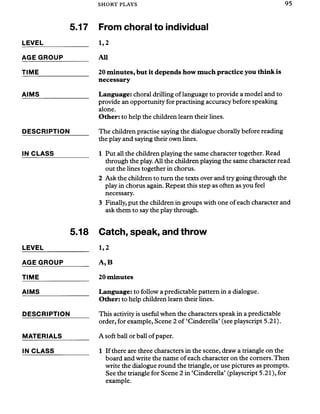
5.17 From choral to individual 1,2 All 20
5.18 Catch, speak, and throw 1,2 A, B 20
82
81
Listening to and 82
following a story;
identifying characters
Listening to and 83
following a story;
identifying characters
Listening to and 84
following a story;
identifying characters
Predicting the end of 85
a story
85
Listening for specific 85
words and phrases
Text cohesion; dialogue 86
Stress and rhythm for 87
memorization
Dialogue building 88
Associating words and 88
characters;
memorization
Cloze; introducing 89
dialogue
Rhyme reading skills; 89
introducing dialogue
Reading and following 91
the development of a
story
91
Non-verbal 91
communication; role
building
Language with physical 92
movement; role building
Describing character; 92
role building
93
Familiarization with 94
language
Accuracy 95
Turn-taking 95
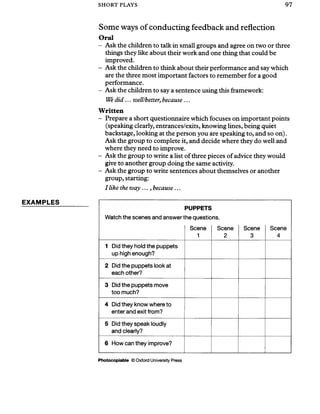
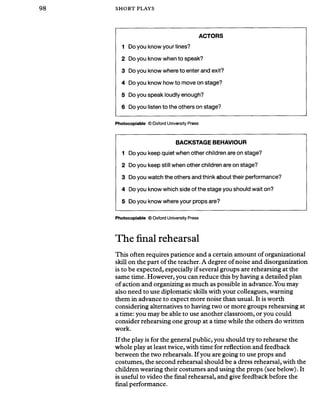
Reflection andfeedback
Thefinal rehearsal
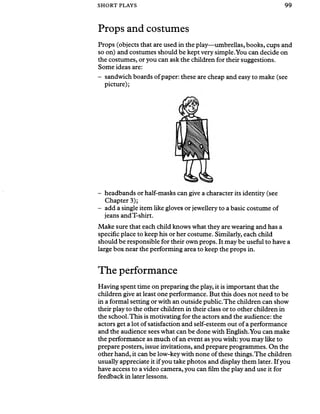
Props and costumes
Theperformance
Theplays
5.19 Marty the Martian 1,2 A
5.20 Chicken Little 2,3 A,B
5.21 Cinderella 2,3 All
5.22 Find a bin to put it in 2,3 B, C
5.23 That’s funny 3 C
5.24 Starlet 3 C
5.25 Using a model to write
a play
2,3 C
5.26 Superheroes: writing
a play from an idea
2,3 B, C
96
98
99
99
100
40 + (2 x 40) Confidence building;
group co-ordination
100
(5 x 30) or
(10x15)
Confidence building;
group co-ordination
101
10x30+ Confidence building;
group co-ordination
102
4 x30 Confidence building;
environmental issues
104
(3 x 50) or
(6 x 20-30)
Confidence building;
music and craft
105
3x50 Confidence building;
colloquial English
107
2x50 Writing following a
model
108
(1-2x50) Creative expression;
writing
109
6 Role plays and improvisation
6.1 The market 1,2 B, C
6.2 Tourists 2,3 B,C
6.3 At a restaurant 2,3 B, C
6.4 First lines 3 C
6.5 Become someone different 3 C
6.6 Just imagine 3 C
6.7 The quiz show 3 C
6.8 Shipwreck 3 C
111
4 x5 0 Improvising; shopping 112
20 + 40 Improvising; towns 116
30 + 30 Improvising;
restaurants
117
20 Improvising;
developing fluency
119
15 + 15 Improvising;
developing a character
120
25 Fluency; solving
problems
121
50 + 50 Fluency; questions 122
30 + 30 Discussion; how
society works
124
Photocopiable worksheets 127
Further reading 149
Indexes 152
The author and
series editor
Sarah Phillips trained as an English Language teacher at the Bell
School, Norwich, and took her MA in ELT at Edinburgh
University. She has held various teaching posts in Europe and has
taught on primary teacher training courses with the Norwich
Institute of Language Education. She has worked with the Regional
Government of Galicia to prepare training courses and materials for
teachers of English. She was part of a team that produced a video of
children’s songs and games with LINGUA support. At the moment
she is working on a textbook for children and teaching at the
Instituto de Idiomas at the University of Santiago de Compostela.
She is the author of Young Learners.
Alan Maley worked for The British Council from 1962 to 1988,
serving as English Language Officer inYugoslavia, Ghana, Italy,
France, and China, and as Regional Representative for The British
Council in South India (Madras). From 1988 to 1993 he was
Director-General of the Bell EducationalTrust, Cambridge. From
1993 to 1998 he was Senior Fellow in the Department of English
Language and Literature of the National University of Singapore.
He is currently a freelance consultant and Director of the graduate
English programme at Assumption University, Bangkok. He wrote
Quartet (with Frangoise Grellet andWimWelsing, OUP 1982), and
Literature, in this series (with Alan Duff, OUP 1990). He has also
written BeyondWords, Sounds Interesting, Sounds Intriguing, Words,
Variations on a Theme, and Drama Techniques in Language Learning
(all with Alan Duff), The Mind's Eye (with Fran^oise Grellet and
Alan Duff), and Learning to Listen and Poem into Poem (with Sandra
Moulding). He is also Series Editor for the New Perspectives and
Oxford Supplementary Skills series.
Foreword
Children, perhaps more than any other category of learners, delight
in make-believe. They are immediately at home in imaginary
worlds, where they can act out a role, engage in ‘pretend’activities,
dress up, and for a short while become another person.
Language teachers at this level commonly have to face two
difficulties however. On the one hand, they need to channel the
naturally exuberant imaginative energy of the children into activity
which is not merely enjoyable but which also has a language pay-off.
On the other, they need to develop a repertoire of concrete activities
which appeal to the children: failure to do so will result in chaos or
boredom.
In this new book, Sarah Phillips comprehensively addresses these
two needs. She offers carefully structured activities with clearly
articulated educational and language teaching aims. And the book
brings together a collection of ideas, texts, and activities which the
busy teacher ofyoung children can draw upon to suit the needs of
her own class. It begins with dramatization activities, such as mime,
and goes on to the use of songs, rhymes, and chants, the making and
use of puppets, and the use of playscripts. It culminates with slightly
more advanced role play and simulation activities.
As the demand for English for younger learners continues to grow,
so too does the demand for reliable and stimulating teaching
materials.This collection represents a significant addition to the
resources available to teachers at this level, and is a fitting extension
of the work available in Sarah Phillips’earlier book in this series,
Young Learners, which has already proved such a well-tried
favourite.
Alan Maley
Introduction
Who is this book for?
Children
Nearly all the activities in this book have been used in the classroom
with children between the ages of five and twelve at different levels.
Of course, other factors affect the suitability ofthe individual
activities for different children: the amount of drama they have done
before, the kind of teaching environment they are used to, their
gender, the atmosphere in the classroom, and cultural attitudes
towards physical expression. The teacher is the best person to
decide how these factors affect his or her class.Therefore, the
recommended ages and levels in each activity are given for guidance
only.
s
Teachers
This book is for both inexperienced and experienced primary-level
language teachers who are interested in introducing, or developing,
drama as an extra dimension in their teaching. It provides practical
introductory activities for teachers who have never used drama in
their classrooms before.There are also more ambitious activities,
like plays and improvisations, for those who feel more confident
about using drama as an integral part of their lessons, or who want
to prepare a performance such as an end-of-term show.The aim is
to provide a practical introduction to dramatizing in the classroom
and to provide a starting-point from which teachers can develop
ideas oftheir own.
Dramatizing not drama
The word drama may produce the image of an end-of-term play,
staged by nervous children, organized by overwrought teachers, and
watched by fond parents. I want to replace this image with a much
less dramatic one. Drama is not only about the product (the
performance) but part of the process of language learning. It allows
children to own the simple and mechanical language they use by
involving their personalities. It gives those children who are shy
when speaking a foreign language another character to ‘hide
behind’. ‘Dramatizing’is perhaps a better word for this than drama:
dramatizing is much simpler than that nerve-racking end-of-term
INTRODUCTION
play. Dramatizing means that the children become actively involved
in a text.This personalization makes language more meaningful and
memorable than drilling or mechanical repetition can.
Why use drama activities?
Using drama and drama activities has clear advantages for language
learning. It encourages children to speak and gives them the chance
to communicate, even with limited language, using non-verbal
communication, such as body movements and facial expressions.
There are also a number of other factors which make drama a very
powerful tool in the language classroom.Try thinking about the
ways in which reading a dialogue aloud from a textbook is different
from acting out that same dialogue.You will find that the list is a
long one.This is because drama involves children at many levels,
through their bodies, minds, emotions, language, and social
interaction. Some ofthe areas where I feel drama is very useful to
language learners and teachers are outlined below.
Motivation
Dramatizing a text is very motivating and it’s fun. In addition, the
same activity can be done at different levels at the same time, which
means that all the children can do it successfully.The end product,
the performance, is clear and so children feel safe, and have a goal to
work towards (even though this may not coincide with their
teacher’s aims). Children are motivated if they know that one or two
groups will be asked to show what they have done, or ifthey are
being videoed or putting on a public performance.
Familiar activities
Dramatizing is part of children’s lives from an early age: children act
out scenes and stories from the age of about three or four.They play
at being adults in situations, like shopping and visiting the doctor,
which are part oftheir lives. Many ofthese day-to-day situations are
predictable. Children try out different roles in make-believe play.
They rehearse the language and the ‘script’of the situation and
experience the emotions involved, knowing that they can switch
back to reality whenever they want to.
Such pretend play prepares children for the real-life situations they
will meet later on: it is a rehearsal of the real thing. Make-believe
encourages their creativity and develops their imagination, and at
the same time gives them the opportunity to use language that is
outside their daily needs. Language teachers can use this natural
desire to act out situations.You can ask them to be Little Red Riding
Hood, Aladdin’s Magic Carpet, or a bank robber and then use all
the language that grows out of that personality or role.
INTRODUCTION 7
Confidence
By taking on a role, children can escape from their everyday identity
and lose their inhibitions.This is useful with children who are shy
about speaking English, or don’t like joining in group activities. If
you give them a special role it encourages them to be that character
and abandon their shyness or embarrassment. This is especially true
when you use puppets and masks. The teacher can use roles to
encourage children who would otherwise hold back, and control
children who dominate the weaker ones.
Group dynamics
Children often work in groups or pairs when dramatizing.This
group work may be very structured, where children reproduce a
model, or it may mean children taking responsibility for their own
work. Children have to make decisions as a group, listen to each
other, and value each other’s suggestions. They have to co-operate
to achieve their aims, find ways of settling their differences, and use
the strengths of each member ofthe group.
Different learning styles
Dramatizing appeals to all kinds of learners.We receive and process
information in different ways, the main ones are through sight,
hearing, and our physical bodies. One of these channels tends to be
dominant in each of us. If we receive new information through this
channel, it is easier for us to understand and use; if it is presented
through a weaker channel, we tend to find the ideas more difficult.
When children dramatize they use all the channels, and each child
will draw on the one that suits them best.This means they will all be
actively involved in the activity and the language will ‘enter’through
the channel most appropriate for them.
Language personalization
Dramatizing allows children to add an emotion or personality to a
text that they have read or listened to.Take any word, sentence, or
short dialogue (two to four lines) and ask the children to practise
saying it ‘in character’. It is surprising how the meaning of
something as simple as ‘What’s your name?’can be changed
according to how and where you say it.Think about how a
policeman asks a robber and how Father Christmas asks a hopeful
child this same question. By interpreting the words, the children
make them their own.This also makes language memorable.
Language in context
In the classroom, we often expose children to small bits of language
such as individual words, rather than whole phrases or ‘chunks’.
When speaking, children are not often asked to combine the
INTRODUCTION
different structures they are learning. Drama is an ideal way to
encourage children to guess the meaning of unknown language in a
context which often makes meaning clear. Similarly, children will
need to use a mixture oflanguage structures and functions ifthey
are to communicate successfully.
Cross-curricular content
When using drama your aims can be more than linguistic.You can
use topics from other subjects: the children can act out scenes from
history, or the life cycle of a frog.You can work on ideas and issues
that run through the curriculum, such as sexism, respect for the
environment, and road safety. Important messages can be conveyed
and explored through sketches and role play. Drama can also be
used to introduce the culture of the new language, through stories
and customs, and with a context for working on different kinds of
behaviour.
The pace of a lesson
Drama can add a change ofpace or mood to the classroom.
Dramatizing is learner-centred so that you can use it to contrast
with the more teacher-centred parts ofyour lesson. It is active and
so you can use it to make a class more lively after quieter or
individual work.
Practical advice on using dramatization in
the classroom
Choose the right activity
When you plan a drama activity you need to know your aim.There
are activities for accuracy and fluency work, and others that practise
language skills.Your aim may be to revise and practise language
from previous lessons, or it may be to change the pace ofthe lesson.
Look at the focus column of the contents page at the beginning of
the book.
The children’s age affects the kind of activity you plan.Younger
children find it more difficult to work in groups and so whole-class
activities, or very guided activities, are better for them. Older
children may work better in smaller groups, though this depends on
the style ofteaching they are used to.They may take more initiative,
contributing their own ideas about characters and situations, and if
they have been attending English classes for some time, will perhaps
only need the teacher to help with language.The more
dramatization the children do, and the more they reflect on what
they have done, the better they will become at it.
INTRODUCTION y
Start small
Not all children are good at acting, especially if drama is not part of
their first language curriculum. Introduce drama into your
classroom in small steps. Start with easy, guided activities, such as
1.1 ‘Mime a monster’, and move on to less controlled activities,
such as the plays, as the children gain confidence.You may be
surprised that you need to teach them simple things like stretching
out their arms, taking big and small steps, and using their faces and
whole bodies to show emotion. ‘Total Physical Response’activities
are an excellent way into dramatization: the children respond to
language with their bodies, a first step to miming and acting.
Children often don’t realize that they can say things in different
ways: simply asking them to say words or sentences loudly, quietly,
angrily, or sadly can be a good way for them to explore the power of
their voices.The children need to see that you are enthusiastic about
dramatizing and enjoy doing the activities you propose.You serve as
a model, and encourage them to be active in the classroom.
Organize the classroom
The children stand up in most of the activities, and usually the space
at the front ofthe classroom is enough. If the children stand in a
circle or work in groups you need more space: push the tables and
chairs to the edge of the classroom, or take the children to the gym.
If you use drama activities often, train your children to move the
tables and chairs quietly to one side. Give each child one thing to
move and practise a few times: make it a competition, they should
be as fast and as quiet as possible! If you have real space problems,
puppets may be a solution.
Give feedback
You are not training professional actors and actresses but giving
children an enjoyable way of practising and using their English.You
need to give feedback on what the children have done, not only the
end product and language, but also the process that they went
through, the way they co-operated with each other, and how they
came to decisions. Find something positive to comment on.There
will be areas of the children’s work that can be improved and this
should be part ofyour feedback to them.While the children are
doing the activity, watch and listen to them, try not to interfere, and
take notes on what you are observing.The process is your main aim,
but the children will see the ‘performance’as the most important
part of the lesson.You need to value their performances.When they
have finished, you can ask some groups to show their work and then
give them feedback. There are many ways of doing this: you could
prepare a feedback sheet for them to do (see ‘Reflection and
Feedback’, page 96) and use this. If constructive feedback becomes
a regular part of dramatization activities, the children will gradually
improve their dramatizing abilities and their language.
How to use this book
In this book, you will find drama activities which you can use in the
children’s classroom to activate language and have fun.The book is
divided into six chapters.The first chapter contains guided activities
which are important first steps to introducing drama into lesson
time and are useful with children who have just started to learn
English. Chapter 2 contains advice on using chants, rhymes, and
songs. Chapters 3 and 4 are on making and using puppets, and
Chapter 5 is about putting on simple plays. In the final chapter the
book moves on to role play and improvisation, where children have
to use all their language resource creatively. Children, at all language
levels, have the opportunity to add something of themselves to these
activities using their bodies, voices, and emotions to make the
language their own.
How each activity is organized
Level
1 = beginners: from children with little or no knowledge of English,
to those who recognize the English names of colours; numbers up to
twelve, and basic vocabulary such as the family, animals, some food;
1am/you are, there is/there are, can, like!don’t like; and classroom
commands such as stand up, sit down, and openyour books.Their
active use of this language will be very limited.
2 = elementary: these children are able to use level 1 language more
actively and make simple sentences and questions.They have a
wider range ofvocabulary: for example, clothes, shops, parts of the
body, verbs for daily routines, and telling the time in English (ifthey
know this in their own language).
3 = pre-intermediate: these children will be more capable of
recognizing sentence patterns and generating language of their own.
They are ready to learn structures such as the past simple,
comparatives, possibly going to, and functions such as obligation,
requests, or making suggestions.
It is very important not to confuse these levels with years of English,
as a child’s maturity makes a great difference to what he or she is
able to do. An older child may reach level 2 in one year, while
younger children need to go more slowly.
Age group
The letters A, B, and C refer to children’s ages:
A = 6-8 years old
B = 8-10 years old
HOWTO USETHIS BOOK
C = 10-12 years old
This is a rough guide only.You must use your own judgement.
Time
A rough guide to how long the activity will take.This will vary
considerably according to such factors as the size ofthe class, the
age of the children, whether they are used to working in groups, and
so on.
Aims
The aims of the activities are divided into two parts: ‘language’aims
and ‘other’aims.The language aims cover language and skills
development, while the others refer to the intellectual and social
development ofthe children.
Description
A short summary of the activity so that you can get an overall idea of
it.
Materials
A list ofwhat you need in order to do the activity.
Preparation
A brief outline ofwhat you need to do before the lesson.
In class
A step-by-step guide to doing the activity.
Follow-up
Ideas for further activities which reinforce what has been learnt.
Variations
Examples ofways in which you could adapt the activity to suit your
children.
Comments
Hints and advice to make the activity run more smoothly.
1 Getting started
The activities in this chapter allow you to introduce an element of
dramatization in your day-to-day lessons and work on the skills
necessary for longer activities.They are short, fun, easy to set up,
and can be adapted for use with different language content. Many of
the activities focus on mime so that children can work on using their
bodies to express meaning. This change in focus can be very
powerful for language learning: the children acquire the language at
a more subconscious level because they are not thinking about what
they are saying, but how to show the meaning.
In all the activities, the children work in pairs, groups, or together as
a whole class, preparing mimes or mini-sketches. If your children
are not used to working in pairs and taking responsibility for their
work, you will need to introduce the idea step by step, giving them
teacher-controlled activities like 1.1, ‘Mime a monster’before
moving on to freer work like 1.9, ‘Story stills’. Feedback on how the
children work together is important to help them learn to work in
groups.
Ifyou use these kinds of activities a lot, the children will become
comfortable with dramatizing. If you wish to be more ambitious and
work on a short play, these introductory activities are an essential
bridging point between ‘reading the text’and ‘acting it out’.
1.1 Mime a monster
LEVEL_____________ 1,2
AGE GROUP All
TIME ______ 15 minutes
AIMS_______________ Language: vocabulary ofparts of the body and listening for detail.
Other: working in pairs; working on physical co-ordination.
DESCRIPTION The children work in pairs or groups.The teacher describes a
monster which the children make between them with their bodies.
PREPARATION Prepare the descriptions of the monsters. For example: Make a
monster with two heads, three arms, one leg, and a tail.
IN CLASS__________ 1 Point at the various parts of the body which you are going to use
and elicit the names to check that the children are familiar with
them.
14 GETTING STARTED
2 Ask for two volunteers to come to the front of the class. Explain
that they are going to work together to make a monster according
to your instructions.
3 Describe the monster and help the volunteers make it with their
arms, legs, and other parts oftheir bodies. Ask for comments from
the class and give positive feedback that will help the other
children when they are making the monsters.
4 Repeat the activity with the whole class.
5 Note the pairs who have made interesting monsters. Get them to
show their monsters to the rest of the class.
FOLLOW-UP_______ Get the children to draw pictures of the monsters and make a
gallery or a ‘monster catalogue’.
VARIATION_________ The children work in groups of three or four to make a monster.
One child in each group gives instructions which the others follow.
The teacher looks around the class, describes one of the monsters,
and the other children identify it.
1.2 Who am I?
LEVEL 1
AGE GROUP_______ A, B
TIME 15 minutes
AIMS_______________ Language: to revise phrases from the coursebook.
Other: to encourage children to work together in pairs, to work on
co-ordination, and encourage children to revise language in their
coursebook.
DESCRIPTION______ The children work in pairs to represent the characters on a
particular page in their book. Each pair shows their mime to the rest
of the class, who guess the characters and try to remember what
they were saying at the time.
MATERIALS Your coursebook.
PREPARATION_____ Prepare a simple mime of a memorable scene in the coursebook.
IN CLASS__________ 1 Ask the children the names of the characters in their book,
including animals, robots, witches, and so on!
2 Show the children your mime. Ask them who you are. Can they
remember what the character was saying at the time?
3 Tell the children they are going to work in pairs to prepare a mime
from the book. Put them into pairs or threes and give them time
GETTING STARTED 15
to look back through their book, choose a scene, and prepare it. It
doesn’t need to be static, they can add movement if they want to.
4 When most of the pairs are ready, stop the preparation and ask
some groups to show their scene.The other children should guess
who they are and what their characters were saying.
FOLLOW-UP_______ You, or a child, can take photos of the scenes. The children can add
speech bubbles to the photos and display them on the wall.
1.3 Statues
LEVEL_____________ 1
AGE GROUP_______ A, B
TIME 15 minutes
AIMS_______________ Language: to revise vocabulary.
Other: to encourage children to work together in pairs, stimulate
imagination and creativity, and work on physical co-ordination.
DESCRIPTION The children work in pairs to mime a word from a ‘word family’they
have worked on, for example: pencil, pen, and pencil owe.They show
it to the rest ofthe class who guess what it is.
IN CLASS__________ 1 Introduce the idea of word families.You could ask the children to
tell you the topics they have been working on lately and get them
to give you words they associate with the topics, for example: car,
train, and bus. Alternatively, you may like to write a few words
from each topic and ask the children to group them into families,
giving the reasons for their grouping.
2 Choose a word from one of the families on the board. Tell the
children you are going to become a statue of one of the words, and
tell them which family it comes from. Mime the word and let the
children guess which word it is.
3 Divide the children into pairs.Tell them to select a word from one
of the word families on the board.
16 GETTING STARTED
VARIATION
4 Give the children a few minutes to prepare their statue. Go
around the class helping and encouraging.
5 Stop the preparation. Get the pairs to show their statue to the
class and get them to guess what it is. If any of the children are
really unwilling to show their statue, don’t force them.
The children could work in threes or fours to make their statues.
LEVEL
AGE GROUP
1.4 Find your partner
1,2
A ,B
TIME
AIMS
DESCRIPTION
MATERIALS
15 + 15, including revision of dialogue
Language: to practise vocabulary offeelings and to practise a short
dialogue.
Other: to practise showing emotion with voices, faces, and bodies.
The children work on short dialogues (2-4 lines) which they have
been studying, and are given a card which tells them how they feel.
They mingle with the others in the class, trying to find another
person who feels the same way as they do.
Small cards, each with one of these words on them: happy, sad,
angry, bored, hungry, tired, hot, and cold (seeWorksheet 1.4).There
should be enough to go around the class, and at least two of each
card: it does not matter if there is an uneven number.
PREPARATION
IN CLASS
1 Prepare the cards above.
2 Prepare the dialogue you want the children to practise. It can be
based on the unit of the book you are doing, or revise something
from a previous one. It could be connected with a topic. Or ifyou
are preparing a play to perform, you can use a key dialogue.
1 Review the dialogue you are going to use. It can be as simple as:
A Hi!
B Hello!
A Doyou like the new teacher?
B Yes!
2 For ideas on learning and reviewing dialogues, see pages 93 and
94 in Chapter 5.
3 Present or elicit the feelings that are on the cards you have
prepared.You can do this through mime and using your voice,
asking How do Ifeel?, or using the pictures inWorksheet 1.4. If
these words are new to your children, you may want to write them
on the board.
GETTING STARTED 17
4 Tell the children to work in pairs and choose one of the feelings
words. Ask them to practise the dialogue they have learnt, saying
it in the manner of the word they have chosen. Go around the
class monitoring and commenting. If there is time, they can
choose another word and repeat the dialogue using the new word.
5 You may like to ask some of the children to demonstrate their
dialogues and ask the class to guess which feeling they are acting.
This can be an alternative to step 6 ifyou don’t have enough
space for a mingling activity.
6 Give out the cards.Tell the children that they are going to act as if
that is how they are feeling at the moment. Explain that they
should mingle with the rest of the class, finding partners and
saying the dialogue in the manner of their word, until they find
someone who feels the same as they do.When they have found a
partner, they should stand at the front of the class. If there is an
uneven number of children, tell them that there will be one group
of three. If you have a large group, it is best to divide the class in
two. Let one group do the activity while the others watch, and
then let the second group have a turn.
7 When all the children have found a partner, ask some pairs to say
the dialogue while the rest of the class guess the feeling.
8 Give the children feedback on the activity, both the language they
have been using, and the way in which they carried out the
activity.
COMMENTS________ If you want a more structured mingling, get the children to stand in
two concentric circles, those on the inside facing those on the
outside. The children move in opposite directions until you say stop.
The children facing each other say the dialogue. If their feelings
coincide, they leave the circle.
VARIATION 1 Instead of a set dialogue, each child can prepare a question to ask in
the manner of the word.
VARIATION 2_______ Children who are more fluent in English can be asked to improvise
using an initial question such as Where areyou going?
1.5 The multi-purpose spoon
LEVEL_____________ All
AGE GROUP_______ All
TIME 10 minutes
AIMS Language: to revise and practise present continuous, can, past
simple, or other structures.
18 GETTING STARTED
Other: to encourage children to use their imaginations and to
practise using a simple prop.
DESCRIPTION_____ The children work as a class or in large groups.They sit or stand in a
circle and pass the spoon around. Each child uses the spoon to
represent an action.The others guess what they are doing.
MATERIALS________ One wooden spoon for each group of 8-10 children or one ‘multi­
purpose object’ (for example: a box, paper plate, or newspaper) for
each group of 8-10 children.
PREPARATION_____ 1 Choose the structure you want to work on.
2 Think ofhow to contextualize the structure.
3 Decide on a simple action using the spoon to show the class.
IN CLASS__________ 1 Show the children a wooden spoon (or other multi-purpose
object). Give a short introduction to contextualize the structure
you want to practise. For example: Pm going to use this spoon to tell
you what I did at the weekend. Use it to mime an action and at the
same time say the sentence using the structure you want to
practise. For example, pretend to hit a ball, use the spoon as a
tennis racket, and say: I played tennis at the weekend.
2 Ask the children to think of other things they could use the spoon
to show.When a child has an idea, give them the spoon so that
they can show the class. Ask the other children to guess the
sentence.
3 When the children have understood the activity, divide them into
groups of about ten and get each group to stand (or sit) in a circle.
Give each group a spoon. Explain that the children should take
turns to use the spoon to act out something and the others should
guess the sentence.You may like to say that the spoon should go
around the circle at least twice.
4 When most of the groups have finished, stop the activity and ask
them to sit down. The groups should now try to remember what
each person did.With children who have a higher level of English
this can be done in pairs or small groups, or there could be a
group secretary who writes down the sentences as the whole
group tries to remember.
VARIATION_________ With older children: you can turn the activity into a competition
by asking each group to read out its sentences. As the sentences are
read out to the whole class, the group secretary should cross any
sentences offthe list that are the same. The children then count the
sentences that remain on the list: the group with the largest number
of original sentences is the winner.
FOLLOW-UP Each group makes a poster of its original sentences.The teacher
makes a poster ofthe sentences the groups had in common.
GETTING STARTED 19
1.6
LEVEL_____________
AGE GROUP_______
TIME_______________
AIMS
DESCRIPTION
MATERIALS
PREPARATION
IN CLASS
EXAMPLE
Listen and mime
All
All
15-30 minutes, depending on the story
Language: to listen to a story and listen for specific words and
phrases.
Other: to use actions to illustrate a story.
The children listen to a story, and do actions as they hear certain
words.
A story, for example, ‘Enormous Elephant’on pages 20-21.
1 Choose a story and write a story skeleton for it.
2 Practise telling it, to a colleague ifpossible.
3 Select key words from the story and think of gestures to illustrate
them.
4 Practise telling the story, making the gestures at the same time.
Before the story
1 Tell the children that you are going to tell them a story, but that
they need to learn some actions first.
2 Ask the children to stand up, in a circle ifpossible. Join them in
the circle: start by teaching them two or three words and actions.
Then repeat the words in a different order and get the children to
do the actions (they don’t need to say the words).
3 Teach a few more words and actions. Get the children to do the
actions for the new words and old words mixed together.
Continue adding a few more words and actions one at a time until
you have presented and practised them all.
Words for miming Actions
Enormous
Elephant
bored
idea
walk
New York
meet
Starting above your head, trace a big circle with
your hands
Wave an arm in front ofyour nose like an
elephant’s trunk
Putyour head in your hand with bored
expression on your face
Point atyour head with a sudden, pleased
expression on your face
Walka few steps on the spot
Put both hands above your head to make a
skyscraper
Turn to someone beside you and shake hands
20 GETTING STARTED
STORY OUTLINE
Magic Hold up your hands and shimmer them down
like magic dust
Monkey Scratch your head with one hand and under one
arm with another
Open your hands and shrug your shoulders in a
questioning way
The usual gesture in your country for OK
The usual gesture in your country for crazy
Make snapping crocodilejaws with outstretched
arms
tired Sagyourbody
sleep Putyourhead on your two hands
What’s the matter?
OK
Crazy
Crocodile
ENORMOUS ELEPHANT
This is the story of Enormous Elephant, Magic Monkey, and Crazy
Crocodile.
One day Enormous Elephant was bored, very very bored. Then he had
an idea.
‘I know,’ he said, ‘I’ll go to New York.’
So he started to walk, and he walked, and he walked, and he walked.
On the way he met Magic Monkey.
‘Hello, Magic Monkey,’ he said.
‘Hello,’ said Magic Monkey.
‘What’s the matter?’ said Enormous Elephant.
‘I’m bored,’ said Magic Monkey, ‘very, very bored.’
‘I’ve got an idea,’ said Enormous Elephant, ‘why don’t you come to
New York with me?’
‘OK,’ said Magic Monkey.
So they started to walk, and they walked, and they walked, and they
walked. On the way they met Crazy Crocodile.
‘Hello, Crazy Crocodile,’ they said.
‘Hello,’ said Crazy Crocodile.
‘What’s the matter?’ said Enormous Elephant.
‘I’m bored,’ said Crazy Crocodile, ‘very, very bored.’
‘I’ve got an idea,’ said Enormous Elephant, ‘why don’t you come to
New York with us?’
‘OK,’ said Crazy Crocodile.
So they started to walk, and they walked, and walked, and walked.
And they walked, and they walked, and they walked.
‘Oh, I’m tired,’ said Enormous Elephant.
‘Oh, I’m tired,’ said Magic Monkey.
‘Oh, I’m tired,’ said Crazy Crocodile.
So they all went to sleep.
GETTING STARTED 21
Telling the story
4 Ask the children to stand up, and make sure they can all see you.
Again, a circle is the best option ifpossible. Elicit the actions if
you have taught them in an earlier lesson. Ask the children to
listen to the story and do the appropriate action each time they
hear one of the words you have been practising.
5 Tell the story, doing the actions as you tell it. Encourage the
children to join in the actions with you.
6 Tell the story again, in this or a later class. On subsequent tellings
you may feel that you don’t need to model the actions.
Acknowledgement
I learnt this story from a colleague, Guy Norman, who learned it at
an APIGA conference some 10 years ago. I would like to
acknowledge the unknown author of this most successful story.
FOLLOW-UP_______ You can do a variety of follow-ups after telling a story with actions:
- make a comic strip or book of the story;
- give the written story with gaps for the words with actions;
- ask them to put pictures of the story in order, and write a sentence
for each one;
- ask them to think of a variation on the story;
- show the story to an audience.You could add masks, hats, and so
on (see Chapter 3).
There are many ideas for using stories in the young learners’
classroom in Storytelling with Children by AndrewWright.
VARIATIONS_______ - If the words are familiar, show the children the actions and ask
them to guess what the words might be.
- Present the words through pictures and then ask the children to
invent the actions for the words themselves.
- Ask the children to predict the story from the words with actions.
- With a story with three or four main characters, divide the
children into small groups, one for each character, and get them
to do the actions as you tell it.
COMMENTS________ You may like to do the ‘before story’activity in one or more lessons
before you tell the story. Many authentic children’s stories of the
kind that build up by repeating a basic structure lend themselves to
this kind of activity. For example: The Elephant and The Bad Baby
and The Enormous Turnip (see Further Reading, page 149).
22 GETTING STARTED
1.7
LEVEL
AGE GROUP
TIME
AIMS
DESCRIPTION
MATERIALS
PREPARATION
What am I telling you?
All
All
15 minutes
Language: to revise and recycle language from previous lessons.
Other: to practise communicating without words and to encourage
children to look for alternatives when their first guess is wrong.
Two children mime a sentence and the other children guess what
the sentence is.
Pre-prepared sentences on slips ofpaper (see examples below).
Prepare some sentences connected with the topic or language point
you are working on or want to revise. It is best to set the sentences in
a context—in a restaurant, at the police station, on a radio phone-in
show, or from a story or song. Remember, it must be possible to
mime the sentences.There are some examples in the box below.
EXAMPLES
In a restaurant
Waiter, can I have the menu, please?
I’d like some spaghetti.
Can we have some fresh orange juice?
This steak is tough.
From a story
The princess had long hair and blue eyes.
She dropped her ball into a pond.
The frog swam to the bottom of the pond and found the ball.
The princess didn’t want to kiss the frog.
A situation: in the supermarket
He’s buying some apples.
The bananas are cheap.
Where are the ice creams?
IN CLASS__________ 1 Set the context for the situation you have chosen, perhaps
through pictures on the board or by miming. For example, if
you’ve chosen ‘in the supermarket’, you could draw pictures of
food, or you could mime buying something.
2 Show the children the sentence slips and choose one that is very
easy to mime. Ask for two volunteers to come and read it silently.
Make sure the children understand the sentence, helping them if
necessary.
GETTING STARTED 23
3 Tell the class that the volunteers are going to ‘tell’the other
children what is on the slip without speaking, writing, or drawing.
Ask the other children how the volunteers could do this.
4 Ask the volunteers to have a go, either individually or together
(see Comments).
5 When the class has guessed the sentence, or close to it, it is useful
to get them to think about their classmates’performance.This
reflection will help them when they try miming themselves. Ask
them to say two things they liked about the performance and one
thing that could be improved.Tell the children to remember those
things when it is their turn. If you think it is necessary, do the
same thing with another two volunteers.
6 When you think the class is ready to work in small groups, divide
the children into groups of four or five.Tell them that two
children from each group should come to you to collect a
sentence to mime.When the group has guessed the sentence, two
more children should come to you.They must tell you the
sentence they have just guessed before you give them another
one.
7 End the activity when each group has guessed five or six
sentences.
COMMENTS________ Before the volunteers try to mime the sentence (step 4), you may
like to work as a class on a series ofhelpful gestures. For example, a
gesture to represent the number ofwords in the sentence could
involve holding up the number of fingers. Other instructions could
tell the class which word the child is miming or ifthe words are long
or short. On the other hand, you may like to let the volunteers try to
mime the sentence first, and then get the children to think how they
could have made the sentence clearer.
FOLLOW-UP 1______ Ask each group to choose one mime they would like to show to the
class.
FOLLOW-UP 2_____ Ask the children to remember and write down the sentences they
have mimed.
FOLLOW-UP 3_____ Ask the children to work some of the sentences into a dialogue.
VARIATION 1_______ When the class is used to doing the activity, the children themselves
can think of the sentences to be mimed.You may like to turn the
activity into a team game.
VARIATION 2 The children can mouth the words as well as miming them.
24 GETTING STARTED
1.8 Who are we?
LEVEL
AGE GROUP
2,3
B ,C
TIME
AIMS
DESCRIPTION
MATERIALS
PREPARATION
Either 3 x 15-m inute slots in different lessons, or 15-30
minutes preparing and 15 m inutes presentation.
Language: to revise and recycle language from previous lessons.
Other: to think about and use appropriate gestures, body language,
and voice to represent character and to think about staging
(entrances, exits, movements) in a short sketch
The children work in groups of two or three to prepare a sketch
involving a conversation between a group of characters, including,
for example, ‘an old person’or ‘a person in a hurry’.The class
watches the sketch and guesses who the characters are.
Cards with the characters written on them like the ones in the box
(these can be in the children’s first language); space in the room.
1 Choose a simple dialogue that you want the children to work on.
Decide on where the conversation takes place, for example: in the
street, or in a bar. If your children are more fluent, you can simply
choose a situation and let them improvise the conversation. See
the examples of a conversation and situation below:
EXAMPLES
A conversation that takes place in the street
A Excuse me! Where’s the park?
B It’s over there.
A Where? Ican’t see it.
B Look where I’m pointing. Over there, near the river!
A situation where the children improvise the conversation
It’s Saturday afternoon. One person wants to watch television. Another
person wants to go out and play football. The third person wants some
peace and quiet.
2 Prepare cards with characters written on them (see ‘Suggestions
for characters’).You need a card for each child but the characters
can be duplicated, for a class of 24, eight characters are enough.
GETTING STARTED 25
EXAMPLES
Suggestions for characters
A deaf person
A person in a hurry
A person with a broken arm
A person with a broken leg
A person with a bad cold
An old person
A person carrying a lot of shopping
A child on a skateboard
A child on roller skates
A very tired person
A person with a dog
A person in a bad mood
IN CLASS Preparing the children for their sketch
This may need a whole lesson.
1 If the children are not used to acting out different characters, you
can start by helping them get ‘inside’a character.Write up one of
the characters on your cards on the board.
2 Help the children to think about his or her physical appearance.
Draw, or ask the children to draw, a picture of the character on the
board. Then ask the children to use their imagination and show
you how the character stands, walks, holds their head, and so on.
3 Help the children to identify with the character’s personality like
this: draw a thought bubble coming from the character’s head. If
the character is tired or bad-tempered you can ask the children
why they feel like this. Ask the children what they think the
character is thinking and feeling.
4 Ask all the children to stand up and become the character.
Comment on the gestures and actions they use and encourage
them to be as creative as possible.
26 GETTING STARTED
COMMENTS
5 Ask them to say their name in the way the character would.
Comment on how they use their voices.
Practising the sketch
6 Write the characters you have chosen on the board. Tell the
children that they are each going to become one of the characters.
You may like to repeat steps 1,2, and 3 ifyou feel the class need
help in identifying with their character.
7 Give out the cards and ask the children to imagine being their
character.
8 Teach or elicit the conversation ifyou are using one.
9 Tell the children the situation, for example, ‘On a bus’.You may
like to arrange some desks and chairs to set the scene, and get the
children to help. Keep it very simple. Make sure the entrances
and exits are well defined—for example, doors in a room, streets
coming on to a square, the front door of a house.
10 Put the children in pairs or small groups. Give them plenty of
time to work on the conversation. Remind them that they should
use the space, not simply stand still in the middle of it. As they
work, circulate and comment on their sketches.
Performing the sketch
11 In this or a different lesson, ask some ofthe groups to show their
sketches.The rest of the class guesses who they are.
12 Give feedback on the performances. Ask the children what they
liked and how the performances could be improved. (For more on
feedback, see ‘Reflection and feedback’, page 96.)
13 If you are going to do this activity regularly, and it is appropriate,
make a poster of the positive points and the suggestions the
children have made.They can refer to it the next time you do the
activity.
If your children are new to this kind of activity, part 1 ‘Preparing the
children for their sketch’, will probably take a whole lesson. If you
are preparing a play, you can use this activity to help the children to
work on developing their roles, and learning their lines.
VARIATIONS - Ifyou have access to a video camera, you can video the scenes
instead of the groups giving performances.
- The children can write the dialogues or a description of the scene.
GETTING STARTED 27
1.9 Story stills
LEVEL_____________ 2,3
AGE GROUP_______ C
TIME 45 minutes
AIMS_______________ Language: to listen to a story and use language of discussion and
negotiation.
Other: to work together co-operatively in small groups; to focus on
the physical composition of a scene using body language and
gesture.
DESCRIPTION_____ The children listen to a story.Then they prepare scenes for key
points in the story, ‘freeze-framed’, as if they were stills from a film.
The teacher or a child could take photos oftheir stills to be
displayed in the classroom.
MATERIALS________ Paper and coloured pencils, scissors, a camera.
PREPARATION_____ 1 Choose a suitable story; ideally it should have four or five
principal characters and a flexible number of extra characters. It
also needs to have four or five well-defined points in the story
suitable for representing as stills.
2 Practise drawing stills and making paper figures.
IN CLASS__________ In the first lesson
1 Introduce the characters and tell the story.This may be the story
of a play like the ones in Chapter 5, or ones like those in
Storytelling with Children by AndrewWright.
In another lesson
2 Elicit and review the story and make a list of the principal
characters on the board.
3 Draw four or five (depending on possibilities for stills in the story)
film-style frames on the board.Tell the children that these are for
pictures that represent the story.
□ □ □ □ □ a o n n r □□DDE Dnoonnnnnn
i 2 3 4- 5
n acm a a a a a a a a a a o □QQnDanpQD
4 Ask the children which points of the story the pictures could
illustrate. At the bottom of each picture frame write a title and the
names of the characters that appear in that frame.
28 GETTING STARTED
5 Ask the children to imagine the background to each frame.
Sketch in their suggestions, or ask one ofthe children to draw for
you.
6 Divide the class into groups; each group should have at least one
child for each character in the story. If there are uneven numbers,
the other children can be extras.
7 Tell the groups that they are going to plan stills of the frames they
have described. Ask them to draw the film frames as you have
done. Show them how to cut out paper figures and arrange them.
8 When they are satisfied with their pictures, ask them to find a
space and make a tableau of one of the scenes. Remind them that
you will be taking photos of them when they have finished. Give
them the deadline—it may be in this or a subsequent lesson.
9 When the groups are ready they show their stills to the class.You,
or one ofthe children, can take photos of the work.These can be
mounted to make posters and displayed alongside the pictures
made with cut-out figures.
FOLLOW-UP_______ There are a number ofpossible follow-ups to this activity:
- the children write captions for the photos;
- they can write speech or thought bubbles for the photos;
- they can use them to illustrate a written version of the story.
If you don’t have access to a camera, you could end the activity by
getting the groups to display their stills while the rest of the class
guess which part ofthe story it comes from.
2 Songs, rhymes, and
chants
Songs and rhymes provide a rich source of texts for acting out. They
are especially useful in classes ofyounger children who may not be
able to produce much of their own language. Rhythm and melody
make language easier to learn and remember, and movement and
gesture help illustrate meaning. Songs appeal to the whole child
through visual, aural, and kinaesthetic (physical) channels. Songs,
rhymes, and chants can be used as the first steps to a more
independent kind of acting. By providing children with the words,
we leave them free to concentrate on expressing feelings and
character through body language and gesture. Later, as they become
more confident and aware of the possibilities of their own bodies,
they are able to use their own words.
You will often find that the instructions fall into two parts. In the
first part, the children learn the words and actions to the song or
chant as a whole class. In the second, they work in small groups on a
version of their own: they may personalize it by changing the
actions, or by adapting the text. It is usually best that these two parts
fall in different lessons.The time between lessons allows the
language to ‘sink in’and become assimilated, before actions and
rhyme are added.
Both teachers and children vary in the amount of control they want
to have over an activity. As a teacher, it is sometimes difficult to let
the children have a free hand in what they are doing, and some
children find total freedom of decision difficult to cope with.You
need to decide what balance you feel comfortable with, and work
towards it step by step.
2.1 Conduct a chant
LEVEL_____________ All
AGE GROUP_______ All
TIME 10-15 minutes
AIMS Language: to practise stress and rhythm.
Other: to practise chanting in chorus, work on communication
through gesture and group dynamics.
30 SONGS, RHYMES, AND CHANTS
DESCRIPTION
MATERIALS
PREPARATION
IN CLASS
The children learn a short chant and say it in chorus.They invent
gestures to control the speed and volume of their words and work in
groups to prepare a ‘concert’performance.
If you want the children to practise reading, make large cards, each
with one word or phrase of the chant.
Prepare the word cards ifyou are going to use them.
1 Draw a robot on the board and ask the children what it is, and
how it moves and talks.
2 Ask the children to mime these actions like a robot:
Rhyme word Actions
think Lift arm stiffly andpoint to head
drink Mime lifting a cup toyour mouth in two sudden
movements
walk Walk with straight legs and arms
talk Talk with a mechanical voice
write Mime writing with stiffmovements
fight Liftfists andpunch the air with stiffmovements
hop Stand on one legandjump into the air with very
straight arms and legs
stop Stop very suddenly
3 Say the rhyme and encourage the children to do the actions.Then
say it line by line and get them to repeat it after you.
We are robots
We are robots We are robots
We are robots
• • • •
Robots thinking
• • • •
Robots drinking
• • • •
Robots walking
. • • • .
Robots talking
• • • •
We are robots
Robots writing
• • •
Robots fighting
• • •
Robots hopping
• • • •
Robots stopping
• • • •
We are robots
• • • •
We are robots
SONGS, RHYMES, AND CHANTS 31
4 If you have made word cards of the poem (see materials), give
them out to the class, one to each child. Ask who has the first
word, then the next, and so on.The children can stick their words
on the board or come to the front of the class and hold them up in
the right order.
5 When the children know the rhyme, get them to say it slowly,
quickly, loudly, quietly, and in combinations; for example,
starting slowly and getting faster, or starting quietly and getting
louder.
6 Ask the children if they know how a conductor controls an
orchestra. Ask them what hand signals you could use to tell them
you want them to go slowly, quickly, loudly, and quietly. Practise
them with the children and then ask them if they think the
gestures are clear, or if they want to change them.
7 Ask a few children to take turns conducting the class. Comment
on their gestures making it clear that the gestures need to be large,
deliberate, and without abrupt changes.
8 Ask each group to prepare a ‘concert’.When the groups are ready
they can perform their version for the rest of the class.
COMMENTS________ The technique can be used with any short rhyme or chant, for
example ‘Coffee, coffee’in Young Learners (see Further reading), as
well as when preparing other rhymes and chants in this section.
2.2 Five little monkeys
LEVEL_____________ 1
AGE GROUP_______ A, B
TIME 20 minutes
AIMS_______________ Language: to work on the stress and rhythm of spoken English and
practise recognition of isolated words embedded in a text.
Other: Total Physical Response and group co-ordination.
DESCRIPTION______ The children say and act out a traditional rhyme.
MATERIALS________ A blackboard and space in the classroom.You could use some
simple props, for example: a toy stethoscope, doctor’s glasses, and a
toy telephone.
PREPARATION_____ 1 Learn the chant.
2 Practise drawing the picture.
32 SONGS, RHYMES, AND CHANTS
IN CLASS
Five little monkeys
• •
Five little monkeys jumping on the bed
• • • • • •
One fell off and bumped his head
Mummy phoned the doctor and the doctor said
• • • • •
‘No more jumping on the bed!’
Continue with:
Four little monkeys
Three little monkeys
Two little monkeys
One little monkey
Learning the chant
1 Copy the picture onto the board and tell the children that you are
going to teach them a story about five little monkeys. Show them
the monkeys on the bed. Mummy, the phone, and the doctor.
2 Ask the children if they have ever jumped on the bed (you can do
this in their own language).What might happen? Has anyone
fallen off? Check key vocabulary: monkey,jump, bed, head,
Mummy, phone, doctor.
3 Teach the children the first two lines, miming as you do so.
Encourage the children to join in the actions, and the words too if
they want to.
4 Ask the children how Mummy feels and what they think she will
do next.What will the doctor do and say? Ask them to act out
their suggestions.
5 Teach the children the last two lines, mime a worried Mummy
and a severe doctor shaking his finger at the monkey who has
fallen off.
6 Repeat the rhyme with four monkeys, and so on.
SONGS, RHYMES, AND CHANTS 33
Performing the chant
7 Remind the children of the rhyme. Chant the first verse together.
8 Divide the children into groups of seven (five monkeys, Mummy,
and the doctor). If your class does not divide into groups of seven,
you can add other characters—Daddy, a nurse, a brother, or
sister. Substitute these characters for Mummy in some verses of
the rhyme.
9 Make sure each group has a space to work in. Draw a rectangle on
the floor with chalk to represent the bed for each group.Tell the
children they are going to act out the poem. Give them time to
practise.
10 Each individual group acts out their version of the chant while the
whole class chants the poem.
11 Give the children feedback on their performance, balancing good
points and points to be improved.You may like to ask the children
to evaluate their own performance too.
LEVEL
2.3 I’m big, I’m small
AGE GROUP
TIME
AIMS
A, B
20 minutes to learn the poem; 20 minutes to prepare the
presentation (in a different lesson).
Language: to present and practise adjectives {big, small, short, tall,
good, bad, happy, sad).
Other: to encourage children to associate adjectives with
movement and work on group dynamics.
DESCRIPTION
PREPARATION
The children act out a poem.
1 Learn the poem.
I’m big, I’m small
I’m big.
I’m small,
m short.
m tall,
m happy,
m sad.
m good.
34 SONGS, RHYMES, AND CHANTS
I’m bad.
We’re friends.
• •
That’s the end.
kxsd
IVnsmall.
‘6*.
lm bi( lmshort. lm happy. Tmsad.
’m 500<L. lm bad. We’re fiends. Tltab's tfce end..
IN CLASS
2 Practise the drawings.
Learning the poem
1 Use board drawings like those in the illustration to teach the
adjectives.
2 Ask the children to suggest an action or mime for each adjective.
3 Get the children to do the actions as you call out the adjectives.
4 Draw a speech bubble coming out of one character’s mouth.
Write Pm big in it. Draw speech bubbles for the rest ofthe
characters and ask the children what they are saying.Write the
words in the bubbles.
5 Ask the children to stand up. Say the first eight lines of the poem
together, doing the actions as you go.
I ’m big.
Pm small.
Pm short.
Pm tall.
Pm happy.
Pm sad.
Pm good.
Pm bad.
SONGS, RHYMES, AND CHANTS 35
FOLLOW-UP
VARIATION 1
VARIATION 2
6 Teach them the last two lines and ask them to think of an action
or mime for these lines.
We'refriends.
That's the end.
7 Say the poem and do the actions again.
Acting out the poem
1 Elicit the poem, say it, and do the actions together.
2 Divide the children into groups of four or eight. Tell them that you
want them to act out the poem. At this point, you can either give
the children guidance or let them work independently. This will
depend on both the age of the children and their experience of
working alone. In either case they need to decide:
- who says which part of the poem (one line each? all together?);
- how they are going to stand (in a row? in a circle?);
- if they are going to move (taking steps forward and backwards?
in a circle?);
- how the poem starts and ends.
3 Give the children 10-15 minutes to practise their presentation.
While they are working, go around the class, encouraging and
helping where necessary. Give your honest opinion of what they
have done. If you say you like it, help them to reflect on their work
by asking them why they think you like it.
- Ask one or more groups to show their poem to the class.
- The children draw their own pictures for the poem.
You can make this activity more challenging and creative with older
children. Start by presenting the first four lines ofthe poem, and
then brainstorm other adjectives for describing people and their
feelings (old,young, hot, cold, dirty, clean, kind, mean).Ask the
children to add another four or eight lines to the poem. Get them to
prepare the presentation as above.
Vary the person of the poem, usingyou, he, she, we, or they.The
actions in the presentation must make the meaning of the subject
pronoun clear.
2.4 Two tall daddies
LEVEL_____________ 1,2
AGE GROUP_______ A, B
TIME_______________ 20 minutes in the first lesson; 20 minutes in the second.
AIMS Language: to recognize sounds and rhythms of English and
vocabulary of the family.
36 SONGS, RHYMES, AND CHANTS
Other: Total Physical Response, using different kinds ofvoices, and
co-ordinating in groups and pairs.
DESCRIPTION The children learn a poem. Pairs of children take different roles in
the poem and do simple actions as the class recites it.
PREPARATION
None, though you may like to use simple finger puppets with the
poem (see 3.3).
1 Learn the poem yourself.
2 Decide how the children are going to act it out, and what actions
they will do.
3 Prepare pictures of the tall daddies, busy mummies, and other
characters.
Two tall daddies
Words
• •
Two tall daddies
® • #
Walking down the lane
Waved to each other
Suggested actions
Stand on tip toes and walk around
being ‘tall3
March in one direction
Wave
And then they waved again Wave again
How are you? Nod heads
SONGS, RHYMES, AND CHANTS 37
IN CLASS
VARIATION
• •
How are you? Nod heads again
• •
Lovely day again! Point to the sky
Continue the poem using these phrases instead of ‘Two tall
daddies’:
Two busy mummies
Two best friends
Two noisy sisters
Two little brothers
Learning the chant
1 Show the children the pictures and introduce the characters.
2 Ask the children to think of an action that represents each
character, or show them the ones you have prepared.
3 Say the names of the characters and get the children to do the
appropriate action.
4 Say the rhyme and teach it to the children. Chant it two or three
times together.
Performing the chant
5 Elicit and review the rhyme and the actions.
6 Divide the children into pairs. Assign a character to each pair.You
could put five pairs together to make a group of ten, with all the
characters in the poem.
7 The pairs or groups act out the rhyme like this:
The whole class says the first part of the poem, while those in
each group or pair who are the ‘tall daddies’do the actions:
Everybody Two tall daddies
Walking down the lane
Waved to each other
And then they waved again
Tall daddy 1 How are you?
Tall daddy 2 How are you?
Daddies together Lovely day again!
Repeat the verse but each time introduce one of the other
characters (mummies, friends, sisters, brothers)into the verse.
8 The whole class practises the poem together two or three times. If
you have decided to get the children to work on the poem in
groups, they can now practise acting it out on their own.You
should go around the class monitoring, helping, and giving
feedback.
The adjectives for the characters can be changed, or you may like to
ask the children to suggest some.
38 SONGS, RHYMES, AND CHANTS
COMMENTS_______ There are other well-known songs and poems that you can use for
acting out. For example: ‘The Wheels on the Bus Go Round and
Round’, ‘Miss Polly Had a Dolly’, ‘ThereWereTen in the Bed’, ‘Five
Little Ducks’, ‘Five Little Speckled Frogs’.You can find these in
books oftraditional rhymes, or in the videos Fun Song Factory 1 and
Fun Song Factory 2.
2.5 The Marching Band
LEVEL
AGE GROUP
TIME
AIMS
DESCRIPTION
MATERIALS
PREPARATION
1,2
A, B
20 minutes in the first class, 20 minutes in the second.
Language: to learn vocabulary ofmusical instruments.
Other: co-ordination through miming and marching.
The children mime a marching band and sing a song about musical
instruments.
Pictures of musical instruments, a piece of music with different
musical instruments on it.
1 Make pictures of musical instruments (seeWorksheet 2.5).
2 If possible, find a recording of a piece of music with various
instruments.
The marching band
(Tune: ‘Here We Go Round the Mulberry Bush’, traditional)
G D7
.< V - i= p =F r $ r j" • h --------Ic-----
m
—0------- 0---- m 9 --------- ^-----m 7 0 0 m 7 *
L . #
1. The march - ing band has come to town, Come to town, Come to town, The
2. The band can play the big bass drum, Big bass drum, Big bass drum, The
G
L . h 1 = ^ . ^ V - ... Js
D7
l J h ----
G
- 4 ................ ^ ------- j
7——0---------0----- 0 ---------- *----- 0---------0— 0 0
0
_--------mJ---- -----------• -----------]
march - ing band has cometo town, So ear ly in the mom - ing.
band can play the big bass drum, And march a - long the high street.
Photocopiable ©Oxford University Press
SONGS, RHYMES, AND CHANTS 39
Substitute some or any of these instruments in other verses:
long trombone silver flute loud cymbals piano
triangle accordion violin
IN CLASS__________ 1 Ask if any children can play an instrument, or if they know anyone
who can. Ask them the names of musical instruments they know
and teach them the English names ifnecessary. Include the names
of the instruments which appear in the song.
2 Get the children to mime how the instruments are played.
Children who play instruments can demonstrate.
3 This step is optional: play a piece of music in which different
instruments can be clearly heard. Ask the children which
instruments they can hear. Get them to mime the instruments as
they hear them.
4 Sing the ‘Marching Band’song. Ask the children which
instruments are in the band in the song.Teach them the adjectives
for instruments, for example, long trombone.
5 Sing the song again and ask the children to clap and march on the
spot in time to the first and last verses (these are the ‘marching
band’verse), and to mime the instruments in the others.
6 Teach the children the words of the verses with instruments:
The Band canplay the big bass drum
Big bass drum
Big bass drum
The Band canplay the big bass drum
And march along the high street
7 Practise singing the song.
8 Ask if any children have seen a marching band, and get them to
explain how the band line up. Ifyou can, divide the children into
groups of 15 or 16 and stand them in five rows ofthree, or four
rows of four, with a band leader at the front. Practise marching
along in time to the first verse.
9 Finally, play and sing the whole song as the band marches and
mimes the instruments.
10The children can add verses with other instruments.
FOLLOW-UP 1______ Make hats for the band (see 3.10, ‘Hat base’and 3.11, ‘Headband’).
FOLLOW-UP 2_____ Make simple percussion instruments and then use these to
accompany the band.You can make instruments by putting beans in
empty drinks cans or yoghurt pots, stretching paper over old biscuit
tins, and hitting wooden or metal spoons together.
FOLLOW-UP 3 Make a frieze of the band to put on the wall.
40 SONGS, RHYMES, AND CHANTS
LEVEL
AGE GROUP
2.6 Who stole the cookie from the cookie jar?
1,2
A ,B
TIME
AIMS
DESCRIPTION
MATERIALS
PREPARATION
25 m inutes to learn the chant; 25 minutes to prepare the
presentation (in a different lesson).
Language: to practise the stress and rhythm of spoken English and
take part in a simple question and answer exchange.To listen for key
words in a text.
Other: to express emotions with body language and stimulate
imagination.
First, the children learn a traditional chant with a question and
answer verse and a chorus. Then they add actions to it. Finally, they
suggest new words and actions for their own version.
Some biscuits in a biscuit jar and a soft toy that you can use to ‘steal’
some biscuits (‘cookies’).
Learn the chant
• • • •
All Who stole the cookie from the cookie jar?
• • • • •
Teacher Maria stole the cookie from the cookie jar.
Maria
Teacher
Maria Not me!
Who, me?
Yes, you.
Teacher Then who?
All Who stole the cookie from the cookie jar?
Maria Pablo!
All Pablo stole the cookie from the cookie jar.
Pablo Who me?
Maria Yes, you.
Pablo Not me!
Maria Then who?
All Who stole the cookie from the cookie jar?
Pablo (another child’s name)
IN CLASS Learning the chant
1 Show the children a biscuit jar with some biscuits in it, or draw a
picture on the board.Teach them ‘cookies’and ‘cookie jar’.Tell
them that you are Mum or Dad and that they and the soft toy are
your children.You are all in the kitchen and the cookie jar
contains your favourite cookies.
SONGS, RHYMES, AND CHANTS 41
2 Count the number of cookies. Make the soft toy ‘steal’a cookie.
Count them again and say the first line ofthe chant looking
indignant, perhaps with your hands on your hips:
• • • • • • # • •
Who stole the cookiefrom the cookiejar?
3 Get the children to repeat the line.Write it on the board.
4 Look at a child (choose one who will enjoy taking part in the play
acting) and say:
(Name) stole the cookiefrom the cookiejar.
Get the children to repeat the line.Write it on the board. Practise
the first two lines.
5 Ask the child how he or she feels. Did he or she really steal the
cookie?Teach him or her the next line:
Who me?
Get the class to reply:
Yes,you!
and teach the reply:
Not me!
Write these lines on the board.
Practise the chant from the beginning.
6 Teach and practise the next two lines:
Teacher Then who?
All Who stole the cookiefrom the cookiejar?
Write them on the board. Practise the chant from the beginning.
7 Ask the child to accuse someone else and teach the line:
C hild (name)
All (name) stole the cookiefrom the cookiejar!
8 Write the line on the board, and draw an arrow back to the first
line to show that the chant repeats itself.This time the dialogue is
between the first and second child, with the rest of the class
chanting the chorus.
WUo sole- Ue, c~oc&<-e* ‘fv'om fUe- b o o k ie -
(KicweJ slolc- fU e 6 o o k ic - "fvom fUe,
YeS; you!
N of
TV&,v who?
WUo s fo le - fUe* fr'ony *.e, c.ock-e,
Ckicme)
(yawe,) s lo le - fUe. e, c~octe-e, yxr
42 SONGS, RHYMES, AND CHANTS
COMMENTS
9 Repeat the chant from the beginning, and as many times with
different names as the children wish to. If the children get
confused, it is often better to stop the chant and go back to it later.
Performing the chant with m im e
10 Ask the children if they have ever been unjustly accused of doing
something wrong. How did they feel? How can they show how
they felt with their faces and bodies?
11 Remind them ofthe chant. Remind them that it takes place in the
kitchen.What do they think they are doing there (cooking, doing
homework, eating, playing). Ask them to mime these activities.
12 Say the chant again, but this time the children include mime and
facial expressions.
Adaptation and presentation
13 If necessary, remind the children ofthe chant and practise it.
14 Ask the children what other things could be stolen and where
from, for example, treasure from a treasure chest, apples from the
fruit bowl, chocolate from the Christmas tree, washing from the
washing line.Write the suggestions on the board.
15 Write cookie and cookiejar on the board and get the children to
clap out the syllables.
Explain that you want to change the words ofthe chant and that
you need to find words that fit the rhythm.
16 Try doing the chant with some ofthe children’s suggestions.
17 Ask the children to imagine who would be asking and answering
the questions and for each of their suggested substitutions.
18 If you are working with older children, divide them into groups of
four or five. Get each group to choose which substitution they
want to work on and ask them to think ofmimes for the rhyme. If
you are working with younger children you will probably need to
work with the whole class on the presentation ofthe substitution
they choose. Ask them for suggestions and help them build up the
presentation together.
19 One or two groups can show their version of the rhyme.
You can give the children numbers, colours, animal names, and so
on, instead of their own names.
SONGS, RHYMES, AND CHANTS 43
2.7 The dragon hunt
LEVEL
AGE GROUP
TIME
AIMS
DESCRIPTION
MATERIALS
2,3
B ,C
25 minutes to learn the poem; 25 minutes to prepare the
presentation (in a different lesson).
Language: to work on the stress and rhythm of spoken English and
revise and reinforce prepositions, plus can’t for possibility and must
for obligation.
Other: to work on body language, group co-ordination, and using
imagination.
The children act out a traditional echo chant.
Flashcards showing two children ‘armed’with sticks and a huge net
and flashcards showing a dragon, long grass, wet mud, and water
(seeWorksheet 2.7).
PREPARATION 1 Learn and practise the chant.
2 This activity is best done in a large open space. If you are in class,
push the tables and chairs back in the classroom. If that is not
possible, create a space at the front of the classroom.
3 Decide where these places are in the room: home, the long grass,
the wet mud, the water, the cave.They should be on a route
arranged so that as large a group of children as possible can
follow.
C o V e
/
/
W / 'slf
G-ra-S^>
I
/
/
/
WoCter Home
SONGS, RHYMES, AND CHANTS
The dragon hunt
(based on We’re Going on a Bear Hunt by Michael Rosen and
Helen Oxenbury, see Further Reading)
Verse 1
• # • 0 • •
Teacher We’re going on a dragon hunt
# • • • 9 •
Children We’re going on a dragon hunt
• • 9
Teacher We’re going to catch a big one
• • •
Children We’re going to catch a big one
• •
Teacher We’re not scared
• •
Children We’re not scared.
Verse 2
• • • •
Teacher Oh no, grass, long green grass
• • • •
Children Oh no, grass, long green grass
• • •
Teacher We can’t go over it
• •
Children We can’t go over it
# •
Teacher We can’t go under it
• •
Children We can’t go under it
# • •
Teacher We can’t go round it
• • • •
Children We can’t go round it
• • *
Teacher We must go through it
• •
Children We must go through it.
• •
Together Swish, swish
• • •
Together Swish, swish, swish.
Continue with:
Verse 3
Oh no, water, cold wet water
Together
Splash, splash
Splash, splash, splash.
Verse 4
Oh no, mud, black sticky mud
Together
Squelch, squelch
Squelch, squelch, squelch.
SONGS, RHYMES, AND CHANTS 45
Verse 5
Oh look, a cave, a big dark cave
Chorus
Shh, shh,
Shh, shh, shh
Verse 6
Oh no, a dragon, a fierce fiery dragon
Teacher Quick run
Children Quick run
Teacher Out of the cave
Together Shh, shh
Together Shh, shh, shh
Teacher Through the mud
Together Squelch, squelch
Together Squelch, squelch, squelch
Teacher Through the water
Together Splash, splash
Together Splash, splash, splash
Teacher Through the grass
Together Swish, swish
Together Swish, swish, swish
Teacher And back home
Together Phew!
Show the children the flashcards and see if they can give you the
words grass, water, mud, cave, and dragon.Write the adjectives on
the board and ask the children to match them to the nouns.
Choral practise: longgreen grass, cold wet water, black sticky mud,
big dark cave, and fiercefiery dragon. Put the flashcards in place
around the room saying ‘Here’s the grass’, and so on.
Ask the children to tell you the noise that grass, water, and mud
make as you go through them. Use their suggestions when you
teach and act out the chorus (see step 5). Ask them:
How doyou walk:
- whenyou are scared?
— ifa dragon is chasingyou?
Show the children the flashcards of the children going on the
hunt. Ask them questions:
What are they going to do?
Why have they got sticks and a net?
How do theyfeel?
Is it easy to admit to being scared?
Tell them that these children say We’re not scared. Ask the children
to walk around as if they were scared and then pretending not to
be scared.
46 SONGS, RHYMES, AND CHANTS
5 Teach the first verse. Make sure that the children understand that
they should listen and then repeat what you say using the same
rhythm.
# t # •
Teacher We’re going on a dragon hunt
# • 9 • •
Children We’re going on a dragon hunt
and so on.
6 Practise the first verse as the children stride out round the room,
or on the spot ifyou don’t have much space. If at all possible you
should be joining in the action with the children .
7 Lead the children to the grass.Teach them the next part of the
poem:
• •
Teacher Oh no!
• •
Children Oh no!
• •
Teacher Grass, long green grass
• •
Children Grass, long green grass
8 Teach the children the chorus, using appropriate actions as you
do so:
• •
Teacher We can’t go over it
• • • •
Children We can’t go over it
Teacher We can’t go under it
Children We can’t go under it
Teacher We can’t go round it
Children We can’t go round it
Teacher We must go through it
Children We must go through it.
Teacher Swish, swish
Swish, swish, swish
Children Swish, swish
Swish, swish, swish
9 Teach the children verses 3,4, and 5 in the same way.
10 Lead the children quickly from place to place as you teach them
verse 6.When they get back home, ask them how they would feel
ifthey had really escaped from a dragon. Ask them to show you
with their bodies and faces.
11 Repeat the poem from the beginning, with a different group of
actors ifyou are working with a large class.The children who are
not acting can join in with the chorus.
FOLLOW-UP_______ One of the children can take your place as the leader, while the other
children repeat.
COMMENTS If you have a large class, you will need to divide them into actors and
the chorus. Fifteen children as actors are probably the maximum possible.
SONGS, RHYMES, AND CHANTS 47
2.8 A story chant
LEVEL______________ 2,3
AGE GROUP_______ A, B (alternative version for age group C in variation)
TIME_______________ 20-30 minutes
AIMS Language: to practise listening for specific words or phrases.
Other: to work together to act out a story.
DESCRIPTION The children stand in a circle and do actions as the teacher chants or
sings the story rhyme.There are two examples here: a traditional
English story rhyme, and an invented rhyme of my own. It is not
difficult to invent simple story rhymes that fit in with the topic you
are working on in class.
MATERIALS________ Flashcards or board pictures of a princess, a high tower, a wicked
fairy, a wand, a forest, a prince, and an axe (seeWorksheet 2.8).
PREPARATION_____ 1 Learn the rhyme and practise it.
2 Make the flashcards.
IN CLASS Tell the children you are going to tell them a story. Show them the
flashcards or board pictures and teach them the words. Ask them
what they think it will be about.
Tell the story and ask the children to put the cards in the order
that they hear about them, or to number the board pictures.
Get the children to stand in a circle, and choose a princess, a
wicked fairy, and a prince. Explain that they are going to act out
the story (see story and actions box).Teach the actions one verse
at a time, and then chant the story and do the actions right
through.
FOLLOW-UP With certain classes you may like to ask the children if they think the
story could be told ‘the other way round’, with the princess rescuing
the prince.This can lead to an interesting first-language discussion
of the roles in stories and in real life.You can try acting it out the
other way round too.
COMMENTS________ Although the children are not asked to learn the words, you may
find that after acting out the story several times they begin to join in
with you.
VARIATION_________ A more modern story, which may appeal to older children, is given
below. Older children with more English can try to invent a story of
their own.They will need help in getting the rhythm of the verses
right.
EXAMPLES
48 SONGS, RHYMES, AND CHANTS
The Princess song (traditional)
A7
£
D
There was a prin cess long a - go,
D A7 D
A7
-LL i i
Long a - go,
A7 D
j J f f J J j Ij J JU t-J.
long a - go. There was a princess long a-go, Long, long a - go.
There was a princess long ago
Long ago, long ago
There was a princess long ago
Long, long ago.
And she lived in a high, high
tower
Highj high tower, high, high
tower
And she lived in a high, high
tower
Long, long ago.
A wicked fairy waved her wand
Waved her wand, waved her
wand
A wicked fairy waved her wand
Long, long ago.
The princess slept for a
hundred years
A hundred years, a hundred
years
The princess slept for a
hundred years
Long, long ago.
A great big forest grew around
Grew around, grew around
A great big forest grew around
Long, long ago.
A handsome prince came
riding by
Riding by, riding by
A handsome prince came
riding by
Long, long ago.
Actions
The children stand in a circle
holding hands, theprincess stands
in the middle. The children move
roundslowly. Thefairy and the
prince stand outside the circle.
The children raise their hands to
make a high tower as they move
round.
Thefairy waves her wand, the
children stop moving and the
princess lies down and sleeps.
Everyone lies or crouches down
with their heads on their hands,
sleeping.
The children get up slowly>,
stretching their arms up high, and
waving them like trees in the wind.
Theprince rides round the outside
ofthe circle.
SONGS, RHYMES, AND CHANTS 49
He cut the trees down one
by one
One by one, one by one
He cut the trees down one
by one
Long, long ago.
He took the princess by
the hand
By the hand, by the hand
He took the princess by
the hand
Long, long ago.
So everybody’s happy now
Happy now, happy now
So everybody’s happy now
Happy, happy now.
Theprince makes chopping
movements with his hands and
cuts the trees down.
Theprince enters the circle and
takes theprincess by the hand.
The children get up and theprince
andprincessjoin the circle.
The children skip roundfaster
andfaster.
There was a girl who had a cat (modern version)
Decide who is going to be:
- the girl
- the cat
- the aliens
- the spacecraft
There was a girl who had a cat
Had a cat, had a cat
There was a girl who had a cat
Long, long ago.
The aliens stole her cat away
Cat away, cat away
The aliens stole her cat away
Long, long ago.
She built a spacecraft with her
friend
With her friend, with her friend
She built a spacecraft with
her friend
Long, long ago.
They chased the aliens to
the moon
To the moon, to the moon
They chased the aliens to
the moon
Long, long ago.
Actions
The childrenform a circle with the
girl and cat and thefriend in the
middle. The children circle round
slowly.
The aliens break out ofthe circle,
form a circle round the cat and
carry it away. The other children
stand still.
The girl and thefriend build a
spacecraft with the other children
and get into it.
The spacecraft chases the aliens.
When the aliens get to the moon
they scattertaking the cat with
them. The girl andfriendget out
oftheir spacecraft.
SONGS, RHYMES, AND CHANTS
There they found some
magic dust
Magic dust, magic dust
There they found some
magic dust
Long, long ago.
They turned the aliens
into stone
Into stone, into stone
They turned the aliens
into stone
Long, long ago.
They took the cat and went
back home
Went back home, went
back home
They took the cat and went
back home
Long, long ago.
The girl andfriend walk around
andfind the magic dust. The
aliens move their arms
menacingly.
They sprinkle the dust over the
aliens who freeze’.
They rescue the cat,get back into
the spacecraft, andfly home.
3 Making puppets and
props
Puppets are a very versatile resource in the young learners’
classroom. Children use language while making them, often
respond to puppets more readily than to the teacher, and are
usually enthusiastic about manipulating them.The process of
making a puppet is a rewarding craft activity in itself and the end
product, the puppet, plays a key role in a subsequent activity.
The way children respond to puppets is fascinating: they are willing
to suspend belief, and react to the puppet as if it were real.This can
be a useful way of stimulating learners to produce language: many
teachers have a puppet that ‘only speaks English’, and use it
effectively to encourage their children to speak in English throughout
the lesson. In addition, puppets promote real communication tasks
as children attempt to discover the names, ages, likes, and dislikes of
puppets made by other learners.When children use a puppet as their
mouthpiece, they often lose their reticence and hide behind it,
participating in a way that they would not ifthey were asked to act
out the part themselves.The language becomes one step removed.
In this chapter you will find instructions for making a variety of
puppets. All of them are very simple and range from temporary
ones, like ‘faces on fists’, to longer-lasting ones, like ‘sock puppets’.
You can use ready-made puppets, but if the children make them
themselves they will have a sense of ownership when they use the
puppets in drama activities.The song, dialogue, improvisation, or
play will be more personal and memorable. Most of the puppets can
be made in 10-15 minutes, so that you can then concentrate on
using them to produce language.
There are also instructions for making very simple puppet theatres.
The theatres are basic, and add an extra dramatic touch when the
children show puppet activities to their classmates, because the
main aim of these activities is not to produce something for the
public, but rather to exploit the children’s enjoyment of using
puppets for language production.
In the last part of the chapter there are some instructions for making
simple props, like hats and masks, which can be used when you do
songs, role plays, and plays.They are all easy to make and don’t
require elaborate materials or a lot of time. However, they are
valuable tools for helping children to ‘get into’their role and
become part of the ‘play’world. Like the puppets, they provide
protection for children who are shy about speaking.There are more
ideas for making puppets in YoungLearners.
52 MAKING PUPPETS AND PROPS
3-1
LEVEL
AGE GROUP
TIME
DESCRIPTION
AIMS
MATERIALS
PREPARATION
IN CLASS
Face on a finger
1,2
A ,B
5-10 minutes
The children draw faces on their fingers.They can make hats or
‘skirts’for them too.
Language: following instructions.
Other: preparing puppets for acting out; working on hand co­
ordination.
Washable felt-tip pens, strips ofwhite and/or coloured paper if you
want to make skirts, scissors, and fingers.
Practise making a puppet on your finger.
1 Tell the children they are going to make a puppet and that you are
going to show them how. If you are using the puppets for a play,
tell learners which characters they need.
2 Use the washable pens to draw a face halfway up your index
finger.
3 Take a strip ofpaper and stick it into a circle that just fits the top
ofyour finger. Cut and/or colour it to make hair or a hat. Put the
paper on your finger.
t / W V W v i
4 Ask the children what they are going to need. Make sure everyone
has the materials before they start.
5 Give the children 5-10 minutes to make their puppets.
VARIATION The children draw puppets on their partner’s finger.
MAKING PUPPETS AND PROPS 53
3.2
LEVEL_____________
AGE GROUP_______
TIME_______________
AIMS
DESCRIPTION
MATERIALS
PREPARATION
IN CLASS__________ 1 If you are going to use the puppets for a play, tell the children who
the characters are.
2 Tell them to close their fists and draw on the eyes, lips, and hair.
3 Practise raising and lowering your thumb to show them how to
make the puppet speak.
4 Put the children into pairs and get them to draw the puppets onto
each other’s fists.
3.3 Finger tube puppet
2,3
A, B
15 m inutes
Language: giving and receiving instructions; body vocabulary.
Other: to encourage creativity and make puppets for use in class on
such activities as 2.4, ‘Two tall daddies’.
The children make a tube of paper to fit over their finger.They draw
a face and costume on the paper.These puppets have the advantage
LEVEL
AGE GROUP
TIME_______
AIMS
DESCRIPTION
Face on a fist
1,2
A, B
5-10 minutes
Language: following instructions.
Other: to make puppets.
The children draw faces on their fists (see picture).They can raise
and lower their thumb to make the puppet speak.
Washable felt-tip pens and hands.
Practise drawing the puppet on your fist and making it talk (see
illustration).
/
54 MAKING PUPPETS AND PROPS
MATERIALS
PREPARATION
IN CLASS
of being slightly longer-lasting and can be more elaborate than
simply painting a face onto a finger.You can use these puppets with
the rhyme, 2.4, ‘Two tall daddies’.
Pieces ofwhite and/or coloured paper, and coloured pens or felt
tips.
Prepare a puppet yourselfto show the children.
1 Show the children your puppet and tell them they are going to
make a similar one.
2 Cut out a rectangle ofpaper. It needs to be about the height of the
children’s fingers and long enough to wrap twice round. This
double wrap gives the puppet a little more strength.
3 Draw the features ofthe puppet (see diagram).Add hair, ears,
buttons, and so on, using scraps of coloured paper or coloured
pens. As you do so, give simple instructions like draw the ears, stick
on the hair.
4 Ask the children what materials they need, and tell them to make,
sure they have everything before they start.
5 Go through the instructions again.
6 Tell them to take it in turns to instruct each other on how to make
the puppet. As they work, go around the class, commenting and
helping ifnecessary.
7 The children will need about 15 minutes to make a simple
puppet. They could, of course, take much longer if they want to
make a more elaborate one.
MAKING PUPPETS AND PROPS 55
3.4
LEVEL
AGE GROUP
TIME
AIMS
DESCRIPTION
MATERIALS
PREPARATION
IN CLASS
Sponge puppet
All
A, B
20 minutes
Language: following instructions.
Other: working on co-operation and helping each other.
The children make a puppet using a bath sponge as a base.You can
use these puppets in 4.5, ‘Animating the textbook’.
A cheap oval bath sponge per child, glue, and scraps ofpaper, card,
or felt.
Make a puppet yourselfto show the children.
1 Have all the materials you need, nearby. Show the sponge and tell
them to watch you as you make the puppet. Talk through the
process as you show them how to make it.
2 Cut holes in the back of the sponge for your fingers and thumb.
3 Cut out eyes, ears, hair, teeth, and so on. Stick them on the
sponge.
slits for P rnyrs
oyvd IWwb
4 Put your fingers in the holes and use them to make the sponge
talk.
5 Get the children to collect the material they need before they
start.
6 Tell them to make their puppets in pairs, helping each other and
giving advice.
7 Go around the class encouraging and commenting as they make
their puppets.
56 MAKING PUPPETS AND PROPS
3.5
LEVEL_____________
AGE GROUP_______
TIME_______________
AIMS_______________
MATERIALS________
DESCRIPTION
PREPARATION
IN CLASS
Origami puppet
All
B ,C
15 m inutes to make the basic form and 15 minutes to
decorate it.
Language: following spoken instructions.
Other: develop manual dexterity, create a character through
physical features.
A piece ofA4-size paper, blank on at least one side; crayons or felt
tips, coloured paper, scissors, glue.
The children follow spoken instructions and make an origami
puppet from a piece ofA4 paper.There is a suggestion for using
these puppets in 4.8, ‘Puppet conversations’.
1 Make the puppet base yourself. Make sure that you can make it
‘in the air’while demonstrating the folds to your children.
2 Practise explaining how to make the puppet to a colleague if you
can.This will help you discover possible problems.
3 Make and decorate a puppet to show to the children.
1 Show the children your puppet and tell them they are going to
make one too.
2 Give out the paper.
3 Give instructions on making the puppet like this:
MAKING PUPPETS AND PROPS 57
4 Get the children to try following the above instructions to make
the puppet in pairs first, and then they can make their own.
5 When they have finished making the puppet, show the children
how to make the puppet’s face.The children can cut out paper
features and stick them on.
3.6
LEVEL
AGE GROUP
TIME
AIMS
DESCRIPTION
MATERIALS
PREPARATION
IN CLASS
Sock puppet
All
B ,C
40 minutes
Language: to follow instructions.
Other: to prepare the puppet for use in a story.
The children make a puppet using a sock as a base.When you put
your four fingers in the toe of the sock and the palm ofyour hand or
your thumb in the heel, you make a mouth that opens and closes.
Although they take longer to make, they are stronger and longer
lasting than the ones described previously.They are also suitable to
use as your own puppet who ‘only speaks English’.There is a
suggestion for using these puppets in 4.1, ‘Yes and no puppets’.
An old sock per child, coloured wool, table tennis balls or balls of
cotton wool for eyes (optional), scraps of coloured card or felt,
coloured pens or crayons.
1 Tell the children at least a week before the lesson that they need to
bring an old sock to school.The children’s own socks will
probably be too small; an older child’s or an adult sock is better.
2 Make several puppets, each at a different stage of completion.
These are useful when demonstrating how to make the puppet.
1 Show the children your finished puppet and explain that they are
going to make one themselves.
2 Show the children all the materials they will need, naming them
and writing a list on the board. Ask them to find the material they
are going to use.
3 Show them the different stages one at a time. Describe what they
have to do, demonstrating at the same time.Wait until all the
children have finished one stage before you demonstrate the next.
Make the puppet like this:
58 MAKING PUPPETS AND PROPS
VARIATION
a Put your hand in the sock and mark where the hair will go. Glue
or sew short pieces ofwool in place.
b Cut out an oval piece of card which fits the inside of the mouth.
Colour it red and then glue it in place.You can stick on teeth and a
tongue too: these are very useful for making a snake or ‘Dracula’.
c Make eyes out ofthe table tennis balls, cotton wool balls or circles
of card by drawing black dots in the middle. Glue them in place.
You can make a simple puppet with arms, using a sock and a glove.
Make holes in the sock for the ‘arms’and wear the glove‘inside’the
sock.
3.7
LEVEL
AGE GROUP
TIME
AIMS
DESCRIPTION
Shadow puppet
All
All
10 minutes upwards (depending on the complexity of the
puppet)
Language: following instructions.
Other: to stimulate creativity and use puppets to reinforce and act
out a play activity like the ones in Chapter 5.
The children cut out a face or figure with a clear silhouette.They
mount it on their fingers or a stick, and use the puppets with a
shadow puppet theatre (see 3.9, variation 5, ‘A shadow puppet
theatre’).There is an activity for using shadow puppets in 4.4,
‘Telling a story with shadow puppets’.
MAKING PUPPETS AND PROPS 59
MATERIALS
PREPARATION
IN CLASS
VARIATION 1
VARIATION 2
VARIATION 3
Pencils, photocopiable card or card and paper, scissors, sticky tape,
and thin sticks; photocopies or drawings of the characters for your
story, for example, ‘The Little Red Hen’ (see 4.4 for the story and
Worksheet 3.7 for the figures).
1 Decide on the story or situation you are going to use the puppets
in.
2 Photocopy the figures on the worksheet, or design your own. If
possible, copy the figures on to thin card (this saves sticking the
paper figures on to card later).
3 Make the puppets yourself.
4 Make a simple shadow puppet theatre (see 3.9, ‘A shadow puppet
theatre’).
1 Set up the theatre and show the children the puppets and how
they work. Move them around behind the screen, perhaps using
them to tell the children a short story.
2 Give out the photocopies and tell the children they are going to
make a puppet.
3 Cut out the figures and fix them to the stick. If the copies are on
paper, stick them on to card first.
Stick a loop of card to the figures and put your finger or thumb
through it instead of using a stick.
If you want coloured figures, cut out parts of the figure and stick
coloured cellophane over the space.The light will shine through the
cellophane to make a coloured shadow.
You can make jointed figures using paper fasteners and sticking one
stick to each moving part, for example, the body and an arm (see
3.8, ‘Stick puppets’).
Ghost
Vtoles -Po»r
eqelov'owS
moufc.
border o£ cmt<£
red ce{lopUo*i«,
Giant
stick, PixeJ
lolfce back
uitfci stick*)fope
stuck-ow
spots
L ad U jb ird
60 MAKING PUPPETS AND PROPS
LEVEL
3.8 Stick puppet
All
AGE GROUP
TIME
AIMS
DESCRIPTION
MATERIALS
PREPARATION
IN CLASS
All
20 minutes
Language: following instructions.
Other: to make a puppet for use in such activities as 4.3, ‘Big Blue
Fish and Small Red Fish’.
The children cut out figures like the ones inWorksheet 4.3 for ‘Big
Blue Fish and Small Red Fish’.They colour them.
Photocopies or drawings ofthe figures you want to use. Two sticks
for each puppet, coloured pencils, scissors, card, glue, a split pin for
each puppet, sticky tape.
1 Choose the story you want to use the puppets in.
2 Make a puppet.
3 Make a theatre (see next section).
1 Draw or photocopy the outline ofthe character you want to use
on to thin card.
2 Colour it and draw eyes, a mouth, and so on on to the figure.
3 If you want the puppet to have a moving part, for example, an
arm, or a fin for the fish puppets in 4.3, attach the fin to the figure
with a split pin.
4 Attach one thin stick on to the back of the puppet and one on to
the fin. Move the fin using the stick.
3.9 Simple puppet theatres
LEVEL_____________ All
AGE GROUP_______ All
TIME 5-15 minutes
AIMS_______________ Language: to follow instructions
Other: to make a theatre for use with puppets in this chapter and
for plays in Chapter 5.
IN CLASS Unless you are going to use puppets a great deal in class, or are
going to put on a puppet show for parents and friends, it is not
necessary to have an elaborate theatre. Here are some simple ideas
that you can use in most classrooms:
MAKING PUPPETS AND PROPS 61
VARIATION 1
VARIATION 2
VARIATION 3
VARIATION 4
Put two or three tables or chairs together in a line and get the
children to crouch behind them.You can pin a sheet or a length of
paper across the front of the desks to hide the puppeteers.
Pin an old sheet across the classroom door, high enough for the
children to hide behind. The puppeteers go into the passage while
the audience stays in the classroom.
You (and the children) can make a more permanent puppet booth
with a box for domestic appliances like a washing machine or
dishwasher. Cut a hole in the back for the puppeteers to go in and
out of, and a hole in the front for the puppets. Paint the box with
poster paints.
Make a mini theatre for small stick puppets out of a grocery box.
Cut holes in the front and sides and paint the box.You can make
backdrops painted with suitable backgrounds to fit the back ofthe
box.
nnn
62 MAKING PUPPETS AND PROPS
VARIATION 5 A shadow puppet theatre
Make a shadow theatre using a large cardboard box. Cut out one of
the biggest sides, cut a hole in it and make a screen by sticking white
(or coloured) crepe paper over the hole. Attach the screen to the
back of a chair with wide sticky tape. Set up a lamp behind the
screen.
*vt«. oP
strong
cajftJboardl
crepe, f cxper
or o<k slrt&et"
3.10 Hat base
LEVEL All
AGE GROUP B, C
TIME
AIMS
DESCRIPTION
MATERIALS
15 minutes folding and 15 minutes decorating.
Language: following instructions, parts of the body.
Other: develop precision in paper folding skills.
The children fold stiffpaper to make a hat which they can then
decorate.You can use these hats in the story chant (see 2.8).
A square ofpaper 50-60 cm square. The length ofthe side should be
the same as the circumference of the child’s head.You can use
newspaper, though ifyou want a stronger hat, it is best to use parcel
wrapping paper, which can now often be bought in various colours.
PREPARATION
IN CLASS
1 Make a hat yourself.
2 Unfold your hat and make it again: practise giving instructions as
you fold.
3 Practise giving instructions to a colleague ifyou can.
4 If possible, teach three or four children from your class how to
make the hat before you teach the whole class.When the children
have mastered it, they will be able to act as your helpers in class.
You may like to ask them to keep the activity a secret.
1 Show the children a square of paper and ask them to guess what
you are going to make.
2 Make the hat in front of the children, talking through each step.
MAKING PUPPETS AND PROPS 63
1 1
t
1
1
1
1
1
1
1
1
1
1
1
1
11
JT*
1-oldl ttie, sfuture. iV talf.
Open ifc ou t ajaii/i.
"Jlvis mavks"ttU, ctt/vf/e o£ ttve.
Ik&tA. Void ttu. S 'j^ 'e ia talf- 1te otttev w ^ |
Fold
^ePlof>s ,
•felfiebotk.
T-oU1te siJtes4o
fae- ivtidoile.
Tut"
i*<Aex
*ev ii/ito
corner X..
1VU (Udt A ovev 04/U
ioum "h>meef -ftjld 3 •
Toldl tfce,
corners"It?
ttoe nMcUUe
(in-(r©vifc owd IjeUitfuA^).
IDo the*
same,oiathe
oftiejr sele~.
Youshouldev*dtf-p
Viitfcv a 'house. sU ape!
Told fee
'friable up.
0 3
Open out
1foeUocb. MoTE. VoU owa -Raldl
ttet- tooii/ite op-1tkearovdiA"To
tfce wwcUle+>make*-P(at hah
Tell the children to clear their desks and give out the pieces of
paper. Ifyou have got some helpers (see Preparation) ask them to
be ready to help if necessary.
Demonstrate how to make the hat again, step by step. Don’t move
on to the next step until all the children are ready.
When the base is finished, the children can decorate them as
necessary.
For an idea for making an all-purpose hat see VeryYoungLearners,
Further Reading.
3.11 Headband
LEVEL
AGE GROUP
TIME
All
All
15 minutes
AIMS Language: following instructions.
Other: developing craft skills.
64 MAKING PUPPETS AND PROPS
DESCRIPTION
MATERIALS
PREPARATION
IN CLASS
3.12
LEVEL_____________
AGE GROUP_______
TIME_______________
AIMS_______________
DESCRIPTION
The children make a headband out of card and decorate it as
appropriate. For example, add:
- ears to make animals;
- antennae to make insects or space monsters;
- feathers to make Indians;
- leaves, flowers, and fruit to make trees and bushes;
- numbers, letters, shapes to use the bands in team games.
You can use these headbands in songs and plays where you only
need a simple indication of character.
Card, sticky tape, scissors, coloured pens, glue.
1 Make a headband yourself.
2 Cut strips of card about 7 cm wide and long enough to fit the
children’s heads and add a little more.This will make an overlap
for sticking.
1 Show the children how to make the headband, talking the steps
through as you go.
2 Tell the children to find the materials they need before you start.
3 Cut a strip of card long enough to go round your head and
overlap slightly.
4 Decorate it and then stick the ends together to the right size.
5 Add appropriate decoration.
6 Give out the bands for the children to decorate.
7 Stick the bands together yourself as the children finish.
8 The children can stick the decoration on with sticky tape.
A half mask
All
All
20-25 minutes
Language: following instructions.
Other: developing craft skills.
The children use the mask base (seeWorksheet 3.12) to make a
mask.
MAKING PUPPETS AND PROPS 65
MATERIALS
PREPARATION
IN CLASS
3.13
LEVEL_____________
AGE GROUP_______
TIME_______________
AIMS__________
DESCRIPTION
MATERIALS
Enough copies of the mask base, on card ifpossible; hat elastic
(about 30 cm for each child); colours, scissors, glue, card (ifyou can
not make copies on card).
1 Make a mask for a character yourself. Add features, fur, or
eyebrows to the upper outline, but the lower outline should be left
as it is, so that it fits over your nose.
2 Make enough copies of the mask base, on card if possible.
3 Cut the elastic into 30 cm lengths.
1 Show the children the mask you have made. Tell them to make
one. Explain that they can adapt the base to make any animal or
character they want to: it is only a guide.
2 Ask the children to clear their desks and find the material
they need.
3 Give out the mask bases. Go around the class, commenting and
encouraging the children as they work.
4 As the children finish, put the elastic in their masks. Make a hole
where marked. Then put the elastic through the hole and tie it
round. Older children may be able to do it themselves.
Mask on a stick
All
All
20-25 minutes
Language: following instructions.
Other: developing craft skills.
The children decorate a paper plate or cardboard circle and attach it
to a stick to make a hand-held mask.
Paper plates or circles of card for each child; a stick for each child;
strong tape, colours, glue, scissors.
66 MAKING PUPPETS AND PROPS
PREPARATION_____ Make a mask yourself.
IN CLASS__________ 1 Show the children your mask.
2 Ask the children what they need and make a list on the board.
3 Tell the children to make sure they have everything to make the
mask before they start.
4 If you are going to use the masks in a play, make sure each child
knows which mask to make.
Making the mask
5 Draw circles on the plate for the eyes and cut them out.
6 Add a nose and mouth.
7 Decorate the mask, according to the character.
8 Stick a thin stick on the back using strong tape.
9 As the children are working, walk around the class commenting
and helping where necessary.
4 Using puppets
Puppets have many other uses in addition to the ones outlined in the
previous chapter. Puppets can be used with songs, chants,
dialogues, improvisations, and plays like the ones in Chapter 5.
They encourage children to use their imaginations freely in acting
out and using language, even in a confined space. Puppets allow you
to make elaborate characters, even ghosts, monsters, dinosaurs, and
so on, which are difficult to achieve on stage.They can be used with
stories you tell the children and ones they invent themselves.
Using puppets calls for some of the same skills as acting—using
your voice, co-operation between puppeteers, and memorization,
but it also uses different ones. Puppeteers need to learn how to
manipulate the puppets, open their mouths in time, hold the
puppets still, turn and move them appropriately, as well as enter and
exit with care.While these skills are vital in a professional puppeteer,
the children only need to control the puppets sufficiently to make
the play or sketch interesting and understandable to an audience of
their peers. If you are going to ask the children to use puppets
regularly, it is worthwhile focusing on these skills in the feedback
sessions, and helping the children towards an awareness of them.
Puppets add variety, and sometimes a touch of magic, to the
activities the children do in their language class.You may find that
children who are not always co-operative, or who do not show a
great deal ofinterest in class, will respond very positively to puppets.
They combine the visual, aural, and kinaesthetic (physical) in a way
that is hard to resist.
4.1 Yes and no puppets
LEVEL_____________ All
AGE GROUP_______ A, B
TIME 20 minutes
AIMS_______________ Language: to present and practise questions, affirmatives, and
negatives of a given structure (in this example like).
Other: to practise working with puppets in pairs.
DESCRIPTION_____ The teacher uses a red and a green sock puppet (see 3.6, ‘Sock
puppet’) to present the questions, affirmative, and negative of a
structure, for example: Haveyougot ...?Yes,I have. No, I haven’t.The
children can make their own puppets to practise with.
68 USING PUPPETS
MATERIALS
PREPARATION
IN CLASS
Two sock (or other) puppets in red and green (or other contrasting
colours); items to practise with, for example, fruit for Ilike, toys for
I ’ve got, different kinds of balls/rackets for I ’m going to, and so on.
1 Make the puppets (see 3.6, ‘Sock puppet’).
2 Practise the presentation, especially ifyou are not used to using
puppets.
In this example the structure is Haveyou got... ?Yes,I have. No, I
haven’t.You can adapt the procedure for other structures as
necessary.
1 Show the children the puppets. If it is the first time you have used
them, tell the children their names, for example:YolandaYes (the
green puppet) and Nicky No (the red puppet). Explain that
YolandaYes always saysyes, and Nicky No always says no.
2 Get the puppet to ask the children their names and a yes/no
question (for example, Areyou nine?). If possible get the children
to ask the puppets questions, makingYolanda answer.yes and
Nicky answer no.
3 Show the children the toys you have brought in. Alternatively, you
can use objects from a pencil case. Check they know the names of
the toys or objects.
4 Set the situation by telling the children thatYolanda and Nicky
have a toy shop.Yolanda wants to sell lots of things, but Nicky
wants to keep them for himself.
Teacher Good morning,Yolanda. Good morning, Nicky.
Yolanda Good morning.
Nicky Good morning.
Yolanda Can I help you?
Teacher Well, I want a car. Have you got a car?
Yolanda Yes, we have {starts togive teacher the car).
Nicky No, we haven’t (takes it away and hides it).
Teacher Oh well, have you got a robot?
Yolanda Yes, we have (starts togive teacher the robot).
Nicky No, we haven’t (takes it away and hides it).
Continue until you think the children are ready to try using the
puppets themselves.
5 Teach the children the question, and then let them take your role
and ask the puppets.
6 Check the children can say the answers, and ask for three
volunteers to try the conversation.
FOLLOW-UP The children make their own puppets and practise the conversation
in threes.
USING PUPPETS 69
4.2 Guessing games
LEVEL
AGE GROUP
TIME
AIMS
DESCRIPTION
MATERIALS
IN CLASS
VARIATION
COMMENTS
All
B ,C
10-15 minutes
Language: to revise and recycle vocabulary, to askyes/no questions.
Other: to encourage children to solve problems by making and
testing hypotheses.
The teacher uses a puppet (see Chapter 3) to set a problem for the
children to solve. For example, the puppet tells the children what
food it likes and doesn’t like.This may be according to the type of
food (for example, it may like white food but not coloured food) or
spelling (for example, it may like food spelt with a double letter and
not food without a double letter).The children ask the puppet
questions to solve the problem.
A puppet; fruit and vegetables or flashcards ofthem.
1 Show the children the fruit and vegetables and check they can
name them.
2 Ask them which fruits and vegetables they like and dislike. Check
they can ask the question: Doyou like ...?
3 Explain that the puppet is going to tell them what she likes and
dislikes and that they have to guess why.
4 Get the puppet to say I like carrots, I don’t like apples, I like potatoes,
I don't like oranges. Encourage the children to think of what the
puppet’s likes and dislikes have in common (in this case, it likes
vegetables but not fruit).
5 Get them to discuss their ideas in pairs and then think of some
questions to ask the puppet to see if they are right.
6 Let the children ask their questions.
If the children are getting frustrated, help them by making a list of
the puppets’likes and dislikes on the board. Ask key questions to
guide them to the answer.
This could be done with other topics, for example, sports. Get the
puppet to say I can'tplayfootball, I can swim, I can'tplay tennis, lean
ski (the puppet can’t do sports that use a ball).
Andrew Wright’s 1000+ Picturesfor Teachers to Copy has easy
pictures of people playing different sports.
70 USING PUPPETS
4.3
LEVEL
AGE GROUP
TIME
AIMS
MATERIALS
DESCRIPTION
PREPARATION
IN CLASS
Telling a story with stick puppets:
‘Big Blue Fish and Small Red Fish’
1,2
A, B
20 minutes + 20 minutes
Language: prepositions ofplace, Where areyou?, and Help!
re-writing a story following a model (older children).
Other: co-operating in re-telling a story.
Stick puppets of Big Blue Fish and Small Red Fish (see Chapter 3);
flashcards with a flap on them (seaweed, shells, rocks, old boot,
picnic basket; seeWorksheet 4.3); blu-tack; the story (later in this
section).
The teacher uses stick puppets (see 3.8, ‘Stick puppets’) to tell the
children a story.The children can then make the puppets themselves
and use them to act out the same story or use it as a model to write
and act out their own version of it.
1 Make the puppets.
2 Make the flashcards.
3 Practise telling the story with the puppets.
1 Show the children the fish puppets and tell them their names.
2 Draw a wavy blue line high on the board to represent the sea, and
draw some sand at the bottom of the board. Stick the flashcards
on to the board. See illustration.
3 Use the puppets to tell the story; there are suggested actions with
the story on the next page to help you.
USING PUPPETS 71
FOLLOW-UP
STORY OUTLINE
Teach the children the key phrases in the story, and tell it again.
This time you can divide the class into two halves; one half can say
the lines of Big Blue Fish and the other the lines of Small Red Fish.
5 Ask two children to come to the board and move the puppets as
the class says the dialogue.
The children make their own puppets and props and use them to
practise the story.
BIG BLUE FISH AND
Story
This is Big Blue Fish.
She was very, very big.
And this is Small Red Fish.
She was very, very small.
They lived in the deep blue sea.
Small Red Fish was frightened of
Big Blue Fish.
One day Big Blue Fish said in a
loud voice, ‘I’m hungry.
I’m very, very hungry!
Where are you, Small Red Fish?’
‘Oh, help! Help! Help!’ said
Small Red Fish.
‘Where can I hide?’
And Small Red Fish hid under a
shell.
But Big Blue Fish could see her
tail.
There you are!’ she said in a loud
voice.
But Small Red Fish just
escaped in time.
‘I’m hungry’ said Big Blue
Fish. ‘Where are you, Small
Red Fish?’
‘Oh, help! help! help!’ said
Small Red Fish.‘Where can
I hide?’
And she hid behind a rock.
But Big Blue Fish could see her
tail.
‘There you are!’ she said in a loud
voice.
SMALL RED FISH
Actions
Show the children the Big Blue
Fish (BBF) puppet.
Show the Small Red Fish (SRF)
puppet.
Make the fish swim in the sea.
Make SRF tremble.
Hold BBF up as you talk.
Move SRFbackwards and
forwards looking for somewhere
to hide.
Hide SRFunder the shell.
Move BBF towards the shell.
Make SRFescape and hide
behind the seaweed.
Move SRFbackwards and
forwards looking forsomewhere
to hide.
Hide SRFbehind a rock.
Move BBF towards the rock.
72 USING PUPPETS
But Small Red Fish just escaped
in time.
‘I’m hungry’ said Big Blue Fish.
‘Where are you, Small Red Fish?’
‘Oh, help!, help! help!’ said Small
Red Fish.
‘Where can I hide?’
And she hid in a boot.
But Big Red Fish could see her tail.
‘There you are’ she said.
And this time Small Red Fish
couldn’t escape.
‘Please don’t eat me’ said Small
Red Fish.
‘Eat you!’ said Big Blue Fish
laughing, ‘Eat you!
I’m hungry. You’re very, very small.’
‘Oh’ said Small Red Fish and she
came out of the boot.
‘I’ve got a picnic’ said Big Blue Fish.
‘Come and have a picnic with me!’
So Big Blue Fish and Small
Red Fish had a picnic together,
and from that day they were
good friends.
SRFescapes and hides behind
the seaweed.
Move SRFbackwards and
forwards looking forsomewhere
to hide.
Hide SRFin the boot.
Move BRF towards the boot.
Make SRF tremble.
Hold BBF up and laugh.
Make SRFcome out of the boot.
Move BBF to the picnic basket.
Move SRF to the picnic basket.
Stick them both to the board
with blu-tack.
VARIATION This story also works well with shadow puppets.The fish can be
made by sticking red and blue cellophane on to the fish outlines.
The shell, rock, and boot are made by mounting cut outs on to
sticks.
4.4 Telling a story with shadow puppets:
The Little Red Hen’
LEVEL
AGE GROUP
TIME
AIMS
All
All
40 minutes
Language: to listen attentively to the information in a story so that
you are able to re-tell it.
USING PUPPETS 73
Other: to co-ordinate words and movement and collaborate with
others to produce a piece of work.
DESCRIPTION______ The teacher tells a story using shadow puppets (see 3.7, ‘Shadow
puppets’).The children then make puppets of their own and re-tell
the story. Older children can write a parallel story and make puppets
for it.
MATERIALS
PREPARATION
Card, cellophane, and sticks to make the shadow; a shadow puppet
theatre (see 3.9, ‘A shadow puppet theatre’, variation 5).
1 Decide on the story you are going to tell.There is a story skeleton
of‘The Little Red Hen’below.
2 Make the shadow puppets.There are templates for the characters
in ‘The Little Red Hen’onWorksheet 4.4.
3 Practise telling the story as you manipulate the puppets.
IN CLASS
FOLLOW-UP 1
FOLLOW-UP 2
1 Show the children the puppets.Tell them their names.
2 Mix up the words from step 4 and teach them to the children. Ask
them to put them in a logical order.
3 Use the puppets to tell the story.
4 Write the appropriate verb next to each noun:
grains ofwheat found
plant
wheat cut
wheat sheaf take the wheat sheafto the mill
flour take theflour to the baker
bread eat
5 Ask the children if they can remember the question the Little Red
Hen asked. (Will/Can/Couldyou help me ...?) Practise the
questions for each part of the story.
6 Ask the children if they can remember what the animals replied.
{Fm too busy, tired, hot.) Practise the answers for each part of the
story.
7 Ask the children what the animals said when they offered to help
eat the bread. {Shall I helpyou eat the bread?) Practise the
question.
8 Ask for four volunteers to manipulate the puppets while you and
the class tell the story again.You may like to divide the class into
four groups, giving each group a part.
Ask the children ifthey think the animals acted as good friends to
the Litde Red Hen. Was she right not to share the bread?What else could
she have done?What are the characteristics ofa goodfriend?
In another class, get the children to make the puppets and use them
to act out the story themselves.
74 USING PUPPETS
FOLLOW-UP 3
STORY OUTLINE
COMMENTS________
4.5
LEVEL_____________
AGE GROUP_______
TIME_______________
AIMS
Older children can take the basic story and change and personalize
it.They can change the characters and the setting, which will
naturally lead to changing the dialogue.
THE LITTLE RED HEN
The Little Red Hen lived on a farm with the Cat, the Pig, and the
Mouse.
One day she found some grains of wheat.
‘Will you help me plant the wheat?’ she asked the Cat.
‘Oh, no,’ said the Cat, ‘I’m too tired.’
‘Can you help me plant the wheat?’ she asked the Pig.
‘Oh, no,’ said the Pig, ‘I’m too hot.’
‘Could you help me plant the wheat?’ she asked the Rat.
‘Oh, no,’ said the Rat, ‘I’m too busy.’
‘Well,’ said the Little Red Hen, ‘then Ithink I’ll plant it myself.’
The seeds grew into wheat, and soon it was time to cut it.
‘Will you help me cut the wheat?’ she asked the Cat. [and so on]
Then the Little Red Hen had to take the wheat sheaf to the miller. It
was quite heavy.
‘Will you help me take the wheat sheaf to the mill?’ she asked the Cat.
[and so on]
Then she had to take the flour to the baker.
‘Will you help me take the flour to the baker?’ she asked the Cat.
[and so on]
Then she took the beautiful loaf of bread to the farm.
‘Shall I help you eat the bread?’ asked the Cat.
‘Shall I help you eat the bread?’ asked the Pig.
‘Shall I help you eat the bread?’ asked the Rat.
‘No, thank you,’ said the Little Red Hen, ‘I’m very hungry, and Ithink I’ll
eat it all myself!’
According to the level of the children, you may like to limit the
Hen’s request for help to only one simple question form, for
example, Please help me ..., or make it more difficult by including
Willyou ..., and others.
Animating the textbook
All
All
30 minutes
Language: speaking, revision, and recycling of language from
previous units.
Other: to bring the text alive, to stimulate memory, and to
encourage children to improvise.
USING PUPPETS 75
DESCRIPTION
MATERIALS
PREPARATION
IN CLASS
FOLLOW-UP
The children use puppets to animate a text from their coursebook
(see 3.8, ‘Stick puppets’, for the instructions for making stick
puppets).
A puppet for each child (these can be made in a previous lesson).
1 Choose a text you have worked on and want to animate. It can be
a dialogue or a story which contains dialogue.There should be at
least two speaking parts and not more than five.
2 Get the children to make the puppets in a previous lesson. Each
child needs to make one of the characters. If you are using a story
with characters that appear at intervals throughout the book, and
are planning to activate the stories on a regular basis, it is a good
idea to make one of the more long-lasting puppets, for example,
the sponge puppets, stick puppets, or sock puppets.
1 Show the children the text and ask them if they can remember
what happened.
2 Ask them if they can remember what any of the characters said.
Write what they remember on the board.
3 Write up the rest of the dialogue on the board, out of order. Ask
the children which character says what, and then ask them to
order the dialogue.They can do this as a class, in pairs, or in
groups.
4 Divide the children into groups, making sure that each group has
one puppet for each character. Ask them to practise the dialogue.
They should practise it three times: the first time looking at the
board or their book, the second time ‘half looking’, and the third
time they should try and remember (or improvise) the text.
5 Ask them to get out their puppets. The children practise saying
the dialogue using their puppets. Remind them that the puppets
should look at each other when they speak, and should not move
too much.
6 Ask some of the groups to show the rest of the class their work.
7 If you are going to use puppets regularly, it is worth giving some
feedback. For example, you can ask the children what advice they
would give to another group doing the same activity. Make a
poster oftheir suggestions and use it to remind the children the
next time they work with puppets.
The children can use the text as a basis and adapt and change it as
they like.They can change the words, the setting, and the
characters.
VARIATION Use a scene from a video (for example, Wizadora) to act out.
76 USING PUPPETS
4.6 From situation to dialogue
LEVEL
AGE GROUP
TIME
AIMS
DESCRIPTION
MATERIALS
PREPARATION
IN CLASS
VARIATION 1
VARIATION 2
2,3
45 minutes
Language: to activate the children’s language resource.
Other: to stimulate the children’s imagination and to encourage
them to build a story and its dialogue together.
The teacher sets a context through a board picture or description.
The children invent a dialogue for the situation with help from the
teacher or in small groups.Then they use the puppets to act it out.
Materials necessary to make the puppets (see Chapter 3); flashcards
or poster to set up the situation.
1 Decide on the situation, how you are going to present it (through
flashcards, a poster, realia, a board picture), and how many
characters there are.There are some suggestions for situations in
the box on page 77.
2 Decide what kind of puppet you want the children to make and
make one yourselffor each character.
1 Set up the situation using board pictures, flashcards, and so on to
help you. Ask the children what each of the characters would say.
Accept their suggestions and use them to build up the beginning
ofthe dialogue on the board.
2 Encourage them to continue the story if appropriate, asking
‘What happened next?’
3 When you and the class are satisfied with the dialogue ask the
children to make puppets for the characters and to use them to
act out the dialogue, following the steps in activity 4.5,
‘Animating the textbook’.
Use a cartoon strip with pictures that clearly tell the story.The
children invent the words and then use puppets to act them out.
If the children are used to building dialogues you can put them in
small groups and ask each group to work on its own text.
COMMENTS As you will see from the situations below, you can use this activity to
stimulate the children to solve problems, or encourage them to
reflect on moral dilemmas.
USING PUPPETS 77
Real or possible situations
Two children arriving late to class.
A child about to cross the road when a car is coming.
Three children and two lollipops.
Two children locked into a park.
Two children with enough money to buy one ice
cream/sandwich/snack/cinema ticket, and so on.
Imaginary situations
Two children looking into a black hole in which they can see two yellow
eyes.
Two children and an alien or a monster.
Two children needing to cross a river without a bridge.
Two children find a large amount of money in the street.
4.7 At the doctor’s
LEVEL
AGE GROUP
TIME
AIMS
DESCRIPTION
MATERIALS
PREPARATION
IN CLASS
2,3
B, C
10-15 m inutes to make the puppet; 15-20 minutes to prepare
the improvisation; 10-15 m inutes to do the improvisation and
feedback. These three stages can be done in one or separate
lessons.
Language: to encourage fluency in a given situation and to practise
the language of illnesses and doctor’s visits.
Other: to stimulate the children’s creativity.
The children use puppets to act out a common situation, in this
example a visit to the doctor’s.
Those needed to make the puppets (see Chapter 3); copies of role
cards like those in 5.15, ‘Make your own role card’.
Make several role cards like the personal file card in 5.15, ‘Make
your own role card’.Make half of them for doctors (include name,
where they work, and what kind of doctor they are) and half of them
for patients (include things like the patient’s problem and how they
feel).
Preparing the character
1 The children make either a ‘patient’puppet or a ‘doctor’puppet.
The patient puppet may have something obviously wrong—a cut,
spots—or they may have an ill expression. As the children are
making the puppets, go round the class asking ‘What’s the
matter?’and commenting on the children’s work.
78 USING PUPPETS
2 When they are finished, get the children to show the patient
puppets to the rest of the class and say what is wrong with them.
3 Give each child a character sheet to complete for their puppet.
This will help them invent a personality for their puppet, as well
as make them think about concrete details such as name, age, and
problem.
Preparing the dialogue
4 When they have finished the character sheet, brainstorm some
useful expressions with the class and write them on the board. For
example:
Good morning!afternoon ....
What’s the matter?
Let me see!
How long haveyou had... ?
When didyou ... ?
Take this (twice a day).
Go home and rest.
I don’tfeel well.
I ’ve got a terrible ....
M y stomach hurts.
Ouch!
Thankyou very much.
5 Use a patient and a doctor puppet to improvise a dialogue
showing the children what you would like them to do.
6 Put the children into pairs and get them to work out a dialogue
together using the character sheets and the phrases on the board
to help them.They can write it down ifthey need to, though it is
best to encourage them to write only key words which help them
remember what they want to say.
7 Get the children to practise their dialogue with their puppets.
Acting out
8 If possible, arrange the desks in the classroom to represent a
doctor’s surgery, with two chairs facing each other at each desk.
Ask the children to sit the doctor puppets behind the desks and
line up the patient puppets at the front of the class. Act as a
receptionist, asking the puppets their names, and showing them
into the different doctors’surgeries. Once in the surgery, the
puppets should play out the scene. Some ofthe language will be
as they have prepared it, but they will need to improvise as well.
9 While the children are working on the improvisation, listen in and
watch their work in order to give feedback on the performances.
FOLLOW-UP_______ When they have finished, ask them how they felt they did and
comment on their work.You may like to ask them to think about
how they could have improved their performances and use their
comments next time you do an improvisation.
USING PUPPETS 79
VARIATION_________ This activity can be done in any situation where the language is
fairly predictable, for example: in a shop, buying travel tickets, at
customs, at a restaurant, at a hotel, talking to Father Christmas, or
interviews with real or imaginary beings.
4.8 Puppet conversations
LEVEL
AGE GROUP
TIME
AIMS
DESCRIPTION
MATERIALS
PREPARATION
2,3
All
20 minutes + 20 minutes
Language: to practise asking and giving personal information.
Other: to create a character and to practise speaking to a puppet
and making a puppet speak.
The children make an animal using one ofthe puppet bases given in
Chapter 3, and then invent a personal file for it.Then they talk to
other puppets and discover as much information as they can about
them.
Any of the puppet bases.
1 Prepare an animal puppet yourself and invent its personal file.
2 Photocopy or prepare a personal file card for each child (see
photocopiable file card below).
Personal file card
Name
Country
Favourite food
Colour
What they can do _
Photocopiable ©Oxford University Press
IN CLASS 1 Show the class your puppet and get them to ask it some questions.
2 Put the children in pairs and tell them that each pair is going to
make one puppet. It can be a pet, a farm animal, an animal from
the jungle, or even an insect.
3 If necessary, show them how to make the puppet. Then give them
about 15 minutes to make their puppet.
4 Draw up a personal file on the board (see the file card) and get the
children to recall the information for your puppet.
80 USING PUPPETS
5 Tell each pair to invent a similar personal file for their puppet.
6 Ask them what questions they need to ask to get the information
in the personal file, and if necessary practise them.
7 Tell the children that they are going to find out about the other
puppets in the class and report back.
8 One child in each pair takes the puppet, the other finds another
puppet to talk to.You could involve writing in this activity by
getting them to fill in personal files for the puppets they interview,
or you could tell them to remember as much information as
possible and report back at the end. Give the children time to talk
to two or three puppets.Then the children with puppets change
with those without puppets and the activity is repeated.
FOLLOW-UP The children report back to their partner and class what they have
found out and decide which animal they like most.
VARIATIONS_______ The puppets can be pop, film, or sports stars. In this case the
children can stick a photo of their hero on the puppet for the face.
They could also be aliens or monsters.
5 Short plays
There are six short plays in this chapter (activities 5.19-5.24). Some
ofthem are suitable for young children in their first year of English,
and others are aimed at older children who have been studying
English for longer. All the plays are easy to stage and fun to act, and
children will find working together on a play motivating and
memorable.
The chapter starts with notes on each step ofpreparing a play
followed by a variety of activities for each step.Then there is a short
introduction to each play and a brief guide to preparing it.The texts
of the plays are in the photocopiable playscripts at the end of the
book.
Preparing a play
The basic steps for preparing a play are:
- introducing the characters and telling the story;
- introducing the dialogue;
- casting and character building;
- learning the lines and rehearsing;
- reflecting and giving feedback;
- the final rehearsal;
- the props and costumes;
- the performance.
These steps are flexible, and of course you can adapt them to suit
your circumstances. In the next section you will find ideas and
activities for each step.
Plays tell stories but you can also use them to introduce cross­
curricular material—ideas from other subjects such as Geography
or History—or you can make them part ofwork on issues which run
through the curriculum, like pollution and health education.When
preparing a play you work on many aspects ofEnglish as well as
other more general aspects of education, working together co­
operatively, or allowing reflection and self-evaluation by the
children. In most cases, the preparation of a play, or the ‘process’, is
more important than the final performance, the ‘product’, though
this should not be devalued. Children get great enjoyment and
satisfaction from performing a play.You can also produce plays for a
wider public: other classes in the school, parents, or for school open
days.The children will find it easier if they have done some of the
activities in the previous chapters, which introduce them to acting
on a smaller scale.
82 SHORT PLAYS
You can ask the children to write their own plays.This is motivating
for them, and will encourage them to draw on all the language they
know.They can make up their own versions of a play they have
worked on or dramatize stories that they have read or invented.
Introducing the characters and
telling the story
LEVEL
AGE GROUP
TIME
5.1 Telling the story with puppets
____ All
____ All
10-15 m inutes, depending on the length of the story.
AIMS
DESCRIPTION
MATERIALS
PREPARATION
IN CLASS
Language: to listen to a story.
Other: to introduce characters and story in preparation for a play.
The teacher tells the story ofthe play using puppets as the
characters.
Puppets like those in Chapter 3.
1 Decide which kind ofpuppet you are going to use (see
Chapter 4). ‘Stick puppets’are good, especially if you are going to
put on a performance.
2 Make a puppet yourselffor each character.
3 Find or make any props you will need. For example, in ‘Marty the
Martian’you will need a bar of chocolate, an ice cream, some
biscuits, and a cauliflower.
4 Practise the story.
1 Introduce the characters and use them to help you tell the story. It
may be difficult to use the puppets as puppets here, as you might
not have enough hands. However, you can use them as flashcards,
sticking them to the board for each scene.
2 Check that the children have understood the story by getting
them to tell you what happened as you point at the puppets.
SHORT PLAYS 83
LEVEL
AGE GROUP
TIME
5.2 Using a board picture
____ All
____ All
15-20 m inutes, depending on the length of the story.
AIMS
DESCRIPTION
MATERIALS
PREPARATION
Language: listening to a story.
Other: introduce children to the characters and storyline of a play
they are going to perform.
The teacher tells the story ofthe play, using a board picture to help
her.
A board, and something with which to stick the pictures on, for
example: blu-tack, magnets, or velcro.
1 Make cut-out figures of the characters you need.
2 Sketch the picture you are going to use on the board, this is
particularly useful when the story involves a journey like ‘Chicken
Little’ (see 5.20, ‘Chicken Little’).
3 Practise the story.
. J ? P ‘House c€Cn
G ’mwclirvia.S
U o u S - e -
iPs house
IN CLASS
VARIATION
1 Introduce the characters. Stick them on the picture in the
positions they appear in the story.
2 Tell the story, moving the characters as necessary.
You can draw a plan of the stage on the board and use this to tell the
story.This is useful in a play like ‘That’s Funny’ (see 5.23) where the
stage is divided into three areas and they are used for different
scenes (see page 84).
84 SHORT PLAYS
LEVEL
AGE GROUP
5.3 Picture cues
All
All
TIME
AIMS
DESCRIPTION
MATERIALS
PREPARATION
IN CLASS
15-20 minutes, depending on the length of the story.
Language: language of suggestion; listening to a story.
Other: preparing the children for a play they are going to perform.
The teacher uses key pictures, for example, a pumpkin and a glass
slipper, to help her tell the story of a play the children are going to
perform.
Pictures from the story.
1 Decide on the pictures you need to elicit the story from the
children. If you are using a well-known story like ‘Cinderella’(see
5.21), then one key picture is enough—for example, a pumpkin.
1 Draw or stick the first picture on the board.Tell the children it is
from a well-known fairy-tale and get them to guess which one.
Put them into pairs and get them to discuss their ideas.
2 Elicit their answers and tell them the right one.
3 Elicit the rest of the characters for the story.
4 Either tell the story in English or ask the children to tell you the
story first in their language.
SHORT PLAYS 85
5.4 What happens next?
LEVEL_____________ 2,3
AGE GROUP_______ All
TIME 20 minutes
AIMS
PREPARATION
IN CLASS
Language: language of speculation; listening to a story in order to
guess what will happen next.
Other: to prepare the children for performing a play.
1 Decide on suitable points in the story to stop—for example, at a
point of suspense, and ask What isgoing to happen? A good story
for this kind of activity is ‘That’s Funny’ (see 5.23).
2 Practise telling the story.
1 Introduce the characters and start to tell the story.When you
reach the first stopping point, ask the children to tell you what is
going to happen, particularly when something exciting is about to
happen. Accept all their suggestions and then continue.
2 Stop again and ask them which of their suggestions were correct.
Then continue until the next stopping point.
Introducing the dialogue
It is important to introduce the dialogue to the whole class before
giving individual children their parts.This helps to set the story in
the children’s minds and reduces the amount that they have to learn
later on.You can introduce the dialogue scene-by-scene, or you can
present the children with the whole play at once. Many of the
suggestions in this section are for children who can read. Ifyou are
working with children who cannot read in English yet, then you will
need to introduce and practise the dialogue with the whole class
together.There are suggestions for helping individual children
remember their lines in the section ‘Learning the lines and
rehearsing’.
5.5 Listen to the play
LEVEL_____________ All
AGE GROUP_______ All
TIME_______________ About 15, but depends on the length of the play.
MATERIALS A tape recording of the play you are using.
86 SHORT PLAYS
AIMS
DESCRIPTION
PREPARATION
IN CLASS
Language: listening generally to a story, and for specific
information.
Other: to introduce the dialogue of a play which children are going
to perform.
The teacher plays a recording of the play and gives the children a
task to do so that they become familiar with the dialogue.
1 If you can, find people who will record the play on cassette for
you.
2 Prepare a task for the children to do while they are listening: for
example, some pictures to order, a table to complete, phrases to
listen out for, matching character to words, or any other suitable
listening comprehension task.
1 Go through the story, eliciting what happens from the children.
2 Explain the comprehension task to the children.
3 Play the cassette, or read out the play, and give the children time
to do the task. Play the cassette again.
4 Check the children’s answers with them.
LEVEL
5.6 Mixed-up lines
All
AGE GROUP
TIME
AIMS
MATERIALS
DESCRIPTION
PREPARATION
IN CLASS
All
20-30 minutes
Language: practise reading skills: word recognition.
Other: to introduce the dialogue of a play before rehearsing it.
Flashcards with the lines of the dialogue written on them; flashcards
with pictures of the characters, or puppets.
This technique is suitable for plays that have a simple basic dialogue
that is repeated with variations as the play unfolds, for example,
‘Marty the Martian’ (see 5.19).
1 Write each line of the dialogue in big letters on a flashcard.
2 Draw pictures of the characters on the board, or make flashcards
or puppets.
1 Use the pictures or puppets to demonstrate the dialogue.
2 Stick up the lines of the dialogue on the board and ask the
children to put them in the right order.
3 Ask the children to practise them in pairs.
SHORT PLAYS 87
4 Turn one of the lines over and ask the children to practise the
dialogue again.
5 Continue turning the lines over until the children can ‘read’the
blank lines.
VARIATION_________ If your children can’t read English, prepare picture cues for each
line.
LEVEL
AGE GROUP
5.7 Repeat to a rhythm
All
All
TIME
AIMS
MATERIALS
DESCRIPTION
PREPARATION
20 minutes
Language: to practise stress and rhythm.
Other: to encourage memorization, to introduce a part of a play
before rehearsing it.
Percussion instruments and a poster of the chant (optional).
This activity is useful to teach chants or dialogues with a strong
rhythm, for example the chants in ‘Chicken Little’ (see 5.20).
1 Establish the rhythm of the chant and practise it by clicking your
fingers or clapping your hands in time.
2 (Optional) Find percussion instruments for the children to use
while they are chanting.
3 If your children can read, you may like to make a poster of the
chant.
IN CLASS
VARIATION
1 Teach the children the rhythm of the chant and get them to clap
it, or bang their percussion instruments in time.
2 Chant the chant and get the children to accompany you.
3 Teach the chant line by line, and finally get the children to chant it
all the way through.
Divide the children into groups after step 1. Ask each group to
practise the rhythm using ‘body percussion’, for example, by
clicking their fingers, stamping their feet, and slapping their thighs.
88 SHORT PLAYS
5.8 Predict the lines
LEVEL_____________ 2,3
AGE GROUP_______ B, C
TIME 15 minutes for a short piece of dialogue, but it depends how
much o f the dialogue you are going to do this way.
AIMS Language: getting the children to use their entire language
resource to choose appropriate language for a situation.
Other: building the dialogue for use in a play.
DESCRIPTION This activity is useful with children with a higher level of English.
Although they may not predict exactly the same words as the script,
you should accept their version unless your aims call for the exact
language of the text.
IN CLASS 1 Set the context of the scene, for example, Cinderella is sitting in the
kitchen;she is crying.
2 Explain what happens, for example, The rats come up to her. Ask
the children what the rats say and how Cinderella replies. Build
up the dialogue on the board.
5.9 Match the dialogue to the character
LEVEL
AGE GROUP
TIME
AIMS
DESCRIPTION
IN CLASS
2,3
B, C
20 m inutes, but it depends on the amount of dialogue you
select.
Language: associating words with character and style.
Other: learning a dialogue.
This activity is useful when the characters are clearly defined, for
example in fairy-tales.
1 Ask the children to recall the characters in the play.
2 Write the dialogue from a scene on the board. Ask the children to
match the characters to the lines they say.
SHORT PLAYS 89
5.10
LEVEL_____________
AGE GROUP_______
TIME_______________
AIMS
PREPARATION
IN CLASS
5.11
LEVEL_____________
AGE GROUP_______
TIME_______________
AIMS
MATERIALS
Fill the gaps
2,3
B ,C
30 m inutes, but it depends on the amount of dialogue you
have selected.
Language: getting children to use their entire linguistic knowledge
to select appropriate language for a situation.
Other: to introduce dialogue for a play.
1 Prepare the script you will put on the board.Write the name of
the character, and then dashes to represent the number ofwords
in the line. For scene 6 in ‘Cinderella’ (seeWorksheet 5.21), you
would have:
PiriViC&
5-fe-pSi I
Sle-pSise,Y 2-
?Yvc,e,
5 I ourA 2-
1 Explain the context of the scene. In this scene the Prince is
looking for the owner of the shoe.
2 Ask the children what they think each character says. If they guess
a word correctly, write it in all the spaces it appears in (you may
need to give them some clues).
3 Continue until they have completed as much of the dialogue as
possible and then give them the remaining words.
Find the rhyme
2,3
B ,C
30 minutes
Language: to raise awareness of the phonology ofwords,
particularly ‘rhyme’.
Other: to introduce children to the dialogue of a play that rhymes.
Correction fluid for blanking out the rhyming words.
90 SHORT PLAYS
DESCRIPTION
PREPARATION
IN CLASS
5.12
LEVEL_____________
AGE GROUP_______
TIME_______________
AIMS
PREPARATION
IN CLASS
The teacher prepares the text from a rhyming play, such as ‘Find a
bin to put it in’ (5.22), by blanking out the rhyming words.The
children become familiar with the dialogue and rhythm by filling in
the gaps.
1 Make a copy ofthe text and white out the rhyming words to make
a gapped text.
2 Make a list ofthe rhyming words, in two groups, with one word
from each rhyming pair in each group.
1 Remind the children ofthe story and the characters.
2 Write the rhyming words on the board in two columns, out of
order. In ‘Find a bin to put it in’ (5.22), these would be:
VA/Uife ecvf please- jo skin slink
-fiunk Iiki eyids r a j Pe^fc. know c*e,e,Se,
3 Ask the children to match the rhyming words from each column.
4 Give out the gapped texts. Explain which lines rhyme and ask
them to complete the text with the words from the board.
5 Read the text aloud so that the children can check their work.
Matching lines to summaries
3
B ,C
20 minutes or m ore, depending on the length of the play.
Language: reading: following the logical structure of a story;
comparing spoken and written text.
Other: to familiarize children with the story and dialogue of a play.
1 Prepare a mixed-up series of summaries or pictures of each scene.
Make copies for the children.
2 Prepare a copy ofthe script. Make copies for the children.
1 Ask the children to recall the story and then give out the
summaries. Get them to put them in order.
2 Give out the copies of the scripts. Ask the children to work in pairs
and match the scripts to the summaries.
SHORT PLAYS 91
5.13
LEVEL_____________
AGE GROUP_______
TIME_______________
AIMS
DESCRIPTION
Casting and character building
It is important to make sure that all the children participate in the
play, whatever their abilities or circumstances. In a class you may
well have children with different language levels and abilities, and
you could have children with special needs too.You can improvise
non-speaking roles or ask children with particular artistic or
organizational abilities to be in charge of scenery, props, posters,
and programme design. There are three basic possibilities for
assigning roles:
1 You, the teacher, decide which child plays which part, taking into
account the character and language abilities of each child.
2 The children decide on the roles themselves, volunteering for
specific parts, or suggesting their classmates for different
characters.
3 The casting is done at random: write the parts on slips of paper
and each child draws one.
Each method has its advantages and drawbacks. Some of the factors
you need to take into account when deciding how to cast are:
- the children’s maturity;
- the relationship they have with you and each other;
- whether the quality ofthe performance is important or if it is
really the process ofpreparing it that interests you;
- whether you want to give certain children a chance to ‘shine’.
Once the casting has been done, you may like to help the children
make the character their own. Some ways of doing this are outlined
in this section.
Gestures and walks
1,2
All
10 minutes
Language: associating language with physical movement (Total
Physical Response).
Other: introducing children to the characters in a play.
This is suitable for a play like ‘Chicken Little’ (5.20) where each
character has a well-defined personality.
92 SHORT PLAYS
IN CLASS
5.14
LEVEL_____________
AGE GROUP_______
TIME_______________
AIMS
DESCRIPTION
IN CLASS
5.15
LEVEL_____________
AGE GROUP_______
TIME_______________
AIMS
1 Elicit the story and the characters from the children.
2 Ask the children to suggest a gesture for each character. For
example, for a hen you can bend your arms, hold them close to
your sides, and flap them. Then ask the children how each
character would walk. For example, a hen moves its head
backwards and forwards.
3 Call out the names of the characters and the children respond
with the appropriate gesture and walk.
Mime and guess
All
All
10-15 minutes
Language: association of words with physical actions (Total
Physical Response).
Other: helping children to create a picture in their minds ofthe
character they are to play.
The children create typical actions for the characters in the play and
act them out.
1 Ask the children to remember and tell you the story and who the
characters are.
2 Ask the children to mime a gesture or action typical of each
character. For example in ‘Cinderella’ (see 5.21), the stepmother
looks bad-tempered and claps her hands together giving orders.
3 The children work in groups. One child mimes a character and
the others guess.
Make your own role card
2,3
All
10-15 minutes
Language: adjectives, language for talking about someone’s
character, for example: likes and dislikes.
Other: helping children to create a picture in their minds ofthe role
they are to play.
SHORT PLAYS 93
DESCRIPTION_____ The children make role cards for the characters they are playing,
including likes and dislikes, jobs, and so on.
PREPARATION_____ Make a basic role card like the one here for each of the children.
ROLECARD
Name ____________________________________________
Age -------------------------------------------------------------------------
Appearance ____________________________________________
Clothes ____________________________________________
Character ____________________________________________
Photocopiable © Oxford University Press
IN CLASS__________ 1 Elicit the story and the characters and distribute the roles.
2 Give out the blank role cards and ask the children to complete
them for their character.You may like all the children who are
playing the same character to work together.
Learning the lines and rehearsing
None of the plays in this book has large parts which require the
children to memorize a lot of lines.The context often suggests the
dialogue, and so the children do not really have to learn the lines,
but rather supply language suitable to the situation.This close
connection between context and language, helps them remember
what they need to say. However, at lower levels improvisation is
difficult as the children do not have the necessary language
resources, so the lines give them support and confidence.You must
make it clear to the children that you are not asking them to be word
perfect, but that they should do the best they can. If you take time to
rehearse the scenes and suggest strategies for learning their lines,
the children do not usually have problems with remembering what
they have to say.
If you are opposed on principle to getting children to learn their
lines, they can note them down on a small piece ofpaper and read
them from it.The drawback is that a lot of spontaneity of action is
lost when the children read.
Useful strategies for learning lines
- practise reading the dialogue with a friend;
- cover parts of the dialogue and practise it with a friend, for
example: cover the first word or two of each line with a piece of
94 SHORT PLAYS
5.16
LEVEL_____________
AGE GROUP_______
TIME_______________
AIMS
DESCRIPTION
MATERIALS
PREPARATION
IN CLASS
paper and practise the dialogue, then gradually increase the
number ofwords covered up;
- read the dialogue three times with a friend, the first time looking
at the script, the second ‘half looking’, and third not looking at all.
‘Half looking’means that they try not to look at the text, but have
it in front ofthem to look at if necessary;
- practise saying the dialogue in your head;
- practise saying the dialogue under your breath (muttering);
- write down your part several times;
- sing or say the dialogue with a marked rhythm;
- visualize the dialogue: imagine a series ofpictures, one for each
line and associate the words with the pictures.
When the children are familiar with their lines, they can act out the
scenes.The acting should be kept as simple as possible: the children
need to know where and when to enter and exit, and how to move
on stage.They can decide this themselves, or you can direct them.
This will depend on how much experience they have of acting, and
how much freedom you wish to let them have.
What to say and when to say it
2,3
B ,C
20-30 minutes, but it depends on the length of the play.
Language: practising language before you produce it.
Other: to help children become familiar with their lines and when
they have to say them.
The children identify their own lines in the script, as well as those of
the character before them.They read the script.
Copies of the script.
Make a copy ofthe script for each child.
1 Explain to the children that they need to know their own lines and
when to say them.This means they need to listen for the line
before theirs.
2 Put all the children playing the same part together. Give out the
scripts and ask the children to underline their own lines with a
continuous line, and the line before theirs with a dotted line or
with a different coloured pen.
3 Rearrange the children in groups with one of each character. Ask
them to read the play.
SHORT PLAYS 95
5.17
LEVEL_____________
AGE GROUP_______
TIME_______________
AIMS
DESCRIPTION
IN CLASS
5.18
LEVEL_____________
AGE GROUP_______
TIME_______________
AIMS_______________
DESCRIPTION
MATERIALS
IN CLASS
From choral to individual
1,2
All
20 minutes, but it depends how much practice you think is
necessary
Language: choral drilling of language to provide a model and to
provide an opportunity for practising accuracy before speaking
alone.
Other: to help the children learn their lines.
The children practise saying the dialogue chorally before reading
the play and saying their own lines.
1 Put all the children playing the same character together. Read
through the play. All the children playing the same character read
out the lines together in chorus.
2 Ask the children to turn the texts over and try going through the
play in chorus again. Repeat this step as often as you feel
necessary.
3 Finally, put the children in groups with one of each character and
ask them to say the play through.
Catch, speak, and throw
1,2
A ,B
20 minutes
Language: to follow a predictable pattern in a dialogue.
Other: to help children learn their lines.
This activity is useful when the characters speak in a predictable
order, for example, Scene 2 of ‘Cinderella’(see playscript 5.21).
A soft ball or ball ofpaper.
1 If there are three characters in the scene, draw a triangle on the
board and write the name of each character on the corners.Then
write the dialogue round the triangle, or use pictures as prompts.
See the triangle for Scene 2 in ‘Cinderella’ (playscript 5.21), for
example.
SHORT PLAYS
2 Divide the class into three groups, one for each character, and ask
each group to choose a ‘catcher’.Tell them that when the catcher
catches the ball, the others in the group should say their
character’s line.
3 Start throwing the ball like this:
Stepsister 1 Look. (Throws the ball to Stepsister 2)
Stepsister 2 What? (Throws the ball to Stepmother)
Stepmother What? (Throws the ball to Stepsister 1)
Stepsister 1 A letter! (Throws the ball to Stepsister 2)
4 Regroup the children in groups of three, with one of each
character, to practise the scene again.
Reflection and feedback
Reflection and feedback on the children’s performance in rehearsals
are very important, especially if the children are not used to acting.
After rehearsing, you should give the children time to think about
their work.This reflection may be done in groups or as a whole class.
It may be oral or written.The children should think about key
points, evaluate themselves, and consider how they could improve.
You can also give your opinion: it is good practice to concentrate on
positive points as this will reinforce your criteria of a good
performance and help the whole class understand what they are
aiming to achieve.
You watched each other andgave some useful suggestions.
Next time, try to change overgroupsfaster.
You spoke clearly.
You need to listen to each other.
Make a note ofboth your and the children’s comments, and use it to
remind the children of their conclusions at the beginning ofthe next
session. If you feel the children’s reflections have been especially
useful, you can make a poster of the main points and put it on the
classroom wall for future reference.
Feedback is probably best done in the children’s own language as
they will be able to express themselves more precisely. Remember
that the aim ofthis activity is not language but to help the children
think about their performance and how to improve it.
SHORT PLAYS 97
EXAMPLES
Some ways of conducting feedback and reflection
Oral
- Ask the children to talk in small groups and agree on two or three
things they like about their work and one thing that could be
improved.
- Ask the children to think about their performance and say which
are the three most important factors to remember for a good
performance.
- Ask the children to say a sentence using this framework:
We did... well/better, because ...
Written
- Prepare a short questionnaire which focuses on important points
(speaking clearly, entrances/exits, knowing lines, being quiet
backstage, looking at the person you are speaking to, and so on).
Ask the group to complete it, and decide where they do well and
where they need to improve.
- Ask the group to write a list of three pieces of advice they would
give to another group doing the same activity.
- Ask the group to write sentences about themselves or another
group, starting:
I like the way ..., because ...
Watch the scenes and answer t
PUPPETS
he questic
Scene
1
ns.
Scene
2
Scene
3
Scene
4
1 Did they hold the puppets
up high enough?
2 Did the puppets look at
each other?
3 Did the puppets move
too much?
4 Did they know where to
enter and exit from?
5 Did they speak loudly
and clearly?
6 How can they improve?
Photocopiable © Oxford University Press
SHORT PLAYS
ACTORS
1 Do you know your lines?
2 Do you know when to speak?
3 Do you know where to enter and exit?
4 Do you know how to move on stage?
5 Do you speak loudly enough?
6 Do you listen to the others on stage?
Photocopiable © Oxford University Press
BACKSTAGE BEHAVIOUR
1 Do you keep quiet when other children are on stage?
2 Do you keep still when other children are on stage?
3 Do you watch the others and think about their performance?
4 Do you know which side of the stage you should wait on?
5 Do you know where your props are?
Photocopiable © Oxford University Press
The final rehearsal
This often requires patience and a certain amount of organizational
skill on the part of the teacher. A degree ofnoise and disorganization
is to be expected, especially if several groups are rehearsing at the
same time. However, you can reduce this by having a detailed plan
of action and organizing as much as possible in advance.You may
also need to use diplomatic skills with your colleagues, warning
them in advance to expect more noise than usual. It is worth
considering alternatives to having two or more groups rehearsing at
a time: you may be able to use another classroom, or you could
consider rehearsing one group at a time while the others do written
work.
If the play is for the general public, you should try to rehearse the
whole play at least twice, with time for reflection and feedback
between the two rehearsals. If you are going to use props and
costumes, the second rehearsal should be a dress rehearsal, with the
children wearing their costumes and using the props (see below). It
is useful to video the final rehearsal, and give feedback before the
final performance.
SHORT PLAYS 99
Props and costumes
Props (objects that are used in the play—umbrellas, books, cups and
so on) and costumes should be kept very simple.You can decide on
the costumes, or you can ask the children for their suggestions.
Some ideas are:
- sandwich boards ofpaper: these are cheap and easy to make (see
picture);
- headbands or half-masks can give a character its identity (see
Chapter 3);
- add a single item like gloves or jewellery to a basic costume of
jeans and T-shirt.
Make sure that each child knows what they are wearing and has a
specific place to keep his or her costume. Similarly, each child
should be responsible for their own props. It may be useful to have a
large box near the performing area to keep the props in.
The performance
Having spent time on preparing the play, it is important that the
children give at least one performance. But this does not need to be
in a formal setting or with an outside public.The children can show
their play to the other children in their class or to other children in
the school.This is motivating for the actors and the audience: the
actors get a lot of satisfaction and self-esteem out of a performance
and the audience sees what can be done with English.You can make
the performance as much of an event as you wish: you may like to
prepare posters, issue invitations, and prepare programmes. On the
other hand, it can be low-key with none of these things.The children
usually appreciate it ifyou take photos and display them later. If you
have access to a video camera, you can film the play and use it for
feedback in later lessons.
100 SHORT PLAYS
5.19
LEVEL_____________
AGE GROUP_______
TIME_______________
AIMS_______________
DESCRIPTION
MATERIALS________
PREPARATION
IN CLASS
The plays
Six plays are presented in activities 5.19 to 5.24 of this section.
There are notes which describe the play and then a sequence of
activities that build up to a performance of it.The activities
themselves are not described in detail, but you can select the ones
that are best for your class from the previous section. The
photocopiable playscripts appear at the back of the book.
The order of the plays is roughly from the simplest to the most
difficult, in terms of language.Three are constructed around a basic
dialogue which changes slightly in each scene. In ‘Cinderella’ (5.21)
the dialogue is reduced to the minimum, ‘Find a Bin’ (5.22) is in
verse, and the last play (5.24, ‘Starlet’) is reminiscent of TV
advertisements. If you don’t find the play you are looking for here,
you may like to take one of these as a model and use it to write your
own.You can also use the plays as the starting point for children to
write their own texts.There are two ideas for doing this at the end of
the chapter.
Marty the Martian
1,2
A
40 minutes to tell the story and make the puppets; 2 x 40
minutes for the play.
Language: likes and dislikes, suggestions.
Other: working together on a play.
This is a very simple play with a repetitive structure.
Materials for puppets and theatre, ifyou are using them, see
Chapter 3; photocopies of the script (Worksheet 5.19).
1 Make your puppets to tell the story.
2 Make a theatre (see 3.9, ‘Simple puppet theatres’).
1 Tell the story using the puppets.
2 Divide the children into groups of six to make their puppets.
3 Teach the dialogue and get the children to practise it in pairs.
4 Tell the story again; encourage the children to join in.
5 (Optional) If the children can read, and you feel they need the
support of the written script, give them the playscript and ask
them to underline their parts.
SHORT PLAYS 101
6 Rehearse the play.While the others watch they complete a
feedback form.
7 Give feedback and rehearse again.
8 The groups show each other their plays.
COMMENTS________ You can omit some of the characters and vary the language to suit
your class.
Chicken Little
2,3
A, B
6 x 30 minutes plus rehearsal and performance, or 15 m inute
slots over twelve lessons.
Language: prepositions, must, past simple.
Other: group dynamics and co-ordination.
This is a play based on an American folk tale adapted from Carolyn
Graham’sJazz Chant Fairytales.
Photocopies of the script (Worksheet 5.20); materials for props (see
Chapter 3).
1 Read the script
2 Practise the sketch map of the route the animals take.
A
a a
JXi
3 Make cut-out pictures of the characters.
IN CLASS__________ 1 Draw a sketch map ofthe route the animals take and use cut-out
pictures to tell the story.
2 Teach the first chant and practise it.
V/oo(J.S^^
Corner
5.20
LEVEL_____________
AGE GROUP_______
TIME_______________
AIMS_______________
DESCRIPTION
MATERIALS________
PREPARATION
102 SHORT PLAYS
COMMENTS
5.21
LEVEL_____________
AGE GROUP_______
TIME______________
AIMS
DESCRIPTION
MATERIALS
PREPARATION
IN CLASS
3 Teach the second chant and practise it.The children can
accompany the chant with percussion instruments (see 5.7,
‘Repeat to a rhythm’).
4 Work on a gesture to represent each character, and a walk for each
one. Practise them together with the second chant (see 5.13,
‘Gestures and walks’).
5 Work on gestures for ‘up the hill’and so on.The children practise
these gestures in role.
6 (Optional) The children make masks for their characters (see
3.12,‘Masks’).
7 Teach the dialogue and practise it.
8 Divide the children into groups with the same number of children
as there are characters in the play. Each child chooses a role. Each
group rehearses its own version of the play.Watch and give
feedback to individual groups.
9 The groups show each other their work.
10Allow reflection and feedback on the whole process.
If you want to vary the number of roles for the children, you can
increase the number of children in the chorus.You can play the
narrator yourself, or you can give different parts of the role to
different children. I learnt about this play from Amaya Arribi, Susi
Diaz, and Elena de la Inglesia.
Cinderella
2,3
All
10 x 30 minutes plus
Language: various structures, including: possessives, questions,
and instructions; following a script.
Other: group co-ordination, motivation, fun.
This is an example of a play where most of the lines have between
one and three words.This makes them easier for the children to
learn, but acting has to carry a lot ofthe meaning.
Photocopies ofthe script (Worksheet 5.21); materials for props (see
Chapter 3).
Read through the script.
1 Draw a pumpkin on the board and ask the children which fairy
story it comes from. Elicit the characters and the story (see 5.3,
‘Picture cues’).
SHORT PLAYS 103
2 Work on gestures for each character. One child mimes a
character, while the others guess who it is (see 5.14, ‘Mime and
guess’).
3 Introduce the scenes one by one, and practise them. For
example:
Scene 1: Make flashcards of the dialogue, the children order
them (see 5.6, ‘Mixed-up lines’).
Scene 2: Draw a triangle on the board, build up the dialogue
round it.The children practise the dialogue as they throw a ball
(see 5.18, ‘Catch, speak, and throw’).
Scenes 3 and 4: Teach the children some basic expressions.
Give them the context and ask them to predict the dialogue (see
5.8, ‘Predict the lines’), then practise it.
Scene 5: Write the lines on the board. Ask the children to match
the lines to the characters (see 5.9, ‘Match the dialogue to the
character’). Practise the dialogue.
Scene 6: Set the context, and then do a gap-fill activity (see 5.10,
‘Fill the gaps’). Practise the dialogue.
4 Divide the children who are performing the play into groups of
nine, with each group containing all the characters from the play.
It is easier to rehearse ifyou have two children playing Cinderella.
5 Divide each group ofnine into two:
Group 1 Group 2
Stepmother
Stepsister 1
Stepsister 2
Cinderella A
Cinderella B
Rat 1
Rat 2
Fairy Godmother
Prince
6 Give the children a feedback form (such as the first form on
page 98) to complete for their own scenes.
7 Rehearse the play.
Scene 1 Scene 2 Scene 3 Scene 4 Scene 5 Scene 6
Stepmother
Stepsister 1
Stepsister 2
Cinderella A
Stepmother
Stepsister 1
Stepsister 2
Stepmother
Stepsister 1
Stepsister 2
Cinderella A
FairyGodmother
CinderellaA
Cinderella B
Rat 1
Rat 2
Cinderella B
Rat 1
Rat 2
FairyGodmother
Prince
Stepsister 1
Stepsister 2
Stepmother
Cinderella A
Rat 1
Rat 2
FairyGodmother
Prince
Stepsister 1
Stepsister 2
104 SHORT PLAYS
COMMENTS
5.22
LEVEL_____________
AGE GROUP_______
TIME_______________
AIMS
DESCRIPTION
MATERIALS
PREPARATION
- Group 1 can rehearse scenes 1 and 3 while Group 2 rehearses
scene 5, apart from the Stepsisters’dialogue.
- Group 1, without Cinderella A, rehearses scene 2 while Group 2,
with Cinderella A and B, rehearses scene 4.
- Everybody can rehearse scene 6 together.
8 Decide on the costumes and props (for ideas see Chapter 3).
9 Conduct a full dress rehearsal of the play. Give the children who
are not acting something to do while they are waiting their turn to
rehearse.
10 The groups of nine perform their version of the play for each
other.
11 Ask the children to reflect on the experience and draw some
conclusions.
If you need to vary the number of characters, Rat 1 and Rat 2 can be
played by one child, and you can also add characters at the Ball. I
suggest that you work on one scene per lesson with all the children
and do not cast the characters until the end of the preparation
period.
Find a bin to put it in
2,3
B, C
4 x 30 minutes
Language: language about the environment, rhyming words,
adjectives.
Other: group co-ordination and fun.
This is a short play in verse which carries a message about caring for
the environment. There is a basic cast of six characters and a
narrator. This play can be performed by children or with stick
puppets. The activities suggested below are for puppets; there are
photocopiable outlines for the puppets inWorksheet 5.22.
There are four steps to preparing the play, as, unlike the other plays,
the children do not need to work intensively on the dialogue or learn
it by heart.
Photocopies ofplayscript 5.22; puppets and theatre (see Chapter
3); a bag, a fizzy drinks can, a tin, a banana skin, a dirty rag, silver
foil; long sticks of wire; sticky tape.
1 Read the story.
2 Make puppets if you are using them.
SHORT PLAYS 105
3 Prepare a gap-fill text (see 5.11, ‘Find the rhyme’).
IN CLASS__________ 1 Use puppets and ‘rubbish’to tell the story.
2 Write the rhyming words on the board.When the children have
made rhyming pairs ofwords use them to complete the gap-fill
text (see 5.11, ‘Find the rhyme’).The completed texts will be
used in step 4.
3 Divide the children into groups of six (or as many as you have in
the play).Tell them to make the puppets (Chapter 3).They will
also need to put the rubbish on a long stick or wire, so that they
can ‘fly’it through the air (see the picture).
4 Practise the play using the texts from step 2.The children can
stick these at eye level inside their puppet theatre.
5 Give the children a feedback form to fill in.
6 Rehearse the play again.
7 Each group shows its play to the class.
COMMENTS________ You can vary the number of mermaids and mermen ifyou need to.
5.23 That’s funny
LEVEL_____________ 3
AGE GROUP_______ C
TIME_______________ 3 x 50 m inute lessons, or 6 x 20-30 minutes over different
lessons.
AIMS_______________ Language: the present perfect, modals of speculation.
Other: working on cross-curricular themes: music (a rap) and craft
(making instruments).
106 SHORT PLAYS
DESCRIPTION_____ This play is a detective story with two familiar characters, the
detective who thinks he knows everything and his assistant who
finally resolves the case.There are ten characters in the cast; three of
these are children.The number of children can be increased or
decreased as necessary.
MATERIALS________ Photocopies of playscript 5.23; materials for making percussion
‘instruments’:balloons, beans, yoghurt pots, elastic bands, empty
shoe boxes, and blocks ofwood.
PREPARATION_____ 1 Learn the rap.
2 Make a percussion instrument to demonstrate.
IN CLASS 1 Teach the first verse of the rap and the vocabulary needed to make
the instruments.
2 Tell the children to make percussion instruments (see 5.7,
‘Repeat to a rhythm’).
3 Teach the rest of the rap and practise it with the percussion
instruments.
4 Draw the division of the stage on the board (see the illustration in
5.2, ‘Using a board picture’).Tell the story, stopping at intervals
and asking the children to predict what is going to happen (see
5.8, ‘Predict the lines’). Do not tell them the end, but ask them to
predict who was taking the things and why.
5 Divide the children into groups of ten and cast the roles. Give out
the scripts.The children read them to check their predictions and
underline their parts.
6 Teach the children the basic dialogue.
7 Divide each group like this:
GroupA Group B
Nicky Al
Jerry Pat
Det. Smart Child 2
Slow Child 3
Child 1 Child 4
Group A can practise Scenes 1,3, and 5 with Child 1 as prompter.
Group B can practise Scenes 2 and 4. Child 2 can take the role of
Detective Smart and Child 3 the role of Slow; Child 4 acts as
prompter.
8 Practise scene 6 all together.
9 Decide on the costumes and make them or collect them (see
Chapter 3 for ideas).
10 Each group rehearses their play and completes a feedback sheet
(see page 98).
11 The groups show each other their plays.
SHORT PLAYS 107
5.24
LEVEL_____________
AGE GROUP_______
TIME_______________
AIMS_______________
DESCRIPTION
MATERIALS
PREPARATION
IN CLASS
COMMENTS
Starlet
3 x 50 minute lessons
Language: using conversational language and colloquial phrases.
Other: working as a group, the performance.
This play tells the story of an ordinary girl or boy, Starlet, who
becomes a film star through a series of strange coincidences.There
are eleven short scenes, each showing a step in Starlet’s path to
stardom. Starlet and the Film Director move from one scene to the
next while the other characters remain still when they are not acting
(seeWorksheet 5.24).
Copies of Worksheet 5.24 (a) and (b), copies of Playscript 5.24, and
role cards like those in 5.15.
1 Read the play.
2 Photocopy Playscript 5.24,Worksheets 5.24 (a) and 5.24 (b).
3 Photocopy role cards like those on 5.15.
1 Tell the children to match the summary sentences to the flow
chart on the worksheet.
2 Ask them to match the dialogues to the flow chart and summary
sentences on the worksheets.
3 Cast the play and give out role cards for the children to complete
for each character (see photocopiable role card in 5.15).
4 Put the children into pairs to learn their parts.
5 Put them into groups with one of each character. Each group
draws the boxes ofthe flow chart on the floor and practises each
scene in the appropriate box.
6 Each group watches the others rehearse and gives feedback.
7 The children rehearse again, taking into account the feedback.
8 The children show each other their final versions.
- The number of characters is variable. One child can play two
characters, or the number of characters can be increased by
writing more scenes.
- When you have done this play with the children, they can use it as
a model to write similar ones themselves.
- This is a good play for videoing.The short film can be used for
feedback.
108 SHORT PLAYS
5.25
LEVEL_____________
AGE GROUP_______
TIME_______________
AIMS_______________
DESCRIPTION
MATERIALS________
PREPARATION
IN CLASS
GLOSSARYOF PLAYWORDS
act (n): a section of a play, longer than a scene. It usually finishes
when something dramatic happens.
act (v): to perform a part in a play or film.
cast (n): the group of actors acting in a play.
cast (v): to choose which actor will play which part.
dress rehearsal: practising the play with all the costumes and props.
lines: the dialogue in a play.
narrator: someone who tells the audience what is happening, or the
background to the plot.
prompter: someone who reminds the actors when they forget their
lines.
props: items that the actors use on stage—an umbrella, a basket, and
so on.
rehearse: to practise a play,
rehearsal: the act of practising a play.
scene: a time of continuous action which usually all takes place in the
same place; for example, the scene in the kitchen in ‘Cinderella’ (see
5.21).
scenery: the pieces of furniture and decoration on stage.
script: the text of a play.
stage: place where the actors stand.
Photocopiable © Oxford University Press
Using a model to write a play
2,3
B ,C
2 x 50 minute lessons to write the play; another 2 x 50 minutes
to rehearse and perform it.
Language: to practise writing following a model.
Other: to develop the children’s creativity in English.
The children write a play of their own, using one they have already
worked on as a model.
Copies ofthe script ofthe original play for each group ofthree offour.
Choose a play which is suitable for your class to use as a model.You
could use one from this book or one you have written yourself.The
children should be familiar with it.
1 Remind the children ofthe play that you are going to use as a
model. Ask them to suggest how they could change it (the
characters, the setting ofthe story, the ending).Write their
suggestions on the board.
SHORT PLAYS 109
FOLLOW-UP_______
COMMENTS________
5.26
LEVEL_____________
AGE GROUP_______
TIME_______________
AIMS_______________
DESCRIPTION
MATERIALS________
IN CLASS
2 Divide the children into groups of three or four.Tell each group
that it is going to write a play.
3 Give the children the text and explain that they are going to use it
as the skeleton of their play, but that they need to change the
words to fit in with their new story.
4 Give the children time to work on their play. Go around the
groups helping with language and making suggestions where
necessary.
5 When the children have finished writing, they prepare their new
version of the play for the others to see.
The children give feedback on each other’s plays.
You can do this as a whole-class activity.The children make
suggestions for the new dialogue and you write them on the board to
build up the new script.
Superheroes: writing a play from an idea
2,3
B ,C
1-2 x 50 minute to write the play; 2 x 50 minutes to rehearse
and perform it.
Language: to practise writing dialogues.
Other: to develop the children’s creativity in English.
The children write an episode for a superhero story of their own.
They invent the characters and then create a storyboard to which
they add dialogue.
Old magazines that can be cut up.
1 Ask the children who are the typical characters in a series like
‘Superman’, or any of the other well-known superhero series (the
good characters, the bad characters, the person with a problem,
the funny characters, and so on).Tell them that they are going to
invent their own superheroes.
2 Divide the children into groups ofthree or four and ask them to
find pictures in the magazines to represent the characters.They
should make a poster and give the characters names.
3 Ask them to invent a short description oftheir character.
4 Ask the children what usually happens in these stories; for
example, someone has a problem because of the bad characters
and the good characters solve the problem after a series of
difficulties.
110 SHORT PLAYS
5 Ask the children in each group to invent a story using the
characters and to represent it in a flow chart like the one in 5.24,
‘Starlet’,Worksheet 5.24 (b)3.
6 Ask the children to work in pairs and write the dialogue for each
box in the flow chart.
7 When the pairs have finished, tell them to make the play script by
putting the dialogues in order.You will probably need to help at
the stage to ensure that the play is coherent.The children cast the
play and rehearse it as described in Chapter 6.
COMMENTS_______ You can do this activity as a whole class up to step 5, at which point
the children work on the dialogue in groups.
VARIATION 1_______ Use another genre with which the children may be familiar; for
example fairy stories, Rudyard Kipling’sJust So Stories, legends, and
so on.
VARIATION 2 Use the same technique to dramatize a story that the children have
read.
6 Role plays and
improvisation
In role plays and improvisations the children are asked to assume a
role and act out a situation, using whatever language they have.The
roles may be characters that the children recognize from their
everyday lives (doctor and patient, parent and child, bus driver and
passenger), or fantasy characters (princess and dragon, space
visitors to Earth, animals in a zoo). Role play is usually more
successful if it involves problem solving, for example, 6.6, ‘Just
imagine’, or if there is a task to be carried out as in 6.1, ‘The
market’, rather than simply acting out a situation until it runs out of
momentum. At higher levels, role play can be used to explore
situations which the children will come across in real life: the
resolution of dilemmas, assigning tasks, sharing resources, making
and keeping rules, and so on. This kind of‘educational’role play
allows children to explore issues in a non-threatening way and can
lead to interesting discussions. I have only included a few examples
as the children need quite a high language level. If you are interested
in exploring the idea further, see Drama in the Scholastic Bright
Ideas series, which have inspired many of the activities in this
chapter.
A role play can be quite simple, requiring little preparation and few
props, or more elaborate, requiring you to spend time preparing the
language and setting up the situation (as in 6.1, ‘The market’). Role
plays may involve two or three children, or the whole class.
There are usually three stages to doing a role play or improvisation
in class. In the first stage, the teacher prepares the children for the
role play by setting up the situation and making sure the children
have the necessary language. In the second, the children do the role
play and the teacher observes them, noting down comments in
preparation for stage three. At this point, it is important not to
interfere unless absolutely necessary. Once the role play is finished,
the teacher organizes reflection and feedback on the process (how
the children did the activity) and the product (how it turned out).
In practice, the basic steps in preparing a role play could be:
- introduce or elicit and practise the language the children need;
- introduce the characters: here you might give the children a role
card with the information they need to play their role;
- introduce the situation and present the children with the task;
- practise some typical dialogues in a more controlled
environment;
112 ROLE PLAYS AND IMPROVISATION
- do the role play;
- feedback from the teacher and children: how did the children do
the task and how well did they complete it?
These steps are given as a guide.You can of course change and adapt
them as you wish.
Most of the role plays in this chapter are designed for use with the
whole class working together.The classroom is the setting for a
scenario and each child takes a role: they tend to become deeply
involved in the action and there is generally a good atmosphere.
Mixed-ability classes respond well too, as each child can use the
language they are comfortable with: those with a greater language
resource are able to hold more elaborate conversations, while those
who feel less confident can stay with the basic dialogue. Some are
suitable for children with a limited knowledge of English, and there
are others which will encourage children at a higher level to be
creative and to use the language they know in an unpredictable
situation.
There are other activities which use improvisation in the book, for
example, 4.5, ‘Animating the textbook’, and 1.4, ‘Find your
partner’; 4.6, ‘From situation to dialogue’.
6.1 Themarket
LEVEL_____________ 1,2
AGE GROUP_______ B, C
TIME 4x50 minutes
AIMS_______________ Language: to practise shopping language, fruit and vegetable
vocabulary, numbers.
Other: improvisation, taking on a role.
DESCRIPTION_____ After some language work, the classroom is set up as a market place.
The children are either shoppers, with the task ofbuying a number
of things as cheaply as possible, or stallholders whose task is to make
as much money as possible.
MATERIALS________ Fruit and vegetables, either real or pictures, ‘money’ (counters or
cut-out copies of real money), blank price tags for the fruit and
vegetables, tables, aprons and shopping bags, blu-tack; feedback
questionnaires like the ones in 5.1, ‘Telling the story with puppets’.
PREPARATION_____ 1 Decide which fruit and vegetables there will be in the market. If
you are going to use fresh fruit, decide on four or five cheap fruits
and vegetables: for example carrots, potatoes, apples, oranges,
and lemons. If you are using pictures then the range can be much
wider.
ROLE PLAYS AND IMPROVISATION 113
IN CLASS
IN CLASS
2 If you don’t have the real thing, find pictures of fruit and
vegetables.
3 Make price tags.
4 Make feedback questionnaires like the ones in 5.1, ‘Telling the
story with puppets’.
Presenting or revising fruit and vegetable vocabulary
(lesson one)
Use the pictures to teach the names of the fruit and vegetables. Here
is one suggestion ifyou have room:
1 The children and teacher stand in a circle. Show the children the
flashcards, say the word, and then put the card in the middle of
the circle.
2 Say the words and get the children to point to the appropriate
flashcard in the middle.
3 Repeat the words and encourage the children to say the words
with you.
4 Pick up the flashcards. Cross the circle and hand a card to a child,
saying the word clearly.That child should then cross the circle,
hand the card to another child, and say the word clearly, and so
on. Hand the rest of the cards to different children until you have
none left and the children are criss-crossing the circle, handing
over the flashcards and saying the word.
5 Tell everyone to sit down.Write the words on the board for the
children to copy.
6 Teach Can I have a cabbage/a kilo ofbananas,please? Hereyou are.
The children practise by asking you, and each other, for the
flashcards.
7 Ask the children to draw pictures of the fruit and vegetables.You
can use these in the next lesson on the market stall.
8 Tell the children to make copies of coins: place one under a piece
ofpaper and rub over it with a pencil until the image appears. Cut
it out. (You could simply photocopy the coins for the children to
cut out.)
Practising asking about prices and building a dialogue
(lesson two)
1 Show the children coins in your currency and tell them how to
name and pronounce them in English (for example, euro,pesetas,
dollars,yen,francs, lire, baht, or drachma).
2 Hold up combinations of coins and ask How much? Elicit the
answer from learners. Get the children to do the same to each
other in pairs.
3 Draw a market stall on the board, fill it with the fruit and
vegetable flashcards and any pictures the children have drawn.
114 ROLE PLAYS AND IMPROVISATION
EXAMPLE
Ask the children How much is a kilo ofbananas? and write their
answer on a price tag.
Use the stall to practise the question and answer. (How much is a
kilo ofbananas? 200 drachmas.)
Teach the children That’s very expensive and an answer like: OK
then, 150 drachmas.
Set the situation with the children: a man wants to buy a kilo of
apples, he goes to the market. Draw the man and stallholder on
the board, leaving room to write the dialogue between them. Ask
the children to suggest what the dialogue might be and write it up
on the board. A basic dialogue may be something like this, though
children with more language will probably suggest other
alternatives.
A
B
A
B
A
B
A
B
A
B
Soodi mor'Kl
SooA morViiHP.
HoW rvucU is a k ilo o f Qpplc-5?
2-00 cir'acMwciS.
T h a i 5 V&r'y exp e n sive .
OK fUe.k'i. dfacUrvaS.
OK. C an I Uave- a k ilo ple-ase?
Hc.r'c- you a<&. dracUrvc<s pleaSe..
He^e. you ar'e*. Thank you. (Soodbyc-.
(Soodoyc-.
8 Practise the dialogue in chorus and then in pairs.Then substitute
key words with pictures and practise it again.
9 Ask the children for other useful phrases, add them to the
dialogue, and practise it again.This is especially important ifyou
are using the role play with children who have more English.
Make it clear to them that they can use any language in the role
play.
FOLLOW-UP_______ The children write the dialogue (or variations on it) in their
notebooks.
Preparing the role play (lesson three)
IN CLASS__________ 1 Explain that in the next lesson the classroom is going to become
the market place and that some of the children will be stallholders
and others shoppers.
2 Explain that the stallholders will set up their stalls.Then the
shoppers must buy a kilo each of five different products. (One
piece of fruit represents one kilo.) Shoppers and stallholders can
bargain over the price.The shoppers should try to spend as little
money as possible, and the stallholders should try to make as
much money as possible.Tell the children that you are going to be
a language policeman and will fine anyone who does not speak in
English!
ROLE PLAYS AND IMPROVISATION 115
3 Ask the children which role they want to take. A good ratio of
shoppers to stallholders is two shoppers to one stallholder.Then
tell each group what they need to bring or what you will supply.
Shoppers: some fruit and vegetables, or pictures of fruit and
vegetables (ifthis is not possible you can use coloured bricks or
pieces of card to represent the fruit); money, either cut-out coin
rubbings or photocopies. A bag to put the shopping in.
Stallholders: some fruit and vegetables; money, either cut-out
coin rubbings or photocopies; a piece ofpaper with the prices of
the fruit and vegetables written on it; stallholders can also wear an
apron and prepare a name board for their stall.
4 For children with more language, make feedback questionnaires
like the ones in 5.1, ‘Telling the story with puppets’.
Doing the role play (lesson four)
1 If you can, set up the classroom before the children come in.You
need to clear away all the tables and chairs, leaving a table for
each stallholder.
2 Let the stallholders in first to set up their stalls.While they are
doing this, go over the shoppers’instructions with them.When
the stall are set up, go over the instructions with the stallholders.
3 When everything is ready, and with a final reminder about
speaking English and the ‘language policeman’, declare the
market open and let the shoppers in.
4 When the shoppers finish buying, send them to one side to count
their money and work out how much they have spent.
5 When everyone has finished, tell the stallholders to work how
much money they have made.
6 Find out who has spent the least and made the most money.
7 Put the furniture back in place and do some reflection on the
improvisation.You may like to give out a questionnaire, or it may
be more appropriate to ask the whole class some questions about
the experience.You need to find out if they enjoyed it, how much
English they spoke, what they think they did well and where they
could improve.
If you are able to take photos of the improvisation, you can make a
collage to display in the school.
Instead of a fruit and vegetable market you can hold a jumble sale.
This is a typically English event where people donate things they no
longer want—toys, clothes, kitchen items, and so on—to the jumble
sale.The money from the sale is given to a good cause.This idea was
suggested to me by Covadonga Rodriguez Arguelles.
116 ROLE PLAYS AND IMPROVISATION
LEVEL
AGE GROUP
6.2 Tourists
____ 2,3
B, C
TIME
AIMS
DESCRIPTION
MATERIALS
PREPARATION
IN CLASS
EXAMPLE
20 minutes to prepare the dialogue; 40 minutes to do the role
play.
Language: to use the language of description (There is!are) and to
activate town vocabulary (cinema, supermarket, library, chemist,park,
tourist office, museum, church, restaurant).
Other: taking on a role, improvising with the language they have.
The children take the roles of tourists and pedestrians. The tourists
ask the pedestrians about places in the town, and the pedestrians tell
them where to find them.
Mini role cards for the tourists and pedestrians (seeWorksheet 6.2).
1 Photocopy the role cards.
2 Draw a picture of a tourist on one side of the board, with a
thought bubble coming out ofher head.Write or draw one of the
places from a town in the bubble. On the other side of the board
draw a pedestrian.
1 Explain the situation to the children.The tourist wants to find the
place in the bubble.
2 Build up a simple dialogue on the board with the children.
A Excu se, Kve^
b r^ s 7
A Is a pi'z-z-e*'ia
B YeS; oVe^ I rv S < S n -f.
A Tfocwk you. (Soodbye*.
B (Soodby&.
3 Help the children learn the dialogue by rubbing out words and
either leaving them blank, or replacing them with a picture. Each
time you rub out some words the children repeat the dialogue in
pairs, until they know it.
ROLE PLAYS AND IMPROVISATION 117
Ifyou are using this role play with children with more language
facility, you can ask them for alternatives to each line. Make it
clear to them that they can use any of the alternatives when they
are doing the role play.
4 Give out the role play cards.The cards of the tourists have three
cards, each with a thought bubble with a place they want to go to
in it.The pedestrians have a map with three places in the town
marked on it.
5 Ask the children to mingle and talk together.When a tourist finds
a pedestrian who can tell them where the place they are looking
for is, they should give the appropriate card to the teacher.When
they have ‘found’all three places they should sit down.
6 When most of the tourists are sitting down, stop the activity. Ask
the children to reflect on the process.You can ask them how much
English they used, and if they would like to know some other
words and phrases before repeating the activity. Give them your
opinion oftheir work, emphasizing what they did well and
suggesting ways of improving.
7 Repeat the activity, the children changing roles.
VARIATION You can make a model town with the children and use it to prepare
the role cards.
6.3 At a restaurant
LEVEL 2,3
AGE GROUP
TIME
AIMS
B ,C
30 minutes to prepare for the role play; 30 minutes to do it.
Language: to activate the vocabulary of food, and practise asking
and ordering.
Other: taking on a role, improvising.
DESCRIPTION In this role play, the children take the parts of customers, waiters
and waitresses, and cooks.They each have a role card which gives
them specific information about their character and they add some
extra information to personalize it.The aim of the customers is to
get the meal they want, the waitresses and cooks aim to get tips by
giving good service. All the children prepare the menu and the food
and then the role play starts.
MATERIALS Colours and paper to make the food; paper plates or circles of card;
plastic or photocopied money; aprons for the waiters/waitresses and
hats for the cooks;Worksheets 6.3 (a) and (b).
118 ROLE PLAYS AND IMPROVISATION
IN CLASS Preparing for the role play
1 Tell the children that you are going to turn the classroom into a
restaurant. Ask them what characters you will need (customers,
waiters/waitresses, and cooks).
2 Write ‘Starters’, ‘Main courses’, ‘Desserts’, and ‘Drinks’on a
section of the board. Ask for suggestions for each category. Give *
each dish a price.
3 Divide the children into small groups. Ask each group to draw
quick pictures of the food on the menu. It is important that there
are at least two pictures of each dish.They will use these pictures
in the role play.They can do the pictures at home.
Doing the role play
4 Divide the board into three columns, headed ‘Customers’,
‘Waiters and waitresses’, and ‘Cooks’.Ask the children who
would say We’d like a tablefor three,Areyou ready to order?, and
There aren’t any hamburgers left. Ask them for more suggestions for
each column. Alternatively, you may like to copyWorksheet
6.3 (b) and ask them to mark who says what.
5 Explain how the role play works: the customers have to order a
meal from the menu.The waiters/waitresses have to take the order
and ask the cooks for the food.The cooks have to give the
waiters/waitresses the food if they have it on their cards. If not, the
waiters have to ask another cook.The customers give the waiters a
tip at the end ofthe meal if they are satisfied with the service and
the food.
6 Divide the class into ‘Customers’, ‘Waiters and waitresses’, and
‘Cooks’. Give each child a role card, seeWorksheet 6.3 (a). Give
them time to read their cards. Check that they understand what
they have to do by getting them to tell you.
7 Arrange the class as a restaurant ifyou can.You need a dining area
and a kitchen.Tell the cooks to go to the kitchen, the customers to
wait at the door, and the waiters and waitresses to stand near the
tables. Give each cook some paper plates and the pictures of the
dishes that the children have prepared: not all the cooks will have
all the dishes. Give the waiters the menus and the customers the
money.
8 Start the role play by acting as the head waiter and showing the
customers to their tables.When most of the customers have paid
their bills, stop the role play.
9 Find out which waiter received the most tips. Ask the children to
reflect on their work and to tell you what they did well and where
they could improve.
FOLLOW-UP Repeat the role play another day with the children in different roles.
ROLE PLAYS AND IMPROVISATION 119
6.4 First lines
LEVEL_____________ 3
AGE GROUP_______ C
TIME 20 minutes
AIMS
DESCRIPTION
Language: to encourage oral fluency and encourage the use of the
children’s whole language resource.
Other: to stimulate creativity.
The children invent a conversation starting with the first line the
teacher gives them.The conversation should tell a story.They show
their conversation to the rest of the class.
PREPARATION
EXAMPLES
Think of a first line that fits in with the topic or theme you are
working on. See box for examples.
WUy o r'e yo u So diV ly?
I fU in k We Ye, Ios f
iy cure, you.
CM oi I Ve ■for'^o-M'en H ie picjnicJ
IN CLASS__________ 1 Explain the activity to the class.You are going to give them a first
line and they must develop a conversation from it. Give them an
example first line. Ask them who they think said it and who that
person was talking to. Accept all the children’s suggestions and
then select two characters and develop the conversation as a class.
2 Divide the children into pairs, or groups of three. Check that they
know what they have to do and then write a new first line on the
board. Remind them that they must decide who the characters
are in their dialogue. Give them a time limit, and let them start
working.
3 As the children are working, go around the class helping where
necessary.
When most of the children have finished, stop the activity. Ask for
some volunteers to show their conversation.
4 Children and teacher give feedback on the process and the
product.
VARIATION You can give the children last lines instead of first lines.
120 ROLE PLAYS AND IMPROVISATION
6.5 Become someone different
LEVEL
AGE GROUP
TIME
AIMS
DESCRIPTION
MATERIALS
PREPARATION
15 minutes to create the characters, 15 m inutes to do the role
play.
Language: to develop oral fluency and listen for detail.
Other: to assume a role using a prop and to encourage creativity
and quick thinking.
The children work in groups of five or six. Each child takes a prop
and develops a character from it.The teacher gives the children a
situation and they develop a conversation in character.
A selection ofprops, such as different hats, bags, umbrellas,
newspapers, scarves, and head scarves. A role card for each child
(see personal file card in 4.8 ‘Puppet conversations’).
Find the necessary props and decide on the setting for the
improvisation. Possible settings are: in a dark street, hunting for a
criminal, in a zoo full of escaped animals, at a football match, at a
party.
IN CLASS 1 Draw a role card, like the personal file card in 4.8, page 000, on
the board (include things like ‘hobbies’, ‘age’and ‘family’). Show
the children one ofthe props. Ask them to imagine the person it
belongs to and help you complete the role card on the board.
2 Give each child, or pair of children, a prop. Ask them to imagine
the person the prop belongs to, and complete a role card in their
books for that person.
3 Divide the class into groups of five or six. If the children have
prepared the role cards in pairs, the groups should be of 10 or 12.
The children in the pair take it in turns to play their part in the
role play.
4 Explain the situation: they are in a zoo full of escaped animals and
they should develop a conversation while they are hiding behind
the elephant enclosure. Ask the children for some conversation
starters.
The, 2-ooke-e.pe^r' sUouldn  Wxte, H>e, Aoors
Is fU cif cwi elepUcwf" I c~cv se,e, cMe,r
Look- oui 'For' rUe-
Then get the groups started.You may need to help them to get
going, but resist the temptation to interfere ifpossible.
ROLE PLAYS AND IMPROVISATION 121
5 Stop the improvisation when it seems to be slowing down.
Comment on the children’s work and ask for their comments too.
Then get the other child in each pair to do the role play.You can
use the same situation or change it.
FOLLOW-UP_______ When both groups have finished, you may like to do some language
work, writing up incorrect sentences you have heard and asking the
children to correct them. Remember that the aim of this activity is
to encourage fluency. If the children feel they are being evaluated on
their language, they will be more inhibited next time you do it.
6.6
LEVEL_____________
AGE GROUP_______
TIME_______________
AIMS_______________
DESCRIPTION
PREPARATION
IN CLASS
EXAMPLES
Just imagine
25 minutes
Language: to use functional language and encourage oral fluency.
Other: to explore ways of solving problems.
The children work in groups of four or five.The teacher describes a
situation in which there is conflict, or a problem to solve.The
children act out their reactions to the situation.
Prepare the situation; there are some examples in the box.
1 Choose the situation and set the scene. If you feel the children
need some support, ask the class what they could do in that
situation.Write the suggestions on the board.
2 Divide the children into groups of three or four. Explain that they
are in the situation and have to decide what to do. Go from group
to group, starting the activity by summarizing the situation as if
you were one of the children, for example, in situation 1: The ball
is over there, on the road, and breaktime isgoing tofinish infive
minutes. What can we do?
Situation 1
The children are playing football and the ball goes over the wall and on
to the main road. The school rules say that children must not go
outside the gate. The teacher on playground duty is not in the
playground as she is looking after a little boy who has cut his knee
badly.
Situation 2
The children come out of a shop. One of the children finds some
sweets from the shop in her pocket. She can’t remember taking them.
What should they do?
122 ROLE PLAYS AND IMPROVISATION
Situation 2
The children come out of a shop. One of the children finds some
sweets from the shop in her pocket. She can’t remember taking them.
What should they do?
Situation 3
Two children start to argue about a pen. They each say it is theirs. What
do the other children do? What does the teacher do?
Situation 4
It is lunchtime. The children don’t like the food. What do they do? What
do their parents say?
3 While the children are working, go around the class listening, and
perhaps noting down words and phrases that the children need,
but haven’t got.You may also like to note down important
language errors on which you need to do some more work in later
classes.
4 Stop the activity after 5-10 minutes and ask each group if they
have reached a solution. Discuss the various solutions with the
class.
5 Ask the children if there were things they wanted to say, but
couldn’t. Supply the correct language and also any other words
and phrases you noted down in step 3.
FOLLOW-UP_______ Repeat the activity in different groups in this or another lesson.
6.7 The quiz show
LEVEL_____________ 3
AGE GROUP_______ C
TIME_______________ 50 minutes to prepare the show, 50 minutes to do the
improvisation.
AIMS_______________ Language: to encourage oral fluency and to practise question
forms.
Other: to encourage spontaneity and practise taking on a role.
DESCRIPTION______ The children prepare and act out a quiz show. In the first lesson they
prepare the questions and distribute the roles. In the second lesson
they do the improvisation.You can video the improvisation ifyou
have the facilities.
MATERIALS________ Video camera (optional).
ROLE PLAYS AND IMPROVISATION 123
IN CLASS
FO LLOW -UP
Preparing the show
1 Ask the children ifthey watch quiz shows.Which are their
favourites?Why do they like them?Who takes part in a quiz show?
(The quiz master, the contestants, the assistants, the audience.)
2 Tell the children that they are going to act out a general
knowledge quiz show. Ask them what categories of questions
there could be, and write the categories on the board. (‘Sport’,
‘History’, ‘Geography’, ‘Music’, ‘Cinema’, ‘Literature’, and so
on). Divide the class into as many groups as there are categories,
and ask each group to invent ten questions for their category.
3 Ask what kind of things the quiz master, assistants, contestants,
and audience say and do. Make a list ofuseful expressions on the
board. Make a basic running order which the children will follow
in the next lesson. Here is one suggestion:
- the assistants show the audience to their seats;
- the assistants look after the contestants;
- the quiz master welcomes the audience;
- the assistants introduce the contestants;
- the quiz master asks the contestants which category they want to
start with.
4 Make a poster of this and put it on the wall.The children can refer
to it in the next lesson.
Doing the improvisation
5 Assign the children roles (see introduction to Chapter 5). Give
them time to think about their role and what they have to do and
say.
6 Use the poster to remind them of the running order.
7 Set up the classroom with tables at the front for the contestants.
Get the assistants to show the audience to their seats and to look
after the contestants.
8 Start the show and note down any comments as they do it.
9 When the show comes to a natural conclusion, stop the
improvisation.
10 Ask the children if they have enjoyed doing the activity.Would
they like to repeat it another day? Do they want to change roles?
What did they learn from this first experience? Be very positive in
your feedback as this is a difficult activity.
Repeat the activity, with the children taking different roles.
124 ROLE PLAYS AND IMPROVISATION
LEVEL
AGE GROUP
6.8 Shipwreck
TIME
AIMS
DESCRIPTION
MATERIALS
IN CLASS
Part 1,30 minutes and part 2,30 minutes.
Language: to encourage oral fluency and practise the language of
discussion and suggestions.
Other: to encourage children to think about how society works.
In part 1, the children are shipwrecked on a desert island.They have
to decide what they need to do to survive, and how to distribute the
tasks on the island. In part 2, some ofthe children do not want to do
as they are told.The children have to decide if they need rules on the
island, how to make them and how to apply them.
A recording of storm music, for example: Beethoven’s Sixth
Symphony, First Movement.
Arriving on the island
1 Clear a space in the classroom.Tell the children to stand in the
space.Tell them it is the sea and they are shipwrecked. If possible,
play some storm music like the symphony above. As it plays, say:
The waves are big;you are trying to swim;you see an island; thenyou
manage toget to the island.
Finish this first part with all the children sitting exhausted on the
beach on the island.
2 Explain that there are no adults in the group.The children have to
look after themselves.What do they need to do? Ask them to make
a list of the things to do and to organize themselves into groups.
Each group is responsible for one job: for example, finding food,
cooking food, making shelter, and exploring the island. Each
group should make a list ofwhat they need to do.Then they
should make a timetable of the things they need to do every day,
and every week, and decide who is going to do what.
3 Stop the activity when each group has its list.The groups explain
their list to the others in turn.
4 When all the groups have explained their ideas, talk with the
whole class about how they decided to share out the work. Did
boys and girls get stereotyped jobs? Did they think about who was
good at doing certain things?
Making rules
5 Divide the children into groups of five or six.There should be a
mixture of children from the different groups. Ifyou are doing
part 2 in a different lesson from part 1, remind the children ofthe
jobs they assigned themselves in part 1.
ROLE PLAYS AND IMPROVISATION 125
COMMENTS
6 Call one child from each group and tell them that they are going
to refuse to do their jobs.They should say that they don’t think
anyone should tell them what to do.
7 Send these children back to their groups.They tell the other
children that they are not going to do their jobs.Wait a short time
for the other children to react and then stop the activity and tell
them they need to decide what to do about this situation. Ask the
children to think about the following points:
Doyou need rules on the desert island?
How canyou make the rules?
What happens ifsomeone breaks the rules?
8 If the children decide to make rules, get them to write them out
carefully and then compare them with the other groups’ideas.
9 When they have finished, ask them if they have learned anything
about rules, making them and keeping them.You will probably
have to do this discussion in their first language as the children
will find it difficult to express their ideas in their limited English.
In Drama (Bright Ideas series, Scholastic), this activity is carried
much further. It is used to explore other issues such as using leisure
time, sharing food, bargaining, deciding on leaders, and so on.
126 WORKSHEET 1.4
Photocopiable ©Oxford UniversityPress
WORKSHEET 2.5 127
128 WORKSHEET 2.7
Photocopiable ©OxfordUniversityPress
WORKSHEET 2.8 129
Photocopiable ©OxfordUniversity Press
130 WORKSHEET 3.7
stick,
strips or
cord ov*
-&irUiskers
stick on a pipe ctawiev'-
or '■Han^TavAtie' -for ltae1a.il
-fix a stick
on 1Cie back-
uiita sh'ckj "tape-
Photocopiable ©OxfordUniversityPress
WORKSHEET 3.12 131
/
I
I
V

A
( 
 /
V
J
X A
f I 
I  /
I V
V
Photocopiable ©OxfordUniversity Press
132 WORKSHEET 4.3
Photocopiable ©OxfordUniversityPress
PLAYSCRIPT 5.19 133
MARTY THE MARTIAN
Characters
Marty the Martian
Anna
Peter
Chris
Mrs Brown (Mrs B)
Baby Brown (Baby B)
SCENE 1_______________________________
The kitchen
Anna is in the kitchen. She is eating a Mars Bar.
Suddenly Marty arrives.
Anna Oh! Who are you?
Marty I’m Marty.
Anna Ah. I’m Anna. And where are you from?
Marty I’m from Mars ... and ... I’m hungry!
Anna Do you like chocolate?
Marty I love chocolate!
Anna Here you are. Try this!
Marty (Eats all the Mars Bar very fast) Ugh!
I don’t like chocolate!
Anna Oh no! My Mars Bar. My Mars Bar!
Marty I’m hungry!
Anna Well. Let’s go to Peter’s.
SCENE 2_______________________________
Peter’s house
Peter is eating an ice cream.
Peter Hello Anna. (Looks at Marty) Who
are you?
Marty I’m Marty.
Peter Oh. Hello Marty. I’m Peter.
Marty I’m hungry!
Peter Do you like ice cream?
Marty I love ice cream!
©Oxford University Press
Peter Here you are. Try this!
Marty (Eats all the ice cream very fast)
Ugh! I don’t like ice cream!
Peter Oh no. My ice cream. My ice cream!
Marty I’m hungry!
Peter Well. Let’s go to Chris’s.
SCENE 3_______________________________
Chris’s house
Chris is eating some biscuits.
Chris Hello Peter. Hello Anna. Who are you?
Marty I’m Marty.
Chris Oh. Hello Marty. I’m Chris.
Marty I’m hungry!
Chris Do you like biscuits?
Marty I love biscuits!
Chris Here you are. Try this!
Marty (Eats all the biscuits very fast)
Ugh! I don’t like biscuits!
Chris Oh no. My biscuits. My biscuits!
Marty I’m hungry!
Chris ^
Peter / Well. Let’s go to Mrs Brown’s.
Anna '
SCENE 4_______________________________
Mrs Brown’s house
Mrs Brown is giving Baby Brown his cauliflower.
He doesn’t like it. The others watch.
Mrs B Here you are, lovely cauliflower.
Baby B No, no, no. I don’t like cauliflower.
Mrs B Come on. It’s nice.
Baby B No, no, no. I don’t like cauliflower.
Marty I’m hungry!
Photocopiable
134 PLAYSCRIPT 5.20
Baby B (Gives Marty the cauliflower) Here
you are!
Marty (Eats all the cauliflower very fast)
Mmmm. Lovely. Delicious. I love cauliflower.
Peter ^
Anna / Oh, no! Ugh! Disgusting!
Chris '
Mrs B Oh no! The cauliflower. The cauliflower.
Baby B Ha ha ha. My cauliflower, my
cauliflower.
Marty I like cauliflower.
Peter 'j
Anna > Oh yuck, he likes cauliflower!
Chris /
CHICKEN LITTLE
Characters
Narrator
Chicken Little
Ducky Wucky
Rabbit Fabbit
Piggy Wiggy
Foxy Loxy
Chorus
SCENE 1_______________________________
Narrator Once upon a time there was a
chicken. Her name was Chicken Little. She
lived in a little house in the country. There was a
big apple tree in her garden. One day she was
sitting in the garden, enjoying the sun, when
suddenly an apple dropped off the tree and on
to her head. She jumped up ...
Chicken Little Oh no!
The sky is falling in
I must tell the king
The sky is falling in.
Narrator And off she went to tell the King.
Chorus Run Chicken, run Chicken
Run Chicken Little, run.
Narrator She went up the hill, and down the
hill...
Chorus Run Chicken, run
The sky is falling in.
Narrator She went over the bridge and
through the tunnel...
Chorus Chicken Little, run run
Chicken Little run run.
Narrator She went into the woods and out of
the woods ...
Chorus You must tell the King.
The sky is falling in!
Narrator She went round the corner... and
there she met her friend Ducky Wucky.
SCENE 2 _______________________
Chicken Little Hello Ducky Wucky.
Ducky Wucky Hi Chicken Little. What’s the
matter? Where are you going?
Chicken Little To the castle.
Ducky Wucky To the castle. But why?
Chicken Little The sky is falling in!
Ducky Wucky Oh no! The sky is falling in.
Chicken Little Yes, we must tell the King.
Together We must tell the King
We must tell the King
The sky is falling in
We must tell the King.
Ducky Wucky Come on. Let’s go!
Narrator And off they went to tell the King.
They went up the hill, and down the h ill...
Chorus Run Chicken, run Chicken
Run Chicken Little, run.
Photocopiable ©OxfordUniversityPress
PLAYSCRIPT 5.23 135
Narrator They went over the bridge and
through the tunnel...
Chorus Run Chicken, run
The sky is falling in.
Narrator They went into the woods and out of
the woods ...
Chorus Chicken Little, run run
Chicken Little, run run.
Narrator They went round the corner...
Chorus You must tell the king
The sky is falling in!
Narrator And there they met their friend
Rabbit Fabbit.
SCENE 3_______________________________
Repeat Scene 2 with Rabbit Fabbit. Change the
last line.
Narrator They went round the corner and
there they met their friend Piggy Wiggy.
SCENE 4_______________________________
Repeat Scene 2 with Piggy Wiggy. Change the
last line.
Narrator They went round the corner and
there they met their friend Foxy Loxy.
SCENES_______________________________
Chicken Little Hello, Foxy Loxy.
Foxy Loxy Hi Chicken Little. What’s the
matter? Where are you going?
Chicken Little To the castle.
Foxy Loxy To the castle. But why?
Chicken Little The sky is falling in!
Foxy Loxy Oh no! The sky is falling in.
Chicken Little Yes, we must tell the King.
Altogether We must tell the King
We must tell the king
The sky is falling in
We must tell the king.
Foxy Loxy Come on, follow me!
Narrator And off they went to tell the King.
They went up the hill, and down the h ill...
Chorus Run Chicken, run Chicken
Run Chicken Little, run.
Narrator They went over the bridge and
through the tunnel...
Chorus Run Chicken, run
The sky is falling in.
Narrator They went into the woods and out of
the woods ...
Chorus Chicken Little, run run
Chicken Little, run run.
Narrator They went round the corner...
Chorus You must tell the King
The sky is falling in!
All the characters go offstage.
Narrator and ...
Foxy Loxy comes back on stage licking his lips
and rubbing his tummy.
Narrator ... nobody ever saw Chicken Little
and her friends again.
Photocopiable ©Oxford University Press
136 PLAYSCRIPT 5.21
CINDERELLA
Characters
Cinderella A
Cinderella B
Stepmother
Stepsister 1
Stepsister 2
Rat 1
Rat 2
Fairy Godmother
Prince
SCENE 1
The kitchen
Stepmother (Shouting) Cinderella!
Cinderella A Yes?
Stepsisters 1 and 2 (Shouting) Cinderella!
Cinderella A Yes?
Stepsister 1 Come here!
Stepsister 2 Come here!
Stepmother Wash my dress!
Cinderella A OK.
Stepsisters 1 Clean my shoes!
Cinderella A OK.
Stepsister 2 Clean my boots!
Cinderella A OK.
Stepmother Hurry up now! Go away!
Stepsisters 1 Cinderella!
Cinderella A Yes?
Stepsister 1 Go away!
Stepsister 2 Go away!
Stepmother Go away!
SCENE 2
The kitchen
Stepsister 1 Look!
Stepsister 2 What?
Stepmother What?
Stepsister 1 A letter!
Stepsister 2 A letter!
Stepmother (Takes the letter and opens it)
An invitation!
Stepsister 1 Who from?
Stepsister 2 Who from?
Stepmother The Prince!
Stepsister 1 The Prince!
Stepsister 2 The Prince!
Stepmother To a party!
Stepsister 1 A party!
Stepsister 2 A party!
Stepmother Tomorrow!
Stepsister 1 Tomorrow!
Stepsister 2 Tomorrow!
All Cinderella!
SCENE 3____________________________
The kitchen
Stepmother Come on!
Stepsister 1 Hurry up!
Stepsister 2 Where’s Cinderella?
Stepmother Cinderella!
Stepsisters 1 and 2 Cinderella!
Cinderella A Yes?
Stepmother Where’s my dress?
Stepsister 1 My shoes!
Stepsister 2 My boots!
Stepmother Cinderella! Hurry up!
Cinderella A Yes, yes, yes!
Photocopiable ©OxfordUniversity Press
PLAYSCRIPT 5.24 137
Stepmother Girls! Are you ready?
Stepsisters 1 and 2 Yes, yes.
Cinderella A Yes.
Stepmother Cinderella!
Cinderella A Yes.
Stepmother Stay here!
Cinderella A Here?
Stepmother In the kitchen!
Cinderella A In the kitchen?
Stepmother Yes, clean the kitchen!
Cinderella A Clean the kitchen?
Stepmother That’s right.
Stepsister 1 and 2 Goodbye!
Stepmother Goodbye!
SCENE 4__________________________
The kitchen
Cinderella is crying.
Rat 1 Look, it’s Cinderella.
Rat 2 She’s crying.
Rat 1 and 2 Poor Cinderella.
R ati What’s the matter?
Cinderella A I’m tired.
R ati Cheer up!
Rat 2 What’s the matter?
Cinderella A I’m sad.
Rat 2 Cheer up.
R ati Don’t cry!
Rat 2 No, don’t cry!
The Fairy Godmother appears.
Cinderella A Who are you?
Fairy Godmother Your fairy godmother!
R ati Who’s she?
Rat 2 Her Fairy Godmother!
Cinderella A My Fairy Godmother!
Fairy Godmother Come on. Your wishes!
Cinderella A What wishes?
Fairy Godmother ) Come on! Come on!
Rats 1 and 2 j Your wishes.
Cinderella A Oh, my wishes!
Fairy Godmother Number one?
Cinderella A A dress—please.
Fairy Godmother A dress! (Magics a dress-
the lights go off and Cinderella A changes
places with Cinderella B)
Rats 1 and 2 Ooh—a dress.
Fairy Godmother Number two?
Cinderella B Shoes—please.
Fairy Godmother Shoes! (Magics
some shoes)
Rats 1 and 2 Ooh—shoes.
Fairy Godmother Number three?
Cinderella B A car—please.
Fairy Godmother A car! (Magics a car)
Rats 1 and 2 Ooh—a car.
Cinderella B Thank you!
Fairy Godmother OK. Goodbye!
Cinderella B Come on Rats!
Rats 1 and 2 Goodbye, goodbye!
Fairy Godmother Wait, wait!
Cinderella B What?
Fairy Godmother Come home at 12 o’clock.
Cinderella B OK. 12 o’clock.
Rats 1 and 2 12 o’clock.
Cinderella B Goodbye!
Rats 1 and 2 Goodbye!
Fairy Godmother Goodbye!
Photocopiable ©OxfordUniversity Press
138 PLAYSCRIPT 5.24
SCENES_______________________
The palace
Cinderella arrives at the party.
Stepsister 1 Who’s that?
Stepsister 2 I don’t know.
Stepmother Who’s that?
Stepsister 2 I don’t know.
The Prince talks to Cinderella.
The Prince Hello!
Cinderella B Hello.
The Prince Come and dance.
Cinderella B Yes, please.
The Prince and Cinderella dance.
Stepsister 1 Look!
Stepsister 2 What?
Stepsister 1 The Prince!
Stepsister 2 What?
Stepsister 1 They’re dancing!
Stepsisters 1 and 2 Oh no!
R ati Look!
Rat 2 What?
Rat 1 The Prince!
Rat 2 What?
R ati They’re dancing!
Rats 1 and 2 Aaaah (a romantic sigh)
R ati What’s the time?
Rat 2 12 o’clock.
Rat 1 12 o’clock. Oh no!
Rat 2 Oh no, Cinderella!
R ati Cinderella!
Rats 1 and 2 It’s 12 o’clock!
Cinderella B 12 o’clock. Oh no!
Rats 1 and 2 Run Cinderella, run!
Cinderella B Goodbye!
Prince Goodbye?
Cinderella B Yes, it’s 12 o’clock. Goodbye!
(Cinderella runs away)
Prince Stop, stop!
Cinderella B I can’t.
Prince Stop, stop!
Prince Look, a shoe!
R ati A shoe!
Rat 2 Her shoe.
Prince Her shoe!
SCENE 6____________________________
Cinderella’s house
The Prince has got the shoe.
Prince Is it yours?
Stepsister 1 Yes, yes!
Stepmother Yes, yes!
Prince Oh, no it isn’t.
Rats 1 and 2 It isn’t, it isn’t.
Fairy Godmother No, it isn’t.
Prince Is it yours?
Stepsister 2 Yes, yes!
Stepmother Yes, yes!
Prince Oh, no it isn’t.
Rats 1 and 2 It isn’t, it isn’t.
Fairy Godmother No, it isn’t.
Prince Is it yours?
Cinderella Yes.
Stepsisters 1 and 2 No, it isn’t.
Stepmother No, it isn’t.
Rats 1 and 2 Yes, it is. Yes, it is.
Photocopiable ©OxfordUniversityPress
PLAYSCRIPT 5.22 139
Fairy Godmother Yes, it is.
Prince Yes, it is.
Donee music starts.
Prince Here you are!
Cinderella Thank you.
Prince Let’s dance!
Cinderella Yes, let’s dance. (Cinderella and
the Prince dance together.)
FIND A BIN TO PUT IT IN
Characters
Narrator
Mermaids 1,2, and 3
Sal
Pete
Mum
Dad
Narrator Once upon a time there was a family
of mermaids and mermen who lived by the
beach. They swam in the sea and played on the
beach.
Together What a lovely day!
Mermaid 1 The sand is white.
Mermaid 2 The water’s clean.
Mermaid 3 The fishes are our friends.
Mermaid 1 The sun is bright.
Mermaid 2 The rocks are warm.
Mermaid 3 I hope it never ends.
Narrator Then a family of humans came to the
beach.
Together What a lovely beach!
Sal I want to eat.
Pete I’m hungry too.
Mum Wait a minute please.
Dad Your picnic, Pete. And one for Sal.
Rats Yes, yes, let’s dance! {The Rats dance
togethei)
Fairy Godmother Come on, let’s dance!
(The Fairy Godmother and Cinderella B dance
together)
Stepsister 1 It’s not fair!
Stepsister 2 It’s not fair!
Stepmother It’s not fair!
Mum And Dad wants ham and cheese.
Narrator The mermaids and mermen saw the
humans and decided to hide.
Mermaids Humans, quick hide.
Mermaid 1 Don’t move, keep still.
Mermaid 2 Keep still, don’t move.
Mermaid 3 Wait until they go.
Mermaid 1 Don’t move, keep still.
Mermaid 2 Keep still, don’t move.
Mermaid 3 And they will never know.
Narrator The mermaids watched while the
humans ate their picnic.
Mermaid 1 What’s that? look, look.
Mermaid 2 Look look, what’s that?
Mermaid 3 Flying through the air.
Mermaid It’s rubbish.
Mermaid 2 From their picnic.
Mermaid 3 Going everywhere.
Mermaid 1 A can, a bag,
Mermaid 2 A cup, a pot,
Mermaid 3 And a banana skin.
Mermaid 1 A dirty rag,
Mermaid 2 Some silver foil,
Photocopiable ©OxfordUniversity Press
140 PLAYSCRIPT 5.23
Mermaid 3 A fizzy drink tin!
Mermaid 1 What a stink!
Mermaid 2 What a mess!
Mermaid 3 What a horrid sight!
Mermaid 1 It’s theirs I think.
Mermaid 2 Yes, throw it back.
Mermaid 3 Let’s have a rubbish fight.
Narrator So the mermaids and mermen
started throwing the rubbish back at the
humans.
Mum What’s that? Look, look!
Dad Look, look, what’s that?
Mum Flying through the air.
Sal It’s rubbish.
Pete From our picnic.
Together Going everywhere.
Mum A can, a bag,
Dad A cup, a pot,
Mum And a banana skin.
Sal A dirty rag,
Pete Some silver foil,
Together A fizzy drink tin!
Mum What a stink!
Dad What a mess!
Mum What a horrid sight!
Sal Let’s find a bin,
Pete To put it in,
Together And stop this rubbish fight!
Narrator So the family of humans picked up all
their rubbish and put it in the bin. And then the
mermaids and the humans enjoyed the beach
together.
Mermaid 1 The sand is white.
Mermaid 2 The water’s clean.
Mermaid 3 The fishes are our friends.
Children The sun is bright.
Mum and Dad The rocks are warm.
All I hope it never ends.
THAT’S FUNNY
Characters
Nicky, a cleaner
Jerry, a cleaner
Detective Smart, a detective
Slow, the detective’s assistant
Al, a caretaker
Pat, a caretaker
Four children
The stage area is divided into three parts: the
hall, where the concert will take place, the
kitchen, and Detective Smart’s office. When the
children are not involved in the action, they
should keep still.
SCENE 1_______________________________
The hall
Nicky andJerry are preparing the hall for the
concert, putting up balloons and streamers. The
children creep in and take some balloons.
Detective Smart and Slow are in the office. Slow
is reading thepaper.
Nicky Look!
Jerry What?
Nicky They’ve disappeared!
Jerry What? What’s disappeared?
Nicky Those balloons! Eight balloons! They’ve
gone!
Photocopiable ©Oxford UniversityPress
PLAYSCRIPT 5.26 141
Jerry Well, that’s funny! Where can they be?
Nicky I don’t know. Call Detective Smart!
Jerry Detective Smart. Hello. They’ve gone!
Detective Smart What’s gone?
Jerry Eight balloons!
Detective Smart Eight balloons. Don’t worry!
I’ll find them.
Jerry Thank you, Detective Smart. Goodbye.
Detective Smart Goodbye! Well, well, well.
Eight balloons. What a funny thing to steal.
Slow Detective Smart, look, look at this.
There’s a concert...
Detective Smart Be quiet! I’m thinking.
SCENE 2_______________________________
Another part of the hall
Al and Pat are working. The children creep in
and take some bits of wood.
Detective Smart and Slow are in the office. Slow
is reading the paper.
All Look!
Pat What?
Al They’ve disappeared!
Pat What? What’s disappeared?
Al Those blocks. Those wooden blocks.
They’ve gone!
Pat That’s funny! Where can they be?
Al Don’t know. Call Detective Smart!
Pat Detective Smart. Hello. They’ve gone!
Detective Smart What’s gone?
Al Some wooden blocks.
Detective Smart Wooden blocks! Don’t worry!
I’ll find them.
Al Thank you, Detective Smart. Goodbye.
Detective Smart Goodbye! Well, well, well.
Wooden blocks. What a funny thing to
disappear.
Slow Detective Smart, look, look at this.
There’s a concert with big prizes ...
Detective Smart Be quiet! I’m thinking.
SCENE 3_______________________________
The kitchen
Nicky and Jerry are working. The children creep
in and take some saucepan lids.
Detective Smart and Slow are in the office. Slow
is reading the paper.
Jerry Look!
Nicky What?
Jerry They’ve disappeared!
Nicky What? What’s disappeared?
Jerry The saucepan lids! They’ve gone!
Nicky That’s funny! Where can they be?
Jerry I don’t know. Call Detective Smart!
Nicky Detective Smart. Hello. They’ve gone!
Detective Smart What’s gone?
Nicky Some saucepan lids.
Detective Smart Some saucepan lids. Don’t
worry! I’ll find them.
Nicky Thank you, Detective Smart. Goodbye.
Detective Smart Goodbye! Well, well, well.
Some saucepan lids. What a funny thing to
disappear!
Slow Detective Smart, look, look at this.
There’s a concert with big prizes
tonight....
Detective Smart Be quiet! I’m thinking.
Photocopiable © OxfordUniversity Press
142 PLAYSCRIPT 5.26
SCENE 4________ _______________ _ _ _ _ _
The hall
Al and Pat are working. The children creep in
and take some elastic bands.
Detective Smart and Slow are in the office. Slow
is reading the paper.
Pat Look!
Al What?
Pat They’ve disappeared!
Al What? What’s disappeared?
Pat The elastic bands. They’ve gone!
Al That’s funny! Where can they be?
Pat I don’t know. Call Detective Smart!
Al Detective Smart. Hello. They’ve gone!
Detective Smart What’s gone?
Al The elastic bands.
Detective Smart Elastic bands. Don’t worry!
I’ll find them.
Al Thank you, Detective Smart. Goodbye.
Detective Smart Goodbye! Well, well, well.
What a funny thing to steal.
Slow Detective Smart, look, look at this.
There’s a concert tonight with big prizes. It says
big prizes fo r...
Detective Smart Be quiet! I’m thinking.
SCENES_______________________________
The kitchen
Nicky and Jerry are working. The children creep
in and take some beans.
Detective Smart and Slow are in the office. Slow
is reading the paper.
Nicky Look!
Jerry What?
Nicky They’ve disappeared!
Jerry What? What’s disappeared?
Nicky The beans! The beans for lunch.
They’ve gone!
Jerry That’s funny! Where can they be?
Nicky I don’t know. Call Detective Smart!
Jerry Detective Smart. Hello. They’ve gone!
Detective Smart What’s gone?
Jerry The beans. The beans for lunch!
Detective Smart Beans. Don’t worry! I’ll find
them.
Jerry Thank you, Detective Smart. Goodbye.
Detective Smart Goodbye! Well, well, well.
Beans. What a funny thing to steal.
Slow Detective Smart, look, look at this.
There’s a concert tonight with big prizes. It says
big prizes for the most original music.
Detective Smart Be quiet! I’m thinking.
Slow But Detective—the concert
Detective Smart I’m thinking!
Slow Original music!
Detective Smart Be quiet!
Slow Goodnight sir. I’m going to the concert!
SCENE 6_______________________________
A bar with a sm all stage
On the stage are the balloons, the wooden
blocks, the lids, yoghurt pots with beans in
(maraccas), and a shoe box guitar. Everyone
is there except Detective Smart.
Nicky Look, my balloons!
Al And my elastic bands!
Jerry And my lids!
Pat And my blocks!
Nicky And my beans!
All Now we understand! What a surprise!
The children come on and perform the rap. The
audience does the actions.
Photocopiable ©Oxford University Press
PLAYSCRIPT 5.24 143
The Odd Band Rap
Making music’s
Lots of fun
With instruments
For everyone.
Listen to
The ballon beat
Move your hands
Move your feet.
Listen to
The yoghurt pot
Move your body
On the spot.
Listen to
The rubber bands
Stamp your feet
Clap your hands.
Listen to
The blocks of wood
Dance together
That feels good.
STARLET
The floor space should be divided into 11 parts,
including the introduction, see diagram. There is
a film poster of an Egyptian mummy on the wall,
or drawn on the blackboard. It says Stacy/Steve
Star, in The Mummy.
Listen to
The saucepan lids
We’re the odd band
Now join in kids!
Making music’s
Lots of fun
Instruments for
Everyone.
Slow And the winners are ... The Odd Band!
All Well done! Very good!
The children give back the things.
Children Thank you. It was a suprise. Here
you are.
Slow phones Detective Smart.
Detective Smart Hello!
Slow The concert...
Detective Smart Be quiet! I’m thinking!
Characters
Stan/Stacy Starlet
Starlet’s Mum
Starlet’s Dad
Bus Conductor
Starlet’s Friend
Film Director
Film Star
Passer-by
Ambulance Attendant 1
Ambulance Attendant 2
Nurse
Robber
INTRODUCTION______________________
To the audience
Starlet So, you want to be a star! Well, watch
this!
Sce-we
3
<2.
1
5c«*V€' Sc&y^'
4- 7
Scevie- Sccmo
8
Scene Scene
IO (o
i^tro<jLA£llrioKi
Scewe
5
Photocopiable ©OxfordUniversity Press
144 PLAYSCRIPT 5.27
SCENE 1______________________________
Mum Stacy! It’s 9 o’clock.
Starlet It’s what? Oh no, I’m late!
Mum Again! Get a move on! Bye!
Starlet Bye!
SCENE 2______________________________
In the car
Starlet Oh no!
Dad What’s the matter?
Starlet There isn’t any petrol in the car!
Dad Well, get the bus!
Starlet The bus. Good idea! Bye!
SCENE 3______________________________
On the bus
Starlet The High Street, please.
Bus Conductor 54p, please.
Starlet Here you are.
Conductor Thanks.
SCENE 4______________________________
On the bus
Starlet Well, hello! How are you?
Friend Hi Stacy! How’s things?
Starlet Fine, fine. How’s your Mum?
Friend She’s fine. And your brother?
SCENES______________________________
On a film set
Film Star is dressed as a mummy in bandages.
Film Star I don’t like you.
Director You don’t?
Film Star I don’t like the film!
Director You don’t?
Film Star And I don’t like this costume. I’m
leaving. (Film Stargoes out)
Director You are?
SCENE 6_______________________________
On the street
Director I don’t believe it. She’s gone!
Robber Hands up!
Director What am I going to do?
Robber Your money or your life!
Director My star! My film!
Robber I said ‘Your money or your life’!
Director Oh yes! (He realizes what is
happening, He faints)
SCENE 7_______________________________
On the bus
Starlet Oh no! That was my stop!
Friend Wait a minute. Don’t jump!
Starletjumps off the bus and lands in the same
scene as the Film Director.
Starlet Ow, ow ow, my ankle, my arm,
my legs!
Friend Too late!
SCENE 8_______________________________
On the street
Passer-by Oh no! I’ll call an ambulance.
Passer-by takes out a mobile phone and calls
an ambulance.
Starlet Ow, ow, ow, my ankle, my arm,
my legs.
Passer-by Oh dear. I think they’re broken?
Starlet Of course they’re broken. Ow, ow, ow.
Call an ambulance.
Passer-by Don’t worry it’ll be here in a minute.
(Notices Film Director) Oh look, another body.
Photocopiable ©OxfordUniversityPress
PLAYSCRIPT 5.27 145
Here’s the ambulance. Take them away please.
Ambulance attendants take Starlet and the
Director away to the hospital scene.
SCENE 9_______________________________
In hospital
Nurse He’s waking up!
Film Director Where am I?
Nurse In hospital.
Film Director Oh, what happened? What
happened? My film. My film star! Where is she?
Nurse Oh, so that woman is a film star. Well,
well, well. She’s over there. Look.
Points to Starlet, who is covered in bandages
like a mummy.
Film Director Perfect, she’s perfect.
Nurse (To Starlet) Don’t move
Starlet I can’t!
Film Director Hello. How are you?
Starlet Terrible, it’s been the worst day in
my life.
Film Director Really?
Starlet Yes! Just look at me!
Film Director Oh yes. I see. Oh yes. Mmmm,
would you like a job?
Starlet A job?
Film Director Yes, I’m looking for a film star,
just like you!
SCENE 10_____________________________
At the front
Starlet And that’s how it all started.
All the other actors crowd round asking for
autographs.
Photocopiable ©Oxford University Press
146 WORKSHEET 5.24 (a) and (b)
Match the sentences to the pictures in Starlet’s story
A She meets an old friend on the bus and they talk and talk.
B A man calls an ambulance.
C She goes to her car but it doesn’t work. Her father tells her to get the bus.
D Film Star is not happy with her part in the film The Mummy. She leaves.
E Starlet misses her stop so she jumps off the bus and breaks some bones.
F Film Director meets Starlet in hospital.
G Starlet becomes a famous film star.
H She gets on the bus.
I Starlet gets up late. Her mother tells her to hurry.
J A thief takes all Film Director’s money, he faints.
K Starlet introduces the story.
At SWleVs house.--■ ^ ^ 7
Photocopiable ©OxfordUniversityPress
WORKSHEET 6.2 147
T W k
1
»— ________
l l CWct>®
TWk
L- v i .
□ S B v
^OwetKq
i--------1 r n
r T r J ! ~ r x
hj"@ ) I  
?ost*
Office S3
CWewiist
n
s—i rSagtrworkefc"
i--------1 r 1 1
(Museum)
1
o'ArSsi
O ffice.  
RetRestaurant-
Dd B l
urtevwa.
1 I---------- 1 nHGnema*
r i r ; i l
1 ... RestKurawtr
q&s
r
1
m
CWtk
m_
n > J
Lifciw
fksh
fe a E§3
i--------1 r
Supemarkeb'
= : i i
Stoar(sVOfcpioe.  
CUemistr
i--------1 r n CUewtiSt*
r~" i r r
Photocopiable ©OxfordUniversity Press
148 WORKSHEET 6.3(a)
Role cards
Waiter/waitress
1 You are feeling very tired today.
Cook
1 You are feeling very tired today.
Waiter/waitress
2 You have a cold and a headache.
Cook
2 You have a cold and a headache.
Waiter/waitress
3 You want to earn a lot of tips.
Cook
3 You don’t like waiters.
Waiter/waitress
4 You are in love with one of the cooks.
Cook
4 You are in love with one of the waiters.
Waiter/waitress
5 Your feet hurt.
Cook
5 You hate your job.
Waiter/waitress
6 You are in a hurry to go home.
Cook
6 You need to make a phone call urgently.
Customer
1 You don’t eat meat.
Customer
3 You are very, very hungry.
Customer
5 You don’t like fried food.
Customer
2 You are on a diet.
Customer
4 You don’t eat eggs.
Customer
6 You can’t eat salt.
WORKSHEET 6.3(b)
Who says what?
^Qva This meat is not cooked! QyolJ,
°U9otor,uch wbveW<'w ee' H ° ° V
Uch**? e ^ g o trea
T h e r e isn't any salad left. ,s evem in g alright? 'V" ’e?
o ^ n'
Anything else?
Tf)ereOren, Here s them Ptease come this way.
* ° S0^ 0
Is your soup nice? Arid Uou
s/e* % -yu P! Sola«s’M*aSe.
•n' ^ S0 "P ***** r
-^e<e's °an we have the bill? ^ Woso^ c o m ing up!
Photocopiable ©OxfordUniversityPress
Further reading
Many stories, rhymes, chants, and poems can be adapted for
dramatization, and the activities in this book are intended to suggest
ways in which teachers can do this. Below are some theoretical
books about using drama, as well as various fictional works which
may provide useful material.This is not intended to be an
exhaustive list and teachers should feel confident about selecting
material of their own.
Using drama
Maley, A. and A. Duff. Second edition 1983. Drama Techniques in
Language Learning:A Resource Book ofCommunicativeActivitiesfor
Language Teachers. Cambridge: Cambridge University Press.
ISBN 0 521 2886 1. A rich source of‘dramatic’ideas which can be used
and adapted with young learners.
M cCaslin, N. Sixth edition 1996. Creative Drama in the Classroom and
beyond. NewYork: Longman. ISBN 0 801315859. How to introduce the
dynamics of drama into the classroom and other settings.The text
stresses the benefits of drama as a tool for helping all children develop
communication and critical thinking skills.There are numerous
exercises and practical suggestions for planning activities and adapting
materials for use in improvisation, pantomime, movement, speech, and
other dramatic arts.
Wessels, C. 1987. Drama. Oxford: Oxford University Press.
ISBN 0 A 4370976. Resource Books forTeachers series. Gives practical
ideas on using drama to promote language acquisition; to improve
coursebook presentation; to teach spoken communication skills; and
for revision and reinforcement.
Teaching children
Halliwell, S. 1992. TeachingEnglish in the Primary Classroom. Harlow:
Longman. ISBN 0 582071097. Longman Handbooks for Language
Teachers series. Gives an insight into how children learn and how to
achieve a positive attitude towards language learning in your classroom.
Jennings, C. 1993. Children as Storytellers:Developing Language Skills in
the Classroom. Oxford: Oxford University Press. A practical book for
classroom teachers that uses and develops children’s natural talents for
telling stories.
Phillips, S. 1993. YoungLearners. Oxford: Oxford University Press.
ISBN 0 19 4371956. Resource Books forTeachers series. A rich source
ofideas for different activities including puppets, drama, songs, and
stories.
Reilly,V. and S. M.Ward. 1997. VeryYoungLearners. Oxford: Oxford
University Press. ISBN 0 19 437209 X. Resource Books forTeachers
series. Gives advice and ideas for teaching children aged 3 to 6 years. It
contains activities using songs, drama, stories, and arts and crafts.
150 FURTHER READING
Wright, A. 1995. Storytelling with Children. Oxford: Oxford University
Press. ISBN 0 19 437202 20. Resource Books forTeachers series. Gives
ideas for exploiting over 30 stories in class.
Wright, A. 1997. Creating Stories with Children. Oxford: Oxford
University Press. ISBN 0 19 437204 9. Resource Books forTeachers
series. Ideas for getting children to tell and write stories in English.
Songs, chants, and rhymes
Byrne, J.,M . Pratt, and A. Waugh. 1982.Jingle Bells. Oxford: Oxford
University Press. Book and cassette.Traditional songs for use with
young learners.
Davies, L., F. Leibe, and J. Matthews. 1987. Language Resources. Bright
Ideas series. Leamington Spa: Scholastic.This book has rhymes, games,
dances, and poems in it. Although it is aimed at teachers of English-
speaking children, some of the material can be adapted for English as a
foreign language.
Cahill, N. and M. Pratt. 1993. Literacy Skills Through Rhyme and
Rhythm. Oxford: Oxford University Press. A photocopiable book
designed for native speaker primary teachers offering differentiated
activities through rhyme and rhythm.
Graham, C. 1979. Jazz Chantsfor Children. 1988. NewYork: Oxford
University Press. ISBN 0 19 5024974.Teacher’s book, workbook, and
cassette. A collection of chants which focus on English stress, rhythm,
and pronunciation.
Graham, C. 1988.Jazz Chant Fairy Tales. NewYork: Oxford University
Press. ISBN 0 19 4342999. Fairytales told in verse to a strong rhythm,
suitable for children with several years of English.
Murphey,T. 1992. Music and Song. Oxford: Oxford University Press.
ISBN 0 19 437055 0. Resource Books forTeachers series. Ideas for
using music in the classroom. Many can be adapted and the book has a
chapter on young learners.
Paul, D. 1996. Songs and Gamesfor Children. Oxford: Heinemann. Songs
and games grouped around target language areas.
Ward, S. 1980. Dippitydoo. Harlow: Longman. A book of songs with
actions.
The Oxford Book ofStory Poems. Oxford: Oxford University Press. An
anthology ofpoems that tell stories.
Puppets and props
Robson, D. 1990. Rainy Days:Puppets. London: FranklinWatts. Lots of
different kinds of puppets aimed at native speaker 7-year-olds and
above. Simple instructions and colour photographs.
Wright, A. 1993 (new edition). 1000+ Picturesfor Teachers to Copy.
Harlow, Essex, UK: Longman. ISBN 017 556878 2.These pictures
could provide ideas for outlines ofpuppets.
Wizadorn. Oxford: Oxford University Press. Contains several scenes
which could be acted out with puppets.
FURTHER READING 151
Plays
Conklin,T. Mystery Plays. Scholastic. Detective story plays aimed at
native-speaker children. Could be used with children who have a few
years of English.
OxfordPlayscripts. ‘Owls Stages’. Oxford: Oxford University Press.
Playscripts adapted from popular stories for native speaker children.
Stories
Carle, E. 1984 TheVery Hungry Caterpillar. Harmondsworth: Penguin. A
story about a baby caterpillar growing into a butterfly.
Clarke, G. 1993 Ten Green Monsters. London: Anderson Press. Funny
story about ten monsters who fall off a wall.
Hill, E. 1999 Where’s Spot?. London: Penguin.This practises simple
structures. It is a story about a popular dog.
Rosen, M. and H. Oxenbury. 1989 We’regoing on a Bear Hunt. London:
Walker Books. ISBN 07445 23230. An illustrated version of a well-
known rhyme.
Ross,T. 1995 Stone Soup. London: Picture Lions, HarperCollins
Publishers Ltd. A story about a clever hen who persuades a hungry wolf
to taste her stone soup.
Tolstoy, A. and H. Oxenbury. The Great Big Enormous Turnip. Oxford:
Heinemann.The famous story of a big turnip that is very difficult to get
out of the ground.
Vipont, E. 1971 The Elephant and the Bad Baby. London: Puffin Books,
Penguin. This is the story of a journey taken by an ungrateful baby.
Role plays and improvisation
Paul Rooyackers et al. 101 Drama Gamesfor Children:Fun and learning
withActing and Make-believe. California: Hunter House. Non­
competitive improvisational games which include: Introduction games,
sensory games, story games, and games with masks and costumes.
Useful address
The English Folk Dance and Song Society has a number of useful
publications written for English speaking children, but which English
language teachers could easily use in their classes.Their material is
especially useful ifyou are teaching English culture as part ofyour
curriculum.They take orders by phone.
The English Folk Dance and Song Society
2 Cecil Sharp House
Regents Park Road
London
NW1 7AY
Tel: 44 (0)171 485 2206
Fax: 44 (0)171 284 0523
Indexes
Activities which can be adapted to practise
various structures or vocabulary topics are
not listed under each separate structure.
Topics
Aliens 2.8, 5.19
Animals 2.2, 2.7, 4.3, 4.4, 4.8, 5.20
Body 1.1, 1.3, 3.1, 3.2, 3.3, 3.4, 3.5, 3.6,
3.7, 3.8
Doctors 2.2, 4.7
Fairytales 2.7, 5.21
Family 2.2, 2.4, 5.24
Feelings 1.4, 4.7
Films 1.9
Food 2.6, 4.3, 4.4, 6.1
Likes and dislikes 4.1, 4.2, 5.19
Monsters 1.1, 2.7
Numbers 1.1, 2.2, 2.4, 6.1
People 1.8, 4.6, 4.7, 5.13, 5.14, 5.15, 6.5
Personal information 4.2, 4.7, 4.8, 6.5
Quiz shows 6.7
Restaurants 1.7, 6.3
Sea 4.3, 6.8
Shopping 1.7, 6.1
Towns 6.2
Language
Adjectives 2.3, 2.4, 2.7, 4.5, 5.22
Adverbs 2.1
Advice 4.7
B e 4.3, 4.5
Can 2.5, 2.7
Dialogues 1.4, 1.8, 4.5, 4.6, 4.7, 5.5, 5.6,
5.9, 5.10, 5.12, 5.26
Discussion and negotiation 1.9, 5.4
G oing to 2.7
H ave (got) 4.1
Instructions 1.1, 3.2, 3.3, 3.4, 3.5, 3.6, 3.7,
5.12
Modals of speculation 5.23
M u st 2.7, 5.20
Negatives 2.7, 4.1
Non-linguistic communication 1.1, 1.2,
1.3, 1.4, 1.5, 1.7, 1.8, 2.1, 2.2, 5.13
Past tenses (exposure to) 1.5, 2.2, 2.6,
2.8, 4.3, 5.20
Possessives 5.21
Prepositions of place 2.7, 4.3, 5.20
Present continuous 2.7
Present perfect 5.23
Pronouns 2.6
Questions 2.6, 4.5, 5.21
Revision 1.2, 1.3, 1.7, 1.8, 4.2, 4.5
Stress and rhythm 2.1, 2.2, 2.3, 2.4, 2.5,
2.6, 5.7, 5.11, 5.22
There is, there are 6.2
Will 4.5
Word fam ilies 1.3
Yes and no 4.1
Cross-curricular themes
Drawing and colouring 1.9, 3.2, 3.3, 3.4,
3.5, 3.6, 3.7, 3.8, 3.9, 3.10, 3.11, 3.12, 3.13
Environment 5.22
Group dynamics 2.1, 2.3, 2.4, 2.7, 3.4,
4.1,4.3,5.20, 5.21, 5.22,5.24
Making things 2.5, 3.1, 3.2, 3.3, 3.4, 3.5,
3.6, 3.7, 3.8, 3.9, 3.10, 3.11, 3.12, 3.13,
5.23
M emorising 5.16, 5.17, 5.18
Mime 1.1, 1.2, 1.3, 1.4, 1.5, 1.6, 1.7, 2.1,
2.3, 5.14
Music 2.1, 2.5, 5.23
Physical co-ordination 1.1, 3.1, 3.5
Pictures 2.3, 5.2, 5.3
Predicting 5.3, 5.4, 5.8
Problem solving 4.2, 6.6
Stories 1.6, 1.7, 1.9, 2.7, 2.8, 4.3

Drama with-children

  • 2.
    Contents The author andseries editor 1 Foreword 3 Introduction 5 How to use this book 11 Activity Level Age Time Focus Page (minutes) 1 Getting started 13 1.1 Mime a monster 1,2 All 15 Introducing mime 13 1.2 Who am I? 1 A, B 15 Revision through mime 14 1.3 Statues 1 A, B 15 Revision ofvocabulary using mime 15 1.4 Find your partner 1,2 A, B 15 + 15 Learning a dialogue through non-verbal communication 16 1.5 The multi-purpose spoon All All 10 Language practice; using a prop 17 1.6 Listen and mime All All 15-30 Listening for detail; mime 19 1.7 What am I telling you? All All 15 Revision through mime 22 1.8 Who are we? 2,3 B, C 15-30+15 Revision/practice; performance skills 24 1.9 Story stills 2,3 C 45 Listening for information; discussion co-operation 27 5 2 Songs, rhymes, and chants 29 2.1 Conduct a chant All All 10-15 Group dynamics; rhythm 29 2.2 Five little monkeys 1 A, B 20 Co-operation; rhythm 31 2.3 I’m big, I’m small 1 A, B 20 + 20 Co-operation; describing people 33 2.4 Two tall daddies 1,2 A, B 20 + 20 Co-operation; families 36 2.5 The Marching Band 1,2 A, B 20 + 20 Miming; musical vocabulary 38
  • 3.
    2.6 Who stolethe cookie from the cookie jar? 1,2 A,B 25 + 25 Group co-ordination; rhythm 40 2.7 The dragon hunt 2,3 B, C 25 + 25 Miming; group co-ordination 43 2.8 A story chant 2,3 All 20-30 Listening for information; co-operation 47 3 M aking puppets and props 51 3.1 Face on a finger 1,2 A,B 5-10 Craft skills; instructions 52 3.2 Face on a fist 1,2 A,B 5-10 Craft skills; instructions 53 3.3 Finger tube puppet 2,3 A, B 15 Craft skills; instructions 53 3.4 Sponge puppet All A,B 20 Craft skills; instructions 55 3.5 Origami puppet All B, C 15 + 15 Craft skills; instructions 56 3.6 Sock puppet All B, C 40 Craft skills; instructions 57 3.7 Shadow puppet All All 10+ Craft skills; instructions 58 3.8 Stick puppet All All 20+ Craft skills; instructions 60 3.9 Simple puppet theatres All All 5-15 Craft skills; instructions 60 3.10 Hat base All B}C 15 + 15 Craft skills; instructions 62 3.11 Headband All All 15+ Craft skills; instructions 63 3.12 A half mask All All 20-25 Craft skills; instructions 64 3.13 Mask on a stick All All 20-25 Craft skills; instructions 65 4 U sing puppets 67 4.1 Yes and no puppets All A,B 20 Getting used to puppets; questions 67 4.2 Guessing games All B, C 10-15 Solving problems; questions 69 4.3 Telling a story with stick puppets: ‘Big Blue Fish and Small Red Fish’ 1,2 A,B 20 + 20 Co-operation; listening to and telling stories 70 4.4 Telling a story with shadow puppets: ‘The Little Red Hen’ All All 40 Group co-operation; listening to and telling stories 72 4.5 Animating the textbook All All 30 Improvisation; memory; dialogues 74 4.6 From situation to dialogue 2,3 C 45 Improvisation; activate language resource 76 4.7 At the doctor’s 2,3 B, C 35-50 Improvisation; fluency 77 4.8 Puppet conversations 2,3 All 20 + 20 Exchanging personal 79 information
  • 4.
    5 S hortplays Introducing the characters and telling the story 5.1 Telling the story with puppets All All 10-15 5.2 Using a board picture All All 15-20 5.3 Picture cues All All 15-20 5.4 What happens next? Introducing the dialogue 2,3 All 15 5.5 Listen to the play All All 15-40 5.6 Mixed-up lines All All 20-30 5.7 Repeat to a rhythm All All 10-15 5.8 Predict the lines 2,3 B, C 15-20 5.9 Match the dialogue to 2,3 B, C 20 the character 5.10 Fill the gaps 2,3 B, C 30 5.11 Find the rhyme 2,3 B, C 30 5.12 Matching lines to summaries 3 B, C 20 Casting and character building 5.13 Gestures and walks 1,2 All 10 5.14 Mime and guess All All 10- 5.15 Make your own role card 2,3 All 10- Learning lines and rehearsing 5.16 What to say and when to say it 2,3 B, C 20- 5.17 From choral to individual 1,2 All 20 5.18 Catch, speak, and throw 1,2 A, B 20 82 81 Listening to and 82 following a story; identifying characters Listening to and 83 following a story; identifying characters Listening to and 84 following a story; identifying characters Predicting the end of 85 a story 85 Listening for specific 85 words and phrases Text cohesion; dialogue 86 Stress and rhythm for 87 memorization Dialogue building 88 Associating words and 88 characters; memorization Cloze; introducing 89 dialogue Rhyme reading skills; 89 introducing dialogue Reading and following 91 the development of a story 91 Non-verbal 91 communication; role building Language with physical 92 movement; role building Describing character; 92 role building 93 Familiarization with 94 language Accuracy 95 Turn-taking 95
  • 5.
    Reflection andfeedback Thefinal rehearsal Propsand costumes Theperformance Theplays 5.19 Marty the Martian 1,2 A 5.20 Chicken Little 2,3 A,B 5.21 Cinderella 2,3 All 5.22 Find a bin to put it in 2,3 B, C 5.23 That’s funny 3 C 5.24 Starlet 3 C 5.25 Using a model to write a play 2,3 C 5.26 Superheroes: writing a play from an idea 2,3 B, C 96 98 99 99 100 40 + (2 x 40) Confidence building; group co-ordination 100 (5 x 30) or (10x15) Confidence building; group co-ordination 101 10x30+ Confidence building; group co-ordination 102 4 x30 Confidence building; environmental issues 104 (3 x 50) or (6 x 20-30) Confidence building; music and craft 105 3x50 Confidence building; colloquial English 107 2x50 Writing following a model 108 (1-2x50) Creative expression; writing 109 6 Role plays and improvisation 6.1 The market 1,2 B, C 6.2 Tourists 2,3 B,C 6.3 At a restaurant 2,3 B, C 6.4 First lines 3 C 6.5 Become someone different 3 C 6.6 Just imagine 3 C 6.7 The quiz show 3 C 6.8 Shipwreck 3 C 111 4 x5 0 Improvising; shopping 112 20 + 40 Improvising; towns 116 30 + 30 Improvising; restaurants 117 20 Improvising; developing fluency 119 15 + 15 Improvising; developing a character 120 25 Fluency; solving problems 121 50 + 50 Fluency; questions 122 30 + 30 Discussion; how society works 124 Photocopiable worksheets 127 Further reading 149 Indexes 152
  • 6.
    The author and serieseditor Sarah Phillips trained as an English Language teacher at the Bell School, Norwich, and took her MA in ELT at Edinburgh University. She has held various teaching posts in Europe and has taught on primary teacher training courses with the Norwich Institute of Language Education. She has worked with the Regional Government of Galicia to prepare training courses and materials for teachers of English. She was part of a team that produced a video of children’s songs and games with LINGUA support. At the moment she is working on a textbook for children and teaching at the Instituto de Idiomas at the University of Santiago de Compostela. She is the author of Young Learners. Alan Maley worked for The British Council from 1962 to 1988, serving as English Language Officer inYugoslavia, Ghana, Italy, France, and China, and as Regional Representative for The British Council in South India (Madras). From 1988 to 1993 he was Director-General of the Bell EducationalTrust, Cambridge. From 1993 to 1998 he was Senior Fellow in the Department of English Language and Literature of the National University of Singapore. He is currently a freelance consultant and Director of the graduate English programme at Assumption University, Bangkok. He wrote Quartet (with Frangoise Grellet andWimWelsing, OUP 1982), and Literature, in this series (with Alan Duff, OUP 1990). He has also written BeyondWords, Sounds Interesting, Sounds Intriguing, Words, Variations on a Theme, and Drama Techniques in Language Learning (all with Alan Duff), The Mind's Eye (with Fran^oise Grellet and Alan Duff), and Learning to Listen and Poem into Poem (with Sandra Moulding). He is also Series Editor for the New Perspectives and Oxford Supplementary Skills series.
  • 7.
    Foreword Children, perhaps morethan any other category of learners, delight in make-believe. They are immediately at home in imaginary worlds, where they can act out a role, engage in ‘pretend’activities, dress up, and for a short while become another person. Language teachers at this level commonly have to face two difficulties however. On the one hand, they need to channel the naturally exuberant imaginative energy of the children into activity which is not merely enjoyable but which also has a language pay-off. On the other, they need to develop a repertoire of concrete activities which appeal to the children: failure to do so will result in chaos or boredom. In this new book, Sarah Phillips comprehensively addresses these two needs. She offers carefully structured activities with clearly articulated educational and language teaching aims. And the book brings together a collection of ideas, texts, and activities which the busy teacher ofyoung children can draw upon to suit the needs of her own class. It begins with dramatization activities, such as mime, and goes on to the use of songs, rhymes, and chants, the making and use of puppets, and the use of playscripts. It culminates with slightly more advanced role play and simulation activities. As the demand for English for younger learners continues to grow, so too does the demand for reliable and stimulating teaching materials.This collection represents a significant addition to the resources available to teachers at this level, and is a fitting extension of the work available in Sarah Phillips’earlier book in this series, Young Learners, which has already proved such a well-tried favourite. Alan Maley
  • 8.
    Introduction Who is thisbook for? Children Nearly all the activities in this book have been used in the classroom with children between the ages of five and twelve at different levels. Of course, other factors affect the suitability ofthe individual activities for different children: the amount of drama they have done before, the kind of teaching environment they are used to, their gender, the atmosphere in the classroom, and cultural attitudes towards physical expression. The teacher is the best person to decide how these factors affect his or her class.Therefore, the recommended ages and levels in each activity are given for guidance only. s Teachers This book is for both inexperienced and experienced primary-level language teachers who are interested in introducing, or developing, drama as an extra dimension in their teaching. It provides practical introductory activities for teachers who have never used drama in their classrooms before.There are also more ambitious activities, like plays and improvisations, for those who feel more confident about using drama as an integral part of their lessons, or who want to prepare a performance such as an end-of-term show.The aim is to provide a practical introduction to dramatizing in the classroom and to provide a starting-point from which teachers can develop ideas oftheir own. Dramatizing not drama The word drama may produce the image of an end-of-term play, staged by nervous children, organized by overwrought teachers, and watched by fond parents. I want to replace this image with a much less dramatic one. Drama is not only about the product (the performance) but part of the process of language learning. It allows children to own the simple and mechanical language they use by involving their personalities. It gives those children who are shy when speaking a foreign language another character to ‘hide behind’. ‘Dramatizing’is perhaps a better word for this than drama: dramatizing is much simpler than that nerve-racking end-of-term
  • 9.
    INTRODUCTION play. Dramatizing meansthat the children become actively involved in a text.This personalization makes language more meaningful and memorable than drilling or mechanical repetition can. Why use drama activities? Using drama and drama activities has clear advantages for language learning. It encourages children to speak and gives them the chance to communicate, even with limited language, using non-verbal communication, such as body movements and facial expressions. There are also a number of other factors which make drama a very powerful tool in the language classroom.Try thinking about the ways in which reading a dialogue aloud from a textbook is different from acting out that same dialogue.You will find that the list is a long one.This is because drama involves children at many levels, through their bodies, minds, emotions, language, and social interaction. Some ofthe areas where I feel drama is very useful to language learners and teachers are outlined below. Motivation Dramatizing a text is very motivating and it’s fun. In addition, the same activity can be done at different levels at the same time, which means that all the children can do it successfully.The end product, the performance, is clear and so children feel safe, and have a goal to work towards (even though this may not coincide with their teacher’s aims). Children are motivated if they know that one or two groups will be asked to show what they have done, or ifthey are being videoed or putting on a public performance. Familiar activities Dramatizing is part of children’s lives from an early age: children act out scenes and stories from the age of about three or four.They play at being adults in situations, like shopping and visiting the doctor, which are part oftheir lives. Many ofthese day-to-day situations are predictable. Children try out different roles in make-believe play. They rehearse the language and the ‘script’of the situation and experience the emotions involved, knowing that they can switch back to reality whenever they want to. Such pretend play prepares children for the real-life situations they will meet later on: it is a rehearsal of the real thing. Make-believe encourages their creativity and develops their imagination, and at the same time gives them the opportunity to use language that is outside their daily needs. Language teachers can use this natural desire to act out situations.You can ask them to be Little Red Riding Hood, Aladdin’s Magic Carpet, or a bank robber and then use all the language that grows out of that personality or role.
  • 10.
    INTRODUCTION 7 Confidence By takingon a role, children can escape from their everyday identity and lose their inhibitions.This is useful with children who are shy about speaking English, or don’t like joining in group activities. If you give them a special role it encourages them to be that character and abandon their shyness or embarrassment. This is especially true when you use puppets and masks. The teacher can use roles to encourage children who would otherwise hold back, and control children who dominate the weaker ones. Group dynamics Children often work in groups or pairs when dramatizing.This group work may be very structured, where children reproduce a model, or it may mean children taking responsibility for their own work. Children have to make decisions as a group, listen to each other, and value each other’s suggestions. They have to co-operate to achieve their aims, find ways of settling their differences, and use the strengths of each member ofthe group. Different learning styles Dramatizing appeals to all kinds of learners.We receive and process information in different ways, the main ones are through sight, hearing, and our physical bodies. One of these channels tends to be dominant in each of us. If we receive new information through this channel, it is easier for us to understand and use; if it is presented through a weaker channel, we tend to find the ideas more difficult. When children dramatize they use all the channels, and each child will draw on the one that suits them best.This means they will all be actively involved in the activity and the language will ‘enter’through the channel most appropriate for them. Language personalization Dramatizing allows children to add an emotion or personality to a text that they have read or listened to.Take any word, sentence, or short dialogue (two to four lines) and ask the children to practise saying it ‘in character’. It is surprising how the meaning of something as simple as ‘What’s your name?’can be changed according to how and where you say it.Think about how a policeman asks a robber and how Father Christmas asks a hopeful child this same question. By interpreting the words, the children make them their own.This also makes language memorable. Language in context In the classroom, we often expose children to small bits of language such as individual words, rather than whole phrases or ‘chunks’. When speaking, children are not often asked to combine the
  • 11.
    INTRODUCTION different structures theyare learning. Drama is an ideal way to encourage children to guess the meaning of unknown language in a context which often makes meaning clear. Similarly, children will need to use a mixture oflanguage structures and functions ifthey are to communicate successfully. Cross-curricular content When using drama your aims can be more than linguistic.You can use topics from other subjects: the children can act out scenes from history, or the life cycle of a frog.You can work on ideas and issues that run through the curriculum, such as sexism, respect for the environment, and road safety. Important messages can be conveyed and explored through sketches and role play. Drama can also be used to introduce the culture of the new language, through stories and customs, and with a context for working on different kinds of behaviour. The pace of a lesson Drama can add a change ofpace or mood to the classroom. Dramatizing is learner-centred so that you can use it to contrast with the more teacher-centred parts ofyour lesson. It is active and so you can use it to make a class more lively after quieter or individual work. Practical advice on using dramatization in the classroom Choose the right activity When you plan a drama activity you need to know your aim.There are activities for accuracy and fluency work, and others that practise language skills.Your aim may be to revise and practise language from previous lessons, or it may be to change the pace ofthe lesson. Look at the focus column of the contents page at the beginning of the book. The children’s age affects the kind of activity you plan.Younger children find it more difficult to work in groups and so whole-class activities, or very guided activities, are better for them. Older children may work better in smaller groups, though this depends on the style ofteaching they are used to.They may take more initiative, contributing their own ideas about characters and situations, and if they have been attending English classes for some time, will perhaps only need the teacher to help with language.The more dramatization the children do, and the more they reflect on what they have done, the better they will become at it.
  • 12.
    INTRODUCTION y Start small Notall children are good at acting, especially if drama is not part of their first language curriculum. Introduce drama into your classroom in small steps. Start with easy, guided activities, such as 1.1 ‘Mime a monster’, and move on to less controlled activities, such as the plays, as the children gain confidence.You may be surprised that you need to teach them simple things like stretching out their arms, taking big and small steps, and using their faces and whole bodies to show emotion. ‘Total Physical Response’activities are an excellent way into dramatization: the children respond to language with their bodies, a first step to miming and acting. Children often don’t realize that they can say things in different ways: simply asking them to say words or sentences loudly, quietly, angrily, or sadly can be a good way for them to explore the power of their voices.The children need to see that you are enthusiastic about dramatizing and enjoy doing the activities you propose.You serve as a model, and encourage them to be active in the classroom. Organize the classroom The children stand up in most of the activities, and usually the space at the front ofthe classroom is enough. If the children stand in a circle or work in groups you need more space: push the tables and chairs to the edge of the classroom, or take the children to the gym. If you use drama activities often, train your children to move the tables and chairs quietly to one side. Give each child one thing to move and practise a few times: make it a competition, they should be as fast and as quiet as possible! If you have real space problems, puppets may be a solution. Give feedback You are not training professional actors and actresses but giving children an enjoyable way of practising and using their English.You need to give feedback on what the children have done, not only the end product and language, but also the process that they went through, the way they co-operated with each other, and how they came to decisions. Find something positive to comment on.There will be areas of the children’s work that can be improved and this should be part ofyour feedback to them.While the children are doing the activity, watch and listen to them, try not to interfere, and take notes on what you are observing.The process is your main aim, but the children will see the ‘performance’as the most important part of the lesson.You need to value their performances.When they have finished, you can ask some groups to show their work and then give them feedback. There are many ways of doing this: you could prepare a feedback sheet for them to do (see ‘Reflection and Feedback’, page 96) and use this. If constructive feedback becomes a regular part of dramatization activities, the children will gradually improve their dramatizing abilities and their language.
  • 13.
    How to usethis book In this book, you will find drama activities which you can use in the children’s classroom to activate language and have fun.The book is divided into six chapters.The first chapter contains guided activities which are important first steps to introducing drama into lesson time and are useful with children who have just started to learn English. Chapter 2 contains advice on using chants, rhymes, and songs. Chapters 3 and 4 are on making and using puppets, and Chapter 5 is about putting on simple plays. In the final chapter the book moves on to role play and improvisation, where children have to use all their language resource creatively. Children, at all language levels, have the opportunity to add something of themselves to these activities using their bodies, voices, and emotions to make the language their own. How each activity is organized Level 1 = beginners: from children with little or no knowledge of English, to those who recognize the English names of colours; numbers up to twelve, and basic vocabulary such as the family, animals, some food; 1am/you are, there is/there are, can, like!don’t like; and classroom commands such as stand up, sit down, and openyour books.Their active use of this language will be very limited. 2 = elementary: these children are able to use level 1 language more actively and make simple sentences and questions.They have a wider range ofvocabulary: for example, clothes, shops, parts of the body, verbs for daily routines, and telling the time in English (ifthey know this in their own language). 3 = pre-intermediate: these children will be more capable of recognizing sentence patterns and generating language of their own. They are ready to learn structures such as the past simple, comparatives, possibly going to, and functions such as obligation, requests, or making suggestions. It is very important not to confuse these levels with years of English, as a child’s maturity makes a great difference to what he or she is able to do. An older child may reach level 2 in one year, while younger children need to go more slowly. Age group The letters A, B, and C refer to children’s ages: A = 6-8 years old B = 8-10 years old
  • 14.
    HOWTO USETHIS BOOK C= 10-12 years old This is a rough guide only.You must use your own judgement. Time A rough guide to how long the activity will take.This will vary considerably according to such factors as the size ofthe class, the age of the children, whether they are used to working in groups, and so on. Aims The aims of the activities are divided into two parts: ‘language’aims and ‘other’aims.The language aims cover language and skills development, while the others refer to the intellectual and social development ofthe children. Description A short summary of the activity so that you can get an overall idea of it. Materials A list ofwhat you need in order to do the activity. Preparation A brief outline ofwhat you need to do before the lesson. In class A step-by-step guide to doing the activity. Follow-up Ideas for further activities which reinforce what has been learnt. Variations Examples ofways in which you could adapt the activity to suit your children. Comments Hints and advice to make the activity run more smoothly.
  • 15.
    1 Getting started Theactivities in this chapter allow you to introduce an element of dramatization in your day-to-day lessons and work on the skills necessary for longer activities.They are short, fun, easy to set up, and can be adapted for use with different language content. Many of the activities focus on mime so that children can work on using their bodies to express meaning. This change in focus can be very powerful for language learning: the children acquire the language at a more subconscious level because they are not thinking about what they are saying, but how to show the meaning. In all the activities, the children work in pairs, groups, or together as a whole class, preparing mimes or mini-sketches. If your children are not used to working in pairs and taking responsibility for their work, you will need to introduce the idea step by step, giving them teacher-controlled activities like 1.1, ‘Mime a monster’before moving on to freer work like 1.9, ‘Story stills’. Feedback on how the children work together is important to help them learn to work in groups. Ifyou use these kinds of activities a lot, the children will become comfortable with dramatizing. If you wish to be more ambitious and work on a short play, these introductory activities are an essential bridging point between ‘reading the text’and ‘acting it out’. 1.1 Mime a monster LEVEL_____________ 1,2 AGE GROUP All TIME ______ 15 minutes AIMS_______________ Language: vocabulary ofparts of the body and listening for detail. Other: working in pairs; working on physical co-ordination. DESCRIPTION The children work in pairs or groups.The teacher describes a monster which the children make between them with their bodies. PREPARATION Prepare the descriptions of the monsters. For example: Make a monster with two heads, three arms, one leg, and a tail. IN CLASS__________ 1 Point at the various parts of the body which you are going to use and elicit the names to check that the children are familiar with them.
  • 16.
    14 GETTING STARTED 2Ask for two volunteers to come to the front of the class. Explain that they are going to work together to make a monster according to your instructions. 3 Describe the monster and help the volunteers make it with their arms, legs, and other parts oftheir bodies. Ask for comments from the class and give positive feedback that will help the other children when they are making the monsters. 4 Repeat the activity with the whole class. 5 Note the pairs who have made interesting monsters. Get them to show their monsters to the rest of the class. FOLLOW-UP_______ Get the children to draw pictures of the monsters and make a gallery or a ‘monster catalogue’. VARIATION_________ The children work in groups of three or four to make a monster. One child in each group gives instructions which the others follow. The teacher looks around the class, describes one of the monsters, and the other children identify it. 1.2 Who am I? LEVEL 1 AGE GROUP_______ A, B TIME 15 minutes AIMS_______________ Language: to revise phrases from the coursebook. Other: to encourage children to work together in pairs, to work on co-ordination, and encourage children to revise language in their coursebook. DESCRIPTION______ The children work in pairs to represent the characters on a particular page in their book. Each pair shows their mime to the rest of the class, who guess the characters and try to remember what they were saying at the time. MATERIALS Your coursebook. PREPARATION_____ Prepare a simple mime of a memorable scene in the coursebook. IN CLASS__________ 1 Ask the children the names of the characters in their book, including animals, robots, witches, and so on! 2 Show the children your mime. Ask them who you are. Can they remember what the character was saying at the time? 3 Tell the children they are going to work in pairs to prepare a mime from the book. Put them into pairs or threes and give them time
  • 17.
    GETTING STARTED 15 tolook back through their book, choose a scene, and prepare it. It doesn’t need to be static, they can add movement if they want to. 4 When most of the pairs are ready, stop the preparation and ask some groups to show their scene.The other children should guess who they are and what their characters were saying. FOLLOW-UP_______ You, or a child, can take photos of the scenes. The children can add speech bubbles to the photos and display them on the wall. 1.3 Statues LEVEL_____________ 1 AGE GROUP_______ A, B TIME 15 minutes AIMS_______________ Language: to revise vocabulary. Other: to encourage children to work together in pairs, stimulate imagination and creativity, and work on physical co-ordination. DESCRIPTION The children work in pairs to mime a word from a ‘word family’they have worked on, for example: pencil, pen, and pencil owe.They show it to the rest ofthe class who guess what it is. IN CLASS__________ 1 Introduce the idea of word families.You could ask the children to tell you the topics they have been working on lately and get them to give you words they associate with the topics, for example: car, train, and bus. Alternatively, you may like to write a few words from each topic and ask the children to group them into families, giving the reasons for their grouping. 2 Choose a word from one of the families on the board. Tell the children you are going to become a statue of one of the words, and tell them which family it comes from. Mime the word and let the children guess which word it is. 3 Divide the children into pairs.Tell them to select a word from one of the word families on the board.
  • 18.
    16 GETTING STARTED VARIATION 4Give the children a few minutes to prepare their statue. Go around the class helping and encouraging. 5 Stop the preparation. Get the pairs to show their statue to the class and get them to guess what it is. If any of the children are really unwilling to show their statue, don’t force them. The children could work in threes or fours to make their statues. LEVEL AGE GROUP 1.4 Find your partner 1,2 A ,B TIME AIMS DESCRIPTION MATERIALS 15 + 15, including revision of dialogue Language: to practise vocabulary offeelings and to practise a short dialogue. Other: to practise showing emotion with voices, faces, and bodies. The children work on short dialogues (2-4 lines) which they have been studying, and are given a card which tells them how they feel. They mingle with the others in the class, trying to find another person who feels the same way as they do. Small cards, each with one of these words on them: happy, sad, angry, bored, hungry, tired, hot, and cold (seeWorksheet 1.4).There should be enough to go around the class, and at least two of each card: it does not matter if there is an uneven number. PREPARATION IN CLASS 1 Prepare the cards above. 2 Prepare the dialogue you want the children to practise. It can be based on the unit of the book you are doing, or revise something from a previous one. It could be connected with a topic. Or ifyou are preparing a play to perform, you can use a key dialogue. 1 Review the dialogue you are going to use. It can be as simple as: A Hi! B Hello! A Doyou like the new teacher? B Yes! 2 For ideas on learning and reviewing dialogues, see pages 93 and 94 in Chapter 5. 3 Present or elicit the feelings that are on the cards you have prepared.You can do this through mime and using your voice, asking How do Ifeel?, or using the pictures inWorksheet 1.4. If these words are new to your children, you may want to write them on the board.
  • 19.
    GETTING STARTED 17 4Tell the children to work in pairs and choose one of the feelings words. Ask them to practise the dialogue they have learnt, saying it in the manner of the word they have chosen. Go around the class monitoring and commenting. If there is time, they can choose another word and repeat the dialogue using the new word. 5 You may like to ask some of the children to demonstrate their dialogues and ask the class to guess which feeling they are acting. This can be an alternative to step 6 ifyou don’t have enough space for a mingling activity. 6 Give out the cards.Tell the children that they are going to act as if that is how they are feeling at the moment. Explain that they should mingle with the rest of the class, finding partners and saying the dialogue in the manner of their word, until they find someone who feels the same as they do.When they have found a partner, they should stand at the front of the class. If there is an uneven number of children, tell them that there will be one group of three. If you have a large group, it is best to divide the class in two. Let one group do the activity while the others watch, and then let the second group have a turn. 7 When all the children have found a partner, ask some pairs to say the dialogue while the rest of the class guess the feeling. 8 Give the children feedback on the activity, both the language they have been using, and the way in which they carried out the activity. COMMENTS________ If you want a more structured mingling, get the children to stand in two concentric circles, those on the inside facing those on the outside. The children move in opposite directions until you say stop. The children facing each other say the dialogue. If their feelings coincide, they leave the circle. VARIATION 1 Instead of a set dialogue, each child can prepare a question to ask in the manner of the word. VARIATION 2_______ Children who are more fluent in English can be asked to improvise using an initial question such as Where areyou going? 1.5 The multi-purpose spoon LEVEL_____________ All AGE GROUP_______ All TIME 10 minutes AIMS Language: to revise and practise present continuous, can, past simple, or other structures.
  • 20.
    18 GETTING STARTED Other:to encourage children to use their imaginations and to practise using a simple prop. DESCRIPTION_____ The children work as a class or in large groups.They sit or stand in a circle and pass the spoon around. Each child uses the spoon to represent an action.The others guess what they are doing. MATERIALS________ One wooden spoon for each group of 8-10 children or one ‘multi­ purpose object’ (for example: a box, paper plate, or newspaper) for each group of 8-10 children. PREPARATION_____ 1 Choose the structure you want to work on. 2 Think ofhow to contextualize the structure. 3 Decide on a simple action using the spoon to show the class. IN CLASS__________ 1 Show the children a wooden spoon (or other multi-purpose object). Give a short introduction to contextualize the structure you want to practise. For example: Pm going to use this spoon to tell you what I did at the weekend. Use it to mime an action and at the same time say the sentence using the structure you want to practise. For example, pretend to hit a ball, use the spoon as a tennis racket, and say: I played tennis at the weekend. 2 Ask the children to think of other things they could use the spoon to show.When a child has an idea, give them the spoon so that they can show the class. Ask the other children to guess the sentence. 3 When the children have understood the activity, divide them into groups of about ten and get each group to stand (or sit) in a circle. Give each group a spoon. Explain that the children should take turns to use the spoon to act out something and the others should guess the sentence.You may like to say that the spoon should go around the circle at least twice. 4 When most of the groups have finished, stop the activity and ask them to sit down. The groups should now try to remember what each person did.With children who have a higher level of English this can be done in pairs or small groups, or there could be a group secretary who writes down the sentences as the whole group tries to remember. VARIATION_________ With older children: you can turn the activity into a competition by asking each group to read out its sentences. As the sentences are read out to the whole class, the group secretary should cross any sentences offthe list that are the same. The children then count the sentences that remain on the list: the group with the largest number of original sentences is the winner. FOLLOW-UP Each group makes a poster of its original sentences.The teacher makes a poster ofthe sentences the groups had in common.
  • 21.
    GETTING STARTED 19 1.6 LEVEL_____________ AGEGROUP_______ TIME_______________ AIMS DESCRIPTION MATERIALS PREPARATION IN CLASS EXAMPLE Listen and mime All All 15-30 minutes, depending on the story Language: to listen to a story and listen for specific words and phrases. Other: to use actions to illustrate a story. The children listen to a story, and do actions as they hear certain words. A story, for example, ‘Enormous Elephant’on pages 20-21. 1 Choose a story and write a story skeleton for it. 2 Practise telling it, to a colleague ifpossible. 3 Select key words from the story and think of gestures to illustrate them. 4 Practise telling the story, making the gestures at the same time. Before the story 1 Tell the children that you are going to tell them a story, but that they need to learn some actions first. 2 Ask the children to stand up, in a circle ifpossible. Join them in the circle: start by teaching them two or three words and actions. Then repeat the words in a different order and get the children to do the actions (they don’t need to say the words). 3 Teach a few more words and actions. Get the children to do the actions for the new words and old words mixed together. Continue adding a few more words and actions one at a time until you have presented and practised them all. Words for miming Actions Enormous Elephant bored idea walk New York meet Starting above your head, trace a big circle with your hands Wave an arm in front ofyour nose like an elephant’s trunk Putyour head in your hand with bored expression on your face Point atyour head with a sudden, pleased expression on your face Walka few steps on the spot Put both hands above your head to make a skyscraper Turn to someone beside you and shake hands
  • 22.
    20 GETTING STARTED STORYOUTLINE Magic Hold up your hands and shimmer them down like magic dust Monkey Scratch your head with one hand and under one arm with another Open your hands and shrug your shoulders in a questioning way The usual gesture in your country for OK The usual gesture in your country for crazy Make snapping crocodilejaws with outstretched arms tired Sagyourbody sleep Putyourhead on your two hands What’s the matter? OK Crazy Crocodile ENORMOUS ELEPHANT This is the story of Enormous Elephant, Magic Monkey, and Crazy Crocodile. One day Enormous Elephant was bored, very very bored. Then he had an idea. ‘I know,’ he said, ‘I’ll go to New York.’ So he started to walk, and he walked, and he walked, and he walked. On the way he met Magic Monkey. ‘Hello, Magic Monkey,’ he said. ‘Hello,’ said Magic Monkey. ‘What’s the matter?’ said Enormous Elephant. ‘I’m bored,’ said Magic Monkey, ‘very, very bored.’ ‘I’ve got an idea,’ said Enormous Elephant, ‘why don’t you come to New York with me?’ ‘OK,’ said Magic Monkey. So they started to walk, and they walked, and they walked, and they walked. On the way they met Crazy Crocodile. ‘Hello, Crazy Crocodile,’ they said. ‘Hello,’ said Crazy Crocodile. ‘What’s the matter?’ said Enormous Elephant. ‘I’m bored,’ said Crazy Crocodile, ‘very, very bored.’ ‘I’ve got an idea,’ said Enormous Elephant, ‘why don’t you come to New York with us?’ ‘OK,’ said Crazy Crocodile. So they started to walk, and they walked, and walked, and walked. And they walked, and they walked, and they walked. And they walked, and they walked, and they walked. ‘Oh, I’m tired,’ said Enormous Elephant. ‘Oh, I’m tired,’ said Magic Monkey. ‘Oh, I’m tired,’ said Crazy Crocodile. So they all went to sleep.
  • 23.
    GETTING STARTED 21 Tellingthe story 4 Ask the children to stand up, and make sure they can all see you. Again, a circle is the best option ifpossible. Elicit the actions if you have taught them in an earlier lesson. Ask the children to listen to the story and do the appropriate action each time they hear one of the words you have been practising. 5 Tell the story, doing the actions as you tell it. Encourage the children to join in the actions with you. 6 Tell the story again, in this or a later class. On subsequent tellings you may feel that you don’t need to model the actions. Acknowledgement I learnt this story from a colleague, Guy Norman, who learned it at an APIGA conference some 10 years ago. I would like to acknowledge the unknown author of this most successful story. FOLLOW-UP_______ You can do a variety of follow-ups after telling a story with actions: - make a comic strip or book of the story; - give the written story with gaps for the words with actions; - ask them to put pictures of the story in order, and write a sentence for each one; - ask them to think of a variation on the story; - show the story to an audience.You could add masks, hats, and so on (see Chapter 3). There are many ideas for using stories in the young learners’ classroom in Storytelling with Children by AndrewWright. VARIATIONS_______ - If the words are familiar, show the children the actions and ask them to guess what the words might be. - Present the words through pictures and then ask the children to invent the actions for the words themselves. - Ask the children to predict the story from the words with actions. - With a story with three or four main characters, divide the children into small groups, one for each character, and get them to do the actions as you tell it. COMMENTS________ You may like to do the ‘before story’activity in one or more lessons before you tell the story. Many authentic children’s stories of the kind that build up by repeating a basic structure lend themselves to this kind of activity. For example: The Elephant and The Bad Baby and The Enormous Turnip (see Further Reading, page 149).
  • 24.
    22 GETTING STARTED 1.7 LEVEL AGEGROUP TIME AIMS DESCRIPTION MATERIALS PREPARATION What am I telling you? All All 15 minutes Language: to revise and recycle language from previous lessons. Other: to practise communicating without words and to encourage children to look for alternatives when their first guess is wrong. Two children mime a sentence and the other children guess what the sentence is. Pre-prepared sentences on slips ofpaper (see examples below). Prepare some sentences connected with the topic or language point you are working on or want to revise. It is best to set the sentences in a context—in a restaurant, at the police station, on a radio phone-in show, or from a story or song. Remember, it must be possible to mime the sentences.There are some examples in the box below. EXAMPLES In a restaurant Waiter, can I have the menu, please? I’d like some spaghetti. Can we have some fresh orange juice? This steak is tough. From a story The princess had long hair and blue eyes. She dropped her ball into a pond. The frog swam to the bottom of the pond and found the ball. The princess didn’t want to kiss the frog. A situation: in the supermarket He’s buying some apples. The bananas are cheap. Where are the ice creams? IN CLASS__________ 1 Set the context for the situation you have chosen, perhaps through pictures on the board or by miming. For example, if you’ve chosen ‘in the supermarket’, you could draw pictures of food, or you could mime buying something. 2 Show the children the sentence slips and choose one that is very easy to mime. Ask for two volunteers to come and read it silently. Make sure the children understand the sentence, helping them if necessary.
  • 25.
    GETTING STARTED 23 3Tell the class that the volunteers are going to ‘tell’the other children what is on the slip without speaking, writing, or drawing. Ask the other children how the volunteers could do this. 4 Ask the volunteers to have a go, either individually or together (see Comments). 5 When the class has guessed the sentence, or close to it, it is useful to get them to think about their classmates’performance.This reflection will help them when they try miming themselves. Ask them to say two things they liked about the performance and one thing that could be improved.Tell the children to remember those things when it is their turn. If you think it is necessary, do the same thing with another two volunteers. 6 When you think the class is ready to work in small groups, divide the children into groups of four or five.Tell them that two children from each group should come to you to collect a sentence to mime.When the group has guessed the sentence, two more children should come to you.They must tell you the sentence they have just guessed before you give them another one. 7 End the activity when each group has guessed five or six sentences. COMMENTS________ Before the volunteers try to mime the sentence (step 4), you may like to work as a class on a series ofhelpful gestures. For example, a gesture to represent the number ofwords in the sentence could involve holding up the number of fingers. Other instructions could tell the class which word the child is miming or ifthe words are long or short. On the other hand, you may like to let the volunteers try to mime the sentence first, and then get the children to think how they could have made the sentence clearer. FOLLOW-UP 1______ Ask each group to choose one mime they would like to show to the class. FOLLOW-UP 2_____ Ask the children to remember and write down the sentences they have mimed. FOLLOW-UP 3_____ Ask the children to work some of the sentences into a dialogue. VARIATION 1_______ When the class is used to doing the activity, the children themselves can think of the sentences to be mimed.You may like to turn the activity into a team game. VARIATION 2 The children can mouth the words as well as miming them.
  • 26.
    24 GETTING STARTED 1.8Who are we? LEVEL AGE GROUP 2,3 B ,C TIME AIMS DESCRIPTION MATERIALS PREPARATION Either 3 x 15-m inute slots in different lessons, or 15-30 minutes preparing and 15 m inutes presentation. Language: to revise and recycle language from previous lessons. Other: to think about and use appropriate gestures, body language, and voice to represent character and to think about staging (entrances, exits, movements) in a short sketch The children work in groups of two or three to prepare a sketch involving a conversation between a group of characters, including, for example, ‘an old person’or ‘a person in a hurry’.The class watches the sketch and guesses who the characters are. Cards with the characters written on them like the ones in the box (these can be in the children’s first language); space in the room. 1 Choose a simple dialogue that you want the children to work on. Decide on where the conversation takes place, for example: in the street, or in a bar. If your children are more fluent, you can simply choose a situation and let them improvise the conversation. See the examples of a conversation and situation below: EXAMPLES A conversation that takes place in the street A Excuse me! Where’s the park? B It’s over there. A Where? Ican’t see it. B Look where I’m pointing. Over there, near the river! A situation where the children improvise the conversation It’s Saturday afternoon. One person wants to watch television. Another person wants to go out and play football. The third person wants some peace and quiet. 2 Prepare cards with characters written on them (see ‘Suggestions for characters’).You need a card for each child but the characters can be duplicated, for a class of 24, eight characters are enough.
  • 27.
    GETTING STARTED 25 EXAMPLES Suggestionsfor characters A deaf person A person in a hurry A person with a broken arm A person with a broken leg A person with a bad cold An old person A person carrying a lot of shopping A child on a skateboard A child on roller skates A very tired person A person with a dog A person in a bad mood IN CLASS Preparing the children for their sketch This may need a whole lesson. 1 If the children are not used to acting out different characters, you can start by helping them get ‘inside’a character.Write up one of the characters on your cards on the board. 2 Help the children to think about his or her physical appearance. Draw, or ask the children to draw, a picture of the character on the board. Then ask the children to use their imagination and show you how the character stands, walks, holds their head, and so on. 3 Help the children to identify with the character’s personality like this: draw a thought bubble coming from the character’s head. If the character is tired or bad-tempered you can ask the children why they feel like this. Ask the children what they think the character is thinking and feeling. 4 Ask all the children to stand up and become the character. Comment on the gestures and actions they use and encourage them to be as creative as possible.
  • 28.
    26 GETTING STARTED COMMENTS 5Ask them to say their name in the way the character would. Comment on how they use their voices. Practising the sketch 6 Write the characters you have chosen on the board. Tell the children that they are each going to become one of the characters. You may like to repeat steps 1,2, and 3 ifyou feel the class need help in identifying with their character. 7 Give out the cards and ask the children to imagine being their character. 8 Teach or elicit the conversation ifyou are using one. 9 Tell the children the situation, for example, ‘On a bus’.You may like to arrange some desks and chairs to set the scene, and get the children to help. Keep it very simple. Make sure the entrances and exits are well defined—for example, doors in a room, streets coming on to a square, the front door of a house. 10 Put the children in pairs or small groups. Give them plenty of time to work on the conversation. Remind them that they should use the space, not simply stand still in the middle of it. As they work, circulate and comment on their sketches. Performing the sketch 11 In this or a different lesson, ask some ofthe groups to show their sketches.The rest of the class guesses who they are. 12 Give feedback on the performances. Ask the children what they liked and how the performances could be improved. (For more on feedback, see ‘Reflection and feedback’, page 96.) 13 If you are going to do this activity regularly, and it is appropriate, make a poster of the positive points and the suggestions the children have made.They can refer to it the next time you do the activity. If your children are new to this kind of activity, part 1 ‘Preparing the children for their sketch’, will probably take a whole lesson. If you are preparing a play, you can use this activity to help the children to work on developing their roles, and learning their lines. VARIATIONS - Ifyou have access to a video camera, you can video the scenes instead of the groups giving performances. - The children can write the dialogues or a description of the scene.
  • 29.
    GETTING STARTED 27 1.9Story stills LEVEL_____________ 2,3 AGE GROUP_______ C TIME 45 minutes AIMS_______________ Language: to listen to a story and use language of discussion and negotiation. Other: to work together co-operatively in small groups; to focus on the physical composition of a scene using body language and gesture. DESCRIPTION_____ The children listen to a story.Then they prepare scenes for key points in the story, ‘freeze-framed’, as if they were stills from a film. The teacher or a child could take photos oftheir stills to be displayed in the classroom. MATERIALS________ Paper and coloured pencils, scissors, a camera. PREPARATION_____ 1 Choose a suitable story; ideally it should have four or five principal characters and a flexible number of extra characters. It also needs to have four or five well-defined points in the story suitable for representing as stills. 2 Practise drawing stills and making paper figures. IN CLASS__________ In the first lesson 1 Introduce the characters and tell the story.This may be the story of a play like the ones in Chapter 5, or ones like those in Storytelling with Children by AndrewWright. In another lesson 2 Elicit and review the story and make a list of the principal characters on the board. 3 Draw four or five (depending on possibilities for stills in the story) film-style frames on the board.Tell the children that these are for pictures that represent the story. □ □ □ □ □ a o n n r □□DDE Dnoonnnnnn i 2 3 4- 5 n acm a a a a a a a a a a o □QQnDanpQD 4 Ask the children which points of the story the pictures could illustrate. At the bottom of each picture frame write a title and the names of the characters that appear in that frame.
  • 30.
    28 GETTING STARTED 5Ask the children to imagine the background to each frame. Sketch in their suggestions, or ask one ofthe children to draw for you. 6 Divide the class into groups; each group should have at least one child for each character in the story. If there are uneven numbers, the other children can be extras. 7 Tell the groups that they are going to plan stills of the frames they have described. Ask them to draw the film frames as you have done. Show them how to cut out paper figures and arrange them. 8 When they are satisfied with their pictures, ask them to find a space and make a tableau of one of the scenes. Remind them that you will be taking photos of them when they have finished. Give them the deadline—it may be in this or a subsequent lesson. 9 When the groups are ready they show their stills to the class.You, or one ofthe children, can take photos of the work.These can be mounted to make posters and displayed alongside the pictures made with cut-out figures. FOLLOW-UP_______ There are a number ofpossible follow-ups to this activity: - the children write captions for the photos; - they can write speech or thought bubbles for the photos; - they can use them to illustrate a written version of the story. If you don’t have access to a camera, you could end the activity by getting the groups to display their stills while the rest of the class guess which part ofthe story it comes from.
  • 31.
    2 Songs, rhymes,and chants Songs and rhymes provide a rich source of texts for acting out. They are especially useful in classes ofyounger children who may not be able to produce much of their own language. Rhythm and melody make language easier to learn and remember, and movement and gesture help illustrate meaning. Songs appeal to the whole child through visual, aural, and kinaesthetic (physical) channels. Songs, rhymes, and chants can be used as the first steps to a more independent kind of acting. By providing children with the words, we leave them free to concentrate on expressing feelings and character through body language and gesture. Later, as they become more confident and aware of the possibilities of their own bodies, they are able to use their own words. You will often find that the instructions fall into two parts. In the first part, the children learn the words and actions to the song or chant as a whole class. In the second, they work in small groups on a version of their own: they may personalize it by changing the actions, or by adapting the text. It is usually best that these two parts fall in different lessons.The time between lessons allows the language to ‘sink in’and become assimilated, before actions and rhyme are added. Both teachers and children vary in the amount of control they want to have over an activity. As a teacher, it is sometimes difficult to let the children have a free hand in what they are doing, and some children find total freedom of decision difficult to cope with.You need to decide what balance you feel comfortable with, and work towards it step by step. 2.1 Conduct a chant LEVEL_____________ All AGE GROUP_______ All TIME 10-15 minutes AIMS Language: to practise stress and rhythm. Other: to practise chanting in chorus, work on communication through gesture and group dynamics.
  • 32.
    30 SONGS, RHYMES,AND CHANTS DESCRIPTION MATERIALS PREPARATION IN CLASS The children learn a short chant and say it in chorus.They invent gestures to control the speed and volume of their words and work in groups to prepare a ‘concert’performance. If you want the children to practise reading, make large cards, each with one word or phrase of the chant. Prepare the word cards ifyou are going to use them. 1 Draw a robot on the board and ask the children what it is, and how it moves and talks. 2 Ask the children to mime these actions like a robot: Rhyme word Actions think Lift arm stiffly andpoint to head drink Mime lifting a cup toyour mouth in two sudden movements walk Walk with straight legs and arms talk Talk with a mechanical voice write Mime writing with stiffmovements fight Liftfists andpunch the air with stiffmovements hop Stand on one legandjump into the air with very straight arms and legs stop Stop very suddenly 3 Say the rhyme and encourage the children to do the actions.Then say it line by line and get them to repeat it after you. We are robots We are robots We are robots We are robots • • • • Robots thinking • • • • Robots drinking • • • • Robots walking . • • • . Robots talking • • • • We are robots Robots writing • • • Robots fighting • • • Robots hopping • • • • Robots stopping • • • • We are robots • • • • We are robots
  • 33.
    SONGS, RHYMES, ANDCHANTS 31 4 If you have made word cards of the poem (see materials), give them out to the class, one to each child. Ask who has the first word, then the next, and so on.The children can stick their words on the board or come to the front of the class and hold them up in the right order. 5 When the children know the rhyme, get them to say it slowly, quickly, loudly, quietly, and in combinations; for example, starting slowly and getting faster, or starting quietly and getting louder. 6 Ask the children if they know how a conductor controls an orchestra. Ask them what hand signals you could use to tell them you want them to go slowly, quickly, loudly, and quietly. Practise them with the children and then ask them if they think the gestures are clear, or if they want to change them. 7 Ask a few children to take turns conducting the class. Comment on their gestures making it clear that the gestures need to be large, deliberate, and without abrupt changes. 8 Ask each group to prepare a ‘concert’.When the groups are ready they can perform their version for the rest of the class. COMMENTS________ The technique can be used with any short rhyme or chant, for example ‘Coffee, coffee’in Young Learners (see Further reading), as well as when preparing other rhymes and chants in this section. 2.2 Five little monkeys LEVEL_____________ 1 AGE GROUP_______ A, B TIME 20 minutes AIMS_______________ Language: to work on the stress and rhythm of spoken English and practise recognition of isolated words embedded in a text. Other: Total Physical Response and group co-ordination. DESCRIPTION______ The children say and act out a traditional rhyme. MATERIALS________ A blackboard and space in the classroom.You could use some simple props, for example: a toy stethoscope, doctor’s glasses, and a toy telephone. PREPARATION_____ 1 Learn the chant. 2 Practise drawing the picture.
  • 34.
    32 SONGS, RHYMES,AND CHANTS IN CLASS Five little monkeys • • Five little monkeys jumping on the bed • • • • • • One fell off and bumped his head Mummy phoned the doctor and the doctor said • • • • • ‘No more jumping on the bed!’ Continue with: Four little monkeys Three little monkeys Two little monkeys One little monkey Learning the chant 1 Copy the picture onto the board and tell the children that you are going to teach them a story about five little monkeys. Show them the monkeys on the bed. Mummy, the phone, and the doctor. 2 Ask the children if they have ever jumped on the bed (you can do this in their own language).What might happen? Has anyone fallen off? Check key vocabulary: monkey,jump, bed, head, Mummy, phone, doctor. 3 Teach the children the first two lines, miming as you do so. Encourage the children to join in the actions, and the words too if they want to. 4 Ask the children how Mummy feels and what they think she will do next.What will the doctor do and say? Ask them to act out their suggestions. 5 Teach the children the last two lines, mime a worried Mummy and a severe doctor shaking his finger at the monkey who has fallen off. 6 Repeat the rhyme with four monkeys, and so on.
  • 35.
    SONGS, RHYMES, ANDCHANTS 33 Performing the chant 7 Remind the children of the rhyme. Chant the first verse together. 8 Divide the children into groups of seven (five monkeys, Mummy, and the doctor). If your class does not divide into groups of seven, you can add other characters—Daddy, a nurse, a brother, or sister. Substitute these characters for Mummy in some verses of the rhyme. 9 Make sure each group has a space to work in. Draw a rectangle on the floor with chalk to represent the bed for each group.Tell the children they are going to act out the poem. Give them time to practise. 10 Each individual group acts out their version of the chant while the whole class chants the poem. 11 Give the children feedback on their performance, balancing good points and points to be improved.You may like to ask the children to evaluate their own performance too. LEVEL 2.3 I’m big, I’m small AGE GROUP TIME AIMS A, B 20 minutes to learn the poem; 20 minutes to prepare the presentation (in a different lesson). Language: to present and practise adjectives {big, small, short, tall, good, bad, happy, sad). Other: to encourage children to associate adjectives with movement and work on group dynamics. DESCRIPTION PREPARATION The children act out a poem. 1 Learn the poem. I’m big, I’m small I’m big. I’m small, m short. m tall, m happy, m sad. m good.
  • 36.
    34 SONGS, RHYMES,AND CHANTS I’m bad. We’re friends. • • That’s the end. kxsd IVnsmall. ‘6*. lm bi( lmshort. lm happy. Tmsad. ’m 500<L. lm bad. We’re fiends. Tltab's tfce end.. IN CLASS 2 Practise the drawings. Learning the poem 1 Use board drawings like those in the illustration to teach the adjectives. 2 Ask the children to suggest an action or mime for each adjective. 3 Get the children to do the actions as you call out the adjectives. 4 Draw a speech bubble coming out of one character’s mouth. Write Pm big in it. Draw speech bubbles for the rest ofthe characters and ask the children what they are saying.Write the words in the bubbles. 5 Ask the children to stand up. Say the first eight lines of the poem together, doing the actions as you go. I ’m big. Pm small. Pm short. Pm tall. Pm happy. Pm sad. Pm good. Pm bad.
  • 37.
    SONGS, RHYMES, ANDCHANTS 35 FOLLOW-UP VARIATION 1 VARIATION 2 6 Teach them the last two lines and ask them to think of an action or mime for these lines. We'refriends. That's the end. 7 Say the poem and do the actions again. Acting out the poem 1 Elicit the poem, say it, and do the actions together. 2 Divide the children into groups of four or eight. Tell them that you want them to act out the poem. At this point, you can either give the children guidance or let them work independently. This will depend on both the age of the children and their experience of working alone. In either case they need to decide: - who says which part of the poem (one line each? all together?); - how they are going to stand (in a row? in a circle?); - if they are going to move (taking steps forward and backwards? in a circle?); - how the poem starts and ends. 3 Give the children 10-15 minutes to practise their presentation. While they are working, go around the class, encouraging and helping where necessary. Give your honest opinion of what they have done. If you say you like it, help them to reflect on their work by asking them why they think you like it. - Ask one or more groups to show their poem to the class. - The children draw their own pictures for the poem. You can make this activity more challenging and creative with older children. Start by presenting the first four lines ofthe poem, and then brainstorm other adjectives for describing people and their feelings (old,young, hot, cold, dirty, clean, kind, mean).Ask the children to add another four or eight lines to the poem. Get them to prepare the presentation as above. Vary the person of the poem, usingyou, he, she, we, or they.The actions in the presentation must make the meaning of the subject pronoun clear. 2.4 Two tall daddies LEVEL_____________ 1,2 AGE GROUP_______ A, B TIME_______________ 20 minutes in the first lesson; 20 minutes in the second. AIMS Language: to recognize sounds and rhythms of English and vocabulary of the family.
  • 38.
    36 SONGS, RHYMES,AND CHANTS Other: Total Physical Response, using different kinds ofvoices, and co-ordinating in groups and pairs. DESCRIPTION The children learn a poem. Pairs of children take different roles in the poem and do simple actions as the class recites it. PREPARATION None, though you may like to use simple finger puppets with the poem (see 3.3). 1 Learn the poem yourself. 2 Decide how the children are going to act it out, and what actions they will do. 3 Prepare pictures of the tall daddies, busy mummies, and other characters. Two tall daddies Words • • Two tall daddies ® • # Walking down the lane Waved to each other Suggested actions Stand on tip toes and walk around being ‘tall3 March in one direction Wave And then they waved again Wave again How are you? Nod heads
  • 39.
    SONGS, RHYMES, ANDCHANTS 37 IN CLASS VARIATION • • How are you? Nod heads again • • Lovely day again! Point to the sky Continue the poem using these phrases instead of ‘Two tall daddies’: Two busy mummies Two best friends Two noisy sisters Two little brothers Learning the chant 1 Show the children the pictures and introduce the characters. 2 Ask the children to think of an action that represents each character, or show them the ones you have prepared. 3 Say the names of the characters and get the children to do the appropriate action. 4 Say the rhyme and teach it to the children. Chant it two or three times together. Performing the chant 5 Elicit and review the rhyme and the actions. 6 Divide the children into pairs. Assign a character to each pair.You could put five pairs together to make a group of ten, with all the characters in the poem. 7 The pairs or groups act out the rhyme like this: The whole class says the first part of the poem, while those in each group or pair who are the ‘tall daddies’do the actions: Everybody Two tall daddies Walking down the lane Waved to each other And then they waved again Tall daddy 1 How are you? Tall daddy 2 How are you? Daddies together Lovely day again! Repeat the verse but each time introduce one of the other characters (mummies, friends, sisters, brothers)into the verse. 8 The whole class practises the poem together two or three times. If you have decided to get the children to work on the poem in groups, they can now practise acting it out on their own.You should go around the class monitoring, helping, and giving feedback. The adjectives for the characters can be changed, or you may like to ask the children to suggest some.
  • 40.
    38 SONGS, RHYMES,AND CHANTS COMMENTS_______ There are other well-known songs and poems that you can use for acting out. For example: ‘The Wheels on the Bus Go Round and Round’, ‘Miss Polly Had a Dolly’, ‘ThereWereTen in the Bed’, ‘Five Little Ducks’, ‘Five Little Speckled Frogs’.You can find these in books oftraditional rhymes, or in the videos Fun Song Factory 1 and Fun Song Factory 2. 2.5 The Marching Band LEVEL AGE GROUP TIME AIMS DESCRIPTION MATERIALS PREPARATION 1,2 A, B 20 minutes in the first class, 20 minutes in the second. Language: to learn vocabulary ofmusical instruments. Other: co-ordination through miming and marching. The children mime a marching band and sing a song about musical instruments. Pictures of musical instruments, a piece of music with different musical instruments on it. 1 Make pictures of musical instruments (seeWorksheet 2.5). 2 If possible, find a recording of a piece of music with various instruments. The marching band (Tune: ‘Here We Go Round the Mulberry Bush’, traditional) G D7 .< V - i= p =F r $ r j" • h --------Ic----- m —0------- 0---- m 9 --------- ^-----m 7 0 0 m 7 * L . # 1. The march - ing band has come to town, Come to town, Come to town, The 2. The band can play the big bass drum, Big bass drum, Big bass drum, The G L . h 1 = ^ . ^ V - ... Js D7 l J h ---- G - 4 ................ ^ ------- j 7——0---------0----- 0 ---------- *----- 0---------0— 0 0 0 _--------mJ---- -----------• -----------] march - ing band has cometo town, So ear ly in the mom - ing. band can play the big bass drum, And march a - long the high street. Photocopiable ©Oxford University Press
  • 41.
    SONGS, RHYMES, ANDCHANTS 39 Substitute some or any of these instruments in other verses: long trombone silver flute loud cymbals piano triangle accordion violin IN CLASS__________ 1 Ask if any children can play an instrument, or if they know anyone who can. Ask them the names of musical instruments they know and teach them the English names ifnecessary. Include the names of the instruments which appear in the song. 2 Get the children to mime how the instruments are played. Children who play instruments can demonstrate. 3 This step is optional: play a piece of music in which different instruments can be clearly heard. Ask the children which instruments they can hear. Get them to mime the instruments as they hear them. 4 Sing the ‘Marching Band’song. Ask the children which instruments are in the band in the song.Teach them the adjectives for instruments, for example, long trombone. 5 Sing the song again and ask the children to clap and march on the spot in time to the first and last verses (these are the ‘marching band’verse), and to mime the instruments in the others. 6 Teach the children the words of the verses with instruments: The Band canplay the big bass drum Big bass drum Big bass drum The Band canplay the big bass drum And march along the high street 7 Practise singing the song. 8 Ask if any children have seen a marching band, and get them to explain how the band line up. Ifyou can, divide the children into groups of 15 or 16 and stand them in five rows ofthree, or four rows of four, with a band leader at the front. Practise marching along in time to the first verse. 9 Finally, play and sing the whole song as the band marches and mimes the instruments. 10The children can add verses with other instruments. FOLLOW-UP 1______ Make hats for the band (see 3.10, ‘Hat base’and 3.11, ‘Headband’). FOLLOW-UP 2_____ Make simple percussion instruments and then use these to accompany the band.You can make instruments by putting beans in empty drinks cans or yoghurt pots, stretching paper over old biscuit tins, and hitting wooden or metal spoons together. FOLLOW-UP 3 Make a frieze of the band to put on the wall.
  • 42.
    40 SONGS, RHYMES,AND CHANTS LEVEL AGE GROUP 2.6 Who stole the cookie from the cookie jar? 1,2 A ,B TIME AIMS DESCRIPTION MATERIALS PREPARATION 25 m inutes to learn the chant; 25 minutes to prepare the presentation (in a different lesson). Language: to practise the stress and rhythm of spoken English and take part in a simple question and answer exchange.To listen for key words in a text. Other: to express emotions with body language and stimulate imagination. First, the children learn a traditional chant with a question and answer verse and a chorus. Then they add actions to it. Finally, they suggest new words and actions for their own version. Some biscuits in a biscuit jar and a soft toy that you can use to ‘steal’ some biscuits (‘cookies’). Learn the chant • • • • All Who stole the cookie from the cookie jar? • • • • • Teacher Maria stole the cookie from the cookie jar. Maria Teacher Maria Not me! Who, me? Yes, you. Teacher Then who? All Who stole the cookie from the cookie jar? Maria Pablo! All Pablo stole the cookie from the cookie jar. Pablo Who me? Maria Yes, you. Pablo Not me! Maria Then who? All Who stole the cookie from the cookie jar? Pablo (another child’s name) IN CLASS Learning the chant 1 Show the children a biscuit jar with some biscuits in it, or draw a picture on the board.Teach them ‘cookies’and ‘cookie jar’.Tell them that you are Mum or Dad and that they and the soft toy are your children.You are all in the kitchen and the cookie jar contains your favourite cookies.
  • 43.
    SONGS, RHYMES, ANDCHANTS 41 2 Count the number of cookies. Make the soft toy ‘steal’a cookie. Count them again and say the first line ofthe chant looking indignant, perhaps with your hands on your hips: • • • • • • # • • Who stole the cookiefrom the cookiejar? 3 Get the children to repeat the line.Write it on the board. 4 Look at a child (choose one who will enjoy taking part in the play acting) and say: (Name) stole the cookiefrom the cookiejar. Get the children to repeat the line.Write it on the board. Practise the first two lines. 5 Ask the child how he or she feels. Did he or she really steal the cookie?Teach him or her the next line: Who me? Get the class to reply: Yes,you! and teach the reply: Not me! Write these lines on the board. Practise the chant from the beginning. 6 Teach and practise the next two lines: Teacher Then who? All Who stole the cookiefrom the cookiejar? Write them on the board. Practise the chant from the beginning. 7 Ask the child to accuse someone else and teach the line: C hild (name) All (name) stole the cookiefrom the cookiejar! 8 Write the line on the board, and draw an arrow back to the first line to show that the chant repeats itself.This time the dialogue is between the first and second child, with the rest of the class chanting the chorus. WUo sole- Ue, c~oc&<-e* ‘fv'om fUe- b o o k ie - (KicweJ slolc- fU e 6 o o k ic - "fvom fUe, YeS; you! N of TV&,v who? WUo s fo le - fUe* fr'ony *.e, c.ock-e, Ckicme) (yawe,) s lo le - fUe. e, c~octe-e, yxr
  • 44.
    42 SONGS, RHYMES,AND CHANTS COMMENTS 9 Repeat the chant from the beginning, and as many times with different names as the children wish to. If the children get confused, it is often better to stop the chant and go back to it later. Performing the chant with m im e 10 Ask the children if they have ever been unjustly accused of doing something wrong. How did they feel? How can they show how they felt with their faces and bodies? 11 Remind them ofthe chant. Remind them that it takes place in the kitchen.What do they think they are doing there (cooking, doing homework, eating, playing). Ask them to mime these activities. 12 Say the chant again, but this time the children include mime and facial expressions. Adaptation and presentation 13 If necessary, remind the children ofthe chant and practise it. 14 Ask the children what other things could be stolen and where from, for example, treasure from a treasure chest, apples from the fruit bowl, chocolate from the Christmas tree, washing from the washing line.Write the suggestions on the board. 15 Write cookie and cookiejar on the board and get the children to clap out the syllables. Explain that you want to change the words ofthe chant and that you need to find words that fit the rhythm. 16 Try doing the chant with some ofthe children’s suggestions. 17 Ask the children to imagine who would be asking and answering the questions and for each of their suggested substitutions. 18 If you are working with older children, divide them into groups of four or five. Get each group to choose which substitution they want to work on and ask them to think ofmimes for the rhyme. If you are working with younger children you will probably need to work with the whole class on the presentation ofthe substitution they choose. Ask them for suggestions and help them build up the presentation together. 19 One or two groups can show their version of the rhyme. You can give the children numbers, colours, animal names, and so on, instead of their own names.
  • 45.
    SONGS, RHYMES, ANDCHANTS 43 2.7 The dragon hunt LEVEL AGE GROUP TIME AIMS DESCRIPTION MATERIALS 2,3 B ,C 25 minutes to learn the poem; 25 minutes to prepare the presentation (in a different lesson). Language: to work on the stress and rhythm of spoken English and revise and reinforce prepositions, plus can’t for possibility and must for obligation. Other: to work on body language, group co-ordination, and using imagination. The children act out a traditional echo chant. Flashcards showing two children ‘armed’with sticks and a huge net and flashcards showing a dragon, long grass, wet mud, and water (seeWorksheet 2.7). PREPARATION 1 Learn and practise the chant. 2 This activity is best done in a large open space. If you are in class, push the tables and chairs back in the classroom. If that is not possible, create a space at the front of the classroom. 3 Decide where these places are in the room: home, the long grass, the wet mud, the water, the cave.They should be on a route arranged so that as large a group of children as possible can follow. C o V e / / W / 'slf G-ra-S^> I / / / WoCter Home
  • 46.
    SONGS, RHYMES, ANDCHANTS The dragon hunt (based on We’re Going on a Bear Hunt by Michael Rosen and Helen Oxenbury, see Further Reading) Verse 1 • # • 0 • • Teacher We’re going on a dragon hunt # • • • 9 • Children We’re going on a dragon hunt • • 9 Teacher We’re going to catch a big one • • • Children We’re going to catch a big one • • Teacher We’re not scared • • Children We’re not scared. Verse 2 • • • • Teacher Oh no, grass, long green grass • • • • Children Oh no, grass, long green grass • • • Teacher We can’t go over it • • Children We can’t go over it # • Teacher We can’t go under it • • Children We can’t go under it # • • Teacher We can’t go round it • • • • Children We can’t go round it • • * Teacher We must go through it • • Children We must go through it. • • Together Swish, swish • • • Together Swish, swish, swish. Continue with: Verse 3 Oh no, water, cold wet water Oh no, water, cold wet water Together Splash, splash Splash, splash, splash. Verse 4 Oh no, mud, black sticky mud Oh no, mud, black sticky mud Together Squelch, squelch Squelch, squelch, squelch.
  • 47.
    SONGS, RHYMES, ANDCHANTS 45 Verse 5 Oh look, a cave, a big dark cave Oh look, a cave, a big dark cave Chorus Shh, shh, Shh, shh, shh Verse 6 Oh no, a dragon, a fierce fiery dragon Oh no, a dragon, a fierce fiery dragon Teacher Quick run Children Quick run Teacher Out of the cave Together Shh, shh Together Shh, shh, shh Teacher Through the mud Together Squelch, squelch Together Squelch, squelch, squelch Teacher Through the water Together Splash, splash Together Splash, splash, splash Teacher Through the grass Together Swish, swish Together Swish, swish, swish Teacher And back home Together Phew! Show the children the flashcards and see if they can give you the words grass, water, mud, cave, and dragon.Write the adjectives on the board and ask the children to match them to the nouns. Choral practise: longgreen grass, cold wet water, black sticky mud, big dark cave, and fiercefiery dragon. Put the flashcards in place around the room saying ‘Here’s the grass’, and so on. Ask the children to tell you the noise that grass, water, and mud make as you go through them. Use their suggestions when you teach and act out the chorus (see step 5). Ask them: How doyou walk: - whenyou are scared? — ifa dragon is chasingyou? Show the children the flashcards of the children going on the hunt. Ask them questions: What are they going to do? Why have they got sticks and a net? How do theyfeel? Is it easy to admit to being scared? Tell them that these children say We’re not scared. Ask the children to walk around as if they were scared and then pretending not to be scared.
  • 48.
    46 SONGS, RHYMES,AND CHANTS 5 Teach the first verse. Make sure that the children understand that they should listen and then repeat what you say using the same rhythm. # t # • Teacher We’re going on a dragon hunt # • 9 • • Children We’re going on a dragon hunt and so on. 6 Practise the first verse as the children stride out round the room, or on the spot ifyou don’t have much space. If at all possible you should be joining in the action with the children . 7 Lead the children to the grass.Teach them the next part of the poem: • • Teacher Oh no! • • Children Oh no! • • Teacher Grass, long green grass • • Children Grass, long green grass 8 Teach the children the chorus, using appropriate actions as you do so: • • Teacher We can’t go over it • • • • Children We can’t go over it Teacher We can’t go under it Children We can’t go under it Teacher We can’t go round it Children We can’t go round it Teacher We must go through it Children We must go through it. Teacher Swish, swish Swish, swish, swish Children Swish, swish Swish, swish, swish 9 Teach the children verses 3,4, and 5 in the same way. 10 Lead the children quickly from place to place as you teach them verse 6.When they get back home, ask them how they would feel ifthey had really escaped from a dragon. Ask them to show you with their bodies and faces. 11 Repeat the poem from the beginning, with a different group of actors ifyou are working with a large class.The children who are not acting can join in with the chorus. FOLLOW-UP_______ One of the children can take your place as the leader, while the other children repeat. COMMENTS If you have a large class, you will need to divide them into actors and the chorus. Fifteen children as actors are probably the maximum possible.
  • 49.
    SONGS, RHYMES, ANDCHANTS 47 2.8 A story chant LEVEL______________ 2,3 AGE GROUP_______ A, B (alternative version for age group C in variation) TIME_______________ 20-30 minutes AIMS Language: to practise listening for specific words or phrases. Other: to work together to act out a story. DESCRIPTION The children stand in a circle and do actions as the teacher chants or sings the story rhyme.There are two examples here: a traditional English story rhyme, and an invented rhyme of my own. It is not difficult to invent simple story rhymes that fit in with the topic you are working on in class. MATERIALS________ Flashcards or board pictures of a princess, a high tower, a wicked fairy, a wand, a forest, a prince, and an axe (seeWorksheet 2.8). PREPARATION_____ 1 Learn the rhyme and practise it. 2 Make the flashcards. IN CLASS Tell the children you are going to tell them a story. Show them the flashcards or board pictures and teach them the words. Ask them what they think it will be about. Tell the story and ask the children to put the cards in the order that they hear about them, or to number the board pictures. Get the children to stand in a circle, and choose a princess, a wicked fairy, and a prince. Explain that they are going to act out the story (see story and actions box).Teach the actions one verse at a time, and then chant the story and do the actions right through. FOLLOW-UP With certain classes you may like to ask the children if they think the story could be told ‘the other way round’, with the princess rescuing the prince.This can lead to an interesting first-language discussion of the roles in stories and in real life.You can try acting it out the other way round too. COMMENTS________ Although the children are not asked to learn the words, you may find that after acting out the story several times they begin to join in with you. VARIATION_________ A more modern story, which may appeal to older children, is given below. Older children with more English can try to invent a story of their own.They will need help in getting the rhythm of the verses right.
  • 50.
    EXAMPLES 48 SONGS, RHYMES,AND CHANTS The Princess song (traditional) A7 £ D There was a prin cess long a - go, D A7 D A7 -LL i i Long a - go, A7 D j J f f J J j Ij J JU t-J. long a - go. There was a princess long a-go, Long, long a - go. There was a princess long ago Long ago, long ago There was a princess long ago Long, long ago. And she lived in a high, high tower Highj high tower, high, high tower And she lived in a high, high tower Long, long ago. A wicked fairy waved her wand Waved her wand, waved her wand A wicked fairy waved her wand Long, long ago. The princess slept for a hundred years A hundred years, a hundred years The princess slept for a hundred years Long, long ago. A great big forest grew around Grew around, grew around A great big forest grew around Long, long ago. A handsome prince came riding by Riding by, riding by A handsome prince came riding by Long, long ago. Actions The children stand in a circle holding hands, theprincess stands in the middle. The children move roundslowly. Thefairy and the prince stand outside the circle. The children raise their hands to make a high tower as they move round. Thefairy waves her wand, the children stop moving and the princess lies down and sleeps. Everyone lies or crouches down with their heads on their hands, sleeping. The children get up slowly>, stretching their arms up high, and waving them like trees in the wind. Theprince rides round the outside ofthe circle.
  • 51.
    SONGS, RHYMES, ANDCHANTS 49 He cut the trees down one by one One by one, one by one He cut the trees down one by one Long, long ago. He took the princess by the hand By the hand, by the hand He took the princess by the hand Long, long ago. So everybody’s happy now Happy now, happy now So everybody’s happy now Happy, happy now. Theprince makes chopping movements with his hands and cuts the trees down. Theprince enters the circle and takes theprincess by the hand. The children get up and theprince andprincessjoin the circle. The children skip roundfaster andfaster. There was a girl who had a cat (modern version) Decide who is going to be: - the girl - the cat - the aliens - the spacecraft There was a girl who had a cat Had a cat, had a cat There was a girl who had a cat Long, long ago. The aliens stole her cat away Cat away, cat away The aliens stole her cat away Long, long ago. She built a spacecraft with her friend With her friend, with her friend She built a spacecraft with her friend Long, long ago. They chased the aliens to the moon To the moon, to the moon They chased the aliens to the moon Long, long ago. Actions The childrenform a circle with the girl and cat and thefriend in the middle. The children circle round slowly. The aliens break out ofthe circle, form a circle round the cat and carry it away. The other children stand still. The girl and thefriend build a spacecraft with the other children and get into it. The spacecraft chases the aliens. When the aliens get to the moon they scattertaking the cat with them. The girl andfriendget out oftheir spacecraft.
  • 52.
    SONGS, RHYMES, ANDCHANTS There they found some magic dust Magic dust, magic dust There they found some magic dust Long, long ago. They turned the aliens into stone Into stone, into stone They turned the aliens into stone Long, long ago. They took the cat and went back home Went back home, went back home They took the cat and went back home Long, long ago. The girl andfriend walk around andfind the magic dust. The aliens move their arms menacingly. They sprinkle the dust over the aliens who freeze’. They rescue the cat,get back into the spacecraft, andfly home.
  • 53.
    3 Making puppetsand props Puppets are a very versatile resource in the young learners’ classroom. Children use language while making them, often respond to puppets more readily than to the teacher, and are usually enthusiastic about manipulating them.The process of making a puppet is a rewarding craft activity in itself and the end product, the puppet, plays a key role in a subsequent activity. The way children respond to puppets is fascinating: they are willing to suspend belief, and react to the puppet as if it were real.This can be a useful way of stimulating learners to produce language: many teachers have a puppet that ‘only speaks English’, and use it effectively to encourage their children to speak in English throughout the lesson. In addition, puppets promote real communication tasks as children attempt to discover the names, ages, likes, and dislikes of puppets made by other learners.When children use a puppet as their mouthpiece, they often lose their reticence and hide behind it, participating in a way that they would not ifthey were asked to act out the part themselves.The language becomes one step removed. In this chapter you will find instructions for making a variety of puppets. All of them are very simple and range from temporary ones, like ‘faces on fists’, to longer-lasting ones, like ‘sock puppets’. You can use ready-made puppets, but if the children make them themselves they will have a sense of ownership when they use the puppets in drama activities.The song, dialogue, improvisation, or play will be more personal and memorable. Most of the puppets can be made in 10-15 minutes, so that you can then concentrate on using them to produce language. There are also instructions for making very simple puppet theatres. The theatres are basic, and add an extra dramatic touch when the children show puppet activities to their classmates, because the main aim of these activities is not to produce something for the public, but rather to exploit the children’s enjoyment of using puppets for language production. In the last part of the chapter there are some instructions for making simple props, like hats and masks, which can be used when you do songs, role plays, and plays.They are all easy to make and don’t require elaborate materials or a lot of time. However, they are valuable tools for helping children to ‘get into’their role and become part of the ‘play’world. Like the puppets, they provide protection for children who are shy about speaking.There are more ideas for making puppets in YoungLearners.
  • 54.
    52 MAKING PUPPETSAND PROPS 3-1 LEVEL AGE GROUP TIME DESCRIPTION AIMS MATERIALS PREPARATION IN CLASS Face on a finger 1,2 A ,B 5-10 minutes The children draw faces on their fingers.They can make hats or ‘skirts’for them too. Language: following instructions. Other: preparing puppets for acting out; working on hand co­ ordination. Washable felt-tip pens, strips ofwhite and/or coloured paper if you want to make skirts, scissors, and fingers. Practise making a puppet on your finger. 1 Tell the children they are going to make a puppet and that you are going to show them how. If you are using the puppets for a play, tell learners which characters they need. 2 Use the washable pens to draw a face halfway up your index finger. 3 Take a strip ofpaper and stick it into a circle that just fits the top ofyour finger. Cut and/or colour it to make hair or a hat. Put the paper on your finger. t / W V W v i 4 Ask the children what they are going to need. Make sure everyone has the materials before they start. 5 Give the children 5-10 minutes to make their puppets. VARIATION The children draw puppets on their partner’s finger.
  • 55.
    MAKING PUPPETS ANDPROPS 53 3.2 LEVEL_____________ AGE GROUP_______ TIME_______________ AIMS DESCRIPTION MATERIALS PREPARATION IN CLASS__________ 1 If you are going to use the puppets for a play, tell the children who the characters are. 2 Tell them to close their fists and draw on the eyes, lips, and hair. 3 Practise raising and lowering your thumb to show them how to make the puppet speak. 4 Put the children into pairs and get them to draw the puppets onto each other’s fists. 3.3 Finger tube puppet 2,3 A, B 15 m inutes Language: giving and receiving instructions; body vocabulary. Other: to encourage creativity and make puppets for use in class on such activities as 2.4, ‘Two tall daddies’. The children make a tube of paper to fit over their finger.They draw a face and costume on the paper.These puppets have the advantage LEVEL AGE GROUP TIME_______ AIMS DESCRIPTION Face on a fist 1,2 A, B 5-10 minutes Language: following instructions. Other: to make puppets. The children draw faces on their fists (see picture).They can raise and lower their thumb to make the puppet speak. Washable felt-tip pens and hands. Practise drawing the puppet on your fist and making it talk (see illustration). /
  • 56.
    54 MAKING PUPPETSAND PROPS MATERIALS PREPARATION IN CLASS of being slightly longer-lasting and can be more elaborate than simply painting a face onto a finger.You can use these puppets with the rhyme, 2.4, ‘Two tall daddies’. Pieces ofwhite and/or coloured paper, and coloured pens or felt tips. Prepare a puppet yourselfto show the children. 1 Show the children your puppet and tell them they are going to make a similar one. 2 Cut out a rectangle ofpaper. It needs to be about the height of the children’s fingers and long enough to wrap twice round. This double wrap gives the puppet a little more strength. 3 Draw the features ofthe puppet (see diagram).Add hair, ears, buttons, and so on, using scraps of coloured paper or coloured pens. As you do so, give simple instructions like draw the ears, stick on the hair. 4 Ask the children what materials they need, and tell them to make, sure they have everything before they start. 5 Go through the instructions again. 6 Tell them to take it in turns to instruct each other on how to make the puppet. As they work, go around the class, commenting and helping ifnecessary. 7 The children will need about 15 minutes to make a simple puppet. They could, of course, take much longer if they want to make a more elaborate one.
  • 57.
    MAKING PUPPETS ANDPROPS 55 3.4 LEVEL AGE GROUP TIME AIMS DESCRIPTION MATERIALS PREPARATION IN CLASS Sponge puppet All A, B 20 minutes Language: following instructions. Other: working on co-operation and helping each other. The children make a puppet using a bath sponge as a base.You can use these puppets in 4.5, ‘Animating the textbook’. A cheap oval bath sponge per child, glue, and scraps ofpaper, card, or felt. Make a puppet yourselfto show the children. 1 Have all the materials you need, nearby. Show the sponge and tell them to watch you as you make the puppet. Talk through the process as you show them how to make it. 2 Cut holes in the back of the sponge for your fingers and thumb. 3 Cut out eyes, ears, hair, teeth, and so on. Stick them on the sponge. slits for P rnyrs oyvd IWwb 4 Put your fingers in the holes and use them to make the sponge talk. 5 Get the children to collect the material they need before they start. 6 Tell them to make their puppets in pairs, helping each other and giving advice. 7 Go around the class encouraging and commenting as they make their puppets.
  • 58.
    56 MAKING PUPPETSAND PROPS 3.5 LEVEL_____________ AGE GROUP_______ TIME_______________ AIMS_______________ MATERIALS________ DESCRIPTION PREPARATION IN CLASS Origami puppet All B ,C 15 m inutes to make the basic form and 15 minutes to decorate it. Language: following spoken instructions. Other: develop manual dexterity, create a character through physical features. A piece ofA4-size paper, blank on at least one side; crayons or felt tips, coloured paper, scissors, glue. The children follow spoken instructions and make an origami puppet from a piece ofA4 paper.There is a suggestion for using these puppets in 4.8, ‘Puppet conversations’. 1 Make the puppet base yourself. Make sure that you can make it ‘in the air’while demonstrating the folds to your children. 2 Practise explaining how to make the puppet to a colleague if you can.This will help you discover possible problems. 3 Make and decorate a puppet to show to the children. 1 Show the children your puppet and tell them they are going to make one too. 2 Give out the paper. 3 Give instructions on making the puppet like this:
  • 59.
    MAKING PUPPETS ANDPROPS 57 4 Get the children to try following the above instructions to make the puppet in pairs first, and then they can make their own. 5 When they have finished making the puppet, show the children how to make the puppet’s face.The children can cut out paper features and stick them on. 3.6 LEVEL AGE GROUP TIME AIMS DESCRIPTION MATERIALS PREPARATION IN CLASS Sock puppet All B ,C 40 minutes Language: to follow instructions. Other: to prepare the puppet for use in a story. The children make a puppet using a sock as a base.When you put your four fingers in the toe of the sock and the palm ofyour hand or your thumb in the heel, you make a mouth that opens and closes. Although they take longer to make, they are stronger and longer lasting than the ones described previously.They are also suitable to use as your own puppet who ‘only speaks English’.There is a suggestion for using these puppets in 4.1, ‘Yes and no puppets’. An old sock per child, coloured wool, table tennis balls or balls of cotton wool for eyes (optional), scraps of coloured card or felt, coloured pens or crayons. 1 Tell the children at least a week before the lesson that they need to bring an old sock to school.The children’s own socks will probably be too small; an older child’s or an adult sock is better. 2 Make several puppets, each at a different stage of completion. These are useful when demonstrating how to make the puppet. 1 Show the children your finished puppet and explain that they are going to make one themselves. 2 Show the children all the materials they will need, naming them and writing a list on the board. Ask them to find the material they are going to use. 3 Show them the different stages one at a time. Describe what they have to do, demonstrating at the same time.Wait until all the children have finished one stage before you demonstrate the next. Make the puppet like this:
  • 60.
    58 MAKING PUPPETSAND PROPS VARIATION a Put your hand in the sock and mark where the hair will go. Glue or sew short pieces ofwool in place. b Cut out an oval piece of card which fits the inside of the mouth. Colour it red and then glue it in place.You can stick on teeth and a tongue too: these are very useful for making a snake or ‘Dracula’. c Make eyes out ofthe table tennis balls, cotton wool balls or circles of card by drawing black dots in the middle. Glue them in place. You can make a simple puppet with arms, using a sock and a glove. Make holes in the sock for the ‘arms’and wear the glove‘inside’the sock. 3.7 LEVEL AGE GROUP TIME AIMS DESCRIPTION Shadow puppet All All 10 minutes upwards (depending on the complexity of the puppet) Language: following instructions. Other: to stimulate creativity and use puppets to reinforce and act out a play activity like the ones in Chapter 5. The children cut out a face or figure with a clear silhouette.They mount it on their fingers or a stick, and use the puppets with a shadow puppet theatre (see 3.9, variation 5, ‘A shadow puppet theatre’).There is an activity for using shadow puppets in 4.4, ‘Telling a story with shadow puppets’.
  • 61.
    MAKING PUPPETS ANDPROPS 59 MATERIALS PREPARATION IN CLASS VARIATION 1 VARIATION 2 VARIATION 3 Pencils, photocopiable card or card and paper, scissors, sticky tape, and thin sticks; photocopies or drawings of the characters for your story, for example, ‘The Little Red Hen’ (see 4.4 for the story and Worksheet 3.7 for the figures). 1 Decide on the story or situation you are going to use the puppets in. 2 Photocopy the figures on the worksheet, or design your own. If possible, copy the figures on to thin card (this saves sticking the paper figures on to card later). 3 Make the puppets yourself. 4 Make a simple shadow puppet theatre (see 3.9, ‘A shadow puppet theatre’). 1 Set up the theatre and show the children the puppets and how they work. Move them around behind the screen, perhaps using them to tell the children a short story. 2 Give out the photocopies and tell the children they are going to make a puppet. 3 Cut out the figures and fix them to the stick. If the copies are on paper, stick them on to card first. Stick a loop of card to the figures and put your finger or thumb through it instead of using a stick. If you want coloured figures, cut out parts of the figure and stick coloured cellophane over the space.The light will shine through the cellophane to make a coloured shadow. You can make jointed figures using paper fasteners and sticking one stick to each moving part, for example, the body and an arm (see 3.8, ‘Stick puppets’). Ghost Vtoles -Po»r eqelov'owS moufc. border o£ cmt<£ red ce{lopUo*i«, Giant stick, PixeJ lolfce back uitfci stick*)fope stuck-ow spots L ad U jb ird
  • 62.
    60 MAKING PUPPETSAND PROPS LEVEL 3.8 Stick puppet All AGE GROUP TIME AIMS DESCRIPTION MATERIALS PREPARATION IN CLASS All 20 minutes Language: following instructions. Other: to make a puppet for use in such activities as 4.3, ‘Big Blue Fish and Small Red Fish’. The children cut out figures like the ones inWorksheet 4.3 for ‘Big Blue Fish and Small Red Fish’.They colour them. Photocopies or drawings ofthe figures you want to use. Two sticks for each puppet, coloured pencils, scissors, card, glue, a split pin for each puppet, sticky tape. 1 Choose the story you want to use the puppets in. 2 Make a puppet. 3 Make a theatre (see next section). 1 Draw or photocopy the outline ofthe character you want to use on to thin card. 2 Colour it and draw eyes, a mouth, and so on on to the figure. 3 If you want the puppet to have a moving part, for example, an arm, or a fin for the fish puppets in 4.3, attach the fin to the figure with a split pin. 4 Attach one thin stick on to the back of the puppet and one on to the fin. Move the fin using the stick. 3.9 Simple puppet theatres LEVEL_____________ All AGE GROUP_______ All TIME 5-15 minutes AIMS_______________ Language: to follow instructions Other: to make a theatre for use with puppets in this chapter and for plays in Chapter 5. IN CLASS Unless you are going to use puppets a great deal in class, or are going to put on a puppet show for parents and friends, it is not necessary to have an elaborate theatre. Here are some simple ideas that you can use in most classrooms:
  • 63.
    MAKING PUPPETS ANDPROPS 61 VARIATION 1 VARIATION 2 VARIATION 3 VARIATION 4 Put two or three tables or chairs together in a line and get the children to crouch behind them.You can pin a sheet or a length of paper across the front of the desks to hide the puppeteers. Pin an old sheet across the classroom door, high enough for the children to hide behind. The puppeteers go into the passage while the audience stays in the classroom. You (and the children) can make a more permanent puppet booth with a box for domestic appliances like a washing machine or dishwasher. Cut a hole in the back for the puppeteers to go in and out of, and a hole in the front for the puppets. Paint the box with poster paints. Make a mini theatre for small stick puppets out of a grocery box. Cut holes in the front and sides and paint the box.You can make backdrops painted with suitable backgrounds to fit the back ofthe box. nnn
  • 64.
    62 MAKING PUPPETSAND PROPS VARIATION 5 A shadow puppet theatre Make a shadow theatre using a large cardboard box. Cut out one of the biggest sides, cut a hole in it and make a screen by sticking white (or coloured) crepe paper over the hole. Attach the screen to the back of a chair with wide sticky tape. Set up a lamp behind the screen. *vt«. oP strong cajftJboardl crepe, f cxper or o<k slrt&et" 3.10 Hat base LEVEL All AGE GROUP B, C TIME AIMS DESCRIPTION MATERIALS 15 minutes folding and 15 minutes decorating. Language: following instructions, parts of the body. Other: develop precision in paper folding skills. The children fold stiffpaper to make a hat which they can then decorate.You can use these hats in the story chant (see 2.8). A square ofpaper 50-60 cm square. The length ofthe side should be the same as the circumference of the child’s head.You can use newspaper, though ifyou want a stronger hat, it is best to use parcel wrapping paper, which can now often be bought in various colours. PREPARATION IN CLASS 1 Make a hat yourself. 2 Unfold your hat and make it again: practise giving instructions as you fold. 3 Practise giving instructions to a colleague ifyou can. 4 If possible, teach three or four children from your class how to make the hat before you teach the whole class.When the children have mastered it, they will be able to act as your helpers in class. You may like to ask them to keep the activity a secret. 1 Show the children a square of paper and ask them to guess what you are going to make. 2 Make the hat in front of the children, talking through each step.
  • 65.
    MAKING PUPPETS ANDPROPS 63 1 1 t 1 1 1 1 1 1 1 1 1 1 1 1 11 JT* 1-oldl ttie, sfuture. iV talf. Open ifc ou t ajaii/i. "Jlvis mavks"ttU, ctt/vf/e o£ ttve. Ik&tA. Void ttu. S 'j^ 'e ia talf- 1te otttev w ^ | Fold ^ePlof>s , •felfiebotk. T-oU1te siJtes4o fae- ivtidoile. Tut" i*<Aex *ev ii/ito corner X.. 1VU (Udt A ovev 04/U ioum "h>meef -ftjld 3 • Toldl tfce, corners"It? ttoe nMcUUe (in-(r©vifc owd IjeUitfuA^). IDo the* same,oiathe oftiejr sele~. Youshouldev*dtf-p Viitfcv a 'house. sU ape! Told fee 'friable up. 0 3 Open out 1foeUocb. MoTE. VoU owa -Raldl ttet- tooii/ite op-1tkearovdiA"To tfce wwcUle+>make*-P(at hah Tell the children to clear their desks and give out the pieces of paper. Ifyou have got some helpers (see Preparation) ask them to be ready to help if necessary. Demonstrate how to make the hat again, step by step. Don’t move on to the next step until all the children are ready. When the base is finished, the children can decorate them as necessary. For an idea for making an all-purpose hat see VeryYoungLearners, Further Reading. 3.11 Headband LEVEL AGE GROUP TIME All All 15 minutes AIMS Language: following instructions. Other: developing craft skills.
  • 66.
    64 MAKING PUPPETSAND PROPS DESCRIPTION MATERIALS PREPARATION IN CLASS 3.12 LEVEL_____________ AGE GROUP_______ TIME_______________ AIMS_______________ DESCRIPTION The children make a headband out of card and decorate it as appropriate. For example, add: - ears to make animals; - antennae to make insects or space monsters; - feathers to make Indians; - leaves, flowers, and fruit to make trees and bushes; - numbers, letters, shapes to use the bands in team games. You can use these headbands in songs and plays where you only need a simple indication of character. Card, sticky tape, scissors, coloured pens, glue. 1 Make a headband yourself. 2 Cut strips of card about 7 cm wide and long enough to fit the children’s heads and add a little more.This will make an overlap for sticking. 1 Show the children how to make the headband, talking the steps through as you go. 2 Tell the children to find the materials they need before you start. 3 Cut a strip of card long enough to go round your head and overlap slightly. 4 Decorate it and then stick the ends together to the right size. 5 Add appropriate decoration. 6 Give out the bands for the children to decorate. 7 Stick the bands together yourself as the children finish. 8 The children can stick the decoration on with sticky tape. A half mask All All 20-25 minutes Language: following instructions. Other: developing craft skills. The children use the mask base (seeWorksheet 3.12) to make a mask.
  • 67.
    MAKING PUPPETS ANDPROPS 65 MATERIALS PREPARATION IN CLASS 3.13 LEVEL_____________ AGE GROUP_______ TIME_______________ AIMS__________ DESCRIPTION MATERIALS Enough copies of the mask base, on card ifpossible; hat elastic (about 30 cm for each child); colours, scissors, glue, card (ifyou can not make copies on card). 1 Make a mask for a character yourself. Add features, fur, or eyebrows to the upper outline, but the lower outline should be left as it is, so that it fits over your nose. 2 Make enough copies of the mask base, on card if possible. 3 Cut the elastic into 30 cm lengths. 1 Show the children the mask you have made. Tell them to make one. Explain that they can adapt the base to make any animal or character they want to: it is only a guide. 2 Ask the children to clear their desks and find the material they need. 3 Give out the mask bases. Go around the class, commenting and encouraging the children as they work. 4 As the children finish, put the elastic in their masks. Make a hole where marked. Then put the elastic through the hole and tie it round. Older children may be able to do it themselves. Mask on a stick All All 20-25 minutes Language: following instructions. Other: developing craft skills. The children decorate a paper plate or cardboard circle and attach it to a stick to make a hand-held mask. Paper plates or circles of card for each child; a stick for each child; strong tape, colours, glue, scissors.
  • 68.
    66 MAKING PUPPETSAND PROPS PREPARATION_____ Make a mask yourself. IN CLASS__________ 1 Show the children your mask. 2 Ask the children what they need and make a list on the board. 3 Tell the children to make sure they have everything to make the mask before they start. 4 If you are going to use the masks in a play, make sure each child knows which mask to make. Making the mask 5 Draw circles on the plate for the eyes and cut them out. 6 Add a nose and mouth. 7 Decorate the mask, according to the character. 8 Stick a thin stick on the back using strong tape. 9 As the children are working, walk around the class commenting and helping where necessary.
  • 69.
    4 Using puppets Puppetshave many other uses in addition to the ones outlined in the previous chapter. Puppets can be used with songs, chants, dialogues, improvisations, and plays like the ones in Chapter 5. They encourage children to use their imaginations freely in acting out and using language, even in a confined space. Puppets allow you to make elaborate characters, even ghosts, monsters, dinosaurs, and so on, which are difficult to achieve on stage.They can be used with stories you tell the children and ones they invent themselves. Using puppets calls for some of the same skills as acting—using your voice, co-operation between puppeteers, and memorization, but it also uses different ones. Puppeteers need to learn how to manipulate the puppets, open their mouths in time, hold the puppets still, turn and move them appropriately, as well as enter and exit with care.While these skills are vital in a professional puppeteer, the children only need to control the puppets sufficiently to make the play or sketch interesting and understandable to an audience of their peers. If you are going to ask the children to use puppets regularly, it is worthwhile focusing on these skills in the feedback sessions, and helping the children towards an awareness of them. Puppets add variety, and sometimes a touch of magic, to the activities the children do in their language class.You may find that children who are not always co-operative, or who do not show a great deal ofinterest in class, will respond very positively to puppets. They combine the visual, aural, and kinaesthetic (physical) in a way that is hard to resist. 4.1 Yes and no puppets LEVEL_____________ All AGE GROUP_______ A, B TIME 20 minutes AIMS_______________ Language: to present and practise questions, affirmatives, and negatives of a given structure (in this example like). Other: to practise working with puppets in pairs. DESCRIPTION_____ The teacher uses a red and a green sock puppet (see 3.6, ‘Sock puppet’) to present the questions, affirmative, and negative of a structure, for example: Haveyougot ...?Yes,I have. No, I haven’t.The children can make their own puppets to practise with.
  • 70.
    68 USING PUPPETS MATERIALS PREPARATION INCLASS Two sock (or other) puppets in red and green (or other contrasting colours); items to practise with, for example, fruit for Ilike, toys for I ’ve got, different kinds of balls/rackets for I ’m going to, and so on. 1 Make the puppets (see 3.6, ‘Sock puppet’). 2 Practise the presentation, especially ifyou are not used to using puppets. In this example the structure is Haveyou got... ?Yes,I have. No, I haven’t.You can adapt the procedure for other structures as necessary. 1 Show the children the puppets. If it is the first time you have used them, tell the children their names, for example:YolandaYes (the green puppet) and Nicky No (the red puppet). Explain that YolandaYes always saysyes, and Nicky No always says no. 2 Get the puppet to ask the children their names and a yes/no question (for example, Areyou nine?). If possible get the children to ask the puppets questions, makingYolanda answer.yes and Nicky answer no. 3 Show the children the toys you have brought in. Alternatively, you can use objects from a pencil case. Check they know the names of the toys or objects. 4 Set the situation by telling the children thatYolanda and Nicky have a toy shop.Yolanda wants to sell lots of things, but Nicky wants to keep them for himself. Teacher Good morning,Yolanda. Good morning, Nicky. Yolanda Good morning. Nicky Good morning. Yolanda Can I help you? Teacher Well, I want a car. Have you got a car? Yolanda Yes, we have {starts togive teacher the car). Nicky No, we haven’t (takes it away and hides it). Teacher Oh well, have you got a robot? Yolanda Yes, we have (starts togive teacher the robot). Nicky No, we haven’t (takes it away and hides it). Continue until you think the children are ready to try using the puppets themselves. 5 Teach the children the question, and then let them take your role and ask the puppets. 6 Check the children can say the answers, and ask for three volunteers to try the conversation. FOLLOW-UP The children make their own puppets and practise the conversation in threes.
  • 71.
    USING PUPPETS 69 4.2Guessing games LEVEL AGE GROUP TIME AIMS DESCRIPTION MATERIALS IN CLASS VARIATION COMMENTS All B ,C 10-15 minutes Language: to revise and recycle vocabulary, to askyes/no questions. Other: to encourage children to solve problems by making and testing hypotheses. The teacher uses a puppet (see Chapter 3) to set a problem for the children to solve. For example, the puppet tells the children what food it likes and doesn’t like.This may be according to the type of food (for example, it may like white food but not coloured food) or spelling (for example, it may like food spelt with a double letter and not food without a double letter).The children ask the puppet questions to solve the problem. A puppet; fruit and vegetables or flashcards ofthem. 1 Show the children the fruit and vegetables and check they can name them. 2 Ask them which fruits and vegetables they like and dislike. Check they can ask the question: Doyou like ...? 3 Explain that the puppet is going to tell them what she likes and dislikes and that they have to guess why. 4 Get the puppet to say I like carrots, I don’t like apples, I like potatoes, I don't like oranges. Encourage the children to think of what the puppet’s likes and dislikes have in common (in this case, it likes vegetables but not fruit). 5 Get them to discuss their ideas in pairs and then think of some questions to ask the puppet to see if they are right. 6 Let the children ask their questions. If the children are getting frustrated, help them by making a list of the puppets’likes and dislikes on the board. Ask key questions to guide them to the answer. This could be done with other topics, for example, sports. Get the puppet to say I can'tplayfootball, I can swim, I can'tplay tennis, lean ski (the puppet can’t do sports that use a ball). Andrew Wright’s 1000+ Picturesfor Teachers to Copy has easy pictures of people playing different sports.
  • 72.
    70 USING PUPPETS 4.3 LEVEL AGEGROUP TIME AIMS MATERIALS DESCRIPTION PREPARATION IN CLASS Telling a story with stick puppets: ‘Big Blue Fish and Small Red Fish’ 1,2 A, B 20 minutes + 20 minutes Language: prepositions ofplace, Where areyou?, and Help! re-writing a story following a model (older children). Other: co-operating in re-telling a story. Stick puppets of Big Blue Fish and Small Red Fish (see Chapter 3); flashcards with a flap on them (seaweed, shells, rocks, old boot, picnic basket; seeWorksheet 4.3); blu-tack; the story (later in this section). The teacher uses stick puppets (see 3.8, ‘Stick puppets’) to tell the children a story.The children can then make the puppets themselves and use them to act out the same story or use it as a model to write and act out their own version of it. 1 Make the puppets. 2 Make the flashcards. 3 Practise telling the story with the puppets. 1 Show the children the fish puppets and tell them their names. 2 Draw a wavy blue line high on the board to represent the sea, and draw some sand at the bottom of the board. Stick the flashcards on to the board. See illustration. 3 Use the puppets to tell the story; there are suggested actions with the story on the next page to help you.
  • 73.
    USING PUPPETS 71 FOLLOW-UP STORYOUTLINE Teach the children the key phrases in the story, and tell it again. This time you can divide the class into two halves; one half can say the lines of Big Blue Fish and the other the lines of Small Red Fish. 5 Ask two children to come to the board and move the puppets as the class says the dialogue. The children make their own puppets and props and use them to practise the story. BIG BLUE FISH AND Story This is Big Blue Fish. She was very, very big. And this is Small Red Fish. She was very, very small. They lived in the deep blue sea. Small Red Fish was frightened of Big Blue Fish. One day Big Blue Fish said in a loud voice, ‘I’m hungry. I’m very, very hungry! Where are you, Small Red Fish?’ ‘Oh, help! Help! Help!’ said Small Red Fish. ‘Where can I hide?’ And Small Red Fish hid under a shell. But Big Blue Fish could see her tail. There you are!’ she said in a loud voice. But Small Red Fish just escaped in time. ‘I’m hungry’ said Big Blue Fish. ‘Where are you, Small Red Fish?’ ‘Oh, help! help! help!’ said Small Red Fish.‘Where can I hide?’ And she hid behind a rock. But Big Blue Fish could see her tail. ‘There you are!’ she said in a loud voice. SMALL RED FISH Actions Show the children the Big Blue Fish (BBF) puppet. Show the Small Red Fish (SRF) puppet. Make the fish swim in the sea. Make SRF tremble. Hold BBF up as you talk. Move SRFbackwards and forwards looking for somewhere to hide. Hide SRFunder the shell. Move BBF towards the shell. Make SRFescape and hide behind the seaweed. Move SRFbackwards and forwards looking forsomewhere to hide. Hide SRFbehind a rock. Move BBF towards the rock.
  • 74.
    72 USING PUPPETS ButSmall Red Fish just escaped in time. ‘I’m hungry’ said Big Blue Fish. ‘Where are you, Small Red Fish?’ ‘Oh, help!, help! help!’ said Small Red Fish. ‘Where can I hide?’ And she hid in a boot. But Big Red Fish could see her tail. ‘There you are’ she said. And this time Small Red Fish couldn’t escape. ‘Please don’t eat me’ said Small Red Fish. ‘Eat you!’ said Big Blue Fish laughing, ‘Eat you! I’m hungry. You’re very, very small.’ ‘Oh’ said Small Red Fish and she came out of the boot. ‘I’ve got a picnic’ said Big Blue Fish. ‘Come and have a picnic with me!’ So Big Blue Fish and Small Red Fish had a picnic together, and from that day they were good friends. SRFescapes and hides behind the seaweed. Move SRFbackwards and forwards looking forsomewhere to hide. Hide SRFin the boot. Move BRF towards the boot. Make SRF tremble. Hold BBF up and laugh. Make SRFcome out of the boot. Move BBF to the picnic basket. Move SRF to the picnic basket. Stick them both to the board with blu-tack. VARIATION This story also works well with shadow puppets.The fish can be made by sticking red and blue cellophane on to the fish outlines. The shell, rock, and boot are made by mounting cut outs on to sticks. 4.4 Telling a story with shadow puppets: The Little Red Hen’ LEVEL AGE GROUP TIME AIMS All All 40 minutes Language: to listen attentively to the information in a story so that you are able to re-tell it.
  • 75.
    USING PUPPETS 73 Other:to co-ordinate words and movement and collaborate with others to produce a piece of work. DESCRIPTION______ The teacher tells a story using shadow puppets (see 3.7, ‘Shadow puppets’).The children then make puppets of their own and re-tell the story. Older children can write a parallel story and make puppets for it. MATERIALS PREPARATION Card, cellophane, and sticks to make the shadow; a shadow puppet theatre (see 3.9, ‘A shadow puppet theatre’, variation 5). 1 Decide on the story you are going to tell.There is a story skeleton of‘The Little Red Hen’below. 2 Make the shadow puppets.There are templates for the characters in ‘The Little Red Hen’onWorksheet 4.4. 3 Practise telling the story as you manipulate the puppets. IN CLASS FOLLOW-UP 1 FOLLOW-UP 2 1 Show the children the puppets.Tell them their names. 2 Mix up the words from step 4 and teach them to the children. Ask them to put them in a logical order. 3 Use the puppets to tell the story. 4 Write the appropriate verb next to each noun: grains ofwheat found plant wheat cut wheat sheaf take the wheat sheafto the mill flour take theflour to the baker bread eat 5 Ask the children if they can remember the question the Little Red Hen asked. (Will/Can/Couldyou help me ...?) Practise the questions for each part of the story. 6 Ask the children if they can remember what the animals replied. {Fm too busy, tired, hot.) Practise the answers for each part of the story. 7 Ask the children what the animals said when they offered to help eat the bread. {Shall I helpyou eat the bread?) Practise the question. 8 Ask for four volunteers to manipulate the puppets while you and the class tell the story again.You may like to divide the class into four groups, giving each group a part. Ask the children ifthey think the animals acted as good friends to the Litde Red Hen. Was she right not to share the bread?What else could she have done?What are the characteristics ofa goodfriend? In another class, get the children to make the puppets and use them to act out the story themselves.
  • 76.
    74 USING PUPPETS FOLLOW-UP3 STORY OUTLINE COMMENTS________ 4.5 LEVEL_____________ AGE GROUP_______ TIME_______________ AIMS Older children can take the basic story and change and personalize it.They can change the characters and the setting, which will naturally lead to changing the dialogue. THE LITTLE RED HEN The Little Red Hen lived on a farm with the Cat, the Pig, and the Mouse. One day she found some grains of wheat. ‘Will you help me plant the wheat?’ she asked the Cat. ‘Oh, no,’ said the Cat, ‘I’m too tired.’ ‘Can you help me plant the wheat?’ she asked the Pig. ‘Oh, no,’ said the Pig, ‘I’m too hot.’ ‘Could you help me plant the wheat?’ she asked the Rat. ‘Oh, no,’ said the Rat, ‘I’m too busy.’ ‘Well,’ said the Little Red Hen, ‘then Ithink I’ll plant it myself.’ The seeds grew into wheat, and soon it was time to cut it. ‘Will you help me cut the wheat?’ she asked the Cat. [and so on] Then the Little Red Hen had to take the wheat sheaf to the miller. It was quite heavy. ‘Will you help me take the wheat sheaf to the mill?’ she asked the Cat. [and so on] Then she had to take the flour to the baker. ‘Will you help me take the flour to the baker?’ she asked the Cat. [and so on] Then she took the beautiful loaf of bread to the farm. ‘Shall I help you eat the bread?’ asked the Cat. ‘Shall I help you eat the bread?’ asked the Pig. ‘Shall I help you eat the bread?’ asked the Rat. ‘No, thank you,’ said the Little Red Hen, ‘I’m very hungry, and Ithink I’ll eat it all myself!’ According to the level of the children, you may like to limit the Hen’s request for help to only one simple question form, for example, Please help me ..., or make it more difficult by including Willyou ..., and others. Animating the textbook All All 30 minutes Language: speaking, revision, and recycling of language from previous units. Other: to bring the text alive, to stimulate memory, and to encourage children to improvise.
  • 77.
    USING PUPPETS 75 DESCRIPTION MATERIALS PREPARATION INCLASS FOLLOW-UP The children use puppets to animate a text from their coursebook (see 3.8, ‘Stick puppets’, for the instructions for making stick puppets). A puppet for each child (these can be made in a previous lesson). 1 Choose a text you have worked on and want to animate. It can be a dialogue or a story which contains dialogue.There should be at least two speaking parts and not more than five. 2 Get the children to make the puppets in a previous lesson. Each child needs to make one of the characters. If you are using a story with characters that appear at intervals throughout the book, and are planning to activate the stories on a regular basis, it is a good idea to make one of the more long-lasting puppets, for example, the sponge puppets, stick puppets, or sock puppets. 1 Show the children the text and ask them if they can remember what happened. 2 Ask them if they can remember what any of the characters said. Write what they remember on the board. 3 Write up the rest of the dialogue on the board, out of order. Ask the children which character says what, and then ask them to order the dialogue.They can do this as a class, in pairs, or in groups. 4 Divide the children into groups, making sure that each group has one puppet for each character. Ask them to practise the dialogue. They should practise it three times: the first time looking at the board or their book, the second time ‘half looking’, and the third time they should try and remember (or improvise) the text. 5 Ask them to get out their puppets. The children practise saying the dialogue using their puppets. Remind them that the puppets should look at each other when they speak, and should not move too much. 6 Ask some of the groups to show the rest of the class their work. 7 If you are going to use puppets regularly, it is worth giving some feedback. For example, you can ask the children what advice they would give to another group doing the same activity. Make a poster oftheir suggestions and use it to remind the children the next time they work with puppets. The children can use the text as a basis and adapt and change it as they like.They can change the words, the setting, and the characters. VARIATION Use a scene from a video (for example, Wizadora) to act out.
  • 78.
    76 USING PUPPETS 4.6From situation to dialogue LEVEL AGE GROUP TIME AIMS DESCRIPTION MATERIALS PREPARATION IN CLASS VARIATION 1 VARIATION 2 2,3 45 minutes Language: to activate the children’s language resource. Other: to stimulate the children’s imagination and to encourage them to build a story and its dialogue together. The teacher sets a context through a board picture or description. The children invent a dialogue for the situation with help from the teacher or in small groups.Then they use the puppets to act it out. Materials necessary to make the puppets (see Chapter 3); flashcards or poster to set up the situation. 1 Decide on the situation, how you are going to present it (through flashcards, a poster, realia, a board picture), and how many characters there are.There are some suggestions for situations in the box on page 77. 2 Decide what kind of puppet you want the children to make and make one yourselffor each character. 1 Set up the situation using board pictures, flashcards, and so on to help you. Ask the children what each of the characters would say. Accept their suggestions and use them to build up the beginning ofthe dialogue on the board. 2 Encourage them to continue the story if appropriate, asking ‘What happened next?’ 3 When you and the class are satisfied with the dialogue ask the children to make puppets for the characters and to use them to act out the dialogue, following the steps in activity 4.5, ‘Animating the textbook’. Use a cartoon strip with pictures that clearly tell the story.The children invent the words and then use puppets to act them out. If the children are used to building dialogues you can put them in small groups and ask each group to work on its own text. COMMENTS As you will see from the situations below, you can use this activity to stimulate the children to solve problems, or encourage them to reflect on moral dilemmas.
  • 79.
    USING PUPPETS 77 Realor possible situations Two children arriving late to class. A child about to cross the road when a car is coming. Three children and two lollipops. Two children locked into a park. Two children with enough money to buy one ice cream/sandwich/snack/cinema ticket, and so on. Imaginary situations Two children looking into a black hole in which they can see two yellow eyes. Two children and an alien or a monster. Two children needing to cross a river without a bridge. Two children find a large amount of money in the street. 4.7 At the doctor’s LEVEL AGE GROUP TIME AIMS DESCRIPTION MATERIALS PREPARATION IN CLASS 2,3 B, C 10-15 m inutes to make the puppet; 15-20 minutes to prepare the improvisation; 10-15 m inutes to do the improvisation and feedback. These three stages can be done in one or separate lessons. Language: to encourage fluency in a given situation and to practise the language of illnesses and doctor’s visits. Other: to stimulate the children’s creativity. The children use puppets to act out a common situation, in this example a visit to the doctor’s. Those needed to make the puppets (see Chapter 3); copies of role cards like those in 5.15, ‘Make your own role card’. Make several role cards like the personal file card in 5.15, ‘Make your own role card’.Make half of them for doctors (include name, where they work, and what kind of doctor they are) and half of them for patients (include things like the patient’s problem and how they feel). Preparing the character 1 The children make either a ‘patient’puppet or a ‘doctor’puppet. The patient puppet may have something obviously wrong—a cut, spots—or they may have an ill expression. As the children are making the puppets, go round the class asking ‘What’s the matter?’and commenting on the children’s work.
  • 80.
    78 USING PUPPETS 2When they are finished, get the children to show the patient puppets to the rest of the class and say what is wrong with them. 3 Give each child a character sheet to complete for their puppet. This will help them invent a personality for their puppet, as well as make them think about concrete details such as name, age, and problem. Preparing the dialogue 4 When they have finished the character sheet, brainstorm some useful expressions with the class and write them on the board. For example: Good morning!afternoon .... What’s the matter? Let me see! How long haveyou had... ? When didyou ... ? Take this (twice a day). Go home and rest. I don’tfeel well. I ’ve got a terrible .... M y stomach hurts. Ouch! Thankyou very much. 5 Use a patient and a doctor puppet to improvise a dialogue showing the children what you would like them to do. 6 Put the children into pairs and get them to work out a dialogue together using the character sheets and the phrases on the board to help them.They can write it down ifthey need to, though it is best to encourage them to write only key words which help them remember what they want to say. 7 Get the children to practise their dialogue with their puppets. Acting out 8 If possible, arrange the desks in the classroom to represent a doctor’s surgery, with two chairs facing each other at each desk. Ask the children to sit the doctor puppets behind the desks and line up the patient puppets at the front of the class. Act as a receptionist, asking the puppets their names, and showing them into the different doctors’surgeries. Once in the surgery, the puppets should play out the scene. Some ofthe language will be as they have prepared it, but they will need to improvise as well. 9 While the children are working on the improvisation, listen in and watch their work in order to give feedback on the performances. FOLLOW-UP_______ When they have finished, ask them how they felt they did and comment on their work.You may like to ask them to think about how they could have improved their performances and use their comments next time you do an improvisation.
  • 81.
    USING PUPPETS 79 VARIATION_________This activity can be done in any situation where the language is fairly predictable, for example: in a shop, buying travel tickets, at customs, at a restaurant, at a hotel, talking to Father Christmas, or interviews with real or imaginary beings. 4.8 Puppet conversations LEVEL AGE GROUP TIME AIMS DESCRIPTION MATERIALS PREPARATION 2,3 All 20 minutes + 20 minutes Language: to practise asking and giving personal information. Other: to create a character and to practise speaking to a puppet and making a puppet speak. The children make an animal using one ofthe puppet bases given in Chapter 3, and then invent a personal file for it.Then they talk to other puppets and discover as much information as they can about them. Any of the puppet bases. 1 Prepare an animal puppet yourself and invent its personal file. 2 Photocopy or prepare a personal file card for each child (see photocopiable file card below). Personal file card Name Country Favourite food Colour What they can do _ Photocopiable ©Oxford University Press IN CLASS 1 Show the class your puppet and get them to ask it some questions. 2 Put the children in pairs and tell them that each pair is going to make one puppet. It can be a pet, a farm animal, an animal from the jungle, or even an insect. 3 If necessary, show them how to make the puppet. Then give them about 15 minutes to make their puppet. 4 Draw up a personal file on the board (see the file card) and get the children to recall the information for your puppet.
  • 82.
    80 USING PUPPETS 5Tell each pair to invent a similar personal file for their puppet. 6 Ask them what questions they need to ask to get the information in the personal file, and if necessary practise them. 7 Tell the children that they are going to find out about the other puppets in the class and report back. 8 One child in each pair takes the puppet, the other finds another puppet to talk to.You could involve writing in this activity by getting them to fill in personal files for the puppets they interview, or you could tell them to remember as much information as possible and report back at the end. Give the children time to talk to two or three puppets.Then the children with puppets change with those without puppets and the activity is repeated. FOLLOW-UP The children report back to their partner and class what they have found out and decide which animal they like most. VARIATIONS_______ The puppets can be pop, film, or sports stars. In this case the children can stick a photo of their hero on the puppet for the face. They could also be aliens or monsters.
  • 83.
    5 Short plays Thereare six short plays in this chapter (activities 5.19-5.24). Some ofthem are suitable for young children in their first year of English, and others are aimed at older children who have been studying English for longer. All the plays are easy to stage and fun to act, and children will find working together on a play motivating and memorable. The chapter starts with notes on each step ofpreparing a play followed by a variety of activities for each step.Then there is a short introduction to each play and a brief guide to preparing it.The texts of the plays are in the photocopiable playscripts at the end of the book. Preparing a play The basic steps for preparing a play are: - introducing the characters and telling the story; - introducing the dialogue; - casting and character building; - learning the lines and rehearsing; - reflecting and giving feedback; - the final rehearsal; - the props and costumes; - the performance. These steps are flexible, and of course you can adapt them to suit your circumstances. In the next section you will find ideas and activities for each step. Plays tell stories but you can also use them to introduce cross­ curricular material—ideas from other subjects such as Geography or History—or you can make them part ofwork on issues which run through the curriculum, like pollution and health education.When preparing a play you work on many aspects ofEnglish as well as other more general aspects of education, working together co­ operatively, or allowing reflection and self-evaluation by the children. In most cases, the preparation of a play, or the ‘process’, is more important than the final performance, the ‘product’, though this should not be devalued. Children get great enjoyment and satisfaction from performing a play.You can also produce plays for a wider public: other classes in the school, parents, or for school open days.The children will find it easier if they have done some of the activities in the previous chapters, which introduce them to acting on a smaller scale.
  • 84.
    82 SHORT PLAYS Youcan ask the children to write their own plays.This is motivating for them, and will encourage them to draw on all the language they know.They can make up their own versions of a play they have worked on or dramatize stories that they have read or invented. Introducing the characters and telling the story LEVEL AGE GROUP TIME 5.1 Telling the story with puppets ____ All ____ All 10-15 m inutes, depending on the length of the story. AIMS DESCRIPTION MATERIALS PREPARATION IN CLASS Language: to listen to a story. Other: to introduce characters and story in preparation for a play. The teacher tells the story ofthe play using puppets as the characters. Puppets like those in Chapter 3. 1 Decide which kind ofpuppet you are going to use (see Chapter 4). ‘Stick puppets’are good, especially if you are going to put on a performance. 2 Make a puppet yourselffor each character. 3 Find or make any props you will need. For example, in ‘Marty the Martian’you will need a bar of chocolate, an ice cream, some biscuits, and a cauliflower. 4 Practise the story. 1 Introduce the characters and use them to help you tell the story. It may be difficult to use the puppets as puppets here, as you might not have enough hands. However, you can use them as flashcards, sticking them to the board for each scene. 2 Check that the children have understood the story by getting them to tell you what happened as you point at the puppets.
  • 85.
    SHORT PLAYS 83 LEVEL AGEGROUP TIME 5.2 Using a board picture ____ All ____ All 15-20 m inutes, depending on the length of the story. AIMS DESCRIPTION MATERIALS PREPARATION Language: listening to a story. Other: introduce children to the characters and storyline of a play they are going to perform. The teacher tells the story ofthe play, using a board picture to help her. A board, and something with which to stick the pictures on, for example: blu-tack, magnets, or velcro. 1 Make cut-out figures of the characters you need. 2 Sketch the picture you are going to use on the board, this is particularly useful when the story involves a journey like ‘Chicken Little’ (see 5.20, ‘Chicken Little’). 3 Practise the story. . J ? P ‘House c€Cn G ’mwclirvia.S U o u S - e - iPs house IN CLASS VARIATION 1 Introduce the characters. Stick them on the picture in the positions they appear in the story. 2 Tell the story, moving the characters as necessary. You can draw a plan of the stage on the board and use this to tell the story.This is useful in a play like ‘That’s Funny’ (see 5.23) where the stage is divided into three areas and they are used for different scenes (see page 84).
  • 86.
    84 SHORT PLAYS LEVEL AGEGROUP 5.3 Picture cues All All TIME AIMS DESCRIPTION MATERIALS PREPARATION IN CLASS 15-20 minutes, depending on the length of the story. Language: language of suggestion; listening to a story. Other: preparing the children for a play they are going to perform. The teacher uses key pictures, for example, a pumpkin and a glass slipper, to help her tell the story of a play the children are going to perform. Pictures from the story. 1 Decide on the pictures you need to elicit the story from the children. If you are using a well-known story like ‘Cinderella’(see 5.21), then one key picture is enough—for example, a pumpkin. 1 Draw or stick the first picture on the board.Tell the children it is from a well-known fairy-tale and get them to guess which one. Put them into pairs and get them to discuss their ideas. 2 Elicit their answers and tell them the right one. 3 Elicit the rest of the characters for the story. 4 Either tell the story in English or ask the children to tell you the story first in their language.
  • 87.
    SHORT PLAYS 85 5.4What happens next? LEVEL_____________ 2,3 AGE GROUP_______ All TIME 20 minutes AIMS PREPARATION IN CLASS Language: language of speculation; listening to a story in order to guess what will happen next. Other: to prepare the children for performing a play. 1 Decide on suitable points in the story to stop—for example, at a point of suspense, and ask What isgoing to happen? A good story for this kind of activity is ‘That’s Funny’ (see 5.23). 2 Practise telling the story. 1 Introduce the characters and start to tell the story.When you reach the first stopping point, ask the children to tell you what is going to happen, particularly when something exciting is about to happen. Accept all their suggestions and then continue. 2 Stop again and ask them which of their suggestions were correct. Then continue until the next stopping point. Introducing the dialogue It is important to introduce the dialogue to the whole class before giving individual children their parts.This helps to set the story in the children’s minds and reduces the amount that they have to learn later on.You can introduce the dialogue scene-by-scene, or you can present the children with the whole play at once. Many of the suggestions in this section are for children who can read. Ifyou are working with children who cannot read in English yet, then you will need to introduce and practise the dialogue with the whole class together.There are suggestions for helping individual children remember their lines in the section ‘Learning the lines and rehearsing’. 5.5 Listen to the play LEVEL_____________ All AGE GROUP_______ All TIME_______________ About 15, but depends on the length of the play. MATERIALS A tape recording of the play you are using.
  • 88.
    86 SHORT PLAYS AIMS DESCRIPTION PREPARATION INCLASS Language: listening generally to a story, and for specific information. Other: to introduce the dialogue of a play which children are going to perform. The teacher plays a recording of the play and gives the children a task to do so that they become familiar with the dialogue. 1 If you can, find people who will record the play on cassette for you. 2 Prepare a task for the children to do while they are listening: for example, some pictures to order, a table to complete, phrases to listen out for, matching character to words, or any other suitable listening comprehension task. 1 Go through the story, eliciting what happens from the children. 2 Explain the comprehension task to the children. 3 Play the cassette, or read out the play, and give the children time to do the task. Play the cassette again. 4 Check the children’s answers with them. LEVEL 5.6 Mixed-up lines All AGE GROUP TIME AIMS MATERIALS DESCRIPTION PREPARATION IN CLASS All 20-30 minutes Language: practise reading skills: word recognition. Other: to introduce the dialogue of a play before rehearsing it. Flashcards with the lines of the dialogue written on them; flashcards with pictures of the characters, or puppets. This technique is suitable for plays that have a simple basic dialogue that is repeated with variations as the play unfolds, for example, ‘Marty the Martian’ (see 5.19). 1 Write each line of the dialogue in big letters on a flashcard. 2 Draw pictures of the characters on the board, or make flashcards or puppets. 1 Use the pictures or puppets to demonstrate the dialogue. 2 Stick up the lines of the dialogue on the board and ask the children to put them in the right order. 3 Ask the children to practise them in pairs.
  • 89.
    SHORT PLAYS 87 4Turn one of the lines over and ask the children to practise the dialogue again. 5 Continue turning the lines over until the children can ‘read’the blank lines. VARIATION_________ If your children can’t read English, prepare picture cues for each line. LEVEL AGE GROUP 5.7 Repeat to a rhythm All All TIME AIMS MATERIALS DESCRIPTION PREPARATION 20 minutes Language: to practise stress and rhythm. Other: to encourage memorization, to introduce a part of a play before rehearsing it. Percussion instruments and a poster of the chant (optional). This activity is useful to teach chants or dialogues with a strong rhythm, for example the chants in ‘Chicken Little’ (see 5.20). 1 Establish the rhythm of the chant and practise it by clicking your fingers or clapping your hands in time. 2 (Optional) Find percussion instruments for the children to use while they are chanting. 3 If your children can read, you may like to make a poster of the chant. IN CLASS VARIATION 1 Teach the children the rhythm of the chant and get them to clap it, or bang their percussion instruments in time. 2 Chant the chant and get the children to accompany you. 3 Teach the chant line by line, and finally get the children to chant it all the way through. Divide the children into groups after step 1. Ask each group to practise the rhythm using ‘body percussion’, for example, by clicking their fingers, stamping their feet, and slapping their thighs.
  • 90.
    88 SHORT PLAYS 5.8Predict the lines LEVEL_____________ 2,3 AGE GROUP_______ B, C TIME 15 minutes for a short piece of dialogue, but it depends how much o f the dialogue you are going to do this way. AIMS Language: getting the children to use their entire language resource to choose appropriate language for a situation. Other: building the dialogue for use in a play. DESCRIPTION This activity is useful with children with a higher level of English. Although they may not predict exactly the same words as the script, you should accept their version unless your aims call for the exact language of the text. IN CLASS 1 Set the context of the scene, for example, Cinderella is sitting in the kitchen;she is crying. 2 Explain what happens, for example, The rats come up to her. Ask the children what the rats say and how Cinderella replies. Build up the dialogue on the board. 5.9 Match the dialogue to the character LEVEL AGE GROUP TIME AIMS DESCRIPTION IN CLASS 2,3 B, C 20 m inutes, but it depends on the amount of dialogue you select. Language: associating words with character and style. Other: learning a dialogue. This activity is useful when the characters are clearly defined, for example in fairy-tales. 1 Ask the children to recall the characters in the play. 2 Write the dialogue from a scene on the board. Ask the children to match the characters to the lines they say.
  • 91.
    SHORT PLAYS 89 5.10 LEVEL_____________ AGEGROUP_______ TIME_______________ AIMS PREPARATION IN CLASS 5.11 LEVEL_____________ AGE GROUP_______ TIME_______________ AIMS MATERIALS Fill the gaps 2,3 B ,C 30 m inutes, but it depends on the amount of dialogue you have selected. Language: getting children to use their entire linguistic knowledge to select appropriate language for a situation. Other: to introduce dialogue for a play. 1 Prepare the script you will put on the board.Write the name of the character, and then dashes to represent the number ofwords in the line. For scene 6 in ‘Cinderella’ (seeWorksheet 5.21), you would have: PiriViC& 5-fe-pSi I Sle-pSise,Y 2- ?Yvc,e, 5 I ourA 2- 1 Explain the context of the scene. In this scene the Prince is looking for the owner of the shoe. 2 Ask the children what they think each character says. If they guess a word correctly, write it in all the spaces it appears in (you may need to give them some clues). 3 Continue until they have completed as much of the dialogue as possible and then give them the remaining words. Find the rhyme 2,3 B ,C 30 minutes Language: to raise awareness of the phonology ofwords, particularly ‘rhyme’. Other: to introduce children to the dialogue of a play that rhymes. Correction fluid for blanking out the rhyming words.
  • 92.
    90 SHORT PLAYS DESCRIPTION PREPARATION INCLASS 5.12 LEVEL_____________ AGE GROUP_______ TIME_______________ AIMS PREPARATION IN CLASS The teacher prepares the text from a rhyming play, such as ‘Find a bin to put it in’ (5.22), by blanking out the rhyming words.The children become familiar with the dialogue and rhythm by filling in the gaps. 1 Make a copy ofthe text and white out the rhyming words to make a gapped text. 2 Make a list ofthe rhyming words, in two groups, with one word from each rhyming pair in each group. 1 Remind the children ofthe story and the characters. 2 Write the rhyming words on the board in two columns, out of order. In ‘Find a bin to put it in’ (5.22), these would be: VA/Uife ecvf please- jo skin slink -fiunk Iiki eyids r a j Pe^fc. know c*e,e,Se, 3 Ask the children to match the rhyming words from each column. 4 Give out the gapped texts. Explain which lines rhyme and ask them to complete the text with the words from the board. 5 Read the text aloud so that the children can check their work. Matching lines to summaries 3 B ,C 20 minutes or m ore, depending on the length of the play. Language: reading: following the logical structure of a story; comparing spoken and written text. Other: to familiarize children with the story and dialogue of a play. 1 Prepare a mixed-up series of summaries or pictures of each scene. Make copies for the children. 2 Prepare a copy ofthe script. Make copies for the children. 1 Ask the children to recall the story and then give out the summaries. Get them to put them in order. 2 Give out the copies of the scripts. Ask the children to work in pairs and match the scripts to the summaries.
  • 93.
    SHORT PLAYS 91 5.13 LEVEL_____________ AGEGROUP_______ TIME_______________ AIMS DESCRIPTION Casting and character building It is important to make sure that all the children participate in the play, whatever their abilities or circumstances. In a class you may well have children with different language levels and abilities, and you could have children with special needs too.You can improvise non-speaking roles or ask children with particular artistic or organizational abilities to be in charge of scenery, props, posters, and programme design. There are three basic possibilities for assigning roles: 1 You, the teacher, decide which child plays which part, taking into account the character and language abilities of each child. 2 The children decide on the roles themselves, volunteering for specific parts, or suggesting their classmates for different characters. 3 The casting is done at random: write the parts on slips of paper and each child draws one. Each method has its advantages and drawbacks. Some of the factors you need to take into account when deciding how to cast are: - the children’s maturity; - the relationship they have with you and each other; - whether the quality ofthe performance is important or if it is really the process ofpreparing it that interests you; - whether you want to give certain children a chance to ‘shine’. Once the casting has been done, you may like to help the children make the character their own. Some ways of doing this are outlined in this section. Gestures and walks 1,2 All 10 minutes Language: associating language with physical movement (Total Physical Response). Other: introducing children to the characters in a play. This is suitable for a play like ‘Chicken Little’ (5.20) where each character has a well-defined personality.
  • 94.
    92 SHORT PLAYS INCLASS 5.14 LEVEL_____________ AGE GROUP_______ TIME_______________ AIMS DESCRIPTION IN CLASS 5.15 LEVEL_____________ AGE GROUP_______ TIME_______________ AIMS 1 Elicit the story and the characters from the children. 2 Ask the children to suggest a gesture for each character. For example, for a hen you can bend your arms, hold them close to your sides, and flap them. Then ask the children how each character would walk. For example, a hen moves its head backwards and forwards. 3 Call out the names of the characters and the children respond with the appropriate gesture and walk. Mime and guess All All 10-15 minutes Language: association of words with physical actions (Total Physical Response). Other: helping children to create a picture in their minds ofthe character they are to play. The children create typical actions for the characters in the play and act them out. 1 Ask the children to remember and tell you the story and who the characters are. 2 Ask the children to mime a gesture or action typical of each character. For example in ‘Cinderella’ (see 5.21), the stepmother looks bad-tempered and claps her hands together giving orders. 3 The children work in groups. One child mimes a character and the others guess. Make your own role card 2,3 All 10-15 minutes Language: adjectives, language for talking about someone’s character, for example: likes and dislikes. Other: helping children to create a picture in their minds ofthe role they are to play.
  • 95.
    SHORT PLAYS 93 DESCRIPTION_____The children make role cards for the characters they are playing, including likes and dislikes, jobs, and so on. PREPARATION_____ Make a basic role card like the one here for each of the children. ROLECARD Name ____________________________________________ Age ------------------------------------------------------------------------- Appearance ____________________________________________ Clothes ____________________________________________ Character ____________________________________________ Photocopiable © Oxford University Press IN CLASS__________ 1 Elicit the story and the characters and distribute the roles. 2 Give out the blank role cards and ask the children to complete them for their character.You may like all the children who are playing the same character to work together. Learning the lines and rehearsing None of the plays in this book has large parts which require the children to memorize a lot of lines.The context often suggests the dialogue, and so the children do not really have to learn the lines, but rather supply language suitable to the situation.This close connection between context and language, helps them remember what they need to say. However, at lower levels improvisation is difficult as the children do not have the necessary language resources, so the lines give them support and confidence.You must make it clear to the children that you are not asking them to be word perfect, but that they should do the best they can. If you take time to rehearse the scenes and suggest strategies for learning their lines, the children do not usually have problems with remembering what they have to say. If you are opposed on principle to getting children to learn their lines, they can note them down on a small piece ofpaper and read them from it.The drawback is that a lot of spontaneity of action is lost when the children read. Useful strategies for learning lines - practise reading the dialogue with a friend; - cover parts of the dialogue and practise it with a friend, for example: cover the first word or two of each line with a piece of
  • 96.
    94 SHORT PLAYS 5.16 LEVEL_____________ AGEGROUP_______ TIME_______________ AIMS DESCRIPTION MATERIALS PREPARATION IN CLASS paper and practise the dialogue, then gradually increase the number ofwords covered up; - read the dialogue three times with a friend, the first time looking at the script, the second ‘half looking’, and third not looking at all. ‘Half looking’means that they try not to look at the text, but have it in front ofthem to look at if necessary; - practise saying the dialogue in your head; - practise saying the dialogue under your breath (muttering); - write down your part several times; - sing or say the dialogue with a marked rhythm; - visualize the dialogue: imagine a series ofpictures, one for each line and associate the words with the pictures. When the children are familiar with their lines, they can act out the scenes.The acting should be kept as simple as possible: the children need to know where and when to enter and exit, and how to move on stage.They can decide this themselves, or you can direct them. This will depend on how much experience they have of acting, and how much freedom you wish to let them have. What to say and when to say it 2,3 B ,C 20-30 minutes, but it depends on the length of the play. Language: practising language before you produce it. Other: to help children become familiar with their lines and when they have to say them. The children identify their own lines in the script, as well as those of the character before them.They read the script. Copies of the script. Make a copy ofthe script for each child. 1 Explain to the children that they need to know their own lines and when to say them.This means they need to listen for the line before theirs. 2 Put all the children playing the same part together. Give out the scripts and ask the children to underline their own lines with a continuous line, and the line before theirs with a dotted line or with a different coloured pen. 3 Rearrange the children in groups with one of each character. Ask them to read the play.
  • 97.
    SHORT PLAYS 95 5.17 LEVEL_____________ AGEGROUP_______ TIME_______________ AIMS DESCRIPTION IN CLASS 5.18 LEVEL_____________ AGE GROUP_______ TIME_______________ AIMS_______________ DESCRIPTION MATERIALS IN CLASS From choral to individual 1,2 All 20 minutes, but it depends how much practice you think is necessary Language: choral drilling of language to provide a model and to provide an opportunity for practising accuracy before speaking alone. Other: to help the children learn their lines. The children practise saying the dialogue chorally before reading the play and saying their own lines. 1 Put all the children playing the same character together. Read through the play. All the children playing the same character read out the lines together in chorus. 2 Ask the children to turn the texts over and try going through the play in chorus again. Repeat this step as often as you feel necessary. 3 Finally, put the children in groups with one of each character and ask them to say the play through. Catch, speak, and throw 1,2 A ,B 20 minutes Language: to follow a predictable pattern in a dialogue. Other: to help children learn their lines. This activity is useful when the characters speak in a predictable order, for example, Scene 2 of ‘Cinderella’(see playscript 5.21). A soft ball or ball ofpaper. 1 If there are three characters in the scene, draw a triangle on the board and write the name of each character on the corners.Then write the dialogue round the triangle, or use pictures as prompts. See the triangle for Scene 2 in ‘Cinderella’ (playscript 5.21), for example.
  • 98.
    SHORT PLAYS 2 Dividethe class into three groups, one for each character, and ask each group to choose a ‘catcher’.Tell them that when the catcher catches the ball, the others in the group should say their character’s line. 3 Start throwing the ball like this: Stepsister 1 Look. (Throws the ball to Stepsister 2) Stepsister 2 What? (Throws the ball to Stepmother) Stepmother What? (Throws the ball to Stepsister 1) Stepsister 1 A letter! (Throws the ball to Stepsister 2) 4 Regroup the children in groups of three, with one of each character, to practise the scene again. Reflection and feedback Reflection and feedback on the children’s performance in rehearsals are very important, especially if the children are not used to acting. After rehearsing, you should give the children time to think about their work.This reflection may be done in groups or as a whole class. It may be oral or written.The children should think about key points, evaluate themselves, and consider how they could improve. You can also give your opinion: it is good practice to concentrate on positive points as this will reinforce your criteria of a good performance and help the whole class understand what they are aiming to achieve. You watched each other andgave some useful suggestions. Next time, try to change overgroupsfaster. You spoke clearly. You need to listen to each other. Make a note ofboth your and the children’s comments, and use it to remind the children of their conclusions at the beginning ofthe next session. If you feel the children’s reflections have been especially useful, you can make a poster of the main points and put it on the classroom wall for future reference. Feedback is probably best done in the children’s own language as they will be able to express themselves more precisely. Remember that the aim ofthis activity is not language but to help the children think about their performance and how to improve it.
  • 99.
    SHORT PLAYS 97 EXAMPLES Someways of conducting feedback and reflection Oral - Ask the children to talk in small groups and agree on two or three things they like about their work and one thing that could be improved. - Ask the children to think about their performance and say which are the three most important factors to remember for a good performance. - Ask the children to say a sentence using this framework: We did... well/better, because ... Written - Prepare a short questionnaire which focuses on important points (speaking clearly, entrances/exits, knowing lines, being quiet backstage, looking at the person you are speaking to, and so on). Ask the group to complete it, and decide where they do well and where they need to improve. - Ask the group to write a list of three pieces of advice they would give to another group doing the same activity. - Ask the group to write sentences about themselves or another group, starting: I like the way ..., because ... Watch the scenes and answer t PUPPETS he questic Scene 1 ns. Scene 2 Scene 3 Scene 4 1 Did they hold the puppets up high enough? 2 Did the puppets look at each other? 3 Did the puppets move too much? 4 Did they know where to enter and exit from? 5 Did they speak loudly and clearly? 6 How can they improve? Photocopiable © Oxford University Press
  • 100.
    SHORT PLAYS ACTORS 1 Doyou know your lines? 2 Do you know when to speak? 3 Do you know where to enter and exit? 4 Do you know how to move on stage? 5 Do you speak loudly enough? 6 Do you listen to the others on stage? Photocopiable © Oxford University Press BACKSTAGE BEHAVIOUR 1 Do you keep quiet when other children are on stage? 2 Do you keep still when other children are on stage? 3 Do you watch the others and think about their performance? 4 Do you know which side of the stage you should wait on? 5 Do you know where your props are? Photocopiable © Oxford University Press The final rehearsal This often requires patience and a certain amount of organizational skill on the part of the teacher. A degree ofnoise and disorganization is to be expected, especially if several groups are rehearsing at the same time. However, you can reduce this by having a detailed plan of action and organizing as much as possible in advance.You may also need to use diplomatic skills with your colleagues, warning them in advance to expect more noise than usual. It is worth considering alternatives to having two or more groups rehearsing at a time: you may be able to use another classroom, or you could consider rehearsing one group at a time while the others do written work. If the play is for the general public, you should try to rehearse the whole play at least twice, with time for reflection and feedback between the two rehearsals. If you are going to use props and costumes, the second rehearsal should be a dress rehearsal, with the children wearing their costumes and using the props (see below). It is useful to video the final rehearsal, and give feedback before the final performance.
  • 101.
    SHORT PLAYS 99 Propsand costumes Props (objects that are used in the play—umbrellas, books, cups and so on) and costumes should be kept very simple.You can decide on the costumes, or you can ask the children for their suggestions. Some ideas are: - sandwich boards ofpaper: these are cheap and easy to make (see picture); - headbands or half-masks can give a character its identity (see Chapter 3); - add a single item like gloves or jewellery to a basic costume of jeans and T-shirt. Make sure that each child knows what they are wearing and has a specific place to keep his or her costume. Similarly, each child should be responsible for their own props. It may be useful to have a large box near the performing area to keep the props in. The performance Having spent time on preparing the play, it is important that the children give at least one performance. But this does not need to be in a formal setting or with an outside public.The children can show their play to the other children in their class or to other children in the school.This is motivating for the actors and the audience: the actors get a lot of satisfaction and self-esteem out of a performance and the audience sees what can be done with English.You can make the performance as much of an event as you wish: you may like to prepare posters, issue invitations, and prepare programmes. On the other hand, it can be low-key with none of these things.The children usually appreciate it ifyou take photos and display them later. If you have access to a video camera, you can film the play and use it for feedback in later lessons.
  • 102.
    100 SHORT PLAYS 5.19 LEVEL_____________ AGEGROUP_______ TIME_______________ AIMS_______________ DESCRIPTION MATERIALS________ PREPARATION IN CLASS The plays Six plays are presented in activities 5.19 to 5.24 of this section. There are notes which describe the play and then a sequence of activities that build up to a performance of it.The activities themselves are not described in detail, but you can select the ones that are best for your class from the previous section. The photocopiable playscripts appear at the back of the book. The order of the plays is roughly from the simplest to the most difficult, in terms of language.Three are constructed around a basic dialogue which changes slightly in each scene. In ‘Cinderella’ (5.21) the dialogue is reduced to the minimum, ‘Find a Bin’ (5.22) is in verse, and the last play (5.24, ‘Starlet’) is reminiscent of TV advertisements. If you don’t find the play you are looking for here, you may like to take one of these as a model and use it to write your own.You can also use the plays as the starting point for children to write their own texts.There are two ideas for doing this at the end of the chapter. Marty the Martian 1,2 A 40 minutes to tell the story and make the puppets; 2 x 40 minutes for the play. Language: likes and dislikes, suggestions. Other: working together on a play. This is a very simple play with a repetitive structure. Materials for puppets and theatre, ifyou are using them, see Chapter 3; photocopies of the script (Worksheet 5.19). 1 Make your puppets to tell the story. 2 Make a theatre (see 3.9, ‘Simple puppet theatres’). 1 Tell the story using the puppets. 2 Divide the children into groups of six to make their puppets. 3 Teach the dialogue and get the children to practise it in pairs. 4 Tell the story again; encourage the children to join in. 5 (Optional) If the children can read, and you feel they need the support of the written script, give them the playscript and ask them to underline their parts.
  • 103.
    SHORT PLAYS 101 6Rehearse the play.While the others watch they complete a feedback form. 7 Give feedback and rehearse again. 8 The groups show each other their plays. COMMENTS________ You can omit some of the characters and vary the language to suit your class. Chicken Little 2,3 A, B 6 x 30 minutes plus rehearsal and performance, or 15 m inute slots over twelve lessons. Language: prepositions, must, past simple. Other: group dynamics and co-ordination. This is a play based on an American folk tale adapted from Carolyn Graham’sJazz Chant Fairytales. Photocopies of the script (Worksheet 5.20); materials for props (see Chapter 3). 1 Read the script 2 Practise the sketch map of the route the animals take. A a a JXi 3 Make cut-out pictures of the characters. IN CLASS__________ 1 Draw a sketch map ofthe route the animals take and use cut-out pictures to tell the story. 2 Teach the first chant and practise it. V/oo(J.S^^ Corner 5.20 LEVEL_____________ AGE GROUP_______ TIME_______________ AIMS_______________ DESCRIPTION MATERIALS________ PREPARATION
  • 104.
    102 SHORT PLAYS COMMENTS 5.21 LEVEL_____________ AGEGROUP_______ TIME______________ AIMS DESCRIPTION MATERIALS PREPARATION IN CLASS 3 Teach the second chant and practise it.The children can accompany the chant with percussion instruments (see 5.7, ‘Repeat to a rhythm’). 4 Work on a gesture to represent each character, and a walk for each one. Practise them together with the second chant (see 5.13, ‘Gestures and walks’). 5 Work on gestures for ‘up the hill’and so on.The children practise these gestures in role. 6 (Optional) The children make masks for their characters (see 3.12,‘Masks’). 7 Teach the dialogue and practise it. 8 Divide the children into groups with the same number of children as there are characters in the play. Each child chooses a role. Each group rehearses its own version of the play.Watch and give feedback to individual groups. 9 The groups show each other their work. 10Allow reflection and feedback on the whole process. If you want to vary the number of roles for the children, you can increase the number of children in the chorus.You can play the narrator yourself, or you can give different parts of the role to different children. I learnt about this play from Amaya Arribi, Susi Diaz, and Elena de la Inglesia. Cinderella 2,3 All 10 x 30 minutes plus Language: various structures, including: possessives, questions, and instructions; following a script. Other: group co-ordination, motivation, fun. This is an example of a play where most of the lines have between one and three words.This makes them easier for the children to learn, but acting has to carry a lot ofthe meaning. Photocopies ofthe script (Worksheet 5.21); materials for props (see Chapter 3). Read through the script. 1 Draw a pumpkin on the board and ask the children which fairy story it comes from. Elicit the characters and the story (see 5.3, ‘Picture cues’).
  • 105.
    SHORT PLAYS 103 2Work on gestures for each character. One child mimes a character, while the others guess who it is (see 5.14, ‘Mime and guess’). 3 Introduce the scenes one by one, and practise them. For example: Scene 1: Make flashcards of the dialogue, the children order them (see 5.6, ‘Mixed-up lines’). Scene 2: Draw a triangle on the board, build up the dialogue round it.The children practise the dialogue as they throw a ball (see 5.18, ‘Catch, speak, and throw’). Scenes 3 and 4: Teach the children some basic expressions. Give them the context and ask them to predict the dialogue (see 5.8, ‘Predict the lines’), then practise it. Scene 5: Write the lines on the board. Ask the children to match the lines to the characters (see 5.9, ‘Match the dialogue to the character’). Practise the dialogue. Scene 6: Set the context, and then do a gap-fill activity (see 5.10, ‘Fill the gaps’). Practise the dialogue. 4 Divide the children who are performing the play into groups of nine, with each group containing all the characters from the play. It is easier to rehearse ifyou have two children playing Cinderella. 5 Divide each group ofnine into two: Group 1 Group 2 Stepmother Stepsister 1 Stepsister 2 Cinderella A Cinderella B Rat 1 Rat 2 Fairy Godmother Prince 6 Give the children a feedback form (such as the first form on page 98) to complete for their own scenes. 7 Rehearse the play. Scene 1 Scene 2 Scene 3 Scene 4 Scene 5 Scene 6 Stepmother Stepsister 1 Stepsister 2 Cinderella A Stepmother Stepsister 1 Stepsister 2 Stepmother Stepsister 1 Stepsister 2 Cinderella A FairyGodmother CinderellaA Cinderella B Rat 1 Rat 2 Cinderella B Rat 1 Rat 2 FairyGodmother Prince Stepsister 1 Stepsister 2 Stepmother Cinderella A Rat 1 Rat 2 FairyGodmother Prince Stepsister 1 Stepsister 2
  • 106.
    104 SHORT PLAYS COMMENTS 5.22 LEVEL_____________ AGEGROUP_______ TIME_______________ AIMS DESCRIPTION MATERIALS PREPARATION - Group 1 can rehearse scenes 1 and 3 while Group 2 rehearses scene 5, apart from the Stepsisters’dialogue. - Group 1, without Cinderella A, rehearses scene 2 while Group 2, with Cinderella A and B, rehearses scene 4. - Everybody can rehearse scene 6 together. 8 Decide on the costumes and props (for ideas see Chapter 3). 9 Conduct a full dress rehearsal of the play. Give the children who are not acting something to do while they are waiting their turn to rehearse. 10 The groups of nine perform their version of the play for each other. 11 Ask the children to reflect on the experience and draw some conclusions. If you need to vary the number of characters, Rat 1 and Rat 2 can be played by one child, and you can also add characters at the Ball. I suggest that you work on one scene per lesson with all the children and do not cast the characters until the end of the preparation period. Find a bin to put it in 2,3 B, C 4 x 30 minutes Language: language about the environment, rhyming words, adjectives. Other: group co-ordination and fun. This is a short play in verse which carries a message about caring for the environment. There is a basic cast of six characters and a narrator. This play can be performed by children or with stick puppets. The activities suggested below are for puppets; there are photocopiable outlines for the puppets inWorksheet 5.22. There are four steps to preparing the play, as, unlike the other plays, the children do not need to work intensively on the dialogue or learn it by heart. Photocopies ofplayscript 5.22; puppets and theatre (see Chapter 3); a bag, a fizzy drinks can, a tin, a banana skin, a dirty rag, silver foil; long sticks of wire; sticky tape. 1 Read the story. 2 Make puppets if you are using them.
  • 107.
    SHORT PLAYS 105 3Prepare a gap-fill text (see 5.11, ‘Find the rhyme’). IN CLASS__________ 1 Use puppets and ‘rubbish’to tell the story. 2 Write the rhyming words on the board.When the children have made rhyming pairs ofwords use them to complete the gap-fill text (see 5.11, ‘Find the rhyme’).The completed texts will be used in step 4. 3 Divide the children into groups of six (or as many as you have in the play).Tell them to make the puppets (Chapter 3).They will also need to put the rubbish on a long stick or wire, so that they can ‘fly’it through the air (see the picture). 4 Practise the play using the texts from step 2.The children can stick these at eye level inside their puppet theatre. 5 Give the children a feedback form to fill in. 6 Rehearse the play again. 7 Each group shows its play to the class. COMMENTS________ You can vary the number of mermaids and mermen ifyou need to. 5.23 That’s funny LEVEL_____________ 3 AGE GROUP_______ C TIME_______________ 3 x 50 m inute lessons, or 6 x 20-30 minutes over different lessons. AIMS_______________ Language: the present perfect, modals of speculation. Other: working on cross-curricular themes: music (a rap) and craft (making instruments).
  • 108.
    106 SHORT PLAYS DESCRIPTION_____This play is a detective story with two familiar characters, the detective who thinks he knows everything and his assistant who finally resolves the case.There are ten characters in the cast; three of these are children.The number of children can be increased or decreased as necessary. MATERIALS________ Photocopies of playscript 5.23; materials for making percussion ‘instruments’:balloons, beans, yoghurt pots, elastic bands, empty shoe boxes, and blocks ofwood. PREPARATION_____ 1 Learn the rap. 2 Make a percussion instrument to demonstrate. IN CLASS 1 Teach the first verse of the rap and the vocabulary needed to make the instruments. 2 Tell the children to make percussion instruments (see 5.7, ‘Repeat to a rhythm’). 3 Teach the rest of the rap and practise it with the percussion instruments. 4 Draw the division of the stage on the board (see the illustration in 5.2, ‘Using a board picture’).Tell the story, stopping at intervals and asking the children to predict what is going to happen (see 5.8, ‘Predict the lines’). Do not tell them the end, but ask them to predict who was taking the things and why. 5 Divide the children into groups of ten and cast the roles. Give out the scripts.The children read them to check their predictions and underline their parts. 6 Teach the children the basic dialogue. 7 Divide each group like this: GroupA Group B Nicky Al Jerry Pat Det. Smart Child 2 Slow Child 3 Child 1 Child 4 Group A can practise Scenes 1,3, and 5 with Child 1 as prompter. Group B can practise Scenes 2 and 4. Child 2 can take the role of Detective Smart and Child 3 the role of Slow; Child 4 acts as prompter. 8 Practise scene 6 all together. 9 Decide on the costumes and make them or collect them (see Chapter 3 for ideas). 10 Each group rehearses their play and completes a feedback sheet (see page 98). 11 The groups show each other their plays.
  • 109.
    SHORT PLAYS 107 5.24 LEVEL_____________ AGEGROUP_______ TIME_______________ AIMS_______________ DESCRIPTION MATERIALS PREPARATION IN CLASS COMMENTS Starlet 3 x 50 minute lessons Language: using conversational language and colloquial phrases. Other: working as a group, the performance. This play tells the story of an ordinary girl or boy, Starlet, who becomes a film star through a series of strange coincidences.There are eleven short scenes, each showing a step in Starlet’s path to stardom. Starlet and the Film Director move from one scene to the next while the other characters remain still when they are not acting (seeWorksheet 5.24). Copies of Worksheet 5.24 (a) and (b), copies of Playscript 5.24, and role cards like those in 5.15. 1 Read the play. 2 Photocopy Playscript 5.24,Worksheets 5.24 (a) and 5.24 (b). 3 Photocopy role cards like those on 5.15. 1 Tell the children to match the summary sentences to the flow chart on the worksheet. 2 Ask them to match the dialogues to the flow chart and summary sentences on the worksheets. 3 Cast the play and give out role cards for the children to complete for each character (see photocopiable role card in 5.15). 4 Put the children into pairs to learn their parts. 5 Put them into groups with one of each character. Each group draws the boxes ofthe flow chart on the floor and practises each scene in the appropriate box. 6 Each group watches the others rehearse and gives feedback. 7 The children rehearse again, taking into account the feedback. 8 The children show each other their final versions. - The number of characters is variable. One child can play two characters, or the number of characters can be increased by writing more scenes. - When you have done this play with the children, they can use it as a model to write similar ones themselves. - This is a good play for videoing.The short film can be used for feedback.
  • 110.
    108 SHORT PLAYS 5.25 LEVEL_____________ AGEGROUP_______ TIME_______________ AIMS_______________ DESCRIPTION MATERIALS________ PREPARATION IN CLASS GLOSSARYOF PLAYWORDS act (n): a section of a play, longer than a scene. It usually finishes when something dramatic happens. act (v): to perform a part in a play or film. cast (n): the group of actors acting in a play. cast (v): to choose which actor will play which part. dress rehearsal: practising the play with all the costumes and props. lines: the dialogue in a play. narrator: someone who tells the audience what is happening, or the background to the plot. prompter: someone who reminds the actors when they forget their lines. props: items that the actors use on stage—an umbrella, a basket, and so on. rehearse: to practise a play, rehearsal: the act of practising a play. scene: a time of continuous action which usually all takes place in the same place; for example, the scene in the kitchen in ‘Cinderella’ (see 5.21). scenery: the pieces of furniture and decoration on stage. script: the text of a play. stage: place where the actors stand. Photocopiable © Oxford University Press Using a model to write a play 2,3 B ,C 2 x 50 minute lessons to write the play; another 2 x 50 minutes to rehearse and perform it. Language: to practise writing following a model. Other: to develop the children’s creativity in English. The children write a play of their own, using one they have already worked on as a model. Copies ofthe script ofthe original play for each group ofthree offour. Choose a play which is suitable for your class to use as a model.You could use one from this book or one you have written yourself.The children should be familiar with it. 1 Remind the children ofthe play that you are going to use as a model. Ask them to suggest how they could change it (the characters, the setting ofthe story, the ending).Write their suggestions on the board.
  • 111.
    SHORT PLAYS 109 FOLLOW-UP_______ COMMENTS________ 5.26 LEVEL_____________ AGEGROUP_______ TIME_______________ AIMS_______________ DESCRIPTION MATERIALS________ IN CLASS 2 Divide the children into groups of three or four.Tell each group that it is going to write a play. 3 Give the children the text and explain that they are going to use it as the skeleton of their play, but that they need to change the words to fit in with their new story. 4 Give the children time to work on their play. Go around the groups helping with language and making suggestions where necessary. 5 When the children have finished writing, they prepare their new version of the play for the others to see. The children give feedback on each other’s plays. You can do this as a whole-class activity.The children make suggestions for the new dialogue and you write them on the board to build up the new script. Superheroes: writing a play from an idea 2,3 B ,C 1-2 x 50 minute to write the play; 2 x 50 minutes to rehearse and perform it. Language: to practise writing dialogues. Other: to develop the children’s creativity in English. The children write an episode for a superhero story of their own. They invent the characters and then create a storyboard to which they add dialogue. Old magazines that can be cut up. 1 Ask the children who are the typical characters in a series like ‘Superman’, or any of the other well-known superhero series (the good characters, the bad characters, the person with a problem, the funny characters, and so on).Tell them that they are going to invent their own superheroes. 2 Divide the children into groups ofthree or four and ask them to find pictures in the magazines to represent the characters.They should make a poster and give the characters names. 3 Ask them to invent a short description oftheir character. 4 Ask the children what usually happens in these stories; for example, someone has a problem because of the bad characters and the good characters solve the problem after a series of difficulties.
  • 112.
    110 SHORT PLAYS 5Ask the children in each group to invent a story using the characters and to represent it in a flow chart like the one in 5.24, ‘Starlet’,Worksheet 5.24 (b)3. 6 Ask the children to work in pairs and write the dialogue for each box in the flow chart. 7 When the pairs have finished, tell them to make the play script by putting the dialogues in order.You will probably need to help at the stage to ensure that the play is coherent.The children cast the play and rehearse it as described in Chapter 6. COMMENTS_______ You can do this activity as a whole class up to step 5, at which point the children work on the dialogue in groups. VARIATION 1_______ Use another genre with which the children may be familiar; for example fairy stories, Rudyard Kipling’sJust So Stories, legends, and so on. VARIATION 2 Use the same technique to dramatize a story that the children have read.
  • 113.
    6 Role playsand improvisation In role plays and improvisations the children are asked to assume a role and act out a situation, using whatever language they have.The roles may be characters that the children recognize from their everyday lives (doctor and patient, parent and child, bus driver and passenger), or fantasy characters (princess and dragon, space visitors to Earth, animals in a zoo). Role play is usually more successful if it involves problem solving, for example, 6.6, ‘Just imagine’, or if there is a task to be carried out as in 6.1, ‘The market’, rather than simply acting out a situation until it runs out of momentum. At higher levels, role play can be used to explore situations which the children will come across in real life: the resolution of dilemmas, assigning tasks, sharing resources, making and keeping rules, and so on. This kind of‘educational’role play allows children to explore issues in a non-threatening way and can lead to interesting discussions. I have only included a few examples as the children need quite a high language level. If you are interested in exploring the idea further, see Drama in the Scholastic Bright Ideas series, which have inspired many of the activities in this chapter. A role play can be quite simple, requiring little preparation and few props, or more elaborate, requiring you to spend time preparing the language and setting up the situation (as in 6.1, ‘The market’). Role plays may involve two or three children, or the whole class. There are usually three stages to doing a role play or improvisation in class. In the first stage, the teacher prepares the children for the role play by setting up the situation and making sure the children have the necessary language. In the second, the children do the role play and the teacher observes them, noting down comments in preparation for stage three. At this point, it is important not to interfere unless absolutely necessary. Once the role play is finished, the teacher organizes reflection and feedback on the process (how the children did the activity) and the product (how it turned out). In practice, the basic steps in preparing a role play could be: - introduce or elicit and practise the language the children need; - introduce the characters: here you might give the children a role card with the information they need to play their role; - introduce the situation and present the children with the task; - practise some typical dialogues in a more controlled environment;
  • 114.
    112 ROLE PLAYSAND IMPROVISATION - do the role play; - feedback from the teacher and children: how did the children do the task and how well did they complete it? These steps are given as a guide.You can of course change and adapt them as you wish. Most of the role plays in this chapter are designed for use with the whole class working together.The classroom is the setting for a scenario and each child takes a role: they tend to become deeply involved in the action and there is generally a good atmosphere. Mixed-ability classes respond well too, as each child can use the language they are comfortable with: those with a greater language resource are able to hold more elaborate conversations, while those who feel less confident can stay with the basic dialogue. Some are suitable for children with a limited knowledge of English, and there are others which will encourage children at a higher level to be creative and to use the language they know in an unpredictable situation. There are other activities which use improvisation in the book, for example, 4.5, ‘Animating the textbook’, and 1.4, ‘Find your partner’; 4.6, ‘From situation to dialogue’. 6.1 Themarket LEVEL_____________ 1,2 AGE GROUP_______ B, C TIME 4x50 minutes AIMS_______________ Language: to practise shopping language, fruit and vegetable vocabulary, numbers. Other: improvisation, taking on a role. DESCRIPTION_____ After some language work, the classroom is set up as a market place. The children are either shoppers, with the task ofbuying a number of things as cheaply as possible, or stallholders whose task is to make as much money as possible. MATERIALS________ Fruit and vegetables, either real or pictures, ‘money’ (counters or cut-out copies of real money), blank price tags for the fruit and vegetables, tables, aprons and shopping bags, blu-tack; feedback questionnaires like the ones in 5.1, ‘Telling the story with puppets’. PREPARATION_____ 1 Decide which fruit and vegetables there will be in the market. If you are going to use fresh fruit, decide on four or five cheap fruits and vegetables: for example carrots, potatoes, apples, oranges, and lemons. If you are using pictures then the range can be much wider.
  • 115.
    ROLE PLAYS ANDIMPROVISATION 113 IN CLASS IN CLASS 2 If you don’t have the real thing, find pictures of fruit and vegetables. 3 Make price tags. 4 Make feedback questionnaires like the ones in 5.1, ‘Telling the story with puppets’. Presenting or revising fruit and vegetable vocabulary (lesson one) Use the pictures to teach the names of the fruit and vegetables. Here is one suggestion ifyou have room: 1 The children and teacher stand in a circle. Show the children the flashcards, say the word, and then put the card in the middle of the circle. 2 Say the words and get the children to point to the appropriate flashcard in the middle. 3 Repeat the words and encourage the children to say the words with you. 4 Pick up the flashcards. Cross the circle and hand a card to a child, saying the word clearly.That child should then cross the circle, hand the card to another child, and say the word clearly, and so on. Hand the rest of the cards to different children until you have none left and the children are criss-crossing the circle, handing over the flashcards and saying the word. 5 Tell everyone to sit down.Write the words on the board for the children to copy. 6 Teach Can I have a cabbage/a kilo ofbananas,please? Hereyou are. The children practise by asking you, and each other, for the flashcards. 7 Ask the children to draw pictures of the fruit and vegetables.You can use these in the next lesson on the market stall. 8 Tell the children to make copies of coins: place one under a piece ofpaper and rub over it with a pencil until the image appears. Cut it out. (You could simply photocopy the coins for the children to cut out.) Practising asking about prices and building a dialogue (lesson two) 1 Show the children coins in your currency and tell them how to name and pronounce them in English (for example, euro,pesetas, dollars,yen,francs, lire, baht, or drachma). 2 Hold up combinations of coins and ask How much? Elicit the answer from learners. Get the children to do the same to each other in pairs. 3 Draw a market stall on the board, fill it with the fruit and vegetable flashcards and any pictures the children have drawn.
  • 116.
    114 ROLE PLAYSAND IMPROVISATION EXAMPLE Ask the children How much is a kilo ofbananas? and write their answer on a price tag. Use the stall to practise the question and answer. (How much is a kilo ofbananas? 200 drachmas.) Teach the children That’s very expensive and an answer like: OK then, 150 drachmas. Set the situation with the children: a man wants to buy a kilo of apples, he goes to the market. Draw the man and stallholder on the board, leaving room to write the dialogue between them. Ask the children to suggest what the dialogue might be and write it up on the board. A basic dialogue may be something like this, though children with more language will probably suggest other alternatives. A B A B A B A B A B Soodi mor'Kl SooA morViiHP. HoW rvucU is a k ilo o f Qpplc-5? 2-00 cir'acMwciS. T h a i 5 V&r'y exp e n sive . OK fUe.k'i. dfacUrvaS. OK. C an I Uave- a k ilo ple-ase? Hc.r'c- you a<&. dracUrvc<s pleaSe.. He^e. you ar'e*. Thank you. (Soodbyc-. (Soodoyc-. 8 Practise the dialogue in chorus and then in pairs.Then substitute key words with pictures and practise it again. 9 Ask the children for other useful phrases, add them to the dialogue, and practise it again.This is especially important ifyou are using the role play with children who have more English. Make it clear to them that they can use any language in the role play. FOLLOW-UP_______ The children write the dialogue (or variations on it) in their notebooks. Preparing the role play (lesson three) IN CLASS__________ 1 Explain that in the next lesson the classroom is going to become the market place and that some of the children will be stallholders and others shoppers. 2 Explain that the stallholders will set up their stalls.Then the shoppers must buy a kilo each of five different products. (One piece of fruit represents one kilo.) Shoppers and stallholders can bargain over the price.The shoppers should try to spend as little money as possible, and the stallholders should try to make as much money as possible.Tell the children that you are going to be a language policeman and will fine anyone who does not speak in English!
  • 117.
    ROLE PLAYS ANDIMPROVISATION 115 3 Ask the children which role they want to take. A good ratio of shoppers to stallholders is two shoppers to one stallholder.Then tell each group what they need to bring or what you will supply. Shoppers: some fruit and vegetables, or pictures of fruit and vegetables (ifthis is not possible you can use coloured bricks or pieces of card to represent the fruit); money, either cut-out coin rubbings or photocopies. A bag to put the shopping in. Stallholders: some fruit and vegetables; money, either cut-out coin rubbings or photocopies; a piece ofpaper with the prices of the fruit and vegetables written on it; stallholders can also wear an apron and prepare a name board for their stall. 4 For children with more language, make feedback questionnaires like the ones in 5.1, ‘Telling the story with puppets’. Doing the role play (lesson four) 1 If you can, set up the classroom before the children come in.You need to clear away all the tables and chairs, leaving a table for each stallholder. 2 Let the stallholders in first to set up their stalls.While they are doing this, go over the shoppers’instructions with them.When the stall are set up, go over the instructions with the stallholders. 3 When everything is ready, and with a final reminder about speaking English and the ‘language policeman’, declare the market open and let the shoppers in. 4 When the shoppers finish buying, send them to one side to count their money and work out how much they have spent. 5 When everyone has finished, tell the stallholders to work how much money they have made. 6 Find out who has spent the least and made the most money. 7 Put the furniture back in place and do some reflection on the improvisation.You may like to give out a questionnaire, or it may be more appropriate to ask the whole class some questions about the experience.You need to find out if they enjoyed it, how much English they spoke, what they think they did well and where they could improve. If you are able to take photos of the improvisation, you can make a collage to display in the school. Instead of a fruit and vegetable market you can hold a jumble sale. This is a typically English event where people donate things they no longer want—toys, clothes, kitchen items, and so on—to the jumble sale.The money from the sale is given to a good cause.This idea was suggested to me by Covadonga Rodriguez Arguelles.
  • 118.
    116 ROLE PLAYSAND IMPROVISATION LEVEL AGE GROUP 6.2 Tourists ____ 2,3 B, C TIME AIMS DESCRIPTION MATERIALS PREPARATION IN CLASS EXAMPLE 20 minutes to prepare the dialogue; 40 minutes to do the role play. Language: to use the language of description (There is!are) and to activate town vocabulary (cinema, supermarket, library, chemist,park, tourist office, museum, church, restaurant). Other: taking on a role, improvising with the language they have. The children take the roles of tourists and pedestrians. The tourists ask the pedestrians about places in the town, and the pedestrians tell them where to find them. Mini role cards for the tourists and pedestrians (seeWorksheet 6.2). 1 Photocopy the role cards. 2 Draw a picture of a tourist on one side of the board, with a thought bubble coming out ofher head.Write or draw one of the places from a town in the bubble. On the other side of the board draw a pedestrian. 1 Explain the situation to the children.The tourist wants to find the place in the bubble. 2 Build up a simple dialogue on the board with the children. A Excu se, Kve^ b r^ s 7 A Is a pi'z-z-e*'ia B YeS; oVe^ I rv S < S n -f. A Tfocwk you. (Soodbye*. B (Soodby&. 3 Help the children learn the dialogue by rubbing out words and either leaving them blank, or replacing them with a picture. Each time you rub out some words the children repeat the dialogue in pairs, until they know it.
  • 119.
    ROLE PLAYS ANDIMPROVISATION 117 Ifyou are using this role play with children with more language facility, you can ask them for alternatives to each line. Make it clear to them that they can use any of the alternatives when they are doing the role play. 4 Give out the role play cards.The cards of the tourists have three cards, each with a thought bubble with a place they want to go to in it.The pedestrians have a map with three places in the town marked on it. 5 Ask the children to mingle and talk together.When a tourist finds a pedestrian who can tell them where the place they are looking for is, they should give the appropriate card to the teacher.When they have ‘found’all three places they should sit down. 6 When most of the tourists are sitting down, stop the activity. Ask the children to reflect on the process.You can ask them how much English they used, and if they would like to know some other words and phrases before repeating the activity. Give them your opinion oftheir work, emphasizing what they did well and suggesting ways of improving. 7 Repeat the activity, the children changing roles. VARIATION You can make a model town with the children and use it to prepare the role cards. 6.3 At a restaurant LEVEL 2,3 AGE GROUP TIME AIMS B ,C 30 minutes to prepare for the role play; 30 minutes to do it. Language: to activate the vocabulary of food, and practise asking and ordering. Other: taking on a role, improvising. DESCRIPTION In this role play, the children take the parts of customers, waiters and waitresses, and cooks.They each have a role card which gives them specific information about their character and they add some extra information to personalize it.The aim of the customers is to get the meal they want, the waitresses and cooks aim to get tips by giving good service. All the children prepare the menu and the food and then the role play starts. MATERIALS Colours and paper to make the food; paper plates or circles of card; plastic or photocopied money; aprons for the waiters/waitresses and hats for the cooks;Worksheets 6.3 (a) and (b).
  • 120.
    118 ROLE PLAYSAND IMPROVISATION IN CLASS Preparing for the role play 1 Tell the children that you are going to turn the classroom into a restaurant. Ask them what characters you will need (customers, waiters/waitresses, and cooks). 2 Write ‘Starters’, ‘Main courses’, ‘Desserts’, and ‘Drinks’on a section of the board. Ask for suggestions for each category. Give * each dish a price. 3 Divide the children into small groups. Ask each group to draw quick pictures of the food on the menu. It is important that there are at least two pictures of each dish.They will use these pictures in the role play.They can do the pictures at home. Doing the role play 4 Divide the board into three columns, headed ‘Customers’, ‘Waiters and waitresses’, and ‘Cooks’.Ask the children who would say We’d like a tablefor three,Areyou ready to order?, and There aren’t any hamburgers left. Ask them for more suggestions for each column. Alternatively, you may like to copyWorksheet 6.3 (b) and ask them to mark who says what. 5 Explain how the role play works: the customers have to order a meal from the menu.The waiters/waitresses have to take the order and ask the cooks for the food.The cooks have to give the waiters/waitresses the food if they have it on their cards. If not, the waiters have to ask another cook.The customers give the waiters a tip at the end ofthe meal if they are satisfied with the service and the food. 6 Divide the class into ‘Customers’, ‘Waiters and waitresses’, and ‘Cooks’. Give each child a role card, seeWorksheet 6.3 (a). Give them time to read their cards. Check that they understand what they have to do by getting them to tell you. 7 Arrange the class as a restaurant ifyou can.You need a dining area and a kitchen.Tell the cooks to go to the kitchen, the customers to wait at the door, and the waiters and waitresses to stand near the tables. Give each cook some paper plates and the pictures of the dishes that the children have prepared: not all the cooks will have all the dishes. Give the waiters the menus and the customers the money. 8 Start the role play by acting as the head waiter and showing the customers to their tables.When most of the customers have paid their bills, stop the role play. 9 Find out which waiter received the most tips. Ask the children to reflect on their work and to tell you what they did well and where they could improve. FOLLOW-UP Repeat the role play another day with the children in different roles.
  • 121.
    ROLE PLAYS ANDIMPROVISATION 119 6.4 First lines LEVEL_____________ 3 AGE GROUP_______ C TIME 20 minutes AIMS DESCRIPTION Language: to encourage oral fluency and encourage the use of the children’s whole language resource. Other: to stimulate creativity. The children invent a conversation starting with the first line the teacher gives them.The conversation should tell a story.They show their conversation to the rest of the class. PREPARATION EXAMPLES Think of a first line that fits in with the topic or theme you are working on. See box for examples. WUy o r'e yo u So diV ly? I fU in k We Ye, Ios f iy cure, you. CM oi I Ve ■for'^o-M'en H ie picjnicJ IN CLASS__________ 1 Explain the activity to the class.You are going to give them a first line and they must develop a conversation from it. Give them an example first line. Ask them who they think said it and who that person was talking to. Accept all the children’s suggestions and then select two characters and develop the conversation as a class. 2 Divide the children into pairs, or groups of three. Check that they know what they have to do and then write a new first line on the board. Remind them that they must decide who the characters are in their dialogue. Give them a time limit, and let them start working. 3 As the children are working, go around the class helping where necessary. When most of the children have finished, stop the activity. Ask for some volunteers to show their conversation. 4 Children and teacher give feedback on the process and the product. VARIATION You can give the children last lines instead of first lines.
  • 122.
    120 ROLE PLAYSAND IMPROVISATION 6.5 Become someone different LEVEL AGE GROUP TIME AIMS DESCRIPTION MATERIALS PREPARATION 15 minutes to create the characters, 15 m inutes to do the role play. Language: to develop oral fluency and listen for detail. Other: to assume a role using a prop and to encourage creativity and quick thinking. The children work in groups of five or six. Each child takes a prop and develops a character from it.The teacher gives the children a situation and they develop a conversation in character. A selection ofprops, such as different hats, bags, umbrellas, newspapers, scarves, and head scarves. A role card for each child (see personal file card in 4.8 ‘Puppet conversations’). Find the necessary props and decide on the setting for the improvisation. Possible settings are: in a dark street, hunting for a criminal, in a zoo full of escaped animals, at a football match, at a party. IN CLASS 1 Draw a role card, like the personal file card in 4.8, page 000, on the board (include things like ‘hobbies’, ‘age’and ‘family’). Show the children one ofthe props. Ask them to imagine the person it belongs to and help you complete the role card on the board. 2 Give each child, or pair of children, a prop. Ask them to imagine the person the prop belongs to, and complete a role card in their books for that person. 3 Divide the class into groups of five or six. If the children have prepared the role cards in pairs, the groups should be of 10 or 12. The children in the pair take it in turns to play their part in the role play. 4 Explain the situation: they are in a zoo full of escaped animals and they should develop a conversation while they are hiding behind the elephant enclosure. Ask the children for some conversation starters. The, 2-ooke-e.pe^r' sUouldn Wxte, H>e, Aoors Is fU cif cwi elepUcwf" I c~cv se,e, cMe,r Look- oui 'For' rUe- Then get the groups started.You may need to help them to get going, but resist the temptation to interfere ifpossible.
  • 123.
    ROLE PLAYS ANDIMPROVISATION 121 5 Stop the improvisation when it seems to be slowing down. Comment on the children’s work and ask for their comments too. Then get the other child in each pair to do the role play.You can use the same situation or change it. FOLLOW-UP_______ When both groups have finished, you may like to do some language work, writing up incorrect sentences you have heard and asking the children to correct them. Remember that the aim of this activity is to encourage fluency. If the children feel they are being evaluated on their language, they will be more inhibited next time you do it. 6.6 LEVEL_____________ AGE GROUP_______ TIME_______________ AIMS_______________ DESCRIPTION PREPARATION IN CLASS EXAMPLES Just imagine 25 minutes Language: to use functional language and encourage oral fluency. Other: to explore ways of solving problems. The children work in groups of four or five.The teacher describes a situation in which there is conflict, or a problem to solve.The children act out their reactions to the situation. Prepare the situation; there are some examples in the box. 1 Choose the situation and set the scene. If you feel the children need some support, ask the class what they could do in that situation.Write the suggestions on the board. 2 Divide the children into groups of three or four. Explain that they are in the situation and have to decide what to do. Go from group to group, starting the activity by summarizing the situation as if you were one of the children, for example, in situation 1: The ball is over there, on the road, and breaktime isgoing tofinish infive minutes. What can we do? Situation 1 The children are playing football and the ball goes over the wall and on to the main road. The school rules say that children must not go outside the gate. The teacher on playground duty is not in the playground as she is looking after a little boy who has cut his knee badly. Situation 2 The children come out of a shop. One of the children finds some sweets from the shop in her pocket. She can’t remember taking them. What should they do?
  • 124.
    122 ROLE PLAYSAND IMPROVISATION Situation 2 The children come out of a shop. One of the children finds some sweets from the shop in her pocket. She can’t remember taking them. What should they do? Situation 3 Two children start to argue about a pen. They each say it is theirs. What do the other children do? What does the teacher do? Situation 4 It is lunchtime. The children don’t like the food. What do they do? What do their parents say? 3 While the children are working, go around the class listening, and perhaps noting down words and phrases that the children need, but haven’t got.You may also like to note down important language errors on which you need to do some more work in later classes. 4 Stop the activity after 5-10 minutes and ask each group if they have reached a solution. Discuss the various solutions with the class. 5 Ask the children if there were things they wanted to say, but couldn’t. Supply the correct language and also any other words and phrases you noted down in step 3. FOLLOW-UP_______ Repeat the activity in different groups in this or another lesson. 6.7 The quiz show LEVEL_____________ 3 AGE GROUP_______ C TIME_______________ 50 minutes to prepare the show, 50 minutes to do the improvisation. AIMS_______________ Language: to encourage oral fluency and to practise question forms. Other: to encourage spontaneity and practise taking on a role. DESCRIPTION______ The children prepare and act out a quiz show. In the first lesson they prepare the questions and distribute the roles. In the second lesson they do the improvisation.You can video the improvisation ifyou have the facilities. MATERIALS________ Video camera (optional).
  • 125.
    ROLE PLAYS ANDIMPROVISATION 123 IN CLASS FO LLOW -UP Preparing the show 1 Ask the children ifthey watch quiz shows.Which are their favourites?Why do they like them?Who takes part in a quiz show? (The quiz master, the contestants, the assistants, the audience.) 2 Tell the children that they are going to act out a general knowledge quiz show. Ask them what categories of questions there could be, and write the categories on the board. (‘Sport’, ‘History’, ‘Geography’, ‘Music’, ‘Cinema’, ‘Literature’, and so on). Divide the class into as many groups as there are categories, and ask each group to invent ten questions for their category. 3 Ask what kind of things the quiz master, assistants, contestants, and audience say and do. Make a list ofuseful expressions on the board. Make a basic running order which the children will follow in the next lesson. Here is one suggestion: - the assistants show the audience to their seats; - the assistants look after the contestants; - the quiz master welcomes the audience; - the assistants introduce the contestants; - the quiz master asks the contestants which category they want to start with. 4 Make a poster of this and put it on the wall.The children can refer to it in the next lesson. Doing the improvisation 5 Assign the children roles (see introduction to Chapter 5). Give them time to think about their role and what they have to do and say. 6 Use the poster to remind them of the running order. 7 Set up the classroom with tables at the front for the contestants. Get the assistants to show the audience to their seats and to look after the contestants. 8 Start the show and note down any comments as they do it. 9 When the show comes to a natural conclusion, stop the improvisation. 10 Ask the children if they have enjoyed doing the activity.Would they like to repeat it another day? Do they want to change roles? What did they learn from this first experience? Be very positive in your feedback as this is a difficult activity. Repeat the activity, with the children taking different roles.
  • 126.
    124 ROLE PLAYSAND IMPROVISATION LEVEL AGE GROUP 6.8 Shipwreck TIME AIMS DESCRIPTION MATERIALS IN CLASS Part 1,30 minutes and part 2,30 minutes. Language: to encourage oral fluency and practise the language of discussion and suggestions. Other: to encourage children to think about how society works. In part 1, the children are shipwrecked on a desert island.They have to decide what they need to do to survive, and how to distribute the tasks on the island. In part 2, some ofthe children do not want to do as they are told.The children have to decide if they need rules on the island, how to make them and how to apply them. A recording of storm music, for example: Beethoven’s Sixth Symphony, First Movement. Arriving on the island 1 Clear a space in the classroom.Tell the children to stand in the space.Tell them it is the sea and they are shipwrecked. If possible, play some storm music like the symphony above. As it plays, say: The waves are big;you are trying to swim;you see an island; thenyou manage toget to the island. Finish this first part with all the children sitting exhausted on the beach on the island. 2 Explain that there are no adults in the group.The children have to look after themselves.What do they need to do? Ask them to make a list of the things to do and to organize themselves into groups. Each group is responsible for one job: for example, finding food, cooking food, making shelter, and exploring the island. Each group should make a list ofwhat they need to do.Then they should make a timetable of the things they need to do every day, and every week, and decide who is going to do what. 3 Stop the activity when each group has its list.The groups explain their list to the others in turn. 4 When all the groups have explained their ideas, talk with the whole class about how they decided to share out the work. Did boys and girls get stereotyped jobs? Did they think about who was good at doing certain things? Making rules 5 Divide the children into groups of five or six.There should be a mixture of children from the different groups. Ifyou are doing part 2 in a different lesson from part 1, remind the children ofthe jobs they assigned themselves in part 1.
  • 127.
    ROLE PLAYS ANDIMPROVISATION 125 COMMENTS 6 Call one child from each group and tell them that they are going to refuse to do their jobs.They should say that they don’t think anyone should tell them what to do. 7 Send these children back to their groups.They tell the other children that they are not going to do their jobs.Wait a short time for the other children to react and then stop the activity and tell them they need to decide what to do about this situation. Ask the children to think about the following points: Doyou need rules on the desert island? How canyou make the rules? What happens ifsomeone breaks the rules? 8 If the children decide to make rules, get them to write them out carefully and then compare them with the other groups’ideas. 9 When they have finished, ask them if they have learned anything about rules, making them and keeping them.You will probably have to do this discussion in their first language as the children will find it difficult to express their ideas in their limited English. In Drama (Bright Ideas series, Scholastic), this activity is carried much further. It is used to explore other issues such as using leisure time, sharing food, bargaining, deciding on leaders, and so on.
  • 128.
    126 WORKSHEET 1.4 Photocopiable©Oxford UniversityPress
  • 129.
  • 130.
    128 WORKSHEET 2.7 Photocopiable©OxfordUniversityPress
  • 131.
    WORKSHEET 2.8 129 Photocopiable©OxfordUniversity Press
  • 132.
    130 WORKSHEET 3.7 stick, stripsor cord ov* -&irUiskers stick on a pipe ctawiev'- or '■Han^TavAtie' -for ltae1a.il -fix a stick on 1Cie back- uiita sh'ckj "tape- Photocopiable ©OxfordUniversityPress
  • 133.
    WORKSHEET 3.12 131 / I I V A ( / V J X A f I I / I V V Photocopiable ©OxfordUniversity Press
  • 134.
    132 WORKSHEET 4.3 Photocopiable©OxfordUniversityPress
  • 135.
    PLAYSCRIPT 5.19 133 MARTYTHE MARTIAN Characters Marty the Martian Anna Peter Chris Mrs Brown (Mrs B) Baby Brown (Baby B) SCENE 1_______________________________ The kitchen Anna is in the kitchen. She is eating a Mars Bar. Suddenly Marty arrives. Anna Oh! Who are you? Marty I’m Marty. Anna Ah. I’m Anna. And where are you from? Marty I’m from Mars ... and ... I’m hungry! Anna Do you like chocolate? Marty I love chocolate! Anna Here you are. Try this! Marty (Eats all the Mars Bar very fast) Ugh! I don’t like chocolate! Anna Oh no! My Mars Bar. My Mars Bar! Marty I’m hungry! Anna Well. Let’s go to Peter’s. SCENE 2_______________________________ Peter’s house Peter is eating an ice cream. Peter Hello Anna. (Looks at Marty) Who are you? Marty I’m Marty. Peter Oh. Hello Marty. I’m Peter. Marty I’m hungry! Peter Do you like ice cream? Marty I love ice cream! ©Oxford University Press Peter Here you are. Try this! Marty (Eats all the ice cream very fast) Ugh! I don’t like ice cream! Peter Oh no. My ice cream. My ice cream! Marty I’m hungry! Peter Well. Let’s go to Chris’s. SCENE 3_______________________________ Chris’s house Chris is eating some biscuits. Chris Hello Peter. Hello Anna. Who are you? Marty I’m Marty. Chris Oh. Hello Marty. I’m Chris. Marty I’m hungry! Chris Do you like biscuits? Marty I love biscuits! Chris Here you are. Try this! Marty (Eats all the biscuits very fast) Ugh! I don’t like biscuits! Chris Oh no. My biscuits. My biscuits! Marty I’m hungry! Chris ^ Peter / Well. Let’s go to Mrs Brown’s. Anna ' SCENE 4_______________________________ Mrs Brown’s house Mrs Brown is giving Baby Brown his cauliflower. He doesn’t like it. The others watch. Mrs B Here you are, lovely cauliflower. Baby B No, no, no. I don’t like cauliflower. Mrs B Come on. It’s nice. Baby B No, no, no. I don’t like cauliflower. Marty I’m hungry! Photocopiable
  • 136.
    134 PLAYSCRIPT 5.20 BabyB (Gives Marty the cauliflower) Here you are! Marty (Eats all the cauliflower very fast) Mmmm. Lovely. Delicious. I love cauliflower. Peter ^ Anna / Oh, no! Ugh! Disgusting! Chris ' Mrs B Oh no! The cauliflower. The cauliflower. Baby B Ha ha ha. My cauliflower, my cauliflower. Marty I like cauliflower. Peter 'j Anna > Oh yuck, he likes cauliflower! Chris / CHICKEN LITTLE Characters Narrator Chicken Little Ducky Wucky Rabbit Fabbit Piggy Wiggy Foxy Loxy Chorus SCENE 1_______________________________ Narrator Once upon a time there was a chicken. Her name was Chicken Little. She lived in a little house in the country. There was a big apple tree in her garden. One day she was sitting in the garden, enjoying the sun, when suddenly an apple dropped off the tree and on to her head. She jumped up ... Chicken Little Oh no! The sky is falling in The sky is falling in I must tell the king The sky is falling in. Narrator And off she went to tell the King. Chorus Run Chicken, run Chicken Run Chicken Little, run. Narrator She went up the hill, and down the hill... Chorus Run Chicken, run The sky is falling in. Narrator She went over the bridge and through the tunnel... Chorus Chicken Little, run run Chicken Little run run. Narrator She went into the woods and out of the woods ... Chorus You must tell the King. The sky is falling in! Narrator She went round the corner... and there she met her friend Ducky Wucky. SCENE 2 _______________________ Chicken Little Hello Ducky Wucky. Ducky Wucky Hi Chicken Little. What’s the matter? Where are you going? Chicken Little To the castle. Ducky Wucky To the castle. But why? Chicken Little The sky is falling in! Ducky Wucky Oh no! The sky is falling in. Chicken Little Yes, we must tell the King. Together We must tell the King We must tell the King The sky is falling in We must tell the King. Ducky Wucky Come on. Let’s go! Narrator And off they went to tell the King. They went up the hill, and down the h ill... Chorus Run Chicken, run Chicken Run Chicken Little, run. Photocopiable ©OxfordUniversityPress
  • 137.
    PLAYSCRIPT 5.23 135 NarratorThey went over the bridge and through the tunnel... Chorus Run Chicken, run The sky is falling in. Narrator They went into the woods and out of the woods ... Chorus Chicken Little, run run Chicken Little, run run. Narrator They went round the corner... Chorus You must tell the king The sky is falling in! Narrator And there they met their friend Rabbit Fabbit. SCENE 3_______________________________ Repeat Scene 2 with Rabbit Fabbit. Change the last line. Narrator They went round the corner and there they met their friend Piggy Wiggy. SCENE 4_______________________________ Repeat Scene 2 with Piggy Wiggy. Change the last line. Narrator They went round the corner and there they met their friend Foxy Loxy. SCENES_______________________________ Chicken Little Hello, Foxy Loxy. Foxy Loxy Hi Chicken Little. What’s the matter? Where are you going? Chicken Little To the castle. Foxy Loxy To the castle. But why? Chicken Little The sky is falling in! Foxy Loxy Oh no! The sky is falling in. Chicken Little Yes, we must tell the King. Altogether We must tell the King We must tell the king The sky is falling in We must tell the king. Foxy Loxy Come on, follow me! Narrator And off they went to tell the King. They went up the hill, and down the h ill... Chorus Run Chicken, run Chicken Run Chicken Little, run. Narrator They went over the bridge and through the tunnel... Chorus Run Chicken, run The sky is falling in. Narrator They went into the woods and out of the woods ... Chorus Chicken Little, run run Chicken Little, run run. Narrator They went round the corner... Chorus You must tell the King The sky is falling in! All the characters go offstage. Narrator and ... Foxy Loxy comes back on stage licking his lips and rubbing his tummy. Narrator ... nobody ever saw Chicken Little and her friends again. Photocopiable ©Oxford University Press
  • 138.
    136 PLAYSCRIPT 5.21 CINDERELLA Characters CinderellaA Cinderella B Stepmother Stepsister 1 Stepsister 2 Rat 1 Rat 2 Fairy Godmother Prince SCENE 1 The kitchen Stepmother (Shouting) Cinderella! Cinderella A Yes? Stepsisters 1 and 2 (Shouting) Cinderella! Cinderella A Yes? Stepsister 1 Come here! Stepsister 2 Come here! Stepmother Wash my dress! Cinderella A OK. Stepsisters 1 Clean my shoes! Cinderella A OK. Stepsister 2 Clean my boots! Cinderella A OK. Stepmother Hurry up now! Go away! Stepsisters 1 Cinderella! Cinderella A Yes? Stepsister 1 Go away! Stepsister 2 Go away! Stepmother Go away! SCENE 2 The kitchen Stepsister 1 Look! Stepsister 2 What? Stepmother What? Stepsister 1 A letter! Stepsister 2 A letter! Stepmother (Takes the letter and opens it) An invitation! Stepsister 1 Who from? Stepsister 2 Who from? Stepmother The Prince! Stepsister 1 The Prince! Stepsister 2 The Prince! Stepmother To a party! Stepsister 1 A party! Stepsister 2 A party! Stepmother Tomorrow! Stepsister 1 Tomorrow! Stepsister 2 Tomorrow! All Cinderella! SCENE 3____________________________ The kitchen Stepmother Come on! Stepsister 1 Hurry up! Stepsister 2 Where’s Cinderella? Stepmother Cinderella! Stepsisters 1 and 2 Cinderella! Cinderella A Yes? Stepmother Where’s my dress? Stepsister 1 My shoes! Stepsister 2 My boots! Stepmother Cinderella! Hurry up! Cinderella A Yes, yes, yes! Photocopiable ©OxfordUniversity Press
  • 139.
    PLAYSCRIPT 5.24 137 StepmotherGirls! Are you ready? Stepsisters 1 and 2 Yes, yes. Cinderella A Yes. Stepmother Cinderella! Cinderella A Yes. Stepmother Stay here! Cinderella A Here? Stepmother In the kitchen! Cinderella A In the kitchen? Stepmother Yes, clean the kitchen! Cinderella A Clean the kitchen? Stepmother That’s right. Stepsister 1 and 2 Goodbye! Stepmother Goodbye! SCENE 4__________________________ The kitchen Cinderella is crying. Rat 1 Look, it’s Cinderella. Rat 2 She’s crying. Rat 1 and 2 Poor Cinderella. R ati What’s the matter? Cinderella A I’m tired. R ati Cheer up! Rat 2 What’s the matter? Cinderella A I’m sad. Rat 2 Cheer up. R ati Don’t cry! Rat 2 No, don’t cry! The Fairy Godmother appears. Cinderella A Who are you? Fairy Godmother Your fairy godmother! R ati Who’s she? Rat 2 Her Fairy Godmother! Cinderella A My Fairy Godmother! Fairy Godmother Come on. Your wishes! Cinderella A What wishes? Fairy Godmother ) Come on! Come on! Rats 1 and 2 j Your wishes. Cinderella A Oh, my wishes! Fairy Godmother Number one? Cinderella A A dress—please. Fairy Godmother A dress! (Magics a dress- the lights go off and Cinderella A changes places with Cinderella B) Rats 1 and 2 Ooh—a dress. Fairy Godmother Number two? Cinderella B Shoes—please. Fairy Godmother Shoes! (Magics some shoes) Rats 1 and 2 Ooh—shoes. Fairy Godmother Number three? Cinderella B A car—please. Fairy Godmother A car! (Magics a car) Rats 1 and 2 Ooh—a car. Cinderella B Thank you! Fairy Godmother OK. Goodbye! Cinderella B Come on Rats! Rats 1 and 2 Goodbye, goodbye! Fairy Godmother Wait, wait! Cinderella B What? Fairy Godmother Come home at 12 o’clock. Cinderella B OK. 12 o’clock. Rats 1 and 2 12 o’clock. Cinderella B Goodbye! Rats 1 and 2 Goodbye! Fairy Godmother Goodbye! Photocopiable ©OxfordUniversity Press
  • 140.
    138 PLAYSCRIPT 5.24 SCENES_______________________ Thepalace Cinderella arrives at the party. Stepsister 1 Who’s that? Stepsister 2 I don’t know. Stepmother Who’s that? Stepsister 2 I don’t know. The Prince talks to Cinderella. The Prince Hello! Cinderella B Hello. The Prince Come and dance. Cinderella B Yes, please. The Prince and Cinderella dance. Stepsister 1 Look! Stepsister 2 What? Stepsister 1 The Prince! Stepsister 2 What? Stepsister 1 They’re dancing! Stepsisters 1 and 2 Oh no! R ati Look! Rat 2 What? Rat 1 The Prince! Rat 2 What? R ati They’re dancing! Rats 1 and 2 Aaaah (a romantic sigh) R ati What’s the time? Rat 2 12 o’clock. Rat 1 12 o’clock. Oh no! Rat 2 Oh no, Cinderella! R ati Cinderella! Rats 1 and 2 It’s 12 o’clock! Cinderella B 12 o’clock. Oh no! Rats 1 and 2 Run Cinderella, run! Cinderella B Goodbye! Prince Goodbye? Cinderella B Yes, it’s 12 o’clock. Goodbye! (Cinderella runs away) Prince Stop, stop! Cinderella B I can’t. Prince Stop, stop! Prince Look, a shoe! R ati A shoe! Rat 2 Her shoe. Prince Her shoe! SCENE 6____________________________ Cinderella’s house The Prince has got the shoe. Prince Is it yours? Stepsister 1 Yes, yes! Stepmother Yes, yes! Prince Oh, no it isn’t. Rats 1 and 2 It isn’t, it isn’t. Fairy Godmother No, it isn’t. Prince Is it yours? Stepsister 2 Yes, yes! Stepmother Yes, yes! Prince Oh, no it isn’t. Rats 1 and 2 It isn’t, it isn’t. Fairy Godmother No, it isn’t. Prince Is it yours? Cinderella Yes. Stepsisters 1 and 2 No, it isn’t. Stepmother No, it isn’t. Rats 1 and 2 Yes, it is. Yes, it is. Photocopiable ©OxfordUniversityPress
  • 141.
    PLAYSCRIPT 5.22 139 FairyGodmother Yes, it is. Prince Yes, it is. Donee music starts. Prince Here you are! Cinderella Thank you. Prince Let’s dance! Cinderella Yes, let’s dance. (Cinderella and the Prince dance together.) FIND A BIN TO PUT IT IN Characters Narrator Mermaids 1,2, and 3 Sal Pete Mum Dad Narrator Once upon a time there was a family of mermaids and mermen who lived by the beach. They swam in the sea and played on the beach. Together What a lovely day! Mermaid 1 The sand is white. Mermaid 2 The water’s clean. Mermaid 3 The fishes are our friends. Mermaid 1 The sun is bright. Mermaid 2 The rocks are warm. Mermaid 3 I hope it never ends. Narrator Then a family of humans came to the beach. Together What a lovely beach! Sal I want to eat. Pete I’m hungry too. Mum Wait a minute please. Dad Your picnic, Pete. And one for Sal. Rats Yes, yes, let’s dance! {The Rats dance togethei) Fairy Godmother Come on, let’s dance! (The Fairy Godmother and Cinderella B dance together) Stepsister 1 It’s not fair! Stepsister 2 It’s not fair! Stepmother It’s not fair! Mum And Dad wants ham and cheese. Narrator The mermaids and mermen saw the humans and decided to hide. Mermaids Humans, quick hide. Mermaid 1 Don’t move, keep still. Mermaid 2 Keep still, don’t move. Mermaid 3 Wait until they go. Mermaid 1 Don’t move, keep still. Mermaid 2 Keep still, don’t move. Mermaid 3 And they will never know. Narrator The mermaids watched while the humans ate their picnic. Mermaid 1 What’s that? look, look. Mermaid 2 Look look, what’s that? Mermaid 3 Flying through the air. Mermaid It’s rubbish. Mermaid 2 From their picnic. Mermaid 3 Going everywhere. Mermaid 1 A can, a bag, Mermaid 2 A cup, a pot, Mermaid 3 And a banana skin. Mermaid 1 A dirty rag, Mermaid 2 Some silver foil, Photocopiable ©OxfordUniversity Press
  • 142.
    140 PLAYSCRIPT 5.23 Mermaid3 A fizzy drink tin! Mermaid 1 What a stink! Mermaid 2 What a mess! Mermaid 3 What a horrid sight! Mermaid 1 It’s theirs I think. Mermaid 2 Yes, throw it back. Mermaid 3 Let’s have a rubbish fight. Narrator So the mermaids and mermen started throwing the rubbish back at the humans. Mum What’s that? Look, look! Dad Look, look, what’s that? Mum Flying through the air. Sal It’s rubbish. Pete From our picnic. Together Going everywhere. Mum A can, a bag, Dad A cup, a pot, Mum And a banana skin. Sal A dirty rag, Pete Some silver foil, Together A fizzy drink tin! Mum What a stink! Dad What a mess! Mum What a horrid sight! Sal Let’s find a bin, Pete To put it in, Together And stop this rubbish fight! Narrator So the family of humans picked up all their rubbish and put it in the bin. And then the mermaids and the humans enjoyed the beach together. Mermaid 1 The sand is white. Mermaid 2 The water’s clean. Mermaid 3 The fishes are our friends. Children The sun is bright. Mum and Dad The rocks are warm. All I hope it never ends. THAT’S FUNNY Characters Nicky, a cleaner Jerry, a cleaner Detective Smart, a detective Slow, the detective’s assistant Al, a caretaker Pat, a caretaker Four children The stage area is divided into three parts: the hall, where the concert will take place, the kitchen, and Detective Smart’s office. When the children are not involved in the action, they should keep still. SCENE 1_______________________________ The hall Nicky andJerry are preparing the hall for the concert, putting up balloons and streamers. The children creep in and take some balloons. Detective Smart and Slow are in the office. Slow is reading thepaper. Nicky Look! Jerry What? Nicky They’ve disappeared! Jerry What? What’s disappeared? Nicky Those balloons! Eight balloons! They’ve gone! Photocopiable ©Oxford UniversityPress
  • 143.
    PLAYSCRIPT 5.26 141 JerryWell, that’s funny! Where can they be? Nicky I don’t know. Call Detective Smart! Jerry Detective Smart. Hello. They’ve gone! Detective Smart What’s gone? Jerry Eight balloons! Detective Smart Eight balloons. Don’t worry! I’ll find them. Jerry Thank you, Detective Smart. Goodbye. Detective Smart Goodbye! Well, well, well. Eight balloons. What a funny thing to steal. Slow Detective Smart, look, look at this. There’s a concert... Detective Smart Be quiet! I’m thinking. SCENE 2_______________________________ Another part of the hall Al and Pat are working. The children creep in and take some bits of wood. Detective Smart and Slow are in the office. Slow is reading the paper. All Look! Pat What? Al They’ve disappeared! Pat What? What’s disappeared? Al Those blocks. Those wooden blocks. They’ve gone! Pat That’s funny! Where can they be? Al Don’t know. Call Detective Smart! Pat Detective Smart. Hello. They’ve gone! Detective Smart What’s gone? Al Some wooden blocks. Detective Smart Wooden blocks! Don’t worry! I’ll find them. Al Thank you, Detective Smart. Goodbye. Detective Smart Goodbye! Well, well, well. Wooden blocks. What a funny thing to disappear. Slow Detective Smart, look, look at this. There’s a concert with big prizes ... Detective Smart Be quiet! I’m thinking. SCENE 3_______________________________ The kitchen Nicky and Jerry are working. The children creep in and take some saucepan lids. Detective Smart and Slow are in the office. Slow is reading the paper. Jerry Look! Nicky What? Jerry They’ve disappeared! Nicky What? What’s disappeared? Jerry The saucepan lids! They’ve gone! Nicky That’s funny! Where can they be? Jerry I don’t know. Call Detective Smart! Nicky Detective Smart. Hello. They’ve gone! Detective Smart What’s gone? Nicky Some saucepan lids. Detective Smart Some saucepan lids. Don’t worry! I’ll find them. Nicky Thank you, Detective Smart. Goodbye. Detective Smart Goodbye! Well, well, well. Some saucepan lids. What a funny thing to disappear! Slow Detective Smart, look, look at this. There’s a concert with big prizes tonight.... Detective Smart Be quiet! I’m thinking. Photocopiable © OxfordUniversity Press
  • 144.
    142 PLAYSCRIPT 5.26 SCENE4________ _______________ _ _ _ _ _ The hall Al and Pat are working. The children creep in and take some elastic bands. Detective Smart and Slow are in the office. Slow is reading the paper. Pat Look! Al What? Pat They’ve disappeared! Al What? What’s disappeared? Pat The elastic bands. They’ve gone! Al That’s funny! Where can they be? Pat I don’t know. Call Detective Smart! Al Detective Smart. Hello. They’ve gone! Detective Smart What’s gone? Al The elastic bands. Detective Smart Elastic bands. Don’t worry! I’ll find them. Al Thank you, Detective Smart. Goodbye. Detective Smart Goodbye! Well, well, well. What a funny thing to steal. Slow Detective Smart, look, look at this. There’s a concert tonight with big prizes. It says big prizes fo r... Detective Smart Be quiet! I’m thinking. SCENES_______________________________ The kitchen Nicky and Jerry are working. The children creep in and take some beans. Detective Smart and Slow are in the office. Slow is reading the paper. Nicky Look! Jerry What? Nicky They’ve disappeared! Jerry What? What’s disappeared? Nicky The beans! The beans for lunch. They’ve gone! Jerry That’s funny! Where can they be? Nicky I don’t know. Call Detective Smart! Jerry Detective Smart. Hello. They’ve gone! Detective Smart What’s gone? Jerry The beans. The beans for lunch! Detective Smart Beans. Don’t worry! I’ll find them. Jerry Thank you, Detective Smart. Goodbye. Detective Smart Goodbye! Well, well, well. Beans. What a funny thing to steal. Slow Detective Smart, look, look at this. There’s a concert tonight with big prizes. It says big prizes for the most original music. Detective Smart Be quiet! I’m thinking. Slow But Detective—the concert Detective Smart I’m thinking! Slow Original music! Detective Smart Be quiet! Slow Goodnight sir. I’m going to the concert! SCENE 6_______________________________ A bar with a sm all stage On the stage are the balloons, the wooden blocks, the lids, yoghurt pots with beans in (maraccas), and a shoe box guitar. Everyone is there except Detective Smart. Nicky Look, my balloons! Al And my elastic bands! Jerry And my lids! Pat And my blocks! Nicky And my beans! All Now we understand! What a surprise! The children come on and perform the rap. The audience does the actions. Photocopiable ©Oxford University Press
  • 145.
    PLAYSCRIPT 5.24 143 TheOdd Band Rap Making music’s Lots of fun With instruments For everyone. Listen to The ballon beat Move your hands Move your feet. Listen to The yoghurt pot Move your body On the spot. Listen to The rubber bands Stamp your feet Clap your hands. Listen to The blocks of wood Dance together That feels good. STARLET The floor space should be divided into 11 parts, including the introduction, see diagram. There is a film poster of an Egyptian mummy on the wall, or drawn on the blackboard. It says Stacy/Steve Star, in The Mummy. Listen to The saucepan lids We’re the odd band Now join in kids! Making music’s Lots of fun Instruments for Everyone. Slow And the winners are ... The Odd Band! All Well done! Very good! The children give back the things. Children Thank you. It was a suprise. Here you are. Slow phones Detective Smart. Detective Smart Hello! Slow The concert... Detective Smart Be quiet! I’m thinking! Characters Stan/Stacy Starlet Starlet’s Mum Starlet’s Dad Bus Conductor Starlet’s Friend Film Director Film Star Passer-by Ambulance Attendant 1 Ambulance Attendant 2 Nurse Robber INTRODUCTION______________________ To the audience Starlet So, you want to be a star! Well, watch this! Sce-we 3 <2. 1 5c«*V€' Sc&y^' 4- 7 Scevie- Sccmo 8 Scene Scene IO (o i^tro<jLA£llrioKi Scewe 5 Photocopiable ©OxfordUniversity Press
  • 146.
    144 PLAYSCRIPT 5.27 SCENE1______________________________ Mum Stacy! It’s 9 o’clock. Starlet It’s what? Oh no, I’m late! Mum Again! Get a move on! Bye! Starlet Bye! SCENE 2______________________________ In the car Starlet Oh no! Dad What’s the matter? Starlet There isn’t any petrol in the car! Dad Well, get the bus! Starlet The bus. Good idea! Bye! SCENE 3______________________________ On the bus Starlet The High Street, please. Bus Conductor 54p, please. Starlet Here you are. Conductor Thanks. SCENE 4______________________________ On the bus Starlet Well, hello! How are you? Friend Hi Stacy! How’s things? Starlet Fine, fine. How’s your Mum? Friend She’s fine. And your brother? SCENES______________________________ On a film set Film Star is dressed as a mummy in bandages. Film Star I don’t like you. Director You don’t? Film Star I don’t like the film! Director You don’t? Film Star And I don’t like this costume. I’m leaving. (Film Stargoes out) Director You are? SCENE 6_______________________________ On the street Director I don’t believe it. She’s gone! Robber Hands up! Director What am I going to do? Robber Your money or your life! Director My star! My film! Robber I said ‘Your money or your life’! Director Oh yes! (He realizes what is happening, He faints) SCENE 7_______________________________ On the bus Starlet Oh no! That was my stop! Friend Wait a minute. Don’t jump! Starletjumps off the bus and lands in the same scene as the Film Director. Starlet Ow, ow ow, my ankle, my arm, my legs! Friend Too late! SCENE 8_______________________________ On the street Passer-by Oh no! I’ll call an ambulance. Passer-by takes out a mobile phone and calls an ambulance. Starlet Ow, ow, ow, my ankle, my arm, my legs. Passer-by Oh dear. I think they’re broken? Starlet Of course they’re broken. Ow, ow, ow. Call an ambulance. Passer-by Don’t worry it’ll be here in a minute. (Notices Film Director) Oh look, another body. Photocopiable ©OxfordUniversityPress
  • 147.
    PLAYSCRIPT 5.27 145 Here’sthe ambulance. Take them away please. Ambulance attendants take Starlet and the Director away to the hospital scene. SCENE 9_______________________________ In hospital Nurse He’s waking up! Film Director Where am I? Nurse In hospital. Film Director Oh, what happened? What happened? My film. My film star! Where is she? Nurse Oh, so that woman is a film star. Well, well, well. She’s over there. Look. Points to Starlet, who is covered in bandages like a mummy. Film Director Perfect, she’s perfect. Nurse (To Starlet) Don’t move Starlet I can’t! Film Director Hello. How are you? Starlet Terrible, it’s been the worst day in my life. Film Director Really? Starlet Yes! Just look at me! Film Director Oh yes. I see. Oh yes. Mmmm, would you like a job? Starlet A job? Film Director Yes, I’m looking for a film star, just like you! SCENE 10_____________________________ At the front Starlet And that’s how it all started. All the other actors crowd round asking for autographs. Photocopiable ©Oxford University Press
  • 148.
    146 WORKSHEET 5.24(a) and (b) Match the sentences to the pictures in Starlet’s story A She meets an old friend on the bus and they talk and talk. B A man calls an ambulance. C She goes to her car but it doesn’t work. Her father tells her to get the bus. D Film Star is not happy with her part in the film The Mummy. She leaves. E Starlet misses her stop so she jumps off the bus and breaks some bones. F Film Director meets Starlet in hospital. G Starlet becomes a famous film star. H She gets on the bus. I Starlet gets up late. Her mother tells her to hurry. J A thief takes all Film Director’s money, he faints. K Starlet introduces the story. At SWleVs house.--■ ^ ^ 7 Photocopiable ©OxfordUniversityPress
  • 149.
    WORKSHEET 6.2 147 TW k 1 »— ________ l l CWct>® TWk L- v i . □ S B v ^OwetKq i--------1 r n r T r J ! ~ r x hj"@ ) I ?ost* Office S3 CWewiist n s—i rSagtrworkefc" i--------1 r 1 1 (Museum) 1 o'ArSsi O ffice. RetRestaurant- Dd B l urtevwa. 1 I---------- 1 nHGnema* r i r ; i l 1 ... RestKurawtr q&s r 1 m CWtk m_ n > J Lifciw fksh fe a E§3 i--------1 r Supemarkeb' = : i i Stoar(sVOfcpioe. CUemistr i--------1 r n CUewtiSt* r~" i r r Photocopiable ©OxfordUniversity Press
  • 150.
    148 WORKSHEET 6.3(a) Rolecards Waiter/waitress 1 You are feeling very tired today. Cook 1 You are feeling very tired today. Waiter/waitress 2 You have a cold and a headache. Cook 2 You have a cold and a headache. Waiter/waitress 3 You want to earn a lot of tips. Cook 3 You don’t like waiters. Waiter/waitress 4 You are in love with one of the cooks. Cook 4 You are in love with one of the waiters. Waiter/waitress 5 Your feet hurt. Cook 5 You hate your job. Waiter/waitress 6 You are in a hurry to go home. Cook 6 You need to make a phone call urgently. Customer 1 You don’t eat meat. Customer 3 You are very, very hungry. Customer 5 You don’t like fried food. Customer 2 You are on a diet. Customer 4 You don’t eat eggs. Customer 6 You can’t eat salt. WORKSHEET 6.3(b) Who says what? ^Qva This meat is not cooked! QyolJ, °U9otor,uch wbveW<'w ee' H ° ° V Uch**? e ^ g o trea T h e r e isn't any salad left. ,s evem in g alright? 'V" ’e? o ^ n' Anything else? Tf)ereOren, Here s them Ptease come this way. * ° S0^ 0 Is your soup nice? Arid Uou s/e* % -yu P! Sola«s’M*aSe. •n' ^ S0 "P ***** r -^e<e's °an we have the bill? ^ Woso^ c o m ing up! Photocopiable ©OxfordUniversityPress
  • 151.
    Further reading Many stories,rhymes, chants, and poems can be adapted for dramatization, and the activities in this book are intended to suggest ways in which teachers can do this. Below are some theoretical books about using drama, as well as various fictional works which may provide useful material.This is not intended to be an exhaustive list and teachers should feel confident about selecting material of their own. Using drama Maley, A. and A. Duff. Second edition 1983. Drama Techniques in Language Learning:A Resource Book ofCommunicativeActivitiesfor Language Teachers. Cambridge: Cambridge University Press. ISBN 0 521 2886 1. A rich source of‘dramatic’ideas which can be used and adapted with young learners. M cCaslin, N. Sixth edition 1996. Creative Drama in the Classroom and beyond. NewYork: Longman. ISBN 0 801315859. How to introduce the dynamics of drama into the classroom and other settings.The text stresses the benefits of drama as a tool for helping all children develop communication and critical thinking skills.There are numerous exercises and practical suggestions for planning activities and adapting materials for use in improvisation, pantomime, movement, speech, and other dramatic arts. Wessels, C. 1987. Drama. Oxford: Oxford University Press. ISBN 0 A 4370976. Resource Books forTeachers series. Gives practical ideas on using drama to promote language acquisition; to improve coursebook presentation; to teach spoken communication skills; and for revision and reinforcement. Teaching children Halliwell, S. 1992. TeachingEnglish in the Primary Classroom. Harlow: Longman. ISBN 0 582071097. Longman Handbooks for Language Teachers series. Gives an insight into how children learn and how to achieve a positive attitude towards language learning in your classroom. Jennings, C. 1993. Children as Storytellers:Developing Language Skills in the Classroom. Oxford: Oxford University Press. A practical book for classroom teachers that uses and develops children’s natural talents for telling stories. Phillips, S. 1993. YoungLearners. Oxford: Oxford University Press. ISBN 0 19 4371956. Resource Books forTeachers series. A rich source ofideas for different activities including puppets, drama, songs, and stories. Reilly,V. and S. M.Ward. 1997. VeryYoungLearners. Oxford: Oxford University Press. ISBN 0 19 437209 X. Resource Books forTeachers series. Gives advice and ideas for teaching children aged 3 to 6 years. It contains activities using songs, drama, stories, and arts and crafts.
  • 152.
    150 FURTHER READING Wright,A. 1995. Storytelling with Children. Oxford: Oxford University Press. ISBN 0 19 437202 20. Resource Books forTeachers series. Gives ideas for exploiting over 30 stories in class. Wright, A. 1997. Creating Stories with Children. Oxford: Oxford University Press. ISBN 0 19 437204 9. Resource Books forTeachers series. Ideas for getting children to tell and write stories in English. Songs, chants, and rhymes Byrne, J.,M . Pratt, and A. Waugh. 1982.Jingle Bells. Oxford: Oxford University Press. Book and cassette.Traditional songs for use with young learners. Davies, L., F. Leibe, and J. Matthews. 1987. Language Resources. Bright Ideas series. Leamington Spa: Scholastic.This book has rhymes, games, dances, and poems in it. Although it is aimed at teachers of English- speaking children, some of the material can be adapted for English as a foreign language. Cahill, N. and M. Pratt. 1993. Literacy Skills Through Rhyme and Rhythm. Oxford: Oxford University Press. A photocopiable book designed for native speaker primary teachers offering differentiated activities through rhyme and rhythm. Graham, C. 1979. Jazz Chantsfor Children. 1988. NewYork: Oxford University Press. ISBN 0 19 5024974.Teacher’s book, workbook, and cassette. A collection of chants which focus on English stress, rhythm, and pronunciation. Graham, C. 1988.Jazz Chant Fairy Tales. NewYork: Oxford University Press. ISBN 0 19 4342999. Fairytales told in verse to a strong rhythm, suitable for children with several years of English. Murphey,T. 1992. Music and Song. Oxford: Oxford University Press. ISBN 0 19 437055 0. Resource Books forTeachers series. Ideas for using music in the classroom. Many can be adapted and the book has a chapter on young learners. Paul, D. 1996. Songs and Gamesfor Children. Oxford: Heinemann. Songs and games grouped around target language areas. Ward, S. 1980. Dippitydoo. Harlow: Longman. A book of songs with actions. The Oxford Book ofStory Poems. Oxford: Oxford University Press. An anthology ofpoems that tell stories. Puppets and props Robson, D. 1990. Rainy Days:Puppets. London: FranklinWatts. Lots of different kinds of puppets aimed at native speaker 7-year-olds and above. Simple instructions and colour photographs. Wright, A. 1993 (new edition). 1000+ Picturesfor Teachers to Copy. Harlow, Essex, UK: Longman. ISBN 017 556878 2.These pictures could provide ideas for outlines ofpuppets. Wizadorn. Oxford: Oxford University Press. Contains several scenes which could be acted out with puppets.
  • 153.
    FURTHER READING 151 Plays Conklin,T.Mystery Plays. Scholastic. Detective story plays aimed at native-speaker children. Could be used with children who have a few years of English. OxfordPlayscripts. ‘Owls Stages’. Oxford: Oxford University Press. Playscripts adapted from popular stories for native speaker children. Stories Carle, E. 1984 TheVery Hungry Caterpillar. Harmondsworth: Penguin. A story about a baby caterpillar growing into a butterfly. Clarke, G. 1993 Ten Green Monsters. London: Anderson Press. Funny story about ten monsters who fall off a wall. Hill, E. 1999 Where’s Spot?. London: Penguin.This practises simple structures. It is a story about a popular dog. Rosen, M. and H. Oxenbury. 1989 We’regoing on a Bear Hunt. London: Walker Books. ISBN 07445 23230. An illustrated version of a well- known rhyme. Ross,T. 1995 Stone Soup. London: Picture Lions, HarperCollins Publishers Ltd. A story about a clever hen who persuades a hungry wolf to taste her stone soup. Tolstoy, A. and H. Oxenbury. The Great Big Enormous Turnip. Oxford: Heinemann.The famous story of a big turnip that is very difficult to get out of the ground. Vipont, E. 1971 The Elephant and the Bad Baby. London: Puffin Books, Penguin. This is the story of a journey taken by an ungrateful baby. Role plays and improvisation Paul Rooyackers et al. 101 Drama Gamesfor Children:Fun and learning withActing and Make-believe. California: Hunter House. Non­ competitive improvisational games which include: Introduction games, sensory games, story games, and games with masks and costumes. Useful address The English Folk Dance and Song Society has a number of useful publications written for English speaking children, but which English language teachers could easily use in their classes.Their material is especially useful ifyou are teaching English culture as part ofyour curriculum.They take orders by phone. The English Folk Dance and Song Society 2 Cecil Sharp House Regents Park Road London NW1 7AY Tel: 44 (0)171 485 2206 Fax: 44 (0)171 284 0523
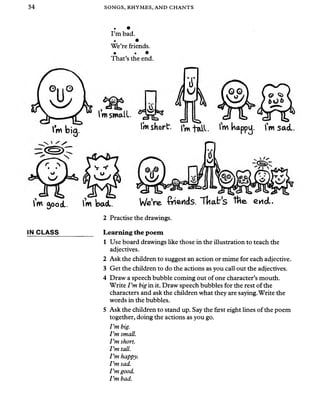
  • 154.
    Indexes Activities which canbe adapted to practise various structures or vocabulary topics are not listed under each separate structure. Topics Aliens 2.8, 5.19 Animals 2.2, 2.7, 4.3, 4.4, 4.8, 5.20 Body 1.1, 1.3, 3.1, 3.2, 3.3, 3.4, 3.5, 3.6, 3.7, 3.8 Doctors 2.2, 4.7 Fairytales 2.7, 5.21 Family 2.2, 2.4, 5.24 Feelings 1.4, 4.7 Films 1.9 Food 2.6, 4.3, 4.4, 6.1 Likes and dislikes 4.1, 4.2, 5.19 Monsters 1.1, 2.7 Numbers 1.1, 2.2, 2.4, 6.1 People 1.8, 4.6, 4.7, 5.13, 5.14, 5.15, 6.5 Personal information 4.2, 4.7, 4.8, 6.5 Quiz shows 6.7 Restaurants 1.7, 6.3 Sea 4.3, 6.8 Shopping 1.7, 6.1 Towns 6.2 Language Adjectives 2.3, 2.4, 2.7, 4.5, 5.22 Adverbs 2.1 Advice 4.7 B e 4.3, 4.5 Can 2.5, 2.7 Dialogues 1.4, 1.8, 4.5, 4.6, 4.7, 5.5, 5.6, 5.9, 5.10, 5.12, 5.26 Discussion and negotiation 1.9, 5.4 G oing to 2.7 H ave (got) 4.1 Instructions 1.1, 3.2, 3.3, 3.4, 3.5, 3.6, 3.7, 5.12 Modals of speculation 5.23 M u st 2.7, 5.20 Negatives 2.7, 4.1 Non-linguistic communication 1.1, 1.2, 1.3, 1.4, 1.5, 1.7, 1.8, 2.1, 2.2, 5.13 Past tenses (exposure to) 1.5, 2.2, 2.6, 2.8, 4.3, 5.20 Possessives 5.21 Prepositions of place 2.7, 4.3, 5.20 Present continuous 2.7 Present perfect 5.23 Pronouns 2.6 Questions 2.6, 4.5, 5.21 Revision 1.2, 1.3, 1.7, 1.8, 4.2, 4.5 Stress and rhythm 2.1, 2.2, 2.3, 2.4, 2.5, 2.6, 5.7, 5.11, 5.22 There is, there are 6.2 Will 4.5 Word fam ilies 1.3 Yes and no 4.1 Cross-curricular themes Drawing and colouring 1.9, 3.2, 3.3, 3.4, 3.5, 3.6, 3.7, 3.8, 3.9, 3.10, 3.11, 3.12, 3.13 Environment 5.22 Group dynamics 2.1, 2.3, 2.4, 2.7, 3.4, 4.1,4.3,5.20, 5.21, 5.22,5.24 Making things 2.5, 3.1, 3.2, 3.3, 3.4, 3.5, 3.6, 3.7, 3.8, 3.9, 3.10, 3.11, 3.12, 3.13, 5.23 M emorising 5.16, 5.17, 5.18 Mime 1.1, 1.2, 1.3, 1.4, 1.5, 1.6, 1.7, 2.1, 2.3, 5.14 Music 2.1, 2.5, 5.23 Physical co-ordination 1.1, 3.1, 3.5 Pictures 2.3, 5.2, 5.3 Predicting 5.3, 5.4, 5.8 Problem solving 4.2, 6.6 Stories 1.6, 1.7, 1.9, 2.7, 2.8, 4.3