What is a Team?
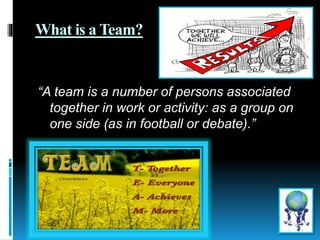
“A team is a number of persons associated
together in work or activity: as a group on
one side (as in football or debate).”
Qualities of a Team :
• Members care for one another
• Members know what is important
• Members communicate with one another
• Each team member plays a special role
• Team members avoid "winning" or looking good at the
expense of others.
• Team members are open to the ideas of others.
• Team members share information and ideas.
• Team members support the contribution of others.
• Team has enough members to share the work.
• Members know exactly where the team stands.
Defining Team Work:
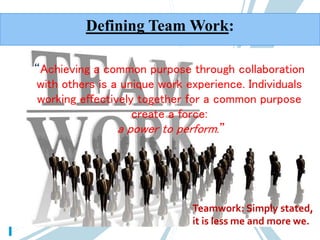
“Achieving a common purpose through collaboration
with others is a unique work experience. Individuals
working effectively together for a common purpose
create a force:
a power to perform.”
Teamwork: Simply stated,
it is less me and more we.
1. Teams initiate change :
Why Teams Work ???
• Often those at the top of the
organization are challenged by
what changes are necessary
within an organization.
• Teams provide a valuable
source of feedback.
2. Teams are natural problem solving devices
:
. A team setting opens up new
communication lines.
. Because of the necessity of
communication within a team, members
encounter problems and challenges in
early stages and are able to head them off
with greater efficiency and success.
Why Teams Work ???
3. Teams are collections of the organization’s best
assets :
Why Teams Work ???
•Each team member has specific talents.
• By combining individuals in team fashion,
all of these talents are joined to work toward
a common goal
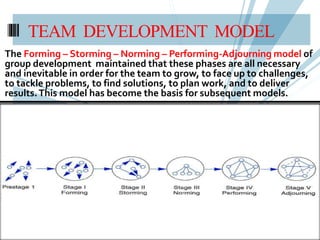
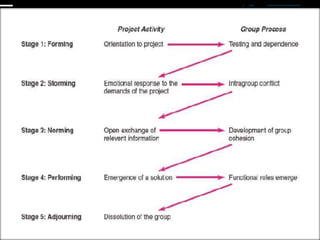
1. Forming
2. Storming
3. Norming
4. Performing
5. Adjourning
Five StagesTEAM DEVELOPMENT MODEL
The Forming – Storming – Norming – Performing-Adjourning model of
group development maintained that these phases are all necessary
and inevitable in order for the team to grow, to face up to challenges,
to tackle problems, to find solutions, to plan work, and to deliver
results.This model has become the basis for subsequent models.
TEAM DEVELOPMENT MODEL
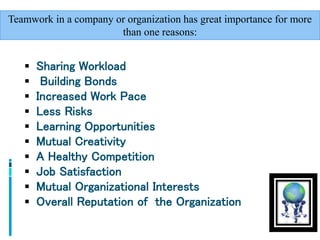
 Sharing Workload
 Building Bonds
 Increased Work Pace
 Less Risks
 Learning Opportunities
 Mutual Creativity
 A Healthy Competition
 Job Satisfaction
 Mutual Organizational Interests
 Overall Reputation of the Organization
Teamwork in a company or organization has great importance for more
than one reasons:
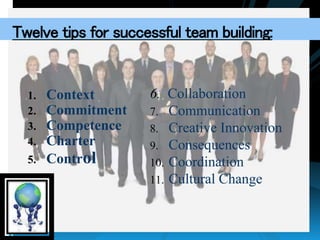
1. Context
2. Commitment
3. Competence
4. Charter
5. Control
Twelve tips for successful team building:
6. Collaboration
7. Communication
8. Creative Innovation
9. Consequences
10. Coordination
11. Cultural Change
The secrets to successful teamwork are:
• Trust
• Accountability
Coming Togetherwas Beginning......
Keeping Togetherwas Progress…..
Working Together is SUCCESS
TEAM WORK ( HR TOPICS)

TEAM WORK ( HR TOPICS)

  • 2.
    What is aTeam? “A team is a number of persons associated together in work or activity: as a group on one side (as in football or debate).”
  • 3.
    Qualities of aTeam : • Members care for one another • Members know what is important • Members communicate with one another • Each team member plays a special role • Team members avoid "winning" or looking good at the expense of others. • Team members are open to the ideas of others. • Team members share information and ideas. • Team members support the contribution of others. • Team has enough members to share the work. • Members know exactly where the team stands.
  • 4.
    Defining Team Work: “Achievinga common purpose through collaboration with others is a unique work experience. Individuals working effectively together for a common purpose create a force: a power to perform.” Teamwork: Simply stated, it is less me and more we.
  • 5.
    1. Teams initiatechange : Why Teams Work ??? • Often those at the top of the organization are challenged by what changes are necessary within an organization. • Teams provide a valuable source of feedback.
  • 6.
    2. Teams arenatural problem solving devices : . A team setting opens up new communication lines. . Because of the necessity of communication within a team, members encounter problems and challenges in early stages and are able to head them off with greater efficiency and success. Why Teams Work ???
  • 7.
    3. Teams arecollections of the organization’s best assets : Why Teams Work ??? •Each team member has specific talents. • By combining individuals in team fashion, all of these talents are joined to work toward a common goal
  • 8.
    1. Forming 2. Storming 3.Norming 4. Performing 5. Adjourning Five StagesTEAM DEVELOPMENT MODEL
  • 9.
    The Forming –Storming – Norming – Performing-Adjourning model of group development maintained that these phases are all necessary and inevitable in order for the team to grow, to face up to challenges, to tackle problems, to find solutions, to plan work, and to deliver results.This model has become the basis for subsequent models. TEAM DEVELOPMENT MODEL
  • 11.
     Sharing Workload Building Bonds  Increased Work Pace  Less Risks  Learning Opportunities  Mutual Creativity  A Healthy Competition  Job Satisfaction  Mutual Organizational Interests  Overall Reputation of the Organization Teamwork in a company or organization has great importance for more than one reasons:
  • 12.
    1. Context 2. Commitment 3.Competence 4. Charter 5. Control Twelve tips for successful team building: 6. Collaboration 7. Communication 8. Creative Innovation 9. Consequences 10. Coordination 11. Cultural Change
  • 13.
    The secrets tosuccessful teamwork are: • Trust • Accountability
  • 14.
    Coming Togetherwas Beginning...... KeepingTogetherwas Progress….. Working Together is SUCCESS

Editor's Notes

  • #2  In today's work environment, the concept of working together to get an assignment done is as nonexistent as co- workers becoming acquainted outside the workplace
  • #3 Can you imagine yourself working on a project all alone in the office and no one to support and assist you? The first reaction would always be, definitely not! This is because we are all bound to be a part of a cooperative group to accomplish our daily tasks at the workplace, and this is what we call ‘teamwork’. Teamwork is defined as an activity or a set of inter-related activities undertaken by a number of people, in order to achieve a common objective. Whether it is a cricket ground, a movie production or the corporate world, working in teams is inevitable because the productivity ratio of multiple people, working on the same task, is always greater than o son, and the ROI is always higher.ne per
  • #12 the list of advantages points out to two basic facts that work, when distributed, reduces workload, and a reduced amount of work ensures optimization and efficiency. Effective teamwork in the workplace benefits the organization by increasing the individual productivity, which is important in order to achieve the targets and fulfill commitments
  • #14 When there is no accountability, oftentimes one person will pick up the slack and take on too many responsibilities. Trust and respect are two essential elements for building relationships in the workplace and beyond. It’s all about the relationships you have with people – which doesn’t necessarily mean friendships. Relationships are built over time, when one person has respect for another. Gradually, trust beings to build, too. You don’t have to be a close personal friend with everyone at work, but you do always need to show each person respect and professionalism.To build trust and accountability, we need consistent leadership. One way is to have effective team meetings on a regular basis for feedback and input on projects. With team meetings, allow your staff members the opportunity to volunteer for special tasks and projects. Remember, it’s impossible to build trust if one person is favored over others.
  • #16 Teamwork is one of the most important reasons for employee job satisfaction. This is because working in a team improves employee performance as well as makes the work enjoyable. This is also conducive to employee motivation.  When employees work in team, they automatically work for mutual organizational interests; their personal interest is subordinate to the organizational interests. This ensures that all the team members put in the maximum possible efforts, focusing on the same goal, thereby ensuring a high quality and timely output. Teamwork also increases the goodwill and reputation of a company or an organization. The goodwill created by mutual cooperation of professionals in an organization, in fact, plays a highly instrumental role in bringing in more business and public trust. Team-work can be an important source of job satisfaction and professional fulfillment for employees. The reason behind it is that working in a team improves employee performance as well as makes the work enjoyable for them. This is also favorable for employee motivation and workplace enthusiasm.