Teams:
Team definition
A team is a group of people with a commitment to
one another, to the group, to a high level of
achievement, to a common goal, and to a common
vision.
Teams in the Work World
Businesses today rely more and
more on teams of workers to get
jobs done.
The advantages of teams:
• A team broadens what individuals can do.
• Several heads mean a wider range of ideas.
• Teams have a great array of talents and skills.
• Team members learn new skills from their colleagues.
• Teamwork is more efficient than a number of individuals
working singly.
• Teamwork provides relief when someone's having a
problem.
• Team workers are more effective.
• A team member has more ownership of what she's doing.
• Good teams can build leaders.
• A shared vision keeps everyone moving forward.
The disadvantages of teams:
• Team decision-making takes longer.
• Team effort can be wasted effort.
• The team's success may hang on the work of the least
effective team member.
• A team might gain momentum in the wrong
direction.
• The work of team can brought down in interpersonal
issues, resentments, and blame.
• Team members may be reluctant to tell other about
their unsatisfactory work.
• Lost motivation for lack of individual recognition.
When should you build teams?
• Creating a strategic plan for addressing issues.
• Starting up a new organization or initiative.
• Starting a new program or intervention.
• Starting a coalition.
• Planning and carrying out a community
assessment.
• Evaluating an organization, initiative, or
intervention.
When should you build teams?
(cont.)
• Spearheading an advocacy campaign with a
specific goal.
• Running a fundraising event or campaign.
• Staffing and running an organization or
initiative.
• Engaging in ongoing advocacy.
• Performing a particular function within a
community program or initiative.
• Changing the community over the long term.
Some lessons about Great Groups:
• Greatness starts with superb people.
• Great Groups and great leaders create
each other.
• Every Great Group has a strong leader
• Leaders of Great Groups love talent and
know where to find it.
• Great Groups are full of talented people
who can work together.
About Great team Groups
• Great Groups think they are on a mission from God.
• Every Great Group is an island -- but an island with a bridge to
the mainland.
• Great Group see themselves as winning underdogs.
• Great Groups always have an enemy.
• People in Great Groups have blinders on.
• Great Groups are optimistic, not realistic.
• In Great Groups the right person has the right job.
• The leaders of Great Groups give them what they need and
free them from the rest.
• Great Groups produce results.
• Great work is its own reward.
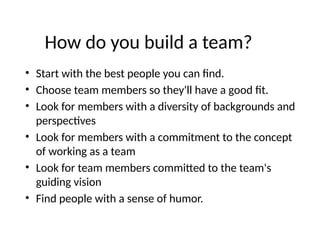
How do you build a team?
• Start with the best people you can find.
• Choose team members so they'll have a good fit.
• Look for members with a diversity of backgrounds and
perspectives
• Look for members with a commitment to the concept
of working as a team
• Look for team members committed to the team's
guiding vision
• Find people with a sense of humor.
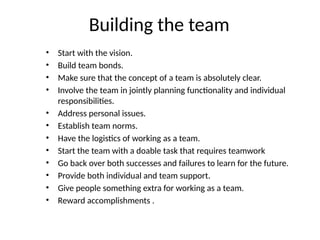
Building the team
• Start with the vision.
• Build team bonds.
• Make sure that the concept of a team is absolutely clear.
• Involve the team in jointly planning functionality and individual
responsibilities.
• Address personal issues.
• Establish team norms.
• Have the logistics of working as a team.
• Start the team with a doable task that requires teamwork
• Go back over both successes and failures to learn for the future.
• Provide both individual and team support.
• Give people something extra for working as a team.
• Reward accomplishments .
Key Terms
collaboration
empowerment
brainstorming
team planning
assess
Collaboration
Team members of a group
collaborate.
Collaboration means working
with others for a common purpose.
Empowerment
Team players tend to feel good about their
work because they are empowered.
Empowerment is the feeling of power and
satisfaction that comes from being directly
responsible for your work decisions.
Brainstorming
Brainstorming is one method that teams
use to come up with ideas to solve
problems.
Brainstorming is a method of shared
problem solving in which all members of
a group contribute ideas.
Try This Activity
Think of a problem at workplace. Write down as
many ways to solve the problem as you can in
one minute. Then ask three friends to do the
same. Put all of your ideas together.
Pool Your Ideas
Try This Activity
Evaluate the Ideas What ideas did your friends
have that you didn’t think of? A variety of ideas
and points of view is one of the best reasons for
working as a team.
Pool Your Ideas
Team Planning
Before you start working on a
team project, you should make a
plan.
Team planning involves working
with others to set goals, assign
tasks, and assess results.
Setting Goals
Taking time to set goals helps
everyone understand the
purpose of the group.
When you set goals as a team,
you will all be moving in the same
direction.
Assigning Roles and Tasks
It’s important for each team
member to have a role, or part to
play.
No matter what your role, the
other team members will count
on you.
Try This Activity
Make a list of the characteristics of an
effective team member. Next to each
characteristic, explain how such a
characteristic could be developed.
Team
Characteristics
Try This Activity
Develop Your Strengths Write a report
explaining which characteristics of an
effective team member you have and why.
Team
Characteristics
Assessing Results
Problems are less likely to crop
up if team members meet from
time to time to assess, or judge,
their progress.
Q and A
I like being team leader, but my
teammates think I’m bossy. What
should I do?
continued
Q and A
Share the role of leader. Try different
roles and tasks in your teams. You
might find that you have strong skills
in the role of a cooperative team
member too.
Dealing With Problems
Teams face their share of
problems no matter how well
organized they are.
Dealing With Problems
Most problems can be avoided
by setting clear goals, taking
action promptly, and
communicating.
Attitude Counts
Perfection
Always expecting perfection can cause
problems. If you try to do everything
perfectly, you will probably be
disappointed and become stressed out.
Why is teamwork important at work place?
Teamwork is important at workplace because we
work in many kinds of groups and must cooperate to
complete projects .
Critical Thinking Review
Critical Thinking
Q
A
continued
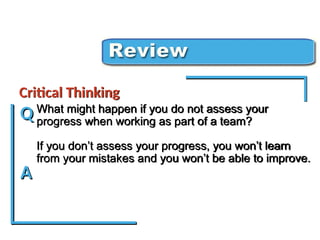
What might happen if you do not assess your
progress when working as part of a team?
If you don’t assess your progress, you won’t learn
from your mistakes and you won’t be able to improve.
Critical Thinking Review
Critical Thinking
Q
A
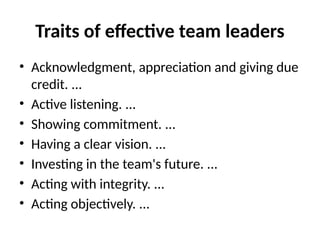
Traits of effective team leaders
• Acknowledgment, appreciation and giving due
credit. ...
• Active listening. ...
• Showing commitment. ...
• Having a clear vision. ...
• Investing in the team's future. ...
• Acting with integrity. ...
• Acting objectively. ...
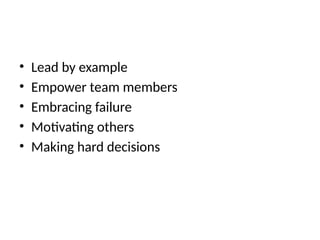
• Lead by example
• Empower team members
• Embracing failure
• Motivating others
• Making hard decisions
Assignment
• Why teams Fail
• Team theories
• Types of teams
• The End
• Thank you

Building Teams (1).powerpoint presesntation

  • 1.
  • 2.
    Team definition A teamis a group of people with a commitment to one another, to the group, to a high level of achievement, to a common goal, and to a common vision.
  • 3.
    Teams in theWork World Businesses today rely more and more on teams of workers to get jobs done.
  • 4.
    The advantages ofteams: • A team broadens what individuals can do. • Several heads mean a wider range of ideas. • Teams have a great array of talents and skills. • Team members learn new skills from their colleagues. • Teamwork is more efficient than a number of individuals working singly. • Teamwork provides relief when someone's having a problem. • Team workers are more effective. • A team member has more ownership of what she's doing. • Good teams can build leaders. • A shared vision keeps everyone moving forward.
  • 5.
    The disadvantages ofteams: • Team decision-making takes longer. • Team effort can be wasted effort. • The team's success may hang on the work of the least effective team member. • A team might gain momentum in the wrong direction. • The work of team can brought down in interpersonal issues, resentments, and blame. • Team members may be reluctant to tell other about their unsatisfactory work. • Lost motivation for lack of individual recognition.
  • 6.
    When should youbuild teams? • Creating a strategic plan for addressing issues. • Starting up a new organization or initiative. • Starting a new program or intervention. • Starting a coalition. • Planning and carrying out a community assessment. • Evaluating an organization, initiative, or intervention.
  • 7.
    When should youbuild teams? (cont.) • Spearheading an advocacy campaign with a specific goal. • Running a fundraising event or campaign. • Staffing and running an organization or initiative. • Engaging in ongoing advocacy. • Performing a particular function within a community program or initiative. • Changing the community over the long term.
  • 8.
    Some lessons aboutGreat Groups: • Greatness starts with superb people. • Great Groups and great leaders create each other. • Every Great Group has a strong leader • Leaders of Great Groups love talent and know where to find it. • Great Groups are full of talented people who can work together.
  • 9.
    About Great teamGroups • Great Groups think they are on a mission from God. • Every Great Group is an island -- but an island with a bridge to the mainland. • Great Group see themselves as winning underdogs. • Great Groups always have an enemy. • People in Great Groups have blinders on. • Great Groups are optimistic, not realistic. • In Great Groups the right person has the right job. • The leaders of Great Groups give them what they need and free them from the rest. • Great Groups produce results. • Great work is its own reward.
  • 10.
    How do youbuild a team? • Start with the best people you can find. • Choose team members so they'll have a good fit. • Look for members with a diversity of backgrounds and perspectives • Look for members with a commitment to the concept of working as a team • Look for team members committed to the team's guiding vision • Find people with a sense of humor.
  • 11.
    Building the team •Start with the vision. • Build team bonds. • Make sure that the concept of a team is absolutely clear. • Involve the team in jointly planning functionality and individual responsibilities. • Address personal issues. • Establish team norms. • Have the logistics of working as a team. • Start the team with a doable task that requires teamwork • Go back over both successes and failures to learn for the future. • Provide both individual and team support. • Give people something extra for working as a team. • Reward accomplishments .
  • 12.
  • 13.
    Collaboration Team members ofa group collaborate. Collaboration means working with others for a common purpose.
  • 14.
    Empowerment Team players tendto feel good about their work because they are empowered. Empowerment is the feeling of power and satisfaction that comes from being directly responsible for your work decisions.
  • 15.
    Brainstorming Brainstorming is onemethod that teams use to come up with ideas to solve problems. Brainstorming is a method of shared problem solving in which all members of a group contribute ideas.
  • 16.
    Try This Activity Thinkof a problem at workplace. Write down as many ways to solve the problem as you can in one minute. Then ask three friends to do the same. Put all of your ideas together. Pool Your Ideas
  • 17.
    Try This Activity Evaluatethe Ideas What ideas did your friends have that you didn’t think of? A variety of ideas and points of view is one of the best reasons for working as a team. Pool Your Ideas
  • 18.
    Team Planning Before youstart working on a team project, you should make a plan. Team planning involves working with others to set goals, assign tasks, and assess results.
  • 19.
    Setting Goals Taking timeto set goals helps everyone understand the purpose of the group. When you set goals as a team, you will all be moving in the same direction.
  • 20.
    Assigning Roles andTasks It’s important for each team member to have a role, or part to play. No matter what your role, the other team members will count on you.
  • 21.
    Try This Activity Makea list of the characteristics of an effective team member. Next to each characteristic, explain how such a characteristic could be developed. Team Characteristics
  • 22.
    Try This Activity DevelopYour Strengths Write a report explaining which characteristics of an effective team member you have and why. Team Characteristics
  • 23.
    Assessing Results Problems areless likely to crop up if team members meet from time to time to assess, or judge, their progress.
  • 24.
    Q and A Ilike being team leader, but my teammates think I’m bossy. What should I do? continued
  • 25.
    Q and A Sharethe role of leader. Try different roles and tasks in your teams. You might find that you have strong skills in the role of a cooperative team member too.
  • 26.
    Dealing With Problems Teamsface their share of problems no matter how well organized they are.
  • 27.
    Dealing With Problems Mostproblems can be avoided by setting clear goals, taking action promptly, and communicating.
  • 28.
    Attitude Counts Perfection Always expectingperfection can cause problems. If you try to do everything perfectly, you will probably be disappointed and become stressed out.
  • 29.
    Why is teamworkimportant at work place? Teamwork is important at workplace because we work in many kinds of groups and must cooperate to complete projects . Critical Thinking Review Critical Thinking Q A continued
  • 30.
    What might happenif you do not assess your progress when working as part of a team? If you don’t assess your progress, you won’t learn from your mistakes and you won’t be able to improve. Critical Thinking Review Critical Thinking Q A
  • 31.
    Traits of effectiveteam leaders • Acknowledgment, appreciation and giving due credit. ... • Active listening. ... • Showing commitment. ... • Having a clear vision. ... • Investing in the team's future. ... • Acting with integrity. ... • Acting objectively. ...
  • 32.
    • Lead byexample • Empower team members • Embracing failure • Motivating others • Making hard decisions
  • 33.
    Assignment • Why teamsFail • Team theories • Types of teams
  • 34.
    • The End •Thank you